In the past, I’ve touched on the subject of Shinto religion, and its vast number kami (神) who range from great deities (similar to the Greek gods) to little more than nature spirits and revered historical figures. This is a pretty common feature of polytheistic religion in ancient times, across many cultures: gods were quite diverse in both size and roles.
In Japanese Shinto there is a saying: ya-o-yorozu no kami (八百万の神) which means “the Eight Million kami (of Japan)”. It is not meant to be literal, but simply means that there are many, many kami within Shinto. But outside the short-list of well-known kami, such as Inari Okami, most of this pantheon is pretty obscure, even to Japanese people. Many are so local, that there might be only one or two shrines associated with them. Some are not even named, they are just thought to occupy a particular sacred space, so you might find a tiny roadside shrine somewhere to a particular kami and that’s it. Compare this with the ancient Greek daimon, Arabic djinn, or Roman genius.
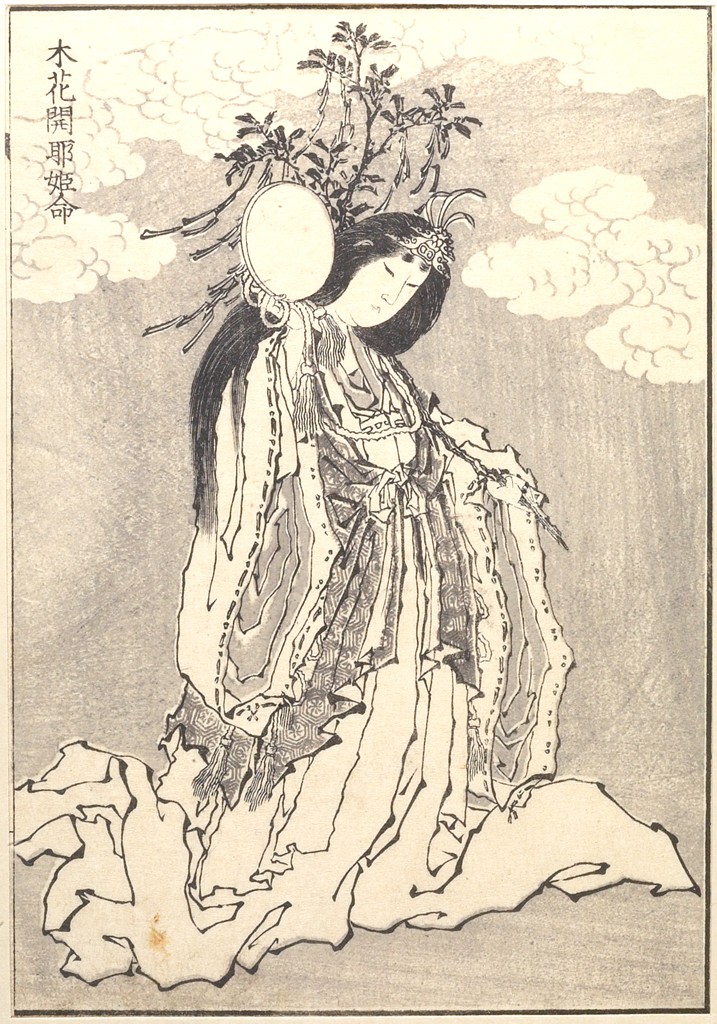
But I digress a bit. Let’s talk about one particular kami who has been particular interest of mine lately since I started writing adventure modules for Dungeons and Dragons, and delving more and more into Shinto mythology.1 She is in one sense important to Japanese mythology, but also obscure, and fascinating too. Her name Konohana-no-sakuyahime-no-mikoto (木花之佐久夜毘売命). She is often called Konohana-no-sakuya-bimé for short and is both a goddess of volcanoes, and of cherry blossoms:
Konohana-no-sakuya-bimé is probably best known as the goddess of Mount Fuji itself. You can read more about it on the English-language page of the official shrine of Mount Fuji. The mountain is treated as her form, and thus the mountain is considered sacred ground. Konohana-no-sakuyahime is also the kami of volcanoes in general, not just Mount Fuji.
Like many obscure kami in the Shinto religion, Konohana-no-sakuya-bimé appears mostly in ancient texts such as the Kojiki and the Nihon Shoki.2 These two texts are semi-mythical origin stories for Japan, but also contain many myths from antiquity and are the most common sources for Japanese mythology.3
In one such myth, found in both the Kojiki and Nihon Shoki (online here) Konohana-no-sakuya-bimé is described as the goddess of cherry blossoms and is married to Ninigi, grandson of Amaterasu and ancestor of the Japanese imperial family. Before long, she becomes pregnant. Hononinigi is suspicious of her being pregnant so fast, and she vows that if the child is born safely, it belongs to Hononinigi. To prove her point, she shuts herself in a home and sets her house on fire, then delivers the baby in the middle of the blaze. Actually, she delivers three sons. All are safe and unharmed by the blaze, and thus proving that they are Ninigi’s children after all.
In another story, posted in Wikipedia, Konohana-no-sakuya-bimé is disguised as a little girl who helps guide a villager to a stream whose waters have healing powers, and can save his village from a plague. The villager carries out the instructions of the little girl, and the village is saved. When he returns to thank the little girl, he comes to realize that the little girl is in fact the goddess herself.
To be reiterate, such kami are also obscure to most Japanese people as well. A deep understanding of a certain kami or even the pantheon as a whole isn’t really required anyway. Instead, I would argue that the whole point of Shinto is more about deepening one’s “spiritual tie” or goshin’en (御神縁 or ご神縁) with a particular kami4 than grasping a deeper teaching. It’s not that Shinto doesn’t have its spiritual truths, but it doesn’t explore complex cosmology or theological issues the way Buddhism does. It tends to have a more practical, “this-worldly” focus.
Still, the fact that a goddess of both volcanoes and cherry blossoms exists is kind of fascinating to me, and one of those examples of how very little of Shinto has been properly conveyed (not to mention translated) to English audiences.
1 Although, my background with Japanese religion is definitely more Buddhist than Shinto, I still have my personal favoritekami, and always happy to visit shrines when I can.
2 Sadly, translations of the Kojiki and Nihon Shoki in English are by and large terrible. Like, really bad. I have heard that the “Phillipi translation” (ISBN: 0691648905) is the best, but it’s also out of print and hard to find. The only sources that sell it are quite expensive too. I hate Amazon’s third-party pricing model, btw. 😦 So, I’ve turned to Japanese sources instead, but obviously this isn’t feasible for everyone.
3 In the same way, Greek mythology mostly derives from two ancient sources: Homer’s Iliad and Odyssey, and Hesiod’s Theogony.
4 The word for this is musubu (結ぶ) which means to tie something. In this case, it’s a spiritual tie though rather than tying one’s shoelaces. 😌
While I usually talk about Buddhism a lot, especially Japanese Buddhism, on this blog, I wanted to take some time to talk a little bit about the other religion in Japan: Shintoism. With New Year’s just past, it’s a good time to explore this oft-misunderstood tradition.
Japan has two religions that have co-existed side by side for a very long time: Buddhism and Shinto. They have different origins, different ways of describing the world, and so on. However, due to (mostly) peaceful coexistence, they influence one another, and Japanese culture leading to what we see today.
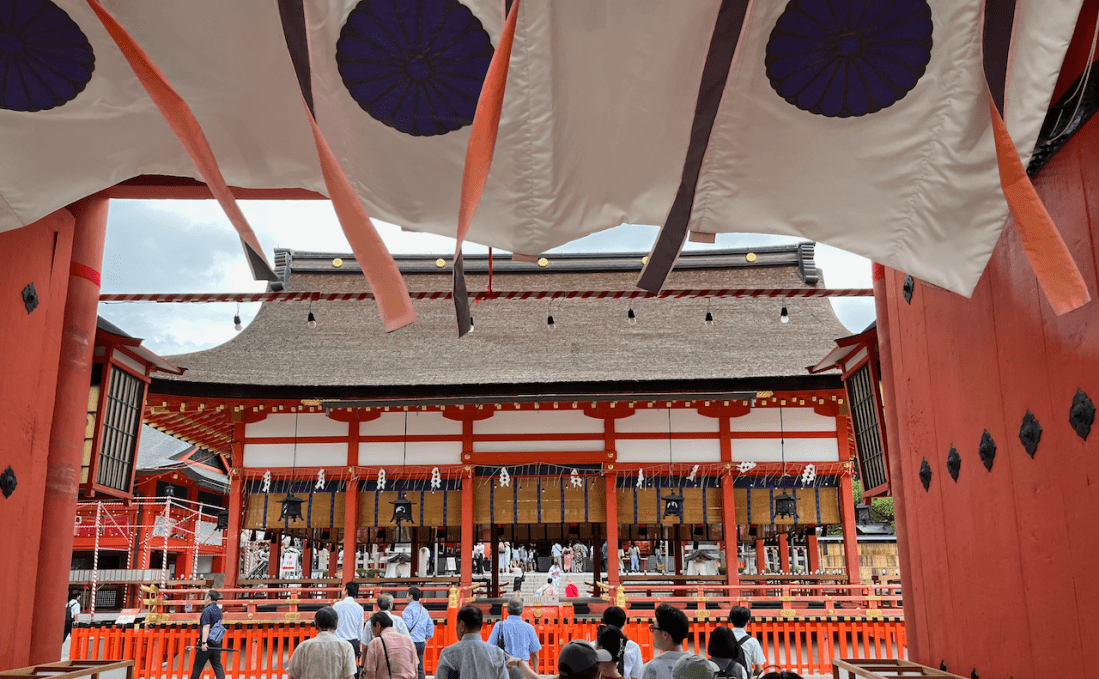
Taken by me at the excellent Hie Shrine in downtown Tokyo in 2017.
Shinto is a tricky subject in some ways because it’s deeply tied to Japan, and “Japan-ness” in a way that Buddhism, a foreign religion, is not. My personal interest in Shinto began years ago when I visited a few shrines here and there as a tourist and would pay respects to whatever kami or divinity dwelt within. It’s not something I really believe in, but I felt that it was worth taking the time to delve into the culture and do things the Japanese way.
Back then, I picked up a book on Shinto called The Essence of Shinto by a Shinto priest, or kannushi (神主), named Motohisa Yamakage to learn more. Later, I found a Professor Ian Reader’s excellent and easy to read guide to Shinto titled: Shinto – Simple Guides. These are the two primary sources for this post.
Basic Shinto Beliefs
Shintō (神道) is translated as the “Way of the Kami”. It has no founder, no doctrines, and no real central authority. Variations exist throughout different parts of Japan, and according to Yamakage, each kannushi (priest) will have slightly different view of it. It has been around since antiquity, before the arrival of Buddhism, and just gradually sprang up out of local, common practices. Each shrine, and each priest is trying to commune with the Kami, to revere nature, and much emphasis is placed upon experiential wisdom.
Shinto “deities” or Kami (神), usually gets translated into English as “gods”, but they run the gamut. Kami come in all shapes and sizes, some are revered country-wide, some very obscure and local. Many embody many aspects of nature, or aspects of life, but also include more celestial Kami as well. It’s hard to compare with modern, Western religion. But it’s somewhat analogous to ancient Greco-Roman religion with its Olympian gods, chthonic earth deities, spirits like nymphs, naiads, etc., plus foreign-imported deities from elsewhere (Dionysus, Isis, Mithras, etc). The variety of Kami is nearly endless. In Japanese, there is a term for this: 八百万の神 (yaoyorozu no kami) which means “eight million kami” literally, but really just means “countless kami”.
Ian Reader’s book lists some of the most well-known:
Amaterasu – Goddess of the sun and associated with the Imperial family, who traditionally claims descent from this Kami.
Hachiman – God of war, originally thought to have derived from the legendary Emperor Ōjin. Absorbed by Buddhism in medieval times as a bodhisattva (frequent references in the Tales of the Heike, for example).
Ebisu – A Kami associated with small business and commerce. Particularly popular in the Osaka area.
Inari – Kami of rice and harvest originally, but grew in popularity as a guardian of Buddhism and separately of business. The famous Shiseido cosmetic company has a shrine devoted to Inari on top of its headquarters called Seidō Shrine.
Benten or Benzaiten – Kami associated with music and the arts. Originally thought to be imported indirectly from India, as the goddess Saraswati. Imported gods in Shinto is not unusual.
Tenjin – Kami of education. Originally a famous Heian Period nobleman named Sugawara no Michizane, who was wrongfully slandered and whose death was thought to have triggered natural disasters at the time. Worshiped as a Kami to placate his restless spirit, as well as for his excellent poetry and writings.
Konpira – Kami associated with seafaring, and with sea commerce. A popular patron for sailors, fishermen and other such groups.
Susanoo – Amaterasu’s brother, and Kami of wind. While legendary as a trouble-maker, he is also revered for protection against natural forces such as typhoons.
Izanami and Izanagi – The original female and male pair of Kami believed to have created Japan according to traditional myth.
Professor Reader also quotes an excellent definition of kami from a famous scholar from the Edo Period named Motoori Norinaga:
…it is not only the divinities of Japanese sacred texts and myths that are considered as kami, for anything — humans, animals, trees, plants, rocks, mountains, seas — which appears impressive, inspires a sense of awe, or exhibits a life-force, may be a kami.
This helps to emphasize the fact that Kami are not so much a set pantheon of gods in a set hierarchy, but rather that they exist in a near-infinite variety that embody many aspects of life. Many Kami are very local to a region, and myths of their origin grow over time as worship around the Kami develops over generations after some miraculous event or discovery.
Communing with Kami
In spite of their variety, Kami are believed to have very human-like qualities and must be appeased and placated, or they may cause trouble. This is reinforced by carefully followed rituals where a Kami is honored, and whose assistance is called for. Or, one expresses gratitude to the Kami for their protection, thereby showing humility and appreciation. In order to avoid offending a Kami, the ritual must be carried out correctly, and by someone who is considered ritually pure, otherwise the Kami may ignore them, or cause problems instead.
For Shinto priests and even lay followers, it’s also important to setup a good dwelling spot so that a Kami can descend and make their presence felt. Originally, there were no Shinto shrines, or jinja (神社), instead the ancient priests would sanctify a suitable spot and call out to the Kami to descend to that spot. Later, formalized structures were built around holy places and these became the major shrines (jinja) seen today, which branched out into sub-shrines and so on. In people’s homes, devout Shinto followers will also create a small sacred space in hopes that a Kami will descend there as well. Kami don’t live in these sacred spaces, according to Yamakage, instead it’s more like an antenna allowing the Kami to descend for a time. The actual term for this “antenna” is yorishiro (依り代), and can be something like a rock, a mirror, a special charm someone got from a Shinto shrine, and so on.
Since Kami will only descend in places that are clean, pure and bright, if this “antenna” or the sacred space around it gets run-down, dusty, and such, then the Kami will not descend, and if they do not descend, they won’t be able to help you, or worse, some evil spirit will take up residence.
So as part of communing with Kami, Shinto a lot revolves around purification.
Ritual Purification
An ōnusa wand used for purification rituals. Source: Wikipedia.
In Shinto, there is a strong relation between purity and well-being. Through contact with unclean things, or through negative and angry thoughts, one builds up negative energy or impurities that can cause concrete problems. Thus, Shinto has many ceremonies (祓 harai or harae) designed to restore balance, and to remove the impurities. According to Yamakage, the four Shinto ideals are clean, bright, right and straight and these ceremonies, rituals and such help to restore one to a state that reflects all four. Yamakage is quick to emphasize that there is no Original Sin in Shinto (obviously intended toward a Western audience), but things get off-kilter from time to time, and so one should restore the balance through these rituals.
One of the most important rituals, and probably the most familiar, is the misogi (禊ぎ) or purification by bathing in water. This ceremony can be practiced at a waterfall, river or other body of water, but ceremonies can also be as simple as temizu (手水), which is something people often do at Shinto shrines, and even Buddhist temples. Temizu is a “purification-lite” ceremony, where you wash your hands and maybe your mouth. If you’ve visited a major temple or shrine in Japan, you will see a little water area with ladles and people washing their hands. The basic ceremony is the following steps:
Wash your left hand with the water from the ladle.
Now wash your right hand with the water from the ladle.
(optional) Now, holding some water in your left hand, pour it into your mouth.
That purifies the person, so they can enter the sacred space of a shrine. Of course, if you forget to do this, it’s not a disaster, it just won’t help you in any way commune with the Kami there.
Relation to Buddhism
The relation to Buddhism here is a tricky one. Medieval Buddhism, that of the Nara and Heian Periods, tended to have a strong blending of native Shinto and Buddhist beliefs. A common theory from that time until the modern era, was that the Shinto Kami were manifestations of Buddhist figures. For example, the major Shinto deity Amaterasu, goddess of the sun, was assumed to be a manifestation of Vairocana Buddha. The Tales of the Heike, among other famous Japanese literature at the time, would frequently mention this.
Buddhist sects in the past attempted to assimilate or eschew¹ this blending in varying degrees, while Shintoists at times tried to reassert themselves as a separate religion.
In the end the two religions have learned to co-exist because they have little overlap with one another. Buddhism has little to say about spirits and divinities, while Shinto is focused primarily on them. Shinto focuses on purification and avoiding pollution and taboos so it has little to do with funerals, while funerals have been a part of the Buddhist tradition for a long time.
Shinto as a religion is so deeply tied to Japanese culture and people, it’s hard to separate the two, which also helps to explain why Shinto has almost no presence outside of Japan, but at the same time, it’s a fascinating spiritual tradition and well worth getting familiar with if one intends to come to Japan, or to explore the tradition more.



 Gleanings in Buddha-Fields

You must be logged in to post a comment.