A Refutation of Exclusive-Nembutsu Buddhist Practice

Author’s Note: this was another post I found recently from my old blog, possibly something I wrote in 2013 or 2014. It was shortly after this that I decided to leave the local Jodo Shinshu Buddhist community, give up the prospect of ordination, and strike out on my own. My feelings on the subject have changed somewhat, but I still agree with the general sentiment. I do miss many of my old friends at the local temple, but these days I am kind of done with Jodo Shinshu Buddhism. Apart from minor edits, and fixing broken links, this is posted as-is. Oh, and I added a cover image from that time and updated the title slightly for clarity. 😋

An old altar we setup years ago while living in Ireland. The central image was purchased from Tsukiji Honganji in Japan and venerates Amitabha Buddha, the Buddha of Infinite Light.

Lately, as I have been able to enjoy a small break in life, work and so on, I delved into some books I haven’t finished reading in a long while, including an excellent study on the life of Hossō Buddhist scholar, Jōkei. The book, titled Jokei and Buddhist Devotion in Early Medieval Japan by James L. Ford, is both a biography, but also a critical look at the late Heian, early Kamakura periods from a Buddhist perspective, and an effort to shed new light on this oft-studied and oft-misunderstood period.

In a way, I feel like I am betraying friends I have had the privilege of encountering over the years who are devout Jodo Shu and Shinshu Buddhists, but at the same time, I think Buddhism should be able to stand on its own two feet and take the acid test of criticism sometimes.1 To my friends on the Pure Land path, please forgive this post. It is not a personal attack, and I know many people in Jodo Shu and Jodo Shinshu who are admirable Buddhists in their own right. It’s just that while reading Ford’s book, I really felt he hit the nail on the head with certain things about Honen and Shinran’s teachings that made me uneasy, particularly the “exclusive” Pure Land approach that orthodox Jodo Shu and Jodo Shinshu followers adopt. Until recently though, I couldn’t quite articulate it myself.

This uneasiness came about back when I first started reading Rev. Tagawa’s book on Yogacara Buddhism, and on my recent trip to Kyoto and Nara, this old uneasiness arose in me moreso as I stood at the feet of great temples such in Kyoto and Nara. When I stood in the Treasure House of Kofukuji, beheld all the amazing artwork there, and the vast corpus of teachings they represented, I knew something was still amiss in my Buddhist path and it’s been gnawing on my mind for a while now.

Jōkei is best known as a sharp critic of Hōnen and the exclusive Pure Land movement, or senju nembutsu (専修念仏). As such, he was the primary author in 1205 of the Kōfukuji Sōjō (興福寺奏状), or the “Kofukuji Petition” to the Emperor which sought to suppress the “exclusive nembutsu” Pure Land school started by Honen. History has not been kind to Jokei, and Professor Ford argues that the study of Kamakura Buddhism is flawed because of some underlying biases and assumptions about “old” vs. “new” Buddhism. Meiji-era and later studies tend to apply a kind of “Buddhist revolution” to Honen and Shinran, and paint traditional Buddhist sects as elitist or oppressive. Sometimes, parallels between Shinran and Martin Luther have been drawn in scholarly circles, though more modern research has refuted this analogy as superficial at best.

A while back, after reading Dr. Richard Payne’s collection of essays on the subject of Kamakura-era Buddhism, I started to question these assumptions, but more so after reading Ford’s book. He explores the Petition toward the last-half of the book and Jokei’s relationship with Honen to show how history has normally written about the incident, and carefully dissects it to show another viewpoint. In essence, he argues that Jokei’s criticism of Honen isn’t an “old-guard” or “elitist” perspective, but more accurately reflects a “normative” Buddhist doctrinal stance.

Ford explores at length about the content of Jokei’s Kofukuji Petition and its nine articles faulting the new senju nembutsu (専修念仏) or “exclusive nembutsu” movement, which are Ford summarizes in four points (I am quoting verbatim here):

  1. [According to Jokei,] Honen abandoned all traditional Buddhist practices other than verbal recitation of the nembutsu.
  2. Honen rejected the importance of karmic causality and moral behavior in pursuit of birth in the Pure Land.
  3. Honen false appropriated and misinterpreted Shan-tao with respect to nembutsu practice.
  4. Honen’s teachings had negative social and political implications.

To bolster his stance in the Petition, Jokei uses the same textual sources as Honen to demonstrate that Honen only selectively drew certain teachings from Chinese Pure Land patriarchs, Shan-Tao, Tao-ch’o and T’an-luan to prove his beliefs concerning the verbal nembutsu, while ignoring the whole of their teachings and writings, which included a more comprehensive Pure Land Buddhist path. Ford then turns to modern scholars to show that in China, the nembutsu (nian-fo) was never seen as a verbal-only practice even in Shan-tao’s time, but was interpreted as a well-developed meditation system. This is reflected even in modern day Chinese Buddhist writings, such as those of the late Ven. Yin-Shun.

As Ford then concludes:

Thus Jōkei’s claim that the Pure Land schools had no precedence in China is probably true. All in all, Jōkei’s critique of Honen’s construction of an independent Pure Land sect based on exclusive practice of the oral nembutsu is generally well grounded both doctrinally and historically. (pg. 178)

Jokei’s accusation that Honen abandoned the karmic law of causality and undermined the Buddhist teachings for upholding moral conduct, also weighs heavily. Jokei asserts the traditional Buddhist view2 of time as infinite, and that people are responsible for their own karma and the pursuit of wisdom. From Jokei’s perspective, one’s poor conduct can forestall one’s rebirth in the Pure Land, or reduce the conditions of rebirth itself. He notes the Nine Grades of Rebirth in the Contemplation of Amitabha Sutra, but I am personally also reminded of the proviso in Amida Buddha’s 18th Vow in the Immeasurable Life Sutra:

Excluded, however, are those who commit the five gravest offences and abuse the right Dharma.

Or Shakyamuni’s admonition in the same Immeasurable Life Sutra:

Anyone who sincerely desires birth in the Land of Peace and Bliss is able to attain purity of wisdom and supremacy in virtue. You should not follow the urges of passions, break the precepts, or fall behind others in the practice of the Way. If you have doubts and are not clear about my teaching, ask me, the Buddha, about anything and I shall explain it to you.”

One’s poor conduct doesn’t prevent the Vow of Amitabha Buddha from being fulfilled, but delayed and hindered for a time, Jokei argues. Either way, Jokei reinforces a traditional Buddhist view of the importance of karmic causality as central to Buddhism, inline with the teachings of Shakyamuni Buddha himself in countless, countless, countless sutras. As evinced elsewhere in the book, Jokei like many Buddhists believes in the power of Amitabha and his Vows to bring people to the Pure Land, but also asserts that one is still responsible for their karma, so one has to meet Amitabha Buddha half-way in a sense. Jokei’s many sermons and devotions to Kannon, Maitreya and others show that he often advocated this “middle” approach between devotion and personal practice/responsibility and Ford argues that this was the normative approach to Buddhism taken through out Asian Buddhist history.

Indeed, in Jokei’s words describing himself:

[My opinion] is not like the doubt of scholars concerning nature and marks, nor is it like the single-minded faith of people in the world. (pg. 179)

Meanwhile, later Ford shows how Jokei by contrast:

…represents a ‘middle-way’ between the extremes of ‘self-power’ and ‘other-power.’ He was not unique in this respect, since this perspective, though perhaps unarticulated, predominated within traditional Buddhism — despite the rhetorical efforts of figures like Honen and Shinran to paint the established schools as jiriki (self-power) extremists. (pg. 202)”.

But nevertheless, Ford shows how modern scholars in Japan and in the West have skewed this view of history with the belief that the politics of medieval Japan were reactionary, and stifling Buddhism in Japan at the time, leading to the Pure Land movement. Here, I quote Ford directly (emphasis added):

Hōnen’s response to the apparent social inequity and underlying monastic/lay tension — always a feature of Buddhism — was, in effect, to abolish the traditional lay-monastic framework. I am not convinced that he meant to destroy the system, particularly given his devotion to the monastic life, but the effect of his message, as revealed in the Senchakushū, was to undermine the practices and doctrines that sustained the monastic ideal. Pronouncing them obsolete because of the limitations of the age, he concluded that salvation was no longer contingent upon precept adherence, meditative practice, or diligent effort toward realization. Realization was now deemed a secondary goal, since it could not be attained in this world; it could only be attained in Amida’s Pure Land. Although others before Hōnen had devised “simple” practices to address the needs of lay practitioners and lessen the tension noted above, an implicit contradiction remained. If these practices could deliver as promised, why go through the arduous training of a monk? The monastic ideal could be interpreted as an ever-present source of doubt with respect to the efficacy of the “simple” practices. Hōnen can be seen, at least in terms of effect, as one who address this doubt directly, but Shinran appears much more explicitly conscious of this issue. (pg. 183)

Ford then adds:

We certainly cannot fault Hōnen and Shinran for creatively adapting these well-established labels [self-power/other-power, “easy” and “difficult” practices] for their own proselytizing ends. However, we must dismiss these sectarian rhetorical categories as legitimate analytical categories in the study of Kamakura Buddhism. (pg. 202)

Summing up here, I think Ford gets at two critical points here. First, in mainland Asia, historically Pure Land teachings have never been divided along exclusive or sectarian lines, and such was even the case for early medieval Japanese Buddhism:

Scholars generally agree that the tradition of the Pure Land in China represented more of a “scriptural tradition” than a “doctrinal school” and that people of many different schools practiced the nien-fo [nembutsu]. Thus, Jōkei’s claim that the Pure Land schools had no precedence in China is probably true.

A sectarian, exclusive Pure Land Buddhism quite literally did not arise until Honen and later Shinran’s time. Ford is right in crediting them with adapting teaching to suit a need, and I write this with a heavy heart because I actually like both Honen and Shinran, but I agree that the effect, perhaps unintended, was to foster a kind of narrow sectarianism that didn’t exist in Pure Land Buddhist teachings and practices before. I guess it was the sign of the times.

And yet in the modern world, there are many Buddhists in Asia, Japan and the mainland, who are devoted to Amitabha Buddha and still follow traditional Buddhist practices in some form or another. Such people have not forgotten the important balance of sila (moral conduct), samadhi (practice) and paññā (wisdom) even as they strive for rebirth in the Pure Land. Indeed the late Ven. Yin-Shun in his book The Way to Buddhahood, taught a comprehensive approach not unlike that which Shan-tao and Tao-ch’o offered many centuries ago:

The chanting of “Amitabha Buddha” should also be accompanied by prostrations, praise, repententance, the making of sincere requests, rejoicing, and the transference of merit. According to the five sequences in the “Jing tu lun” (Pure Land Treatise),3 one should start with prostrations and praise and then move into practicing cessation [meditation], contemplation [more meditation], and skillful means. One can thereby quickly reach the stage of not retreating from the supreme bodhi. As Nāgārjuna’s Śāstra puts it “those aiming for the stage of avivartin [non-retrogression] should not just be mindful, chant names and prostrate.

It’s a well-established trend, and works for many people in the world, but only in Japan is there a separate trend toward exclusivity and the idea of traditional Buddhism being invalidated. The sense of Dharma Decline so critical to Japanese Pure Land in today’s climate seems like a subjective anachronism now, and difficult to base a doctrine on with so great a diversity of sanghas and teachings in the world.

Second, what I believe to be the stronger refutation of Japanese Pure Land Buddhism as traditionally practiced in Jodo Shinshu and Jodo Shu is summed up in the following passage which deals with the issue of hōben (方便) or “expedient means” (again, emphasis added):

Both in his religious practice and, specifically, the Sōjō, Jōkei’s articulation of the normative voice of inclusivism and diversity within Buddhism is again instructive. The content of this vision of Buddhism, grounded in the tradition’s emphasis on karmic causality, appears almost boundless at times. Hōnen’s exclusive claims of efficacy, resonating with much of the contemporary Tendai hongaku discourse and effectively undermining the moral implications of karma and its ramifications for Buddhist soteriolology, was a wholesale rejection of Buddhist tradition. It invalidated not only the devotion to the variety of Buddhas and Bodhisattvas that manifest different qualities of wisdom and compassion but also the importance of various kinds of ascetic practices, long the centerpiece of monastic life. In short, Hōnen’s teaching “delocated” Buddhist sacrality from its traditional broad manifestations — temporal and spatial — to one single exclusive manifestation. (pg. 203)

Again, I think back to my experiences in Nara, Japan in particular. At Todaiji alone, I saw six or seven temples on the temple grounds devoted to various figures of Buddhism. The plurality was amazing, and welcoming in a way. It felt inclusive, not exclusive, and there was no sense of guilt in praying to Jizo Bodhisattva, or the Lotus Sutra, one might feel in a Jodo Shinshu temple for example4 While there, if all I wanted to do was see Kannon, I could do so, but if I wanted to see other figures too, no problem. In other words, the broad, inclusive nature of Nara-style Buddhism allows Buddhists to offer as much or as little devotion to their heart’s content. No need to worry about doctrinal clashes or implicit guilt.

Thus, my faith in Amitabha Buddha and the Pure Land is no less than it once was, but Ford’s and Jokei’s writings and my experiences in Nara and Kyoto remind me that Buddhism is strongest in diversity, and later Kamakura schools of Buddhism have a tendency toward exclusivity. Japanese Pure Land Buddhists, along with some Zen and Nichiren Buddhists, argue that exclusive approach is simpler and more accessible, but given what other Buddhists faiths I’ve seen, I believe the exclusive approach is ironically less simple and less accessible by virtue of their exclusivity. Too much rationalization, cutting off, and justification while the rest of the Buddhist world quietly hums along to a relatively consistent tune, even with all its own faults.

The inclusive approach exemplified by Jokei, and Ford’s argument that it’s the normative Buddhist approach for most of the Buddhist world, allows considerable flexibility to follow an approach that works for you, without having to deny other paths as too difficult, elitist or only valid during a “better era” of Buddhism. Just follow which aspect you tend to have a karmic connection toward, whether it be Amitabha Buddha, Shakyamuni Buddha, Kannon, zazen, tantra, or some combination.

First and foremost, I guess I consider myself a Mahayana Buddhist and second a Pure Land follower, not the other way around. So, what does this mean for me? I think I already know the answer, but I’m holding off for now to think further. Jokei’s “middle of the road” approach to Buddhist devotion and practice, and inclusiveness, provides a lot of inspiration right now, along with my experiences in Japan, and I hope to explore this more as time goes on.

Namo Shaka Nyorai
Namo Amida Butsu

P.S. More regarding the critical role karmic causality plays in Buddhism from Ven. Thanissaro Bhikkhu

P.P.S. More on the subject of inclusiveness/exclusiveness in Pure Land Buddhism.

1 This would normally be the time to bring up the classic Kalama Sutta text, an awesome, though often quoted out of context in Buddhist writings. Instead, I’ll encourage you to read it yourself in full. It really is one of the best sutras in Buddhism. 🙂

2 Exemplified in the Yogacara/Hossō school in particular amongst the Nara Buddhist schools, and in opposition to Tendai “hongaku” or “innate enlightenment” teachings, and Shingon teachings regarding the “womb of Buddhahood”. It was one of the most tense and long-standing doctrinal feuds in Japanese Buddhism all the way until after Jokei’s time when some reconciliation was made. Ford does not elaborate on how this was done.

3 To be precise the Pure Land Treatise is: 淨土論, Ching-t’u-lun (Wade-Giles) or Jìngtǔ lùn (Pinyin), composed by Jiacai (迦才, ca.620-680).

4 Some Shinshu Buddhists I’ve met have explained it’s OK, as long as it’s an expression of gratitude but again there’s that subtle “if” in there.

A Criticism of Dharma Decline in Buddhism

george_romney_-_a_procession_of_the_damned-_study_for_the_damned_in_dante27s_22inferno22_-_google_art_project
George Romney’s “A Procession of the Damned”, courtesy of Wikipedia

In broad tradition of Mahayana Buddhism, there is a concept called “Dharma Decline”, or “The Age of Dharma Decline” or other such names. A few sutras in the Buddhist canon (out of literally hundreds) allude to this concept, but starting with the medieval period in Asia, it became a hugely influential idea that persists even today.  Dharma Decline is vaguely reminiscent of the End Times beliefs in Western religion, though considerably less dramatic.

The idea is based on the earliest Buddhist teachings that the appearance of Buddhas, that is to say a fully-awakened being capable of teachings others the Dharma, is super rare but occurs in a somewhat cyclical manner.  Ancient Indian thought believed the world to be very old and would come and go in cycles.  In the same way, there would be periods of enlightenment and decline.  This influenced Buddhist thought in that the historical Buddha, Shakyamuni (e.g. Siddhartha Gautama), was one of a long line of Buddhas to have appeared in the world.

This model doesn’t fit very well with the geological history of the Earth, since humans have only been around at most 2.5 million years, but it is what it is.  🤷🏼‍♂️

This notion was only mentioned in a few obscure sutras in the Pali canon, but was expanded further in Mahayana literature, such that world history would be divided into 5 phases (often conflated into 3) that in brief summary were:

  • The appearance of a Buddha, a period of great spiritual awakening and enlightenment. (e.g. the “turning of the wheel of the Dharma”).  People are wise, live long, healthy lifespans, etc.
  • After the Buddha dies, the “wheel” starts to slow down more and more over time and the teachings of the Buddha become less and less potent.  Quality of life gradually diminishes.
  • At some point of no-return, the wheel basically stops and the Buddha’s teachings fades and are corrupted so badly that society breaks down.  Life at this point is short, brutal and saturated by ignorance.

The final period, also known as the Age of Dharma Decline, was the closest thing that Buddhist literature and culture had to an apocalypse.  There was no dramatic sounding of trumpets, but the quality of life would worsen, life spans would be shorter, and no one would be able to practice the Dharma anymore for tens of thousands of years until another Buddha appeared.

In medieval Japan, the end of the Heian period was marked by terrible strife, warfare, famine, and by the time of the Kamakura period the social order had been totally upended when warlords seized power away from the Imperial family and the aristocrats in Kyoto.  As a result, Buddhist thinkers at the time such as Honen, Shinran, Nichiren and others quite literally interpreted Japan as being in the end-times.  This was a period of time, where monks would frequently interpret Buddhist sutras verbatim, just as Honen, Shinran and Nichiren all did. As described in such sutras, at some point the Buddhist teachings would no longer work, except perhaps this teaching or that.  Take for example the ending of the Sutra on the Buddha of Immeasurable Life:

The Buddha further said, “I have expounded this teaching for the sake of sentient beings and enabled you to see Amitāyus and all in his land. Strive to do what you should. After I have passed into Nirvāṇa, do not allow doubt to arise. In the future, the Buddhist scriptures and teachings will perish.”

But, out of pity and compassion, I will especially preserve this sutra and maintain it in the world for a hundred years more. Those beings who encounter it will attain deliverance in accord with their aspirations

translation by Professor Charles Muller

The Lotus Sutra references the Age of Dharma Decline as well, for example in the 23rd chapter:

“If in the last five hundred year period after the Thus Come One has entered extinction there a woman who hears this sutra and carries out its practices as this sutra directs, when her life here on earth comes to an end she will immediately go to the world of Peace and Delight where the Buddha Amitayus dwells surrounded by the assembly of great bodhisattvas and there will be born seated on a jeweled seat in the center of a lotus blossom….For this reason, Constellation King Flower, I entrust this chapter on the Former Affairs of the Bodhisattva Medicine King to you. After I pass into extinction, in the last five hundred period you must spread it abroad widely throughout Jambudvipa and never allowed to be cut off….

translation by Professor Burton Watson

In light of all this, Buddhist teachers at the time actively sought that one thing that would they could still rely on in the dark age when everything else had fallen apart. For Honen/Shinran it was reliance on the Buddha Amitabha, for Nichiren it was the Lotus Sutra (and his innovative chant in praise of it).  

This literal interpretation of the Buddhist texts also tended to favor exclusively Mahayana teachings at the expense of older teachings, since some early Mahayana sutras (cf. the Virmalakirti Sutra) tended to trash the “old guard” Buddhists.  In the same way, Kamakura-Era Buddhism also tended to trash the old monastic establishment, which admittedly had grown pretty corrupt thanks to an unhealthy association with political power at the time.

The focus of these Buddhist sects was mass-appeal. The more venerable Buddhist teachings no longer worked due to the condition of the times (not the teachings themselves), and in line with Mahayana-Buddhist compassion towards all beings, these thinkers, among others like Ippen, tried to spread any teaching they could that would help the masses escape a terrible fate being reborn over and over in a world of strife and danger.

But what about other Buddhist sects in Japan at the time? In various degrees, the fear of Dharma-Decline affected them all, but some more than others. The old-guard sects like Tendai and Shingon Buddhism accepted the notion of Dharma-Decline, especially Tendai Buddhism.1 Genshin’s influential Ojoyoshu was a Tendai-centered treatise on the importance of seeking the Pure Land in the Age of Dharma Decline.

Zen was not above Dharma Decline either.2 One one article on JSTOR,3 quotes Eisai, founder of Rinzai Zen, wrote:

The Prajñā, Lotus and Nirvana Sutras all teach the meditational practice of zazen for the last age. If it did not suit the people’s capacity in these latter days, the Buddha would not have taught this. For this reason, the people of the great Sung [Dynasty] nation avidly practice Zen. They err, who, in ignorance of zazen, hold that Buddhism has fallen into decline.

Having said all that, I think that there are some problems with the premises of Dharma Decline. This is *not* a criticism of Buddhist sects and teachers, but Dharma Decline itself.

First, the situation in Japan at the time that spurned Dharma Decline was based on specific historical events and the cultural environment at the time, but obviously this doesn’t apply to the rest of the world at the time. Where Japan saw societal decline, other societies probably prospered. Eisai’s comment about Song Dynasty China is interesting since the Song Dynasty was near its zenith, so tying Dharma Decline to political/historical events probably doesn’t make much sense anyway. Basically, it was a pretty subjective world viewpoint.

Second, as alluded to above, Dharma Decline, if taken at face-value, relies on a specific world-view in ancient India that doesn’t fit well into modern notions of historiography and geology. For example, lifespans are typically _longer_ than before, and humans haven’t been around long enough for a series of Buddhas to appear across the eons (kalpas). The quality of life is arguably *better* than before, not less, and the Buddhist community still has good Buddhist teachers, both famous and more local. Dharma Decline hasn’t really panned out as predicted in old Buddhist literature.

However, one can argue that since the appearance of Shakyamuni Buddha, there is a more general sense of decline, and this may very well be true.

The stock, five periods of increasing decline are too formulaic to realistically apply to anything, but the idea of things declining is very Buddhist. Afterall, all condition phenomena are inherently empty. Buddhism as a religious institution (not the Dharma itself) therefore would be subject to the same changes and decline.

Which leaves us with an awkward question: are Buddhist teachings based on Dharma Decline even relevant anymore?

It’s fair to say that Buddhism now is pretty different than it was in 5th century BCE India, but is it realistic to try and wind back the clock to that era? Are all the “cultural accretions” and innovations that have come since a bad thing? Or do they reflect Buddhism as a continuously evolving religion rather than a moribund one?

On the other hand, at what point does the religion change and evolve that it loses its original essence, that it doesn’t really reflect the Buddha’s teachings anymore.

This is just one layman’s opinion, but if I had to distill the Buddha’s teachings, it involves three facets:

  • Moral conduct – Buddhism has various “lists” of precepts, but they all tend to follow the same pattern: a blameless life of dignity toward oneself and others.
  • Cultivation – The Buddha definitely did not want followers being idle. Buddhism wasn’t meant to be a mental exercise. Everything from the precepts to meditation practices were meant to be training on some level or another.
  • Wisdom – The Buddha placed heavy emphasis on the importance of insight, not beliefs. Cultivation and moral conduct were both meant to facilitate this.

So, I suppose that if we’re looking for a measuring stick of various Buddhist teachings today, they need to be able to conform (again, just my opinion) to these general guidelines in order to still be a genuine continuation of the Buddhist tradition.

A literal reading into some of the Buddhist sutras (need I remind readers that none of them were written anything less than 400 years after the Buddha, some much later) isn’t really a good use of one’s time, but reflecting on them in the light of the general Buddhist principles outlined above helps put them into context, while still keeping on grounded here and now on one’s path.

But at the same time the tradition, warts and all, is important to Buddhism and shouldn’t be tossed out with the bath water. Nor need we be bound by it though.

1 Ironically, teachers like Honen, Shinran, Nichiren and Ippen were all former Tendai monks.

2 Contrary to what modern Zen Buddhists tend to think.

3 Stone, Jackie. “Seeking Enlightenment in the Last Age: Mappō Thought in Kamakura Buddhism: PART II.” The Eastern Buddhist, vol. 18, no. 2, 1985, pp. 35–64. JSTOR, http://www.jstor.org/stable/44346128. Accessed 26 Feb. 2020.

Having been a Buddhist more or less since 2005, I’ve come to realize that there is no “magic” teaching or practice that you can follow to fruition and become a fully-awakened Buddha.  Of course, it’s natural to start with one teaching/practice as your starting point, but in the end Buddhism is a holistic religion. Anything that interprets Buddhism otherwise is a doctrinal house of cards.

The quotation I posted above illustrates what I think is a more balanced approach to Buddhism whereby one’s goal is fixed on awakening, and different “tools” are employed toward that end. Because of the depth and breadth of Buddhism, many such tools exist, and sometimes what works at one point in life might not work in another. Further, these tools are not mutually exclusive.

What is the Nembutsu? A Not-So Brief Overview

(A reprint of Honen’s calligraphy, which I found in a Jodo Shu liturgy book)

For anyone who’s come across the Pure Land tradition in Buddhism, they will have almost certainly heard like terms “nenbutsu”, “nian-fo” and such. Pure Land Buddhism is a long, broad tradition within the even broader Mahayana Buddhism. But if I had to distill it into a 30-second explanation, the tradition is based on devotion to Amitabha Buddha, the Buddha of Infinite Light, who vowed to rescue all beings and enable them to also reach enlightenment more easily within the safety of his Pure Land. In the original Sanskrit, this Pure Land is called Sukhavati.

(warning: this post is a bit long … sorry)

Since Pure Land Buddhists are devoted to Amitabha, and aspire to be reborn in this Pure Land, a major focus is on how to get to the Pure Land. The Buddhist sutras that focus on the Pure Land offer a number of overlapping explanations, with some contradictions (more on that later). While all Pure Land Buddhists agree on the compassionate nature of Amitabha Buddha and the potential for Enlightenment for anyone reborn there, when we get to specifics, things get tricky.

Nowadays, the most common tradition is through reciting something called the nembutsu (Japanese) or nian-fo (Chinese), etc. Usually this a stock phrase such as:

PhraseLanguageNative Script
Nā-mó Ē-mí-tuó-fóChineseTraditional: 南無阿彌陀佛
Simplified: 南无阿弥陀佛
Namu Amida ButsuJapaneseKanji: 南無阿弥陀仏
Hiragana: なむ あみだ ぶつ
Namu Amita BulKoreanHanja: 南無阿彌陀佛
Hangul: 나무아미타불
Nam mô A Di Đà PhậtVietnamesen/a

…and so on. These all mean the same thing: “Hail to Amitabha Buddha”, but are just recited in different languages, and all of them adapted from the original Sanskrit phrase (which is not precisely known anymore) via Classical Chinese. Technically it’s not reciting the name only, and there are even other, more elaborate variations to this phrase, but this is the most common practice for devotees to the Pure Land.

The basis for this practices comes from two places, among others. First, in the Sutra on the Buddha of Immeasurable Life (a.k.a. “the Larger Sutra”) the 18th vow out of 48 of the Buddha-to-be is:

If, when I attain Buddhahood, sentient beings in the lands of the ten quarters who sincerely and joyfully entrust themselves to me, desire to be born in my land, and call my Name, even ten times, should not be born there, may I not attain perfect Enlightenment. Excluded, however, are those who commit the five gravest offences and abuse the right Dharma.

translation by Rev. Hisao Inagaki

and also the Contemplation of Amitabha Sutra, which at the very end lists the 9 grades of followers who will attain rebirth in the Pure Land:

‘…On the eve of death he will meet a good and learned teacher who will, soothing and encouraging him in various ways, preach to him the excellent Dharma and teach him the remembrance of Buddha, but, being harassed by pains, he will have no time to think of Buddha. Some good friend will then say to him: “Even if you cannot exercise the remembrance of Buddha, you may, at least, utter the name, “Buddha Amitayus.” Let him do so serenely with his voice uninterrupted; let him be (continually) thinking of Buddha until he has completed ten times the thought, repeating the formula, “Adoration to Buddha Amitayus” (Namah Amitabha Buddhayah, Namu Amida Butsu). On the strength of his merit of uttering that Buddha’s name he will, during every repetition, expiate the sins which involved him in births and deaths during eighty million kalpas. He will, while dying, see a golden lotus-flower like the disk of the sun appearing before his eyes; in a moment he will be born in the World of Highest Happiness….’

translation by J. Takakusu 

So, when most people think of Pure Land Buddhism, this is what they think of: reciting the nembutsu/nianfo and aspiring to reborn in the Pure Land. This is how I understood it for a long, long time, too.

However, while reading my new book, I came to realize that this is only part of the story! It turns out that for much of Pure Land Buddhist history reciting the name of Amitabha Buddha was only part of the practice. For example, early proponents and teachers of Pure Land Buddhism in both China and India focused on Pure Land Buddhism as a form of meditation and visualization. Verbal recitation was supplemental.

This was, as with verbal recitation, also based on the same sutras. The Contemplation Sutra cited above is almost entirely devoted to detailed visual descriptions of the Pure Land and of Amitabha Buddha, among other things, and the benefits of fixing one’s mind on them in meditation:

‘When this perception has been formed, you should meditate on its (constituents) one by one and make (the images) as clear as possible, so that they may never be scattered and lost, whether your eyes be shut or open. Except only during the time of your sleep, you should always keep this in your mind. One who has reached this (stage of) perception is said to have dimly seen the Land of Highest Happiness (Sukhavati).’

translation by J. Takakusu

The verbal component, despite being singled out by later commentators, only occurs at the very end of the sutra.

Elsewhere, in the Amitabha Sutra (a.k.a. “The Smaller Sutra”), is the following line:

Shariputra, if there be a good man or a good woman, who, on hearing of Buddha Amitayus, keeps his name (in mind) with thoughts undisturbed for one day, two days, three days, four days, five days, six days, or seven days…

translation by Nishu Utsuki, The Educational Department of the West Hongwanji (1924)

And finally, the historically oldest Buddhist sutra that talks about Amitabha Buddha, the Pratyutpanna Samadhi Sutra, says:

The Buddha said to Bhadrapala, “If you hold to this method of practice, you will attain the samadhi in which all the present Buddhas appear before you. If a bhiksu, bhiksuni, upasaka or upasika wants to practice according to the prescribed method, he or she should strictly observe the precepts, dwell alone in a place and contemplate Amida Buddha of the western quarter where he lives now. According to the teaching received, one should remember: ten million kotis of Buddha-lands away from here, there is a land called ‘Sukhavati.’ Contemplate this land with singleness of mind, for a day and night up to seven days and nights. The seventh day having passed, one will see it.

translation by Rev. Hisao Inagaki

Examples of this in practice started in early Chinese-Buddhist history with the famous monk Zhiyi who founded the highly influential Tiantai school. Zhiyi wrote a treatise called Mohe Zhiguan (摩訶止観, “The Great Contemplation and Abiding”) in which he laid out multiple practices for attaining samadhi (deep insight and concentration). One of these was called the “constantly walking samadhi” which involved circumambulating around a statue of Amitabha Buddha for 90 days without rest without stopping constantly reciting the Buddha’s name while holding a very detailed image of the Buddha preaching in the Pure Land.

Later, the focus shifted toward a more devotional practice in China starting with Tanluan (曇鸞, 476–542), one of the pioneers of Pure Land Buddhism. Tanluan wrote that in addition to arousing the aspiration to be enlightened:

If a son of good family or daughter of good family cultivates the five gates of mindfulness and perfects their practice, they will ultimately be able to gain birth in the Country of Peace and Bliss and behold Amida Buddha

translation by Robert F. Rhodes, “Genshin’s Ōjōyōshū and the Construction of Pure Land Discourse in Heian Japan”

Later, Daochuo (道綽, 562–645) reaffirmed the importance of awakening the aspiration for enlightenment, in addition to reciting the Buddha’s name at the time of death, and also by attaining the “nembutsu samadhi”. Robert F. Rhodes implies that this “samadhi” was a combination of reciting the Buddha’s name as a tool for fixing one’s mind on the Buddha.

This practice extended into medieval Japan. The picture below is from an early work of Japanese Buddhist art attributed to a Nara Period-era monk named Chikō (智光, 709 – 770 or 781) who belonged to the Japanese branch of the San-lun (Sanron in Japanese) sect of Buddhism.

The “Chiko Mandala” (智光曼荼羅) depicting the Pure Land of Amitabha Buddha, attributed to Chikō. This version is a copy made in the Kamakura Period, while the original was made centuries earlier in the Nara Period.

Chikō wrote in the Muryōjukyōron Shaku (無量寿経論釋, “Commentaries on the Treatise on the Sutra of Immeasurable Life”):

There are two types of nembutsu. The first is the mental nembutsu (shinnen 心念) and the second is the vocal nembutsu (kunen 口念)….As for the vocal nembutsu, if you lack the power (to undertake the mental nembutsu), use your mouth (to recite the nembutsu as a means) to remain mindful of the buddha and to prevent your mind from becoming distracted. In this way, you can achieve mental concentration.

translation by Robert F. Rhodes

What’s interesting is that all of these monks, both in China and in early Japanese history, focused on Buddhist practices that focused primarily on visualization in keeping with the sutras, but that the verbal recitation as a complementary or support practice. This is further complicated in Asian languages because the Chinese characters for nenbutsu/nianfo are 念仏1 whereby 念 refers to the mind (e.g. thoughts, feelings, etc) and 仏 is the generic term for a Buddha. So, this can mean things like “bringing a Buddha (usually Amitabha) to mind”, or “recalling a Buddha”, or “holding a Buddha in one’s thoughts”.

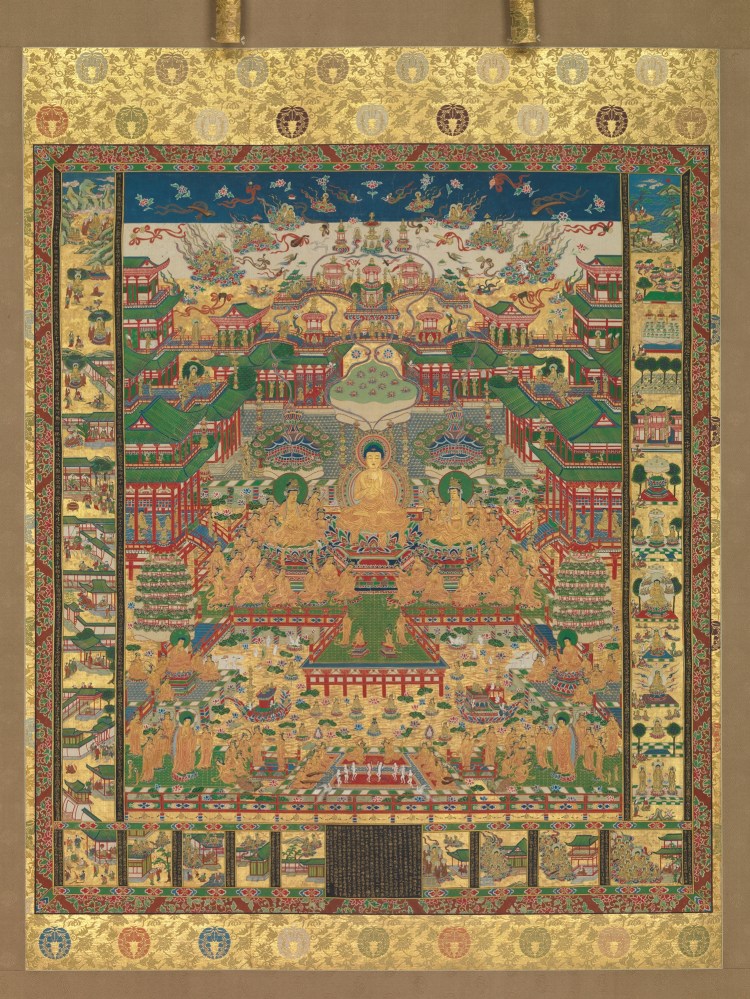
The Taima Mandala, another famous Pure Land “mandala” from that era. More on that in another blog post.

To further complicate things, as we’ve seen above, this recalling of the Buddha is often conflated with the Buddha’s name since that presumably requires one to think of the Buddha as one is saying. This often happens so much so that when most people talk about the nenbutsu/nianfo, they’re talking about the verbal recitation only. This trend was further accelerated in 12th Century Japan when populist Buddhist movements such as Jodo Shu and Jodo Shinshu started. In order appeal to as many people as possible, meditation aspects of the Pure Land were eschewed and complete reliance on the name of Amitabha (e.g. verbal nembutsu) in some way or another became the core practice. At times in Japanese-Buddhist history, the name itself has become an object of meditation, but only so much. Pure Land Buddhist became much more widely popular after this time, but at the cost of the streamlining the practice to the verbal nembutsu only, then justifying this approach retroactively in various writings.

One thing that we haven’t touched on yet is the fact that many of these visualization practices were written by, and practiced by, the monastic community. The monastic community was the target audience since the monastic community comprised of bikkhus (monks) and bikkhunis (nuns) who had given up worldly pursuits in order to devote themselves full-time to practicing the Buddhist path full time. While the history of Buddhist monasticism even to the present day has its scallywags, there were monks and nuns who really did try to put these various meditation exercises, circumambulations, and verbal+visual practices to use.

But this leaves us with a problem: what is the Nembutsu? Is it the meditative practice, or the recitation?

It’s clear from the early tradition that the visual/meditative nembutsu was the intention, but it’s also clear that over time this proved elaborate and impractical, hence later generations have emphasized the verbal nembutsu, even though the meditative nembutsu is more inline with the overall Buddhist tradition.2. This leaves a tricky conundrum: expediency vs. efficacy (or doctrinal orthodoxy).

My $0.02 as a non-ordained, amateur Buddhist with too much time on his hands (and who doesn’t want to get sued) is that both are still needed. Mahayana Buddhism in the early years seems to have suffered a tendency of trying to “out-do” itself over and over in the literature until the practices and levels of attainment simply weren’t realistic anymore. A look at the Sutra of the 10 Stages within the massive Flower Garland Sutra will frighten all but the most dedicated Buddhists. Not surprisingly, as these teachings established roots in China (and cultures on its periphery), a culture that was radically different from India, reaction movements like Zen and Pure Land and Tiantai schools arose to basically “fix this”. Like software patches to fix the initial release.

But I think the core essence of the Pure Land tradition is still important and we can still learn from it, but not necessarily be bound by it. Nor do we have to follow the strict orthodoxy of newer “populist sects” either. They were products of their time, and outlook on the world, and not all of it applies to now.

In any case, meditation practice is still one of the most fundamental practices in Buddhism, and it doesn’t have to be a terrible slog either as described in places like in the Contemplation Sutra. In the excellent book The Way to Buddhahood, but the late Venerable Yin-Shun, he spent some time explaining how basic visualization meditation works. I’ll post this in a separate article, but the gist was that one should hold an image of Amitabha (or any Buddha or Bodhisattva) that one has seen (e.g. from a work or art, etc) in mind as they meditate. This is similar to mindfulness of the breath, but visually oriented. One can also supplement with reciting the verbal nembutsu as well.

At the same time, it’s easy for this practice to get in the way of itself. People who are perfectionists or suffer from “imposter syndrome” will begin worrying about their inability to focus their mind, doubt that they’re making progress, etc. In other words, their self-doubt and unrealistic drive to perfection will get in the way. This could happen just as easily with any other form of Buddhist practice, though. It does require a little bit of, dare I say it, faith in the practice and the Dharma, but also faith in oneself. 😉

Because Buddhist practice has a therapeutic side to it, I think it’s important to keep the practice simple, realistic, flexible and even a little pleasant. Not pleasant in the sense of whacked-out mental states, but in the sense of a calm, abiding joy. Find an image of Amitabha Buddha you like, find inspiration in the beautiful images of the Pure Land described in the Amitabha Sutra, find a reasonable period of time in your day (3 minutes, 5 minutes, whatever) and just try it. You can refine the process as you go, so long as you keep the right intentions in mind.

Meditation, like all Buddhist practices, is a process of emotional growth, insight into things, and fostering goodwill toward others. As long as you keep these things in mind, the rest will work itself out one way or another.

May the Light of Amitabha Buddha shine upon all beings! Namu Amida Butsu.

1 in traditional Chinese characters, it is written as 念佛. You’ll see this in places like Taiwan, but even in Chinese/Japanese temples and sources that predate the reformation of Chinese characters.

2 meditating on Buddhist figures is nothing new. Even Shakyamuni said there was some value in contemplating his own form, though he also downplayed the devotional side quite a bit.