What Is A Shogun

With the conclusion of the hit mini-series Shogun,1 it seemed like good time to delve into what a Shogun was. I talked a lot about the first few Shoguns of the Kamakura Period, and the Shoguns of the late Edo Period, but there’s a lot more to the story.

In early Japanese history (a.k.a. Japanese antiquity), the government was modeled on a Chinese-style, Confucian-influenced bureaucracy. This is epitomized in the Ritsuryo Code which started in 645, under the Taika Reforms, and continued (nominally) in some form all the way until 1868.

This imperial bureaucracy elevated the Emperor of Japan to the first rank, and other officials and nobility were allocated ranks below this. The ranks dictated all kinds of things: salaries, colors to wear at the Court, other rights and responsibilities, etc. There were bureaucratic offices for all sorts of government functions: land management, taxes, religious functions, military and so on.

The imperial court did not rule all of Japan as we know it today. The north and eastern parts of Japan in particular were dominated by “barbarian” groups called Emishi whose origins are somewhat obscure but are probably ethnically different than early Japanese people.

To subdue these people, certain military commanders in the Imperial bureaucracy were granted a temporary title of sei-i taishōgun (征夷大将軍), or “Supreme Commander of Barbarian-suppressing Forces”. Since a military force needs a clear chain of command, someone had to be made the supreme commander, and this was what the Shogun was meant to do.

But everything changed after the Genpei War, and the fall of the Heike Clan.

After the Genji clan (a.k.a. the Minamoto) crushed the Heike clan, they assumed military control of Japan. The head of the Genji clan, Minamoto no Yoritomo, was granted the title of sei-i taishōgun by the Emperor permanently, and given the task pacifying the rest of Japan. The title became hereditary, not temporary, and thus created a new system of government in Japan.

The original Imperial Court, and its institutions, remained in place in Kyoto. However, practical control of Japan was managed through the new bakufu (幕府) government headquartered in the eastern city of Kamakura. This began a period of history called the Kamakura Period of 1185–1333.

From here, Japan’s history and its bakufu governments can be divided like so:

PeriodCapitolNotes
Kamakura Period (1185–1333)KamakuraAfter Minamoto no Yoritomo‘s death, plagued with infighting and power-plays by vassals. Minamoto line died with Sanetomo’s untimely death, further heirs drawn from obscure Hojo relatives.
Southern Court Insurrection
(1336 – 1392)
YoshinoEmperor Go-Daigo attempts to reassert authority of the Imperial line. Kamakura Bakufu dispatches Ashikaga Takauji to suppress rebellion, but is betrayed by Takauji.
Muromachi Period
(1336 to 1573)
KyotoFirst 3 shoguns were strong rulers, but quality of rulership slowly declines, culminating in 8th shogun Yoshimasa, and the disastrous Onin War. High point of Kyoto culture, ironically.
Warring States
Period
(1467 – 1615)
Kyoto
(barely)
After Onin War of 1467, Ashikaga Shoguns still nominally rule until 1573, but country descends into civil war. Almost no central authority.
Oda Nobunaga
(1573 – 1582)
KyotoAfter driving out last of Ashikaga Shoguns, Oda Nobunaga reaches deal with reigning Emperor and conferred titles of authority. Almost unifies Japan. Later betrayed and murdered by a vassal.
Azuchi-Momoyama Period
(1585 – 1598)
KyotoAfter unifying Japan after Oda Nobunaga’s demise, vassal Toyotomi Hideyoshi unifies, and then rules Japan as the Sesshō (摂政, “regent to Emperor”) then Kampaku (関白, “chief advisor”). Dies in 1598, and son is too young to rule. Country falls into civil war again.
Edo Period
(1600 – 1867)
Edo
(Tokyo)
Tokugawa Ieyasu, a former vassal of Oda Nobunaga, then unifies Japan for the final time, and moves capitol to a newly fortified town of Edo (modern Tokyo). Effective policies by Ieyasu and his early descendants avoids many problems of past Shogunates, and provides stable rule for 268 years until Meiji Restoration of 1868. Similar to Muromachi period, quality of rulership gradually declines, but effective policies help maintain stability far longer.2

The last shogun, Tokugawa Yoshinobu, relinquishes authority back to Emperor at Osaka Castle in 1867.

During this entire period of history, the Imperial line, and its Court of noble families in Kyoto never ended. The Southern Court vs. Northern Court briefly split the Imperial family into two competing thrones, but once they reunified, everything continued on as normal. The Emperors reigned, but the military governments ruled.

Once the Meiji Restoration of 1868 came, this changed, and with a new constitution borrowed from the Prussian model, the Emperor’s assumed direct control again until the modern constitution in 1947 when the Emperor returned to a mostly ceremonial role that we see today.

The series of Shogun takes place at the very end of the Azuchi-Momoyama Period to the very beginning of the Edo Period, but as you can see, Japan’s military history was far longer, and its many ruling families each faced different challenges. For the peasants on the ground, who they paid taxes to may have changed, but life overall probably remained somewhat the same.

1 I read the original book by James Clavell back in the day, including his other books: King Rat, Taipan, and so on. Great story-telling, especially King Rat (based on his personal experiences), but older me kind of facepalms now at the bad stereotypes, linguistic mistakes, and so on.

Abarembo Shogun” Television series set piece, Toei Uzumasa Studios Kyoto Japan. Photo by fg2, Public domain, via Wikimedia Commons

2 It’s also why, today, many historical dramas, comics and stories take place in the Edo Period. My father-in-law likes to watch one Japanese TV show called Abarenbo Shogun (暴れん坊将軍, “Unfettered Shogun”), which is a mostly fictional drama about the unusually talented 8th Shogun of the Edo Period, Tokugawa Yoshimune (1684 – 1751). In the drama Yoshimune, often traveling in disguise, solves mysteries and fights crime. It’s campy, but also a fun show to watch. The “Megumi” lantern shown on the right is a set piece from the show.

Hanging Out With Kannon at Sanjusangendo

I alluded in recent posts about my visits to the temple of Sanjūsangendō (三十三間堂, San-ju-san-gen-do) in Kyoto, Japan, but I’ve never really talked about it.

My experiences with Sanjusangendo go all the way back to our first trip to Japan together in 2005. My wife (whose Japanese) and I had married the previous year,1 and we came to Japan to meet the extended family, but also take in many sites. That first trip through Kyoto was a whirlwind, and I have very fuzzy memories of most of it. I couldn’t remember much about Sanjusangendo, and since we couldn’t take photos, I had very little to remind me either.

And yet, something about Sanjusangendo drew us back in recent years. My late mother-in-law really liked Sanjusangendo, and my wife wanted visit again for her mother’s sake, and now with 20 years of experience in Buddhism, the temple made a lot more sense to me. The fact that it’s a Tendai temple (and I like Tendai Buddhism) was icing on the cake. My wife was really inspired by it too, so the following year we visited it again.

…. so, what is Sanjusangendo?

Sanjusangendo is a Buddhist temple, which venerates the bodhisattva Kannon, also known as Avalokiteshvara, Guan-yin, etc. It was founded in the 12th century by the infamous warlord Taira no Kiyomori as a way to impress Emperor Go-Shirakawa (tl;dr it didn’t work). What makes Sanjusangendo so famous is two things:

  1. It’s very long, narrow main hall (本堂, hondō). This is different than most temples which have a more square-shaped main hall. The hondō of Sanjusangendo is a very long rectangle, but there’s a reason for this. The featured photo above is something I took in 2023, and shows the scale of the building. The website also has a nice photo.
  2. The temple’s main attraction is the 1,000 statues of Kannon bodhisattva, centering around a much larger statue of Kannon. These statues are lined up in rows along the main hall, and in front of them are other statues featuring various gods and other divine beings protecting the temple. More on that below.

Since Sanjusangendo doesn’t allow photography inside the main hall,2 you should check out the official website instead. You can see the main hall, and the row upon row of Kannons here. The official website also has photos of each figure.

The main figure of devotion, as i said above, is the bodhisattva Kannon, but since Kannon has many forms, this form is the 1,000-armed Kannon called Senju Kannon (千手観音). This form of Kannon isn’t limited to Japanese Buddhism; I have seen this form expressed at Vietnamese Buddhist temples as well. The idea is that Kannon, according to the Lotus Sutra, uses many different means and methods to help people, and the 1,000 arms, each holding different objects, symbolizes the diverse ways that Kannon helps others.

You can see a photo of the 1,000-armed Kannon here.

Something you might also note is that the Kannon statue has 11 heads. Just as the 1,000 arms show Kannon’s efforts to help all beings in a variety of ways, the 11 heads show Kannon’s vigilance in watching out over people.

Not shown in the photos is a small display which teaches a particular mantra associated with the 1,000-armed Kannon:

LanguageMantra Pronunciation
SanskritOṃ     vajra-dharma     hrīḥ    svāhā
Japanese, katakana script3オン サラバ ダルマ キリ ソワカ
RomajiOn saraba daruma kiri sowaka

You can recite this mantra in Japanese or Sanskrit. I am unclear what the translation is, but I’ve been told before that translating mantras is kind of pointless, like giving answers to a Zen koan. So, I left out the translation.

Anyhow, flanking the great big statue of Kannon on either side are 10 rows of smaller, standing statues of Kannon, each with 1,000 arms, which you can see here. The website says that of the one-thousand statues, they were built over time: 124 were from the late Heian period (12th century) and the rest were constructed during the Kamakura period (13th-15th century). There are a total of 1,000 statues, each one slightly different, but generally the same form.

Finally, in front of these statues is a series of mythical figures. Some are originally from India, and traveled the Silk Road, gradually transforming into what we see today. Others are more native Japanese deities who’ve also become Buddhist guardians. You can see the full catalog here.

To give an example of the eclectic nature of these figures, one figure is a Buddhist guardian deity named Vajrapani (Naraenkengō 那羅延堅固 in Japanese), whose imagery was influenced by the Greek hero Herakles at a time when places like Bactria and Gandhara were still part of the Greek world.

On the other hand, you can also see the famous figures of Raijin and Fūjin who are Thunder and Wind gods respectively. As far as I know, these are native deities and did not originate from the Silk Road.

The quality of the artwork is really excellent. When you see any of these figures, Kannon, Vajrapani, Raijin, etc, the life-like quality is really impressive. And, like many examples of Buddhist art, they are full of symbolism and visual meaning beyond words. They impress and inspire those who see them. Since I have now seen Sanjusangendo three times, I found that it continues to impress me every time I see it.

Speaking from experience, Sanjusangendo is a place that requires some context to really appreciate. If you are unfamiliar with Kannon and why they have one-thousand arms, or with the strange but beautiful figures guarding the front row, then some of it will feel like a mystery. It’s a beautiful mystery, but still a mystery. But, hopefully after reading this, you will get a chance to see it someday and really get a feel for why this place is special.

As someone who has an affinity for Kannon since I first became a Buddhist, it is a special place for me. 😊

Edit: fixed a number of typos. Three-day weekend drowsiness. 😅

P.S. Again, apologies for the lack of photos. I know sometimes foreigners will take photos anyway (I have seen people do this), despite the signs clearly saying “photography prohibited”, but I don’t want to be one of those tourists. So, if you want to see more, check out the excellent website.

1 Twenty-year anniversary as of early 2024. 🎉

2 A lot of temples in Japan do this. I don’t fully understand why, and it is frankly a little frustrating.

3 Katakana script is often used to write foreign-imported words in Japanese, as opposed to hiragana script. Since mantras are originally derived from Sanskrit, using katakana makes sense in this context. Sometimes katakana is also used for visual impact (like in manga), so that might explain things too. NHK has a nice website explaining how to read katakana.

The Five Mountains System in Medieval Japan

In a recent post I talked about how Zen imported from Song-Dynasty China found patronage with the elite samurai families of the city of Kamakura. Sometimes this was due to the cultural prestige of Zen among “country bumpkin samurai”, but also the new Zen monastic community drew sincere students as well, helping it take root. Zen still had a very small presence, compared to other Buddhist institutions in medieval Japan, but it was definitely the “up and coming” sect.

By the 14th century, and with the destruction of the Hojo Family (ending the Kamakura Period of history), the seat of government shifted back to Kyoto under the new Ashikaga Shogunate (a.k.a. the Muromachi Period of Japanese history). The Ashikaga Shoguns, many of whom were avid Sinophiles, further cultivated the Rinzai Zen institutions from China, and created a new hierarchy of temples called the Five Mountains System. The same system existed in China, where “mountain” was synonymous with “Buddhist monasteries”, but the Chinese version was a looser organization and not strictly related to Zen Buddhism.

The Japanese version organized Rinzai Zen temples (and some Soto Zen temples) across the country into one of three administrative “ranks” with the “five mountains” (gozan, 五山) at the very top. These temples, as we’ll see later, functioned less as Buddhist temples and increasingly as bureaucratic hubs for the rest of the temples in Japan. They enjoyed much patronage and prestige, but the monastic life greatly suffered.

The three ranks were:

  • Gozan (五山) temples, the top-tier
  • Middle-tier jissatsu (十刹) temples, and
  • Shozan (諸山) temples at the bottom.

Confusingly, many Rinzai Zen temples existed outside this temple structure, either by choice, or just lacked prestige, and were derisively called rinka (林下, “the forest below”) to distinguish from more prestigious temples “up on the mountain”. I briefly mentioned rinka temples in this old post.

Anyhow, let’s look more closely at each.

The Gozan Temples

The list of gozan temples varied over time, usually whichever temples the current Shogun patronized. Further, there were actually two sets of gozan temples, one for Kyoto and one for the former capitol of Kamakura. Which one was more important depending on who was in power.

For example, in 1341, under guidance from Tadayoshi, the ranks were as follows (homepages linked where possible):

RankKamakura TemplesKyoto Temples
1KenchōjiNanzenji
2EngakujiTenryuji
3Jufukuji
4Kenninji
5Tōfukuji
“associate”
temple
Jōchiji

For each rank, the Kamakura temples were elevated slightly higher than their Kyoto counterparts. By 1380 under the 3rd Shogun, Yoshimitsu:

RankKamakura TemplesKyoto Temples
1KenchōjiNanzenji
2EngakujiTenryuji
3JufukujiKenninji
4JōchijiTōfukuji
5JōmyōjiManjuji

And by 1386, also under Yoshimitsu, the rankings switch in favor of the Kyoto temples, but also Nanzenji gets elevated to a “superior gozan temple”. Plus, a new temple built on Yoshimitsu’s orders, Shōkokuji, was slotted into the Gozan temple ranks.

RankKyoto TemplesKamakura Temples
“superior”Nanzenji
1TenryujiKenchōji
2ShōkokujiEngakuji
3KenninjiJufukuji
4TōfukujiJōchiji
5ManjujiJōmyōji

The Gozan temples were the top of a large administrative bureaucracy that managed the many other Rinzai Zen temples, and as such enjoyed much patronage and influence. However, as we’ll see later, this came at a heavy cost.

Middle Rank Temples: Jissatsu

The ten temples of the middle rank, the jissatsu (十刹), were major temples in the provinces that served as middle-management. They managed other temples in the provinces and were subordinate to the gozan temples, but also held much influence too. Eventually, the jissatsu temples were also split up into 10 temples under the Kyoto gozan temples, and 10 more under the Kamakura gozan temples.

The list of temples moves around a lot, and sometimes temples were promoted to gozan temples, or downgraded.

Lower Rank Temples: Shozan

The shozan temples are the lowest-ranking, but also the largest group by far. At any time, up to 250 temples were ranked as shozan temples. As with the jissatsu temples, the shozan temples were usually provincial temples that simply didn’t have the prestige or political influence that the jissatsu had. However, they were still important in extending Shogunal control over the provinces, and thus still had ranking.

What Happened to the Gozan System?

As we saw in an old post, whenever the Buddhist establishment developed close ties with the ruling regime, this worked as long as the regime was powerful, but began to collapse easily when the regime was weak.

In the case of the Gozan system, the Zen temples never maintained huge standing armies that other, older temples such as Enryakuji (Tendai) or Kofukuji (Hossō sect) did, and so they relied on the Ashikaga shoguns for protection. As the Ashikaga shogunate started to weaken, local warlords in the provinces and the rival temple armies began to assert their power, and the Gozan temples suffered.

In fact, the disastrous Ōnin War in the 15th century practically destroyed many of these monasteries along with most of Kyoto city. Some of these temples never to rebuilt, or became greatly diminished. By this point, the Ashikaga “shoguns” had no real power outside of the Kyoto area, and thus couldn’t protect or influence other temples anyway.

However, probably the biggest reason for their decline was that spiritual practices at these temples declined and atrophied as they became more and more important politically. In the book Five Mountains: The Rinzai Zen Monastic Institution in Medieval Japan by Professor Martin Collcutt, Collcutt shows how records and journals at these temples showed that they had a very active social scene: banquets, religious functions, public rituals, and so on, but very little actual Zen practice as we know it. Monastic discipline greatly declined, and while they flourished culturally, the religious practices suffered. The famous Zen monk, Ikkyu, at the time lamented the decline in monastic discipline. Then again, he was a bit of an eccentric curmudgeon anyway.

Ironically, Rinzai Zen temples that existed outside the Gozan system, gained lasting prominence instead. The modern lineages in Rinzai derive from two temples that were not in the Gozan system: Daitokuji and Myōshinji. Both had reputations for maintaining austere Zen practices, and enjoyed patronage from wealthy merchants, and the increasingly powerful provincial warlords. Under Hakuin (mentioned here), the two temples became the basis for Rinzai Zen today.

Admittedly, both Daitokuji and Myoshinji suffered from corruption as well, as they gained social prominence, but Hakuin’s reforms later fixed this.

So, repeat after me: religion and politics should not mix.

P.S. happy Spring Ohigan! 🌸

A Not-So Brief History of Zen and Samurai

There is a persistent image in the West of samurai being adherents of Zen, that the “way of the warrior” (bushido)1 and Zen are somehow one and the same. One can imagine a samurai who has practiced swordsmanship to a finely honed skill, meditating under a waterfall, and writing Zen-like deathbed poetry before preparing to throw away their life in battle. In my first visit to Ryoanji temple (featured photo shown above), 28-year old me had a similar image in mind persisting all the way back when I was a naïve 16-year old white kid just reading about Zen for the first time. Looking back after almost 20 years of Buddhist-study and practice, I facepalm at myself a little, but it’s a very persistent image in media. (side note: Last Samurai is not my favorite movie)

So, did samurai really embrace Zen, and was Zen essentially a “samurai religion”? Turns out, it’s complicated, and most of the imagery was romanticized.

Recently, I dusted off an old book that I hadn’t read in years: Five Mountains: The Rinzai Zen Monastic Institution in Medieval Japan by Professor Martin Collcutt. As I am stuck home in Covid-isolation for a few days, I finally have time to both read and write about it.

Dr Collcut summarizes all this in the book:

Even at the height of its influence in the last fourteenth century, Zen–including the more widely diffused Sōtō Zen–probably had still not replaced devotion to Kannon, Jizō [Bodhisattva], the Lotus Sutra [e.g. Nichiren Buddhism], or the Pure Land of Amida in the hearts of most ordinary, and many high-ranking, Japanese samurai.

page 80

Further:

Zen in the Kamakura and Muromachi periods can be called “the religion of the samurai” only in the sense that most patrons of Zen were samurai, not in the sense that it was practiced assiduously or exclusive by all, or even perhaps the majority, of those who would be described as warriors.

page 80

So where did the image come from? Let’s take a brief look at the history of Zen, especially Rinzai Zen, in Japan.

The Two Lineages of Zen in Japan

Japan has historically two sects of Buddhism, both descended from Chinese lineages: Soto and Rinzai Zen. The differences between the two are too big to cover here, and there’s plenty of information on the web that explore the two. Suffice to say, the two lineages came to Japan in the 12th century, but took pretty different trajectories.

Soto Zen, founded by Dogen after journeying to China, did not sit well with existing powerful Buddhist sects in Japan, because of Dogen’s unwavering commitment to his ideal of ideal Zen practice, and was pushed out to the countryside. For centuries it was obscure, and enjoyed little patronage beyond certain local samurai families, primarily for the sake of prestige. Its popularity grew later through the efforts of a monk named Keizan, who developed increasing patronage from (mostly) provincial samurai rulers, and cultivated more community support. Professor Bodiford’s book, Sōtō Zen in Medieval Japan, is an excellent overview of its history. In any case, all Soto Zen traditions in Japan (and beyond) trace back to Dogen.

Rinzai Zen, founded by Eisai, has a much more complicated history. Eisai was willing to compromise more when he returned from China with the Buddhist establishment, so early Rinzai Zen was more like a hybrid Zen-Tendai Buddhist institution with a lot of esoteric practices. It enjoyed further popularity under Enni Ben’en (圓爾辯圓, 1202 – 1280) in the capitol of Kyoto, but remained a relatively small sect, often conflated with existing Buddhist institutions at the time.

Zen really didn’t take off until the second-half of the Kamakura Period under the Hojo Clan regency. After the death of Sanetomo, the 3rd shogun, the subsequent shoguns, distant offshoots of the family, were installed but increasingly powerless against their own regents, the Hojo Clan. Under talented Hojo leaders such as Hojo Tokiyori and Tokimune, power was consolidated, and they became the effective rulers of Japan.

But there was a persistent issue: the Hojo Clan, while militarily powerful and based in Kamakura was seen as inferior to the old aristocracy (e.g. the Fujiwara) in Kyoto who had centuries of refinement to rely upon compared to the upstarts. The old Buddhist establishment was still closely allied to the aristocracy, and thus hostile to the Hojo Clan.

Enter the Mongols

When the Mongols finally destroyed the Song Dynasty in China, establishing the new “Yuan” Dynasty, the upheaval affected many monastic institutions. Some monks, including ardent Song-loyalists, decided to leave China and make the journey to Japan either to get away from Mongol authority, or possibly in some cases, to work as spies for the Mongols who later tried to invade Japan.

Starting with a monk named Lanxi Daolong (蘭溪道隆, 1213-1278), who came to Japan in 1246 for reasons not entirely clear, followed by Wuan Puning (兀庵普寧, 1197 – 1276) in 1260, a steady stream of Rinzai-lineage monks came to Japan. For the Hojo leadership, this new source of Chinese education, culture and religious teachings practically fell into their lap, and they quickly adopted these new monks, establishing a series of monasteries in the new capital of Kamakura starting with Kenchōji (website here) in 1253, and expanding to other temples such as Engaku-ji in 1282. These new temples in Kamakura Zen temples were different than the ones that Eisai and Enni Ben’en’s temples had established in Kyoto, designed to match Song Dynasty practices, with Chinese monks frequently serving as abbots.

Thus, Rinzai Zen in Japan was essentially established as two separate lineages2 albeit with a common ancestry: the first lineage established by Eisai and popularized in Kyoto by Enni Ben’en that incorporated more native Japanese-Buddhist practices, and the second lineage which came later driven by Chinese Zen monks during the end of the Song Dynasty who established a more “pure” form of Zen based on the Chinese model. It should be noted that the Chinese monks mentioned above did journey to Kyoto as well to update existing monasteries of the older lineage to modern (e.g. Song Dynasty) standards as well, but the temple of Kenchōji was the premiere Zen temple for centuries in Japan. Further, by the 14th century, and especially later, much of Rinzai Zen was more homogenized than the early communities.

The arrival of the Chinese-Buddhist teachers to Japan in the 13th century is important to note, though, because this is the point in time where the samurai class really start to interact with Zen communities.

The Hojo Clan had finally found a way to one-up their rivals in Kyoto by raising their own cultural credentials with the new immigrants from China, but also some Hojo family members really did embrace Rinzai Zen teachings. Hojo Tokiyori (北条 時頼, 1227 – 1263) and his son, Tokimune (北条 時宗, 1251 – 1284) both became avid students under Chinese teachers, patronized the new monastic communities in Kamakura, and encouraged its practice among their samurai vassals. Other regents of the Hojo Clan never took much interest. But now, Zen finally had the patronage it needed to expand and grow in Japan, yet as Collcut’s book shows, it was still largely adopted for cultural prestige, and also oftentimes due to obligation towards Hojo Clan. Many of these vassal clans later rose to be major powers centuries later (cf. Hosokawa, Takeda, Uesugi, Tokugawa, etc) with their own patronage to Zen temples in their provinces.

Later, as the Hojo Clan finally declined in power, and gradually replaced by the Ashikaga Clan (e.g the Muromachi Period), the pattern continued. Both the emperors of the time such as Go-Daigo and Hanazono, and the Ashikaga Shoguns patronized Rinzai Zen temples, but often times for political expediency. The “Five Mountains” monastic system developed at this time, borrowed from Chinese cultural, is a big topic, and worthy of its own post.

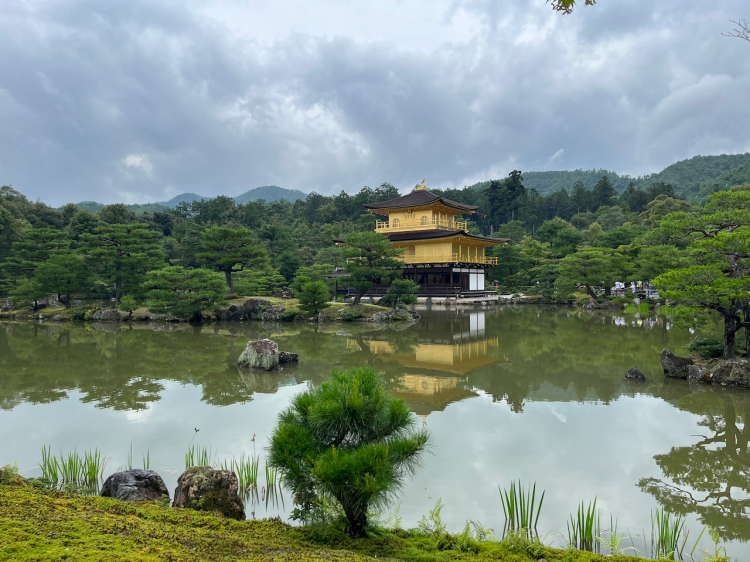
The Golden Pavilion, built as a villa for Ashikaga Yoshimitsu, later converted to a Rinzai Zen temple.

The high-point of “Zen-Samurai” culture as we know it can probably be traced to the 8th shogun of the Ashikaga Clan, Yoshimasa (足利 義政, 1436 – 1490) who while being a dismal military commander, was a brilliant innovator of Zen aesthetics. Yoshimasa had a taste of artistic genius, and patronized Zen-influenced architecture, painting, poetry, and gardening, and so on, but also directly added his own spin. The “zen aesthetic” we all recognize is largely due to Yoshimasa who synthesized earlier Song-Dynasty culture through establishment of institutions by the Hojo Clan.

However, on a personal level, Yoshimasa recited the nembutsu and seldom meditated.

Conclusion

All this is not meant to detract from Zen teachings, or the contributions of Zen monks to Japanese culture, or to imply that there were no Zen-devotees among the samurai class, but as I alluded to in the beginning, the romanticized Zen-Samurai image mostly exists on paper or in the writings of its sincere devotees. It was the ideal at the time among enthusiasts, and this ideal has persisted into Western culture, including teachers and self-help gurus.

How samurai in Japan, or Japanese in general, interacted with Buddhism (including Zen) was complicated and very individual, and not always related to piety. When you look at other pre-modern cultures, you see similar patterns. The emperors of the Eastern Romans had a complex relationship with the Church, and usually were not interested in the deeper teachings, or various doctrinal conflicts of the Byzantine Orthodox church except when it interfered with political goals (cf. iconoclasm, schisms, etc), or were varying degrees of sincerity. Further, how they practiced religion would have been noticeably different than your typical Eastern Roman in the provinces or the streets of Byzantium.

Now, imagine the same in any other culture: Western medieval communities, people in the Islamic caliphate, Chinese Buddhists, etc.

In short, how people interact with religion, and how its romanticized, are two different things. The dynamic interaction of people, culture and religion is fascinating, but not very marketable. The romanticized form of religion is marketable, but is like a bag of potato chips: tastes good, but rarely provides anything meaningful.

1 Please, please, please: if you ever go visit Japan, do not wear a “bushido” shirt. It really pegs you as a tourist.

2 The third “Obaku” sect of Zen in Japan is in fact yet another Rinzai Zen lineage that came from China, this time from the Ming Dynasty. By this point, Pure Land Buddhism and Zen in China had largely reconciled, and Obaku Zen includes more elements of Pure Land than is found in other Rinzai lineages, while still retaining its core Zen element.

Lonely At The Top: Minamoto no Sanetomo

I’m still keeping up with the Japanese historical drama the Thirteen Lords of Kamakura, discussed here, which is based primarily on the Azuma Kagami (吾妻鏡) a historical text about the period, and a fascinating look at how the Shogunate, or samurai military government, of the Kamakura Period rose and fell.

The rise of the Kamakura Shogunate began with the climactic battle between the Heiki (Taira) clan and the Genji (Minamoto). In order to topple their rivals, the Genji had to enlist a complex web of alliances with other samurai clans in the eastern regions of Japan, with Kamakura as their capitol, most crucially the Hojo Clan (the source of the Triforce in the Legend of Zelda series). This alliance overwhelmed the Heike and led to downfall.

However, once the Heike were wiped out, and the old Imperial political order ended, the various clans including the Minamoto themselves turned on one another to sort out who the Shogun would be, and would be pulling the strings behind the throne. The first Shogun, Minamoto no Yoritomo, turned on his half brothers and killed them one by one using flimsy legal pretexts, while his firstborn son Yoriie, the second Shogun, vied with his council (the aforementioned 13 Lords above) until he was driven into permanent exile. Hojo Masako, the so-called “Warlord Nun” contended with her father Hojo Tokimasa when he tried to assert a dominant hand, and had him exiled too. As all this was going on, the various allied clans took sides with members of the Hojo and Minamoto. Generation after generation, people kept stabbing each other in the back in order to advance their faction in the new military government.

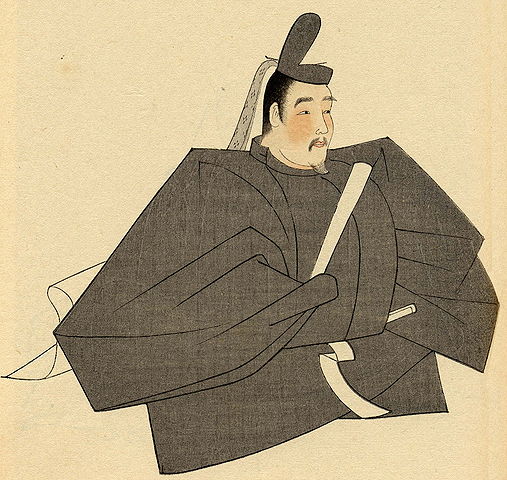
Sanetomo in court clothing, painting by the priest Goshin. Photo courtesy of Hannah, Public domain, via Wikimedia Commons

This left Yoritomo’s younger son, Minamoto no Sanetomo (源 実朝, 1192 – 1219), to assume the position as Shogun, the 3rd in line. Sanetomo was doomed from the beginning.

Sanetomo was a puppet of his maternal family, the Hojo Clan, who surrounded him as advisors and ministers, but also carried out the real functions of government. Sanetomo knew from early on that he was essentially a figurehead, and could easily be toppled by whatever faction wanted to replace him with a more amenable candidate for Shogun. It is said that Sanetomo retreated into drinking and composing poetry, of which one of them is included in the Hyakunin Isshu anthology:

JapaneseRomanizationTranslation by Joshua Mostow
世の中はYo no naka waIf only this world
つねにもがもなTsune ni mo ga mo nacould always remain the same!
なぎさこぐNagisa koguThe sight of them towing
あまの小舟のAma no obune nothe small boats of the fishermen
who row in the tide
綱手かなしもTsuna de kanashi mois touching indeed!
Also posted in the other blog…

Sanetomo evidentially composed the poem after watching some fishermen at work on the shore, envying their simple lives in contrast to the constant political infighting and manipulation that surrounded his.

Sadly, things never got better.

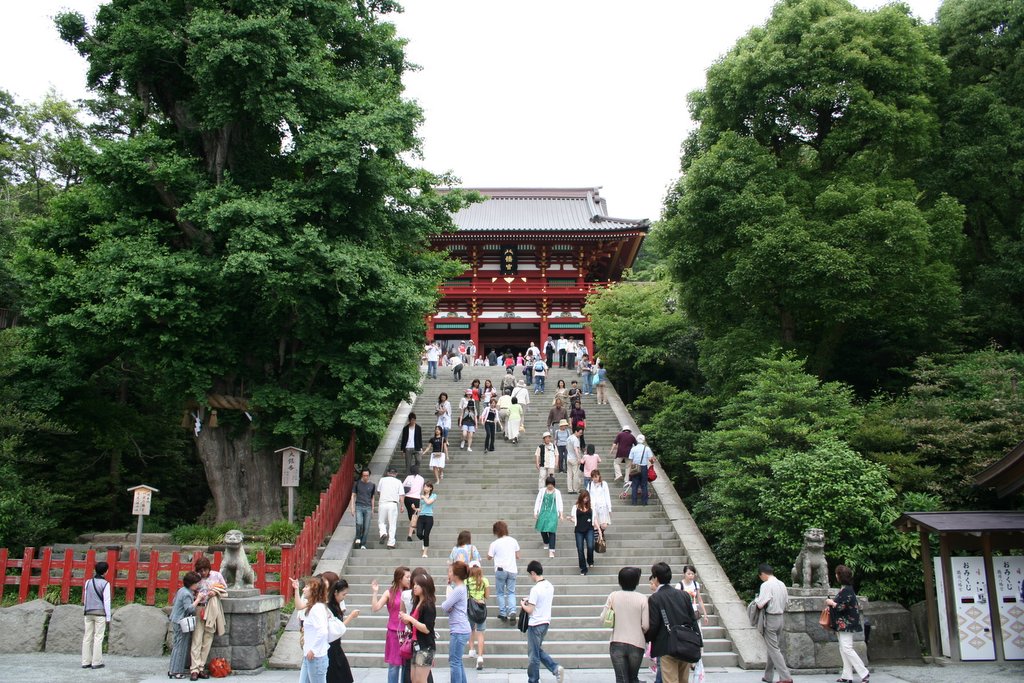
Sanetomo’s life ended at the age of 28, when he was assassinated by his nephew at the footsteps of the famous Tsurugaoka Hachimangu Shrine (visual tour here) in Kamakura. It is said his nephew hid behind the ginkgo tree there, and as Sanetomo descended the steps, leapt out and ran him through with a sword.

The gingko tree where Sanetomo’s assassin hid is shown here on the left. In 2010, the tree now many hundreds of years old, fell over in a powerful wind storm, and has been partially rehabilitated from a shoot. No machine-readable author provided. Abrahami assumed (based on copyright claims)., CC BY-SA 2.5, via Wikimedia Commons

Further, the Kamakura Shogunate only spiraled further. With Sanetomo’s death, the Minamoto line ended, and the Hojo Clan promoted various relations of the Minamoto (often drawn from the Fujiwara clan) as the subsequent Shoguns. Each one of these shoguns was simply another figurehead, while the Hojo tightened their grip on power as “regents”. Once Hojo Masako died, there was no one left savvy enough to hold it together, and the Mongol invasions further drained away any remaining resources until the government was finally toppled by a rival warlord.

Sanetomo’s life, the ignominious circumstances that surrounded his family (both his father’s line and his mother’s family’s scheming) ensured that even with the powerful title of Sei-i Taishōgun (征夷大将軍, “Commander-in-Chief of the Expeditionary Force Against the Barbarians”) he lived alone and apart from everyone, constantly in fear of his life, and powerless to do anything about it.

Hojo Masako: the “Nun Warlord”

As I continue watching a Japanese historical drama, the Thirteen Lords of Kamakura, I have been delving more into the history of the Kamakura Period (12th – 14th century) of Japan, under the new military government. I know this era a lot less than I do the Heian Period, but while it is different, it is no less interesting.

The Shogunate of Kamakura, while nominally ruled by Minamoto no Yoritomo and his descendants, was actually controlled by their close allies, the Hojo (北条) clan, the same folks who gave us the Triforce symbol. Yoritomo was almost as bad as his dead rival, Taira no Kiyomori, and wasn’t above killing his various brothers and half-brothers who were potential rivals for the coveted title of Seii Shōgun (征夷将軍, generalissimo of Japan). The dynamic warlord, Minamoto no Yoshitsune (younger half-brother to Yoritomo) was killed shortly after earning the title from the Emperor, allowing Yoritomo to get the title himself by default.

In any case, for all of Yoritomo’s titles and power, he was less effective as a ruler, and the Hojo clan filled in this crucial role as regents and other administrative roles. The most important of these was in fact, Yoritomo’s wife, Hojo Masako. When Yoritomo died from illness a few years later, it was Hojo Masako, who by now took tonsure as a Buddhist nun, who filled in the role at a crucial time in Japan and kept things together. So effective was she at ruling Japan, that she earned the title ama shōgun (尼将軍), or “Nun Shogun” / “Nun Warlord” and so on.

Hojo Masako spying on one of her husband’s love trysts, painting by Utagawa Kuniyoshi (1840’s) courtesy of Wikimedia Commons.

In many ways, Hojo Masako fulfills a similar role to that of Empress Irene of the Byzantines: someone who has excellent leadership skills, but is prevented from openly leading armies by paternalistic society, so she played the role of a pious wife (later widow), while carefully pulling the strings.

As the wife of Minamoto no Yoritomo, she had to protect her family and descendants from Minamoto no Yoritomo’s constant philandering, but once he was gone, she stepped in to guide the Regency while her son and second shogun grew up. The Hojo clan regency was the true force behind the Shogunate, but as her son was now a member of that clan, she also wanted to ensure that lineage was safe from rival claimants. She is portrayed as crafty, but level-headed and responsible in contrast to her moody, and reckless husband.

Hojo Masako as played in the current drama, The Thirteen Lords of Kamakura, by the incredibly lovely and talented Koike Eiko.

So, what did Hojo Masako do that earned her such a prestigious title? When Minamoto no Yoritomo had prevailed over the Heike (Taira) Clan, he was the dominant power, but the title of Seii Shōgun wasn’t given willingly by the Emperor. In fact, the Emperor’s grandson, later Emperor Gotoba, would make one last effort to wrest true political authority. He rallied a large number of samurai clans, primarily from the West, away from the new capitol of Kamakura, with promises of titles and land.

The samurai clans allied to Minamoto no Yoritomo wavered in support. Going against the Emperor was never part of the deal, they rallied to stop the Heike Clan only, and they were hesitant to take up arms against their sovereign.

Hojo Masako, according to the Azuma Kagami, was said to have made the following speech:

故右大将軍(源頼朝)が朝敵を征伐し、関東を草創してから、官位といい、俸禄といい、その恩はすでに山よりも高く、海よりも深い。その恩に報いる思いが浅いはずはなかろう。そこに今、逆臣の讒言によって道理に背いた綸旨が下された。

名を惜しむ者は、速やかに藤原秀康・三浦胤義らを討ち取り、三代にわたる将軍の遺跡を守るように。
ただし院(後鳥羽)に参りたければ、今すぐに申し出よ。

“Since the days when Yoritomo, the late Captain of the Right, put down the court’s enemies and founded the Kantō regime, the obligations you have incurred for offices, ranks, emoluments, and stipends have in their sum become higher than mountains and deeper than the sea. You must, I am sure, be eager to repay them. Because of the slander of traitors, an unrighteous imperial order has now been issued.

Those of you who value your reputations will wish to kill [Fujiwara no] Hideyasu, [Miura] Taneyoshi, and the others at once in order to secure the patrimony of the three generations of shoguns. If any of you wish to join the ex-emperor, speak out.”

Translation by McCullough, William (1968). “The Azuma Kagami Account of the Shōkyū War”. Monumenta Nipponica. Tokyo: Sophia University. 23 (1/2): 102–155.

It is said that this put some backbone in the Shogun’s allies and they were able to crush Emperor Gotoba’s army, finally ending resistance from Kyoto. Later she was dispatched by her brother the regent to try and heal the political divide with Emperor Gotoba, among other important tasks. By the time she passed away, she attained the rank of Second Junior in the Imperial Court (still around, but largely ceremonial now), which is very high for someone of a more humble, warrior-class family.

Schoolchildren in Japan often learn about Hojo Masako when they learn Japanese history, including the famous phrase 山よりも高く、海よりも深い from the speech above: yama yori mo takaku, umi yori mo fukai (“[kindness is] higher than a mountain, and deeper than an ocean”). She was dynamic, intelligent, and charismatic leader who held together a fragile alliance of clans in a force that could resist Imperial power, and maintain a dynasty that lasted for 200 years.

Essays In Idleness: A Japanese Text

As I wrote about recently, the end of the Heian Period in Japan (8th century to 12th century) represented a seismic shift in Japanese culture from a cultured aristocracy to a military society led by the samurai class. This finally stabilized Japan from decades of strife, but there was also a palpable sense of loss reflected in such works as the Hojoki (Ten Foot Hut) and other works of the time.

One of my favorite, and the best known from this era is a work called the Tsure-zure-gusa (徒然草) which is hard to translate in English.1 The most accepted translation of the title is “Essays in Idleness”, but this not the only one. It’s a classic that every kid in Japan studies in school, just as American kids might read Ivanhoe or something.2

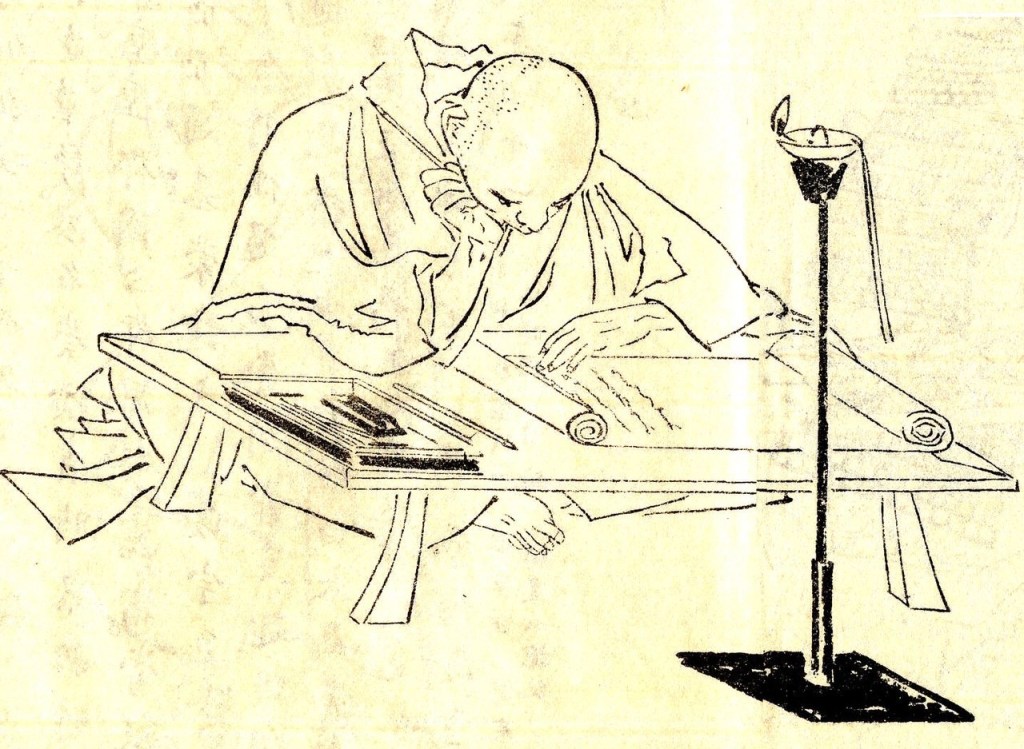
A depiction of Kenkō, drawn centuries later by Kikuchi Yōsai. Courtesy of Wikipedia Commons.

The Tsure-zure-gusa was written by a Buddhist monk of the Jodo-shu sect named Yoshida Kenkō (吉田兼好, 1283?–1350?). The text was composed between 1330 and 1332, and is a form of free-form writing. Kenko would just write down what he was thinking. Sometimes it was old anecdotes, or stories he had heard. At other times, he wrote deeper thoughts about life. Sometimes, he would just point out social faux-pas committed by others. There is no overarching messages in the text, but it covers many aspects of life, so it’s a fascinating look at Japan during the Kamakura Period (12th-14th century) as well as food for thought.

For example, here’s a commentary on fish:

119) The fish called katsuo is unequaled among those caught in the sea off Kamakura, and of late has been much in demand. An old gentleman of Kamakura told me, “When we were young, this fish was never served to persons of quality. Even the servants refused to eat the head. They cut it off and threw it away. It is typical of these degenerate times that such fish have become accepted.

Translation by Donald Keene

Interestingly, katsuo (known in English as bonito) is pretty universal in Japanese cuisine now as it is the most common ingredient of dashi (fish broth), as well as numerous dishes.

Another amusing example:

57) It is exasperating when discussions of poetry are devoted to bad poems. How, one wonders, could anyone with the smallest knowledge of the art have supposed such verses were worthy of discussion?

Even to an outsider, it is both embarrassing and painful to listen to someone discuss a subject — whatever it may be — that he doesn’t really know.

Translation by Donald Keene

One can imagine a bad TED Talk the same way too.

The text is at times surprisingly relevant to people living in the 21st century, though:

29) When I sit down in quiet meditation, the one emotion hardest to fight against is a longing in all things for the past. After the others have gone to bed, I pass the time on a long autumn’s night by putting in order whatever belongings are at hand. As I tear up old correspondence I should prefer not to leave behind, I sometimes find among them samples of calligraphy of a friend who has died, or pictures he drew for his own amusement, and I feel exactly as I did at the time. Even with letters written by friends who are still alive I try, when it has been long since we met, to remember the circumstances, the year. What a moving experience that is! It is sad to think that a man’s familiar possessions, indifferent to his death, should remain unaltered long after he is gone.

Translation by Donald Keene

It’s a pretty moving book to read, with all its random quips, reflections on an age now gone, plus deeper thoughts. The Donald Keene copy is hard to find now, but I have seen other good translations too, so don’t hesitate to pick one up if you can find it.

1 The phrase つれづれ (徒然 tsure-zure), pronounced as “tsoo-ray zoo-ray”, often appears in modern blogs or diaries as well in Japanese as a kind of introduction.

2 My wife recalls learning it, but just as reading Shakespeare without some guidance is hard for English speakers, reading the Tsure-zure-gusa to a native Japanese speaker is difficult since so many centuries have passed and the language has changed.

The End of an Era

One historical period that has continuously fascinated me for a long time is the end of the Heian Period in Japan, culminating in the climactic war between the Heike (Taira) Clan and the Genji (Minamoto) Clan, followed by the rise of military government for the next 800+ years.

“How did you go bankrupt?” Bill asked.

“Two ways,” Mike said. “Gradually and then suddenly.”

The Sun Also Rises by Ernest Hemingway

Why does this matter?

As the quote above suggests, the fall of the Heian Period and of the Imperial aristocracy, built around a Chinese-inspired Confucian bureaucracy, came slow, then suddenly when the lower samurai class rose and and asserted power. Let’s compare the before and after:

The Latter Days of the Heian Period

Fujiwara no Kinto, as depicted in One Hundred Aspects of the Moon, courtesy of Wikipedia.

The Heian Period (平安時代, 794 – 1185) of Japanese was a long, 400-year period, that began when the Imperial capitol moved to the new city of Heian-kyō (modern day Kyoto) away from Heijō-kyō (modern day Nara). The Imperial government had been plagued with infighting and manipulation by powerful temples in Heiji-kyo, so the Emperor decided to make a clean start and migrate the capitol.

But the earlier Nara Period and the Heian Period represent a single continuum of life in Japan where the Emperor ruled in a Chinese-Confucian style bureaucracy with Japanese characteristics. The Imperial bureaucracy was run by a large number of literate officials either through Entrance Exams that tested your knowledge of the Confucian Classics, and aspects of Chinese history, or through connections if you were nobility.

Speaking of nobility, everyone in the Court, from the lowliest bureaucrat, to the Emperor had an official rank. This was part of the old Ritsuryō system. The Emperor was automatically 1st rank upper (正一位, shō ichi-i), while just below him someone might be 1st rank lower (従一位, ju ichi-i), then 2nd rank upper (正二位, shō ni-i), and so on until you get to the lowly paper-pushing bureaucrat at 少初位下 (shō so-i no ge) rank. Each year, the Emperor would approve promotions or demotions of rank, which would be annouced, so for doing some good work, you might be promoted one year, and your stipend increased, as well as other perks. However, there was a catch. If you were born to a venerable noble family such as the Fujiwara, Ōe or Tachibana, you were automatically 5th rank or higher. If you were not, it was almost impossible to attain anything above 7th rank. Sugawara no Michizane was a rare exception, but he paid for it when court treachery got him exiled.

Thus, the aristocracy held a grip on the Imperial court, but it didn’t stop there. The aristocracy held increasingly large tracts of land called shōen (荘園) that were tax-exempt due to a loop-hole in the system. The wealth of the aristocratic families grew larger and larger while the state became increasingly bankrupt.

Further, as the Heian Period went on, the aristocracy figured out how to manipulate power even further by arranging marriages with the reigning Emperor, and if they had a son, pressure the reigning Emperor to abdicate, so the ambitious family could control the Imperial heir as a regent. Case in point, during the 990’s two different branches of the Fujiwara clan were struggling for control, on led by Fujiwara no Michitaka and the other by Fujiwara no Michinaga. Both them had daughters wed to reigning emperor Ichijō, who had multiple sons. Initially, next reigning emperor was his son Emperor Sanjō who had not been born from a Fujiwara mother, but he was soon pressured to abdicate by Fujiwara no Michinaga, thus allowing Michinaga’s grandson and Ichijo’s other son to become emperor Go-Ichijō (i.e. “Ichijō the latter”) to reign.

Things got even nuttier when certain emperors, forced to abdicate and take tonsure as Buddhist monks, figured out how to retain power behind the scenes at odds with the nobility. The most well known example was Emperor Go-shirakawa who only reigned officially as emperor for three years, but retained power as the “cloistered emperor” for another 37 years.

None of this takes into the account the growing power and political manipulation of Buddhist temples, and their armies of soldiers, an open violation of the Buddhist principle to abstain from politics and violence.

Thus with such a toxic mix of competing power centers, a crippled central government, to say nothing of the earthquakes, plagues and political neglect of the provinces.

… and then it finally started to fall apart.

The Fall

The battle of Dan-no-ura, courtesy of Wikipedia

The fall of the Heian Period and its aristocratic society started with a power struggle between the upstart Taira and Minamoto clans. Like many other samurai families, they began as little more than escorts and bodyguards to the nobility, but in time they rose to positions of power and influence, filling in the gaps of government when emperors pushed the Fujiwara back.

This culminated with the dreaded Taira no Kiyomori seizing power in all but name. This grandson, the child Emperor Antoku, technically reigned, but behind the scenes Emperor Go-Shirakawa mentioned above still held to some power, but was effectively a hostage himself. The Minamoto clan were scattered and its clan head was executed for formenting a rebellion.

Kiyomori’s grip on power didn’t last long, and wasn’t long before the his enemies in the provinces began to rally around Minamoto no Yoritomo who led a successful counterattack that resulted in a war across most of Japan, with the Taira (e.g. the “Heike clan”) mostly dominating the west and the Minamoto (e.g. the “Genji”) ruling in the eastern provinces. The current TV drama in Japan, the Thirteen Lords of Kamakura, reenacts this struggle, and the aftermath.

The Taira, including the child emperor Antoku, were wiped out at the battle of Dan-no-ura, but the battles didn’t end there. The genie was out of the bottle, and there was no going back. Minamoto no Yoritomo then seized power by compelling to emperor to recognize him as Shōgun, the generallisimo of all Japan, and he went after rivals within the Minamoto clan including the famous warrior and half-brother, Minamoto no Yoshitsune. He based his regime in the eastern city of Kamakura, not Kyoto, thus drawing power away from the old Imperial court. Emperor Go-shirakawa’s son, Emperor Go-toba, attempted one last military effort to restore the power of the Imperial court in the Jōkyū War, but the samurai class centered around Yoritomo’s widow, the powerful Hojo Masako, and Go-toba’s efforts were doomed. He was exiled until his death.

Ironically, Minamoto no Yoritomo would end his life as little more than a figurehead himself as the Hojo family he married into (ironically a branch of the Taira he defeated) manipulated marriages and increasingly held power.

In the end, the new “Kamakura Period” of history was the first of several military regimes in Japan until 1868 (arguably 1945) where the Imperial court still held nominal power, but true power rested with the military class. The old Confucian-style bureaucracy still existed, people including power warlords still held rank in the Court, but it was a shadow of its former power, and was mainly used to legitimatize the ruling shogun and little else.

On the Ground

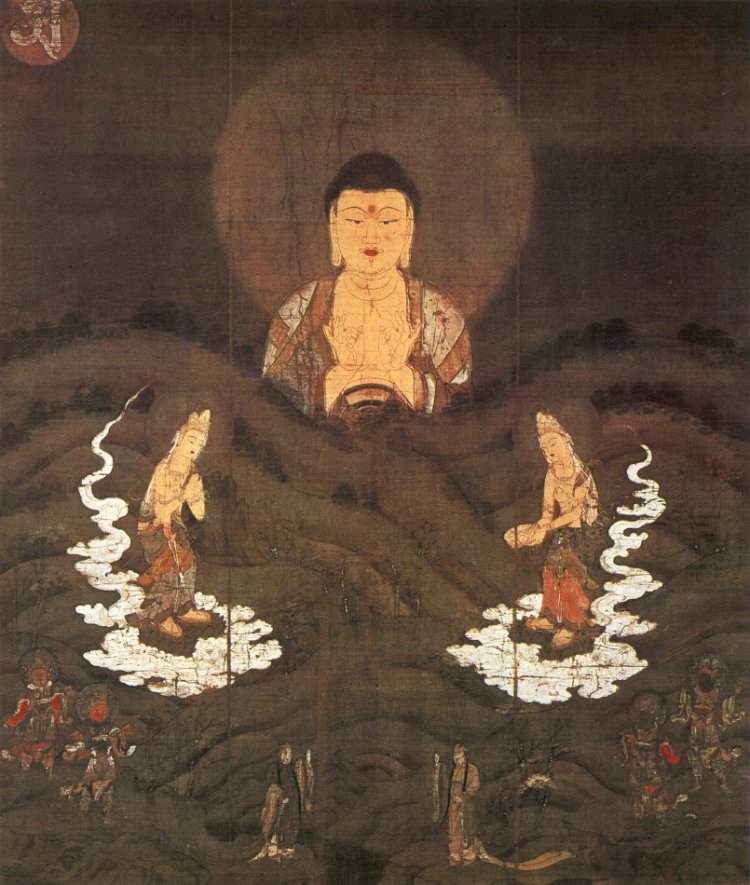
Amitabha Buddha rising over the mountain to welcome the believer to the Pure Land

Reading this history is one thing, but to people on the ground, as one crisis after another affected Japan during the end of the Heian Period both political and physical, it certainly felt like the End Times.

Millenarian Buddhist movements among the provinces sprang up in great number, as people were convinced that the era of Dharma Decline, the era mentioned in Buddhist scriptures when the Buddha-Dharma had utterly faded from the world, had come and that they were all doomed. This is why the Pure Land Buddhist movement started by Honen became so widespread and popular. By this point, people were so convinced that it was all over, they focused on escaping the endless cycle of birth and death to be reborn in the Pure Land of Amitabha Buddha instead. Pure Land Buddhism had been popular before this, but it took on a new sense of urgency under the collapse of the old society. Thus Honen’s disciples, such as Shinran, carried this message further out into the provinces and Pure Land Buddhist movements sprang up everywhere.

Nichiren Buddhism, which came slightly, was a similar millenarian movement, but instead Nichiren blamed society’s ills ironically on the Pure Land movement itself for leading society away from the True Dharma (e.g. the Lotus Sutra). Like many others in society, including Honen a couple generations earlier, Nichiren was appalled by the death, warfare and disasters affecting Japan and felt there had to be a reason for it all.

This may seem odd to us in the 21st century, but for people who grew up that the world around them was governed by the Buddha-Dharma (or lack of it), this is the only conclusion that would make sense. We in our time believe the world is governed by science, so when something happens, we tend to look for a scientific-analytical explanation. When the Byzantines in the 8th century saw their world collapse due to the Plague of Justinian followed by invasions from the new Muslim Arabs, they saw felt that their world that had been governed by God as approaching the End Times too, culminating with the siege of Constantinople itself. Thus, Iconoclasm sprang up soon after.

In each case, people are faced with a cataclysm and are using reason to try to come to grips with what’s going on, and how to fix it. We can look back and laugh and people for their “backward views”, but what will people say about us 1,000 years in the future, I wonder?

The Aftermath

In any case, once the war between the Taira and the Minamoto ended and the capital was moved to Kamakura, life in Japan was simply never the same. Generations had lived with the trauma of last years of the Heian Period, the warfare and so on, and much of the literature of the time including the Hojoki and the Essays in Idleness carry a sense of “paradise lost”. It was over. Everyone knew it, and there would be no going back.

And yet, for all the sadness and sense of loss, Japan did carry on through many subsequent generations to be the country it is today. The court life of the Heian Period is still remembered in things such as the Hyakunin Isshu poetry anthology, doll displays on Girls’ Day, woodblock art, and so on. And of course, historical dramas.

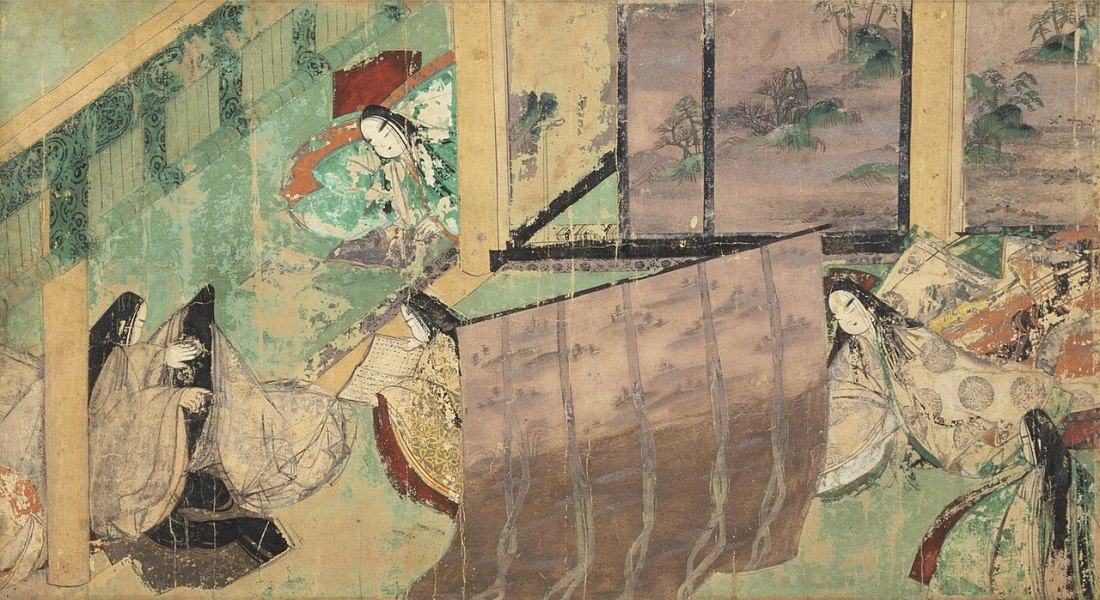
P.S. A scene from the Illustrated scroll of Tale of Genji (11th cent.), depicting the Azuma-ya (“East Wing”). Imperial court in Kyoto, Public domain, via Wikimedia Commons

The Hojoki: A Record of my Ten-Square Hut

Life in Japan was especially hard during the last half of the twelfth century to the first half of the thirteenth. The historical transition from the aristocratic Heian Period to the militaristic Kamakura Period was a time of tremendous political upheaval, nationwide warfare between the Heike and Genji samurai clans, and finally good ol’ fashioned plagues, famines and natural disasters. In time, Japan did rebuild, and life moved on, but within a couple generations a great deal in Japan had changed.

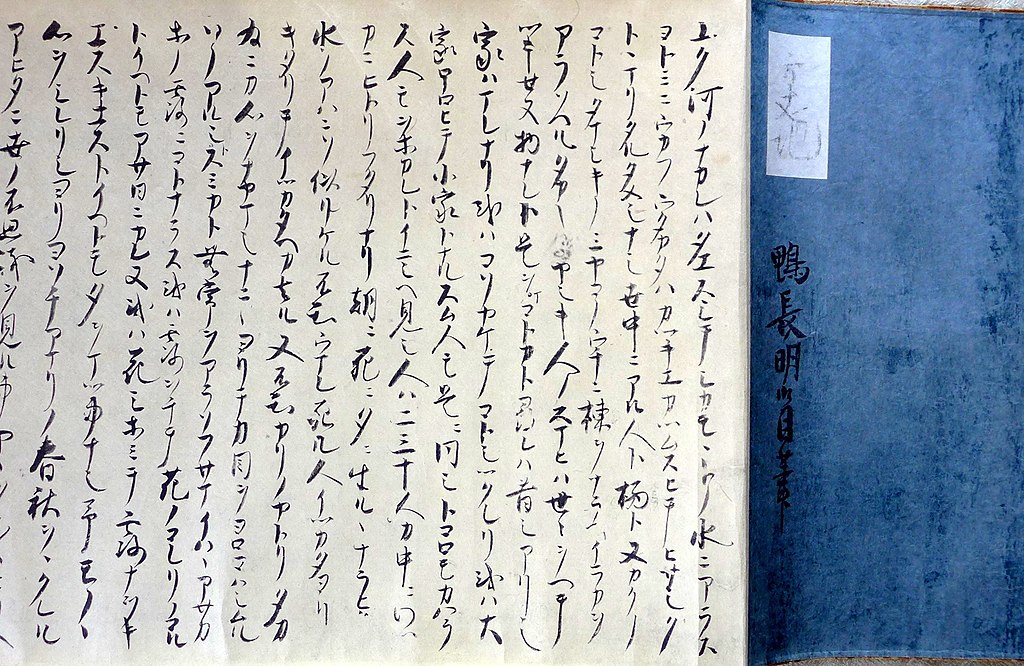
It was under this backdrop that a man named Kamo no Chōmei (鴨長明, 1155-1216), a former poet of the Imperial court turned Buddhist renunciant, composed a small work in 1212 around the age of 60 detailing the dramatic and painful changes in society, and his subsequent self-imposed hermitage in a tiny hut titled the Hōjōki (方丈記). The term hōjō (方丈) is a unit of measure meaning 10 square shaku which is very close to 10 square feet, and “ki” (記) just means a record of something. So, it’s reasonable to translate this as “A Record of [my] Ten Square Foot Hut”.

The inspiration for the hut, which was in the hills southeast of Kyoto (photos here), was from the legendary Buddhist figure Vimalakirti who practiced the Buddhist path from a similar hut in India.

Kamo no Chōmei spends much time in the Hojoki explaining the numerous disasters and tragic tales that befell the capital, Heian-Kyo (now modern Kyoto) during the 1180’s (the Yōwa era), and the social upheaval of the time. For this blog post, I am using Dr Meredith McKinney’s translation from the the book Three Japanese Buddhist Monks, published by Penguin Random House.

All this drove people throughout the provinces to leave their land and migrate elsewhere, or desert their homes and simply take to the hills. Various prayers to the gods were instigated and fervent Buddhist ceremonies performed at the palace, but to no avail….People [in the capital] were driven to offer all their treasured possessions to buyers for a song, but no one would so much as glance at them. And if any exchange did happen to be made, money meant almost nothing, while grain was everything. Beggars crowded the roadsides, and the sound of wailing filled the ears.

Pages 9-10

Kamo no Chōmei then continues on with a series of disasters that came after: a pandemic, scarcity of basic goods, an earthquake, and so on. Starvation and illness were rampant, and Kamo no Chōmei saw many heart-breaking sights:

….In their sympathy for one another they [husband or wife] would put themselves second, and give their partner any rare morsel that came their way. So also, if parent and child lived together the parent was always the first to die.; a baby would like suckling, unaware that its mother was dead.

Page 11

He summarizes all this with the words:

Yes, take it for all in all, this world is a hard place to live, and both we and our dwellings are fragile and impermanent, as these events reveal.

Page 13

Then, the Hojoki shifts gears, and Kamo no Chōmei discusses his own failed career in the Court bureaucracy, and eventual hermitage.

All told, I spent some thirty troubled years withstanding the vagaries of this world. At each new setback, I understood afresh how wretched my luck is. And so, in the spring of my fiftieth year, I came to leave my home and take tonsure, and turned my back on the world. I had never had a wife and children, so there were no close ties that were difficult to break. I had no rank [in the imperial court] and salary to forgo. What was there to hold me to the world? I made my bed among the clouds of Ōhara’s mountains…

page 15

He describes his hut in detail, discussing the garden, water system, farming he does to make ends meet, and his relations with a father and son living nearby. He talks about his small Buddhist altar, and his devotion to Amitabha Buddha, with whom he hopes to be reborn in the Pure Land after death.

Finally, he reminisces about the capital and how much things have changed:

When news of the capital happens to come my way, I learn of many people in high places who have met their end since I retired to this mountain, and other lesser folk besides, too many to be told. And how many houses too, have been lost in all those fires? In all this, my mere passing shelter has remained tranquil and safe from fears.

page 19

and contrasts it with his own life:

I love my tiny hut, my lonely dwelling. When I chance to go down to the capital, I am ashamed of my lowly beggar status, but once back here again I pity those who chase after sordid rewards of the world.

page 21

In the final page though, he begins to doubt his own progress along the Buddhist path due to his attachment to his quiet life and hut, and whether he’s simply traded one set of delusions and attachments for another. To this he ends the text with these words:

When I confront my heart thus, it cannot reply. At most, this mortal tongue can only end in three faltering invocations [the nembutsu] of the holy, unapproachable name of Amida.

page 22

Throughout the Hojoki, there is a strong sense of Buddhist impermanence, things coming and going, the pointlessness of attaining ephemeral benefits in this world, the empty decadence, and bittersweet nostalgia for the good old days in the Capital (Kyoto) before the war. Anyone who’s read The Great Gatsby might appreciate a common thread between the two books, even if separated by almost 1,000 years and totally different cultures.

I highly recommend anyone reading the Hojoki if they have an hour or two to spend. This is a good online translation in particular, but I also think Meredith McKinney’s is also excellent and worth picking up. The Hojoki is short, about 20 pages in a modern book, but a fascinating look at the last days of the historical “Heian Period” of Japan, the passing of a golden age in Japan, and life since then. Plus, it is a reminder that the powerful do not last very long anyway. It’s pretty grim at times, somewhat bittersweet in others, but I think there’s something for everyone.

Edit: updated blog post with Meredith McKinney’s translation as I like her style more.

Meet The Original Triforce: The Hojo Clan!

I was cleaning out old photos from my phone’s camera roll, when I realized that I still had photos left over from this post, including a photo of my omamori charm that I got from Enoshima Shrine way back in 2019. Sadly that was my last trip to Japan, and I haven’t been able to return my omamori since.

One thing a careful observer might notice the three triangles at the top. This is probably the most famous family crest (kamon 家紋) in the history of Japan because it’s also the inspiration for the Triforce of the Legend of Zelda series!

An example of the Hojo Family crest on a stone lantern, which I took in 2010 at Ueno Park in Tokyo, Japan. Clearly the Hojo family influence extended beyond the borders of Kamakura.

The Hojo Clan was a powerful clan during the Kamakura Period of Japanese history, and has an interesting history. Originally, the Hojo Clan was an offshoot of the Heike (Taira) Clan, but during the famous Genpei War, they openly sided with the Taira’s enemy, the Genji (Minamoto) Clan after being snubbed by the Heike due to a succession issue. The Genpei War ended with the total destruction of the Heike Clan, and the Genji Clan under Minamono no Yoritomo became the ascendant power. The power of the Emperor and his Court in Kyoto effectively ended and was now in the hands of Genji Clan’s samurai forces, who were based in Kamakura far to the east.

What’s interesting is that while Minamoto no Yoritomo was the clear victor and the first Shogun of the new government in Kamakura, he was surrounded by Hojo Clan allies, and before long married into the family through Hojo Masako. Within a generation, the Kamakura Shogunate was entirely controlled and managed by the Hojo Clan, and the Minamoto clan whom they nominally served was relegated to mere figureheads.

The historical drama (Japanese: 大河ドラマ. taiga dorama), 鎌倉殿の13人 or “The 13 Lords of the [Kamakura] Shogun” is about the struggle for power by several Hojo family members, and their rivals, after the death of Minamoto no Yoritomo. It’s been fun to watch so far.

So, the next time you see the Triforce in a Zelda game, don’t forget the powerful clan that was behind it all.