Recently my wife shared a certain Youtube channel in Japanese by a Nichiren priest1 who lives in Kyoto. It’s a nice channel with some good Dharma talks, and good English translations via closed-captioning. In particular, she shared this video with me. The owner does not allow embedding into the blog, so you’ll have to click on the link above instead.
This is a story from the priest’s own childhood and reflects a Japanese sentiment that the dead remain with us for some time. This is not always seen as a bad thing, just more of a sensitivity to death and mortality, especially the loss of loved ones. It also plays into various practices and superstitions as well, which are too many to go into here. Also, the word “gacha-gacha” are the little capsule machines in Japan that have knick-knacks, toys and such.
Japanese ghost stories, such as those in the famous collection Kaidan (or Kwaidan in older spellings) are not the same as ghost stories in the West which tend to focus on evil or tragic stories. Japanese ghost stories, by contrast, tend to be more weird and less scary. Of course, there are exceptions such as the films The Ring and The Grudge. So, it’s not all roses.
But I digress. The video above is actually a very interesting story, and well worth watching. Enjoy!
P.S. of course if you don’t believe in ghosts or prefer not to deal with them, remember this scene from Thor: Ragnarok:
1 For various and complicated reasons, Nichiren Buddhism tends to have a lot of sub-sects, and they frankly don’t always get along. Most overseas Westerners tend to encounter fringe sects and offshoots2 such as Nichiren Shoshu or more oftentimes SGI (Soka Gakkai), or Rissho Kosei-kai. I have had positive experiences with RKK myself, though I am not a follower. But it’s important to remember that these are offshoots, and not necessarily “normative” Nichiren Buddhism. Mainstream Nichiren Buddhism, or Nichiren-shu, is the mainstream branch and has the most extensive history. It is what you see most often in Japan. They all chant the odaimoku (Namu Myoho Renge Kyo), but disagree on matters of interpretation and practice. As the Romans would say: Caveat Emptor.
2 This issue of fringe sects having many followers in the West is not limited to Nichiren Buddhism. You can find this in western Tibetan Buddhist communities, Zen communities, etc. Westerners are often converts with zero experience in Buddhist culture, and looking for answers. It’s not hard for a cult to gain followers easily this way, even when the home culture rejects them. I wish I could offer advice on this, but there’s not much I can say other than do your homework, be cautious, and if a sect’s claims seem outlandish no matter how much you might agree with them, they probably are outlandish.
In the 19th-century book Kwaidan, a collection of strange and scary Japanese stories, one of the most famous stories is called Yuki-Onna (雪女, lit. “Snow Woman”). Unlike other stories that Lafcadio Hearn collected, he claimed that this one was told to him directly by a local who somehow passed on the tale. I’ve posted it here verbatim from Project Gutenberg.1
Unlike other stories in Kwaidan, Yuki-Onna is less of a scary story than it is a weird story, but also if you play D&D/Pathfinder, I think the idea of a beautiful snow spirit wandering the woods and killing people by stealing their warmth, would make an interesting, albeit short, campaign setting too.2
Of the stories in Kwaidan, it is one of the most popular, and frequently shows up in Japanese media. One of my favorite comedy shows did a 3-minute summary of it in Japanese (sorry, no English, but the animation is great), joking how the identity of “O-Yuki” was painfully obvious:
As this is Obon Season in Japan, it’s a great time to enjoy another scary story or two…
In a village of Musashi Province (1), there lived two woodcutters: Mosaku and Minokichi. At the time of which I am speaking, Mosaku was an old man; and Minokichi, his apprentice, was a lad of eighteen years. Every day they went together to a forest situated about five miles from their village. On the way to that forest there is a wide river to cross; and there is a ferry-boat. Several times a bridge was built where the ferry is; but the bridge was each time carried away by a flood. No common bridge can resist the current there when the river rises.

Mosaku and Minokichi were on their way home, one very cold evening, when a great snowstorm overtook them. They reached the ferry; and they found that the boatman had gone away, leaving his boat on the other side of the river. It was no day for swimming; and the woodcutters took shelter in the ferryman’s hut,—thinking themselves lucky to find any shelter at all. There was no brazier in the hut, nor any place in which to make a fire: it was only a two-mat[1] hut, with a single door, but no window. Mosaku and Minokichi fastened the door, and lay down to rest, with their straw rain-coats over them. At first they did not feel very cold; and they thought that the storm would soon be over.

The old man almost immediately fell asleep; but the boy, Minokichi, lay awake a long time, listening to the awful wind, and the continual slashing of the snow against the door. The river was roaring; and the hut swayed and creaked like a junk at sea. It was a terrible storm; and the air was every moment becoming colder; and Minokichi shivered under his rain-coat. But at last, in spite of the cold, he too fell asleep.

He was awakened by a showering of snow in his face. The door of the hut had been forced open; and, by the snow-light (yuki-akari), he saw a woman in the room,—a woman all in white. She was bending above Mosaku, and blowing her breath upon him;—and her breath was like a bright white smoke. Almost in the same moment she turned to Minokichi, and stooped over him. He tried to cry out, but found that he could not utter any sound. The white woman bent down over him, lower and lower, until her face almost touched him; and he saw that she was very beautiful,—though her eyes made him afraid. For a little time she continued to look at him;—then she smiled, and she whispered:—“I intended to treat you like the other man. But I cannot help feeling some pity for you, because you are so young... You are a pretty boy, Minokichi; and I will not hurt you now. But, if you ever tell anybody even your own mother—about what you have seen this night, I shall know it; and then I will kill you... Remember what I say!”

With these words, she turned from him, and passed through the doorway. Then he found himself able to move; and he sprang up, and looked out. But the woman was nowhere to be seen; and the snow was driving furiously into the hut. Minokichi closed the door, and secured it by fixing several billets of wood against it. He wondered if the wind had blown it open;—he thought that he might have been only dreaming, and might have mistaken the gleam of the snow-light in the doorway for the figure of a white woman: but he could not be sure. He called to Mosaku, and was frightened because the old man did not answer. He put out his hand in the dark, and touched Mosaku’s face, and found that it was ice! Mosaku was stark and dead...

By dawn the storm was over; and when the ferryman returned to his station, a little after sunrise, he found Minokichi lying senseless beside the frozen body of Mosaku. Minokichi was promptly cared for, and soon came to himself; but he remained a long time ill from the effects of the cold of that terrible night. He had been greatly frightened also by the old man’s death; but he said nothing about the vision of the woman in white. As soon as he got well again, he returned to his calling,—going alone every morning to the forest, and coming back at nightfall with his bundles of wood, which his mother helped him to sell.

One evening, in the winter of the following year, as he was on his way home, he overtook a girl who happened to be traveling by the same road. She was a tall, slim girl, very good-looking; and she answered Minokichi’s greeting in a voice as pleasant to the ear as the voice of a song-bird. Then he walked beside her; and they began to talk. The girl said that her name was O-Yuki;[2] that she had lately lost both of her parents; and that she was going to Yedo (2), where she happened to have some poor relations, who might help her to find a situation as a servant. Minokichi soon felt charmed by this strange girl; and the more that he looked at her, the handsomer she appeared to be. He asked her whether she was yet betrothed; and she answered, laughingly, that she was free. Then, in her turn, she asked Minokichi whether he was married, or pledged to marry; and he told her that, although he had only a widowed mother to support, the question of an “honorable daughter-in-law” had not yet been considered, as he was very young... After these confidences, they walked on for a long while without speaking; but, as the proverb declares, Ki ga aréba, mé mo kuchi hodo ni mono wo iu: “When the wish is there, the eyes can say as much as the mouth.” By the time they reached the village, they had become very much pleased with each other; and then Minokichi asked O-Yuki to rest awhile at his house. After some shy hesitation, she went there with him; and his mother made her welcome, and prepared a warm meal for her. O-Yuki behaved so nicely that Minokichi’s mother took a sudden fancy to her, and persuaded her to delay her journey to Yedo. And the natural end of the matter was that Yuki never went to Yedo at all. She remained in the house, as an “honorable daughter-in law.”

O-Yuki proved a very good daughter-in-law. When Minokichi’s mother came to die,—some five years later,—her last words were words of affection and praise for the wife of her son. And O-Yuki bore Minokichi ten children, boys and girls, handsome children all of them, and very fair of skin.

The country-folk thought O-Yuki a wonderful person, by nature different from themselves. Most of the peasant-women age early; but O-Yuki, even after having become the mother of ten children, looked as young and fresh as on the day when she had first come to the village.

One night, after the children had gone to sleep, O-Yuki was sewing by the light of a paper lamp; and Minokichi, watching her, said:—

“To see you sewing there, with the light on your face, makes me think of a strange thing that happened when I was a lad of eighteen. I then saw somebody as beautiful and white as you are now—indeed, she was very like you.”...

Without lifting her eyes from her work, O-Yuki responded:—

“Tell me about her... Where did you see her?”

Then Minokichi told her about the terrible night in the ferryman’s hut,—and about the White Woman that had stooped above him, smiling and whispering,—and about the silent death of old Mosaku. And he said:—

“Asleep or awake, that was the only time that I saw a being as beautiful as you. Of course, she was not a human being; and I was afraid of her,—very much afraid,—but she was so white!... Indeed, I have never been sure whether it was a dream that I saw, or the Woman of the Snow.”...

O-Yuki flung down her sewing, and arose, and bowed above Minokichi where he sat, and shrieked into his face:—

“It was I—I—I! Yuki it was! And I told you then that I would kill you if you ever said one word about it!... But for those children asleep there, I would kill you this moment! And now you had better take very, very good care of them; for if ever they have reason to complain of you, I will treat you as you deserve!”...

Even as she screamed, her voice became thin, like a crying of wind;—then she melted into a bright white mist that spired to the roof-beams, and shuddered away through the smoke-hole.... Never again was she seen.
Enjoy!
1Note: This eBook is for the use of anyone anywhere at no cost and with almost no restrictions whatsoever. You may copy it, give it away or re-use it under the terms of the Project Gutenberg License included with this eBook or online at http://www.gutenberg.net
2 At least, it would make a good one-shot adventure?
With Obon Season coming to Japan in late July and August, this is also the time of the Segaki (施餓鬼) ceremony in many Buddhist temples.
In Buddhism, one of the six (sometimes five or ten) realms of rebirth that brings undergo based on accumulated karma is the realm of the Hungry Ghosts, called preta in India, or gaki (餓鬼) in Japanese.
From a 12th century scroll depicting hungry ghosts living among us unseen, feeding on refuse, feces, water, etc. Courtesy of Wikipedia.
Hungry Ghosts are those whose past lives were defined by extreme vice and craving. This could be alcohol, drugs, women, money, etc. The usual. This craving carries over and they lived as hungry shades, unseen by the living, surviving off of scraps in the shadows. Further, the foods they are forced to eat, garbage, feces, blood, etc, are never enough, so such ghosts are constantly hungry and living in misery. It is the second-worst realm of rebirth apart from the hell realms in the Buddhist cosmology.
Thus, the segaki ritual, practiced in all Buddhist sects except Jodo Shinshu, is meant to help alleviate their craving, at least for a short while, also in hopes (depending on sect) that they can be reborn in the Pure Land of Amitabha Buddha next.
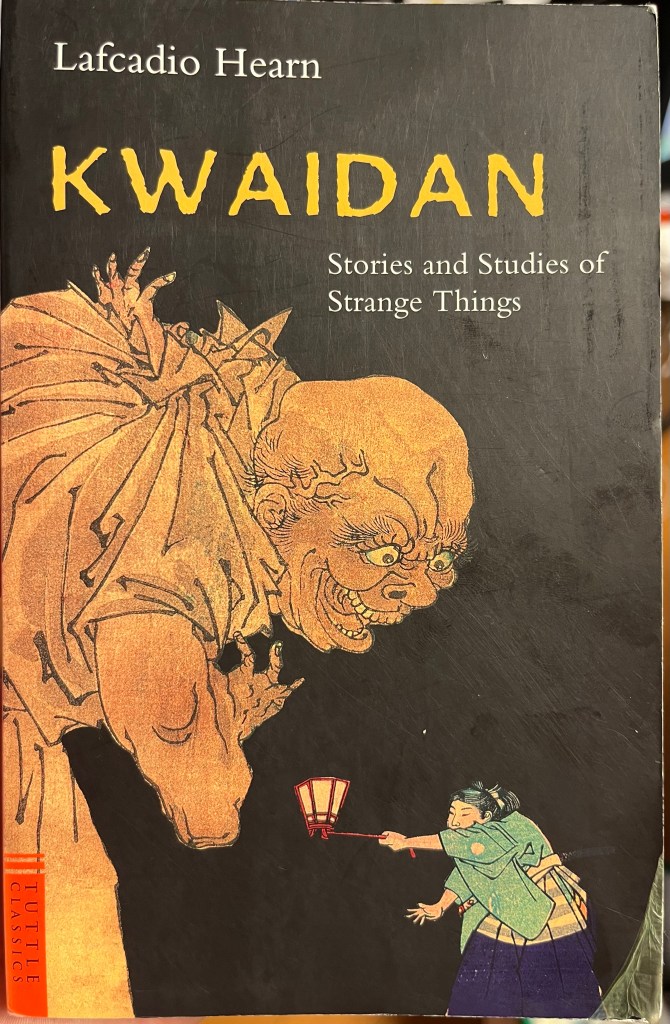
Just as early American history is replete with strange or weird stories such as Rip Van Winkle, and the Legend of Sleepy Hollow and its headless horseman, all composed by Washington Irving, Japan has a collection of weird and strange stories compiled in a book called Kwaidan (怪談), which in modern Japanese is Kaidan.
A used copy of the Tuttle Classics edition that I picked up a while back.
The full title is Kwaidan: Stories and Studies of Strange Things and was written by Greco-Irish author Lafcadio Hearn (1850-1904). Hearn had worked in journalism in the US for several years before moving to Japan, and settling down there, taking a Japanese wife and Japanese name, Koizumi Yakumo (小泉八雲), and writing many about early-modern, Imperial Japan.
Kaidan (using the modern spelling from here on out), Hearn admits in the foreword, is compiled from earlier Japanese sources, but it was the first of its kind published in English, and is even popular among Japanese audiences because it’s such a good compilation of disparate stories that have floated around Japanese culture for centuries. In the same way, the stories of Washington Irving drew on older European tales, but retold in an early American colonial setting.
By today’s standards, the stories in Kaidan, just like those of Irving, are pretty tame, more spooky or just plain weird. But they are full of vivid imagery that remains popular to this day. When Obon Season comes in Japan, usually starting around July 15th (not October like in the US), it is a popular time to relive these stories in TV and other media.
Because Kaidan is so old it is available for free on places like Project Gutenberg. If you like a physical copy though, you can easily find used ones online.
I have linked a few stories from Kaidan that I previously posted in the past.
Yuki-Onna, an example of a story from Kwaidan that’s less scary, and more weird.
One other aspect of the book not usually covered is the last section where Hearn shifts entirely to observations about insects in Japan, namely butterflies, ants, and mosquitoes. He then applies Japanese-Buddhist moral interpretations to them. Hearn, who was deeply fascinated by Buddhism, makes a few pointed comments about Christianity, while carefully any hint of criticism to his Western audience at the time. No doubt, at the time, this was probably a touch scandalous.
Hearn’s writings about Japan, and his understanding of Japanese culture and language (“honorable” this, and “honorable” that 🤦🏼♂️), don’t necessarily age well, but he was also one of the very first Westerners to be immersed and so I tend to give him a pass on many things (his publisher’s comments about Japanese women in the introduction are a bit cringey, though).
I tend to think of Hearn as something of a kindred spirit, separated by 120 years of time.
Maybe there’s something weird about that too. 😉
P.S. I learned from the Japanese Wikipedia article that the “Kw” in Kwaidan is probably a feature of the Izumo-dialect of Japanese that Hearn was immersed in the town of Matsue in Western Japan where he lived.
P.P.S. There was also apparently a film based on the book in 1965, though I have never seen it. I enjoy the written version more, perhaps.
Late July through August is the Obon season in Japan, which mirrors Halloween in the West, or Day of the Dead in Mexico. It is both a time to return to one’s hometown, reconnect to family, pay respects to one’s ancestors, but also to delve into matters of death, afterlife, ghosts, etc.
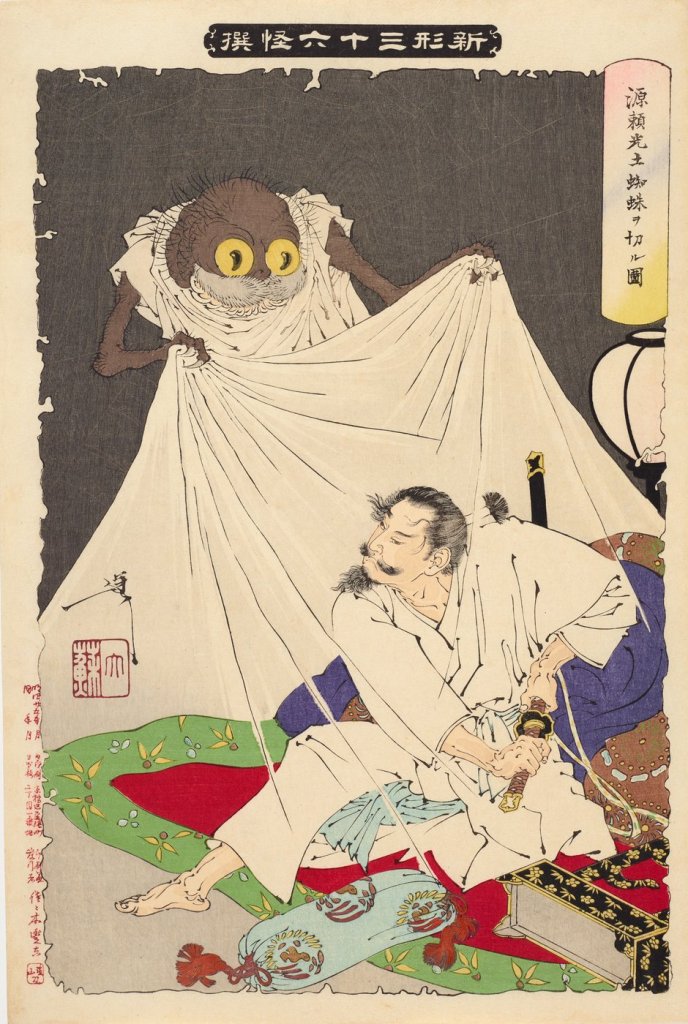
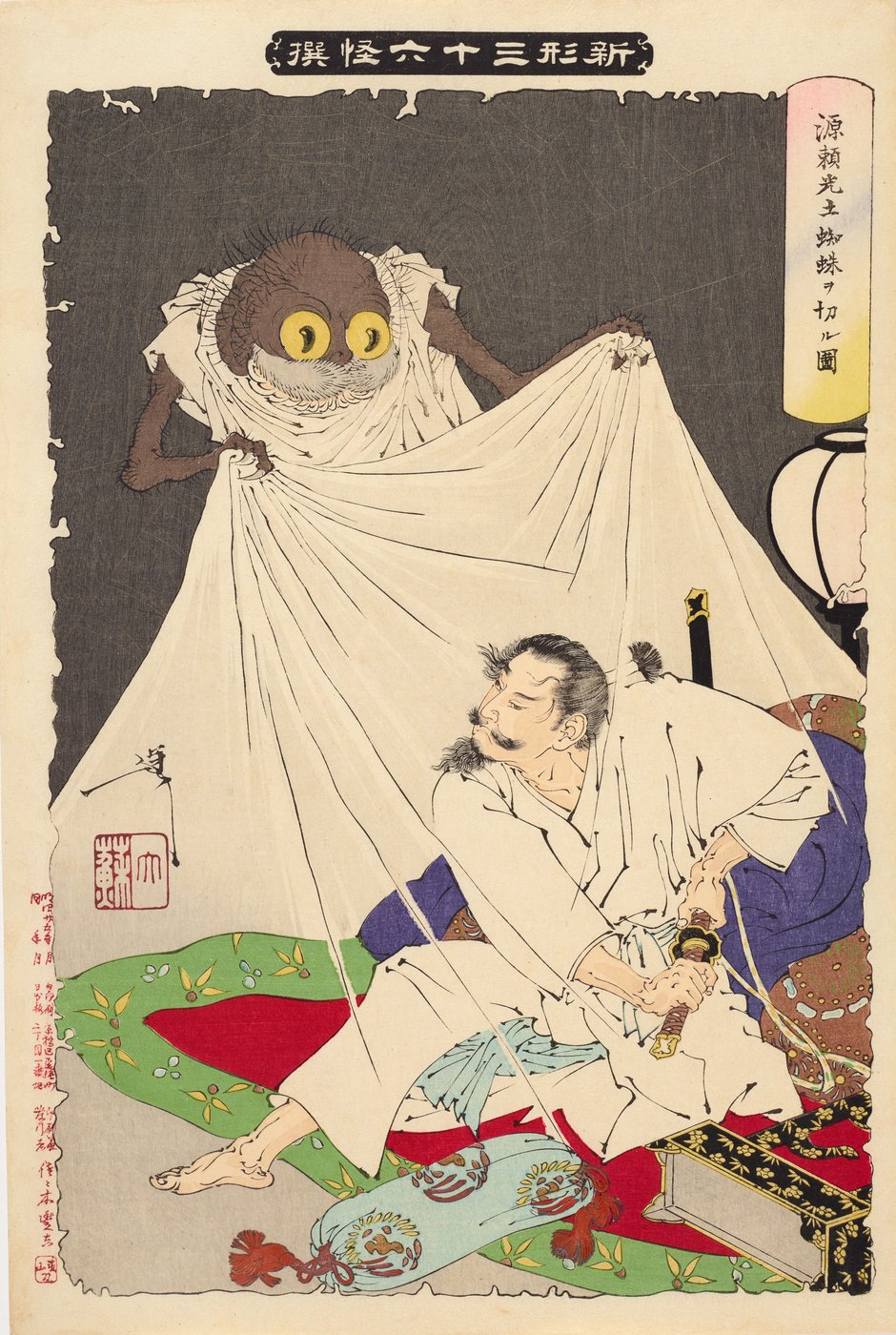
10th century warlord, Minamoto no Yorimitsu battling a spider monster, as depicted in wood-block print by Yoshitoshi in 1892 by Tsukioka Yoshitoshi, Public domain, via Wikimedia Commons. This would make a pretty neat D&D campaign by the way.
The yokai (monsters and ghosts) of pre-modern Japan differ in many ways to the traditional Halloween, gothic monsters we know, but are rich in variety from simple kasa-obaké “umbrella ghost” to terrifying nekomata “cat demon”. For people who enjoy playing TTRPG games, it is a wealth of material and inspiration, though as with any cross-cultural games, it’s important to be mindful of other people’s culture.
The rich world of Yokai is exemplified by a famous collection of ghost stories called Kaidan (怪談), compiled by the Greco-Irish author Lafcadio Hearn in 1904. Lafcadio Hearn is a fascinating man, who was one of the first Westerns to live in Japan and start a family there, and someone whose works I’ve admired for many years.1 His most well-known work today is Kaidan, but I highly recommend his other writings too. Kaidan, archaic spelling “Kwaidan”, is Hearn’s retelling of various ghost stories he’s heard with his own dramatic flourish. It is well known among Japanese audiences, and has influenced pop-culture since.
Previously, I compiled some of my favorite stories here, re-posting from the Project Gutenberg originals:
Mujina – this a short, short tale, but is a great story to retell to others. It also plays into the traditional belief of tanuki as malicious, mischief makers.
A Dead Secret – this is less of a terrifying ghost story, and falls more under the “weird” genre that you often see in Kaidan. It is one of my favorites, and was the inspiration of a Dungeons and Dragons one-shot module I published on DMS Guild: A Letter Buried.
Earless Hoichi – this story is one of the most iconic of Kaidan, and does a great job of linking the fall of the ancient Heike clan, with a compelling ghost story. The hinotama “ghost lights”, similar to will-o-wisp in the West, are a popular monster you see in Japanese pop culture and make for good D&D monsters too. I have posted monster stat blocks in A Traveler’s Guide to the Hamato Islands if interested.
Kaidan is a great book to pick up if you’re looking for inspiration, or interested in Japanese culture just as it was on the cusp of modernization from the earlier Edo Period of history to the modern-industrial Meiji Period.
1Kokoro is another good read, though it is more focused on daily life in Japan at the time, while Gleanings in Buddha-Fields delves into more spiritual matters.
The following is yet another of my favorite stories from the 19th-century collection of Japanese ghost stories called Kwaidan (怪談) written by Greco-Irish author Lafcadio Hearn. This story relates to the ancient, climactic sea battle of Dan-no-ura which ended the Genpei War in the 12th century. In this battle, the infant emperor Antoku was drowned with his nursemaid as the once mighty Heike clan (a.k.a. Taira clan) faced annihilation.
Along with Yuki-Onna, this is a well-known tale in Japanese culture, and one of my favorite comedy shows did a 3-minute summary of the tale here (Japanese only, sorry):
As this is Obon Season in Japan, it’s a great time to enjoy a scary story or two…
THE STORY OF MIMI-NASHI-HOICHI

More than seven hundred years ago, at Dan-no-ura, in the Straits of Shimonoseki, was fought the last battle of the long contest between the Heike, or Taira clan, and the Genji, or Minamoto clan. There the Heike perished utterly, with their women and children, and their infant emperor likewise--now remembered as Antoku Tenno. And that sea and shore have been haunted for seven hundred years... Elsewhere I told you about the strange crabs found there, called Heike crabs, which have human faces on their backs, and are said to be the spirits of the Heike warriors [1].  But there are many strange things to be seen and heard along that coast. On dark nights thousands of ghostly fires hover about the beach, or flit above the waves,--pale lights which the fishermen call Oni-bi, or demon-fires; and, whenever the winds are up, a sound of great shouting comes from that sea, like a clamor of battle.

In former years the Heike were much more restless than they now are. They would rise about ships passing in the night, and try to sink them; and at all times they would watch for swimmers, to pull them down. It
was in order to appease those dead that the Buddhist temple, Amidaji, was built at Akamagaseki [2]. A cemetery also was made close by, near the beach; and within it were set up monuments inscribed with the names of the drowned emperor and of his great vassals; and Buddhist services were regularly performed there, on behalf of the spirits of them. After the temple had been built, and the tombs erected, the Heike gave less trouble than before; but they continued to do queer things at intervals,--proving that they had not found the perfect peace.

Some centuries ago there lived at Akamagaseki a blind man named Hoichi, who was famed for his skill in recitation and in playing upon the biwa[3]. From childhood he had been trained to recite and to play; and while yet a lad he had surpassed his teachers. As a professional
biwa-hoshi he became famous chiefly by his recitations of the history of the Heike and the Genji; and it is said that when he sang the song of the battle of Dan-no-ura "even the goblins [kijin] could not refrain from tears."

At the outset of his career, Hoichi was very poor; but he found a good friend to help him. The priest of the Amidaji was fond of poetry and music; and he often invited Hoichi to the temple, to play and recite. Afterwards, being much impressed by the wonderful skill of the lad, the priest proposed that Hoichi should make the temple his home; and this offer was gratefully accepted. Hoichi was given a room in the temple-building; and, in return for food and lodging, he was required only to gratify the priest with a musical performance on certain evenings, when otherwise disengaged.

One summer night the priest was called away, to perform a Buddhist service at the house of a dead parishioner; and he went there with his
acolyte, leaving Hoichi alone in the temple. It was a hot night; and the blind man sought to cool himself on the verandah before his
sleeping-room. The verandah overlooked a small garden in the rear of the Amidaji.  There Hoichi waited for the priest's return, and tried to relieve his solitude by practicing upon his biwa. Midnight passed; and the priest did not appear. But the atmosphere was still too warm for comfort within doors; and Hoichi remained outside. At last he heard steps approaching from the back gate. Somebody crossed the garden, advanced to the verandah, and halted directly in front of him--but it was not the priest. A deep voice called the blind man's name--abruptly and unceremoniously, in the manner of a samurai summoning an inferior:--

"Hoichi!"

"Hai!" (1) answered the blind man, frightened by the menace in the voice,--"I am blind!--I cannot know who calls!"

"There is nothing to fear," the stranger exclaimed, speaking more gently. "I am stopping near this temple, and have been sent to you with a message. My present lord, a person of exceedingly high rank, is now staying in Akamagaseki, with many noble attendants. He wished to view the scene of the battle of Dan-no-ura; and to-day he visited that place. Having heard of your skill in reciting the story of the battle, he now desires to hear your performance: so you will take your biwa and come with me at once to the house where the august assembly is waiting."

In those times, the order of a samurai was not to be lightly disobeyed. Hoichi donned his sandals, took his biwa, and went away with the stranger, who guided him deftly, but obliged him to walk very fast. The hand that guided was iron; and the clank of the warrior's stride proved him fully armed,--probably some palace-guard on duty. Hoichi's first alarm was over: he began to imagine himself in good luck;--for, remembering the retainer's assurance about a "person of exceedingly high rank," he thought that the lord who wished to hear the recitation could not be less than a daimyo of the first class. Presently the samurai halted; and Hoichi became aware that they had arrived at a large gateway;--and he wondered, for he could not remember any large gate in that part of the town, except the main gate of the Amidaji. "Kaimon!" [4] the samurai called,--and there was a sound of unbarring; and the twain passed on. They traversed a space of garden, and halted again before some entrance; and the retainer cried in a loud voice, "Within there! I have brought Hoichi." Then came sounds of feet hurrying, and screens sliding, and rain-doors opening, and voices of women in converse. By the language of the women Hoichi knew them to be domestics in some noble household; but he could not imagine to what place he had been conducted. Little time was allowed him for
conjecture. After he had been helped to mount several stone steps, upon the last of which he was told to leave his sandals, a woman's hand
guided him along interminable reaches of polished planking, and round pillared angles too many to remember, and over widths amazing of matted floor,--into the middle of some vast apartment. There he thought that many great people were assembled: the sound of the rustling of silk was like the sound of leaves in a forest. He heard also a great humming of voices,--talking in undertones; and the speech was the speech of courts.

Hoichi was told to put himself at ease, and he found a kneeling-cushion ready for him. After having taken his place upon it, and tuned his instrument, the voice of a woman--whom he divined to be the Rojo, or matron in charge of the female service--addressed him, saying,--

"It is now required that the history of the Heike be recited, to the accompaniment of the biwa."

Now the entire recital would have required a time of many nights: therefore Hoichi ventured a question:--

"As the whole of the story is not soon told, what portion is it augustly desired that I now recite?"

The woman's voice made answer:--

"Recite the story of the battle at Dan-no-ura,--for the pity of it is the most deep." [5]

Then Hoichi lifted up his voice, and chanted the chant of the fight on the bitter sea,--wonderfully making his biwa to sound like the straining of oars and the rushing of ships, the whirr and the hissing of arrows, the shouting and trampling of men, the crashing of steel upon helmets, the plunging of slain in the flood. And to left and right of him, in the pauses of his playing, he could hear voices murmuring praise: "How marvelous an artist!"--"Never in our own province was playing heard like this!"--"Not in all the empire is there another singer like Hoichi!" Then fresh courage came to him, and he played and sang yet better than before; and a hush of wonder deepened about him. But when at last he came to tell the fate of the fair and helpless,--the piteous perishing of the women and children,--and the death-leap of Nii-no-Ama, with the imperial infant in her arms,--then all the listeners uttered together one long, long shuddering cry of anguish; and thereafter they wept and wailed so loudly and so wildly that the blind man was frightened by the violence and grief that he had
made. For much time the sobbing and the wailing continued. But gradually the sounds of lamentation died away; and again, in the great
stillness that followed, Hoichi heard the voice of the woman whom he supposed to be the Rojo.

She said:--

"Although we had been assured that you were a very skillful player upon the biwa, and without an equal in recitative, we did not know that any one could be so skillful as you have proved yourself to-night. Our lord has been pleased to say that he intends to bestow upon you a fitting reward. But he desires that you shall perform before him once every night for the next six nights--after which time he will probably make his august return-journey. To-morrow night, therefore, you are to come
here at the same hour. The retainer who to-night conducted you will be sent for you... There is another matter about which I have been ordered to inform you. It is required that you shall speak to no one of your visits here, during the time of our lord's august sojourn at
Akamagaseki. As he is traveling incognito, [6] he commands that no mention of these things be made... You are now free to go back to your
temple."


After Hoichi had duly expressed his thanks, a woman's hand conducted him to the entrance of the house, where the same retainer, who had
before guided him, was waiting to take him home. The retainer led him to the verandah at the rear of the temple, and there bade him farewell.


It was almost dawn when Hoichi returned; but his absence from the temple had not been observed,--as the priest, coming back at a very
late hour, had supposed him asleep. During the day Hoichi was able to take some rest; and he said nothing about his strange adventure. In the middle of the following night the samurai again came for him, and led him to the august assembly, where he gave another recitation with the same success that had attended his previous performance. But during this second visit his absence from the temple was accidentally
discovered; and after his return in the morning he was summoned to the presence of the priest, who said to him, in a tone of kindly reproach:--

"We have been very anxious about you, friend Hoichi. To go out, blind and alone, at so late an hour, is dangerous. Why did you go without
telling us? I could have ordered a servant to accompany you. And where have you been?"

Hoichi answered, evasively,--

"Pardon me kind friend! I had to attend to some private business; and I could not arrange the matter at any other hour."

The priest was surprised, rather than pained, by Hoichi's reticence: he felt it to be unnatural, and suspected something wrong. He feared that the blind lad had been bewitched or deluded by some evil spirits. He did not ask any more questions; but he privately instructed the men-servants of the temple to keep watch upon Hoichi's movements, and to follow him in case that he should again leave the temple after dark.

On the very next night, Hoichi was seen to leave the temple; and the servants immediately lighted their lanterns, and followed after him.
But it was a rainy night, and very dark; and before the temple-folks could get to the roadway, Hoichi had disappeared. Evidently he had walked very fast,--a strange thing, considering his blindness; for the
road was in a bad condition. The men hurried through the streets, making inquiries at every house which Hoichi was accustomed to visit;
but nobody could give them any news of him. At last, as they were returning to the temple by way of the shore, they were startled by the
sound of a biwa, furiously played, in the cemetery of the Amidaji. Except for some ghostly fires--such as usually flitted there on dark nights--all was blackness in that direction. But the men at once hastened to the cemetery; and there, by the help of their lanterns, they discovered Hoichi,--sitting alone in the rain before the memorial tomb of Antoku Tenno, making his biwa resound, and loudly chanting the chant of the battle of Dan-no-ura. And behind him, and about him, and everywhere above the tombs, the fires of the dead were burning, like candles. Never before had so great a host of Oni-bi appeared in the sight of mortal man...

"Hoichi San!--Hoichi San!" the servants cried,--"you are bewitched!...Hoichi San!"

But the blind man did not seem to hear. Strenuously he made his biwa to rattle and ring and clang;--more and more wildly he chanted the chant of the battle of Dan-no-ura. They caught hold of him;--they shouted into his ear,--

"Hoichi San!--Hoichi San!--come home with us at once!"

Reprovingly he spoke to them:--

"To interrupt me in such a manner, before this august assembly, will not be tolerated."

Whereat, in spite of the weirdness of the thing, the servants could not help laughing. Sure that he had been bewitched, they now seized him, and pulled him up on his feet, and by main force hurried him back to the temple,--where he was immediately relieved of his wet clothes, by order of the priest. Then the priest insisted upon a full explanation of his friend's astonishing behavior.

Hoichi long hesitated to speak. But at last, finding that his conduct had really alarmed and angered the good priest, he decided to abandon
his reserve; and he related everything that had happened from the time of first visit of the samurai.

The priest said:--

"Hoichi, my poor friend, you are now in great danger! How unfortunate that you did not tell me all this before! Your wonderful skill in music has indeed brought you into strange trouble. By this time you must be aware that you have not been visiting any house whatever, but have been passing your nights in the cemetery, among the tombs of the Heike;--and it was before the memorial-tomb of Antoku Tenno that our people to-night found you, sitting in the rain. All that you have been imagining was illusion--except the calling of the dead. By once obeying them, you have put yourself in their power. If you obey them again, after what has already occurred, they will tear you in pieces. But they would have destroyed you, sooner or later, in any event... Now I shall not be able to remain with you to-night: I am called away to perform another service. But, before I go, it will be necessary to protect your body by writing holy texts upon it."


Before sundown the priest and his acolyte stripped Hoichi: then, with their writing-brushes, they traced upon his breast and back, head and face and neck, limbs and hands and feet,--even upon the soles of his feet, and upon all parts of his body,--the text of the holy sutra called Hannya-Shin-Kyo. [7] When this had been done, the priest instructed Hoichi, saying:--

"To-night, as soon as I go away, you must seat yourself on the verandah, and wait. You will be called. But, whatever may happen, do not answer, and do not move. Say nothing and sit still--as if meditating. If you stir, or make any noise, you will be torn asunder. Do not get frightened; and do not think of calling for help--because no help could save you. If you do exactly as I tell you, the danger will pass, and you will have nothing more to fear."

After dark the priest and the acolyte went away; and Hoichi seated himself on the verandah, according to the instructions given him. He laid his biwa on the planking beside him, and, assuming the attitude of meditation, remained quite still,--taking care not to cough, or to breathe audibly. For hours he stayed thus.

Then, from the roadway, he heard the steps coming. They passed the gate, crossed the garden, approached the verandah, stopped--directly in front of him.

"Hoichi!" the deep voice called. But the blind man held his breath, and sat motionless.

"Hoichi!" grimly called the voice a second time. Then a third time--savagely:--

"Hoichi!"

Hoichi remained as still as a stone,--and the voice grumbled:--

"No answer!--that won't do!... Must see where the fellow is."...

There was a noise of heavy feet mounting upon the verandah. The feet approached deliberately,--halted beside him. Then, for long minutes,--during which Hoichi felt his whole body shake to the beating of his heart,--there was dead silence.

At last the gruff voice muttered close to him:--

"Here is the biwa; but of the biwa-player I see--only two ears!... So that explains why he did not answer: he had no mouth to answer with--there is nothing left of him but his ears... Now to my lord those ears I will take--in proof that the august commands have been obeyed, so far as was possible"...

At that instant Hoichi felt his ears gripped by fingers of iron, and torn off! Great as the pain was, he gave no cry. The heavy footfalls
receded along the verandah,--descended into the garden,--passed out to the roadway,--ceased. From either side of his head, the blind man felt a thick warm trickling; but he dared not lift his hands...

Before sunrise the priest came back. He hastened at once to the verandah in the rear, stepped and slipped upon something clammy, and
uttered a cry of horror;--for he saw, by the light of his lantern, that the clamminess was blood. But he perceived Hoichi sitting there, in the attitude of meditation--with the blood still oozing from his wounds.

"My poor Hoichi!" cried the startled priest,--"what is this?... You have been hurt?"

At the sound of his friend's voice, the blind man felt safe. He burst out sobbing, and tearfully told his adventure of the night.

"Poor, poor Hoichi!" the priest exclaimed,--"all my fault!--my very
grievous fault!... Everywhere upon your body the holy texts had been written--except upon your ears! I trusted my acolyte to do that part of the work; and it was very, very wrong of me not to have made sure that he had done it!... Well, the matter cannot now be helped;--we can only try to heal your hurts as soon as possible... Cheer up, friend!--the danger is now well over. You will never again be troubled by those visitors."

With the aid of a good doctor, Hoichi soon recovered from his injuries. The story of his strange adventure spread far and wide, and soon made him famous. Many noble persons went to Akamagaseki to hear him recite; and large presents of money were given to him,--so that he became a wealthy man... But from the time of his adventure, he was known only by the appellation of Mimi-nashi-Hoichi: "Hoichi-the-Earless."

NOTES:

[1] See my Kotto, for a description of these curious crabs.

[2] Or, Shimonoseki. The town is also known by the name of Bakkan.

[3] The biwa, a kind of four-stringed lute, is chiefly used in musical recitative. Formerly the professional minstrels who recited the Heike-Monogatari, and other tragical histories, were called biwa-hoshi, or "lute-priests." The origin of this appellation is not clear; but it is possible that it may have been suggested by the fact that "lute-priests" as well as blind shampooers, had their heads shaven, like Buddhist priests. The biwa is played with a kind of plectrum, called bachi, usually made of horn.

(1) A response to show that one has heard and is listening attentively.

[4] A respectful term, signifying the opening of a gate. It was used by samurai when calling to the guards on duty at a lord's gate for admission.

[5] Or the phrase might be rendered, "for the pity of that part is the deepest." The Japanese word for pity in the original text is "aware."

[6] "Traveling incognito" is at least the meaning of the original phrase,--"making a disguised august-journey" (shinobi no go-ryoko).

[7] The Smaller Pragna-Paramita-Hridaya-Sutra is thus called in Japanese. Both the smaller and larger sutras called Pragna-Paramita ("Transcendent Wisdom") have been translated by the late Professor Max Muller, and can be found in volume xlix. of the Sacred Books of the East ("Buddhist Mahayana Sutras").--Apropos of the magical use of the text, as described in this story, it is worth remarking that the subject of the sutra is the Doctrine of the Emptiness of Forms,--that is to say, of the unreal character of all phenomena or noumena... "Form is emptiness; and emptiness is form. Emptiness is not different from form; form is not different from emptiness. What is form--that is emptiness. What is emptiness--that is form... Perception, name, concept, and knowledge, are also emptiness... There is no eye, ear, nose, tongue, body, and mind... But when the envelopment of consciousness has been annihilated, then he [the seeker] becomes free from all fear, and beyond the reach of change, enjoying final Nirvana."
Special thanks to Project Gutenberg for posting this book online, which I copied this chapter verbatim.
Note: This eBook is for the use of anyone anywhere at no cost and with almost no restrictions whatsoever. You may copy it, give it away or re-use it under the terms of the Project Gutenberg License included with this eBook or online at www.gutenberg.net
The following is one of my favorite stories from the 19th-century collection of Japanese ghost stories called Kwaidan (怪談) written by Greco-Irish author Lafcadio Hearn. It is less well-known than other tales, but I really like this one, especially the ending. It is the kind of story that’s just within the realm of possibility, and is both weird and creepy at the same time.
It also inspired me to make an adventure module on DMS Guild.
As this is Obon Season in Japan, it’s a great time to enjoy a scary story or two…
A DEAD SECRET

A long time ago, in the province of Tamba (1), there lived a rich merchant named Inamuraya Gensuke. He had a daughter called O-Sono. As
she was very clever and pretty, he thought it would be a pity to let her grow up with only such teaching as the country-teachers could give her: so he sent her, in care of some trusty attendants, to Kyoto, that she might be trained in the polite accomplishments taught to the ladies of the capital. After she had thus been educated, she was married to a friend of her father's family--a merchant named Nagaraya;--and she lived happily with him for nearly four years. They had one child,--a boy.
But O-Sono fell ill and died, in the fourth year after her marriage.

On the night after the funeral of O-Sono, her little son said that his mamma had come back, and was in the room upstairs. She had smiled at
him, but would not talk to him: so he became afraid, and ran away. Then some of the family went upstairs to the room which had been O-Sono's; and they were startled to see, by the light of a small lamp which had been kindled before a shrine in that room, the figure of the dead mother. She appeared as if standing in front of a tansu, or chest of drawers, that still contained her ornaments and her wearing-apparel. Her head and shoulders could be very distinctly seen; but from the waist downwards the figure thinned into invisibility;--it was like an imperfect reflection of her, and transparent as a shadow on water.

Then the folk were afraid, and left the room. Below they consulted together; and the mother of O-Sono's husband said: "A woman is fond of
her small things; and O-Sono was much attached to her belongings. Perhaps she has come back to look at them. Many dead persons will do
that,--unless the things be given to the parish-temple. If we present O-Sono's robes and girdles to the temple, her spirit will probably find rest."

It was agreed that this should be done as soon as possible. So on the following morning the drawers were emptied; and all of O-Sono's ornaments and dresses were taken to the temple. But she came back the next night, and looked at the tansu as before. And she came back also
on the night following, and the night after that, and every night;--and the house became a house of fear.


The mother of O-Sono's husband then went to the parish-temple, and told the chief priest all that had happened, and asked for ghostly counsel. The temple was a Zen temple; and the head-priest was a learned old man,
known as Daigen Osho. He said: "There must be something about which she is anxious, in or near that tansu."--"But we emptied all the drawers," replied the woman;--"there is nothing in the tansu."--"Well," said Daigen Osho, "to-night I shall go to your house, and keep watch in that room, and see what can be done. You must give orders that no person shall enter the room while I am watching, unless I call."

After sundown, Daigen Osho went to the house, and found the room made ready for him. He remained there alone, reading the sutras; and nothing appeared until after the Hour of the Rat. [1]  Then the figure of O-Sono suddenly outlined itself in front of the tansu. Her face had a wistful look; and she kept her eyes fixed upon the tansu.

The priest uttered the holy formula prescribed in such cases, and then, addressing the figure by the kaimyo [2] of O-Sono, said:--"I have come here in order to help you. Perhaps in that tansu there is something about which you have reason to feel anxious. Shall I try to find it for you?" The shadow appeared to give assent by a slight motion of the head; and the priest, rising, opened the top drawer. It was empty.
Successively he opened the second, the third, and the fourth drawer;--he searched carefully behind them and beneath them;--he carefully examined the interior of the chest. He found nothing. But the figure remained gazing as wistfully as before. "What can she want?"
thought the priest. Suddenly it occurred to him that there might be something hidden under the paper with which the drawers were lined. He
removed the lining of the first drawer:--nothing! He removed the lining of the second and third drawers:--still nothing. But under the lining of the lowermost drawer he found--a letter. "Is this the thing about which you have been troubled?" he asked. The shadow of the woman turned toward him,--her faint gaze fixed upon the letter. "Shall I burn it for you?" he asked. She bowed before him. "It shall be burned in the temple this very morning," he promised;--"and no one shall read it, except
myself." The figure smiled and vanished.

Dawn was breaking as the priest descended the stairs, to find the family waiting anxiously below. "Do not be anxious," he said to them:
"She will not appear again." And she never did.

The letter was burned. It was a love-letter written to O-Sono in the time of her studies at Kyoto. But the priest alone knew what was in it; and the secret died with him.

NOTES:

(1) On the present-day map, Tamba corresponds roughly to the central area of Kyoto Prefecture and part of Hyogo Prefecture.

[1] The Hour of the Rat (Ne-no-Koku), according to the old Japanese method of reckoning time, was the first hour. It corresponded to the time between our midnight and two o'clock in the morning; for the ancient Japanese hours were each equal to two modern hours.

[2] Kaimyo, the posthumous Buddhist name, or religious name, given to the dead. Strictly speaking, the meaning of the word is sila-name. (See my paper entitled, "The Literature of the Dead" in Exotics and Retrospectives.)
Special thanks to Project Gutenberg for posting this book online, which I copied this chapter verbatim.
Note: This eBook is for the use of anyone anywhere at no cost and with almost no restrictions whatsoever. You may copy it, give it away or re-use it under the terms of the Project Gutenberg License included with this eBook or online at www.gutenberg.net
P.S. The topic of kaimyō (戒名, posthumous Buddhist names) is a good topic for a future post. It requires some explanation.
Cover illustration of “Kaidan” by Lafcadio Hearn, specifically 怪談:妖しい物の話と研究, Kindle Edition
The following is one of my favorite stories from the 19th-century collection of Japanese ghost stories called Kwaidan (怪談) written by Greco-Irish author Lafcadio Hearn. It is about a dangerous tanuki (aka mujina) harassing passersby at night.
As this is Obon Season in Japan, it’s a great time to enjoy a scary story or two…
MUJINA

On the Akasaka Road, in Tokyo, there is a slope called Kii-no-kuni-zaka,--which means the Slope of the Province of Kii. I do not know why it is called the Slope of the Province of Kii. On one side of this slope you see an ancient moat, deep and very wide, with high green banks rising up to some place of gardens;--and on the other side of the road extend the long and lofty walls of an imperial palace. Before the era of street-lamps and jinrikishas, this neighborhood was very lonesome after dark; and belated pedestrians would go miles out of their way rather than mount the Kii-no-kuni-zaka, alone, after sunset.

All because of a Mujina that used to walk there. (1)

The last man who saw the Mujina was an old merchant of the Kyobashi quarter, who died about thirty years ago. This is the story, as he told it:--

One night, at a late hour, he was hurrying up the Kii-no-kuni-zaka, when he perceived a woman crouching by the moat, all alone, and weeping bitterly. Fearing that she intended to drown herself, he stopped to offer her any assistance or consolation in his power. She appeared to be a slight and graceful person, handsomely dressed; and her hair was arranged like that of a young girl of good family. "O-jochu," [1] he exclaimed, approaching her,--"O-jochu, do not cry like that!... Tell me what the trouble is; and if there be any way to help you, I shall be glad to help you." (He really meant what he said; for he was a very kind man.) But she continued to weep,--hiding her face from him with one of her long sleeves. "O-jochu," he said again, as gently as he could,--"please, please listen to me!... This is no place for a young lady at night! Do not cry, I implore you!--only tell me how I may be of some help to you!" Slowly she rose up, but turned her back to him, and continued to moan and sob behind her sleeve. He laid his hand lightly upon her shoulder, and pleaded:--"O-jochu!--O-jochu!--O-jochu!...

Listen to me, just for one little moment!... O-jochu!--O-jochu!"...

Then that O-jochu turned around, and dropped her sleeve, and stroked her face with her hand;--and the man saw that she had no eyes or nose or mouth,--and he screamed and ran away. (2)

Up Kii-no-kuni-zaka he ran and ran; and all was black and empty before him. On and on he ran, never daring to look back; and at last he saw a lantern, so far away that it looked like the gleam of a firefly; and he made for it. It proved to be only the lantern of an itinerant soba-seller, [2] who had set down his stand by the road-side; but any light and any human companionship was good after that experience; and he flung himself down at the feet of the soba-seller, crying out, "Ah!--aa!!--aa!!!"...

"Kore! kore!" (3) roughly exclaimed the soba-man. "Here! what is the matter with you? Anybody hurt you?"

"No--nobody hurt me," panted the other,--"only... Ah!--aa!"

"--Only scared you?" queried the peddler, unsympathetically. "Robbers?"

"Not robbers,--not robbers," gasped the terrified man... "I saw... I saw a woman--by the moat;--and she showed me... Ah! I cannot tell you what she showed me!"...

"He! (4) Was it anything like THIS that she showed you?" cried the soba-man, stroking his own face--which therewith became like unto an Egg... And, simultaneously, the light went out.

Notes:
(1) A kind of badger. Certain animals were thought to be able to transform themselves and cause mischief for humans.
[1] O-jochu ("honorable damsel"), a polite form of address used in speaking to a young lady whom one does not know.
(2) An apparition with a smooth, totally featureless face, called a "nopperabo," is a stock part of the Japanese pantheon of ghosts and demons.
[2] Soba is a preparation of buckwheat, somewhat resembling vermicelli.
(3) An exclamation of annoyed alarm.
(4) Well!
Note: This eBook is for the use of anyone anywhere at no cost and with almost no restrictions whatsoever. You may copy it, give it away or re-use it under the terms of the Project Gutenberg License included with this eBook or online at www.gutenberg.net
P.S. Special thanks to Project Gutenberg for posting this book online, which I copied verbatim.
A print of a kasa-obake (傘お化け, “umbrella ghost”) made around 1850.
For Westerners, the “scary” time of year (besides tax season) is Halloween, but Japan has a similar tradition, called Obon (お盆) season which arose from a totally different set of circumstances, yet is an interesting example of convergent (and yet divergent) cultural traditions. Obon season in Japan varies by region: in the eastern “Kantō” part of Japan it’s around July 15th, while in the western “Kansai” part of Japan it is around August 15th. The reasons for this are due to certain political/historical reasons we won’t get into here. Despite the differences in timing, the traditions are still basically the same.
Obon, which literally means “serving tray”, is loosely derived from a Buddhist sutra called the Ullambana Sutra (盂蘭盆経; urabon-kyō in Japanese) wherein one of Shakyamuni Buddha’s chief disciples, named Maudgalyayana (or Mogallana), experiences a vision during a deep state of meditation. In this vision, he sees his mother trapped in one of the many Hell realms.1 His mother, while doting on lil’ Maudgalyayana, tended to bad-mouth others and did a lot of negative things all for the sake of her son.2
Maudgalyayana felt terrible about this, and resolved to help get his mother out of Hell, so he consulted with Shakyamuni Buddha, who said that if Maudgalyayana made offerings to the rest of the monastic community and dedicated the good merit to his mother, his mother would be liberated and could move onto a better rebirth. As the story goes, Maudgalyayana carried out the Buddha’s advice (hence the “serving tray” referring to Maudgalyayana’s offerings to the other monks). Having accomplished this, he later had a vision of his mother being liberated from Hell as a result.
Thus, in China and Japan this story has served as an inspiration for late-summer festivities that revere the ghosts of ancestors, offering gratitude to them, and so on. It’s an interesting example of how Buddhist teachings intermingle with local beliefs to create a cultural tradition (much the same way that Halloween is a mix of pre-Christian Celtic + early-medieval Christian traditions). It’s also why ghost stories are popular around this time. The famous book Kaidan (older spelling Kwaidan) by Greco-Irish author Lafcadio Hearn is a rare English-language window into some of these classics ghost-stories. I’ll post a few such stories later this week.
In practical terms, Obon has a lot of parallels with the Mexican Day of the Dead festivities. Offerings are made to one’s ancestors in the family Buddhist altar (butsudan, 仏壇), and families will also visit ancestral graves to clean them up and make further offerings there (ohaka-mairi, お墓参り). People often take time off around this time, or companies have work holidays (obon-yasumi お盆休み) to allow people to return to their hometowns, relax and get in touch with family again.
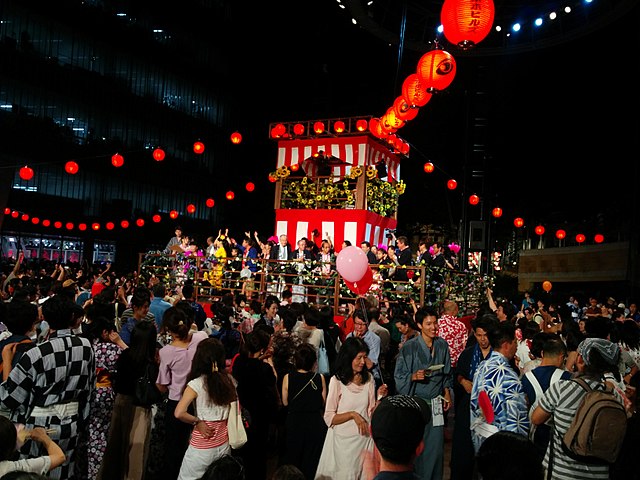
Bon-odori in Tokyo (Roppongi), courtesy of Wikipedia
The most well-known custom of Obon is the communal dance or bon-odori (盆踊り) which you’ll often find in overseas Japanese communities as well. I’ll post some videos or something soon of the Bonodori dances in my wife’s neighborhood, which we often visit around this time. My daughter, who’s now a teenager and knows a lot of the neighbors, helps volunteer at the local bonodori every year.
Anyhow, while Obon season is very much a Japanese tradition, it also has fascinating roots from both China and Buddhist India as well.
P.S. The July vs. August celebration of Obon happens not just between east and west, but can vary by region. Northern Japan also celebrates in August while the Tokyo area celebrates in July, and so on.
1 Buddhism, borrowing from earlier Indian cosmology, describes many hell realms and many heavenly realms. All of these are seen as temporary destinations on the even longer cycle of rebirth. For Buddhism, the larger goal is liberation from the near-infinite cycle of rebirth (Samsara, or “aimless wandering”) more than seeking out the “good” realms over the bad ones.
2 I think this often gets overlooked, but the Ullambana Sutra is a poignant reminder that not everything done for the sake of one’s kids is the right thing to do. Parents need to uphold good moral conduct in addition to good parenting. They’re not necessarily exclusive either. In simpler terms: don’t be a dick.




 Gleanings in Buddha-Fields




You must be logged in to post a comment.