Recently, I dusted off an old book from my shelf titled Traversing the Pure Land Path which was published by the Jodo Shu Research Institute (JSRI).1 They had a number of their publications at the time, and their English-language resources were very helpful. A lot of them appear to be out of print, sadly.
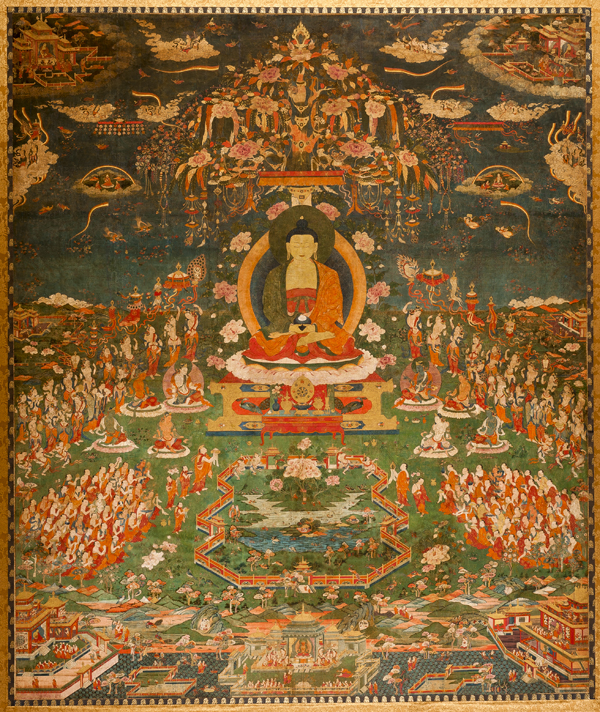
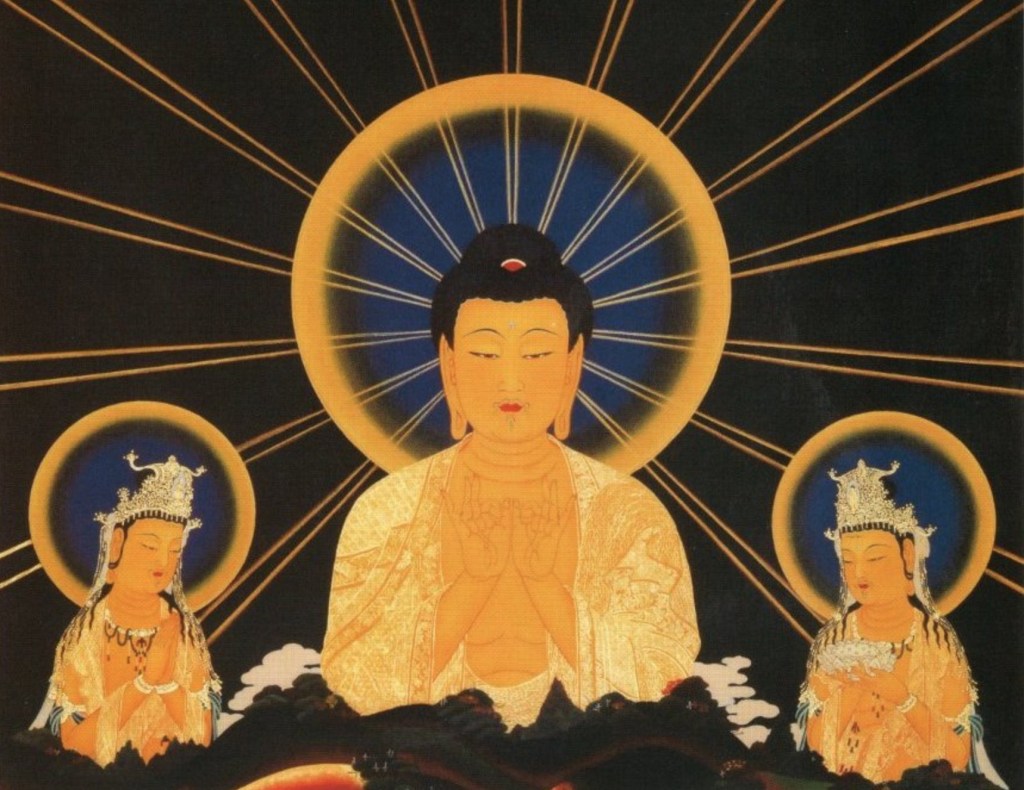
The Buddha Amida (Amitabha) as depicted in Tibetan art
Anyhow, the book has a translation of a famous reply to the Shogun, Yoritsune, by a Buddhist monk named Shōkū (証空, 1177-1247). Shoku was the founder of the “Seizan” branch of Jodo Shu Buddhism, and had originally been a disciple of Honen. Anyhow, Shoku’s letter to Yoritsune talks about the Three Karmic Bonds (san’en 三縁) that are established through one’s relationship with Amida Buddha:
The first is an “intimate karmic” (shin’en 親縁) bond, which Shoku explains:
…Amida takes us into his embrace no matter how dull or ignorant we may be….This is the reason that when we call, he hears; when we pray, he sees; and when we meditate, he knows, and unfailingly leads us to ojo [rebirth in the Pure Land].
page 119
Next is a “close karmic” (gon’en 近縁) bond. Here, Shoku explains in the letter:
…if we long to see him, he actually appears at our side in a dream or at life’s last hour.
page 119
Finally, the last bond is that of “superior karma” (zōjō’en 増上縁) which Shoku explains at length:
Since this means for us total exemption from the pains that our karma would bring us through countless ages, we will surely fear unethical behavior. Even more, we will give it up and never allow ourselves carelessly to fall into it….Pulled forward by Amida’s mighty power, we find an ever deepening joy in the contemplation of the good we have done….
page 120
The idea of karmic bonds is a common theme within the greater Mahayana Buddhist tradition, not just Pure Land Buddhism, and can apply to buddhas, bodhisattvas, even other people. It also applies to reciting the nembutsu itself toward others around you. But Shoku’s in-depth explanation on the ways in which one’s karmic bonds deepen through practice of the nembutsu, is fascinating, especially in that he argues that no one is only escaping the endless cycle of birth and death, but the sheer magnetism of Amida Buddha also inspires one to do good in this life here and now.
P.S. It’s been kind of fun to re-read old books I haven’t touched in years. A chance to revisit things I learned, but with a few more years of experience behind me. 😄
1 The site is long gone, sadly, but the Wayback Machine has an archive of the site. The updated Japanese-only site is here.
The nembutsu (念仏),1 whose origins and doctrinal place within Buddhism I’ve written about here, is the central practice for Pure Land Buddhists across all of East Asia. Due to the breadth of the Pure Land tradition, are many approaches, interpretations and ways to recite the nembutsu.
However, today I am focusing on the Jodo Shu sect’s practice specifically. From my experience, Jodo Shu has a particularly simple, straightforward approach to Pure Land Buddhism and is a good place to start for new Buddhists.
Also, I decided to write this post after I discovered recently that an old English language site for Jodo Shu Buddhism had been archived and will not be supported anymore (update: the site no longer exists 💔). I loved that site when I first explored Buddhism back in 2005, and before Youtube, I loved to listen to the chanting of the nembutsu there. That site was a direct inspiration for me, and so this post is meant to preserve its memory.
The former site explained that there are three styles for reciting the nembutsu in Jodo Shu Buddhism, and these are (with Japanese added):2
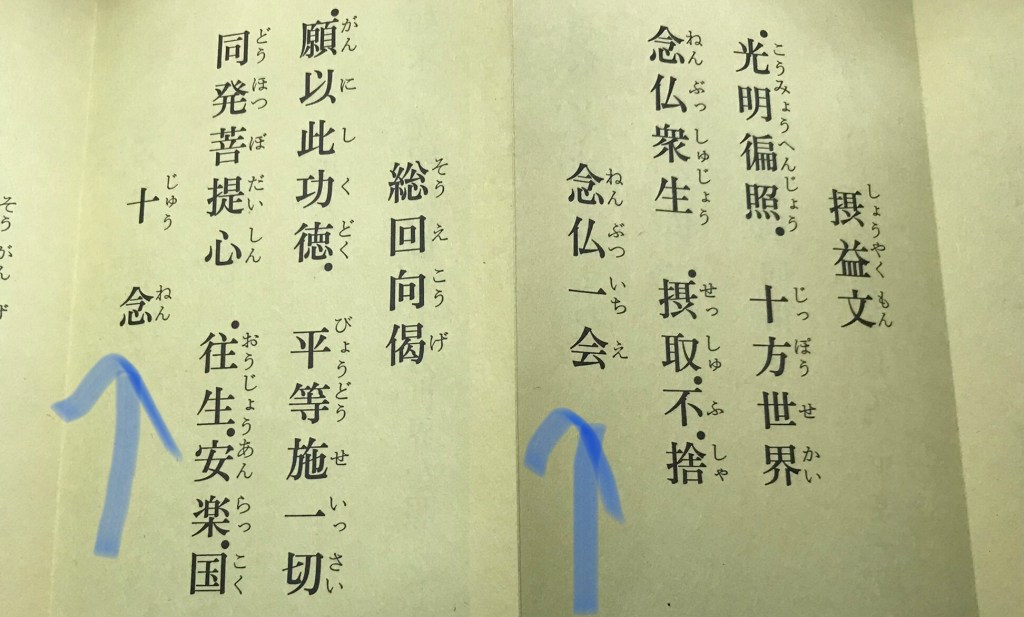
Jūnen (十念) – this just means to recite the nembutsu ten times consecutively, and is insipred by the 18th vow of Amida Buddha from the Sutra of the Buddha of Immeasurable Life (alternate link here). There’s a particular style that Jodo Buddhists use to recite this, which we’ll get into shortly.
Nembutsu Ichi-é (念仏一会) – this just means to recite the nembutsu over and over without a particular number in mind.
Sanshōrai (三唱礼) – this means the “three prostrations”. It’s a particular style of nembutsu recitation used in some services where you recite the nembutsu three times slowly, drawn out (e.g. naaaamuuuu aaaamiiidaaa buuuuu), then bow at the end of the third recitation. Then repeat the cycle two more times (3 x 3 = 9 times total).
A couple examples of nembutsu recitations (highlighted with blue arrows) from a Jodo Shu service book I got in Japan years ago.
Oftentimes, especially when reciting more than a few times, a rosary is often used.
By far the most common is the jūnen style of recitation, and this is the default practice when someone mentions the nembutsu. It basically just goes like this:
na-mu-a-mi-da-bu
na-mu-a-mi-da-bu
na-mu-a-mi-da-bu
na-mu-a-mi-da-bu
na-mu-a-mi-da-bu
na-mu-a-mi-da-bu
na-mu-a-mi-da-bu
na-mu-a-mi-da-bu
na-mu-a-mi-da-bu-tsu
na-mu-a-mi-da-bu
Notice that the 9th recitation adds the extra “tsu” at the end. Typically, the jūnen is recited within the span of one breath, but if you can’t do that, please don’t kill yourself over it. You can see a nice, clear example of this in the morning liturgy at Zojoji temple in Tokyo (my wife and I have been there many times, one of our favorite). The jūnen is recited starting at 0:48 (and again at 2:18):
You can hear the junen recited starting at 0:48 in the morning service video of Zojoji Temple.
For completeness, you can also hear it in the evening service, starting at 23:00:
Also, when doing reciting the nembutsu, you should put your hands together in gasshō (合掌). You can see an example of this on one temple website, and on the video above at 2:18. Notice that your hands do not go through the rosary (o-juzu), if you have one. Instead, the rosary is sort of draped over the thumbs and hangs behind them.
Anyhow, happy nembutsu-ing !
P.S. How often should you recite the nembutsu? My opinion on the subject here.
P.P.S. Sometimes people ask if they can recite the nembutsu in another language: their native language, Sanskrit language (namo’mitābhāya buddhāya), whatever. In my humble opinion as a lay person: yes. But within Jodo Shu tradition, the nembutsu is always recited as namu amida butsu, so for consistency’s sake I use that here, and in my own practice.
1 Technically, in modern Japanese-romanization, it’s nenbutsu (“n”, not “m”), and that’s how it is spelled in Japanese hiragana: ねんぶつ. However, romanization of Japanese into English has a long and messy history, and it’s a pain to get people to adopt the correct spelling now. So, for convenience and consistency with other sources, I am spelling it as nembutsu. Since this is a free, volunteer blog don’t expect quality. 🤪
2 The Japanese language site, which is more actively maintained, also explains this here. No English, sorry, but I did review it before writing this post.
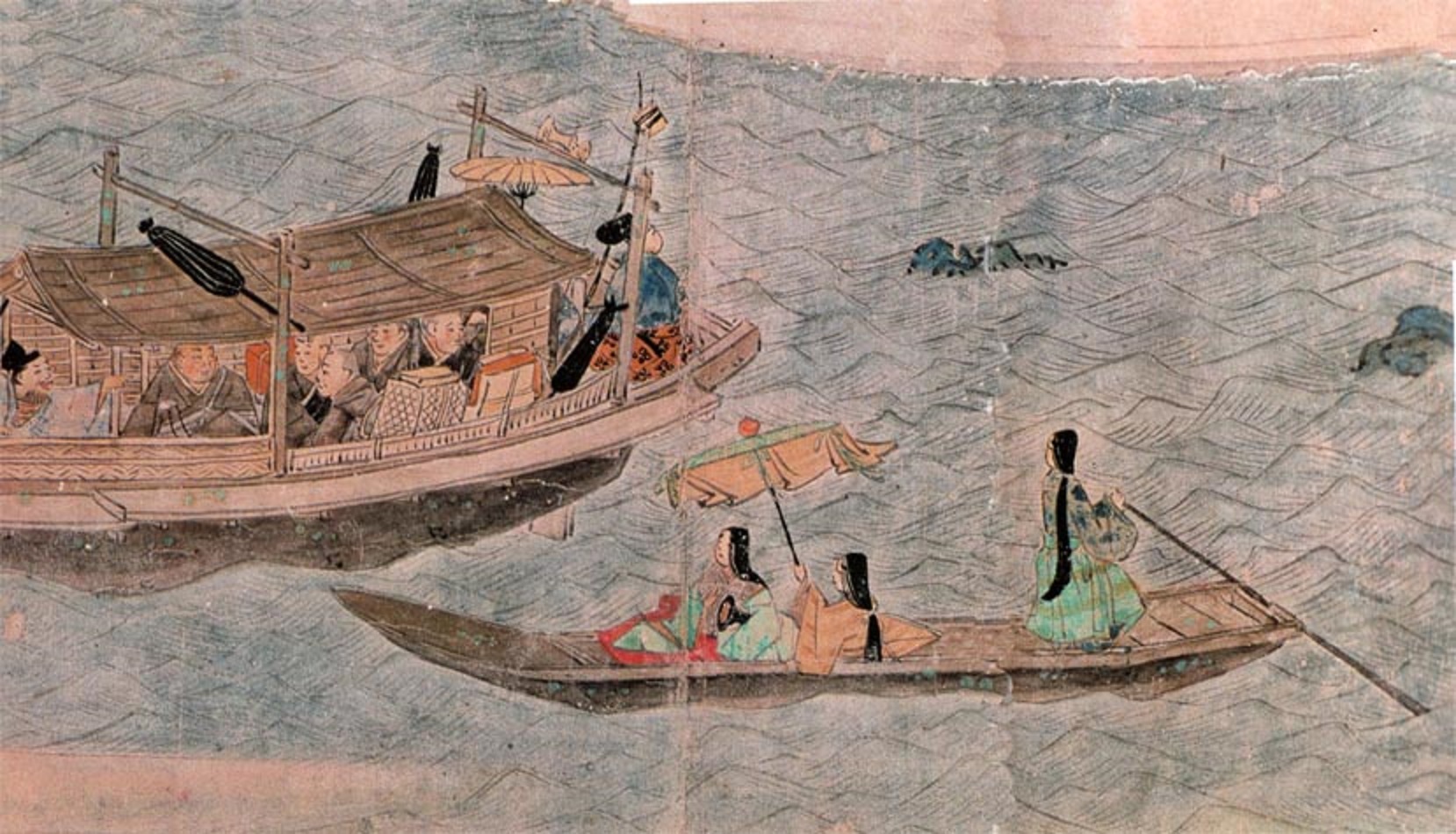
A medieval scroll depicting the life of Honen. This is the famous scene where Honen preaches the Dharma to a prostitute, who sought his advice, at Murotsu (modern day Hyogo Prefecture) on his way to exile. Courtesy of Wikipedia, originally from a 14th century biography about Honen titled hōnen shōnin e-den (法然上人絵伝, “a pictoral biography of master Honen”)
One of my favorite stories about the life of Honen, the 12th century Buddhist monk who started the Pure Land Buddhist movement in Japan, is from his time of exile in 1207. From the capitol (modern day Kyoto) he and many followers were banished to the hinterlands, a common punishment at the time. In Honen’s case, he was exiled to the island of Shikoku, and while he crossed the channel from the port of Murotsu (室津),1 he was approached by another boat whose passenger was a local prostitute.
The story is recorded in English in Traversing the Pure Land Path among other places, but basically the woman asks Honen how someone like her with such a miserable lifestyle can find salvation in the life to come. Honen replied:
“If you can find another means of livelihood, give this up at once. But if you can’t, or if you are not yet ready to sacrifice your very life for the true way, begin just as you are and call on the sacred name [of Amida Buddha]….”
page 50-51
Later, when Honen was allowed to return back to the capitol, he found out along the way that the woman had taken his advice and devoted herself to the Buddhist path until her death some time shortly after. “Yes, it is just as I expected,” he said.
There are few things I think are worth calling out here. First, Honen was already pretty well known at the time, and in a conservative medieval society, the thought of a famous monk talking to a woman of the night would have been scandalous. Second, Honen didn’t try to shame her. He pointed out that it was a dangerous lifestyle, but if she can’t leave, she can begin her Buddhist path “just as she is”. Finally, the results (if the biography is to be believed) is that in the end she took it seriously and attained great progress.
Even now, 800 years later, I think this idea of “begin just as you are” is one of the most appealing aspects of the Pure Land Buddhist path, especially Jodo Shu Buddhism, and why I still come back to it time and time again after all these years.
Pure Land Buddhism gets a lot of flak sometimes from Western audiences because it doesn’t mesh with our understanding of Buddhism (spoiler alert: 5th century BC India is not the same as 12th century Japan, which is not the same as 21st century America), and while I understand the concerns, I think it’s missing the point.
One of the frustrations I’ve had over and over again, especially with so-called “American Buddhism” or “Western Buddhism” besides its Protestant approach1 to a totally different religious tradition, is its tendency to rely strongly on master-disciple relationships. This means things like finding the right empowerment from such-and-such guru, or finding a good meditation teacher, etc. These put a lot of trust in one individual (some with sketchy backgrounds) and tend to be biased toward those who can afford the time, money and educational background for this sort of “lifestyle”. Newer “modern” traditions can be even more risky because they’re often thinly-disguised cults.
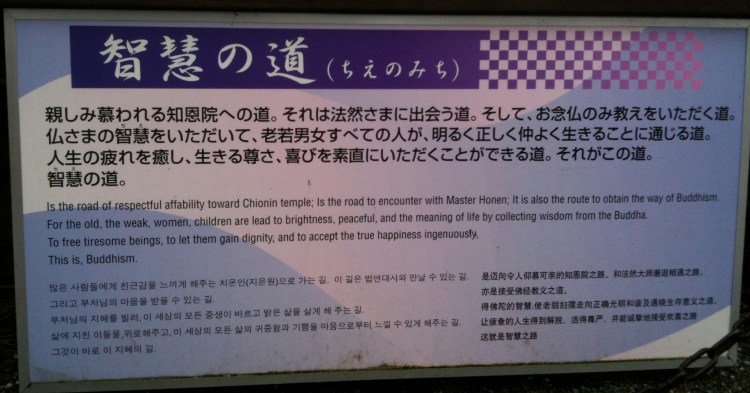
A multilingual sign posted at the front of Chion-in Temple in Kyoto, Japan. A more accurate English translation, in my opinion, reads: “This is a path toward affinity with Chion-in Temple. This is a path to encountering Master Honen, and a path for receiving the Buddha’s teachings. This is a path, where receiving the compassion of the Buddha, young and old, men and woman can live a bright, upright, and affable life. This is a path for those who are weary to find healing, a reverence for life, and sincere joy. This is the path of Compassion.”
In keeping with Honen’s “begin just as you are”, I feel that the Pure Land path, while being a part of East Asian Buddhism for many centuries before Honen, still has an enduring power to it even here and now because any one can do it, and once one passes through that gate, it opens up many other possibilities for Buddhist practice, teachings and so on. I can attest to this from personal experience: after a chance encounter at the temple of Chion-in way back in 2005, what I first thought was”Buddhist superstition” grew on me and became a strong foundation from which I explored other aspects of Buddhism later. Some of those aspects were ultimately dead-ends for me, but I never entirely forgot the simple practice of reciting the nembutsu, even when I have disagreed with doctrinal minutiae here and there.
Like the prostitute at Murotsu though, everyone has their personal problems, some very serious. Many of us aren’t good Buddhists, or even particularly good people. Nevertheless, what the Pure Land Buddhist path shows is that the compassion of Buddha still shines down upon all of us, just as we are, and welcomes us to follow a better way with the light of the Buddha quietly guiding us.
1 Now part of modern day city of Tatsuno in Hyogo Prefecture.
Author’s Note: this was another post I found recently from my old blog, possibly something I wrote in 2013 or 2014. It was shortly after this that I decided to leave the local Jodo Shinshu Buddhist community, give up the prospect of ordination, and strike out on my own. My feelings on the subject have changed somewhat, but I still agree with the general sentiment. I do miss many of my old friends at the local temple, but these days I am kind of done with Jodo Shinshu Buddhism. Apart from minor edits, and fixing broken links, this is posted as-is. Oh, and I added a cover image from that time and updated the title slightly for clarity. 😋
An old altar we setup years ago while living in Ireland. The central image was purchased from Tsukiji Honganji in Japan and venerates Amitabha Buddha, the Buddha of Infinite Light.
Lately, as I have been able to enjoy a small break in life, work and so on, I delved into some books I haven’t finished reading in a long while, including an excellent study on the life of Hossō Buddhist scholar, Jōkei. The book, titled Jokei and Buddhist Devotion in Early Medieval Japan by James L. Ford, is both a biography, but also a critical look at the late Heian, early Kamakura periods from a Buddhist perspective, and an effort to shed new light on this oft-studied and oft-misunderstood period.
In a way, I feel like I am betraying friends I have had the privilege of encountering over the years who are devout Jodo Shu and Shinshu Buddhists, but at the same time, I think Buddhism should be able to stand on its own two feet and take the acid test of criticism sometimes.1 To my friends on the Pure Land path, please forgive this post. It is not a personal attack, and I know many people in Jodo Shu and Jodo Shinshu who are admirable Buddhists in their own right. It’s just that while reading Ford’s book, I really felt he hit the nail on the head with certain things about Honen and Shinran’s teachings that made me uneasy, particularly the “exclusive” Pure Land approach that orthodox Jodo Shu and Jodo Shinshu followers adopt. Until recently though, I couldn’t quite articulate it myself.
This uneasiness came about back when I first started reading Rev. Tagawa’s book on Yogacara Buddhism, and on my recent trip to Kyoto and Nara, this old uneasiness arose in me moreso as I stood at the feet of great temples such in Kyoto and Nara. When I stood in the Treasure House of Kofukuji, beheld all the amazing artwork there, and the vast corpus of teachings they represented, I knew something was still amiss in my Buddhist path and it’s been gnawing on my mind for a while now.
Jōkei is best known as a sharp critic of Hōnen and the exclusive Pure Land movement, or senju nembutsu (専修念仏). As such, he was the primary author in 1205 of the Kōfukuji Sōjō (興福寺奏状), or the “Kofukuji Petition” to the Emperor which sought to suppress the “exclusive nembutsu” Pure Land school started by Honen. History has not been kind to Jokei, and Professor Ford argues that the study of Kamakura Buddhism is flawed because of some underlying biases and assumptions about “old” vs. “new” Buddhism. Meiji-era and later studies tend to apply a kind of “Buddhist revolution” to Honen and Shinran, and paint traditional Buddhist sects as elitist or oppressive. Sometimes, parallels between Shinran and Martin Luther have been drawn in scholarly circles, though more modern research has refuted this analogy as superficial at best.
A while back, after reading Dr. Richard Payne’s collection of essays on the subject of Kamakura-era Buddhism, I started to question these assumptions, but more so after reading Ford’s book. He explores the Petition toward the last-half of the book and Jokei’s relationship with Honen to show how history has normally written about the incident, and carefully dissects it to show another viewpoint. In essence, he argues that Jokei’s criticism of Honen isn’t an “old-guard” or “elitist” perspective, but more accurately reflects a “normative” Buddhist doctrinal stance.
Ford explores at length about the content of Jokei’s Kofukuji Petition and its nine articles faulting the new senju nembutsu (専修念仏) or “exclusive nembutsu” movement, which are Ford summarizes in four points (I am quoting verbatim here):
[According to Jokei,] Honen abandoned all traditional Buddhist practices other than verbal recitation of the nembutsu.
Honen rejected the importance of karmic causality and moral behavior in pursuit of birth in the Pure Land.
Honen false appropriated and misinterpreted Shan-tao with respect to nembutsu practice.
Honen’s teachings had negative social and political implications.
To bolster his stance in the Petition, Jokei uses the same textual sources as Honen to demonstrate that Honen only selectively drew certain teachings from Chinese Pure Land patriarchs, Shan-Tao, Tao-ch’o and T’an-luan to prove his beliefs concerning the verbal nembutsu, while ignoring the whole of their teachings and writings, which included a more comprehensive Pure Land Buddhist path. Ford then turns to modern scholars to show that in China, the nembutsu (nian-fo) was never seen as a verbal-only practice even in Shan-tao’s time, but was interpreted as a well-developed meditation system. This is reflected even in modern day Chinese Buddhist writings, such as those of the late Ven. Yin-Shun.
As Ford then concludes:
Thus Jōkei’s claim that the Pure Land schools had no precedence in China is probably true. All in all, Jōkei’s critique of Honen’s construction of an independent Pure Land sect based on exclusive practice of the oral nembutsu is generally well grounded both doctrinally and historically. (pg. 178)
Jokei’s accusation that Honen abandoned the karmic law of causality and undermined the Buddhist teachings for upholding moral conduct, also weighs heavily. Jokei asserts the traditional Buddhist view2 of time as infinite, and that people are responsible for their own karma and the pursuit of wisdom. From Jokei’s perspective, one’s poor conduct can forestall one’s rebirth in the Pure Land, or reduce the conditions of rebirth itself. He notes the Nine Grades of Rebirth in the Contemplation of Amitabha Sutra, but I am personally also reminded of the proviso in Amida Buddha’s 18th Vow in the Immeasurable Life Sutra:
Excluded, however, are those who commit the five gravest offences and abuse the right Dharma.
Or Shakyamuni’s admonition in the same Immeasurable Life Sutra:
Anyone who sincerely desires birth in the Land of Peace and Bliss is able to attain purity of wisdom and supremacy in virtue. You should not follow the urges of passions, break the precepts, or fall behind others in the practice of the Way. If you have doubts and are not clear about my teaching, ask me, the Buddha, about anything and I shall explain it to you.”
One’s poor conduct doesn’t prevent the Vow of Amitabha Buddha from being fulfilled, but delayed and hindered for a time, Jokei argues. Either way, Jokei reinforces a traditional Buddhist view of the importance of karmic causality as central to Buddhism, inline with the teachings of Shakyamuni Buddha himself in countless, countless, countless sutras. As evinced elsewhere in the book, Jokei like many Buddhists believes in the power of Amitabha and his Vows to bring people to the Pure Land, but also asserts that one is still responsible for their karma, so one has to meet Amitabha Buddha half-way in a sense. Jokei’s many sermons and devotions to Kannon, Maitreya and others show that he often advocated this “middle” approach between devotion and personal practice/responsibility and Ford argues that this was the normative approach to Buddhism taken through out Asian Buddhist history.
Indeed, in Jokei’s words describing himself:
[My opinion] is not like the doubt of scholars concerning nature and marks, nor is it like the single-minded faith of people in the world. (pg. 179)
Meanwhile, later Ford shows how Jokei by contrast:
…represents a ‘middle-way’ between the extremes of ‘self-power’ and ‘other-power.’ He was not unique in this respect, since this perspective, though perhaps unarticulated, predominated within traditional Buddhism — despite the rhetorical efforts of figures like Honen and Shinran to paint the established schools as jiriki (self-power) extremists. (pg. 202)”.
But nevertheless, Ford shows how modern scholars in Japan and in the West have skewed this view of history with the belief that the politics of medieval Japan were reactionary, and stifling Buddhism in Japan at the time, leading to the Pure Land movement. Here, I quote Ford directly (emphasis added):
Hōnen’s response to the apparent social inequity and underlying monastic/lay tension — always a feature of Buddhism — was, in effect, to abolish the traditional lay-monastic framework. I am not convinced that he meant to destroy the system, particularly given his devotion to the monastic life, but the effect of his message, as revealed in the Senchakushū, was to undermine the practices and doctrines that sustained the monastic ideal. Pronouncing them obsolete because of the limitations of the age, he concluded that salvation was no longer contingent upon precept adherence, meditative practice, or diligent effort toward realization. Realization was now deemed a secondary goal, since it could not be attained in this world; it could only be attained in Amida’s Pure Land. Although others before Hōnen had devised “simple” practices to address the needs of lay practitioners and lessen the tension noted above, an implicit contradiction remained. If these practices could deliver as promised, why go through the arduous training of a monk? The monastic ideal could be interpreted as an ever-present source of doubt with respect to the efficacy of the “simple” practices. Hōnen can be seen, at least in terms of effect, as one who address this doubt directly, but Shinran appears much more explicitly conscious of this issue. (pg. 183)
Ford then adds:
We certainly cannot fault Hōnen and Shinran for creatively adapting these well-established labels [self-power/other-power, “easy” and “difficult” practices] for their own proselytizing ends. However, we must dismiss these sectarian rhetorical categories as legitimate analytical categories in the study of Kamakura Buddhism. (pg. 202)
Summing up here, I think Ford gets at two critical points here. First, in mainland Asia, historically Pure Land teachings have never been divided along exclusive or sectarian lines, and such was even the case for early medieval Japanese Buddhism:
Scholars generally agree that the tradition of the Pure Land in China represented more of a “scriptural tradition” than a “doctrinal school” and that people of many different schools practiced the nien-fo [nembutsu]. Thus, Jōkei’s claim that the Pure Land schools had no precedence in China is probably true.
A sectarian, exclusive Pure Land Buddhism quite literally did not arise until Honen and later Shinran’s time. Ford is right in crediting them with adapting teaching to suit a need, and I write this with a heavy heart because I actually like both Honen and Shinran, but I agree that the effect, perhaps unintended, was to foster a kind of narrow sectarianism that didn’t exist in Pure Land Buddhist teachings and practices before. I guess it was the sign of the times.
And yet in the modern world, there are many Buddhists in Asia, Japan and the mainland, who are devoted to Amitabha Buddha and still follow traditional Buddhist practices in some form or another. Such people have not forgotten the important balance of sila (moral conduct), samadhi (practice) and paññā (wisdom) even as they strive for rebirth in the Pure Land. Indeed the late Ven. Yin-Shun in his book The Way to Buddhahood, taught a comprehensive approach not unlike that which Shan-tao and Tao-ch’o offered many centuries ago:
The chanting of “Amitabha Buddha” should also be accompanied by prostrations, praise, repententance, the making of sincere requests, rejoicing, and the transference of merit. According to the five sequences in the “Jing tu lun” (Pure Land Treatise),3 one should start with prostrations and praise and then move into practicing cessation [meditation], contemplation [more meditation], and skillful means. One can thereby quickly reach the stage of not retreating from the supreme bodhi. As Nāgārjuna’s Śāstra puts it “those aiming for the stage of avivartin [non-retrogression] should not just be mindful, chant names and prostrate.
It’s a well-established trend, and works for many people in the world, but only in Japan is there a separate trend toward exclusivity and the idea of traditional Buddhism being invalidated. The sense of Dharma Decline so critical to Japanese Pure Land in today’s climate seems like a subjective anachronism now, and difficult to base a doctrine on with so great a diversity of sanghas and teachings in the world.
Second, what I believe to be the stronger refutation of Japanese Pure Land Buddhism as traditionally practiced in Jodo Shinshu and Jodo Shu is summed up in the following passage which deals with the issue of hōben (方便) or “expedient means” (again, emphasis added):
Both in his religious practice and, specifically, the Sōjō, Jōkei’s articulation of the normative voice of inclusivism and diversity within Buddhism is again instructive. The content of this vision of Buddhism, grounded in the tradition’s emphasis on karmic causality, appears almost boundless at times. Hōnen’s exclusive claims of efficacy, resonating with much of the contemporary Tendai hongaku discourse and effectively undermining the moral implications of karma and its ramifications for Buddhist soteriolology, was a wholesale rejection of Buddhist tradition. It invalidated not only the devotion to the variety of Buddhas and Bodhisattvas that manifest different qualities of wisdom and compassion but also the importance of various kinds of ascetic practices, long the centerpiece of monastic life. In short, Hōnen’s teaching “delocated” Buddhist sacrality from its traditional broad manifestations — temporal and spatial — to one single exclusive manifestation. (pg. 203)
Again, I think back to my experiences in Nara, Japan in particular. At Todaiji alone, I saw six or seven temples on the temple grounds devoted to various figures of Buddhism. The plurality was amazing, and welcoming in a way. It felt inclusive, not exclusive, and there was no sense of guilt in praying to Jizo Bodhisattva, or the Lotus Sutra, one might feel in a Jodo Shinshu temple for example4 While there, if all I wanted to do was see Kannon, I could do so, but if I wanted to see other figures too, no problem. In other words, the broad, inclusive nature of Nara-style Buddhism allows Buddhists to offer as much or as little devotion to their heart’s content. No need to worry about doctrinal clashes or implicit guilt.
Thus, my faith in Amitabha Buddha and the Pure Land is no less than it once was, but Ford’s and Jokei’s writings and my experiences in Nara and Kyoto remind me that Buddhism is strongest in diversity, and later Kamakura schools of Buddhism have a tendency toward exclusivity. Japanese Pure Land Buddhists, along with some Zen and Nichiren Buddhists, argue that exclusive approach is simpler and more accessible, but given what other Buddhists faiths I’ve seen, I believe the exclusive approach is ironically less simple and less accessible by virtue of their exclusivity. Too much rationalization, cutting off, and justification while the rest of the Buddhist world quietly hums along to a relatively consistent tune, even with all its own faults.
The inclusive approach exemplified by Jokei, and Ford’s argument that it’s the normative Buddhist approach for most of the Buddhist world, allows considerable flexibility to follow an approach that works for you, without having to deny other paths as too difficult, elitist or only valid during a “better era” of Buddhism. Just follow which aspect you tend to have a karmic connection toward, whether it be Amitabha Buddha, Shakyamuni Buddha, Kannon, zazen, tantra, or some combination.
First and foremost, I guess I consider myself a Mahayana Buddhist and second a Pure Land follower, not the other way around. So, what does this mean for me? I think I already know the answer, but I’m holding off for now to think further. Jokei’s “middle of the road” approach to Buddhist devotion and practice, and inclusiveness, provides a lot of inspiration right now, along with my experiences in Japan, and I hope to explore this more as time goes on.
Namo Shaka Nyorai Namo Amida Butsu
P.S. More regarding the critical role karmic causality plays in Buddhism from Ven. Thanissaro Bhikkhu
1 This would normally be the time to bring up the classic Kalama Sutta text, an awesome, though often quoted out of context in Buddhist writings. Instead, I’ll encourage you to read it yourself in full. It really is one of the best sutras in Buddhism. 🙂
2 Exemplified in the Yogacara/Hossō school in particular amongst the Nara Buddhist schools, and in opposition to Tendai “hongaku” or “innate enlightenment” teachings, and Shingon teachings regarding the “womb of Buddhahood”. It was one of the most tense and long-standing doctrinal feuds in Japanese Buddhism all the way until after Jokei’s time when some reconciliation was made. Ford does not elaborate on how this was done.
3 To be precise the Pure Land Treatise is: 淨土論, Ching-t’u-lun (Wade-Giles) or Jìngtǔ lùn (Pinyin), composed by Jiacai (迦才, ca.620-680).
4 Some Shinshu Buddhists I’ve met have explained it’s OK, as long as it’s an expression of gratitude but again there’s that subtle “if” in there.
Japanese Tendai Buddhism, that is the Buddhist sect descended from the venerable Chinese Tiantai (天台) tradition started by Zhiyi (智顗, 538–597), has a number of interesting, not to mention pithy, teachings and phrases. Lately, I’ve been thinking about a particular phrase called asa daimoku ni yū nenbutsu (朝題目に夕念仏). In its most literal sense, it means “Odaimoku in the morning; Nenbutsu in the evening”.
This phrase is fascinating to me, because it summarizes two important facets of Tendai Buddhism.
First, the “odaimoku”. Tiantai Buddhism in China was the first serious effort at taking the vast corpus of teachings imported from India and the Silk Road and synthesizing them into a native school of thought, not just something lifted-and-shipped from abroad. In order to do this, Zhiyi analyzed the vast number of Buddhist sutras, shastras (essays) and commentaries and arranged them into a kind of hierarchy. At the very top, he felt the Lotus Sutra was the most important teaching, the summation of everything else. For this reason, the Tiantai/Tendai schools treat the Lotus Sutra as the core teaching. In devotional practices, this was expressed in something called the o-daimoku (お題目) attributed to famous Tendai monks such as Genshin, but popularized to a greater degree by Nichiren in the 13th century. The most common form of the o-daimoku chant is namu myoho renge kyo (南無妙法蓮華経)1 which means something like “Praise to the Wondrous (alternatively “Mystic”) Law of the Lotus [Sutra]”. This is also the central practice of the Nichiren Buddhist sets you see today: Nichiren-shu, etc.
However, over time, Japanese Tendai Buddhism began to strongly adopt Pure Land Buddhist teachings from mainland China as well.2 Zhiyi, when he synthesized the various Buddhist teachings and practices paid special attention to meditations on Amitabha Buddha, the Buddha of Infinite Light, in his magnum opus, the Great treatise on Concentration and Insight (摩訶止観, Móhē Zhǐguān), but these meditations were intended for serious monastic disciples only, and could be very physically demanding. While Tendai monks sometimes did undertake these practices, the popular practices related to Pure Land Buddhism gradually evolved into chanting practices (again, due to Genshin) similar to the odaimoku. This chanting, is called the nenbutsu (念仏) or “mindfulness of the Buddha [Amitabha]”. The most common form of the nenbutsu is namu amida butsu, and this is overwhelmingly what you find in Pure Land Buddhist schools in Japan today such as Jodo Shu and Jodo Shinshu. Since the 12th century, many Buddhists in Japan have focused on reciting the nenbutsu and aspiring to be born in the Pure Land of Amitabha Buddha as a refuge, but also as a means of progressing on the Buddhist path much faster: like taking the highway to get to your destination vs. taking the back roads.
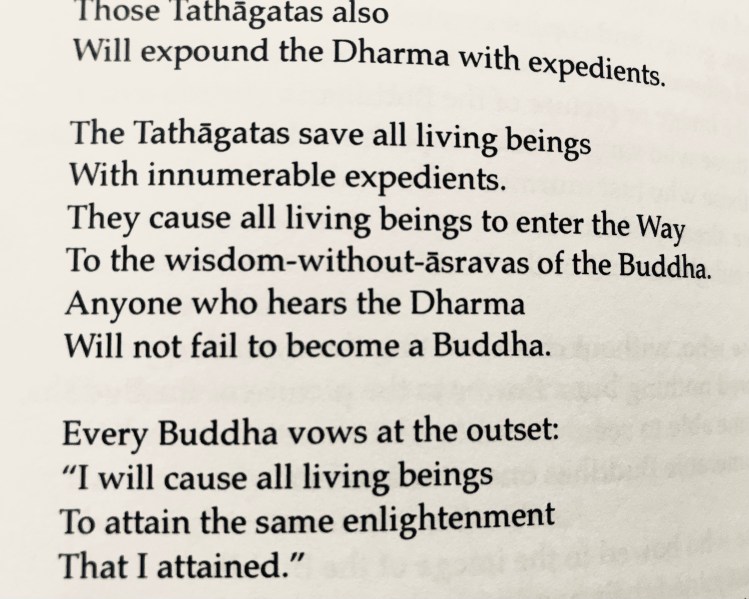
A verse from the second chapter of the Lotus Sutra, Murano translation.
These two things may sound contradictory, but they’re not. The second chapter of the Lotus Sutra introduces a couple important concepts to Mahayana Buddhism (that is Buddhism across all of East Asia): the One Vehicle and Expedient Means. The One Vehicle was a way of reconciling all the rival Buddhist schools in India by teaching that all of them were really just the same thing, and that sincere practioners were all heading in the same direction, towards Buddhahood, in the end. No need to argue over minutia. The Expedient Means teaching just recognizes that the various meditations, devotional chants, sutras, Buddhist schools, etc, were all just tools to get us there. The Buddha in the Lotus Sutra hammers his point over and over again in subsequent chapters: the various teachings and practices are all just temporary tools to suit a time, place, or need. All of them point to the truth, but must be put down when they are no longer needed.
In this sense, the Pure Land teachings, the chanting of the nenbutsu and so on is just another expedient means, albeit an especially popular and efficacious one. One could also lump Zen meditation, esoteric Vajrayana teachings and such under the same umbrella, and Tendai Buddhism pretty much does this. Unlike later Buddhist schools in Japan that center around “one practice, one teaching”, Tendai maintains the basic structure imported from China where all teachings and practices are kept under the same basic umbrella.
However, there’s more.
The whole asa daimoku ni yū nenbutsu phrase isn’t just limited to reciting the odaimoku in the morning, and the nembutsu at night. It also expresses a mindset, summarized by two other key concepts in Japanese Tendai Buddhism: hokke senpō and reiji sahõ.
In a Japanese book I own on basic Tendai Buddhist teachings, these are summed up as follows:
法華懺法は、すべての人を救う究極の教えである「法華経」に感謝して読経し、自らの罪を懺悔するのです。
“Hokke Senpo” means to show appreciation toward the Lotus Sutra, which contains the ultimate teaching of helping all beings, through reading of the sutras, and to reflect on one’s own faults.
例時作法は、念仏し、自身の心のなかに備わる仏性を呼び起こすものです。
“Reiji Saho” means to recite the nembutsu, and to awaken the Buddha nature within oneself.
Let’s discuss in more detail…
Hokke senpō (法華懺法) means to reflect on one’s actions in light of the Dharma, the teachings of the Buddha. This is a very time-honored practice across the entire Buddhist religion, and is why (in my opinion) Buddhism is so effective as a form of mental discipline and training. Unlike the Christian notion of “guilt”, the idea behind self-reflection is a kind of objective, scientific review of one’s actions and whether they have been wholesome or unwholesome. Here, the Dharma is used as a kind of yardstick to measure one’s actions, and in the case of Tendai Buddhism, the Lotus Sutra in particular. Upon reflection, many Buddhists will recite some kind of verse to acknowledge (not punish oneself) and resolve not to do it again. You’re giving yourself a fresh start and resolving to try again. Like rehearsing for a play: you’ll have good days and bad, but you just keep at it until it becomes second nature.
While hokke senpō reflects on the past, reiji sahõ (例時作法) is forward thinking, and expresses the desire to make the Pure Land of the Buddha not just a reality in the future, but here and now starting with oneself. The sixteenth chapter of the Lotus Sutra is meant to be a kind of bombshell teaching as the Buddha explains that, among other things, not only is the Dharma eternal (and thus the Buddha has always existed), but that his Pure Land has always existed on Vulture Peak (an important site in India), even if people can’t see it. This may sound strange, but what the Buddha is saying in chapter sixteen in my view is that the mind is the most important thing, and even when “living beings witness the end of a kalpa [an eon] and all is consumed in a great fire”, those whose minds are honest and sincere will see that the Pure Land of Buddha is still right there and available to anyone who seeks refuge. One need not pine for a glorious past, or a particular holy site, it’s all there when you need it. Further, the Pure Land isn’t just a place, it’s the embodiment of the Dharma, the Buddha’s teachings, at its finest, and through our actions, words and thoughts, we gradually make this world the Pure Land for others as well.
All this is to say that the pithy phrase asa daimoku ni yū nenbutsu expresses a lot of stuff, at a lot of levels. In my opinion, if one just adopts this phrase as a simple, daily practice guide (recite namu-myoho-renge-kyo in the morning, even a few times, then recite namu-amida-butsu in the evening, even a few times), then that’s more than enough. As I’ve saidbefore, better to do a small, sustainable Buddhist practice often than a big, elaborate one only occasionally. If you even chant one of these things as part of a small, sustainable practice, you’re doing great.
However, what’s interesting to me is that there is a whole lot more under the surface. As one explores this practice more, they realize that there’s a lot of meaning behind a few simple chants, enough for a lifetime of practice. ☺️
P.S. This article on the Tendai Buddhism homepage (Japanese language only) was a good source for this post. The article also points out that the two sides of Tendai Buddhism: exoteric teachings and esoteric (taimitsu or vajrayana) teachings are two separate things within Tendai. This entire blog post has been focused on the exoteric teachings, as I have no experience with the esoteric side and being esoteric, you would need to find a proper teacher anyway. 😉
1 Sometimes you see it pronounced as nam-myoho renge kyo (dropping the “u” in “mu”), but that gets into doctrinal differences among Nichiren Buddhist sects that I personally don’t want to get involved in.
2 This was, needless to say, a strong point of contention by Nichiren, who sought to restore the Tendai teachings to a more pristine form (with the Lotus Sutra as the essential teaching), but also to make it more accessible to people as well.
A famous painting of the legendary battle between Benkei (left), a sohei warrior, and the princely samurai warlord Minamoto no Yoshitsune (right) at Gojō Ōhashi (五条大橋) Bridge. Benkei ultimately yields to Yoshitsune and they become staunch allies and subsequent legds. Utagawa Yoshifuji (歌川国芳, 1798 – 1861), Public domain, via Wikimedia Commons
Samurai, as well as Ninja, have left a strong impression on Western culture as two kinds of warriors in medieval Japanese culture: the samurai as a brave and powerful “knight” to the secretive and cunning ninja. But there’s a third side of warfare in Japan that is often misunderstood: the Sohei (僧兵, pronounced “so-hey”) or soldier-monks. You can see a great visual example here (no English, sorry).
History of the Sohei
The emergence of the soldier-monks, unusual in Buddhist culture where monks are supposed to refrain from all violence and to avoid taking life, is something peculiar to the late 11th century Japan. Major, urban temple complexes were getting increasingly tangled in political battles. Because high-ranking monks, roughly analogous to medieval bishops or abbots, were appointed from noble families, this created friction when rival families would instigate conflicts about the succession of abbots of such and such temple. Similarly, disagreements with the reigning emperor meant that Sohei armies would march on the capitol to express their opinion.
Here’s a historical example. Within the powerful Tendai sect, based on Mt Hiei, two rival factions called the Jimon (寺門, “temple gate”) and Sanmon (山門, “mountain gate”) began to fight over the role of the abbot (zasu, 座主 ) of the Tendai Order.
Over generations, this struggle grew into armed, physical conflict and the Jimon were driven out. The Sanmon took over Enryaku-ji Temple on Mt Hiei and massed a huge army to defend their claim. Meanwhile, the defeated Jimon retreated to another major Tendai temple, Mii-dera, and massed their own army. Later, during in the 12th century these two armies clashed because they were on opposite sides of the struggle between the Genji and Heike samurai clans.
But it wasn’t just the Tendai who assembled armies. Rival sects to the Tendai, such as the Hosso sect (based at Kofukuji temple) fielded major armies of their own, and use them to intimidate rival temple complexes, and even the government, such as their protest to the reigning Emperor over the religious efforts of Honen, who spread new Buddhist teachings to the masses. The sohei army of Enryraku-ji Temple (Mt Hiei) even desecrated the grave of former-monk Honen in the early 12th century due to his perceived heresy. They later intimidated the newly arrived Zen monasteries in the capitol due to loss of patronage. Mount Hiei was the closest thing to a religious “mafia” at the time.
This chaos lasted until the 15th century Warring States Period, when the warlord Oda Nobunaga destroyed the Sohei by besieging Mt Hiei and setting it on fire, and the Sohei as an army finally ended.
Sohei as RPG Characters
In spite of their shady backstory, Sohei are still an object of fascination in contemporary Japanese culture, and as part of my adventure writing, I figured it would be good to find a place for them in the Hamato Islands setting. Question is, what are they?
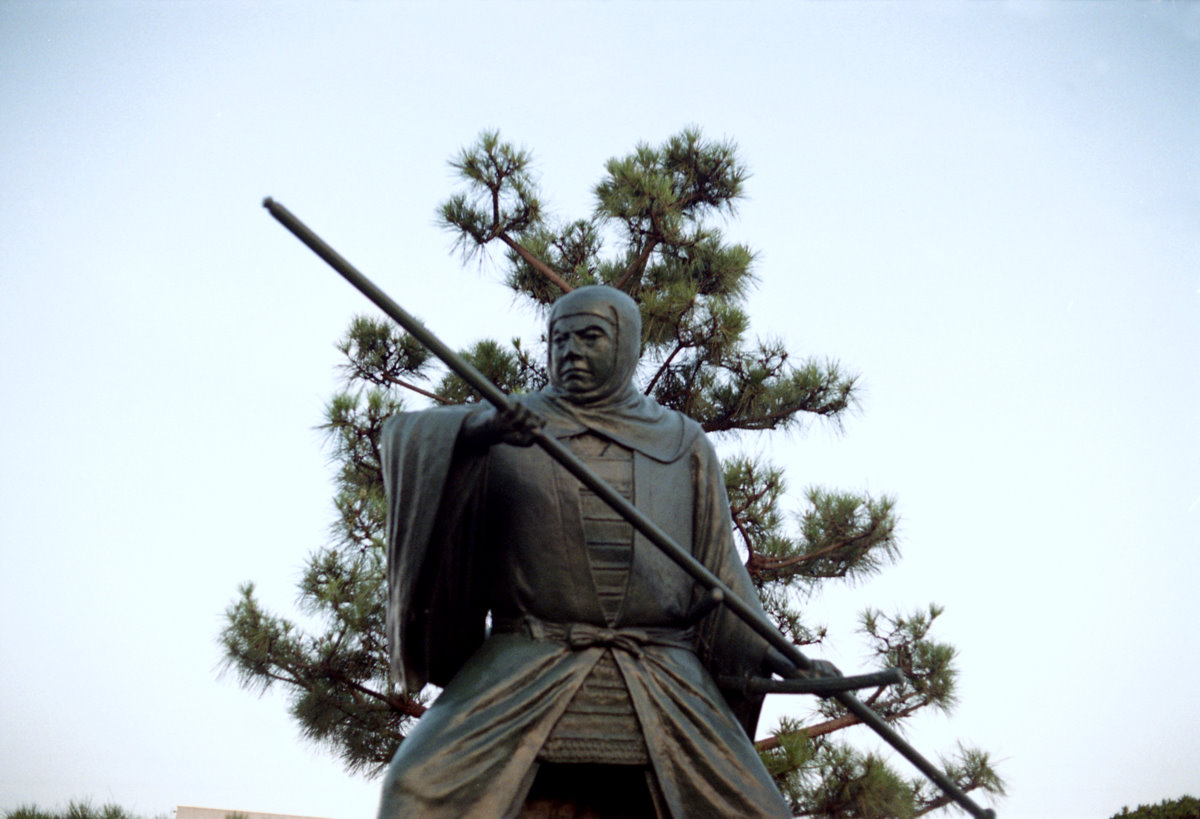
A statue of Benkei, the archetypal sohei warrior, in Tanabe city in Wakayama, Prefecture. shikabane taro, CC BY 3.0, via Wikimedia Commons
Sohei are most often depicted as armed warriors with naginata (glaive) weapons, and usually a katana blade (equivalent in the Dungeon Master’s Guide to a longsword) as backup, while frequently depicted wearing a white cowl. But are they fighters, clerics, fighter-clerics, paladins? I played around with several options and ultimately settled on Sohei being the Japanese equivalent to a paladin. Here’s why.
Despite their devotion to a particular temple, Sohei had little or no actual ordination. The Buddhist orders at this time still closely followed the traditional ordination rules, the Vinaya, dating all the way back to the time of the historical Buddha. Soldier-monk, by their violent nature and political entanglements, would have violated quite a few precepts.
Further, full monastic ordination required years of training and practice. Instead, the monasteries had to field armies quickly, so they needed warriors more than monks. The Sohei might received some kind of provisional ordination, if even that, but not ordination as true Buddhist monks. Buddhist “monks” would be analogous to clerics, of course.
But their religious fanaticism and martial training can’t be denied. They are neither run-of-the-mill soldiers, nor samurai due to the loyalty to temples, not warlord. So to me, the paladin class makes sense. A fighter-cleric combination, based on my trial and error, was just a bit too clumsy to make it work and still look like a sohei warrior. A paladin-class warrior fits the two aspects of combat and religion more seamlessly, and like the European knightly orders, the sohei could field large armies if required.
Building a Sohei Paladin
As stated above, in many respects, a Sohei works best as a Paladin that is just flavored for a medieval Japan setting:
Weapons flavored for Japan setting: Naginata for Glaive, Katana for longsword
No use of shields (shields were not used in Japanese warfare).
Rudimentary, combat-focused magic.
Next, what Oath would a sohei / paladin take? Using the Player’s Handbook as a starting point, I settled on these interpretations:
Oath of Vengeance – destroy heretics, or supernatural evil depending on one’s inclination. I feel like there’s enough for a player character to find a suitable “calling” while adhering to this Oath, and thus this seems like the best fit to me.
Oath of Devotion – possible, though a bit more of a stretch due to dubious history of the sohei. One could still be devoted to a religious order, while also protecting the community. Such a “white knight” sohei probably takes the religious precepts more seriously (especially given Buddhism’s encouragement to not take life).
Oath of the Ancients – this one just felt like a stretch to me. I can imagine a sohei that’s somehow tied to Japan’s other religion, Shinto, where the Oath of the Ancients fits really nicely, but I am unaware of any historical precedence of sohei serving major Shinto shrines. Then again, in a fantasy setting, anything is possible.
Thus, playing around with a few options in DnD Beyond, I made an example character here:1
A few things to note, some pretty self-explanatory:
I chose basic Human just because I like the general stats bonuses, but I could choose Variant Human in order to get the Polearm Master feat right away. Either option is fine, and there’s no shame in branching out and trying other things too.
Having a paladin’s proficiency in all martial weapons means that wielding a longsword / katana is no issue either. However, in this case, I decided to arm him with both a naginata (glaive) and a daikyū (longbow). D&D Beyond allows me to customize mundane weapons and equipment with new names, while keeping the mechanics the same.
Shields were not used in medieval Japan, so to compensate I plan to give him the Defense Fighting Style at level 2. He uses chain armor for now, though I’ll probably upgrade to Splint later later.
A Sohei using some divine magic, especially for war, makes sense in a fantasy theme, so the existing paladin spell list is pretty suitable, though perhaps with some flavor adjustments.
For backstory, I gave him the soldier’s background, and backstory (reflecting history) that he comes from a rural, peasant background from a family that lived and worked on farmland owned by a powerful temple. A serf’s family. Recruited at a young age, he fought in a number of battles between his temple and a local warlored until the temple was destroyed. Now, Shinji is trying to atone for his part in the war, through adventuring in the wider world.
So, that’s my first-pass effort at making a sohei character for Dungeons and Dragons. I’ll let you all know how it goes.
1 In keeping with Japanese custom, I originally named him Moritomo Shinji, with the family name, Moritomo, coming first and the given name second. However, because VTT and online D&D games have limited text space, I shortened to just “Shinji” later.
After my recent personal ascetic retreat, I spent some time getting reacquainted with Jodo Shu Buddhist teachings, and in particular the “second founder” of Jodo Shu: a monk named Benchō, who had been a leading disciple of founder, Hōnen. In Japanese Buddhism, he is often called in Shōkō Shōnin (聖光上人). Benchō’s writings are not that well known any more as he is kind of overshadowed by his teacher, especially in English sources, but I find some good gems in Japanese sources some times.
One famous saying by Benchō is:
念死念仏 nen shi nen butsu
Basically, this means that to contemplate death is to contemplate the nembutsu, the central practice of Jodo Shu Buddhism. Benchō elaborates more here:
Because human life is fleeting, and death is a still, breathless thing, one must face that breathless death. For this reason alone, one should seek out the salvation of Amitabha Buddha [the Buddha of Infinite Light], and recite the nembutsu through the course of one’s life.
What Benchō is saying, I believe, is that the value of the vows of Amitabha Buddha to lead all beings to the Pure Land (through recitation of the nembutsu, among other things) isn’t apparent until one realizes how fleeting our life now is. One can have a fun, easy life now, but soon or later, the breath stills and one is stone dead.
Further, the contemplation of mortality in Buddhism was not limited to Benchō. The historical Buddha (i.e. the founder of Buddhism), Shakyamuni taught his disciples to also contemplate death:
You shouldn’t chase after the past or place expectations on the future. What is past is left behind. The future is as yet unreached. Whatever quality is present you clearly see right there, right there. Not taken in, unshaken, that’s how you develop the heart. Ardently doing what should be done today, for — who knows? — tomorrow death. There is no bargaining with Mortality & his mighty horde.
Whoever lives thus ardently, relentlessly both day & night, has truly had an auspicious day: so says the Peaceful Sage.
translation by Ven. Thanissaro Bhikkhu
So, the point here isn’t a kind of morbid fascination, but to ground oneself on the here and now, and not get caught up in the myriad things that can distract us. Or, as old Seneca would have said:
“We should take care to live well, not long”
non ut diu vivamus curandum est, sed ut satis #Seneca
Taraka, King of Demons: “So why do you consider my presence a pollution, a disease? Is it because there is that within you which is like unto myself? …If so, I mock you in your weakness, Binder.”
Sam: “It is because I am a man who occasionally aspires to things beyond the belly and the phallus.”
“Lord of Light”, by Roger Zelazny
For the Jūya-e season, I have been undertaking a little ascetic Buddhist practice nightly for the past few days. I didn’t want to go into this willy-nilly, so I spent an evening mapping out what it would look like, what was reasonable and what was overkill (or lax), wrote it down in a little journal, and then committed to it for next ten nights.
The details of that 10 day practice are not important, but it is a kind of Buddhist “home retreat” for myself, and it has been challenging, but also very pleasant.
Asceticism, whether it be full-time as a practicing monk or nun, or as a lay person “in retreat”, is less about punishing yourself and more about taking your life back and aspiring for something more noble. It’s a chance to reset your life and your priorities and such as well as strengthen the mind. Further, it doesn’t have to be some expensive retreat at a resort with some Tibetan Lama that you paid thousands of dollars for. I often think about this quote by a 12th century monk, and chief disciple of Honen, named Benchō (弁長, 1162 – 1238) also known Shōkō (聖光).
人ごとに閑居の所をば、高野・粉河と申あへども、我身にはあか月のねざめのとこにしかずとぞおもふ People maintain that the best place for a life of retirement is the Kokawa Temple or Mount Koya. But as for me, there is nothing to compare with the bed from which I rise every morning.
Kokawadera (粉河寺, a famous Tendai Buddhist temple) and Koyasan (高野山, a famous Shingon Buddhist temple) were both major monastic centers, and still are, but what Benchō is saying that where you practice Buddhism here is now is the best place. No need for fancy retreats, just carve out a space and a routine where you are now.
As someone who has tried and failed from time to time at various “Buddhist endeavors” I’ve also learned a few tips along the way:
If you want to engage in a Buddhist practice or retreat, write it out first.
Make this practice/retreat something that’s sustainable and reasonable, but also “stretches” you a little bit. You can always revise it later if it’s too easy.
If you commit to something, commit (refer back to #1 above). There’s no worse feeling than giving up halfway, even if you really want to. Also, remember that the mind is naturally fickle so sooner or later, you’ll get bored or want to quit.1 This is normal, but it doesn’t have to define you either.
Later, when you are finished, think about what worked and what didn’t. It’ll save you headaches later.
Good luck and happy …. monking?
1 In Japanese, they call this mikka bōzu or “3-day monk”. Let’s face it, it’s hard keeping anything up any endeavor for 3 days. 😅
Speaking of the moon, October in Japanese Buddhism, specifically the Jodo Shu sect of Buddhism is an important time called jūya-e (十夜会), meaning “Ten Nights observance”. It is also sometimes known as:
jūya hōyō (十夜法要, “ten night Buddhist sermon”)
jūyakō (十夜講 “ten night lecture”)
jūya nenbutsu (十夜念仏, “ten night nembutsu“), or more formally
jūnichi jūya hōyō (十日十夜法要, “ten day and ten night Buddhist sermon”)
Jūya-e isn’t a holiday as such, but it is traditionally a time of renewed practice and study of the Buddhist teachings, particularly the Pure Land Buddhist teachings. In the old calendar, it began on the fifth night of the 10th month and extended to the fifteenth day of the month. In the modern calendar this means that Juya-e starts on October 5th to 14th. Jodo Shu followers might dedicate themselves to more chanting of the nembutsu for 10 nights, often in a group setting, among other things. Often special services are held at the local temple, though not necessarily for all ten days.
The tradition behind Jūya-e lies with a 15th century samurai noble named Taira no Sadakuni (平貞国) who having become disillusioned by this world shut himself in the temple of Shinnyodō (真如堂), more properly a Tendai Buddhist temple known as Shinshō Gokurakuji (真正極楽寺), for ten nights and days of intensive Buddhist practice.
Why ten? The basis for this lies in a passage from one of the three core sutras of the Pure Land tradition, the Sutra on the Buddha of Immeasurable Life, a.k.a. the Larger Sutra, the Sutra of Immeasurable Life, etc.:
“In this world, you should extensively plant roots of virtue, be benevolent, give generously, abstain from breaking the precepts, be patient and diligent, teach people with sincerity and wisdom, do virtuous deeds, and practice good. If you strictly observe the precepts of abstinence with upright thought and mindfulness even for a day and a night, the merit acquired will surpass that of practicing good in the land of Amitayus for a hundred years. The reason is that in that Buddha-land of effortless spontaneity all the inhabitants do good without committing even a hair’s breadth of evil. If in this world you do good for ten days and nights, the merit acquired will surpass that of practicing good in the Buddha-land of other quarters for a thousand years. The reason is that in the Buddha-land of other quarters many practice good and very few commit evil. They are lands where everything is naturally provided as a result of one’s merit and virtue, and so no evil is done. But in this world much evil is committed, and few are provided for naturally; people must work hard to get what they want. Since they intend to deceive each other, their minds are troubled, their bodies exhausted, and they drink bitterness and eat hardship. In this way, they are preoccupied with their toil no have time for rest.
The idea is that in the Pure Land of Amitabha Buddha, people naturally commit good deeds and have peaceful minds due to the wholesomeness of the environment. Conversely, trying to stay good in this world with all its hassles and troubles is a lot harder, and so the merit attained is far greater. Even a little bit here really counts for something.
Speaking of Jūya-e in literature, I also found this haiku by Kobayashi Issa:
Japanese
Romanization
Rough translation
もろもろの
Moro moro no
All kinds of
愚者も月見る
Gusha mo tsuki miru
Foolish people see the moon and realize
十夜かな
Jūya kana
“Hey, it’s the Ten Nights observance!”
Poem source: Zenkōji temple with my rough, rough translation
The moon was a common metaphor in medieval Japanes Buddhism for the light of wisdom and compassion of Amitabha Buddha, as evinced by a much earlier poem by the founder of the Jodo Shu sect of Buddhism, Honen in the 12th century:
Japanese
Romanization
Rough translation
月影の
Tsuki kage no
Though there is no corner
いたらぬ里は
Itaranu sato wa
Of the world where the moon’s light
なけれども
Nakeredomo
Does not shine,
眺むる人の
Nagamuru hito no
Only those who gaze up at it
心にぞすむ
Kokoro ni zosumu
Appreciate its light
Yet again, my rough translation
If you’re wondering what to do during Jūya-e season, and not part of a Buddhist community, try stretching your Buddhist practice for 10 days, something above and beyond your usual Buddhist practice. However, also make sure the practice is sustainable too. Finding that balance is tricky, especially if you’re not part of a temple community, but with a bit of effort, one can find that sweet spot and have a fruitful and joyous season.
From time to time, I am reminded of the importance of goodwill, or metta, in Buddhism, and as an example of this the famous Circle of Hierocles, which I wrote about here. Lately, I’ve been inspired to recite the nembutsu1 not so much as a personal practice but for the sake of sharing a bit of goodwill toward the world.
The practice of sharing goodwill or good karma with the world is a very common practice in Mahayana Buddhism, that is all Buddhism found in places like Japan, Tibet, China, etc. It is also mentioned in an number of sutras as a practice that bodhisattvas do, to say nothing about regular Buddhist disciples. However, the focus of Pure Land Buddhism, in particular, is typically to help one achieve rebirth in the Pure Land of Amitabha Buddha2 in order to progress along the Buddhist path more easily and eventually to help one another.
However, chanting the nembutsu as a means of helping others is not entirely unheard of either. About 100 years before the monk Honen started the Pure Land Buddhist movement in the late 12th century, there was another offshoot of Tendai Buddhism called the Yūzū Nembutsu-shū which I would translate as the “All-Inclusive Nembutsu Sect”.
This sect was started by a Tendai-Buddhist monk named Ryōgen (良忍, 1073-1132) while during a period of Pure Land ascetic training beheld a vision of Amitabha Buddha who was said to have uttered the following phrase (with my rough, rough translation):
一人一切人 One person in all beings 一切人一人 All beings in one person 一行一切行 One act in all acts 一切行一行 All acts in one act 十界一念 One nembutsu for all 10 realms3 融通念仏 The all-inclusive nembutsu 億百万編 encompasses countless (lit. 101,000,000) 功徳円満 tranquil merit
This concept of “all in one, one in all” is a core teaching of the massive tome, the Flower Garland Sutra, as well as Mahayana Buddhism in general and basically revolves around a concept that we’re all inter-connected one way or another. So what one does, thinks or wishes, ultimately affects others. In the same way, what they do also affects us in one way or another.
A classic Buddhist example of this is the parable of the Jeweled Net of Indra. Indra is one of the primary deities in Indian religion, and was roughly analogous to figures like Odin or Zeus in that he is the king of the other gods.4 In Indian mythology Indra (sometimes a different deity, Brahma) has a great net strung inside of his palace, and each node of the net has a great shining jewel inside. Thus, the light of each jewel shines the light of every other jewel.
The implication of this isn’t hard to imagine: when we think or do something wholesome, it affects others, improving the quality of life that much more. Conversely, when we think or do something rotten or selfish, it degrades the quality of life that much more.
So, the Yūzū Nembutsu sect takes this to its logical conclusion: when we recite the nembutsu, it benefits us, but also benefits countless other people as well. This is encompassed in the phrase: 一人の念仏が万人の念仏に通じる (hitori no nembutsu ga mannin no nembutsu ni tsūjiru) which means “the nembutsu of one person becomes (lit. “spreads to”) the nembutsu of 10,000 people”.
In reality, the Yūzū Nembutsu sect is very small and has never really had the mass-appeal that the later Jodo Shu and Jodo Shinshu sects have attained. Ryonin probably was a little ahead of his time, but the important thing is that concept of the nembutsu for the benefit of others has historical precedent.
Further, this is not limited to the nembutsu. Nichiren Buddhists frequently recite the odaimoku (namu myoho renge kyo) for similar reasons. And of course many Mahayana Buddhists include a “dedication of merit” whenever they complete a home service or a service at their local temple. One of the most famous and commonly-used verses used was composed by a Chinese monk named Shan-dao (善導, 613-681) and are:
Original Chinese
Japanese Romanization
English
願似此功德
Gan ni shi ku do ku
May this merit I accumulate here
平等施一切
Byo do se is-sai
Be equally distributed to all beings
同發菩提心
Do ho tsu bo dai shin
So that we may all awaken the Bodhi Mind
往生安樂國
O jo an raku koku
And dwell together in the Pure Land
Anyhow, all this is to say that in these crazy, turbulent times of pandemics, petty politicians, protests and a pervading sense of powerlessness,5 you can leverage your Buddhist (or even non-Buddhist) practice, whatever it is, and send out goodwill and good thoughts to others and work for a better world. This isn’t just empty wishing either, because as far as Buddhism is concerned, all of it counts for something.
1 When I recite it, which is admittedly inconsistent… 😅
2 What exactly that means is often up to personal interpretation, not to mention the various schools of Buddhist thought.
3 The ten realms have nothing to do with the Thor Marvel comic universe. 😅 These are the ten realms of existence in classic Buddhism: the Hell realm, the realm of Hungry Ghost, the realm of animals, the realm of the Asuras (roughly analogous to Titans), the realm of humans, the realm of the Devas (lit. gods with a small “g”), the realm of the Buddhist monastic disciples (lit. “voice-hearers”), the realm of private Buddhas, the realm of the Bodhisattvas and the realm of the Buddhas. These are/were interpreted as both literally realms of existence, but also mental states which a person might transition to in the course of one’s life or even one day. It’s a lengthy subject and too large for this post.
4 The shared Indo-European linguistic and cultural ancestry of northern India with Europe probably implies more than just a casual similarity between these deities, but that’s a topic too large for this post.
5 The alliteration was unintentional, but I am kind of glad I did it. 😉🏆







 Gleanings in Buddha-Fields


You must be logged in to post a comment.