Medieval Japan and Amitabha Buddha

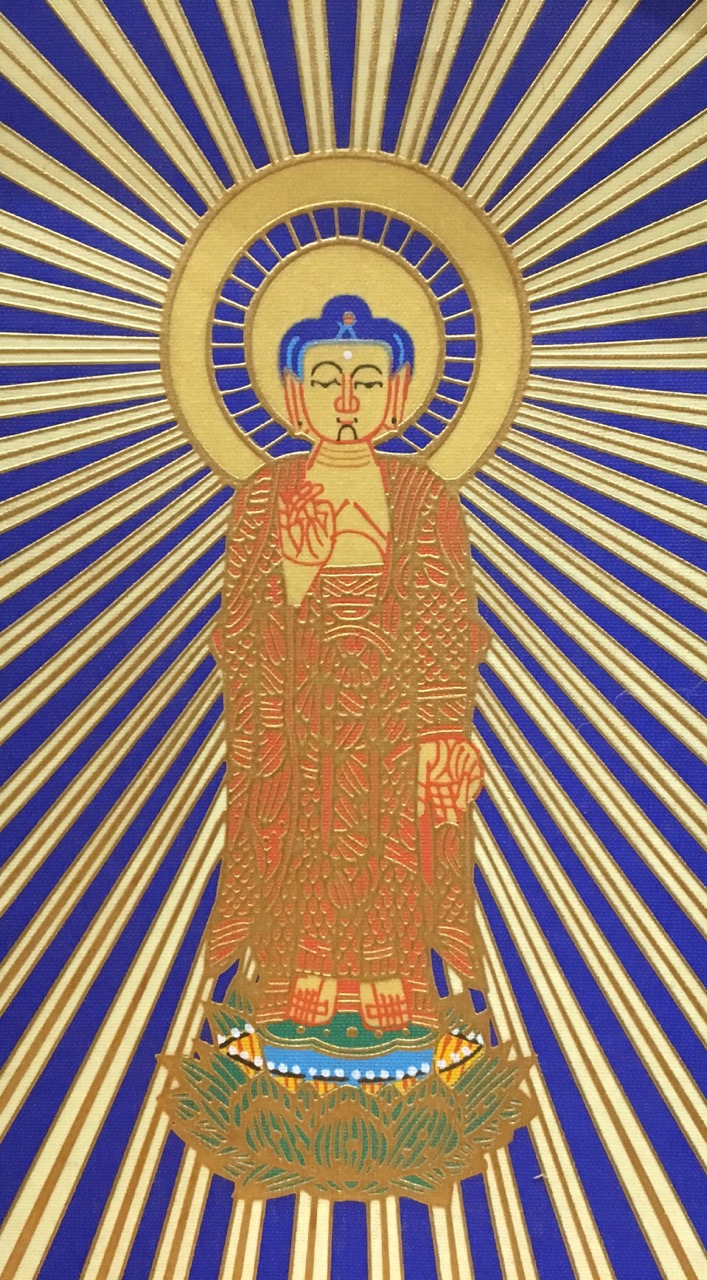
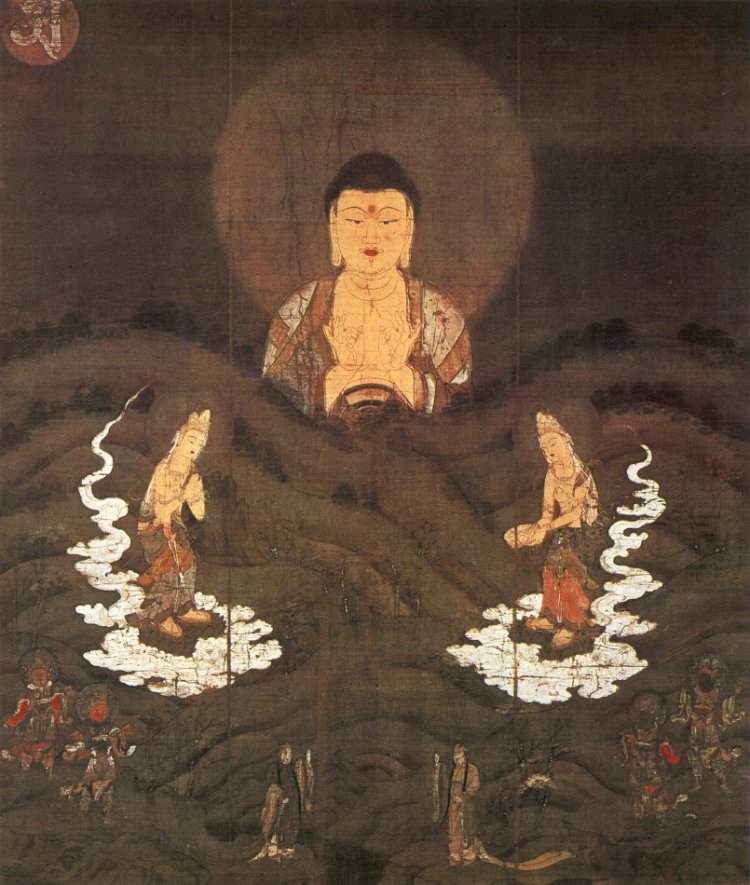
「山越えあの阿弥陀」, or “Amida crossing over the mountain”. Courtesy of Eikando Temple in Kyoto, Japan, and the Museum of Nara. Public domain, via Wikimedia Commons

On the same Japanese documentary as here, I saw a great segment on the famous Eikandō Temple, more formally known as Eikan-dō Zenrin-ji (永観堂禅林寺). Homepage here in Japanese and English. The temple is iconic for several reasons, including its very picturesque fall scenery, and also its vast collection of Buddhist artwork listed here. The most famous is the central figure of Amida Buddha looking back (more on that in a future post).

The picture above, called yamagoé amida-zu (山越阿弥陀図, “Amida Buddha Crossing Over the Mountain”) is a pretty famous work of art that I’ve seen even on English books related to Pure Land Buddhism and especially Jodo-Shu Buddhism.1

It also exemplifies how Amida Buddha was venerated in medieval Japanese culture.

The picture depicts Amida Buddha, a very popular figure in Mahayana Buddhism who vowed to lead all beings to his Pure Land after death so that they may escape the endless cycle of birth and death, and accelerate along the Buddhist path much more readily.2 Amida Buddha is frequently depicted in artwork flanked by two bodhisattvas: Kannon (観音, Avalokitesvara) and Seishi (勢至, Mahasthamaprapta).

As the figure was imported into early Japanese history, he gradually increased in popularity, and many medieval practices were used to help ensure that devout followers would be reborn in his Pure Land. As the situation in medieval Japan gradually worsened, this became even more prominent. If you look carefully, Amida Buddha’s fingertips in each hand touch together in a mudra, a form of Buddhist iconography. What you don’t see is that traditionally, where the fingertips touch, there are usually five strings of different colors hanging down, and there was a common deathbed practice where the dying individual would hold on the other end of those strings as much as they could. This was believed to help ensure that the dying person would not fall through Amida Buddha’s grasp in being reborn to the Pure Land.

Another noteworthy thing about this painting is the Siddham (Sanskrit) syllable written on the upper-left: 𑖀 (“ah”). It is not the “seed syllable” for Amitabha, which is hrīḥ (𑖮𑖿𑖨𑖱𑖾), but is frequently used in esoteric Buddhism (e.g. Vajrayana). This shows that at this time, Amitabha Buddha was still closely associated with earlier esoteric practices found in both Tendai and Shingon-sect Buddhism. For some reason, English-language books on Japanese Pure Land Buddhism frequently seem to crop out the syllable when including this painting.

One rival practice to reciting the nembutsu at this time was reciting an esoteric mantra called the Mantra of Light, promulgated by Pure Land critic Myōe.3 You can see from this picture that pairing devotion to Amitabha Buddha with a popular esoteric mantra wasn’t such a leap either.

Many of these practices gradually faded as Buddhism in Japan evolved and replaced with other practices, but it’s interesting how this one painting can encapsulate so many things in the 11th-12th century Buddhist-Japanese culture.

P.S. I might have messed up the “hrih” siddham syllable. Unicode, Sanskrit and HTML are not easy. 😉

1 Eikando converted from a Shingon-sect temple to a Jodo Shu-sect temple in the late 12th century when it was administered by a disciple of Honen’s named Johen (1166-1224), and then more fully under Shoku. Interestingly, the “Amida Looking Back” statue was crafted a century earlier, in 1082, by Eikan (also known as Yōkan, 永観, 1033-1111) who saw Amida in a dream, and also later founded a hospital on the temple grounds.

2 The assumption that the Pure Land is the Buddhist version of “heaven” (i.e. in a western sense) will require a separate post to explain. TL;DR they have little in common.

3 I actually recite both in my home practice: the nembutsu and the mantra of light. First one, then the other. I first learned about it not from esoteric sources, but actually from Rinzai-Zen Buddhist liturgy, where it is often recited. It’s interesting how certain practices kind of persist in unexpected places.
Chanting the Shiseige / Juseige

Just as the Heart Sutra is chanted by a very wide swath of the Buddhist community in the world, within the Pure Land Buddhist community1 there is another liturgy that’s similar in length and popular in Japanese Buddhism called the juseigé (重誓偈), shiseigé (四誓偈) or rarely the sanseigé (三誓偈). These names mean something along the lines of the “hymn of the grave [as in important] vows [of Amitabha Buddha]”, “hymn of the four [or three] vows [of Amitabha Buddha]” and so on.

This liturgy is actually a small excerpt of an influential Buddhist sutra called the Immeasurable Life Sutra, also known as the Larger Sukhavativyuha Sutra, the largest of the three Pure Land Sutras. These sutras are so called because of their central importance to the tradition. However, two out of three of these sutras are simply too long for lay people recite in whole (unlike the Heart Sutra above), so people often just recite key verses instead.

In any case, the Immeasurable Life Sutra goes in great detail about the origins of Amitabha Buddha (also called Amida Buddha in Japanese), his 48 vows to aid all beings, aspects of the Pure Land that Amitabha created and why one would want to go there. It also, provides a nice overview of Buddhist teachings overall, so in my opinion, it’s a handy, self-contained Buddhist text.

The Forty Eight Vows are central to Amitabha Buddha’s “origin story” (a la the Marvel Cinematic Universe), and are beyond the scope of this blog post.

However, in the sutra, what follows right after the forty eight vows is a short series of verses by aspiring buddha-to-be, proclaiming his lofty and grand vows, summarizing his intent to liberate all beings and provide a refuge for them. These verses were later turned to a liturgy chanted by various Pure Land groups in Japan as a devotional to Amitabha.

While being a member of the Buddhist Churches of America,2 the American branch of the Jodo Shinshu tradition, I can’t tell you how many times I chanted this liturgy during Sunday services. I can practically do it from memory. Here’s a nice Youtube example provided by Tsukiji Honganji,3 one of my favorite Shinshu temples in Japan, located in the heart of Tokyo:

For people who aren’t part of a Buddhist community, I have created a PDF file to help you chant the verses of the Juseige / Shiseige. Please use it, and refer to Youtube videos and other sources for how to chant. I was surprised to learn that someone actually made a Sanskrit version too, since the Immeasurable Life Sutra was originally translated from Sanskrit to Chinese.

I have also provided it below for reference:

Original ChineseRomanizationTranslation by
Hisao Inagaki
我建超世願
必至無上道
斯願不満足
誓不成正覚
Ga gon cho se gan
Hish-shi mu jo do
Shi gan fu man zoku
Sei fu jo sho gaku
I have made vows, unrivaled in all the world;
I shall certainly reach the unsurpassed Way.
If these vows should not be fulfilled,
May I not attain perfect enlightenment.
我於無量劫
不為大施主
普済諸貧苦
誓不成正覚
Ga o mu ryo ko
Fu I dai se shu
Fu sai sho bin gu
Sei fu jo sho gaku
If I should not become a great benefactor
In lives to come for immeasurable
kalpas [eons]
To save the poor and afflicted everywhere,
May I not attain perfect enlightenment.
我至成仏道
名声超十方
究竟靡所聞
誓不成正覚
Ga shi jo butsu do
Myo sho cho jip-po
Ku kyo mi sho mon
Sei fu jo sho gaku
When I attain Buddha,
My Name will be heard throughout the ten directions;
Should there be any place where it is not heard,
May I not attain perfect enlightenment.
離欲深正念
浄慧修梵行
志求無上道
為諸天人師
Ri yoku jin sho nen
Jo e shu bon gyo
Shi gu mu jo do
I sho ten nin shin
Free of greed and with profound mindfulness
And pure wisdom; I will perform the sacred practices;
I will seek to attain the unsurpassed Way,
And become the teacher of
devas [gods] and humans
神力演大光
普照無際土
消除三垢冥
広済衆厄難
Jin riki en dai ko
Fu sho mu sai do
Sho jo san ku myo
Ko sai shu yaku nan
With my divine power I will display great light,
Illuminating the worlds without limit,
And dispel the darkness of the three defilements [greed, anger, delusion];
Thus I will deliver all beings from misery.
開彼智慧眼
滅此昏盲闇
閉塞諸悪道
通達善趣門
Kai hi chi e gen
Mes-shi kon mo an
Hei soku sho aku do
Tsu datsu zen shu mon
Having obtained the eye of wisdom,
I will remove the darkness of ignorance;
I will block all evil paths
And open the gate to the good realms [of rebirth]
功祚成満足
威耀朗十方
日月戢重暉
天光隠不現
Ko so jo man zoku
I yo ro jip-po
Nichi gatsu shu ju ki
Ten ko on pu gen
When merits and virtues are perfected,
My majestic light will radiate in the ten directions,
Outshining the sun and moon
And surpassing the brilliance of the heavens.
為衆開法蔵
広施功徳宝
常於大衆中
説法師子吼
I shu kai ho zo
Ko se ku doku ho
Jo o dai shu ju
Sep-po shi shi ku
I will open the Dharma storehouse for the multitudes
And endow them all with the treasures of merit.
Being always among the multitudes,
I will proclaim the Dharma with the lion’s roar.
供養一切仏
具足衆徳本
願慧悉成満
得為三界雄
Ku yo is-sai butsu
Go soku shu toku hon
Gan e shitsu jo man
Toku I san gai o
I will make offerings to all the Buddhas,
Thereby acquiring roots of virtue.
When my vows are fulfilled and wisdom perfected,
I shall be the sovereign of the three worlds [i.e. of
samsara].
如仏無碍智
通達靡不照
願我功慧力
等此最勝尊
Nyo butsu mu ge chi
Tsu datsu mi fu sho
Gan ga ku e riki
To shi sai sho son
Like your unhindered wisdom, O Buddha,
Mine shall reach everywhere, illuminating all;
May my supreme wisdom
Be like yours, Most Honored One.
斯願若剋果
大千応感動
虚空諸天人
当雨珍妙華
Shi gan nyak-kok-ka
Dai sen o kan do
Ko ku sho ten nin
To u chin myo ke
If these vows are to be fulfilled,
Let this universe of a thousand million worlds quake in response
And let all the
devas in heaven
Rain down rare and marvelous flowers.
Note: many communities recite the final line (highlighted above in bold) at a slower speed for emphasis.

For me, I tend to rotate between chanting the juseige / shiseige and the Heart Sutra. One day, I’ll chant the Heart Sutra in my daily service, the next day the Juseige, back and forth. I like covering both bases.

Finally, the BCA Bookstore (a great site) sells a kind of “starter kit” for new Buddhists that is only $5. It includes an image of Amitabha Buddha and a laminated card for chanting the Juseige. I have purchased this in the past and definitely recommend.

The Buddhist tradition of chanting verses during home services, or in community services, is not limited to whole sutras. It’s quite common in many communities to chant important excerpts, whether these come from the Pali Canon, the Mahayana Canon or whatever. Recitation is a great practice to help internalize teachings, and generates good merit for oneself and others.

Good luck and happy chanting!

Namu Amida Butsu
Namu Kanzeon Bosatsu

1 At least, in the Japanese Pure Land Buddhist community. I poked around Google and wasn’t able to find comparable liturgy in Chinese Buddhism. They do discuss it quite a bit in Buddhist websites, but it’s not clear to me if it’s chanted or not. It’s possible people just chant other comparable liturgy instead.

2 While I am not an active member anymore, my kids grew up there and I have many fond memories of the Japanese-American community, and the many friends I still keep in touch with. 10/10 definitely would recommend to anyone. My disagreements with Jodo Shinshu theologically do not impact my positive experiences with the community.

3 Official homepage in Japanese and English.

Introducing the Taima Mandala

Recently I was chatting with some folks in my PBP group about mandalas, starting with the famous sand mandalas that the Tibetan community drew for President Obama, then mandala in Japanese Buddhism. This conversation woke up some old memories of mine, including an obscure mandala that I wanted to share: the Taima Mandala.

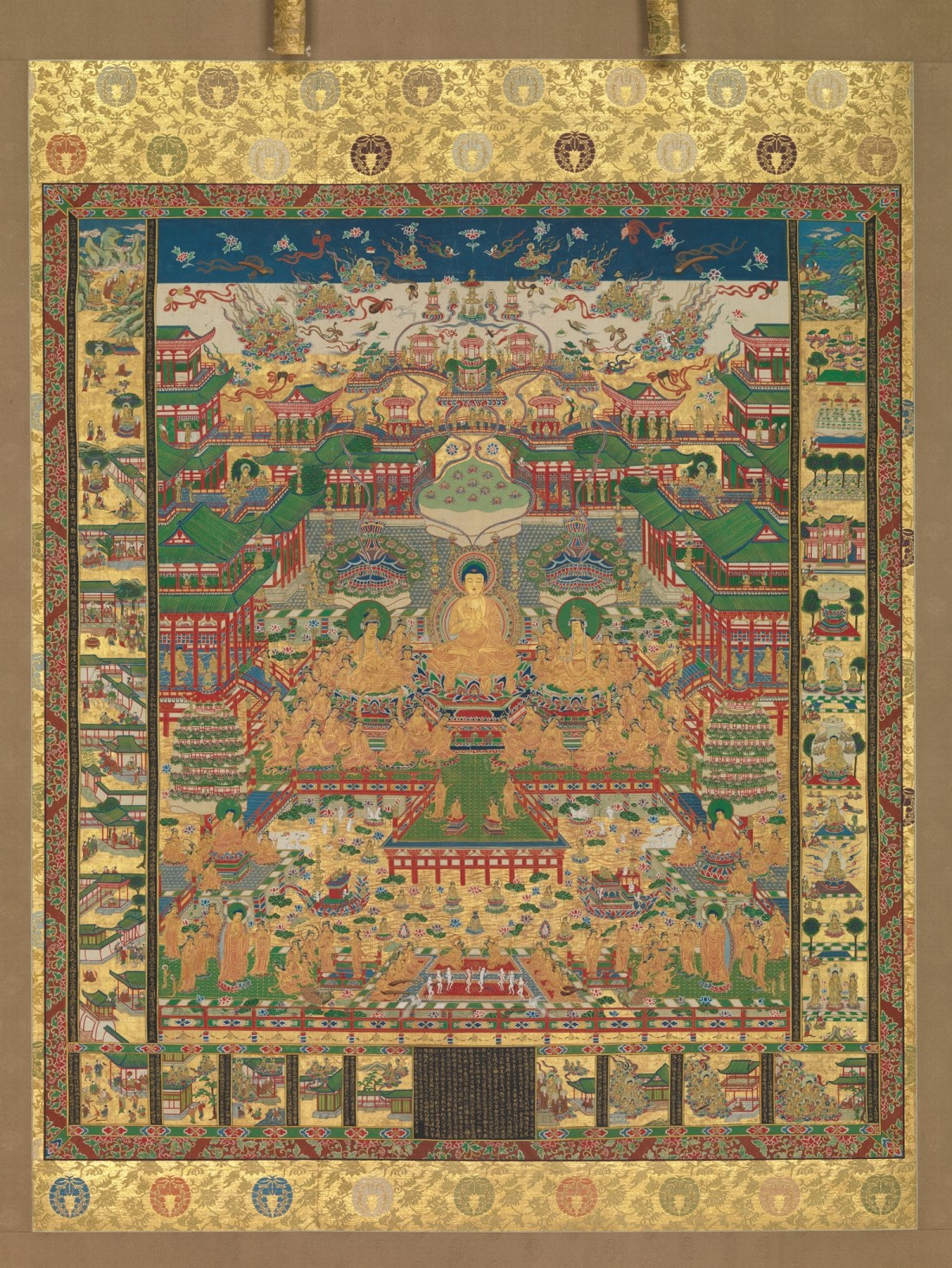
The Taima Mandala (taima mandara, 当麻曼荼羅) is a tapestry that was created in the year 763 and currently stored in the temple of Taima-dera in the city of Nara, Japan although many reproductions exist. You can see the original here. In spite of the name “mandala” it is not technically a mandala, nor is related to the esoteric traditions of Buddhism. Instead, it is part of genre of Buddhist art called hensōzu (変相図) in Japanese, graphic illustrations of the Pure Land of the Buddha or of the Buddhist hell realms.1

The Taima Mandala is a visual depiction of the Pure Land of Amitabha Buddha, the Buddha of Infinite Light. It is in the Pure Land (jōdo 浄土 in Japanese) that the Buddha provides refuge for all beings, and there that they can dwell in an environment that is very conducive to the Buddhist path and ultimately Buddhahood of their own. Part of the appeal of the Pure Land as a Buddhist practice or “dharma gate” is its accessibility. The Buddha, in order to create this refuge for all beings, vowed to make it so accessible that one need only recite his name as little as 10 times, or more if you wish.

Think of it as the ultimate Buddhist retreat, but far more affordable. 😉

If you click on the picture above you can see many details. In the center sits the Buddha Amitabha himself attended by his two attendant bodhisattvas Kannon (right) and Seishi (left).3 They are surrounded by many disciples of all kinds, who eager listen to the Dharma4 and toward the lower central area, you can see new beings being reborn in the Pure Land from the buds of lotus blossoms. Around the edges are smaller pictures, depicting various scenes of the Pure Land, adapted from existing Buddhist sutras, and the bottom depicts the nine grades of followers who are reborn in the Pure Land. The primary source for all this is the Contemplation of Amitabha Sutra, if I recall correctly.

The creation of the Taima Mandala is attributed to a Buddhist nun named Chūjō-himé (中将姫), daughter of one Fujiwara no Toyonari. She was deeply devoted to the Bodhisattva Kannon (Guan-yin). According to the origin story, she finished transcribing a copy of a Buddhist sutra called the shōsanjōdokyō (称讃浄土経, “Sutra on Praises of the Pure Land”?),2 and that same evening, from the western direction of the setting sun, she beheld a vision of the Pure Land in its splendid detail. She was so amazed that she took tonsure as a nun at Taima-dera Temple, and with Kannon’s guidance was able to craft the mandala based on what she saw.

As an example of hensōzu art, the Taima Mandala is simply amazing. It is one of those “often imitated, but never surpassed” works of art. While it is not a mandala in the strict sense, it has been called one for many generations because it does provide a very visual representation of the Pure Land that can’t be fully expressed in written form, hence it has a religious impact all its own.

Very little information about the Taima Mandala or this artistic genre exists in English unfortunately, and I have only scratched the surface, but I hope this helps inspire readers and other Buddhists in some way.

Namu Amida Butsu

P.S. Featured photo is a reprint of the Taima Mandala with the Jodo Shinshu-sect crest at the top and bottom, Metropolitan Museum of Art, CC0, via Wikimedia Commons

1 Ages ago, I attended a museum exhibition in Kamakura which displayed many such medieval hensōzu artwork from local temples, and it was simply amazing. It had a big impression on me, and how I understand Pure Land Buddhism.

2 There is very little information about this sutra in English or Japanese, but it appears to be an alternate translation of the more famous Amida Sutra, brought by the famous Chinese monk, Xuanzang, from India during his journeys. It is also called the shōsan jōdo butsu shōju-kyō (称讃浄土仏摂受経). There’s no translation at all in English, so the above title is my best guess.

3 Buddhas were often depicted in “trinities” with two attendant Bodhisattvas. Shakyamuni, the historical founder of Buddhism, was often depicted with Monju (Manjushri) and Fugen (Samantabhadra) for example.

4 The Buddhist law of existence, or “how things work”. Buddhism at its heart is not a dogma but a way of expressing how reality works, not how we want it to work, with the aim to awaken and enlighten others.

The Amitabha Sutra: the Story of An Old Recording

Some time ago, I used to go to a local Jodo Shinshu Buddhist temple, part of the Buddhist Churches of America, and started training for ordination. This meant that I often got involved in cool research projects at the temple, which had been serving the local Japanese-American community (through thick and thin) for 100+ years.

Anyhow, one time, the minister and I were clearing out some old boxes and found a CD containing a recording from the 1970’s of several ministers chanting the Amitabha Sutra (阿弥陀経, amida-kyō in Japanese). The original recording had been on a cassette tape, and later someone had copied this recording onto a CD. And with permissions from the minister I copied it onto Youtube for all to enjoy:

Unfortunately, I’ve lost my notes on who was singing that day, and what day it was in 1970. I just recall it seeing that it was several ministers from the Buddhist Churches of America at that time, and I recall one them, the lead chanter, was a famous minister in the BCA at the time. If anyone recognizes his voice, I would love to hear back from you.

The photos used in the video are ones I took in Japan. The first is from Nishi Honganji, a major temple of the Jodo Shinshu sect, the second from a local temple in Tokyo featuring the 500 “arakan” (arhat) disciples of Shakyamuni Buddha.

Although I parted ways with the BCA (and Jodo Shinshu as a whole),1 I still miss my time there especially with our minister, who retired, and of course the fascinating cultural legacy that early Japanese Americans brought to the US.2 It’s unfortunate that much of it has been lost and left to dust, but there’s still much there that can be found and researched for those willing to look.

Namu Amida Butsu

Edit: I believe the lead chanter in the recording is the late reverend Haruyoshi Kusada (1921 – 2013).

P.S. If nothing else, I am happy that I was able to take an old recording from 50 years ago and bring it to life, and to all those who helped preserve it along the way.

1 Long-winded explanation here.

2 I miss a lot of people there, actually, but I am fortunate to run into them from time to time since we all live in the same area.

The Thirteen Lords of Kamakura

Since the kids were very young, the family and I subscribe to Terebi Japan, a cable channel that allows us to watch Japanese TV. The cable channel mostly shows TV from the public channel, NHK (roughly analogous to the BBC), and not other content, but it does allow us to watch Japanese TV legitimately and not through some shady third-party service. NHK has a famous series of historical dramas called Taiga Dorama (大河ドラマ) which change every year, but feature some aspect of Japanese history. I usually don’t watch these because they’re not that interesting, and the Japanese dialog is particularly archaic and difficult for me.

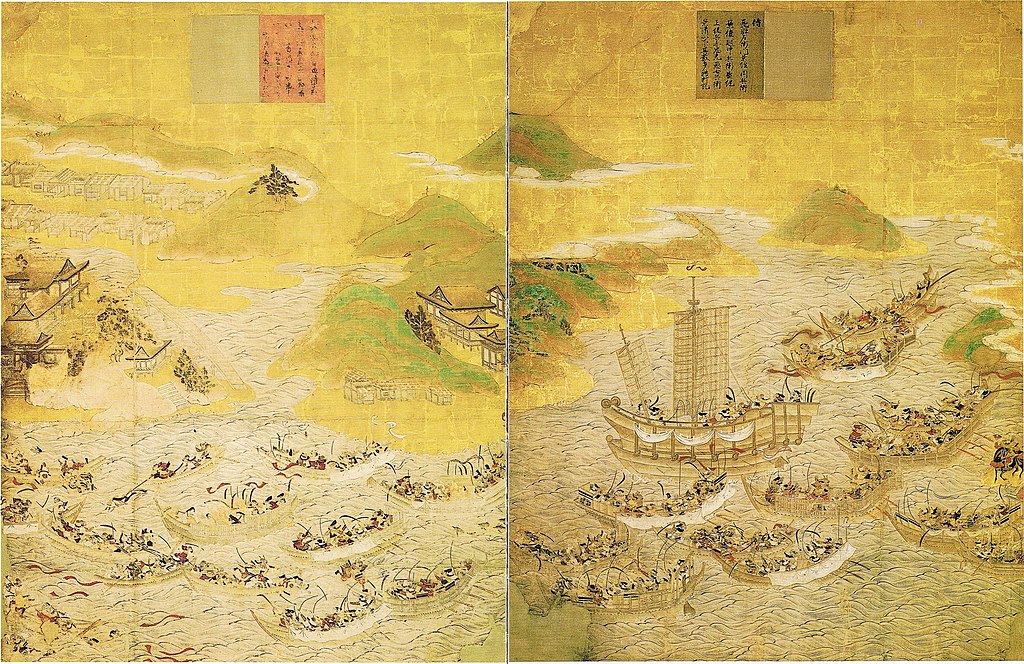
However, lately, I’ve gotten sucked into the latest Taiga Dorama series: Kamakura-dono no Ju-san-nin (鎌倉殿の13人) which translates to the Thirteen Lords of Kamakura. The opening theme alone is pretty epic and worth a watch. I always love seeing the rain of arrows at sea during the climactic final battle of Dan-no-ura in particular.

The Battle of Dan-no-ura, 日本語: 伝土佐光信 English: Tosa Mitsunobu, Public domain, via Wikimedia Commons

This series covers a period of Japanese history that I find particularly fascinating ever since I first studied it in college: the Genpei War in the 12th century. I’ve touched upon the Genpei War before, but to summarize again, this was a four-year country-wide conflict between two powerful samurai clans: the Heike (a.k.a. the Taira) and the Genji (a.k.a. the Minamoto). During this time in Japanese history, the last days of the Heian Period, the samurai class were socially inferior to the noble families of Kyoto (known as Heian-kyo back then) and were subject to manipulation by them. However, the Heike clan turned this around by manipulating the Imperial throne under one Taira no Kiyomori. Having effectively seized the throne, Taira no Kiyomori began to drive out his rivals, including the Minamoto.

The Minamoto were savagely defeated and driven to remote provinces where they were eventually able to rally allied clans (including a Heike off-shoot, the Hojo clan)1 and push the Heike back in defeat after defeat until the battle of Dan-no-ura where the Heike made their last stand, and Kiyomori’s grandson, the two year old Emperor Antoku drowned.

From this point on, the power of the nobility, who had stirred up so much conflict in the first place, was greatly curtailed for centuries, and the samurai class became the true power in Japan until the late 19th century. Minamoto no Yoritomo, who led the Minamoto clan to victory, was the first shogun (generalissimo) of the new military government based in Kamakura, not Kyoto.

This period of warfare was incredibly disruptive to Japan, as evinced in such works as the Hojoki, and is still remembered as the end of Japan’s cultural “golden age”, and the ascendancy of the Samurai. The epic Tales of the Heike (heike monogatari, 平家物語) is a later retelling of what happens, but there are numerous cultural references to the people and places of the War such as ghost stories of the Heike, “Heike crabs“, Kabuki dramas, artistic works in the 19th century, and so on.

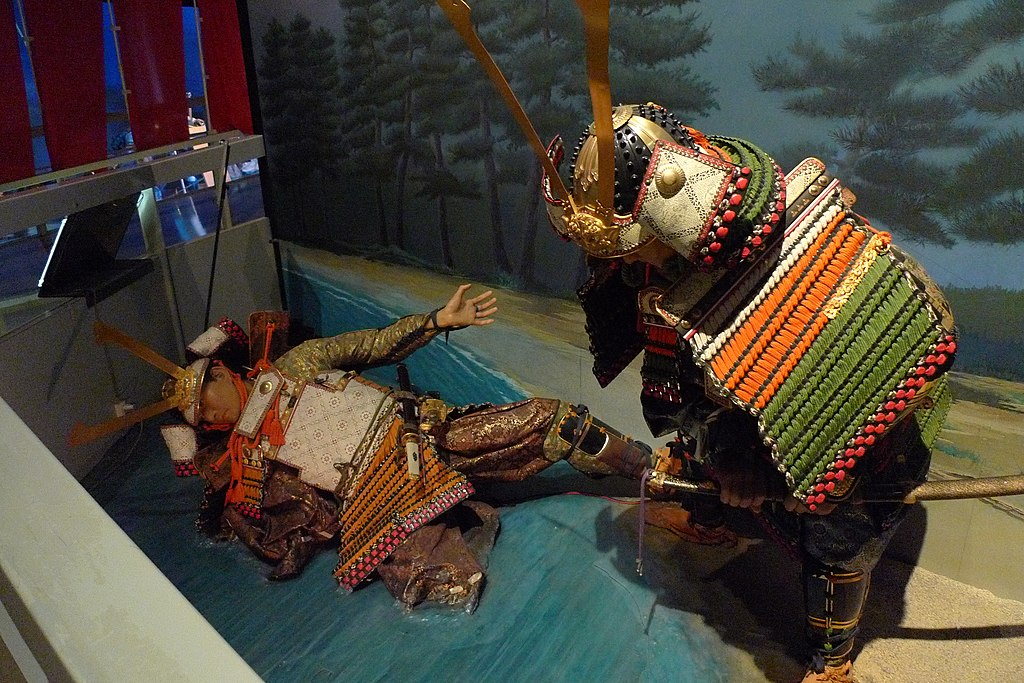
One of my personal favorite is a famous duel between the Genji-clan soldier named Kumagai Naozane (熊谷直実) against the Heike prince named Taira no Atsumori (平敦盛) at the beach-side battle of Ichi-no-tani. Because Naozane was old enough to be Atsumori’s father, and because Atsumori was such a refined youth, Naozane hesitated to kill him at first, but with the other Minamoto soldiers arriving, Atsumori was obviously doomed no matter what. Naozane gave him a quick, merciful kill.

A wax recreation of the death of prince Taira-no-Atsumori at the hands of Kumagai Naozane, courtesy of Takamatsu Heike Monogatari Wax Museum, Takamatsu city, Kagawa pref, Japan.. Photo by Motokoka, CC BY-SA 4.0, ウィキメディア・コモンズ経由で and Wikipedia Commons

After the war, Naozane felt remorse for slaying Atsumori, and retired to the Buddhist clergy as a monk and a devotee of Honen of the Pure Land sect where he took the ordination name of Hōrikibō Rensei (法力房 蓮生) and was a fervent devotee until his death.2

As for the Taiga drama, it’s pretty awesome. The Japanese is still archaic and difficult for me to follow, but they do try to use modern Japanese more, and the cast are celebrities I am more or less familiar with. Matsudaira Ken (of Matsuken Samba fame) plays Taira no Kiyomori, too. 😋

It’s not the first Taiga drama that NHK has done about the Genpei War (another famous one about 10 years ago made the villain, Taira no Kiyomori, the main character), but this drama is particularly well done, and my language skills have finally reached the point where I can appreciate it in Japanese, rather than filtered through limited Western media. But also, as someone who avidly studied Japanese history in college, the War between the Genji and the Heike is something I’ve imagined for half my life and now I can see not just in my imagination, but vividly in a powerful drama.

P.S. The featured image is a 19th century woodblock painting of Heiki general Taira no Tsunemasa (平経正) in a scene from the Tales of the Heike by Yoshitoshi.

P.P.S. Burton Watson’s abridged translation of the Tales of the Heike is a good read if you are interested.

1 The title of the drama “Thirteen Lords of Kamakura” is, I believe, in reference to the various samurai clans who are allies or enemies of the Genji, and each one jockeying for power. I might be wrong though.

2 This also debunks a tired old myth about samurai and Zen Buddhism. The reality was quite a bit more nuanced.

Buddhist Hymn: Dedication of Merit

The dedication of merit at the end of a Buddhist service (at the temple, or home services) is a time-honored tradition, and you’ll see it in almost every Buddhist community in one form or another. In Japanese Buddhism, this dedicated of merit called ekō (回向) and you’ll often see it recited in more or less the same way:

This hymn, called the ekōku (回向句, “verses on dedication of merit”), ekōmon (回向文, “text on dedication of merit”) or ekōgé (回向偈, “hymn of dedication of merit”), depending on the particular Buddhist tradition, is attributed to the 7th century Chinese-Buddhist master Shan-dao (善導 613-681) and goes like so:1

Chinese charactersJapanese-RomanizationTranslation
願以此功徳Gan Ni Shi Ku DokuMay this good merit that I have accumulated…
平等施一切Byo Do Se Is-SaiBe offered equally with all beings…
同発菩提心Do Hotsu Bo Dai ShinThat they may equally awaken the Bodhi Mind
往生安楽国O Jo An Rak-kokuAnd be reborn in the Pure Land of Amitabha Buddha…

An example of how this is sung or recited is here:

There are other versions to within Japanese Buddhism. A version used in Tendai is:

Chinese charactersRomanizationRough Translation1
願以此功徳Gan ni shi ku do kuMay this good merit that I have accumulated…
普及於一切Fu gyu o is-saiBe distributed to all beings
我等與衆生Ga to yo shu joSo that we may all walk this path
皆共成佛道Kai gu jo butsu doAnd equally attain the Buddha Way.
1 Apologies for any mistakes in this translation.

Interestingly, in 2025, I found a similar version from Nanzenji Temple in Kyoto, Japan (a Rinzai Zen temple), that has a similar dedication of merit verse, but the pronunciation of the Chinese characters is much more Sinified (Chinese-style):2

Chinese charactersRomanizationRough Translation1
願以此功徳Gen ni su kun teMay this good merit that I have accumulated…
普及於一切Fu gyu o i shiiBe distributed to all beings
我等與衆生Go ten ni shun sanSo that we may all walk this path
皆共成佛道Kai kyu jin bu doAnd equally attain the Buddha Way.
1 See above

Interestingly, you will also see hymns for the dedication of merit in Chinese Buddhism as well, though with more elaborate lyrics (I found multiple versions online) where it is called the Huí Xiàng Jì (回向偈):

Anyhow, the dedication of merit and its various hymns encompass the Mahayana-Buddhist notion that we’re all in this together. Just as one person awakens the bodhi mind and wishes to share with others, hopefully others will benefit from this too.

Namu Amida Butsu
Namu Kanzeon Bosatsu

1 Some Buddhist traditions in Japan translate this into a more native text, using flowery liturgical language, but the meaning is basically the same.

2 It’s also possible that these are both Chinese pronunciations but from different eras of Chinese history. Tendai was imported during the Tang Dynasty and Zen during the Song and Yuan dynasties. A lot can change in 400-500 years.

Buddhism: Gates, not Sects

Recently, I stumbled upon a particularly fascinating book on the oft-neglected subject of Chinese Pure Land Buddhism titled Chinese Pure Land Buddhism: Understanding a Tradition of Practice by Charles B. Jones. This book was published in 2020, so it’s quite recent.

The book seeks to clarify what defines the Chinese “Pure Land Buddhist tradition” by relying on more native Chinese sources, rather than Western interpretations. I have only started reading the book and it has done much to clarify my own misconceptions.

One of the many gates surrounding the urban lake of Hoàn Kiếm Lake (Lake of the Return Sword) in Hanoi, Vietnam. Taken by me in the summer of 2001. Apologies for the graininess of photo, but all I had was a disposable camera.

In particular, one the first chapters attempts to define what Chinese Pure Land Buddhism is rather than what it isn’t (a common trope from earlier Western research). In Japan, due to certain historical and political factors, Buddhism as a religion has been divided into a number of fixed sects 宗 (shū), such as Jodo Shu, Nichiren Shu, Soto Zen Shu and so on. Each has a set founder, a set practice, and set lineage, etc. This is what most Westerners are familiar with and tends to resonate with our own Protestant religious landscape.

However, when you look at mainland Buddhism such as in China, and probably also Vietnam and Korea, you don’t see such a division. Western research has tended to assume that is because there are no explicitly-defined sects, it’s just one syncretic, Buddhist tradition. However, the book demonstrates that if you scratch the surface you will find unique practices, traditions, it’s just that Western scholarship hasn’t adequately defined them yet.

In the context of Pure Land Buddhism in China, Chinese Buddhist writers have rarely used the equivalent term 宗 (zōng, sounds like “tsohng”) as in 浄土宗 (jìng tǔ zōng, “Pure Land Sect”) to describe the traditions therein. Instead, the book shows that the term 法門 (fǎmén, sounds like “fah-muhn”), or Dharma-gate, was much more commonly used throughout Chinese-Buddhist history. For clarity, the “Dharma” here refers to the Buddhist teachings as taught by the historical Buddha, or in a broader sense, the nature of reality. The Buddha didn’t invent the Dharma, he awakened to what was already there, just as other Buddhas supposedly did, and shared with others.

In any case, the notion of Dharma Gate, rather than “sect” kind of blew my mind.

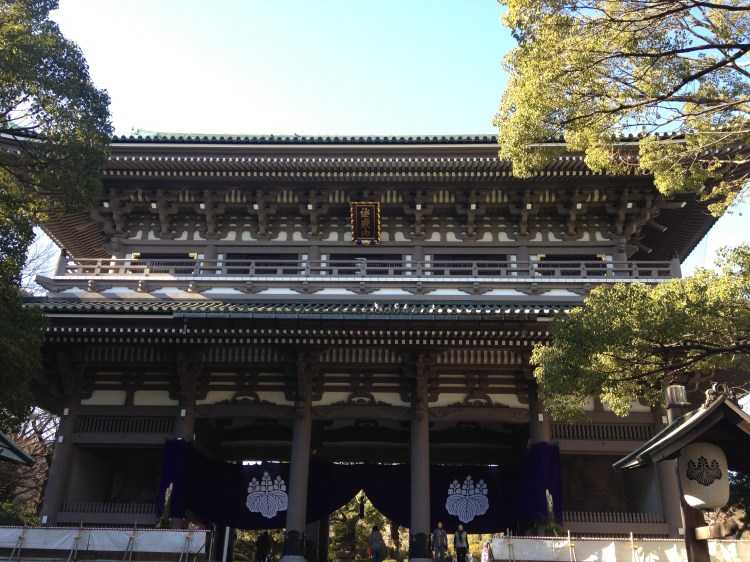
The sanmon (山門, “mountain gate”) of Zojiji temple in Japan, a major Soto-Zen temple, located right in the city of Kawasaki.

The idea of gates is nothing new in Buddhism: many Buddhist temples, including urban ones, have a “gate” representing one’s entrance to the Buddhist path. Even becoming Buddhist is sometimes referred to as “passing through the Gate of the Dharma”,

However, in this context, it means something bigger. In the famous Lotus Sutra, the Buddha uses the analogy of a burning household, and the efforts to lead the children out of the house with promises of gifts, only to reveal that all the gifts were the same (and much better than what was originally promised). A frequent theme in the Lotus Sutra is thus “expedient means” or upāya in Sanskrit: using a variety of teachings and methods to suit the backgrounds and inclinations of various living beings to help them take those first steps. Ensure no one is left behind, in other words.

This gives rise to the idea of many different “gates”, usually based around specific Buddhist practices rather than a sectarian interpretation, all converging on the same point in the middle.

T-Mobile Park, formerly Safeco Field. MyName (Cacophony), CC BY-SA 3.0 http://creativecommons.org/licenses/by-sa/3.0/, via Wikimedia Commons

Imagine someone going through one gate at the local sports stadium versus a different gate. Sometimes, this is less about choice, and more about which parking lot you parked in,1 but other times it might be because you like to stop and get some garlic fries on the way in, or maybe you like taking the less crowded gate even if you have to walk a bit further to your seat. Maybe you just really want that beer. In any case, you arrive at your seat, but the experience leading up to it will be different until you converge to your seat. It’s all the same stadium one way or another, but you have some agency about which gate you pass through and how you will get to your seat.

I like this expression of the various “dharma gates” of Buddhism because it doesn’t divide Buddhism into competing sects, nor does it necessarily imply one gate is better than another (they’re all roughly equidistant to the goal). It’s more about choice.

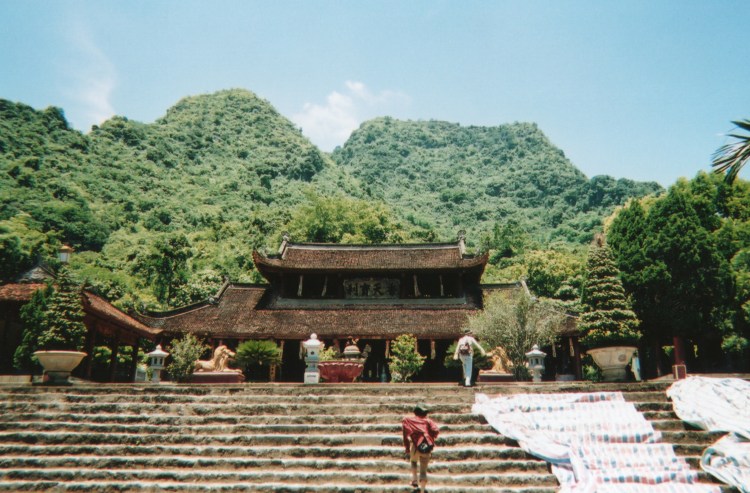
The Thiên Trù Pagoda, the central temple of the Perfumed Pagoda in northern Vietnam. Photo taken by me in the summer of 2001 with my grainy disposable camera. I wasn’t Buddhist then, and did not fully understand anything. Plus it was stiflingly hot and muggy. I would love to visit again someday.

And the concept of a “dharma gate” isn’t limited to particular traditions. As the book shows, the Pure Land “dharma gate” has within it many different sub-gates, based on particular practices (reciting sutras, prostrations, meditation practices, etc). Zen-based traditions might also vary somewhat by practices, the degree they do this or that, and thus there’s not just “Zen gate”, but many gates within.

I like sects as much as the next person,2 but I think describing Buddhism as a large religion with many “dharma-gates” rather than denominations or sects, is a more accurate model. Imagine the Buddhist religion as the Colosseum of Rome. Buddhism as whole tends to place heavy emphasis on practice and less on dogma, so it’s more of a matter of finding a practice (e.g. a dharma-gate) and entering through that gate. In time your practice and understanding will converge with other Buddhists over time.

1 In the same way, sometimes we living beings are hemmed in by our past karmic circumstances and thus our options for practicing Buddhism are more limited.

2 I am sorry, but I couldn’t resist the joke. 😝

Moonlight: A Buddhist Poem

Photo by Aleksandar Pasaric on Pexels.com

The founder of the Jodo-Shu sect of Buddhism, a 12th-century Buddhist monk named Honen, once composed a poem titled tsukikagé (月かげ, “Moonlight”). What follows is a rough translation on my part:

JapaneseRomanizationTranslation
月かげのTsuki-kagé-noThere is no village
いたらぬ里はItaranu sato wathat the light of moon
なけれどもNakeredomodoes not shine,
眺むる人のNagamuru hito nobut it dwells in the hearts
心にぞすむKokoro ni zosumuof those who see it.

The “light of the moon” here is meant to symbolize the light of the Buddha, namely Amida Buddha. Light is a common motif in Buddhist art, depicting both wisdom to banish away the darkness of ignorance, and also goodwill to all living beings.

Amida Buddha and his attendant bodhisattvas welcoming Chūjōhime, Taima Temple Mandala,
University of Michigan Museum of Art, Artist Unknown, Japan, Public domain, via Wikimedia Commons

The idea is that Amida Buddha’s light shines upon all beings and all places, as explained in the Buddhist text, the Sutra of the Buddha of Immeasurable Life:

“The radiant light of the Buddha of Immeasurable Life is dazzling brilliant, illuminating all the buddha lands of the ten directions, and there is nowhere it is not heard of.”

From The Three Pure Land Sutras published by the Jodo Shu Research Institute, translation by Karen J. Mack

Further, the sutra explains in the previous section:

“Those sentient beings who encounter this light will have the three hindrances1 eliminated, become amenable in body and mind, leap with joy and their hearts will give rise to good. Should they suffer hardship in the three realms of defilement,2 when they see this radiant light, they will all attain relief and not again suffer this pain.”

Thus, the light of Amida Buddha shines everywhere, but people may not necessarily know it. Those who do encounter the light experience a transformation within. It may not be obvious at first, but it as one of Honen’s disciples once taught, it melts ice to become warm water.

Thus, Honen’s poem is about how Amida’s goodwill and wisdom reaches out to all beings and all places, and even if people do not see it, it is still there. Further, those who do see it are changed by it, even if they are not aware of it at first.

Namu Amida Butsu

1 The three hindrances in Buddhism are greed, hatred and ignorance.

2 The three realms of defilement is another term for lower states of rebirth that one might fall into: animals, hungry ghosts, and the hell realms.

Summers in Tokyo

One of my favorite places to visit in Tokyo each year (my wife loves it too) is the Buddhist temple of Zojoji, which sits right next to Tokyo Tower:

Translates as (roughly): Zojoji in the summer, 2021 (lit. the 3rd year of the reign of the Reiwa Emperor). A babbling brook.

Enjoy!

P.S. Official homepage of Zojiji Temple (includes English).

Toward a New Look at Honen

Photo by Abdullah Ghatasheh on Pexels.com

Recently, I re-posted an old polemic article I wrote 8 years ago (!) in a former blog at a time when I was on my out the door from the local Jodo Shinshu Buddhist community, citing references to one of Honen’s biggest critics, Jokei, an influential monk of the influential Hosso (Yogacara) school. Many of the points that Jokei criticized are common complaints that even today people level against the Pure Land path, specifically Jodo Shu and Jodo Shinshu Buddhism. I have even made these criticisms myself from time to time.

However, in the book Traversing the Pure Land Path, the author makes an interesting point that I did not fully grasp back then:

…Honen’s single-minded focus on the nenbutsu (senju nenbutsu) is not a narrow-minded or exclusivist practice. Rather, it is prioritization or “selection” (senchaku) of a practice that Honen felt was the most beneficial. In other words, the nenbutsu is an essential competence which needs to be thoroughly understood and experience.

Page 77

Jodo Shu Buddhism takes the nenbutsu practice as its bedrock. This is not unusual in Japanese Buddhism, where many of the Kamakura-era Buddhist schools (Zen, Pure Land, Nichiren) tended to build around a single practice first, and build the teachings around it for support.

However, the book doesn’t stop there:

Honen’s senchaku process also includes reintegration. After realizing the mind is firmly established towards Birth [in the Pure Land] (ketsujo ojo-shin), the four other right practices (sho-gyo) of Amida’s Pure Land can be readopted as similar kinds of auxiliary practices (dorui-no-jogo)….With the transformation of one’s heart through single-minded nenbutsu practice, these auxiliary practices go beyond being merely helpful to nenbutsu practice. Subsumed within nenbutsu practice, they become practices corresponding to Amida’s Original Vow.

Page 77

This idea of reintegration of other practices within the dedicated nenbutsu practice is something I didn’t fully appreciate in my younger years, but makes more sense now with the benefit of experience. Basically, Honen’s concept of senchaku (選択) is to establish a solid foundation first, then reintegrate other Buddhist practices as your confidence grows. Over time, it becomes a comprehensive practice.

I am reminded of a passage from the Larger Sutra on the Buddha of Infinite Light:

Anyone who sincerely desires birth in the Land of Peace and Bliss is able to attain purity of wisdom and supremacy in virtue. You should not follow the urges of passions, break the precepts, or fall behind others in the practice of the Way.

trans. Hisao Inagaki

Even in the fundamental sutras of Pure Land Buddhism, disciples are encouraged to do good works, maintain wholesome conduct, etc, so it doesn’t differ from the rest of mainstream Buddhism, but Honen’s senchaku approach represents a shift in mindset. Instead of doing the practices just for practices sake, they are rely on Amida’s vow to help all beings, and to prepare for one’s rebirth in the Pure Land.

In my experience, some people I have met who are Pure Land Buddhists tend to take a strictly nenbutsu-only, exclusivist approach, which Honen clearly didn’t agree with, and even in Honen’s time, some of his disciples, such as Kosai, really went of the deep-end.

I feel like Honen’s approach was “never stop, and never get complacent”, but at the same time, he wanted to prioritize a straightforward simple practice first as the bedrock that other things could be built upon. Thus, laypeople and monks, could both start the same way and take it as far as they want.