While in Japan, my wife, kids and I attended the 49-day memorial service (details here) for my mother in law. This service was held at a neighborhood Jodo Shinshu-sect temple which my mother in law frequently volunteered, and have been family friends for generations. 😌
This was the first Jodo Shinshu Buddhist service that I had attended in almost five years. The Pandemic was a large reason, but also there are personalreasons too.
Anyhow, the memorial service included an important hymn in the Jodo Shinshu tradition called the Shōshinge (正信偈). This is a hymn composed in the 13th century by the founder Shinran, and lays down the basics of Jodo Shinshu teachings, and the “lineage” of one Dharma master to another, starting in India, through China, to Shinran’s teacher, Honen.1
The hymn is quite long (20 minutes), but it is frequently used in formal services. When I was training for ordination years ago, I practiced this hymn over and over with my minister, so hearing it brought back a lot of memories. I could still remember some of the verses, the rhythm, etc. It’s interesting how music stays in your memory like that. Also, I am very tone-deaf so during my training days, I sang it terrible. My minister was quite good at it, and also very patient with me. Reverend Castro, thank you.
The above YouTube video is a good example of the Shōshinge when sang properly. I definitely did not sound like this, no matter how much I practiced. Also, there are at least two styles to singing the Shōshinge, the gyōfu (行譜) style, and the more common sōfu (草譜) style. But start off somewhat flat, but then gradually build as the song goes along. IIRC, the gyōfu is more difficult.
This video below, demonstrates the gyōfu style. Note the abrupt change in style around 10:00 or so…
One other note is that the Shōshinge often ends with a set of 6 shorter hymns called Wasan (和讃). Shinran wrote quite a few of these little hymns, but these 6 in particular are most commonly included at the end. I remember singing these too (also rather poorly).
By the way, you can find a full translation of the Shoshinge including the 6 Wasan hymns here.
One thing that always struck me as unusual about Jodo Shinshu as a sect was its heavy reliance on hymns more than chanting the Buddhist sutras, as other sects do. My guess is that using music and hymnals, especially in vernacular Japanese, made the teachings more accessible to Japanese lay people. This is similar to the medieval Christian debate between using Latin vs vernacular language, perhaps.
However, Jodo Shinshu does recite some Buddhist sutras too, such as the Juseige and Sanbutsuge, both excerpts from the Immeasurable Life Sutra. Also, the Shoshinge is written in Sino-Japanse, not vernacular (like the Wasan hymns), so the answer is maybe not clear-cut. Maybe Shinran was just a musically-inclined person. I am not sure. Personally, I just prefer to recite sutras as it is the more mainstream tradition anyway.
In any case, for the 100th day memorial for my mother in law, I will probably sing the Shoshinge hymn as a tribute to her, so I have been brushing up a bit lately. We’ll see how it goes. But, I hope she enjoys nonetheless.
1 The concept of lineage in Pure Land Buddhism is a bit fuzzy, compared to Zen, Shingon or Tendai Buddhism in that there is no physical “handover” from master to student. The patriachs all lived in different times and places, but each contributed new ideas or innovations to Pure Land Buddhism, hence there is a steady evolution.
Well, life tends to mitigate against complete commitment, doesn’t it?
— Count Saint Germain, Castlevania animated series, season 4
With the recent turmoil following my mother-in-law’s passing, life has been disrupted in many ways. All of this is temporary, but it has reminded me of how easily one’s Buddhist practice can slip. Since this started shortly after taking up the Ango abstinence, my meditation and even my daily exercise routine fell apart due to changes in routine, caring for the kids, etc.
This isn’t surprising really, and it’s not necessarily a bad thing either. It’s just that, as the quote above shows, life tends to get in the way. We imagine a pristine Buddhist practice, and then life blows up in your face again and again.
At work, we got signed up for free self-help services, including meditation videos, through Headspace. I tried it once and found it kind of useless. My company probably meant well, but the idea that you can meditate your problems away is, ironically, contrary to Buddhist teachings.
A long time ago, I worked in a certain big e-commerce site (starts with an “A”) under pretty stressful conditions. At times, it was so stressful, I had painful acid reflux issues,1 leading to vomiting and other things. This happened at least once a month. I tried to meditate in order to calm down and reduce stress. I would take a break during work, meditate for 15-20 minutes at a time, and then return to work.
It didn’t help. I felt calm and at peace at the time I was meditating, but as soon as the first problem came up, my stress level shot right back up again. And of course it’s not possible to just meditate all the time.
It was only when I finally quit that e-commerce site that my stress and my stomach issues finally resolved. The problem was not my attitude toward work, the problem was that I worked in a genuinely shitty, competitive work environment, and the money and prestige weren’t worth it.
Years later, I’ve come to realize that trying to run away from life through Buddhist practice didn’t work. I needed to practice Buddhism through life, not in contrary of it. Buddhist practice isn’t meant to help you “bliss out”. It is to help you face your challenges, and make intelligent, mature decisions.
I believe this is why in Zen Buddhism they emphasize the importance of samu (作務), or practice through work, or the Pure Land teaching of practice amidst daily life. There’s nothing magical or mystical about this. People have to work, eat and survive, even as a monastic, and in the end you’ll never have all the “me time” you need. It sucks, and it ain’t pretty, but that’s life.
Each one of us lives in our own private hell in a sense. We suffer, we’re stressed out, we’re getting older, we face health problems, we have obligations we can’t escape. In the end, we will die and eventually be forgotten. This is the burning house spoken of in the Lotus Sutra. It is through this, not in spite of this that the Buddhist teachings and practices truly come alive. Meditation retreats and self-help books are not the answer; you have to live, survive, reflect, and you have to help others do the same. In so doing, you learn more about yourself.
Namu Amida Butsu
P.S. if you work in a stressful work environment, get out if you can. Do not think a “stiff upper lip” will work in the long-run.
1 Turns out the pain and acid reflux were due to another issue… (2025 edit)
Hello dear readers, I have a few updates to share.
First, I updated the name of the blog. When I first built it, I had chosen a snarky name at random and never bothered to update it until I had a more clear idea what i wanted to do with the blog (and not just post random things). I realized that over time the blog has unknowingly envolved, and having been inspired by the novel of the same name by Greco-Irish author Lafcadio Hearn, I decided to finally update the name.
Second, I decided to setup a Twitter feed for the blog here. I will be posting blog updates there, but also extra content as interesting things come up. I might even also start other social media feeds at some point, but for now, I wanted to at least do Twitter. My teenager likes to remind me how old-fashioned Twitter is now.
FInally, as folks probably picked up, I’ve been busy on the spiritual side of things lately and I wanted to share some things.
The home “retreat” I did in August had, not surprisingly, a lot of twists and turns. Planning a months-long retreat at home with kids, work and summer plans was never going to be easy and something goals quickly fell off (like not blogging, nor abstaining from junk food), but other aspects did fare better such as finishing a number of books and keeping up home practice. So, all in all it wasn’t bad. I had to remind myself, once again, to keep it simple and flexible. 🤦🏼♂️
Further, I felt like taking a retreat would help reinforce my faith in the Pure Land path, but after a series of unexpected encounters and realizations, I decided that I feel more at home in the Zen path, and I’ve decided to shift gears and focus my practice and study there. I don’t regret my time involved in the Pure Land path, but I think I’ve taken as far as I could, and I found that once I started a new meditation regimen and such, i was happier with my practice again.
This isn’t such a big change for me. I’ve always been a Pure Land Buddhist with an interest in Zen, but I guess I’ve now transition (at least for the time being) into a Zen Buddhist with a deep appreciation for the Pure Land path. And again, as we learned with Chinese Pure Land Buddhism, the distinctions between the two aren’t so great anyway.
On the other hand, one reason why I’ve avoided Zen for so long is that proliferation of two types of Zen students you often meet in local communities: First are the “Bushido Bros”: people who love martial arts and Zen, but with little understanding of contemporary Japanese culture or language. These “Neo-Orthodox” types are eager to imitate traditional Zen culture in an intellectual way without the cultural context. If Dogen didn’t say it, it’s worthless. Conversely, there are the “American Buddhist” types who want to eschew all Asian cultural trappings for something more hip and modern. You’ll see these folks in trendy (read: gentrified) neighborhoods, and dot-com companies.
In short, I am not comfortable with either one, and they’ve turned me off for the longest time.
However, as my language skills have improved to the point that I can read (basic) Japanese literature on Zen in Japanese, I am finding that there’s plenty of good stuff. It’s not that Westerners get it wrong, or that Westerners are stupid, but they either try too hard to imitate, or try too hard to reinvent Zen. I just want to enjoy the tradition as it is (i.e. as it is practiced in Japan), warts and all, and just enjoy it for now. I still recite the nembutsu often, but the emphasis these days is more on practical meditation and a streamlined liturgy, and not getting hung up on doctrinal minutiae.
So anyhow, hope you like the new title, please feel free to follow on Twitter, and please be patient as I adjust my blog content slightly to meet the new path.
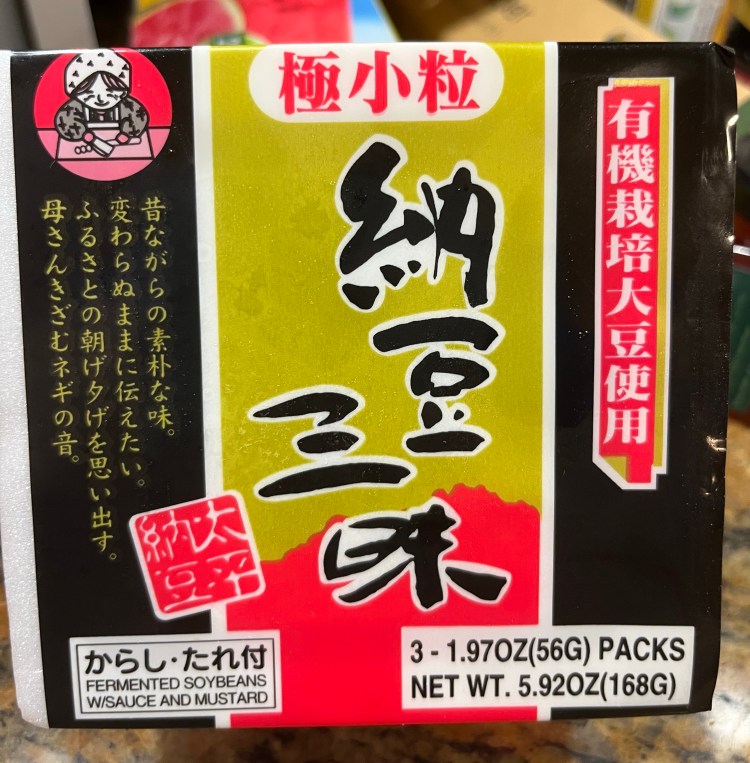
My family knows I love to eat rice and natto, or fermented soy beans, in the morning. Often with Korean kimchi. It’s a breakfast habit I started about 10-15 years ago, and never looked back. Thanks to the crunch of the pandemic, and inflation, shipments from Japan have become a trickle, and so our local Asian market will sometimes have no natto in stock, other times it will have a huge stock that quickly disappears. My wife found this new brand recently after the latest shipment came in, and the name of the product gave me a good chuckle.
The name of this product is nattō zanmai (納豆三昧), with “zanmai” being a Japanese transliteration of the Chinese-Buddhist term from the Sanskrit word samādhi. The word samadhi is something used in Indian religion in general, but refers to a state of intense concentration through meditation. It appears in a wide variety of contexts, but for now we’ll focus on the Buddhist ones. It helps to think of samādhi as being “in the zone”, but in a deeper, meditative sense.
Usually when people think of meditation, they think of the classic mindfulness meditation (a.k.a. vipassanameditation) and sometimes when one meditates here, they get into a deep, absorbed state. However, meditation is a broad subject in Buddhism, and with other kinds, including walking meditation, mantra-chanting, visualization of the Buddha, etc. In each such practice, some kind of samadhi is possible too. Even in the context of Pure Land Buddhism, chanting the nembutsu (the name of Amitabha Buddha) is said to bring about something called nembutsu samadhi if done as a long-term, dedicated practice. Honen was said to have seen the Pure Land around him during this intense state of recitation. Similarly, the intense practices of the Tendai sect were said to bring about powerful samadhi experiences as well if carried to fruition.
However, while all that is interesting for Buddhist-nerds like me, it is not the context being used for the brand of natto. The term “zanmai”, which still retains it Buddhist context, can also mean in a regular day to day context something that you’re just really into. You might even say “absorbed” by. 😎 Day to day Japanese has a lot of old Buddhist terms that have changed meaning over time and reflect cultural attitude even as their religion meaning is obscured. The term aisatsu (挨拶) refers generically to the formalities people use to greet one another, but originally derived from a Zen-Buddhist term for when a teacher would quiz his student on their grasp of Zen. Even the common phrase ganbaru (頑張る, “hang in there”) originally derived from a Zen context as well.
Of course, we do this in English too: many Christian-religious terms have gradually taken on a more pop-culture meaning as well. I have heard from an old Palestinian co-worker that this happens with Islamic terms in Arabic as well. It is a natural cultural phenomenon.
All this is to say that while natto over warm rice does not lead to meditate absorption, it is really darn good, and if like me, you eat it almost every day, you might say you’ve been pretty absorbed by it.
I’ll see myself out.
P.S. If you do like natto, this is a great brand. Definitely pick it up if you can.
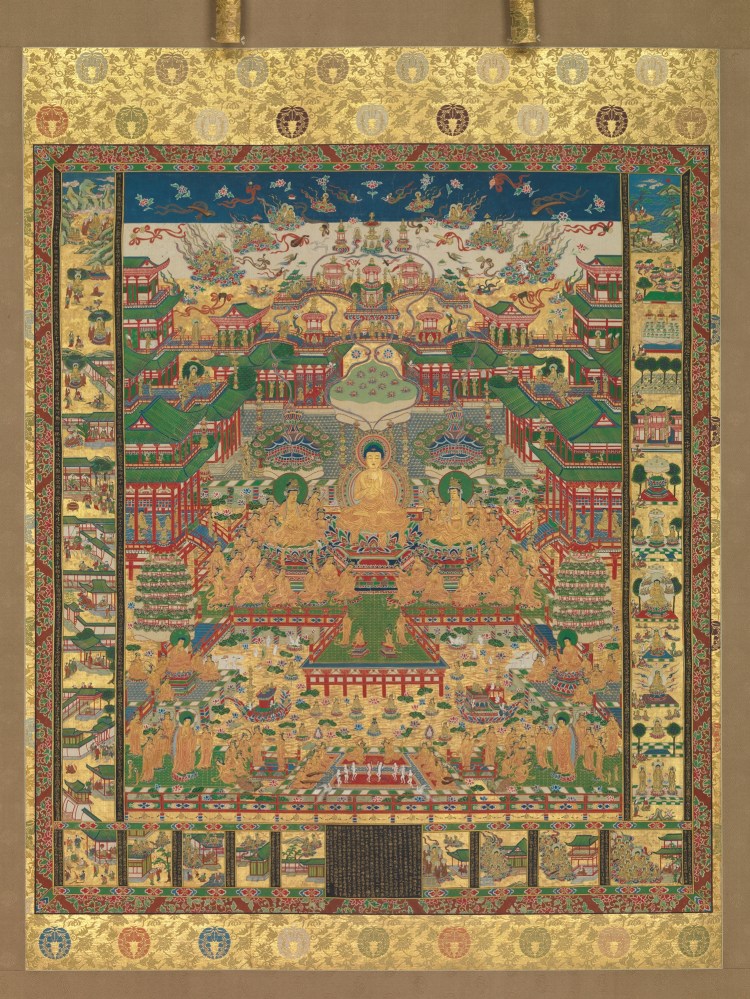
A reprint of the Taima Mandala, one of my favorite works of Buddhist art, with the Jodo Shinshu-sect crest at the top and bottom, Metropolitan Museum of Art, CC0, via Wikimedia Commons
Recently, I have been reading up on the Obaku sect (Ōbaku-shū, 黄檗宗) of Japanese Zen Buddhism: the same sect that Tetsugen was a disciple of. Obaku Zen is the third and last Zen sect to come to Japan to China, centuries after Rinzai and Soto were imported. Rinzai and Soto were both imported from China during the Song Dynasty. Obaku had the same lineage as Rinzai Zen, but was imported at the end of the Ming Dynasty, and had evolved over time to include some elements of Pure Land Buddhism, but with distinctly Chinese-Zen flavor.
In Japan, due to the Obaku sect’s common ancestry with the Rinzai sect, it was gradually absorbed administratively by the latter, but it’s arrival in Japan also reinvigorated Zen-monastic discipline. Soto and Rinzai sects frequently studied for a time at Obaku temple communities.
Obaku Zen, though small, still retains its more Sinified liturgy (sutra recitation is pronounced in a more more Chinese, less Japanese, style) and integration of Pure Land teachings.
For example their temple homepage lists an interesting excerpt from an earlier publication about the meaning of the Pure Land of Amitabha Buddha in a Zen context. What follows is the original excerpt, plus my rough translation:
If we take this world that exists as none other than Mind only, such that all of its affairs, its phenomenon, and such all depend on the movements of the Mind, and thus are “Conscious-only”, then the “Pure Land” is that which dwells in the heart. That is to say, Amitabha Buddha is this very self.
from「己身」の「弥陀」 (“Amitabha Buddha of the self”) from 黄檗宗青年僧の会発行「黄檗」(“Obaku Zen young monk’s periodical ‘Obaku'”)
To borrow that 1980’s cliché found in every Saturday morning cartoon: the real treasure was inside us all along.
The term “Conscious-only” or yuishin (唯心) is the Buddhist term for the Yogacara Buddhist school of philosophy, which taught that all things we perceive, think and feel are ultimately projections of the mind itself. It’s a subject that is super fascinating and far beyond the scope of this post, but important to understand that the Yogacara tradition of Buddhism has had a huge influence on Buddhism at large. I highly, highly recommend the book Living Yogacara: An Introduction to Consciousness-Only Buddhism if you’d like a general overview of Conscious-only Buddhism. It is a book that I come back to every now and then.
In any case, this concept of the Pure Land as the mind only might seem far-fetched given the overall trend, especially in Japanese Buddhist history, to focus on Amitabha Buddha and the Pure Land as separate, external entities. However if you’ll recall, the Chinese monk Ouyi who also lived in Ming Dynasty promoted a similar outlook:1 that in the end the real Pure Land was our Mind, and yet it’s perfectly fine to continue practicing Pure Land Buddhism as if it were external.
You might even say that the real bodhisattvas we encountered were the friends we made along the way. 🤪
Namu Amida Butsu
1 It’s tempting to argue that the Zen traditions of Soto and Rinzai that came to Japan earlier are more “pristine” than the later Obaku tradition, but I think that’s it’s a highly romanticized view of the past. Further, it’s important for religious traditions to “till the soil” from time to time, innovate and such. We can’t recreate the original 5th Century BCE community of the Buddha and his direct disciples, nor can we recreate the early Zen traditions in China and so on. We can learn from them, and keep innovating as time goes on. Later Zen tradition in China probably reflected continuous innovation as it vied with other schools of thought: Confucian, Taoist, other Buddhist schools, etc.
I found this quotation recently in the 13th century Japanese text, the Essays in Idleness, and have been giving it some thought:
Someone asked the holy priest Honen how to prevent himself from being negligent in his practice by inadvertently nodding off when chanting the nenbutsu. “Chant for as long as you stay awake,” answered Honen. Venerable spoken.
I like this approach wherein Honen is encouraging a “do your best” with respect to Buddhist practice vs. “do a set amount” that you often see in modern Buddhist literature. For folks who dabble in Buddhism or spiritual practices in general, in particular meditation, it’s often the case we treat it as a prescriptive thing. A teacher prescribes a specific thing (do X for 15 minutes), and we try to do it. It works for a bit, then life gets in the way, and we’re forced to make awkward choices.
Well, life tends to mitigate against complete commitment, doesn’t it?
Count Saint Germain, Castlevania animated series, season 4
If you are a parent, this goes double. You might wake up early, and have a few minutes to get some “personal time”, but if you’re exhausted and your brain is fried, you might not be able to muster the energy for any spiritual practice. If your kids were up late last night, and you wake up late, you don’t even have the benefit of personal time. If you’re working extra hours that day, parent or not, you might not know when you’re done, or have to sacrifice personal time to keep your job.
All this makes consistent, prescriptive spiritual practices unrealistic for most people, but it’s important not to give up either. Hence Honen’s advice makes a lot of sense.
In 17th century China there lived a Buddhist monk named Ouyi Zhixu1 (蕅益智旭, 1599–1655) who wrote a famous commentary on the Amitabha Sutra called the Mind Seal of the Buddhas (阿彌陀經要解, Ā mí tuó jīng dài jiě, lit. “Commentaries on the Amitabha Sutra”). I have linked a PDF of it here. Ouyi lived during a time of chaos in Chinese history as the native Ming Dynasty was collapsing, and eventually overrun by the foreign Manchus who established the Qing Dynasty. It was also a time of great revival in Buddhist thought, including Ouyi, which demonstrated an increasing synthesis between Zen and Pure Land traditions in Buddhism.2 The Mind Seal of The Buddhas, through its commentaries on the Sutra, is a good exposition of this synthesis.
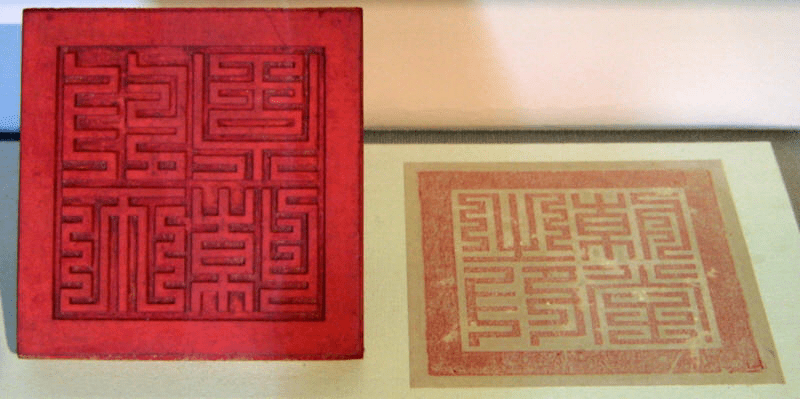
The concept of a “seal” of the mind is something that gets used a lot in traditional Buddhist literature, especially in Zen. Using the analogy of a traditional wax seal, or red-ink seal as used in East Asia, it’s the impression created by the seal onto the paper. Ouyi talks about this imprinting, or impression, in the context of the Pure Land (emphasis added):
By invoking the Buddha-name [e.g. reciting the nembutsu], you will bring on a response — the impression is made and the seal if lifted — Amitabha [Buddha] and his holy retinue come to you without coming, and extend a hand to lead you off [to the Pure Land]. You, the person practicing Buddha-name recitation, recognize Amitabha in your mind, and you go to the Pure Land without going, placing yourself in a jewel lotus there….
There are two levels of practice in reciting the Buddha- name: reciting the Buddha-name at the phenomenal level and reciting the Buddha-name at the level of inner truth (noumenon).
1. Reciting the Buddha-name at the phenomenal level means believing that Amitabha exists in his Pure Land in the West, but not yet comprehending that he is a Buddha created by the Mind, and that this Mind is Buddha. It means you resolve to make vows and to seek birth in the Pure Land, like a child longing for its mother, and never forgetting her for a moment.
2. Reciting the Buddha-name at the level of inner truth (noumenon) means believing that Amitabha and his Pure Land in the West are inherent features of our own [pure] Minds, the creation of our own [pure] Minds. It means using the great name of Amitabha, which is inherent in our Minds and the creation of our Minds, as a focal point to concentrate our minds on, so that we never forget it for a moment.
This is a good example of why Chinese Pure Land Buddhism is such a fascinating thing religious tradition. Here, Ouyi doesn’t imply which attitude toward recitation is better than the other, instead it’s a very inclusive approach. As long as you’re keeping up the practice, regardless of how you understand it, that’s what matters. Once you’ve taken that step, the impression on your mind never goes away, and you are in the light of the Buddha.
P.S. Photo by Bình Giang, Public domain, via Wikimedia Commons
1 His name in English is pronounced “Oh-ee jih-shoo”.
2 This differs considerably from Japanese Buddhism at the same time (Edo Period) where sects were forcibly molded into “doctrinal swimlanes” in order to better track them by the government. This wasn’t necessarily negative, as the Edo Period also saw a period of revival, but it did tend to discourage blending of sects and ideas by encouraging each sect to define themselves as distinctly as possible, centered around a select founder, set of texts, etc.
Recently while taking my personal retreat, I spent some time catching up on Buddhist reading, and finished a book titled Introduction to the Lotus Sutra by Yoshiro Tamura, and translated to English. I had high hopes for the book, but came away pretty disappointed as it was a pretty thinly veiled promotion of a Nichiren-Buddhist interpretation of the Lotus Sutra, and of Nichiren Buddhism in general.1
One passage makes some interesting comments worth noting though (Wikipedia links added):
Shinran (1173-1262), Dogen (1200-1253), and Nichiren (1222-1282) also came into reality of out Mt. Hiei’s hall of truth [same as Honen a generation earlier]. Yet their attitudes toward the actual world were quite different from Honen’s. While Honen was mostly devoted to giving up on life and longed for the pure land of the next life, Shinran, Dogen, and Nichiren struggled positively within the actual world. Their activities and writings came right after the Jokyu turbulence of 1221 and were related to it.
Page 123, translation by Michio Shinozaki, edited by Gene Reeves
Mr Tamura is comparing several different Buddhist monks who all left the Tendai sect around the same time, and each founded their own sects. The first, was Honen, who founded the Jodo Shu sect and greatly popularized Pure Land Buddhism in Japan. This is a fascinating historical phenomenon that started in the last 12th century with Honen, and persisted with a couple more generations of Buddhist monks all trained from the same Tendai sect, and apart from Nichiren, its great temple complex on Mt Hiei.
As Nichiren was the last of these great reformers, he had the benefit of hindsight, and tended to be rather harsh toward Honen’s Pure Land movement as degenerate, and further obscuring the true Buddhist teachings (as enshrined in the Lotus Sutra and the Tendai sect). Thus, ever since, Nichiren authors and followers have had particular animus toward Honen. The book doesn’t pull punches either.
But it’s an interesting comment to make, and not without merit. The Jodo Shu Buddhist sect has always been focused on a singular goal within the larger Buddhist religion: to enable followers to be reborn in the Pure Land of Amitabha (Amida) Buddha and thus provide as a refuge, but also to enable them to accelerate on the traditional Buddhist path faster. A lot of this hinges on a medieval-Buddhist interpretation of the “end days” or Dharma Decline, which looks a bit silly knowing what we know now.
In any case, Jodo Shu sect Buddhism, at least on paper, definitely focuses on the life to come. From what I hear on the ground, the reality is a lot more nuanced, and many communities still practice some manner “traditional Buddhism”, but the primary focus still remains rebirth in the Pure Land to come.
So, what Mr Tamura says makes sense.
Mr Tamura is also correct in that Dogen, who founded the Soto Zen sect, and Nichiren approached the same medieval concern with Dharma Decline, but in different ways: Dogen focused on the classic Buddhist approach to mindfulness, meditation, focus on the now, etc. Nichiren took the logical conclusion of the Lotus Sutra’s egalitarian teachings in the form of social reform, nominally as a reform of the Tendai sect, especially in the face of the crooked administration by the new Hojo clan’s military government.2
But I have to disagree with Mr Tamura’s hidden conclusion that by focusing on this-worldly practice that certain sects of Buddhism are superior to others. I feel that this hopelessly generalizes things.
One of the things that always attracted me to Honen’s teachings was his overt rejection of petty, secular life while keeping his focus on the future, namely the Buddha’s Pure Land. It may seem counterintuitive, but by focusing on the “world to come” and thus rejecting the world as it is, i think this fosters a renunciant’s mindset, even as one continues to live in this world. The historical Buddha, Shakyamuni, definitely advocatedthisapproach.
This may seems like not a big deal, especially given other Buddhist sects also have some form of monastic practice, or similar rejection of secular life, but consider that the other aforementioned reformers were all Buddhist monks of hte same Tendai sect, and Tendai at the time had a controversial teaching called hongaku (本覚) or original enlightenment. The idea is that one is already enlightened but unaware of this due to ignorance or skewed viewpoints. This leads to all sorts of thorny issues with Buddhism and Buddhist practice, and gave some scallywags in the Buddhist monastic community an excuse to “loosen the reins a bit” in terms of discipline.
Honen seeing the state of affairs of the community at his time, overtly rejected this concept. Other reformers embraced the concept to some degree or another, sometimes leading to some behavior that in the wider Buddhist world would raise eyebrows.
On the other hand, the historical Buddha definitely advocated practice and mindfulness here and now too. In fact, it’s pretty much central to Buddhist practice, at least for monastic followers. So, Mr Tamura, Dogen, Nichiren and others aren’t wrong.
As a modern 21st-century Buddhist speaking 800 years later (and from another culture), with plenty of personal biases of my own, I think you need a bit of both. On the one hand, whether you are a Buddhist layperson or a monastic, it’s healthy to maintain a renunciant’s mindset. The world is a series of endless transitions, both on a macro level and a personal level, so there’s no lastingrefuge or rest. Further, it doesn’t make sense to just throw up your hands and bank on the future through prayer and good merit, because there’s plenty of things you can do in the hereandnow to make life better for others, and also for yourself. Even if you engage in a little bit of Buddhist practice,3 that’s still a step in the right direction. Even if you meditate even only occasionally, that’s still better than nothing.
So, in a sense, all of the Buddhist reformers in 12th-13th century Japan had something positive to contribute, and each was approaching the same issues with novel approaches. It’s somewhat stupid to try to and hold up one sect as superior to others based on an artificial criteria.
So, anyhow, the book was disappointing, but it does help remind me of what matters.
P.S. Photo taken at the Butchart Gardens in Victoria BC last week.
1 The book started out reasonably well, but the last third of the book was unabashedly promotion of Nichiren Buddhism. Bear in mind that the Lotus Sutra has been revered and influential in many Buddhist communities outside of 13th century Japanese-Buddhist thought, so this tendency to focus on a single sect’s teachings to the exclusion of others. The book’s not-so-subtle tendencies to belittle continental Buddhist culture while promoting Japanese thought didn’t help either. People sure do love to inject culture into their religion.
2 Shinran, who was a follower of Honen, took a more nuanced approach that tends to incorporate some elements of Honen’s view, while focusing on a radically lay-oriented religious community (similar to Nichiren). There’s already plenty of books about Jodo Shinshu (Shinran’s sect), and Shinran, so no need to belabor it here.
Sometimes the world is overwhelming and you just need a retreat. When people usually think of a retreat, usually we imagine spending thousands of dollars, staying at some exotic location, drinking organic tea, while learning at the feet of a high-priced guru.
In reality, most of us can’t do that. I would even question how useful that is in the long-run. The experience might change you, but wait a few weeks (or even a few days) and you’ll be back to your old situation.
Instead, a retreat, especially in a Buddhist context is more about withdrawing from the world here and now. The 12th century Japanese-Buddhist monk, and chief disciple of Honen, named Benchō (弁長, 1162 – 1238) once said:
人ごとに閑居の所をば、高野・粉河と申あへども、 我身にはあか月のねざめのとこにしかずとぞおもふ
People maintain that the best place for a life of retirement is the Kokawa Temple or Mount Koya. But as for me, there is nothing to compare with the bed from which I rise every morning.
Such a tradition goes back even as far as the time of the Buddha himself. When the monsoon rains came, crops were young and easily trampled by wandering bhikkhu (monks) begging for alms. The Buddha, conscious of how this might impact farmers, ordered his monks to stay indoors for the duration of the monsoon, focus on intensive training, and avoid bothering the lay community.
Thus, this “Rains Retreat” has been a part of the Buddhist tradition since. The idea has carried onto cultures that don’t have monsoonal seasons (Korea and Japan), in the form of intensive retreats, usually in early summer and early winter. Not only do monks and nuns participate, but in fact lay tradition usually has something to coincide with it, similar to the Christian tradition of Lent.
Thus, the idea of retreat in Buddhism is not a vacation. It’s about making a conscious effort to withdraw from the world, even partially, where you are now, and take your practice above and beyond the usual for a sustained period of time. It’s about fostering mental training and self-discipline in a conductive environment. This can mean something simple like turning off your phone for as little as a few hours a day, limiting meat consumption, chanting a bit more than usual, etc.
Based on limited experience, I found it best to plan ahead what the home retreat will look like and be realistic. For example, I am a working parent with two kids, so there are big limitations to what I can do. Pick a reasonable schedule, a reasonable duration, and try to decide ahead of time what the retreat will look like, rather than deciding on the fly (as I sometimes did). “Don’t move the goalpost,” in other words.
Even as a busy parent, there are things still under my control: how I spend my spare time, how I treat others, what I choose to eat, etc. The Five Hindrances affect us all regardless of who we are, but we can also counteract them one way or another.
Thus if doing a retreat, it’s important to stretch yourself a bit beyond your comfort zone. Otherwise, nothing is gained from it. The Buddha in explaining this to a monk named Sona, used the analogy of lute strings:
“In the same way, Sona, over-aroused persistence leads to restlessness, overly slack persistence leads to laziness. Thus you should determine the right pitch for your persistence, attune the pitch of the [five] faculties [to that], and there pick up your theme.”
AN 6.55, the Sona Sutta, translated by Ven. Thanissaro Bhikkhu
As I am writing this in the deep of Summer, what the Japanese calendar used to call taisho (大暑, “great heat”), I’ve decided to take my own semi-retreat for the rest of August. I wanted to observe the summer abstinence, but almost entirely missed this, and after hectic work schedule in July, I felt like taking some time off and refocusing on things that matter most. So, I’ll be trying the abstinence again, but with a few modifications. I’ll talk more about it after I get back.
In the meantime, I have some posts that will be published throughout August that I hope you’ll enjoy. Until September, thanks and happy summer!
One historical period that has continuously fascinated me for a long time is the end of the Heian Period in Japan, culminating in the climactic war between the Heike (Taira) Clan and the Genji (Minamoto) Clan, followed by the rise of military government for the next 800+ years.
“How did you go bankrupt?” Bill asked.
“Two ways,” Mike said. “Gradually and then suddenly.”
The Sun Also Rises by Ernest Hemingway
Why does this matter?
As the quote above suggests, the fall of the Heian Period and of the Imperial aristocracy, built around a Chinese-inspired Confucian bureaucracy, came slow, then suddenly when the lower samurai class rose and and asserted power. Let’s compare the before and after:
The Heian Period (平安時代, 794 – 1185) of Japanese was a long, 400-year period, that began when the Imperial capitol moved to the new city of Heian-kyō (modern day Kyoto) away from Heijō-kyō (modern day Nara). The Imperial government had been plagued with infighting and manipulation by powerful temples in Heiji-kyo, so the Emperor decided to make a clean start and migrate the capitol.
But the earlier Nara Period and the Heian Period represent a single continuum of life in Japan where the Emperor ruled in a Chinese-Confucian style bureaucracy with Japanese characteristics. The Imperial bureaucracy was run by a large number of literate officials either through Entrance Exams that tested your knowledge of the Confucian Classics, and aspects of Chinese history, or through connections if you were nobility.
Speaking of nobility, everyone in the Court, from the lowliest bureaucrat, to the Emperor had an official rank. This was part of the old Ritsuryō system. The Emperor was automatically 1st rank upper (正一位, shō ichi-i), while just below him someone might be 1st rank lower (従一位, ju ichi-i), then 2nd rank upper (正二位, shō ni-i), and so on until you get to the lowly paper-pushing bureaucrat at 少初位下 (shō so-i no ge) rank. Each year, the Emperor would approve promotions or demotions of rank, which would be annouced, so for doing some good work, you might be promoted one year, and your stipend increased, as well as other perks. However, there was a catch. If you were born to a venerable noble family such as the Fujiwara, Ōe or Tachibana, you were automatically 5th rank or higher. If you were not, it was almost impossible to attain anything above 7th rank. Sugawara no Michizane was a rare exception, but he paid for it when court treachery got him exiled.
Thus, the aristocracy held a grip on the Imperial court, but it didn’t stop there. The aristocracy held increasingly large tracts of land called shōen (荘園) that were tax-exempt due to a loop-hole in the system. The wealth of the aristocratic families grew larger and larger while the state became increasingly bankrupt.
Further, as the Heian Period went on, the aristocracy figured out how to manipulate power even further by arranging marriages with the reigning Emperor, and if they had a son, pressure the reigning Emperor to abdicate, so the ambitious family could control the Imperial heir as a regent. Case in point, during the 990’s two different branches of the Fujiwara clan were struggling for control, on led by Fujiwara no Michitaka and the other by Fujiwara no Michinaga. Both them had daughters wed to reigning emperor Ichijō, who had multiple sons. Initially, next reigning emperor was his son Emperor Sanjō who had not been born from a Fujiwara mother, but he was soon pressured to abdicate by Fujiwara no Michinaga, thus allowing Michinaga’s grandson and Ichijo’s other son to become emperor Go-Ichijō (i.e. “Ichijō the latter”) to reign.
Things got even nuttier when certain emperors, forced to abdicate and take tonsure as Buddhist monks, figured out how to retain power behind the scenes at odds with the nobility. The most well known example was Emperor Go-shirakawa who only reigned officially as emperor for three years, but retained power as the “cloistered emperor” for another 37 years.
None of this takes into the account the growing power and political manipulation of Buddhist temples, and their armies of soldiers, an open violation of the Buddhist principle to abstain from politics and violence.
Thus with such a toxic mix of competing power centers, a crippled central government, to say nothing of the earthquakes, plagues and political neglect of the provinces.
… and then it finally started to fall apart.
The Fall
The battle of Dan-no-ura, courtesy of Wikipedia
The fall of the Heian Period and its aristocratic society started with a power struggle between the upstart Taira and Minamoto clans. Like many other samurai families, they began as little more than escorts and bodyguards to the nobility, but in time they rose to positions of power and influence, filling in the gaps of government when emperors pushed the Fujiwara back.
This culminated with the dreaded Taira no Kiyomori seizing power in all but name. This grandson, the child Emperor Antoku, technically reigned, but behind the scenes Emperor Go-Shirakawa mentioned above still held to some power, but was effectively a hostage himself. The Minamoto clan were scattered and its clan head was executed for formenting a rebellion.
Kiyomori’s grip on power didn’t last long, and wasn’t long before the his enemies in the provinces began to rally around Minamoto no Yoritomo who led a successful counterattack that resulted in a war across most of Japan, with the Taira (e.g. the “Heike clan”) mostly dominating the west and the Minamoto (e.g. the “Genji”) ruling in the eastern provinces. The current TV drama in Japan, the Thirteen Lords of Kamakura, reenacts this struggle, and the aftermath.
The Taira, including the child emperor Antoku, were wiped out at the battle of Dan-no-ura, but the battles didn’t end there. The genie was out of the bottle, and there was no going back. Minamoto no Yoritomo then seized power by compelling to emperor to recognize him as Shōgun, the generallisimo of all Japan, and he went after rivals within the Minamoto clan including the famous warrior and half-brother, Minamoto no Yoshitsune. He based his regime in the eastern city of Kamakura, not Kyoto, thus drawing power away from the old Imperial court. Emperor Go-shirakawa’s son, Emperor Go-toba, attempted one last military effort to restore the power of the Imperial court in the Jōkyū War, but the samurai class centered around Yoritomo’s widow, the powerful Hojo Masako, and Go-toba’s efforts were doomed. He was exiled until his death.
Ironically, Minamoto no Yoritomo would end his life as little more than a figurehead himself as the Hojo family he married into (ironically a branch of the Taira he defeated) manipulated marriages and increasingly held power.
In the end, the new “Kamakura Period” of history was the first of several military regimes in Japan until 1868 (arguably 1945) where the Imperial court still held nominal power, but true power rested with the military class. The old Confucian-style bureaucracy still existed, people including power warlords still held rank in the Court, but it was a shadow of its former power, and was mainly used to legitimatize the ruling shogun and little else.
On the Ground
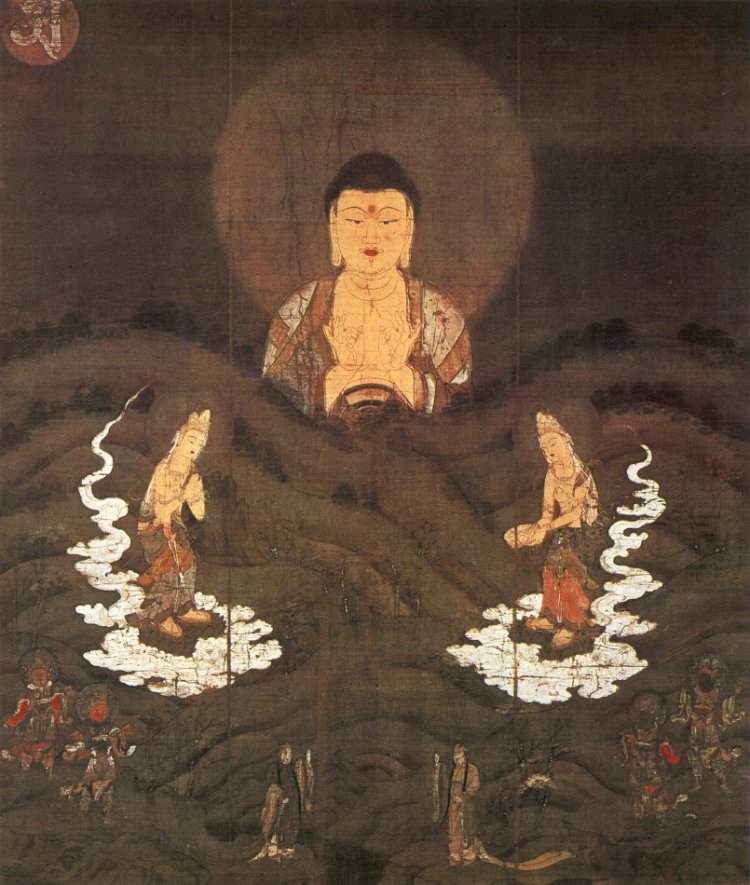
Amitabha Buddha rising over the mountain to welcome the believer to the Pure Land
Reading this history is one thing, but to people on the ground, as one crisis after another affected Japan during the end of the Heian Period both political and physical, it certainly felt like the End Times.
Millenarian Buddhist movements among the provinces sprang up in great number, as people were convinced that the era of Dharma Decline, the era mentioned in Buddhist scriptures when the Buddha-Dharma had utterly faded from the world, had come and that they were all doomed. This is why the Pure Land Buddhist movement started by Honen became so widespread and popular. By this point, people were so convinced that it was all over, they focused on escaping the endless cycle of birth and death to be reborn in the Pure Land of Amitabha Buddha instead. Pure Land Buddhism had been popular before this, but it took on a new sense of urgency under the collapse of the old society. Thus Honen’s disciples, such as Shinran, carried this message further out into the provinces and Pure Land Buddhist movements sprang up everywhere.
Nichiren Buddhism, which came slightly, was a similar millenarian movement, but instead Nichiren blamed society’s ills ironically on the Pure Land movement itself for leading society away from the True Dharma (e.g. the Lotus Sutra). Like many others in society, including Honen a couple generations earlier, Nichiren was appalled by the death, warfare and disasters affecting Japan and felt there had to be a reason for it all.
This may seem odd to us in the 21st century, but for people who grew up that the world around them was governed by the Buddha-Dharma (or lack of it), this is the only conclusion that would make sense. We in our time believe the world is governed by science, so when something happens, we tend to look for a scientific-analytical explanation. When the Byzantines in the 8th century saw their world collapse due to the Plague of Justinian followed by invasions from the new Muslim Arabs, they saw felt that their world that had been governed by God as approaching the End Times too, culminating with the siege of Constantinople itself. Thus, Iconoclasm sprang up soon after.
In each case, people are faced with a cataclysm and are using reason to try to come to grips with what’s going on, and how to fix it. We can look back and laugh and people for their “backward views”, but what will people say about us 1,000 years in the future, I wonder?
The Aftermath
In any case, once the war between the Taira and the Minamoto ended and the capital was moved to Kamakura, life in Japan was simply never the same. Generations had lived with the trauma of last years of the Heian Period, the warfare and so on, and much of the literature of the time including the Hojoki and the Essays in Idleness carry a sense of “paradise lost”. It was over. Everyone knew it, and there would be no going back.
And yet, for all the sadness and sense of loss, Japan did carry on through many subsequent generations to be the country it is today. The court life of the Heian Period is still remembered in things such as the Hyakunin Isshu poetry anthology, doll displays on Girls’ Day, woodblock art, and so on. And of course, historical dramas.
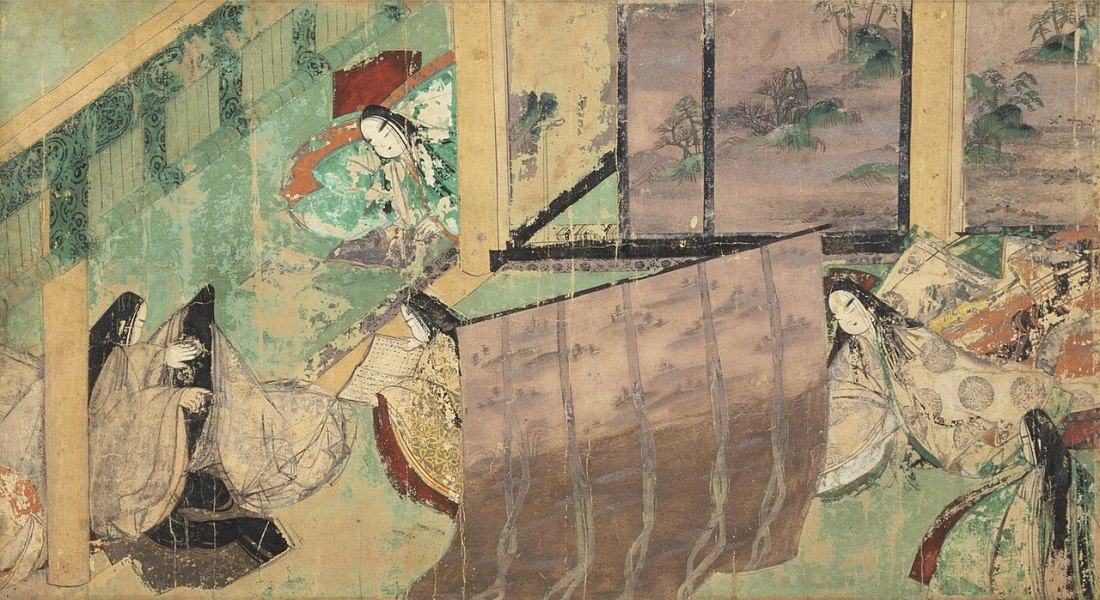
P.S. A scene from the Illustrated scroll of Tale of Genji (11th cent.), depicting the Azuma-ya (“East Wing”). Imperial court in Kyoto, Public domain, via Wikimedia Commons







 Gleanings in Buddha-Fields


You must be logged in to post a comment.