A 13th century depiction of Shandao’s Parable of the Two Rivers, source Kosetsu Museum in Japan
The 7th century Chinese Buddhist monk Shandao (pinyin: Shàndǎo, 善導, 613-681) is probably the single most influential monk in the entire Pure Land Buddhist tradition. Both Japanese and Chinese traditions claim him as a patriarch of their respective lineages. Shandao taught an interpretation of the Pure Land that was much less ambiguous and more accessible than earlier masters and popularized some practices that are now universally found, such as the verbal form of the nembutsu, and the dedication of merit hymn. He also penned the Parable of the White Path and Two Rivers.
Another teaching of Shandao’s that’s often cited in later sources, especially in Jodo Shu-sect Buddhism is the Three Minds and Four Modes of Practice (三心四修) or sanjin shishu.
The idea is that through devotion toward Amida (Amitabha) Buddha, and aspiration to be reborn on the Pure Land path, one’s mind and life style will eventually give rise to the Three Minds and your practice will align with the Four Modes of Practice.
According to the book, Traversing the Pure Land Path, the Three Minds are:
至誠心 (shijōshin): An utterly sincere mind
深心 (jinshin): A deeply, believing mind
回向発願心 (ekō-hotsuganshin): The mind that dedicates one’s merit and good works toward rebirth in the Pure Land.
The Four Modes of Practice are:
恭敬修 (kugyōshu): reverence toward Amida Buddha and his two bodhisattvas:
I like to think that this is a natural outflow of devotion through Buddhist practices such as reciting sutras, reciting the nembutsu, and dedicating good merits toward rebirth in the Pure Land, etc. It’s not something you contrive or measure your progress with. It just happens over time.
This post is mostly meant to be a reference post, but also I think it’s an example of how Buddhist practice over long term has positive benefits. No need to be elaborate or immerse yourself in difficult practices. Slow and steady wins the race.
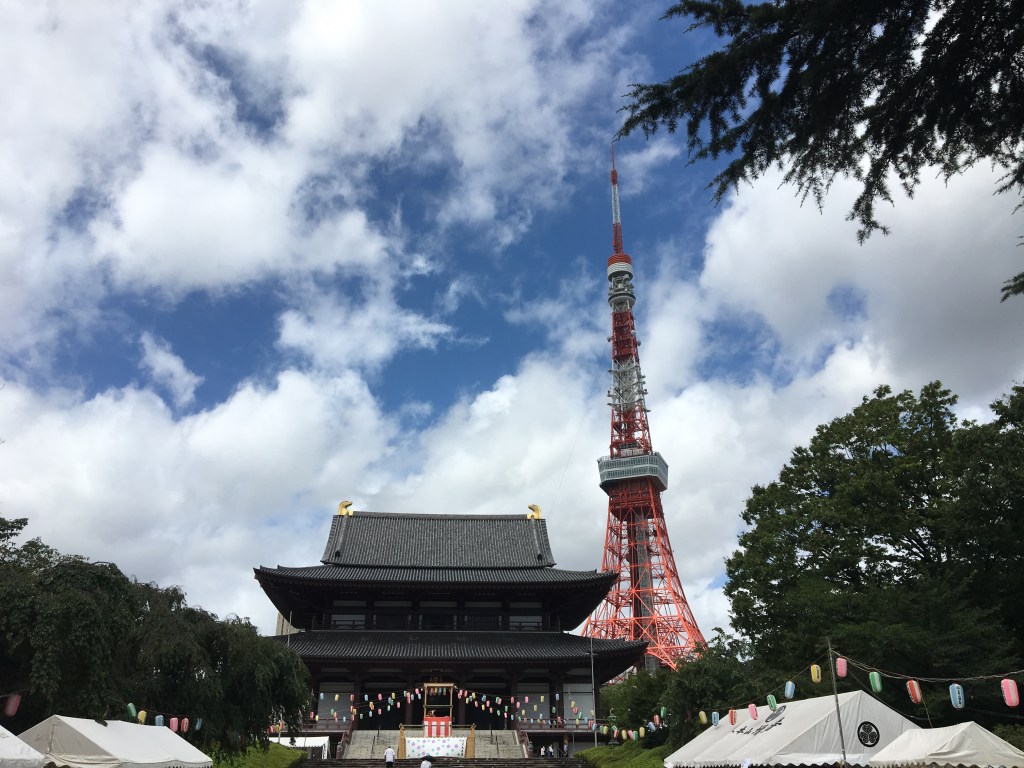
A few years ago, during our last trip to Japan before the Pandemic, we came to the famous Buddhist temple of Zojoji: one of two head temples of the Jodo Shu sect.
My wife and I like Zojoji in particular, and since it is right next to the famous Tokyo Tower, it is always worth a visit.
Taken in 2019, Tower Tower is in the back, about 2-3 blocks away.
Along its famous treasures is a “black Amida [Buddha]” statue which has a separate altar room, in the annex room to the right of the main hall:
Taken in 2019
Anyhow, on that visit, I picked up a neat little portable altar/image of Amida Buddha: it is normally wrapped in a small brocade envelope:
Inside you can see an image of Amida Buddha:
The writing on the left is a verse from the Shiseige (aka Juseige) a devotional set of verses, which is in turn an excerpt from a Buddhist text, the Immeasurable Life Sutra. The verse above reads:
神力演大光 Jin riki en dai ko 普照無際土 Fu sho mu sai do 消除三垢冥 Sho jo san ku myo 広済衆厄難 Ko sai shu yaku nan
With my divine power I [Amida Buddha] will display great light,
Illuminating the worlds without limit,
And dispel the darkness of the three defilements [greed, anger, delusion];
Thus I will deliver all beings from misery.
On the right is a poem by Honen (法然, 1133-1212), founder of Jodo Shu, called “Moonlight”. I talked about the poem here.
This folds out like a mini triptych, though it doesn’t stand up very well on its own.
Because it’s so small, yet very beautiful, it is a nice thing to carry with you sometimes for those moments of inspiration or private devotion.
Recently, I took some personal time to delve deep into Pure Land Buddhist teachings, re-reading some old books, but also some new ones. In particular, I was very impressed by Charles B Jones’s latest book, an excellent survey of the entire Pure Land tradition in Mahayana Buddhism.
If you’re not familiar with Pure Land Buddhism, this is a broad, broad tradition in East Asia, focused on a single Buddha named Amitabha, not the historical Buddha (Shakyamuni). There are way more devotees of the Pure Land path in many Buddhist countries versus, say, Zen practitioners. It is said that Amitabha, according to the Buddhist canon (a.k.a. the sutras), made a great series of vows to provide a refuge for all beings if they with to be reborn there. In this refuge, one will unfailingly become an enlightened being, by virtue of being so close to a living Buddha.
This might seem weird at first glance, since Shakyamuni Buddha started the whole religion in the first place, right? It’s a long story of how we got to something like Four Noble Truths to something like an ethereal paradise where people can go simply by reciting his name.
Charles B Jones’s book actually does walk through how this tradition evolved from an advanced meditative practice in India to the forms we see today, so that alone is worth reading the book. However, there’s another side to this issue that Jones’s book also covers: sectarian bias.
Way back in 2005, shortly after I married my Japanese girlfriend (now wife), we made our first trip to Japan to visit her extended family. The culture shock hit hard: I hardly knew the language, the customs and food weren’t what I expected, and the Buddhist religion that I was so interested in made no sense to me. I remember seeing Amitabha Buddha at Chion-in temple in Kyoto, and while it was very beautiful, it felt like weird superstition to me. This wasn’t mentioned in any of my books about Buddhism! Someone in Japan even asked me what I thought about it all, and I made some stupid, arrogant comment about superstition, etc.
But it was still nagging me when I got home later, and that’s when I discovered the Jodo Shu homepage in English. I slowly started to unravel things, and eventually became a devoted follower (still am in many ways), but at the time, this was very niche Buddhist teachings outside of some Western organizations like the Buddhist Churches of America (also a wonderful org, highly recommend).
Since then, there have been a lot of books published in the last 20 years about Pure Land Buddhism, but they are almost always sectarian, and obfuscate the variety of practices in favor of one single approach. I learned Pure Land Buddhism through Jodo Shu/Jodo Shinshu sectarian sources, including one overtly nationalist book by D T Suzuki (don’t get me started on that guy…), and it colored my understanding for a long time.
For all the increased information on Pure Land Buddhism in the West, it’s still based on very biased, sectarian sources, namely Japanese sects such as Jodo Shu and Jodo Shinshu. This isn’t necessarily wrong, and as a long-time follower of these traditions, they really helped me a lot when I was first getting on my feet.
However, long time readers may note that I’ve danced aroundotheraspects of Pure Land Buddhism, but until recently I had no idea how broad the tradition was, and the many ways people have tackled the theological questions behind it.
Through Jones’s book, I realized that the tradition is huge, and varied in its approach. It’s not just a “Japanese Buddhism versus Chinese Buddhism” comparison either. Many thinkers over the centuries in many countries and eras have grappled with these questions:
What is the nature of Amitabha Buddha and the Pure Land? Is it mind-only? Does it literally exist X yojanas to the West? Or is it right here?
Similarly, is Amitabha Buddha the embodiment of the Dharma or a literal Buddha who excels at reaching out to people?
What is the point of striving for rebirth into the Pure Land? Is it to awaken one’s mind here and now, or is it to reach a refuge in which one can progress along the Buddhist path more easily?
How does one do it? Do they rely on Amitabha Buddha’s compassion (e.g. other power) or does one strive to be reborn there? Is it a “meet in the middle” situation?
What is the nianfo/nembutsu (念佛/念仏), and is the nianfo/nembutsu sufficient on its own to accomplish rebirth in the Pure Land, or are other practices required?
Charles B Jones covers all the ways people have interpreted these questions, in India, in China and in Japan and the variety of responses and interpretations is surprising.
For example, if we only consider the questions of whether the Pure Land and Amitabha arises from one’s own mind, a Zen-style interpretation, or a more literal savior to that exists elsewhere reaching out to others, we get a spectrum of interpretations. However even if you have two different teachers both advocate for a literal interpretation of Amitabha Buddha, they will differ on whether reciting the nianfo/nembutsu alone is enough, or what practices one should do to strive there.
Even when two teachers agree on a set of practices leading to rebirth in the Pure Land, they might differ on how much of it is due to one’s own efforts versus Amitabha’s compassion and power of his vows.
Thus, what you get is a really complicated, three-dimensional matrix of views.
For example, the Chinese Buddhist teacher, Yunqi Zhuhong (雲棲袾, 1535–1615),1 advocated a very sophisticated approach that tried to reconcile both the mind-only or “principle” interpretation of Amitabha Buddha with the more literal or “phenomenal” one often used by lay people. In his mind, both were essentially correct, and it was perfectly fine to approach from either mentality, so long as one kept up the essential practices: reciting the nianfo (nembutsu in Japanese), reciting sutras, devotional acts, etc. It confirms what I suspected for a long time: that there is more to Pure Land Buddhism than just the nembutsu.
I never even knew about Yunqi Zhuhong until a few weeks ago (I pretty much rewrote the entire Wikipedia article linked above using more sources), and this shows how sectarian views, even when benign, obscure aspects of the tradition and make it hard to understand Pure Land Buddhism at large. One can easily apply this to other Buddhist traditions such as Zen, or Theravada, etc.
Another challenge in Buddhism has always been accessibility, and Charles B Jones shows how the Jodo Shu and especially Jodo Shinshu sects in Japan really excelled at outreach to common people instead of the aristocratic Buddhist followers who focused on esoteric Buddhist practices.2 However, in order to make Buddhism very accessible to large segments of the population, it’s clear they also took some liberties in how they interpret some of the issue above, and these are issues that they have to continuously defend, theologically, to this day.
Anyhow, there’s no clear answer here on who’s right or not. Jones’s book does a great job showing all the different approaches, arguments, and the virtues and challenges of each one, and thus the reader is welcome to decide for themselves. It’s so rare to find such a balanced and thorough overview of the entire tradition. For my part, I haven’t fully decided for myself what the right approach is (hence all the book reading lately), but it really helped give me a broader picture, and plenty of food for thought.
Namu Amida Butsu
1 Pronounced as “yoon-chee joo-hong”
2 Another interesting contrast that Jones’s book shows between Chinese Buddhist history versus Japanese: Japanese Buddhist history starts with the Imperial Court patronage and over generations gradually filtered down to the general population, thus it required patronage, sects, etc. Chinese Buddhism by contrast “percolated” up from small communities, often influenced by foreign merchant communities, and thus never had to organize sects, schools and such; Buddhist communities just sprang up organically.
I stumbled upon this great quotation by Oscar Wilde and somehow it reminded of a much, much older poem but a Japanese-Buddhist monk named Hōnen (法然, 1133 – 1212). The poem is titled “Moonlight” which I covered here.
What Oscar Wilde says here is very profound.
In Mahayana Buddhism, the Parable of Burning House from the Lotus Sutra famously describes a similar state of affairs, and in that parable the Buddha is calling people to escape the flames to safety. Like the Moonlight poem, the Buddha calls all of us and leads us to refuge if we listen. You can also see this in the Parable of the Two Rivers.
In the Jodo Shinshu sect of Pure Land Buddhism, this moment of listening to the Buddha is called shinjin (信心, “true entrusting”). I like to think of it as a “come to Jesus Amida” moment: we become starkly aware of our plight, we recall Amida Buddha’s promise to rescue all beings, and respond with the nembutsu.
All of us are in the gutter in some sense or another, but we don’t have to be. As the Third Noble Truth of Buddhism states: there is a way out.
I grew up as a teenager watching the old TV show, Kung Fu, on syndicate. I was a big fan, and although the show hasn’t always aged well, it was my first naive introduction to Asian culture, Buddhism, etc, so it holds a special place in my heart.
I found this clip on Youtube recently and wanted to share. It really speaks to the Buddhist notion of metta or goodwill (which I talked about here):
This reminds me of the famous encounter by the Japanese Buddhist monk, Honen, and the prostitute, and his similar approach. I really like the flashback scene here (the one describing the lily in the desert), which reminds me of appreciating the value of all life. Even Gandalf makes this point in the Lord of the Rings:
Finally, I was happy to find another clip from Kung Fu here:
The first flashback scene here, between young Kwai-Chang Caine and Master Po sitting beside a statue of the Buddha, really resonated with me when I was a teenager and first watched Kung-Fu. In fact, this was probably my first encounter with Buddhism ever.
Today, April 7th in the Japanese-Buddhist calendar, is a holiday called Shūso Gōtan-e (宗祖降誕会) which celebrates the birthday of a monk named Honen (法然, April 7, 1133 – February 29, 1212). Ostensibly, Honen was a monk of the Tendai sect in Japan, but went on to be a founder of the Jodo-Shu or “Pure Land” Buddhist sect, as well as many other spin-offs. You can read more about his biography here.
Portrait of Honen by Shinkai (忍海), courtesy of Wikimedia Commons.
Honen didn’t invent Pure Land Buddhist as a practice and tradition. We can see earlier examples such as Genshin who were already practicing it avidly, and indeed, Pure Land Buddhism had been popular for centuries, especially when the social order was breaking down in the 12th century.
However, what Honen did and why he’s still revered today is his efforts to make the Pure Land practices as utterly accessible as possible through recitation of the nembutsu. Where many career monks were concerned with politics, or were seemingly aloof with the plight of people outside the Heian-period aristocracy, Honen really went out of his way to help others, and teach them a simple, straight-forward Buddhist practice, without discriminating by social class or gender.
Honen’s encounter with the woman of the night has always been one of my favorite stories about him, and underscores his easy-going manner, and his commitment to helping anyway he could. Even after his exile from the capitol, he maintained his monastic vows, and taught the Pure Land even to his dyingbreath.
Admittedly, I do have somequibbles about Honen’s approach to Pure Land Buddhism, and James L Ford’s book on Jokei, a critic of Honen, rightly points out how Honen cherry-picked teachings from earlier Pure Land masters to suit his own viewpoint. However, one thing is certain: Honen was very sincere in his efforts even if one might questions his methods. He did not get delusions of grandeur the way some contemporaries did, and he did not retreat to monasteries in pursuit of the truth. He was out among the masses all the time, teaching fellow monks, nuns, and lay people everything he knew.
So, happy birthday Honen! Thank you for teaching this American, 800 years later, about the nembutsu, and helping me get started on the Buddhist path when I needed it most.
P.S. another contemporary critic of Honen, Myōe, tried to do something similar by promoting the Mantra of Light, but for whatever reason it never quite caught on. Similarly, Nichiren promoted the odaimoku a couple generations later.
All of these monks, Jokei, Myoe, Honen and Nichiren were all talented teachers and sincerely sought to help others, but for whatever reason, perhaps because Honen was the first, or something dynamic in his teachings, achieved an impact on Japanese Buddhism not seen since.
Still catching up on blog posts from our latest trip to Japan, but today I wanted to share some photos from the Great Buddha of Kamakura, or in Japanese Kamakura no Daibutsu (鎌倉の大仏).1 The Great Buddha is one of two major attractions in the old city of Kamakura, the other being the grand shrine of Tsurugaoka-Hachimangu. We came to Kamakura in late December during a late afternoon.
The Great Buddha was originally part of a temple called Kōtoku-in (高徳院), but that temple was swept away by a terrible tsunami in 1498 (mentioned in this blog post too), leaving only the bronze statue of Amitabha Buddha, the Buddha of Infinite Light, behind. The current structure was built after this of course. This is near the front entrance of the premises, the Niō-mon Gate:
There is also a sign near the front entrance as shown below. Because it’s pretty far removed from walkway, it’s hard to get a good view of the sign without zooming in, so apologies for the poor quality photo:
STRANGER WHOSOEVER THOU ART and what soever [sic] be thy creed. when thou enterest this sanctuary remember thou treadest upon ground hallowed by the worship of ages. This is the Temple of BHUDDA [sic] and the gate of the Eternal, and should therefore be entered with reverence.
The antiquated English, and the heavy use of katakana (instead of hiragana) suggests that this sign was probably written in the early-modern Meiji Period, but that’s just a supposition on my part. Once you go past the sign, you will be greeted by the following:
Up close, the Buddha is definitely bigger than pictures suggest:
It’s hard to see from here, but the back of the statue contains some stairs where, prior to the pandemic, you can climb up inside the head. However, that is off-limits now.
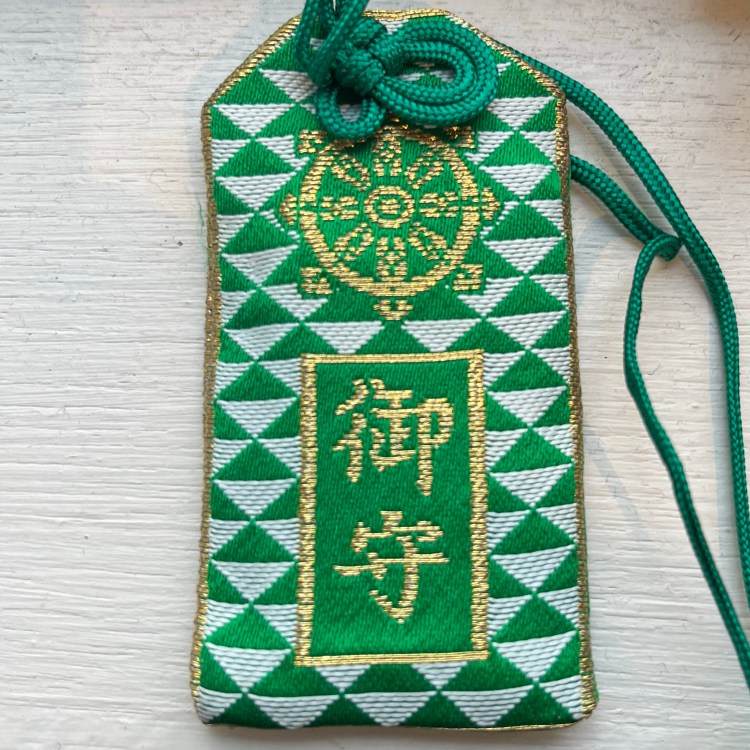
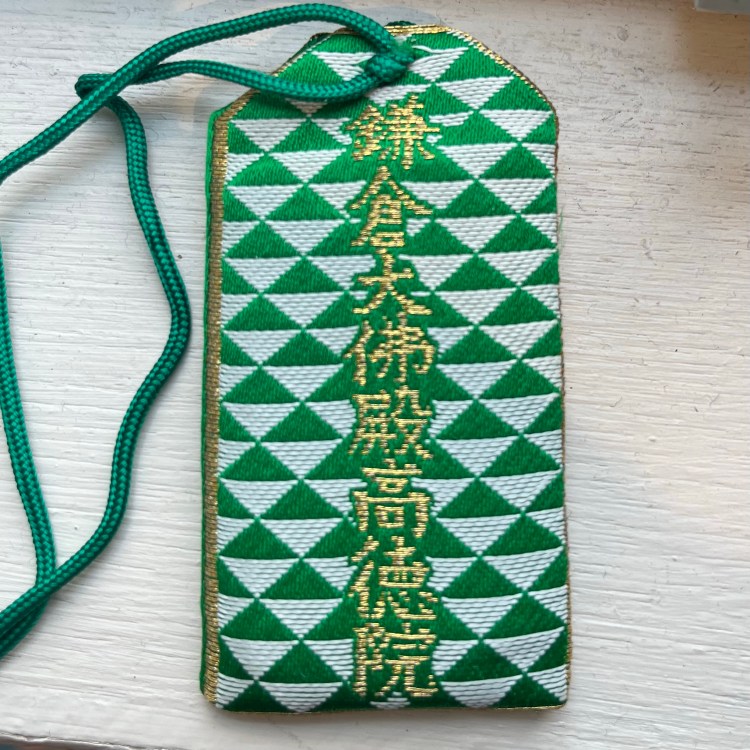
The Great Buddha is also were I got my old Buddhist rosary way back in 2007 or so, and I picked up a new omamoricharm here:
Around the premises, they have a lot of nice gift shops and goods you can get there, plus lots of nice shops outside the presmises.
In short, it’s a great place to visit for half a day or so, whatsoever be thy creed.
1 This is to help distinguish it from the Great Buddha (daibutsu) in Nara, of course.
Here is another wonderful poem (previous posts here and here) by the 11th century Japanese poetess, Lady Izumi (izumi shikibu 和泉式部 in Japanese), that I found in The Ink Dark Moon by Jane Hirshfield and Mariko Aratani:
Original Japanese
Romanization
Translation*
ものをのみ
Mono o nomi
Should I leave this burning house
思ひの家を
Omoi no ie o
of ceaseless thoughts
出でてふる
Idete furu
and taste the pure rain’s
一味の雨に
Ichimi no ame ni
single truth
ぬれやしなまし
Nure ya shina mashi
failing upon my skin?
* Translation by by Jane Hirshfield and Mariko Aratani
The headline for this poem reads:
On the night of the sixth, the sound of the night monk’s voice reciting the Sutras mingled with the sound of incessant rain, and truly this seemed to be a world of dreams…
Lady Izumi cleverly makes not one, not two, but THREE separate allusions to the famous Lotus Sutra, in this poem. I’ve talked about the Lotus Sutra before. It’s a very influential Buddhist text in the Mahayana tradition, and contains many parables and dramatic allusions, compared to some of the drier, more textbook style Buddhist sutras. Thus, allusions to the Lotus Sutra are found throughout literature in East Asia. In my opinion, understanding the Lotus Sutra is key to understanding Buddhism in East Asia: Zen, Pure Land, Tiantai, Nichiren and Vajrayana, etc.
The “burning house” here alludes to the Parable of the Burning House of third chapter of the Lotus Sutra. I’ve talked about it here, among otherplaces. This is pretty straightforward to understand in the poem: the Burning House here is symbolic of the world we live in, burning with passions, craving, anger, delusion, old age, disease, and so on. We can step out of the burning house if we choose to, but we are often distracted by things in the house, and thus unaware that the timbers all around us are on fire, putting us in mortal danger.
The second allusion is that of rain. In the fifth chapter of the Lotus Sutra, there is a parable describing rain on plants, the so-called The Parable of the Medicinal Herbs:
What falls from the cloud is water of a single flavor, but the plants and trees, thickets and groves, each accept the moisture that is appropriate to its portion. All the various trees, whether superior, middling or inferior, take that is fitting for large or small and each is enabled to sprout and grow. Root, stem, limb, leaf, the glow and hue of flower and fruit— one rain extends to them and all are able to become fresh and glossy, whether their allotment of substance, form and nature is large or small, the moistening they receive is one, but each grows and flourishes in its own way.
The Buddha is like this when he appears in the world, comparable to a great cloud that covers all things everywhere, Having appeared in the world, for the sake of living beings he makes distinctions in expounding the truth regarding phenomena.
This is, for me, one of my most favorite parts of the Lotus Sutra. As a sutra, it’s very inclusive (cf. the Parable of the Dragon Princess), but it also acknowledges that there is a huge variety of people in the world. Some people are just different than others, but they can all benefit from the Dharma in their own way, just like the various plants in world drinking from the rain.
Finally, the third allusion in Lady Izumi’s poem is that of a single “taste”. Both the Parable of the Burning House and the Parable of the Medicinal Herbs make a single point: the Dharma of the Buddha appears in a variety of ways, or “gates” for one to enter, but in the end the Dharma tastes the same equally, and is but one truth. So, whichever gate one enters, the rain will ultimately taste the same. For the Burning House, when the children come outside, their father offers, in the end, a single magnificent cart (not many) to offer them as an incentive.
Turning back to Lady Izumi, it’s obvious that she was very thoughtful of these things, even if she struggled to practice them amidst her life. Even when she was surrounded by scandal, and lost both her lovers and her daughter to illness, she could see past it and look at the greater picture.
A while back, I talked about a famous poetess from 11th century Japan named Lady Izumi, one of several famous ladies of the court at that time, but for some reason the one I find most fascinating.1 Lady Izumi was a prolific poet, and I have been reading samples of her poetry compiled in The Ink Dark Moon by Jane Hirshfield and Mariko Aratani. I found this poem the other day and wanted to share. The headline of the poem was that Lady Izumi was on retreat while on retreat at a mountain temple in autumn…
Original Japanese
Romanization
English translation*
心には
Kokoro niwa
Although I try
ひとつみのりを
Hitotsu minori wo
to hold the single thought
思へども
Omoe domo
of Buddha’s teaching in my heart,
蟲のこゑこゑ
Mushi wa koegoe
I cannot help but hear
聞ゆなるかな
Kikoyu naru kana
the many crickets’ voices calling as well.
* Translations by Jane Hirshfield and Mariko Aratani
I think this speaks to the classic frustration many Buddhists (among others) have: the willingness to undertake a practice, and the reality of not being able to stay focused. If it were easy, we’d probably all be doing it.
Lately, in an effort to reconnect to the local Buddhist community, and due to recent experiences in Victoria, BC, I decided to join a local Soto Zen group for remote meditation sessions. It’s been great actually: I have something in the week to look forward to besides more work meetings, and it provides a nice spiritual anchor in my life again. However, I noticed that while meditating for 25 minutes at a time, my mind rarely stays focused for long. Sometimes I can discipline myself for a few minutes, counting my breaths, etc. However, most of the time my mind is just wandering around for most of the session.
When I was younger and first encountered the nembutsu, I used to dedicate myself to reciting the nembutsu 1080 times (using my rosary to help count). Usually this takes about 15-20 depending on the speed of recitation. I (surprisingly) continued this practice for months. However, I also noticed a pattern: my mind would quickly grow bored from reciting, then anxious to hurry up and finish, and then relief when I got near the end. My mind would wander, just as it does with meditation.
So, the experience that Lady Izumi has is not unique to her, and even now, a thousand years later, I can empathize with her.
Further, I don’t think there’s an easy solution here: it’s something that every one has to work out for themselves.
Namu Amida Butsu
1 Speaking of fascinating, you might like to read my review of the Diary of Lady Murasaki, her contemporary on my other blog. Lady Murasaki evidentially didn’t think too highly of Lady Izumi.
The Amida Nyorai Konpon Dharani (阿弥陀如来根本陀羅尼) or “Amitabha Root Dharani” is a dharani used in some Japanese Buddhist sects, typically only on the Segaki ritual used to feed the hungry ghosts in Buddhism, or possibly funerals and other similar services. It is typically only found in esoteric rituals in Shingon and Tendai Buddhism, but can be found in Jodo Shu and Zen as well. The dharani is typically of very, very limited use, and not part of normal liturgy.
This page is intended to post the dharani for reference purposes only. Esoteric practices such as mantras and dharani should only be used as recommended by one’s teacher, under a guided training program. I found reference material on this dharani to be almost non-existent in English, hence my decision to post it here.
This page will provide both the Sino-Japanese reading follow by the Sanskrit reading. There are multiple versions of the dharani in Japanese, so pronunciation may vary slightly between them, so for this reason the Sanskrit is provided as well. No translation will be provided as this is part of the esoteric training one should undergo when learning the dharani. Any translation you see online of this, or any mantra/dharani, should be treated as suspect.
Can’t read the characters?
If you’re having trouble reading the Kanji characters, you might have one or two problems with your computer:
Your computer may not have Asian fonts installed. In Windows you have to enable UTF8 and East Asian fonts under the Control Panel. Modern Mac computers are fully compatible already.
Your browser may be assuming the wrong character set. If you use a relatively modern browser and use UTF8 as character set, you should be able to read fine. IE, Firefox and Safari all read this fine as far as I can tell.
Even if not, then you can still use the romanized characters, and the (terrible) English translation.
Disclaimer and Legal Info
I hereby release this into the public domain. Please use it as you see fit, but if you attribute it to this site, greatly appreciated. Also, please bear in mind this is an amateur work, and should not be taken too seriously.
Dedication
I dedicate this effort to all sentient beings everywhere. May all beings be well, and may they all attain perfect peace.
P.S. This is an old post from my former blog that I thought I had lost, but recently recovered. Reposting here with better blog formatting. Otherwise, I haven’t changed the contents.









 Gleanings in Buddha-Fields

You must be logged in to post a comment.