Who Is Amida Buddha: the Buddha of Infinite Light?

Hello Readers,

Recently I talked about the Pure Land Buddhist tradition, and in particular the Three Pure Land Sutras that are central to the tradition.

But then I realized that I’ve never really explained who Amida (Amitabha) Buddha is. Now that the English language site for Jodo Shu has been retired, I wanted to fill in some gaps in information, and explain Amida Buddha’s significance to the Buddhist religion at large.

Who Is Amida?

Amida (阿弥陀) Buddha is short for Amitabha Buddha: the Buddha of Infinite Light. Sometimes he is alternatively called Amitayus: the Buddha of Infinite Life too.

Amida Buddha is a cosmic, almost timeless Buddha who is said to dwell “very far” to the west in a realm called Sukhavati in Sanskrit, which means “Land of Bliss [or Joy]”. Over time, people just call it the Pure Land.

A reproduction of the Taima Mandala, an 8th century tapestry in Japan depicting the Pure Land

The Pure Land should not be confused with Heaven. It is a peaceful, safe refuge. In the Pure Land, people can escape difficult circumstances and be surrounded by many excellent Buddhist teachers. Even the very air and animals preach the Buddha-Dharma. Best of all, the sutras emphasize that one can be reborn there easily … if they so choose. It is not required in Buddhism, but it is available

The vast light of Amida Buddha (hence “Buddha of Infinite Light”) reaches out in all directions of the cosmos:

“The light of Amitāyus shines brilliantly, illuminating all the buddha lands of the ten directions. There is no place where it is not perceived. I am not the only one who now praises his light….”

The Sutra of the Buddha of Immeasurable Life, translation by Rev. Hisao Inagaki

and provides comfort to those who encounter it, inviting them to be reborn in the Pure Land:

“….If, sentient beings encounter his light, their three defilements are removed; they feel tenderness, joy and pleasure; and good thoughts arise. If sentient beings in the three realms of suffering see his light, they will all be relieved and freed from affliction. At the end of their lives, they all reach emancipation.”

The Sutra of the Buddha of Immeasurable Life, translation by Rev. Hisao Inagaki

This Buddha’s promise to rescue all beings, regardless of who they are, has been very attractive to people in difficult social circumstances: women (who were thought spiritually inferior in those days), the poor, and illiterate who toiled all day with no chance to invest in other spiritual development.

However many monks devote at least part of their time and effort toward Amida as well. As a Buddhist tradition, devotion to Amida is very broad and inclusive.

Further, everyone has a slightly different idea on who Amida Buddha is, what the Pure Land is, and so on. This is fine. There is no orthodox interpretation. Buddhism is more concerned with practice, so how one interprets this tradition up to them.

Some people devote themselves fully to Amida Buddha, others venerate Amida Buddha as one among a larger tradition. Again, it is up to the individual.

What Does Amida Look Like?

Amida Buddha is often depicted with gold color imagery, sometimes red. Compare with someone like the Medicine Buddha who is often depicted with lapis lazuli color (deep blue).

The gold color is based on the Pure Land Sutras that describe every person there, including the Buddha, as having gold-colored skin. Further, gold shines, so it fits the Buddha’s symbolism as a Buddha of light.

In some art, Amida is seated in meditation.

Amida Buddha statue at Sensoji (Asakusa Temple) in Tokyo, Japan
Amida Buddha statue at Kamakura, Japan, also known as the Great Buddha (daibutsu) of Kamakura

In some art, Amida is standing, with his hands in specific gestures.

Amida Buddha welcoming the deceased, with his attendants, to the Pure Land. A medieval Japanese painting.
A small home altar I purchased from Tsukiji Honganji in Tokyo about 10 years ago.
A tiny, pocket image of Amida Buddha I purchased at Zojoji Temple near Tokyo Tower in Japan.

Buddhist statues are full of symbolism, they are not intended to be accurate portrayals. They convey meaning. The double-“OK” hand gestures used by Amida, one hand up, one hand down with palm up, means something like all beings are welcome.

Why Amida?

Someone learning about Buddhism will probably find this very confusing: why is there a “Buddhist Jesus” when the religion is supposed to be about meditation and finding enlightenment? Is this a sign of Buddhism’s decadence and decline?

Buddhism can be a tough religion to explain because it is really broad. Much broader than a “Buddhism for Dummies” book can explain.

The historical founder, Shakyamuni Buddha, was like a doctor describing the state of things (e.g. the Dharma), and providing a “prescription” (e.g. Buddhist practice) to help cure the “ills” of the world.

But within that, Shakyamuni Buddha gave people a lot of autonomy. He described the world as like a river with two shores: one shore full of strife and dissatisfaction, the other peace and wellbeing. He described the need to build a raft to cross from one shore to the other. But how exactly to build that raft is up to you.

He held students, especially monks, to high standards of conduct, but as for putting teachings into practice he tailored different practices to different audiences, or to suit the person. Contrary to popular conception there are various forms of meditation taught even in the earliest traditions, not just mindfulness.

Mahayana Buddhism, one of two major branches of Buddhism, really emphasizes this diversity of practices because it recognizes the concept of upaya (expedient means): whatever works at that time for that person and helps them stay in the Buddhist path is right for them.

It’s partly why there are so many Buddhist figures, so many chants and sutras, and so many different sects. Each of these represent a different “gate” for entering the Buddhist path.

Anyhow, the existence of Amida Buddha, along with other figures such as Kannon, helps fill in a gap where some Buddhist practices and regiments just aren’t practical for most people, and also provides a sense of assurance in an uncertain world (speaking from experience). Those who find the “mind-only” interpretation of Amida attractive can also take comfort that nurturing Amida Buddha in one’s own mind helps awaken the Buddha within. Further, a timeless Buddha like Amida avoids the challenges of the interpreting the historical Buddha, Shakyamuni, through various layers of culture and history.2

As Amida Buddha is a tradition within the larger tradition, some Buddhists gravitate toward Amida, and some do not. Each person according to their own path. Mahayana Buddhism is large enough to embrace them all.

Namu Amida Butsu

P.S. Featured photo is the famous “Black Amida” statue at Zojoji Temple near Tokyo Tower in Japan. This was the statue that was venerated by the Tokugawa Shoguns back in the day.

1 The use of light symbolism in Amida Buddha is thought to possibly borrow from Zoroastrianism, which is possible given the contacts between the Parthians and the Buddhist community. Light is central to Zoroastrianism, but not mentioned in early Buddhist culture. The concept of Amida Buddha is definitely Indian-Buddhist, but Buddhists in the northwest of India often borrowed artistic concepts from neighboring cultures. Another example is Greco-Buddhist art.

2 Early Mahayana Buddhism was a critic of the “pilgrimage” culture at the time in India, where there was increasing importance of the holy sites, and the holy relics of the historical Buddha. Mahayana shifted the emphasis toward the timeless Dharma, and Buddhas as embodying this Dharma.

It’s similar to how people in other religions split hairs over what the religious founder said, based on layers in interpretation, or how people try in vain to recreate the original community (again through layers and layers of interpretation).

The Three Pure Land Sutras

While writing a recent blog post, I realized that I had mentioned, but never explained, what the Three Pure Land Sutras are in the Buddhist tradition, and their significance to Mahayana Buddhism as a whole.

Think of this as a handy reference post. I haven’t done one of these in a while. 😊

The Buddhist Canon

When you think of most world religions, they are usually based on one or two books. Christianity has the Bible (including both Old and New Testaments), Islam has the Qur’an plus Hadiths, and so on. Things get fuzzier with religions like Hinduism and Buddhism where they are not based on one or two books, but instead layers of texts written at different periods of time. Such religions have a kind of “accumulated” religious tradition.

As an organized religion, Buddhism begins and ends with the historical Buddha, Shakyamuni. His birth name is Siddhartha Gautama, but in the Buddhist tradition he is called “Shakyamuni”, or “Sage of the Shakya clan”.

Long story short, all Buddhist texts, called “sutras”, are considered sermons of Shakyamuni Buddha, passed down through the generations, first by word, and later written down. Modern historians question the historicity of this, since the very earliest sutras were recorded around 100 BC, 400 years after the Buddha lived. Also some sutras, especially those in the Mahayana Buddhist tradition, were definitely later compositions since they have a more narrative flow quite different from earlier ones.

Why did the early Mahayana Buddhist compose a new set of sutras? My personal guess is that these authors took fragments of early teachings and repackaged them in a more “hip” (relative to the times) and smoother format for easier distribution.

In any case, Buddhism doesn’t have a strict dependency on the sutras the way other religions might. The Dharma, the teachings of the Buddha, is more like the Laws of Physics: something all around us whether we believe it or not. Shakyamuni Buddha’s contribution was to both uncover the Dharma and articulate it. So, the sutras, as purported sermons of the Buddha, are our best guide to understanding the Dharma, but they have their limits.

Sutra Format

Buddhist sutras can be volumes long, or extremely short, very specific to a topic, or kind of general in their teachings. Many were composed in India to address specific audiences, while others were composed in China, but made to look like they were from India for authenticity. As the featured photo above shows, many sutras are preserved in Classical Chinese (not modern Chinese) instead of Sanskrit, despite originating from India. The sutra book above is from a Japanese temple, so each Chinese character includes pronunciation guides (furigana) for Japanese audiences.

Finally, because there are so many sutras, many Buddhist traditions tend to gravitate toward one sutra or set of sutras for their theological foundation. This is especially true in Mahayana Buddhism.

Mahayana Buddhism teaches the notion of “expedient means” (lit. Upaya in Sanskrit): this means that any and all of these sutras are suitable to someone somewhere for progressing along the Buddhist path. “Different strokes for different folks”.1 Mahayana Buddhism is (speaking frankly) broad and messy, but it also strives to be as accessible as possible to a variety of people since one of its founding tenets is that all beings are capable of enlightenment. They just each start from different circumstances.

Sutras of the Pure Land Tradition

The Pure Land Buddhist tradition is probably one of the largest, if not the largest in East Asian Buddhism, but it’s not a single sect or school. It is a loose network of traditions across several countries, from Tibet to Japan, all centered around three key sutras and devotion to Amitabha Buddha, the Buddha of Infinite Light. Professor Charles B Jones compared it to the tradition in Catholicism venerating the Virgin Mary within the larger Christian tradition: some Christians do, some do not. In the same way, some Buddhists are devoted to the Buddha of Infinite Light, and some are not.

In any case, across all Pure Land traditions, the primary textual sources are called the Three Pure Land Sutras. In short, they are:

English TitleSanskrit TitleChinese with
pinyin
Likely Country of Origin
Immeasurable Life SutraSukhāvatīvyūha Sūtra, longer version佛說無量壽經
(Fó shuō wú liàng shòu jīng)
India, before 2nd century
Amitabha SutraSukhāvatīvyūha Sūtra, shorter version佛說阿彌陀經
(Fó shuō Ā mí tuó jīng)
India, before 4th century
Contemplation SutraAmitāyurdhyāna Sūtra佛說觀無量壽佛經
(Fó shuō guān wú liàng shòu fó jīng)
China, possibly 4th century

Note that many other sutras mention or focus on Amitabha Buddha too, but the three above are the primary sources.

Let’s look at each one individually…

The Immeasurable Life Sutra

This sutra, known more formally as The Sutra of the Buddha of Immeasurable Life, is the oldest and longest of the three. In English, it would probably take about 2 hours to read, so it’s not short, but not a tome like the Lotus Sutra either.

The general format is (in order):

  • A long preamble about the progress of a Bodhisattva to full Buddhahood (patterned from Shakyamuni’s life)
  • The origin of Amitabha Buddha, and his 48 vows to help all beings
  • The virtues of Amitabha Buddha, and benefits of those who encounter his light
  • Why someone would want to be reborn in his Pure Land, and the three grades of people reborn there
  • Contrasting this world with the Pure Land (spoiler: our world sucks)
  • General Buddhist exposition about the hassles of this life (again, trying to emphasize the Pure Land)
  • Admonition by Shakyamuni Buddha to be reborn there

What’s interesting about the Immeasurable Life Sutra is that it’s a fairly good primer, covering many general Buddhist subjects, from a Mahayana-Buddhist perspective, while also explaining in detail who Amitabha Buddha is, and why the Pure Land is a worthwhile goal.

Sometimes I still find little hidden gems in there when I read it.

Note, for ritual and chanting, the sutra is much too long to chant, so people often chant key sections, for example the Shiseige in Japanese-Buddhist traditions. The featured photo above is part of the Immeasurable Life Sutra.

The Amitabha Sutra

The Amitabha Sutra, known by the more clunky name Shorter Sukhāvatīvyūha Sūtra, is by far the shortest and simplest of the three Pure Land sutras. It is not quite as short as the Heart Sutra (it takes about 10 minutes to recite/chant compared to the Heart Sutra which takes 1-2 minutes), but it is often chanted as a whole.

The Amitabha Sutra condenses many things about the Immeasurable Life Sutra into a much simpler and shorter narrative, mostly describing the wonder of the Pure Land of Amitabha Buddha. and why one would want to be reborn there:

  • The land is very beautiful and safe, with nothing to fear. It reflects Amitabha Buddha’s goodwill toward all beings.
  • The land is very conducive to Buddhist practice since everything there relates to Buddhism somehow, even the birds singing, or the wind blowing.
  • You will be in the presence of a great many teachers, Bodhisattvas, and even the Buddha Amitabha himself.

From there, the sutra lists many, many Buddhas who attest to the Pure Land, and reiterate that it’s worth being reborn there.

Finally the sutra states that one can be reborn there by simply being mindful of the Buddha.

The Contemplation Sutra

The Contemplation Sutra, also known as the The Sutra on the Contemplation of the Buddha of Immeasurable Life, is the newest sutra, and believed to have been composed in China, not India. It is the most “visual” of the three sutras since it describes a long, complex meditation exercise one can do to be reborn in the Pure Land of Amitabha Buddha. The sutra starts with a story about the Buddha (Shakyamuni) helping Queen Vaidehi who is in prison due to her son’s treachery. She wants to escape this world of misery, and so the Buddha teaches her the following visualization exercises, which are meant to be done in order:

  1. The setting sun in the west
  2. Placid water that becomes clear ice, then beryl.
  3. The ground as made of precious jewels, like sand
  4. Trees that are jeweled, countless in number
  5. Pools of water with precious jewels as sediment
  6. Jewelled pavilions, countless in number
  7. A great dais made of a lotus flower
  8. The Buddha, golden in color, seated upon that dais, then flanked by his two bodhisattvas on each side, also on their lotus seats.
  9. Details of the Buddha, Amitabha
  10. Details of the Bodhisattva, Avalokitesvara
  11. Details of the Bodhisattva, Mahastamaprapta
  12. Oneself being reborn in the Pure Land in a lotus bud
  13. Visualizing the Buddha Amitabha in a specific way, leading beings to the Pure Land
  14. Rebirth in the Pure Land for those of superior grade
  15. Rebirth in the Pure Land for those of middle grade
  16. Rebirth in the Pure Land for those of lower grade

Because the visualization exercises listed in the sutra are so detailed, they have often been depicted in Buddhist artwork such as the Taima Mandala.

Significance

Of course the Three Pure Land Sutras are important to the Pure Land tradition, but they are also influential in other Buddhist traditions, and also in Buddhist art and culture in the medieval period. Even today in various communities, people relive the origin story of Amitabha Buddha in chanting and liturgy, and art related to the Pure Land still persist in such things as video games and other media. It has greatly influenced East Asian Buddhism and continues to influence Buddhism at large.

I like the Immeasurable Life Sutra in particular, and every once in a while like to read through it again. I suppose it’s my “go to” sutra.

Namu Amida Butsu

1 This is does not mean an “anything goes” approach to Buddhism, of course. Stories of “crazy wisdom” and other such things are exaggerated and rarely practiced in Buddhism. Instead, teachings such as the The Four Dharma Seals provide a theological “anchor”, as well as the Buddhist tradition. Not everyone may like the idea of following a religion tradition, but as with any long tradition, it has the benefit of collective experience across generations, so long as we are not overly bound to it.

Bad Bosses

Usually I don’t like to talk about my personal life, especially work,1 but this past week or two has been pretty rough. I’ve been working with another team on a project, and I found out recently that the manager of that project was unhappy with me, and complained to my own manager. Further, the same manager made an under-handed comment during a meeting yesterday, almost certainly aimed at me, rubbing salt on the wound.

My own manager has done his best to be supportive, but I can’t lie, getting criticized really stings, especially given all I’ve done for that team in the past.

In the last 24 hours, I went through a range of emotions: rage, revenge, quitting the job entirely, then despair because I need the job, etc. The fact is is that a steady, secure income is hard to come by these days, and as the sole bread-winner of a family, I have to be extra mindful of where I go, and sometimes have to just “suck it up” to provide for my family. I am certain I am not the only person who is in this bind, either. Each time we get up and head to work, we are forced to “sing for our bread” whether we want to or not. Capitalism sucks.

Even a Buddhist text near and dear to my heart, the Larger Sutra of Immeasurable Life2 (link and link), composed more than 2,000 years ago, touches on this:

But in this world [as opposed to the Pure Land of the Buddha] much evil is committed, and few are provided for naturally; people must work hard to get what they want. Since they intend to deceive each other, their minds are troubled, their bodies exhausted, and they drink bitterness and eat hardship.

Translation by Rev. Hisao Inagaki

So, yeah, as Office Space rightly said: work sucks, and yet we have to put up with it to survive.3

But the sting to my pride, coupled with the fact that I have to suck it up and continue to work with this person for the forseeable future makes me feel rotten. I do it for the sake of my kids and wife, but it still makes me feel rotten inside.

So, I started thinking about things like the Eight Winds of Buddhism, and the story of Hakuin the 18th century Zen master in Japan who was unfairly blamed for something but shrugged it off anyway, or the story of the tsunami and the Zen master. In each case, the lesson is to not get hung up on one’s reputation, and gain freedom in the process. This makes sense, but is a lot harder to implement in practice.

I suppose in a more Pure Land Buddhist, less Zen Buddhist context, the goodwill of Amida Buddha extends to all beings equally regardless of their character. Even if the world finds fault in you, Amida Buddha extends his goodwill nonetheless. The Eight Winds may blow this way and that, but it doesn’t matter. No need to get hung up on perfection, or criticizing yourself. In the end, you will be fine.

Namu Amida Butsu

P.S. Another thing I forgot to mention is that regardless of Buddhist sect or practice, it never hurts to stop and contemplate goodwill in Buddhism. You don’t have to like the other person, but you can extend a sense of goodwill toward them.

P.P.S. The oppressiveness of the working class isn’t necessarily limited to modern capitalist societies. Back in the Hellenistic Period of history, the Ptolemaic dynasty in Egypt was known for their oppressive bureacracy too:

1 Folks might be surprised where I currently work, but it’s definitely unrelated to my blog in every respect. Plus, it’s generally best not to mix the two.

2 This sutra is also known by various other names: the Larger Sutra, the Immeasurable Life Sutra, the Longer Sukhāvatīvyūha Sūtra, and so on. More on the Pure Land Buddhist canon here.

3 There are limits though. If someone is subject to harassment, intimidation or discrimination, that’s when the environment is simply too toxic. No amount of patience can fix that. It will erode one’s mental health. If you are in this situation, please do not think “sucking it up” will make it better. Sometimes a change in environment is the best thing you can do for yourself. At the very least, talk to someone you trust, preferably outside of work.

Warts And All

Just prior to my trip to Japan this summer, I found this essay in Japanese by a Jodo Shu-sect Buddhist temple, but since we were leaving imminently, and the return back was so hectic, I never had a chance to talk about this. So, this post had been sitting in draft for months. 😅

The article is written in Japanese, but you can read the Google translation here. This article talks about a Jodo Shu concept, called shiraki nembutsu (白木念仏) or “unvarnished nembutsu”. I’ve talked about this concept before, but modern discussions of it are less common than analysis of old essays from early Jodo Shu masters. It was nice to find a modern essay about this.

Normally, the idea of “accepting things as they are” is something you might normally equate with Zen Buddhism, but the concept is not exclusive to Zen, and is found across all Buddhist traditions in some form or another, even something faith-based like Pure Land Buddhism.

Since all things come into this world through various and complex causes and conditions, every living being is unique in some way, with unique traits (for better or for worse). Learning to accept all such things as they are, warts and all, is part of the Buddhist path. Learning to accept yourself as you are, warts and all, is also part of the Buddhist path.

Namu Amida Butsu

Not So Common Sense

After finishing the game Fire Emblem: Three Houses, I am playing through again, but this time through the Golden Deer house,1 and I stumbled upon this amazing quote by one of the characters, Claude:

Claude is a particularly insightful character in the game (and probably one of the coolest), but this statement really sounds Buddhist to me, especially if you are familiar with Yogacara Buddhism, or the concept of mind as mirror.

It also reminds me of that quote I posted previously from Chrono Trigger:

Speaking of Fire Emblem: Three Houses, I have really enjoyed how diverse and well-written the characters are. With each path, the characters start out pretty different, but in time they learn to understand one another as your teamwork builds up, and in spite of their different viewpoints, they learn to work more closely together, sometimes even romantically. They don’t necessarily agree with one another, but they learn to co-exist at the very least. That’s not an easy thing to do, but I believe it’s the emotionally mature thing to do.

In any case, I think what matters is learning to appreciate how one-sided your own viewpoint is, even when it feels like “common sense”.2

The choices you make, the lifestyle you choose then to create a feedback loop that reinforces your own view of the world, and this in turn skews your thinking more and more to one viewpoint. It’s an easy thing to say, but hard to notice in oneself. You don’t have to throw it all out, but never be afraid to question your own assumptions.

Since this is also the start of the Juya season in the Jodo Shu tradition, best wishes to you all!

Namu Amida Butsu

1 previously Black Eagle house. Edelgard is controversial, but that lady was amazing. I got a little choked up at the end.

2 even the Buddha called this out in the famous Kalama Sutta.

Zen, the Pure Land, and Buddhism Lite

Warning: long, (mostly) unedited, stream of thought. Sometimes it’s just funner this way. 😄

Since my trip to Japan and back, I’ve been kind of debating something in the back of my head.

Much of my background in Buddhism since as far back as 2005 has been in the Pure Land tradition, especially Japanese “Jodo Shu” and to a lesser-extent “Jodo Shinshu” sects. The sure openness and simplicity are very appealing, especially when I am having a hard time in my life. At other times, I see my conduct as backsliding or lazy, or that I am not grounding myself enough in the here-and-now, and so I tend to shift toward Zen. At such times, the passivity of the Pure Land path seems out of place with what I feel Shakyamuni Buddha would have wanted to us as disciples to do.

Buddhism, as a world religion, is a religion of doing not believing.

But the reason why the Pure Land tradition is so popular across many Asian cultures, and increasingly in the West is that it realistically assesses the situation of lay followers and provides an accessible path for them to follow.

The monastic/lay-disciple relationship within Buddhism has always been a challenge throughout its history since it tends to relegate the lay disciples as passive followers. The doing of Buddhism tends to favor those who are willing to commit the time and energy into it (i.e. mendicants, renunciants, etc), leaving the laity to support them, or at least participate as time allows.

The Buddha was not insensitive to this, and sternly reminded his followers that without the lay community, they could not be a Sangha. Further, many of the original precepts in the monastic code were to avoid monks and nuns abusing their authority over the laity, including the Rains Retreat. Further, when the lay community and monastic community have a healthy relationship, everyone benefits.

The catch is that even with good intentions, the laity are often put in a more passive role. Many of the traditional sutras in the Buddhist canon are intended for fellow monks, not laity. Many of the practices require time and effort that laity simply can’t do.

While Pure Land Buddhism does help to address this, I realized that it can also lead to complacency. When dealing with my puppy, who while adorable is still behaving like a puppy, or dealing with constant pressures at work, such things tend to bring out the worst in me, and simply reciting the nembutsu over and over doesn’t seem like a particularly effective strategy.1 Further, I don’t want to forget about my experience last year, and some of the insights I gleaned from that.

On the other hand, I’ve never really liked the Zen tradition, especially in the West. Western Zen tends to feel weirdly divorced from the tradition it inherits from, sometimes flippantly so, and tends to feel sterile and lacking any sense of community. People seem come to Zen centers and practices because they need something, not because they are happy to be there.2 The Zen community in the West is comprised of he same sort of people who argue online about why such-and-such Star Wars series is good/bad, or try to out-do one another in their knowledge of Zen esoterica. In other words, it’s saturated with smarmy nerds.

In much of the current Asian-Buddhist tradition, both the Pure Land and Zen tradition stand at opposite poles between utter passivity (“it’s OK, I have faith in Amida Buddha”) or utter DIY (“I’m gonna meditate my way to Enlightenment!”). There are many efforts over the centuries, to somehow wed the two traditions, and these efforts usually gravitate toward one pole or the other. The famous Chinese monk, Yunqi Zhuhong,3 was a particularly effective example of this, but Yunqi isn’t well known in the West. Ven. Thich Nhat’s Hanh’s interpretation of Pure land through the lens of Zen, Finding Our True Home, was a pretty good modern attempt as well.

Still, these are somewhat intellectual exercises, and not always useful to lay people who may not always understand either tradition. So, going back to my main concern: how do you make Buddhism accessible (and easily understood) to a wide, non-Buddhist audience while still keeping faithful to the Buddha’s teachings on discipline, wisdom and cultivation. Further, how do you keep the “heart” of Buddhism so it doesn’t become a nerdy, sterile exercise?

I think this is where the Lotus Sutra really comes in handy. The Lotus Sutra by itself is hard to discern, and pretty tough to read, but if you’re already familiar with Buddhism, I think it helps provide the “heart” of Buddhism and helps address the question: what’s the point of it all? The parables in the Lotus Sutra are also a really great way to get around intellectual discussions and convey Buddhist teachings in a way people can adopt and carry with them, hence their popularity throughout antiquity.

However, as with Zen or the Pure Land, it’s important not to get a one-sided, literalist view of the Lotus Sutra either, or a person will go off the rails. It’s a historical text, written with a specific audience in mind, and has to be taken into context. Yup, I said it.

Anyhow, to that end, I have been thinking about this and I feel there are certain universal practices in buddhism that, regardless of sect you follow, are really beneficial to observe. By beneficial, I mean, you are aligning with teh intention of what the Buddha would have wanted us to follow either as a lay-person or as a monastic disciple. In previous blogs, I called this “Buddhism Lite”, since it distills the tradition to as simple and generic an approach as I can. You can re-name it something else.

Buddhism Lite

  • Uphold five precepts – In my opinion, this is the most fundamental practice for lay Buddhists, and really dove-tails nicely with the other practices below. If you have to prioritize the precepts versus meditation and such, prioritize the precepts. They are also the easiest to integrate in everyday life.
  • Recite “nembutsu” – in this context I am using nembutsu as simply recollecting the Buddha, and venerating him. The Buddha is our beacon in this world, and so it behooves us to give due gratitude. To me, the simplest way to venerate the historical Buddha is to recite the phrase Namo Shakamuni Buddha. If you prefer another Buddha or Bodhisattva, that’s totally fine. In the end, there is only one Dharma,4 and each figure simply embodies it. The Dharma is what maters most, not the particular Buddha.
  • Mindfulness meditation – as much as I tend to avoid mindfulness meditation, there’s no denying that it’s central to Buddhism. It is the practice the Buddha prescribed most to followers, and has a tangible value both in the near term and in the long term. I won’t prescribe how much a person meditate; just work it into your life in a way that’s sustainable (like physical exercise).
  • Optional: Uposatha – I haven’t really talked about this much, but Uposatha is traditionally when the Buddha would set aside time for devout laity and the monastic community to practice together. Think of the Uposatha as like the Sabbath, or Sunday services, etc. Uposatha is traditionally held on six days of the calendar month: the 8th, 14th, 15th, 23rd, 29th and 30th days.5 The example below is a Uposatha service you can observe at home on Uposatha days, based on existing traditions. As with meditation, make it sustainable for your life.
    • Praise to the 3 treasures:
      • “I go to the Buddha for refuge”
      • “I go to the Dharma for refuge”
      • “I go to the Sangha for refuge”
    • Confession of transgressions: All of the misdeeds I have committed in the past are the result of my greed, anger and delusion. I repent these misdeeds.
      • The key here is not to “flog yourself”, it’s about observing scientifically when your own conduct fell short and acknowledging this, wiping the slate clean, and resolving not to do them again.
    • Recite a sutra, or part of a sutra: your choice.
    • Recite the “Nembutsu” three times – see above.
    • Dedication of merit – you are not just practicing for yourself, but also for the benefit of others.

I think the key here is balancing devotion to the Buddha as a teacher, with putting things into practice in real life, and avoiding complacency.

Anyhow, this has been a somewhat rambling stream, but it was easier to just write it all out in one shot than try to explain in something more polished and shorter. If you made it this far and find it useful, thanks!

1 This is something I recall from a Jodo Shu called the ippyaku-shijūgo-kajō-mondō (百四十五箇条問答) or “One Hundred and Forty Five Questions and Answers” addressed to Honen:

Q: Is it better to recite Nembutsu abstaining from doing evil and doing only good, or to recite Nembutsu believing only in the true wish of Amida Buddha?

A [from Honen]: Abstaining from the evil while doing good things is the total admonition of Buddha. But for us, living in the real world, we disobey the admonition, so by believing from the bottom of our hearts in the real wish of Amida Buddha to save all kinds of people, we are able to say “Namu Amida Butsu”. Amida Buddha will lead all people into the Pure Land without any discrimination between people with or without wisdom, or between those who can or cannot keep the precepts. Please keep this in mind.” (Clause 145)

http://www.jodo.org/teachings/teachings01.html

2 From Brad Warner’s blog:

Plus those adoring audiences of sincere truth seekers that I imagined would hang on my trippy words of wisdom were nowhere to be found in his case. Instead, he was surrounded mainly by curiosity-seekers who never stayed around long, or by needy hangers-on who often became angry and belligerent when they weren’t satisfied with what he taught — which was always. He did have a handful of sincere students, but we were not much help when it came to supporting him.

http://hardcorezen.info/so-you-want-to-be-a-dharma-teacher/7843

Although I don’t really follow Mr Warner, this has been my limited experience as well.

3 I wrote much of this Wikipedia article, so I may be biased. 😏

4 Chapter two of the Lotus Sutra, by the way:

But stop, Shariputra, I will say no more. Why? Because what the Buddha has achieved is the rarest and most difficult-to-understand Law. The true entity of all phenomena can only be understood and shared between Buddhas. This reality consists of the appearance, nature, entity, power, influence, inherent cause, relation, latent effect, manifest effect, and their consistency from beginning to end.”

source: https://nichiren.info/buddhism/lotussutra/text/chap02.html

In other words, the Buddhas all awaken to the same Dharma, and have the same qualities and awareness. The Dharma is what matters. Also, the Vakkali Sutta in the Pali Canon.

5 How would Uposatha look in February? I would probably just bump the 29th and 30th to March 1st and 2nd respectively.

Life Finds a Way

Here in the Pacific Northwest, there’s nothing more depressing each August and/September than seeing the summer sky filled with wildfire smoke, and constantly scanning air quality sites to see if I can safely walk the dog, or shut in for the day.

This is a view from my house one morning last week while walking the dog.

It’s very gloomy, and it’s hard not to get depressed knowing that in the years to come this will probably get worse, not better. On the other hand, I thought about it, and I was still thankful to be alive, able to breathe, and see the sunrise. I don’t mean this in a naïve “live laugh love” sort of way. It’s just like that Zen aphorism about every day being a good day: it’s not that every day is happy and blissful, especially if you have to deal with work, kids, and bills, it’s just that simply being alive one more day is still kind of remarkable in a way.

Also, each little thing you do, each decision you make, each word you say, does matter even if you can’t see the results right away.

Namu Amida Butsu

Little by Little

Hello from Japan!

The family and I staying with family again, and boy I forgot how hot and humid the summers are. It’s currently the monsoon season (梅雨, tsuyu) so it rains a lot, and even indoors it’s hot and sticky without A/C. This is also the season of the Rains Retreat in Buddhist Japan in the olden days.

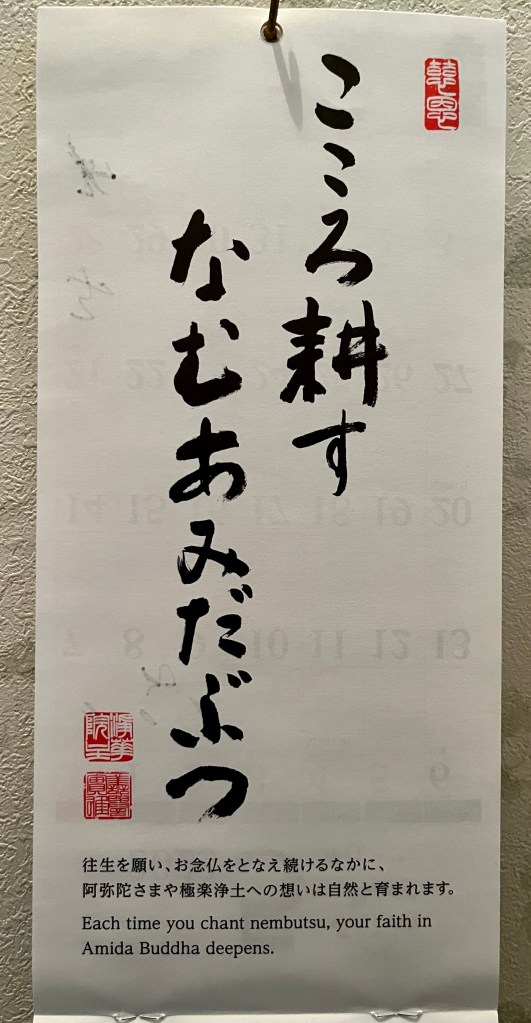
Anyhow, recently I saw this Jodo-Shu Buddhist-themed calendar around the house:

The English translation is very close, but the Japanese has some extra nuance that’s noteworthy.

In Japanese is written:

こころ耕す kokoro tagayasu

南無阿弥陀仏 namu amida butsu

The first line, means to cultivate the heart using the verb tagayasu (耕す), which implies tilling a field, or plowing a field.

So, it’s not just an academic exercise in reciting the nenbutsu, it cultivates the heart like a field. If you let the field go fallow, nothing grows except maybe some weeds. Buddhist practice is much like this, whether it be the nenbutsu or some other practice.

Namu Amida Butsu

The “Unvarnished” Nenbutsu

Honen, the founder of the Japanese Pure Land movement in 12th century Japan had quite a few disciples as we’ve talked about before, but there were certain disciples that particularly carried the torch. One of them was a monk named Shōkū (証空, 1177 – 1247) who later went on to found the Seizan branch (seizan-ha, 西山派) of the Jodo Shu sect. He is thus often called Seizan-shōnin as a result.

Shōkū was among the few disciples who was not exiled from the capitol during the Jogen Persecution (jōgen no hōnan, 承元の法難) of 1207, probably due to his closer affiliation with the Shingon sect, and because he wasn’t a firebrand like some of Honen’s other disciples. Since he stayed in the capitol, he was able to repurpose an existing temple in the capitol, Eikan-dō (homepage, with English too), into a Jodo-Shu sect temple, while the exiled disciples established Jodo Shu teachings in the countryside.

Anyhow, what made Shōkū noteworthy within the context of Japanese Pure Land Buddhism was a concept he described as shiraki nenbutsu (白木念仏), or “unvarnished wood nembutsu”. In the following passage, he writes:

….those who color [i.e. “varnish”] their nenbutsu practice with many meditative practices and non-meditative practices boast that they will definitely attain ōjō [往生, rebirth in the Pure Land].

Meanwhile those who cannot develop these practices and whose nenbutsu is utterly colorless grow discouraged about their ability to attain ōjō.

“Traversing the Pure Land Path”, page 116, translations by Jonathan Watts and Yoshiharu Tomatsu

Some people, especially those with more means, want to supplement (i.e. “varnish”) their nembutsu practice with additional Buddhist practices, but Shōkū points out that this puts other people at a disadvantage. All they can do is recite the nembutsu in sincere faith. This is the unvarnished nembutsu. Shōkū quotes the revered Chinese master Shandao by comparing the unvarnished nembutsu with Shandao’s “sincere and believing mind”. For Shōkū, what mattered in the end isn’t form, it’s sincerity.

This is echoed many centuries later by Vietnamese Buddhist monk, Ven. Thich Thiên-Tâm, in Buddhism of Wisdom and Faith (1991) when he writes (emphasis added):

Moreover, the power of the Buddha’s vow [Amitabha Buddha’s] is so immense that, no matter how heavy our karma is, by reciting His name in all earnestness, we can, in this very lifetime, be reborn in the Pure Land.

Page 14, translation by the Van Hien Study Group in NY

Similar to Shōkū’s “unvarnished nembutsu”, Thich Thiên-Tâm shows how there’s no “gaming the system”. Rebirth in the Pure Land is due to Amida Buddha’s vow and compassion toward all beings; there’s no adding or subtracting to this. If one is sincere, Amida Buddha hears, and will lead you to the Pure Land.

Further, Shōkū writes:

Now this doesn’t mean that there’s no value in the nembutsu of people either deeply or just ordinary knowledge of the Mahayana teachings, or of those who keep the precepts. It’s very important to avoid all confusion of thought here.

“Traversing the Pure Land Path”, page 118, translations by Jonathan Watts and Yoshiharu Tomatsu

Shōkū, I feel, is making a distinction between conduct in this life and the goal of being reborn in the Pure Land. While living in this life, the Buddha’s teachings about, and living responsibly, with goodwill towards others, still hold true. If you can put even some of these teachings into practice, great. Everyone has to start from somewhere.

Further, as we see in the Buddhist text, the Immeasurable Life Sutra (emphasis added):

If you strictly observe the precepts of abstinence with upright thought and mindfulness even for a day and a night, the merit acquired will surpass that of practicing good in the land of Amitāyus for a hundred years. The reason is that in that Buddha-land of effortless spontaneity all the inhabitants do good without committing even a hair’s breadth of evil.

Translation by Rev Hisao Inagaki

And yet, as Shōkū and Thich Thiên-Tâm teach, regardless of how much or little you’ve accomplished in this life, one can still take refuge in Amida Buddha, and be reborn in the Pure Land rather than taking one’s chances with future rebirths. It is all due to Amida’s compassion.

Thus, for me, the beauty of the Pure Land Buddhist path, is that anyone can begin just as they are, make the best effort they can in this life, and yet be secure in the knowledge that they are embraced by Amida Buddha nonetheless.

Namu Amida Butsu

P.S. Originally, I had an even longer post, a stream of thought in draft mode, but after finding the passage above, I found a much simpler way to explain it. As a writer, it’s always good to step back and wait before publishing. You might find a better way to explain it.

P.P.S. More on making Buddhism accessible to a diverse array of people.

Practical Buddhism

Recently, I’ve been reading some old books of mine about the life of Honen, a 12th century Japanese-Buddhist monk who started the Pure Land movement in Japan which includes Jodo Shu and Jodo Shinshu Buddhism. Honen had a pretty eclectic following: from nobility in the elite Fujiwara family, to prostitutes, ex-monks, etc.

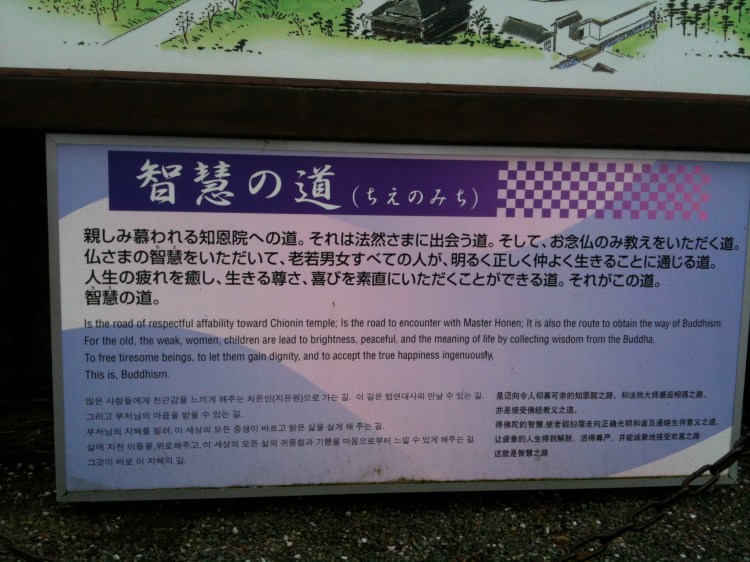
Taken in 2010 at Chion-in Temple in Kyoto, Japan, this is one of two head temples of Jodo Shu, and where Honen’s mausoleum is said to be. This was a sign posted near the main gate.

In one famous dialogue, Honen is talking with a former robber named Amano Shiro (天野四郎), who had previously been a leader of a gang in Kawachi Province and had reputedly killed some people as well. In his old age, he became inspired by Honen’s teachings and became a devout follower named Kyo Amidabutsu (教阿弥陀仏). One night, while staying with Honen, Kyo Amidabutsu had woken up in the middle of the night to hear Honen reciting the nembutsu by himself. When Honen realized he was no longer alone, he quietly went to bed.

A few days later, Kyo Amidabutsu went to talk to Honen. He had no family to care for him in his old age, and so he would be leaving soon to stay with a friend in a remote province in the east. Before he would leave though, he had some questions for Honen.

In the dialogue, as recorded in both Honen The Buddhist Saint and Traversing the Pure Land Path, is pretty long, Honen carefully explains what the nembutsu is all about, and patiently answers Kyo Amidabutsu’s questions. For example, Honen explains the significance of the nembutsu:

First of all, notice that there is nothing so extremely profound in the nembutsu at all. The only thing to now is that everyone who calls upon the sacred name [namu amida butsu] is certain to be Born into the Pure Land. No matter how educated a scholar may be, he has no right to assert that there are things in our school [e.g. Pure Land Buddhism] which really do not belong to it.

Page 61-62, “Traversing the Pure Land Path”

Here, Honen is trying to counter some of the other Buddhist schools at the time, which tended to emphasize a more esoteric, intellectual meaning, something that would require considerable time and effort for a monk to discover through practice, esoteric initiations, and meditation. Kyo Amidabutsu, as an elderly commoner in the 12th century, would probably had a minimal education, and thus would’ve found all that intimidating, assuming that he could even take tonsure and become a monk.

I really like the fact that Honen is not hitting Kyo Amidabutsu over the head with a bunch of doctrinal explanations about the Four Noble Truths, Karma, Rebirth, etc., either. Instead, he’s providing a simple, straightforward path with no hidden, mystical or esoteric meanings. It’s not that these aren’t important, but Buddhism is first and foremost a religion of practice, not belief, so these can be learned gradually.

Next, Kyo Amidabutsu asks a series of questions about when is it the right time to recite the nembutsu, whether to setup an altar, wear clerical robes, etc. Honen’s reply is similarly straightforward:

The nembutsu may be practiced whether you are walking, standing, sitting, or lying [down]. So it can be left to everyone according to their circumstances to do it either reclining or sitting or in any way they choose. And as to holding the rosary or putting on the robes, this also should be decided according to circumstances. The main point is not the outward manner at all but the fixing of the mind on the one thing — firmly determined to gain ojo [往生, rebirth in the Pure Land] and with all seriousness calling upon the sacred name [namu amida butsu].

Page 65-66, “Traversing the Pure Land Path”

This sense of sincerity is the key, as Honen teaches. For Kyo Amidabutsu’s sake, he uses an analogy of a thief who means to rob a house:

“Down deep in his heart [the thief] means to steal, but as far as his outward appearance is concerned, he gives not the slightest indication to others of his purpose by look or gesture. As others know absolutely nothing about the purpose to steal that is in his heart, we may say that the purpose is for him alone, without any reference to outward appearance. Such an undivided heart as this is necessary in the man who would make sure of birth into the Pure Land [of Amida Buddha].

Page 63, “Traversing the Pure Land Path”

In my limited experiences talking with people who are curious about Buddhism here in 21st Century America, I often notice that they are curious, but don’t know where to begin, and find it a bit overwhelming. Buddhism is hard to explain, and yet most of that information isn’t necessary upfront either. If people want to know more, they can (and will) ask. Instead of hitting people over the head with a bunch of esoteric, mystical or complicated psychological explanations, it’s probably better to just KISS: Keep It Simple, Stupid.

Buddhism isn’t meant to be an intellectual playground for the upper classes, it’s meant to help people from all walks of life. Everyone should feel free to begin the Buddhist path just as they are, and go at their own pace, using the tools they have.

Honen was sensitive to Kyo Amidabutsu’s situation and provided a straightforward, simple practice that provides both a sense of spiritual comfort, but also something very flexible and adaptable to his circumstances. Kyo Amidabutsu is old, has no kin, financially broke, and has no where to live. He probably doesn’t even know when he might eat next, or where he might sleep next. So, it has to be something that can be adapted to his existing lifestyle, and straightforward (not esoteric) enough that it is easy to understand yet provides a sense of refuge in a chaotic world. It may be looked down upon by more “elite” Buddhist followers, but for Kyo Amidabutsu, it’s just right.

Indeed, in founding the Jodo Shu sect, Honen reportedly once said:

The reason I founded the Jōdo [浄土, Pure Land] sect was that I might show the ordinary man how to be born into the Buddha’s real land of recompense [e.g. the Pure Land]. According to the Tendai sect, the ordinary man may be born into the so-called Pure Land, but that land is conceived of as a very inferior place. Although the Hossō [Yogacara] sect conceives of it as indeed a very fine superior place, they do not allow that the common man can be born there at all. And all the sects, though differing in many points, all agree in not allowing that the common man can be born into the Buddha’s land of real compensation….Unless I start a separate sect, the truth that the common man may be born into the Buddha’s land of compensation will be obscured, and it will be hard to realize the deep meaning Amida [Buddha]’s Original Vow [to provide a refuge for all beings].

Honen: The Buddhist Saint, page 23-24

For this reason, I come back again and again to Jodo Shu Buddhism over the years because even when I quibble about specific details, it’s accessibility, and simple message is pretty hard to beat within the Buddhist world. It meets the needs of all walks of life, and does not overwhelm people with philosophical details, yet it also provides plenty of flexibility to grow and learn as well. I feel this is an exemplary example of Buddhist metta if nothing else.

Namu Amida Butsu