The Many Names of The Nianfo

The nianfo (念佛) is widely recited across many cultures and languages by people who follow the Pure Land Buddhist tradition. In Japanese it is called the nembutsu (念仏), and that is the name I most often use on this blog. In Korean it is the yeombul (염불), and in Vietnamese it is the niệm phật. Just as the name differs by language, the phrase itself has changed pronunciation as it is adopted in other cultures and languages, just like the sutras did.

Let’s look at examples.

The original form of the nianfo (as far as I can tell) comes from Sanskrit language in India. In Sanskrit, “nianfo” was buddhānusmṛti (buddhānussati in Pāli language). The venerable site Visible Mantra states that it was recited like so:1

namo’mitābhāyabuddhāya

In the Siddham script, still used in some esoteric practices, this is written as:

𑖡𑖦𑖺𑖦𑖰𑖝𑖯𑖥𑖯𑖧𑖤𑖲𑖟𑖿𑖠𑖯𑖧

From here, Buddhism was gradually imported into China from India (a fascinating story in and of itself), and because Chinese language and Sanskrit are so different, this was no easy task. Nevertheless, the buddhānusmṛti was translated as nianfo (念佛) and written as:

南無阿彌陀佛

This was how the Chinese at the time approximated the sound of the Sanskrit phrase. In modern, Simplified Chinese characters this looks like:

南无阿弥陀佛

But how does one read these characteres? That’s a fun question to answer.

You see, Chinese has many dialects because of geography, regional differences, and migration of people. Thus, even though Chinese characters are written the same (with only modest regional differences), the way they are read and pronounced varies. Thanks to Wiktionary, I found a helpful list to illustrate:

Dialect or writing systemPronunciation
Mandarin, Pinyin systemNāmó Ēmítuófó or
Námó Ēmítuófó
Mandarin, Zhuyin (Bopomofo) systemㄋㄚ ㄇㄛˊ ㄜ ㄇㄧˊ ㄊㄨㄛˊ ㄈㄛˊ, or
ㄋㄚˊ ㄇㄛˊ ㄜ ㄇㄧˊ ㄊㄨㄛˊ ㄈㄛˊ
Cantonese, Jyutping systemnaam4 mo4 o1 mei4 to4 fat6
naam4 mo4 o1 nei4-1 to4 fat6
naa1 mo4 o1 mei4 to4 fat6, or
naa1 mo4 o1 nei4-1 to4 fat6
Hakka, Sixian or Phak-fa-su systemNà-mò Ô-mì-thò-fu̍t
Nà-mò Ô-nî-thò-fu̍t
Nà-mò Â-mì-thò-fu̍t
Eastern Min, BUC system
Nàng-mò̤-ŏ̤-mì-tò̤-hŭk
Puxian Min, Pouseng Ping’ing systemna2 mo2 or1 bi2 tor2 hoh7, or
na2 mo2 or1 bi2 tor2 huoh7
Southern Min (a.k.a. Hokkien), Peh-oe-ji systemLâm-bû O-bí-tô-hu̍t
Lâm-bû-oo-mì-tôo-hu̍t

Of these dialects, I am only familiar with Mandarin and (to a much lesser extent) Hokkien, so I can only trust the others based on Wikipedia.

Anyhow, China was a powerful, dynamic culture at the time, and it had a profound influence on its smaller neighbors such as the Korean peninsula, Japan, and northern Vietnam (a.k.a. Dai Viet). Just as the neighbors of the Romans (including the Byzantines) absorbed Roman culture, the neighbors of China did the same even though the languages were very different.

Thus, the nembutsu in these languages became:

LanguageHow to Recite
JapaneseKanji: 南無阿弥陀仏
Romaji: Namu Amida Butsu
KoreanHanja: 南無阿彌陀佛
Hangul: 나무아미타불
Romanization: Namu Amita Bul
VietnameseChữ Hán: 南無阿彌陀佛
Quốc ngữNam mô A-di-đà Phật2

What about Tibetan Buddhism? I am really unfamiliar with that tradition, so I might be wrong here, but my understanding is that Tibetan veneration of Amida Buddha stems from a different tradition, so instead of the nianfo, they recite appropriate mantras instead. Beyond that, I don’t know.

Anyhow, this is a brief look at how a simple Sanskrit phrase has evolved into so many traditions and ways to express veneration to the Buddha of Infinite Light. Thanks for reading!

𑖡𑖦𑖺𑖦𑖰𑖝𑖯𑖥𑖯𑖧𑖤𑖲𑖟𑖿𑖠𑖯𑖧
南無阿彌陀佛
Namu Amida Butsu

P.S. Another post despite my intended rest. The time off really has helped, so it’s been well worth it, but now I am eager to write again. 😌

1 As I’ve written before, writing Sanskrit in the more modern Devanagari script is kind of pointless since Sanskrit was never written in that until late in history, long after Buddhism in India was gone. Sanskrit does not have a native script either, so the Roman Alphabet is as god as any.

2 Brushing off my college Vietnamese, this is pronounced as “Nam-moe Ah-zee-dah-fut”.
Amitabha: The Welcoming Buddha

During my wife’s latest trip to Japan (I stayed home this year for various reasons), she found this delightful patch/sticker:

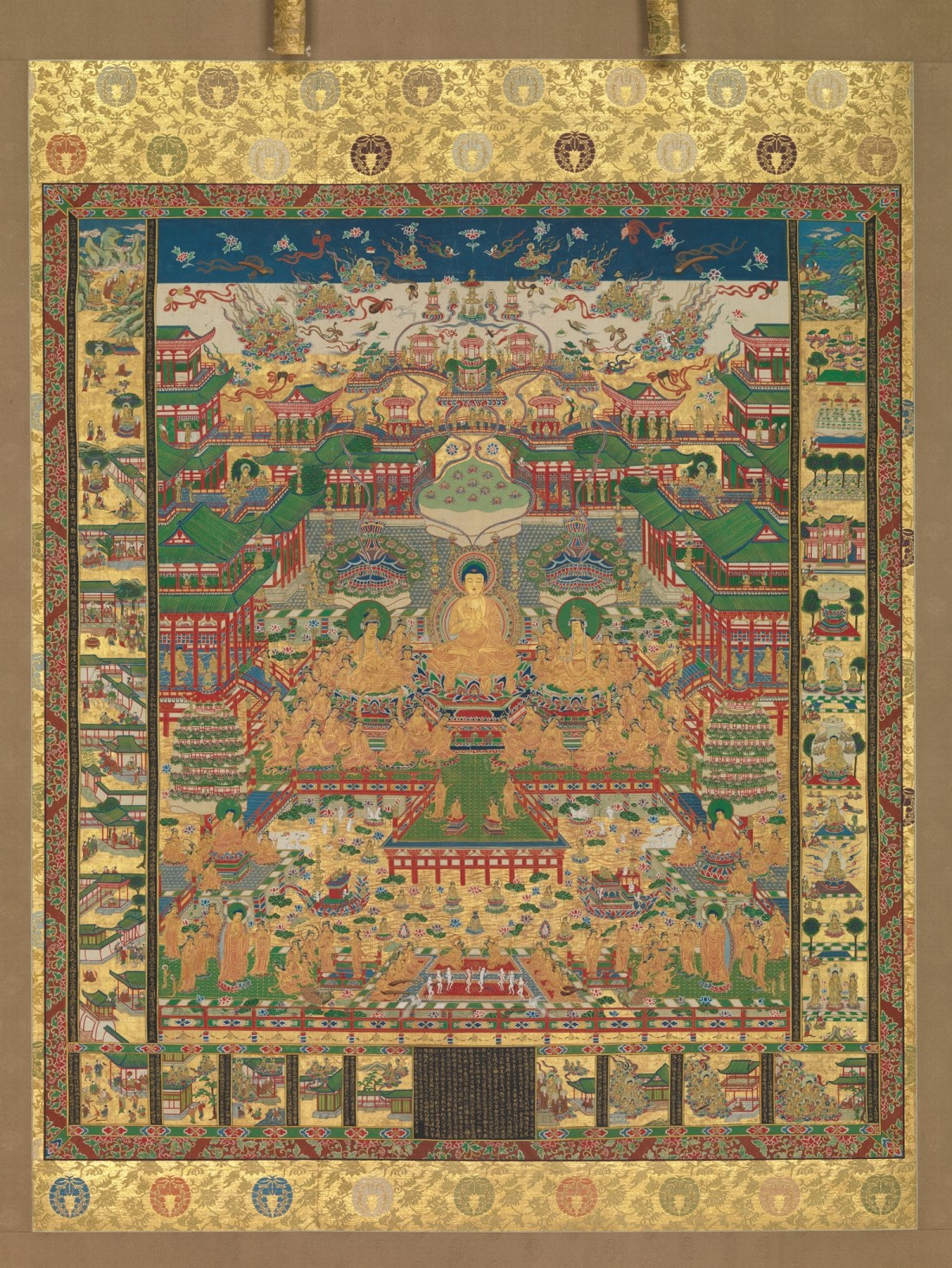
This is an image of Amida Buddha, welcoming the deceased to the Pure Land. This is called raigō amida (来迎阿弥陀, “Amida welcoming the dead”). I talked about this before a little while ago, becuase it was a common artistic motif in medieval Japanese Buddhism, especially at a time where disease, warfare and death would often cut people’s lives short.

The imagery of Amida Buddha coming to greet the dead is found primarily in the Contemplation of Amitabha Sutra (a.k.a. “the Contemplation Sutra”). The last section of the sutra lists the nine grades of people who are reborn in the Pure Land, and the fourth grade (“highest level of the middle grade”) gives the following description, for example:

“When such a person is about to die, Amitayus [Amida] appears before him, surrounded by a host of monks and radiating a golden light. He then expounds the truth of suffering, emptiness, impermanence and no-self, and praises renunciation of the world as the way to escape from suffering.

“Seeing this, the aspirant greatly rejoices and finds himself seated upon a lotus-flower. He kneels down, joins his palms and worships the Buddha. Before he raises his head, he attains birth in the Land of Utmost Bliss, where his lotus-bud soon opens.

Translation by Rev. Hisao Inagaki

Depending on the grade of the aspirant, this welcome may be more or less elaborate, but all of them are reborn in the Pure Land somehow.

So, I like this patch because it’s a reminder of the goodwill Amida Buddha extends to all beings, and how everyone can be born in the Pure Land if they want to.

Namu Amida Butsu

P.S. I kept the patch in its wrapper for a long time, but finally decided to put it in a sutra book I’ve been making.

P.P.S. Accidental double-post. 🤦🏼‍♂️

The Dynamic Duo of Zen and Pure Land

A few months ago, I made this post about how the Obaku Zen sect interprets Amida Buddha and the Pure Land. To my surprise, I keep reflecting on this phrase from time to time, almost like a Zen koan:

This mind is the Pure Land,
this body is Amida Buddha

This idea of merging Zen and Pure Land ideas is somewhat rare in Japanese Buddhism, but it’s surprisingly common in Chinese-Buddhist thought. Originally, I thought it was limited to later Ming-Dynasty Buddhism (which Obaku descends from), but similar strands of thought exist much further back.

A famous Chinese monk named Yongming Yanshou (永明延壽. 904 – 976) once wrote a poem titled the “Four Alternatives” (sì liào jiǎn 四料揀):1

Lacking both Chan and the Pure Land, it will be the iron beds and bronze pillars [of hell] for ten thousand kalpas [eons] and a thousand lives with no one to turn to.

Having Chan but lacking the Pure Land, nine out of ten will stray from the path; when the realm of the aggregates appears before them, they will instantly follow it.

Lacking Chan but having the Pure Land, ten thousand out of ten thousand who practice it will go [to rebirth]. Having seen Amitābha, why worry that one might not attain enlightenment?

Having both Chan and Pure Land, one is like a tiger with horns [i.e., doubly capable]. Such a person will be a teacher in the present life, and a buddha or patriarch in future lives.

translation by Charles B. Jones, “Chinese Pure Land Buddhism, Understanding a Tradition of Practice”, pg 210

Yongming is advocating a supportive model where both Zen practice and Pure Land practice work in concert. The Pure Land path is the “safer” path to follow, due to the vows of Amida Buddha, but if supported by Zen practice here and now, one is really making progress on the Buddhist path.

Further, a later writer named Yunqi Zhuhong2 (雲棲袾宏, 1535 – 1615) explained that these things were not mutually exclusive (Chinese added by me):3

To contemplate the Buddha (nianfo 念佛) is to contemplate the mind (nian-xin 念心). Birth there (in the Pure Land) does not entail birth away from here. Mind, Buddha, and sentient beings are all of one substance; the middle stream (non-duality) does not abide on the two banks (this world and the Pure Land).

Similarly, Ouyi Zhixu (蕅益智旭, 1599 – 1655) in his excellent work “Mind Seal of Buddhas” makes a similar argument: Zen and Pure Land practice are the same thing, just operating at different levels. You’re not forced to chose one or the other in your practice.

But such ideas aren’t limited to medieval Chinese-Buddhist monks. You can find such sentiments in Pure Land sutras themselves! In the Immeasurable Life Sutra is this passage (emphasis added):

“In this world, you should extensively plant roots of virtue, be benevolent, give generously, abstain from breaking the precepts, be patient and diligent, teach people with sincerity and wisdom, do virtuous deeds, and practice good. If you strictly observe the precepts of abstinence with upright thought and mindfulness even for a day and a night, the merit acquired will surpass that of practicing good in the land of Amitāyus [a.k.a. the Pure Land] for a hundred years. The reason is that in that buddha land of effortless spontaneity all the inhabitants do good without committing even a hair’s breadth of evil. If in this world you do good for ten days and nights, the merit acquired will surpass that of practicing good in the buddha lands of other directions for a thousand years.

Translation by Rev. Hisao Inagaki

In this passage, the Buddha is clearly advocating both bending your efforts toward rebirth in the Pure Land, but also making the most of the time you have here to undergo traditional Buddhist practices too because even a modest effort here is a great benefit in the future (both for yourself and others).

As I often tell my kids: “go nuts”!4

What I mean is: recite the nembutsu, meditate, uphold the precepts, or some combination thereof. You have nowhere to go but up.

But what if you can’t decide or don’t have the time?

In my opinion, start with the nembutsu. Begin just as you are, and recite it just 10 times daily. From there, add the Five Precepts when you are ready, and once you have that foundation, and are ready to branch out, then look into Zen practices. This make take months or even years. Take your time, go slow, and don’t be afraid to explore.

When I talk about the flexibility of Tendai Buddhism in Japan as well, this is what I am alluding to: start with something simple and small at first (such as a devotional practice), and gradually building upon it as you gain confidence and see the positive transformation in your life. Buddhism is kind of a SLOW, gradual religion, but like a glacier, once it starts moving, it has a wonderful momentum all its own even if you can’t see it.

Namu Shakumuni Butsu
Namu Amida Butsu

P.S. Featured blog image is another famous “Dynamic Duo”: Batman and Robin from the 1960’s series.

P.P.S. Posting kind of off-schedule just because it is fun. 😊

1 I found this on Wikipedia actually and I thought to myself “wow, this person quoted exactly the same way that I would do!”, then I realized that I had put this on Wikipedia a few years ago. 🤦🏼‍♂️

2 Pronounced like “yoon-chee joo-hong”.

3 Again, I managed to pull a quote from Wikipedia that I had unwittingly added years ago and then promptly forgot.

4 My kids ask me if they can watch TV, play Switch or whatever, and my frequent answer is “go nuts” [go crazy, have fun].

Effort

Garibaldi: This isn’t gonna be easy.
G’kar: Nothing worthwhile ever is.

Babylon 5, “And the Rock Cried Out, No Hiding Place”, s3:ep20

Recently, I talked about the key to practicing Zen (or Buddhism in general) is training while incorporating other things in your life toward that same goal. Like Rocky Balboa training in Rocky, or Li Fong in the excellent movie Karate Kid: Legends, or someone working hard to learn a language by making other aspects of life conducive toward language learning.

In most cases, we go through a some stages when we take up a project like this.

  1. New thing – “this is fun, I can see the benefits already!”
  2. Steady practice – “gotta keep this up”
  3. Boredom – “ugh, I gotta do this again”
  4. Skipped days – “I’ll make up for it tomorrow”
  5. More skipped days – “No, really, I’ll make up it up tomorrow.”
  6. Guilt – “I suck”
  7. Despair – “I’ll never succeed.”
  8. Quitting.

My usual pattern with new projects, or dieting and exercise, is to eventually feel guilty, despair, and quit. It happens to me a lot over the years, admittedly.

But also, there are a few things that surprisingly I have managed to stick with for years, decades even. I’ve been actively studying Japanese since 2008, for example. I realized though that the way I’ve studied Japanese has changed and shifted many times. Some experiments succeeded, others failed immediately. But the goal was important enough to me, that even when I failed I just shifted tactics and tried again. I failed the N1 JLPT twice in the last five years, and to my surprise, I am still at it, but now trying a new tactic.

Put another way: when I hit a roadblock, instead of hitting my head on the wall harder and harder, I tried another route. I knew where I wanted to go (language fluency) and just kept trying methods until I found something that stuck.

I realized too that my pursuit of the Buddhist path has been much the same way. I started out in 2005 with very little understanding, but I really liked reciting the nembutsu, and I loved the simple, down-to-earth, and highly approachable Jodo Shu sect as taught by Honen (still do!). But while I’ve had the same basic goal, my understanding of Buddhism has grown over time, and like language learning, has gone through many false-starts, projects that soon ended, or things that just didn’t work. So, I just shifted, tried another route, backtracked, and so on. This what I think happened to me, and why I took up Zen practice since May.

My current Zen practice is, I suppose, just another track toward my goal.

So, I think the point of all this is that the goal is more important than the particular approach. If the goal is something you really care about you’ll find a way. In fact, you’ll probably bend other aspects of your life toward it. If not, then the goal maybe wasn’t that important to begin with. That’s OK. Better to acknowledge it, cut your losses, and move on.

But if the goal is worthwhile to you, then like G’Kar says, you’ll find a way.

Namu Shakamuni Butsu
Namu Amida Butsu

The Art of Dying

One thing that really annoys me as a long-time Buddhist is the tendency for self-help and spritual seminars to cost so much money. I saw this advertised locally in my area for weeks, and the starting price for a seat is $250 for a backrow seat, which to me is totally bonkers.

The Dharma, as taught by Shakyamuni Buddha was freely given, and required nothing.

Having said that, as a counter to pricey spiritual seminars, I wanted to promote a concept: the Art of Dying.

DYING?!

It is a simple concept: you are going to die. You cannot necessarily choose the hour or manner of your death. But it will occur inevitably occur.

You do not have to take my word for it. Here’s a Buddhist sutra (freely given I might add) from the words of the Buddha:

There is no bargaining with Mortality & his mighty horde.

Whoever lives thus ardently, relentlessly both day & night, has truly had an auspicious day:

So says the Peaceful Sage [Shakyamuni Buddha].

MN 131, translation by Ven. Thanissaro Bhikkhu

The Lotus Sutra, a later Buddhist text but in my opinion the capstone of the Buddhist canon, describes this using the famous Parable of the Burning House in the third chapter. You can find Dr Burton Watson’s translation here (again, for free!).

But, to summarize the Parable, the Buddha Shakyamuni asks us, the reader, to imagine a great, big mansion that’s old, rickey, and so on. Then, imagine the house is burning. Deep inside, some kids are playing in a room, unaware the house is on fire. The father, having just returned from a trip, sees his kids in danger and calls out to them to leave the house at once. The kids, engrossed in their games, fail to see their situation. Finally, the father offers them great rewards if they leave (specifically carts of goods), and the kids finally come out.

The father, Shakyamuni Buddha, has left the burning house and stands outside. He calls to those in danger, namely the “kids”, to see their peril and to come out too.

What about the burning house itself? That is the world we live in, with strife, conflict, disease, chaos, aging, and death.

The late Thich Nhat Hanh wrote about this too:

“Imagine two hens about to be slaughtered, but they do not know it. One hen says to the other, “The rice is much tastier than the corn. The corn is slightly off.” She is talking about relative joy. She does not realize that the real joy of this moment is the joy of not being slaughtered, the joy of being alive.”

Thich Nhat Hanh, The Heart of the Buddha’s Teaching

This gets to the heart of the Buddha’s teachings: do not squander the time you have on this Earth. It doesn’t mean you can’t enjoy life and your loved ones, but remember: Death will not wait for it to be convenient for you.

When you hear this, your instinct might be the “live, laugh, and love”, indulge in all the fun things in life before it’s too late. But that’s not what the Buddha intended. When you look back at the Parable of the Burning House, the father wasn’t asking the kids to play more, he was telling them to get out before it’s too late.

Further, in the Mahayana tradition, one can get themselves out of the burning house, but helping and guide others to get out of the burning house is even better. One can call such people bodhisattvas.

But you can’t help others (let alone yourself) until you :

  • Recognize the situation
  • Put down your own toys and find the way out before you can help others.

This is part of the progression of the Buddhist path: get your foundations in order, increasing confidence in the Dharma (which you can see in your own life), and turning outward to help other beings.

But starting at the beginning, how does one establish a foundation?

Everyone is different, but generally it starts with some simple things:

  1. Taking the Buddha, Dharma and Sangha as one’s chosen refuge (you can do this by yourself or in a community). You can setup a small shrine too.
  2. Taking up an ethical life, such as undertaking the Five Precepts
    • If all five are too hard, start with one, and work your way up over the months and years.
  3. Cultivate metta:
    • Say to yourself (yes, you): May I be well, may I be free from harm.
    • Now think of loved ones: may they be well, may they be free from harm.
    • Now think of all living beings (even the awful ones): may they be well, may they be free from harm.
  4. Setup a reasonable daily practice. Think of it like exercise or stretching: if you start too aggressively, you’ll injure yourself and set yourself back. So start small, and build up.
    • What does a daily practice look like? Some examples here.
    • A small meditation practice can be beneficial too, but intention matters.
    • Study the sutras. Not self-help books, but the sutras. Commentaries on the sutras, such as those provided by Thich Nhat Hanh are quite good and easy to find in used and independent bookstores such as Powell’s City of Books.
    • Find worthy teachers and communities, not slick, overpriced seminars or cults. Caveat emptor.
  5. Give yourself permission to screw up, then reflect on it, and move on.
  6. Repeat. Buddhism is a long-term practice. “Play the long game“, but also remember you are on the clock. Time is short.

So, that’s your free teaching for today. Thanks for attending this seminar. Want to support the blog? Pay it forward or something. This is “Buddhism on a Budget”, and I strongly feel this is how Buddhism should be.

Namu Shakyamuni Butsu
Namu Amida Butsu
Namu Kanzeon Bosatsu

P.S. apparently this also a band with this name. As fellow PNW residents, I salute them.

Autumn Nights in Japan: Otsukimi and Juya-E

In the old Chinese lunar calendar, on the 15th day of the 8th lunar month (i.e. full moon on the 8th month), many cultures across East Asia celebrate something called the Mid-Autumn Festival. This has various names depending on the country and language:

  • Zhōng-qiū-jié (中秋節) in Mandarin Chinese,
    • Tiong-chhiu-cheh in Hokkien, by the way
  • Tết Trung Thu in Vietnam, and
  • Chuseok (추석) in Korea

In Japan, this festival is called formally the Jūgoya (十五夜, “15th night”) festival, but in popular culture is known as Otsukimi (お月見, “moon viewing”). This year, due to the lunar calendar, Otsukimi falls somewhat late on October 6th. This festival is about viewing the moon with friends and family, while enjoying some dango (rice dumplings) using displays like so:

A stack of dango treats, photo by evan p. cordes, CC BY 2.0, via Wikimedia Commons

According to this excellent book on Japanese culture, people also decorate such displays with pampas grass (susuki, ススキ), edamamé beans and taro potatoes. Unlike cherry-blossom viewing, people do not usually get drunk.

Chinese moon cakes, called geppei (月餅) in Japanese, are sometimes eaten as well, though it’s more of an exotic treat. Here, moon cakes are easy to obtain, and quite delicious. Highly recommend. We also get the Korean version of dango (tteok, 떡) too.

In any case, Otsukimi is about relaxing, enjoying the autumn vibes with the ones you love. As my family and I live in the Pacific Northwest, weather here isn’t reliable, and so we often get stuck with cloudy weather. But the image of Otsukimi is still popular. You can even find an emoji for it: 🎑.

Also, fun fact: there are traditionally two days of moon-viewing in Japan. The main one is Jūgoya (十五夜, “15th night”), but traditionally there is also a Jūsanya (十三夜, “13th night”) viewing on the 13th night of the ninth (not eighth) lunar month. This year, 13th night falls on November 2nd. On the 13th night of the lunar month, people enjoy chestnuts instead. Traditionally, people felt you should view the moon on both nights, otherwise, according to my book, you only did katamitsuki (片見月, “one-sided viewing”), which wasn’t ideal.

By the way, there is one other tradition around this time that’s specifically Buddhist: Juya-é (十夜会, “ten nights ceremony”), which is ten nights of observance of Pure Land Buddhist practice, starting from October 5th to 14th in the Western calendar. I usually try to recite the nembutsu a full 1080 times using my old Jodo Shu rosary for ten nights. Easier said than done as a parent, but it’s nice to have a challenge from time to time. Traditionally, people try to attend temple services if possible, or just focus on good behavior.

Anyhow, wishing you all a fun Otsukimi, Mid-Autumn Festival, or Juya-e, etc., or all of the above!

Out of the Mud Springs the Lotus

Recently, I reread a famous autobiography of a former “bathhouse” geisha titled Autobiography of a Geisha. The geisha in question, Sayo Masuda (1926? – 2008), lived a pretty horrible life and her story as a geisha is far from the glamorous stories normally told in English publications.

The short summary is that Sayo Masuda was a child born from an impoverished mother who cycled through a few husbands, and unable to feed or raise her kids. So, she sold some of the children off to indentured servitude. Sayo was one of them (she didn’t even know her name until her teenage years). The landlord family who took her in was very abusive and did nothing to support or raise her: she was another mouth to feed, and they did the bare minimum to raise her. Sayo never received a formal education, and was thus totally illiterate for life. Later, she was sold again as an indentured servitude to a local geisha house in Nagano Prefecture. Her geisha “mother” similarly abused her for minor infractions and made her work chores all day to support the existing geisha, until she was trained to be one as well.

The term geisha (芸者) is tricky because it means different things to different people. Much of it has been romanticized by Western media, but also by autobiographies like Iwasaki Mineko’s “Geisha, A Life“, which was told from the perspective of a very high-class geisha working in Kyoto.1 Sayo Masuda, by contrast, was a geisha at a provincial red-light district, so there was every expectation that she would be available for sexual favors and would have a danna (“patron”) well before she was 18. What separated provincial geisha from prostitutes mostly was mostly a degree of refinement and artistic skills (song, dance, conversation, etc).

It was a very nasty and cutthroat world she survived in:

Geisha can do horrid, spiteful things: they’ll attack one another tooth and nail, each trying to force the other out of the way. To someone who doesn’t know this world and sees only the surface of it, I suppose we must appear quite carefree; but inwardly were eternally weeping tears of pain and sorrow.

Page 70

Much of the biography covers her struggles to survive in a cutthroat world, but also her increasing shame as she got older, and felt that was not worthy of some of the kind men she would meet. Her sense of despair, guilt, and hopelessness only increased as she got older, and she wondered if she’d ever be more than a nasty, cutthroat geisha.

Diverging a bit, this sense of crushing hopelessness tied with evil is a bit theme in J.R.R. Tolkien’s The Lord of the Rings, too. People who are corrupted and succumb to evil are those who are most often weighed down by guilt (Gollum), desperation (Boromir), or hopelessness (Denethor, steward of Gondor). Frodo the Ringbearer almost succumbs too, if not for the love and optimism of Samwise Gamgee. This is how evil works: not just through raw force, but also by breaking people down.

But I digress.

Sayo Masuda thankfully did have a happy (though bittersweet) ending where she finally found stable employment in spite of her literacy, and friends and family who supported her.

As I read this, I kept thinking over and over of a famous anecdote from the time of Honen, founder of the Pure Land sect (Jodo Shu) in Japan. Namely, when Honen was exiled to the provinces and encountered a woman of the night. She too lived a nasty, cruel life and wondered if she’d ever find salvation. Honen kindly told her:

“Your guilt in living such a life is surely great and the penalties seem incalculable. If you can find another means of livelihood, give this up at once. But if you can’t, or if you are not yet ready to sacrifice your very life for the true way, begin just as you are and call on the sacred name. It is for just such deluded folk as you that Amida Buddha made that wonderfully comprehensive Original Vow (hongan 本願). So put your full trust in it without the smallest reservation. If you rely upon the Original Vow and repeat the nenbutsu, your ojo is absolutely certain.”

Later, when Honen was pardoned and allowed to return to the capital, he found out that the woman had been inspired to take up the Buddhist path, and died as a nembutsu follower. He reportedly said:

“Yes, it is just as I had expected.”

This sense of redemption is one of the strongest aspects of Pure Land Buddhism to me. The transformation of “bits of rubble into gold” is something that appeals to myself and many others who struggle with teh Buddhist path, or just struggle in life. But the basic theme of Mahayana Buddhism is not just that all beings can be awakened as Buddhas, but given enough time they all will be awakened as Buddhas.

But even going allllll the way back to the earliest sermons (sutras) of the Buddha, we can see the symbolism of a lotus flower growing from the mud:

“Monks, just as a blue, red, or white lotus—born in the water, grown up in the water—stands having risen above the water, unsmeared by the water; in the same way, the Tathāgata—born in the world, grown up in the world—dwells having conquered the world, unsmeared by the world.”

The Puppha Sutta  (SN 22:94), translation by Ven. Thanissaro Bhikkhu

And again later in the Amitabha Sutra in the Mahayana tradition, the Pure Land of Amida Buddha is described in terms of its lotus ponds:

The lotus-flowers in the lakes, large as chariot wheels, are blue-colored
with blue splendor, yellow-colored with yellow splendor, red-colored with red splendor, whitecolored with white splendor, and (they are all) the most exquisite and purely fragrant.

English translation from the Chinese Version of Kumarajiva by Nishu Utsuki, The Educational Department of the West Hongwanji, Kyoto, Japan: 1924.

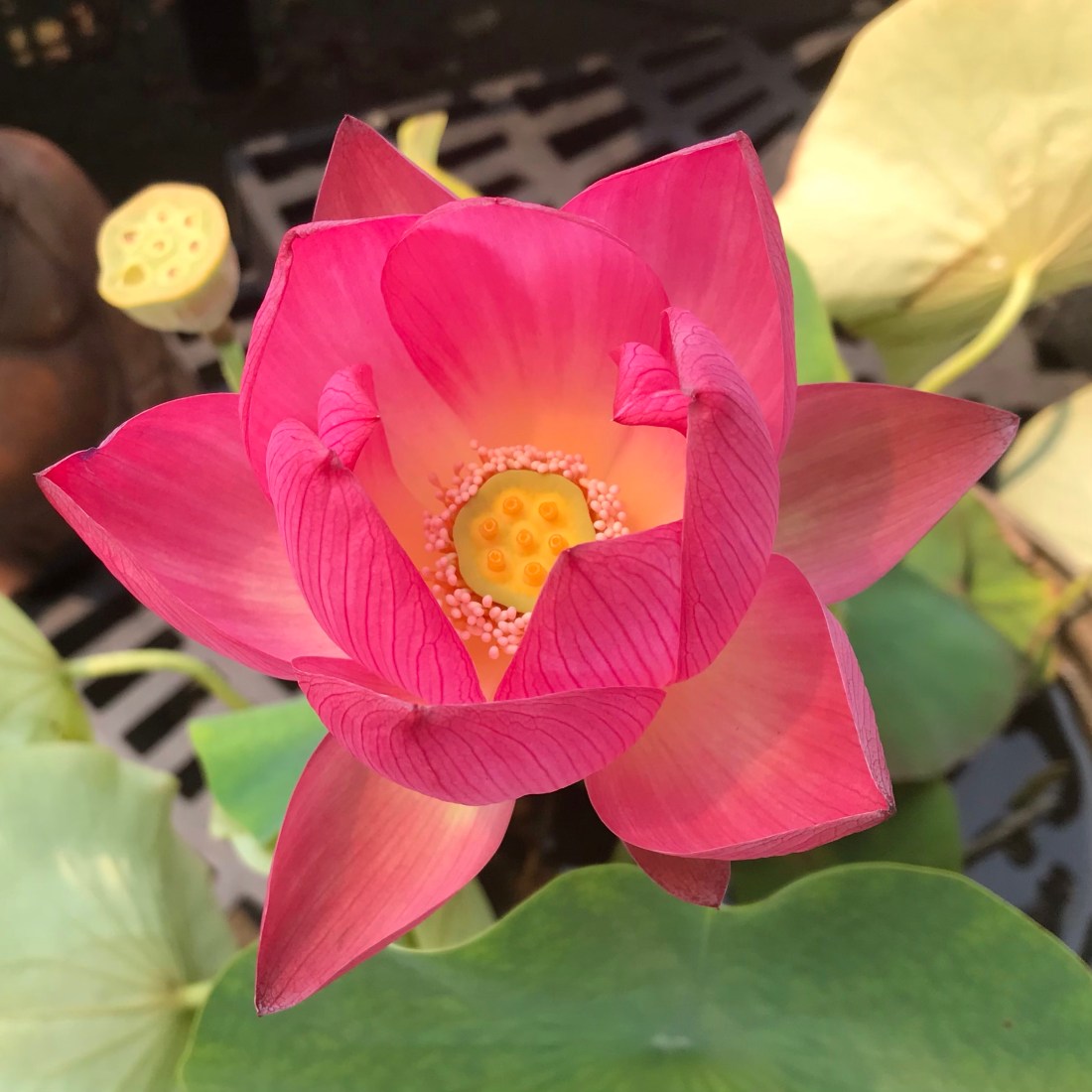
To reiterate, the idea of a lotus growing from the mud, unsullied by the mud was both intended to show the potential of all beings to awaken like the Buddha, but also the many colors of lotuses (in my opinion) show the diversity of followers from many walks of life.

Namu Shakamuni Butsu
Namu Amida Butsu

1 She also had a pretty high opinion of herself, which was grating to read at times. I seriously doubt her experience is representative of a lot of women in the industry.

Highs and Lows

Dr Helen J Baroni’s excellent book Iron Eyes covers the life and writings of Obaku Zen master Tetsugen Dōkō (鉄眼道光, 1630–1682). I’ve mentioned it in a few older posts, but I wanted to share a couple of Tetsugen’s poems really stood out to me:

41. MEETING AN OLD FRIEND

Separated east and west for twenty years.

You exclusively chant the Buddha’s [name, a.k.a. the nembutsu], while I practice meditation.

We meet together, why argue over high and low.

The wind and the moon originate in the same heaven.

Page 167

The “high and low” refers to the perception that the path of monastic self-discipline (as exemplified by the Zen tradition) is the “high road”, while the “low road” is instead relying Amida Buddha’s compassion to be reborn in the Pure Land. Here, Tetsugen argues that they both reach the same destination in the end, so the distinction doesn’t really matter.

Another poem he wrote is:

44. GIVEN TO THE FAITHFUL BELIEVER JONYU, WHO CHANTS THE BUDDHA’S NAME

The body is healthy, the years pour out; your ears and eyes are [still] clear.

Contented and unselfish, you reject personal glory.

Reflected light, in a single moment you penetrate the self.

For the first time you realize that practitioner and Dharma are complete in one body.1

Page 168

What really strikes me about these two poems is that Tetsugen openly acknowledges that his lay friends and followers recite the nembutsu and he’s totally fine with it.

It’s assumed in Japanese Buddhism that a sect practices meditation, or chanting, but not necessarily both. It’s also assumed that Zen people only hang out with Zen people, Pure Land Buddhists with Pure Land Buddhists, etc. There were exceptions: people like Ikkyu and Rennyo who were friends despite totally different practices and backgrounds, but you don’t hear about these often. Yet, in spite of this image, Tetsugen clearly was open to lay people practicing the Pure Land path and saw no conflict with this.

This makes more sense when you consider that Obaku Zen, a cousin of the Rinzai Zen sect, came to Japan from Ming-Dynasty China, when Zen and Pure Land thought had largely reconciled there. The excellent writings of Chinese monk Ouyi Zhixu (蕅益智旭, 1599–1655)2 and Yunqi Zhuhong (雲棲袾宏, 1535–1615)3 are typical of the thought at the time: both Zen and Pure Land Buddhism are different ways of approaching the same Dharma (e.g. Buddhism). One blends into the other.

Even modern Chan (Chinese Zen) teachers such as my favorite, Yin-shun (印順, 1906–2005), had no trouble recommending the nembutsu alongside other practices. In his book The Way to Buddhahood, he wrote:

If therefore, one is timid and finds it difficult to practice the bodhisattva-way, fearing that one will fall into the Two Vehicles or that following the karmic forces will cause one to drift apart from the Buddha Way, then chanting Amitabha Buddha is most secure! It is a wonderfully skillful means that can best embrace and protect those sentient beings who are beginners so that they do not lose their faith.

page 249

But I digress.

It should be noted that Tetsugen in particular was raised in the more native Jodo Shinshu-sect Buddhism and even went to Kyoto to train as a priest but eventually decided to pursue Obaku instead. So, perhaps he still had some connections toward his religious upbringing.

Nonetheless, all this is to say that Obaku Zen, having inherited such an outlook from Chinese Buddhism, takes Amida Buddha as its ideal, but sees Amida in more Zen terms. One is not required to see Amida that way upfront; it just comes in time with practice. Come as you are, and don’t worry if it doesn’t make sense. Someday, it will.

Namu Shakamuni Butsu
Namu Amida Butsu

1 According to Dr Baroni’s footnotes: Kihō, can also be translated as “opportunity and Dharma,” in Pure Land thought, it means that while the sentient beings believe in the Buddha, the Buddha’s power saves sentient beings. Personally, I like to think this relates to Shoku’s comment about the Three Karmic Bonds, too.

2 Pronounced like “Oh-ee Jih-shoo” in English

3 Pronounced like “Yoon-chee Joo-hohng” in English

Jodo Shu Home Liturgy

Hello dear readers, I realized recently that after posting I home liturgy examples for Soto Zen, Rinzai Zen, and Tendai sect Buddhism, I had never posted about Jodo Shu sect home liturgy despite being a follower for many years. There are a couple reasons for this.

Sutra book for Jodo Shu followers. I think this might be the first such book I have ever owned.

First, as someone who came to Jodo Shu Buddhism many years ago, I tended to rely on English sources only, and such sources tend follow Honen’s teachings, but nothing beyond that. Thus, through such books I followed Honen’s simple advice that focusing on the nembutsu is all that mattered. So, in my early efforts to learn Buddhist practice, I focused on reciting just the nembutsu. More on why the liturgy has expanded over time later in this post.

The second reason is that the Jodo Shu home liturgy is particularly long. My book on Jodo Shu explains that this usually takes about 20 minutes.

My limited experience confirms this. I have an old Jodo Shu sutra book from many years ago, which I received during one of our earliest family trips to Japan. That particular winter, we celebrated New Year in Japan, I got to participate in a local Joya-no-kané (“ringing of the temple bell”) ceremony, thanks to my father-in-law, and generally had a great time. It might even be the first sutra book I ever owned.

A photo of Honen, founder of Jodo Shu Buddhism, with his famous poem “Moonlight” below. A copy of his handwriting is to the right depicting the Nembutsu.

The book, needless to say, has some sentimental value for me.

But I digress.

You can find example Jodo Shu liturgy here on the official Jodo Shu homepage in Japanese. There is even a translated one on the Jodo Shu North American mission website. The format of the liturgy is:

  1. Kōgé – verse for offering incense
  2. Sanbōrai – taking refuge in the Buddha, Dharma and Sangha
  3. Shibujō or Sanbujō – both are verses of praise to the Buddhas
  4. Sangege – verses of repentance
  5. Junenreciting the nembutsu ten times.
  6. Kaikyōgé – verses for opening the sutra
  7. Shiseigé – an excerpt of the Sutra on the Buddha of Immeasurable Life, which I posted here.
  8. Honzeigé – dedicating the good merit to all beings
  9. Junenreciting the nembutsu ten times.
  10. Ichimai-kishōmon – Honen’s One-sheet Document, essentially his last will and testimony.
  11. (optional) Hotsuganmon – a verse attributed to Chinese Pure Land master Shan-dao, expressing a desire to be reborn in the Pure Land, become a bodhisattva and help others.1
  12. Shōyakumon – a verse for expressing the light of Amida Buddha.
  13. Nembutsu-ichi-éreciting the nembutsu as much as one likes.
  14. Sō-e-kō-gé – Another verse for transferring the good merit to all beings.
  15. Junenreciting the nembutsu ten times.
  16. Sōgangé – a variation of the Four Bodhisattva vows.
  17. Sanshōrai or Sanjinrai – three adorations or prostrations toward Amida Buddha
  18. Sōbutsu-gé – verses of praise to the Buddhas, but also a kind of warm sendoff too.
  19. Junenreciting the nembutsu ten times.

As you can see, it has many components, with the nembutsu sprinkled throughout. Many of these verses are very short too, so once you get used to the format, it is not that hard. It can feel a bit daunting upfront if you’re new to Pure Land Buddhism, though.

Thankfully, the Japanese site also has a couple example videos showing slightly different versions of the liturgy. Version one below with uses the Shibujo and Sanshorai:

and version two, which recites the Sanbujo and Sanshinrai instead:

The North America sites uses a little of both: the Sanbujo from version two, and the Sanshorai from version one. By contrast, my sutra book has all the verses, so you presumably pick which version you want to recite. It seems like they are basically interchangeable.

Since there is already an official English translation available online, I won’t repost here. Please refer to the links above for more details.

Instead, I wanted to address the question of liturgy versus just saying the nembutsu, and I found a good explanation in this article.

The author reiterates that Jodo Shu Buddhism begins and ends with the nembutsu and doesn’t need other verses to effect rebirth in the Pure Land. So, pretty consistent so far.

And yet, the author cites Honen who encouraged people to cultivate the “five right practices” (五種正行, goshushōgyō) which includes:

  • Recitation of verses
  • Observation
  • Paying homage
  • Reciting the nembutsu [lit. Amida Buddha’s sacred name]
  • Praise

Thus as a liturgy, it is meant to cultivate all five, with the nembutsu as the peak or the climax of a movie. From a general Mahayana-Buddhist standpoint, it covers all the important points: taking refuge, repentance, reciting a Buddhist sutra, sharing the good merit, and vows toward becoming a Bodhisattva.

My personal opinion is that if you’re new to Pure Land Buddhism, it’s perfectly fine to just recite the nembutsu, but as you become more comfortable with Buddhism, you can expand to include the whole liturgy. I have no doubt that it’s a wonderful experience once you do it from start-to-finish, but without context it can seem a bit difficult.

In any case, good luck and happy chanting!

1 My sutra book puts the Hotsuganmon at the very end, while the Jodo Shu site in Japanese puts it just after the One Sheet Document. The North America Jodo Shu site doens’t include it at all. I am not sure why there is a difference in format. I assume it is optional.

Other Power and the Nembutsu

The saying of nembutsu is neither a religious practice nor a good act. Since it is practiced without any calculation, it is “non-practice.” Since it is also not a good created by my calculation, it is “non-good.” Since it is nothing but Other Power, completely free of self-power, it is neither a religious practice nor a good act on the part of the practicer.

The Tannisho, section eight, translation by Dr Taitetsu Unno

This quote comes from a 13th century Japanese text called The Tannisho, a record of conversations between an aging Shinran, the founder of Jōdo Shinshu-sect Buddhism, and his disciple Yui-en.

It’s a strange quote, and many aspects of the Tannisho are also strange at first glance. But the details are important and worth exploring.

Shinran is basically deflating the idea, still common today, that the nembutsu (reciting the name of Amida Buddha) is a practice in the traditional Buddhist sense. Shinran says the recitation of the nembutsu isn’t a magic spell, mantra, or anything that could accomplish a desired result. From Shinran’s perspective, the nembutsu doesn’t do anything.

So, why recite it? From the Jodo Shinshu perspective,1 the nembutsu is simply means calling out to Amida in our hour of deep need. That’s why it’s not a good act nor a practice. Further, Amida Buddha hears all beings and shines his light upon them, a combination of wisdom to illuminate our ignorance, and compassion to embrace us.

The Other-Power described here is called tariki (他力) in Japanese. The idea is that Amida Buddha’s light (i.e. wisdom and compassion) is what transform us. There’s nothing we do that adds or subtracts from this.

Sometimes when I reflect on this, it feels a little bit like sophistry to me, but then I remember an anecdote about Shinran’s teacher, Honen, that helps illustrates this.

One time, someone asked whose nembutsu was better: Honen himself, or Awanosuke, a former-fortune teller who was not well-regarded by others in the community. Honen scoffed at this question and said that there was no difference between his nembutsu and Awanosuke’s because neither skill, nor style, nor conduct, nor grasp of the Buddhist doctrines mattered. It was all through Amida Buddha and not through one’s own efforts.

The whole idea is that in spite of who we are, Amida Buddha’s compassion shines on us all. It is simply that many people may be unaware of this.

Namu Amida Butsu

P.S. Just to clarify, the concept of Other Power wasn’t invented by Shinran and his teacher Honen. It was alreaady prevalent in earlier generations of Chinese Pure Land Buddhists such as Tan-luan and Dao-chuo, but I suppose that Shinran/Honen took it to its logical conclusion centuries later.

P.P.S. I have a backlog of fun things I wanted to share with readers, but the backlog is growing, so I am posting three a week or now just to help catch up.

1 … and arguably the Jodo Shu sect, too. The emphasis of both sects is on Amida Buddha’s compassion, rather than one’s own efforts as depicted in other Pure Land traditions. Sometimes, this feels like a case of “tomayto vs. tomahtoe” to this old Buddhist, but it’s how the various sects of Pure Land Buddhism sometimes define themselves.