Neither Priest Nor Layman

I’ve talked a lot recently about the Jodo Shinshu sect (sometimes called “Shin Buddhism” in some circles) of Japanese Buddhism and its founder Shinran, a former Tendai-Buddhist monk of the 13th century.

Portrait of Shinran, Nanbokucho-period artist, Public domain, via Wikimedia Commons

Shinran was one of a multitude of disciples of Honen. Honen was crucial in propagating Pure Land Buddhist teachings to the wider Japanese populace through simple recitation of the nembutsu over elaborate death-bed practices. For his part, Honen was building on older teachings from such illustrious monks as Genshin in Japan (also Tendai), and Shandao in China.

Needless to say, Honen’s hugely popular egalitarian movement really rubbed the Buddhist establishment, which had close ties with the Imperial government (especially with the Fujiwara), the wrong way. Although several complaints by powerful temples such as Kofukuji of the Hosso (Yogacara) sect and Enryakuji of the Tendai sect were rejected, Emperor Gotoba1 finally purged the movement after some alleged shenanigans between a couple disciples and some of his ladies in waiting. This is known in history as the Jogen Persecution (jōgen no hōnan, 承元の法難) of 1207.2

I say this because not only were the offending disciples executed, Honen and many of his followers were banished to the provinces, including Shinran, and were stripped of their monastic certification. The latter point is important to this post and worth exploring.

Way back in the day in ancient India, during the time of Shakyamuni (5th c. BCE), people who wished to follow the Buddha full time would renounce worldly life and become monks (bhikkhu) or nuns (bhikkuni). This was voluntary, and people could choose to give it up and return to lay life, assuming of course they weren’t kicked out for committing some offense. Since antiquity, Indian religious culture respected sages, ascetics, and monastics, such sages, ascetics and monks lived by begging for alms and were generally supported by the community. Since they were supposed to devote themselves full time to religious pursuits, it was assumed that the community would handle their day to day needs.

Fast-forward centuries later to Imperial China, where Confucianism was already entrenched in the government. Confucian bureaucrats generally had a suspicious view of Buddhist monks because they did not work, and didn’t contribute toward rearing families, or other such obligations to society. This clash of cultures played out over centuries, and there was even a dramatic purge during the Tang Dynasty in 845 where many monasteries were destroyed. Centuries later, they gradually reconciled, but it was a very bumpy ride.

This tension between Confucian bureaucracy and Buddhists played out in Japan too. Buddhism was eagerly adopted by the early Imperial court in Japan, but it was a tightly regulated extension of the State, intended to help avert calamities, and bring prosperity to the nations. Monks were frequently called on to recite sutra passages, or chant mantras to help ailing members of the aristocracy, or prevent natural disasters. Of course, many people were sincere followers too, but ordinations, regulations and such were all managed by the central government. It was, first and foremost, another organ of the State.

Why do I mention this?

Because when Shinran and other followers of Honen were stripped of monastic certification, they were no longer recognized as monks by the authorities. Sure they might have training, but no official status.

However, Shinran had been a trainee on Mount Hiei, center of the Tendai sect, since he was a small boy. He knew no other life. And yet now he was technically not a monk anymore in the eyes of the law. And yet, he wasn’t really a lay person either.

This led to a fascinating declaration by Shinran who changed his name to Gutoku Shinran (愚禿釋親鸞, “foolish, stubble-headed disciple of Shakyamuni [Buddha], Shinran”) and declaring himself hisō hizoku (非僧非俗) which means “neither priest, nor layman”. This set the trend that became the Jodo Shinshu movement thereafter.

Rather than relying on monastic institutions or monastic structure, Jodo Shinshu followers self-organized into dōjō (道場)3 which were often just people’s houses. Such members would gather periodically, pay dues, discuss issues at the time, shared letters from Shinran, recited the nembutsu together and so on. It was probably the first truly lay-centered Buddhist movement of this size and scale in Japan, possibly in history.

Lay movements are not new to Buddhism, but usually are often centered around a famous teacher (a monk) or a temple. Or, they tended to dissipate after a few generations. The Jodo Shinshu movement had neither monastic teachers, nor temples. They self-organized, trained their own priests, which included both men and women, and these men and women lived as other people did: they married, had families, worked, etc. Shinran for his part also married and had kids. He had no reason at this point not to since he was legally not a monk any more.

It wasn’t always smooth sailing, and Shinran (and later Rennyo) had to frequently deal with bad teachers, who let the power go to their heads, or taught unorthodox ideas purporting that they came from Shinran. Further, in the time of warlord Oda Nobunaga, and later the Zen monk Tetsugen, mob-violence by Jodo Shinshu followers was a genuine threat.

Nevertheless, the fact that such a self-organized lay-focused Buddhist community existed and thrived across medieval Japan is very noteworthy. It’s openness to women priests was revolutionary for the time, as was its lack of monastic standards for priests. It was run by laypeople for laypeople.

Even while I criticize some aspects of Shinran’s thought, I can’t help but deny that the “neither priest nor layman” concept, even if it was lamenting his own fate, ended up being a brilliant innovation and ahead of his time. Lay-Buddhist movements are very common now across Asia and the West, but these are often very modern innovations. Jodo Shinshu was basically doing it centuries earlier, before it was cool. It met the needs of people in a way that “ivory tower” monastic institutions could not, and solved the issue of accessibility of Buddhist teachings in a robust, sustainable way.

Not surprisingly, Jodo Shinshu is overwhelmingly the largest sect in Japan.

P.S. Shinran wasn’t the only one to really propagate Pure Land teachings in the provinces. Another major disciple of Honen, Bencho, was exiled to the island of Kyushu and established a lineage there which is now the main branch (a.k.a. Chinzei-branch) of the Jodo Shu sect we know today. Another disciple, Shoku, developed a second branch called Seizan-branch Jodo Shu. Shinran’s teachings and organization differed enough from Honen’s that later generations treated it as a separated sect entirely. Hence, “Jodo Shinshu”, not “Jodo Shu”. This might feel like splitting hairs, but if you’re a history nerd, now you know.

1 Emperor Gotoba was also the author of poem 99 in the Hyakunin Isshu, and was definitely a larger-than-life figure… for better or for worse.

2 There is also another persecution in 1227 called the Karoku Persecution (karoku no hōnan, 嘉禄の法難). In the latter case, Honen had already passed away, but after followers who remained in Kyoto built a mausoleum for their beloved teacher, the warrior monks of Enryaku-ji temple raided the mausoleum, destroyed it, and killed some disciples. These were tough times.

3 the modern “dojo” as a martial-arts institution gradually derived from this.

No Working Is True Working: the Tannisho

Writing my recent post about Ikkyu and Rennyo brought back a lot of old memories for me.1 I was also overjoyed when I was recently contacted by another member of my old Jodo Shinshu community. So, I started leafing through the old material I saved, much of it out of print now, and remembered this old quote from the Tannisho (歎異抄), a collection of sayings attributed to the founder, Shinran (1173 – 1263):

10) 念仏ねんぶつには無義むぎをもってとす。しょうせつのゆにとおおそうらき。

“In the nembutsu no selfworking is true-working; it is beyond description, explanation, and conception.”

translation by Dr Taitetsu Unno

This cryptic saying is probably the most emblematic of Shinran’s thinking, and what distinguishes Jodo Shinshu from the rest of the vast Pure Land Buddhist tradition.

Since the days of the early Chinese Buddhist Pure Land teachers such as Dao-chuo (道綽, 562–645) and Shan-dao (善導, 613–681), there has been this notion that Buddhism has two general paths:

  • The path of the Sages (i.e. the classic, monastic path), and
  • The path of the Pure Land

This morphed over time into the concepts of Self-Power and Other-Power. In other words, when following the Buddhist path does one rely on one’s own efforts, or fall back and rely on the grace of the Buddhist deities, primarily Amida Buddha? Every Pure Land Buddhist tradition and teacher that has arisen across history has wrestled with these competing approaches, how to find a balance, or where they might overlap. Charles B Jones’s book really explores this in far greater detail and well worth the read.

In any case, on the Self-Power vs. Other-Power spectrum, Jodo Shinshu Buddhism, as taught by Shinran and later Rennyo, really tipped the scales toward Other Power only. It’s not just 95% Other Power, 5% Self-Power; it’s entirely 100% Other Power. The idea arose through a combination of both Dharma Decline: that people were so far removed from the time of the historical Buddha Shakyamuni that any efforts towards one’s own emancipation were no longer possible, and the aforementioned tension between the Pure Land Path vs. Path of the Sages.

Thus, Shinran is saying that regardless of what one does or doesn’t do, the salvation provided by Amida Buddha is entirely due to Amida Buddha. One cannot add or detract from this grace. Once one experiences such grace, they spontaneously recite the nembutsu, rather than as a Buddhist practice.

Astute readers may find that this sounds an awful lot like Calvanism, and Charles B Jones points this out too. He also points out that the while this can provide great comfort to those who sincerely follow yet doubt their abilities, the challenge of Calvinist-type thinking is that it can leave the believer in doubt about whether they ever will be selected. It almost feels like a religious lottery. A person can be a genuine follower all their life, and yet grace might not come. Not every Jodo Shinshu follower experiences shinjin. And if they did, how would they know?

Back then, I wrestled with this issue quite a bit as a Jodo Shinshu follower. Shinshu teachings have a certain internal logic and beauty to them, but I always had this this nagging feeling that there was some “philosophical gymnastics” involved. And, to be frank, I am no longer convinced that this is what the Buddha taught. Even if you read the Larger Sutra of Immeasurable Life, the most important Pure Land Sutra and the source of the Juseige, it’s pretty clear that Shakyamuni intended for people to bend their efforts toward rebirth in the Pure Land, rather than let go and let Amida Buddha handle everything. The sutra is a bit long, and takes about 1-2 hours to finish reading, but if you’re learning about the Pure Land tradition, it’s worth the read.

I already critiqued Dharma Decline in another post so I won’t belabor that here. Suffice to say, it’s too formulaic to be a realistic assessment of human history.

But what about Other Power versus Self Power? In my humble opinion it’s a false dichotomy. You’re not actually forced in Buddhism to choose one or the other. It is possible, and very common, to find a balance of both in one’s practice. If a Buddhist deity inspires you to keep going, great! And since there many deities in Buddhism, it is possible to find someone who inspires you even if it is the historical Buddha himself. It doesn’t have to be a “cosmic” deity and will still be just as Buddhist.

I don’t want to trash on Shinran though, because a spiritual crisis like the one he had can be a very difficult to resolve even after years. Shinran was an accomplished and fascinating figure, and the Tannisho as a document is a valuable insight into his thinking process.

It’s just that I had my own “mini-crisis” in my younger years as a Buddhist and I came to a different conclusion even as a nembutsu devotee. These days I am pretty happy with my practice, small as it is, plus everything I’ve learned along the way.

Maybe I am totally wrong, but the way I figure it:

  • Slow and steady wins the race.
  • With the breadth of teachings and practices Buddhism has to offer there’s something for everyone and there’s nowhere to go but up.
  • Never be complacent. There’s always more to learn, more to try, and more to experience.

Good luck and happy practicing!

1 This is an old selfie I took of myself in 2015, wearing the robes of a minister’s assistant with the Buddhist Churches of America:

I was still in training (certified later in 2016), but I was very proud to wear it nonetheless. My chanting voice was terrible (still is), but I really tried to take my role seriously. I have a lot of happy memories from that time and am always grateful.

P.S. it’s hard to find a good translation of the Tannisho these days, but you find Dr Taitetsu Unno’s translation here on Web Archive.

Ikkyu and Rennyo: The Odd Couple

Years ago, when I was part of the local Jodo Shinshu Buddhist community, my minister told me a story about how Rennyo and Ikkyu, two famous Buddhist monks from 15th century Japan, were both good friends and would frequently test one another in their grasp of Buddhism. They were an unlikely pair of friends, given that they belonged to two very different Buddhist traditions, and yet they clearly had a rapport that you rarely find in Japanese-Buddhist history.

To be honest, I thought the story of them being friends was embellished, but I got curious recently poked around some Japanese sources on the Interwebs, and sure enough there were a number of famous anecdotes between Ikkyu and Rennyo. These anecdotes aren’t necessarily historically accurate, but they have been passed down through the generations and even show up in Japanese TV today.

But first, let’s introduce Ikkyu and Rennyo.

Ikkyu Sojun (一休宗純, 1394 – 1481) was a monk of the Rinzai Zen tradition,1 which was politically dominant at this time due to the Five Mountains System in Kyoto. He was disillusioned with the pomp and grandeur of the Zen community at that time, and left to live a more “authentic life” among the people. He is famous for his flashes of genius, and his artistic talents, but also his unorthodox behavior, including partying and sleeping with girls. Ikkyu left behind many excellent poems, paintings, and his genius image has made him a popular figure even in modern Japan.

Rennyo (蓮如, 1415–1499) was the eighth head of the ancestral Honganji Temple in Kyoto,2 which ostensibly was the head temple of the Jodo Shinshu sect. Trouble was, the movement was very fractured, with regional groups, rival powers, etc. And then there were the warrior-monks of Mount Hiei (head of Tendai sect) that wanted him dead. Rennyo had to flee Kyoto for a long while to the provinces, but used the time to unify the Jodo Shinshu groups into a more cohesive sect for the first time. His Letter on White Ashes, is a particularly inspired piece of writing.

Ikkyu was 20 years older than Rennyo, but in many anecdotes, they are making jokes with one another, or testing each other’s wisdom.

In one famous story (used in the “Ikkyu-san” cartoon), Ikkyu had put up a sign near a really crooked pine tree. The sign read whoever can see this pine straight, I will give them a kanmon of gold.

People were stumped, and brought this to Rennyo’s attention. Rennyo said, “pfft, more of Ikkyu’s mischief. I see this pine straight. I’ll get the cash.”

When Rennyo confronted Ikkyu about it, Ikkyu said, “Oh, it’s you. You don’t count. Look at the back of the sign.”

Sure enough, on the back of the sign was painted “EXCEPT RENNYO”.

When people ask Rennyo how he was able to see the crooked pine straight, Rennyo said that he saw it for what it was: a crooked pine. By seeing it for what it really was (a crooked pine), he saw it “straight”.

In another anecdote, for which I could find the original Japanese, Ikkyu had read the Amitabha Sutra and commented:

阿弥陀には まことの慈悲はなかりけり たのむ衆生のみぞ助ける

Amida Buddha has no true compassion; he only helps those who ask.

Source

To which Rennyo wrote back:

阿弥陀にはへだつる心なけれども 
蓋(ふた)ある水に月は宿らじ

Although my heart is not estranged from Amida Buddha,
the moonlight does not reside where water has a lid.

Source

Rennyo is invoking the imagery of Amida Buddha’s compassion as moonlight, which we’ve seen before, and how it shines everywhere. But if water is in a container (has a lid on it), the moonlight will not reflect back.

Ikkyu tested Rennyo again:

極楽は十万億土と説くなれば 足腰立たぬ婆は行けまじ

If the Pure Land of Amida Buddha is indeed 10,000,000,000,000 lands away [as described in the sutras], then an elderly woman who is unable to stand cannot go there.

Source

To which Rennyo replied:

極楽は 十万億土と説くなれど 近道すれば南無のひと声

It is taught that the Pure Land is indeed 10,000,000,000,000 lands away, but if you’re looking for a short-cut, recite the nembutsu.

Source

In another story, Ikkyu attended the 200th memorial of the founder of Jodo Shinshu (and Rennyo’s ancestor), Shinran. Of Shinran, Ikkyu wrote the following verse:

襟巻の あたたかそうな黒坊主 こやつが法は 天下一なり

That black[-robed] monk with the warm [as in “kind”] head and scarf,
his Dharma teachings are peerless.

Source

Ikkyu was referring to a famous portrait of Shinran depicts him as wearing his black clerical robes, and shaved head:

Nanbokucho-period artist, Public domain, via Wikimedia Commons

There are a lot of other stores too, and I’ll try to share more as I find them, but I thought these were neat. Zen and Pure Land Buddhism are often treated as separated teachings, and separate sects, but I suspect that as with any Buddhist path if you get far enough along, you’ll start to run into people of the same mind.

That, in my humble opinion, is the power of the Lotus Sutra and its many gates.

1 Zen in Japan is divided into 3 schools: Soto, Rinzai and Obaku, all imported from China at various points in history. Rinzai and Obaku both have the same “ancestral lineage” in China, but arrived in Japan at different points. Soto comes from a different lineage entirely in China.

2 A few generations after Rennyo, the Honganji split into two temples: Nishi (West) Honganji, and Higashi (East) Honganji after a family split, plus politics. They are effectively equal, but different sub-sects.

Take Two: What Is the Nembutsu?

For months, I’ve had on my to-do list to go and fix up the Wikipedia article about the nembutsu (or nian-fo in Chinese). I had started contributing to that article way back in 2006 shortly after I first got interested in Pure Land Buddhism, and occasionally update or add details. The article was flagged for some quality control issues recently, and I decided to help clean it up.

Some of my early contributions in Wikipedia way back in the day… can’t believe it’s been 18 years.

As I began to write some updates to the article, though, and trying to distill what the nembutsu is within the Pure Land tradition, I realized that this is a really tough question. There’s centuries of interpretations, layers of culture, and divergent viewpoints. I tried to summarize this in an older article, but after reading over that article, I realized that I didn’t quite hit the mark there either.

So, let’s try this again.

Pure Land Buddhism is a large, broad, organic tradition within Mahayana Buddhism (an even bigger tradition). It is not centrally-organized, but follows many trends and traditions across many places and time periods. However, these traditions all have a couple things in common:

  1. Reverence toward the Buddha of Infinite Light (a.k.a. Amitabha Buddha, Amida, Emituofo, etc.). The nature of who or what Amitabha Buddha is is open to interpretation though.
  2. Aspiration to be reborn (as in one’s next life) in the Pure Land of Amitabha Buddha. There have been many ways to interpret what exactly this means, but I am sticking to the most simple, literal interpretation for now.

In any case, these two things are what make the “Cult of Amitabha” what it is. By “cult” I mean the more traditional, academic definition, not the modern, negative definition. Amitabha is to Mahayana Buddhism, what the Virgin Mary is to Catholicism.

Every Pure Land tradition across Buddhist history is mostly focused on #2: how to get to the Pure Land. The early Pure Land Sutras spend much time describing how great Amitabha Buddha is, and how getting to the Pure Land is so beneficial towards one’s practice, but differ somewhat on how get reborn there.

One early sutra, the Pratyutpanna Sutra is one of the first to mention Amitabha and the Pure Land at all, but it very strongly emphasizes a meditative approach, in order to achieve a kind of samadhi. According to Charles B Jones, being reborn in the Pure Land wasn’t even mentioned in this sutra, nor Amitabha’s origin story. It was a purely meditate text. Nonetheless, this sutra was highly favored by the early Chinese Pure Land Buddhists, namely the White Lotus Society started in the 5th century by Lushan Huiyuan.

The main textual source for being reborn in the Pure Land is from the Immeasurable Life Sutra, also called the Larger [Sukhavati Vyuha] Sutra. This is where we see the famous 48 vows of the Buddha, including the most important, the 18th vow (highlights added):

設我得佛。十方衆生至心信樂。欲生我國乃至十念。若不生者不取正覺。唯除五逆誹謗正法

(18) If, when I attain Buddhahood, sentient beings in the lands of the ten quarters who sincerely and joyfully entrust themselves to me, desire to be born in my land, and call my Name, even ten times, should not be born there, may I not attain perfect Enlightenment. Excluded, however, are those who commit the five gravest offences and abuse the right Dharma.

translation by Rev. Hisao Inagaki

This is where things get interesting, in my opinion.

The Chinese character (niàn) was used to translate the Buddhist-Sanskrit term Buddhānusmṛti or “recollection of the Buddha”. But, according to Jones, the Chinese character 念 had multiple nuances in Chinese:

  • To mentally focus on something.
  • A moment in time.
  • Reciting the Confucian Classics aloud.

And in fact each one of these interpretations can be applied to the nembutsu (Chinese niànfó) because it means niàn (念) of the Buddha (, 佛).

But which is it: concentration, a moment of recollection, or verbal recitation?

Most of the early Chinese Buddhist teachers like Tanluan, Daochuo and Shandao all promoted a mix: usually visualization was the superior method, but verbal recitation was a fallback for people who couldn’t dedicate themselves to visualization-meditation and ritual. The earliest Buddhist teachers mostly emphasized the visualization-meditation approach, but by Shandao’s time (7th century) the verbal recitation was deemed the most effective method.

Later, in Japan, the monk Genshin (not to be confused with the game…) summarizes these various methods in his 10th century work, the Ojoyoshu. It was a high quality work and even praised by Chinese monks when it was sent over as part of Japan’s diplomatic missions. But Genshin came to the same basic conclusion: the nembutsu can be any one of the three.

Finally we get to Buddhist teachers like Honen (12th century), who taught that the verbal recitation was the only viable choice. Honen praised past methods, but his target audience was a mostly illiterate population, as well as monks whose monastic institutions had largely declined into corruption and empty ritual. So, for such people, better to rely on Amitabha Buddha’s compassion and recite the verbal nembutsu wholeheartedly.

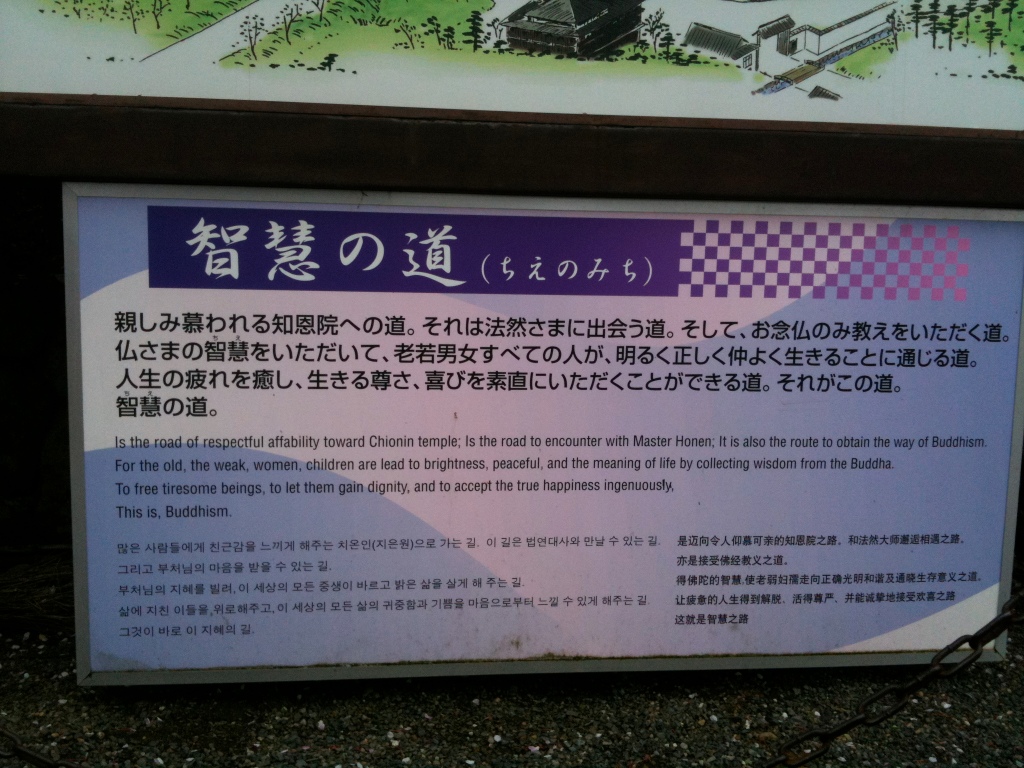
Multi-lingual sign at the temple of Chion-in in Kyoto, Japan where Honen’s mausoleum rests.

This approach isn’t that different from the Chinese approach which varied by teacher or patriarch but through Shandao’s influence had a parallel development. Some teachers emphasized the efficacy of simply reciting the nembutsu (much like Honen), others added the importance of concentration while reciting the nembutsu.

However, turning back to the Larger Sutra, let’s go back to the 48 vows. The 19th and 20th vows state:

(19) If, when I attain Buddhahood, sentient beings in the lands of the ten quarters, who awaken aspiration for Enlightenment, do various meritorious deeds and sincerely desire to be born in my land, should not, at their death, see me appear before them surrounded by a multitude of sages, may I not attain perfect Enlightenment.

(20) If, when I attain Buddhahood, sentient beings in the lands of the ten quarters who, having heard my Name, concentrate their thoughts on my land, plant roots of virtue, and sincerely transfer their merits towards my land with a desire to be born there, should not eventually fulfill their aspiration, may I not attain perfect Enlightenment.

So, taken together, the 18-20th vows cover the various interpretations of 念 we discussed above. All of them are included in Amitabha’s vows to bring across anyone who desires to be reborn there. The common theme is sincerity (至心 zhì xīn). If you look at the original Chinese text, all three include “sincerity”.

Further, when asked about how many times one should recite the nembutsu, Honen replied:1

“….believe that you can attain ojo [往生, rebirth in the Pure Land] by one repetition [of the nembutsu], and yet go on practicing it your whole life long.”

So, let’s get down to business: what is the nembutsu / niànfó ?

Based on the evidence above, I believe that the nembutsu is any of these Buddhist practices described above, taken under a sincere aspiration to be reborn in the Pure Land. It’s about bending one’s efforts and aspirations toward the Pure Land.

If you are calculating how to be reborn, or if your heart’s not 100% into it, then it may be a waste of effort.

Instead, if you feel unsure, study the Buddhist doctrines, get to know the Pure Land sutras, read about past teachers and if you feel fired up about, recite the nembutsu, or do whatever moves you. You will just know when. The more you put into it, the more you get out of it too.

Amitabha’s light shines upon all beings, like moonlight, and if you feel inspired by it, just know that you’re already halfway to the Pure Land.

Namu Amida Butsu

1 The site is long gone, sadly, but the Wayback Machine has an archive of the site. The updated Japanese-only site is here.

Liturgy on White Ashes

A while back, I mentioned a well-known liturgy called the Letter on White Ashes (白骨の章, hakkotsu no shō). It is letter that is often read aloud in the Jodo Shinshu tradition, and was originally composed by the 8th head (monshu, 門主) of the order, Rennyo (蓮如, 1415–1499) to a follower.

Some quick backstory about Rennyo first though.

A portrait of Rennyo, courtesy of ブレイズマン, Public domain, via Wikimedia Commons

Rennyo is an interesting, though often controversial figure. Jodo Shinshu is somewhat unusual in Buddhism because it was, from the outset, a strictly lay order and even today the priests do not take any clerical vows. Rennyo reputedly had 28 children by 4 different wives (not at the same time). The ravages of war, famine, and medieval healthcare for pregnant women,1 meant that he remarried 3 times.

Rennyo also presided over a very fractured and divided Jodo Shinshu community. Because the community was lay-oriented and had no political support, it divided into regional sects in rural areas, each developing their own interpretation, and with no oversight.

Further, certain established sects constantly viewed the widespread Jodo Shinshu Buddhism as a threat and, in the case of the Tendai complex on Mount Hiei, would send monastic armies to persecute them.

As if all this wasn’t enough, by Rennyo’s time, the central authority in Kyoto had broken down leaving the country in civil war (the Warring States period).

Rennyo was politically vulnerable against other rival, regional Jodo Shinshu groups and was actively being chased by the armies of Mount Hiei. He fled with his family to a more remote region in Echizen province. Here, Rennyo was finally able to catch his breath and gradually reunite many of the disparate Jodo Shinshu communities under a single organization, with reformed and updated liturgy, ordination and so on. Rennyo’s efforts were greatly successful and today he is remembered as the “Restorer” of Jodo Shinshu.2

Part of Rennyo’s success was his letter-writing. These are collected today in a text called the Gobunsho (御文章) or more colloquially the O-fumi (御文).

The letter below is perhaps the most famous of the collection (emphasis added). There are many translations available, but I tend to like Rev. Hisao Inagaki’s the most.

When I deeply contemplate the transient nature of human life, I realize that, from beginning to end, life is impermanent like an illusion. We have not yet heard of anyone who lived ten thousand years. How fleeting is a lifetime!

Who in this world today can maintain a human form for even a hundred years? There is no knowing whether I will die first or others, whether death will occur today or tomorrow. We depart one after another more quickly than the dewdrops on the roots or the tips of the blades of grasses. So it is said. Hence, we may have radiant faces in the morning, but by evening we may turn into white ashes.

Once the winds of impermanence have blown, our eyes are instantly closed and our breath stops forever. Then, our radiant face changes its color, and the attractive countenance like peach and plum blossoms is lost. Family and relatives will gather and grieve, but all to no avail?

Since there is nothing else that can be done, they carry the deceased out to the fields, and then what is left after the body has been cremated and has turned into the midnight smoke is just white ashes. Words fail to describe the sadness of it all.

Thus the ephemeral nature of human existence is such that death comes to young and old alike without discrimination. So we should all quickly take to heart the matter of the greatest importance of the afterlife, entrust ourselves deeply to Amida Buddha, and recite the nembutsu.

Humbly and respectfully.

Rennyo

Translated by Reverend Hisao Inagaki

Rennyo does a terrific job distilling important Buddhist truths into a single letter, written in a straightforward, accessible manner, with a simple message at the end: do not waste time, settle your affairs in the afterlife and entrust yourself to Amida Buddhia. It is no surprise this is still read aloud even today in Jodo Shinshu funerals, including my mother-in-law’s. Personally I always liked this letter more than something long and droning like the Shōshinge hymn.

Namu Amida Butsu

P.S. This is the first post I started after my medical emergency. Needless to say, I’ve been thinking about this stuff a lot.

1 throughout most of world history, pregnancy and childbirth was extremely dangerous for women everywhere. Each childbirth had an average 10% fatality rate for the mother. And since pre-modern populations had high birth rates and high death rates, a family typically would have 8-10 kids on average. Each one of these was another 10% chance for a woman to die during childbirth. Small wonder that wives often died, and men had to remarry. I think about this sometimes because my wife had a very difficult labor with our firstborn, and I imagine that had we lived in pre-modern times, she would have almost certainly died. Chilling.

2 something I didn’t cover here, and Rennyo’s biggest controversy was his association with the peasant rebellions known as ikko-ikki. Warfare and neglect caused multiple peasant uprisings and even disaffected samurai joined the cause. Some of these rebellions were quite serious and actively threatened the established order. Rennyo’s relationship is somewhat vague and confusing. It doesn’t appear that he advocated rebellion, but many of the rebels were devout followers of Jodo Shinshu Buddhism and looked to Rennyo for support.

Make Your Own Buddhist Sutra Book

Lately I’ve been talking a lot about home Buddhist practice, including home Buddhist services and such. These are things that devout lay-Buddhists often do (myself included), but then I realized I never talked about making one’s own sutra book.

There are a couple reasons why one might make their own.

First, Buddhist resources outside of Buddhist countries are hard to find. For someone like me who lives on a large city with a large Asian community this is not so hard. But if you lived in, say, rural Iowa, it might be a lot harder. So, sometimes you have to just DIY.

Second, it’s a nice way to personalize your Buddhist practice in a way that suits you.

I started making my own maybe about 9-10 years ago. I picked up a nice little Paperblanks notebook at the airport at the time, and I decided to collect Buddhist sutras and quotes that I liked. I started out small, just copying things now and then from sites like accesstoinsight.org, or copied from books.

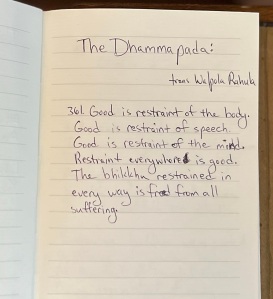
This is a small quote from the Dhammapada :

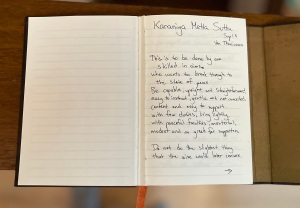
And the Metta Sutta from the Pali Canon:

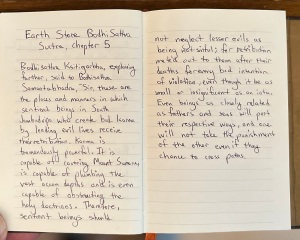
I also recorded Mahayana Buddhist sutras as well, such as this quote from chapter 5 of the Earth Store Bodhisattva Sutra:

I copied each of these by hand. I even tried to copy much longer texts, such as the 4th chapter of the Golden Light Sutra, which is a very beautiful prose about repentance and goodwill, but the text was much longer than I thought, and I eventually gave up halfway.

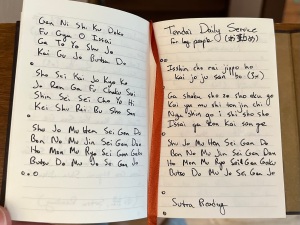
But eventually, around 2017-2018, when I left my old Jodo Shinshu-Buddhist community and started exploring other sects, I focused more on home practice and I started to add Japanese-style liturgies as well:

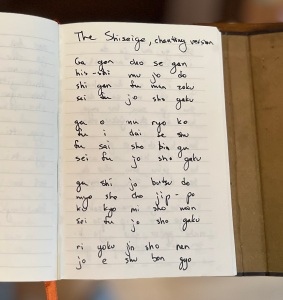
I also wrote specific sutra chants too, such as the Shiseige:

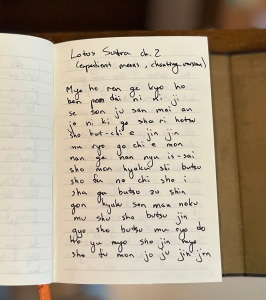
And chapter 2 of the Lotus Sutra:

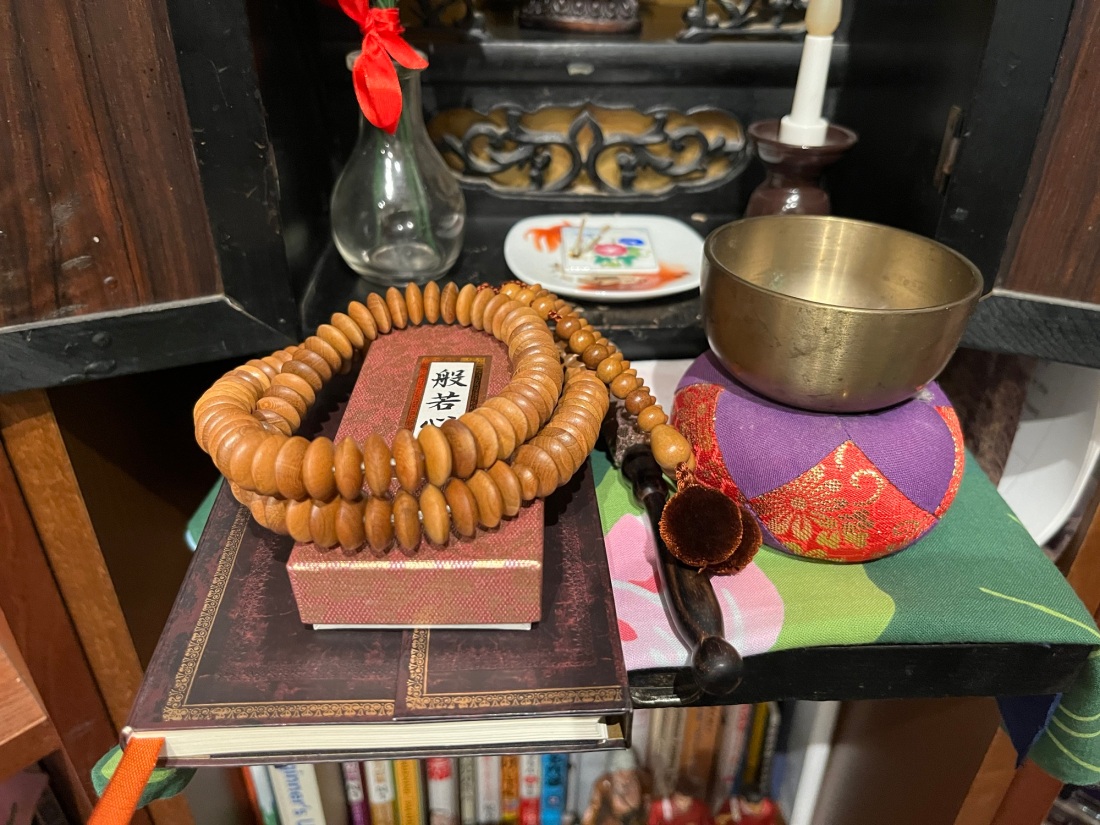
As you can see from the featured photo above,1 I keep this sutra book on my home altar (bottom left in photo), and use it almost daily. A personal sutra book works best when it’s meaningful, simple and useful for you, so the important thing is to not do what other people do, but make it useful for yourself. Find sutras or Buddhist quotes you like, collect them into a notebook, and copy them by hand (word of advice, use a gel pen, not a ballpoint pen, it’s easier to read), and make it your own. There’s no wrong way to do it.

Further, the sutra book I made has gradually progressed over time, just as my own path and practice have and I still have more room to write things in the future.

1 You can also see my Buddhist rosary, a Tendai-style rosary I ordered online, along with a boxed copy of the Heart Sutra, which I got in 2023 while visiting Nara‘s Kofukuji Temple, one of my personal favorite.

Pure Land Buddhism: Just As I Am

Something I was thinking about lately while pondering this famous tale between 12th century Japanese monk, Honen, and a woman of the night. Honen’s advice to the woman was non-judgmental but a genuine concern for her well-being, and at the same time, it also acknowledged her circumstances.

Something I’ve always liked about the Pure Land Buddhist path is its openness. The light of Amida Buddha calls to all beings, regardless of their background and circumstances, or their accomplishments as Buddhists (or non-Buddhists) and unconditionally leads them to the Pure Land. How one interprets Amida, the Pure Land and such doesn’t really matter. What’s important is that Amida accepts all beings as they are, and leads them forward.

And so, when I was thinking about this, I realized that if Amida Buddha accepts you for who you are, then it makes sense to do the same.

Thinking about the woman of the night that Honen encountered, it made me realize that Pure Land Buddhism is a great expression of Buddhist metta, or goodwill.

This is not exclusive to Pure Land Buddhism, though. In Theravada Buddhism, there is the practice of metta meditation (separate from mindfulness meditation), and Zen similarly teaches contentment with oneself and the world around you. So, each tradition in Buddhism takes metta as a core teaching and find different ways to express and foster it.

The accessibility, simplicity and portability of Pure Land Buddhism makes it ideally suited for everyday folks. As a foundation, one can then explore other aspects of Buddhism, or be content with the nembutsu.

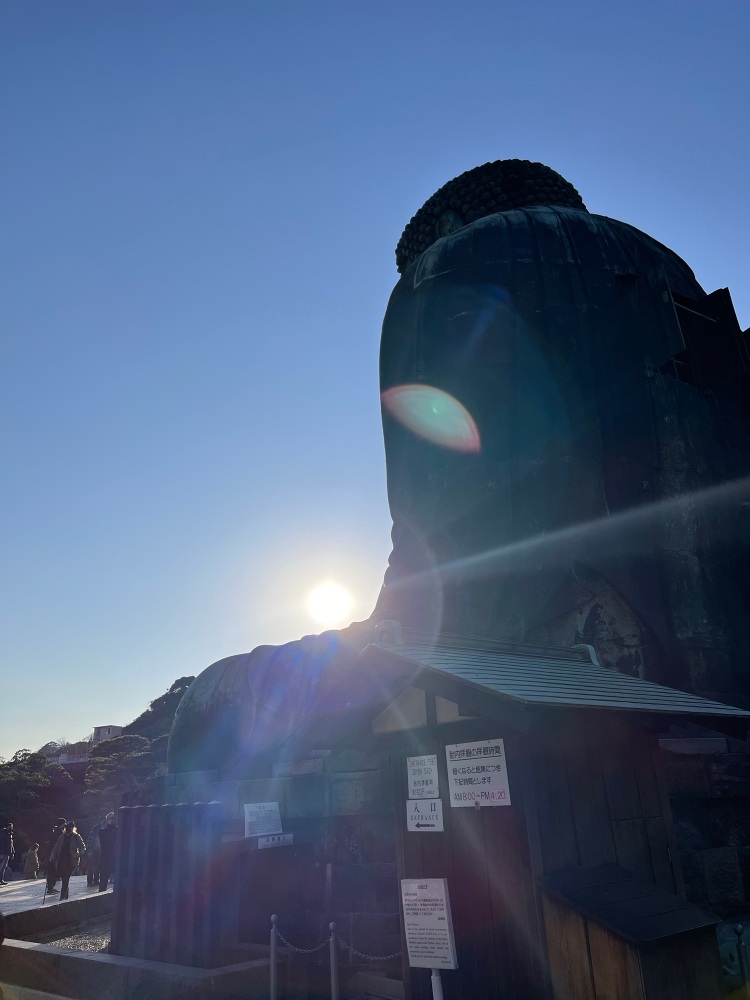
The Great Buddha of Kamakura statue (depicting Amida Buddha), taken in December 2022. I think my daughter might have snapped this photo, not me. I forget.

What’s important is that even if you are a crappy Buddhist, it’s OK. Obviously, like exercise and eating, Buddhist practice provides many positive benefits, so anything you can do, however often, is always worth the time and effort. However, if circumstances work against you, you do not need to punish yourself for your failings either. Like the woman of the night, sometimes life just gets in the way, but there’s no need to punish yourself for it. Amida Buddha’s light and goodwill extends to you just as it extends to others. Practice what you can, when you can, and Amida will guide you along the Buddhist path (via the Pure Land) somehow or some way.

Namu Amida Butsu

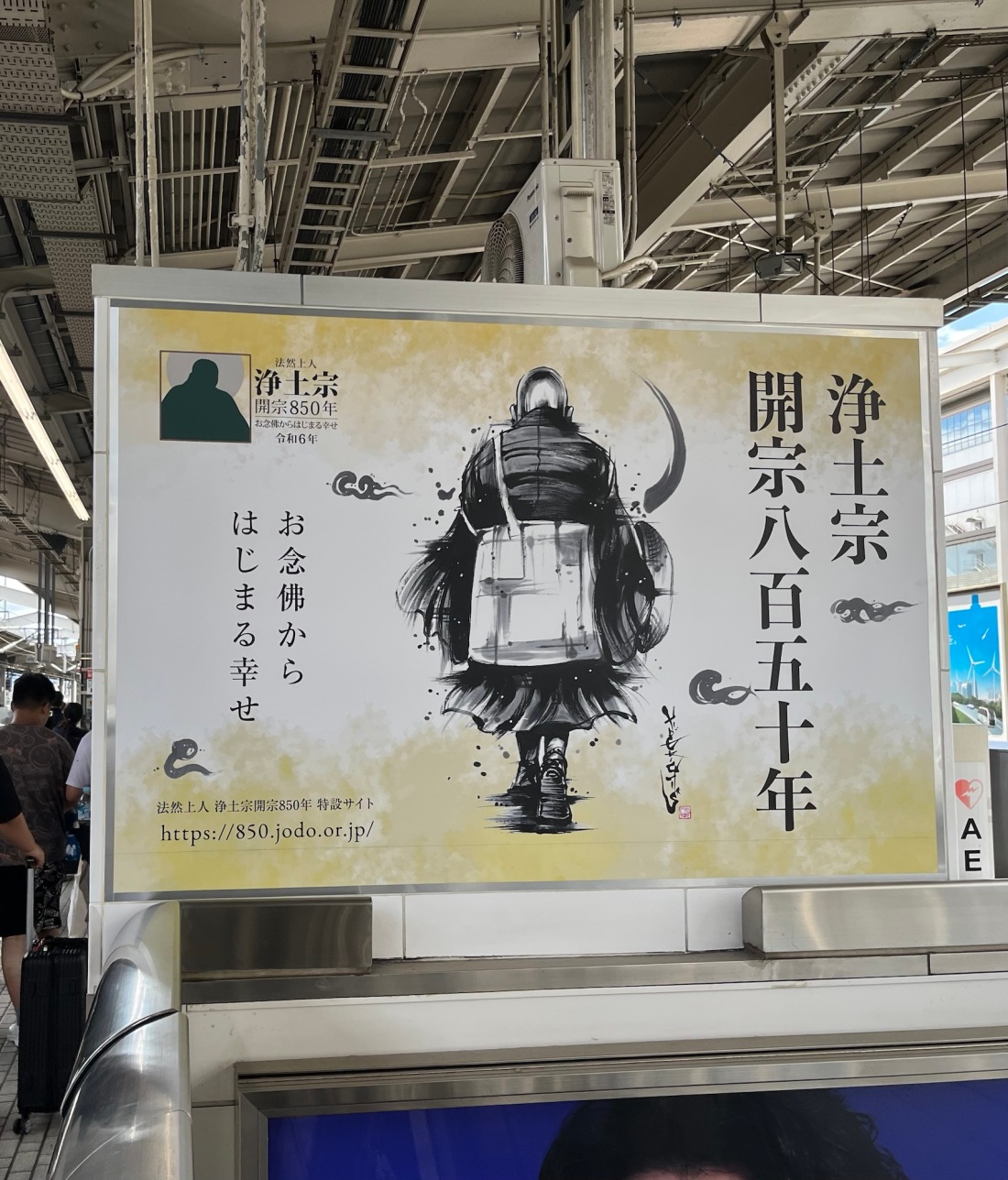
P.S. Featured photo is something I took at the Kyoto train station in summer 2023, part of a promotion to celebrate Honen’s 850th birthday. I always liked this poster, but couldn’t find a post I could work it into. 😅

Who Is Amida Buddha: the Buddha of Infinite Light?

Hello Readers,

Recently I talked about the Pure Land Buddhist tradition, and in particular the Three Pure Land Sutras that are central to the tradition.

But then I realized that I’ve never really explained who Amida (Amitabha) Buddha is. Now that the English language site for Jodo Shu has been retired, I wanted to fill in some gaps in information, and explain Amida Buddha’s significance to the Buddhist religion at large.

Who Is Amida?

Amida (阿弥陀) Buddha is short for Amitabha Buddha: the Buddha of Infinite Light. Sometimes he is alternatively called Amitayus: the Buddha of Infinite Life too.

Amida Buddha is a cosmic, almost timeless Buddha who is said to dwell “very far” to the west in a realm called Sukhavati in Sanskrit, which means “Land of Bliss [or Joy]”. Over time, people just call it the Pure Land.

A reproduction of the Taima Mandala, an 8th century tapestry in Japan depicting the Pure Land

The Pure Land should not be confused with Heaven. It is a peaceful, safe refuge. In the Pure Land, people can escape difficult circumstances and be surrounded by many excellent Buddhist teachers. Even the very air and animals preach the Buddha-Dharma. Best of all, the sutras emphasize that one can be reborn there easily … if they so choose. It is not required in Buddhism, but it is available

The vast light of Amida Buddha (hence “Buddha of Infinite Light”) reaches out in all directions of the cosmos:

“The light of Amitāyus shines brilliantly, illuminating all the buddha lands of the ten directions. There is no place where it is not perceived. I am not the only one who now praises his light….”

The Sutra of the Buddha of Immeasurable Life, translation by Rev. Hisao Inagaki

and provides comfort to those who encounter it, inviting them to be reborn in the Pure Land:

“….If, sentient beings encounter his light, their three defilements are removed; they feel tenderness, joy and pleasure; and good thoughts arise. If sentient beings in the three realms of suffering see his light, they will all be relieved and freed from affliction. At the end of their lives, they all reach emancipation.”

The Sutra of the Buddha of Immeasurable Life, translation by Rev. Hisao Inagaki

This Buddha’s promise to rescue all beings, regardless of who they are, has been very attractive to people in difficult social circumstances: women (who were thought spiritually inferior in those days), the poor, and illiterate who toiled all day with no chance to invest in other spiritual development.

However many monks devote at least part of their time and effort toward Amida as well. As a Buddhist tradition, devotion to Amida is very broad and inclusive.

Further, everyone has a slightly different idea on who Amida Buddha is, what the Pure Land is, and so on. This is fine. There is no orthodox interpretation. Buddhism is more concerned with practice, so how one interprets this tradition up to them.

Some people devote themselves fully to Amida Buddha, others venerate Amida Buddha as one among a larger tradition. Again, it is up to the individual.

What Does Amida Look Like?

Amida Buddha is often depicted with gold color imagery, sometimes red. Compare with someone like the Medicine Buddha who is often depicted with lapis lazuli color (deep blue).

The gold color is based on the Pure Land Sutras that describe every person there, including the Buddha, as having gold-colored skin. Further, gold shines, so it fits the Buddha’s symbolism as a Buddha of light.

In some art, Amida is seated in meditation.

Amida Buddha statue at Sensoji (Asakusa Temple) in Tokyo, Japan
Amida Buddha statue at Kamakura, Japan, also known as the Great Buddha (daibutsu) of Kamakura

In some art, Amida is standing, with his hands in specific gestures.

Amida Buddha welcoming the deceased, with his attendants, to the Pure Land. A medieval Japanese painting.
A small home altar I purchased from Tsukiji Honganji in Tokyo about 10 years ago.
A tiny, pocket image of Amida Buddha I purchased at Zojoji Temple near Tokyo Tower in Japan.

Buddhist statues are full of symbolism, they are not intended to be accurate portrayals. They convey meaning. The double-“OK” hand gestures used by Amida, one hand up, one hand down with palm up, means something like all beings are welcome.

Why Amida?

Someone learning about Buddhism will probably find this very confusing: why is there a “Buddhist Jesus” when the religion is supposed to be about meditation and finding enlightenment? Is this a sign of Buddhism’s decadence and decline?

Buddhism can be a tough religion to explain because it is really broad. Much broader than a “Buddhism for Dummies” book can explain.

The historical founder, Shakyamuni Buddha, was like a doctor describing the state of things (e.g. the Dharma), and providing a “prescription” (e.g. Buddhist practice) to help cure the “ills” of the world.

But within that, Shakyamuni Buddha gave people a lot of autonomy. He described the world as like a river with two shores: one shore full of strife and dissatisfaction, the other peace and wellbeing. He described the need to build a raft to cross from one shore to the other. But how exactly to build that raft is up to you.

He held students, especially monks, to high standards of conduct, but as for putting teachings into practice he tailored different practices to different audiences, or to suit the person. Contrary to popular conception there are various forms of meditation taught even in the earliest traditions, not just mindfulness.

Mahayana Buddhism, one of two major branches of Buddhism, really emphasizes this diversity of practices because it recognizes the concept of upaya (expedient means): whatever works at that time for that person and helps them stay in the Buddhist path is right for them.

It’s partly why there are so many Buddhist figures, so many chants and sutras, and so many different sects. Each of these represent a different “gate” for entering the Buddhist path.

Anyhow, the existence of Amida Buddha, along with other figures such as Kannon, helps fill in a gap where some Buddhist practices and regiments just aren’t practical for most people, and also provides a sense of assurance in an uncertain world (speaking from experience). Those who find the “mind-only” interpretation of Amida attractive can also take comfort that nurturing Amida Buddha in one’s own mind helps awaken the Buddha within. Further, a timeless Buddha like Amida avoids the challenges of the interpreting the historical Buddha, Shakyamuni, through various layers of culture and history.2

As Amida Buddha is a tradition within the larger tradition, some Buddhists gravitate toward Amida, and some do not. Each person according to their own path. Mahayana Buddhism is large enough to embrace them all.

Namu Amida Butsu

P.S. Featured photo is the famous “Black Amida” statue at Zojoji Temple near Tokyo Tower in Japan. This was the statue that was venerated by the Tokugawa Shoguns back in the day.

1 The use of light symbolism in Amida Buddha is thought to possibly borrow from Zoroastrianism, which is possible given the contacts between the Parthians and the Buddhist community. Light is central to Zoroastrianism, but not mentioned in early Buddhist culture. The concept of Amida Buddha is definitely Indian-Buddhist, but Buddhists in the northwest of India often borrowed artistic concepts from neighboring cultures. Another example is Greco-Buddhist art.

2 Early Mahayana Buddhism was a critic of the “pilgrimage” culture at the time in India, where there was increasing importance of the holy sites, and the holy relics of the historical Buddha. Mahayana shifted the emphasis toward the timeless Dharma, and Buddhas as embodying this Dharma.

It’s similar to how people in other religions split hairs over what the religious founder said, based on layers in interpretation, or how people try in vain to recreate the original community (again through layers and layers of interpretation).

The Three Pure Land Sutras

While writing a recent blog post, I realized that I had mentioned, but never explained, what the Three Pure Land Sutras are in the Buddhist tradition, and their significance to Mahayana Buddhism as a whole.

Think of this as a handy reference post. I haven’t done one of these in a while. 😊

The Buddhist Canon

When you think of most world religions, they are usually based on one or two books. Christianity has the Bible (including both Old and New Testaments), Islam has the Qur’an plus Hadiths, and so on. Things get fuzzier with religions like Hinduism and Buddhism where they are not based on one or two books, but instead layers of texts written at different periods of time. Such religions have a kind of “accumulated” religious tradition.

As an organized religion, Buddhism begins and ends with the historical Buddha, Shakyamuni. His birth name is Siddhartha Gautama, but in the Buddhist tradition he is called “Shakyamuni”, or “Sage of the Shakya clan”.

Long story short, all Buddhist texts, called “sutras”, are considered sermons of Shakyamuni Buddha, passed down through the generations, first by word, and later written down. Modern historians question the historicity of this, since the very earliest sutras were recorded around 100 BC, 400 years after the Buddha lived. Also some sutras, especially those in the Mahayana Buddhist tradition, were definitely later compositions since they have a more narrative flow quite different from earlier ones.

Why did the early Mahayana Buddhist compose a new set of sutras? My personal guess is that these authors took fragments of early teachings and repackaged them in a more “hip” (relative to the times) and smoother format for easier distribution.

In any case, Buddhism doesn’t have a strict dependency on the sutras the way other religions might. The Dharma, the teachings of the Buddha, is more like the Laws of Physics: something all around us whether we believe it or not. Shakyamuni Buddha’s contribution was to both uncover the Dharma and articulate it. So, the sutras, as purported sermons of the Buddha, are our best guide to understanding the Dharma, but they have their limits.

Sutra Format

Buddhist sutras can be volumes long, or extremely short, very specific to a topic, or kind of general in their teachings. Many were composed in India to address specific audiences, while others were composed in China, but made to look like they were from India for authenticity. As the featured photo above shows, many sutras are preserved in Classical Chinese (not modern Chinese) instead of Sanskrit, despite originating from India. The sutra book above is from a Japanese temple, so each Chinese character includes pronunciation guides (furigana) for Japanese audiences.

Finally, because there are so many sutras, many Buddhist traditions tend to gravitate toward one sutra or set of sutras for their theological foundation. This is especially true in Mahayana Buddhism.

Mahayana Buddhism teaches the notion of “expedient means” (lit. Upaya in Sanskrit): this means that any and all of these sutras are suitable to someone somewhere for progressing along the Buddhist path. “Different strokes for different folks”.1 Mahayana Buddhism is (speaking frankly) broad and messy, but it also strives to be as accessible as possible to a variety of people since one of its founding tenets is that all beings are capable of enlightenment. They just each start from different circumstances.

Sutras of the Pure Land Tradition

The Pure Land Buddhist tradition is probably one of the largest, if not the largest in East Asian Buddhism, but it’s not a single sect or school. It is a loose network of traditions across several countries, from Tibet to Japan, all centered around three key sutras and devotion to Amitabha Buddha, the Buddha of Infinite Light. Professor Charles B Jones compared it to the tradition in Catholicism venerating the Virgin Mary within the larger Christian tradition: some Christians do, some do not. In the same way, some Buddhists are devoted to the Buddha of Infinite Light, and some are not.

In any case, across all Pure Land traditions, the primary textual sources are called the Three Pure Land Sutras. In short, they are:

English TitleSanskrit TitleChinese with
pinyin
Likely Country of Origin
Immeasurable Life SutraSukhāvatīvyūha Sūtra, longer version佛說無量壽經
(Fó shuō wú liàng shòu jīng)
India, before 2nd century
Amitabha SutraSukhāvatīvyūha Sūtra, shorter version佛說阿彌陀經
(Fó shuō Ā mí tuó jīng)
India, before 4th century
Contemplation SutraAmitāyurdhyāna Sūtra佛說觀無量壽佛經
(Fó shuō guān wú liàng shòu fó jīng)
China, possibly 4th century

Note that many other sutras mention or focus on Amitabha Buddha too, but the three above are the primary sources.

Let’s look at each one individually…

The Immeasurable Life Sutra

This sutra, known more formally as The Sutra of the Buddha of Immeasurable Life, is the oldest and longest of the three. In English, it would probably take about 2 hours to read, so it’s not short, but not a tome like the Lotus Sutra either.

The general format is (in order):

  • A long preamble about the progress of a Bodhisattva to full Buddhahood (patterned from Shakyamuni’s life)
  • The origin of Amitabha Buddha, and his 48 vows to help all beings
  • The virtues of Amitabha Buddha, and benefits of those who encounter his light
  • Why someone would want to be reborn in his Pure Land, and the three grades of people reborn there
  • Contrasting this world with the Pure Land (spoiler: our world sucks)
  • General Buddhist exposition about the hassles of this life (again, trying to emphasize the Pure Land)
  • Admonition by Shakyamuni Buddha to be reborn there

What’s interesting about the Immeasurable Life Sutra is that it’s a fairly good primer, covering many general Buddhist subjects, from a Mahayana-Buddhist perspective, while also explaining in detail who Amitabha Buddha is, and why the Pure Land is a worthwhile goal.

Sometimes I still find little hidden gems in there when I read it.

Note, for ritual and chanting, the sutra is much too long to chant, so people often chant key sections, for example the Shiseige in Japanese-Buddhist traditions. The featured photo above is part of the Immeasurable Life Sutra.

The Amitabha Sutra

The Amitabha Sutra, known by the more clunky name Shorter Sukhāvatīvyūha Sūtra, is by far the shortest and simplest of the three Pure Land sutras. It is not quite as short as the Heart Sutra (it takes about 10 minutes to recite/chant compared to the Heart Sutra which takes 1-2 minutes), but it is often chanted as a whole.

The Amitabha Sutra condenses many things about the Immeasurable Life Sutra into a much simpler and shorter narrative, mostly describing the wonder of the Pure Land of Amitabha Buddha. and why one would want to be reborn there:

  • The land is very beautiful and safe, with nothing to fear. It reflects Amitabha Buddha’s goodwill toward all beings.
  • The land is very conducive to Buddhist practice since everything there relates to Buddhism somehow, even the birds singing, or the wind blowing.
  • You will be in the presence of a great many teachers, Bodhisattvas, and even the Buddha Amitabha himself.

From there, the sutra lists many, many Buddhas who attest to the Pure Land, and reiterate that it’s worth being reborn there.

Finally the sutra states that one can be reborn there by simply being mindful of the Buddha.

The Contemplation Sutra

The Contemplation Sutra, also known as the The Sutra on the Contemplation of the Buddha of Immeasurable Life, is the newest sutra, and believed to have been composed in China, not India. It is the most “visual” of the three sutras since it describes a long, complex meditation exercise one can do to be reborn in the Pure Land of Amitabha Buddha. The sutra starts with a story about the Buddha (Shakyamuni) helping Queen Vaidehi who is in prison due to her son’s treachery. She wants to escape this world of misery, and so the Buddha teaches her the following visualization exercises, which are meant to be done in order:

  1. The setting sun in the west
  2. Placid water that becomes clear ice, then beryl.
  3. The ground as made of precious jewels, like sand
  4. Trees that are jeweled, countless in number
  5. Pools of water with precious jewels as sediment
  6. Jewelled pavilions, countless in number
  7. A great dais made of a lotus flower
  8. The Buddha, golden in color, seated upon that dais, then flanked by his two bodhisattvas on each side, also on their lotus seats.
  9. Details of the Buddha, Amitabha
  10. Details of the Bodhisattva, Avalokitesvara
  11. Details of the Bodhisattva, Mahastamaprapta
  12. Oneself being reborn in the Pure Land in a lotus bud
  13. Visualizing the Buddha Amitabha in a specific way, leading beings to the Pure Land
  14. Rebirth in the Pure Land for those of superior grade
  15. Rebirth in the Pure Land for those of middle grade
  16. Rebirth in the Pure Land for those of lower grade

Because the visualization exercises listed in the sutra are so detailed, they have often been depicted in Buddhist artwork such as the Taima Mandala.

Significance

Of course the Three Pure Land Sutras are important to the Pure Land tradition, but they are also influential in other Buddhist traditions, and also in Buddhist art and culture in the medieval period. Even today in various communities, people relive the origin story of Amitabha Buddha in chanting and liturgy, and art related to the Pure Land still persist in such things as video games and other media. It has greatly influenced East Asian Buddhism and continues to influence Buddhism at large.

I like the Immeasurable Life Sutra in particular, and every once in a while like to read through it again. I suppose it’s my “go to” sutra.

Namu Amida Butsu

1 This is does not mean an “anything goes” approach to Buddhism, of course. Stories of “crazy wisdom” and other such things are exaggerated and rarely practiced in Buddhism. Instead, teachings such as the The Four Dharma Seals provide a theological “anchor”, as well as the Buddhist tradition. Not everyone may like the idea of following a religion tradition, but as with any long tradition, it has the benefit of collective experience across generations, so long as we are not overly bound to it.

The Pious Prince Shotoku

This pagoda (Buddhist stupa) we saw in Kyoto near Kiyomizudera is among others attributed to Prince Shotoku.

The 6th century Prince Shotoku (Shōtoku Taishi, 聖徳太子) holds a revered place in Japanese culture not unlike Constantine the Great, Emperor Ashoka, or Good King Wenceslas. Even today, kids in Japan learn about Prince Shotoku through comic books, art and even the two-thousand yen bill. Even my son, who’s grown up in both Japanese and American culture has learned about the famous prince who was so smart that he could listen to ten conversations at once and recall each individually.

On a historical note, several famous Buddhist temples and pagoda (Buddhist stupa) are attributed to Prince Shotoku, including Horyuji. Further, he reorganized the Yamato court in a Confucian-style bureaucracy and is said to have composed an early Buddhist constitution.

But who was Prince Shotoku?

Prince Shotoku was part of a powerful triad at the time, consisting of Empress Suiko, a rare example of a powerful empress in Japanese history, Prince Shotoku as regent and advisor, and Soga no Umako, head of the powerful and reformist Soga Clan with strong connections to Korean and Chinese communities.

Japan at this time was emerging from geographic isolation and increasingly establishing cultural contacts with the Korean Peninsula, and with Tang-Dynasty China. This led to a power struggle between more conservative, nativist clans such as the Mononobé and Nakatomi, and reformist groups such as the Soga. The triad above were definitely reformist, and clashed with the conservative faction eventually leading to war.

According to the Nihon Shoki, on the eve of battle, Prince Shotoku prayed to the Four Heavenly Kings (a group of Buddhist guardian deities) for success. Upon crushing the Mononobe and their allies, Prince Shotoku built and dedicated the temple of Shitennnoji to the victory. The rest, as they say, is history.

Let’s talk about some of the things attributed to Prince Shotoku…

Buddhist Constitution

In 604, Prince Shotoku supposedly promulgated a seventeen article constitution based on Buddhist and Confucian principles: the jūshichijō kenpō (十七条憲法). Unlike a modern constitution, it was not legally binding, but more of a vague statement of governance, and was later replaced by the Ritsuryo System in the 8th century.

Translations of the 17 Article Constitution are hard to find, but you can see examples of it here and here.

Japan’s New Name

Names for Japan in early, early history varied and inconsistent. Chinese officials called it the land of Wa (倭), and Japan often called itself Wakoku (倭国) or Yamato (大和). However, the modern Japanese name for Japan, Nihon (日本) is attributed to a letter that Prince Shotoku wrote introducing his sovereign to the Sui Dynasty in China:

“From the sovereign of the land of the rising sun (hi izuru tokoro) to the sovereign of the land of the setting sun.”

The “land of the rising sun” evolved into Nihon (日本, lit. “where the sun comes from”).

Further, by putting the Emperor of Japan on equal footing as the Emperor of China, Prince Shotoku was not so subtly rejecting the Chinese-centric world view.

The Cap and Rank System

Prince Shotoku is also credited with establishing the first meritocracy in Japan in 603, inspired by Chinese Confucianism called the Kan’i Jūnikai (冠位十二階, “Twelve Cap and Rank System). The idea was to get out of hereditary government appointments, and promote ministers based on skill and talent, using a series of colored caps to correspond with rank (instead of lineage).

Promulgation of Buddhism

A copy of the Lotus Sutra said to be composed by Prince Shotoku. 日本語: 尾上八郎English: Hachiro Onoue, Public domain, via Wikimedia Commons

Prince Shotoku was said to be a great promoter of the Buddhist faith in Japan. We talked about the conflict with the nativist Mononobé clan earlier, who held to the Shinto faith, but after Shotoku’s victory, he continued to build temples such as Horyu-ji and stupas (like the one shown above), copy sutras, and so on.

Further, later generations of Buddhist teachers in Japan revered Prince Shotoku almost as a cult figure, often conflated with Bodhisattva Kannon. Even today, if you go to many Jodo Shinshu Buddhist temples, you will often see a scroll of Prince Shotoku to the side of the central altar due to the founder Shinran’s devotion to Shotoku.

Historicity

The historicity of Prince Shotoku is interesting though. While a historical figure named Prince Umayado (厩戸皇子) is thought to have really existed, and is thought to be the origin of Prince Shotoku, many of the stories and accomplishments attributed to him may have come from other sources.

Early Japan at this time was importing much mainland culture through the Korean kingdoms of Baekje and Silla, as well as China, and this often meant that immigrant families migrated to serve the early Japanese court. The Hata clan, for example, came from Silla.

The book Shotoku shows how certain subtle aspects of the Shotoku myth stories reflect cultural sources from Silla, via immigrant groups such as the Hata clan. This is through specific imagery used, coupled with archeological evidence from known sites in early Japan where immigrant groups habited, and their influence on local Shinto shrine practices.

For example, a famous story in the Nihon Shoki about Prince Shotoku and the Beggar of Kataoka reads as follows, with [my additions] and (additions from original author):

21st year, 12th month, 1st day.

The crown prince [Shotoku] made a journey to Kataoka. At that time there was a starving man who was lying at the side of the road. He asked for (the beggar’s) name, but he said nothing. The crown prince seeing this, gave him food and drink. He then took off his cloak, and covered the beggar with it, saying “lie there in peace.” He then made a song.

12th month, second day.

The crown prince sent a messenger to see the starving man. The messenger returned and said “The serving man is already dead.” The crown prince was greatly saddened by this and he therefore had them bury the man at that spot in a tomb that was firmly shut. Several days later [trimmed for brevity] he sent (another) messenger to look (at the tomb). The messenger returned and said “When I arrived at the tomb, (the earth) was firm and had not moved. (Yet) when I opened it and looked inside the corpse had already disappeared. There was only the clothing folded above the casket.”

At this the crown prince once again sent the messenger back to retrieve the clothing. He then wore it as he always had done. The people then all marveled at this and said “It is true that a sage knows a sage!”…

Shotoku, by Michael I Como, page 102

The story is hard for Western audiences, and even modern Japanese ones, to understand without additional context. Elements such as the dead resurrecting were motifs used by an immigrant community called the Wani clan from the Korean peninsula in their origin stories, and the notion of a “sage prince” was an idea imported from Chinese-Buddhist culture.

The book takes a very detailed an exhaustive look at the legends and stories of the time, but this example shows how the legend of Prince Shotoku was gradually constructed from obscure cultural trends and symbolism popular in antiquity, and conflated over generations. In later versions, for example, the beggar is the Indian monk Bodhidharma.