The Onin War

After a couple recent posts, I realized that I had never covered a very weird, disastrous war in Japanese history: the Ōnin War (応仁の乱, Ōnin no Ran) from 1467 to 1477.

The Onin War is something most Westerners would not be familiar with, but it had a devastating impact to Japan that can still be felt today in Kyoto. The war spanned 10 years, but was almost entirely fought within and around the old capitol of Kyoto, rather than across the countryside. The war practically flattened Kyoto, and with it centuries of culture and history.

The war began as a succession dispute. After the current shogun of Japan, Ashikaga Yoshimasa (also arguably the worst shogun in Japanese history) adopted this younger brother to be his heir. Yoshimasa had no male heirs, and so this was a common practice. Unfortunately, his wife then gave birth to a son, which put Yoshimasa in a very awkward spot.

Two of the most powerful samurai families supporting Yoshimasa were divided about which person to support: Yoshimasa’s younger brother, or his infant son. The Hosokawa and Yamana clans were already feuding with one another, so this just gave them another axe to grind. The two main generals under Yoshimasa were:

  • Hosokawa Katsumoto (細川勝元) – He supported Yoshimasa’s younger brother’s claim to be the heir.
  • Yamana Sōzen (山名宗全) – He supported Yoshimasa’s infant son, intentionally to further oppose the Hosokawa.

Eventually, both sides secretly built up armies within the city of Kyoto to attack the other. Neither side had a clear advantage, and neither side could score a decisive victory. The Hosokawa had the support of the Shogunate, but the Yamana clan had 6 out of 7 gates to the city. Each side had 100,000+ soldiers in the city. Confusingly, the two opposing sides later switched the heir they supported, and as the war became increasingly pointless, the two sides fought simply because they didn’t want to lose to their rival.

As the war dragged on, both armies pulled in more allies and reinforcements from the provinces, fighting over and over again in the neighborhoods of Kyoto, destroying homes, temples, etc. Battles were fought street-by-street, neighborhood by neighborhood. They even fought at Buddhist temples just to gain some advantage over their opponent.

But after 10 years, both sides were exhausted, weakened and finally withdrew.

Old Kyoto was completely destroyed. When people in Kyoto talk about “the war” destroying Kyoto, they are not referring to World War II, but the Onin War. So much was lost in the destruction that Kyoto has never been quite the same. Many of the famous temples you see in Kyoto today were burned down during the Onin War (possibly other times too, buildings in Japan frequently suffer from fire).

According to Professor Donald Keene, the famous Zen master Ikkyū Sōjun described the destruction in a poem titled “On the Warfare of the Bunmei Era”:1

One burst of flame and the capital—gilt palaces and how many mansions— Turns before one’s eyes into a wasteland. The ruins, more desolate by the day, are autumnal. Spring breezes, peach and plum blossoms, soon become dark.

Part of the reason for such destruction was that old Kyoto was a city made almost entirely out of wood. Further, houses were very close to one another. Even the Yamana and Hosokawa compounds were within walking distance from one another. Also, as I’ve alluded to before, the countless dead and displaced were horrendous to behold, especially compared to the aristocracy of Kyoto that mostly made it out unscathed.

But where was the Shogun in all this?

Ashikaga Yoshimasa was, by hereditary right, the Shogun (将軍): the supreme military commander of Japan, and had authority over both the Hosokawa and Yamana clans. And yet, even after his poor decision making caused the war to begin with, when the conflict erupted, Yoshimasa shrugged and basically did nothing.

Yoshimasa had no force of personality to compel both sides to stop fighting, and although he came from long line of warriors, he was much more inclined toward the arts. Through the entire conflict, Yoshimasa did not take sides, nor lead troops into combat, though some of his relatives briefly did. Yoshimasa simply withdrew and, like an aristocrat, remained aloof to the conflict. Yoshimasa held lavish drinking parties and poetry contests even while fighting raged in the city and Kyoto was burning.

As a Shogun, Yoshimasa was absolutely the wrong man for the job, and yet, when he retired as a Shogun, he devoted all his time, money and efforts to culture and arts, and this helped start a new culture in Kyoto: the Higashiyama culture. The Higashiyama Culture was short-lived, and war resumed in Japan soon after, but many of the traditional arts that exist in Japan today were from this small period of time, promoted and elevated by Yoshimasa.

One can easily argue that few, if any, wars have any real value, but the Onin War is a spectacular example of a war that accomplished almost nothing, could have been prevented by competent leadership, and came at tremendous cost. Even stranger, the result of this tremendous death and destruction was a new flourishing culture that is at the heart of Japan today.

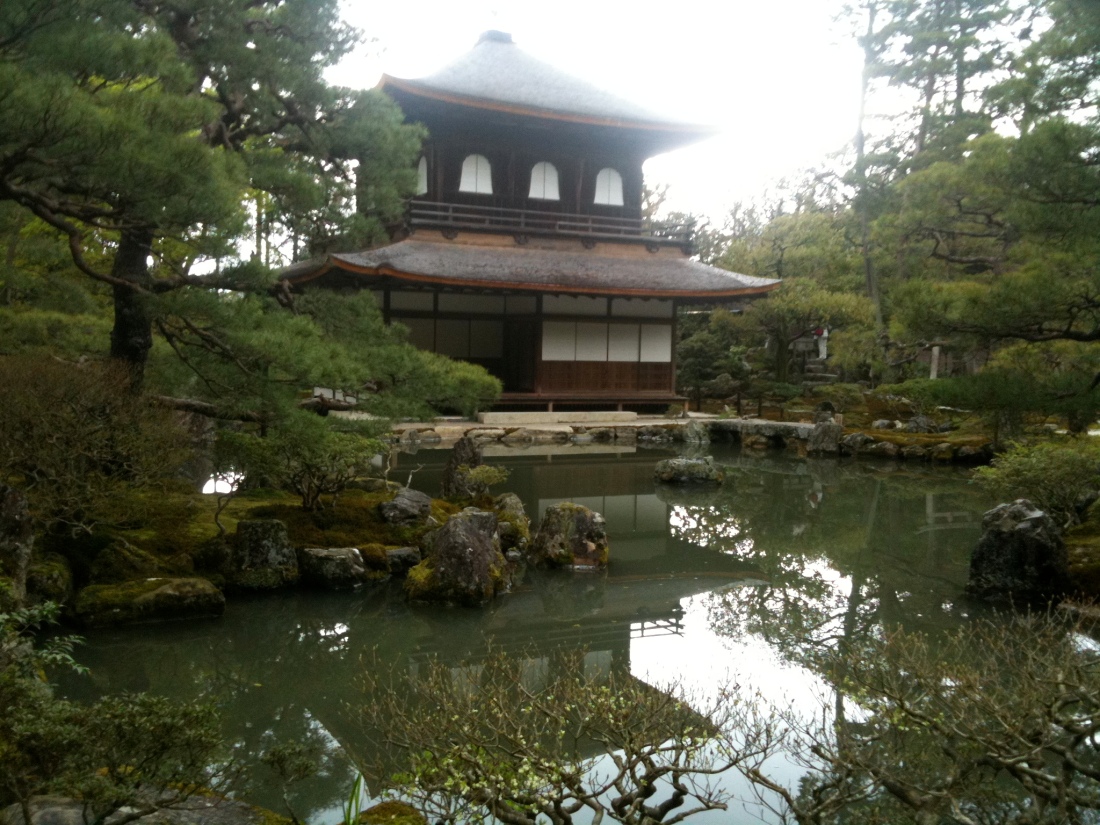
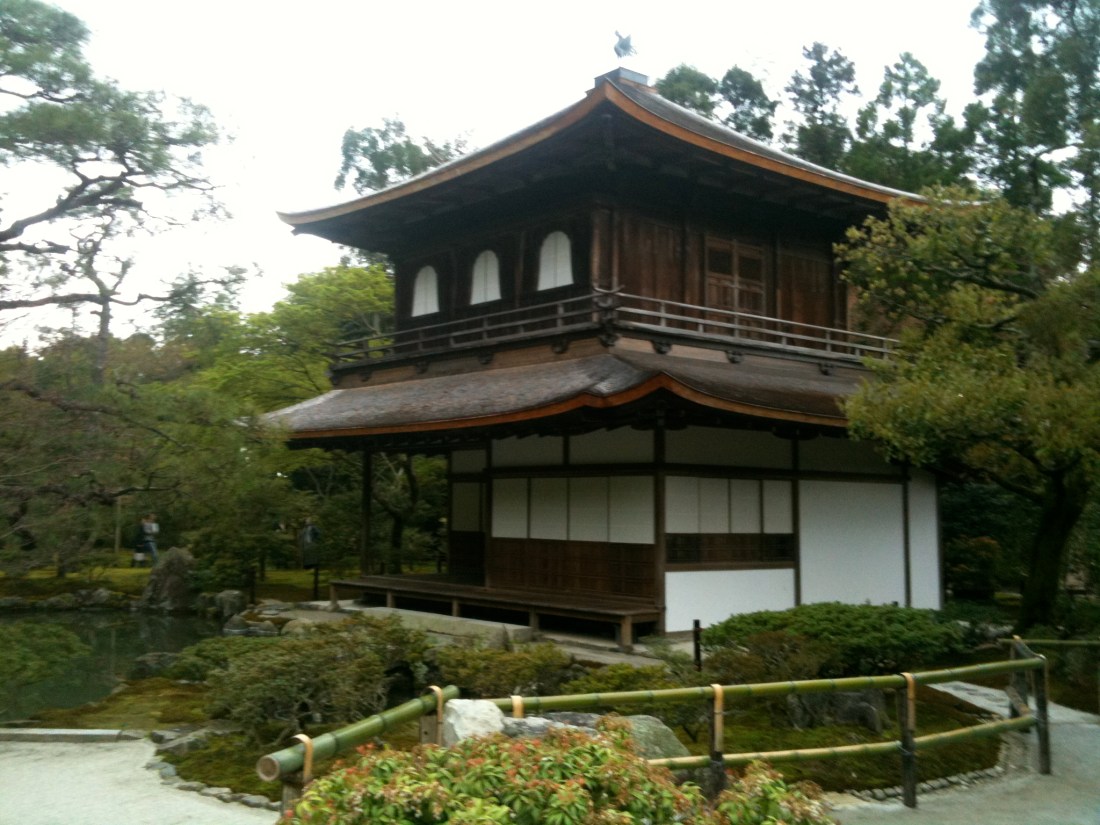
P.S. Featured photo is the Silver Pavilion of Ashikaga Yoshimasa, taken in 2010.

1 I tried finding this in Japanese, but I couldn’t. It was translated from a 1966 book called 五山文学集/江戸漢詩集 apparently.
The Five Mountains System in Medieval Japan

In a recent post I talked about how Zen imported from Song-Dynasty China found patronage with the elite samurai families of the city of Kamakura. Sometimes this was due to the cultural prestige of Zen among “country bumpkin samurai”, but also the new Zen monastic community drew sincere students as well, helping it take root. Zen still had a very small presence, compared to other Buddhist institutions in medieval Japan, but it was definitely the “up and coming” sect.

By the 14th century, and with the destruction of the Hojo Family (ending the Kamakura Period of history), the seat of government shifted back to Kyoto under the new Ashikaga Shogunate (a.k.a. the Muromachi Period of Japanese history). The Ashikaga Shoguns, many of whom were avid Sinophiles, further cultivated the Rinzai Zen institutions from China, and created a new hierarchy of temples called the Five Mountains System. The same system existed in China, where “mountain” was synonymous with “Buddhist monasteries”, but the Chinese version was a looser organization and not strictly related to Zen Buddhism.

The Japanese version organized Rinzai Zen temples (and some Soto Zen temples) across the country into one of three administrative “ranks” with the “five mountains” (gozan, 五山) at the very top. These temples, as we’ll see later, functioned less as Buddhist temples and increasingly as bureaucratic hubs for the rest of the temples in Japan. They enjoyed much patronage and prestige, but the monastic life greatly suffered.

The three ranks were:

  • Gozan (五山) temples, the top-tier
  • Middle-tier jissatsu (十刹) temples, and
  • Shozan (諸山) temples at the bottom.

Confusingly, many Rinzai Zen temples existed outside this temple structure, either by choice, or just lacked prestige, and were derisively called rinka (林下, “the forest below”) to distinguish from more prestigious temples “up on the mountain”. I briefly mentioned rinka temples in this old post.

Anyhow, let’s look more closely at each.

The Gozan Temples

The list of gozan temples varied over time, usually whichever temples the current Shogun patronized. Further, there were actually two sets of gozan temples, one for Kyoto and one for the former capitol of Kamakura. Which one was more important depending on who was in power.

For example, in 1341, under guidance from Tadayoshi, the ranks were as follows (homepages linked where possible):

RankKamakura TemplesKyoto Temples
1KenchōjiNanzenji
2EngakujiTenryuji
3Jufukuji
4Kenninji
5Tōfukuji
“associate”
temple
Jōchiji

For each rank, the Kamakura temples were elevated slightly higher than their Kyoto counterparts. By 1380 under the 3rd Shogun, Yoshimitsu:

RankKamakura TemplesKyoto Temples
1KenchōjiNanzenji
2EngakujiTenryuji
3JufukujiKenninji
4JōchijiTōfukuji
5JōmyōjiManjuji

And by 1386, also under Yoshimitsu, the rankings switch in favor of the Kyoto temples, but also Nanzenji gets elevated to a “superior gozan temple”. Plus, a new temple built on Yoshimitsu’s orders, Shōkokuji, was slotted into the Gozan temple ranks.

RankKyoto TemplesKamakura Temples
“superior”Nanzenji
1TenryujiKenchōji
2ShōkokujiEngakuji
3KenninjiJufukuji
4TōfukujiJōchiji
5ManjujiJōmyōji

The Gozan temples were the top of a large administrative bureaucracy that managed the many other Rinzai Zen temples, and as such enjoyed much patronage and influence. However, as we’ll see later, this came at a heavy cost.

Middle Rank Temples: Jissatsu

The ten temples of the middle rank, the jissatsu (十刹), were major temples in the provinces that served as middle-management. They managed other temples in the provinces and were subordinate to the gozan temples, but also held much influence too. Eventually, the jissatsu temples were also split up into 10 temples under the Kyoto gozan temples, and 10 more under the Kamakura gozan temples.

The list of temples moves around a lot, and sometimes temples were promoted to gozan temples, or downgraded.

Lower Rank Temples: Shozan

The shozan temples are the lowest-ranking, but also the largest group by far. At any time, up to 250 temples were ranked as shozan temples. As with the jissatsu temples, the shozan temples were usually provincial temples that simply didn’t have the prestige or political influence that the jissatsu had. However, they were still important in extending Shogunal control over the provinces, and thus still had ranking.

What Happened to the Gozan System?

As we saw in an old post, whenever the Buddhist establishment developed close ties with the ruling regime, this worked as long as the regime was powerful, but began to collapse easily when the regime was weak.

In the case of the Gozan system, the Zen temples never maintained huge standing armies that other, older temples such as Enryakuji (Tendai) or Kofukuji (Hossō sect) did, and so they relied on the Ashikaga shoguns for protection. As the Ashikaga shogunate started to weaken, local warlords in the provinces and the rival temple armies began to assert their power, and the Gozan temples suffered.

In fact, the disastrous Ōnin War in the 15th century practically destroyed many of these monasteries along with most of Kyoto city. Some of these temples never to rebuilt, or became greatly diminished. By this point, the Ashikaga “shoguns” had no real power outside of the Kyoto area, and thus couldn’t protect or influence other temples anyway.

However, probably the biggest reason for their decline was that spiritual practices at these temples declined and atrophied as they became more and more important politically. In the book Five Mountains: The Rinzai Zen Monastic Institution in Medieval Japan by Professor Martin Collcutt, Collcutt shows how records and journals at these temples showed that they had a very active social scene: banquets, religious functions, public rituals, and so on, but very little actual Zen practice as we know it. Monastic discipline greatly declined, and while they flourished culturally, the religious practices suffered. The famous Zen monk, Ikkyu, at the time lamented the decline in monastic discipline. Then again, he was a bit of an eccentric curmudgeon anyway.

Ironically, Rinzai Zen temples that existed outside the Gozan system, gained lasting prominence instead. The modern lineages in Rinzai derive from two temples that were not in the Gozan system: Daitokuji and Myōshinji. Both had reputations for maintaining austere Zen practices, and enjoyed patronage from wealthy merchants, and the increasingly powerful provincial warlords. Under Hakuin (mentioned here), the two temples became the basis for Rinzai Zen today.

Admittedly, both Daitokuji and Myoshinji suffered from corruption as well, as they gained social prominence, but Hakuin’s reforms later fixed this.

So, repeat after me: religion and politics should not mix.

P.S. happy Spring Ohigan! 🌸

A Not-So Brief History of Zen and Samurai

There is a persistent image in the West of samurai being adherents of Zen, that the “way of the warrior” (bushido)1 and Zen are somehow one and the same. One can imagine a samurai who has practiced swordsmanship to a finely honed skill, meditating under a waterfall, and writing Zen-like deathbed poetry before preparing to throw away their life in battle. In my first visit to Ryoanji temple (featured photo shown above), 28-year old me had a similar image in mind persisting all the way back when I was a naïve 16-year old white kid just reading about Zen for the first time. Looking back after almost 20 years of Buddhist-study and practice, I facepalm at myself a little, but it’s a very persistent image in media. (side note: Last Samurai is not my favorite movie)

So, did samurai really embrace Zen, and was Zen essentially a “samurai religion”? Turns out, it’s complicated, and most of the imagery was romanticized.

Recently, I dusted off an old book that I hadn’t read in years: Five Mountains: The Rinzai Zen Monastic Institution in Medieval Japan by Professor Martin Collcutt. As I am stuck home in Covid-isolation for a few days, I finally have time to both read and write about it.

Dr Collcut summarizes all this in the book:

Even at the height of its influence in the last fourteenth century, Zen–including the more widely diffused Sōtō Zen–probably had still not replaced devotion to Kannon, Jizō [Bodhisattva], the Lotus Sutra [e.g. Nichiren Buddhism], or the Pure Land of Amida in the hearts of most ordinary, and many high-ranking, Japanese samurai.

page 80

Further:

Zen in the Kamakura and Muromachi periods can be called “the religion of the samurai” only in the sense that most patrons of Zen were samurai, not in the sense that it was practiced assiduously or exclusive by all, or even perhaps the majority, of those who would be described as warriors.

page 80

So where did the image come from? Let’s take a brief look at the history of Zen, especially Rinzai Zen, in Japan.

The Two Lineages of Zen in Japan

Japan has historically two sects of Buddhism, both descended from Chinese lineages: Soto and Rinzai Zen. The differences between the two are too big to cover here, and there’s plenty of information on the web that explore the two. Suffice to say, the two lineages came to Japan in the 12th century, but took pretty different trajectories.

Soto Zen, founded by Dogen after journeying to China, did not sit well with existing powerful Buddhist sects in Japan, because of Dogen’s unwavering commitment to his ideal of ideal Zen practice, and was pushed out to the countryside. For centuries it was obscure, and enjoyed little patronage beyond certain local samurai families, primarily for the sake of prestige. Its popularity grew later through the efforts of a monk named Keizan, who developed increasing patronage from (mostly) provincial samurai rulers, and cultivated more community support. Professor Bodiford’s book, Sōtō Zen in Medieval Japan, is an excellent overview of its history. In any case, all Soto Zen traditions in Japan (and beyond) trace back to Dogen.

Rinzai Zen, founded by Eisai, has a much more complicated history. Eisai was willing to compromise more when he returned from China with the Buddhist establishment, so early Rinzai Zen was more like a hybrid Zen-Tendai Buddhist institution with a lot of esoteric practices. It enjoyed further popularity under Enni Ben’en (圓爾辯圓, 1202 – 1280) in the capitol of Kyoto, but remained a relatively small sect, often conflated with existing Buddhist institutions at the time.

Zen really didn’t take off until the second-half of the Kamakura Period under the Hojo Clan regency. After the death of Sanetomo, the 3rd shogun, the subsequent shoguns, distant offshoots of the family, were installed but increasingly powerless against their own regents, the Hojo Clan. Under talented Hojo leaders such as Hojo Tokiyori and Tokimune, power was consolidated, and they became the effective rulers of Japan.

But there was a persistent issue: the Hojo Clan, while militarily powerful and based in Kamakura was seen as inferior to the old aristocracy (e.g. the Fujiwara) in Kyoto who had centuries of refinement to rely upon compared to the upstarts. The old Buddhist establishment was still closely allied to the aristocracy, and thus hostile to the Hojo Clan.

Enter the Mongols

When the Mongols finally destroyed the Song Dynasty in China, establishing the new “Yuan” Dynasty, the upheaval affected many monastic institutions. Some monks, including ardent Song-loyalists, decided to leave China and make the journey to Japan either to get away from Mongol authority, or possibly in some cases, to work as spies for the Mongols who later tried to invade Japan.

Starting with a monk named Lanxi Daolong (蘭溪道隆, 1213-1278), who came to Japan in 1246 for reasons not entirely clear, followed by Wuan Puning (兀庵普寧, 1197 – 1276) in 1260, a steady stream of Rinzai-lineage monks came to Japan. For the Hojo leadership, this new source of Chinese education, culture and religious teachings practically fell into their lap, and they quickly adopted these new monks, establishing a series of monasteries in the new capital of Kamakura starting with Kenchōji (website here) in 1253, and expanding to other temples such as Engaku-ji in 1282. These new temples in Kamakura Zen temples were different than the ones that Eisai and Enni Ben’en’s temples had established in Kyoto, designed to match Song Dynasty practices, with Chinese monks frequently serving as abbots.

Thus, Rinzai Zen in Japan was essentially established as two separate lineages2 albeit with a common ancestry: the first lineage established by Eisai and popularized in Kyoto by Enni Ben’en that incorporated more native Japanese-Buddhist practices, and the second lineage which came later driven by Chinese Zen monks during the end of the Song Dynasty who established a more “pure” form of Zen based on the Chinese model. It should be noted that the Chinese monks mentioned above did journey to Kyoto as well to update existing monasteries of the older lineage to modern (e.g. Song Dynasty) standards as well, but the temple of Kenchōji was the premiere Zen temple for centuries in Japan. Further, by the 14th century, and especially later, much of Rinzai Zen was more homogenized than the early communities.

The arrival of the Chinese-Buddhist teachers to Japan in the 13th century is important to note, though, because this is the point in time where the samurai class really start to interact with Zen communities.

The Hojo Clan had finally found a way to one-up their rivals in Kyoto by raising their own cultural credentials with the new immigrants from China, but also some Hojo family members really did embrace Rinzai Zen teachings. Hojo Tokiyori (北条 時頼, 1227 – 1263) and his son, Tokimune (北条 時宗, 1251 – 1284) both became avid students under Chinese teachers, patronized the new monastic communities in Kamakura, and encouraged its practice among their samurai vassals. Other regents of the Hojo Clan never took much interest. But now, Zen finally had the patronage it needed to expand and grow in Japan, yet as Collcut’s book shows, it was still largely adopted for cultural prestige, and also oftentimes due to obligation towards Hojo Clan. Many of these vassal clans later rose to be major powers centuries later (cf. Hosokawa, Takeda, Uesugi, Tokugawa, etc) with their own patronage to Zen temples in their provinces.

Later, as the Hojo Clan finally declined in power, and gradually replaced by the Ashikaga Clan (e.g the Muromachi Period), the pattern continued. Both the emperors of the time such as Go-Daigo and Hanazono, and the Ashikaga Shoguns patronized Rinzai Zen temples, but often times for political expediency. The “Five Mountains” monastic system developed at this time, borrowed from Chinese cultural, is a big topic, and worthy of its own post.

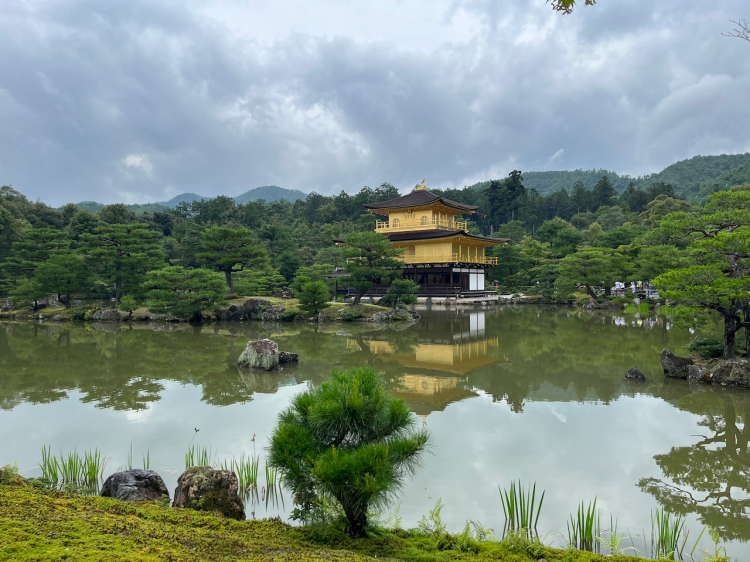
The Golden Pavilion, built as a villa for Ashikaga Yoshimitsu, later converted to a Rinzai Zen temple.

The high-point of “Zen-Samurai” culture as we know it can probably be traced to the 8th shogun of the Ashikaga Clan, Yoshimasa (足利 義政, 1436 – 1490) who while being a dismal military commander, was a brilliant innovator of Zen aesthetics. Yoshimasa had a taste of artistic genius, and patronized Zen-influenced architecture, painting, poetry, and gardening, and so on, but also directly added his own spin. The “zen aesthetic” we all recognize is largely due to Yoshimasa who synthesized earlier Song-Dynasty culture through establishment of institutions by the Hojo Clan.

However, on a personal level, Yoshimasa recited the nembutsu and seldom meditated.

Conclusion

All this is not meant to detract from Zen teachings, or the contributions of Zen monks to Japanese culture, or to imply that there were no Zen-devotees among the samurai class, but as I alluded to in the beginning, the romanticized Zen-Samurai image mostly exists on paper or in the writings of its sincere devotees. It was the ideal at the time among enthusiasts, and this ideal has persisted into Western culture, including teachers and self-help gurus.

How samurai in Japan, or Japanese in general, interacted with Buddhism (including Zen) was complicated and very individual, and not always related to piety. When you look at other pre-modern cultures, you see similar patterns. The emperors of the Eastern Romans had a complex relationship with the Church, and usually were not interested in the deeper teachings, or various doctrinal conflicts of the Byzantine Orthodox church except when it interfered with political goals (cf. iconoclasm, schisms, etc), or were varying degrees of sincerity. Further, how they practiced religion would have been noticeably different than your typical Eastern Roman in the provinces or the streets of Byzantium.

Now, imagine the same in any other culture: Western medieval communities, people in the Islamic caliphate, Chinese Buddhists, etc.

In short, how people interact with religion, and how its romanticized, are two different things. The dynamic interaction of people, culture and religion is fascinating, but not very marketable. The romanticized form of religion is marketable, but is like a bag of potato chips: tastes good, but rarely provides anything meaningful.

1 Please, please, please: if you ever go visit Japan, do not wear a “bushido” shirt. It really pegs you as a tourist.

2 The third “Obaku” sect of Zen in Japan is in fact yet another Rinzai Zen lineage that came from China, this time from the Ming Dynasty. By this point, Pure Land Buddhism and Zen in China had largely reconciled, and Obaku Zen includes more elements of Pure Land than is found in other Rinzai lineages, while still retaining its core Zen element.

The Pious Prince Shotoku

This pagoda (Buddhist stupa) we saw in Kyoto near Kiyomizudera is among others attributed to Prince Shotoku.

The 6th century Prince Shotoku (Shōtoku Taishi, 聖徳太子) holds a revered place in Japanese culture not unlike Constantine the Great, Emperor Ashoka, or Good King Wenceslas. Even today, kids in Japan learn about Prince Shotoku through comic books, art and even the two-thousand yen bill. Even my son, who’s grown up in both Japanese and American culture has learned about the famous prince who was so smart that he could listen to ten conversations at once and recall each individually.

On a historical note, several famous Buddhist temples and pagoda (Buddhist stupa) are attributed to Prince Shotoku, including Horyuji. Further, he reorganized the Yamato court in a Confucian-style bureaucracy and is said to have composed an early Buddhist constitution.

But who was Prince Shotoku?

Prince Shotoku was part of a powerful triad at the time, consisting of Empress Suiko, a rare example of a powerful empress in Japanese history, Prince Shotoku as regent and advisor, and Soga no Umako, head of the powerful and reformist Soga Clan with strong connections to Korean and Chinese communities.

Japan at this time was emerging from geographic isolation and increasingly establishing cultural contacts with the Korean Peninsula, and with Tang-Dynasty China. This led to a power struggle between more conservative, nativist clans such as the Mononobé and Nakatomi, and reformist groups such as the Soga. The triad above were definitely reformist, and clashed with the conservative faction eventually leading to war.

According to the Nihon Shoki, on the eve of battle, Prince Shotoku prayed to the Four Heavenly Kings (a group of Buddhist guardian deities) for success. Upon crushing the Mononobe and their allies, Prince Shotoku built and dedicated the temple of Shitennnoji to the victory. The rest, as they say, is history.

Let’s talk about some of the things attributed to Prince Shotoku…

Buddhist Constitution

In 604, Prince Shotoku supposedly promulgated a seventeen article constitution based on Buddhist and Confucian principles: the jūshichijō kenpō (十七条憲法). Unlike a modern constitution, it was not legally binding, but more of a vague statement of governance, and was later replaced by the Ritsuryo System in the 8th century.

Translations of the 17 Article Constitution are hard to find, but you can see examples of it here and here.

Japan’s New Name

Names for Japan in early, early history varied and inconsistent. Chinese officials called it the land of Wa (倭), and Japan often called itself Wakoku (倭国) or Yamato (大和). However, the modern Japanese name for Japan, Nihon (日本) is attributed to a letter that Prince Shotoku wrote introducing his sovereign to the Sui Dynasty in China:

“From the sovereign of the land of the rising sun (hi izuru tokoro) to the sovereign of the land of the setting sun.”

The “land of the rising sun” evolved into Nihon (日本, lit. “where the sun comes from”).

Further, by putting the Emperor of Japan on equal footing as the Emperor of China, Prince Shotoku was not so subtly rejecting the Chinese-centric world view.

The Cap and Rank System

Prince Shotoku is also credited with establishing the first meritocracy in Japan in 603, inspired by Chinese Confucianism called the Kan’i Jūnikai (冠位十二階, “Twelve Cap and Rank System). The idea was to get out of hereditary government appointments, and promote ministers based on skill and talent, using a series of colored caps to correspond with rank (instead of lineage).

Promulgation of Buddhism

A copy of the Lotus Sutra said to be composed by Prince Shotoku. 日本語: 尾上八郎English: Hachiro Onoue, Public domain, via Wikimedia Commons

Prince Shotoku was said to be a great promoter of the Buddhist faith in Japan. We talked about the conflict with the nativist Mononobé clan earlier, who held to the Shinto faith, but after Shotoku’s victory, he continued to build temples such as Horyu-ji and stupas (like the one shown above), copy sutras, and so on.

Further, later generations of Buddhist teachers in Japan revered Prince Shotoku almost as a cult figure, often conflated with Bodhisattva Kannon. Even today, if you go to many Jodo Shinshu Buddhist temples, you will often see a scroll of Prince Shotoku to the side of the central altar due to the founder Shinran’s devotion to Shotoku.

Historicity

The historicity of Prince Shotoku is interesting though. While a historical figure named Prince Umayado (厩戸皇子) is thought to have really existed, and is thought to be the origin of Prince Shotoku, many of the stories and accomplishments attributed to him may have come from other sources.

Early Japan at this time was importing much mainland culture through the Korean kingdoms of Baekje and Silla, as well as China, and this often meant that immigrant families migrated to serve the early Japanese court. The Hata clan, for example, came from Silla.

The book Shotoku shows how certain subtle aspects of the Shotoku myth stories reflect cultural sources from Silla, via immigrant groups such as the Hata clan. This is through specific imagery used, coupled with archeological evidence from known sites in early Japan where immigrant groups habited, and their influence on local Shinto shrine practices.

For example, a famous story in the Nihon Shoki about Prince Shotoku and the Beggar of Kataoka reads as follows, with [my additions] and (additions from original author):

21st year, 12th month, 1st day.

The crown prince [Shotoku] made a journey to Kataoka. At that time there was a starving man who was lying at the side of the road. He asked for (the beggar’s) name, but he said nothing. The crown prince seeing this, gave him food and drink. He then took off his cloak, and covered the beggar with it, saying “lie there in peace.” He then made a song.

12th month, second day.

The crown prince sent a messenger to see the starving man. The messenger returned and said “The serving man is already dead.” The crown prince was greatly saddened by this and he therefore had them bury the man at that spot in a tomb that was firmly shut. Several days later [trimmed for brevity] he sent (another) messenger to look (at the tomb). The messenger returned and said “When I arrived at the tomb, (the earth) was firm and had not moved. (Yet) when I opened it and looked inside the corpse had already disappeared. There was only the clothing folded above the casket.”

At this the crown prince once again sent the messenger back to retrieve the clothing. He then wore it as he always had done. The people then all marveled at this and said “It is true that a sage knows a sage!”…

Shotoku, by Michael I Como, page 102

The story is hard for Western audiences, and even modern Japanese ones, to understand without additional context. Elements such as the dead resurrecting were motifs used by an immigrant community called the Wani clan from the Korean peninsula in their origin stories, and the notion of a “sage prince” was an idea imported from Chinese-Buddhist culture.

The book takes a very detailed an exhaustive look at the legends and stories of the time, but this example shows how the legend of Prince Shotoku was gradually constructed from obscure cultural trends and symbolism popular in antiquity, and conflated over generations. In later versions, for example, the beggar is the Indian monk Bodhidharma.

The Rise and Fall of the Fujiwara

In our recent visit to Kyoto, the ancient capitol of Japan, we also took a day to visit the city of Nara, which is an even earlier capitol. Downtown Nara has several highlights but two of them are the Buddhist temple of Kofukuji, and the Shinto shrine of Kasuga-Taisha (“Kasuga Grand Shrine”). Kofuku-ji Temple is one of the central temples of the once powerful Hosso sect, and Kasuga Grand Shrine is a famous shrine within Shinto religion,1 and hosts a primeval forest that has been untouched since antiquity. I might post more photos of each later.

The famous Sarasawa Pond with Kofukuji Temple on the left. Taken in July 2023.

What makes these two sites important is that they were both tied to the powerful Fujiwara Clan.

During the Nara Period of Japanese history, the Fujiwara were just one of several noble houses that supported the Imperial family. Back then they were called the Nakatomi (中臣) Clan. During a power-struggle between the Imperial family and the Soga clan, one Nakatomi no Kamatari (614 – 669) came to their rescue and helped defeat the Soga. Thereafter, the Imperial family relied on Kamatari to help reform and strengthen the government. The Nakatomi earned the clan name Fujiwara later under Emperor Tenji. So far so good.

However, starting with Kamatari’s son, Fujiwara no Fuhito (who also helped compile the Nihon Shoki), the clan gradually began to monopolize key positions, increasingly through inter-marriage with the Imperial family. By the 12th century, every member of the Imperial family married members of the Fujiwara clan, over and over, generation after generation. This allowed the head of the Fujiwara to assume the role of “regent” (sesshō, 摂政) to his offspring who were children on the Imperial throne, when switch to “chief advisor” (kanpaku, 関白) when they were old enough to rule on their own. That same advisor could also force the Emperor to abdicate to their son (whose mother was also from the Fujiwara clan) when necessary, allowing the same official to be regent to their grandson.

Further, by holding key government positions, the Fujiwara could also manipulate property laws on their private holdings in the provinces, increasing personal revenue. The Fujiwara were not the only noble houses to do this, even the Imperial family did it, but through their connections and influence, they profited immensely from the untaxed revenue of their lands.

With this increasing power and wealth, the Fujiwara sponsored a number of building projects. One of these was Kofukuji Temple, which was sponsored by the Fujiwara as far back as 669, but with its increasing connections to the Fujiwara, the building complex greatly increased in size and wealth.

Further, the family Shinto shrine of Kasuga Taisha prospered:

But the price of all this interconnectedness between the Fujiwara and religious establishments came at a cost. The religious institutions became extensions of Fujiwara power, with clan members given key positions locking other people out,2 and fielding armies of warrior monks against other rival temples.

By the time the system collapsed, the Fujiwara’s power began to diminish. Kofukuji Temple was largely burned down,3 and the original clan had become so large that it gradually broke up into five different clans, each one marrying with the Imperial family as needed:

JapaneseRomanizationFounded
近衛Konoe12th century
鷹司Takatsukasa1252
九条Kujō1191
一条Ichijō13th century
二条Nijō1242

Some of these new clans, especially the Kujō, even assumed positions of power with the new Kamakura shogunal family after the untimely death of Sanetomo, the 3rd shogun. Further, by the 19th century, with Westernization of Japan (e.g. the Meiji Period) the Five Regent Houses all became merged into the Western-style “peerage“, but by 1945, now hundreds of years since their founding, the five regent clans were finally abolished for good with the post-World War II reforms of the Imperial system.

In any case, after the 12th century, the centers of power had since moved. Kofukuji Temple, having been burned down in various conflicts, never quite rebuilt its power. Newer forms of Buddhism had taken root, and new centers of religious devotion had arisen. Kasuga Taisha grand shrine, being located in Nara, was now remote as the capitol had moved further and further east. When I visited Kofukuji Temple in 2010, and again this year (2023), some things had changed. The central Golden Hall (中金堂, Chū-kondō), had finished reconstruction for the first time in centuries. But even now, many of the original buildings have not been reconstructed.

Throughout Japanese history, the Fujiwara clan maintained prestige for centuries, but actual power continued to slip from their grasp bit by bit after the 12th century, and these historical relics in Nara are shadow of their former selves, and of Fujiwara power.

1 People are often surprised to learn that Japan has essentially two religions: Buddhism which came from India (via China), and Shinto which is the native religion. The two have been pretty intertwined culturally for centuries. It’s a long story.

2 Some of those who were excluded went on to found other Buddhist sects later partly out of disillusionment with the establishment.

3 Quite a few temples burned down in times of war, not just Kofukuji. Todaiji also burned down many times, as well as Enryakuji on Mt Hiei, among others.

Building a Sohei Warrior in Pathfinder 2e

Greetings role-players! A while back, I wrote a piece about making a sohei warrior, a Japanese soldier-monk, in Dungeons and Dragons 5th edition. Since I have transition away from D&D, I have been tinkering with a similar build concept in Pathfinder 2e, and wanted to share. This is just a suggestion, but it’s based on historical precedence as much as possible, while still retaining elements of high fantasy and heroism (important since sohei were often zealots and scallywags). Your mileage may vary, but I’ve enjoyed my character so far.

A statue of Benkei, the archetypal sohei warrior, in Tanabe city in Wakayama, Prefecture. shikabane taro, CC BY 3.0, via Wikimedia Commons

To recap my D&D post, sohei warriors were very similar to samurai despite name “monk” (which is an overloaded term anyway), but they were bodyguards and field-armies for powerful medieval Buddhist temples. In time, they attained a legendary status especially around a semi-legendary figure named Benkei. So many of modern tropes in Japan about sohei warriors are inspired by Benkei.

As soldiers, they frequently are depicted using naginata weapons (similar to a glaive) and katana, as well as wearing typical armor for the time underneath their white cowls. As devotees to a temple, they were not clerics and generally not ordained as priests, but did protect priests and temples, and further political/ecclesiastical issues as needed.

In a fantasy role-playing context, this feels like something akin to a Champion in Pathfinder 2nd-edition. For my character, I chose the Cause of the Paladin (lawful-good)1 since he would not only get Retributive Strike feat (very handy with a naginata), but also from a character-standpoint it made sense to be a protector figure, and also since Buddhism in real-life is a lawfully-inclined religion anyway. I play my character, Shinji, as a straight-laced, through trigger-happy and somewhat clueless character. He is blinded by his devotion at times, but means well.

Shinji as shown on the Nexus site. I couldn’t find the export link, and since the service is still in Beta, many things might change.

For the Retributive Strike feat, if you combine that with 2nd-level feat Ranged Reprisal, the 10-foot range of the naginata now becomes 15 feet.

As for equipment, shields in the Western sense were never really used in Japanese combat, so I didn’t equip Shinji with one, even if he has the option. Instead, I focused on offense by equipping with both a naginata and a katana. If you don’t have the necessary source books, the stats are freely available on Archives of Nethys links above. By second level, I equipped Shinji with scale mail armor.

In the current story, my kids and are playing a small 3-person party exploring the city of Absalom, and Shinji had been dispatched here from Minkai to protect a local priest at the branch temple in Absalom. However, upon arriving, the priest is nowhere to be seen, and the temple is barred shut. So, part of his side story is to unravel what happened, while finding something else useful to do in the meantime (i.e. helping my kids’ characters).

All the guidance above are build suggestions, but if you read the history of the sohei, it is probably (in my opinion), the closest fit I can come up with while still keep it fun for a high-fantasy setting. Your mileage may vary, but I hope you have fun and good luck building a sohei warrior of your own!

1 I know that in the latest Pathfinder updates the alignment system is being deprecated, but for simplicity’s sake, I am mentioning it here.

Then As Now

One of my favorite series to watch on Youtube is the Extra Credit series, which covers fascinating, but lesserknown aspects of world history. I’ve touched on the series in a few recent blog posts.

Anyhow, one mini-series covers the rise of militarism in Japan from the 1910’s to 1940’s. As the series points out, most people fixate on Germany and the rise of Hitler, but Japan’s case was notably different in that there was never a central figure, and still retained a multi-party system (albeit barely). And yet, the results speak for themselves.

Episode four in the series in particular shows how things spiraled out of control:

The Meiji-era constitution, adopted from the Prussians in 1890, gave the Emperor control of the military, not the civilian government. As things worsened in the early 1930’s, military factions polarized and started taking matters into their own hands, then claiming patriotism. Sympathetic elements of civilian society then attacked anyone in the government who tried to punish them. Further, racist international policies gave them fuel to justify going it alone.

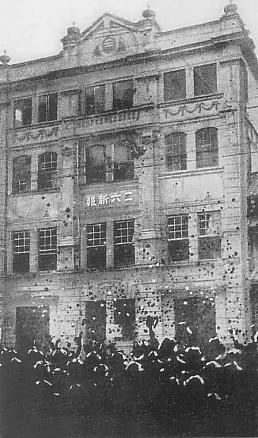
Vandalism of Niroku Shinpo Sha (Pro-government newspaper office) in 1913. Published by Asahi Shimbun Company, Public domain, via Wikimedia Commons

But the problem wasn’t just the political structure. As you can see starting at 4:08 or so, few people got a full education, and thus were vulnerable to conspiracy theories, leading to support for violent solutions.

So, now we have a toxic mix of rampant conspiracy theories, poor education, weak civilian government, rampant nationalism, and factional strife. A dangerous mix.

If you’re interested in Japanese history, definitely watch the whole mini-series. Even though I studied much of this in college for my major, I learned a lot anyway.

P.S. Heading overseas soon, wanted to clear the backlog of blog posts I had.

Of Famine and Excess

Recently, I was re-reading an old book in my personal library about the life of the Shogun Ashikaga Yoshimasa (also mentioned here). The Ashikaga Shogunate, that is the military government in Japan from 14th to 16th centuries,1 started out fairly strong, but quickly ran into a series of succession crises and bad governance that culminated in a very disastrous Onin War. The Onin War was a 10-year urban battle in the heart of Kyoto over a succession crisis that basically flattened the city and caused unimaginable death and starvation there and in the provinces.

In Donald Keene’s book, he talks about the utterly ridiculous income disparity between the typical peasant and the aristocrats in Kyoto, as if they lived in two different worlds. Even as the war was raging, Shogun Ashikaga Yoshimasa’s exorbitant taxes to pay for this vanity projects further exacerbated this.

One chronicler at the time, a Zen priest residing in Kyoto named Unsen Taikyoku (雲泉大極, 1421 – ??), recounts in his personal diary:2

When the sun went down I set out for home, and as I was passing Rokujo I saw an old woman with a child in her arms. She called the child’s name repeatedly, then began to wail. I looked and saw that the child was already dead. The mother, still wailing, collapsed on the ground. People standing nearby asked her where she came from. She said, “I’ve come all the way from Kawachi. We’ve had a terrible drought for three years, and the rice plants didn’t so much as sprout. The district officials are cruel and greedy. They demand a lot of money in taxes and show no mercy. If you don’t pay, they kill you. That’s why I had to run away to another province. I was hoping to earn food by begging. But I couldn’t get anything to give my baby. I’m starving and I’m worn out, heart and soul. I can’t take any more.”

When she had finished speaking, she again choked with great sobs. I took from my wallet what spare money I had and gave it to her, saying, “Take this money and hire a man to bury the child. I’m going back to my cell where, with help from the Three Treasures [the Buddha, the Dharma and the Sangha] and the Five Commandments, I shall choose a Buddhist name for the child and offer prayers for his salvation.” The child’s mother was greatly comforted.

While I was still humbly mulling over her sad story, I encountered a group of noblemen out to admire the blossoms. They were escorted by several thousand mounted men, and servants and followers swarmed around them. These gentlemen acted as if they were so superior that nobody could compare with them. Some sneered at the people in the streets; others swore at the menials in the path of their horses; others laughingly stole blossoms; others, drunkenly singing, drew their swords; others still, having vomited food and drink and being unable to walk, lay on the roadside. There were many such sights, and whoever saw them was appalled. Anyone who happened to run into these people was terrified and ran away, intimidated by their high rank.

Yoshimasa and the Silver Pavilion: The Creation of the Soul of Japan, pages 51-52, translation by Donald Keene

It’s not hard to imagine such things happening in a place like Los Angeles, Silicon Valley, London, Paris and so on. It’s not a question of a particular political faction, it’s a tendency of any society to gradually concentrate wealth over time to a smaller and smaller group, further exacerbating the income disparity. Marx spoke of this in the context of capitalism…

But even as far back as the last days of the Roman Republic, we could see a similar pattern (jump to about 19:30 or so):

In any case, unless this trend is addressed in a sustainable way, it never portends anything good.

1 The Ashikaga military government is unrelated to the earlier Kamakura shogunate which I spoke about elsewhere. Since Japan had a succession of military-samurai governments after the Imperial aristocracy was sidelined, and you can think of them like Chinese imperial dynasties in a historical sense.

2 Criticizing such things openly would have incurred the wrath of the Shogunate of course.

A Life of Pomp and Regret

In Professor Donald Keene’s biography about the life of Shogun Ashikaga Yoshimasa (足利 義政, 1436 – 1490), includes a poem composed by Yoshimasa, now retired and living in his villa, the Silver Pavilion, ruminating on his former life as the supreme military commander of Japan:

JapaneseRomanizationTranslation
くやしくぞKuyashiku zoToday I recall
過ぎしうき世をSugoshi uki yo woThe sad world I lived
今日ぞ思ふKyou zo omouWith bitter regret —
心くまなきKokoro kumanakiMy mind serene as I gaze
月をながめてTsuki wo nagameteAt a moon free of shadows
Translation by Donald Keene

Ashikaga no Yoshimasa, arguably one of the most influential people in Japanese art and aesthetics, yet ironically one of the worst military leaders in Japanese history, was never a serious student of Buddhism (though he was nominally ordained as a Rinzai Zen monk) but it’s interesting to hear him regret his life of luxury and power. To me, it is a contrast with Miyazawa Kenji’s famous poem Unbeaten By Rain (雨にも負けず).

A life of honesty poverty is probably better than wealthy lifestyle full of discord.

P.S. Photo taken of the Silver Pavilion, by me, in 2010.

Lonely At The Top: Minamoto no Sanetomo

I’m still keeping up with the Japanese historical drama the Thirteen Lords of Kamakura, discussed here, which is based primarily on the Azuma Kagami (吾妻鏡) a historical text about the period, and a fascinating look at how the Shogunate, or samurai military government, of the Kamakura Period rose and fell.

The rise of the Kamakura Shogunate began with the climactic battle between the Heiki (Taira) clan and the Genji (Minamoto). In order to topple their rivals, the Genji had to enlist a complex web of alliances with other samurai clans in the eastern regions of Japan, with Kamakura as their capitol, most crucially the Hojo Clan (the source of the Triforce in the Legend of Zelda series). This alliance overwhelmed the Heike and led to downfall.

However, once the Heike were wiped out, and the old Imperial political order ended, the various clans including the Minamoto themselves turned on one another to sort out who the Shogun would be, and would be pulling the strings behind the throne. The first Shogun, Minamoto no Yoritomo, turned on his half brothers and killed them one by one using flimsy legal pretexts, while his firstborn son Yoriie, the second Shogun, vied with his council (the aforementioned 13 Lords above) until he was driven into permanent exile. Hojo Masako, the so-called “Warlord Nun” contended with her father Hojo Tokimasa when he tried to assert a dominant hand, and had him exiled too. As all this was going on, the various allied clans took sides with members of the Hojo and Minamoto. Generation after generation, people kept stabbing each other in the back in order to advance their faction in the new military government.

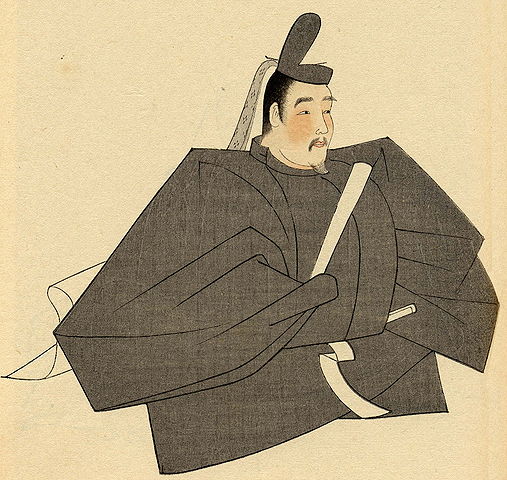
Sanetomo in court clothing, painting by the priest Goshin. Photo courtesy of Hannah, Public domain, via Wikimedia Commons

This left Yoritomo’s younger son, Minamoto no Sanetomo (源 実朝, 1192 – 1219), to assume the position as Shogun, the 3rd in line. Sanetomo was doomed from the beginning.

Sanetomo was a puppet of his maternal family, the Hojo Clan, who surrounded him as advisors and ministers, but also carried out the real functions of government. Sanetomo knew from early on that he was essentially a figurehead, and could easily be toppled by whatever faction wanted to replace him with a more amenable candidate for Shogun. It is said that Sanetomo retreated into drinking and composing poetry, of which one of them is included in the Hyakunin Isshu anthology:

JapaneseRomanizationTranslation by Joshua Mostow
世の中はYo no naka waIf only this world
つねにもがもなTsune ni mo ga mo nacould always remain the same!
なぎさこぐNagisa koguThe sight of them towing
あまの小舟のAma no obune nothe small boats of the fishermen
who row in the tide
綱手かなしもTsuna de kanashi mois touching indeed!
Also posted in the other blog…

Sanetomo evidentially composed the poem after watching some fishermen at work on the shore, envying their simple lives in contrast to the constant political infighting and manipulation that surrounded his.

Sadly, things never got better.

Sanetomo’s life ended at the age of 28, when he was assassinated by his nephew at the footsteps of the famous Tsurugaoka Hachimangu Shrine (visual tour here) in Kamakura. It is said his nephew hid behind the ginkgo tree there, and as Sanetomo descended the steps, leapt out and ran him through with a sword.

The gingko tree where Sanetomo’s assassin hid is shown here on the left. In 2010, the tree now many hundreds of years old, fell over in a powerful wind storm, and has been partially rehabilitated from a shoot. No machine-readable author provided. Abrahami assumed (based on copyright claims)., CC BY-SA 2.5, via Wikimedia Commons

Further, the Kamakura Shogunate only spiraled further. With Sanetomo’s death, the Minamoto line ended, and the Hojo Clan promoted various relations of the Minamoto (often drawn from the Fujiwara clan) as the subsequent Shoguns. Each one of these shoguns was simply another figurehead, while the Hojo tightened their grip on power as “regents”. Once Hojo Masako died, there was no one left savvy enough to hold it together, and the Mongol invasions further drained away any remaining resources until the government was finally toppled by a rival warlord.

Sanetomo’s life, the ignominious circumstances that surrounded his family (both his father’s line and his mother’s family’s scheming) ensured that even with the powerful title of Sei-i Taishōgun (征夷大将軍, “Commander-in-Chief of the Expeditionary Force Against the Barbarians”) he lived alone and apart from everyone, constantly in fear of his life, and powerless to do anything about it.