Some years ago, I received a tenugui (手ぬぐい), a kind of cotton cloth traditdionally used in Japan, with the following calligraphy on it:
我逢人 gahōjin
“self meets person”
I have briefly mentioned here this notion, but today I wanted to delve into it more. I have struggled to find a clear reference, but according to one story I found, these were the words uttered by founder of Soto Zen in Japan, Dogen, after first encountering his new teacher Rújìng (如淨, 1163–1228) in China.1 Dogen had studied under the Tendai sect in Japan for years, but he was dissatisfied with the lack of rigor, and journeyed with his mentor to Song-dynasty China to learn more there. At the Tiantong Temple (天童寺, Tiāntóngsì) he met Rujing, and after their first meeting, Dogen was said to have uttered these words meaning “At last, I have met someone”.
The sentiment here is that even though we might be physically in a room full of people, we may not really connect with them. We all go through this feeling. In modern society, that sense of isolation in a crowded room may feel even more acute. It is indeed a noisy yet lonely world we live in, and as the Buddha described it, a world of aimless wandering.
Only when you connect with someone does it really feel like you meet them. This could be someone romantic, or someone like a mentor, or just a really good friend. When you connect with that person, you can speak your mind 100%, and they will understand you. Such encounters are indeed rare (I can probably think of maybe 10-15 people in my own life), but it’s an example of how karma can work in mysterious ways, maybe across many lifetimes.
It is also why, in my opinion, when one encounters the light of Amida Buddha, or the Dharma in general, it subtly alters one’s aimless trajectory. Imagine an asteroid hurtling through the void of space for eons, then one day it’s finally caught within the gravity of a star. It’s still moving, but now its trajectory gradually bends more and more toward the star. I like to think of encountering the Dharma like that.
It’s also a great example of how Zen phrases and idioms proliferate Japanese language.
Namu Shakamuni Butsu
P.S. Please enjoy the Maha Santa Claus Sutra, an old classic I wrote 6 years old (!). Happy Holidays!
1 In Chinese, he is known better is Tiāntóng Rújìng (天童如净, “Rujing of Tiantong [temple]”).
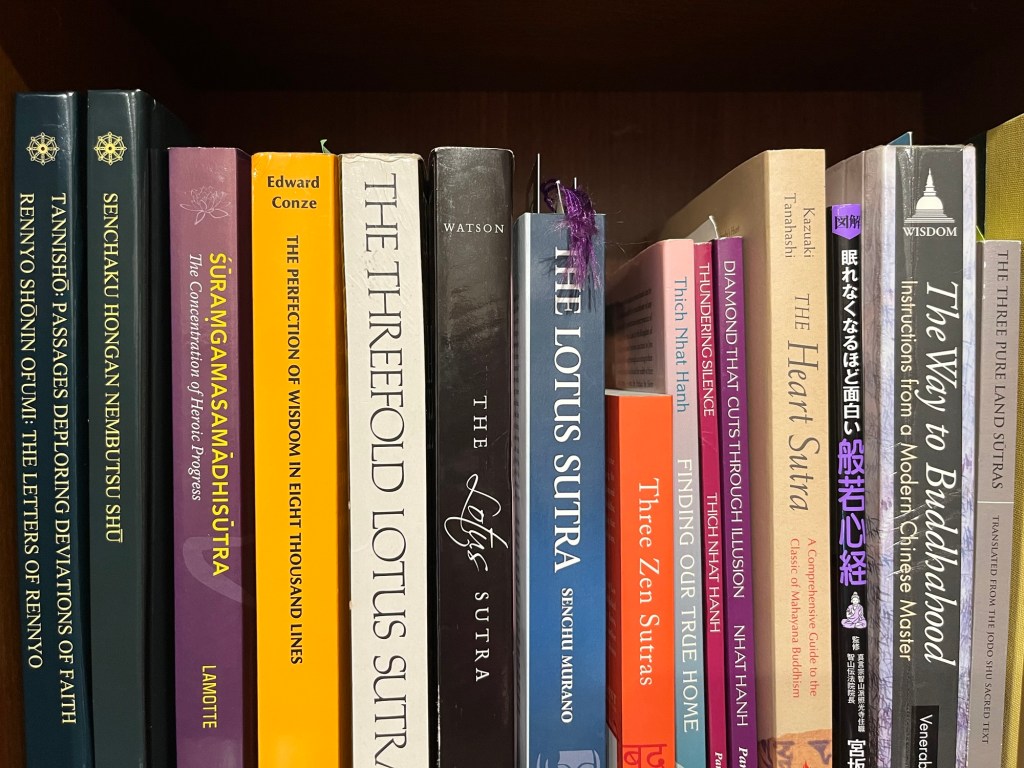
A photo of the Shurangama Sutra (the purple book on the left) from my personal collection. I purchased this years ago at Powell’s City of Books and haven’t found a copy since.
In my last post, I talked about Tetsugen Doko’s open-minded approach to Buddhist practice especially among his lay followers. But there was one thing that Tetsugen Doko did not compromise on.
In 1674 in the castle town of Mori (now Oita Prefecture), Tetsugen gave a controversial Buddhist lecture on the Shurangama Sutra, an influential Buddhist sutra in China not widely discussed in Japan. The lecture caused an uproar.
Tetsugen later summarized the lecture contents in an affadavit as follows (emphasis added):
I lectured first of all about the good and evil of the False Dharma and the True Dharma in the Final Age, which are referred to as the Three Absolutes in the Suramgama Sutra. Those who practice without keeping the precepts set out by the Buddha all represent the False Dharma. The reason for this [is as follows:]
Although practices such as chanting the Nembutsu, seated meditation, and reciting the sutras are each practiced differently depending on the abilities of the believer, the precepts against taking life, stealing, sexual misconduct, lying and the like are absolute, regardless of the sect. Not to keep them is unacceptable. Therefore these precepts are called “absolutes.”
This lecture earned him the ire of the local Jodo Shinshu community whose priests did not, by tradition, uphold any precepts. The local members rioted and multiple arrests were made by the authorities, who feared a return of the Ikko-Ikki riots, and Tetsugen quietly left town to avoid further trouble, especially for the feudal lord who had sponsored the lecture.
Nonetheless, more and more I believe that Tetsugen is correct: the basic lay precepts (a.k.a. the Five Precepts) should be front and center of one’s practice. Everything is grounded on that. Not the other way around, as I believed. What practices you choose to undertake are secondary to how you conduct your life the rest of the time.
I spent many years in my pursuit of the Buddhist path, fretting about doing the right practices, and chanting the right things, but these days I feel that the way to not be a dickhead is to simply stop acting like a dickhead. This is what the “training rules” of the precepts do: file away the sharper edges so that one’s Buddhist practice has a solid foundation.
Recently, I found myself stuck in one of my usual nerd “rabbit holes” of trying to make sense of Zen lineages in Japanese Buddhism, but this led to a more complicated rabbit hole of making sense of the source “Chan” (Zen) lineages in China. This started after reading my new book on Rinzai Zen, which included a nice chart. At first, I tried to emulate and translate that chart in Canva, but then I realized it was missing some critical details, so I kept adding more. This is the result (click on the image for more detail):
Let’s go over this a bit so it makes more sense.
The premise behind all Zen sects regardless of country and lineage is that Zen started when the historical Buddha, Shakyamuni, supposedly held a flower up to his disciples and said nothing. Everyone was confused except his disciple Maha-Kashyapa who smiled in understanding. From here, according to tradition, the teachings were passed down from teacher to disciples for 28 generations in India, culminating in a monk named Bodhidharma who came to China.
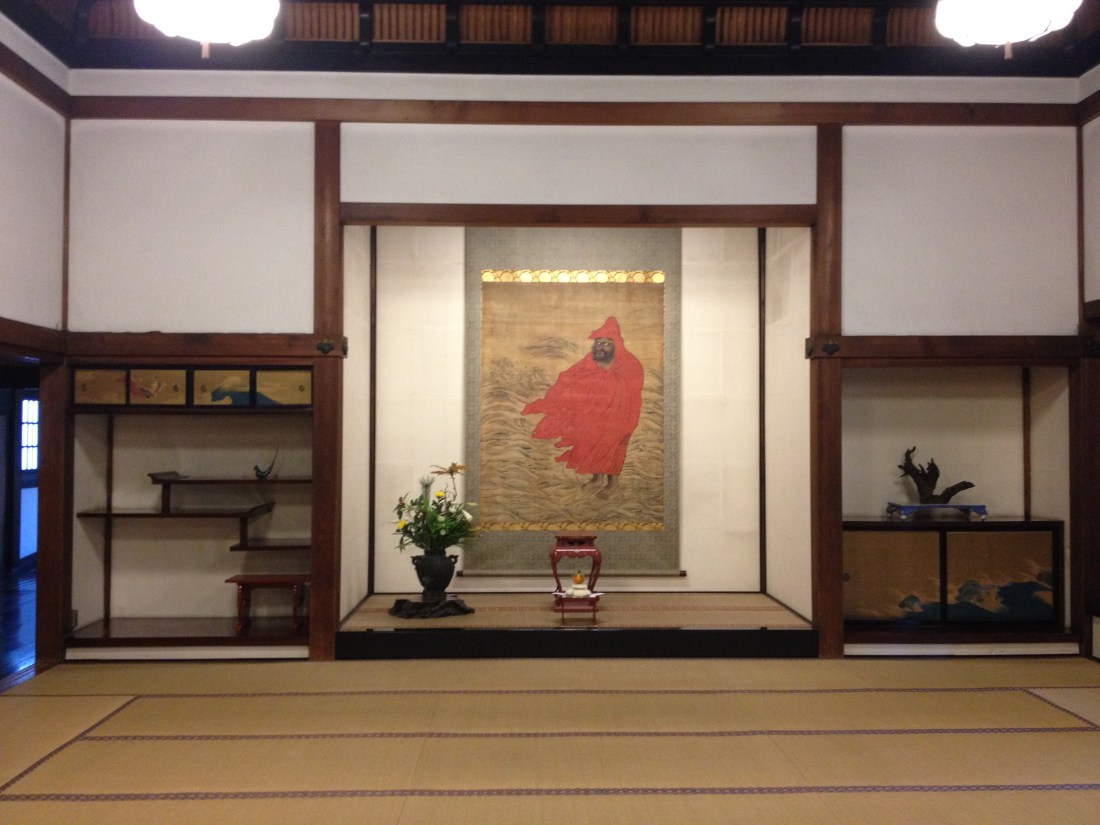
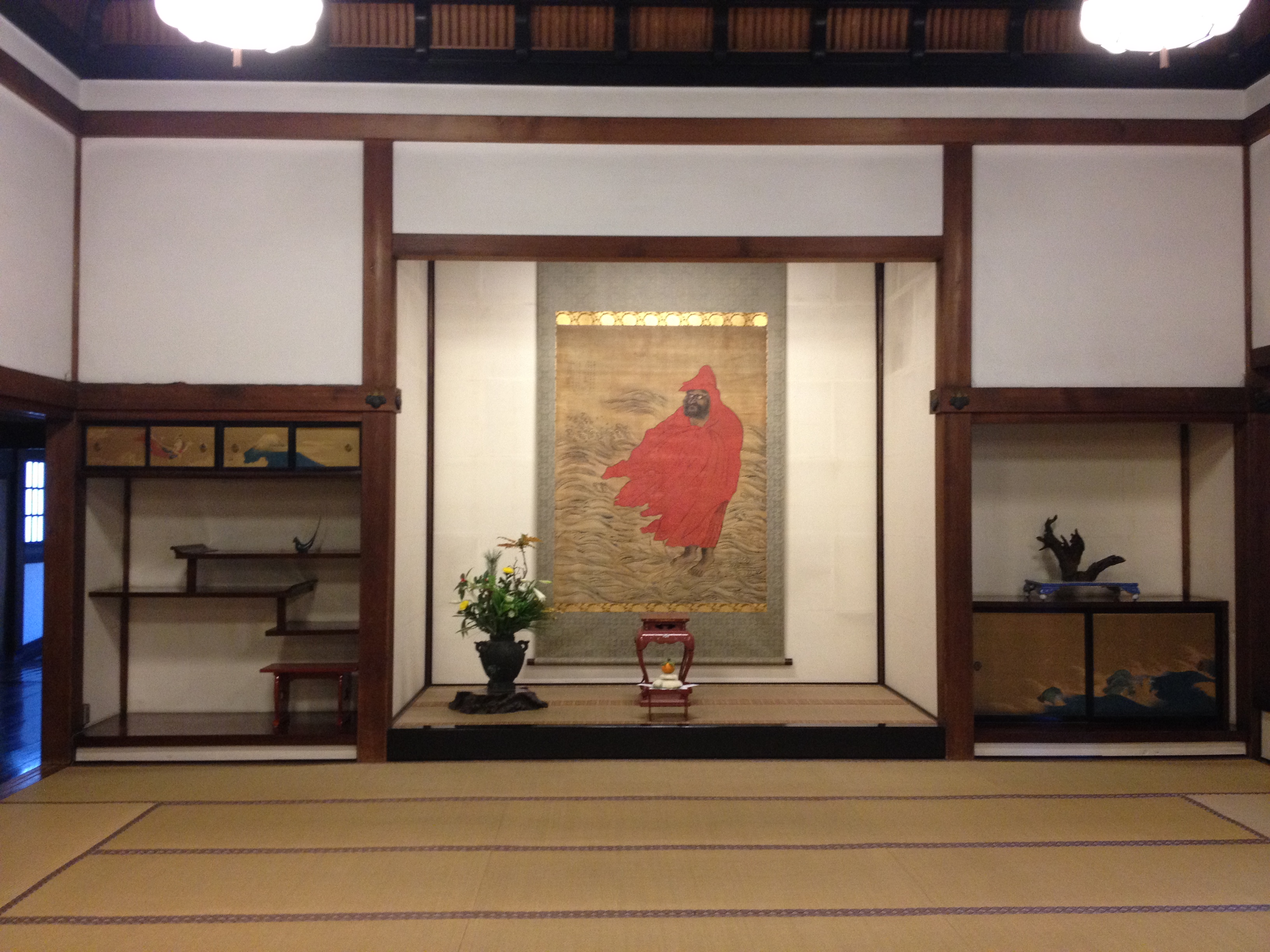
A painting of Bodhidharma at Sojiji temple (head of Soto Zen sect) in Kawasaki, Japan. Taken by me in 2010 (?).
The history up to this point is somewhat vague, and possibly apochryphal, but easy to follow.
This continues for a few more generations in China, until you get to a monk named Hui-Neng (Enō in Japanese)1 who is the supposed author of the Platform Sutra, a Chinese text. As the 6th “patriarch” of the lineage in China, he establishes what we know today as “Chan Buddhism” or Chinese Zen.
Things become more complicated a couple generations later as two descendants: Mazu Daoyi2 and Shitou Xiqian3 directly or indirectly found different schools of Chan Buddhism. This is known as the Five Houses of Chan period during the Tang Dynasty. Thus, the entire Chan/Zen tradition as we know it today is derived from Hui-neng and transmitted through these two men.
Out of the five houses, the Hongzhou,4Lin-ji and Cao-dong5 all survive in some form. The others are gradually absorbed into the Lin-ji school, which in the long-run is what becomes the most widespread form of Chan Buddhism in China. The Cao-dong school is the one exception, while the Hongzhou school’s success in Korea helps establish 8 out of 9 of the “Nine Schools of Seon (Chan)”6 in Korea. It through Bojo Jinul’s efforts in Korea that these nine schools are unified into the Jogye Order (homepage) which absorbed other Buddhist traditions in Korea into a single, cohesive one.
Meanwhile, in Japan, the Lin-ji and Cao-dong schools find their way to Japan where the names are preserved, but pronounced different: Rinzai and Soto respectively. Rinzai’s history is particularly complicated because they were multiple, unrelated transmissions to Japan often spurred by the Mongol conquest of China. Of these various Rinzai lineages, the two that survive are the “Otokan” Rinzai lineage through Hakuin, and the “Obaku” lineage through Ingen, but eventually the Otokan lineage absorbed the Obaku lineage. Today, Rinzai Zen is more formally called Rinzai-Obaku, or Rinnou (臨黄) for short. This is a bit confusing because Rinzai came to Japan under a monk named Eisai, and his lineage did continue for a while in Japan especially in Kyoto, but the lineage from the rival city of Kamakura ultimately prevailed and absorbed other Rinzai lineages. Obaku Zen arrived pretty late in Japanese-Buddhist history, and as you can see from the chart has some common ancestry with Rinzai, but also some differences due to cultural divergence and history.
Soto Zen’s history is quite a bit more streamlined as it had only one founder (Dogen), and although it did grow to have rival sects for a time, Keizan was credited for ultimately unifying these though not without some controversy even into the 19th century.
Anyhow, to summarize, the entire tradition started from a legendary sermon by the Buddha to Maha-Kashyapa, and was passed on over successive generations in India to a legendary figure who came to China and starting with Hui-neng became a tree with many branches. Yet, the roots are all the same. Speaking as someone who’s relatively new to the tradition, I realize while specific liturgy and practices differ, the general teachings and intent remain the surprisingly consistent regardless of culture or label.
Hope this information helps!
P.S. I had trouble deciding which term to use here: Zen or Chan or Seon since they all literally mean the same thing, but are oriented toward one culture or another. If this all seems confusing, the key to remember is that the entire tradition of Zen/Chan/Seon (and Thien in Vietnam) is all one and the same tree.
P.P.S. I realized that I never covered the Vietnamese (Thien, “tee-ehn”) tradition, but there’s so little information on it in English (and I cannot read Vietnamese), that I will have to differ that to another day.
1 Pronounced like “hwey-nung” in English.
2 Pronounced like “ma-tsoo dow-ee” in English.
3 Pronounced like “shih-tow shee-chee-yen” in English.
4 Pronounced like “hohng-joe” in English.
5 Pronounced like “tsow-dohng” in English.7
6 The Korean word “Seon” is pronounced like “sawn” in English. It is how the Chinese character for Chan/Zen () is pronounced in Korean Language.
7 If you made it this far in the post, congrats! I had to put so many footnotes in here because the Pinyin system of Romanizing Chinese words is a little less intuitive than the old Wade-Giles system. Pinyin is not hard to learn. In fact, I think Pinyin is better than the old Wade-Giles system (more “what you see is what you get”), but if you don’t learn Pinyin it can be confusing.better This is always a challenge with a writing system that strictly uses ideograms (e.g. Chinese characters). How do you write 慧能 into an alphabetic system that foreigners can intuitively understand. Also, which foreigners? (English-speaking, French-speaking, Spanish-speaking, etc). Anyhow, if you are interested in learning Chinese, I highly recommend learning Pinyin anyway because it’s quick and easy to pick up. BTW, since I posted about Hokkien recently it also has two different Rominzation systems: Pe̍h-ōe-jī (old, but widespread) and Tâi-lô (Taiwan’s official revised system).
The Ramen Museum in Yokohama is a great way to spend an afternoon, and I have visited a couple times in recent years. I even bought the manga biography about Ando Momofuku (安藤 百福, 1910 – 2007), the creator of “instant ramen”:1
I’ve had a long fascination with instant ramen, and with Ando Momofuku. As a poor kid with a single mom, we ate a lot of “Top Ramen” when times were tough. To be honest, I loved it. I would cook my ramen with an egg, and some frozen peas. In college, my roommate would cook with spam (salty, but tasty).
The story of Ando Momofuku and of instant ramen is pretty interesting. Momofuku was born in Taiwan, at a time when it was still part of the Empire of Japan (1895 – 1945), and thus while he is Taiwanese Chinese, he was also a Japanese citizen. He was born into a merchant family, and from an early age showed an aptitude for business. He took part in knitted textiles (meriyasu in Japanese, メリヤス), and in time was able to expand his business into Osaka since it all belonged to the same empire. From Osaka, the business grew, but then WWII came and many resources were increasingly rationed. His factory was destroyed in the air raids.
Rice production was carefully rationed as the war turned against Japan, and after the war, food supplies were still very limited. During the postwar period, people ate a lot soba noodles and ramen, since they are not made from rice. Ando Momofuku started a partnership business, but this collapsed due to some sketchy financial schemes, and he was jailed for a couple years due to tax evasion (supposedly helping provide scholarships for local students). Bankrupt, but inspired by the idea of making ramen noodles more accessible, he learned how to make ramen, and how to make it more portable and easier cook.
After considerable trial and error, he determined that flash-frying ramen noodles dries them out in a way that’s easy to rehydrate later with hot water. Thus, by August 25th 1958, the first instant ramen was made. Momofuku’s new company, Nissin Foods (Nisshin Shokuhin in Japanese, 日清食品) quickly sold the instant ramen to great success.
Early examples of “Chicken Ramen” sold in 1958, courtesy of the Cup Ramen Museum in Yokohama. Taken by me in 2023.
The “cup style” ramen came later in the 1970’s after Nissin realized that people outside of Asia didn’t eat ramen the traditional way (ramen bowls, chopsticks, etc). After some research, a styrofoam cup was invented, and carefully engineered to keep the brittle noodles safe from crumbling, and also keep the sauce and seasoning together. This allowed people to simply add water, and eat from a fork.
Examples of both packaged “top ramen” and “cup ramen” from the 1990s. Taken at the Cup Ramen Museum in Yokohama.
One of the things, in my opinion, that makes Ando Momofuku more than just a clever businessman is that as the instant ramen business succeeded, and copycat products flooded the market, Momofuku didn’t punish other companies, but instead started a industry-wide standard for instant ramen, and sold licenses to others companies to ensure consistent quality. For Momofuku, the most important thing was that instant ramen help contribute to food availability, and not just pure profit.
Starting with the Great Hanshin Earthquake in 1995, Nissin was responsible for distributing food aid to many sites around the world, and Momofuku often famously said the phrase 食足世界 (shoku tarite yo wa taira ka) which means something like “if there’s enough food, the world will be at peace”.
Speaking as a poor white kid in the 80’s and 90’s, I am grateful to Ando Momofuku for his innovation, and for his commitment to humanity. 🍜
My designed cup at the Cup Ramen Museum in Yokohama. Reads “thank you Ando Momofuku” with my poor handwriting. Taken in 2023.
1 I am using Asian-style naming convention, so family name then given name. Thus, Ando Momofuku’s family name is Ando, which he adopted from his Japanese wife, and his personal name is Momofuku. This is a Japanese name, not his family birth name. In his native Taiwanese-Chinese (aka Hokkien), his name was Go Pek-Hok (吳百福). Taiwanese Pek-Hok (百福) is read as “Momofuku” in Japanese. I want to do a side-post about Hokkien language sometime because I realize lately that it’s pretty underrated but influential, but research will take time.
A while back, I talked about the history of Zen [particularly Rinzai Zen] and the samurai class in pre-modern Japan. Rinzai has a particularly convoluted history compared to other Buddhist sects in Japan due to its multiple waves of immigration from China, each unrelated to one another. Soto Zen’s history is notably different, but fairly convoluted in its own way, since it has two founders.
This concept of two founders started in the 19th century, after certain Soto Zen temples got into a spat about who was the actual founder of Soto Zen. If you’re reading this and know something about Japanese Buddhism, you might think that the answer is obvious: duh, it’s Dogen since he was the one who went to Song-dynasty China, and brought the tradition back. That was Eiheiji temple’s position at the time.
Conversely, Sojiji Temple took the position that it was Keizan’s influence a couple generations later that actually allowed it to flourish in Japan, establishing it as a proper sect, and not just an isolated temple. Further, until the 19th century, Dogen’s writings were kept secret, so very few Soto priests and students ever read it. So Dogen’s actual influence in the sect would be thus smaller than expected. Or so the argument goes.
Needless to say, eventually the two groups came to a compromise and agreed that both monks contributed to the growth of Soto Zen in Japan, each in their own way. Thus, in the Soto Zen tradition since, they are known as:
Dogen – “high founder” (高祖, kōsō)
Keizan – “great founder” (太祖, taisō)
Thus every 29th of September the Soto Zen liturgical calendar holds a memorial service for both founders known as Ryōsoki (両祖忌, lit. “dual founders memorial).
Even today, if you look at a Soto Zen obutsudan in Japan, you often see altar images like the ones linked here and here: namely an image of Shakyamuni Buddha in the middle, and Keizan on the left (facing right), and Dogen on the right (facing left). This is not an entirely unusual arrangement, by the way: in the Jodo Shinshu tradition, the Buddha Amida is in the middle, and often flanked by Shinran the founder, and Rennyo the restorer. Sometimes in Tendai Buddhism, you also see Shakyamuni Buddha flanked by Saicho the Japanese founder, and Zhi-yi the original Chinese founder.
The concept of “trinities” often appear in Buddhism, though not in the Western-Christian sense.
In any case, I am glad to see that Soto Zen was able to reconcile this dispute in a way that feels harmonious to me. I have visited Sojiji a couple times over the years (since it is thankfully pretty close to my wife’s house),1 and it is a pretty neat temple. I haven’t visited Eiheiji yet as it is in a remote prefecture in Japan, but I am sure it’s quite a nice place to visit. Just like Keizan and Dogen, each temple enriches the Soto Zen community in its own way, and this helps broaden the community and make it more inclusive.
It is tempting to look at Japanese-Buddhist history and assign one sect to one founder, etc, but both Soto Zen and Rinzai Zen have histories that tend to defy this mold, and it’s important to recognize that religious history is organic and complicated, but also quite fascinating.
Namu Shakamuni Butsu
P.S. Moving back to two posts a week, now that the backlog is caught up.
P.P.S. Posting late, sorry! Made a scheduling mistake. 😅
1 The present location of Sojiji is actually fairly recent. It was in Fukui Prefecture (same as Eiheiji) for many centuries, and was a branch temple of Keizan’s main temple of Yōkōji (永光寺). Ironically, as Yokoji declined, Sojiji gained in prominence. But, history is funny this way.
I’ve been sitting on this post for a little while, trying to decide how best to put things into words. I don’t like delving into contemporary issues, or politics. But it’s hard to ignore the many problems going on right now.
In particular, I keep thinking about the above quote, and the related Ship of Theseus for us Westerners. Even in peaceful times, it’s hard not to look back and see how things have changed, and won’t go back to the way things were before. Even more so in dramatic times.
But this year, I feel we’ve definitely crossed some kind of threshold, not just in a nostalgic sense.
Even after the Roman general Sulla retired in 78 BCE as dictator, the Roman Republic didn’t carry on as it did before. Instead, rapid decline continued as other men such as Cicero, Pompey, Caesar, and Augustus seized on the precedent to push their own vision of rulership. If one powerful man can break precedent, then what’s to stop others from doing the same?
Of course, this decline of the Republic1 had other precedents too. Bit by bit, across generations, things changed and the effects weren’t always clear until too late. Sulla opposed the populist, reformist Gracchi brothers, and the Gracchi Brothers in turn were opposed to increased centralization of land-wealth, which in turn had been caused by Rome’s increasing power and influence across the Italian Peninsula, etc, etc. Where one issue begins and another ends is hard to fathom. Instead, bit by bit, like the wooden planks on the Ship of Theseus, small changes gradually add up until something is no longer recognizable.
If we look at other societies, such as the fall of Heian Period aristocracy in 12th century Japan, it is the same thing: small changesbuiltup, followed by a dramatic shift in power, and then the aristocracy was then permanently diminished in power, replaced by military governments. Once the threshold was crossed, it was never the same, and that’s why the author of the Hojoki wrote what he did.
“How did you go bankrupt?” “Two ways. Gradually, then suddenly.”
Ernest Hemingway, The Sun Also Rises
Thus, here I sit, an armchair philosopher watching everything I took for granted in my youth change around me, often abruptly, until it’s no longer recognizable. I don’t know how things will resolve, though somehow they will. Yet, countless changes that will only make sense in hindsight have led to this moment in history that I am forced to live in, and I have to accept that in a sense it’s already over.
1 Technically speaking, the Republic (a.k.a. res publica in Latin, or politeia in Greek) never ended until 1453 with the fall of Constantinople. The way that modern historians define a republic is different than how Romans thought of it. The imperial era from Augustus onward was still seen as the res publica/politeia, it just gradually changed and evolved … like the Ship of Theseus … from one system of administration or another. But Romans never really viewed a “break” between the senatorial style of government and the later imperial one as a change in historical period.
This post is part four of four exploring the Ikko-Ikki Rebellions in 15th and 16th century Japan. You can find part one, part two and part three here.
The Ikko-Ikki Rebellions are remarkable as being the one time in pre-modern Japanese history where a peasant uprising not only succeeded, but successfully carved out a region of Japan that was ruled by the masses, and not by military samurai, nor the old aristocracy from Kyoto. The binding influence of the uprising was a strong affinity to a certain Buddhist sect, the Jodo Shinshu (浄土真宗, “True Pure Land Sect”), but there was more to the ikko-Ikki than a “rebel cult” as some labeled them.
Information in English about the Ikko-Ikki is sparse, and often misinformed. I am happy though to have obtained a copy of Dr Carol Tsang’s excellent book War and Faith: Ikko Ikki in Late Muromachi Japan (publisher link), covers the Ikko-Ikki, who they were, and their relation to the Jodo Shinshu sect. It’s been a fascinating read even for an old “history nerd” like myself.
This is the final part of this series. I wanted to go into more depth on some parts, but I wanted to keep a good, easy pace, so summarized some parts a little, while focusing on others. The history Ikko-Ikki was far more extensive and complicated than I expected originally, and I didn’t want to turn this into an eight part series. 😙
If you want to know, please Dr Carol Tsang’s good. It’s quite a good read.
Simmering Tensions after 1488
The defeat of Togashi Masachika in 1488 by a coalition of rebellious retainers and ikko-ikki armies of Jodo Shinshu-sect followers was a watershed for the rebellions, but things settled for a time in a tense balance of powers in the province of Kaga. This balance of powers meant that there was no sole ruler of Kaga, and whenever trouble arose, the central Shogunate authorities had to rely on whomever might be able to help settle a dispute locally. Sometimes ikko-ikki were enlisted to help keep the peace, other times, local samurai were tasked with defeating an ikko-ikki army.
As stated in part three the reputation of Rennyo, the 8th Caretaker of the Honganji Mausoleum, suffered even though he was not part of the rebellions, and was not even in the province. By 1489, he resigned as Caretaker (monshu, 門主) and Rennyo spent his final years proselytizing while his son Jitsunyo (実如, 1458 – 1525) carried on as the 9th Caretaker. Rennyo passed away at Yamashina Honganji temple in 1499.
Dr Tsang shows that Jitsunyo was pretty quiet and conservative for his first decade as Caretaker, carefully compiling Rennyo’s notes and letters, maintaining his reforms to liturgy and so on. Primarily ecclesiastical affairs, in other words.
Then 1506 happened.
Uprisings and Crackdowns
Without getting too embroiled in politics at the time, let me summarize. The Ashikaga shogunate by 1506 was getting weaker and weaker after the Onin War, and their deputy shoguns, the Hosokawa and Hatakeyama clans, were increasingly manipulating the succession process for the Ashikaga.1 This led to disputes by other retainers, and a power struggle increasingly spilled over to the provinces.
Jitsunyo, the ninth Caretaker (monshu, 門主) of the Honganji was forcefully approached by deputy-shogun Hosokawa Masamoto who strong-armed Jitsunyo (literally) to lend him ikko-ikki troops to help his cause. Jitsunyo refused saying he was only a peaceful monk, and tried to escape Masamoto, but Masamoto caught up to him and he finally relented.
It’s noteworthy that this was the first time in Jodo Shinshu history that the monshu directly ordered his followers to battle (even if hesitatingly), but it set the pattern for the next few generations.
This also proved to be a huge problems for the Ikko-ikki . Different Jodo Shinshu communities owed allegiance to members of the Hatakeyama, others the Hosokawa. Some refused Jitsunyo, others came flocking to his banner, but in the end, enough Ikko-ikki came to Masamoto’s assistance to turn the tide of battle. This also set a pattern that continued in later generations when Jitsunyo’s grandson Shōnyo (証如, 1516 – 1554)2 became the tenth monshu.
The Tenbun War
Unlike Jitsunyo, Shōnyo was much less hesitant to mobilize Jodo Shinshu followers into fighting forces to accomplish aims. During a civil between temples in Kaga province in 1531, Dai-shō (大小) Ikki War, Shōnyo decisively defeated the rebel temples and their armies, reasserting Honganji control.
The following year, the Tenbun War (天分の乱, 1532-1536) involved yet another generation of Hosokawa clan members fighting for control of Japan, and Shōnyo actively helped Hosokawa Harumoto (Masamoto’s grandson). The Honganji armies carried the day with Ikko-ikki members turning their wrath on Kōfukuji Temple and burning it down, while also looting Kasuga Shrine next door. This really shocked the establishment.
In the constantly switching alliances of the time, Harumoto turned on them and enlisted NichirenIkki for help. Yes, Nichiren Buddhism had it’s own ikki societes, that destroyed Yamashina Honganji in 1532, and briefly administered the capitol of Kyoto for a time. Despite the series of losses, the Honganji’s mobilization efforts meant that they were more firmly in control of Kaga Province and could muster future armies if needed.
Further, in other provinces, Jodo Shinshu temples in the Hongaji hierarchy created by Jitsunyo wielded considerable influence throughout Japan. Starting with Rennyo, many temples organized jinaichō (寺内町, “temple towns”) that were fortified and exempt from taxation to military authorities. Samurai were not even allowed in these towns, a policy called funyū (不入, “no entry”). This was a problem for local warlords who needed revenue, but also had to constantly deal with fortified temple towns in their own province. A young Tokugawa Ieyasu (future Shogun of Japan) had to contend with his local Ikko-ikki garrisons in order to assert dominance over his domain in the early 1560’s.
But finally, the Ikko-Ikki met their match. Sort of.
War with Oda Nobunaga and Downfall
(A screenshot of the classic strategy game Nobunaga’s Ambition (taken from Nintendo Switch). This shows the Kaga province in the hands of the “Honganji”, more correctly the Ikko-Ikki. Western kids like me who grew up playing this game had no idea who “Honganji” was. 😝)
For the last 100 years, the Ikko-Ikki had gradually grown from disparate, rag-tag bands of rebels to mass-armies mobilized by the Honganji (and its lineage of monshu Caretakers) that warlords would court for military favors. However, the Ikko-Ikki finally met their match with Oda Nobunaga (織田 信長, 1534 – 1582). Nobunaga, star of the Nintendo game Nobunaga’s Ambition (screenshot above), would briefly unify Japan by the 1580’s, but he did so through brutal warfare and centralizing power. This meant destroying any opposition: not just the Ikko-Ikki, but other religious powers such as the sohei warrior-monks of the Tendai Sect. There could be only one sun in the sky, and Nobunaga wanted tl be it.
Despite some initial friendly overtures by the 11th monshu Caretaker of the Honganji, Kennyo (顕如, 1543 – 1592), son of Shōnyo, Oda held a low opinion of the Honganji and it soon became clear that war was inevitable. The Honganji authorities rallied the Ikko-Ikki and fortified their position at temple complex of Ishiyama Honganji. According to one tradition, partially debunked by Dr Carol Tsang, the Ikko-Ikki by this era carried a banner that read:3
進者往生極楽 Advance and be reborn in the Pure Land 退者無間地獄 Retreat and be immediately reborn in Hell.
Nobunaga underestimated the Ikko-Ikki and sent a token force that was soon crushed. A similar, second attempt met the same fate. Finally, Nobunaga had enough and sent a much larger force, with his best generals, but the Ikko-Ikki were well-supplied and well-fortified. Thus began the 10-year long Siege of Ishiyama Honganji.
The end result of this massive and complicated siege was that eventually both sides tired, and ended in a truce, but the Honganji was definitely on the losing side of this truce. Nobunaga agreed to not execute its leadership, but the Honganji was totally burned down and later replaced with Osaka Castle. The Honganji also submitted to Nobunaga’s authority, though grudgingly. Some diehards tried to keep fighting but were destroyed.
Final Thoughts
Once Oda Nobunaga gained authority over all of Japan, the Ikko-Ikki as a phenomenon rapidly wound down and never appeared again. But, who were they?
The usual assumption in English was they they were religious fanatics, willing to die at the command of the monshu. And yet, Dr Tsang shows many examples where they disregarded the the monshu, and either didn’t fight, or sometimes they fight without the monshu’s approval. On the other hand, they had elements of millenarianism too: a deep desire not just to get better taxation, but as seen in Kaga province, to transform society.
Further complicating this was the widespread belief at the time that the monshu, in particular Shōnyo and Kennyo, did have the power to grant or deny rebirth in the Pure Land of Amida Buddha, vaguely similar to indulgences in medieval Christianity. Neither monshu promoted this idea, but they didn’t explicitly deny it either.
Thus, they were not just another peasant rebellion either. The shared religious identity that was Jodo Shinshu-sect Buddhism, in particular the Honganji lineage, gave them a sense of community that transcended the usual shifting alliances of the Warring States period. They weren’t just peasants either. Many urban merchants, artisans, rural jizamurai warriors, and others comprised the Ikko-Ikki in large numbers.
Were the rebellions a form of pre-modern democratic or Marxist revolution? No, they still submitted to authorities (secular and religious) and never reformed the local government in any way we would recognize as a democracy.
Thus, as Dr Tsang writes, the Ikko-Ikki defy easy explanation, but their impact on Japanese politics for the next few centuries, including how military authorities handled the arrival of Christian Europeans (i.e. zero-tolerance) and how the Edo Period reformed and brought all religious groups to heel, is undeniable.
P.S. posting this as a Friday bonus. Enjoy!
1 A pattern similar to previous eras of Japanese history, such as the Fujiwara manipulating the Imperial family, or the Hojo manipulating the succession of the Minamoto/Kamakura shoguns. Of course, this is not limited to Japanese history either, or even Asian history. Anytime there was a non-optimal family succession, it didn’t take long for retainers and advisors to weigh in…
2 Rennyo’s great-great-grandson, in other words.
3 The ikko-ikki at the Siege of Ishiyama did not carry this banner, but rather the allied Mōri clan in western Honshu, according to Dr Tsang.
This post is part three of three four exploring the Ikko Ikki. You can find part one and part two here. We have seen in part two Rennyo’s involvement in the rapidly growing Jodo Shinshu community, and how the seeds of conflict first began as a succession dispute between local samurai warlords. In this post we’ll see how things go off the rails…
The Ikko-Ikki rebellions are remarkable as being the one time in pre-modern Japanese history where a peasant uprising not only succeeded, but successfully carved out a region of Japan that was ruled by the masses, and not by military samurai, nor the old aristocracy from Kyoto. The binding influence of the uprising was a strong affinity to a certain Buddhist sect, the Jodo Shinshu (浄土真宗, “True Pure Land Sect”), but there was more to the Ikko-Ikki than a “rebel cult” as some labeled them.
Information in English about the Ikko-Ikki is sparse, and often misinformed. I am happy though to have obtained a copy of Dr Carol Tsang’s excellent book War and Faith: Ikko Ikki in Late Muromachi Japan (publisher link), covers the Ikko Ikki, who they were, and their relation to the Jodo Shinshu sect. It’s been a fascinating read even for an old “history nerd” like myself.
Now on with the show…
Succession Crises and Retirement
The beginnings of organized conflict by the Ikko-Ikki began when the succession crisis between the Togashi brothers began in part two. As neither side could decisively destroy the other, and began to enlist more and more locals to help.
Masachika, as we saw previously, recruited from the Jodo Shinshu followers (a.k.a. the Honganji sect) of Yoshizaki, while his brother, Kōchiyo, recruited elements of the local rival Takada sect of Jodo Shinshu. Both communities formed ikki societies vowing to fight and help their preferred claimant to succeed.
Needless to say, in 1474 Masachika was ultimately victorious, but as Dr Carol Tsang notes, he did little to reward the Honganji ikko-ikki for their support. This did not go well with the Honganji followers. Dr Tsang shows that documents while somewhat scarce, and confusing, demonstrate how Honganji followers protested the ungrateful military rule, but were then brutally suppressed in 1475. It’s unclear if the uprising had any approval, let alone knowledge, by Rennyo the 8th Caretaker. There is evidence however, that his advisor Rensō had some involvement, and was expelled by the Honganji later. Being expelled or shunned by the sect was a virtual death-sentence for such a person because of the loss of community support.
Rennyo had worked hard to avoid a violent image to the Jodo Shinshu sect, yet the uprising in 1475 cemented the image of the ikko-Ikki as violent religious fanatics. Rennyo for his part left Yoshizaki that same year, reportedly under the cover of night, and travelled to nearby provinces such as the town of Deguchi in Kawachi Province, and then later returning to Ōmi Province of his youth at a place called Yamashina. By 1480 he settled at Yamashina and lodging was built there for him. Soon after a new Honganji temple, called Yamashina Honganji (official homepage here) was built and completed by 1483. It is noteworthy that this temple was designed to be militarily secure, with earthworks, moats and so on. Such where the times they lived in.
While this happened Rennyo chose his firstborn son by his second wife, Jitsunyo (実如, 1458-1525), as the next Caretaker of the mausoleum after his firstborn son (Junnyo) by his first wife had died that year. We will meet Jitsunyo again in a later post.
Overthrow
Meanwhile, after 1475 the ikko-ikki of Kaga Province not only rebelled and refused to send tax revenues, other neighboring communities started doing the same. In Etchū and Hida Provinces next door, refugees from the 1475 uprising had setup communities, and several uprisings are recorded at this time, though documents are pretty thin on what happened. The Honganji followers were able to resist crackdowns by samurai overlords because the local ikko-ikki groups formed powerful alliances that assisted one another in times of need. The sense of shared religious identity, plus religious belief they were only doing what was right, set them apart from other mundane peasant uprisings.
As the ikko-ikki groups took over and divided up territory amongst themselves, they took on increasing administrative responsibility, often county (gun 群) by county. Until the year 1530, these ikko-ikki groups did not answer to the Honganji, and acted semi-autonomously. One of these ikko-ikki might seize land from the landowners in Kyoto, another neighboring ikko-ikki might settle tax disputes between its landowner and local peasants. It was all over the map. The military establishment would sometimes lean on the Honganji leadership (i.e. Rennyo then later Caretakers) to exert pressure on these groups if needed, but otherwise the local ikko-ikki groups ruled as they pleased, independent of one another, sometimes they even threatened the Honganji for interfering. There was essentially no functional central authority in Kaga Province.
In any case, the conflict in Kaga came to a head by 1488, Togashi Masachika had burned enough bridges with supporters that they rose up and overthrew him. This included members of the Jodo Shinshu Honganji sect (ikko-ikki), but also his samurai retainers and other non-religious ikki groups. He was widely unpopular, and people had enough. Masachika had been away for a time helping the Ashikaga shoguns on a campaign (i.e. currying favor with the central authorities), when a full-blown rebellion erupted. Masachika, hurried home, but was besieged at Takao (高尾城, takōjō) Castle.1 Try as he might, Masachika was unable break the siege, and within days, Masachika’s remaining forces were overwhelmed and destroyed. Masachika was no more.
Once the dust settled, Masachika’s uncle, Togashi Yasutaka, was installed as the governor.
Dr Tsang explains that there are two noteworthy things about the downfall of Togashi Masachika:
The rebel army wasn’t comprised of peasants, but large section of the province’s population, from lowly social outcast communities (tanners and such), to Masachika’s own family and retainers. It wasn’t a “peasant rebellion”, but a broad coalition.
During the wars in 1473 and in 1488, the Ikko-Ikki played a major influence in deciding who would govern the province. This kind of popular sovereignty (or at least popular influence on sovereignty) had never really existed in Japan before. In the classical period (aka the Heian Period) it was a bureaucratic aristocracy. Under military rule of the Shoguns, it was a feudal system based on grants and titles. Now, for the first time lower class people in the province were actively weighing in on who should govern.
However, this was only the first phase of the Ikko-Ikki. As we’ll see in part four (yes, series keeps growing…), the ragtag groups would grow even stronger in later generations.
Aftermath
Something to note here is that Rennyo had very little to do with these uprisings in Kaga province. Although his proselytizing efforts greatly increased the popularity of Jodo Shinshu-sect Buddhism in the countryside, and in so doing, helped forge a common identity that allowed the ikko-ikki to form such large communities, he was never involved in these uprisings, and would find out about it later since he was in a different province. Further, when chastised by Rennyo, the ikko-ikki paid little heed. They were fed up, and going to rebel anyway. The genie was out of the bottle, in other words, and Rennyo couldn’t put it back.
Nevertheless, the central authorities in Kyoto didn’t see it that way. Rennyo took a lot of blame for his “unruly followers” and was pressured to write a letter castigating them for their actions. The letter did little to change the situation, and by 1489, Rennyo retired as the Caretaker of the Honganji mausoleum, allowing his son Jitsunyo to take over. It was an ignominious ending for someone who had otherwise made huge contributions to Jodo Shinshu Buddhism and Japanese Buddhism as a whole.
P.S. I couldn’t find any cool historical photos from this particular era. Historical documents and evidence seem to be pretty thin based on Dr Carol Tsang’s book, so there isn’t much media or art. There would be plenty of artwork depicting the Ikko-Ikki in later generations.
1 The castle is no more, but you can see photos of the park here. I am also a bit confused by the name as it should be read as Takao (高尾), but the pronunciation, as listed in Japanese sources is Takō. Call it a quirk of Japanese language, I guess.
Speaking of sutras, while reading about the Heart Sutra in Japanese, I learned about an interesting trend in the late-medieval “Edo Period” (17th through 19th century) called eshin-kyō (絵心経), or “picture Heart Sutra”).
An example of a “picture Heart Sutra” from 1795 (photo taken in 1922), composed by physician Tachibana Nankei in his travelogue Tōyūki (東遊記, “Journey to the East”), Public domain, via Wikimedia Commons
The idea was to make the Heart Sutra, a brief, but important and very popular Buddhist text, readable by illiterate peasants using a kind of rebus. The pictures above, to a native Japanese speaker of the time, would evoke certain words, which matched syllables of the sutra. For example, a few I can pick out:
The demon-looking character is a Hannya (mentioned here), hence hannya.
The pregnant woman with a baby is hara, as in a the torso.
The five vertical lines is go as in the number five.
The upright sword is ken.
This is just one example. It turns out that there’s many different versions, using slightly different pictures and styles. According to this blog, the origin of these picture sutras was a man named Zenpachi (善八). During the Genroku Period (mentioned here and on the other blog), a high-water mark of Japanese (especially Tokyo) culture, Zenpachi wanted to make Buddhist teachings easier for kids to understand and helped devise these pictures.
What’s interesting is that the tradition continues to this day, as seen in my Heart Sutra totebag my wife picked up.
This version is very cute, and of course has hiragana pronunciation guides just in case, but I think it’s a clever way to keep the Buddhist tradition alive.
P.S. moved this to Friday to make up for the accidental double-post on Tuesday and space the content out. We’ll be back to Monday-Thursday schedule starting next week.
Lately, I’ve been enjoying a fantastic history podcast called Grey History, covering the French Revolution in detail. While enjoying this show I started thinking about a famous peasant uprising in medieval Japanese history called the Ikko-Ikki rebellions of the 16th century.
The Ikko-Ikki rebellions are remarkable as being the one time in pre-modern Japanese history where a peasant uprising not only succeeded, but successfully carved out a region of Japan that was ruled by the masses, not by military samurai, nor the old aristocracy from Kyoto. The binding influence of the uprising was a strong affinity to a certain Buddhist sect, the Jodo Shinshu (浄土真宗, “True Pure Land Sect”), but there was more to the Ikko-Ikki than a “rebel cult” as some labeled them.
Information in English about the Ikko-Ikki is sparse, and often misinformed. I am happy though to have obtained a copy of Dr Carol Tsang’s excellent book War and Faith: Ikko Ikki in Late Muromachi Japan (publisher link), covers the Ikko Ikki, who they were, and their relation to the Jodo Shinshu sect. It’s been a fascinating read even for an old “history nerd” like myself.
This post is part two of three exploring the Ikko Ikki, of which part one is here. We can’t talk about the Ikko-Ikki until we cover the life of the 8th-generation Caretaker (monshu, 門主) of the Honganji mausoleum: Rennyo.
I originally intended to do only two posts, but as I wrote this one I realized there was too much interesting detail, and now it has split into three.
Enter Rennyo
As we saw in part one, Jodo Shinshu had somewhat unorthodox origins as a fully lay-oriented sect of Buddhism, through the work of Shinran in the 12th century. Shinran like many disciples of Honen, had been exiled and defrocked. Shinran took this in stride, married, and continued to spread the Pure Land Buddhist teachings he had learned from Honen to provincial people until we returned from exile and died in Kyoto.
His mausoleum (later called the Honganji temple) was managed by his descendants for generations. Like other families in medieval Japan (and other medieval societies), marriages by Shinran’s descendants were arranged to help benefit the family political, economically, etc. These descendants managed the mausoleum, while also building powerful alliances with samurai clans, or influential disciple families in the provinces. Some even married into the aristocracy in Kyoto. Shinran’s various disciples in the provinces went on to found various sects of Jodo Shinshu, while the Honganji remained significant, but not very influential.
By the time of the disastrous Onin War in the 15th century, Rennyo (蓮如, 1415–1499) had been born to the 7th generation caretaker Zonnyō (存如, 1396–1457).1 His mother was of unknown origin, but it is thought that she was a maidservant of Zonnyō, and thus politically risky. She was sent away, and Zonnyō married a woman named Nyoen from an influential family. Rennyo and his step mother did not get along well, and suffice to say, there was a succession struggle between him and Nyoen’s son, but Rennyo won out in the end thanks to the powerful Hino clan (the same clan that married into the reigning Ashikaga Shoguns). Rennyo had also, as per tradition in the family, spent time training at Kofukuji temple in Nara, and could claim some tenuous connections to the prestigious Fujiwara clan through the Kujō cadet branch.
As Jodo Shinshu grew in influence, problems between the community in his native province of Ōmi, near Kyoto, and the powerful Tendai sect arose. Ostensibly, this was due to perceived heresies by the Jodo Shinshu sect, but there’s plenty of evidence that the Tendai sect viewed the growth of Jodo Shinshu as an impact to their fiefdom revenue. Before long, armed conflict with the Tendai sects warrior-monks arose, and the Jodo Shinshu community suffered greatly. The community attempted to fight back, organizing defenses (a forerunner to later Ikko-Ikki armies), bribing the Tendai sect to back off, etc, but the Tendai persisted.
Ministry At Yoshizaki
Bronze statue of Rennyo at the remains of Yoshizaki Gobō temple. Photo by 藤谷良秀, courtesy of Wikipedia.
Rennyo decided it was safer for everyone involved for him to leave, and eventually he retreated to a remote village named Yoshizaki (吉崎) in the province of Echizen in the year 1471. Yoshizaki had a number of advantages, including a large, existent community of Jodo Shinshu followers, distance from Tendai-sect centers of power, and political remoteness, and yet it was on a coastal trade route so it was prosperous too. Soon a temple, now known as Yoshizaki Gobō (吉崎御坊) was founded the same year. The official website (Japanese only) for Yoshizaki Gobō has some neat photos and illustrations, though bear in mind that the original temple was destroyed 1506, and reconstructed centuries later.
It was here that Rennyo and his proselytizing work really took off.
For context, Shinran the founder (and Rennyo’s ancestor) had lived in exile in the eastern provinces and spent much time there teaching the Pure Land am faith as he understood it. Even after he was pardoned and returned to Kyoto in his final years, the communities out in the principles (i.e. his disciples) continued for generations, each in isolated pockets. These communities grew and diverged gradually, but were always more numerous and influential than the Honganji branch under Rennyo’s ancestors.
Thus, when Rennyo showed up, things were a little tense. A major regional sect was the Takada sect (shinshū takadaha, 真宗高田派) which still exists today. I spent a weekend trying to figure out how the Takada sect’s version of Jodo Shinshu differed from the Honganji sect, but couldn’t really find any “ah ha” moments. They both revere Shinran, both recite the nembutsu, both revere Amida Buddha, etc., so the differences feel like they are mostly administrative and liturgical. Jodo Shinshu without the Honganji, in other words. The question, it seems, was basically who had the final say on doctrinal matters.
Rennyo’s Letters
Rennyo was a very active letter writer and these letters (ofumi, 御文) were instrumental in helping to strengthen and clarify the message and build relationships with local communities. I’ve talked about the most famous letter, the Letter on White Ashes, before, but I can say with personal experience that Rennyo’s letters overall are quite good and helpful in clarifying Jodo Shinshu teachings. You can find a collection of them here. I highly recommend reading the letter On Pilgrimage in the Snow (number 6 in the link above).
Side note: these letters (formally called the gobunsho 御文書), were compiled by later generations and are now an important part of Jodo Shinshu liturgy. When my mother-in-law passed away, and we attended her first year memorial in Japan, our local priest (a family friend) recited the Letter on White Ashes, after we recited Shinran’s hymn, the Shoshinge. That’s how important they are. You can see an excellent example of this here on Youtube:2
Within years, Yoshizaki grew to a much larger community, and Rennyo clashed with other existing Jodo Shinshu sects, while also reforming liturgy and standardizing aspects of the faith. Much of these power struggles at the time had as much to do with politics as they did doctrine.
For example, the aforementioned Takada-sect was allied with one Togashi Kōchiyo warlord who was in a bitter feud with his brother Togashi Masachika. The battles for rulership of Echizen and Kaga provinces spilled over into Yoshizaki when the defeated Masachika showed up to recruit members and rebuild his forces. Thus a local ikkō-ikki was formed to assist him.
As we’ll see, this was only the beginning …
P.S. I posted this too early on accident. Please enjoy, and apologies for any typos.
1 random and useless factoid – Rennyo was alive during the final days of the Eastern Roman Empire, and roughly contemporary with its final ruler, Emperor Constantine XI Palaiologos. Of course, Japan and Constantinople didn’t really know of one another. Still, it’s weird to think how both historical events were going on roughly at the same time.
2 The language of the gobunsho letters feels archaic now to a native Japanese speaker (or a language nerd like me), but at the time, this was how people spoke, and thus it was very accessible compared to more formal texts that monks in monasteries wrote.
You must be logged in to post a comment.