Visiting Zojoji Temple: A Photo Tour

Visiting the city of Tokyo is not complete without taking a stop at the iconic Tokyo Tower. But what a lot of visitors might not know is that right next to Tokyo Tower is a Buddhist temple of great historical and cultural value: Zojoji

The temple of Zōjō-ji (増上寺) was the family temple for the Tokugawa shoguns who ruled Japan from 1600 to 1868 (e.g. the Edo Period), and many of the shoguns are interred here. The temple is also one of two main temples of the Jodo-shu sect of Buddhism. Jodo-shu Buddhism really helped me find my foundation back in the day, so I am more than a little fond of it. I have also visited the other main temple, Chion-in, in Kyoto a couple times. My first visit in 2005 is what really started me on the path to Buddhism back in the day. So, it’s no exaggeration that without the Honen the founder and Jodo Shu sect, I wouldn’t have found my path. I am always grateful.

In any case, wife (who’s Japanese) and I both like to come to Zojoji whenever we can. We joke it’s our “power spot”.1

The prestige and political power of Zojoji meant that it has been a very important temple in the Tokyo area for centuries, probably more so than Sensoji / Asakusa Temple (which I am also quite fond of).

The English website for Zojoji is actually pretty good, but it leaves out some details found in the Japanese version. Every time I go, I see foreign tourists dropping by, but I suspect some of them are unaware of the history and teachings of the temple, which is a shame because it’s actually a pretty neat place. So, this post is a lengthy tour of Zojoji. If you are reading this through email, you may want to visit the link instead. This post is VERY picture-heavy.

The Japanese site has a nice map of temple. I started at the bottom-center, at the Sangédatsu-mon (三解脱門), which might translate into something like the Three Gates of Liberation:

To the left of the gate is a sign that posts a monthly Buddhist teaching.

This month’s (August 2024) teaching is a quote from the very early Buddhist text, the Dhammapada, verse 54:

Not the sweet smell of flowers, not even the fragrance of sandal, tagara, or jasmine blows against the wind. But the fragrance of the virtuous blows against the wind. Truly the virtuous man pervades all directions with the fragrance of his virtue.

https://www.accesstoinsight.org/tipitaka/kn/dhp/dhp.04.budd.html

From here, I passed through the gate and took a photo of this statue of the Bodhisattva Kannon:

Next, based on the map linked above, I went clockwise around the perimeter of the temple. The next thing I saw was this pagoda (gojū-no-tō 五重塔 in Japanese) which seems to have been built in 1938:

It sits next to the other gate to Zojoji, the Kuro-mon (黒門, “black gate”) which was built in the 1700’s.

Just north of this (still going clockwise), you can see the Sutra Storehouse (kyōzō 経蔵):
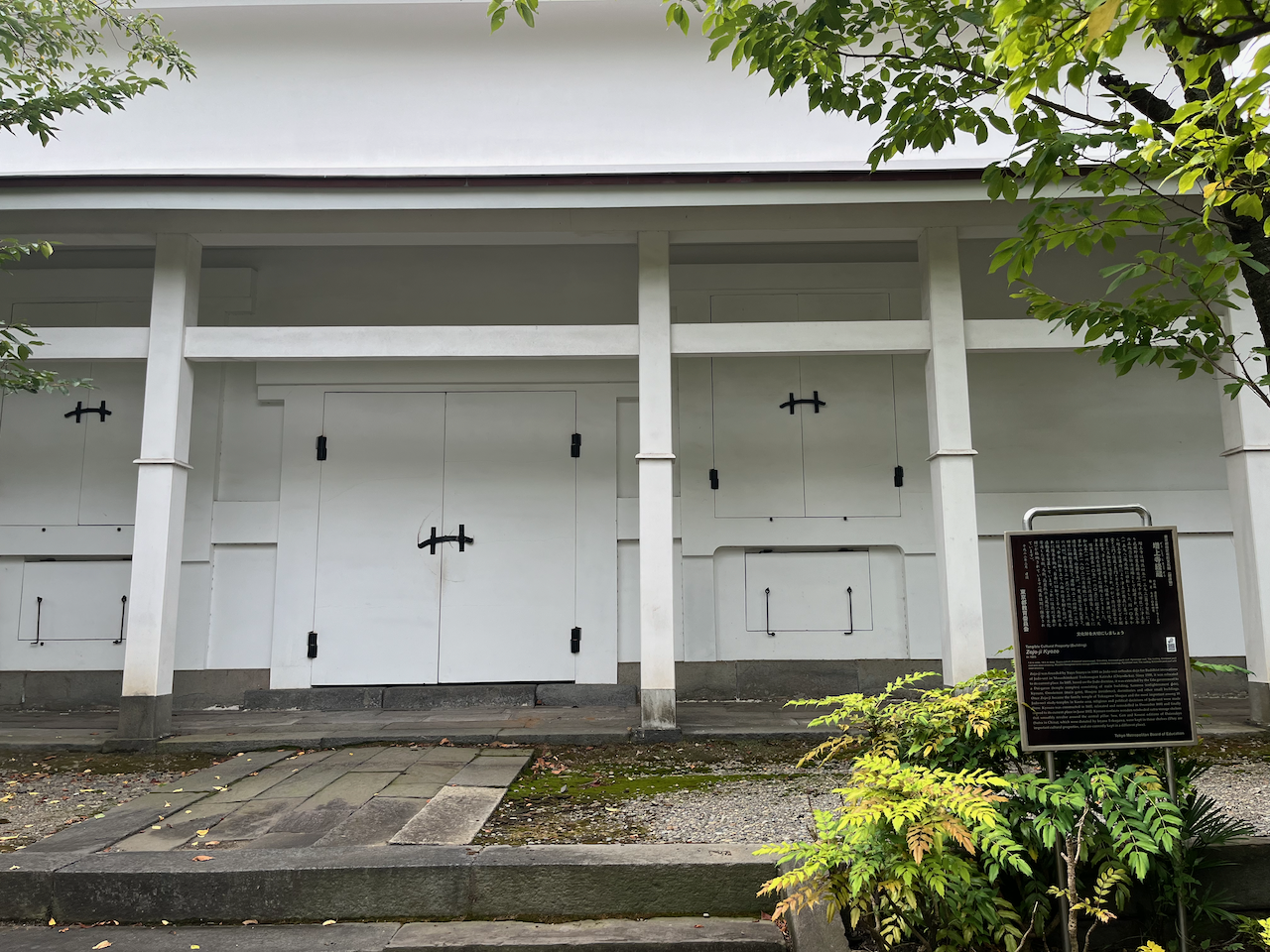
This is something major temples often have: a large store house that contains the vast corpus of Buddhist literature (sutras): the Tripitaka. Sadly, I came too early in the day, and so the doors were closed. If you click on the map above, and look in the bottom left for 経蔵 you can see photo of the interior. It contains a full copy of the Taisho Tripitaka, in three different versions, in a rotating shelf.

The left area of the map mostly contained meeting halls and offices, so I kind of skipped past this quickly, and headed toward the main hall (hondō 本堂). This is in the very center of the map. Just to the left of the stairs is a nice statue of the 12th century founder of the Jodo-shu sect, Honen, in his youth:
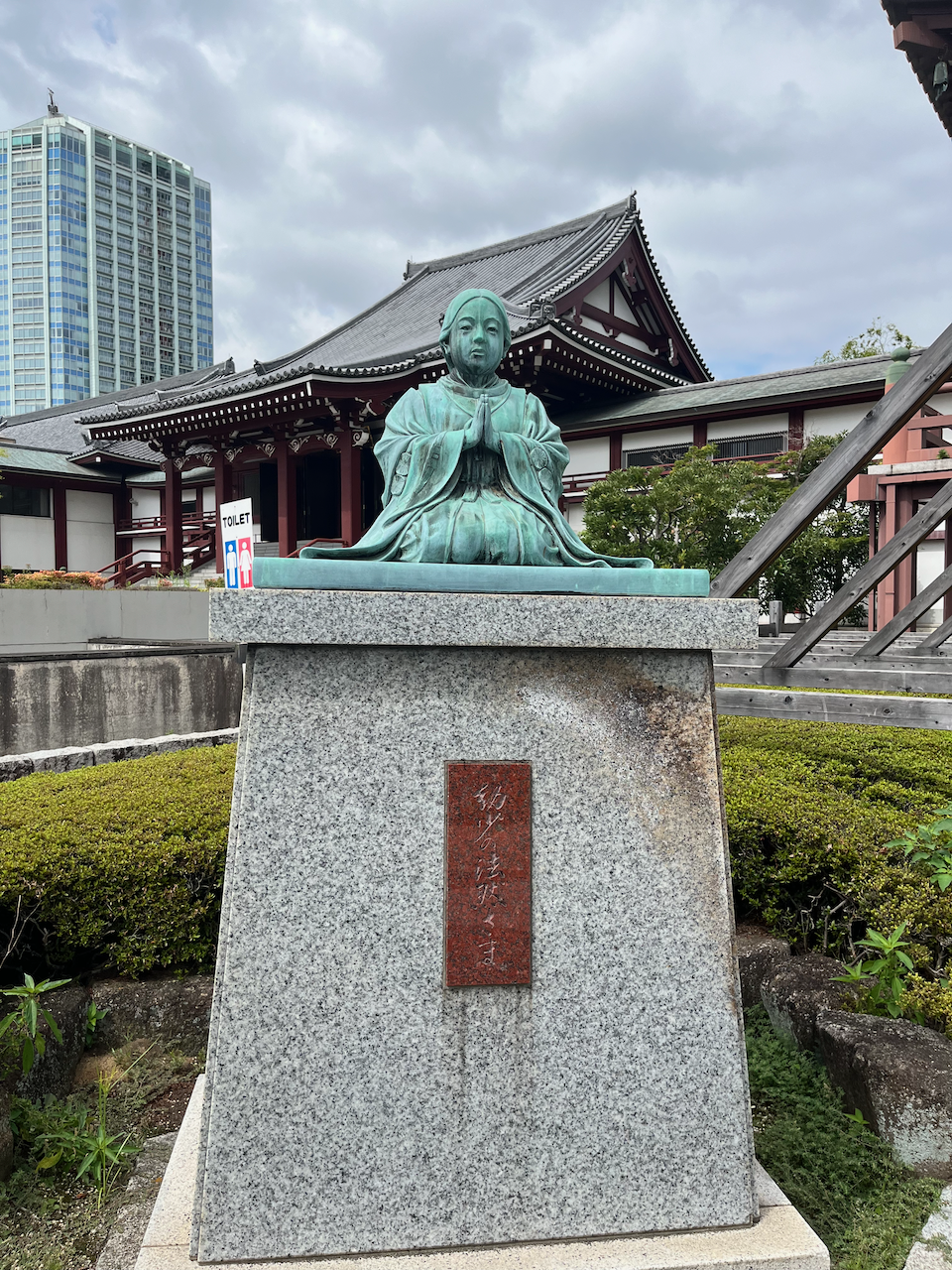
There are some famous stories about his life (somewhat embellished, I believe), including his piousness at a young age. Hence, you often see Jodo-shu temples with status of young Honen. That said, Honen is a cool guy, and he gets my respect any day.

Next is the main hall itself:

This place is pretty amazing inside. Also, unlike many temples, you do not need to remove your shoes at the door and you are welcome to take photos (except during funeral services, obviously):
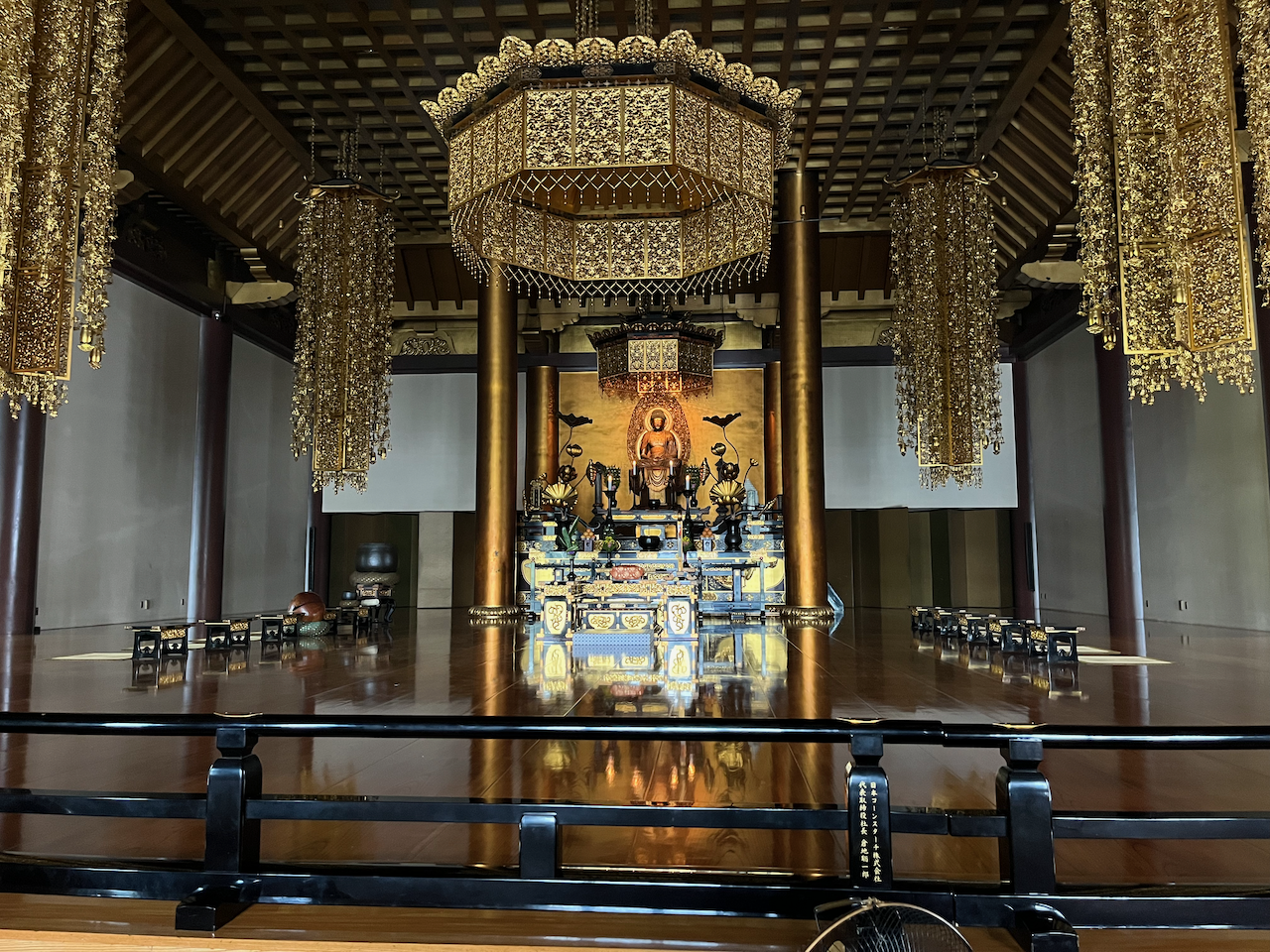
The main altar is to Amida Buddha, the Buddha of Infinite Light, and the devotion of all Pure Land Buddhists across traditions. The gold color and lotus artwork are all taken from descriptions of the Pure Land, as described in the Sutras. It is said all beings reborn in the Pure Land will have the color of gold, just like Amida, and will be born from lotus buds. The Taima Mandala, not related to Zojoji, provides a nice visual representation.

To the left and right of the main altar are Honen, mentioned above, and Shan-dao the Chinese Pure Land master who inspired Honen back in the day, respectively. They lived centuries apart, but both are revered for their contributions to the tradition.

To the right of the main hall you have two choices: one you go down the stairs to the Museum. Or go to the Ankokuden Hall:
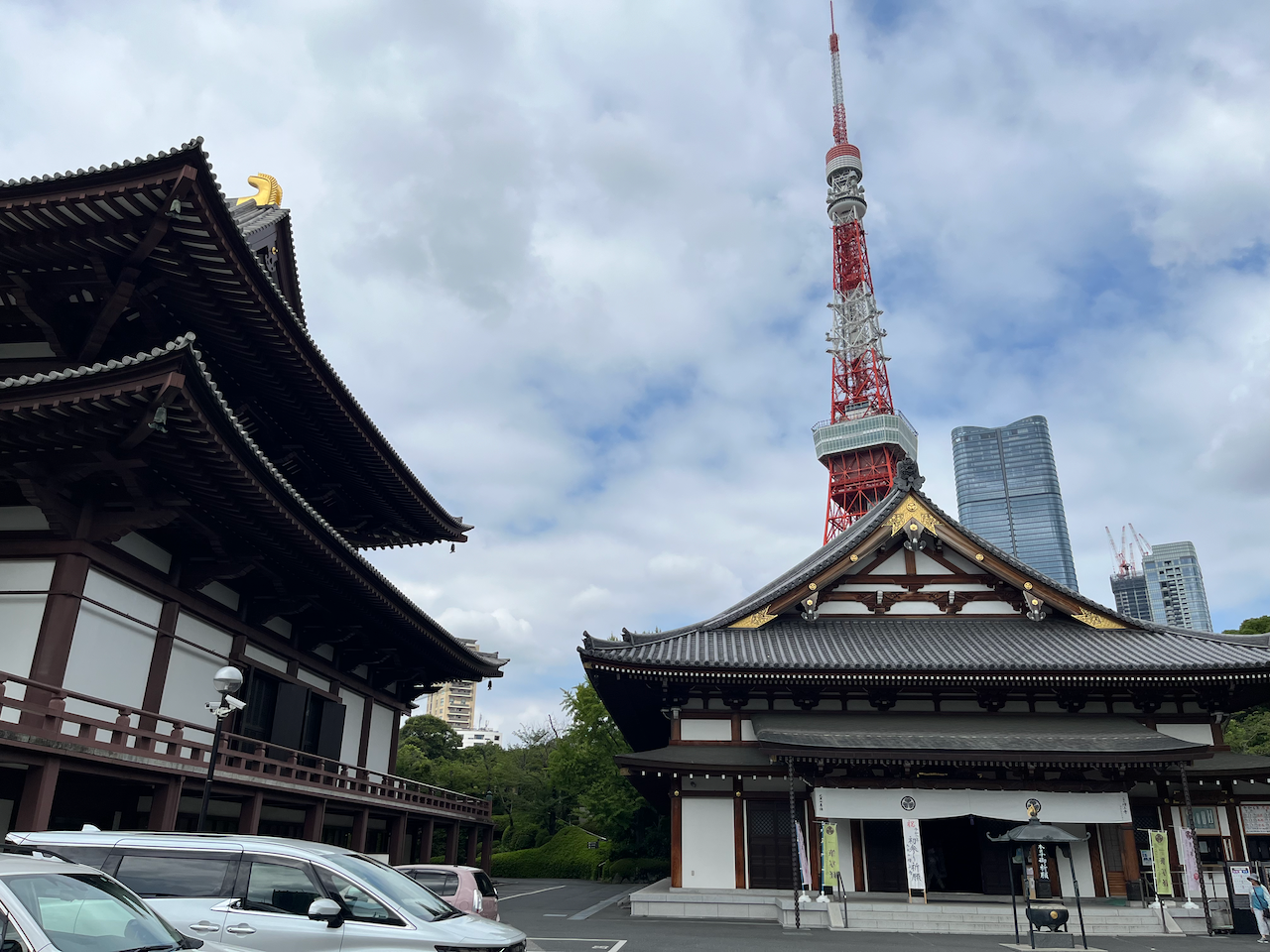
We’ll talk about the museum a bit later. For now let’s focus on the hall. Inside is both a gift shop and another altar to Amida Buddha:

This statue of Amida Buddha is historically significant though: it was the same statue venerated long ago by Tokugawa Ieyasu, the first Shogun of the Edo Period, and final unifier of Japan. This black-colored Amida statue had been a central devotional figure of the Tokugawa Shoguns for generations, so while it’s not the “main attraction” for tourists, from a historical standpoint, it is. I’ve seen it multiple times, and I never get tired of being here.

As alluded to earlier, there are shrines to the left and right of the Amida Buddha. The one on the left is of the founder of the Tokugawa shoguns,2 Tokugawa Ieyasu described above. The one on the right is less clear. It enshrines someone named Princess Kazunomiya. I had to do a bit of research and it turns out that Kazunomiya was a member of the Imperial family (not the Tokugawa family), but had been wed to Tokugawa Iemochi the 14th Shogun as a political marriage intended to heal the centuries old breach between the two families. The arranged marriage had a rocky start, but in the end proved to be a surprisingly happy and successful marriage at a time when Japan was in the waning days of the Shogunate. So, within the Tokugawa family temple, she is enshrined as an important matriarch.

We’ll see more monuments to Princess Kazunomiya shortly, so remember the name.

Anyhow, after picking up some nice incense and another seal in my pilgrimage book, I left the Ankokuden Hall. To its right is a line of statues.

The statue in the front is Bodhisattva Kannon, similar to what we saw earlier.3 There is a small altar to the right as well with another statue of Kannon that is often overlooked:

This is the “Western-facing Kannon”. The western-direction in Mahayana Buddhism is strongly associated with the Pure Land of Amida Buddha (by contrast, the eastern direction is associated with the Medicine Buddha’s own Lapis Lazuli Pure Land), and since Kannon is an attendant of Amida Buddha, this tracks.

But what about the little statues with red bibs?

These statues represent another Bodhisattva named Jizō. I haven’t talked about Jizo as much in this blog, but he’s very important in Japanese religion as a kind of protector deity, especially of children. Each statue adorned with a bib represent a child that was lost in pregnancy or in childbirth, and so the grieving parents pray to Jizo to protect their child in the life beyond. The clothing is an offering to Jizo, perhaps to pass on to the child?

While the statues are very cute, there is a tragic meaning behind them as well.

The line of statues continues back behind the Ankokuden and Hondo (main hall). It is here that you come upon the mausoleum of the Tokugawa Shoguns.
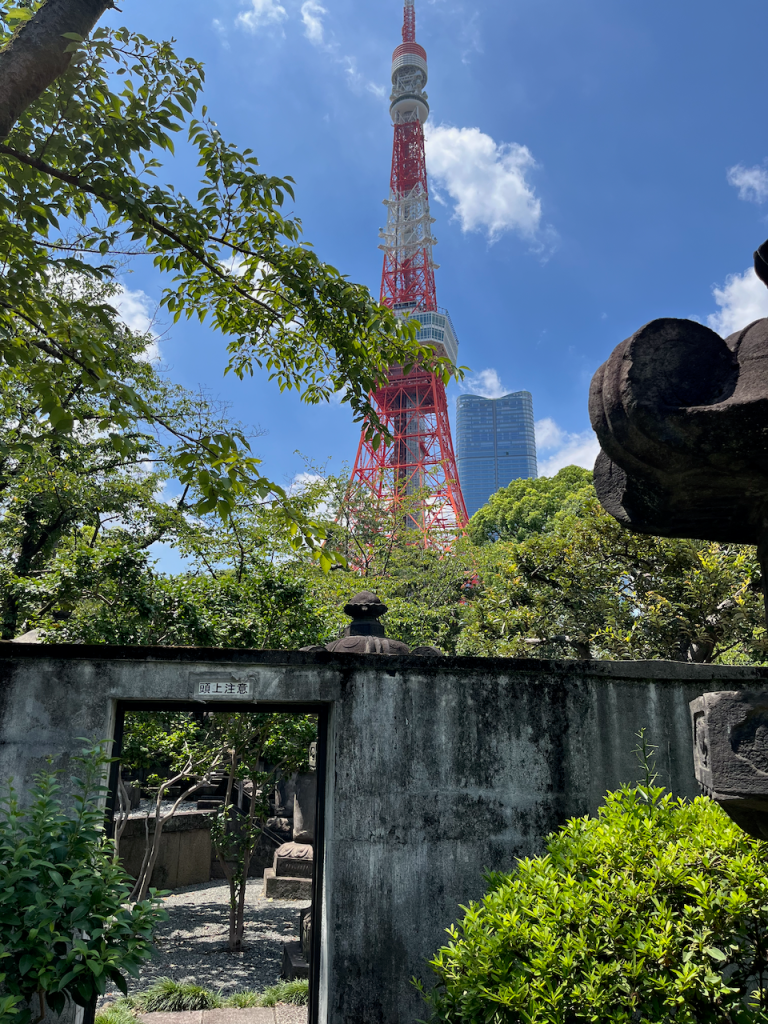
Not all shoguns are interred here. Some are interred in a shrine called Toshogu up north in Nikko. I would estimate that roughly half of the shoguns are interred here. I won’t show them all, since the map and pamphlet you receive at the ticket booth shows a full list. But to give a few examples…

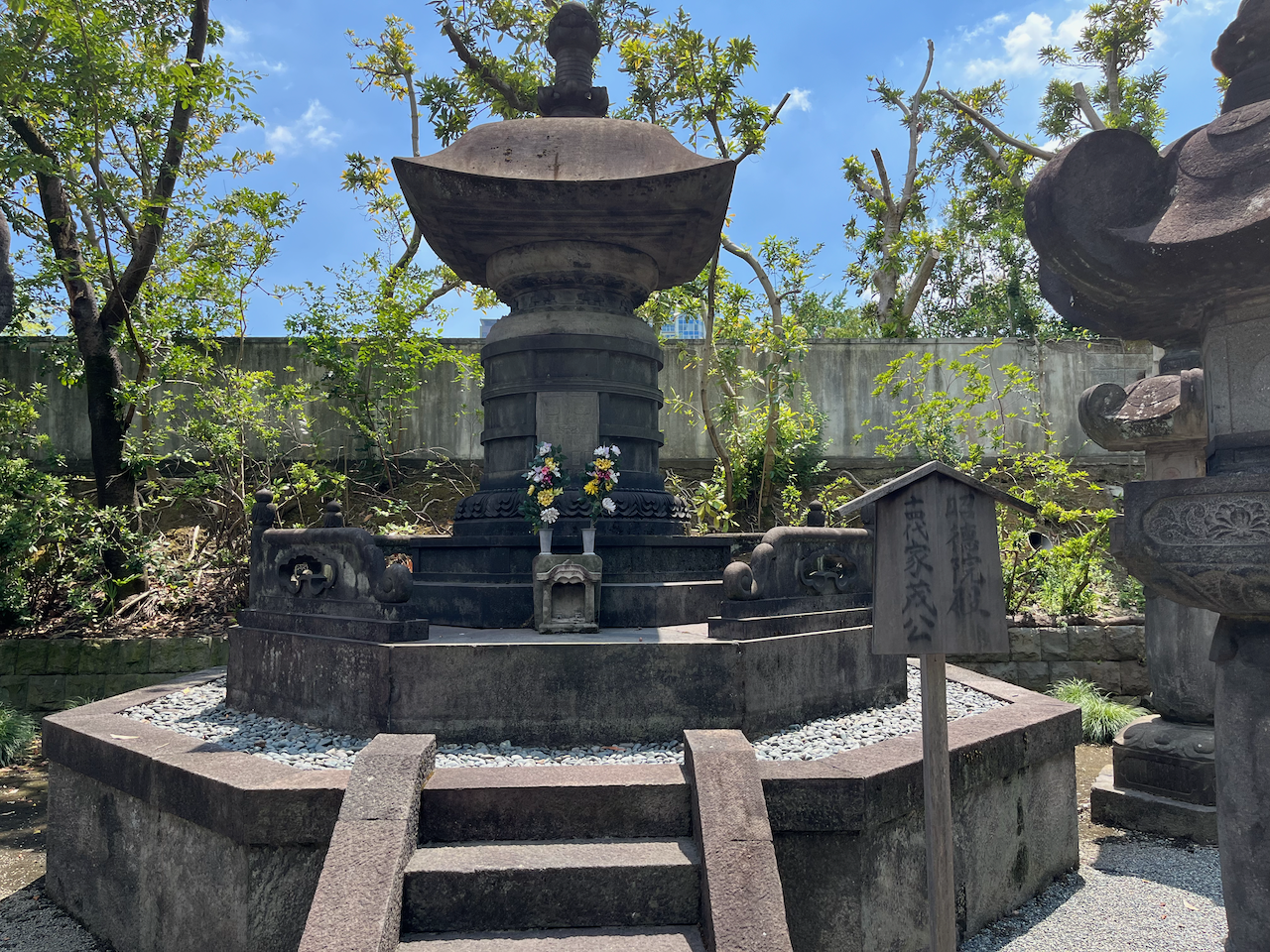
The second shogun, Tokugawa Hidetada and his wife are interred here. Edo (Tokyo) was greatly expanded during his administration from a tiny fishing village to the city we know today.
The aforementioned Tokugawa Iemochi is interred here.
Princess Kazunomiya is interred here.

From the mausoleum entrance, if you were to go further left you will see this statue:

Without getting too bogged down in details, the four statues here represent four major Bodhisattvas in the Mahayana-Buddhist tradition. From left to right with Sanskrit (and Japanese) names:

  • Manjushri (Monju)
  • Avalokitesvara (Kannon)
  • Ksitigarbha (Jizo)
  • Samanthabhadra (Fugen)

It’s actually quite rare to see all four arrayed like this. I was kind of impressed. It is said these statues were created in the year 1258 according to the plaque.

Further left:

If you go up the stairs and turn right…

You can find the tea house of Princess Kazunomiya called the Teikyōan (貞恭庵):
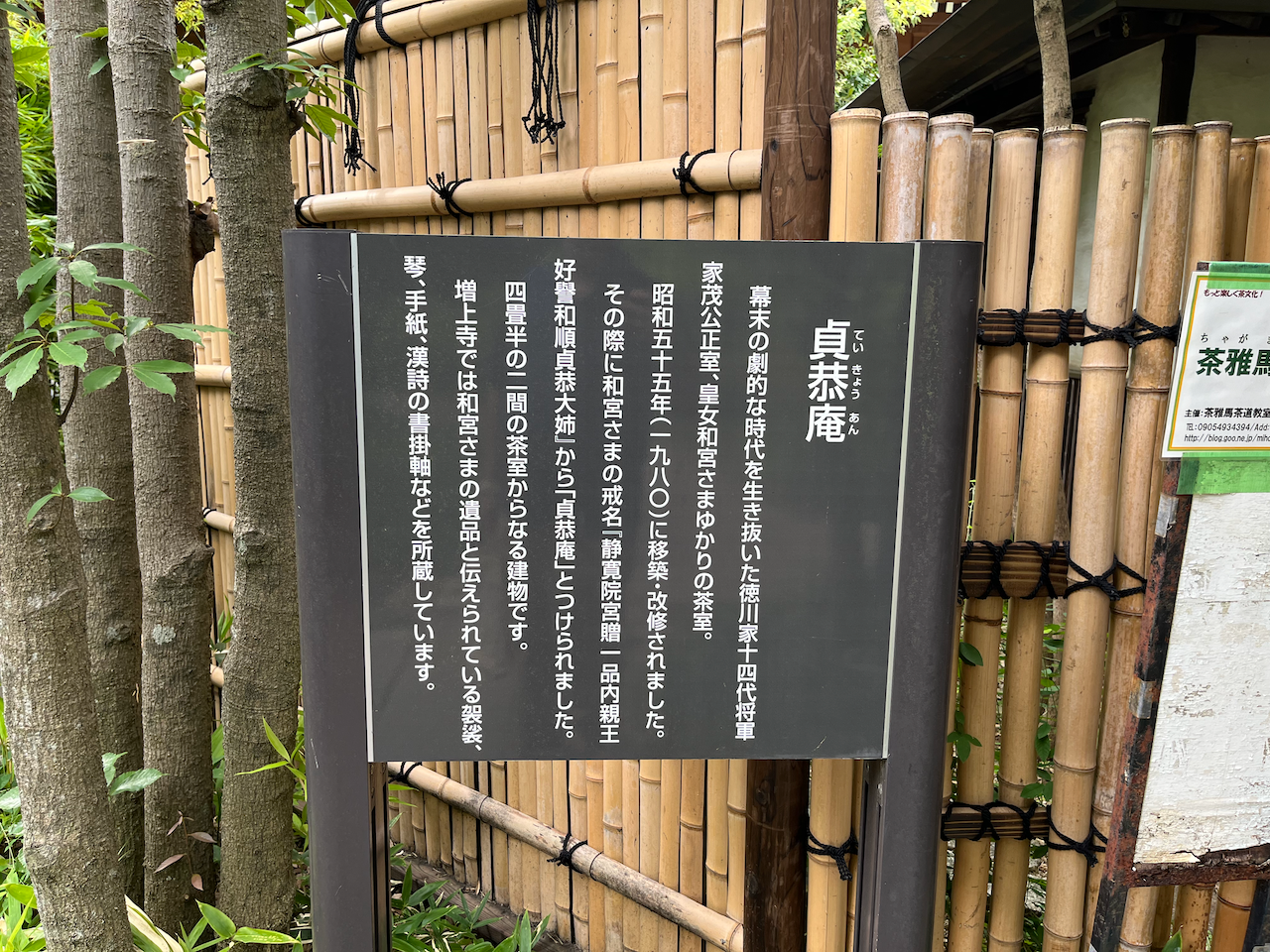
Since Princess Kazunomiya took tonsure as a Buddhist nun in her final years, she took the ordination name Teikyo, so the name of the place is basically “Princess Kazunomiya’s hearth”. The sign said that it was refurbished in 1980 and is used for some public functions. It was closed when I came so I didn’t get to see much.

Facing the tea house is another statue of Kannon Bodhisattva in a more motherly form.

Past the tea house and up some stairs is this place, which is the upper part of the map:

It turns out that this is a columbarium: a storage house for the bones of the deceased after cremation. This is common in Buddhist temples. This columbarium in particular houses the bones of those who are somehow connected to the temple across the generations. Beyond that, the website didn’t provide an explanation.

By this point I wanted to see the museum but again I had arrived too early so I stopped by a local McDonald’s for brunch:

On the way out, I also took photos of the Buddhist bell (bonshō 梵鐘) as well:

And a small Shinto shrine to the right of the main entrance:

This Shinto shrine, called the Yuya (熊野) Shrine, was founded in 1624 by the 13th head priest of Zojoji, one Shoyo Kurayama, to protect the north-east corner of the temple from disasters. The north-east is seen as a particularly dangerous direction in Chinese geomancy (a.k.a. feng-shui), so the kami here provide protection. It is not unusual to see small Shinto shrines within Buddhist temples, and many Shinto deities are viewed as manifestations of Buddhist deities (gongen 権現) by Japanese in medieval times. The sign next to the shrine states that 3 kami reside here:

  • Ketsumiko-no-ōkami
  • Ōnamura-no-mikoto
  • Izanagi-no-mikoto (as in Izanagi from early Japanese mythology? I am not sure)

These three kami all seemed to have been imported from a trio of Shinto shrines called the Kumano shrines, which have a strongly syncretic Buddhist-Shinto worship. I didn’t even know the Kumano shrines existed until I wrote this article. Side note: the Chinese characters for Kumano (熊野) can be alternately read as “Yuya”, hence “Yuya Shrine”.

Anyhow, having satiated myself on McD’s, it was time to go back and visit the Museum…

Much of the museum doesn’t allow photography, but showed the history of Zojoji. As it is being restored from earlier destruction, there wasn’t actually that much in the museum.

However, what the museum also had (and OK to photograph) was a genuine relic of the Buddha, as in Shakyamuni Buddha, the historical founder. It also contains relics of Rahula, the Buddha’s son before his enlightenment, and Ananda, his trusted retainer. As the sign shows above, the relics were uncovered at Sanchi, which is an important Buddhist archeological site. The relics were given to Japan as a gift in 1955 and enshrined right under Zojoji. You can see

A display to the right shows the contents, and the letter from India to Japan. In addition to fragments of the bones of Shakyamuni Buddha, Rahula and Ananda, the contents included recovered copies of Buddhist sutras that were inscribed on palm leaf at the time, and a seed descended from the original Bodhi Tree.
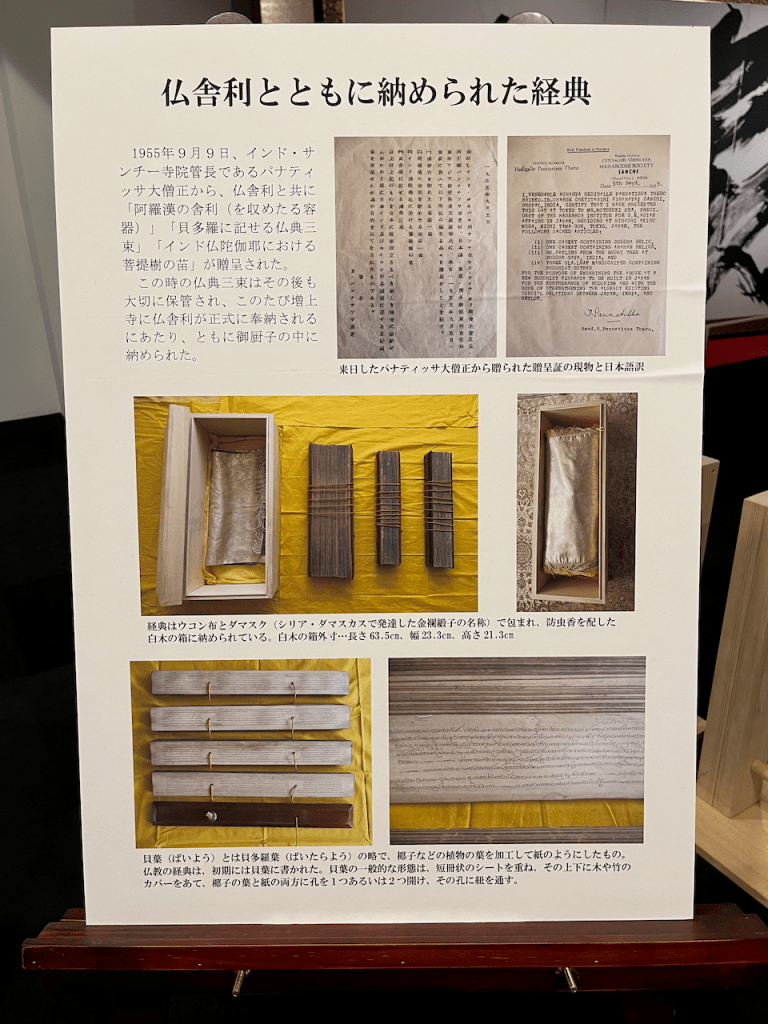
In my nearly 20-25 years as a Buddhist, I had never come face to face with a relic of the Buddha before, so I was kind of awestruck. The small wooden plaque just in front of the small statue of the Buddha contained a small prayer that reads:

Recite 3 times: namu shaka muni bu (praise to Shakyamuni Buddha)

followed by a longer hymn:

kyo rai ten nin dai kaku son

go ja fuku chi kai en man

in nen ka man jo sho gaku

ju ju gyo nen mu ko rai

(then recite the nembutsu 10 times per Jodo Shu tradition…)

I don’t have a translation of this hymn, but after a bit of late night sleuthing, I suspect it’s a verse from a Buddhist text called the Humane King Sutra. I don’t think there’s an English translation anyway.

In any case, I recited the verses of praise to Shakyamuni Buddha and finally went home.4

But that concluded the trip to Zojoji. Usually, I go with the family, and we can’t afford to spend half a day there, but this time I had some free time and was able to really take in all the sites of Zojoji. As a historical site, Zojoji is very dense and fascinating. It’s hard to imagine centuries of history, all closely tied to the Tokugawa shoguns and the Jodo-shu sect all in one place. The relic of the Buddha alone is pretty amazing too.

This post was pretty long, but I hope you enjoyed.

P.S. I didn’t really provide a lot of links to Jodo Shu Buddhism, since I talk about it quite a bit in the blog already, and many of the English sites have sadly atrophied or disappeared over time. I would definitely recommend various books such as A Raft from the Other Shore or Traversing the Pure Land Path, but these are mostly out of print now. I have done what I could over the years to distill many of these lost sources into an accessible format here, but there’s still plenty to find if you know where to look.

1 This is actually a slang phrase in Japanese too, taken from English: pawaa supotto (パワースポット), meaning any place that inspires you spiritually.

2 Without getting too bogged down in history, think of a shōgun (将軍) as the Imperial-appointed “General Commander of the Armed Forces”. The role has changed and evolved over generations, but suffice to say if you were the shogun, you were the real, not symbolic, authority in Japan.

3 The astute might be wondering why a temple devoted to Amida Buddha also contains so many statues to another figure like Kannon. In Mahayana Buddhism, the two share a close relationship. It is described in the sutras who Amida Buddha is attended to by two Bodhisattvas: Kannon and another named Seishi. Kannon has an outsized following of their own, but the two are frequently depicted together, as both embody the universal goodwill and compassion that are hallmarks of Mahayana Buddhism. Seishi, admittedly, isn’t described much in the Buddhist texts, and thus isn’t revered much on their own.

4 Actually, I stopped along the way at Akihabara because I had never been there. That place was … not for me. Nerdy, but in a very different way. I did have some good fries at a Turkish cafe in Akihabara for dinner, thanks to Mustafa the chef. Very nice fellow. If you are in Akihabara, stop by his cafe and get some good Turkish food.

Night and Day: Tendai Home Practice Redux

Home services in Japanese Buddhism, known as otsutomé (お勤め) or more formally gongyō (勤行), have many different approaches. It often depends on sect, particular communities, and personal preference. Trouble is, English sources are often confusing or insufficient. So, I try to look up information in Japanese, which is sometimes harder than you might think.

Anyhow, something I’ve learned recently about Tendai Buddhism, is that at least in some Tendai traditions, home practice might be divided between a morning service and a night service. This is in keeping with the two concepts in Tendai (more on that here):

Thus, in lay-Buddhist home services for Tendai Buddhism, some communities tend to divide the morning versus evening services to reflect these two concepts.

This page from the Jimon-branch of Tendai Buddhism, based in the famous Mii-dera Temple (as opposed to the Sanmon-branch based in Enryakuji atop Mount Hiei) shows example services for both morning and evening. I can’t translate everything word for word from the site, but let me try to summarize the basic format.

Morning Service

For the morning service, one pays homage to the Buddhas and Bodhisattvas “of the ten directions”1 and takes the Lotus Sutra as their basis. The morning service cited in the Jimon-sect page is based on a treatise by founder Saicho called the Hokke Sanmai Gyōhō (法華三昧行法), and for some reason is much shorter than the evening service.

The morning service is comparatively short, but includes liturgy such as:

  1. The Kannon Sutra – chapter 25 of the Lotus Sutra
  2. The Heart Sutra
  3. Dedication of Merit for all sentient beings’ welfare

I left out some of the liturgy from this list because I could not find details, or they were very specific to the Jimon sect (e.g. praises of Saicho’s disciple Enchin, who is the source of the Jimon branch), but hopefully you get the idea. This emphasizes the here and now, and seems rooted in the hokke senpo side of Tendai Buddhism to me.

Evening Service

The evening service by comparison uses the Amitabha Sutra as its basis and includes somewhat different liturgy.

  1. Verses of Repentance
  2. Verses of the Opening of the Sutra
  3. The Jigagé verses (chapter 16) of the Lotus Sutra
  4. Hymns to Amida Buddha
  5. Mantra of Light
  6. Reciting the Nembutsu
  7. Dedication of Merit for Rebirth in the Pure Land (this differs slightly from the morning service version).

It’s interesting to note that the evening service still includes verses from the Lotus Sutra, but also mixes the Nembutsu and Mantra of Light as well and definitely emphasizes the reiji saho side of Tendai.

Conclusion

As these are services associated with just one sub-sect of Tendai, and since people often add, subtract or adapt services to meet their needs, it’s perfectly fine to adjust this to whatever works in your situation. You could potentially reduce this all the way down to reciting the Heart Sutra in the morning, and the nembutsu at night. Or something similar. As long as it is sustainable, and captures the spirit of Hokke Senpo and Reiji Saho.

The themes of morning services expressing hokke senpo, and evening services expressing reiji saho, are a great way to apply Tendai teachings in one’s own life, or just Mahayana Buddhism in general.

P.S. features the gardens of Mii-dera temple, photo by E5894, CC BY-SA 3.0, via Wikimedia Commons

1 The eight cardinal directions, plus up and down.

The Pious Prince Shotoku

This pagoda (Buddhist stupa) we saw in Kyoto near Kiyomizudera is among others attributed to Prince Shotoku.

The 6th century Prince Shotoku (Shōtoku Taishi, 聖徳太子) holds a revered place in Japanese culture not unlike Constantine the Great, Emperor Ashoka, or Good King Wenceslas. Even today, kids in Japan learn about Prince Shotoku through comic books, art and even the two-thousand yen bill. Even my son, who’s grown up in both Japanese and American culture has learned about the famous prince who was so smart that he could listen to ten conversations at once and recall each individually.

On a historical note, several famous Buddhist temples and pagoda (Buddhist stupa) are attributed to Prince Shotoku, including Horyuji. Further, he reorganized the Yamato court in a Confucian-style bureaucracy and is said to have composed an early Buddhist constitution.

But who was Prince Shotoku?

Prince Shotoku was part of a powerful triad at the time, consisting of Empress Suiko, a rare example of a powerful empress in Japanese history, Prince Shotoku as regent and advisor, and Soga no Umako, head of the powerful and reformist Soga Clan with strong connections to Korean and Chinese communities.

Japan at this time was emerging from geographic isolation and increasingly establishing cultural contacts with the Korean Peninsula, and with Tang-Dynasty China. This led to a power struggle between more conservative, nativist clans such as the Mononobé and Nakatomi, and reformist groups such as the Soga. The triad above were definitely reformist, and clashed with the conservative faction eventually leading to war.

According to the Nihon Shoki, on the eve of battle, Prince Shotoku prayed to the Four Heavenly Kings (a group of Buddhist guardian deities) for success. Upon crushing the Mononobe and their allies, Prince Shotoku built and dedicated the temple of Shitennnoji to the victory. The rest, as they say, is history.

Let’s talk about some of the things attributed to Prince Shotoku…

Buddhist Constitution

In 604, Prince Shotoku supposedly promulgated a seventeen article constitution based on Buddhist and Confucian principles: the jūshichijō kenpō (十七条憲法). Unlike a modern constitution, it was not legally binding, but more of a vague statement of governance, and was later replaced by the Ritsuryo System in the 8th century.

Translations of the 17 Article Constitution are hard to find, but you can see examples of it here and here.

Japan’s New Name

Names for Japan in early, early history varied and inconsistent. Chinese officials called it the land of Wa (倭), and Japan often called itself Wakoku (倭国) or Yamato (大和). However, the modern Japanese name for Japan, Nihon (日本) is attributed to a letter that Prince Shotoku wrote introducing his sovereign to the Sui Dynasty in China:

“From the sovereign of the land of the rising sun (hi izuru tokoro) to the sovereign of the land of the setting sun.”

The “land of the rising sun” evolved into Nihon (日本, lit. “where the sun comes from”).

Further, by putting the Emperor of Japan on equal footing as the Emperor of China, Prince Shotoku was not so subtly rejecting the Chinese-centric world view.

The Cap and Rank System

Prince Shotoku is also credited with establishing the first meritocracy in Japan in 603, inspired by Chinese Confucianism called the Kan’i Jūnikai (冠位十二階, “Twelve Cap and Rank System). The idea was to get out of hereditary government appointments, and promote ministers based on skill and talent, using a series of colored caps to correspond with rank (instead of lineage).

Promulgation of Buddhism

A copy of the Lotus Sutra said to be composed by Prince Shotoku. 日本語: 尾上八郎English: Hachiro Onoue, Public domain, via Wikimedia Commons

Prince Shotoku was said to be a great promoter of the Buddhist faith in Japan. We talked about the conflict with the nativist Mononobé clan earlier, who held to the Shinto faith, but after Shotoku’s victory, he continued to build temples such as Horyu-ji and stupas (like the one shown above), copy sutras, and so on.

Further, later generations of Buddhist teachers in Japan revered Prince Shotoku almost as a cult figure, often conflated with Bodhisattva Kannon. Even today, if you go to many Jodo Shinshu Buddhist temples, you will often see a scroll of Prince Shotoku to the side of the central altar due to the founder Shinran’s devotion to Shotoku.

Historicity

The historicity of Prince Shotoku is interesting though. While a historical figure named Prince Umayado (厩戸皇子) is thought to have really existed, and is thought to be the origin of Prince Shotoku, many of the stories and accomplishments attributed to him may have come from other sources.

Early Japan at this time was importing much mainland culture through the Korean kingdoms of Baekje and Silla, as well as China, and this often meant that immigrant families migrated to serve the early Japanese court. The Hata clan, for example, came from Silla.

The book Shotoku shows how certain subtle aspects of the Shotoku myth stories reflect cultural sources from Silla, via immigrant groups such as the Hata clan. This is through specific imagery used, coupled with archeological evidence from known sites in early Japan where immigrant groups habited, and their influence on local Shinto shrine practices.

For example, a famous story in the Nihon Shoki about Prince Shotoku and the Beggar of Kataoka reads as follows, with [my additions] and (additions from original author):

21st year, 12th month, 1st day.

The crown prince [Shotoku] made a journey to Kataoka. At that time there was a starving man who was lying at the side of the road. He asked for (the beggar’s) name, but he said nothing. The crown prince seeing this, gave him food and drink. He then took off his cloak, and covered the beggar with it, saying “lie there in peace.” He then made a song.

12th month, second day.

The crown prince sent a messenger to see the starving man. The messenger returned and said “The serving man is already dead.” The crown prince was greatly saddened by this and he therefore had them bury the man at that spot in a tomb that was firmly shut. Several days later [trimmed for brevity] he sent (another) messenger to look (at the tomb). The messenger returned and said “When I arrived at the tomb, (the earth) was firm and had not moved. (Yet) when I opened it and looked inside the corpse had already disappeared. There was only the clothing folded above the casket.”

At this the crown prince once again sent the messenger back to retrieve the clothing. He then wore it as he always had done. The people then all marveled at this and said “It is true that a sage knows a sage!”…

Shotoku, by Michael I Como, page 102

The story is hard for Western audiences, and even modern Japanese ones, to understand without additional context. Elements such as the dead resurrecting were motifs used by an immigrant community called the Wani clan from the Korean peninsula in their origin stories, and the notion of a “sage prince” was an idea imported from Chinese-Buddhist culture.

The book takes a very detailed an exhaustive look at the legends and stories of the time, but this example shows how the legend of Prince Shotoku was gradually constructed from obscure cultural trends and symbolism popular in antiquity, and conflated over generations. In later versions, for example, the beggar is the Indian monk Bodhidharma.

Zen, the Pure Land, and Buddhism Lite

Warning: long, (mostly) unedited, stream of thought. Sometimes it’s just funner this way. 😄

Since my trip to Japan and back, I’ve been kind of debating something in the back of my head.

Much of my background in Buddhism since as far back as 2005 has been in the Pure Land tradition, especially Japanese “Jodo Shu” and to a lesser-extent “Jodo Shinshu” sects. The sure openness and simplicity are very appealing, especially when I am having a hard time in my life. At other times, I see my conduct as backsliding or lazy, or that I am not grounding myself enough in the here-and-now, and so I tend to shift toward Zen. At such times, the passivity of the Pure Land path seems out of place with what I feel Shakyamuni Buddha would have wanted to us as disciples to do.

Buddhism, as a world religion, is a religion of doing not believing.

But the reason why the Pure Land tradition is so popular across many Asian cultures, and increasingly in the West is that it realistically assesses the situation of lay followers and provides an accessible path for them to follow.

The monastic/lay-disciple relationship within Buddhism has always been a challenge throughout its history since it tends to relegate the lay disciples as passive followers. The doing of Buddhism tends to favor those who are willing to commit the time and energy into it (i.e. mendicants, renunciants, etc), leaving the laity to support them, or at least participate as time allows.

The Buddha was not insensitive to this, and sternly reminded his followers that without the lay community, they could not be a Sangha. Further, many of the original precepts in the monastic code were to avoid monks and nuns abusing their authority over the laity, including the Rains Retreat. Further, when the lay community and monastic community have a healthy relationship, everyone benefits.

The catch is that even with good intentions, the laity are often put in a more passive role. Many of the traditional sutras in the Buddhist canon are intended for fellow monks, not laity. Many of the practices require time and effort that laity simply can’t do.

While Pure Land Buddhism does help to address this, I realized that it can also lead to complacency. When dealing with my puppy, who while adorable is still behaving like a puppy, or dealing with constant pressures at work, such things tend to bring out the worst in me, and simply reciting the nembutsu over and over doesn’t seem like a particularly effective strategy.1 Further, I don’t want to forget about my experience last year, and some of the insights I gleaned from that.

On the other hand, I’ve never really liked the Zen tradition, especially in the West. Western Zen tends to feel weirdly divorced from the tradition it inherits from, sometimes flippantly so, and tends to feel sterile and lacking any sense of community. People seem come to Zen centers and practices because they need something, not because they are happy to be there.2 The Zen community in the West is comprised of he same sort of people who argue online about why such-and-such Star Wars series is good/bad, or try to out-do one another in their knowledge of Zen esoterica. In other words, it’s saturated with smarmy nerds.

In much of the current Asian-Buddhist tradition, both the Pure Land and Zen tradition stand at opposite poles between utter passivity (“it’s OK, I have faith in Amida Buddha”) or utter DIY (“I’m gonna meditate my way to Enlightenment!”). There are many efforts over the centuries, to somehow wed the two traditions, and these efforts usually gravitate toward one pole or the other. The famous Chinese monk, Yunqi Zhuhong,3 was a particularly effective example of this, but Yunqi isn’t well known in the West. Ven. Thich Nhat’s Hanh’s interpretation of Pure land through the lens of Zen, Finding Our True Home, was a pretty good modern attempt as well.

Still, these are somewhat intellectual exercises, and not always useful to lay people who may not always understand either tradition. So, going back to my main concern: how do you make Buddhism accessible (and easily understood) to a wide, non-Buddhist audience while still keeping faithful to the Buddha’s teachings on discipline, wisdom and cultivation. Further, how do you keep the “heart” of Buddhism so it doesn’t become a nerdy, sterile exercise?

I think this is where the Lotus Sutra really comes in handy. The Lotus Sutra by itself is hard to discern, and pretty tough to read, but if you’re already familiar with Buddhism, I think it helps provide the “heart” of Buddhism and helps address the question: what’s the point of it all? The parables in the Lotus Sutra are also a really great way to get around intellectual discussions and convey Buddhist teachings in a way people can adopt and carry with them, hence their popularity throughout antiquity.

However, as with Zen or the Pure Land, it’s important not to get a one-sided, literalist view of the Lotus Sutra either, or a person will go off the rails. It’s a historical text, written with a specific audience in mind, and has to be taken into context. Yup, I said it.

Anyhow, to that end, I have been thinking about this and I feel there are certain universal practices in buddhism that, regardless of sect you follow, are really beneficial to observe. By beneficial, I mean, you are aligning with teh intention of what the Buddha would have wanted us to follow either as a lay-person or as a monastic disciple. In previous blogs, I called this “Buddhism Lite”, since it distills the tradition to as simple and generic an approach as I can. You can re-name it something else.

Buddhism Lite

  • Uphold five precepts – In my opinion, this is the most fundamental practice for lay Buddhists, and really dove-tails nicely with the other practices below. If you have to prioritize the precepts versus meditation and such, prioritize the precepts. They are also the easiest to integrate in everyday life.
  • Recite “nembutsu” – in this context I am using nembutsu as simply recollecting the Buddha, and venerating him. The Buddha is our beacon in this world, and so it behooves us to give due gratitude. To me, the simplest way to venerate the historical Buddha is to recite the phrase Namo Shakamuni Buddha. If you prefer another Buddha or Bodhisattva, that’s totally fine. In the end, there is only one Dharma,4 and each figure simply embodies it. The Dharma is what maters most, not the particular Buddha.
  • Mindfulness meditation – as much as I tend to avoid mindfulness meditation, there’s no denying that it’s central to Buddhism. It is the practice the Buddha prescribed most to followers, and has a tangible value both in the near term and in the long term. I won’t prescribe how much a person meditate; just work it into your life in a way that’s sustainable (like physical exercise).
  • Optional: Uposatha – I haven’t really talked about this much, but Uposatha is traditionally when the Buddha would set aside time for devout laity and the monastic community to practice together. Think of the Uposatha as like the Sabbath, or Sunday services, etc. Uposatha is traditionally held on six days of the calendar month: the 8th, 14th, 15th, 23rd, 29th and 30th days.5 The example below is a Uposatha service you can observe at home on Uposatha days, based on existing traditions. As with meditation, make it sustainable for your life.
    • Praise to the 3 treasures:
      • “I go to the Buddha for refuge”
      • “I go to the Dharma for refuge”
      • “I go to the Sangha for refuge”
    • Confession of transgressions: All of the misdeeds I have committed in the past are the result of my greed, anger and delusion. I repent these misdeeds.
      • The key here is not to “flog yourself”, it’s about observing scientifically when your own conduct fell short and acknowledging this, wiping the slate clean, and resolving not to do them again.
    • Recite a sutra, or part of a sutra: your choice.
    • Recite the “Nembutsu” three times – see above.
    • Dedication of merit – you are not just practicing for yourself, but also for the benefit of others.

I think the key here is balancing devotion to the Buddha as a teacher, with putting things into practice in real life, and avoiding complacency.

Anyhow, this has been a somewhat rambling stream, but it was easier to just write it all out in one shot than try to explain in something more polished and shorter. If you made it this far and find it useful, thanks!

1 This is something I recall from a Jodo Shu called the ippyaku-shijūgo-kajō-mondō (百四十五箇条問答) or “One Hundred and Forty Five Questions and Answers” addressed to Honen:

Q: Is it better to recite Nembutsu abstaining from doing evil and doing only good, or to recite Nembutsu believing only in the true wish of Amida Buddha?

A [from Honen]: Abstaining from the evil while doing good things is the total admonition of Buddha. But for us, living in the real world, we disobey the admonition, so by believing from the bottom of our hearts in the real wish of Amida Buddha to save all kinds of people, we are able to say “Namu Amida Butsu”. Amida Buddha will lead all people into the Pure Land without any discrimination between people with or without wisdom, or between those who can or cannot keep the precepts. Please keep this in mind.” (Clause 145)

http://www.jodo.org/teachings/teachings01.html

2 From Brad Warner’s blog:

Plus those adoring audiences of sincere truth seekers that I imagined would hang on my trippy words of wisdom were nowhere to be found in his case. Instead, he was surrounded mainly by curiosity-seekers who never stayed around long, or by needy hangers-on who often became angry and belligerent when they weren’t satisfied with what he taught — which was always. He did have a handful of sincere students, but we were not much help when it came to supporting him.

http://hardcorezen.info/so-you-want-to-be-a-dharma-teacher/7843

Although I don’t really follow Mr Warner, this has been my limited experience as well.

3 I wrote much of this Wikipedia article, so I may be biased. 😏

4 Chapter two of the Lotus Sutra, by the way:

But stop, Shariputra, I will say no more. Why? Because what the Buddha has achieved is the rarest and most difficult-to-understand Law. The true entity of all phenomena can only be understood and shared between Buddhas. This reality consists of the appearance, nature, entity, power, influence, inherent cause, relation, latent effect, manifest effect, and their consistency from beginning to end.”

source: https://nichiren.info/buddhism/lotussutra/text/chap02.html

In other words, the Buddhas all awaken to the same Dharma, and have the same qualities and awareness. The Dharma is what matters. Also, the Vakkali Sutta in the Pali Canon.

5 How would Uposatha look in February? I would probably just bump the 29th and 30th to March 1st and 2nd respectively.

Building a Sohei Warrior in Pathfinder 2e

Greetings role-players! A while back, I wrote a piece about making a sohei warrior, a Japanese soldier-monk, in Dungeons and Dragons 5th edition. Since I have transition away from D&D, I have been tinkering with a similar build concept in Pathfinder 2e, and wanted to share. This is just a suggestion, but it’s based on historical precedence as much as possible, while still retaining elements of high fantasy and heroism (important since sohei were often zealots and scallywags). Your mileage may vary, but I’ve enjoyed my character so far.

A statue of Benkei, the archetypal sohei warrior, in Tanabe city in Wakayama, Prefecture. shikabane taro, CC BY 3.0, via Wikimedia Commons

To recap my D&D post, sohei warriors were very similar to samurai despite name “monk” (which is an overloaded term anyway), but they were bodyguards and field-armies for powerful medieval Buddhist temples. In time, they attained a legendary status especially around a semi-legendary figure named Benkei. So many of modern tropes in Japan about sohei warriors are inspired by Benkei.

As soldiers, they frequently are depicted using naginata weapons (similar to a glaive) and katana, as well as wearing typical armor for the time underneath their white cowls. As devotees to a temple, they were not clerics and generally not ordained as priests, but did protect priests and temples, and further political/ecclesiastical issues as needed.

In a fantasy role-playing context, this feels like something akin to a Champion in Pathfinder 2nd-edition. For my character, I chose the Cause of the Paladin (lawful-good)1 since he would not only get Retributive Strike feat (very handy with a naginata), but also from a character-standpoint it made sense to be a protector figure, and also since Buddhism in real-life is a lawfully-inclined religion anyway. I play my character, Shinji, as a straight-laced, through trigger-happy and somewhat clueless character. He is blinded by his devotion at times, but means well.

Shinji as shown on the Nexus site. I couldn’t find the export link, and since the service is still in Beta, many things might change.

For the Retributive Strike feat, if you combine that with 2nd-level feat Ranged Reprisal, the 10-foot range of the naginata now becomes 15 feet.

As for equipment, shields in the Western sense were never really used in Japanese combat, so I didn’t equip Shinji with one, even if he has the option. Instead, I focused on offense by equipping with both a naginata and a katana. If you don’t have the necessary source books, the stats are freely available on Archives of Nethys links above. By second level, I equipped Shinji with scale mail armor.

In the current story, my kids and are playing a small 3-person party exploring the city of Absalom, and Shinji had been dispatched here from Minkai to protect a local priest at the branch temple in Absalom. However, upon arriving, the priest is nowhere to be seen, and the temple is barred shut. So, part of his side story is to unravel what happened, while finding something else useful to do in the meantime (i.e. helping my kids’ characters).

All the guidance above are build suggestions, but if you read the history of the sohei, it is probably (in my opinion), the closest fit I can come up with while still keep it fun for a high-fantasy setting. Your mileage may vary, but I hope you have fun and good luck building a sohei warrior of your own!

1 I know that in the latest Pathfinder updates the alignment system is being deprecated, but for simplicity’s sake, I am mentioning it here.

The Golden Pavilion of Kyoto

Hello dear readers,

I am back from my trip to Japan, and while jet-lag is keeping me up at odd hours, I wanted to post some photos from certain places we visited. This year, we visited Kyoto and Nara for the first time since 2010. This was the first visit by my son, who was born after 2010, and his first chance to ride the Bullet Train (e.g. the Shinkansen in Japanese).

I’ve talked about the Golden Pavilion before, but this post uses more updated photos, and more detailed information.

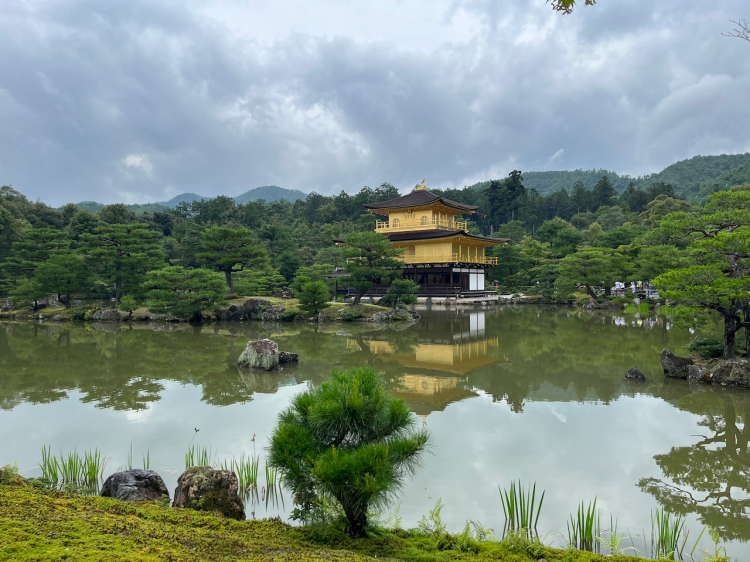
The Golden Pavilion, known as Kinkaku-ji (金閣寺) in Japanese, is technically speaking a Buddhist temple called Roku-on-ji (鹿苑寺). The property of the Golden Pavilion has a long history, first as a villa for the nobleman Fujiwara no Kintsune (who wrote poem 96 in the Hyakunin Isshu, by the way), then centuries later purchased by the Shogun (military dictator) of the time, Ashikaga Yoshimitsu as a personal villa. More on that later. In any case, Yoshimitsu eventually retired and took tonsure as a monk, living at the villa. When he died, the villa was converted to a Rinzai-sect1 Zen Buddhist temple in his honor.

1 Why Rinzai Zen? This is a topic that’s too long to go into here (I should probably make a post about it someday), but during the Ashikaga Shogunate, Rinzai Zen enjoyed a booming popularity in Kyoto the capitol, but also it was organized in a network of temples called the Five Mountains system (modeled after Song-Dynasty China).

Anyhow, let’s take a look. When you first enter the pavilion grounds you see a plaque like so:

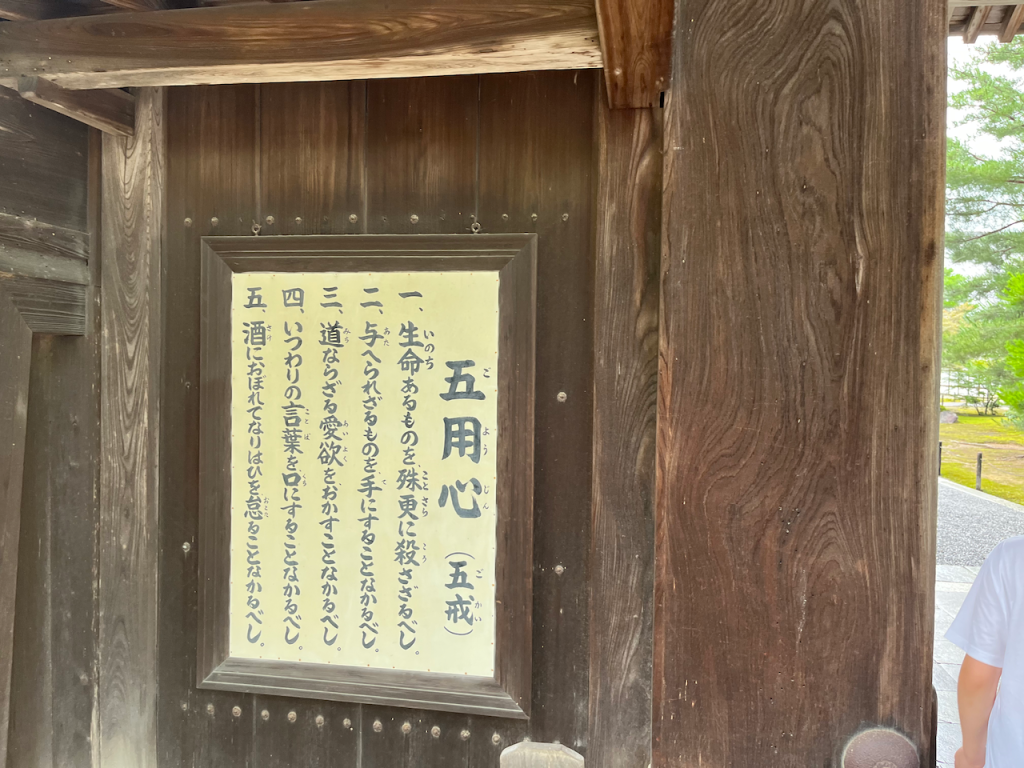
The Five Precepts (gokai 五戒)

This plaque shows the Five Precepts of Buddhism, which is something you don’t normally see in Japanese-Buddhist temples.

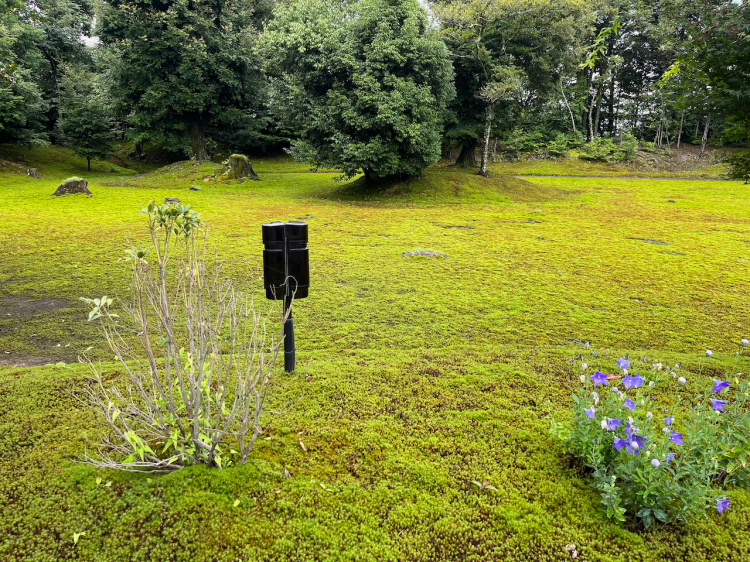
After this, you see a moss garden like so:

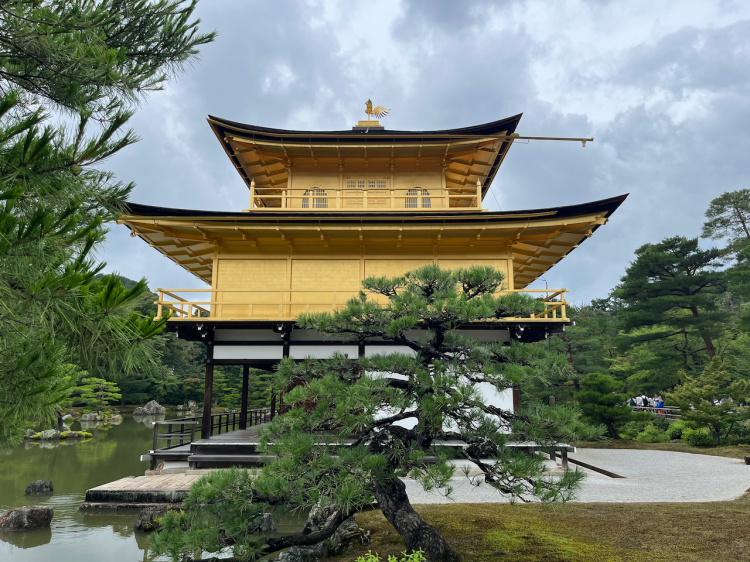
If you keep moving onward, you’ll see the pavilion itself to the right:

If you look up close…

The gold leaf on the temple has been reapplied since the past, as the original sheen peeled off over the centuries, and the pavilion itself was also damaged by an act of arson in 1949.

Our tour guide pointed out that the three levels of the pavilion use different architecture intentionally: demonstrated the Shogunate’s triumph over his political rivals (notice how the first floor is not covered in gold leaf). The bird at the very top is a Chinese phoenix bird, not to be confused with the Western version. The Shogun wasn’t being subtle.

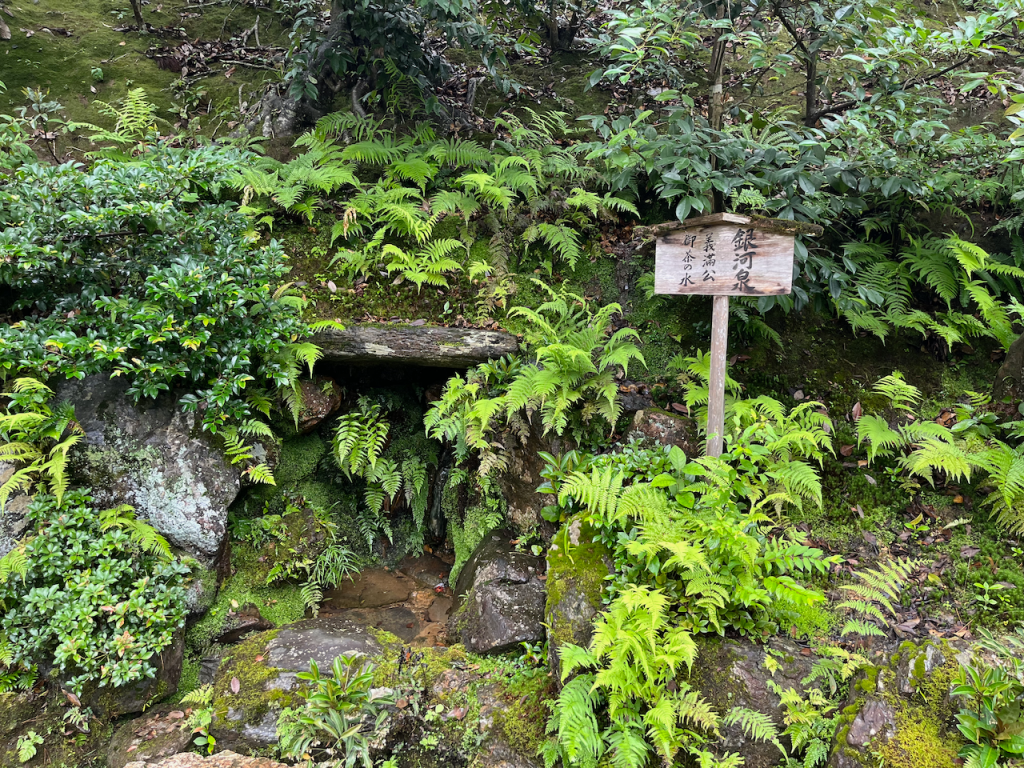
The back half of the pavilion grounds is a long garden walk with a waterfall among other things:

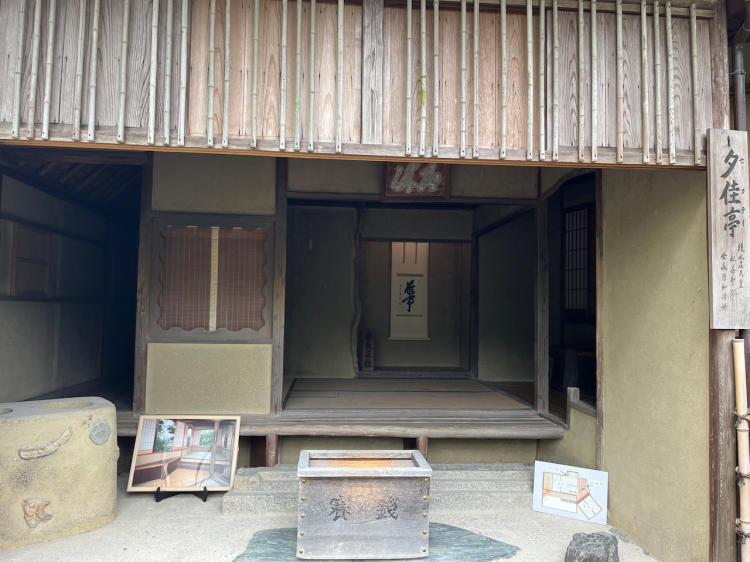
Culminating in the famous tea house:

The tea room, called the sekka-tei (夕佳亭), was actually built centuries later when the temple was revived, and visited by the reigning emperor, Go-Mizu-no-o and indirectly inspired by the first tea house of the Silver Pavilion, ironically by Yoshimitsu’s grandson Yoshimasa.

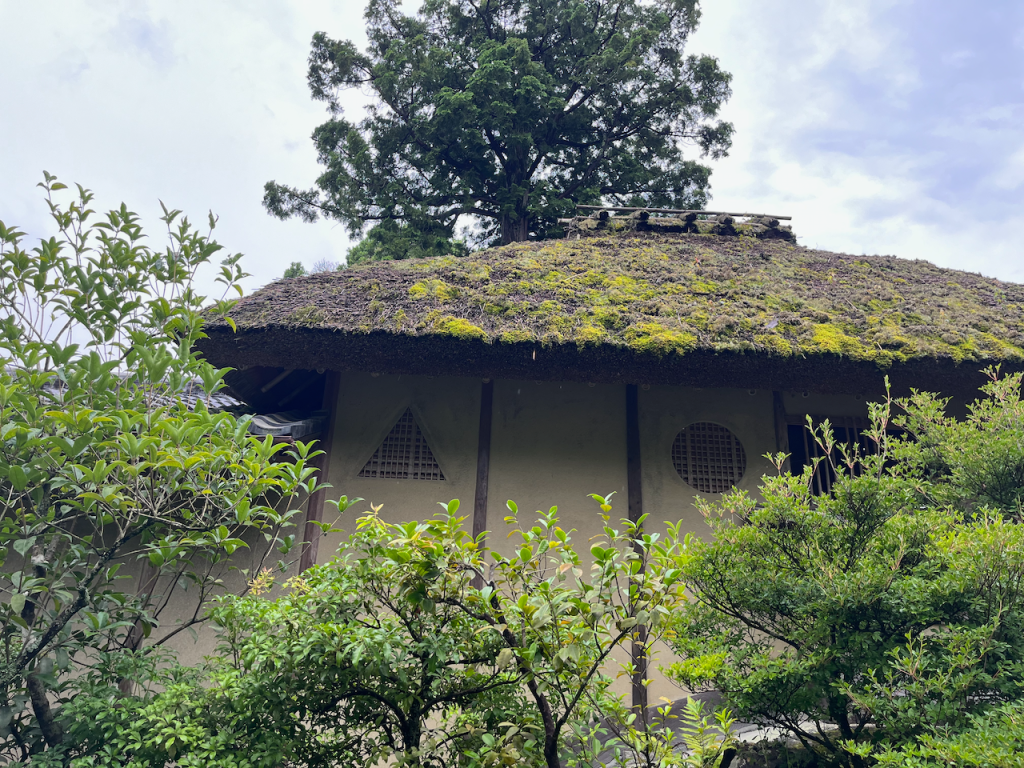
The Sekka-tei includes some interesting architectural design choices as well:

All in all, the Golden Pavilion is an interesting mix of noble aesthetics, history, and Zen influence, and of course a monument to the Shogun Ashikaga Yoshimitsu.

1 Why Rinzai Zen in particular? During the Ashikaga Shogunate, the Rinzai Zen sect had a boom in popularity due in part from influence by Song-Dynasty China. This led to the Five Mountains system for organizing temples into a state-sponsored system. More on that in a future post.

Little by Little

Hello from Japan!

The family and I staying with family again, and boy I forgot how hot and humid the summers are. It’s currently the monsoon season (梅雨, tsuyu) so it rains a lot, and even indoors it’s hot and sticky without A/C. This is also the season of the Rains Retreat in Buddhist Japan in the olden days.

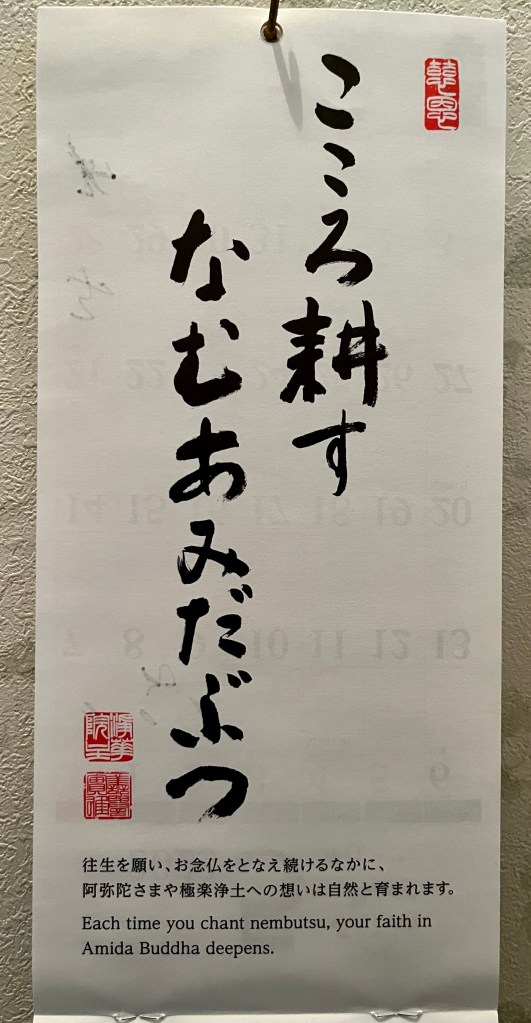
Anyhow, recently I saw this Jodo-Shu Buddhist-themed calendar around the house:

The English translation is very close, but the Japanese has some extra nuance that’s noteworthy.

In Japanese is written:

こころ耕す kokoro tagayasu

南無阿弥陀仏 namu amida butsu

The first line, means to cultivate the heart using the verb tagayasu (耕す), which implies tilling a field, or plowing a field.

So, it’s not just an academic exercise in reciting the nenbutsu, it cultivates the heart like a field. If you let the field go fallow, nothing grows except maybe some weeds. Buddhist practice is much like this, whether it be the nenbutsu or some other practice.

Namu Amida Butsu

Practical Buddhism

Recently, I’ve been reading some old books of mine about the life of Honen, a 12th century Japanese-Buddhist monk who started the Pure Land movement in Japan which includes Jodo Shu and Jodo Shinshu Buddhism. Honen had a pretty eclectic following: from nobility in the elite Fujiwara family, to prostitutes, ex-monks, etc.

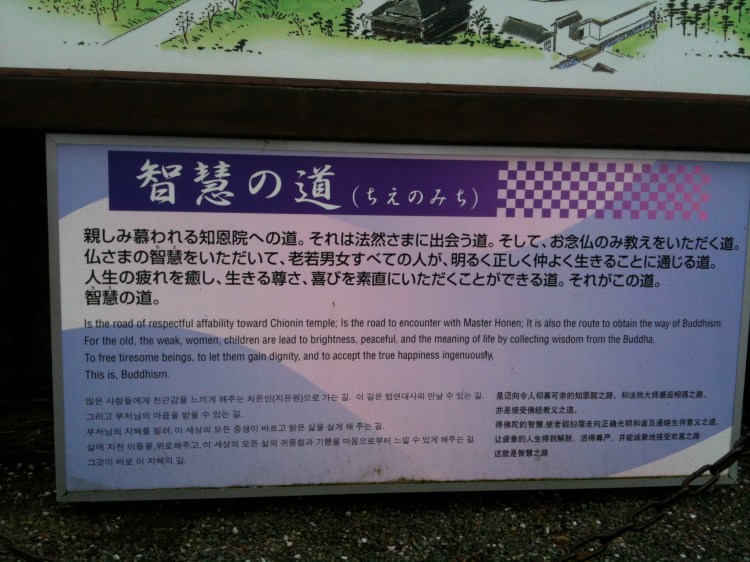
Taken in 2010 at Chion-in Temple in Kyoto, Japan, this is one of two head temples of Jodo Shu, and where Honen’s mausoleum is said to be. This was a sign posted near the main gate.

In one famous dialogue, Honen is talking with a former robber named Amano Shiro (天野四郎), who had previously been a leader of a gang in Kawachi Province and had reputedly killed some people as well. In his old age, he became inspired by Honen’s teachings and became a devout follower named Kyo Amidabutsu (教阿弥陀仏). One night, while staying with Honen, Kyo Amidabutsu had woken up in the middle of the night to hear Honen reciting the nembutsu by himself. When Honen realized he was no longer alone, he quietly went to bed.

A few days later, Kyo Amidabutsu went to talk to Honen. He had no family to care for him in his old age, and so he would be leaving soon to stay with a friend in a remote province in the east. Before he would leave though, he had some questions for Honen.

In the dialogue, as recorded in both Honen The Buddhist Saint and Traversing the Pure Land Path, is pretty long, Honen carefully explains what the nembutsu is all about, and patiently answers Kyo Amidabutsu’s questions. For example, Honen explains the significance of the nembutsu:

First of all, notice that there is nothing so extremely profound in the nembutsu at all. The only thing to now is that everyone who calls upon the sacred name [namu amida butsu] is certain to be Born into the Pure Land. No matter how educated a scholar may be, he has no right to assert that there are things in our school [e.g. Pure Land Buddhism] which really do not belong to it.

Page 61-62, “Traversing the Pure Land Path”

Here, Honen is trying to counter some of the other Buddhist schools at the time, which tended to emphasize a more esoteric, intellectual meaning, something that would require considerable time and effort for a monk to discover through practice, esoteric initiations, and meditation. Kyo Amidabutsu, as an elderly commoner in the 12th century, would probably had a minimal education, and thus would’ve found all that intimidating, assuming that he could even take tonsure and become a monk.

I really like the fact that Honen is not hitting Kyo Amidabutsu over the head with a bunch of doctrinal explanations about the Four Noble Truths, Karma, Rebirth, etc., either. Instead, he’s providing a simple, straightforward path with no hidden, mystical or esoteric meanings. It’s not that these aren’t important, but Buddhism is first and foremost a religion of practice, not belief, so these can be learned gradually.

Next, Kyo Amidabutsu asks a series of questions about when is it the right time to recite the nembutsu, whether to setup an altar, wear clerical robes, etc. Honen’s reply is similarly straightforward:

The nembutsu may be practiced whether you are walking, standing, sitting, or lying [down]. So it can be left to everyone according to their circumstances to do it either reclining or sitting or in any way they choose. And as to holding the rosary or putting on the robes, this also should be decided according to circumstances. The main point is not the outward manner at all but the fixing of the mind on the one thing — firmly determined to gain ojo [往生, rebirth in the Pure Land] and with all seriousness calling upon the sacred name [namu amida butsu].

Page 65-66, “Traversing the Pure Land Path”

This sense of sincerity is the key, as Honen teaches. For Kyo Amidabutsu’s sake, he uses an analogy of a thief who means to rob a house:

“Down deep in his heart [the thief] means to steal, but as far as his outward appearance is concerned, he gives not the slightest indication to others of his purpose by look or gesture. As others know absolutely nothing about the purpose to steal that is in his heart, we may say that the purpose is for him alone, without any reference to outward appearance. Such an undivided heart as this is necessary in the man who would make sure of birth into the Pure Land [of Amida Buddha].

Page 63, “Traversing the Pure Land Path”

In my limited experiences talking with people who are curious about Buddhism here in 21st Century America, I often notice that they are curious, but don’t know where to begin, and find it a bit overwhelming. Buddhism is hard to explain, and yet most of that information isn’t necessary upfront either. If people want to know more, they can (and will) ask. Instead of hitting people over the head with a bunch of esoteric, mystical or complicated psychological explanations, it’s probably better to just KISS: Keep It Simple, Stupid.

Buddhism isn’t meant to be an intellectual playground for the upper classes, it’s meant to help people from all walks of life. Everyone should feel free to begin the Buddhist path just as they are, and go at their own pace, using the tools they have.

Honen was sensitive to Kyo Amidabutsu’s situation and provided a straightforward, simple practice that provides both a sense of spiritual comfort, but also something very flexible and adaptable to his circumstances. Kyo Amidabutsu is old, has no kin, financially broke, and has no where to live. He probably doesn’t even know when he might eat next, or where he might sleep next. So, it has to be something that can be adapted to his existing lifestyle, and straightforward (not esoteric) enough that it is easy to understand yet provides a sense of refuge in a chaotic world. It may be looked down upon by more “elite” Buddhist followers, but for Kyo Amidabutsu, it’s just right.

Indeed, in founding the Jodo Shu sect, Honen reportedly once said:

The reason I founded the Jōdo [浄土, Pure Land] sect was that I might show the ordinary man how to be born into the Buddha’s real land of recompense [e.g. the Pure Land]. According to the Tendai sect, the ordinary man may be born into the so-called Pure Land, but that land is conceived of as a very inferior place. Although the Hossō [Yogacara] sect conceives of it as indeed a very fine superior place, they do not allow that the common man can be born there at all. And all the sects, though differing in many points, all agree in not allowing that the common man can be born into the Buddha’s land of real compensation….Unless I start a separate sect, the truth that the common man may be born into the Buddha’s land of compensation will be obscured, and it will be hard to realize the deep meaning Amida [Buddha]’s Original Vow [to provide a refuge for all beings].

Honen: The Buddhist Saint, page 23-24

For this reason, I come back again and again to Jodo Shu Buddhism over the years because even when I quibble about specific details, it’s accessibility, and simple message is pretty hard to beat within the Buddhist world. It meets the needs of all walks of life, and does not overwhelm people with philosophical details, yet it also provides plenty of flexibility to grow and learn as well. I feel this is an exemplary example of Buddhist metta if nothing else.

Namu Amida Butsu

Pure Land Buddhism at Large

Recently, I took some personal time to delve deep into Pure Land Buddhist teachings, re-reading some old books, but also some new ones. In particular, I was very impressed by Charles B Jones’s latest book, an excellent survey of the entire Pure Land tradition in Mahayana Buddhism.

If you’re not familiar with Pure Land Buddhism, this is a broad, broad tradition in East Asia, focused on a single Buddha named Amitabha, not the historical Buddha (Shakyamuni). There are way more devotees of the Pure Land path in many Buddhist countries versus, say, Zen practitioners. It is said that Amitabha, according to the Buddhist canon (a.k.a. the sutras), made a great series of vows to provide a refuge for all beings if they with to be reborn there. In this refuge, one will unfailingly become an enlightened being, by virtue of being so close to a living Buddha.

This might seem weird at first glance, since Shakyamuni Buddha started the whole religion in the first place, right? It’s a long story of how we got to something like Four Noble Truths to something like an ethereal paradise where people can go simply by reciting his name.

Charles B Jones’s book actually does walk through how this tradition evolved from an advanced meditative practice in India to the forms we see today, so that alone is worth reading the book. However, there’s another side to this issue that Jones’s book also covers: sectarian bias.

Way back in 2005, shortly after I married my Japanese girlfriend (now wife), we made our first trip to Japan to visit her extended family. The culture shock hit hard: I hardly knew the language, the customs and food weren’t what I expected, and the Buddhist religion that I was so interested in made no sense to me. I remember seeing Amitabha Buddha at Chion-in temple in Kyoto, and while it was very beautiful, it felt like weird superstition to me. This wasn’t mentioned in any of my books about Buddhism! Someone in Japan even asked me what I thought about it all, and I made some stupid, arrogant comment about superstition, etc.

But it was still nagging me when I got home later, and that’s when I discovered the Jodo Shu homepage in English. I slowly started to unravel things, and eventually became a devoted follower (still am in many ways), but at the time, this was very niche Buddhist teachings outside of some Western organizations like the Buddhist Churches of America (also a wonderful org, highly recommend).

Since then, there have been a lot of books published in the last 20 years about Pure Land Buddhism, but they are almost always sectarian, and obfuscate the variety of practices in favor of one single approach. I learned Pure Land Buddhism through Jodo Shu/Jodo Shinshu sectarian sources, including one overtly nationalist book by D T Suzuki (don’t get me started on that guy…), and it colored my understanding for a long time.

For all the increased information on Pure Land Buddhism in the West, it’s still based on very biased, sectarian sources, namely Japanese sects such as Jodo Shu and Jodo Shinshu. This isn’t necessarily wrong, and as a long-time follower of these traditions, they really helped me a lot when I was first getting on my feet.

However, long time readers may note that I’ve danced around other aspects of Pure Land Buddhism, but until recently I had no idea how broad the tradition was, and the many ways people have tackled the theological questions behind it.

Through Jones’s book, I realized that the tradition is huge, and varied in its approach. It’s not just a “Japanese Buddhism versus Chinese Buddhism” comparison either. Many thinkers over the centuries in many countries and eras have grappled with these questions:

  • What is the nature of Amitabha Buddha and the Pure Land? Is it mind-only? Does it literally exist X yojanas to the West? Or is it right here?
  • Similarly, is Amitabha Buddha the embodiment of the Dharma or a literal Buddha who excels at reaching out to people?
  • What is the point of striving for rebirth into the Pure Land? Is it to awaken one’s mind here and now, or is it to reach a refuge in which one can progress along the Buddhist path more easily?
  • How does one do it? Do they rely on Amitabha Buddha’s compassion (e.g. other power) or does one strive to be reborn there? Is it a “meet in the middle” situation?
  • What is the nianfo/nembutsu (念佛/念仏), and is the nianfo/nembutsu sufficient on its own to accomplish rebirth in the Pure Land, or are other practices required?

Charles B Jones covers all the ways people have interpreted these questions, in India, in China and in Japan and the variety of responses and interpretations is surprising.

For example, if we only consider the questions of whether the Pure Land and Amitabha arises from one’s own mind, a Zen-style interpretation, or a more literal savior to that exists elsewhere reaching out to others, we get a spectrum of interpretations. However even if you have two different teachers both advocate for a literal interpretation of Amitabha Buddha, they will differ on whether reciting the nianfo/nembutsu alone is enough, or what practices one should do to strive there.

Even when two teachers agree on a set of practices leading to rebirth in the Pure Land, they might differ on how much of it is due to one’s own efforts versus Amitabha’s compassion and power of his vows.

Thus, what you get is a really complicated, three-dimensional matrix of views.

For example, the Chinese Buddhist teacher, Yunqi Zhuhong (雲棲袾, 1535–1615),1 advocated a very sophisticated approach that tried to reconcile both the mind-only or “principle” interpretation of Amitabha Buddha with the more literal or “phenomenal” one often used by lay people. In his mind, both were essentially correct, and it was perfectly fine to approach from either mentality, so long as one kept up the essential practices: reciting the nianfo (nembutsu in Japanese), reciting sutras, devotional acts, etc. It confirms what I suspected for a long time: that there is more to Pure Land Buddhism than just the nembutsu.

I never even knew about Yunqi Zhuhong until a few weeks ago (I pretty much rewrote the entire Wikipedia article linked above using more sources), and this shows how sectarian views, even when benign, obscure aspects of the tradition and make it hard to understand Pure Land Buddhism at large. One can easily apply this to other Buddhist traditions such as Zen, or Theravada, etc.

Another challenge in Buddhism has always been accessibility, and Charles B Jones shows how the Jodo Shu and especially Jodo Shinshu sects in Japan really excelled at outreach to common people instead of the aristocratic Buddhist followers who focused on esoteric Buddhist practices.2 However, in order to make Buddhism very accessible to large segments of the population, it’s clear they also took some liberties in how they interpret some of the issue above, and these are issues that they have to continuously defend, theologically, to this day.

Anyhow, there’s no clear answer here on who’s right or not. Jones’s book does a great job showing all the different approaches, arguments, and the virtues and challenges of each one, and thus the reader is welcome to decide for themselves. It’s so rare to find such a balanced and thorough overview of the entire tradition. For my part, I haven’t fully decided for myself what the right approach is (hence all the book reading lately), but it really helped give me a broader picture, and plenty of food for thought.

Namu Amida Butsu

1 Pronounced as “yoon-chee joo-hong”

2 Another interesting contrast that Jones’s book shows between Chinese Buddhist history versus Japanese: Japanese Buddhist history starts with the Imperial Court patronage and over generations gradually filtered down to the general population, thus it required patronage, sects, etc. Chinese Buddhism by contrast “percolated” up from small communities, often influenced by foreign merchant communities, and thus never had to organize sects, schools and such; Buddhist communities just sprang up organically.

Hosso Yogacara Buddhism and the Five Natures Doctrine

Throughout the history of the Hossō Buddhist sect in Japan, descended from the Yogacara school of thought from India, no one doctrine has caused more controversy or sparked debate with other schools than the Five-Natures Doctrine, or goshō kakubetsu (五姓各別). I don’t necessarily endorse nor criticize this doctrine myself, but I am a big believer that a little healthy competition is good for everyone, and the Japanese Buddhist discourse in the West is dominated by sects descended from Tendai Buddhism in particular (Zen, Pure Land, Nichiren), which tends to make things lop-sided. And so I think it’s good to provide alternate views to get people thinking. This post is one such effort. 🙂

This teaching, unique to Yogacara Buddhism and its offshoots only, states that there are in fact three “vehicles” of Buddhism (三乗, sanjō), not one as contended by the Lotus Sutra:

  1. The Bodhisattva vehicle
  2. The Pratyeka or “private Buddha” vehicle
  3. The Śrāvaka or “voice hearer/disciple” vehicle.

All three of these “vehicles” are defined in the earliest sutra scriptures, but not necessarily in a straightforward, textbook fashion. This page by Buddhanet provides an excellent summary if you’re not already familiar with the concept.

Now the Five Natures Doctrine in Hossō / Yogacara Buddhism states that due to innate natures of beings (lit. innate seeds), people will ultimately follow only one of these nature to fruition, or none at all. One does not feed into the other, so to speak. The Five Natures are:

  1. Beings with a predisposition toward the Bodhisattva Path
  2. Beings with a predisposition toward the Private Buddha Path
  3. Beings with a predisposition toward the Voice Hearer Path
  4. Beings with an indeterminate predisposition (they could go a few different ways)
  5. Beings lacking the predisposition at all for reaching Enlightenment (e.g. icchantikas)

The last class of beings is the one that draws the most fire. The notion of Icchantikas or beings who can never attain Enlightenment has some precedence in the Buddhist teachings, where it’s mentioned in the Mahayana Nirvana Sutra, and also mentioned at length in the Lankavatara Sutra. The Lankavatara also happens to be one of the two central texts in Hossō Buddhism.1 Anyway, the Sutra defines the Icchantikas as follows (explanations added by D.T. Suzuki):

Again, Mahamati, how is it that the Icchantika never awaken the desire for emancipation? Because they have abandoned all the stock of merit, and because they cherish certain vows for all beings since beginningless time. What is meant by abandoning all the stock of merit? It refers to [those Buddhists] who have abandoned the Bodhisattva collection [of the canonical texts], making the false accusation that they are not in conformity with the sutras, the codes of morality, and the emancipation. By this they have forsaken all the stock of merit and will not enter into Nirvana. Secondly again, Mahamati, there are Bodhisattva-Mahasattvas who, on account of their original vows made for all beings, saying, “So long as they do not attain Nirvana, I will not attain it myself,” keep themselves away from Nirvana. This, Mahamati, is the reason of their not entering into Nirvana, and because of this they go on the way of the Icchantika. (Section XXII)

So there are actually two types of icchantikas, or those who will never attain Enlightenment: those who have utterly abandoned merit and good works, and those Bodhisattvas who voluntarily stay and liberate all beings, rather than reach Enlightenment. But even in the case of those who have abandoned merit, the Buddha then states in the Sutra:

Those Icchantikas, Mahamati, who have forsaken all the stock of merit might some day be influenced by the power of the Tathagatas and be induced at any moment to foster the stock of merit. Why? Because, Mahamati, no beings are left aside by the Tathagatas. For this reason, Mahamati, it is [only] the Bodhisattva-Icchantika who never enters into Nirvana.

As Rev. Tagawa in his book, Living Yogacara, explains the doctrine like so:

When we consider the broad range of sentient beings, even without their variations in external form and appearance, we must acknowledge that they internally contain a wide variety of differences in terms of ability of character. In roughly defining a Buddhist lifestyle, I would like to think of it as the lifestyle of consistent application toward the elimination of of evil and cultivation of good, which the ultimate aim of liberating our mind, while simultaneous caring for others. But we certainly cannot say that all sentient beings are endowed with the same capacity for the elimination of evil and cultivation of good. Beyond these very general differences, the Yogācāras understood that all living beings do not uniformly become buddhas in the same way, and furthermore, that the state that they attain differs according to their predilection. (pg. 104)

This teaching drew intense criticism from the Tendai school of Buddhism in particular, which held the Lotus Sutra and its One Vehicle teaching as the ultimate. Indeed, Saichō, the founder of Tendai, traded harsh words with Tokuitsu, the leading Hossō scholar of his time. Later, debates such as the Ōwa Debate in 963, pitted both sides against each other with inconclusive results, followed by more and more debates until the time of Jōkei in the 13th century, who according to James L. Ford’s book, Jōkei and Buddhist Devotion in Early Medieval Japan, attempted to reconcile the differences with a “middle way” approach: reiterating the Lankavatara Sutra’s point that even Icchantikas will be saved by Buddhas and Bodhisattvas, rather than their own effort (or lack thereof). At the same time, he uses the Lotus Sutra, namely chapter five, and the parable of medicinal herbs, to assert the view that there are indeed different natures ultimately for all beings.

Rev. Tagawa writes regarding the whole debate and controversy:

This disparity in view between all sentient beings becoming Buddha and distinction in five natures is grounded in the differences between an idealistic point of view [the Tendai One Vehicle doctrine] and a realistic point of view [the Hossō Five-Natures doctrine]. To the extent that members of each side attach their own positions, they will accomplish nothing more than continuing to traverse along parallel lines, and we can never expect any satisfactory resolution of the controversy. However, those of us who are trying to follow the Buddhist path should, regardless of the standpoint, be willing to give serious consideration to the perspectives of the others. (pg. 108)

And lastly Rev. Tagawa provides one last warning with regard to the Five-Natures Doctrine:

…we should remember to never take the division into five-natures as either a standard by which others are measured in the Buddha-path, or as a teaching that coldly divides practitioners into classes. The theory of the distinction if five natures is something that should be taken up only in the context of one’s own self-examination regarding one’s own qualities. (pg. 109)

Rev. Tagawa’s point about realism vs. idealism is something for Buddhists to bear in mind, as Buddhism has an abundance of very poetic and beautiful imagery and concepts, but sometimes it’s important to take stock of what we have, compare it to reality, and try to understand where they agree and disagree. I do find myself sympathetic to the Five Natures Doctrine, but also willing to consider the Lotus Sutra view of universal Buddhahood if indeed it’s possible.

Definitely open to hear other thoughts, if you have them. 🙂

Namu Amida Butsu

P.S. this is a re-post from the old blog. It’s handy information to have on the Web. 😎

1 The other is the Samdhinirmocana Sutra, which I can’t find a copy of online anymore. 😦 A third critical text, at least for East Asian Yogacara/Hossō Buddhism is the Jō yuishiki ron, better known as the Chéng wéishì lùn (成唯識論) by Xuanzang.