Hokkien: the Forgotten Chinese Dialect

This is not something I usually post about, but after my recent post about Ando Momofuku, I learned some fascinating things about Chinese language and wanted to share with a wider audience. In high school, I took two years of Chinese language and was an enthusiastic student. We learned the Mandarin dialect, though our teacher was from Taiwan, and we never really explored other dialetcs.

However, over the years, I’ve met various overseas Chinese who don’t speak Mandarin-dialect Chinese as a first language, and instead know Cantonese, Toisan, Taiwanese and so on. The history of Chinese languages and its various dialects is complicated. Fascinating, but far too much to cover here and I am not expert. In fact, it’s fair to say that all these dialects aren’t really dialects, but more like a language family, in the same was as Latin to French, Italian and Spanish, or Sanskrit to Hindi, Bengali, and Marathi, etc.

But I did want to cover a particular dialect that’s actually pretty widespread and influential, but not well-known: Hokkien (福建話, hoh-kee-en), sometimes also called Minnan or Bân-lâm (閩南) among other names. In Mandarin, this dialect is called Fújiànhuà (“Fujian speech”). So, we might think of Hokkien as Fujian-dialect Chinese, although as this video explains, that’s not 100% accurate:

It helps to think of Hokkien as one form of “Southern Chinese” vs. Mandarin “Northern Chinese”. This is a very rough comparison, but helps illustrate the history behind the two dialects. Hokkien is one of many, many dialects in southern China, where mountainous geography kept many communities isolated from one another over time. Meanwhile, Mandarin has its origins in northern plains of China, which also happens to be where most Imperial capitals resided in Chinese history, hence it had more influence and prestige.

Another thing to note is that the vast majority of the Chinese characters used are the same regardless of dialect, but they are read and pronounced differently depending on the dialect:

But out of all the fascinating dialects in Southern China, why am I writing about Hokkien? Two reasons.

The first reason is that the influence of Hokkien is surprisingly wide. It’s a very common dialect spoken across Southeast Asia. One of my long-time friends is Indonesian Chinese, and he told me that many people use it in Indonesia, and explained how Hokkien terms often get mixed in Indonesian conversational speech (which is natively Malay, not Chinese). This video below is a fascinating explanation of how Hokkien spread, and has continued to thrive across Southeast Asia.

Hokkien is also an important language in Taiwan. Mandarin became one of the national languages after the Nationalists fled there after 1950, but Hokkien (via Taiwanese) is very widespread too. I have a childhood friend who’s a second-generation Taiwanese-American, and he grew up learning both Mandarin (for practical reasons, every Chinese person knows at least some Mandarin), but also Taiwanese language. When his father passed away last year, I attended the funeral,1 and it was the first time I ever heard Hokkien spoken since most of the attendees were fellow Taiwanese people, and the eulogy was spoken in Taiwanese. Taiwanese is a form of Hokkien, probably the most widely spoken.

So, it’s used far more often than one might expect. But if you didn’t know how to distinguish Hokkien from Mandarain from Cantonese, you might easily miss it.

The second reason I am talking about this might surprise you.

Hokkien has a big influence on Japanese language, because that’s where all the on-yomi (“Chinese readings”) of Kanji come from, not Mandarin.

It’s easier to see when you actually compare words in Japanese, Hokkien, and Mandarin.

A common word in Japanese is 感謝 (かんしゃ, kansha) meaning “gratitude” or to be thankful. In Mandarin this is pronounced as gǎn xiè. That sounds fairly close. But in Hokkien it’s gam sia, (“gum shyah”) which sounds even closer.

Another example is the character 我 (“wa” or “ga”) in Japanese and is used for things like “self”, “mine”, “our”, etc. In Mandarin this is pronounced as , but in Hokkien it’s wa or gwá. Again, this sounds closer to Japanese than Mandarin does.

If you are curious to learn some basic Hokkien words, this is a nice video below, though it does not include Chinese characters (Romanization only):

This video is a fun, light-hearted comparison between Hokkien and other dialects by someone trying to learn Hokkien but who grew up learning Cantonese instead.

Side note, I asked my Taiwanese friend about how well he could understand other southern dialects. To him, Teochew was fairly easy to follow, but Cantonese was 50-50 for him: sometimes he could pick up what was being said, other times he could not.

Anyhow, that’s a very brief look at Hokkien by someone who’s obviously not Chinese, but fascinating by its influence across Asia. I hope to write more about Hokkien as I learn more, but I am quickly discovering how limited resources are. The only dictionary I could find was from 1922 and used for missionary work. Clearly, more research needs to be done, but I am happy to see younger generation Chinese making all these helpful Youtube videos to share information rather than Westerners doing it.

P.S. Featured photo is the city of Quanzhou (“chwan-joe”, 泉州), birthplace of Hokkien.

1 His parents had always been kind to me in school, and patient when I practiced my Chinese language skills with them.

Zen Verses for Mealtime

As I write this post, I am in Dublin, Ireland on a short trip (business, not pleasure), helping my daughter get settled in for college. Thanks to timezone differences my daughter and I were awake at 11:30pm on a Friday and starving.

Taken near Trinity College and the main Bank of Ireland building (right).

Since a lot of pubs close their kitchens early, we went over to the local Supermac’s1 :

My daughter took this photo of her food. Mine is at the far end of the table (upper right corner).

It’s Friday night, so as we’re seated, people are stumbling in drunk looking for some cheap food, and there’s a steady stream of food delivery guys picking up orders. Still, even here, as I open my bag and eat my food, I try to still take a moment and appreciate the food, so I discreetly did gassho.

In Japanese culture, people will usually say itadakimasu before eating food, and gochisōsama deshita after finishing. The word itadakimasu is just the humble form of the verb “I receive”, and gochisōsama deshita means “It was a wonderful meal”.

But there’s also a set of verses that in the Zen tradition are recited before meals called the Shokuji Gokan (食事五観, “five observations at mealtime”). When I was watching a documentary recently, during mealtime, one of the Eiheiji monks walked the documentary host through the five verses. The five verses in Japanese for the Rinzai tradition are:

  1. 一つには、功の多少を計り、彼の来処を量る。
    hitotsu ni wa, kō no tashō wo hakari, kano raisho wo hakaru
  2. 二つには、己が徳行の全闕を忖って供に応ず。
    futatsu ni wa, onore ga tokugyō no zenketsu wo hakatte, ku ni ōzu
  3. 三つには、心を防ぎ、過貪等を離るるを宗とす。
    mitsu ni wa, shin wo fusegi, togatontō wo hanaruru wo shū to su
  4. 四つには、正に良薬を事とするは形枯を療ぜんが為なり。
    yotsu ni wa, masa ni ryōyaku wo koto to suru wa gyōko wo ryōzen ga tame nari
  5. 五つには、道業を成ぜんが為に、応にこの食を受くべし。
    Itsutsu ni wa, dōgyō wo jōzen ga tame ni, ō ni kono jiki wo uku beshi.

The verses in Soto Zen appear to be slightly different. I am fairly certain, these are descended from Chinese Chan Buddhism, but I wasn’t able to find much information.

There are a lot of fine English translations available, though for now I am using the one from Sotozen.net:

  1. We reflect on the effort that brought us this food and consider how it comes to us.
  2. We reflect on our virtue and practice, and whether we are worthy of this offering.
  3. We regard it as essential to free ourselves of excesses such as greed.
  4. We regard this food as good medicine to sustain our life.
  5. For the sake of enlightenment, we now receive this food.

In either case, the meaning is the same: before we take in the food, we should first reflect where it came from (and the countless people who made it possible),2 and whether we are living up to the practice or not. Finally, the verses remind us that food is essentially medicine (hence don’t be a pig), and that it helps us along the path toward Enlightenment. Even some chips (fries) at Supermac’s is something to be grateful for.

So, hello from Ireland, and will post more soon! 🇮🇪🖖🏼

1 The local version of McDonald’s, but ten times better.

2 The Jodo Shinshu tradition focuses on the concept of “gratitude“, so there’s a lot of overlap here.

The Healing Power of Nature

In the past, I talked about the four-character phrases, or yojijukugo, popular in Japanese culture. Recently, I learned about a new phrase that I hadn’t heard before: kachō-fūgetsu (花鳥風月). This phrase describes the beauty of nature, literally the Kanji characters for “flower”, “bird”, “wind” and “moon”.

The meaning here is various aspects of nature, but also in a positive healing sense.

Spock: Indeed, gentlemen. May I point out that I had an opportunity to observe your counterparts here quite closely. They were brutal, savage, unprincipled, uncivilized, treacherous; in every way, splendid examples of homo sapiens, the very flower of humanity. I found them quite refreshing. [he returns to the science station]

Kirk: I’m not sure, but I think we’ve just been insulted.

McCoy: I’m sure.

Star Trek, “Mirror Mirror” (s2ep4), stardate unknown

For all our veneer of civilization and advancement, we are still deep down biological creatures. We come from nature, and we need nature. Nature heals us and sustains us.

A small patch of grass in my yard, taken in April of 2025.

These days, it’s not hard to feel stressed by all the things that are going on, but I also found solace knowing that nature continues on regardless of what humans do or become. That doesn’t mean the future of humanity will necessarily be positive or negative, but it does remind me that life goes on nonetheless.

It also underscores how important protecting nature is.

P.S. More tips here for protecting the environment.

Japanese Enka Music

When most people think of Japanese music they think of J-Pop, and “idol” girls, etc.1 But there’s a whole other side of Japanese music that is found everywhere, but a bit more of an acquired taste: Enka (演歌).

The closest comparison I can think of, is that Enka music in Japan is similar to Country music in the US: raw, folksy, culturally specific, etc. Compare this to Pop music which is usually polished for as wide an audience as possible. Enka instead harks back to a more bygone era of Japanese culture, so it has a nostalgic feel to it, while also using modern and instruments.

I have a lot of memories of my in-laws in Japan watching Enka singers on TV, and singing along with songs they grew up with. Even my late mother-in-law, who was usually pretty quiet, would sing her favorite tunes sometimes. It was very sweet. So, despite not being Japanese, I have a surprising number of memories and nostalgia for it.

But as a foreigner, it’s also hard to get into unless you know where to start. Enka is a big industry in Japan, and there are plenty of artists who come and go, famous songs, etc. Sometimes, even foreigners sometimes become successful Enka singers. I vaguely know some very famous singers (through my in-laws), but although I like Enka, I never really knew where to start.

Luckily, the family and I were watching this year’s Kohaku Uta-Gassen show on Japanese TV for New Year’s, and they often showcase mix of venerable artists as well as newer ones. This song, Kurenai no Chō (“crimson butterfly”, 紅の蝶) is by Yamauchi Keisuke (山内惠介), is great and I have been listening to it on repeat lately. You can purchase it overseas on iTunes and such.

Anyhow, while Japanese music is not always easy to find outside of Japan, you can find some good Enka artists, especially more modern ones, and find some music you might like. It’s hard to explain what Enka sounds like, but I hope you take the time to sample songs and get a feel for it. Enka is a really fun genre.

1 I never really got into J-Pop music after all these years. I had a big K-Pop phase some years ago, and occasionally still purchase an album or two, but J-Pop just never interested me.

Japanese Learning: Going Back to School

I have been studying Japanese language, off and on, for many years, first for curiosity, then to converse with my in-laws, and later because it unlocked aspects of Japanese culture I couldn’t find in English. In the past, I took and passed the JLPT exam, level N2 (failed the N1 twice). And yet despite that certification, I still struggle with conversation, compared to my kids who are pretty bilingual. Of course kids pick up language more easily than adults, but after so many years it is sometimes disheartening to see that my Japanese is functional yet clunky.

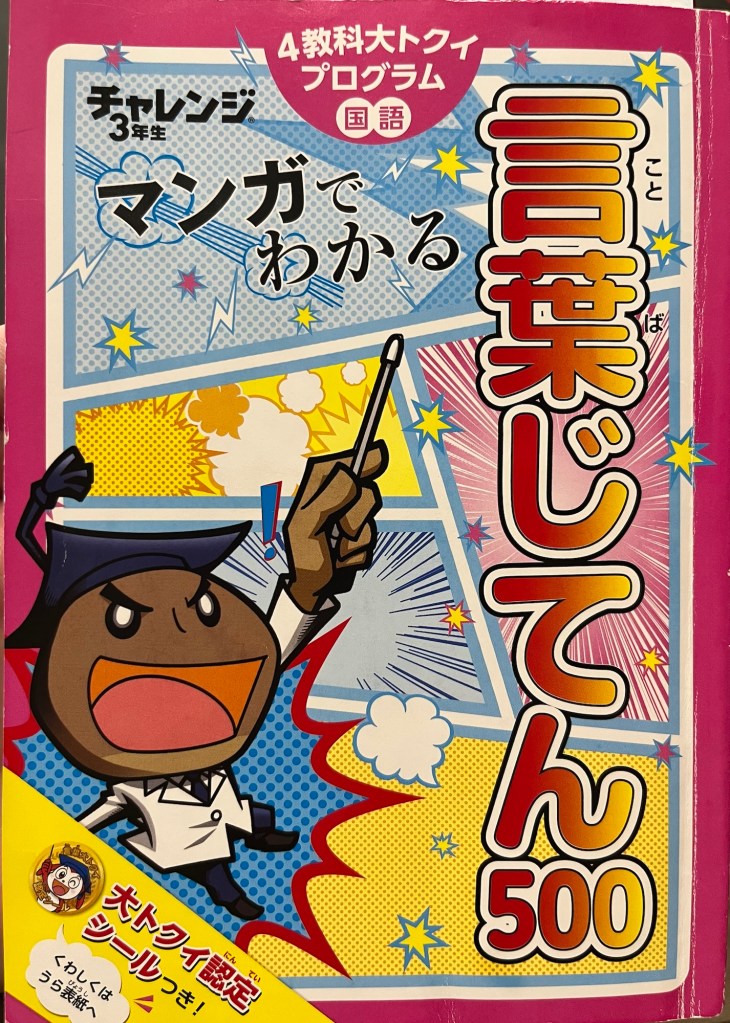
Recently though, I stumbled upon one of my son’s old textbooks from Benesse. Benesse is a company in Japan that provides teaching aides for kids (including Japanese kids overseas), through a monthly subscription service. Kids get study materials appropriate for their grade, and submit work monthly by mail, earning special prizes and such. The teaching staff at Benesse grade the work, send friendly feedback, etc. Our kids both subscribed to the service until about the third grade when they got too busy to keep going.

The cover of a textbook with Japanese written on it, where kids can learn 500 words using fun manga illustrations. The front cover features a cartoon character with a professor hat.
The cover of a textbook by Benesse featuring 500 words in Japanese for a 3rd grader to learn, using Manga.

Because of this, we have lots of old Benesse educational material lying around the house that the kids no longer need, and it turns out that even for an adult foreigner like myself, it’s really useful.

A while back, my kids’ local Japanese language teacher once remarked that if you are able to learn 3rd grade level Japanese, then you have a solid foundation. Forget college level or even high school level; just getting conversant at a third grade level is surprisingly useful.

Having seen the contents of the third-grade materials above I now believe it. I was surprised how many vocabulary words in the book were also in my JLPT study materials for the N2 and N1. Not only that, but they were presented in a fun, more engaging way for native speakers (kids). The explanations and examples were more natural and easier to grasp than my pricey JLPT study guides.

Even now, after years of study, I can pick up an old Doraemon comic and mostly be able to read it. And yet, I find I still have to look up words, and sometimes I learn new expressions and phrases in everyday Japanese. It’s not just learning the words, it’s learning in how people just say things. There’s more than one way to say “I’m impressed by something”, but they have slight nuances or differences in grammatical construction that just can’t be easily explained without context.

Doraemon is an old-timey comic for grade school kids and yet it’s clear that it still presents a good challenge for a language student.

All this is to say that if you are learning Japanese, or any language, jumping into adult material and concepts is somewhat counter-productive. It seems like the right thing to do, speaking as an adult, but grade school level language and material is surprisingly important and shouldn’t be overlooked. Everything beyond grade-school level is mostly just specialization in topics. If you focus on advanced materials too much you’ll be familiar with that topic but not much else. In others, you’ll have glaring gaps in your language skills. This essentially what happened to me, and only now am I starting to correct it.

But how does one approach this as a language student? Most students don’t have access to Benesse materials since it’s intended for Japanese audiences. You may have to get creative, but you can find children’s books, manga (including Doraemon), and study guides for Japanese kids online or in a Japanese bookstore. It doesn’t hurt to pick up such materials, and you may find them more challenging than you expected.

Remember: focus on getting to the third grade. However, you may have to start even lower level, first grade Japanese, second grade Japanese, etc.

It’s less about finding specific materials, and more about setting a realistic level of challenge, and then obtaining enough material (not just one book or two) until it becomes easy, innate. You can think of this as starting a new exercise routine, and setting realistic expectations. Just as kids starting learning basic language, and gradually increase in difficulty, language students should do the same. It’s seemingly slower at first, but builds a better foundation and avoids the painful need to go back and correct your Japanese later.

In any case, simply getting to a grade-school level will be surprisingly useful both in day to day interactions with Japanese people, and in passing the JLPT exams.

Chinese versus Japanese Character Readings

Way back in high school, like most American kids, I had to study things like Spanish, French, etc. I took German for two years in high school, but I didn’t find it very interesting, and I didn’t like my teacher very much. So, I never put in much effort. Later, one of my friends told me that we offered Mandarin Chinese at my high school, and I was just beginning my “teenage weeb phase”, so I was definitely curious.1

Our teacher, Mrs. Wu, was a very nice elderly teacher, even though she was in over her head dealing with a bunch of teenagers. Still, exploring something exotic like Chinese language really interested 16-year old me, and I was a pretty motivated student. I tried to learn both Traditional Chinese characters (used in Taiwan) and Simplified characters (Chinese mainland). My best friend at the time was Taiwanese-American, and I used to practice with his immigrant parents.

Anyhow, long story short, once I got into college, I focused on other priorities, and gradually, I forgot my Chinese studies.

Lately, I have been dabbling in Duolingo and learning Chinese again. I forget why, but I guess it’s partly fueled by nostalgia, but also because I already know how to read many Chinese characters through my studies of Japanese.

It’s been fascinating to see how Japanese kanji (Japanese-imported Chinese characters), and modern Chinese characters overlap and yet differ. The important thing to bear in mind is that Japan (like other neighboring countries), imported Chinese characters at an earlier stage in history, and over centuries the usage, pronuncaition and such have all diverged.

Take this easy sentence in Chinese:

All of these Chinese characters are used in Japanese, and without any prompts, I can read this and get the gist of what its saying, but there’s some notable divergences.

These Chinese sentence above is:

日本菜和中国菜
rì běn caì hé zhōng guó caì

A Japanese equivalent might be:

日本料理と中国料理
nihon ryōri to chūgoku ryōri

A few interesting things to note.

  • The character 菜 is used in modern Chinese to mean food in general, but in Japanese it means vegetables. So the usage has diverged. I noticed that Chinese
  • The country names, 中国 and 日本 are used by both languages, but the pronunciation has also diverged considerably. 中国 is pronounced zhōng guó in Chinese, and chūgoku in Japanese. You can kind of hear the similarities, but also the pronunciation has diverged for centuries.
  • The character 和 () is used in Chinese to mean “and”, but in Japanese a system of particles is used instead. Interestingly, 和 is used in Japanese, for example the old name of Japan was Yamato (大和) or modern words like heiwa (平和, “peace”). The pronunciation is wa, so it has diverged as well.

On thing I haven’t really delved into is the native Japanese readings for Chinese characters. Chinese characters are a foreign, imported writing system to Japan, so native words sound completely different even when written with Chinese characters. The word for 中国 (chūgoku) derives from Chinese, but 中 by itself is pronounced as naka (“middle”) which is a native Japanese word (not imported).

Anyhow, this is just a quick overview of how two entirely different languages both adopted the same writing system, but have diverged over time. If you add in languages like Vietnamese and Korean that also adopted Chinese characters, the picture is even more fascinating.

P.S. Through Duolingo, I learned that the Chinese word for hamburger is hàn-bǎo-bāo.

Chinese has to import foreign words using Chinese characters that at least kind of sound like the original. Japanese uses a second syllabary system, katakana, to approximate the same thing, although in the past Chinese characters were used as well. Hence, America is usually written as amerika アメリカ, but in more formal settings it is called beikoku 米国 (compare the pronunciation with Chinese měi guó).

1 The fact that my high school even offered Chinese language at that time (1990’s America) is pretty unusual, but I am grateful for the option. Also, thank you Mrs Wu if you ever happen to read this.

My JLPT N1 Test Results for 2023

I finally got my results back from the JPLT N1 exam I took in December 2023, and the results were not surprising.

I failed, as expected.

However, the results were not what I expected:

CategoryResults
Vocab / grammar28 / 60 (pass)
Reading7 / 60 (not pass)
Listening26 / 60 (pass)
Total Score61 / 180 (100 needed to pass)

I had expected to fail listening more so than reading, the listening section was very stressful, and yet the reading section felt somewhat easy. Clearly, I underestimated things. After reading about people online who passed or failed the JLPT N1, it’s clear that the N1 assumes full adult literacy. If you can’t read a novel or two in Japanese, you will not pass the reading section. I haven’t reached that level yet, and the results aren’t that surprising then.

That said, the total score to pass has to be 100 out of 180, so even if I passed the reading section, my overall score was still pretty low, and probably not enough to pass.

Needless to say, it was a good effort, but my preparations all around were insufficient.

Will I take it again? This took considerable time, effort and willingness to go the distance, and so I have to think about whether I want to try again. Since I don’t need the JLPT N1 for work, it’s more of a personal project, and may or may not be worth the cost.

Going to think about this for a while. 🤔

Every Day Is A Good Day, Kind Of

Soon after I wrote this post, I was reminded of a certain Zen aphorism in Japanese: 日日是好日 which is read as nichi nichi kore kō nichi.

This usually translates as “every day is a good day”, or “each day is a good day” or other such things. It is originally attributed to a Chinese Zen monk named Yunmen Wenyan from the 9th and 10th centuries.

At first glance, this seems like a positive affirmation of life. This is the sort of thing you might see from life-coaches, self-help gurus, posters, daily affirmations, songs, and so on. Live, laugh, love and all that.

But that kind of attitude and outlook is only useful for financially stable, healthy, affluent people living in stable countries. It’s pretty useless for people who live in difficult circumstances, working thankless, dead-end jobs, dying from pneumonia, or suffering from abuse. If you’re a child in Syria who has lost their parents during the recent earthquakes, the “live, laugh, love” phrase rings pretty hollow.

A while back, I wrote about similar issues with Seneca’s philosophical teachings. The Stoic teachings which Seneca espoused basically amounted to “suck it up” and “don’t be sad”, which is fine when you’re a Roman senator, but not too useful for the Roman slave working the fields.

In fact, for most people in the world, most days are varying degrees of shitty.

Life is a slog; First Noble Truth of Buddhism right there.

So, is there any value or meaning to Yunmen Wenyan’s famous phrase? I think so.

This is strictly my own interpretation, so please take with it a grain of salt. This morning, I had to step outside in the early morning and I beheld the sunrise. It is cold, it is early March, it is still dark outside, yet I saw the sun rising, and birds flying past it. I was glad to see it, to be breathing and savoring that moment.

Life is bittersweet. It is full of pain, loss, frustrations, and unfulfilled needs. It doesn’t necessarily get better, but it does carry on. Each moment of breath is still worth it. If you can share it with others, so much the better. But even if not, each moment is still worth something.

This is, I believe, what Yunmen Wenyan might have been saying to us, even when it gets lost in translation.

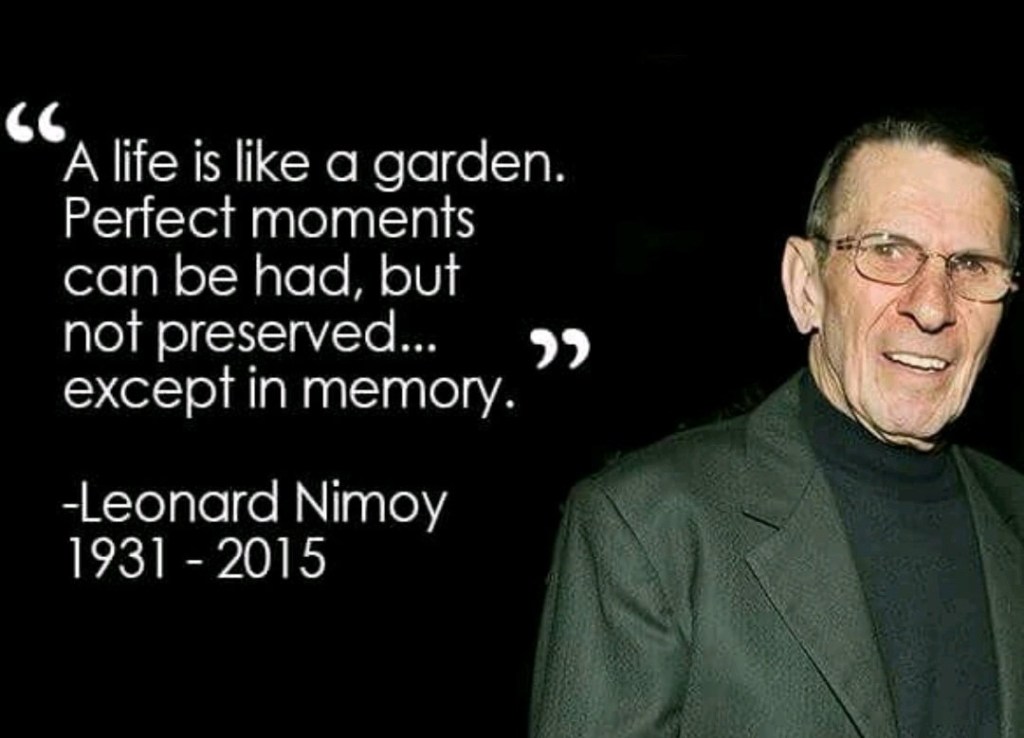
P.S. RIP Leonard Nimoy. LLAP. 🖖

Stop Memorizing Kanji and Learn Through Convergence

ca7e9dbf-2a54-4a0c-a6d0-e08cfed9ec5b-14523-00000f80b731e6a9_file

From time to time, I meet other folks who, like me, are interested in Japanese culture and language.  I have been studying it more or less since I married my wife, but more seriously about 10 years ago when I was focused on passing the JLPT exams, and through it all I’ve made a lot of rookie mistakes in how I learned the language.

When I chat with other Japanophiles, I often see the same patterns in how people learn the language and some of these patterns aren’t helpful.

One of these patterns I often see is when people try to brute-force memorize Japanese “kanji” or Chinese characters.  Japanese uses them¹ a lot and they seem pretty daunting when you first encounter them, so people often fall into the pattern thinking that if they memorize X kanji, they can read Japanese.  They build large flashcard libraries and cycle through them every so often.

Unfortunately (and again speaking for experience and many wasted hours), this doesn’t work because:

  • The sheer number of kanji is too great to retain in one’s mind for long.  Seriously, as soon as  you stop memorizing a kanji character, you’ll start to forget within a week.  SRS (space-repetition study) helps a bit, but once you’re memorizing more than a couple hundred kanji things get out of hand.  And remember, there are thousands of kanji to memorize, not just the 2100+ on the Joyo Kanji list.
  • Past a certain point, the on-yomi (Sinified, non-native reading) for kanji really start to run together.  For example, how many kanji out there have a on-yomi of chō ?  A lot.
  • Knowing a kanji in isolation isn’t nearly as useful as one might assume.  People frequently make the mistake of assuming Chinese characters are self-contained “symbols”,² but they frequently work in concert with other Chinese characters to form proper words.  This is true in Chinese language as much as it is in Japanese despite being totally different languages otherwise.
  • Finally, this really isn’t how Japanese people themselves learn Kanji.  I know because I’ve seen my kids grow up and learn Japanese.  They do rote memorizing, initially, but the real learning comes from all the reading and writing of Japanese that they do.  Rote memorizing is really only useful for learning the proper stroke-order, in my humble opinion.

So, just put down the flashcards and let’s look at another way of learning kanji.  I like to call this the “Convergence Method”.

In so many words, the Convergence Method works like so:

  1. Learn some Japanese words.  Learn how to pronounce them, read them and write them.
  2. Learn some more Japanese words.  Repeat #1.
  3. Eventually, the kanji in those words will start to overlap with one another.
  4. Kanji learned.

Case in point.  Here’s some random Japanese words:

  • 発見hakken (discovery)
  • 見物kenbutsu (sightseeing)
  • 意見iken (viewpoint, opinion)
  • 見事migoto (something splendied)
  • 見る – miru (to see, to watch)

Based on these 5 words, what’s the common denominator?  The kanji 見 which can mean things like “to see, “to observe”, “to watch” and so on.  It can be read sometimes as ken and sometimes as mi or miru.

Now, if you see a 6th word, 見当, and without any other clues, you can reasonably guess how to read the first character and guess it’s general meaning.  That’s how convergence works.

Similarly for , it appears in such words as:

  • 弁当bentō (boxed lunches)
  • 本当hontō (truth, fact)
  • 当時tōji (at that time)
  • 当てるateru (to guess, to hit a target, etc)

So, 見当 is probably going to be read as kentō and probably alludes to “see, observe” and “truth, fact”.  And you’d be pretty close to the mark.

Thus, the key to reading and writing Japanese isn’t memorizing kanji, it’s learning vocabulary, and enough of it to get critical mass to see words overlap.

Good luck!

¹ Interestingly, you also see some usage of Chinese characters in other Chinese-influenced cultures as Korea and Vietnam, but to a far lesser degree, and often in nostalgic or marketing contexts.

² This is another reminder why Chinese character tattoos are generally a bad idea.  Having 光 (light) as a tattoo makes about as much sense as tattooing the Greek φος (phos-) on my arm.  Phos- what? Phosphate? Phosphorescence? I won’t even touch on the times I’ve seen people tattoo the wrong Chinese character on their arm even though it has the same on-yomi as the one they were thinking of.  Compare 禅 (“zen” as in Zen Buddhism) with 善 (“zen” as in a set of dishes, etc).

Keigo: the Spice of Japanese Life

No study of Japanese language would be complete without learning how keigo (敬語) works. Ostensibly, keigo is just honorific speak, but it’s also a good window into Japanese culture as well and reflects a lot of unspoken, cultural rules.

Kinship Terms

One cultural/linguistic rule is how you address your own kin versus another person’s kin. When talking about your own older sister, you use the term ané (姉), but when talking about the listener’s older sister, you use onēsan (お姉さん).  Note that this is not keigo per se, but it is super important to familiarize yourself with to avoid being impolite.

Other kinship terms include:

Relative Self Other
Mother
haha
お母さん
okāsan
Father
chichi
お父さん
otōsan
Older brother
ani
お兄さん
onīsan
Grandmother 祖母
sobo
お婆さん
obāsan
Wife
tsuma
奥さん
okusan

For “wife” sometimes the term kanai (家内) is used for one’s own wife, but this is often sounds old-fashioned because it implies that the wife stays at home.

Honorific and Humble Words

Another unspoken rule is that, in some situations, you replace normal vocab words with either honorific terms when addressing another person or humble terms when describing yourself or people in your “inner circle”. The trick with such words is that, like a fine spice, a little bit goes a long way, while too much kind of ruins the flavor (not to mention sounds like you’re sucking up to people).

Good examples of people to whom you can/should address with honorific speech:

  • A customer (if you’re running a business)
  • Nobility
  • A teacher of your kids
  • Someone much older than you

But even here, it’s usually sufficient to use regular polite speech, and pepper keigo terms here and there.

Examples of honorific speech:

  • Instead of the verb する (suru, to do), replace with なさる (nasaru).
  • Instances of いる (iru), including when it is an auxilliary in te-form verbs, are replaced with いらっしゃる (irassharu).
  • The verb 言う (iu, to say) is replaced in all instances with おっしゃる (ossharu).
  • Many verbs can be made more honorific by changing to a noun-form, prepending with “o” and appending with “ninaru”. For example, with the verb 出かける (dekakeru, “to go out”) becomes お出かけになる (odekakeninaru).
  • A few verbs have more irregular honorific forms: 食べる (taberu, to eat) becomes 召し上がる (meshiagaru), 着る (kiru, “to wear”) becomes 召す (mesu), and so on. These just have to be memorized.

Similarly, examples of humble speech:

  • The verb 言う (iu, to say) is replaced with 申し上げる (mōshiageru).
  • The verb もらう (morau) is replaced with いただく (itadaku). This is often why Japanese say “itadakimasu” before eating a meal: it expresses humility in receiving the meal.
  • Similar to honorific speech, a few verbs have more irregular honorific forms: 合う (au, to meet) becomes お目に掛かる (omenikakaru), and 見る (miru, to see), is replaced with 拝見する (haiken suru) for example. These must be similarly memorized.

Passive Speech as Keigo

Another way to use Keigo, is to use passive speech when referring to someone.  Passive speech isn’t quite as polite as honorific speech, but it’s often sufficient for most situations and easier to use.  For example, instead of saying 帰る (kaeru) for “come home”, simply replace it with the passive form 帰られる (kaerareru), even if the sentence is not actually passive:

本を書く
hon wo kaku (to write a book)

本を書かれる
hon wo kakareru (to write a book, but more polite)

Polite Speech

As weird as it might sound, in Japanese there is a difference between keigo (honorific speech) and teineigo (polite speech).  Polite speech is, as the name implies, when you are speaking politely to another person, but still implies that you’re more or less on equal footing.  Honorific/humble speech overtly elevates someone else, which is why it’s sometimes out of place.

Polite speech is thus a more common and useful pattern of speech to use, and will work 85% of the time.

Chances are, you’ve probably learned polite speech before, but a few tips:

  • Verbs are expressed in masu-form: 食べる (taberu, to eat) becomes 食べます(tabemasu), 見る (miru, to see) becomes 見ます (mimasu), etc.
  • The conjunction が (ga) is often useful for connecting sentences.  It can either be a soft “but” or a soft “and”, depending on context.
  • Another conjunction なので・ので (nanode/node) is more polite than から (kara), but still implies “because” or “since”.
  • Remember those kinship terms above.  😉
  • Especially in business Japanese, regular verbs are often replaced with more formal sounding suru-verbs.  Instead of 答える (kotaeru, “to answer”) it’s more common to use 返事します (henji shimasu).

Conclusion

Part of your success in navigating Japanese culture and speech is being sensitive to hierarchy, and knowing the right amount of polite speech to use.  If you’re new to Japanese, you’re often tempted to either overdo it, or by force of habit, you might be simply too relaxed and forget your manners.  But, if you acclimate yourself to Japanese speech by listening to others’ conversations, you’ll gradually get a “feel” for what’s appropriate and when.

Good luck!