The Japanese Way of Doing Things

My guide book on Japanese culture talks about a concept called sahō (作法), which in a mundane sense just means “instructions” for doing stuff. But the book explains that it also describes how things are done culturally:

… for example, in the case of the tea ceremony, every act is carefully choreographed, from where people sit, to how the water is boiled, to how the ea is prepared and so on.

Again, in the business world, one can observe sahō in action as the seller employs polite language and bows often as he shows various forms of respect to the buyer. Another case would be the social setting of a company, where a subordinate will use particular sahō with his boss.

Page 156

The book further explains:

For most Japanese, sahō is an ingrained pattern of behavior that affects their day-to-day actions without them even being aware of it. However, for people who come from overseas, some of these practices may appear puzzling. Why is someone bowing so many times in a particular setting? Or at another time, why is someone sitting ramrod straight? But for the Japanese, they are simply following the sahō that is appropriate for that place and circumstance.

I definitely experienced some of this confusion in the early years when I visited Japan with my wife. My in-laws kindly took me to a local Takashimaya department store and paid to get me a tailored suit. As a poor white kid in America, the experience was kind of awkward on a few levels: I wasn’t used to getting measured for a tailored suit, I wasn’t used to the very polite speech and mannerisms of the store employee, I wasn’t very good at speaking Japanese, and I wasn’t even used to owning my own suit.1

This concept of sahō isn’t limited to Japanese culture, of course. It is true, based on limited experience, that things can feel really choreographed in Japanese culture compared to American culture, but the idea of “how people do things” is universal. The American handshake is on example, the tendency for Russians not to smile during formal settings, the “pub culture” in Ireland and so on. There’s countless examples unique to each culture.

Even for a culture like Japan, where everything really is kind of choreographed, you do get used to it. The extra flourishes at the bookstore (wrapping the books, extra bowing, etc) were a bit confusing at first, but after a while, I don’t even really mind it anymore. Similarly, certain habits became ingrained more and more each time I visit.

So, when you encounter another culture, the important to bear in mind is that each culture has its own sahō, and it will be different than yours. Be observant, be flexible. If you do, you’ll quickly adapt and will succeed. People who stand like tall trees in the wind get blown down, but those who bend like grass prosper.

Food for thought.

P.S. Fun bonus post before Thanksgiving weekend! Happy Thanksgiving Day and Native American Heritage Day to readers in the US.

1 It is still the only suit I own, but I save it for important occasions only, such as my mother-in-law’s funeral. Speaking of sahō, funerals in Japan are very formal compared to American ones.
Amitabha: The Welcoming Buddha

During my wife’s latest trip to Japan (I stayed home this year for various reasons), she found this delightful patch/sticker:

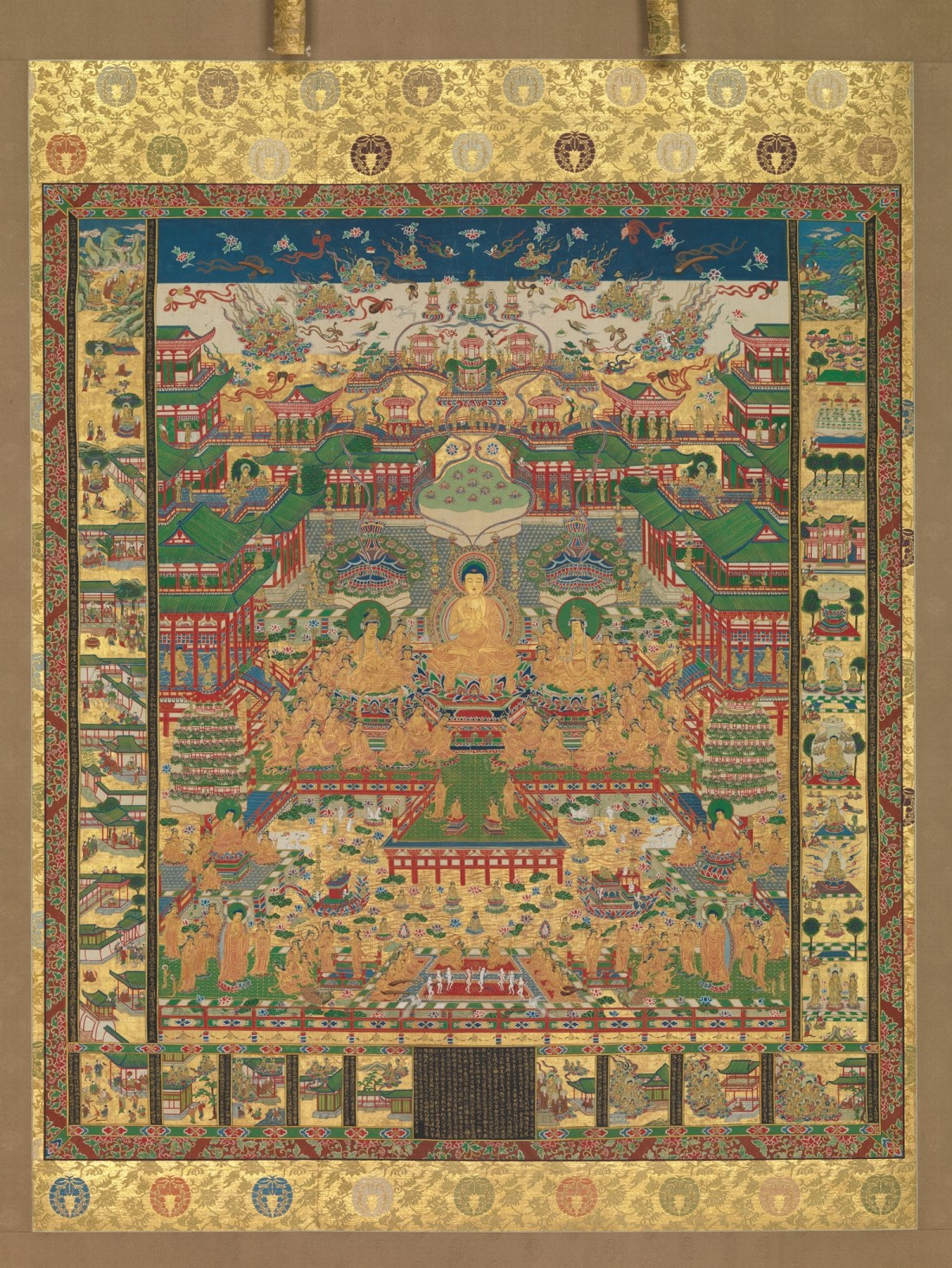
This is an image of Amida Buddha, welcoming the deceased to the Pure Land. This is called raigō amida (来迎阿弥陀, “Amida welcoming the dead”). I talked about this before a little while ago, becuase it was a common artistic motif in medieval Japanese Buddhism, especially at a time where disease, warfare and death would often cut people’s lives short.

The imagery of Amida Buddha coming to greet the dead is found primarily in the Contemplation of Amitabha Sutra (a.k.a. “the Contemplation Sutra”). The last section of the sutra lists the nine grades of people who are reborn in the Pure Land, and the fourth grade (“highest level of the middle grade”) gives the following description, for example:

“When such a person is about to die, Amitayus [Amida] appears before him, surrounded by a host of monks and radiating a golden light. He then expounds the truth of suffering, emptiness, impermanence and no-self, and praises renunciation of the world as the way to escape from suffering.

“Seeing this, the aspirant greatly rejoices and finds himself seated upon a lotus-flower. He kneels down, joins his palms and worships the Buddha. Before he raises his head, he attains birth in the Land of Utmost Bliss, where his lotus-bud soon opens.

Translation by Rev. Hisao Inagaki

Depending on the grade of the aspirant, this welcome may be more or less elaborate, but all of them are reborn in the Pure Land somehow.

So, I like this patch because it’s a reminder of the goodwill Amida Buddha extends to all beings, and how everyone can be born in the Pure Land if they want to.

Namu Amida Butsu

P.S. I kept the patch in its wrapper for a long time, but finally decided to put it in a sutra book I’ve been making.

P.P.S. Accidental double-post. 🤦🏼‍♂️

Sacred Trees in Japan and Korea

Sometimes when you travel in Japan, especially outside of Tokyo, you may come across like this:

A large sacred tree at Kasuga shrine in Nara, Japan. Taken by me in July 2023.

This is a large tree that has been growing for centuries within the precincts of Kasuga Grand Shrine in Nara, Japan. The tree, as you can see, has a large rope tied around it with small paper streamers. If you ever saw the Studio Gibhli movie Totoro, you can see a big camphor tree with a similar rope around it.

Sometimes you also find rocks and other natural things with ropes around them too.

A “shimenawa” around an “iwakura” (sacred rock) at Meigetsuin, Buddhist temple in Kamakura, Japan, courtesy of Wikipedia.

This is a Shinto-religious custom using a special sacred, hempen rope called Shimenawa (注連縄). The little paper streamers called called Shidé (紙垂).

Shimenawa are sometimes used to section off a sacred space, but they’re also used to enshrine places thought to house a local kami, such as a tree or rock thought to be sacred. Sometimes you also see them hanging over home Shinto shrines (kamidana, 神棚). The idea is the same: the paper streamers help deliniate a sacred space (the inner sanctum of your home shrine in this case).

Interestingly, I discovered that a separate, but parallel tradition exists in Korea too. This blog shows that in Korean traditional culture, people would enshrine local guardian spirits by tying a rope (금줄, Geumjul) around them, and decorating with colored cloths (오색천, Osaekcheon) or white strips of paper. Such sacred trees (당산나무, Dangsan-namu) and sacred rocks (누석단, Nuseokdan), are collectively called Seonangdang. They are very similar in appearance to the ones in Japan, so it’s not hard to guess that there’s some common religious tradition between both cultures, though the Wikipedia article linked above also suggests a potential link to Mongol culture too.

Shinto as a religion exists only in Japan1 but it’s not hard to imagine that Shinto tradition drew from something much older that was shared across the Korean peninsula and Japan. Further, since it’s known that in early Japanese history that many Korean families migrated to Japan (the Imperial court sought their skills and technology), it’s quite possible the tradition was imported from Korea to Japan. Further, as this early Yamato court actively allied with the Korean kingdom of Baekche, it’s possible the cultural exchange went in that direction too.

Anyhow, it’s a fascinating example of how the two (or more) cultures have shared religious traditions for millenia, but few would notice.

1 Barring colonial efforts in the early 20th century to introduce it to other Asian countries, but these did not have a lasting impact culturally.

Autumn Nights in Japan: Otsukimi and Juya-E

In the old Chinese lunar calendar, on the 15th day of the 8th lunar month (i.e. full moon on the 8th month), many cultures across East Asia celebrate something called the Mid-Autumn Festival. This has various names depending on the country and language:

  • Zhōng-qiū-jié (中秋節) in Mandarin Chinese,
    • Tiong-chhiu-cheh in Hokkien, by the way
  • Tết Trung Thu in Vietnam, and
  • Chuseok (추석) in Korea

In Japan, this festival is called formally the Jūgoya (十五夜, “15th night”) festival, but in popular culture is known as Otsukimi (お月見, “moon viewing”). This year, due to the lunar calendar, Otsukimi falls somewhat late on October 6th. This festival is about viewing the moon with friends and family, while enjoying some dango (rice dumplings) using displays like so:

A stack of dango treats, photo by evan p. cordes, CC BY 2.0, via Wikimedia Commons

According to this excellent book on Japanese culture, people also decorate such displays with pampas grass (susuki, ススキ), edamamé beans and taro potatoes. Unlike cherry-blossom viewing, people do not usually get drunk.

Chinese moon cakes, called geppei (月餅) in Japanese, are sometimes eaten as well, though it’s more of an exotic treat. Here, moon cakes are easy to obtain, and quite delicious. Highly recommend. We also get the Korean version of dango (tteok, 떡) too.

In any case, Otsukimi is about relaxing, enjoying the autumn vibes with the ones you love. As my family and I live in the Pacific Northwest, weather here isn’t reliable, and so we often get stuck with cloudy weather. But the image of Otsukimi is still popular. You can even find an emoji for it: 🎑.

Also, fun fact: there are traditionally two days of moon-viewing in Japan. The main one is Jūgoya (十五夜, “15th night”), but traditionally there is also a Jūsanya (十三夜, “13th night”) viewing on the 13th night of the ninth (not eighth) lunar month. This year, 13th night falls on November 2nd. On the 13th night of the lunar month, people enjoy chestnuts instead. Traditionally, people felt you should view the moon on both nights, otherwise, according to my book, you only did katamitsuki (片見月, “one-sided viewing”), which wasn’t ideal.

By the way, there is one other tradition around this time that’s specifically Buddhist: Juya-é (十夜会, “ten nights ceremony”), which is ten nights of observance of Pure Land Buddhist practice, starting from October 5th to 14th in the Western calendar. I usually try to recite the nembutsu a full 1080 times using my old Jodo Shu rosary for ten nights. Easier said than done as a parent, but it’s nice to have a challenge from time to time. Traditionally, people try to attend temple services if possible, or just focus on good behavior.

Anyhow, wishing you all a fun Otsukimi, Mid-Autumn Festival, or Juya-e, etc., or all of the above!

Asakusa Temple Sutra Book

This is the last in a series of Japanese-Buddhist sutra books that I wanted to share. I talked about this Soto Zen sutra book, a Rinzai Zen book and a Jodo Shu sutra book. Today, I wanted to share the sutra book I purchased at Asakusa Temple in Tokyo, Japan.

Asakusa Temple (more properly Sensoji Temple, 浅草寺)1 is super famous, and chances are if you have visited Tokyo, you probably went to Asakusa Temple. Asakusa is technically its own Buddhist-sect now, but for much of its history it was a Tendai Buddhist temple that enshrined a legendary statue of Kannon Bodhisattva that supposedly washed up on shore and enshrined in the year 645. This is called the Yanagi no Miei (柳御影, roughly translated “the [sacred] willow image”). The featured photo above shows where it is enshrined at Asakusa Temple.

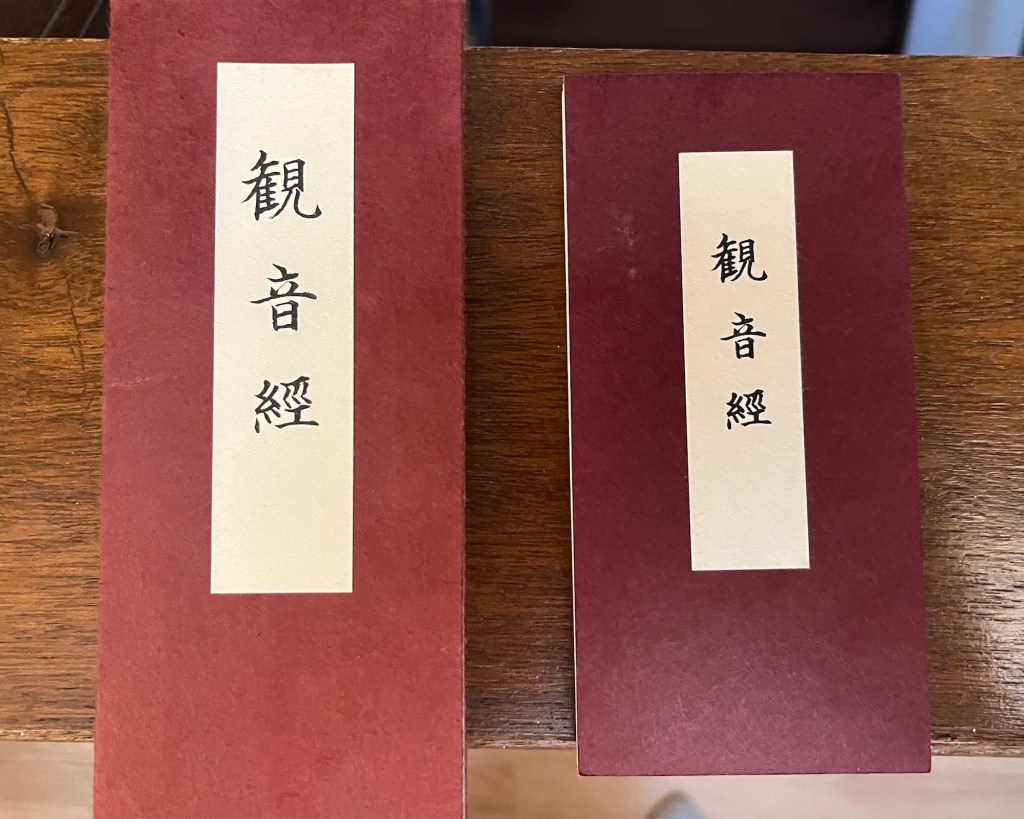
Not surprisingly, the sutra book’s liturgy focuses on Kannon-related chants. This sutra book is sold in two sizes, but the contents are the same:

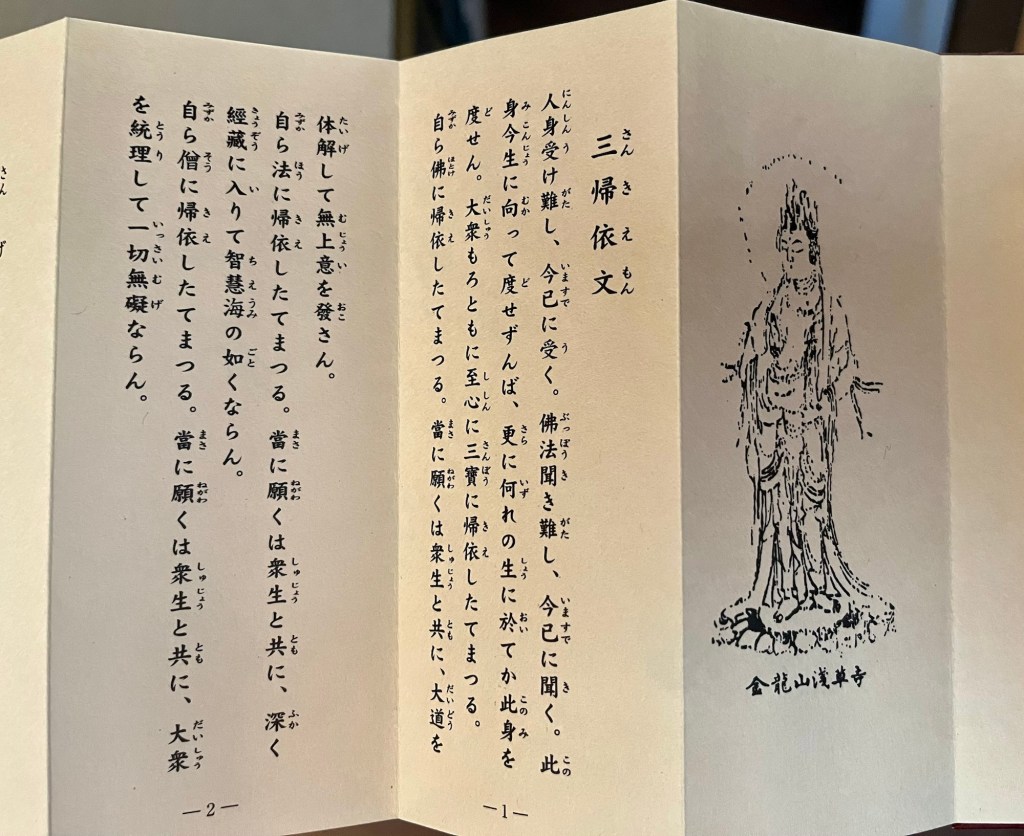
The illustration inside the cover depicts the legendary statue :

The liturgy to the left of the illustration is a form of Taking Refuge in the Three Treasures (san-ki-é-mon, 三帰依文) done in a more native-Japanese style, than the Sino-Japanese version I posted here. Both versions are perfectly valid and are chanted.

More examples below are chants that we’ve seen in older posts in right to left order:

  • the Sangémon (repentance) on the right,
  • Kaikyoge (verses for opening the sutra) second page from right, and
  • the Kannon Sutra itself on the left half.

Unlike other examples I’ve seen, this sutra book posts the entire Kannon sutra, not just the verse section. It’s about 3 times as longer than usual.

Next, we see a classic: the Heart Sutra. This makes sense since the Heart Sutra was spoken by Kannon Bodhisattva, not Shakyamuni Buddha. So. it fits the theme.

And last but not least, after the Heart Sutra is the Ten Verse Kannon Sutra (second from right), and Dedication of Merit verse.

Finally on the far left page is a simple recitation chant of devotion to Kannon Bodhisattva: namu kanzeon bosatsu (南無観世音菩薩). I’ve often used that to sign off blog posts, and unlike more esoteric mantras, this is a very common statement of devotion, much like the nembutsu for Amida Buddha. Feel free to chant it in your Buddhist practice!

Anyhow, this sutra book is something visitors to Asakusa Temple would probably overlook without the necessary background (or religious inclination), but it’s a fascinating look at Tendai Buddhist liturgy, but in a way that’s adapted to a particular temple, and to a particular deity.

Namu Kanzeon Bosatsu

P.S. That covers all the sutra books I wanted to cover here in the blog. I own a few more, but they’re not interesting or unique enough to justify another blog post. If I pick up another sutra book, I’ll post again. But if you did enjoy this mini-series, thank you for reading!

1 The words “asakusa” and “senso” are literally just two different ways to read the same Chinese characters.

The Responsibility of Parenting

Recently, I talked about the autobiography of Sayo Masuda, a former bath-house geisha who suffered a very difficult upbringing. Because she was born out of wedlock by a mother who rotated through one man after another, Sayo’s mother had too many kids and no financial support for them. Sayo was thus sold off as a child to indentured labor where she suffered greatly.

Reflecting back on this, she says in her autobiography:

Even now it fills me with anger: I want to rage against the miserable lives we lead, those of us who are born into this world as blots of sin because of a parent’s irresponsibility; I want to cry out that a life like mine must never be repeated. No matter how deep in disgrace, a human being is human, after all. The human spirit wanders ceaselessly in search of light; and if it finds a light of some sort, it strives somehow to get near it, struggling, writhing in anguish. Yet even as it writhes in anguish, it is drowned before it reaches the light. If you have the heart of a human being and you become the parent of a human being, then even if it exhausts every bit of your energy, until that child can walk alone I want you to do your duty as a parent.

Page 18

Speaking as a parent, I feel this too. Kids are born into your care (through your actions, obviously), so you owe it to them to provide the best possible life you can.

Namu Shakamuni Butsu

Out of the Mud Springs the Lotus

Recently, I reread a famous autobiography of a former “bathhouse” geisha titled Autobiography of a Geisha. The geisha in question, Sayo Masuda (1926? – 2008), lived a pretty horrible life and her story as a geisha is far from the glamorous stories normally told in English publications.

The short summary is that Sayo Masuda was a child born from an impoverished mother who cycled through a few husbands, and unable to feed or raise her kids. So, she sold some of the children off to indentured servitude. Sayo was one of them (she didn’t even know her name until her teenage years). The landlord family who took her in was very abusive and did nothing to support or raise her: she was another mouth to feed, and they did the bare minimum to raise her. Sayo never received a formal education, and was thus totally illiterate for life. Later, she was sold again as an indentured servitude to a local geisha house in Nagano Prefecture. Her geisha “mother” similarly abused her for minor infractions and made her work chores all day to support the existing geisha, until she was trained to be one as well.

The term geisha (芸者) is tricky because it means different things to different people. Much of it has been romanticized by Western media, but also by autobiographies like Iwasaki Mineko’s “Geisha, A Life“, which was told from the perspective of a very high-class geisha working in Kyoto.1 Sayo Masuda, by contrast, was a geisha at a provincial red-light district, so there was every expectation that she would be available for sexual favors and would have a danna (“patron”) well before she was 18. What separated provincial geisha from prostitutes mostly was mostly a degree of refinement and artistic skills (song, dance, conversation, etc).

It was a very nasty and cutthroat world she survived in:

Geisha can do horrid, spiteful things: they’ll attack one another tooth and nail, each trying to force the other out of the way. To someone who doesn’t know this world and sees only the surface of it, I suppose we must appear quite carefree; but inwardly were eternally weeping tears of pain and sorrow.

Page 70

Much of the biography covers her struggles to survive in a cutthroat world, but also her increasing shame as she got older, and felt that was not worthy of some of the kind men she would meet. Her sense of despair, guilt, and hopelessness only increased as she got older, and she wondered if she’d ever be more than a nasty, cutthroat geisha.

Diverging a bit, this sense of crushing hopelessness tied with evil is a bit theme in J.R.R. Tolkien’s The Lord of the Rings, too. People who are corrupted and succumb to evil are those who are most often weighed down by guilt (Gollum), desperation (Boromir), or hopelessness (Denethor, steward of Gondor). Frodo the Ringbearer almost succumbs too, if not for the love and optimism of Samwise Gamgee. This is how evil works: not just through raw force, but also by breaking people down.

But I digress.

Sayo Masuda thankfully did have a happy (though bittersweet) ending where she finally found stable employment in spite of her literacy, and friends and family who supported her.

As I read this, I kept thinking over and over of a famous anecdote from the time of Honen, founder of the Pure Land sect (Jodo Shu) in Japan. Namely, when Honen was exiled to the provinces and encountered a woman of the night. She too lived a nasty, cruel life and wondered if she’d ever find salvation. Honen kindly told her:

“Your guilt in living such a life is surely great and the penalties seem incalculable. If you can find another means of livelihood, give this up at once. But if you can’t, or if you are not yet ready to sacrifice your very life for the true way, begin just as you are and call on the sacred name. It is for just such deluded folk as you that Amida Buddha made that wonderfully comprehensive Original Vow (hongan 本願). So put your full trust in it without the smallest reservation. If you rely upon the Original Vow and repeat the nenbutsu, your ojo is absolutely certain.”

Later, when Honen was pardoned and allowed to return to the capital, he found out that the woman had been inspired to take up the Buddhist path, and died as a nembutsu follower. He reportedly said:

“Yes, it is just as I had expected.”

This sense of redemption is one of the strongest aspects of Pure Land Buddhism to me. The transformation of “bits of rubble into gold” is something that appeals to myself and many others who struggle with teh Buddhist path, or just struggle in life. But the basic theme of Mahayana Buddhism is not just that all beings can be awakened as Buddhas, but given enough time they all will be awakened as Buddhas.

But even going allllll the way back to the earliest sermons (sutras) of the Buddha, we can see the symbolism of a lotus flower growing from the mud:

“Monks, just as a blue, red, or white lotus—born in the water, grown up in the water—stands having risen above the water, unsmeared by the water; in the same way, the Tathāgata—born in the world, grown up in the world—dwells having conquered the world, unsmeared by the world.”

The Puppha Sutta  (SN 22:94), translation by Ven. Thanissaro Bhikkhu

And again later in the Amitabha Sutra in the Mahayana tradition, the Pure Land of Amida Buddha is described in terms of its lotus ponds:

The lotus-flowers in the lakes, large as chariot wheels, are blue-colored
with blue splendor, yellow-colored with yellow splendor, red-colored with red splendor, whitecolored with white splendor, and (they are all) the most exquisite and purely fragrant.

English translation from the Chinese Version of Kumarajiva by Nishu Utsuki, The Educational Department of the West Hongwanji, Kyoto, Japan: 1924.

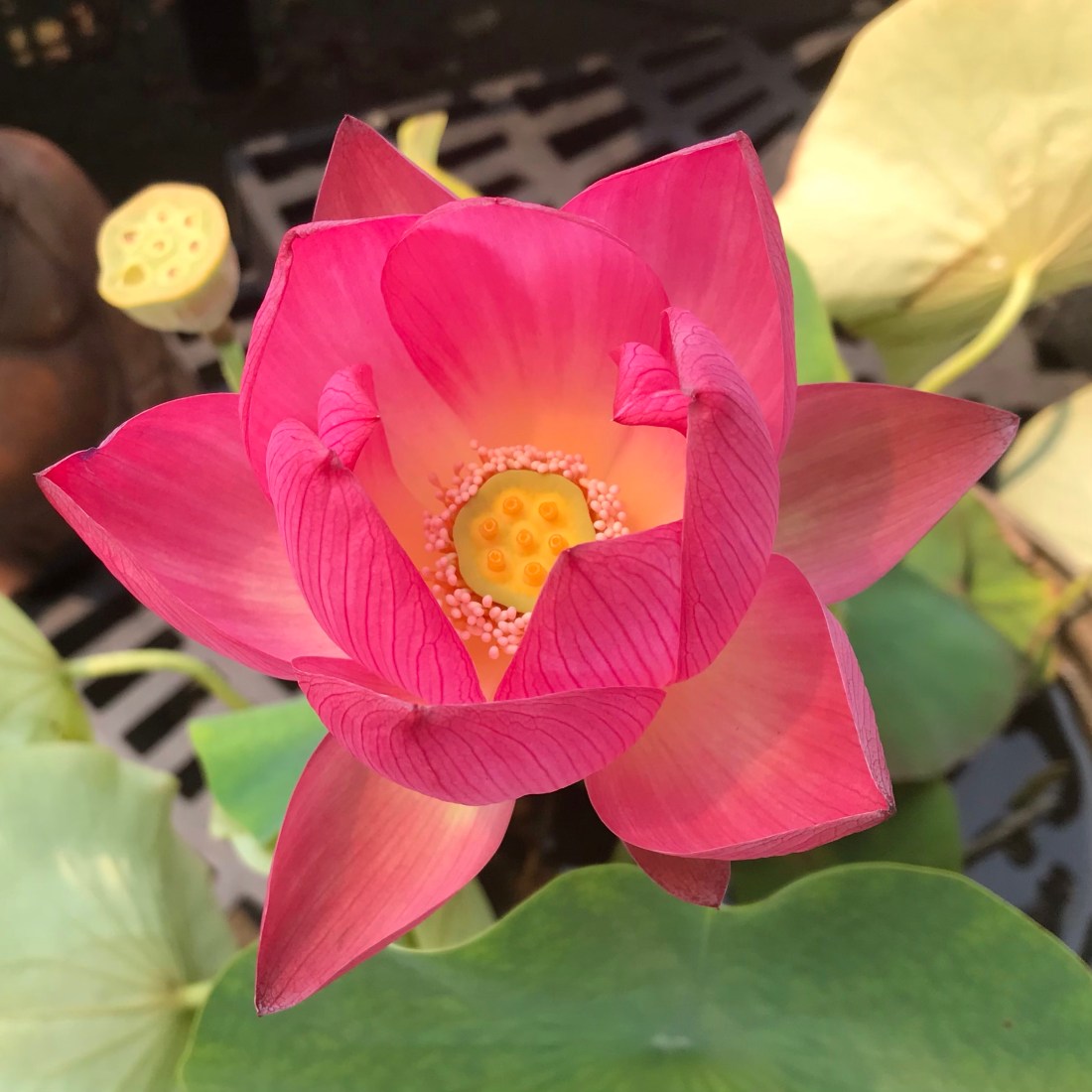
To reiterate, the idea of a lotus growing from the mud, unsullied by the mud was both intended to show the potential of all beings to awaken like the Buddha, but also the many colors of lotuses (in my opinion) show the diversity of followers from many walks of life.

Namu Shakamuni Butsu
Namu Amida Butsu

1 She also had a pretty high opinion of herself, which was grating to read at times. I seriously doubt her experience is representative of a lot of women in the industry.

Taoism and Numerology

Over the years, I’ve written about certain sekku (節句) or seasonal holidays in the traditional Japanese calendar. These are:

  1. Girl’s Day : March 3rd (3/3)
  2. Children’s Day : May 5th (5/5)
  3. Tanabata : July 7th (7/7), and
  4. Day of the Chrysanthemum (9/9)

Notice the dates of each holiday: odd-numbered month with matching odd-numbered day. Turns out that there’s a reason for this.

In Chinese Taoist numerology, numbers are divided into “yang” and “yin” numbers: odd numbers are yang (陽) because they are considered unstable and dynamic, while even numbers are stable and static, thus yin (陰). But because yin and yang depend on one another, and change into one another, if you add yang and yang together, you get yin. If you add yin and yin together, you get yang.

Thus, it was thought that dates on the calendar with double-yang numbers (7 and 7, 5 and 5, etc) would become yin and thus were inauspicious. Holidays were developed to counteract the yin effect, and that’s why seasonal holidays were held on double-odd dates.

Taoism is not a major influence in Japanese culture (at least in modern times), but it’s interesting so see how it still influences traditions, especially those from antiquity.

Anyhow, TIL. 😎

P.S. Learned all this from this excellent book. Highly recommend.

Conduct, Then Practice

A photo of the Shurangama Sutra (the purple book on the left) from my personal collection. I purchased this years ago at Powell’s City of Books and haven’t found a copy since.

In my last post, I talked about Tetsugen Doko’s open-minded approach to Buddhist practice especially among his lay followers. But there was one thing that Tetsugen Doko did not compromise on.

In 1674 in the castle town of Mori (now Oita Prefecture), Tetsugen gave a controversial Buddhist lecture on the Shurangama Sutra, an influential Buddhist sutra in China not widely discussed in Japan. The lecture caused an uproar.

Tetsugen later summarized the lecture contents in an affadavit as follows (emphasis added):

I lectured first of all about the good and evil of the False Dharma and the True Dharma in the Final Age, which are referred to as the Three Absolutes in the Suramgama Sutra. Those who practice without keeping the precepts set out by the Buddha all represent the False Dharma. The reason for this [is as follows:]

Although practices such as chanting the Nembutsu, seated meditation, and reciting the sutras are each practiced differently depending on the abilities of the believer, the precepts against taking life, stealing, sexual misconduct, lying and the like are absolute, regardless of the sect. Not to keep them is unacceptable. Therefore these precepts are called “absolutes.”

This lecture earned him the ire of the local Jodo Shinshu community whose priests did not, by tradition, uphold any precepts. The local members rioted and multiple arrests were made by the authorities, who feared a return of the Ikko-Ikki riots, and Tetsugen quietly left town to avoid further trouble, especially for the feudal lord who had sponsored the lecture.

Nonetheless, more and more I believe that Tetsugen is correct: the basic lay precepts (a.k.a. the Five Precepts) should be front and center of one’s practice. Everything is grounded on that. Not the other way around, as I believed. What practices you choose to undertake are secondary to how you conduct your life the rest of the time.

I spent many years in my pursuit of the Buddhist path, fretting about doing the right practices, and chanting the right things, but these days I feel that the way to not be a dickhead is to simply stop acting like a dickhead. This is what the “training rules” of the precepts do: file away the sharper edges so that one’s Buddhist practice has a solid foundation.

Easier said than done? Oh yes.

Is it worth the effort anyway? Yes, definitely.

Namu Amida Butsu
Namu Shakamuni Butsu

Highs and Lows

Dr Helen J Baroni’s excellent book Iron Eyes covers the life and writings of Obaku Zen master Tetsugen Dōkō (鉄眼道光, 1630–1682). I’ve mentioned it in a few older posts, but I wanted to share a couple of Tetsugen’s poems really stood out to me:

41. MEETING AN OLD FRIEND

Separated east and west for twenty years.

You exclusively chant the Buddha’s [name, a.k.a. the nembutsu], while I practice meditation.

We meet together, why argue over high and low.

The wind and the moon originate in the same heaven.

Page 167

The “high and low” refers to the perception that the path of monastic self-discipline (as exemplified by the Zen tradition) is the “high road”, while the “low road” is instead relying Amida Buddha’s compassion to be reborn in the Pure Land. Here, Tetsugen argues that they both reach the same destination in the end, so the distinction doesn’t really matter.

Another poem he wrote is:

44. GIVEN TO THE FAITHFUL BELIEVER JONYU, WHO CHANTS THE BUDDHA’S NAME

The body is healthy, the years pour out; your ears and eyes are [still] clear.

Contented and unselfish, you reject personal glory.

Reflected light, in a single moment you penetrate the self.

For the first time you realize that practitioner and Dharma are complete in one body.1

Page 168

What really strikes me about these two poems is that Tetsugen openly acknowledges that his lay friends and followers recite the nembutsu and he’s totally fine with it.

It’s assumed in Japanese Buddhism that a sect practices meditation, or chanting, but not necessarily both. It’s also assumed that Zen people only hang out with Zen people, Pure Land Buddhists with Pure Land Buddhists, etc. There were exceptions: people like Ikkyu and Rennyo who were friends despite totally different practices and backgrounds, but you don’t hear about these often. Yet, in spite of this image, Tetsugen clearly was open to lay people practicing the Pure Land path and saw no conflict with this.

This makes more sense when you consider that Obaku Zen, a cousin of the Rinzai Zen sect, came to Japan from Ming-Dynasty China, when Zen and Pure Land thought had largely reconciled there. The excellent writings of Chinese monk Ouyi Zhixu (蕅益智旭, 1599–1655)2 and Yunqi Zhuhong (雲棲袾宏, 1535–1615)3 are typical of the thought at the time: both Zen and Pure Land Buddhism are different ways of approaching the same Dharma (e.g. Buddhism). One blends into the other.

Even modern Chan (Chinese Zen) teachers such as my favorite, Yin-shun (印順, 1906–2005), had no trouble recommending the nembutsu alongside other practices. In his book The Way to Buddhahood, he wrote:

If therefore, one is timid and finds it difficult to practice the bodhisattva-way, fearing that one will fall into the Two Vehicles or that following the karmic forces will cause one to drift apart from the Buddha Way, then chanting Amitabha Buddha is most secure! It is a wonderfully skillful means that can best embrace and protect those sentient beings who are beginners so that they do not lose their faith.

page 249

But I digress.

It should be noted that Tetsugen in particular was raised in the more native Jodo Shinshu-sect Buddhism and even went to Kyoto to train as a priest but eventually decided to pursue Obaku instead. So, perhaps he still had some connections toward his religious upbringing.

Nonetheless, all this is to say that Obaku Zen, having inherited such an outlook from Chinese Buddhism, takes Amida Buddha as its ideal, but sees Amida in more Zen terms. One is not required to see Amida that way upfront; it just comes in time with practice. Come as you are, and don’t worry if it doesn’t make sense. Someday, it will.

Namu Shakamuni Butsu
Namu Amida Butsu

1 According to Dr Baroni’s footnotes: Kihō, can also be translated as “opportunity and Dharma,” in Pure Land thought, it means that while the sentient beings believe in the Buddha, the Buddha’s power saves sentient beings. Personally, I like to think this relates to Shoku’s comment about the Three Karmic Bonds, too.

2 Pronounced like “Oh-ee Jih-shoo” in English

3 Pronounced like “Yoon-chee Joo-hohng” in English