Taraka, King of Demons: “So why do you consider my presence a pollution, a disease? Is it because there is that within you which is like unto myself? …If so, I mock you in your weakness, Binder.”
Sam: “It is because I am a man who occasionally aspires to things beyond the belly and the phallus.”
“Lord of Light”, by Roger Zelazny
For the Jūya-e season, I have been undertaking a little ascetic Buddhist practice nightly for the past few days. I didn’t want to go into this willy-nilly, so I spent an evening mapping out what it would look like, what was reasonable and what was overkill (or lax), wrote it down in a little journal, and then committed to it for next ten nights.
The details of that 10 day practice are not important, but it is a kind of Buddhist “home retreat” for myself, and it has been challenging, but also very pleasant.
Asceticism, whether it be full-time as a practicing monk or nun, or as a lay person “in retreat”, is less about punishing yourself and more about taking your life back and aspiring for something more noble. It’s a chance to reset your life and your priorities and such as well as strengthen the mind. Further, it doesn’t have to be some expensive retreat at a resort with some Tibetan Lama that you paid thousands of dollars for. I often think about this quote by a 12th century monk, and chief disciple of Honen, named Benchō (弁長, 1162 – 1238) also known Shōkō (聖光).
人ごとに閑居の所をば、高野・粉河と申あへども、我身にはあか月のねざめのとこにしかずとぞおもふ People maintain that the best place for a life of retirement is the Kokawa Temple or Mount Koya. But as for me, there is nothing to compare with the bed from which I rise every morning.
Kokawadera (粉河寺, a famous Tendai Buddhist temple) and Koyasan (高野山, a famous Shingon Buddhist temple) were both major monastic centers, and still are, but what Benchō is saying that where you practice Buddhism here is now is the best place. No need for fancy retreats, just carve out a space and a routine where you are now.
As someone who has tried and failed from time to time at various “Buddhist endeavors” I’ve also learned a few tips along the way:
If you want to engage in a Buddhist practice or retreat, write it out first.
Make this practice/retreat something that’s sustainable and reasonable, but also “stretches” you a little bit. You can always revise it later if it’s too easy.
If you commit to something, commit (refer back to #1 above). There’s no worse feeling than giving up halfway, even if you really want to. Also, remember that the mind is naturally fickle so sooner or later, you’ll get bored or want to quit.1 This is normal, but it doesn’t have to define you either.
Later, when you are finished, think about what worked and what didn’t. It’ll save you headaches later.
Good luck and happy …. monking?
1 In Japanese, they call this mikka bōzu or “3-day monk”. Let’s face it, it’s hard keeping anything up any endeavor for 3 days. 😅
Speaking of the moon, October in Japanese Buddhism, specifically the Jodo Shu sect of Buddhism is an important time called jūya-e (十夜会), meaning “Ten Nights observance”. It is also sometimes known as:
jūya hōyō (十夜法要, “ten night Buddhist sermon”)
jūyakō (十夜講 “ten night lecture”)
jūya nenbutsu (十夜念仏, “ten night nembutsu“), or more formally
jūnichi jūya hōyō (十日十夜法要, “ten day and ten night Buddhist sermon”)
Jūya-e isn’t a holiday as such, but it is traditionally a time of renewed practice and study of the Buddhist teachings, particularly the Pure Land Buddhist teachings. In the old calendar, it began on the fifth night of the 10th month and extended to the fifteenth day of the month. In the modern calendar this means that Juya-e starts on October 5th to 14th. Jodo Shu followers might dedicate themselves to more chanting of the nembutsu for 10 nights, often in a group setting, among other things. Often special services are held at the local temple, though not necessarily for all ten days.
The tradition behind Jūya-e lies with a 15th century samurai noble named Taira no Sadakuni (平貞国) who having become disillusioned by this world shut himself in the temple of Shinnyodō (真如堂), more properly a Tendai Buddhist temple known as Shinshō Gokurakuji (真正極楽寺), for ten nights and days of intensive Buddhist practice.
Why ten? The basis for this lies in a passage from one of the three core sutras of the Pure Land tradition, the Sutra on the Buddha of Immeasurable Life, a.k.a. the Larger Sutra, the Sutra of Immeasurable Life, etc.:
“In this world, you should extensively plant roots of virtue, be benevolent, give generously, abstain from breaking the precepts, be patient and diligent, teach people with sincerity and wisdom, do virtuous deeds, and practice good. If you strictly observe the precepts of abstinence with upright thought and mindfulness even for a day and a night, the merit acquired will surpass that of practicing good in the land of Amitayus for a hundred years. The reason is that in that Buddha-land of effortless spontaneity all the inhabitants do good without committing even a hair’s breadth of evil. If in this world you do good for ten days and nights, the merit acquired will surpass that of practicing good in the Buddha-land of other quarters for a thousand years. The reason is that in the Buddha-land of other quarters many practice good and very few commit evil. They are lands where everything is naturally provided as a result of one’s merit and virtue, and so no evil is done. But in this world much evil is committed, and few are provided for naturally; people must work hard to get what they want. Since they intend to deceive each other, their minds are troubled, their bodies exhausted, and they drink bitterness and eat hardship. In this way, they are preoccupied with their toil no have time for rest.
The idea is that in the Pure Land of Amitabha Buddha, people naturally commit good deeds and have peaceful minds due to the wholesomeness of the environment. Conversely, trying to stay good in this world with all its hassles and troubles is a lot harder, and so the merit attained is far greater. Even a little bit here really counts for something.
Speaking of Jūya-e in literature, I also found this haiku by Kobayashi Issa:
Japanese
Romanization
Rough translation
もろもろの
Moro moro no
All kinds of
愚者も月見る
Gusha mo tsuki miru
Foolish people see the moon and realize
十夜かな
Jūya kana
“Hey, it’s the Ten Nights observance!”
Poem source: Zenkōji temple with my rough, rough translation
The moon was a common metaphor in medieval Japanes Buddhism for the light of wisdom and compassion of Amitabha Buddha, as evinced by a much earlier poem by the founder of the Jodo Shu sect of Buddhism, Honen in the 12th century:
Japanese
Romanization
Rough translation
月影の
Tsuki kage no
Though there is no corner
いたらぬ里は
Itaranu sato wa
Of the world where the moon’s light
なけれども
Nakeredomo
Does not shine,
眺むる人の
Nagamuru hito no
Only those who gaze up at it
心にぞすむ
Kokoro ni zosumu
Appreciate its light
Yet again, my rough translation
If you’re wondering what to do during Jūya-e season, and not part of a Buddhist community, try stretching your Buddhist practice for 10 days, something above and beyond your usual Buddhist practice. However, also make sure the practice is sustainable too. Finding that balance is tricky, especially if you’re not part of a temple community, but with a bit of effort, one can find that sweet spot and have a fruitful and joyous season.
From time to time, I am reminded of the importance of goodwill, or metta, in Buddhism, and as an example of this the famous Circle of Hierocles, which I wrote about here. Lately, I’ve been inspired to recite the nembutsu1 not so much as a personal practice but for the sake of sharing a bit of goodwill toward the world.
The practice of sharing goodwill or good karma with the world is a very common practice in Mahayana Buddhism, that is all Buddhism found in places like Japan, Tibet, China, etc. It is also mentioned in an number of sutras as a practice that bodhisattvas do, to say nothing about regular Buddhist disciples. However, the focus of Pure Land Buddhism, in particular, is typically to help one achieve rebirth in the Pure Land of Amitabha Buddha2 in order to progress along the Buddhist path more easily and eventually to help one another.
However, chanting the nembutsu as a means of helping others is not entirely unheard of either. About 100 years before the monk Honen started the Pure Land Buddhist movement in the late 12th century, there was another offshoot of Tendai Buddhism called the Yūzū Nembutsu-shū which I would translate as the “All-Inclusive Nembutsu Sect”.
This sect was started by a Tendai-Buddhist monk named Ryōgen (良忍, 1073-1132) while during a period of Pure Land ascetic training beheld a vision of Amitabha Buddha who was said to have uttered the following phrase (with my rough, rough translation):
一人一切人 One person in all beings 一切人一人 All beings in one person 一行一切行 One act in all acts 一切行一行 All acts in one act 十界一念 One nembutsu for all 10 realms3 融通念仏 The all-inclusive nembutsu 億百万編 encompasses countless (lit. 101,000,000) 功徳円満 tranquil merit
This concept of “all in one, one in all” is a core teaching of the massive tome, the Flower Garland Sutra, as well as Mahayana Buddhism in general and basically revolves around a concept that we’re all inter-connected one way or another. So what one does, thinks or wishes, ultimately affects others. In the same way, what they do also affects us in one way or another.
A classic Buddhist example of this is the parable of the Jeweled Net of Indra. Indra is one of the primary deities in Indian religion, and was roughly analogous to figures like Odin or Zeus in that he is the king of the other gods.4 In Indian mythology Indra (sometimes a different deity, Brahma) has a great net strung inside of his palace, and each node of the net has a great shining jewel inside. Thus, the light of each jewel shines the light of every other jewel.
The implication of this isn’t hard to imagine: when we think or do something wholesome, it affects others, improving the quality of life that much more. Conversely, when we think or do something rotten or selfish, it degrades the quality of life that much more.
So, the Yūzū Nembutsu sect takes this to its logical conclusion: when we recite the nembutsu, it benefits us, but also benefits countless other people as well. This is encompassed in the phrase: 一人の念仏が万人の念仏に通じる (hitori no nembutsu ga mannin no nembutsu ni tsūjiru) which means “the nembutsu of one person becomes (lit. “spreads to”) the nembutsu of 10,000 people”.
In reality, the Yūzū Nembutsu sect is very small and has never really had the mass-appeal that the later Jodo Shu and Jodo Shinshu sects have attained. Ryonin probably was a little ahead of his time, but the important thing is that concept of the nembutsu for the benefit of others has historical precedent.
Further, this is not limited to the nembutsu. Nichiren Buddhists frequently recite the odaimoku (namu myoho renge kyo) for similar reasons. And of course many Mahayana Buddhists include a “dedication of merit” whenever they complete a home service or a service at their local temple. One of the most famous and commonly-used verses used was composed by a Chinese monk named Shan-dao (善導, 613-681) and are:
Original Chinese
Japanese Romanization
English
願似此功德
Gan ni shi ku do ku
May this merit I accumulate here
平等施一切
Byo do se is-sai
Be equally distributed to all beings
同發菩提心
Do ho tsu bo dai shin
So that we may all awaken the Bodhi Mind
往生安樂國
O jo an raku koku
And dwell together in the Pure Land
Anyhow, all this is to say that in these crazy, turbulent times of pandemics, petty politicians, protests and a pervading sense of powerlessness,5 you can leverage your Buddhist (or even non-Buddhist) practice, whatever it is, and send out goodwill and good thoughts to others and work for a better world. This isn’t just empty wishing either, because as far as Buddhism is concerned, all of it counts for something.
1 When I recite it, which is admittedly inconsistent… 😅
2 What exactly that means is often up to personal interpretation, not to mention the various schools of Buddhist thought.
3 The ten realms have nothing to do with the Thor Marvel comic universe. 😅 These are the ten realms of existence in classic Buddhism: the Hell realm, the realm of Hungry Ghost, the realm of animals, the realm of the Asuras (roughly analogous to Titans), the realm of humans, the realm of the Devas (lit. gods with a small “g”), the realm of the Buddhist monastic disciples (lit. “voice-hearers”), the realm of private Buddhas, the realm of the Bodhisattvas and the realm of the Buddhas. These are/were interpreted as both literally realms of existence, but also mental states which a person might transition to in the course of one’s life or even one day. It’s a lengthy subject and too large for this post.
4 The shared Indo-European linguistic and cultural ancestry of northern India with Europe probably implies more than just a casual similarity between these deities, but that’s a topic too large for this post.
5 The alliteration was unintentional, but I am kind of glad I did it. 😉🏆
As the family and I won’t be traveling this year to Japan to visit family, I wanted to post some old photos from past visits. I enjoy the nostalgia, and it’s nice to revisit some moments that I had forgotten.
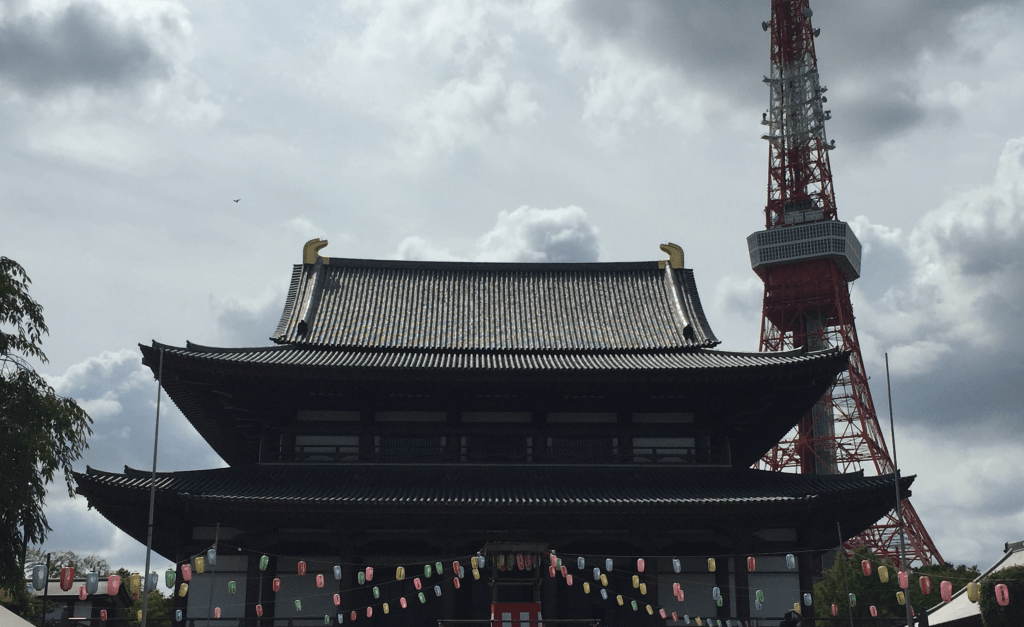
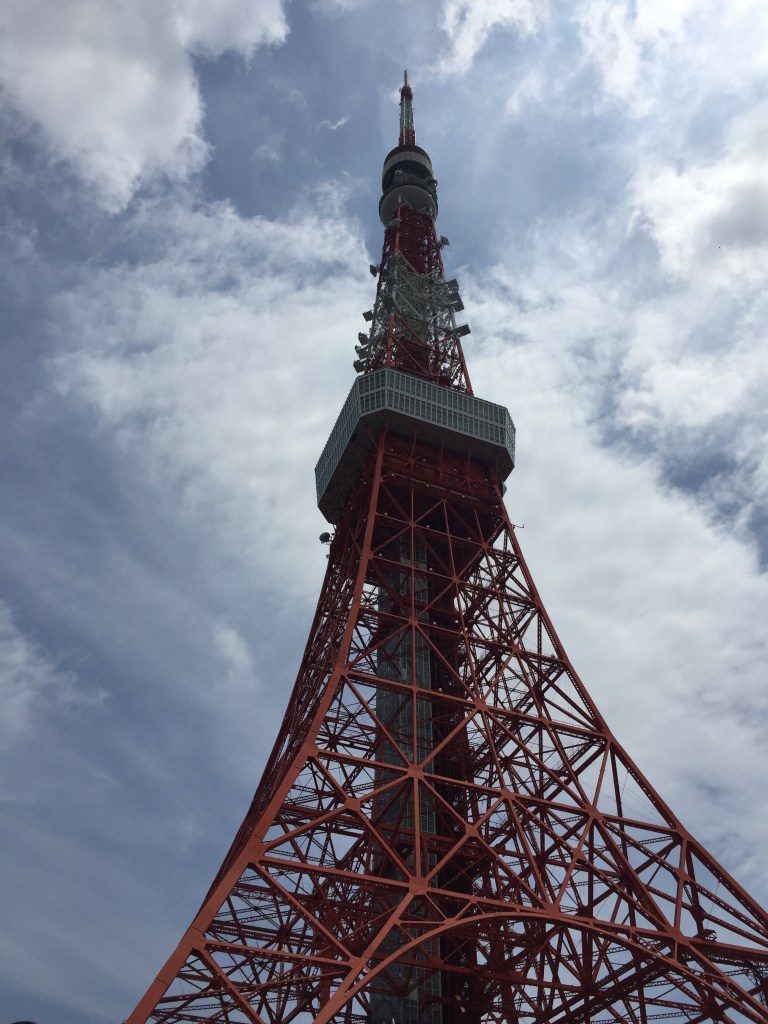
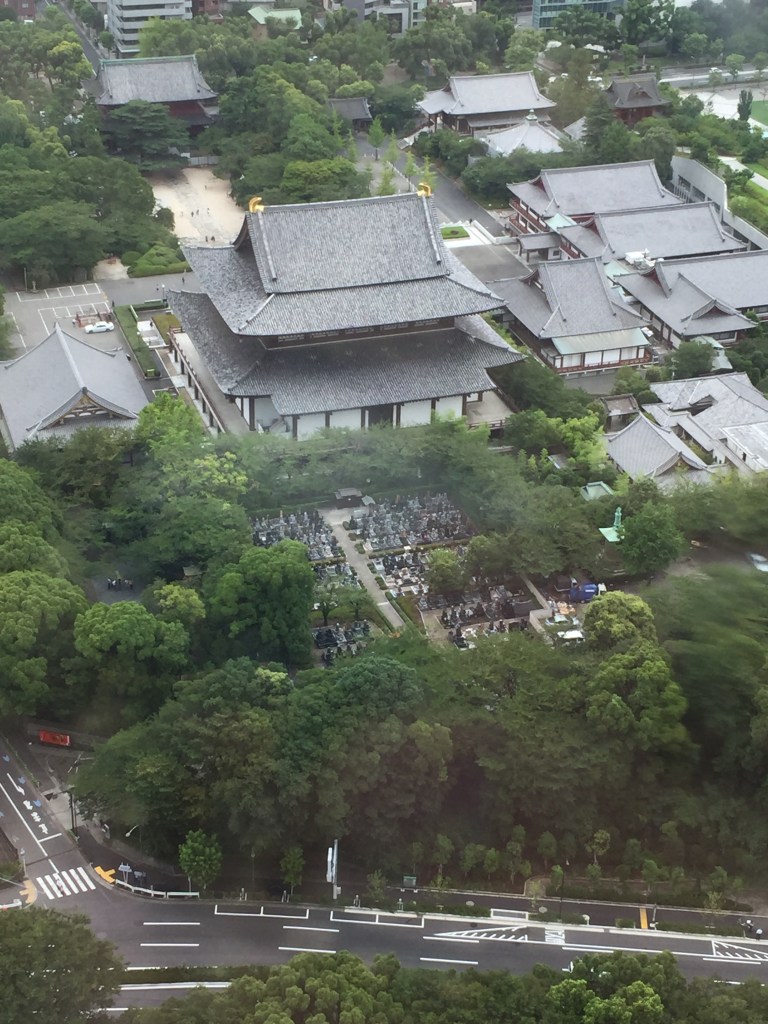
One of the places we visit almost every year is the Buddhist temple of Zojoji, which is about a block away from the famous Tokyo Tower:
Taken by me in the summer of 2018 (?).
Zojoji is one of two head temples (daihonzan 大本山) of the Jodo-Shu sect of Japanese Buddhism. Jodo-Shu is a Buddhist sect and populist movement that started in the 12th century under the influence of Honen (法然 1133 – 1212), and grew to be one of the largest Buddhist sects in Japan even today. Jodo-Shu has two head temples, the first being Chion-in in Kyoto, Japan1 and the second in Tokyo at Zojoji that was founded during the late-medieval Edo Period as the family temple of the Tokugawa Shoguns.2
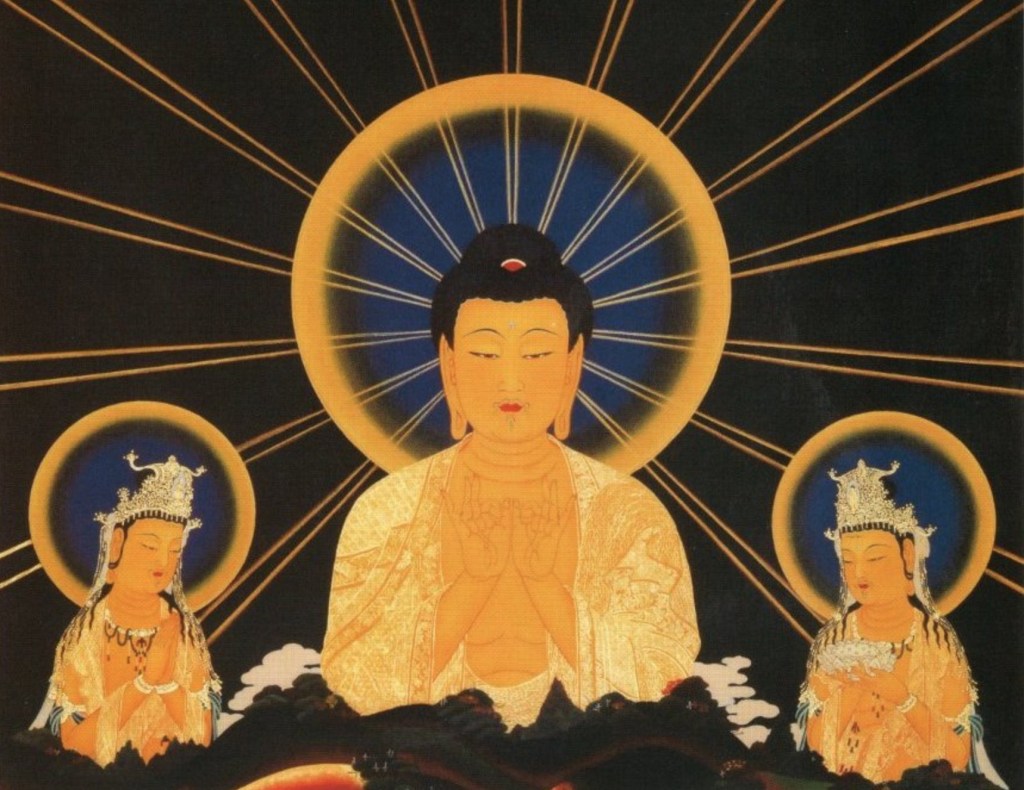
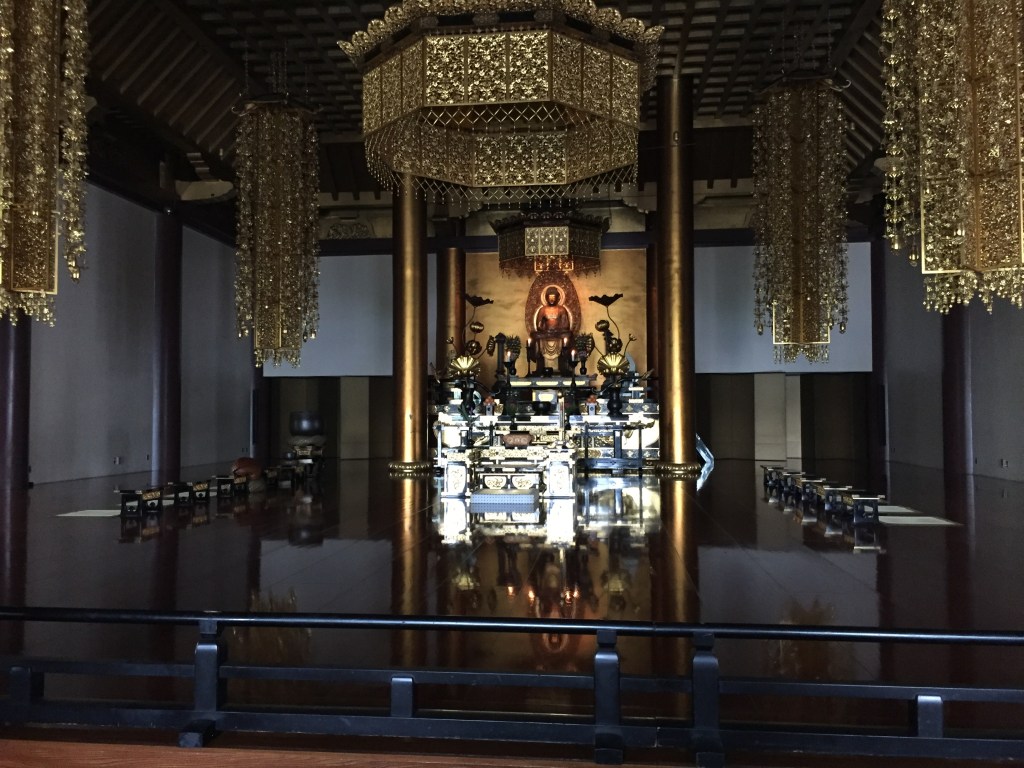
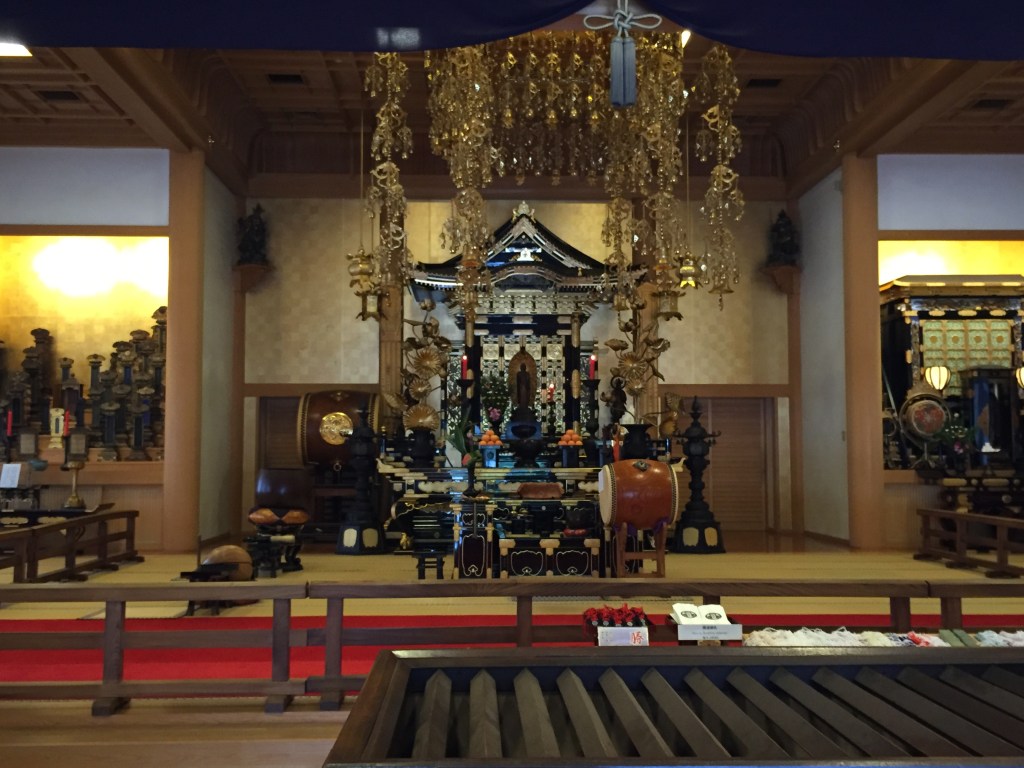
Zojoji is a pretty large temple within Tokyo, so it’s hard to miss. It’s main hall (hondō 本堂) is clearly visible as you pass through the gate. Inside the main hall is the central altar devoted to Amida Buddha, the Buddha of Infinite Light and central figure of Pure Land Buddhism:
Note that the temple is not always open for photography, especially if a memorial service is underway (would you allow people to take photos of your relative’s funeral?), so if you visit, make sure to pay attention to signs. The Chion-in homepage has more details on temple etiquette and other interesting information.
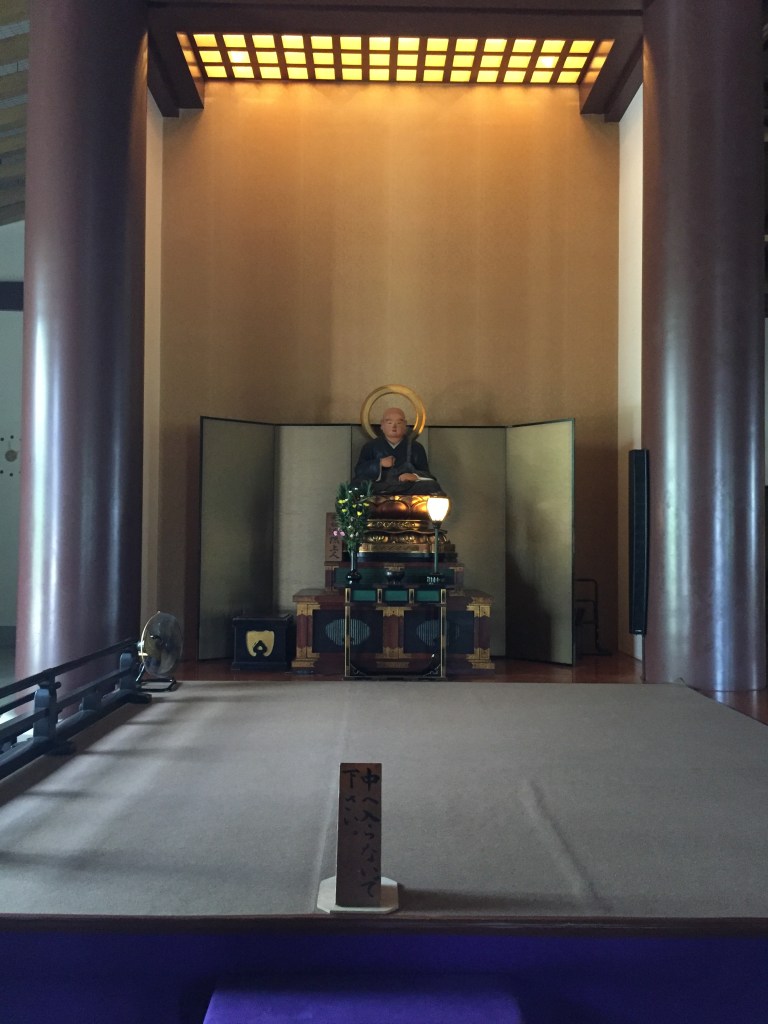
Each side of the altar is flanked by a statue: one of Honen, the founder of Jodo-Shu Buddhism, and the other (not shown) of Chinese Pure Land Master, Shan-dao (善導 613 – 681), whom Honen was inspired by:
After exiting the main hall, there is a gift shop to the right, which is actually a temple annex with a famous Buddhist altar of its own featuring a black, carved statue of Amitabha Buddha in the center:
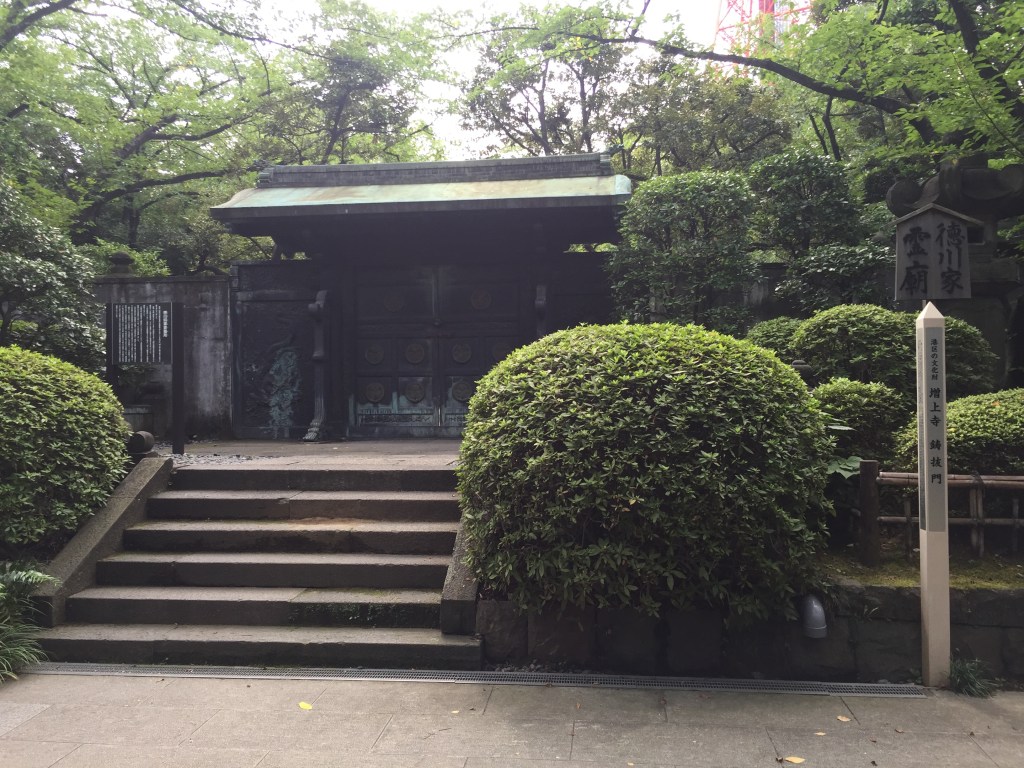
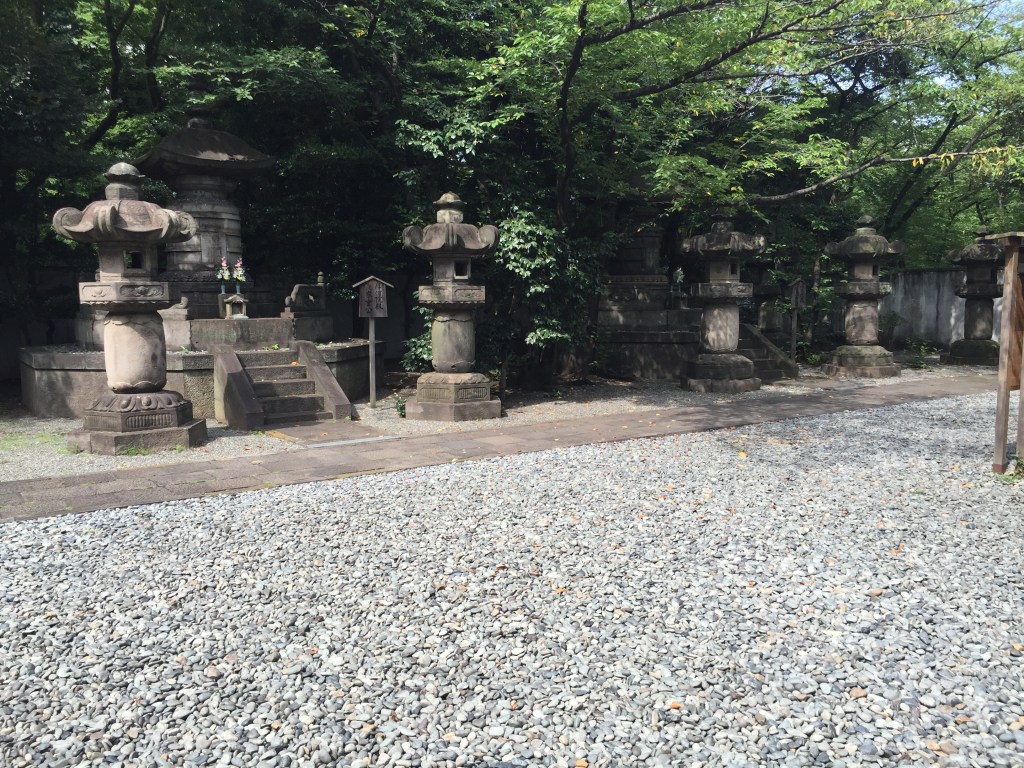
Outside the gift shop/annex is a small cemetery and stone path. If you follow the stone path, you’ll come behind the temple to the mausoleum of the Tokugawa Shoguns:
Mausoleums of some of the later Tokugawa shoguns
The early generations of the Tokugawa shogunal family are buried in a great mausoleum up in Nikkō, but later shoguns are interned here. It was interesting to see the graves of these shoguns who in the past were the leaders of Japan during the Edo Period (1600-1868).
About two blocks away, behind the temple, is the famous broadcast tower of Tokyo Tower (tōkyō tawaa, 東京タワー) which was built in 1958. At the time, it was the largest broadcast tower in the world, though it has long been surpassed by other towers. Nevertheless, it remains a cultural icon.3
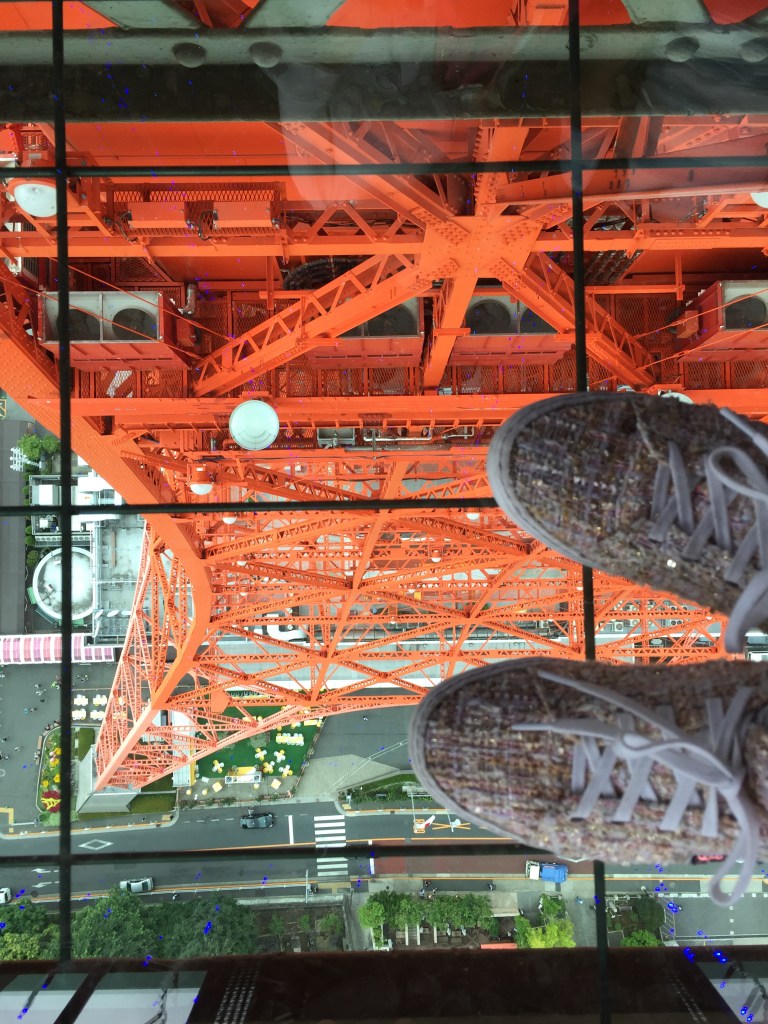
Tickets up to the observation tower are cheap and include many nice views.
My daughter standing over a glass floor on the Tokyo Tower observation deck looking belowZojoji Temple as seen from Tokyo Tower observation deck
One last thing we like to do at Tokyo Tower is to see try the limited edition “Tower Burger” by Mos Burger:
Despite the picture, the burger is actually somewhat smaller than expected (and it’s a actually a chili burger), but it’s quite good:
Zojoji Temple and Tokyo Tower are a pair of sites we regularly visit every year and always have a good time as a family.
Hopefully, after the lockdown, you all can someday visit too. 🗼
1 I visited Chion-in way back in 2005, and it had a big impression on me at the time leading to my eventual interest in Pure Land Buddhism, but Zojoji was something I only started visiting recently. Despite my recent rant about Jodo Shu Buddhism, the reality is is that it still has a special place in my heart and Zojoji Temple is just a great temple to visit, regardless of who you are. My wife and I regularly joke that it’s our spiritual “power spot”. 😊
2 Contrary to popular belief, samurai as a whole were not devotees of Zen Buddhism. The relationship between the samurai class and Buddhism is long and complicated, but suffice to say different warlords had their preferences and patronized different temples according to those preferences.
A scene from the Genpei War, courtesy of Wikipedia
When religion and politics travel in the same cart, the riders believe nothing can stand in their way. Their movements become headlong – faster and faster and faster. They put aside all thoughts of obstacles and forget the precipice does not show itself to the man in a blind rush until it’s too late.
While reading my new book on the Ojoyoshu and its author Genshin, a highly influential Japanese Buddhist monk in the 12th century, I came across the story of two men who were very powerful at the time, and colluded to build the temple of Enryakuji, home of the Tendai sect, to become the most powerful religious institution at the time. This had some very negative unintended side-effects as we shall see, but first let’s see who these two men were.
The first was an ambitious monk named Ryōgen (良源, 912 – 985) who quickly embroiled himself in a generations-long simmering dispute between two rival factions of the Tendai sect: one based on the lineage of the Ennin: the sanmon-ha (山門派), and the other based on the lineage of Enchin: the jimon-ha (寺門派). Both Ennin and Enchin had been direct disciples of founder Saichō (最澄, 767 – 822). Interestingly, neither faction had major doctrinal differences between them, the dispute was entirely over who should run Enryakuji Temple. Ryōgen, who was from the Ennin / sanmon-ha lineage, overtly sought to push out and exclude rivals from the Enchin line from positions of power, until he eventually attained supremacy as the 18th head abbot (zasu, 座主) of Enryakuji Temple in 966.
The other man in this story was a nobleman named Fujiwara no Morosuke, who belonged to one of several competing branches of the Fujiwara clan for control of the Imperial throne. This most common strategy for controlling the throne at the time was through intermarriage with the Imperial family, and controlling the strings as regents for child emperors. In this case, Morosuke wanted to ensure that his pregnant daughter, Anshi (安子, 927-964), the consort of Emperor Murakami, would give birth to a son. He enlisted Ryōgen who had known his father in social circles, and Ryōgen agreed to undertake a lengthy 300-day Buddhist esoteric ritual to ensure safe birth of a son. Sure enough, Anshi gave birth to a son (later Emperor Reizei), and Ryōgen was greatly rewarded by Morosuke with prestigious positions and patronage against rivals at Enryakuji.
This relationship between the two profited both. From Ryōgen, Morosuke got spiritual protection, and influence over the powerful Enryakuji temple, while Ryõgen could further his plans to consolidate power at the temple with blessings from the powerful Fujiwara clan.
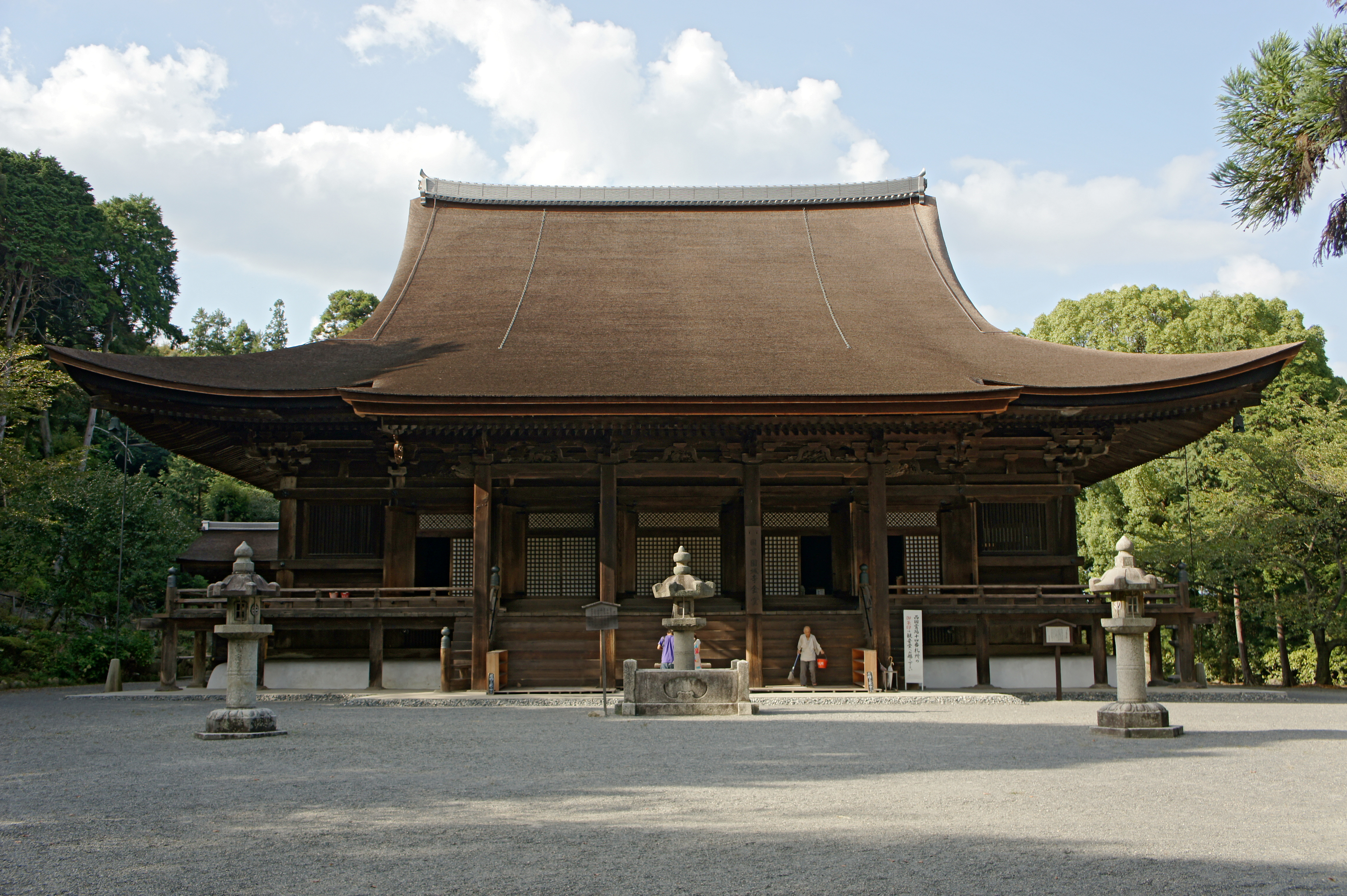
Ryōgen paid back Morosuke by appointing one of Morosuke’s junior family relations, Jinzen, to the prominent position of “bishop” within Enryakuji and then archbishop (sōjō 僧正) two years later. Jinzen was far too young to be an archbishop, and lacked past qualifications, but his connection to the Fujiwaran clan and Ryōgen were enough to make the promotion happen. Ryōgen appointed others similarly to his “inner circle” based more on loyalty to the Ennin faction than on qualifications, while pushing out more qualified rivals who belonged to the Enchin faction. This struggle came to a head later in 981 when a member of the rival Enchin line was appointed to an important position by the government. Protests, threats and rumors by monks spread quickly, and monks of the Enchin lineage felt increasingly unsafe and moved further down the mountain. By 991, armed monks (sōhei 僧兵)1 from the Ennin line (Ryōgen’s lineage) openly attacked the Enchin monks’ residences and they fled to a rival Tendai Buddhist temple named Miidera:
The political/factional rivalry didn’t end there though. Both temple complexes, along with several other major temples in and around the capitol, fielded armies of warrior-monks, and allied themselves with power noble families. Between Enryakuji and Miidera, the violence escalated until Miidera was burned down by warrior monks from Enryakuji 4 times in the 11th century, while Miidera warrior-monks attacked and destroyed places associated with the Ennin lineage.
By the time of the Genpei War in the last 12th century (more on that here), the temples were caught up in the larger struggle between the Taira and Minamoto clans with the Miidera Temple being burned down (yet again) and its monks fleeing with the retreating Minamoto clan.
All of this started with a lineage dispute between two disciples of the founder, Saichō, but gradually escalated as one side sabotaged the other politically and then, starting with Ryōgen, tapped into patronage from power noble families in order to drive out the other faction. This back and forth happened for decades and centuries, until both temples were repeatedly destroyed by warfare. The temporary political gains that Ryōgen received through Morosuke did little to actually solve the issue long-term and worsened things through factionalism. Monks, increasingly drawn into political battles, forgot their monastic training and engaged armed conflicts with other monks (or opposing samurai warriors in some cases) in total contradiction of the Buddha’s firm teachings against taking life, especially in the capacity as a monk.
As the book shows, not all monks at Enryakuji bought into this conflict. Genshin, for example, setup a retreat at the more isolated Yokawa region of Mt. Hiei for monks to focus on the Pure Land teachings and practices. In a sense, he just clocked out. Some monks just openly left to start new Buddhist sects (Honen, Shinran, Dogen, etc) or join them. Others just turned a blind eye to what was happening.
Nevertheless, the monastic system in Japan by the 11th and 12th centuries hadn’t just been plagued by “monks gone wild”; the entire system had totally gone off the rails.
Not surprisingly, although these sects survived the conflict and continued on into the later Kamakura and Muromachi Periods, their reputations were permanently tarnished, and even today enjoy far less prestige that newer, fresher sects that had less political muscle,2 and more mass-appeal. As researchers argue, the political sects at the time hitched their wagons with powerful noble families and profited from this, but when those families declined political, so did the temples.
A cautionary tale for future generations….
P.S. the book also alludes to an “acrimonious debate” in China between two factions of the parent Tiantai sect: the shanjia (山家, “mountain family”) and the shanwai (山外, “outside the mountain”). Unlike Japan, the struggle in China never led to open warfare, but the Tiantai sect suffered paralysis until the debate was resolved.
1 Warrior-monk armies were not exclusive to the Tendai sect, by the way. Other major sects around the capitol got tangled up in a weird kind of religious-political “arms race” with each other. Kōfukuji, the head of the still-powerful Hossō sect, fielded a powerful army and frequently threw their weight around, intimidating followers of the new Pure Land sect, while getting into armed clashes with Enryaku-ji, their rival Miidera, and later with newer Zen temples. The army from Enryakuji was also known for robbing the grave of Pure Land Buddhism founder, Hōnen (ironically a former Tendai monk) later. Centuries later, these warrior-monks were still harassing rival Buddhist sects (for example Rennyo’s community of the Jodo Shinshu sect, and Dōgen’s community of the Sōtō Zen sect) until they were finally wiped out (literally) by the infamous warlord Oda Nobunaga. For more on sohei warrior-monks and how they might look in Dungeons and Dragons role-playing, check out my other blog post.
2 The one prominent exception to this would the Jodo Shinshu sect, which did openly challenge Oda Nobunaga with a peasant army (ikko-ikki) of its own whose relationship to Rennyo was … complicated. Outside of war, Jodo Shinshu has also had a somewhat sketchy history of attacking critics such as the Zen monk Tetsugen through mob-violence.
George Romney’s “A Procession of the Damned”, courtesy of Wikipedia
In broad tradition of Mahayana Buddhism, there is a concept called “Dharma Decline”, or “The Age of Dharma Decline” or other such names. A few sutras in the Buddhist canon (out of literally hundreds) allude to this concept, but starting with the medieval period in Asia, it became a hugely influential idea that persists even today. Dharma Decline is vaguely reminiscent of the End Times beliefs in Western religion, though considerably less dramatic.
The idea is based on the earliest Buddhist teachings that the appearance of Buddhas, that is to say a fully-awakened being capable of teachings others the Dharma, is super rare but occurs in a somewhat cyclical manner. Ancient Indian thought believed the world to be very old and would come and go in cycles. In the same way, there would be periods of enlightenment and decline. This influenced Buddhist thought in that the historical Buddha, Shakyamuni (e.g. Siddhartha Gautama), was one of a long line of Buddhas to have appeared in the world.
This model doesn’t fit very well with the geological history of the Earth, since humans have only been around at most 2.5 million years, but it is what it is. 🤷🏼♂️
This notion was only mentioned in a few obscure sutras in the Pali canon, but was expanded further in Mahayana literature, such that world history would be divided into 5 phases (often conflated into 3) that in brief summary were:
The appearance of a Buddha, a period of great spiritual awakening and enlightenment. (e.g. the “turning of the wheel of the Dharma”). People are wise, live long, healthy lifespans, etc.
After the Buddha dies, the “wheel” starts to slow down more and more over time and the teachings of the Buddha become less and less potent. Quality of life gradually diminishes.
At some point of no-return, the wheel basically stops and the Buddha’s teachings fades and are corrupted so badly that society breaks down. Life at this point is short, brutal and saturated by ignorance.
The final period, also known as the Age of Dharma Decline, was the closest thing that Buddhist literature and culture had to an apocalypse. There was no dramatic sounding of trumpets, but the quality of life would worsen, life spans would be shorter, and no one would be able to practice the Dharma anymore for tens of thousands of years until another Buddha appeared.
In medieval Japan, the end of the Heian period was marked by terrible strife, warfare, famine, and by the time of the Kamakura period the social order had been totally upended when warlords seized power away from the Imperial family and the aristocrats in Kyoto. As a result, Buddhist thinkers at the time such as Honen, Shinran, Nichiren and others quite literally interpreted Japan as being in the end-times. This was a period of time, where monks would frequently interpret Buddhist sutras verbatim, just as Honen, Shinran and Nichiren all did. As described in such sutras, at some point the Buddhist teachings would no longer work, except perhaps this teaching or that. Take for example the ending of the Sutra on the Buddha of Immeasurable Life:
The Buddha further said, “I have expounded this teaching for the sake of sentient beings and enabled you to see Amitāyus and all in his land. Strive to do what you should. After I have passed into Nirvāṇa, do not allow doubt to arise. In the future, the Buddhist scriptures and teachings will perish.”
But, out of pity and compassion, I will especially preserve this sutra and maintain it in the world for a hundred years more. Those beings who encounter it will attain deliverance in accord with their aspirations
translation by Professor Charles Muller
The Lotus Sutra references the Age of Dharma Decline as well, for example in the 23rd chapter:
“If in the last five hundred year period after the Thus Come One has entered extinction there a woman who hears this sutra and carries out its practices as this sutra directs, when her life here on earth comes to an end she will immediately go to the world of Peace and Delight where the Buddha Amitayus dwells surrounded by the assembly of great bodhisattvas and there will be born seated on a jeweled seat in the center of a lotus blossom….For this reason, Constellation King Flower, I entrust this chapter on the Former Affairs of the Bodhisattva Medicine King to you. After I pass into extinction, in the last five hundred period you must spread it abroad widely throughout Jambudvipa and never allowed to be cut off….
translation by Professor Burton Watson
In light of all this, Buddhist teachers at the time actively sought that one thing that would they could still rely on in the dark age when everything else had fallen apart. For Honen/Shinran it was reliance on the Buddha Amitabha, for Nichiren it was the Lotus Sutra (and his innovative chant in praise of it).
This literal interpretation of the Buddhist texts also tended to favor exclusively Mahayana teachings at the expense of older teachings, since some early Mahayana sutras (cf. the Virmalakirti Sutra) tended to trash the “old guard” Buddhists. In the same way, Kamakura-Era Buddhism also tended to trash the old monastic establishment, which admittedly had grown pretty corrupt thanks to an unhealthy association with political power at the time.
The focus of these Buddhist sects was mass-appeal. The more venerable Buddhist teachings no longer worked due to the condition of the times (not the teachings themselves), and in line with Mahayana-Buddhist compassion towards all beings, these thinkers, among others like Ippen, tried to spread any teaching they could that would help the masses escape a terrible fate being reborn over and over in a world of strife and danger.
But what about other Buddhist sects in Japan at the time? In various degrees, the fear of Dharma-Decline affected them all, but some more than others. The old-guard sects like Tendai and Shingon Buddhism accepted the notion of Dharma-Decline, especially Tendai Buddhism.1Genshin’s influential Ojoyoshu was a Tendai-centered treatise on the importance of seeking the Pure Land in the Age of Dharma Decline.
Zen was not above Dharma Decline either.2 One one article on JSTOR,3 quotes Eisai, founder of Rinzai Zen, wrote:
The Prajñā, Lotus and Nirvana Sutras all teach the meditational practice of zazen for the last age. If it did not suit the people’s capacity in these latter days, the Buddha would not have taught this. For this reason, the people of the great Sung [Dynasty] nation avidly practice Zen. They err, who, in ignorance of zazen, hold that Buddhism has fallen into decline.
Having said all that, I think that there are some problems with the premises of Dharma Decline. This is *not* a criticism of Buddhist sects and teachers, but Dharma Decline itself.
First, the situation in Japan at the time that spurned Dharma Decline was based on specific historical events and the cultural environment at the time, but obviously this doesn’t apply to the rest of the world at the time. Where Japan saw societal decline, other societies probably prospered. Eisai’s comment about Song Dynasty China is interesting since the Song Dynasty was near its zenith, so tying Dharma Decline to political/historical events probably doesn’t make much sense anyway. Basically, it was a pretty subjective world viewpoint.
Second, as alluded to above, Dharma Decline, if taken at face-value, relies on a specific world-view in ancient India that doesn’t fit well into modern notions of historiography and geology. For example, lifespans are typically _longer_ than before, and humans haven’t been around long enough for a series of Buddhas to appear across the eons (kalpas). The quality of life is arguably *better* than before, not less, and the Buddhist community still has good Buddhist teachers, both famous and more local. Dharma Decline hasn’t really panned out as predicted in old Buddhist literature.
However, one can argue that since the appearance of Shakyamuni Buddha, there is a more general sense of decline, and this may very well be true.
The stock, five periods of increasing decline are too formulaic to realistically apply to anything, but the idea of things declining is very Buddhist. Afterall, all condition phenomena are inherently empty. Buddhism as a religious institution (not the Dharma itself) therefore would be subject to the same changes and decline.
Which leaves us with an awkward question: are Buddhist teachings based on Dharma Decline even relevant anymore?
It’s fair to say that Buddhism now is pretty different than it was in 5th century BCE India, but is it realistic to try and wind back the clock to that era? Are all the “cultural accretions” and innovations that have come since a bad thing? Or do they reflect Buddhism as a continuously evolving religion rather than a moribund one?
On the other hand, at what point does the religion change and evolve that it loses its original essence, that it doesn’t really reflect the Buddha’s teachings anymore.
This is just one layman’s opinion, but if I had to distill the Buddha’s teachings, it involves three facets:
Moral conduct – Buddhism has various “lists” of precepts, but they all tend to follow the same pattern: a blameless life of dignity toward oneself and others.
Cultivation – The Buddha definitely did not want followers being idle. Buddhism wasn’t meant to be a mental exercise. Everything from the precepts to meditation practices were meant to be training on some level or another.
Wisdom – The Buddha placed heavy emphasis on the importance of insight, not beliefs. Cultivation and moral conduct were both meant to facilitate this.
So, I suppose that if we’re looking for a measuring stick of various Buddhist teachings today, they need to be able to conform (again, just my opinion) to these general guidelines in order to still be a genuine continuation of the Buddhist tradition.
A literal reading into some of the Buddhist sutras (need I remind readers that none of them were written anything less than 400 years after the Buddha, some much later) isn’t really a good use of one’s time, but reflecting on them in the light of the general Buddhist principles outlined above helps put them into context, while still keeping on grounded here and now on one’s path.
But at the same time the tradition, warts and all, is important to Buddhism and shouldn’t be tossed out with the bath water. Nor need we be bound by it though.
1 Ironically, teachers like Honen, Shinran, Nichiren and Ippen were all former Tendai monks.
2 Contrary to what modern Zen Buddhists tend to think.
3 Stone, Jackie. “Seeking Enlightenment in the Last Age: Mappō Thought in Kamakura Buddhism: PART II.” The Eastern Buddhist, vol. 18, no. 2, 1985, pp. 35–64. JSTOR, http://www.jstor.org/stable/44346128. Accessed 26 Feb. 2020.
Having been a Buddhist more or less since 2005, I’ve come to realize that there is no “magic” teaching or practice that you can follow to fruition and become a fully-awakened Buddha. Of course, it’s natural to start with one teaching/practice as your starting point, but in the end Buddhism is a holistic religion. Anything that interprets Buddhism otherwise is a doctrinal house of cards.
The quotation I posted above illustrates what I think is a more balanced approach to Buddhism whereby one’s goal is fixed on awakening, and different “tools” are employed toward that end. Because of the depth and breadth of Buddhism, many such tools exist, and sometimes what works at one point in life might not work in another. Further, these tools are not mutually exclusive.
One of the more interesting, and still commonly-used practices, in Japanese culture is the use of imperial reigns in place of years in the Gregorian calendar. This is most often used now when talking about generations or one’s birth year, whereas the Gregorian calendar is often used for other historical discussions or other such situations.
Prior to the Meiji Emperor, Japan used since antiquity a system where eras were frequently proclaimed especially after major events, disasters, etc. For example, Emperor Juntoku reigned from 1210 to 1221, but within that reign he proclaimed 4 eras:
Jōgen (承元, 1207–1211)
Kenryaku (建暦, 1211–1213)
Kempō (建保, 1213–1219)
Jōkyū (承久, 1219–1222)
The founder of Jodo Shu Buddhism, Honen was said to have died in the 2nd year of Kenryaku which maps to 1212 in the Western calendar. The 260+ year late-medieval Edo Period had more than 40 different era names within it (see Wikipedia for details).
However, this system completely changed with the reign of the Meiji Emperor ō (reign 1867 – 1912). The system was simplified such that each emperor had a *single* reign name, starting with the Meiji Emperor. Since then, there have 5 emperors total, and 5 reigns accordingly:
So, nowadays, when people in Japan talk about what year they were born, they might say “the 52nd year of Shōwa” or in Japanese shōwa go-jū-ni nen.
This also comes up a lot when people joke about different Japanese generations. My wife and I are born in the 1970’s, so we are “Showa” generation kids, by my kids who are half-Japanese are “Heisei” kids. Nowadays, there are even “Reiwa” generation kids now.
On TV documentaries and other sources, reign years are also frequently used alongside the Western calendar, so you get used to doing the math like so:
The first year of an Emperor is year 1, not year 0.
So, for example Heisei 3 is 1991 (1989 + 3 – first year of reign).
Shōwa 47 would be 1926 + 47 – first year of reign, or 1972.
Interestingly, Japan is not the only culture to have novel calendar systems based on the dates of rulers. Rome during the Republic had its own system. The ancient Roman calendar was confusing and imprecise until Julius Caesar fixed it in 46 BCE. However, in popular Roman culture, people told dates based on who the two elected consuls were that year. Just as Japanese know who the line of Emperors are in recent times (see above), Romans in those days remembered each year.
One might say something like “April 4th in the year that Pompey and Crassus were consuls” or “when Caesar and Bibulus were consuls” or something like that.
I often find these little cultural oddities interesting because they add “flavor” to a culture even if they’re not entirely practical. The Julian Calendar introduced by Caesar was a huge improvement over the old system, but I wonder if a little something also got lost in the process too. 😀
¹ Emperor Meiji reigned starting in 1867, but due to radical changes in Japan at the time, it wasn’t technically formalized until 1868.
(A reprint of Honen’s calligraphy, which I found in a Jodo Shu liturgy book)
For anyone who’s come across the Pure Land tradition in Buddhism, they will have almost certainly heard like terms “nenbutsu”, “nian-fo” and such. Pure Land Buddhism is a long, broad tradition within the even broader Mahayana Buddhism. But if I had to distill it into a 30-second explanation, the tradition is based on devotion to Amitabha Buddha, the Buddha of Infinite Light, who vowed to rescue all beings and enable them to also reach enlightenment more easily within the safety of his Pure Land. In the original Sanskrit, this Pure Land is called Sukhavati.
(warning: this post is a bit long … sorry)
Since Pure Land Buddhists are devoted to Amitabha, and aspire to be reborn in this Pure Land, a major focus is on how to get to the Pure Land. The Buddhist sutras that focus on the Pure Land offer a number of overlapping explanations, with some contradictions (more on that later). While all Pure Land Buddhists agree on the compassionate nature of Amitabha Buddha and the potential for Enlightenment for anyone reborn there, when we get to specifics, things get tricky.
Nowadays, the most common tradition is through reciting something called the nembutsu (Japanese) or nian-fo (Chinese), etc. Usually this a stock phrase such as:
Phrase
Language
Native Script
Nā-mó Ē-mí-tuó-fó
Chinese
Traditional: 南無阿彌陀佛 Simplified: 南无阿弥陀佛
Namu Amida Butsu
Japanese
Kanji: 南無阿弥陀仏 Hiragana: なむ あみだ ぶつ
Namu Amita Bul
Korean
Hanja: 南無阿彌陀佛 Hangul: 나무아미타불
Nam mô A Di Đà Phật
Vietnamese
n/a
…and so on. These all mean the same thing: “Hail to Amitabha Buddha”, but are just recited in different languages, and all of them adapted from the original Sanskrit phrase (which is not precisely known anymore) via Classical Chinese. Technically it’s not reciting the name only, and there are even other, more elaborate variations to this phrase, but this is the most common practice for devotees to the Pure Land.
The basis for this practices comes from two places, among others. First, in the Sutra on the Buddha of Immeasurable Life (a.k.a. “the Larger Sutra”) the 18th vow out of 48 of the Buddha-to-be is:
If, when I attain Buddhahood, sentient beings in the lands of the ten quarters who sincerely and joyfully entrust themselves to me, desire to be born in my land, and call my Name, even ten times, should not be born there, may I not attain perfect Enlightenment. Excluded, however, are those who commit the five gravest offences and abuse the right Dharma.
translation by Rev. Hisao Inagaki
and also the Contemplation of Amitabha Sutra, which at the very end lists the 9 grades of followers who will attain rebirth in the Pure Land:
‘…On the eve of death he will meet a good and learned teacher who will, soothing and encouraging him in various ways, preach to him the excellent Dharma and teach him the remembrance of Buddha, but, being harassed by pains, he will have no time to think of Buddha. Some good friend will then say to him: “Even if you cannot exercise the remembrance of Buddha, you may, at least, utter the name, “Buddha Amitayus.” Let him do so serenely with his voice uninterrupted; let him be (continually) thinking of Buddha until he has completed ten times the thought, repeating the formula, “Adoration to Buddha Amitayus” (Namah Amitabha Buddhayah, Namu Amida Butsu). On the strength of his merit of uttering that Buddha’s name he will, during every repetition, expiate the sins which involved him in births and deaths during eighty million kalpas. He will, while dying, see a golden lotus-flower like the disk of the sun appearing before his eyes; in a moment he will be born in the World of Highest Happiness….’
translation by J. Takakusu
So, when most people think of Pure Land Buddhism, this is what they think of: reciting the nembutsu/nianfo and aspiring to reborn in the Pure Land. This is how I understood it for a long, long time, too.
However, while reading my new book, I came to realize that this is only part of the story! It turns out that for much of Pure Land Buddhist history reciting the name of Amitabha Buddha was only part of the practice. For example, early proponents and teachers of Pure Land Buddhism in both China and India focused on Pure Land Buddhism as a form of meditation and visualization. Verbal recitation was supplemental.
This was, as with verbal recitation, also based on the same sutras. The Contemplation Sutra cited above is almost entirely devoted to detailed visual descriptions of the Pure Land and of Amitabha Buddha, among other things, and the benefits of fixing one’s mind on them in meditation:
‘When this perception has been formed, you should meditate on its (constituents) one by one and make (the images) as clear as possible, so that they may never be scattered and lost, whether your eyes be shut or open. Except only during the time of your sleep, you should always keep this in your mind. One who has reached this (stage of) perception is said to have dimly seen the Land of Highest Happiness (Sukhavati).’
translation by J. Takakusu
The verbal component, despite being singled out by later commentators, only occurs at the very end of the sutra.
Elsewhere, in the Amitabha Sutra (a.k.a. “The Smaller Sutra”), is the following line:
Shariputra, if there be a good man or a good woman, who, on hearing of Buddha Amitayus, keeps his name (in mind) with thoughts undisturbed for one day, two days, three days, four days, five days, six days, or seven days…
translation by Nishu Utsuki, The Educational Department of the West Hongwanji (1924)
And finally, the historically oldest Buddhist sutra that talks about Amitabha Buddha, the Pratyutpanna Samadhi Sutra, says:
The Buddha said to Bhadrapala, “If you hold to this method of practice, you will attain the samadhi in which all the present Buddhas appear before you. If a bhiksu, bhiksuni, upasaka or upasika wants to practice according to the prescribed method, he or she should strictly observe the precepts, dwell alone in a place and contemplate Amida Buddha of the western quarter where he lives now. According to the teaching received, one should remember: ten million kotis of Buddha-lands away from here, there is a land called ‘Sukhavati.’ Contemplate this land with singleness of mind, for a day and night up to seven days and nights. The seventh day having passed, one will see it.
translation by Rev. Hisao Inagaki
Examples of this in practice started in early Chinese-Buddhist history with the famous monk Zhiyi who founded the highly influential Tiantai school. Zhiyi wrote a treatise called Mohe Zhiguan (摩訶止観, “The Great Contemplation and Abiding”) in which he laid out multiple practices for attaining samadhi (deep insight and concentration). One of these was called the “constantly walking samadhi” which involved circumambulating around a statue of Amitabha Buddha for 90 days without rest without stopping constantly reciting the Buddha’s name while holding a very detailed image of the Buddha preaching in the Pure Land.
Later, the focus shifted toward a more devotional practice in China starting with Tanluan (曇鸞, 476–542), one of the pioneers of Pure Land Buddhism. Tanluan wrote that in addition to arousing the aspiration to be enlightened:
If a son of good family or daughter of good family cultivates the five gates of mindfulness and perfects their practice, they will ultimately be able to gain birth in the Country of Peace and Bliss and behold Amida Buddha
translation by Robert F. Rhodes, “Genshin’s Ōjōyōshū and the Construction of Pure Land Discourse in Heian Japan”
Later, Daochuo (道綽, 562–645) reaffirmed the importance of awakening the aspiration for enlightenment, in addition to reciting the Buddha’s name at the time of death, and also by attaining the “nembutsu samadhi”. Robert F. Rhodes implies that this “samadhi” was a combination of reciting the Buddha’s name as a tool for fixing one’s mind on the Buddha.
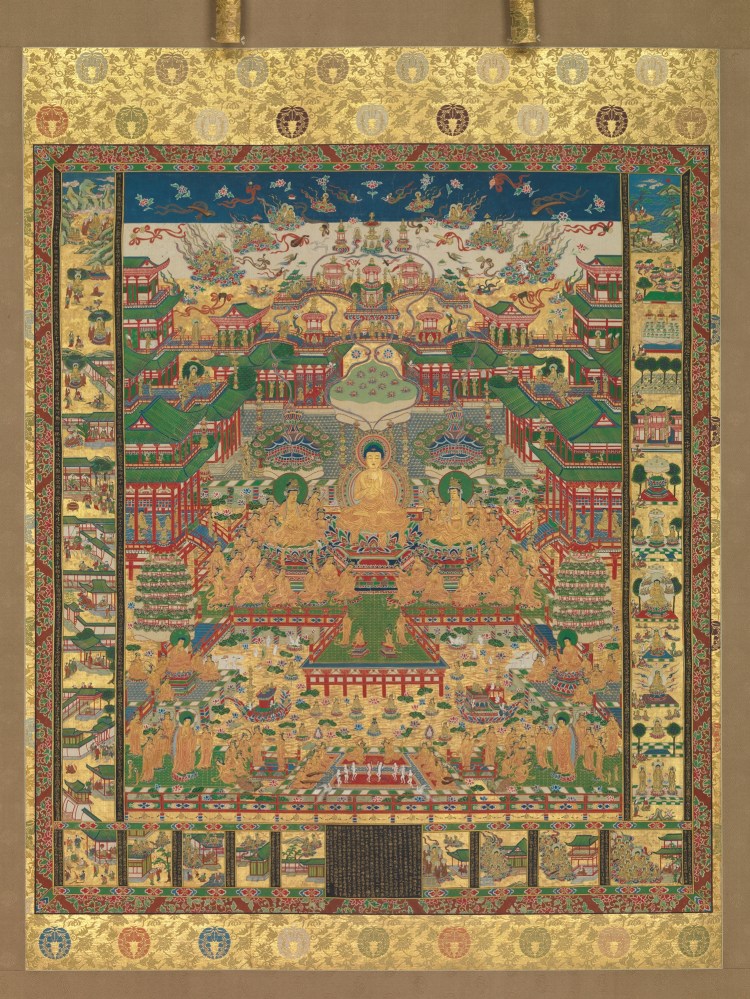
This practice extended into medieval Japan. The picture below is from an early work of Japanese Buddhist art attributed to a Nara Period-era monk named Chikō (智光, 709 – 770 or 781) who belonged to the Japanese branch of the San-lun (Sanron in Japanese) sect of Buddhism.
The “Chiko Mandala” (智光曼荼羅) depicting the Pure Land of Amitabha Buddha, attributed to Chikō. This version is a copy made in the Kamakura Period, while the original was made centuries earlier in the Nara Period.
Chikō wrote in the Muryōjukyōron Shaku (無量寿経論釋, “Commentaries on the Treatise on the Sutra of Immeasurable Life”):
There are two types of nembutsu. The first is the mental nembutsu (shinnen 心念) and the second is the vocal nembutsu (kunen 口念)….As for the vocal nembutsu, if you lack the power (to undertake the mental nembutsu), use your mouth (to recite the nembutsu as a means) to remain mindful of the buddha and to prevent your mind from becoming distracted. In this way, you can achieve mental concentration.
translation by Robert F. Rhodes
What’s interesting is that all of these monks, both in China and in early Japanese history, focused on Buddhist practices that focused primarily on visualization in keeping with the sutras, but that the verbal recitation as a complementary or support practice. This is further complicated in Asian languages because the Chinese characters for nenbutsu/nianfo are 念仏1 whereby 念 refers to the mind (e.g. thoughts, feelings, etc) and 仏 is the generic term for a Buddha. So, this can mean things like “bringing a Buddha (usually Amitabha) to mind”, or “recalling a Buddha”, or “holding a Buddha in one’s thoughts”.
The Taima Mandala, another famous Pure Land “mandala” from that era. More on that in another blog post.
To further complicate things, as we’ve seen above, this recalling of the Buddha is often conflated with the Buddha’s name since that presumably requires one to think of the Buddha as one is saying. This often happens so much so that when most people talk about the nenbutsu/nianfo, they’re talking about the verbal recitation only. This trend was further accelerated in 12th Century Japan when populist Buddhist movements such as Jodo Shu and Jodo Shinshu started. In order appeal to as many people as possible, meditation aspects of the Pure Land were eschewed and complete reliance on the name of Amitabha (e.g. verbal nembutsu) in some way or another became the core practice. At times in Japanese-Buddhist history, the name itself has become an object of meditation, but only so much. Pure Land Buddhist became much more widely popular after this time, but at the cost of the streamlining the practice to the verbal nembutsu only, then justifying this approach retroactively in various writings.
One thing that we haven’t touched on yet is the fact that many of these visualization practices were written by, and practiced by, the monastic community. The monastic community was the target audience since the monastic community comprised of bikkhus (monks) and bikkhunis (nuns) who had given up worldly pursuits in order to devote themselves full-time to practicing the Buddhist path full time. While the history of Buddhist monasticism even to the present day has its scallywags, there were monks and nuns who really did try to put these various meditation exercises, circumambulations, and verbal+visual practices to use.
But this leaves us with a problem: what is the Nembutsu? Is it the meditative practice, or the recitation?
It’s clear from the early tradition that the visual/meditative nembutsu was the intention, but it’s also clear that over time this proved elaborate and impractical, hence later generations have emphasized the verbal nembutsu, even though the meditative nembutsu is more inline with the overall Buddhist tradition.2. This leaves a tricky conundrum: expediency vs. efficacy (or doctrinal orthodoxy).
My $0.02 as a non-ordained, amateur Buddhist with too much time on his hands (and who doesn’t want to get sued) is that both are still needed. Mahayana Buddhism in the early years seems to have suffered a tendency of trying to “out-do” itself over and over in the literature until the practices and levels of attainment simply weren’t realistic anymore. A look at the Sutra of the 10 Stages within the massive Flower Garland Sutra will frighten all but the most dedicated Buddhists. Not surprisingly, as these teachings established roots in China (and cultures on its periphery), a culture that was radically different from India, reaction movements like Zen and Pure Land and Tiantai schools arose to basically “fix this”. Like software patches to fix the initial release.
But I think the core essence of the Pure Land tradition is still important and we can still learn from it, but not necessarily be bound by it. Nor do we have to follow the strict orthodoxy of newer “populist sects” either. They were products of their time, and outlook on the world, and not all of it applies to now.
In any case, meditation practice is still one of the most fundamental practices in Buddhism, and it doesn’t have to be a terrible slog either as described in places like in the Contemplation Sutra. In the excellent book The Way to Buddhahood, but the late Venerable Yin-Shun, he spent some time explaining how basic visualization meditation works. I’ll post this in a separate article, but the gist was that one should hold an image of Amitabha (or any Buddha or Bodhisattva) that one has seen (e.g. from a work or art, etc) in mind as they meditate. This is similar to mindfulness of the breath, but visually oriented. One can also supplement with reciting the verbal nembutsu as well.
At the same time, it’s easy for this practice to get in the way of itself. People who are perfectionists or suffer from “imposter syndrome” will begin worrying about their inability to focus their mind, doubt that they’re making progress, etc. In other words, their self-doubt and unrealistic drive to perfection will get in the way. This could happen just as easily with any other form of Buddhist practice, though. It does require a little bit of, dare I say it, faith in the practice and the Dharma, but also faith in oneself. 😉
Because Buddhist practice has a therapeutic side to it, I think it’s important to keep the practice simple, realistic, flexible and even a little pleasant. Not pleasant in the sense of whacked-out mental states, but in the sense of a calm, abiding joy. Find an image of Amitabha Buddha you like, find inspiration in the beautiful images of the Pure Land described in the Amitabha Sutra, find a reasonable period of time in your day (3 minutes, 5 minutes, whatever) and just try it. You can refine the process as you go, so long as you keep the right intentions in mind.
Meditation, like all Buddhist practices, is a process of emotional growth, insight into things, and fostering goodwill toward others. As long as you keep these things in mind, the rest will work itself out one way or another.
May the Light of Amitabha Buddha shine upon all beings! Namu Amida Butsu.
1 in traditional Chinese characters, it is written as 念佛. You’ll see this in places like Taiwan, but even in Chinese/Japanese temples and sources that predate the reformation of Chinese characters.
2 meditating on Buddhist figures is nothing new. Even Shakyamuni said there was some value in contemplating his own form, though he also downplayed the devotional side quite a bit.
I am very excited to get this book in the mail the other day. I’ve been so busy lately that I haven’t had much free time, but I finally got to start reading last night and it was worth the wait.
The book, titled Genshin’s Ōjōyōshū and the Construction of Pure Land Discourse in Heian Japan by Robert F. Rhodes. This is a book that looks at medieval Pure Land Buddhist thought before schools like Jodo Shu and Jodo Shinshu arose. Genshin (源信; 942 – 1017), the famous monk and central topic of this book lived during a period of explosive growth in Buddhist thought in Japan, which was being imported in waves from China and Korea, and helped develop Pure Land Buddhist thought more than before. His most famous work, the Ōjōyōshū (往生要集, “The Essentials of Rebirth in the Pure Land”) went on to influence later generations of Buddhists, but there’s almost 0 information in English about it. People just kind of naturally assume that Pure Land Buddhism began in Japan with people like Honen and Shinran, but it’s already clear in the book that there was already a lot more that went on leading up to the 12th century. Because of the tendency for Jodo Shu/Jodo Shinshu Buddhism to dominate the conversation in modern-day Buddhist discourse (not just in English) sometimes these details are obscured or forgotten.
This book has been sitting in my wishlist for years, but it’s always been a bit too expensive to purchase, even as a used book, but with things looking up a little this year, I finally decided it was time. I have some personal questions that I would like to get some guidance on, but also I want to flesh out some details here on the blog and on Wikipedia (the Genshin article is awfully short).
Stay tuned!
Namu Amida Butsu
P.S. Subsequent posts about Genshin and this book can be found here, here, here and here.
Way back when in 2005, I got my first exposure to Pure Land Buddhism in the city of Kyoto at a famous temple named Chion-in, where I saw a lone monk chanting evening prayers before a statue of the Buddha. Something about that moment made a real impression on me and I carried that back to the US, where I found some good resources on the Jodo Shu school of Pure Land Buddhism.¹ As a zealous new follower, I started out reciting the nembutsu (or, “namu amida butsu”) almost daily. I would often recite using my double-ringed rosary 1080 times in roughly 15 minutes intervals, sometimes more than one.
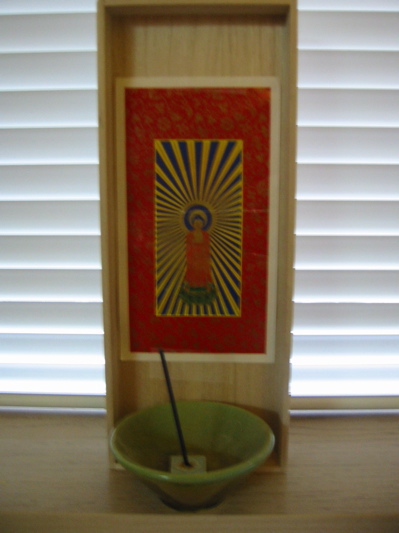
Back when I was living on a smaller budget, I made a Buddhist altar using a balsawood box lid and an image of Amitabha Buddha taped on the inside.
But then life happened: I got busier with work, raising two kids, etc. By and by my recitations have gotten fewer and fewer, and further and further apart.
Some Buddhists that I meet are shocked when I tell them that there are weeks where I don’t recite the nembutsu at all, and sometimes I myself have gone through periods of regret and guilt over this. At such moments, Imposter Syndrome rears its ugly head and I wonder if I should quit Buddhism.
But where does all this come from and why does it matter?
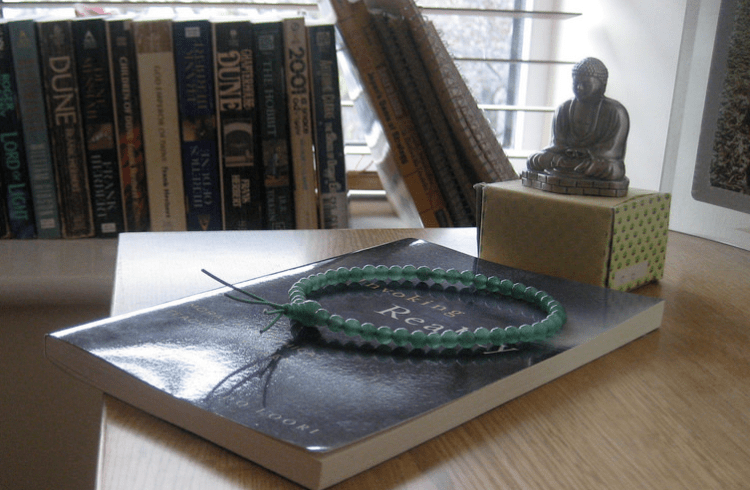
A slight upgrade from the previous altar we used while living in Ireland from 2008-2009. The statue is a souvenir from the Great Buddha of Kamakura.
Unlike some religions based on a single book, Buddhism has a large collection of “sutras” which are reputed to be sermons of the Buddha that have been passed down.² For Pure Land Buddhism, the core sutra is the Sutra on the Buddha of Immeasurable Life sometimes called the “Larger Sutra”, which is the largest of the three Buddhist texts that are central Pure Land Buddhism. You can’t have Pure Land Buddhism without the Larger Sutra, basically.
The Larger Sutra, among other things, is an origin story (think: Marvel comic superheroes 😋) of Amitabha Buddha, the Buddha of Infinite Light. As part of this origin story, it is said in that sutra that Amitabha Buddha made 48 vows that he would accomplish before completing his quiet for Enlightenment,³ but traditionally the most important is the so-called primal vow or 18th vow:
設我得佛。十方衆生至心信樂。欲生我國乃至十念。若不生者不取正覺。唯除五逆誹謗正法
(18) If, when I attain Buddhahood, sentient beings in the lands of the ten quarters who sincerely and joyfully entrust themselves to me, desire to be born in my land, and call my Name, even ten times, should not be born there, may I not attain perfect Enlightenment. Excluded, however, are those who commit the five gravest offences and abuse the right Dharma.
(trans. by Professor A.C. Muller)
Honen, who was something like the father (or grandfather?) of Pure Land Buddhism as a distinct sect in Japan, gathered a large array of followers and disciples, both monastic and secular, and among these disciples there was a broad spectrum of interpretation.
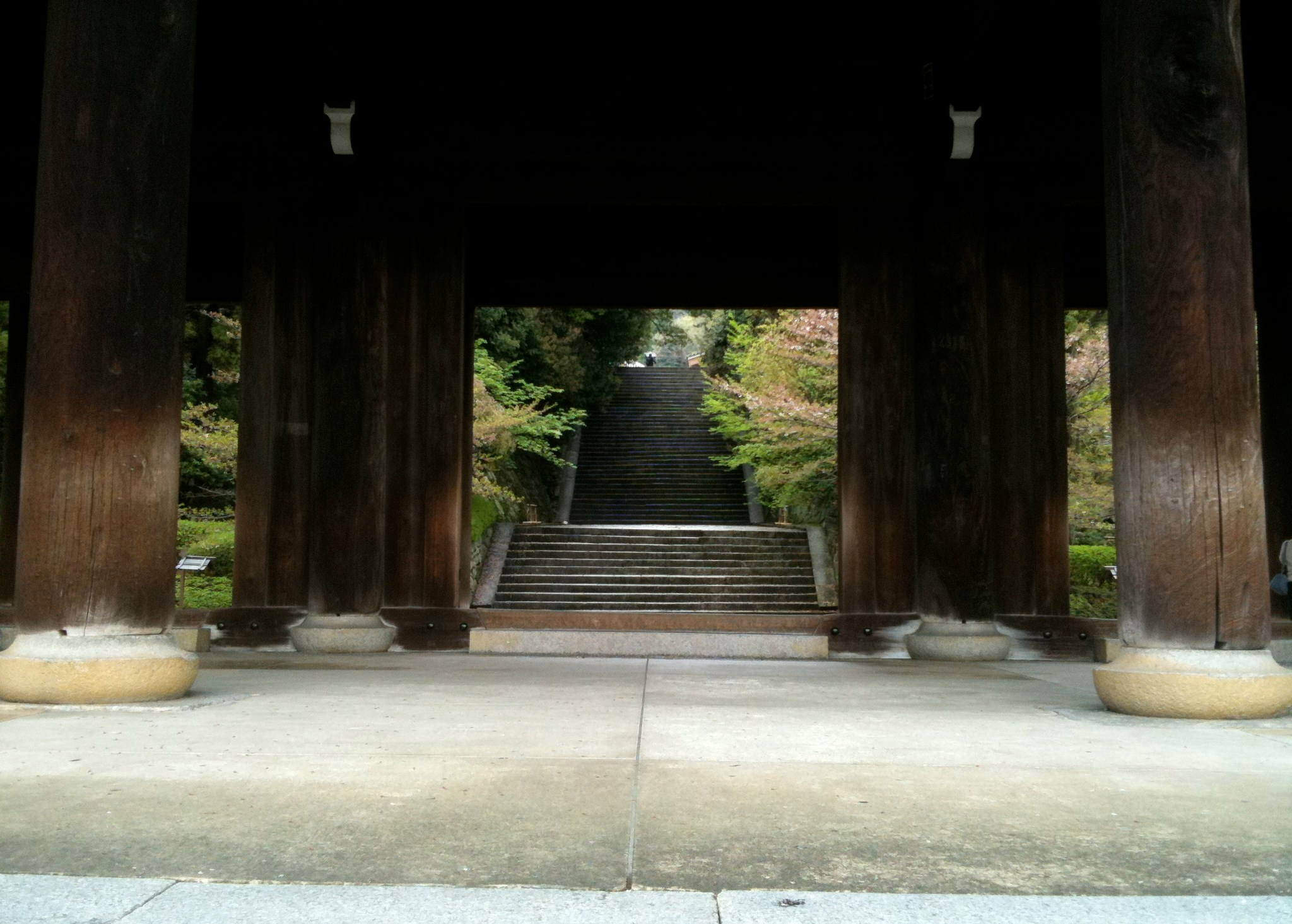
Chion-in Temple in Japan is famous for its large “sanmon” (山門) gate. I took this photo on our second visit to Chion-in in 2010. Chion-in is one of two head temples or “daihonzan” (大本山) of the Jodo Shu sect of Buddhism, the other being Zojoji in Tokyo.
At one extreme end among Honen’s followers was Kōsai (幸西, 1163 – May 20, 1247) who briefly started a movement called the “One-Recitation Doctrine” (ichinen-gi, 一念義). The idea was that if one truly had faith in Amitabha Buddha, they would recite only once and entrust Amitabha Buddha’s compassion from there forward. Even if one lived a rotten life thereafter, if they maintained that faith, they would certainly be reborn in the Pure Land. Shinran, who later founded the off-shoot Jodo Shinshu sect, leaned in this direction, but under his 8th successor, Rennyo, this idea was further developed. For Rennyo, reciting the name of Amitabha Buddha was really nothing more than an expression of gratitude toward the Buddha’s compassion. This sense of faith and gratitude underscores a lot of Jodo Shinshu (and general Japanese-Buddhist) thinking even in modern times.
At the other end was Ryūkan (隆寛, 1148 – January 21st, 1228) who led the “Many-Recitation Doctrine” (tanen-gi, 多念義) who felt that the name should be recited constantly. This was a tool to help fix one’s mind on Amitabha Budha, accumulate more and more positive karma which paved the way for rebirth in the Pure Land, but also an affirmation of Amitabha’s vow. In medieval times, both in China and later Japan, this could mean tens of thousands of recitations per day for monks and nuns. Even lay people were encouraged to recite as much as was reasonably possible as long as it didn’t affect one’s livelihood. Benchō (弁長, June 20, 1162 – March 16, 1238) who went on to found the main “Chinzei branch” of the Jodo Shu sect leaned in this direction, though arguably took a more middle-of-the-road approach. Nevertheless, Bencho did expound the value of reciting the Buddha’s name as a routine practice.
Honen, himself, tried to strike a balance between these extremes with the following quotation attributed to him: (source)4
Again, to say that frequent repetitions of the nembutsu [the Buddha’s name] mean the encouragement of the principle of self-power (jiriki) shows total ignorance of facts and is an awful mistake. Even one repetition or two of the sacred name can be said to be the nembutsu of salvation by one’s own power, if one does it with that thought in one’s mind. But a hundred or a thousand repetitions day and night for a hundred or a thousand days can be the nembutsu of salvation by Amida’s power alone (tariki), as long as one does it with an entire trust in the merits of the great Vow, looking up in confidence to Amida with every repetition.
as well as:
Honen once said, “It’s important that you should never forget the repetition of the nembutsu. Keep it in mind continually. Even though you do impure things or speak impure words, it is a fine thing to keep your heart pure and to say the nembutsu over and over again without stopping it even for a moment. If you go on repeating it at all times and under all circumstances, it will finally bring you to ojo [往生, rebirth in the Pure Land] – no doubt about it.”
So, Honen definitely seems to lean closer to the “many recitations” camp, but only so long as one does it with faith in mind. Dry, repetitions for the sake of just doing it, or some contrived strategy, doesn’t really mean much. On the other hand, Honen also seems to imply that there’s always value in reciting the nembutsu, even if one’s heart is not entirely in it.
In other writings, Honen warned that relying too much on faith tended to make one lazy and risk back-sliding. Too much reliance on practice might make one forget the power of Amida’s vow.
Back to the original question, Honen and other past Pure Land teachers definitely implied some kind of daily practice, as a way of avoiding complacency if nothing else. For monks that often meant hours and countless thousands of repetitions per day, while the answer was more vague for lay followers. The expectation was that followers would adapt it somehow into their lives and recite at a suitable cadence. However, a daily routine was only as good as one’s devotion to Amitabha Buddha. It is important not to let the practice get rote or stale, so Honen even encouraged the occasional “nembutsu retreat” where one would shut themselves from the world for a bit for extra contemplation and recitation.5
As for me, perhaps it’s time to revisit my practice and make a new commitment. I wrote this post partly for my own benefit, but also for new Pure Land Buddhists who may be struggling with a sense of inadequacy in their own practice. Imposter Syndrome is a real thing, and it gets in the way of Buddhist practice. Reciting the nembutsu even once a day is much better than not doing it at all, or doing it in lengthy “bursts” that wear one out and aren’t sustainable.
Like a river that slowly shapes a valley, even small bits of Buddhist practice applied over a very long period of time can have a powerful outcome.
¹ I’ve visited Chion-in again some years later, and it was still great. We also visit the other head temple of Jodo Shu Buddhism, Zojoji near Tokyo Tower yearly as well. It’s our “power spot” as the Japanese say: our place to spiritually recharge. More on that in another post.
² Sutras in Buddhism are a complicated topic for another day, but all you need to know is that there are a lot of them, covering various subjects, composed at different periods of time, and reflecting different times and places in Buddhism. The idea isn’t so much that they represent literal sayings of the Buddha, but that they “rehash” and retell the Buddhist teachings across the generations. Think of it like a famous TV or movie franchise, which reboots itself from time to time. Sometimes the reboots are good, sometimes they’re lousy, but they’re still the same basic story retold over and over.
3 Also known as the path of the Bodhisattva, but that’s a story for another day.
4 The site is long gone, sadly, but the Wayback Machine has an archive of the site. The updated Japanese-only site is here.
5 As opposed to modern Buddhist “retreats” that cost thousands of dollars and are sometimes led by monks of questionable ethics. Indeed, Honen’s disciple Bencho once famously remarked:
People maintain that the best place for a life of retirement is the Kokawa Temple or Mount Koya. But as for me, there is nothing to compare with the bed from which I rise every morning.
Truly, the best Buddhism is the Buddhism you carry with you every day.🥰










 Gleanings in Buddha-Fields


You must be logged in to post a comment.