Sometimes the world is overwhelming and you just need a retreat. When people usually think of a retreat, usually we imagine spending thousands of dollars, staying at some exotic location, drinking organic tea, while learning at the feet of a high-priced guru.
In reality, most of us can’t do that. I would even question how useful that is in the long-run. The experience might change you, but wait a few weeks (or even a few days) and you’ll be back to your old situation.
Instead, a retreat, especially in a Buddhist context is more about withdrawing from the world here and now. The 12th century Japanese-Buddhist monk, and chief disciple of Honen, named Benchō (弁長, 1162 – 1238) once said:
人ごとに閑居の所をば、高野・粉河と申あへども、 我身にはあか月のねざめのとこにしかずとぞおもふ
People maintain that the best place for a life of retirement is the Kokawa Temple or Mount Koya. But as for me, there is nothing to compare with the bed from which I rise every morning.
Such a tradition goes back even as far as the time of the Buddha himself. When the monsoon rains came, crops were young and easily trampled by wandering bhikkhu (monks) begging for alms. The Buddha, conscious of how this might impact farmers, ordered his monks to stay indoors for the duration of the monsoon, focus on intensive training, and avoid bothering the lay community.
Thus, this “Rains Retreat” has been a part of the Buddhist tradition since. The idea has carried onto cultures that don’t have monsoonal seasons (Korea and Japan), in the form of intensive retreats, usually in early summer and early winter. Not only do monks and nuns participate, but in fact lay tradition usually has something to coincide with it, similar to the Christian tradition of Lent.
Thus, the idea of retreat in Buddhism is not a vacation. It’s about making a conscious effort to withdraw from the world, even partially, where you are now, and take your practice above and beyond the usual for a sustained period of time. It’s about fostering mental training and self-discipline in a conductive environment. This can mean something simple like turning off your phone for as little as a few hours a day, limiting meat consumption, chanting a bit more than usual, etc.
Based on limited experience, I found it best to plan ahead what the home retreat will look like and be realistic. For example, I am a working parent with two kids, so there are big limitations to what I can do. Pick a reasonable schedule, a reasonable duration, and try to decide ahead of time what the retreat will look like, rather than deciding on the fly (as I sometimes did). “Don’t move the goalpost,” in other words.
Even as a busy parent, there are things still under my control: how I spend my spare time, how I treat others, what I choose to eat, etc. The Five Hindrances affect us all regardless of who we are, but we can also counteract them one way or another.
Thus if doing a retreat, it’s important to stretch yourself a bit beyond your comfort zone. Otherwise, nothing is gained from it. The Buddha in explaining this to a monk named Sona, used the analogy of lute strings:
“In the same way, Sona, over-aroused persistence leads to restlessness, overly slack persistence leads to laziness. Thus you should determine the right pitch for your persistence, attune the pitch of the [five] faculties [to that], and there pick up your theme.”
AN 6.55, the Sona Sutta, translated by Ven. Thanissaro Bhikkhu
As I am writing this in the deep of Summer, what the Japanese calendar used to call taisho (大暑, “great heat”), I’ve decided to take my own semi-retreat for the rest of August. I wanted to observe the summer abstinence, but almost entirely missed this, and after hectic work schedule in July, I felt like taking some time off and refocusing on things that matter most. So, I’ll be trying the abstinence again, but with a few modifications. I’ll talk more about it after I get back.
In the meantime, I have some posts that will be published throughout August that I hope you’ll enjoy. Until September, thanks and happy summer!
One historical period that has continuously fascinated me for a long time is the end of the Heian Period in Japan, culminating in the climactic war between the Heike (Taira) Clan and the Genji (Minamoto) Clan, followed by the rise of military government for the next 800+ years.
“How did you go bankrupt?” Bill asked.
“Two ways,” Mike said. “Gradually and then suddenly.”
The Sun Also Rises by Ernest Hemingway
Why does this matter?
As the quote above suggests, the fall of the Heian Period and of the Imperial aristocracy, built around a Chinese-inspired Confucian bureaucracy, came slow, then suddenly when the lower samurai class rose and and asserted power. Let’s compare the before and after:
The Heian Period (平安時代, 794 – 1185) of Japanese was a long, 400-year period, that began when the Imperial capitol moved to the new city of Heian-kyō (modern day Kyoto) away from Heijō-kyō (modern day Nara). The Imperial government had been plagued with infighting and manipulation by powerful temples in Heiji-kyo, so the Emperor decided to make a clean start and migrate the capitol.
But the earlier Nara Period and the Heian Period represent a single continuum of life in Japan where the Emperor ruled in a Chinese-Confucian style bureaucracy with Japanese characteristics. The Imperial bureaucracy was run by a large number of literate officials either through Entrance Exams that tested your knowledge of the Confucian Classics, and aspects of Chinese history, or through connections if you were nobility.
Speaking of nobility, everyone in the Court, from the lowliest bureaucrat, to the Emperor had an official rank. This was part of the old Ritsuryō system. The Emperor was automatically 1st rank upper (正一位, shō ichi-i), while just below him someone might be 1st rank lower (従一位, ju ichi-i), then 2nd rank upper (正二位, shō ni-i), and so on until you get to the lowly paper-pushing bureaucrat at 少初位下 (shō so-i no ge) rank. Each year, the Emperor would approve promotions or demotions of rank, which would be annouced, so for doing some good work, you might be promoted one year, and your stipend increased, as well as other perks. However, there was a catch. If you were born to a venerable noble family such as the Fujiwara, Ōe or Tachibana, you were automatically 5th rank or higher. If you were not, it was almost impossible to attain anything above 7th rank. Sugawara no Michizane was a rare exception, but he paid for it when court treachery got him exiled.
Thus, the aristocracy held a grip on the Imperial court, but it didn’t stop there. The aristocracy held increasingly large tracts of land called shōen (荘園) that were tax-exempt due to a loop-hole in the system. The wealth of the aristocratic families grew larger and larger while the state became increasingly bankrupt.
Further, as the Heian Period went on, the aristocracy figured out how to manipulate power even further by arranging marriages with the reigning Emperor, and if they had a son, pressure the reigning Emperor to abdicate, so the ambitious family could control the Imperial heir as a regent. Case in point, during the 990’s two different branches of the Fujiwara clan were struggling for control, on led by Fujiwara no Michitaka and the other by Fujiwara no Michinaga. Both them had daughters wed to reigning emperor Ichijō, who had multiple sons. Initially, next reigning emperor was his son Emperor Sanjō who had not been born from a Fujiwara mother, but he was soon pressured to abdicate by Fujiwara no Michinaga, thus allowing Michinaga’s grandson and Ichijo’s other son to become emperor Go-Ichijō (i.e. “Ichijō the latter”) to reign.
Things got even nuttier when certain emperors, forced to abdicate and take tonsure as Buddhist monks, figured out how to retain power behind the scenes at odds with the nobility. The most well known example was Emperor Go-shirakawa who only reigned officially as emperor for three years, but retained power as the “cloistered emperor” for another 37 years.
None of this takes into the account the growing power and political manipulation of Buddhist temples, and their armies of soldiers, an open violation of the Buddhist principle to abstain from politics and violence.
Thus with such a toxic mix of competing power centers, a crippled central government, to say nothing of the earthquakes, plagues and political neglect of the provinces.
… and then it finally started to fall apart.
The Fall
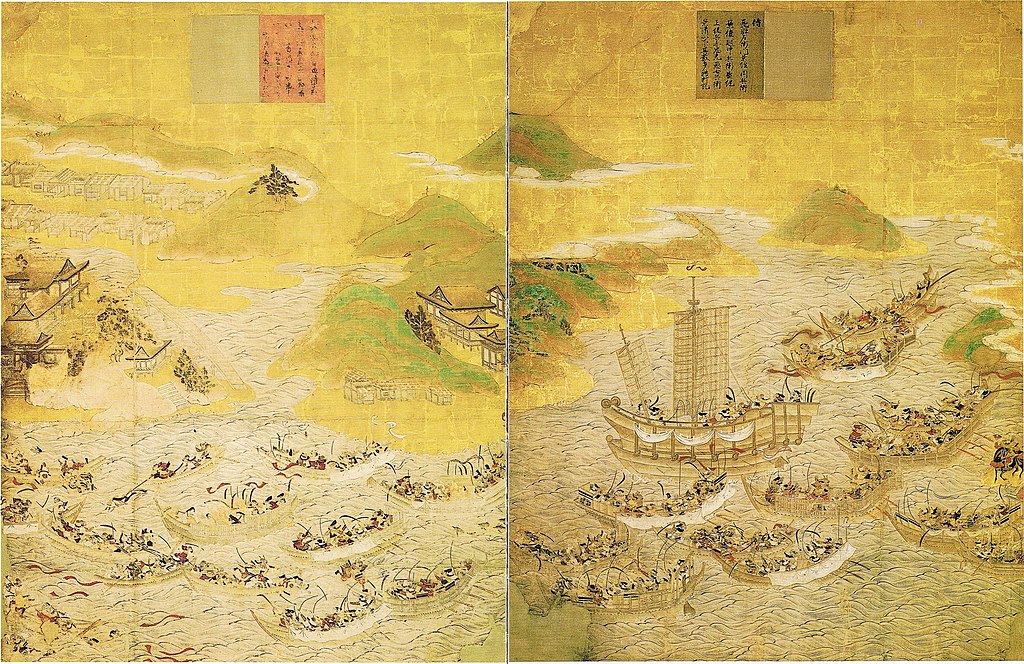
The battle of Dan-no-ura, courtesy of Wikipedia
The fall of the Heian Period and its aristocratic society started with a power struggle between the upstart Taira and Minamoto clans. Like many other samurai families, they began as little more than escorts and bodyguards to the nobility, but in time they rose to positions of power and influence, filling in the gaps of government when emperors pushed the Fujiwara back.
This culminated with the dreaded Taira no Kiyomori seizing power in all but name. This grandson, the child Emperor Antoku, technically reigned, but behind the scenes Emperor Go-Shirakawa mentioned above still held to some power, but was effectively a hostage himself. The Minamoto clan were scattered and its clan head was executed for formenting a rebellion.
Kiyomori’s grip on power didn’t last long, and wasn’t long before the his enemies in the provinces began to rally around Minamoto no Yoritomo who led a successful counterattack that resulted in a war across most of Japan, with the Taira (e.g. the “Heike clan”) mostly dominating the west and the Minamoto (e.g. the “Genji”) ruling in the eastern provinces. The current TV drama in Japan, the Thirteen Lords of Kamakura, reenacts this struggle, and the aftermath.
The Taira, including the child emperor Antoku, were wiped out at the battle of Dan-no-ura, but the battles didn’t end there. The genie was out of the bottle, and there was no going back. Minamoto no Yoritomo then seized power by compelling to emperor to recognize him as Shōgun, the generallisimo of all Japan, and he went after rivals within the Minamoto clan including the famous warrior and half-brother, Minamoto no Yoshitsune. He based his regime in the eastern city of Kamakura, not Kyoto, thus drawing power away from the old Imperial court. Emperor Go-shirakawa’s son, Emperor Go-toba, attempted one last military effort to restore the power of the Imperial court in the Jōkyū War, but the samurai class centered around Yoritomo’s widow, the powerful Hojo Masako, and Go-toba’s efforts were doomed. He was exiled until his death.
Ironically, Minamoto no Yoritomo would end his life as little more than a figurehead himself as the Hojo family he married into (ironically a branch of the Taira he defeated) manipulated marriages and increasingly held power.
In the end, the new “Kamakura Period” of history was the first of several military regimes in Japan until 1868 (arguably 1945) where the Imperial court still held nominal power, but true power rested with the military class. The old Confucian-style bureaucracy still existed, people including power warlords still held rank in the Court, but it was a shadow of its former power, and was mainly used to legitimatize the ruling shogun and little else.
On the Ground
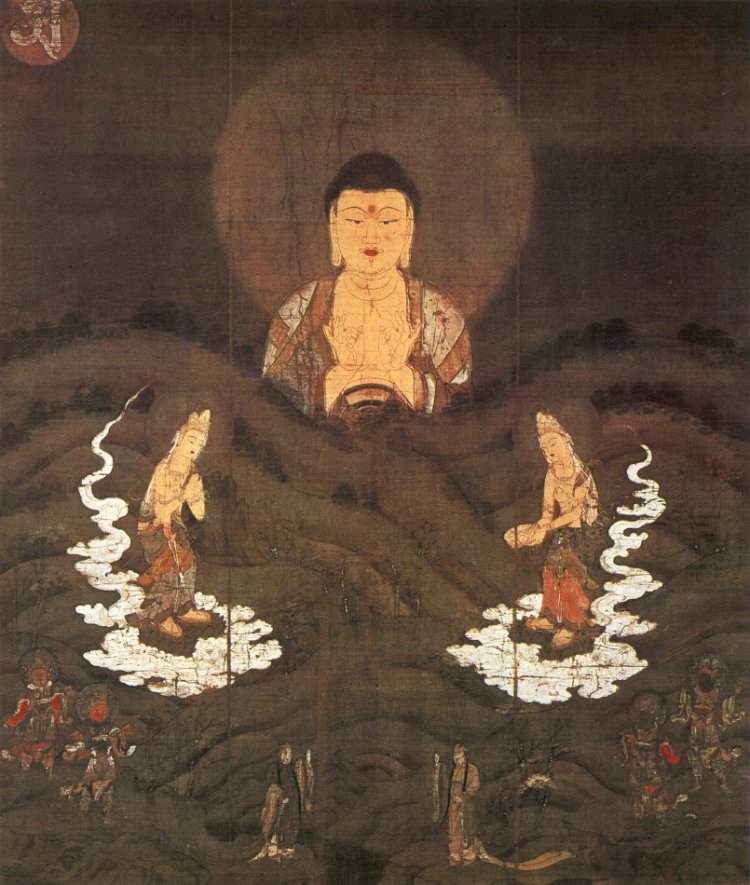
Amitabha Buddha rising over the mountain to welcome the believer to the Pure Land
Reading this history is one thing, but to people on the ground, as one crisis after another affected Japan during the end of the Heian Period both political and physical, it certainly felt like the End Times.
Millenarian Buddhist movements among the provinces sprang up in great number, as people were convinced that the era of Dharma Decline, the era mentioned in Buddhist scriptures when the Buddha-Dharma had utterly faded from the world, had come and that they were all doomed. This is why the Pure Land Buddhist movement started by Honen became so widespread and popular. By this point, people were so convinced that it was all over, they focused on escaping the endless cycle of birth and death to be reborn in the Pure Land of Amitabha Buddha instead. Pure Land Buddhism had been popular before this, but it took on a new sense of urgency under the collapse of the old society. Thus Honen’s disciples, such as Shinran, carried this message further out into the provinces and Pure Land Buddhist movements sprang up everywhere.
Nichiren Buddhism, which came slightly, was a similar millenarian movement, but instead Nichiren blamed society’s ills ironically on the Pure Land movement itself for leading society away from the True Dharma (e.g. the Lotus Sutra). Like many others in society, including Honen a couple generations earlier, Nichiren was appalled by the death, warfare and disasters affecting Japan and felt there had to be a reason for it all.
This may seem odd to us in the 21st century, but for people who grew up that the world around them was governed by the Buddha-Dharma (or lack of it), this is the only conclusion that would make sense. We in our time believe the world is governed by science, so when something happens, we tend to look for a scientific-analytical explanation. When the Byzantines in the 8th century saw their world collapse due to the Plague of Justinian followed by invasions from the new Muslim Arabs, they saw felt that their world that had been governed by God as approaching the End Times too, culminating with the siege of Constantinople itself. Thus, Iconoclasm sprang up soon after.
In each case, people are faced with a cataclysm and are using reason to try to come to grips with what’s going on, and how to fix it. We can look back and laugh and people for their “backward views”, but what will people say about us 1,000 years in the future, I wonder?
The Aftermath
In any case, once the war between the Taira and the Minamoto ended and the capital was moved to Kamakura, life in Japan was simply never the same. Generations had lived with the trauma of last years of the Heian Period, the warfare and so on, and much of the literature of the time including the Hojoki and the Essays in Idleness carry a sense of “paradise lost”. It was over. Everyone knew it, and there would be no going back.
And yet, for all the sadness and sense of loss, Japan did carry on through many subsequent generations to be the country it is today. The court life of the Heian Period is still remembered in things such as the Hyakunin Isshu poetry anthology, doll displays on Girls’ Day, woodblock art, and so on. And of course, historical dramas.
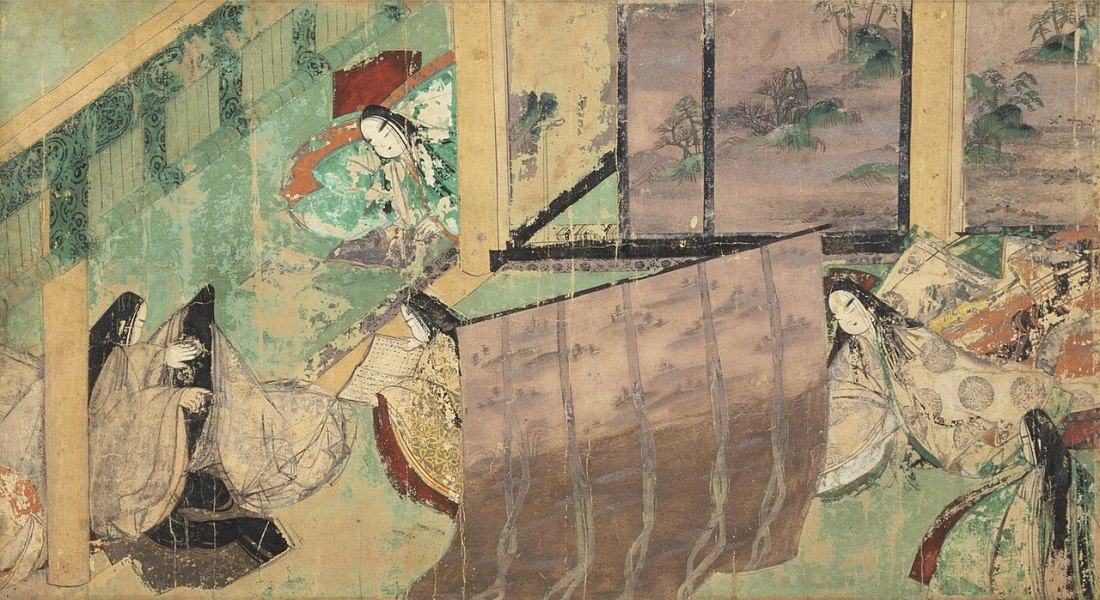
P.S. A scene from the Illustrated scroll of Tale of Genji (11th cent.), depicting the Azuma-ya (“East Wing”). Imperial court in Kyoto, Public domain, via Wikimedia Commons
「山越えあの阿弥陀」, or “Amida crossing over the mountain”. Courtesy of Eikando Temple in Kyoto, Japan, and the Museum of Nara. Public domain, via Wikimedia Commons
On the same Japanese documentary as here, I saw a great segment on the famous Eikandō Temple, more formally known as Eikan-dō Zenrin-ji (永観堂禅林寺). Homepage here in Japanese and English. The temple is iconic for several reasons, including its very picturesque fall scenery, and also its vast collection of Buddhist artwork listed here. The most famous is the central figure of Amida Buddha looking back (more on that in a future post).
The picture above, called yamagoé amida-zu (山越阿弥陀図, “Amida Buddha Crossing Over the Mountain”) is a pretty famous work of art that I’ve seen even on English books related to Pure Land Buddhism and especially Jodo-Shu Buddhism.1
It also exemplifies how Amida Buddha was venerated in medieval Japanese culture.
The picture depicts Amida Buddha, a very popular figure in Mahayana Buddhism who vowed to lead all beings to his Pure Land after death so that they may escape the endless cycle of birth and death, and accelerate along the Buddhist path much more readily.2 Amida Buddha is frequently depicted in artwork flanked by two bodhisattvas: Kannon (観音, Avalokitesvara) and Seishi (勢至, Mahasthamaprapta).
As the figure was imported into early Japanese history, he gradually increased in popularity, and many medieval practices were used to help ensure that devout followers would be reborn in his Pure Land. As the situation in medieval Japan graduallyworsened, this became even more prominent. If you look carefully, Amida Buddha’s fingertips in each hand touch together in a mudra, a form of Buddhist iconography. What you don’t see is that traditionally, where the fingertips touch, there are usually five strings of different colors hanging down, and there was a common deathbed practice where the dying individual would hold on the other end of those strings as much as they could. This was believed to help ensure that the dying person would not fall through Amida Buddha’s grasp in being reborn to the Pure Land.
Another noteworthy thing about this painting is the Siddham (Sanskrit) syllable written on the upper-left: 𑖀 (“ah”). It is not the “seed syllable” for Amitabha, which is hrīḥ (𑖮𑖿𑖨𑖱𑖾), but is frequently used in esoteric Buddhism (e.g. Vajrayana). This shows that at this time, Amitabha Buddha was still closely associated with earlier esoteric practices found in both Tendai and Shingon-sect Buddhism. For some reason, English-language books on Japanese Pure Land Buddhism frequently seem to crop out the syllable when including this painting.
One rival practice to reciting the nembutsu at this time was reciting an esoteric mantra called the Mantra of Light, promulgated by Pure Land critic Myōe.3 You can see from this picture that pairing devotion to Amitabha Buddha with a popular esoteric mantra wasn’t such a leap either.
Many of these practices gradually faded as Buddhism in Japan evolved and replaced with other practices, but it’s interesting how this one painting can encapsulate so many things in the 11th-12th century Buddhist-Japanese culture.
P.S. I might have messed up the “hrih” siddham syllable. Unicode, Sanskrit and HTML are not easy. 😉
1 Eikando converted from a Shingon-sect temple to a Jodo Shu-sect temple in the late 12th century when it was administered by a disciple of Honen’s named Johen (1166-1224), and then more fully under Shoku. Interestingly, the “Amida Looking Back” statue was crafted a century earlier, in 1082, by Eikan (also known as Yōkan, 永観, 1033-1111) who saw Amida in a dream, and also later founded a hospital on the temple grounds.
2 The assumption that the Pure Land is the Buddhist version of “heaven” (i.e. in a western sense) will require a separate post to explain. TL;DR they have little in common.
3 I actually recite both in my home practice: the nembutsu and the mantra of light. First one, then the other. I first learned about it not from esoteric sources, but actually from Rinzai-Zen Buddhist liturgy, where it is often recited. It’s interesting how certain practices kind of persist in unexpected places.
Since the kids were very young, the family and I subscribe to Terebi Japan, a cable channel that allows us to watch Japanese TV. The cable channel mostly shows TV from the public channel, NHK (roughly analogous to the BBC), and not other content, but it does allow us to watch Japanese TV legitimately and not through some shady third-party service. NHK has a famous series of historical dramas called Taiga Dorama (大河ドラマ) which change every year, but feature some aspect of Japanese history. I usually don’t watch these because they’re not that interesting, and the Japanese dialog is particularly archaic and difficult for me.
However, lately, I’ve gotten sucked into the latest Taiga Dorama series: Kamakura-dono no Ju-san-nin (鎌倉殿の13人) which translates to the Thirteen Lords of Kamakura. The opening theme alone is pretty epic and worth a watch. I always love seeing the rain of arrows at sea during the climactic final battle of Dan-no-ura in particular.
This series covers a period of Japanese history that I find particularly fascinating ever since I first studied it in college: the Genpei War in the 12th century. I’ve touched upon the Genpei War before, but to summarize again, this was a four-year country-wide conflict between two powerful samurai clans: the Heike (a.k.a. the Taira) and the Genji (a.k.a. the Minamoto). During this time in Japanese history, the last days of the Heian Period, the samurai class were socially inferior to the noble families of Kyoto (known as Heian-kyo back then) and were subject to manipulation by them. However, the Heike clan turned this around by manipulating the Imperial throne under one Taira no Kiyomori. Having effectively seized the throne, Taira no Kiyomori began to drive out his rivals, including the Minamoto.
The Minamoto were savagely defeated and driven to remote provinces where they were eventually able to rally allied clans (including a Heike off-shoot, the Hojo clan)1 and push the Heike back in defeat after defeat until the battle of Dan-no-ura where the Heike made their last stand, and Kiyomori’s grandson, the two year old Emperor Antoku drowned.
From this point on, the power of the nobility, who had stirred up so much conflict in the first place, was greatly curtailed for centuries, and the samurai class became the true power in Japan until the late 19th century. Minamoto no Yoritomo, who led the Minamoto clan to victory, was the first shogun (generalissimo) of the new military government based in Kamakura, not Kyoto.
This period of warfare was incredibly disruptive to Japan, as evinced in such works as the Hojoki, and is still remembered as the end of Japan’s cultural “golden age”, and the ascendancy of the Samurai. The epic Tales of the Heike (heike monogatari, 平家物語) is a later retelling of what happens, but there are numerous cultural references to the people and places of the War such as ghost stories of the Heike, “Heike crabs“, Kabuki dramas, artistic works in the 19th century, and so on.
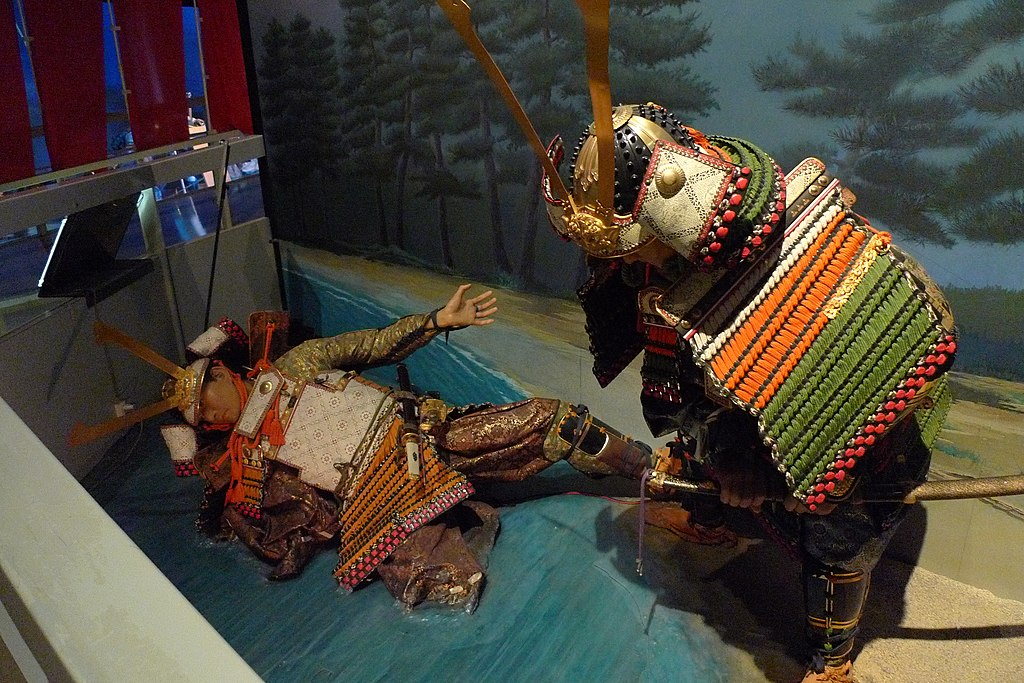
One of my personal favorite is a famous duel between the Genji-clan soldier named Kumagai Naozane (熊谷直実) against the Heike prince named Taira no Atsumori (平敦盛) at the beach-side battle of Ichi-no-tani. Because Naozane was old enough to be Atsumori’s father, and because Atsumori was such a refined youth, Naozane hesitated to kill him at first, but with the other Minamoto soldiers arriving, Atsumori was obviously doomed no matter what. Naozane gave him a quick, merciful kill.
A wax recreation of the death of prince Taira-no-Atsumori at the hands of Kumagai Naozane, courtesy of Takamatsu Heike Monogatari Wax Museum, Takamatsu city, Kagawa pref, Japan.. Photo by Motokoka, CC BY-SA 4.0, ウィキメディア・コモンズ経由で and Wikipedia Commons
After the war, Naozane felt remorse for slaying Atsumori, and retired to the Buddhist clergy as a monk and a devotee of Honen of the Pure Land sect where he took the ordination name of Hōrikibō Rensei (法力房 蓮生) and was a fervent devotee until his death.2
As for the Taiga drama, it’s pretty awesome. The Japanese is still archaic and difficult for me to follow, but they do try to use modern Japanese more, and the cast are celebrities I am more or less familiar with. Matsudaira Ken (of Matsuken Samba fame) plays Taira no Kiyomori, too. 😋
It’s not the first Taiga drama that NHK has done about the Genpei War (another famous one about 10 years ago made the villain, Taira no Kiyomori, the main character), but this drama is particularly well done, and my language skills have finally reached the point where I can appreciate it in Japanese, rather than filtered through limited Western media. But also, as someone who avidly studied Japanese history in college, the War between the Genji and the Heike is something I’ve imagined for half my life and now I can see not just in my imagination, but vividly in a powerful drama.
P.S. The featured image is a 19th century woodblock painting of Heiki general Taira no Tsunemasa (平経正) in a scene from the Tales of the Heike by Yoshitoshi.
P.P.S. Burton Watson’s abridged translation of the Tales of the Heike is a good read if you are interested.
1 The title of the drama “Thirteen Lords of Kamakura” is, I believe, in reference to the various samurai clans who are allies or enemies of the Genji, and each one jockeying for power. I might be wrong though.
2 This also debunks a tired old myth about samurai and Zen Buddhism. The reality was quite a bit more nuanced.
The founder of the Jodo-Shu sect of Buddhism, a 12th-century Buddhist monk named Honen, once composed a poem titled tsukikagé (月かげ, “Moonlight”). What follows is a rough translation on my part:
Japanese
Romanization
Translation
月かげの
Tsuki-kagé-no
There is no village
いたらぬ里は
Itaranu sato wa
that the light of moon
なけれども
Nakeredomo
does not shine,
眺むる人の
Nagamuru hito no
but it dwells in the hearts
心にぞすむ
Kokoro ni zosumu
of those who see it.
The “light of the moon” here is meant to symbolize the light of the Buddha, namely Amida Buddha. Light is a common motif in Buddhist art, depicting both wisdom to banish away the darkness of ignorance, and also goodwill to all living beings.
Amida Buddha and his attendant bodhisattvas welcoming Chūjōhime, Taima Temple Mandala, University of Michigan Museum of Art, Artist Unknown, Japan, Public domain, via Wikimedia Commons
“The radiant light of the Buddha of Immeasurable Life is dazzling brilliant, illuminating all the buddha lands of the ten directions, and there is nowhere it is not heard of.”
From The Three Pure Land Sutras published by the Jodo Shu Research Institute, translation by Karen J. Mack
Further, the sutra explains in the previous section:
“Those sentient beings who encounter this light will have the three hindrances1 eliminated, become amenable in body and mind, leap with joy and their hearts will give rise to good. Should they suffer hardship in the three realms of defilement,2 when they see this radiant light, they will all attain relief and not again suffer this pain.”
Thus, the light of Amida Buddha shines everywhere, but people may not necessarily know it. Those who do encounter the light experience a transformation within. It may not be obvious at first, but it as one of Honen’s disciples once taught, it melts ice to become warm water.
Thus, Honen’s poem is about how Amida’s goodwill and wisdom reaches out to all beings and all places, and even if people do not see it, it is still there. Further, those who do see it are changed by it, even if they are not aware of it at first.
Namu Amida Butsu
1 The three hindrances in Buddhism are greed, hatred and ignorance.
2 The three realms of defilement is another term for lower states of rebirth that one might fall into: animals, hungry ghosts, and the hell realms.
Recently, I re-posted an old polemic article I wrote 8 years ago (!) in a former blog at a time when I was on my out the door from the local Jodo Shinshu Buddhist community, citing references to one of Honen’s biggest critics, Jokei, an influential monk of the influential Hosso (Yogacara) school. Many of the points that Jokei criticized are common complaints that even today people level against the Pure Land path, specifically Jodo Shu and Jodo Shinshu Buddhism. I have even made these criticisms myself from time to time.
However, in the book Traversing the Pure Land Path, the author makes an interesting point that I did not fully grasp back then:
…Honen’s single-minded focus on the nenbutsu (senju nenbutsu) is not a narrow-minded or exclusivist practice. Rather, it is prioritization or “selection” (senchaku) of a practice that Honen felt was the most beneficial. In other words, the nenbutsu is an essential competence which needs to be thoroughly understood and experience.
Page 77
Jodo Shu Buddhism takes the nenbutsu practice as its bedrock. This is not unusual in Japanese Buddhism, where many of the Kamakura-era Buddhist schools (Zen, Pure Land, Nichiren) tended to build around a single practice first, and build the teachings around it for support.
However, the book doesn’t stop there:
Honen’s senchaku process also includes reintegration. After realizing the mind is firmly established towards Birth [in the Pure Land] (ketsujo ojo-shin), the four other right practices (sho-gyo) of Amida’s Pure Land can be readopted as similar kinds of auxiliary practices (dorui-no-jogo)….With the transformation of one’s heart through single-minded nenbutsu practice, these auxiliary practices go beyond being merely helpful to nenbutsu practice. Subsumed within nenbutsu practice, they become practices corresponding to Amida’s Original Vow.
Page 77
This idea of reintegration of other practices within the dedicated nenbutsu practice is something I didn’t fully appreciate in my younger years, but makes more sense now with the benefit of experience. Basically, Honen’s concept of senchaku (選択) is to establish a solid foundation first, then reintegrate other Buddhist practices as your confidence grows. Over time, it becomes a comprehensive practice.
Anyone who sincerely desires birth in the Land of Peace and Bliss is able to attain purity of wisdom and supremacy in virtue. You should not follow the urges of passions, break the precepts, or fall behind others in the practice of the Way.
trans. Hisao Inagaki
Even in the fundamental sutras of Pure Land Buddhism, disciples are encouraged to do good works, maintain wholesome conduct, etc, so it doesn’t differ from the rest of mainstream Buddhism, but Honen’s senchaku approach represents a shift in mindset. Instead of doing the practices just for practices sake, they are rely on Amida’s vow to help all beings, and to prepare for one’s rebirth in the Pure Land.
In my experience, some people I have met who are Pure Land Buddhists tend to take a strictly nenbutsu-only, exclusivist approach, which Honen clearly didn’t agree with, and even in Honen’s time, some of his disciples, such as Kosai, really went of the deep-end.
I feel like Honen’s approach was “never stop, and never get complacent”, but at the same time, he wanted to prioritize a straightforward simple practice first as the bedrock that other things could be built upon. Thus, laypeople and monks, could both start the same way and take it as far as they want.
Recently, I dusted off an old book from my shelf titled Traversing the Pure Land Path which was published by the Jodo Shu Research Institute (JSRI).1 They had a number of their publications at the time, and their English-language resources were very helpful. A lot of them appear to be out of print, sadly.
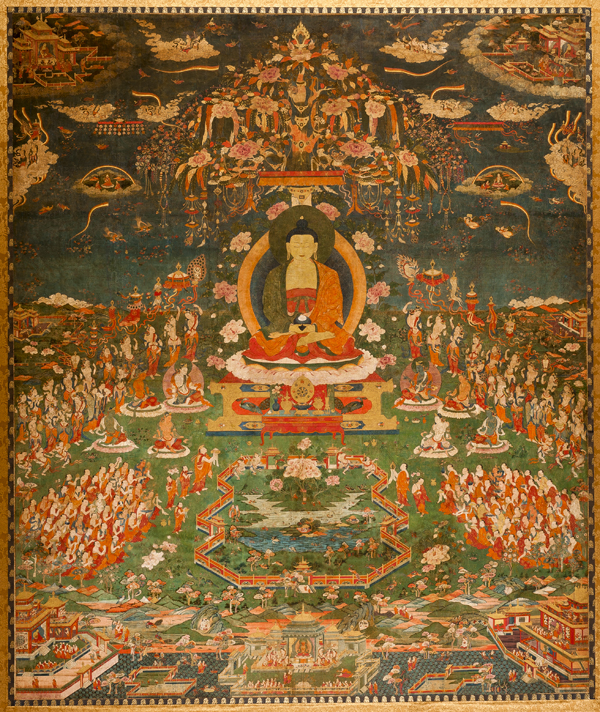
The Buddha Amida (Amitabha) as depicted in Tibetan art
Anyhow, the book has a translation of a famous reply to the Shogun, Yoritsune, by a Buddhist monk named Shōkū (証空, 1177-1247). Shoku was the founder of the “Seizan” branch of Jodo Shu Buddhism, and had originally been a disciple of Honen. Anyhow, Shoku’s letter to Yoritsune talks about the Three Karmic Bonds (san’en 三縁) that are established through one’s relationship with Amida Buddha:
The first is an “intimate karmic” (shin’en 親縁) bond, which Shoku explains:
…Amida takes us into his embrace no matter how dull or ignorant we may be….This is the reason that when we call, he hears; when we pray, he sees; and when we meditate, he knows, and unfailingly leads us to ojo [rebirth in the Pure Land].
page 119
Next is a “close karmic” (gon’en 近縁) bond. Here, Shoku explains in the letter:
…if we long to see him, he actually appears at our side in a dream or at life’s last hour.
page 119
Finally, the last bond is that of “superior karma” (zōjō’en 増上縁) which Shoku explains at length:
Since this means for us total exemption from the pains that our karma would bring us through countless ages, we will surely fear unethical behavior. Even more, we will give it up and never allow ourselves carelessly to fall into it….Pulled forward by Amida’s mighty power, we find an ever deepening joy in the contemplation of the good we have done….
page 120
The idea of karmic bonds is a common theme within the greater Mahayana Buddhist tradition, not just Pure Land Buddhism, and can apply to buddhas, bodhisattvas, even other people. It also applies to reciting the nembutsu itself toward others around you. But Shoku’s in-depth explanation on the ways in which one’s karmic bonds deepen through practice of the nembutsu, is fascinating, especially in that he argues that no one is only escaping the endless cycle of birth and death, but the sheer magnetism of Amida Buddha also inspires one to do good in this life here and now.
P.S. It’s been kind of fun to re-read old books I haven’t touched in years. A chance to revisit things I learned, but with a few more years of experience behind me. 😄
1 The site is long gone, sadly, but the Wayback Machine has an archive of the site. The updated Japanese-only site is here.
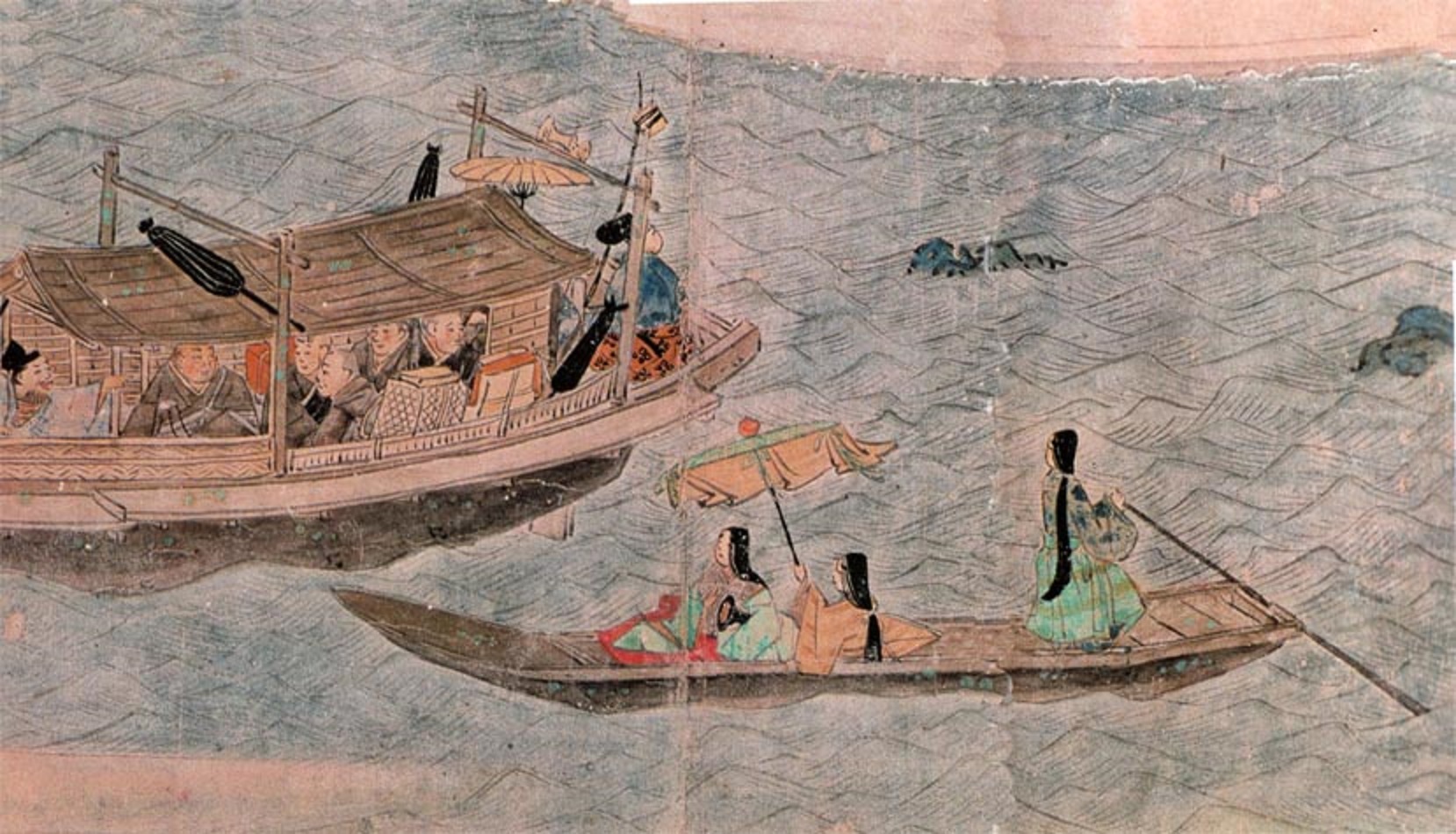
A medieval scroll depicting the life of Honen. This is the famous scene where Honen preaches the Dharma to a prostitute, who sought his advice, at Murotsu (modern day Hyogo Prefecture) on his way to exile. Courtesy of Wikipedia, originally from a 14th century biography about Honen titled hōnen shōnin e-den (法然上人絵伝, “a pictoral biography of master Honen”)
One of my favorite stories about the life of Honen, the 12th century Buddhist monk who started the Pure Land Buddhist movement in Japan, is from his time of exile in 1207. From the capitol (modern day Kyoto) he and many followers were banished to the hinterlands, a common punishment at the time. In Honen’s case, he was exiled to the island of Shikoku, and while he crossed the channel from the port of Murotsu (室津),1 he was approached by another boat whose passenger was a local prostitute.
The story is recorded in English in Traversing the Pure Land Path among other places, but basically the woman asks Honen how someone like her with such a miserable lifestyle can find salvation in the life to come. Honen replied:
“If you can find another means of livelihood, give this up at once. But if you can’t, or if you are not yet ready to sacrifice your very life for the true way, begin just as you are and call on the sacred name [of Amida Buddha]….”
page 50-51
Later, when Honen was allowed to return back to the capitol, he found out along the way that the woman had taken his advice and devoted herself to the Buddhist path until her death some time shortly after. “Yes, it is just as I expected,” he said.
There are few things I think are worth calling out here. First, Honen was already pretty well known at the time, and in a conservative medieval society, the thought of a famous monk talking to a woman of the night would have been scandalous. Second, Honen didn’t try to shame her. He pointed out that it was a dangerous lifestyle, but if she can’t leave, she can begin her Buddhist path “just as she is”. Finally, the results (if the biography is to be believed) is that in the end she took it seriously and attained great progress.
Even now, 800 years later, I think this idea of “begin just as you are” is one of the most appealing aspects of the Pure Land Buddhist path, especially Jodo Shu Buddhism, and why I still come back to it time and time again after all these years.
Pure Land Buddhism gets a lot of flak sometimes from Western audiences because it doesn’t mesh with our understanding of Buddhism (spoiler alert: 5th century BC India is not the same as 12th century Japan, which is not the same as 21st century America), and while I understand the concerns, I think it’s missing the point.
One of the frustrations I’ve had over and over again, especially with so-called “American Buddhism” or “Western Buddhism” besides its Protestant approach1 to a totally different religious tradition, is its tendency to rely strongly on master-disciple relationships. This means things like finding the right empowerment from such-and-such guru, or finding a good meditation teacher, etc. These put a lot of trust in one individual (some with sketchy backgrounds) and tend to be biased toward those who can afford the time, money and educational background for this sort of “lifestyle”. Newer “modern” traditions can be even more risky because they’re often thinly-disguised cults.
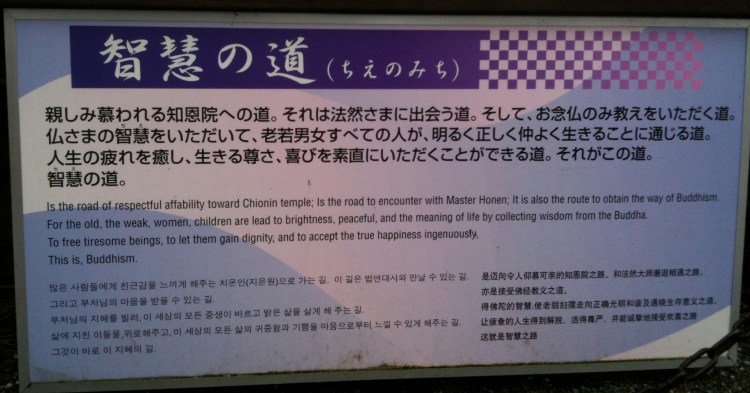
A multilingual sign posted at the front of Chion-in Temple in Kyoto, Japan. A more accurate English translation, in my opinion, reads: “This is a path toward affinity with Chion-in Temple. This is a path to encountering Master Honen, and a path for receiving the Buddha’s teachings. This is a path, where receiving the compassion of the Buddha, young and old, men and woman can live a bright, upright, and affable life. This is a path for those who are weary to find healing, a reverence for life, and sincere joy. This is the path of Compassion.”
In keeping with Honen’s “begin just as you are”, I feel that the Pure Land path, while being a part of East Asian Buddhism for many centuries before Honen, still has an enduring power to it even here and now because any one can do it, and once one passes through that gate, it opens up many other possibilities for Buddhist practice, teachings and so on. I can attest to this from personal experience: after a chance encounter at the temple of Chion-in way back in 2005, what I first thought was”Buddhist superstition” grew on me and became a strong foundation from which I explored other aspects of Buddhism later. Some of those aspects were ultimately dead-ends for me, but I never entirely forgot the simple practice of reciting the nembutsu, even when I have disagreed with doctrinal minutiae here and there.
Like the prostitute at Murotsu though, everyone has their personal problems, some very serious. Many of us aren’t good Buddhists, or even particularly good people. Nevertheless, what the Pure Land Buddhist path shows is that the compassion of Buddha still shines down upon all of us, just as we are, and welcomes us to follow a better way with the light of the Buddha quietly guiding us.
1 Now part of modern day city of Tatsuno in Hyogo Prefecture.
Author’s Note: this was another post I found recently from my old blog, possibly something I wrote in 2013 or 2014. It was shortly after this that I decided to leave the local Jodo Shinshu Buddhist community, give up the prospect of ordination, and strike out on my own. My feelings on the subject have changed somewhat, but I still agree with the general sentiment. I do miss many of my old friends at the local temple, but these days I am kind of done with Jodo Shinshu Buddhism. Apart from minor edits, and fixing broken links, this is posted as-is. Oh, and I added a cover image from that time and updated the title slightly for clarity. 😋
An old altar we setup years ago while living in Ireland. The central image was purchased from Tsukiji Honganji in Japan and venerates Amitabha Buddha, the Buddha of Infinite Light.
Lately, as I have been able to enjoy a small break in life, work and so on, I delved into some books I haven’t finished reading in a long while, including an excellent study on the life of Hossō Buddhist scholar, Jōkei. The book, titled Jokei and Buddhist Devotion in Early Medieval Japan by James L. Ford, is both a biography, but also a critical look at the late Heian, early Kamakura periods from a Buddhist perspective, and an effort to shed new light on this oft-studied and oft-misunderstood period.
In a way, I feel like I am betraying friends I have had the privilege of encountering over the years who are devout Jodo Shu and Shinshu Buddhists, but at the same time, I think Buddhism should be able to stand on its own two feet and take the acid test of criticism sometimes.1 To my friends on the Pure Land path, please forgive this post. It is not a personal attack, and I know many people in Jodo Shu and Jodo Shinshu who are admirable Buddhists in their own right. It’s just that while reading Ford’s book, I really felt he hit the nail on the head with certain things about Honen and Shinran’s teachings that made me uneasy, particularly the “exclusive” Pure Land approach that orthodox Jodo Shu and Jodo Shinshu followers adopt. Until recently though, I couldn’t quite articulate it myself.
This uneasiness came about back when I first started reading Rev. Tagawa’s book on Yogacara Buddhism, and on my recent trip to Kyoto and Nara, this old uneasiness arose in me moreso as I stood at the feet of great temples such in Kyoto and Nara. When I stood in the Treasure House of Kofukuji, beheld all the amazing artwork there, and the vast corpus of teachings they represented, I knew something was still amiss in my Buddhist path and it’s been gnawing on my mind for a while now.
Jōkei is best known as a sharp critic of Hōnen and the exclusive Pure Land movement, or senju nembutsu (専修念仏). As such, he was the primary author in 1205 of the Kōfukuji Sōjō (興福寺奏状), or the “Kofukuji Petition” to the Emperor which sought to suppress the “exclusive nembutsu” Pure Land school started by Honen. History has not been kind to Jokei, and Professor Ford argues that the study of Kamakura Buddhism is flawed because of some underlying biases and assumptions about “old” vs. “new” Buddhism. Meiji-era and later studies tend to apply a kind of “Buddhist revolution” to Honen and Shinran, and paint traditional Buddhist sects as elitist or oppressive. Sometimes, parallels between Shinran and Martin Luther have been drawn in scholarly circles, though more modern research has refuted this analogy as superficial at best.
A while back, after reading Dr. Richard Payne’s collection of essays on the subject of Kamakura-era Buddhism, I started to question these assumptions, but more so after reading Ford’s book. He explores the Petition toward the last-half of the book and Jokei’s relationship with Honen to show how history has normally written about the incident, and carefully dissects it to show another viewpoint. In essence, he argues that Jokei’s criticism of Honen isn’t an “old-guard” or “elitist” perspective, but more accurately reflects a “normative” Buddhist doctrinal stance.
Ford explores at length about the content of Jokei’s Kofukuji Petition and its nine articles faulting the new senju nembutsu (専修念仏) or “exclusive nembutsu” movement, which are Ford summarizes in four points (I am quoting verbatim here):
[According to Jokei,] Honen abandoned all traditional Buddhist practices other than verbal recitation of the nembutsu.
Honen rejected the importance of karmic causality and moral behavior in pursuit of birth in the Pure Land.
Honen false appropriated and misinterpreted Shan-tao with respect to nembutsu practice.
Honen’s teachings had negative social and political implications.
To bolster his stance in the Petition, Jokei uses the same textual sources as Honen to demonstrate that Honen only selectively drew certain teachings from Chinese Pure Land patriarchs, Shan-Tao, Tao-ch’o and T’an-luan to prove his beliefs concerning the verbal nembutsu, while ignoring the whole of their teachings and writings, which included a more comprehensive Pure Land Buddhist path. Ford then turns to modern scholars to show that in China, the nembutsu (nian-fo) was never seen as a verbal-only practice even in Shan-tao’s time, but was interpreted as a well-developed meditation system. This is reflected even in modern day Chinese Buddhist writings, such as those of the late Ven. Yin-Shun.
As Ford then concludes:
Thus Jōkei’s claim that the Pure Land schools had no precedence in China is probably true. All in all, Jōkei’s critique of Honen’s construction of an independent Pure Land sect based on exclusive practice of the oral nembutsu is generally well grounded both doctrinally and historically. (pg. 178)
Jokei’s accusation that Honen abandoned the karmic law of causality and undermined the Buddhist teachings for upholding moral conduct, also weighs heavily. Jokei asserts the traditional Buddhist view2 of time as infinite, and that people are responsible for their own karma and the pursuit of wisdom. From Jokei’s perspective, one’s poor conduct can forestall one’s rebirth in the Pure Land, or reduce the conditions of rebirth itself. He notes the Nine Grades of Rebirth in the Contemplation of Amitabha Sutra, but I am personally also reminded of the proviso in Amida Buddha’s 18th Vow in the Immeasurable Life Sutra:
Excluded, however, are those who commit the five gravest offences and abuse the right Dharma.
Or Shakyamuni’s admonition in the same Immeasurable Life Sutra:
Anyone who sincerely desires birth in the Land of Peace and Bliss is able to attain purity of wisdom and supremacy in virtue. You should not follow the urges of passions, break the precepts, or fall behind others in the practice of the Way. If you have doubts and are not clear about my teaching, ask me, the Buddha, about anything and I shall explain it to you.”
One’s poor conduct doesn’t prevent the Vow of Amitabha Buddha from being fulfilled, but delayed and hindered for a time, Jokei argues. Either way, Jokei reinforces a traditional Buddhist view of the importance of karmic causality as central to Buddhism, inline with the teachings of Shakyamuni Buddha himself in countless, countless, countless sutras. As evinced elsewhere in the book, Jokei like many Buddhists believes in the power of Amitabha and his Vows to bring people to the Pure Land, but also asserts that one is still responsible for their karma, so one has to meet Amitabha Buddha half-way in a sense. Jokei’s many sermons and devotions to Kannon, Maitreya and others show that he often advocated this “middle” approach between devotion and personal practice/responsibility and Ford argues that this was the normative approach to Buddhism taken through out Asian Buddhist history.
Indeed, in Jokei’s words describing himself:
[My opinion] is not like the doubt of scholars concerning nature and marks, nor is it like the single-minded faith of people in the world. (pg. 179)
Meanwhile, later Ford shows how Jokei by contrast:
…represents a ‘middle-way’ between the extremes of ‘self-power’ and ‘other-power.’ He was not unique in this respect, since this perspective, though perhaps unarticulated, predominated within traditional Buddhism — despite the rhetorical efforts of figures like Honen and Shinran to paint the established schools as jiriki (self-power) extremists. (pg. 202)”.
But nevertheless, Ford shows how modern scholars in Japan and in the West have skewed this view of history with the belief that the politics of medieval Japan were reactionary, and stifling Buddhism in Japan at the time, leading to the Pure Land movement. Here, I quote Ford directly (emphasis added):
Hōnen’s response to the apparent social inequity and underlying monastic/lay tension — always a feature of Buddhism — was, in effect, to abolish the traditional lay-monastic framework. I am not convinced that he meant to destroy the system, particularly given his devotion to the monastic life, but the effect of his message, as revealed in the Senchakushū, was to undermine the practices and doctrines that sustained the monastic ideal. Pronouncing them obsolete because of the limitations of the age, he concluded that salvation was no longer contingent upon precept adherence, meditative practice, or diligent effort toward realization. Realization was now deemed a secondary goal, since it could not be attained in this world; it could only be attained in Amida’s Pure Land. Although others before Hōnen had devised “simple” practices to address the needs of lay practitioners and lessen the tension noted above, an implicit contradiction remained. If these practices could deliver as promised, why go through the arduous training of a monk? The monastic ideal could be interpreted as an ever-present source of doubt with respect to the efficacy of the “simple” practices. Hōnen can be seen, at least in terms of effect, as one who address this doubt directly, but Shinran appears much more explicitly conscious of this issue. (pg. 183)
Ford then adds:
We certainly cannot fault Hōnen and Shinran for creatively adapting these well-established labels [self-power/other-power, “easy” and “difficult” practices] for their own proselytizing ends. However, we must dismiss these sectarian rhetorical categories as legitimate analytical categories in the study of Kamakura Buddhism. (pg. 202)
Summing up here, I think Ford gets at two critical points here. First, in mainland Asia, historically Pure Land teachings have never been divided along exclusive or sectarian lines, and such was even the case for early medieval Japanese Buddhism:
Scholars generally agree that the tradition of the Pure Land in China represented more of a “scriptural tradition” than a “doctrinal school” and that people of many different schools practiced the nien-fo [nembutsu]. Thus, Jōkei’s claim that the Pure Land schools had no precedence in China is probably true.
A sectarian, exclusive Pure Land Buddhism quite literally did not arise until Honen and later Shinran’s time. Ford is right in crediting them with adapting teaching to suit a need, and I write this with a heavy heart because I actually like both Honen and Shinran, but I agree that the effect, perhaps unintended, was to foster a kind of narrow sectarianism that didn’t exist in Pure Land Buddhist teachings and practices before. I guess it was the sign of the times.
And yet in the modern world, there are many Buddhists in Asia, Japan and the mainland, who are devoted to Amitabha Buddha and still follow traditional Buddhist practices in some form or another. Such people have not forgotten the important balance of sila (moral conduct), samadhi (practice) and paññā (wisdom) even as they strive for rebirth in the Pure Land. Indeed the late Ven. Yin-Shun in his book The Way to Buddhahood, taught a comprehensive approach not unlike that which Shan-tao and Tao-ch’o offered many centuries ago:
The chanting of “Amitabha Buddha” should also be accompanied by prostrations, praise, repententance, the making of sincere requests, rejoicing, and the transference of merit. According to the five sequences in the “Jing tu lun” (Pure Land Treatise),3 one should start with prostrations and praise and then move into practicing cessation [meditation], contemplation [more meditation], and skillful means. One can thereby quickly reach the stage of not retreating from the supreme bodhi. As Nāgārjuna’s Śāstra puts it “those aiming for the stage of avivartin [non-retrogression] should not just be mindful, chant names and prostrate.
It’s a well-established trend, and works for many people in the world, but only in Japan is there a separate trend toward exclusivity and the idea of traditional Buddhism being invalidated. The sense of Dharma Decline so critical to Japanese Pure Land in today’s climate seems like a subjective anachronism now, and difficult to base a doctrine on with so great a diversity of sanghas and teachings in the world.
Second, what I believe to be the stronger refutation of Japanese Pure Land Buddhism as traditionally practiced in Jodo Shinshu and Jodo Shu is summed up in the following passage which deals with the issue of hōben (方便) or “expedient means” (again, emphasis added):
Both in his religious practice and, specifically, the Sōjō, Jōkei’s articulation of the normative voice of inclusivism and diversity within Buddhism is again instructive. The content of this vision of Buddhism, grounded in the tradition’s emphasis on karmic causality, appears almost boundless at times. Hōnen’s exclusive claims of efficacy, resonating with much of the contemporary Tendai hongaku discourse and effectively undermining the moral implications of karma and its ramifications for Buddhist soteriolology, was a wholesale rejection of Buddhist tradition. It invalidated not only the devotion to the variety of Buddhas and Bodhisattvas that manifest different qualities of wisdom and compassion but also the importance of various kinds of ascetic practices, long the centerpiece of monastic life. In short, Hōnen’s teaching “delocated” Buddhist sacrality from its traditional broad manifestations — temporal and spatial — to one single exclusive manifestation. (pg. 203)
Again, I think back to my experiences in Nara, Japan in particular. At Todaiji alone, I saw six or seven temples on the temple grounds devoted to various figures of Buddhism. The plurality was amazing, and welcoming in a way. It felt inclusive, not exclusive, and there was no sense of guilt in praying to Jizo Bodhisattva, or the Lotus Sutra, one might feel in a Jodo Shinshu temple for example4 While there, if all I wanted to do was see Kannon, I could do so, but if I wanted to see other figures too, no problem. In other words, the broad, inclusive nature of Nara-style Buddhism allows Buddhists to offer as much or as little devotion to their heart’s content. No need to worry about doctrinal clashes or implicit guilt.
Thus, my faith in Amitabha Buddha and the Pure Land is no less than it once was, but Ford’s and Jokei’s writings and my experiences in Nara and Kyoto remind me that Buddhism is strongest in diversity, and later Kamakura schools of Buddhism have a tendency toward exclusivity. Japanese Pure Land Buddhists, along with some Zen and Nichiren Buddhists, argue that exclusive approach is simpler and more accessible, but given what other Buddhists faiths I’ve seen, I believe the exclusive approach is ironically less simple and less accessible by virtue of their exclusivity. Too much rationalization, cutting off, and justification while the rest of the Buddhist world quietly hums along to a relatively consistent tune, even with all its own faults.
The inclusive approach exemplified by Jokei, and Ford’s argument that it’s the normative Buddhist approach for most of the Buddhist world, allows considerable flexibility to follow an approach that works for you, without having to deny other paths as too difficult, elitist or only valid during a “better era” of Buddhism. Just follow which aspect you tend to have a karmic connection toward, whether it be Amitabha Buddha, Shakyamuni Buddha, Kannon, zazen, tantra, or some combination.
First and foremost, I guess I consider myself a Mahayana Buddhist and second a Pure Land follower, not the other way around. So, what does this mean for me? I think I already know the answer, but I’m holding off for now to think further. Jokei’s “middle of the road” approach to Buddhist devotion and practice, and inclusiveness, provides a lot of inspiration right now, along with my experiences in Japan, and I hope to explore this more as time goes on.
Namo Shaka Nyorai Namo Amida Butsu
P.S. More regarding the critical role karmic causality plays in Buddhism from Ven. Thanissaro Bhikkhu
1 This would normally be the time to bring up the classic Kalama Sutta text, an awesome, though often quoted out of context in Buddhist writings. Instead, I’ll encourage you to read it yourself in full. It really is one of the best sutras in Buddhism. 🙂
2 Exemplified in the Yogacara/Hossō school in particular amongst the Nara Buddhist schools, and in opposition to Tendai “hongaku” or “innate enlightenment” teachings, and Shingon teachings regarding the “womb of Buddhahood”. It was one of the most tense and long-standing doctrinal feuds in Japanese Buddhism all the way until after Jokei’s time when some reconciliation was made. Ford does not elaborate on how this was done.
3 To be precise the Pure Land Treatise is: 淨土論, Ching-t’u-lun (Wade-Giles) or Jìngtǔ lùn (Pinyin), composed by Jiacai (迦才, ca.620-680).
4 Some Shinshu Buddhists I’ve met have explained it’s OK, as long as it’s an expression of gratitude but again there’s that subtle “if” in there.
A famous painting of the legendary battle between Benkei (left), a sohei warrior, and the princely samurai warlord Minamoto no Yoshitsune (right) at Gojō Ōhashi (五条大橋) Bridge. Benkei ultimately yields to Yoshitsune and they become staunch allies and subsequent legds. Utagawa Yoshifuji (歌川国芳, 1798 – 1861), Public domain, via Wikimedia Commons
Samurai, as well as Ninja, have left a strong impression on Western culture as two kinds of warriors in medieval Japanese culture: the samurai as a brave and powerful “knight” to the secretive and cunning ninja. But there’s a third side of warfare in Japan that is often misunderstood: the Sohei (僧兵, pronounced “so-hey”) or soldier-monks. You can see a great visual example here (no English, sorry).
History of the Sohei
The emergence of the soldier-monks, unusual in Buddhist culture where monks are supposed to refrain from all violence and to avoid taking life, is something peculiar to the late 11th century Japan. Major, urban temple complexes were getting increasingly tangled in political battles. Because high-ranking monks, roughly analogous to medieval bishops or abbots, were appointed from noble families, this created friction when rival families would instigate conflicts about the succession of abbots of such and such temple. Similarly, disagreements with the reigning emperor meant that Sohei armies would march on the capitol to express their opinion.
Here’s a historical example. Within the powerful Tendai sect, based on Mt Hiei, two rival factions called the Jimon (寺門, “temple gate”) and Sanmon (山門, “mountain gate”) began to fight over the role of the abbot (zasu, 座主 ) of the Tendai Order.
Over generations, this struggle grew into armed, physical conflict and the Jimon were driven out. The Sanmon took over Enryaku-ji Temple on Mt Hiei and massed a huge army to defend their claim. Meanwhile, the defeated Jimon retreated to another major Tendai temple, Mii-dera, and massed their own army. Later, during in the 12th century these two armies clashed because they were on opposite sides of the struggle between the Genji and Heike samurai clans.
But it wasn’t just the Tendai who assembled armies. Rival sects to the Tendai, such as the Hosso sect (based at Kofukuji temple) fielded major armies of their own, and use them to intimidate rival temple complexes, and even the government, such as their protest to the reigning Emperor over the religious efforts of Honen, who spread new Buddhist teachings to the masses. The sohei army of Enryraku-ji Temple (Mt Hiei) even desecrated the grave of former-monk Honen in the early 12th century due to his perceived heresy. They later intimidated the newly arrived Zen monasteries in the capitol due to loss of patronage. Mount Hiei was the closest thing to a religious “mafia” at the time.
This chaos lasted until the 15th century Warring States Period, when the warlord Oda Nobunaga destroyed the Sohei by besieging Mt Hiei and setting it on fire, and the Sohei as an army finally ended.
Sohei as RPG Characters
In spite of their shady backstory, Sohei are still an object of fascination in contemporary Japanese culture, and as part of my adventure writing, I figured it would be good to find a place for them in the Hamato Islands setting. Question is, what are they?
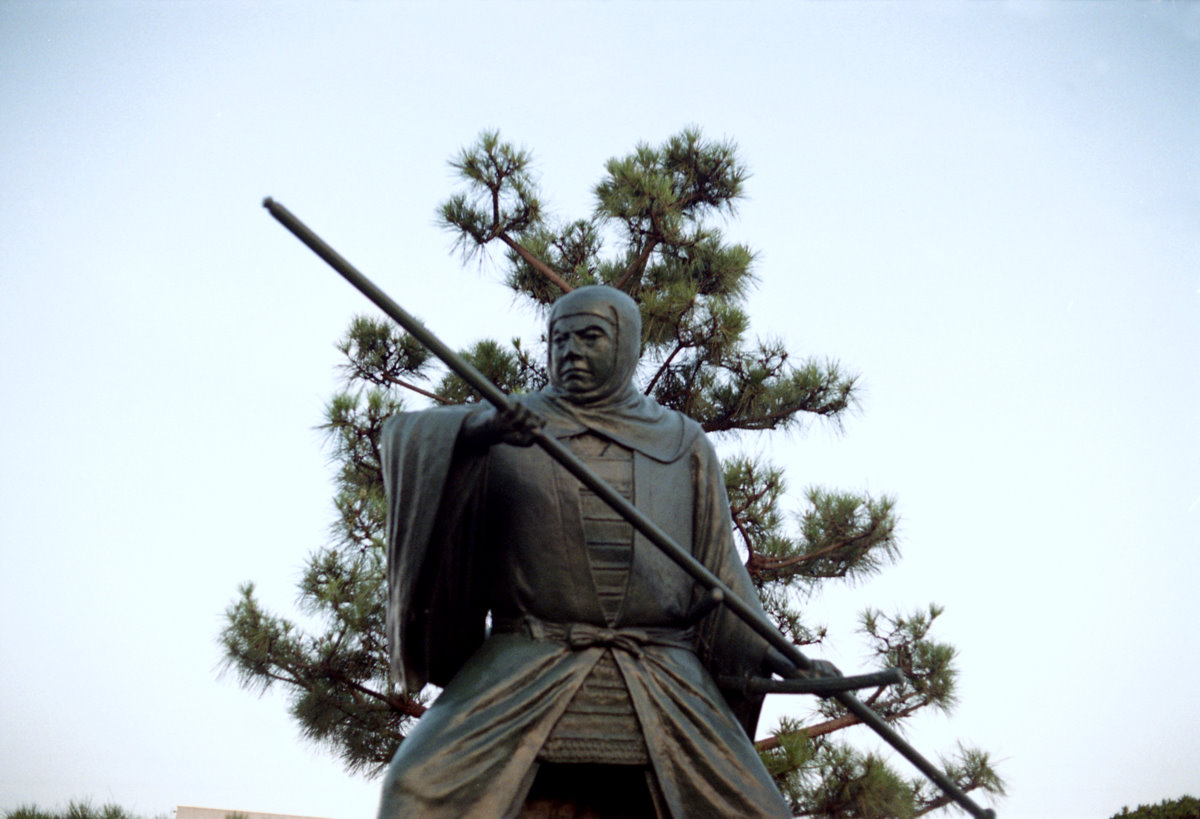
A statue of Benkei, the archetypal sohei warrior, in Tanabe city in Wakayama, Prefecture. shikabane taro, CC BY 3.0, via Wikimedia Commons
Sohei are most often depicted as armed warriors with naginata (glaive) weapons, and usually a katana blade (equivalent in the Dungeon Master’s Guide to a longsword) as backup, while frequently depicted wearing a white cowl. But are they fighters, clerics, fighter-clerics, paladins? I played around with several options and ultimately settled on Sohei being the Japanese equivalent to a paladin. Here’s why.
Despite their devotion to a particular temple, Sohei had little or no actual ordination. The Buddhist orders at this time still closely followed the traditional ordination rules, the Vinaya, dating all the way back to the time of the historical Buddha. Soldier-monk, by their violent nature and political entanglements, would have violated quite a few precepts.
Further, full monastic ordination required years of training and practice. Instead, the monasteries had to field armies quickly, so they needed warriors more than monks. The Sohei might received some kind of provisional ordination, if even that, but not ordination as true Buddhist monks. Buddhist “monks” would be analogous to clerics, of course.
But their religious fanaticism and martial training can’t be denied. They are neither run-of-the-mill soldiers, nor samurai due to the loyalty to temples, not warlord. So to me, the paladin class makes sense. A fighter-cleric combination, based on my trial and error, was just a bit too clumsy to make it work and still look like a sohei warrior. A paladin-class warrior fits the two aspects of combat and religion more seamlessly, and like the European knightly orders, the sohei could field large armies if required.
Building a Sohei Paladin
As stated above, in many respects, a Sohei works best as a Paladin that is just flavored for a medieval Japan setting:
Weapons flavored for Japan setting: Naginata for Glaive, Katana for longsword
No use of shields (shields were not used in Japanese warfare).
Rudimentary, combat-focused magic.
Next, what Oath would a sohei / paladin take? Using the Player’s Handbook as a starting point, I settled on these interpretations:
Oath of Vengeance – destroy heretics, or supernatural evil depending on one’s inclination. I feel like there’s enough for a player character to find a suitable “calling” while adhering to this Oath, and thus this seems like the best fit to me.
Oath of Devotion – possible, though a bit more of a stretch due to dubious history of the sohei. One could still be devoted to a religious order, while also protecting the community. Such a “white knight” sohei probably takes the religious precepts more seriously (especially given Buddhism’s encouragement to not take life).
Oath of the Ancients – this one just felt like a stretch to me. I can imagine a sohei that’s somehow tied to Japan’s other religion, Shinto, where the Oath of the Ancients fits really nicely, but I am unaware of any historical precedence of sohei serving major Shinto shrines. Then again, in a fantasy setting, anything is possible.
Thus, playing around with a few options in DnD Beyond, I made an example character here:1
A few things to note, some pretty self-explanatory:
I chose basic Human just because I like the general stats bonuses, but I could choose Variant Human in order to get the Polearm Master feat right away. Either option is fine, and there’s no shame in branching out and trying other things too.
Having a paladin’s proficiency in all martial weapons means that wielding a longsword / katana is no issue either. However, in this case, I decided to arm him with both a naginata (glaive) and a daikyū (longbow). D&D Beyond allows me to customize mundane weapons and equipment with new names, while keeping the mechanics the same.
Shields were not used in medieval Japan, so to compensate I plan to give him the Defense Fighting Style at level 2. He uses chain armor for now, though I’ll probably upgrade to Splint later later.
A Sohei using some divine magic, especially for war, makes sense in a fantasy theme, so the existing paladin spell list is pretty suitable, though perhaps with some flavor adjustments.
For backstory, I gave him the soldier’s background, and backstory (reflecting history) that he comes from a rural, peasant background from a family that lived and worked on farmland owned by a powerful temple. A serf’s family. Recruited at a young age, he fought in a number of battles between his temple and a local warlored until the temple was destroyed. Now, Shinji is trying to atone for his part in the war, through adventuring in the wider world.
So, that’s my first-pass effort at making a sohei character for Dungeons and Dragons. I’ll let you all know how it goes.
1 In keeping with Japanese custom, I originally named him Moritomo Shinji, with the family name, Moritomo, coming first and the given name second. However, because VTT and online D&D games have limited text space, I shortened to just “Shinji” later.











 Gleanings in Buddha-Fields


.jpg)


You must be logged in to post a comment.