Zen, the Pure Land, and Buddhism Lite

Warning: long, (mostly) unedited, stream of thought. Sometimes it’s just funner this way. 😄

Since my trip to Japan and back, I’ve been kind of debating something in the back of my head.

Much of my background in Buddhism since as far back as 2005 has been in the Pure Land tradition, especially Japanese “Jodo Shu” and to a lesser-extent “Jodo Shinshu” sects. The sure openness and simplicity are very appealing, especially when I am having a hard time in my life. At other times, I see my conduct as backsliding or lazy, or that I am not grounding myself enough in the here-and-now, and so I tend to shift toward Zen. At such times, the passivity of the Pure Land path seems out of place with what I feel Shakyamuni Buddha would have wanted to us as disciples to do.

Buddhism, as a world religion, is a religion of doing not believing.

But the reason why the Pure Land tradition is so popular across many Asian cultures, and increasingly in the West is that it realistically assesses the situation of lay followers and provides an accessible path for them to follow.

The monastic/lay-disciple relationship within Buddhism has always been a challenge throughout its history since it tends to relegate the lay disciples as passive followers. The doing of Buddhism tends to favor those who are willing to commit the time and energy into it (i.e. mendicants, renunciants, etc), leaving the laity to support them, or at least participate as time allows.

The Buddha was not insensitive to this, and sternly reminded his followers that without the lay community, they could not be a Sangha. Further, many of the original precepts in the monastic code were to avoid monks and nuns abusing their authority over the laity, including the Rains Retreat. Further, when the lay community and monastic community have a healthy relationship, everyone benefits.

The catch is that even with good intentions, the laity are often put in a more passive role. Many of the traditional sutras in the Buddhist canon are intended for fellow monks, not laity. Many of the practices require time and effort that laity simply can’t do.

While Pure Land Buddhism does help to address this, I realized that it can also lead to complacency. When dealing with my puppy, who while adorable is still behaving like a puppy, or dealing with constant pressures at work, such things tend to bring out the worst in me, and simply reciting the nembutsu over and over doesn’t seem like a particularly effective strategy.1 Further, I don’t want to forget about my experience last year, and some of the insights I gleaned from that.

On the other hand, I’ve never really liked the Zen tradition, especially in the West. Western Zen tends to feel weirdly divorced from the tradition it inherits from, sometimes flippantly so, and tends to feel sterile and lacking any sense of community. People seem come to Zen centers and practices because they need something, not because they are happy to be there.2 The Zen community in the West is comprised of he same sort of people who argue online about why such-and-such Star Wars series is good/bad, or try to out-do one another in their knowledge of Zen esoterica. In other words, it’s saturated with smarmy nerds.

In much of the current Asian-Buddhist tradition, both the Pure Land and Zen tradition stand at opposite poles between utter passivity (“it’s OK, I have faith in Amida Buddha”) or utter DIY (“I’m gonna meditate my way to Enlightenment!”). There are many efforts over the centuries, to somehow wed the two traditions, and these efforts usually gravitate toward one pole or the other. The famous Chinese monk, Yunqi Zhuhong,3 was a particularly effective example of this, but Yunqi isn’t well known in the West. Ven. Thich Nhat’s Hanh’s interpretation of Pure land through the lens of Zen, Finding Our True Home, was a pretty good modern attempt as well.

Still, these are somewhat intellectual exercises, and not always useful to lay people who may not always understand either tradition. So, going back to my main concern: how do you make Buddhism accessible (and easily understood) to a wide, non-Buddhist audience while still keeping faithful to the Buddha’s teachings on discipline, wisdom and cultivation. Further, how do you keep the “heart” of Buddhism so it doesn’t become a nerdy, sterile exercise?

I think this is where the Lotus Sutra really comes in handy. The Lotus Sutra by itself is hard to discern, and pretty tough to read, but if you’re already familiar with Buddhism, I think it helps provide the “heart” of Buddhism and helps address the question: what’s the point of it all? The parables in the Lotus Sutra are also a really great way to get around intellectual discussions and convey Buddhist teachings in a way people can adopt and carry with them, hence their popularity throughout antiquity.

However, as with Zen or the Pure Land, it’s important not to get a one-sided, literalist view of the Lotus Sutra either, or a person will go off the rails. It’s a historical text, written with a specific audience in mind, and has to be taken into context. Yup, I said it.

Anyhow, to that end, I have been thinking about this and I feel there are certain universal practices in buddhism that, regardless of sect you follow, are really beneficial to observe. By beneficial, I mean, you are aligning with teh intention of what the Buddha would have wanted us to follow either as a lay-person or as a monastic disciple. In previous blogs, I called this “Buddhism Lite”, since it distills the tradition to as simple and generic an approach as I can. You can re-name it something else.

Buddhism Lite

  • Uphold five precepts – In my opinion, this is the most fundamental practice for lay Buddhists, and really dove-tails nicely with the other practices below. If you have to prioritize the precepts versus meditation and such, prioritize the precepts. They are also the easiest to integrate in everyday life.
  • Recite “nembutsu” – in this context I am using nembutsu as simply recollecting the Buddha, and venerating him. The Buddha is our beacon in this world, and so it behooves us to give due gratitude. To me, the simplest way to venerate the historical Buddha is to recite the phrase Namo Shakamuni Buddha. If you prefer another Buddha or Bodhisattva, that’s totally fine. In the end, there is only one Dharma,4 and each figure simply embodies it. The Dharma is what maters most, not the particular Buddha.
  • Mindfulness meditation – as much as I tend to avoid mindfulness meditation, there’s no denying that it’s central to Buddhism. It is the practice the Buddha prescribed most to followers, and has a tangible value both in the near term and in the long term. I won’t prescribe how much a person meditate; just work it into your life in a way that’s sustainable (like physical exercise).
  • Optional: Uposatha – I haven’t really talked about this much, but Uposatha is traditionally when the Buddha would set aside time for devout laity and the monastic community to practice together. Think of the Uposatha as like the Sabbath, or Sunday services, etc. Uposatha is traditionally held on six days of the calendar month: the 8th, 14th, 15th, 23rd, 29th and 30th days.5 The example below is a Uposatha service you can observe at home on Uposatha days, based on existing traditions. As with meditation, make it sustainable for your life.
    • Praise to the 3 treasures:
      • “I go to the Buddha for refuge”
      • “I go to the Dharma for refuge”
      • “I go to the Sangha for refuge”
    • Confession of transgressions: All of the misdeeds I have committed in the past are the result of my greed, anger and delusion. I repent these misdeeds.
      • The key here is not to “flog yourself”, it’s about observing scientifically when your own conduct fell short and acknowledging this, wiping the slate clean, and resolving not to do them again.
    • Recite a sutra, or part of a sutra: your choice.
    • Recite the “Nembutsu” three times – see above.
    • Dedication of merit – you are not just practicing for yourself, but also for the benefit of others.

I think the key here is balancing devotion to the Buddha as a teacher, with putting things into practice in real life, and avoiding complacency.

Anyhow, this has been a somewhat rambling stream, but it was easier to just write it all out in one shot than try to explain in something more polished and shorter. If you made it this far and find it useful, thanks!

1 This is something I recall from a Jodo Shu called the ippyaku-shijūgo-kajō-mondō (百四十五箇条問答) or “One Hundred and Forty Five Questions and Answers” addressed to Honen:

Q: Is it better to recite Nembutsu abstaining from doing evil and doing only good, or to recite Nembutsu believing only in the true wish of Amida Buddha?

A [from Honen]: Abstaining from the evil while doing good things is the total admonition of Buddha. But for us, living in the real world, we disobey the admonition, so by believing from the bottom of our hearts in the real wish of Amida Buddha to save all kinds of people, we are able to say “Namu Amida Butsu”. Amida Buddha will lead all people into the Pure Land without any discrimination between people with or without wisdom, or between those who can or cannot keep the precepts. Please keep this in mind.” (Clause 145)

http://www.jodo.org/teachings/teachings01.html

2 From Brad Warner’s blog:

Plus those adoring audiences of sincere truth seekers that I imagined would hang on my trippy words of wisdom were nowhere to be found in his case. Instead, he was surrounded mainly by curiosity-seekers who never stayed around long, or by needy hangers-on who often became angry and belligerent when they weren’t satisfied with what he taught — which was always. He did have a handful of sincere students, but we were not much help when it came to supporting him.

http://hardcorezen.info/so-you-want-to-be-a-dharma-teacher/7843

Although I don’t really follow Mr Warner, this has been my limited experience as well.

3 I wrote much of this Wikipedia article, so I may be biased. 😏

4 Chapter two of the Lotus Sutra, by the way:

But stop, Shariputra, I will say no more. Why? Because what the Buddha has achieved is the rarest and most difficult-to-understand Law. The true entity of all phenomena can only be understood and shared between Buddhas. This reality consists of the appearance, nature, entity, power, influence, inherent cause, relation, latent effect, manifest effect, and their consistency from beginning to end.”

source: https://nichiren.info/buddhism/lotussutra/text/chap02.html

In other words, the Buddhas all awaken to the same Dharma, and have the same qualities and awareness. The Dharma is what matters. Also, the Vakkali Sutta in the Pali Canon.

5 How would Uposatha look in February? I would probably just bump the 29th and 30th to March 1st and 2nd respectively.

The “Unvarnished” Nenbutsu

Honen, the founder of the Japanese Pure Land movement in 12th century Japan had quite a few disciples as we’ve talked about before, but there were certain disciples that particularly carried the torch. One of them was a monk named Shōkū (証空, 1177 – 1247) who later went on to found the Seizan branch (seizan-ha, 西山派) of the Jodo Shu sect. He is thus often called Seizan-shōnin as a result.

Shōkū was among the few disciples who was not exiled from the capitol during the Jogen Persecution (jōgen no hōnan, 承元の法難) of 1207, probably due to his closer affiliation with the Shingon sect, and because he wasn’t a firebrand like some of Honen’s other disciples. Since he stayed in the capitol, he was able to repurpose an existing temple in the capitol, Eikan-dō (homepage, with English too), into a Jodo-Shu sect temple, while the exiled disciples established Jodo Shu teachings in the countryside.

Anyhow, what made Shōkū noteworthy within the context of Japanese Pure Land Buddhism was a concept he described as shiraki nenbutsu (白木念仏), or “unvarnished wood nembutsu”. In the following passage, he writes:

….those who color [i.e. “varnish”] their nenbutsu practice with many meditative practices and non-meditative practices boast that they will definitely attain ōjō [往生, rebirth in the Pure Land].

Meanwhile those who cannot develop these practices and whose nenbutsu is utterly colorless grow discouraged about their ability to attain ōjō.

“Traversing the Pure Land Path”, page 116, translations by Jonathan Watts and Yoshiharu Tomatsu

Some people, especially those with more means, want to supplement (i.e. “varnish”) their nembutsu practice with additional Buddhist practices, but Shōkū points out that this puts other people at a disadvantage. All they can do is recite the nembutsu in sincere faith. This is the unvarnished nembutsu. Shōkū quotes the revered Chinese master Shandao by comparing the unvarnished nembutsu with Shandao’s “sincere and believing mind”. For Shōkū, what mattered in the end isn’t form, it’s sincerity.

This is echoed many centuries later by Vietnamese Buddhist monk, Ven. Thich Thiên-Tâm, in Buddhism of Wisdom and Faith (1991) when he writes (emphasis added):

Moreover, the power of the Buddha’s vow [Amitabha Buddha’s] is so immense that, no matter how heavy our karma is, by reciting His name in all earnestness, we can, in this very lifetime, be reborn in the Pure Land.

Page 14, translation by the Van Hien Study Group in NY

Similar to Shōkū’s “unvarnished nembutsu”, Thich Thiên-Tâm shows how there’s no “gaming the system”. Rebirth in the Pure Land is due to Amida Buddha’s vow and compassion toward all beings; there’s no adding or subtracting to this. If one is sincere, Amida Buddha hears, and will lead you to the Pure Land.

Further, Shōkū writes:

Now this doesn’t mean that there’s no value in the nembutsu of people either deeply or just ordinary knowledge of the Mahayana teachings, or of those who keep the precepts. It’s very important to avoid all confusion of thought here.

“Traversing the Pure Land Path”, page 118, translations by Jonathan Watts and Yoshiharu Tomatsu

Shōkū, I feel, is making a distinction between conduct in this life and the goal of being reborn in the Pure Land. While living in this life, the Buddha’s teachings about, and living responsibly, with goodwill towards others, still hold true. If you can put even some of these teachings into practice, great. Everyone has to start from somewhere.

Further, as we see in the Buddhist text, the Immeasurable Life Sutra (emphasis added):

If you strictly observe the precepts of abstinence with upright thought and mindfulness even for a day and a night, the merit acquired will surpass that of practicing good in the land of Amitāyus for a hundred years. The reason is that in that Buddha-land of effortless spontaneity all the inhabitants do good without committing even a hair’s breadth of evil.

Translation by Rev Hisao Inagaki

And yet, as Shōkū and Thich Thiên-Tâm teach, regardless of how much or little you’ve accomplished in this life, one can still take refuge in Amida Buddha, and be reborn in the Pure Land rather than taking one’s chances with future rebirths. It is all due to Amida’s compassion.

Thus, for me, the beauty of the Pure Land Buddhist path, is that anyone can begin just as they are, make the best effort they can in this life, and yet be secure in the knowledge that they are embraced by Amida Buddha nonetheless.

Namu Amida Butsu

P.S. Originally, I had an even longer post, a stream of thought in draft mode, but after finding the passage above, I found a much simpler way to explain it. As a writer, it’s always good to step back and wait before publishing. You might find a better way to explain it.

P.P.S. More on making Buddhism accessible to a diverse array of people.

Practical Buddhism

Recently, I’ve been reading some old books of mine about the life of Honen, a 12th century Japanese-Buddhist monk who started the Pure Land movement in Japan which includes Jodo Shu and Jodo Shinshu Buddhism. Honen had a pretty eclectic following: from nobility in the elite Fujiwara family, to prostitutes, ex-monks, etc.

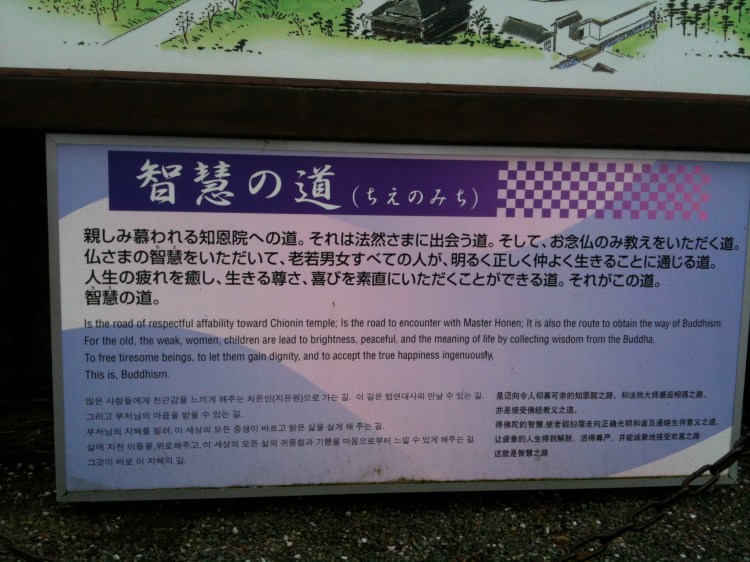
Taken in 2010 at Chion-in Temple in Kyoto, Japan, this is one of two head temples of Jodo Shu, and where Honen’s mausoleum is said to be. This was a sign posted near the main gate.

In one famous dialogue, Honen is talking with a former robber named Amano Shiro (天野四郎), who had previously been a leader of a gang in Kawachi Province and had reputedly killed some people as well. In his old age, he became inspired by Honen’s teachings and became a devout follower named Kyo Amidabutsu (教阿弥陀仏). One night, while staying with Honen, Kyo Amidabutsu had woken up in the middle of the night to hear Honen reciting the nembutsu by himself. When Honen realized he was no longer alone, he quietly went to bed.

A few days later, Kyo Amidabutsu went to talk to Honen. He had no family to care for him in his old age, and so he would be leaving soon to stay with a friend in a remote province in the east. Before he would leave though, he had some questions for Honen.

In the dialogue, as recorded in both Honen The Buddhist Saint and Traversing the Pure Land Path, is pretty long, Honen carefully explains what the nembutsu is all about, and patiently answers Kyo Amidabutsu’s questions. For example, Honen explains the significance of the nembutsu:

First of all, notice that there is nothing so extremely profound in the nembutsu at all. The only thing to now is that everyone who calls upon the sacred name [namu amida butsu] is certain to be Born into the Pure Land. No matter how educated a scholar may be, he has no right to assert that there are things in our school [e.g. Pure Land Buddhism] which really do not belong to it.

Page 61-62, “Traversing the Pure Land Path”

Here, Honen is trying to counter some of the other Buddhist schools at the time, which tended to emphasize a more esoteric, intellectual meaning, something that would require considerable time and effort for a monk to discover through practice, esoteric initiations, and meditation. Kyo Amidabutsu, as an elderly commoner in the 12th century, would probably had a minimal education, and thus would’ve found all that intimidating, assuming that he could even take tonsure and become a monk.

I really like the fact that Honen is not hitting Kyo Amidabutsu over the head with a bunch of doctrinal explanations about the Four Noble Truths, Karma, Rebirth, etc., either. Instead, he’s providing a simple, straightforward path with no hidden, mystical or esoteric meanings. It’s not that these aren’t important, but Buddhism is first and foremost a religion of practice, not belief, so these can be learned gradually.

Next, Kyo Amidabutsu asks a series of questions about when is it the right time to recite the nembutsu, whether to setup an altar, wear clerical robes, etc. Honen’s reply is similarly straightforward:

The nembutsu may be practiced whether you are walking, standing, sitting, or lying [down]. So it can be left to everyone according to their circumstances to do it either reclining or sitting or in any way they choose. And as to holding the rosary or putting on the robes, this also should be decided according to circumstances. The main point is not the outward manner at all but the fixing of the mind on the one thing — firmly determined to gain ojo [往生, rebirth in the Pure Land] and with all seriousness calling upon the sacred name [namu amida butsu].

Page 65-66, “Traversing the Pure Land Path”

This sense of sincerity is the key, as Honen teaches. For Kyo Amidabutsu’s sake, he uses an analogy of a thief who means to rob a house:

“Down deep in his heart [the thief] means to steal, but as far as his outward appearance is concerned, he gives not the slightest indication to others of his purpose by look or gesture. As others know absolutely nothing about the purpose to steal that is in his heart, we may say that the purpose is for him alone, without any reference to outward appearance. Such an undivided heart as this is necessary in the man who would make sure of birth into the Pure Land [of Amida Buddha].

Page 63, “Traversing the Pure Land Path”

In my limited experiences talking with people who are curious about Buddhism here in 21st Century America, I often notice that they are curious, but don’t know where to begin, and find it a bit overwhelming. Buddhism is hard to explain, and yet most of that information isn’t necessary upfront either. If people want to know more, they can (and will) ask. Instead of hitting people over the head with a bunch of esoteric, mystical or complicated psychological explanations, it’s probably better to just KISS: Keep It Simple, Stupid.

Buddhism isn’t meant to be an intellectual playground for the upper classes, it’s meant to help people from all walks of life. Everyone should feel free to begin the Buddhist path just as they are, and go at their own pace, using the tools they have.

Honen was sensitive to Kyo Amidabutsu’s situation and provided a straightforward, simple practice that provides both a sense of spiritual comfort, but also something very flexible and adaptable to his circumstances. Kyo Amidabutsu is old, has no kin, financially broke, and has no where to live. He probably doesn’t even know when he might eat next, or where he might sleep next. So, it has to be something that can be adapted to his existing lifestyle, and straightforward (not esoteric) enough that it is easy to understand yet provides a sense of refuge in a chaotic world. It may be looked down upon by more “elite” Buddhist followers, but for Kyo Amidabutsu, it’s just right.

Indeed, in founding the Jodo Shu sect, Honen reportedly once said:

The reason I founded the Jōdo [浄土, Pure Land] sect was that I might show the ordinary man how to be born into the Buddha’s real land of recompense [e.g. the Pure Land]. According to the Tendai sect, the ordinary man may be born into the so-called Pure Land, but that land is conceived of as a very inferior place. Although the Hossō [Yogacara] sect conceives of it as indeed a very fine superior place, they do not allow that the common man can be born there at all. And all the sects, though differing in many points, all agree in not allowing that the common man can be born into the Buddha’s land of real compensation….Unless I start a separate sect, the truth that the common man may be born into the Buddha’s land of compensation will be obscured, and it will be hard to realize the deep meaning Amida [Buddha]’s Original Vow [to provide a refuge for all beings].

Honen: The Buddhist Saint, page 23-24

For this reason, I come back again and again to Jodo Shu Buddhism over the years because even when I quibble about specific details, it’s accessibility, and simple message is pretty hard to beat within the Buddhist world. It meets the needs of all walks of life, and does not overwhelm people with philosophical details, yet it also provides plenty of flexibility to grow and learn as well. I feel this is an exemplary example of Buddhist metta if nothing else.

Namu Amida Butsu

Buddhist Portable Altar

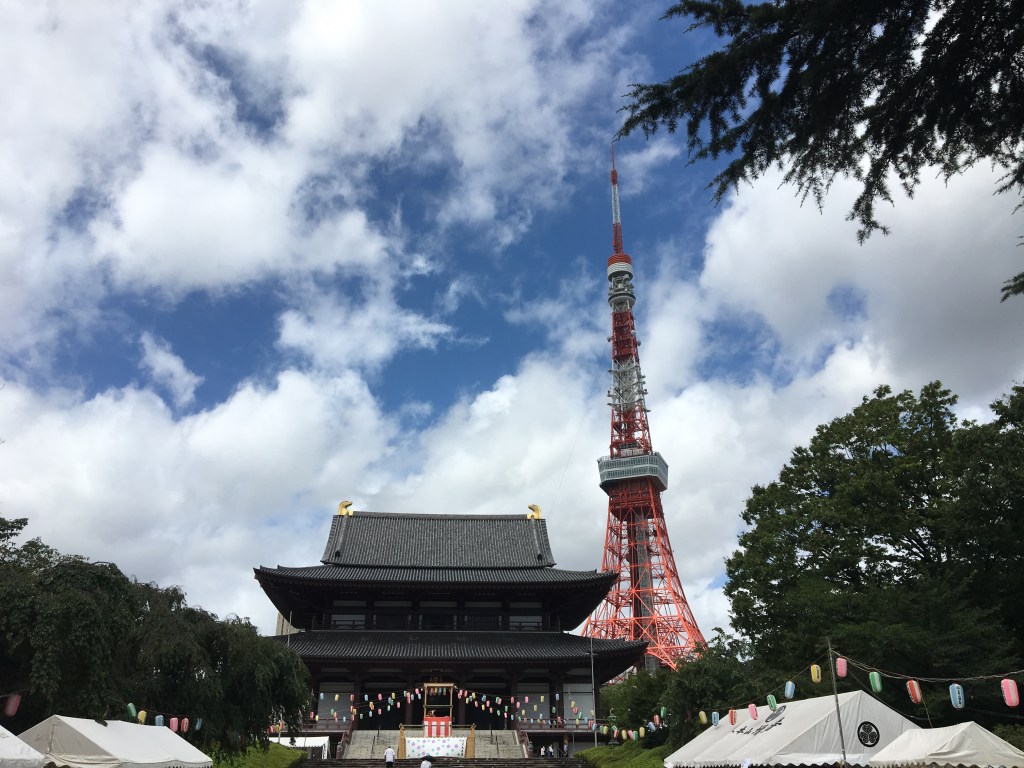
A few years ago, during our last trip to Japan before the Pandemic, we came to the famous Buddhist temple of Zojoji: one of two head temples of the Jodo Shu sect.

My wife and I like Zojoji in particular, and since it is right next to the famous Tokyo Tower, it is always worth a visit.

Taken in 2019, Tower Tower is in the back, about 2-3 blocks away.

Along its famous treasures is a “black Amida [Buddha]” statue which has a separate altar room, in the annex room to the right of the main hall:

Taken in 2019

Anyhow, on that visit, I picked up a neat little portable altar/image of Amida Buddha: it is normally wrapped in a small brocade envelope:

Inside you can see an image of Amida Buddha:

The writing on the left is a verse from the Shiseige (aka Juseige) a devotional set of verses, which is in turn an excerpt from a Buddhist text, the Immeasurable Life Sutra. The verse above reads:

神力演大光 Jin riki en dai ko
普照無際土 Fu sho mu sai do
消除三垢冥 Sho jo san ku myo
広済衆厄難 Ko sai shu yaku nan

With my divine power I [Amida Buddha] will display great light,

Illuminating the worlds without limit,

And dispel the darkness of the three defilements [greed, anger, delusion];

Thus I will deliver all beings from misery.

On the right is a poem by Honen (法然, 1133-1212), founder of Jodo Shu, called “Moonlight”. I talked about the poem here.

This folds out like a mini triptych, though it doesn’t stand up very well on its own.

Because it’s so small, yet very beautiful, it is a nice thing to carry with you sometimes for those moments of inspiration or private devotion.

Compassion

I grew up as a teenager watching the old TV show, Kung Fu, on syndicate. I was a big fan, and although the show hasn’t always aged well, it was my first naive introduction to Asian culture, Buddhism, etc, so it holds a special place in my heart.

I found this clip on Youtube recently and wanted to share. It really speaks to the Buddhist notion of metta or goodwill (which I talked about here):

This reminds me of the famous encounter by the Japanese Buddhist monk, Honen, and the prostitute, and his similar approach. I really like the flashback scene here (the one describing the lily in the desert), which reminds me of appreciating the value of all life. Even Gandalf makes this point in the Lord of the Rings:

Finally, I was happy to find another clip from Kung Fu here:

The first flashback scene here, between young Kwai-Chang Caine and Master Po sitting beside a statue of the Buddha, really resonated with me when I was a teenager and first watched Kung-Fu. In fact, this was probably my first encounter with Buddhism ever.

Happy Birthday, Honen!

Today, April 7th in the Japanese-Buddhist calendar, is a holiday called Shūso Gōtan-e (宗祖降誕会) which celebrates the birthday of a monk named Honen (法然, April 7, 1133 – February 29, 1212). Ostensibly, Honen was a monk of the Tendai sect in Japan, but went on to be a founder of the Jodo-Shu or “Pure Land” Buddhist sect, as well as many other spin-offs. You can read more about his biography here.

Portrait of Honen by Shinkai (忍海), courtesy of Wikimedia Commons.

Honen didn’t invent Pure Land Buddhist as a practice and tradition. We can see earlier examples such as Genshin who were already practicing it avidly, and indeed, Pure Land Buddhism had been popular for centuries, especially when the social order was breaking down in the 12th century.

However, what Honen did and why he’s still revered today is his efforts to make the Pure Land practices as utterly accessible as possible through recitation of the nembutsu. Where many career monks were concerned with politics, or were seemingly aloof with the plight of people outside the Heian-period aristocracy, Honen really went out of his way to help others, and teach them a simple, straight-forward Buddhist practice, without discriminating by social class or gender.

Honen’s encounter with the woman of the night has always been one of my favorite stories about him, and underscores his easy-going manner, and his commitment to helping anyway he could. Even after his exile from the capitol, he maintained his monastic vows, and taught the Pure Land even to his dying breath.

Admittedly, I do have some quibbles about Honen’s approach to Pure Land Buddhism, and James L Ford’s book on Jokei, a critic of Honen, rightly points out how Honen cherry-picked teachings from earlier Pure Land masters to suit his own viewpoint. However, one thing is certain: Honen was very sincere in his efforts even if one might questions his methods. He did not get delusions of grandeur the way some contemporaries did, and he did not retreat to monasteries in pursuit of the truth. He was out among the masses all the time, teaching fellow monks, nuns, and lay people everything he knew.

So, happy birthday Honen! Thank you for teaching this American, 800 years later, about the nembutsu, and helping me get started on the Buddhist path when I needed it most.

P.S. another contemporary critic of Honen, Myōe, tried to do something similar by promoting the Mantra of Light, but for whatever reason it never quite caught on. Similarly, Nichiren promoted the odaimoku a couple generations later.

All of these monks, Jokei, Myoe, Honen and Nichiren were all talented teachers and sincerely sought to help others, but for whatever reason, perhaps because Honen was the first, or something dynamic in his teachings, achieved an impact on Japanese Buddhism not seen since.

The Shōshinge Hymn

While in Japan, my wife, kids and I attended the 49-day memorial service (details here) for my mother in law. This service was held at a neighborhood Jodo Shinshu-sect temple which my mother in law frequently volunteered, and have been family friends for generations. 😌

This was the first Jodo Shinshu Buddhist service that I had attended in almost five years. The Pandemic was a large reason, but also there are personal reasons too.

Anyhow, the memorial service included an important hymn in the Jodo Shinshu tradition called the Shōshinge (正信偈). This is a hymn composed in the 13th century by the founder Shinran, and lays down the basics of Jodo Shinshu teachings, and the “lineage” of one Dharma master to another, starting in India, through China, to Shinran’s teacher, Honen.1

The hymn is quite long (20 minutes), but it is frequently used in formal services. When I was training for ordination years ago, I practiced this hymn over and over with my minister, so hearing it brought back a lot of memories. I could still remember some of the verses, the rhythm, etc. It’s interesting how music stays in your memory like that. Also, I am very tone-deaf so during my training days, I sang it terrible. My minister was quite good at it, and also very patient with me. Reverend Castro, thank you.

The above YouTube video is a good example of the Shōshinge when sang properly. I definitely did not sound like this, no matter how much I practiced. Also, there are at least two styles to singing the Shōshinge, the gyōfu (行譜) style, and the more common sōfu (草譜) style. But start off somewhat flat, but then gradually build as the song goes along. IIRC, the gyōfu is more difficult.

This video below, demonstrates the gyōfu style. Note the abrupt change in style around 10:00 or so…

One other note is that the Shōshinge often ends with a set of 6 shorter hymns called Wasan (和讃). Shinran wrote quite a few of these little hymns, but these 6 in particular are most commonly included at the end. I remember singing these too (also rather poorly).

By the way, you can find a full translation of the Shoshinge including the 6 Wasan hymns here.

One thing that always struck me as unusual about Jodo Shinshu as a sect was its heavy reliance on hymns more than chanting the Buddhist sutras, as other sects do. My guess is that using music and hymnals, especially in vernacular Japanese, made the teachings more accessible to Japanese lay people. This is similar to the medieval Christian debate between using Latin vs vernacular language, perhaps.

However, Jodo Shinshu does recite some Buddhist sutras too, such as the Juseige and Sanbutsuge, both excerpts from the Immeasurable Life Sutra. Also, the Shoshinge is written in Sino-Japanse, not vernacular (like the Wasan hymns), so the answer is maybe not clear-cut. Maybe Shinran was just a musically-inclined person. I am not sure. Personally, I just prefer to recite sutras as it is the more mainstream tradition anyway.

In any case, for the 100th day memorial for my mother in law, I will probably sing the Shoshinge hymn as a tribute to her, so I have been brushing up a bit lately. We’ll see how it goes. But, I hope she enjoys nonetheless.

1 The concept of lineage in Pure Land Buddhism is a bit fuzzy, compared to Zen, Shingon or Tendai Buddhism in that there is no physical “handover” from master to student. The patriachs all lived in different times and places, but each contributed new ideas or innovations to Pure Land Buddhism, hence there is a steady evolution.

Samadhi, Schamadhi

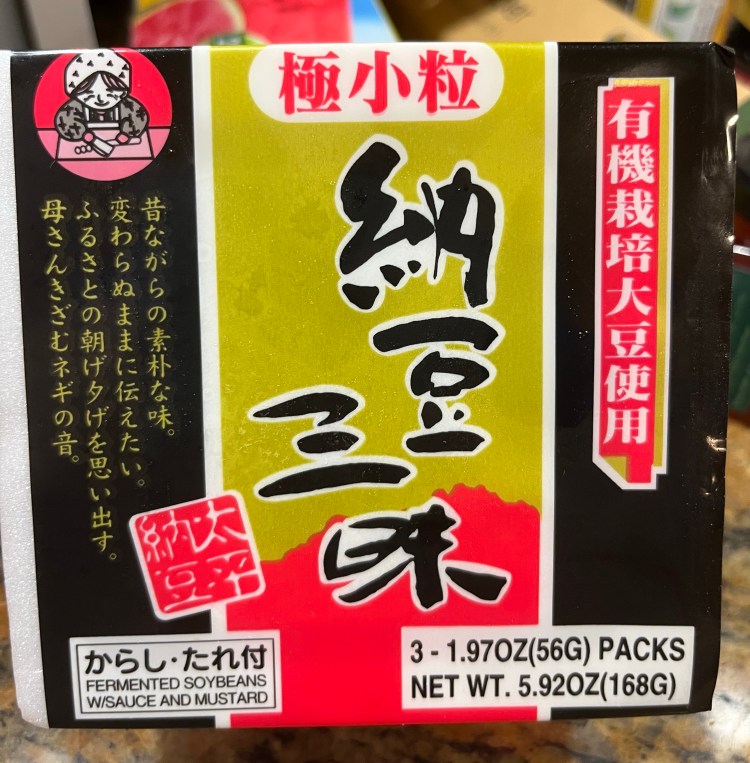
My family knows I love to eat rice and natto, or fermented soy beans, in the morning. Often with Korean kimchi. It’s a breakfast habit I started about 10-15 years ago, and never looked back. Thanks to the crunch of the pandemic, and inflation, shipments from Japan have become a trickle, and so our local Asian market will sometimes have no natto in stock, other times it will have a huge stock that quickly disappears. My wife found this new brand recently after the latest shipment came in, and the name of the product gave me a good chuckle.

The name of this product is nattō zanmai (納豆三昧), with “zanmai” being a Japanese transliteration of the Chinese-Buddhist term from the Sanskrit word samādhi. The word samadhi is something used in Indian religion in general, but refers to a state of intense concentration through meditation. It appears in a wide variety of contexts, but for now we’ll focus on the Buddhist ones. It helps to think of samādhi as being “in the zone”, but in a deeper, meditative sense.

Usually when people think of meditation, they think of the classic mindfulness meditation (a.k.a. vipassana meditation) and sometimes when one meditates here, they get into a deep, absorbed state. However, meditation is a broad subject in Buddhism, and with other kinds, including walking meditation, mantra-chanting, visualization of the Buddha, etc. In each such practice, some kind of samadhi is possible too. Even in the context of Pure Land Buddhism, chanting the nembutsu (the name of Amitabha Buddha) is said to bring about something called nembutsu samadhi if done as a long-term, dedicated practice. Honen was said to have seen the Pure Land around him during this intense state of recitation. Similarly, the intense practices of the Tendai sect were said to bring about powerful samadhi experiences as well if carried to fruition.

However, while all that is interesting for Buddhist-nerds like me, it is not the context being used for the brand of natto. The term “zanmai”, which still retains it Buddhist context, can also mean in a regular day to day context something that you’re just really into. You might even say “absorbed” by. 😎 Day to day Japanese has a lot of old Buddhist terms that have changed meaning over time and reflect cultural attitude even as their religion meaning is obscured. The term aisatsu (挨拶) refers generically to the formalities people use to greet one another, but originally derived from a Zen-Buddhist term for when a teacher would quiz his student on their grasp of Zen. Even the common phrase ganbaru (頑張る, “hang in there”) originally derived from a Zen context as well.

Of course, we do this in English too: many Christian-religious terms have gradually taken on a more pop-culture meaning as well. I have heard from an old Palestinian co-worker that this happens with Islamic terms in Arabic as well. It is a natural cultural phenomenon.

All this is to say that while natto over warm rice does not lead to meditate absorption, it is really darn good, and if like me, you eat it almost every day, you might say you’ve been pretty absorbed by it.

I’ll see myself out.

P.S. If you do like natto, this is a great brand. Definitely pick it up if you can.

Buddhist Practice and Being Reasonable

I found this quotation recently in the 13th century Japanese text, the Essays in Idleness, and have been giving it some thought:

Someone asked the holy priest Honen how to prevent himself from being negligent in his practice by inadvertently nodding off when chanting the nenbutsu. “Chant for as long as you stay awake,” answered Honen. Venerable spoken.

Translation by Meredith McKinney

I like this approach wherein Honen is encouraging a “do your best” with respect to Buddhist practice vs. “do a set amount” that you often see in modern Buddhist literature. For folks who dabble in Buddhism or spiritual practices in general, in particular meditation, it’s often the case we treat it as a prescriptive thing. A teacher prescribes a specific thing (do X for 15 minutes), and we try to do it. It works for a bit, then life gets in the way, and we’re forced to make awkward choices.

Well, life tends to mitigate against complete commitment, doesn’t it?

Count Saint Germain, Castlevania animated series, season 4

If you are a parent, this goes double. You might wake up early, and have a few minutes to get some “personal time”, but if you’re exhausted and your brain is fried, you might not be able to muster the energy for any spiritual practice. If your kids were up late last night, and you wake up late, you don’t even have the benefit of personal time. If you’re working extra hours that day, parent or not, you might not know when you’re done, or have to sacrifice personal time to keep your job.

All this makes consistent, prescriptive spiritual practices unrealistic for most people, but it’s important not to give up either. Hence Honen’s advice makes a lot of sense.

Buddhism Here and Now, Or the Future?

Recently while taking my personal retreat, I spent some time catching up on Buddhist reading, and finished a book titled Introduction to the Lotus Sutra by Yoshiro Tamura, and translated to English. I had high hopes for the book, but came away pretty disappointed as it was a pretty thinly veiled promotion of a Nichiren-Buddhist interpretation of the Lotus Sutra, and of Nichiren Buddhism in general.1

One passage makes some interesting comments worth noting though (Wikipedia links added):

Shinran (1173-1262), Dogen (1200-1253), and Nichiren (1222-1282) also came into reality of out Mt. Hiei’s hall of truth [same as Honen a generation earlier]. Yet their attitudes toward the actual world were quite different from Honen’s. While Honen was mostly devoted to giving up on life and longed for the pure land of the next life, Shinran, Dogen, and Nichiren struggled positively within the actual world. Their activities and writings came right after the Jokyu turbulence of 1221 and were related to it.

Page 123, translation by Michio Shinozaki, edited by Gene Reeves

Mr Tamura is comparing several different Buddhist monks who all left the Tendai sect around the same time, and each founded their own sects. The first, was Honen, who founded the Jodo Shu sect and greatly popularized Pure Land Buddhism in Japan. This is a fascinating historical phenomenon that started in the last 12th century with Honen, and persisted with a couple more generations of Buddhist monks all trained from the same Tendai sect, and apart from Nichiren, its great temple complex on Mt Hiei.

As Nichiren was the last of these great reformers, he had the benefit of hindsight, and tended to be rather harsh toward Honen’s Pure Land movement as degenerate, and further obscuring the true Buddhist teachings (as enshrined in the Lotus Sutra and the Tendai sect). Thus, ever since, Nichiren authors and followers have had particular animus toward Honen. The book doesn’t pull punches either.

But it’s an interesting comment to make, and not without merit. The Jodo Shu Buddhist sect has always been focused on a singular goal within the larger Buddhist religion: to enable followers to be reborn in the Pure Land of Amitabha (Amida) Buddha and thus provide as a refuge, but also to enable them to accelerate on the traditional Buddhist path faster. A lot of this hinges on a medieval-Buddhist interpretation of the “end days” or Dharma Decline, which looks a bit silly knowing what we know now.

In any case, Jodo Shu sect Buddhism, at least on paper, definitely focuses on the life to come. From what I hear on the ground, the reality is a lot more nuanced, and many communities still practice some manner “traditional Buddhism”, but the primary focus still remains rebirth in the Pure Land to come.

So, what Mr Tamura says makes sense.

Mr Tamura is also correct in that Dogen, who founded the Soto Zen sect, and Nichiren approached the same medieval concern with Dharma Decline, but in different ways: Dogen focused on the classic Buddhist approach to mindfulness, meditation, focus on the now, etc. Nichiren took the logical conclusion of the Lotus Sutra’s egalitarian teachings in the form of social reform, nominally as a reform of the Tendai sect, especially in the face of the crooked administration by the new Hojo clan’s military government.2

But I have to disagree with Mr Tamura’s hidden conclusion that by focusing on this-worldly practice that certain sects of Buddhism are superior to others. I feel that this hopelessly generalizes things.

One of the things that always attracted me to Honen’s teachings was his overt rejection of petty, secular life while keeping his focus on the future, namely the Buddha’s Pure Land. It may seem counterintuitive, but by focusing on the “world to come” and thus rejecting the world as it is, i think this fosters a renunciant’s mindset, even as one continues to live in this world. The historical Buddha, Shakyamuni, definitely advocated this approach.

This may seems like not a big deal, especially given other Buddhist sects also have some form of monastic practice, or similar rejection of secular life, but consider that the other aforementioned reformers were all Buddhist monks of hte same Tendai sect, and Tendai at the time had a controversial teaching called hongaku (本覚) or original enlightenment. The idea is that one is already enlightened but unaware of this due to ignorance or skewed viewpoints. This leads to all sorts of thorny issues with Buddhism and Buddhist practice, and gave some scallywags in the Buddhist monastic community an excuse to “loosen the reins a bit” in terms of discipline.

Honen seeing the state of affairs of the community at his time, overtly rejected this concept. Other reformers embraced the concept to some degree or another, sometimes leading to some behavior that in the wider Buddhist world would raise eyebrows.

On the other hand, the historical Buddha definitely advocated practice and mindfulness here and now too. In fact, it’s pretty much central to Buddhist practice, at least for monastic followers. So, Mr Tamura, Dogen, Nichiren and others aren’t wrong.

As a modern 21st-century Buddhist speaking 800 years later (and from another culture), with plenty of personal biases of my own, I think you need a bit of both. On the one hand, whether you are a Buddhist layperson or a monastic, it’s healthy to maintain a renunciant’s mindset. The world is a series of endless transitions, both on a macro level and a personal level, so there’s no lasting refuge or rest. Further, it doesn’t make sense to just throw up your hands and bank on the future through prayer and good merit, because there’s plenty of things you can do in the here and now to make life better for others, and also for yourself. Even if you engage in a little bit of Buddhist practice,3 that’s still a step in the right direction. Even if you meditate even only occasionally, that’s still better than nothing.

So, in a sense, all of the Buddhist reformers in 12th-13th century Japan had something positive to contribute, and each was approaching the same issues with novel approaches. It’s somewhat stupid to try to and hold up one sect as superior to others based on an artificial criteria.

So, anyhow, the book was disappointing, but it does help remind me of what matters.

P.S. Photo taken at the Butchart Gardens in Victoria BC last week.

1 The book started out reasonably well, but the last third of the book was unabashedly promotion of Nichiren Buddhism. Bear in mind that the Lotus Sutra has been revered and influential in many Buddhist communities outside of 13th century Japanese-Buddhist thought, so this tendency to focus on a single sect’s teachings to the exclusion of others. The book’s not-so-subtle tendencies to belittle continental Buddhist culture while promoting Japanese thought didn’t help either. People sure do love to inject culture into their religion.

2 Shinran, who was a follower of Honen, took a more nuanced approach that tends to incorporate some elements of Honen’s view, while focusing on a radically lay-oriented religious community (similar to Nichiren). There’s already plenty of books about Jodo Shinshu (Shinran’s sect), and Shinran, so no need to belabor it here.

3 Consistency has never been my forté. 🤦