Garibaldi: This isn’t gonna be easy. G’kar: Nothing worthwhile ever is.
Babylon 5, “And the Rock Cried Out, No Hiding Place”, s3:ep20
Recently, I talked about the key to practicing Zen (or Buddhism in general) is training while incorporating other things in your life toward that same goal. Like Rocky Balboa training in Rocky, or Li Fong in the excellent movie Karate Kid: Legends, or someone working hard to learn a language by making other aspects of life conducive toward language learning.
In most cases, we go through a some stages when we take up a project like this.
New thing – “this is fun, I can see the benefits already!”
Steady practice – “gotta keep this up”
Boredom – “ugh, I gotta do this again”
Skipped days – “I’ll make up for it tomorrow”
More skipped days – “No, really, I’ll make up it up tomorrow.”
Guilt – “I suck”
Despair – “I’ll never succeed.”
Quitting.
My usual pattern with new projects, or dieting and exercise, is to eventually feel guilty, despair, and quit. It happens to me a lot over the years, admittedly.
But also, there are a few things that surprisingly I have managed to stick with for years, decades even. I’ve been actively studying Japanese since 2008, for example. I realized though that the way I’ve studied Japanese has changed and shifted many times. Some experiments succeeded, others failed immediately. But the goal was important enough to me, that even when I failed I just shifted tactics and tried again. I failed the N1 JLPT twice in the last five years, and to my surprise, I am still at it, but now trying a new tactic.
Put another way: when I hit a roadblock, instead of hitting my head on the wall harder and harder, I tried another route. I knew where I wanted to go (language fluency) and just kept trying methods until I found something that stuck.
I realized too that my pursuit of the Buddhist path has been much the same way. I started out in 2005 with very little understanding, but I really liked reciting the nembutsu, and I loved the simple, down-to-earth, and highly approachable Jodo Shu sect as taught by Honen (still do!). But while I’ve had the same basic goal, my understanding of Buddhism has grown over time, and like language learning, has gone through many false-starts, projects that soon ended, or things that just didn’t work. So, I just shifted, tried another route, backtracked, and so on. This what I think happened to me, and why I took up Zen practice since May.
My current Zen practice is, I suppose, just another track toward my goal.
So, I think the point of all this is that the goal is more important than the particular approach. If the goal is something you really care about you’ll find a way. In fact, you’ll probably bend other aspects of your life toward it. If not, then the goal maybe wasn’t that important to begin with. That’s OK. Better to acknowledge it, cut your losses, and move on.
But if the goal is worthwhile to you, then like G’Kar says, you’ll find a way.
The saying of nembutsu is neither a religious practice nor a good act. Since it is practiced without any calculation, it is “non-practice.” Since it is also not a good created by my calculation, it is “non-good.” Since it is nothing but Other Power, completely free of self-power, it is neither a religious practice nor a good act on the part of the practicer.
The Tannisho, section eight, translation by Dr Taitetsu Unno
This quote comes from a 13th century Japanese text called The Tannisho, a record of conversations between an aging Shinran, the founder of Jōdo Shinshu-sect Buddhism, and his disciple Yui-en.
It’s a strange quote, and many aspects of the Tannisho are also strange at first glance. But the details are important and worth exploring.
Shinran is basically deflating the idea, still common today, that the nembutsu (reciting the name of Amida Buddha) is a practice in the traditional Buddhist sense. Shinran says the recitation of the nembutsu isn’t a magic spell, mantra, or anything that could accomplish a desired result. From Shinran’s perspective, the nembutsu doesn’t do anything.
So, why recite it? From the Jodo Shinshu perspective,1 the nembutsu is simply means calling out to Amida in our hour of deep need. That’s why it’s not a good act nor a practice. Further, Amida Buddha hears all beings and shines his light upon them, a combination of wisdom to illuminate our ignorance, and compassion to embrace us.
The Other-Power described here is called tariki (他力) in Japanese. The idea is that Amida Buddha’s light (i.e. wisdom and compassion) is what transform us. There’s nothing we do that adds or subtracts from this.
Sometimes when I reflect on this, it feels a little bit like sophistry to me, but then I remember an anecdote about Shinran’s teacher, Honen, that helps illustrates this.
One time, someone asked whose nembutsu was better: Honen himself, or Awanosuke, a former-fortune teller who was not well-regarded by others in the community. Honen scoffed at this question and said that there was no difference between his nembutsu and Awanosuke’s because neither skill, nor style, nor conduct, nor grasp of the Buddhist doctrines mattered. It was all through Amida Buddha and not through one’s own efforts.
The whole idea is that in spite of who we are, Amida Buddha’s compassion shines on us all. It is simply that many people may be unaware of this.
Namu Amida Butsu
P.S. Just to clarify, the concept of Other Power wasn’t invented by Shinran and his teacher Honen. It was alreaady prevalent in earlier generations of Chinese Pure Land Buddhists such as Tan-luan and Dao-chuo, but I suppose that Shinran/Honen took it to its logical conclusion centuries later.
P.P.S. I have a backlog of fun things I wanted to share with readers, but the backlog is growing, so I am posting three a week or now just to help catch up.
1 … and arguably the Jodo Shu sect, too. The emphasis of both sects is on Amida Buddha’s compassion, rather than one’s own efforts as depicted in other Pure Land traditions. Sometimes, this feels like a case of “tomayto vs. tomahtoe” to this old Buddhist, but it’s how the various sects of Pure Land Buddhism sometimes define themselves.
The Japanese-Buddhist holiday of Ohigan is fast approaching, and I haven’t written about it in years (!), so I felt like posting about it today.
Ohigan (お彼岸, “the other Shore”) started with the pious 8th-century emperor Shomu. The name implies crossing over from this shore, which is comprised of greed, anger, desired, pain, frustration, strife, etc, etc., the usual nonsense. Contrast that with the “other shore” in Buddhism which symbolizes peace, contentment, freedom from harm, fear, conflict, etc. Because Ohigan is observed both at the Spring and Autumnal equinoxes, this is a time when the weather is mild, and so people can slow down and re-commit to the Buddhist path.1 Given how climate change is affecting the weather, this point is not lost on us today either.
Ages and ages ago, quotations of the historical Buddha, Shakyamuni (a.k.a. Siddhartha Gautama) were collected in India in a text called the Dhammapada. Despite the centuries gap between what the Buddha said, and what was recorded later, the Dhammpada probably represents one of the very oldest texts, and the closest to the historical Buddha that we’ll ever get. It’s short, easy to digest, and has lots of little witticisms that even today people can learn from.
One of them is this quote:
371. Meditate, O monk! Do not be heedless. Let not your mind whirl on sensual pleasures. Heedless, do not swallow a red-hot iron ball, lest you cry when burning, “O this is painful!”
In modern American English, I suppose we’d translate this as “don’t shoot yourself in the foot”.
But, of course we do this all the time. My doctor told me pretty bluntly that I should lose weight, and I want to lose weight, and yet when someone in the family offers to buy some bubble tea, I totally forget. What little spare time I have is usually spent playing Fire Emblem2 games instead of doing anything constructive like washing the dishes.
Centuries later, someone asked the Pure Land Buddhist teacher, Honen in the 12th century a series of questions and answers, this is question 57:
一。さけのむは、つみにて候か。 答。ま事にはのむべくもなけれども、この世のならひ。
Q: Is it a sin to drink saké [alcohol]? A: Indeed one ought not to drink, but [you know] it is the way of the world.
This is our normal state of being. Most of the time its benign, but clearly some actions we do are self-destructive even if just a little bit, and it’s hard to break the cycle if we aren’t even aware we’re doing the cycle to begin with.
So, there tends to be a need for both awareness, as well as self-restraint. When one becomes aware of their own habits, they are more capable of stopping self-destructive habits. By moderating or restraining bad habits, one tends to have fewer headaches later, and thereby getting one step closer on the Buddhist path.
There’s no magic formula for this. As we’ve seen in Mahayana Buddhism, there are countless ways to approach this both in the grand sense, but in the little day to day efforts too. Everyone is encouraged to find their own way, or emulate others they find admirable. The latter is why the Sangha, the Buddhist community, is considered one of the Three Treasures by the way. People can’t always see what they’re doing is harmful, and even if they can, they can’t always fix it without support from loved ones and people they trust.
The Buddhist path is long, spanning countless lifetimes, but even tiny little changes we make here and now, even if we falter, will still have big effects in the future. Don’t underestimate your own ability, and don’t be afraid to rely on others if needed. If nothing else, recite the nembutsu.3
Happy Ohigan!
Namo Shakyamuni Buddha
P.S. The featured image is the temple of Todaiji in Nara, Japan, another project by Emperor Shomu.
1 In modern Japanese culture, it is often a holiday time for overworked employees, and a chance to go to their home town, pay respects to their ancestors, etc. Like a smaller scale Obon.
2 After this initial post, I have still been actively playing Three Houses for the past year (!), but I have also branched into other games in the series. I have five games currently and am various stages of each. It’s a terrific series, but Three Houses will always be my favorite. Such a beautiful story, such an emotional rollercoaster. If you own a Nintendo Switch, I hope you get a chance to play it.
3 Question 69 of same letter addressed to Honen:
一。心に妄念のいかにも思はれ候は、いかがし候べき。 答。ただよくよく念仏を申させ給へ。
Q: When bad thoughts keep arising within my mind, what should I do? A: The only thing to do is to repeat Nembutsu.
I’ve been mulling over a certain quotation of Honen (法然, 1133–1212), the 12th century Buddhist monk credited with spreading the Pure Land tradition in Japan, and thus founder of movements such as Jodo-Shu and Jodo-Shinshu:
“All of our deeds in the realms of saṃsāra result from ties with the three worldly passions of greed, anger, and ignorance. Understand that when the worldly passions of greed, anger, and ignorance surface, an illusion arises that causes one to fall into the lower realms. Do your best to prevent such an occurrence.
If these worldly passions arise, merely think of them as a guest of the heart, and think of nembutsu as the host of the heart. In this way, birth in the Pure Land will be possible. Contrarily, if you think of the worldly passions as the host and nembutsu as the guest, nembutsu becomes virtue mixed with worldly passions and falsity, making birth in the Pure Land impossible.
In essence, even if worldly passions surface in the moments before and after nembutsu is recited, do not allow these passions to intermingle with the recitation of the six characters, Na mu A mi da Butsu.”
Translation from The Promise of Amida Buddha (Digital Edition, pg 105) Joji Atone & Yoko Hayashi, originally posted here.
What Honen says here is quite profound, and shows a good grasp of the challenges of the spiritual life. Saying your are spiritual, or calling yourself a spiritual person frankly isn’t enough. It’s just words and labels. The real question is is who or what lives in the house of your heart?
I’ve been thinking about this a lot, and with some shame, I think the Buddha tends to be more of a guest at times than the host. I’ve been Buddhist at least 2005, but I am also a working parent, and, live with a lot of distractions. So, of course my practice and conduct suffer at times.
And yet, I think it’s more than that.
As members of the homo sapiens species, our natural inclinations are, crudely speaking, to feed, fight, and fuck.
In one sense, this is perfectly normal as a biological species. We are hairless apes after all. Our ancestors were doing this for 300,000 years or more. But deep down it’s just instinct baked into the fiber of our being. What seems perfectly good and normal to us humans may differ from another species. What seems tasty to a jackal might be revolting to us humans.
Further, the Buddha Shakyamuni didn’t necessarily call this “evil”, but he did describe people who lived by such instincts as “run-of-the-mill”, nothing extraordinary. There was nothing praiseworthy about choosing this default lifestyle driven by one’s passions and instincts. Such people are born, grow, struggle, procreate, and die. End of story.
Instead, the Buddha praised those who lived a life of self-control and mental discipline such as this quote from the Dhammapada:
280. The idler who does not exert himself when he should, who though young and strong is full of sloth, with a mind full of vain thoughts — such an indolent man does not find the path to wisdom.
281. Let a man be watchful of speech, well controlled in mind, and not commit evil in bodily action. Let him purify these three courses of action, and win the path made known by the Great Sage.
But this all comes back to the point that Honen made earlier. Honen spoke about it in the context of Pure Land Buddhism, and the desire to be reborn in the Pure Land, but it’s not hard to broaden this to the entire Buddhist tradition. Whoever we choose to let dwell in our house, that is what will drive our actions. Other aspects of our lives drop in as guests, come and go.
Later in the Dhammapada, the Buddha warns that this ins’t just a mental exercise: the clock is ticking:
287. As a great flood carries away a sleeping village, so death seizes and carries away the man with a clinging mind, doting on his children and cattle.
288. For him who is assailed by death there is no protection by kinsmen. None there are to save him — no sons, nor father, nor relatives.
289. Realizing this fact, let the wise man, restrained by morality, hasten to clear the path leading to Nibbana [a.k.a. Nirvana, “final unbinding”].
I’ve talked a lotrecently about the Jodo Shinshu sect (sometimes called “Shin Buddhism” in some circles) of Japanese Buddhism and its founder Shinran, a former Tendai-Buddhist monk of the 13th century.
Shinran was one of a multitude of disciples of Honen. Honen was crucial in propagating Pure Land Buddhist teachings to the wider Japanese populace through simple recitation of the nembutsu over elaborate death-bed practices. For his part, Honen was building on older teachings from such illustrious monks as Genshin in Japan (also Tendai), and Shandao in China.
Needless to say, Honen’s hugely popular egalitarian movement really rubbed the Buddhist establishment, which had close ties with the Imperial government (especially with the Fujiwara), the wrong way. Although several complaints by powerful temples such as Kofukuji of the Hosso (Yogacara) sect and Enryakuji of the Tendai sect were rejected, Emperor Gotoba1 finally purged the movement after some alleged shenanigans between a couple disciples and some of his ladies in waiting. This is known in history as the Jogen Persecution (jōgen no hōnan, 承元の法難) of 1207.2
I say this because not only were the offending disciples executed, Honen and many of his followers were banished to the provinces, including Shinran, and were stripped of their monastic certification. The latter point is important to this post and worth exploring.
Way back in the day in ancient India, during the time of Shakyamuni (5th c. BCE), people who wished to follow the Buddha full time would renounce worldly life and become monks (bhikkhu) or nuns (bhikkuni). This was voluntary, and people could choose to give it up and return to lay life, assuming of course they weren’t kicked out for committing some offense. Since antiquity, Indian religious culture respected sages, ascetics, and monastics, such sages, ascetics and monks lived by begging for alms and were generally supported by the community. Since they were supposed to devote themselves full time to religious pursuits, it was assumed that the community would handle their day to day needs.
Fast-forward centuries later to Imperial China, where Confucianism was already entrenched in the government. Confucian bureaucrats generally had a suspicious view of Buddhist monks because they did not work, and didn’t contribute toward rearing families, or other such obligations to society. This clash of cultures played out over centuries, and there was even a dramatic purge during the Tang Dynasty in 845 where many monasteries were destroyed. Centuries later, they gradually reconciled, but it was a very bumpy ride.
This tension between Confucian bureaucracy and Buddhists played out in Japan too. Buddhism was eagerly adopted by the early Imperial court in Japan, but it was a tightly regulated extension of the State, intended to help avert calamities, and bring prosperity to the nations. Monks were frequently called on to recite sutra passages, or chant mantras to help ailing members of the aristocracy, or prevent natural disasters. Of course, many people were sincere followers too, but ordinations, regulations and such were all managed by the central government. It was, first and foremost, another organ of the State.
Why do I mention this?
Because when Shinran and other followers of Honen were stripped of monastic certification, they were no longer recognized as monks by the authorities. Sure they might have training, but no official status.
However, Shinran had been a trainee on Mount Hiei, center of the Tendai sect, since he was a small boy. He knew no other life. And yet now he was technically not a monk anymore in the eyes of the law. And yet, he wasn’t really a lay person either.
This led to a fascinating declaration by Shinran who changed his name to Gutoku Shinran (愚禿釋親鸞, “foolish, stubble-headed disciple of Shakyamuni [Buddha], Shinran”) and declaring himself hisō hizoku (非僧非俗) which means “neither priest, nor layman”. This set the trend that became the Jodo Shinshu movement thereafter.
Rather than relying on monastic institutions or monastic structure, Jodo Shinshu followers self-organized into dōjō (道場)3 which were often just people’s houses. Such members would gather periodically, pay dues, discuss issues at the time, shared letters from Shinran, recited the nembutsu together and so on. It was probably the first truly lay-centered Buddhist movement of this size and scale in Japan, possibly in history.
Lay movements are not new to Buddhism, but usually are often centered around a famous teacher (a monk) or a temple. Or, they tended to dissipate after a few generations. The Jodo Shinshu movement had neither monastic teachers, nor temples. They self-organized, trained their own priests, which included both men and women, and these men and women lived as other people did: they married, had families, worked, etc. Shinran for his part also married and had kids. He had no reason at this point not to since he was legally not a monk any more.
It wasn’t always smooth sailing, and Shinran (and later Rennyo) had to frequently deal with bad teachers, who let the power go to their heads, or taught unorthodox ideas purporting that they came from Shinran. Further, in the time of warlord Oda Nobunaga, and later the Zen monk Tetsugen, mob-violence by Jodo Shinshu followers was a genuine threat.
Nevertheless, the fact that such a self-organized lay-focused Buddhist community existed and thrived across medieval Japan is very noteworthy. It’s openness to women priests was revolutionary for the time, as was its lack of monastic standards for priests. It was run by laypeople for laypeople.
Even while I criticize some aspects of Shinran’s thought, I can’t help but deny that the “neither priest nor layman” concept, even if it was lamenting his own fate, ended up being a brilliant innovation and ahead of his time. Lay-Buddhist movements are very common now across Asia and the West, but these are often very modern innovations. Jodo Shinshu was basically doing it centuries earlier, before it was cool. It met the needs of people in a way that “ivory tower” monastic institutions could not, and solved the issue of accessibility of Buddhist teachings in a robust, sustainable way.
Not surprisingly, Jodo Shinshu is overwhelmingly the largest sect in Japan.
P.S. Shinran wasn’t the only one to really propagate Pure Land teachings in the provinces. Another major disciple of Honen, Bencho, was exiled to the island of Kyushu and established a lineage there which is now the main branch (a.k.a. Chinzei-branch) of the Jodo Shu sect we know today. Another disciple, Shoku, developed a second branch called Seizan-branch Jodo Shu. Shinran’s teachings and organization differed enough from Honen’s that later generations treated it as a separated sect entirely. Hence, “Jodo Shinshu”, not “Jodo Shu”. This might feel like splitting hairs, but if you’re a history nerd, now you know.
1 Emperor Gotoba was also the author of poem 99 in the Hyakunin Isshu, and was definitely a larger-than-life figure… for better or for worse.
2 There is also another persecution in 1227 called the Karoku Persecution (karoku no hōnan, 嘉禄の法難). In the latter case, Honen had already passed away, but after followers who remained in Kyoto built a mausoleum for their beloved teacher, the warrior monks of Enryaku-ji temple raided the mausoleum, destroyed it, and killed some disciples. These were tough times.
3 the modern “dojo” as a martial-arts institution gradually derived from this.
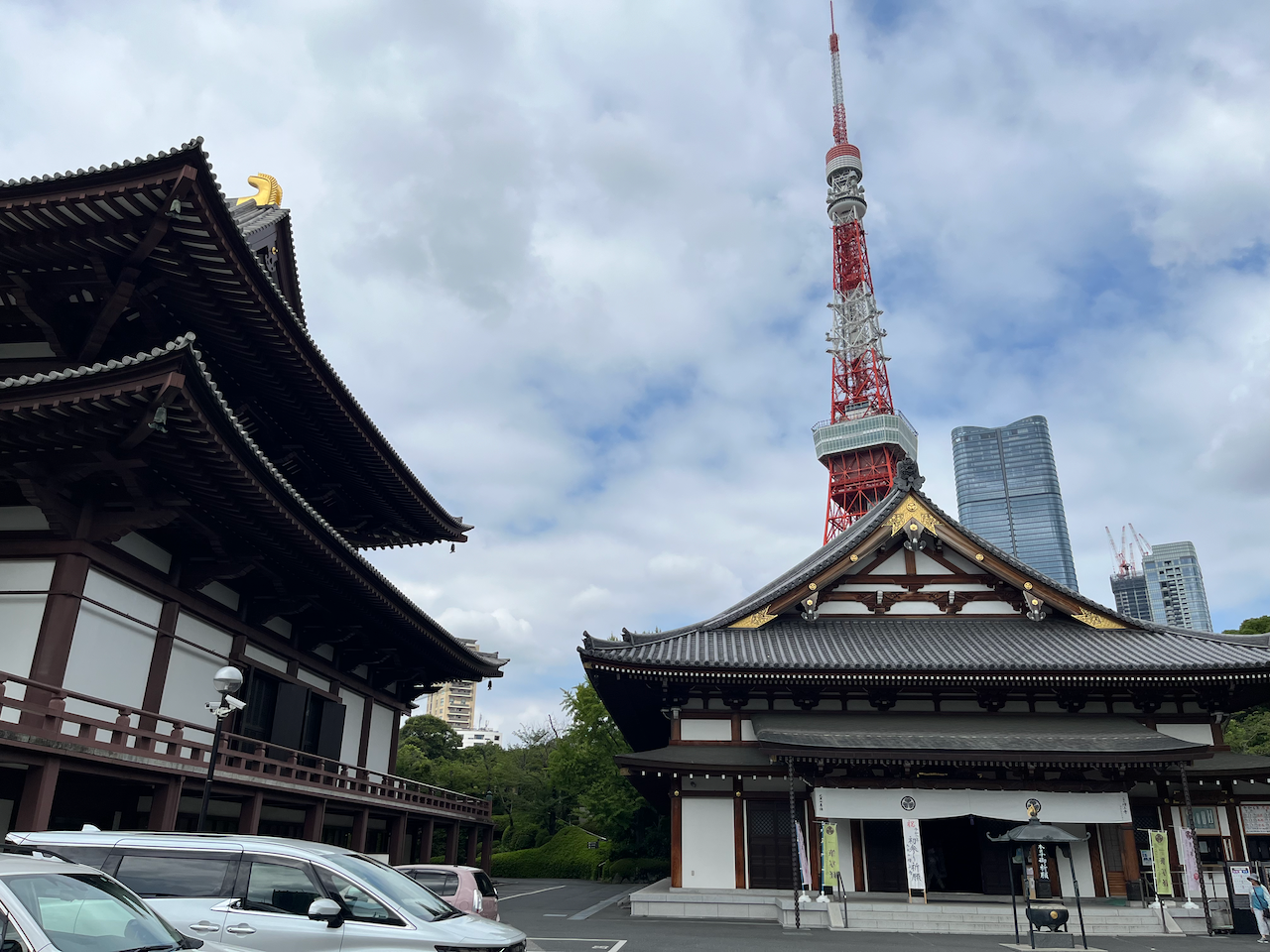
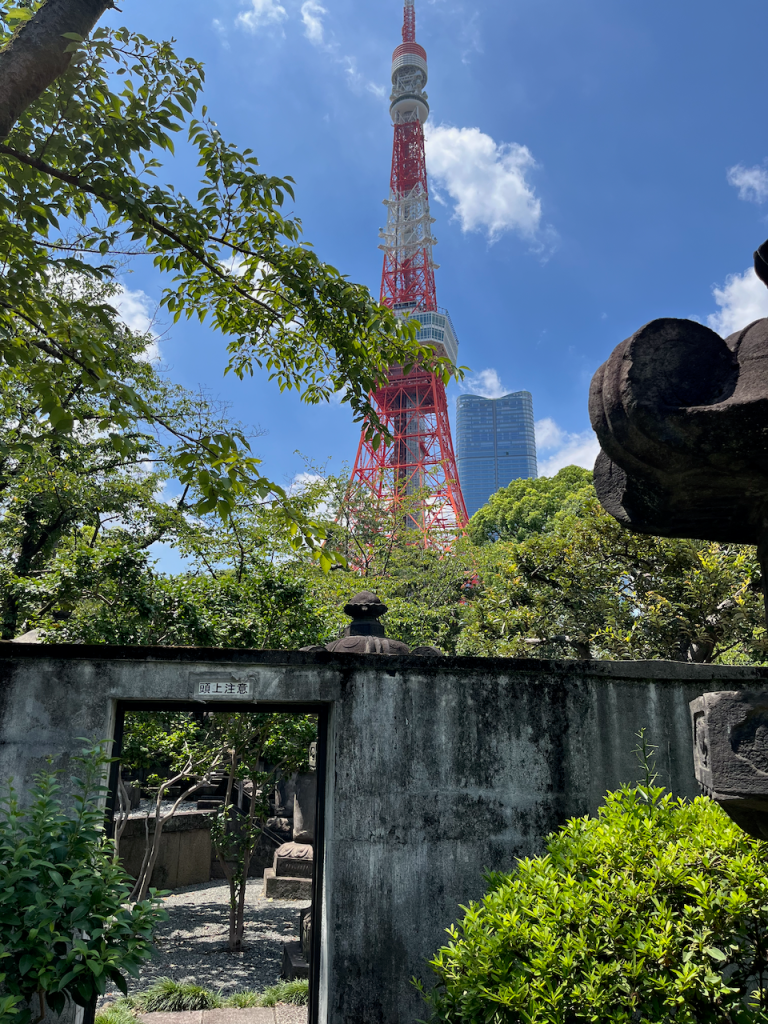
Visiting the city of Tokyo is not complete without taking a stop at the iconic Tokyo Tower. But what a lot of visitors might not know is that right next to Tokyo Tower is a Buddhist temple of great historical and cultural value: Zojoji
The temple of Zōjō-ji (増上寺) was the family temple for the Tokugawa shoguns who ruled Japan from 1600 to 1868 (e.g. the Edo Period), and many of the shoguns are interred here. The temple is also one of two main temples of the Jodo-shu sect of Buddhism. Jodo-shu Buddhism really helped me find my foundation back in the day, so I am more than a little fond of it. I have also visited the other main temple, Chion-in, in Kyoto a couple times. My first visit in 2005 is what really started me on the path to Buddhism back in the day. So, it’s no exaggeration that without the Honen the founder and Jodo Shu sect, I wouldn’t have found my path. I am always grateful.
In any case, wife (who’s Japanese) and I both like to come to Zojoji whenever we can. We joke it’s our “power spot”.1
The prestige and political power of Zojoji meant that it has been a very important temple in the Tokyo area for centuries, probably more so than Sensoji / Asakusa Temple (which I am also quite fond of).
The English website for Zojoji is actually pretty good, but it leaves out some details found in the Japanese version. Every time I go, I see foreign tourists dropping by, but I suspect some of them are unaware of the history and teachings of the temple, which is a shame because it’s actually a pretty neat place. So, this post is a lengthy tour of Zojoji. If you are reading this through email, you may want to visit the link instead. This post is VERY picture-heavy.
The Japanese site has a nice map of temple. I started at the bottom-center, at the Sangédatsu-mon (三解脱門), which might translate into something like the Three Gates of Liberation:
To the left of the gate is a sign that posts a monthly Buddhist teaching.
This month’s (August 2024) teaching is a quote from the very early Buddhist text, the Dhammapada, verse 54:
Not the sweet smell of flowers, not even the fragrance of sandal, tagara, or jasmine blows against the wind. But the fragrance of the virtuous blows against the wind. Truly the virtuous man pervades all directions with the fragrance of his virtue.
From here, I passed through the gate and took a photo of this statue of the Bodhisattva Kannon:
Next, based on the map linked above, I went clockwise around the perimeter of the temple. The next thing I saw was this pagoda (gojū-no-tō 五重塔 in Japanese) which seems to have been built in 1938:
It sits next to the other gate to Zojoji, the Kuro-mon (黒門, “black gate”) which was built in the 1700’s.
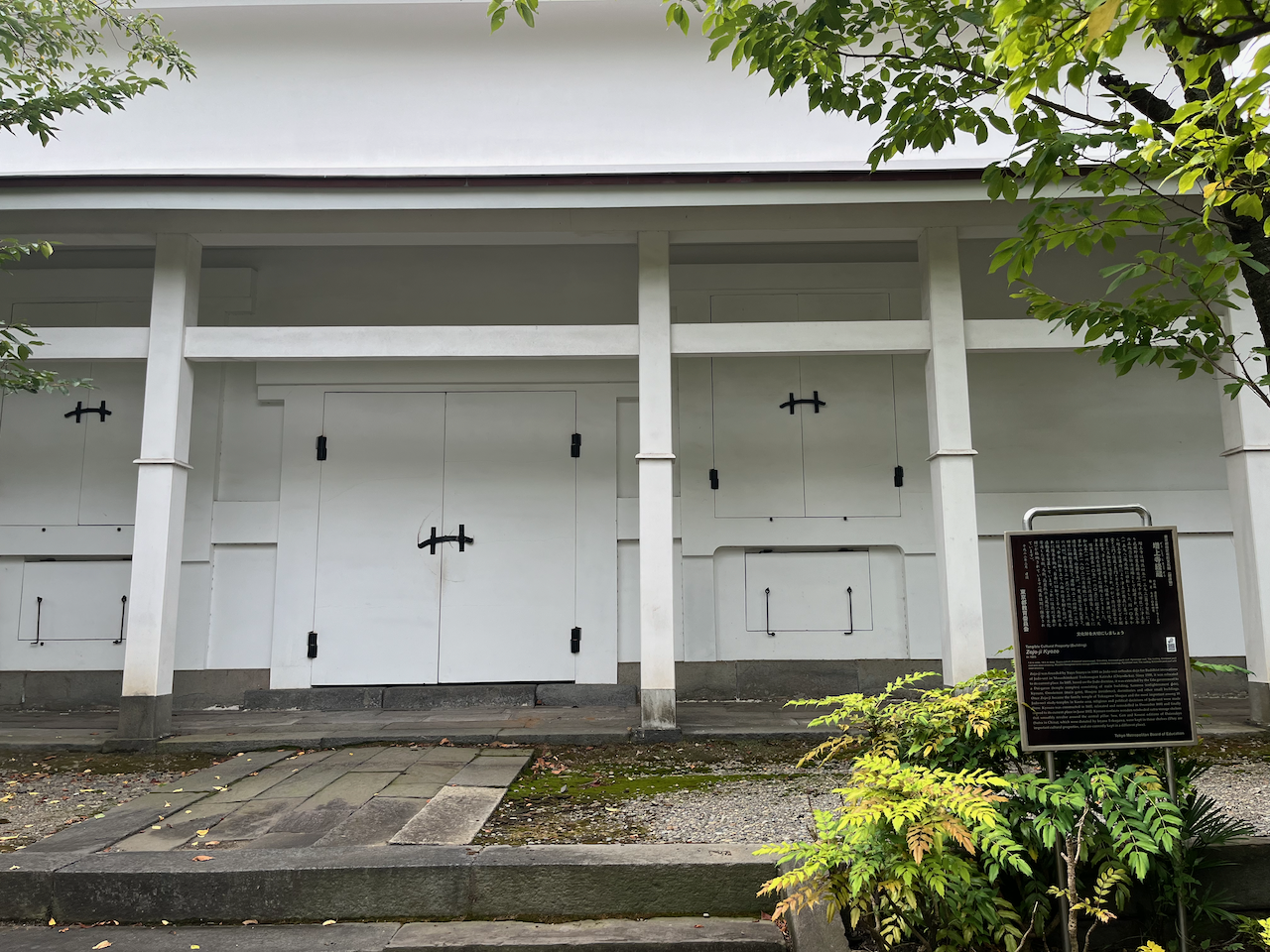
Just north of this (still going clockwise), you can see the Sutra Storehouse (kyōzō 経蔵):
This is something major temples often have: a large store house that contains the vast corpus of Buddhist literature (sutras): the Tripitaka. Sadly, I came too early in the day, and so the doors were closed. If you click on the map above, and look in the bottom left for 経蔵 you can see photo of the interior. It contains a full copy of the Taisho Tripitaka, in three different versions, in a rotating shelf.
The left area of the map mostly contained meeting halls and offices, so I kind of skipped past this quickly, and headed toward the main hall (hondō 本堂). This is in the very center of the map. Just to the left of the stairs is a nice statue of the 12th century founder of the Jodo-shu sect, Honen, in his youth:
There are some famous stories about his life (somewhat embellished, I believe), including his piousness at a young age. Hence, you often see Jodo-shu temples with status of young Honen. That said, Honen is a cool guy, and he gets my respect any day.
Next is the main hall itself:
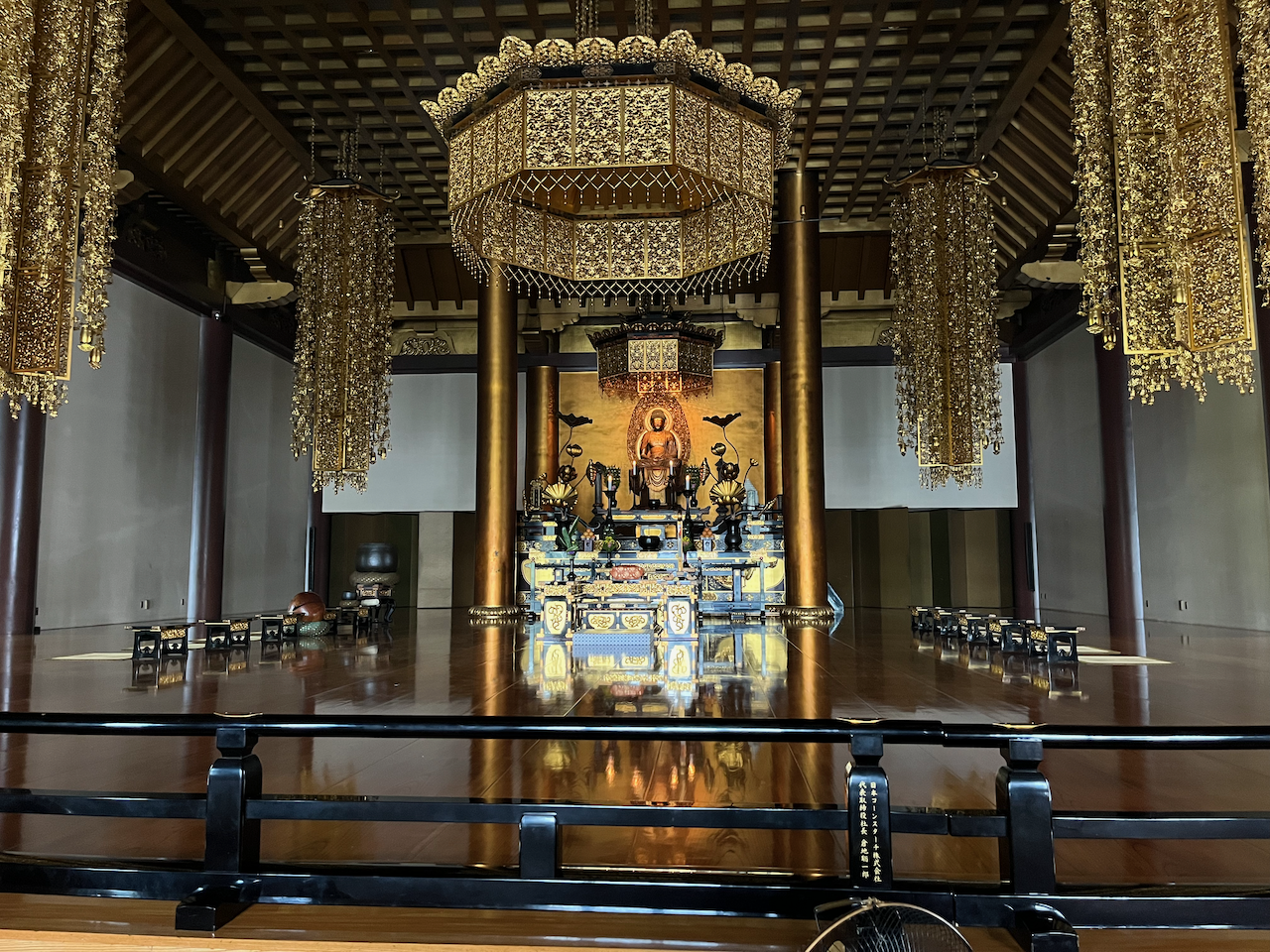
This place is pretty amazing inside. Also, unlike many temples, you do not need to remove your shoes at the door and you are welcome to take photos (except during funeral services, obviously):
The main altar is to Amida Buddha, the Buddha of Infinite Light, and the devotion of all Pure Land Buddhists across traditions. The gold color and lotus artwork are all taken from descriptions of the Pure Land, as described in the Sutras. It is said all beings reborn in the Pure Land will have the color of gold, just like Amida, and will be born from lotus buds. The Taima Mandala, not related to Zojoji, provides a nice visual representation.
To the left and right of the main altar are Honen, mentioned above, and Shan-dao the Chinese Pure Land master who inspired Honen back in the day, respectively. They lived centuries apart, but both are revered for their contributions to the tradition.
To the right of the main hall you have two choices: one you go down the stairs to the Museum. Or go to the Ankokuden Hall:
We’ll talk about the museum a bit later. For now let’s focus on the hall. Inside is both a gift shop and another altar to Amida Buddha:
This statue of Amida Buddha is historically significant though: it was the same statue venerated long ago by Tokugawa Ieyasu, the first Shogun of the Edo Period, and final unifier of Japan. This black-colored Amida statue had been a central devotional figure of the Tokugawa Shoguns for generations, so while it’s not the “main attraction” for tourists, from a historical standpoint, it is. I’ve seen it multiple times, and I never get tired of being here.
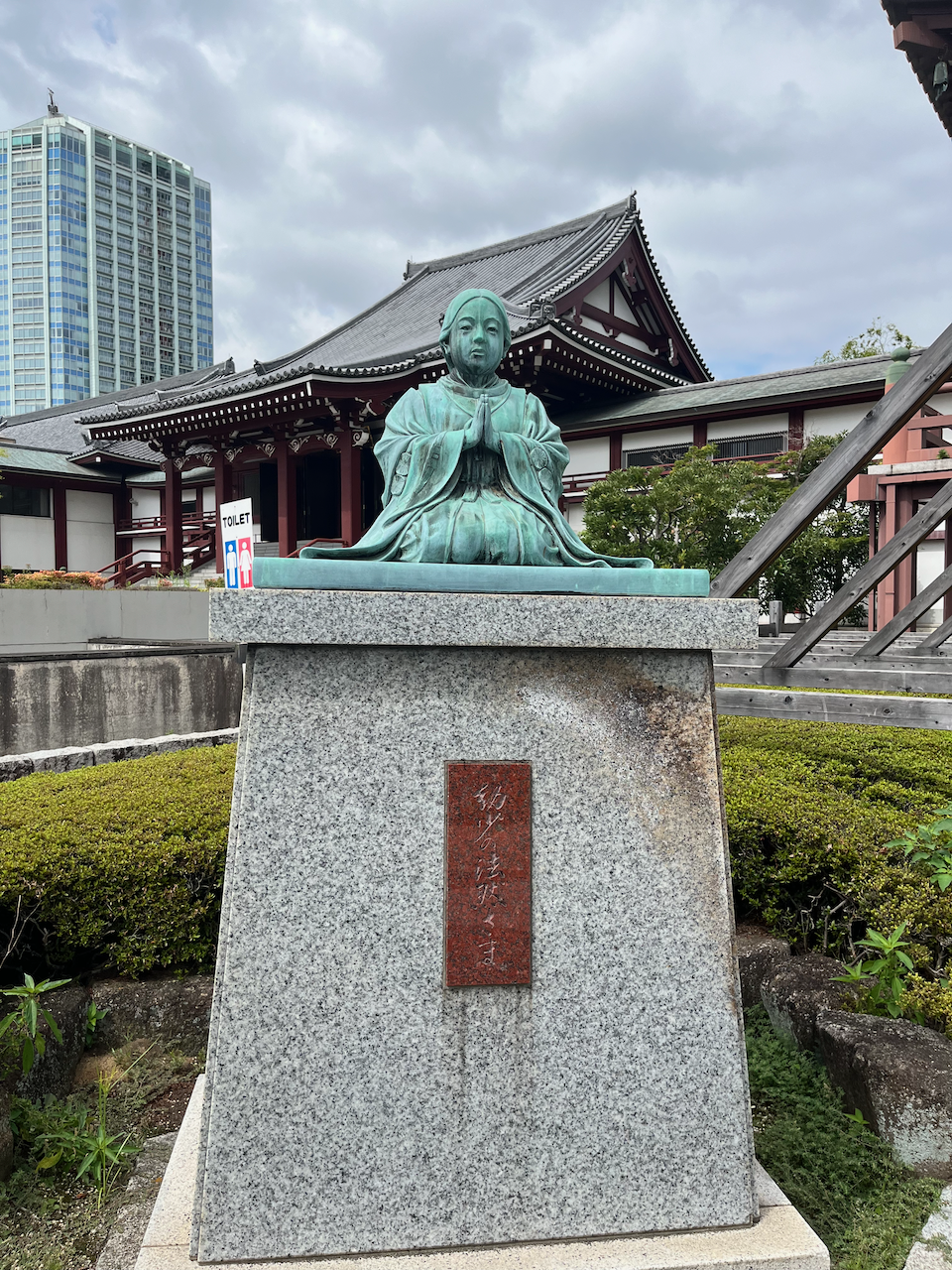
As alluded to earlier, there are shrines to the left and right of the Amida Buddha. The one on the left is of the founder of the Tokugawa shoguns,2 Tokugawa Ieyasu described above. The one on the right is less clear. It enshrines someone named Princess Kazunomiya. I had to do a bit of research and it turns out that Kazunomiya was a member of the Imperial family (not the Tokugawa family), but had been wed to Tokugawa Iemochi the 14th Shogun as a political marriage intended to heal the centuries old breach between the two families. The arranged marriage had a rocky start, but in the end proved to be a surprisingly happy and successful marriage at a time when Japan was in the waning days of the Shogunate. So, within the Tokugawa family temple, she is enshrined as an important matriarch.
We’ll see more monuments to Princess Kazunomiya shortly, so remember the name.
Anyhow, after picking up some nice incense and another seal in my pilgrimage book, I left the Ankokuden Hall. To its right is a line of statues.
The statue in the front is Bodhisattva Kannon, similar to what we saw earlier.3 There is a small altar to the right as well with another statue of Kannon that is often overlooked:
This is the “Western-facing Kannon”. The western-direction in Mahayana Buddhism is strongly associated with the Pure Land of Amida Buddha (by contrast, the eastern direction is associated with the Medicine Buddha’s own Lapis Lazuli Pure Land), and since Kannon is an attendant of Amida Buddha, this tracks.
But what about the little statues with red bibs?
These statues represent another Bodhisattva named Jizō. I haven’t talked about Jizo as much in this blog, but he’s very important in Japanese religion as a kind of protector deity, especially of children. Each statue adorned with a bib represent a child that was lost in pregnancy or in childbirth, and so the grieving parents pray to Jizo to protect their child in the life beyond. The clothing is an offering to Jizo, perhaps to pass on to the child?
While the statues are very cute, there is a tragic meaning behind them as well.
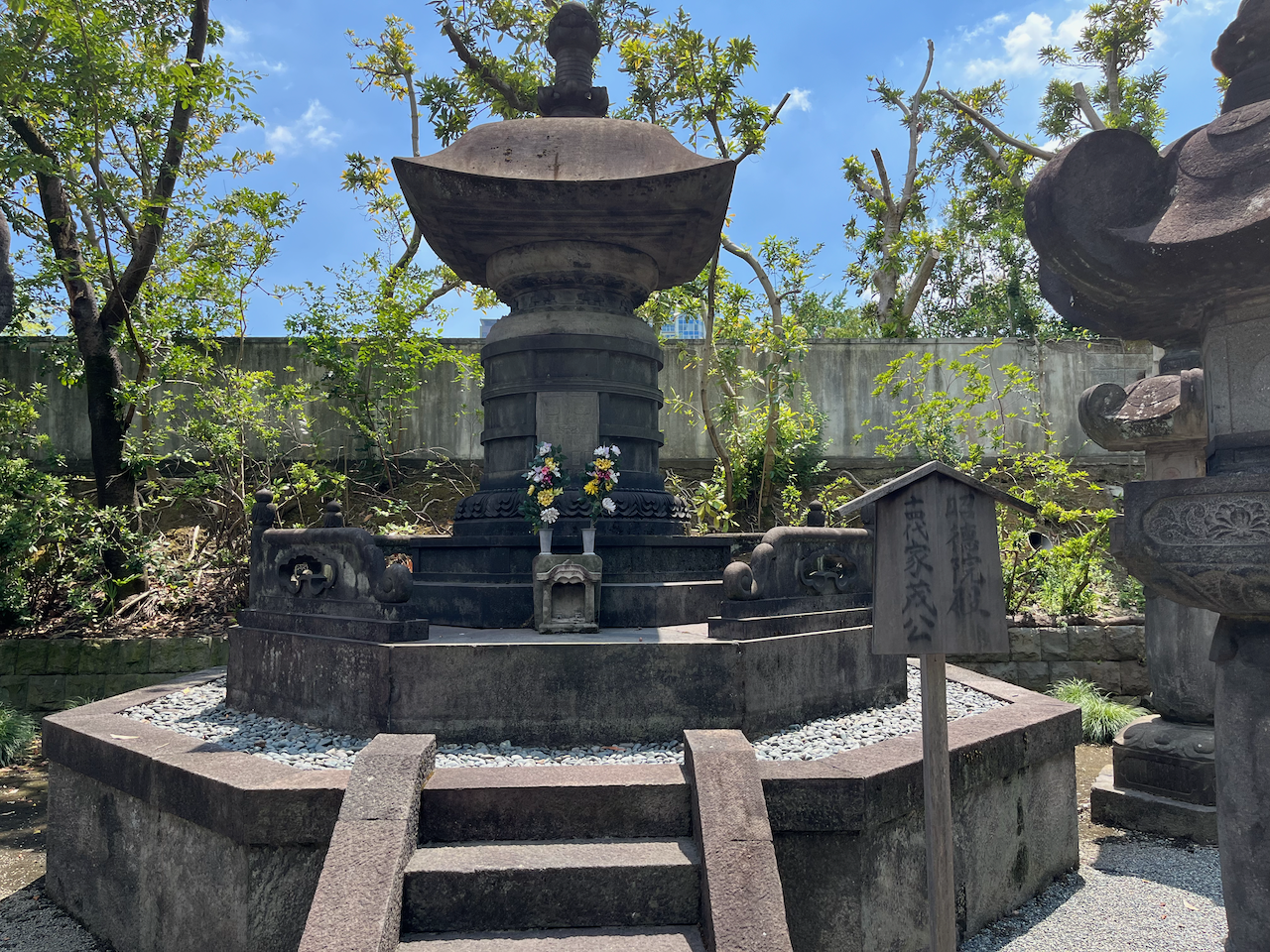
The line of statues continues back behind the Ankokuden and Hondo (main hall). It is here that you come upon the mausoleum of the Tokugawa Shoguns.
Not all shoguns are interred here. Some are interred in a shrine called Toshogu up north in Nikko. I would estimate that roughly half of the shoguns are interred here. I won’t show them all, since the map and pamphlet you receive at the ticket booth shows a full list. But to give a few examples…
The second shogun, Tokugawa Hidetada and his wife are interred here. Edo (Tokyo) was greatly expanded during his administration from a tiny fishing village to the city we know today.
From the mausoleum entrance, if you were to go further left you will see this statue:
Without getting too bogged down in details, the four statues here represent four major Bodhisattvas in the Mahayana-Buddhist tradition. From left to right with Sanskrit (and Japanese) names:
Manjushri (Monju)
Avalokitesvara (Kannon)
Ksitigarbha (Jizo)
Samanthabhadra (Fugen)
It’s actually quite rare to see all four arrayed like this. I was kind of impressed. It is said these statues were created in the year 1258 according to the plaque.
Further left:
If you go up the stairs and turn right…
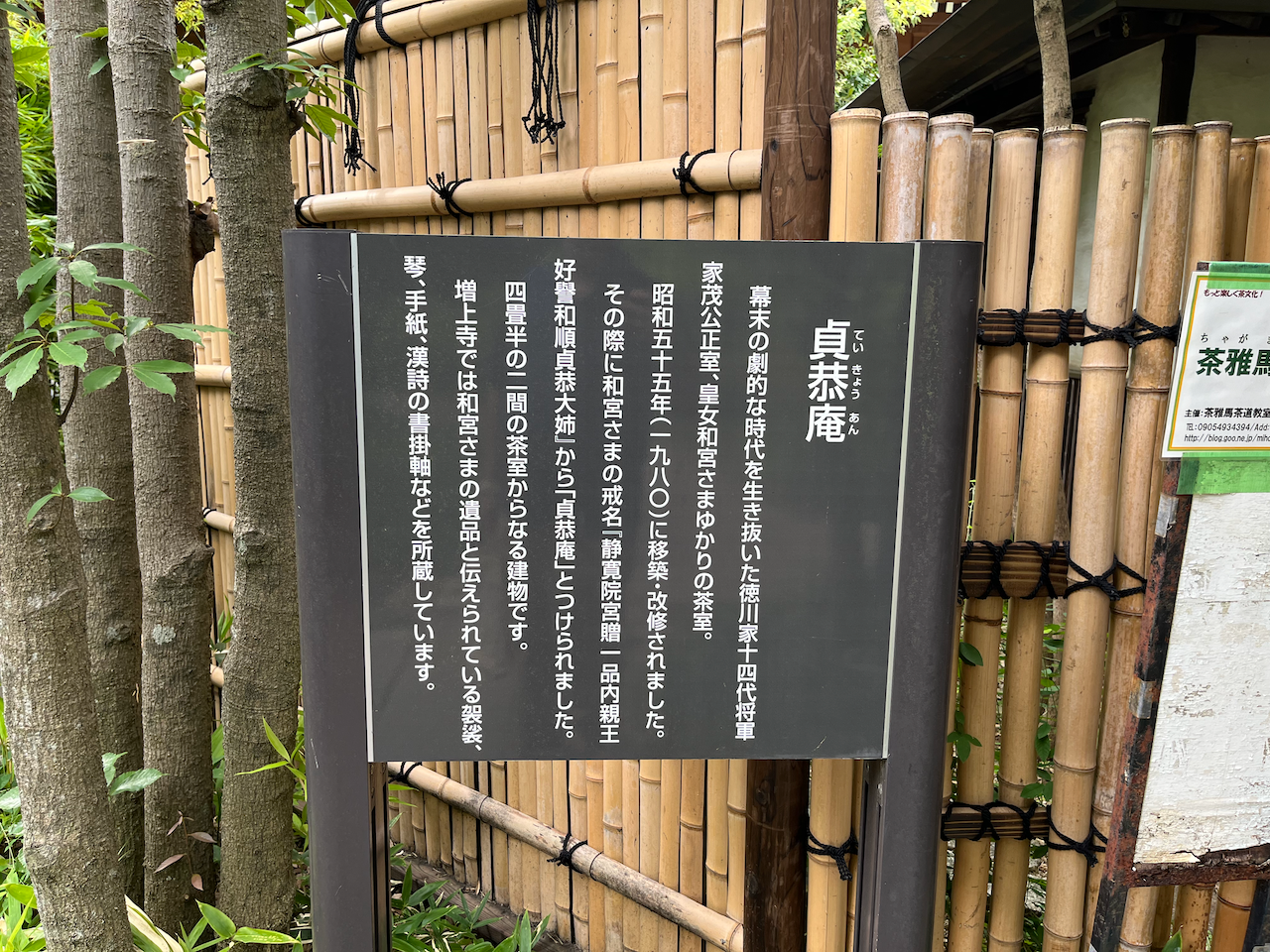
You can find the tea house of Princess Kazunomiya called the Teikyōan (貞恭庵):
Since Princess Kazunomiya took tonsure as a Buddhist nun in her final years, she took the ordination name Teikyo, so the name of the place is basically “Princess Kazunomiya’s hearth”. The sign said that it was refurbished in 1980 and is used for some public functions. It was closed when I came so I didn’t get to see much.
Facing the tea house is another statue of Kannon Bodhisattva in a more motherly form.
Past the tea house and up some stairs is this place, which is the upper part of the map:
It turns out that this is a columbarium: a storage house for the bones of the deceased after cremation. This is common in Buddhist temples. This columbarium in particular houses the bones of those who are somehow connected to the temple across the generations. Beyond that, the website didn’t provide an explanation.
By this point I wanted to see the museum but again I had arrived too early so I stopped by a local McDonald’s for brunch:
On the way out, I also took photos of the Buddhist bell (bonshō 梵鐘) as well:
And a small Shinto shrine to the right of the main entrance:
This Shinto shrine, called the Yuya (熊野) Shrine, was founded in 1624 by the 13th head priest of Zojoji, one Shoyo Kurayama, to protect the north-east corner of the temple from disasters. The north-east is seen as a particularly dangerous direction in Chinese geomancy (a.k.a. feng-shui), so the kami here provide protection. It is not unusual to see small Shinto shrines within Buddhist temples, and many Shinto deities are viewed as manifestations of Buddhist deities (gongen 権現) by Japanese in medieval times. The sign next to the shrine states that 3 kami reside here:
Ketsumiko-no-ōkami
Ōnamura-no-mikoto
Izanagi-no-mikoto (as in Izanagi from early Japanese mythology? I am not sure)
These three kami all seemed to have been imported from a trio of Shinto shrines called the Kumano shrines, which have a strongly syncretic Buddhist-Shinto worship. I didn’t even know the Kumano shrines existed until I wrote this article. Side note: the Chinese characters for Kumano (熊野) can be alternately read as “Yuya”, hence “Yuya Shrine”.
Anyhow, having satiated myself on McD’s, it was time to go back and visit the Museum…
Much of the museum doesn’t allow photography, but showed the history of Zojoji. As it is being restored from earlier destruction, there wasn’t actually that much in the museum.
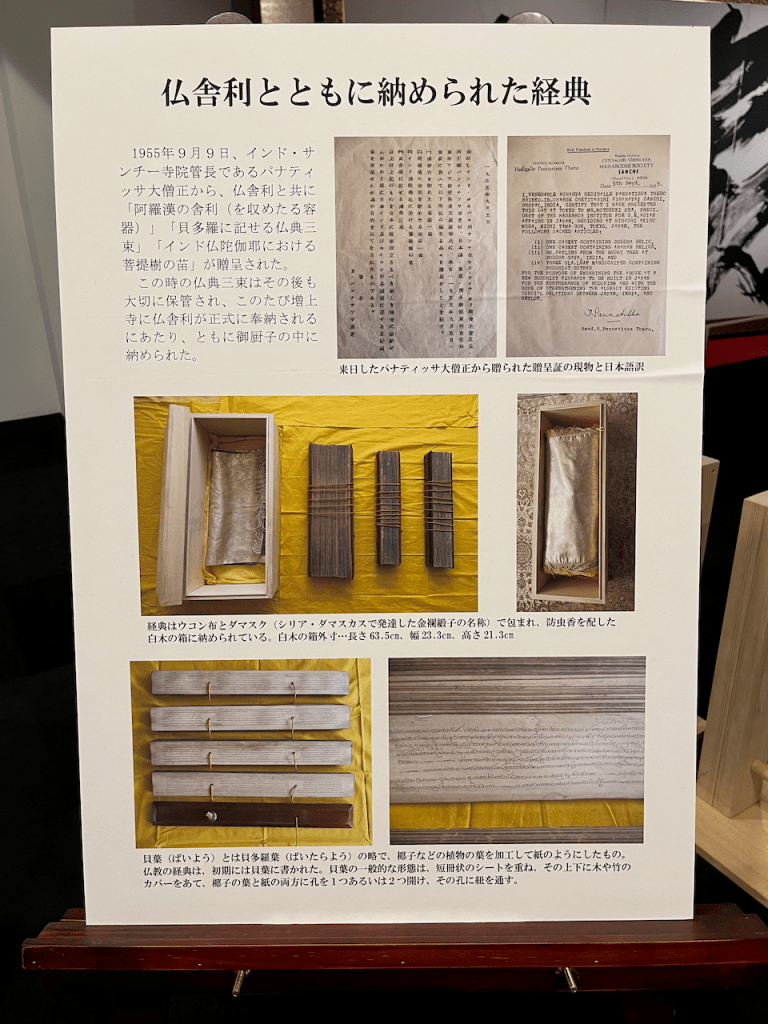
However, what the museum also had (and OK to photograph) was a genuine relic of the Buddha, as in Shakyamuni Buddha, the historical founder. It also contains relics of Rahula, the Buddha’s son before his enlightenment, and Ananda, his trusted retainer. As the sign shows above, the relics were uncovered at Sanchi, which is an important Buddhist archeological site. The relics were given to Japan as a gift in 1955 and enshrined right under Zojoji. You can see
A display to the right shows the contents, and the letter from India to Japan. In addition to fragments of the bones of Shakyamuni Buddha, Rahula and Ananda, the contents included recovered copies of Buddhist sutras that were inscribed on palm leaf at the time, and a seed descended from the original Bodhi Tree.
In my nearly 20-25 years as a Buddhist, I had never come face to face with a relic of the Buddha before, so I was kind of awestruck. The small wooden plaque just in front of the small statue of the Buddha contained a small prayer that reads:
Recite 3 times: namu shaka muni bu (praise to Shakyamuni Buddha)
I don’t have a translation of this hymn, but after a bit of late night sleuthing, I suspect it’s a verse from a Buddhist text called the Humane King Sutra. I don’t think there’s an English translation anyway.
In any case, I recited the verses of praise to Shakyamuni Buddha and finally went home.4
But that concluded the trip to Zojoji. Usually, I go with the family, and we can’t afford to spend half a day there, but this time I had some free time and was able to really take in all the sites of Zojoji. As a historical site, Zojoji is very dense and fascinating. It’s hard to imagine centuries of history, all closely tied to the Tokugawa shoguns and the Jodo-shu sect all in one place. The relic of the Buddha alone is pretty amazing too.
This post was pretty long, but I hope you enjoyed.
P.S. I didn’t really provide a lot of links to Jodo Shu Buddhism, since I talkaboutitquiteabit in the blog already, and many of the English sites have sadly atrophied or disappeared over time. I would definitely recommend various books such as A Raft from the Other Shore or Traversing the Pure Land Path, but these are mostly out of print now. I have done what I could over the years to distill many of these lost sources into an accessible format here, but there’s still plenty to find if you know where to look.
1 This is actually a slang phrase in Japanese too, taken from English: pawaa supotto (パワースポット), meaning any place that inspires you spiritually.
2 Without getting too bogged down in history, think of a shōgun (将軍) as the Imperial-appointed “General Commander of the Armed Forces”. The role has changed and evolved over generations, but suffice to say if you were the shogun, you were the real, not symbolic, authority in Japan.
3 The astute might be wondering why a temple devoted to Amida Buddha also contains so many statues to another figure like Kannon. In Mahayana Buddhism, the two share a close relationship. It is described in the sutras who Amida Buddha is attended to by two Bodhisattvas: Kannon and another named Seishi. Kannon has an outsized following of their own, but the two are frequently depicted together, as both embody the universal goodwill and compassion that are hallmarks of Mahayana Buddhism. Seishi, admittedly, isn’t described much in the Buddhist texts, and thus isn’t revered much on their own.
4 Actually, I stopped along the way at Akihabara because I had never been there. That place was … not for me. Nerdy, but in a very different way. I did have some good fries at a Turkish cafe in Akihabara for dinner, thanks to Mustafa the chef. Very nice fellow. If you are in Akihabara, stop by his cafe and get some good Turkish food.
June 4th is the yearly memorial service in Japan’s Tendai sect of Buddhism called Sangé-é (山家会) for its founder, Saichō (最澄, 767 – 822). I am writing this post a bit late this year, but I wanted to explore the life of Saicho a little bit and why he matters.
Saicho as depicted in a Heian-Period painting.
If you look at the history of Japanese Buddhism, Saicho doesn’t elicit much historical attention and discussion, even compared to contemporary rivals at the time like Kūkai, founder of Shingon-sect Buddhism. Yet, the sect he founded in Japan was overwhelmingly the largest and most influential for centuries (probably too much so), until it finally faded into the background in the late medieval period. This is why you rarely see mention of Saicho or Tendai these days: it’s far smaller now than it was in the past.
Also, to confuse matters further, Saicho is only the founder of the Japanese branch of Tendai. It was the Buddhist monk Zhi-yi (智顗, 538 – 597), who originally started the Tian-tai (天台) sect in China in the 7th century and it remains a very influential sect across many areas of mainland-Buddhist Asia (Korea, Vietnam, etc). Tian-tai in Japan (pronounced as Tendai) reveres Zhiyi as well.
Anyhow, Saicho was a monk at a time when Buddhism had already been established in Japan, primarily around the old capitol of Nara, yet was limited to a very tightly regulated number of schools and monks per school. Besides the Yogacara (Hossō) and Huayan (Kegon) schools, the rest are very obscure today. These schools had all been imported from Tang-Dynasty China, and represent “branch” schools to the mother temples there. The existing schools at that time were obligated to perform rituals on behalf of the Emperor to prevent calamities, cure diseases, bring prosperity to the nation and other political needs. In turn, the government allocated new acolyte monks every year, and allowed them to continue. However, beyond that, Buddhism had very little reach in the rest of Japanese society. This is very different than the bottom-up approach in China.
Saicho was ordained as an official monk, but soon left and retreated to Mount Hiei where he underwent ascetic practices, rather than stay in the urban temple complexes. In time, he attracted other like-minded disciples, and a small, informal monastic community developed there on the mountain. Further, he carved an image of the Medicine Buddha, and later lit an oil lamp in reverence to the Buddha, praying that the light would never be extinguished. This lamp, the Fumetsu no Hōtō (不滅の法灯) was the subject of a previous post. By this point, the foundations of the temple of Enryakuji were laid.
Later, by a lucky coincidence, the capitol of Japan was moved away from Nara to Kyoto (back then Heian-kyō) in 795. Since Mount Hiei happened to be to the northeast of Kyoto, and since the northeast was considered an inauspicious direction in classic Chinese geomancy, the presence of a Buddhist temple there (namely Enryakuji) helped protect the new capital from negative influences. The Emperor, for his part, saw this new Buddhist sect has a counterbalance to the old guard sects in Nara. Thus, Saicho’s star quickly rose.
The Eastern Pagoda (Buddhist stupa), of Enryakuji Temple, 663highland, CC BY-SA 3.0, via Wikimedia Commons
Now with sponsorship from the new Imperial court, Saicho was dispatched to sail back to China in 804, gather more resources and help bring Buddhism to a wider audience. On the same diplomatic mission, another promising young monk named Kūkai was also dispatched. More on him later. Of the four ships that sailed out to sea, only 2 survived a storm at sea (Saicho and Kukai were each aboard one of the surviving ships).
Saicho’s had mixed success in China. He did not speak Chinese (he could only read it), but was able to get official permission from the Chinese government to travel to Mount Tiantai. There he stayed for 135 days. Saicho later received limited training in esoteric Buddhism, which was all the rage in Tang-Dynasty China (and Japan at this time). It wasn’t until the second generation of Tendai monks who went to China (Ennin for example) that esoteric training really developed in the Tendai sect in Japan. Saicho also copied many sutras and texts in order to provide fresh copies back in Japan (printing did not come until much later, despite flourishing in China).
Guoqing Temple (guó qīng sì, 国清寺) on Mount Tiantai, head of the Tiantai Order. Photo by Joshtinho, courtesy of Wikimedia Commons.
Nonetheless, when Saicho returned to Japan 8 months later, he was feted for his accomplishments. He got to work using his newfound training, and his collection of sutras brought back from China to petition the Emperor to start a new sect derived from the Chinese Tiantai Buddhism he trained under. Saicho’s vision was slightly different than Tiantai Buddhism, particularly because he envisioned a purely “Mahayana” sect, not just a sect with Mahayana Buddhism on top of earlier Buddhist tradition. This meant different ordination platforms, different training, etc. It was a big controversy at the time, and the powerful Yogacara (Hossō in Japanese) school based in Nara really gave him grief over it.2
In Dr Paul Groner’s book on Saicho, he explains Saicho’s vision further:
In his works directed against Tokuitsu and the Hossō [Yogacara] School, Saichō argued that all people had the Buddha-nature [capacity for Enlightenment] and could attain Buddhahood. Receiving the Fan wang [Bodhisattva precepts] ordination and adhering to the precepts were religious practices open to anyone. Anyone could receive a Fan wang ordination and anyone who had been correctly ordained could in turn confer the Fan wang precepts on others….
Saichō envisaged a system in which Tendai monks would be trained for twelve years on Mount Hiei and then go to live in the princes in order to perform good works, to preach, and to confer Fan wang ordinations.
Page 179
Further, Saicho really took the idea of unifying different Buddhist practices and traditions into an “umbrella tradition” to a new level. It wasn’t enough that the Lotus Sutra was the highest teaching (per Tiantai tradition), he wanted to really absorb other practices and traditions toward that end, and diffuse them across the country in a religious community that blurred the traditional lines between monks and laity.
Saicho’s zeal, his rising status in the new Imperial court at Kyoto, and his fresh training gave him a lot of leeway, and the Emperor granted his request. Thus, Tendai Buddhism (the Japanese branch of Tiantai) was born. It has a deep connection with the mother sect in China, but Saicho also added some innovations to it as well.
Saicho’s star was soon eclipsed after the other monk from the same diplomatic mission, Kūkai, who returned some time later and brought an extensive training program in esoteric Buddhism (something Saicho had only a partial training of). Because esoteric Buddhism was all the rage (until the Purge of 845), Kukai’s training and religious material he imported outshone Saicho. Kukai and Saicho tried to maintain a cordial relationship, but Saicho wasn’t willing to train under Kukai, and Kukai kept poaching disciples of Saicho’s so the two groups became somewhat acrimonious over time.
Saicho proved throughout his life that he was dedicated to the Lotus Sutra and the Buddhist path. He was a sincere ascetic in his youth, rather than a “career monk” like many others of his time, and held himself to high standards. The fact that attracted like-minded people around him, shows that he “walked the talk” too. In China, he underwent many trainings, copied many sutras, and didn’t stop learning and improving. It should be noted that Kukai and Saicho were both pioneers for journeying to China to bring back more Buddhist teachings, rather than past schools that relied on foreign monks to make the journey to remote Japan.
If Saicho had any virtue, it was zeal.
If Saicho had any fault, it was that he was perhaps stubborn.
Personally, I like Saicho, flaws and all. Like, I would have loved to sit with him on those early days on Mount Hiei, swap practice tips, get his advice, etc. I really like his enthusiasm and positivity. Much like Honen centuries later, Saicho was bold and motivated by sincere conviction. The Tendai sect morphed into something that I don’t think he anticipated but personally I blame politics more than the founder.
But anyway, this is all just my opinion.
As for me, I did an extra long home service for Saicho this week in his honor.
1 Devout Buddhists in early Japanese history, such as Prince Shotoku, were devotees of the Lotus Sutra as well, but I don’t think there was any effort in those days to elevate it to the highest teachings, let alone make a new sect out of it. It was just there as part of the larger tradition.
2 Acrimony between Tendai and Hosso schools of Buddhism continued for centuries, starting with Saicho’s disagreements with one Tokuitsu of Hossō. Both sects frequently faced off during official Buddhist debates at the Imperial court as well.
For months, I’ve had on my to-do list to go and fix up the Wikipedia article about the nembutsu (or nian-fo in Chinese). I had started contributing to that article way back in 2006 shortly after I first got interested in Pure Land Buddhism, and occasionally update or add details. The article was flagged for some quality control issues recently, and I decided to help clean it up.
Some of my early contributions in Wikipedia way back in the day… can’t believe it’s been 18 years.
As I began to write some updates to the article, though, and trying to distill what the nembutsu is within the Pure Land tradition, I realized that this is a really tough question. There’s centuries of interpretations, layers of culture, and divergent viewpoints. I tried to summarize this in an older article, but after reading over that article, I realized that I didn’t quite hit the mark there either.
So, let’s try this again.
Pure Land Buddhism is a large, broad, organic tradition within Mahayana Buddhism (an even bigger tradition). It is not centrally-organized, but follows many trends and traditions across many places and time periods. However, these traditions all have a couple things in common:
Reverence toward the Buddha of Infinite Light (a.k.a. Amitabha Buddha, Amida, Emituofo, etc.). The nature of who or what Amitabha Buddha is is open to interpretation though.
Aspiration to be reborn (as in one’s next life) in the Pure Land of Amitabha Buddha. There have been many ways to interpret what exactly this means, but I am sticking to the most simple, literal interpretation for now.
In any case, these two things are what make the “Cult of Amitabha” what it is. By “cult” I mean the more traditional, academic definition, not the modern, negative definition. Amitabha is to Mahayana Buddhism, what the Virgin Mary is to Catholicism.
Every Pure Land tradition across Buddhist history is mostly focused on #2: how to get to the Pure Land. The early Pure Land Sutras spend much time describing how great Amitabha Buddha is, and how getting to the Pure Land is so beneficial towards one’s practice, but differ somewhat on how get reborn there.
One early sutra, the Pratyutpanna Sutra is one of the first to mention Amitabha and the Pure Land at all, but it very strongly emphasizes a meditative approach, in order to achieve a kind of samadhi. According to Charles B Jones, being reborn in the Pure Land wasn’t even mentioned in this sutra, nor Amitabha’s origin story. It was a purely meditate text. Nonetheless, this sutra was highly favored by the early Chinese Pure Land Buddhists, namely the White Lotus Society started in the 5th century by Lushan Huiyuan.
The main textual source for being reborn in the Pure Land is from the Immeasurable Life Sutra, also called the Larger [Sukhavati Vyuha] Sutra. This is where we see the famous 48 vows of the Buddha, including the most important, the 18th vow (highlights added):
設我得佛。十方衆生至心信樂。欲生我國乃至十念。若不生者不取正覺。唯除五逆誹謗正法
(18) If, when I attain Buddhahood, sentient beings in the lands of the ten quarters who sincerely and joyfully entrust themselves to me, desire to be born in my land, and call my Name, even ten times, should not be born there, may I not attain perfect Enlightenment. Excluded, however, are those who commit the five gravest offences and abuse the right Dharma.
translation by Rev. Hisao Inagaki
This is where things get interesting, in my opinion.
The Chinese character 念 (niàn) was used to translate the Buddhist-Sanskrit term Buddhānusmṛti or “recollection of the Buddha”. But, according to Jones, the Chinese character 念 had multiple nuances in Chinese:
And in fact each one of these interpretations can be applied to the nembutsu (Chinese niànfó) because it means niàn (念) of the Buddha (fó, 佛).
But which is it: concentration, a moment of recollection, or verbal recitation?
Most of the early Chinese Buddhist teachers like Tanluan, Daochuo and Shandao all promoted a mix: usually visualization was the superior method, but verbal recitation was a fallback for people who couldn’t dedicate themselves to visualization-meditation and ritual. The earliest Buddhist teachers mostly emphasized the visualization-meditation approach, but by Shandao’s time (7th century) the verbal recitation was deemed the most effective method.
Later, in Japan, the monk Genshin (not to be confused with the game…) summarizes these various methods in his 10th century work, the Ojoyoshu. It was a high quality work and even praised by Chinese monks when it was sent over as part of Japan’s diplomatic missions. But Genshin came to the same basic conclusion: the nembutsu can be any one of the three.
Finally we get to Buddhist teachers like Honen (12th century), who taught that the verbal recitation was the only viable choice. Honen praised past methods, but his target audience was a mostly illiterate population, as well as monks whose monastic institutions had largely declined into corruption and empty ritual. So, for such people, better to rely on Amitabha Buddha’s compassion and recite the verbal nembutsu wholeheartedly.
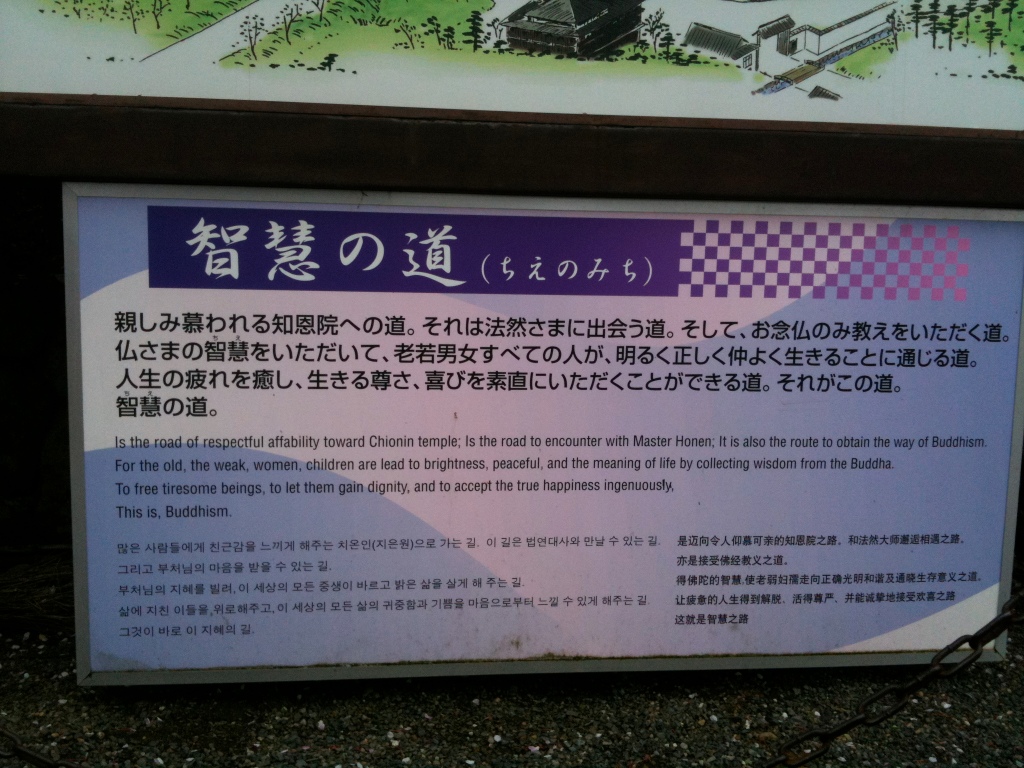
Multi-lingual sign at the temple of Chion-in in Kyoto, Japan where Honen’s mausoleum rests.
This approach isn’t that different from the Chinese approach which varied by teacher or patriarch but through Shandao’s influence had a parallel development. Some teachers emphasized the efficacy of simply reciting the nembutsu (much like Honen), others added the importance of concentration while reciting the nembutsu.
However, turning back to the Larger Sutra, let’s go back to the 48 vows. The 19th and 20th vows state:
(19) If, when I attain Buddhahood, sentient beings in the lands of the ten quarters, who awaken aspiration for Enlightenment, do various meritorious deeds and sincerely desire to be born in my land, should not, at their death, see me appear before them surrounded by a multitude of sages, may I not attain perfect Enlightenment.
(20) If, when I attain Buddhahood, sentient beings in the lands of the ten quarters who, having heard my Name, concentrate their thoughts on my land, plant roots of virtue, and sincerely transfer their merits towards my land with a desire to be born there, should not eventually fulfill their aspiration, may I not attain perfect Enlightenment.
So, taken together, the 18-20th vows cover the various interpretations of 念 we discussed above. All of them are included in Amitabha’s vows to bring across anyone who desires to be reborn there. The common theme is sincerity (至心 zhì xīn). If you look at the original Chinese text, all three include “sincerity”.
Further, when asked about how many times one should recite the nembutsu, Honen replied:1
“….believe that you can attain ojo [往生, rebirth in the Pure Land] by one repetition [of the nembutsu], and yet go on practicing it your whole life long.”
So, let’s get down to business: what is the nembutsu / niànfó ?
Based on the evidence above, I believe that the nembutsu is any of these Buddhist practices described above, taken under a sincere aspiration to be reborn in the Pure Land. It’s about bending one’s efforts and aspirations toward the Pure Land.
If you are calculating how to be reborn, or if your heart’s not 100% into it, then it may be a waste of effort.
Instead, if you feel unsure, study the Buddhist doctrines, get to know the Pure Land sutras, read about past teachers and if you feel fired up about, recite the nembutsu, or do whatever moves you. You will just know when. The more you put into it, the more you get out of it too.
Amitabha’s light shines upon all beings, like moonlight, and if you feel inspired by it, just know that you’re already halfway to the Pure Land.
Namu Amida Butsu
1 The site is long gone, sadly, but the Wayback Machine has an archive of the site. The updated Japanese-only site is here.
I am the sort of person who is bad with names. I recently met some new neighbors, and they told me their names, and I made a point of remembering those names, but 5 minutes later, I had already forgotten one of them.
In the early Buddhist sutras, the Buddha described the mind as a monkey flitting from branch to branch:
Just as a monkey, swinging through a forest wilderness, grabs a branch. Letting go of it, it grabs another branch. Letting go of that, it grabs another one. Letting go of that, it grabs another one. In the same way, what’s called ‘mind,’ ‘intellect,’ or ‘consciousness’ by day and by night arises as one thing and ceases as another.
Assutavā Sutta (SN 12.61), translation by Ven. Thanissaro Bhikkhu
This inability to focus the mind prevents us from gaining any insight, being easily swayed by sensual lust, anger, or ignorance, unable to see the bigger picture. Centuries later, in the Parable of the Burning House of the Lotus Sutra, the kids in the burning house are so distracted by their toys, that they do not notice their father calling them to get out.
This notion of the unstable mind unable to see its own peril is found in every Buddhist tradition, and what drives much of the Buddhist practice. Recognizing one’s own mental patterns is the first step, an important one too, but another important step is to counteract this. One cannot stop the thoughts themselves, it’s just the way the mind of Homo sapiens works. Instead, one should look into Buddhist training to either withstand such thoughts, counteract them, or look past them. This isn’t a simple thing either. It’s quite difficult, and requires long-term training. But it is essential to one’s well-being.
When I catch myself brooding angry thoughts, or thinking something stupid and selfish, I often think about something Honen said in a famous catechism called the 145 Questions and Answers (ippyaku-shijūgo-kajō-mond, 百四十五箇条問答), namely question #69:
一。心に妄念のいかにも思はれ候は、いかがし候べき。
Q) When bad thoughts keep arising within my mind, what ought one to do?
Because the Pure Land tradition of Buddhism is so large, there’s a lot of ways to interpret this. I don’t know the right answer. You should do your own research and decide for yourself. For some, this is using the nembutsu as a form of mindfulness practice (withstanding evil thoughts), while for others, this is acknowledging the grace of Amida Buddha, and that one is still destined to be reborn in the Pure Land (looking past evil thoughts).
This is not to replace the tradition of mindfulness meditation, either. It’s just not always possible to be sitting on a cushion meditating, so remembering Honen’s advice is a handy thing to do when you are going through life, and feeling your mind looping the same negative or unwholesome thoughts over and over.
Something I was thinking about lately while pondering this famous tale between 12th century Japanese monk, Honen, and a woman of the night. Honen’s advice to the woman was non-judgmental but a genuine concern for her well-being, and at the same time, it also acknowledged her circumstances.
Something I’ve always liked about the Pure Land Buddhist path is its openness. The light of Amida Buddha calls to all beings, regardless of their background and circumstances, or their accomplishments as Buddhists (or non-Buddhists) and unconditionally leads them to the Pure Land. How one interprets Amida, the Pure Land and such doesn’t really matter. What’s important is that Amida accepts all beings as they are, and leads them forward.
And so, when I was thinking about this, I realized that if Amida Buddha accepts you for who you are, then it makes sense to do the same.
Thinking about the woman of the night that Honen encountered, it made me realize that Pure Land Buddhism is a great expression of Buddhist metta, or goodwill.
This is not exclusive to Pure Land Buddhism, though. In Theravada Buddhism, there is the practice of metta meditation (separate from mindfulness meditation), and Zen similarly teaches contentment with oneself and the world around you. So, each tradition in Buddhism takes metta as a core teaching and find different ways to express and foster it.
The accessibility, simplicity and portability of Pure Land Buddhism makes it ideally suited for everyday folks. As a foundation, one can then explore other aspects of Buddhism, or be content with the nembutsu.
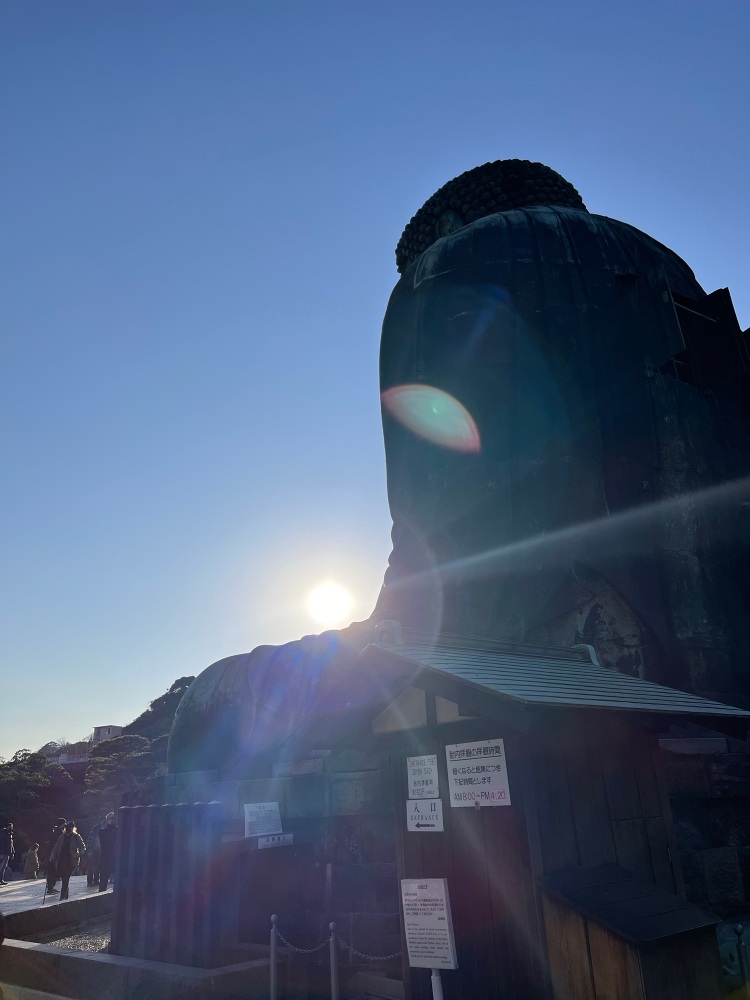
The Great Buddha of Kamakura statue (depicting Amida Buddha), taken in December 2022. I think my daughter might have snapped this photo, not me. I forget.
What’s important is that even if you are a crappy Buddhist, it’s OK. Obviously, like exercise and eating, Buddhist practice provides many positive benefits, so anything you can do, however often, is always worth the time and effort. However, if circumstances work against you, you do not need to punish yourself for your failings either. Like the woman of the night, sometimes life just gets in the way, but there’s no need to punish yourself for it. Amida Buddha’s light and goodwill extends to you just as it extends to others. Practice what you can, when you can, and Amida will guide you along the Buddhist path (via the Pure Land) somehow or some way.
Namu Amida Butsu
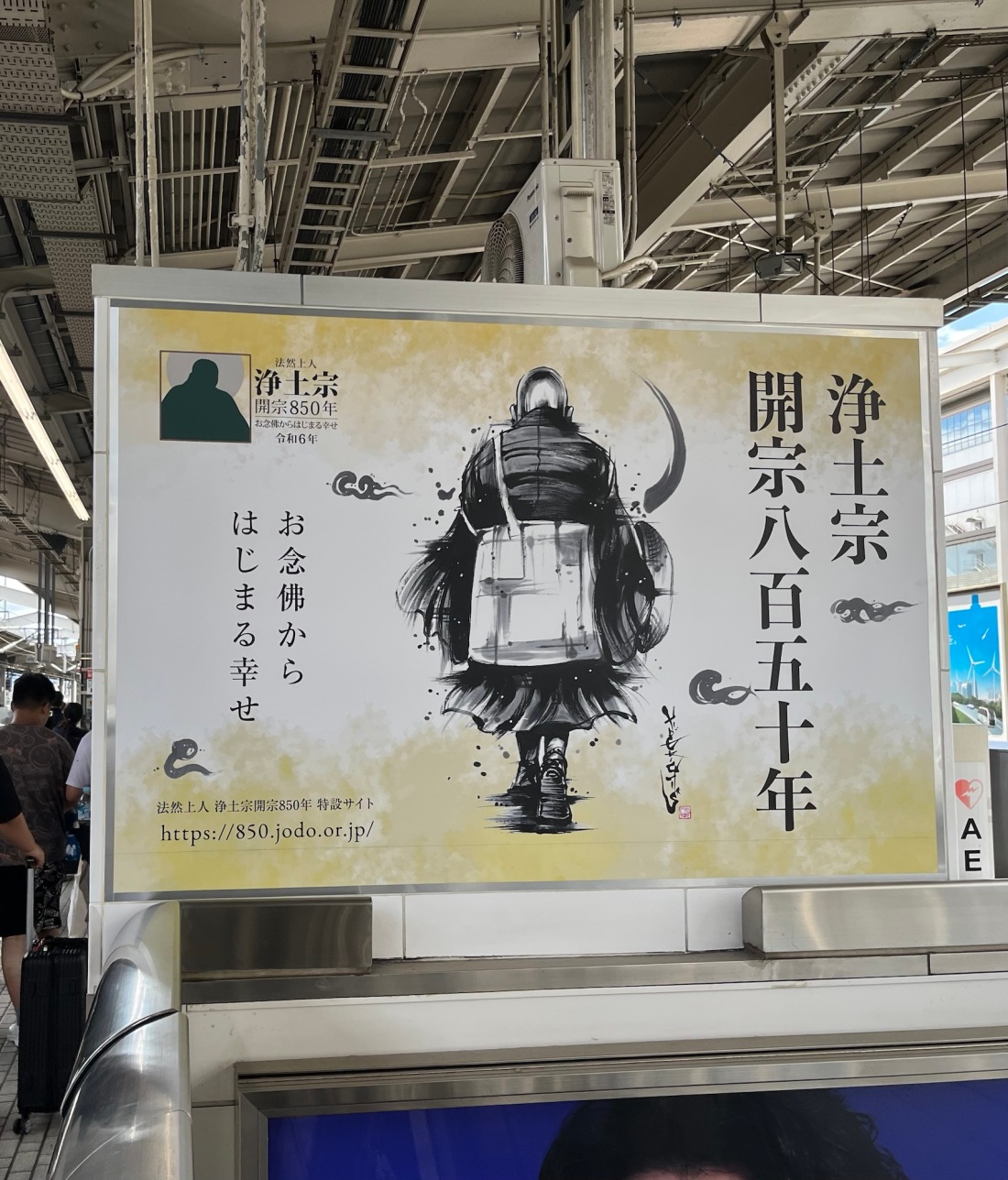
P.S. Featured photo is something I took at the Kyoto train station in summer 2023, part of a promotion to celebrate Honen’s 850th birthday. I always liked this poster, but couldn’t find a post I could work it into. 😅














 Gleanings in Buddha-Fields
.jpg)
You must be logged in to post a comment.