Buddhism Here and Now, Or the Future?

Recently while taking my personal retreat, I spent some time catching up on Buddhist reading, and finished a book titled Introduction to the Lotus Sutra by Yoshiro Tamura, and translated to English. I had high hopes for the book, but came away pretty disappointed as it was a pretty thinly veiled promotion of a Nichiren-Buddhist interpretation of the Lotus Sutra, and of Nichiren Buddhism in general.1

One passage makes some interesting comments worth noting though (Wikipedia links added):

Shinran (1173-1262), Dogen (1200-1253), and Nichiren (1222-1282) also came into reality of out Mt. Hiei’s hall of truth [same as Honen a generation earlier]. Yet their attitudes toward the actual world were quite different from Honen’s. While Honen was mostly devoted to giving up on life and longed for the pure land of the next life, Shinran, Dogen, and Nichiren struggled positively within the actual world. Their activities and writings came right after the Jokyu turbulence of 1221 and were related to it.

Page 123, translation by Michio Shinozaki, edited by Gene Reeves

Mr Tamura is comparing several different Buddhist monks who all left the Tendai sect around the same time, and each founded their own sects. The first, was Honen, who founded the Jodo Shu sect and greatly popularized Pure Land Buddhism in Japan. This is a fascinating historical phenomenon that started in the last 12th century with Honen, and persisted with a couple more generations of Buddhist monks all trained from the same Tendai sect, and apart from Nichiren, its great temple complex on Mt Hiei.

As Nichiren was the last of these great reformers, he had the benefit of hindsight, and tended to be rather harsh toward Honen’s Pure Land movement as degenerate, and further obscuring the true Buddhist teachings (as enshrined in the Lotus Sutra and the Tendai sect). Thus, ever since, Nichiren authors and followers have had particular animus toward Honen. The book doesn’t pull punches either.

But it’s an interesting comment to make, and not without merit. The Jodo Shu Buddhist sect has always been focused on a singular goal within the larger Buddhist religion: to enable followers to be reborn in the Pure Land of Amitabha (Amida) Buddha and thus provide as a refuge, but also to enable them to accelerate on the traditional Buddhist path faster. A lot of this hinges on a medieval-Buddhist interpretation of the “end days” or Dharma Decline, which looks a bit silly knowing what we know now.

In any case, Jodo Shu sect Buddhism, at least on paper, definitely focuses on the life to come. From what I hear on the ground, the reality is a lot more nuanced, and many communities still practice some manner “traditional Buddhism”, but the primary focus still remains rebirth in the Pure Land to come.

So, what Mr Tamura says makes sense.

Mr Tamura is also correct in that Dogen, who founded the Soto Zen sect, and Nichiren approached the same medieval concern with Dharma Decline, but in different ways: Dogen focused on the classic Buddhist approach to mindfulness, meditation, focus on the now, etc. Nichiren took the logical conclusion of the Lotus Sutra’s egalitarian teachings in the form of social reform, nominally as a reform of the Tendai sect, especially in the face of the crooked administration by the new Hojo clan’s military government.2

But I have to disagree with Mr Tamura’s hidden conclusion that by focusing on this-worldly practice that certain sects of Buddhism are superior to others. I feel that this hopelessly generalizes things.

One of the things that always attracted me to Honen’s teachings was his overt rejection of petty, secular life while keeping his focus on the future, namely the Buddha’s Pure Land. It may seem counterintuitive, but by focusing on the “world to come” and thus rejecting the world as it is, i think this fosters a renunciant’s mindset, even as one continues to live in this world. The historical Buddha, Shakyamuni, definitely advocated this approach.

This may seems like not a big deal, especially given other Buddhist sects also have some form of monastic practice, or similar rejection of secular life, but consider that the other aforementioned reformers were all Buddhist monks of hte same Tendai sect, and Tendai at the time had a controversial teaching called hongaku (本覚) or original enlightenment. The idea is that one is already enlightened but unaware of this due to ignorance or skewed viewpoints. This leads to all sorts of thorny issues with Buddhism and Buddhist practice, and gave some scallywags in the Buddhist monastic community an excuse to “loosen the reins a bit” in terms of discipline.

Honen seeing the state of affairs of the community at his time, overtly rejected this concept. Other reformers embraced the concept to some degree or another, sometimes leading to some behavior that in the wider Buddhist world would raise eyebrows.

On the other hand, the historical Buddha definitely advocated practice and mindfulness here and now too. In fact, it’s pretty much central to Buddhist practice, at least for monastic followers. So, Mr Tamura, Dogen, Nichiren and others aren’t wrong.

As a modern 21st-century Buddhist speaking 800 years later (and from another culture), with plenty of personal biases of my own, I think you need a bit of both. On the one hand, whether you are a Buddhist layperson or a monastic, it’s healthy to maintain a renunciant’s mindset. The world is a series of endless transitions, both on a macro level and a personal level, so there’s no lasting refuge or rest. Further, it doesn’t make sense to just throw up your hands and bank on the future through prayer and good merit, because there’s plenty of things you can do in the here and now to make life better for others, and also for yourself. Even if you engage in a little bit of Buddhist practice,3 that’s still a step in the right direction. Even if you meditate even only occasionally, that’s still better than nothing.

So, in a sense, all of the Buddhist reformers in 12th-13th century Japan had something positive to contribute, and each was approaching the same issues with novel approaches. It’s somewhat stupid to try to and hold up one sect as superior to others based on an artificial criteria.

So, anyhow, the book was disappointing, but it does help remind me of what matters.

P.S. Photo taken at the Butchart Gardens in Victoria BC last week.

1 The book started out reasonably well, but the last third of the book was unabashedly promotion of Nichiren Buddhism. Bear in mind that the Lotus Sutra has been revered and influential in many Buddhist communities outside of 13th century Japanese-Buddhist thought, so this tendency to focus on a single sect’s teachings to the exclusion of others. The book’s not-so-subtle tendencies to belittle continental Buddhist culture while promoting Japanese thought didn’t help either. People sure do love to inject culture into their religion.

2 Shinran, who was a follower of Honen, took a more nuanced approach that tends to incorporate some elements of Honen’s view, while focusing on a radically lay-oriented religious community (similar to Nichiren). There’s already plenty of books about Jodo Shinshu (Shinran’s sect), and Shinran, so no need to belabor it here.

3 Consistency has never been my forté. 🤦

Hojo Masako: the “Nun Warlord”

As I continue watching a Japanese historical drama, the Thirteen Lords of Kamakura, I have been delving more into the history of the Kamakura Period (12th – 14th century) of Japan, under the new military government. I know this era a lot less than I do the Heian Period, but while it is different, it is no less interesting.

The Shogunate of Kamakura, while nominally ruled by Minamoto no Yoritomo and his descendants, was actually controlled by their close allies, the Hojo (北条) clan, the same folks who gave us the Triforce symbol. Yoritomo was almost as bad as his dead rival, Taira no Kiyomori, and wasn’t above killing his various brothers and half-brothers who were potential rivals for the coveted title of Seii Shōgun (征夷将軍, generalissimo of Japan). The dynamic warlord, Minamoto no Yoshitsune (younger half-brother to Yoritomo) was killed shortly after earning the title from the Emperor, allowing Yoritomo to get the title himself by default.

In any case, for all of Yoritomo’s titles and power, he was less effective as a ruler, and the Hojo clan filled in this crucial role as regents and other administrative roles. The most important of these was in fact, Yoritomo’s wife, Hojo Masako. When Yoritomo died from illness a few years later, it was Hojo Masako, who by now took tonsure as a Buddhist nun, who filled in the role at a crucial time in Japan and kept things together. So effective was she at ruling Japan, that she earned the title ama shōgun (尼将軍), or “Nun Shogun” / “Nun Warlord” and so on.

Hojo Masako spying on one of her husband’s love trysts, painting by Utagawa Kuniyoshi (1840’s) courtesy of Wikimedia Commons.

In many ways, Hojo Masako fulfills a similar role to that of Empress Irene of the Byzantines: someone who has excellent leadership skills, but is prevented from openly leading armies by paternalistic society, so she played the role of a pious wife (later widow), while carefully pulling the strings.

As the wife of Minamoto no Yoritomo, she had to protect her family and descendants from Minamoto no Yoritomo’s constant philandering, but once he was gone, she stepped in to guide the Regency while her son and second shogun grew up. The Hojo clan regency was the true force behind the Shogunate, but as her son was now a member of that clan, she also wanted to ensure that lineage was safe from rival claimants. She is portrayed as crafty, but level-headed and responsible in contrast to her moody, and reckless husband.

Hojo Masako as played in the current drama, The Thirteen Lords of Kamakura, by the incredibly lovely and talented Koike Eiko.

So, what did Hojo Masako do that earned her such a prestigious title? When Minamoto no Yoritomo had prevailed over the Heike (Taira) Clan, he was the dominant power, but the title of Seii Shōgun wasn’t given willingly by the Emperor. In fact, the Emperor’s grandson, later Emperor Gotoba, would make one last effort to wrest true political authority. He rallied a large number of samurai clans, primarily from the West, away from the new capitol of Kamakura, with promises of titles and land.

The samurai clans allied to Minamoto no Yoritomo wavered in support. Going against the Emperor was never part of the deal, they rallied to stop the Heike Clan only, and they were hesitant to take up arms against their sovereign.

Hojo Masako, according to the Azuma Kagami, was said to have made the following speech:

故右大将軍(源頼朝)が朝敵を征伐し、関東を草創してから、官位といい、俸禄といい、その恩はすでに山よりも高く、海よりも深い。その恩に報いる思いが浅いはずはなかろう。そこに今、逆臣の讒言によって道理に背いた綸旨が下された。

名を惜しむ者は、速やかに藤原秀康・三浦胤義らを討ち取り、三代にわたる将軍の遺跡を守るように。
ただし院(後鳥羽)に参りたければ、今すぐに申し出よ。

“Since the days when Yoritomo, the late Captain of the Right, put down the court’s enemies and founded the Kantō regime, the obligations you have incurred for offices, ranks, emoluments, and stipends have in their sum become higher than mountains and deeper than the sea. You must, I am sure, be eager to repay them. Because of the slander of traitors, an unrighteous imperial order has now been issued.

Those of you who value your reputations will wish to kill [Fujiwara no] Hideyasu, [Miura] Taneyoshi, and the others at once in order to secure the patrimony of the three generations of shoguns. If any of you wish to join the ex-emperor, speak out.”

Translation by McCullough, William (1968). “The Azuma Kagami Account of the Shōkyū War”. Monumenta Nipponica. Tokyo: Sophia University. 23 (1/2): 102–155.

It is said that this put some backbone in the Shogun’s allies and they were able to crush Emperor Gotoba’s army, finally ending resistance from Kyoto. Later she was dispatched by her brother the regent to try and heal the political divide with Emperor Gotoba, among other important tasks. By the time she passed away, she attained the rank of Second Junior in the Imperial Court (still around, but largely ceremonial now), which is very high for someone of a more humble, warrior-class family.

Schoolchildren in Japan often learn about Hojo Masako when they learn Japanese history, including the famous phrase 山よりも高く、海よりも深い from the speech above: yama yori mo takaku, umi yori mo fukai (“[kindness is] higher than a mountain, and deeper than an ocean”). She was dynamic, intelligent, and charismatic leader who held together a fragile alliance of clans in a force that could resist Imperial power, and maintain a dynasty that lasted for 200 years.

The End of an Era

One historical period that has continuously fascinated me for a long time is the end of the Heian Period in Japan, culminating in the climactic war between the Heike (Taira) Clan and the Genji (Minamoto) Clan, followed by the rise of military government for the next 800+ years.

“How did you go bankrupt?” Bill asked.

“Two ways,” Mike said. “Gradually and then suddenly.”

The Sun Also Rises by Ernest Hemingway

Why does this matter?

As the quote above suggests, the fall of the Heian Period and of the Imperial aristocracy, built around a Chinese-inspired Confucian bureaucracy, came slow, then suddenly when the lower samurai class rose and and asserted power. Let’s compare the before and after:

The Latter Days of the Heian Period

Fujiwara no Kinto, as depicted in One Hundred Aspects of the Moon, courtesy of Wikipedia.

The Heian Period (平安時代, 794 – 1185) of Japanese was a long, 400-year period, that began when the Imperial capitol moved to the new city of Heian-kyō (modern day Kyoto) away from Heijō-kyō (modern day Nara). The Imperial government had been plagued with infighting and manipulation by powerful temples in Heiji-kyo, so the Emperor decided to make a clean start and migrate the capitol.

But the earlier Nara Period and the Heian Period represent a single continuum of life in Japan where the Emperor ruled in a Chinese-Confucian style bureaucracy with Japanese characteristics. The Imperial bureaucracy was run by a large number of literate officials either through Entrance Exams that tested your knowledge of the Confucian Classics, and aspects of Chinese history, or through connections if you were nobility.

Speaking of nobility, everyone in the Court, from the lowliest bureaucrat, to the Emperor had an official rank. This was part of the old Ritsuryō system. The Emperor was automatically 1st rank upper (正一位, shō ichi-i), while just below him someone might be 1st rank lower (従一位, ju ichi-i), then 2nd rank upper (正二位, shō ni-i), and so on until you get to the lowly paper-pushing bureaucrat at 少初位下 (shō so-i no ge) rank. Each year, the Emperor would approve promotions or demotions of rank, which would be annouced, so for doing some good work, you might be promoted one year, and your stipend increased, as well as other perks. However, there was a catch. If you were born to a venerable noble family such as the Fujiwara, Ōe or Tachibana, you were automatically 5th rank or higher. If you were not, it was almost impossible to attain anything above 7th rank. Sugawara no Michizane was a rare exception, but he paid for it when court treachery got him exiled.

Thus, the aristocracy held a grip on the Imperial court, but it didn’t stop there. The aristocracy held increasingly large tracts of land called shōen (荘園) that were tax-exempt due to a loop-hole in the system. The wealth of the aristocratic families grew larger and larger while the state became increasingly bankrupt.

Further, as the Heian Period went on, the aristocracy figured out how to manipulate power even further by arranging marriages with the reigning Emperor, and if they had a son, pressure the reigning Emperor to abdicate, so the ambitious family could control the Imperial heir as a regent. Case in point, during the 990’s two different branches of the Fujiwara clan were struggling for control, on led by Fujiwara no Michitaka and the other by Fujiwara no Michinaga. Both them had daughters wed to reigning emperor Ichijō, who had multiple sons. Initially, next reigning emperor was his son Emperor Sanjō who had not been born from a Fujiwara mother, but he was soon pressured to abdicate by Fujiwara no Michinaga, thus allowing Michinaga’s grandson and Ichijo’s other son to become emperor Go-Ichijō (i.e. “Ichijō the latter”) to reign.

Things got even nuttier when certain emperors, forced to abdicate and take tonsure as Buddhist monks, figured out how to retain power behind the scenes at odds with the nobility. The most well known example was Emperor Go-shirakawa who only reigned officially as emperor for three years, but retained power as the “cloistered emperor” for another 37 years.

None of this takes into the account the growing power and political manipulation of Buddhist temples, and their armies of soldiers, an open violation of the Buddhist principle to abstain from politics and violence.

Thus with such a toxic mix of competing power centers, a crippled central government, to say nothing of the earthquakes, plagues and political neglect of the provinces.

… and then it finally started to fall apart.

The Fall

The battle of Dan-no-ura, courtesy of Wikipedia

The fall of the Heian Period and its aristocratic society started with a power struggle between the upstart Taira and Minamoto clans. Like many other samurai families, they began as little more than escorts and bodyguards to the nobility, but in time they rose to positions of power and influence, filling in the gaps of government when emperors pushed the Fujiwara back.

This culminated with the dreaded Taira no Kiyomori seizing power in all but name. This grandson, the child Emperor Antoku, technically reigned, but behind the scenes Emperor Go-Shirakawa mentioned above still held to some power, but was effectively a hostage himself. The Minamoto clan were scattered and its clan head was executed for formenting a rebellion.

Kiyomori’s grip on power didn’t last long, and wasn’t long before the his enemies in the provinces began to rally around Minamoto no Yoritomo who led a successful counterattack that resulted in a war across most of Japan, with the Taira (e.g. the “Heike clan”) mostly dominating the west and the Minamoto (e.g. the “Genji”) ruling in the eastern provinces. The current TV drama in Japan, the Thirteen Lords of Kamakura, reenacts this struggle, and the aftermath.

The Taira, including the child emperor Antoku, were wiped out at the battle of Dan-no-ura, but the battles didn’t end there. The genie was out of the bottle, and there was no going back. Minamoto no Yoritomo then seized power by compelling to emperor to recognize him as Shōgun, the generallisimo of all Japan, and he went after rivals within the Minamoto clan including the famous warrior and half-brother, Minamoto no Yoshitsune. He based his regime in the eastern city of Kamakura, not Kyoto, thus drawing power away from the old Imperial court. Emperor Go-shirakawa’s son, Emperor Go-toba, attempted one last military effort to restore the power of the Imperial court in the Jōkyū War, but the samurai class centered around Yoritomo’s widow, the powerful Hojo Masako, and Go-toba’s efforts were doomed. He was exiled until his death.

Ironically, Minamoto no Yoritomo would end his life as little more than a figurehead himself as the Hojo family he married into (ironically a branch of the Taira he defeated) manipulated marriages and increasingly held power.

In the end, the new “Kamakura Period” of history was the first of several military regimes in Japan until 1868 (arguably 1945) where the Imperial court still held nominal power, but true power rested with the military class. The old Confucian-style bureaucracy still existed, people including power warlords still held rank in the Court, but it was a shadow of its former power, and was mainly used to legitimatize the ruling shogun and little else.

On the Ground

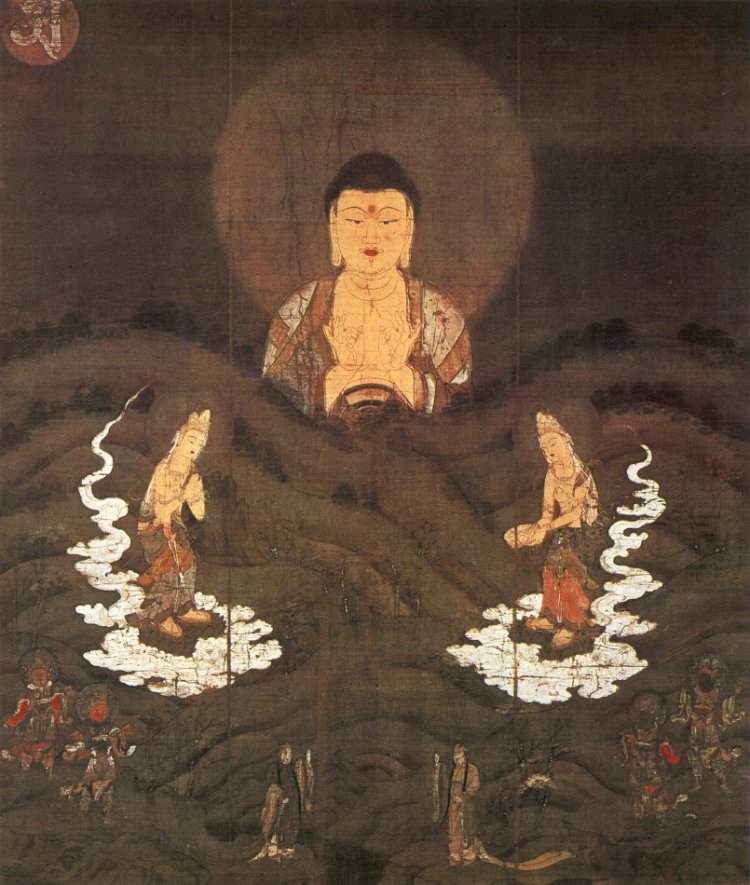
Amitabha Buddha rising over the mountain to welcome the believer to the Pure Land

Reading this history is one thing, but to people on the ground, as one crisis after another affected Japan during the end of the Heian Period both political and physical, it certainly felt like the End Times.

Millenarian Buddhist movements among the provinces sprang up in great number, as people were convinced that the era of Dharma Decline, the era mentioned in Buddhist scriptures when the Buddha-Dharma had utterly faded from the world, had come and that they were all doomed. This is why the Pure Land Buddhist movement started by Honen became so widespread and popular. By this point, people were so convinced that it was all over, they focused on escaping the endless cycle of birth and death to be reborn in the Pure Land of Amitabha Buddha instead. Pure Land Buddhism had been popular before this, but it took on a new sense of urgency under the collapse of the old society. Thus Honen’s disciples, such as Shinran, carried this message further out into the provinces and Pure Land Buddhist movements sprang up everywhere.

Nichiren Buddhism, which came slightly, was a similar millenarian movement, but instead Nichiren blamed society’s ills ironically on the Pure Land movement itself for leading society away from the True Dharma (e.g. the Lotus Sutra). Like many others in society, including Honen a couple generations earlier, Nichiren was appalled by the death, warfare and disasters affecting Japan and felt there had to be a reason for it all.

This may seem odd to us in the 21st century, but for people who grew up that the world around them was governed by the Buddha-Dharma (or lack of it), this is the only conclusion that would make sense. We in our time believe the world is governed by science, so when something happens, we tend to look for a scientific-analytical explanation. When the Byzantines in the 8th century saw their world collapse due to the Plague of Justinian followed by invasions from the new Muslim Arabs, they saw felt that their world that had been governed by God as approaching the End Times too, culminating with the siege of Constantinople itself. Thus, Iconoclasm sprang up soon after.

In each case, people are faced with a cataclysm and are using reason to try to come to grips with what’s going on, and how to fix it. We can look back and laugh and people for their “backward views”, but what will people say about us 1,000 years in the future, I wonder?

The Aftermath

In any case, once the war between the Taira and the Minamoto ended and the capital was moved to Kamakura, life in Japan was simply never the same. Generations had lived with the trauma of last years of the Heian Period, the warfare and so on, and much of the literature of the time including the Hojoki and the Essays in Idleness carry a sense of “paradise lost”. It was over. Everyone knew it, and there would be no going back.

And yet, for all the sadness and sense of loss, Japan did carry on through many subsequent generations to be the country it is today. The court life of the Heian Period is still remembered in things such as the Hyakunin Isshu poetry anthology, doll displays on Girls’ Day, woodblock art, and so on. And of course, historical dramas.

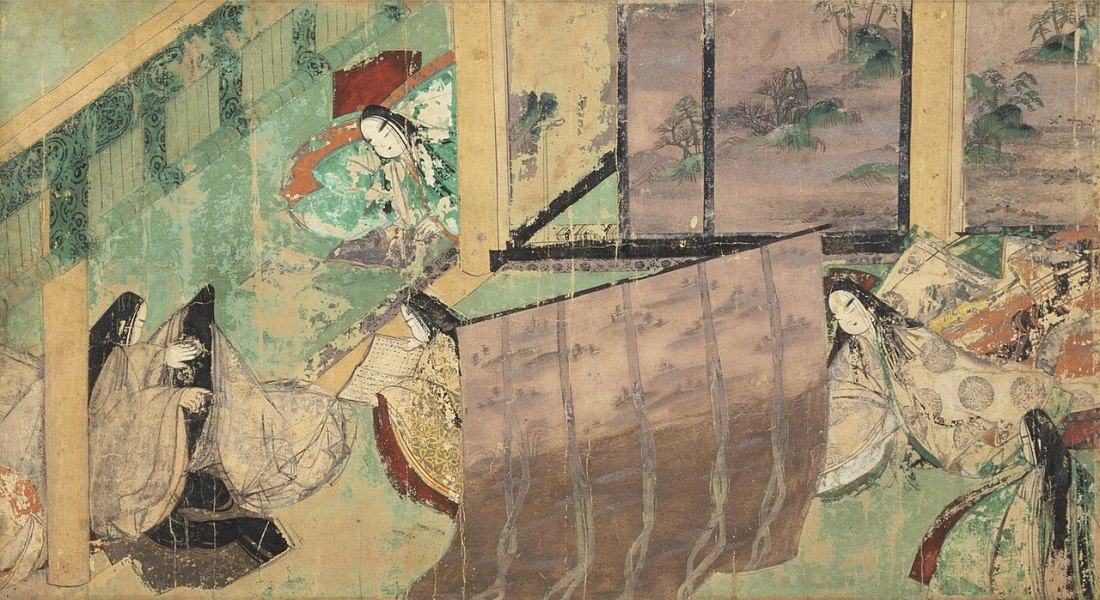
P.S. A scene from the Illustrated scroll of Tale of Genji (11th cent.), depicting the Azuma-ya (“East Wing”). Imperial court in Kyoto, Public domain, via Wikimedia Commons

The Rise and Fall of the Heike

Woodblock print of Taira no Kiyomori, by Yoshitoshi, published in the One Hundred Aspects of the Moon. 月岡芳年, Public domain, via Wikimedia Commons

Near the end of the twelfth century in Japan, amidst decades of political meddling by the Fujiwara clan in Imperial court politics, an upstart samurai warlord named Taira no Kiyomori took control of his own clan, the Heike (平家) clan,1 in 1159. The Heike were one of several offshoots of Imperial offspring in last generation and hung around the Imperial Court as minor aristocrats, lowly samurai, etc.

By 1179 Kiyomori seized control of the capitol in a coup. The head of his hated rivals, the Genji (源氏) clan,2 was executed and his sons forced to live in separate provinces. The capitol was effectively under a military dictatorship under the guise of maintaining the Imperial Court, with Taira no Kiyomori pressuring the Emperor to award him the court rank of 1st rank junior (just under the Emperor). Kiyomori was said to wear brash clothing and flaunt Court etiquette. As he held onto power at the expense of the Emperor he could do what he wanted.

The Genji were now scattered, but not defeated. In time, starting with Minamoto no Yoritomo, they were able to gather allies, including a Heike-offshoot: the Hojo Clan. Further, the brothers of the Genji clan gradually reunited under Yoritomo, including the famous warrior Minamoto no Yoshitsune, and push back the Heike. This “Genpei War” culminated with the navel battle of Dan-no-ura, when the Heike were almost totally wiped out and a couple of the Imperial sacred treasures were reportedly lost.

But by the time of Dan-no-ura, Taira no Kiyomori was already dead. Taira no Kiyomori has become something of a power-hungry villain in Japanese lore since the Tales of the Heike, and subsequent media. His death is dramatized as coming from a terrible illness with a fever so hot that no one could approach him, while in his fever dream he was said to have seen the denizens of hell waiting for him including Enma the Judge of the Underworld.

Another woodblock print by Yoshitoshi dramatizing the illness and death of Taira no Kiyomori. Yoshitoshi, Public domain, via Wikimedia Commons

As the opening lines of the Tales of the Heike eloquently state, the powerful do not last long, and ultimately self-destruct. So it was with Kiyomori and the Heike.

P.S. The larger Heike clan persisted long after the Genpei War, mostly through off-shoots such as the Hojo, Miura, and so on. But Taira no Kiyomori’s ambitions were crushed and his immediately family and forces destroyed at Dan-no-ura. Minamoto no Yoritomo, for his part, wasn’t exactly a saintly figure either. Yoritomo’s own family and sons were hemmed in by the Hojo Clan who managed all the actual affairs of the new Kamakura Shogunate, relegating these new “warlords” to figurehead positions. Ah, politics. 🤦🏻‍♂️

1 Also called the Taira clan. The Chinese character 平 can be read as either hei or taira. Welcome to the world of Japanese kanji.

2 Same situation: 源 can be read as gen or as minamoto. They were another imperial offshoot clan with similar status to the Heike.

The Thirteen Lords of Kamakura

Since the kids were very young, the family and I subscribe to Terebi Japan, a cable channel that allows us to watch Japanese TV. The cable channel mostly shows TV from the public channel, NHK (roughly analogous to the BBC), and not other content, but it does allow us to watch Japanese TV legitimately and not through some shady third-party service. NHK has a famous series of historical dramas called Taiga Dorama (大河ドラマ) which change every year, but feature some aspect of Japanese history. I usually don’t watch these because they’re not that interesting, and the Japanese dialog is particularly archaic and difficult for me.

However, lately, I’ve gotten sucked into the latest Taiga Dorama series: Kamakura-dono no Ju-san-nin (鎌倉殿の13人) which translates to the Thirteen Lords of Kamakura. The opening theme alone is pretty epic and worth a watch. I always love seeing the rain of arrows at sea during the climactic final battle of Dan-no-ura in particular.

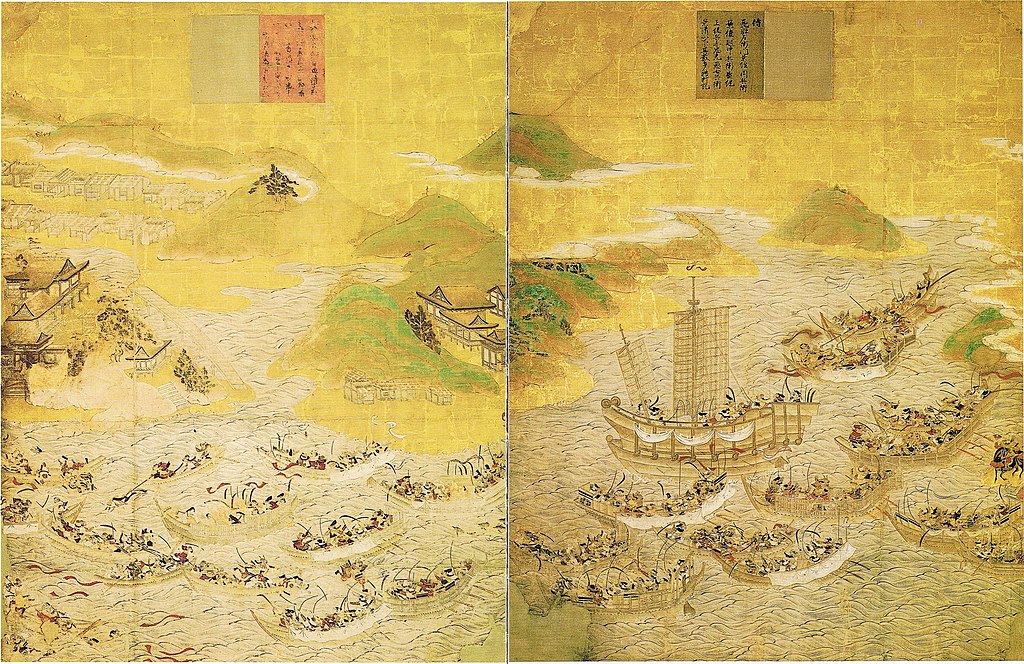
The Battle of Dan-no-ura, 日本語: 伝土佐光信 English: Tosa Mitsunobu, Public domain, via Wikimedia Commons

This series covers a period of Japanese history that I find particularly fascinating ever since I first studied it in college: the Genpei War in the 12th century. I’ve touched upon the Genpei War before, but to summarize again, this was a four-year country-wide conflict between two powerful samurai clans: the Heike (a.k.a. the Taira) and the Genji (a.k.a. the Minamoto). During this time in Japanese history, the last days of the Heian Period, the samurai class were socially inferior to the noble families of Kyoto (known as Heian-kyo back then) and were subject to manipulation by them. However, the Heike clan turned this around by manipulating the Imperial throne under one Taira no Kiyomori. Having effectively seized the throne, Taira no Kiyomori began to drive out his rivals, including the Minamoto.

The Minamoto were savagely defeated and driven to remote provinces where they were eventually able to rally allied clans (including a Heike off-shoot, the Hojo clan)1 and push the Heike back in defeat after defeat until the battle of Dan-no-ura where the Heike made their last stand, and Kiyomori’s grandson, the two year old Emperor Antoku drowned.

From this point on, the power of the nobility, who had stirred up so much conflict in the first place, was greatly curtailed for centuries, and the samurai class became the true power in Japan until the late 19th century. Minamoto no Yoritomo, who led the Minamoto clan to victory, was the first shogun (generalissimo) of the new military government based in Kamakura, not Kyoto.

This period of warfare was incredibly disruptive to Japan, as evinced in such works as the Hojoki, and is still remembered as the end of Japan’s cultural “golden age”, and the ascendancy of the Samurai. The epic Tales of the Heike (heike monogatari, 平家物語) is a later retelling of what happens, but there are numerous cultural references to the people and places of the War such as ghost stories of the Heike, “Heike crabs“, Kabuki dramas, artistic works in the 19th century, and so on.

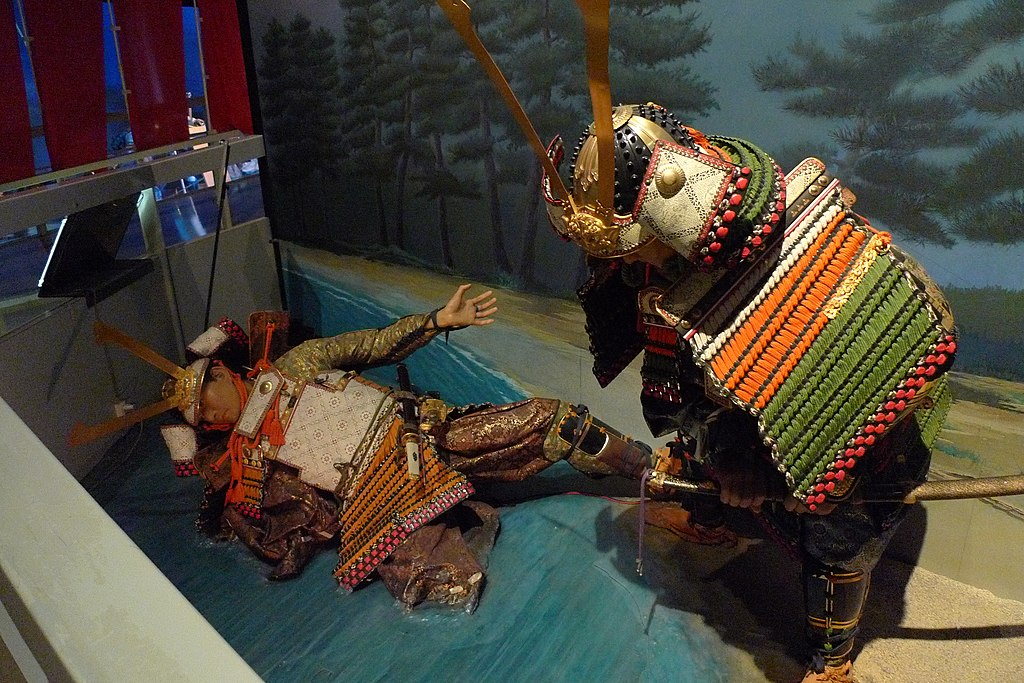
One of my personal favorite is a famous duel between the Genji-clan soldier named Kumagai Naozane (熊谷直実) against the Heike prince named Taira no Atsumori (平敦盛) at the beach-side battle of Ichi-no-tani. Because Naozane was old enough to be Atsumori’s father, and because Atsumori was such a refined youth, Naozane hesitated to kill him at first, but with the other Minamoto soldiers arriving, Atsumori was obviously doomed no matter what. Naozane gave him a quick, merciful kill.

A wax recreation of the death of prince Taira-no-Atsumori at the hands of Kumagai Naozane, courtesy of Takamatsu Heike Monogatari Wax Museum, Takamatsu city, Kagawa pref, Japan.. Photo by Motokoka, CC BY-SA 4.0, ウィキメディア・コモンズ経由で and Wikipedia Commons

After the war, Naozane felt remorse for slaying Atsumori, and retired to the Buddhist clergy as a monk and a devotee of Honen of the Pure Land sect where he took the ordination name of Hōrikibō Rensei (法力房 蓮生) and was a fervent devotee until his death.2

As for the Taiga drama, it’s pretty awesome. The Japanese is still archaic and difficult for me to follow, but they do try to use modern Japanese more, and the cast are celebrities I am more or less familiar with. Matsudaira Ken (of Matsuken Samba fame) plays Taira no Kiyomori, too. 😋

It’s not the first Taiga drama that NHK has done about the Genpei War (another famous one about 10 years ago made the villain, Taira no Kiyomori, the main character), but this drama is particularly well done, and my language skills have finally reached the point where I can appreciate it in Japanese, rather than filtered through limited Western media. But also, as someone who avidly studied Japanese history in college, the War between the Genji and the Heike is something I’ve imagined for half my life and now I can see not just in my imagination, but vividly in a powerful drama.

P.S. The featured image is a 19th century woodblock painting of Heiki general Taira no Tsunemasa (平経正) in a scene from the Tales of the Heike by Yoshitoshi.

P.P.S. Burton Watson’s abridged translation of the Tales of the Heike is a good read if you are interested.

1 The title of the drama “Thirteen Lords of Kamakura” is, I believe, in reference to the various samurai clans who are allies or enemies of the Genji, and each one jockeying for power. I might be wrong though.

2 This also debunks a tired old myth about samurai and Zen Buddhism. The reality was quite a bit more nuanced.

The Hojoki: A Record of my Ten-Square Hut

Life in Japan was especially hard during the last half of the twelfth century to the first half of the thirteenth. The historical transition from the aristocratic Heian Period to the militaristic Kamakura Period was a time of tremendous political upheaval, nationwide warfare between the Heike and Genji samurai clans, and finally good ol’ fashioned plagues, famines and natural disasters. In time, Japan did rebuild, and life moved on, but within a couple generations a great deal in Japan had changed.

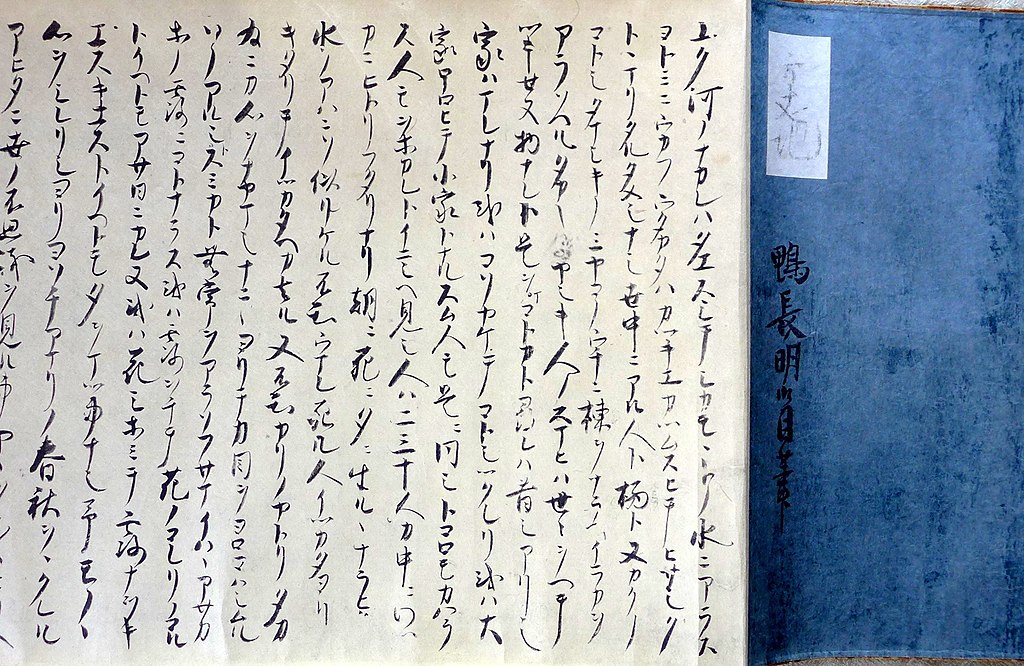
It was under this backdrop that a man named Kamo no Chōmei (鴨長明, 1155-1216), a former poet of the Imperial court turned Buddhist renunciant, composed a small work in 1212 around the age of 60 detailing the dramatic and painful changes in society, and his subsequent self-imposed hermitage in a tiny hut titled the Hōjōki (方丈記). The term hōjō (方丈) is a unit of measure meaning 10 square shaku which is very close to 10 square feet, and “ki” (記) just means a record of something. So, it’s reasonable to translate this as “A Record of [my] Ten Square Foot Hut”.

The inspiration for the hut, which was in the hills southeast of Kyoto (photos here), was from the legendary Buddhist figure Vimalakirti who practiced the Buddhist path from a similar hut in India.

Kamo no Chōmei spends much time in the Hojoki explaining the numerous disasters and tragic tales that befell the capital, Heian-Kyo (now modern Kyoto) during the 1180’s (the Yōwa era), and the social upheaval of the time. For this blog post, I am using Dr Meredith McKinney’s translation from the the book Three Japanese Buddhist Monks, published by Penguin Random House.

All this drove people throughout the provinces to leave their land and migrate elsewhere, or desert their homes and simply take to the hills. Various prayers to the gods were instigated and fervent Buddhist ceremonies performed at the palace, but to no avail….People [in the capital] were driven to offer all their treasured possessions to buyers for a song, but no one would so much as glance at them. And if any exchange did happen to be made, money meant almost nothing, while grain was everything. Beggars crowded the roadsides, and the sound of wailing filled the ears.

Pages 9-10

Kamo no Chōmei then continues on with a series of disasters that came after: a pandemic, scarcity of basic goods, an earthquake, and so on. Starvation and illness were rampant, and Kamo no Chōmei saw many heart-breaking sights:

….In their sympathy for one another they [husband or wife] would put themselves second, and give their partner any rare morsel that came their way. So also, if parent and child lived together the parent was always the first to die.; a baby would like suckling, unaware that its mother was dead.

Page 11

He summarizes all this with the words:

Yes, take it for all in all, this world is a hard place to live, and both we and our dwellings are fragile and impermanent, as these events reveal.

Page 13

Then, the Hojoki shifts gears, and Kamo no Chōmei discusses his own failed career in the Court bureaucracy, and eventual hermitage.

All told, I spent some thirty troubled years withstanding the vagaries of this world. At each new setback, I understood afresh how wretched my luck is. And so, in the spring of my fiftieth year, I came to leave my home and take tonsure, and turned my back on the world. I had never had a wife and children, so there were no close ties that were difficult to break. I had no rank [in the imperial court] and salary to forgo. What was there to hold me to the world? I made my bed among the clouds of Ōhara’s mountains…

page 15

He describes his hut in detail, discussing the garden, water system, farming he does to make ends meet, and his relations with a father and son living nearby. He talks about his small Buddhist altar, and his devotion to Amitabha Buddha, with whom he hopes to be reborn in the Pure Land after death.

Finally, he reminisces about the capital and how much things have changed:

When news of the capital happens to come my way, I learn of many people in high places who have met their end since I retired to this mountain, and other lesser folk besides, too many to be told. And how many houses too, have been lost in all those fires? In all this, my mere passing shelter has remained tranquil and safe from fears.

page 19

and contrasts it with his own life:

I love my tiny hut, my lonely dwelling. When I chance to go down to the capital, I am ashamed of my lowly beggar status, but once back here again I pity those who chase after sordid rewards of the world.

page 21

In the final page though, he begins to doubt his own progress along the Buddhist path due to his attachment to his quiet life and hut, and whether he’s simply traded one set of delusions and attachments for another. To this he ends the text with these words:

When I confront my heart thus, it cannot reply. At most, this mortal tongue can only end in three faltering invocations [the nembutsu] of the holy, unapproachable name of Amida.

page 22

Throughout the Hojoki, there is a strong sense of Buddhist impermanence, things coming and going, the pointlessness of attaining ephemeral benefits in this world, the empty decadence, and bittersweet nostalgia for the good old days in the Capital (Kyoto) before the war. Anyone who’s read The Great Gatsby might appreciate a common thread between the two books, even if separated by almost 1,000 years and totally different cultures.

I highly recommend anyone reading the Hojoki if they have an hour or two to spend. This is a good online translation in particular, but I also think Meredith McKinney’s is also excellent and worth picking up. The Hojoki is short, about 20 pages in a modern book, but a fascinating look at the last days of the historical “Heian Period” of Japan, the passing of a golden age in Japan, and life since then. Plus, it is a reminder that the powerful do not last very long anyway. It’s pretty grim at times, somewhat bittersweet in others, but I think there’s something for everyone.

Edit: updated blog post with Meredith McKinney’s translation as I like her style more.

Meet The Original Triforce: The Hojo Clan!

I was cleaning out old photos from my phone’s camera roll, when I realized that I still had photos left over from this post, including a photo of my omamori charm that I got from Enoshima Shrine way back in 2019. Sadly that was my last trip to Japan, and I haven’t been able to return my omamori since.

One thing a careful observer might notice the three triangles at the top. This is probably the most famous family crest (kamon 家紋) in the history of Japan because it’s also the inspiration for the Triforce of the Legend of Zelda series!

An example of the Hojo Family crest on a stone lantern, which I took in 2010 at Ueno Park in Tokyo, Japan. Clearly the Hojo family influence extended beyond the borders of Kamakura.

The Hojo Clan was a powerful clan during the Kamakura Period of Japanese history, and has an interesting history. Originally, the Hojo Clan was an offshoot of the Heike (Taira) Clan, but during the famous Genpei War, they openly sided with the Taira’s enemy, the Genji (Minamoto) Clan after being snubbed by the Heike due to a succession issue. The Genpei War ended with the total destruction of the Heike Clan, and the Genji Clan under Minamono no Yoritomo became the ascendant power. The power of the Emperor and his Court in Kyoto effectively ended and was now in the hands of Genji Clan’s samurai forces, who were based in Kamakura far to the east.

What’s interesting is that while Minamoto no Yoritomo was the clear victor and the first Shogun of the new government in Kamakura, he was surrounded by Hojo Clan allies, and before long married into the family through Hojo Masako. Within a generation, the Kamakura Shogunate was entirely controlled and managed by the Hojo Clan, and the Minamoto clan whom they nominally served was relegated to mere figureheads.

The historical drama (Japanese: 大河ドラマ. taiga dorama), 鎌倉殿の13人 or “The 13 Lords of the [Kamakura] Shogun” is about the struggle for power by several Hojo family members, and their rivals, after the death of Minamoto no Yoritomo. It’s been fun to watch so far.

So, the next time you see the Triforce in a Zelda game, don’t forget the powerful clan that was behind it all.