Lately, I’ve been reading a fascinating book called The Time Traveler’s Guide to Medieval England: A Handbook for Visitors to the Fourteenth Century and the book touches on the subject of science and magic in 14th century England:
The lack of distinction between fact and fiction with regard to distant countries is understandable, but it should alert you to a wider failure to distinguish between real and the fabulous. At times it seems that medieval people pride themselves on the quantity of their knowledge, not its quality or correctness. Well-educated and intelligent individuals are fully aware of the shortcomings of this attitude….and yet most people are not remotely bothered by such issues. Huge distances mean they do not have to deal with the problem of John the Baptist having three heads, and, by implication the problem of the Church circulating untruths. For almost everyone, the principal of divine providence explains everything. Things are as they are because God has determined that that is the way they shall be–even to the point of John the Baptist having three heads….People do not understand the laws of physics, the nature of matter, or even how the human body functions. Hence they do not see limitations on how the world operates. Their sense of normality is thus somewhat precarious. Anything can happen. In their minds, sorcery really does work, and all sorts of supernatural forces are suspected to have dreadful power. Astrology is used for everything from determining when to take medicine to when to take in the washing. Alchemy might well result in lead and iron being turned into gold. And as for the possibility of witchcraft and magic, these are limited only by the onlooker’s imagination; they have nothing to do with the witch’s or magician’s actual abilities.
Page 74-75
This fascinating passage highlights the medieval mindset, and shows how much things changed after the popularization of the Scientific Method. Having a process to objectively measure how things work in the physical world makes this all seem antiquated, comical, etc. But at the same time, this mindset where “anything is possible” and the runaway thought process it entails was not limited to 14th century England. Greek philosophy as rife with strange theories of how things worked (many of which were absorbed by medieval thinking, such as the medical “wisdom” of Galen).
You can also see this mindset in medieval Japan as well, such as described in a 14th century text called the Essays in Idleness, where the author Kenkō writes this anecdote:
50) Along about the Ōchō era there was a rumor that a man from Ise had brought to the capital a woman who had become a demon, and for twenty days or more people of the downtown and Shirakawa areas wandered here and there day after day, hoping for a look at the demon. They passed he word to one another: “Yesterday she visited the Saionji.1 Today she’s sure to go to the cloistered emperor’s palace. At the moment she’s at such and such place.” Nobody actually claimed dto have seen the demon, but no one, for that matter, said the report was untrue. People of all classes gossiped continuously about one subject, the demon — that, and nothing else.
One day, as I was on my way from Higashiyama [a very famous district of Kyoto] to the area around Agui, I saw a crowd of people running from Shijō and above, all headed north. They were shouting that the demon had been seen at the corner of Ichijō and Muromachi. I looked off in that direction from where I was, near Imadegawa. There was such a crowd packed around the cloistered emperor’s reviewing stand that it seemed quite impossible to get through. I thought it unlikely the rumor could be completely groundless, and sent a man to investigate, but he could find nobody who had actually met the demon. The crowd continued to clamor in this manner until it grew dark. Finally, quarrels broke out and a number of unpleasant incidents occurred. For some time afterward, whenever anyone took sick for a few days, people tended to say that the false rumors of the demon had been a portent of the illness.
Translation by Professor Donald Keene
Of course, the 21st century and our modern lifestyle not a perfect cure for spurious beliefs either. 😅
1 Confusingly, Saionji (西園寺) was both the of a Buddhist temple in Kyoto, and of a branch of the Fujiwara family who lived there.
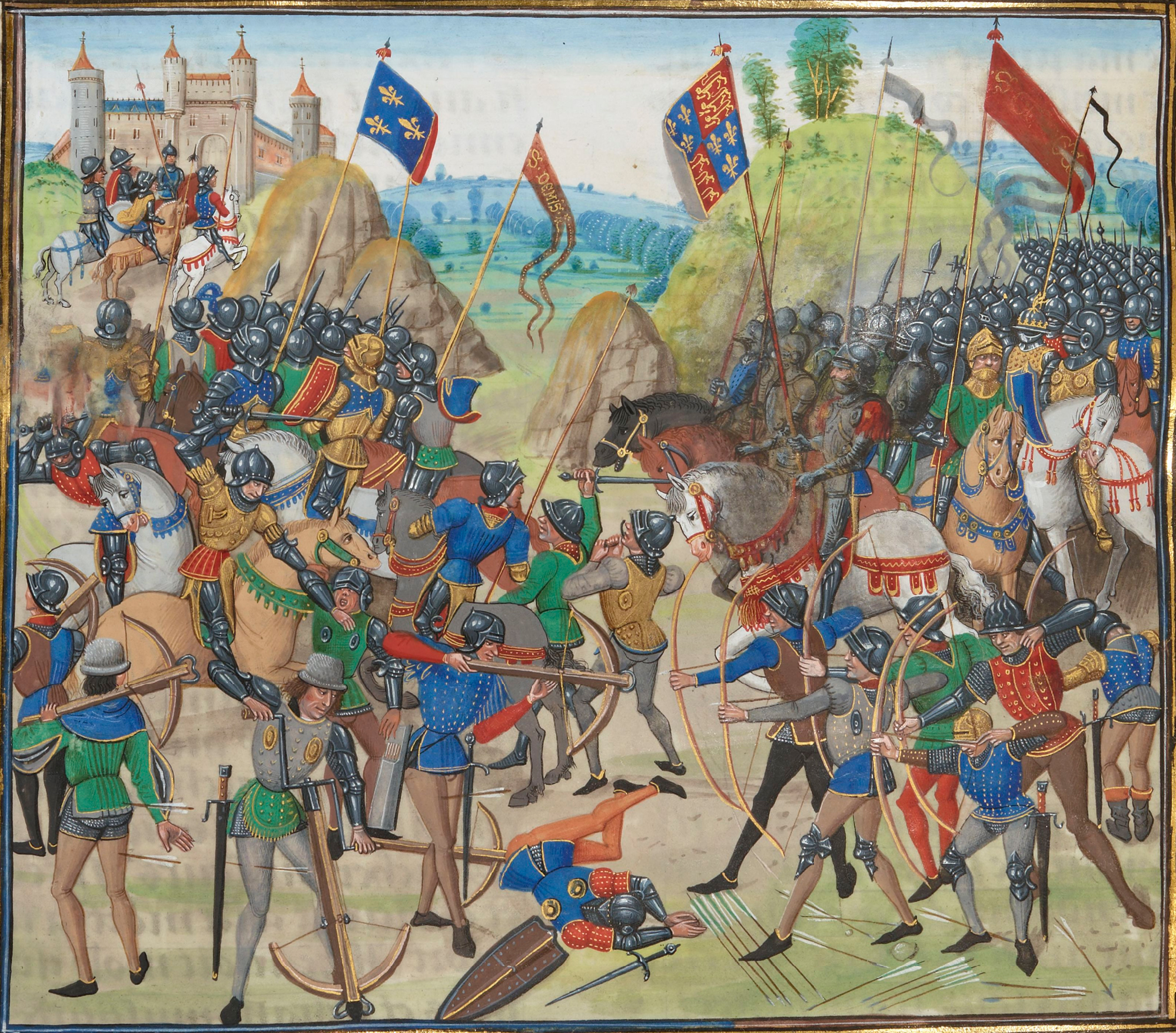
Edward III counting the dead on the battlefield of Crécy, courtesy of Wikipedia
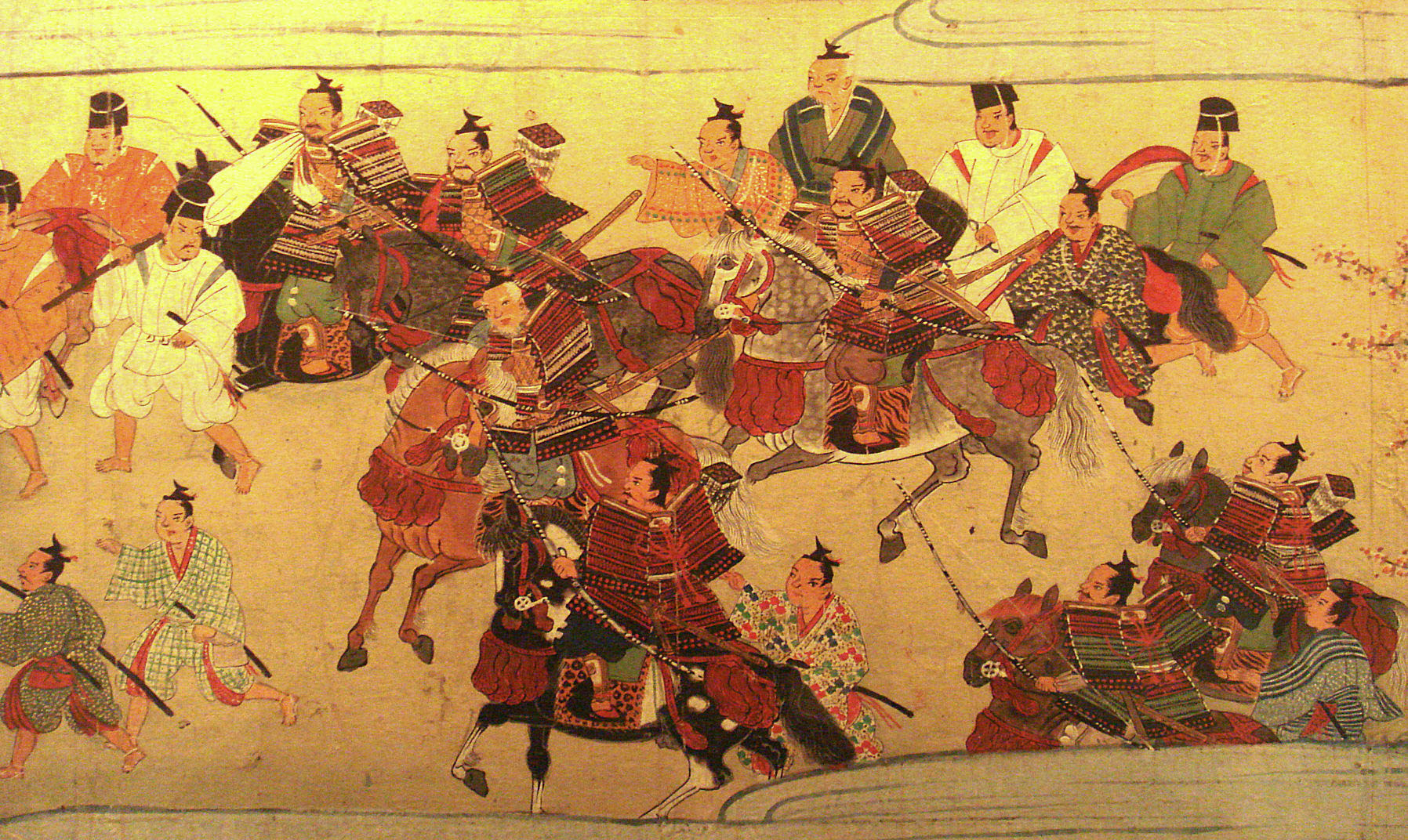
Samurai of the Muromachi Period (14th-15th centuries), also courtesy of Wikipedia.
I’ve been reading a fascinating book called The Time Traveler’s Guide to Medieval England: A Handbook for Visitors to the Fourteenth Century, and it’s triggered some memories of my studies in college about medieval Japan, plus things I learned over the years from writing blogs. So, this post is a fun comparison between fourteenth century Japan and England. This is not an exhaustive review, and may have some historical inaccuracies, so take this as a fun thought-exercise more than a reference.
Medieval Society at a Glance
In the Time Traveler’s Guide above, the author explains that medieval English society was basically broken up into 3 groups:
Those who fight – kings, knights, etc.
Those who pray – bishops, monks, clergy, etc.
Those who work – farmers, laborers, etc.
In theory, each one supports one another: those who fight defend the others from invaders, those who pray bring solace and spiritual guidance to the other groups, and those who work support the other two.
With such a broad structure, you can easily fit the same model on medieval Japan:
Those who fight – the shōgun, samurai, soldiers
Those who pray – Buddhist monks, Shinto priests (called kannushi)
Those who work – farmers, laborers, etc.
This probably accounts for 99% of medieval Japanese society at the same time, except for one small hitch. Japan also had, in my opinion, a fourth class: those who reign. The emperor and the elite aristocracy based in Kyoto, the capitol at the time, were a leftover from an earlier “classical” period of Japanese history, and were never really overthrown, but had ceased to exercise any real power. The samurai had originally started as lower-class soldiery, but had gradually seized more power over the centuries until the old Imperial Court was basically window-dressing. The Imperial Court and its noble families (the Tachibana, the various branches of the Fujiwara, etc) had mostly ceremonial power, but even the highest-ranking samurai still deferred to them for legitimacy.
One other interesting note is that medieval Japan was heavily influenced by Confucian thinking from China, which had a different theoretical model (in descending order):
nobility and scholars (e.g. educated literati)
laborers, farmers, etc.
artisans
merchants
Confucius felt that a successful society would be harmonious if men educated in virtue ran the government, with the laborers held in fairly high esteem because of their obvious contributions to society. Conversely, merchants were seen as very lowly due to their exploitative nature.
While this was the model for Japanese society as Japanese probably saw it back then, in practice, the three-part model we saw above: those who fight, pray and reign, provides another helpful way to look at it. The military samurai class in Japan really did function as “those who fight” and depending heavily on rice output from “those who work”. But then again, so did the Buddhist/Shinto clergy.
This leads us to another facet of medieval society…
Serfdom
The book above provides a very nice breakdown of peasant life in medieval England, and contrary to our view of a large, miserable class of “serfs” working for a lord, the picture was actually more nuanced.
Medieval English society had a few different classes of “those who work”, including:
As weird as it might sound, being a franklin / freeman wasn’t always what it was cracked up to be, since income was pretty meager for most, and you were basically on your own. Some did attain a fair amount of wealth, and were able to not only own land, but become a somewhat prosperous “middle class”, but this was definitely exception, not the rule. On the other hand, being a villein wasn’t all that great either: you were basically property of the local lord, and were pretty tied to the land. Even your children had to work the land, and if they married off (i.e. daughters), you had to pay your lord a fine to cover the lost labor. Then again, as part of your lord’s property, you did enjoy protection that freemen didn’t.
Either way, life was pretty hard.
Interestingly, those in England who survived the Black Death of the 14th century saw that since labor was now in great shortage (since 1/3 of the population basically died), villeins would run off and work under a different lord who might offer better wages. Thus, laborers ended up with more bargaining power than they had before.
The situation in Japan wasn’t all that different (minus the Bubonic Plague which never reached Japan until the 19th century). Japan’s land-management system was rapidly changing in the 14th century, from the old Shōen system of absentee lords, to direct ruler-ship by an increasingly powerful military class. The old Shōen system was a super-confusing patchwork of landownership further compounded by various layers of reform (or tax-evasion methods) and provided a steady, often tax-free income, for nobility or Buddhist monasteries due to an old legal loophole that only taxed land that was owned publicly owned by the Emperor. Peasants worked this land through a kind of rental system where they were “renting” the land and payment included a portion of the yearly crops plus some odd labor here or there. Again, due to a quirk in the laws, laws and regulations by the central government did not extend to the Shōen, so peasants were at the mercy of their landowners. If they couldn’t pay their rent, perhaps due to a bad harvest, the landowners could toss them out and directly seize the land.
A century later when this system was totally abolished and samurai daimyō (feudal lords) took direct control of their fiefdoms, peasants became much more like the English villein than before. They gained protection and some other benefits, but instead of the facade of “renting” the land, they were basically tied to the land by force of feudal law. Like the English villein, Japanese peasants rarely traveled around outside their village unless granted permission, and the village “headman” (sonchō 村長) acted as important intermediaries between the ruling samurai class and the peasants compared with earlier “land stewards” (jitō 地頭).
Speaking of military feudal lords…
Warfare
England, for most of the 14th century, was deeply immersed in a prolonged conflict with France called the Hundred Years War, which saw many battles on the French countryside, and territory changing hands a number of times, not to mention the involvement of Scotland as an ally of France.
Japan around this time was involved in a lengthy civil war called the nanboku-chō (南北朝時代, war between Southern and Northern courts) as the followers of Emperor Go-Daigo attempted to reassert power of the Imperial court, and not the samurai.
In both cases, warfare was very important and the “those who fight” had to mobilize for major warfare.
Welsh longbowmen (right) routing the French-hired mercenaries at the Battle of Crécy.
England at the time was somewhat unusual for relying on very large armies of longbowmen, who could simply fire clouds of arrows from a very long distance, cheaply, at their foes. Both the French and English had more traditional medieval armies, with armored knights, pikemen and so on, but the addition of English longbowmen meant that the longbowmen could pick off the knights and armored calvary easily from a distance while keeping their own forces safely in reserve. This gave the English a major advantage until nearly a century later, when calvary tactics by the French and their allies improved and they could simply mow down the longbowmen.
Further, European armies in general relied heavily on mercenaries. The French army had a large mercenary contingent, and this was by no means unusual. Almost every medieval army hired mercenaries in large numbers, resulting in weird mercenary-on-mercenary warfare.
A painting depicting the 15th, not 14th century, Ōnin War.
Japan, by contrast had neither longbowmen nor mercenaries. By the 14th century, the Japanese samurai class had greatly increased in both power and breadth, and thus the warfare became increasingly “strategic” and less focused on ritual combat. Military technology had also greatly improved as the sword technology had become highly refined, and though archery still remained an essential part of any army, it was not prioritized at the level of say, the English army.
Both England and Japan, being feudal societies, mobilized armies when the sovereign issued a call to war, and the feudal lords under them were required to field armies (or possibly hire them). Thus, unlike modern warfare, where the army was part “of the State”, each feudal lord contributed their own army under a single banner. Of course, the sovereign (e.g. the king of England or shōgun 将軍 of Japan) had a sizeable army of their own both to defeat their foes, but also to assert power over their own vassals (just in case…).
Quality of Life
The quality of life between England and Japan at the 14th century was probably comparable. Both countries, like much of the world, had to deal with famines and diseases, insecure harvests, lack of clean sanitation, medicine that was unreliable, and a considerable difference between rich and poor. For most people, the vast majority of their income went to food (unlike modern times where most people have at least some expendable income) and the average life expectancy was definitely shorter than today. It’s important to note “average” here because a lot of people didn’t live to adulthood, but then again some people lived about as long as people do now. This was true for much for the world, not just England and Japan, by the way.
On the other hand, as the author of Traveler’s Guide points out, apart from the differences in quality of life, customs and such, people of both countries also had a lot in common with people today, and with each other. People are people, after all. 😄
In addition to some writings projects, I’ve been also taking time to read a fascinating book called The Time Traveler’s Guide to Medieval England: A Handbook for Visitors to the Fourteenth Century.
The introduction includes a very nice passage that I wanted to share with fellow historians:
But most of all, it needs to be said that the very best evidence for what it was like to be alive in the fourteenth century is an awareness of what it is like to be alive in any age, and that includes today. Our sole context for understanding all the historical data we might ever gather is our own life experience. We might eat differently, be taller, and live longer, and we might look at jousting as being unspeakably dangerous and not at all a sport, but we know what grief is and what love, fear, pain, ambition, enmity and hunger are. We should always remember that what we have in common with the past is just as important, real, and as essential to our lives as those things which make us different.
Page 4-5
This is true, not just across time, but also places too.
George Romney’s “A Procession of the Damned”, courtesy of Wikipedia
In broad tradition of Mahayana Buddhism, there is a concept called “Dharma Decline”, or “The Age of Dharma Decline” or other such names. A few sutras in the Buddhist canon (out of literally hundreds) allude to this concept, but starting with the medieval period in Asia, it became a hugely influential idea that persists even today. Dharma Decline is vaguely reminiscent of the End Times beliefs in Western religion, though considerably less dramatic.
The idea is based on the earliest Buddhist teachings that the appearance of Buddhas, that is to say a fully-awakened being capable of teachings others the Dharma, is super rare but occurs in a somewhat cyclical manner. Ancient Indian thought believed the world to be very old and would come and go in cycles. In the same way, there would be periods of enlightenment and decline. This influenced Buddhist thought in that the historical Buddha, Shakyamuni (e.g. Siddhartha Gautama), was one of a long line of Buddhas to have appeared in the world.
This model doesn’t fit very well with the geological history of the Earth, since humans have only been around at most 2.5 million years, but it is what it is. 🤷🏼♂️
This notion was only mentioned in a few obscure sutras in the Pali canon, but was expanded further in Mahayana literature, such that world history would be divided into 5 phases (often conflated into 3) that in brief summary were:
The appearance of a Buddha, a period of great spiritual awakening and enlightenment. (e.g. the “turning of the wheel of the Dharma”). People are wise, live long, healthy lifespans, etc.
After the Buddha dies, the “wheel” starts to slow down more and more over time and the teachings of the Buddha become less and less potent. Quality of life gradually diminishes.
At some point of no-return, the wheel basically stops and the Buddha’s teachings fades and are corrupted so badly that society breaks down. Life at this point is short, brutal and saturated by ignorance.
The final period, also known as the Age of Dharma Decline, was the closest thing that Buddhist literature and culture had to an apocalypse. There was no dramatic sounding of trumpets, but the quality of life would worsen, life spans would be shorter, and no one would be able to practice the Dharma anymore for tens of thousands of years until another Buddha appeared.
In medieval Japan, the end of the Heian period was marked by terrible strife, warfare, famine, and by the time of the Kamakura period the social order had been totally upended when warlords seized power away from the Imperial family and the aristocrats in Kyoto. As a result, Buddhist thinkers at the time such as Honen, Shinran, Nichiren and others quite literally interpreted Japan as being in the end-times. This was a period of time, where monks would frequently interpret Buddhist sutras verbatim, just as Honen, Shinran and Nichiren all did. As described in such sutras, at some point the Buddhist teachings would no longer work, except perhaps this teaching or that. Take for example the ending of the Sutra on the Buddha of Immeasurable Life:
The Buddha further said, “I have expounded this teaching for the sake of sentient beings and enabled you to see Amitāyus and all in his land. Strive to do what you should. After I have passed into Nirvāṇa, do not allow doubt to arise. In the future, the Buddhist scriptures and teachings will perish.”
But, out of pity and compassion, I will especially preserve this sutra and maintain it in the world for a hundred years more. Those beings who encounter it will attain deliverance in accord with their aspirations
translation by Professor Charles Muller
The Lotus Sutra references the Age of Dharma Decline as well, for example in the 23rd chapter:
“If in the last five hundred year period after the Thus Come One has entered extinction there a woman who hears this sutra and carries out its practices as this sutra directs, when her life here on earth comes to an end she will immediately go to the world of Peace and Delight where the Buddha Amitayus dwells surrounded by the assembly of great bodhisattvas and there will be born seated on a jeweled seat in the center of a lotus blossom….For this reason, Constellation King Flower, I entrust this chapter on the Former Affairs of the Bodhisattva Medicine King to you. After I pass into extinction, in the last five hundred period you must spread it abroad widely throughout Jambudvipa and never allowed to be cut off….
translation by Professor Burton Watson
In light of all this, Buddhist teachers at the time actively sought that one thing that would they could still rely on in the dark age when everything else had fallen apart. For Honen/Shinran it was reliance on the Buddha Amitabha, for Nichiren it was the Lotus Sutra (and his innovative chant in praise of it).
This literal interpretation of the Buddhist texts also tended to favor exclusively Mahayana teachings at the expense of older teachings, since some early Mahayana sutras (cf. the Virmalakirti Sutra) tended to trash the “old guard” Buddhists. In the same way, Kamakura-Era Buddhism also tended to trash the old monastic establishment, which admittedly had grown pretty corrupt thanks to an unhealthy association with political power at the time.
The focus of these Buddhist sects was mass-appeal. The more venerable Buddhist teachings no longer worked due to the condition of the times (not the teachings themselves), and in line with Mahayana-Buddhist compassion towards all beings, these thinkers, among others like Ippen, tried to spread any teaching they could that would help the masses escape a terrible fate being reborn over and over in a world of strife and danger.
But what about other Buddhist sects in Japan at the time? In various degrees, the fear of Dharma-Decline affected them all, but some more than others. The old-guard sects like Tendai and Shingon Buddhism accepted the notion of Dharma-Decline, especially Tendai Buddhism.1Genshin’s influential Ojoyoshu was a Tendai-centered treatise on the importance of seeking the Pure Land in the Age of Dharma Decline.
Zen was not above Dharma Decline either.2 One one article on JSTOR,3 quotes Eisai, founder of Rinzai Zen, wrote:
The Prajñā, Lotus and Nirvana Sutras all teach the meditational practice of zazen for the last age. If it did not suit the people’s capacity in these latter days, the Buddha would not have taught this. For this reason, the people of the great Sung [Dynasty] nation avidly practice Zen. They err, who, in ignorance of zazen, hold that Buddhism has fallen into decline.
Having said all that, I think that there are some problems with the premises of Dharma Decline. This is *not* a criticism of Buddhist sects and teachers, but Dharma Decline itself.
First, the situation in Japan at the time that spurned Dharma Decline was based on specific historical events and the cultural environment at the time, but obviously this doesn’t apply to the rest of the world at the time. Where Japan saw societal decline, other societies probably prospered. Eisai’s comment about Song Dynasty China is interesting since the Song Dynasty was near its zenith, so tying Dharma Decline to political/historical events probably doesn’t make much sense anyway. Basically, it was a pretty subjective world viewpoint.
Second, as alluded to above, Dharma Decline, if taken at face-value, relies on a specific world-view in ancient India that doesn’t fit well into modern notions of historiography and geology. For example, lifespans are typically _longer_ than before, and humans haven’t been around long enough for a series of Buddhas to appear across the eons (kalpas). The quality of life is arguably *better* than before, not less, and the Buddhist community still has good Buddhist teachers, both famous and more local. Dharma Decline hasn’t really panned out as predicted in old Buddhist literature.
However, one can argue that since the appearance of Shakyamuni Buddha, there is a more general sense of decline, and this may very well be true.
The stock, five periods of increasing decline are too formulaic to realistically apply to anything, but the idea of things declining is very Buddhist. Afterall, all condition phenomena are inherently empty. Buddhism as a religious institution (not the Dharma itself) therefore would be subject to the same changes and decline.
Which leaves us with an awkward question: are Buddhist teachings based on Dharma Decline even relevant anymore?
It’s fair to say that Buddhism now is pretty different than it was in 5th century BCE India, but is it realistic to try and wind back the clock to that era? Are all the “cultural accretions” and innovations that have come since a bad thing? Or do they reflect Buddhism as a continuously evolving religion rather than a moribund one?
On the other hand, at what point does the religion change and evolve that it loses its original essence, that it doesn’t really reflect the Buddha’s teachings anymore.
This is just one layman’s opinion, but if I had to distill the Buddha’s teachings, it involves three facets:
Moral conduct – Buddhism has various “lists” of precepts, but they all tend to follow the same pattern: a blameless life of dignity toward oneself and others.
Cultivation – The Buddha definitely did not want followers being idle. Buddhism wasn’t meant to be a mental exercise. Everything from the precepts to meditation practices were meant to be training on some level or another.
Wisdom – The Buddha placed heavy emphasis on the importance of insight, not beliefs. Cultivation and moral conduct were both meant to facilitate this.
So, I suppose that if we’re looking for a measuring stick of various Buddhist teachings today, they need to be able to conform (again, just my opinion) to these general guidelines in order to still be a genuine continuation of the Buddhist tradition.
A literal reading into some of the Buddhist sutras (need I remind readers that none of them were written anything less than 400 years after the Buddha, some much later) isn’t really a good use of one’s time, but reflecting on them in the light of the general Buddhist principles outlined above helps put them into context, while still keeping on grounded here and now on one’s path.
But at the same time the tradition, warts and all, is important to Buddhism and shouldn’t be tossed out with the bath water. Nor need we be bound by it though.
1 Ironically, teachers like Honen, Shinran, Nichiren and Ippen were all former Tendai monks.
2 Contrary to what modern Zen Buddhists tend to think.
3 Stone, Jackie. “Seeking Enlightenment in the Last Age: Mappō Thought in Kamakura Buddhism: PART II.” The Eastern Buddhist, vol. 18, no. 2, 1985, pp. 35–64. JSTOR, http://www.jstor.org/stable/44346128. Accessed 26 Feb. 2020.
Having been a Buddhist more or less since 2005, I’ve come to realize that there is no “magic” teaching or practice that you can follow to fruition and become a fully-awakened Buddha. Of course, it’s natural to start with one teaching/practice as your starting point, but in the end Buddhism is a holistic religion. Anything that interprets Buddhism otherwise is a doctrinal house of cards.
The quotation I posted above illustrates what I think is a more balanced approach to Buddhism whereby one’s goal is fixed on awakening, and different “tools” are employed toward that end. Because of the depth and breadth of Buddhism, many such tools exist, and sometimes what works at one point in life might not work in another. Further, these tools are not mutually exclusive.
(A reprint of Honen’s calligraphy, which I found in a Jodo Shu liturgy book)
For anyone who’s come across the Pure Land tradition in Buddhism, they will have almost certainly heard like terms “nenbutsu”, “nian-fo” and such. Pure Land Buddhism is a long, broad tradition within the even broader Mahayana Buddhism. But if I had to distill it into a 30-second explanation, the tradition is based on devotion to Amitabha Buddha, the Buddha of Infinite Light, who vowed to rescue all beings and enable them to also reach enlightenment more easily within the safety of his Pure Land. In the original Sanskrit, this Pure Land is called Sukhavati.
(warning: this post is a bit long … sorry)
Since Pure Land Buddhists are devoted to Amitabha, and aspire to be reborn in this Pure Land, a major focus is on how to get to the Pure Land. The Buddhist sutras that focus on the Pure Land offer a number of overlapping explanations, with some contradictions (more on that later). While all Pure Land Buddhists agree on the compassionate nature of Amitabha Buddha and the potential for Enlightenment for anyone reborn there, when we get to specifics, things get tricky.
Nowadays, the most common tradition is through reciting something called the nembutsu (Japanese) or nian-fo (Chinese), etc. Usually this a stock phrase such as:
Phrase
Language
Native Script
Nā-mó Ē-mí-tuó-fó
Chinese
Traditional: 南無阿彌陀佛 Simplified: 南无阿弥陀佛
Namu Amida Butsu
Japanese
Kanji: 南無阿弥陀仏 Hiragana: なむ あみだ ぶつ
Namu Amita Bul
Korean
Hanja: 南無阿彌陀佛 Hangul: 나무아미타불
Nam mô A Di Đà Phật
Vietnamese
n/a
…and so on. These all mean the same thing: “Hail to Amitabha Buddha”, but are just recited in different languages, and all of them adapted from the original Sanskrit phrase (which is not precisely known anymore) via Classical Chinese. Technically it’s not reciting the name only, and there are even other, more elaborate variations to this phrase, but this is the most common practice for devotees to the Pure Land.
The basis for this practices comes from two places, among others. First, in the Sutra on the Buddha of Immeasurable Life (a.k.a. “the Larger Sutra”) the 18th vow out of 48 of the Buddha-to-be is:
If, when I attain Buddhahood, sentient beings in the lands of the ten quarters who sincerely and joyfully entrust themselves to me, desire to be born in my land, and call my Name, even ten times, should not be born there, may I not attain perfect Enlightenment. Excluded, however, are those who commit the five gravest offences and abuse the right Dharma.
translation by Rev. Hisao Inagaki
and also the Contemplation of Amitabha Sutra, which at the very end lists the 9 grades of followers who will attain rebirth in the Pure Land:
‘…On the eve of death he will meet a good and learned teacher who will, soothing and encouraging him in various ways, preach to him the excellent Dharma and teach him the remembrance of Buddha, but, being harassed by pains, he will have no time to think of Buddha. Some good friend will then say to him: “Even if you cannot exercise the remembrance of Buddha, you may, at least, utter the name, “Buddha Amitayus.” Let him do so serenely with his voice uninterrupted; let him be (continually) thinking of Buddha until he has completed ten times the thought, repeating the formula, “Adoration to Buddha Amitayus” (Namah Amitabha Buddhayah, Namu Amida Butsu). On the strength of his merit of uttering that Buddha’s name he will, during every repetition, expiate the sins which involved him in births and deaths during eighty million kalpas. He will, while dying, see a golden lotus-flower like the disk of the sun appearing before his eyes; in a moment he will be born in the World of Highest Happiness….’
translation by J. Takakusu
So, when most people think of Pure Land Buddhism, this is what they think of: reciting the nembutsu/nianfo and aspiring to reborn in the Pure Land. This is how I understood it for a long, long time, too.
However, while reading my new book, I came to realize that this is only part of the story! It turns out that for much of Pure Land Buddhist history reciting the name of Amitabha Buddha was only part of the practice. For example, early proponents and teachers of Pure Land Buddhism in both China and India focused on Pure Land Buddhism as a form of meditation and visualization. Verbal recitation was supplemental.
This was, as with verbal recitation, also based on the same sutras. The Contemplation Sutra cited above is almost entirely devoted to detailed visual descriptions of the Pure Land and of Amitabha Buddha, among other things, and the benefits of fixing one’s mind on them in meditation:
‘When this perception has been formed, you should meditate on its (constituents) one by one and make (the images) as clear as possible, so that they may never be scattered and lost, whether your eyes be shut or open. Except only during the time of your sleep, you should always keep this in your mind. One who has reached this (stage of) perception is said to have dimly seen the Land of Highest Happiness (Sukhavati).’
translation by J. Takakusu
The verbal component, despite being singled out by later commentators, only occurs at the very end of the sutra.
Elsewhere, in the Amitabha Sutra (a.k.a. “The Smaller Sutra”), is the following line:
Shariputra, if there be a good man or a good woman, who, on hearing of Buddha Amitayus, keeps his name (in mind) with thoughts undisturbed for one day, two days, three days, four days, five days, six days, or seven days…
translation by Nishu Utsuki, The Educational Department of the West Hongwanji (1924)
And finally, the historically oldest Buddhist sutra that talks about Amitabha Buddha, the Pratyutpanna Samadhi Sutra, says:
The Buddha said to Bhadrapala, “If you hold to this method of practice, you will attain the samadhi in which all the present Buddhas appear before you. If a bhiksu, bhiksuni, upasaka or upasika wants to practice according to the prescribed method, he or she should strictly observe the precepts, dwell alone in a place and contemplate Amida Buddha of the western quarter where he lives now. According to the teaching received, one should remember: ten million kotis of Buddha-lands away from here, there is a land called ‘Sukhavati.’ Contemplate this land with singleness of mind, for a day and night up to seven days and nights. The seventh day having passed, one will see it.
translation by Rev. Hisao Inagaki
Examples of this in practice started in early Chinese-Buddhist history with the famous monk Zhiyi who founded the highly influential Tiantai school. Zhiyi wrote a treatise called Mohe Zhiguan (摩訶止観, “The Great Contemplation and Abiding”) in which he laid out multiple practices for attaining samadhi (deep insight and concentration). One of these was called the “constantly walking samadhi” which involved circumambulating around a statue of Amitabha Buddha for 90 days without rest without stopping constantly reciting the Buddha’s name while holding a very detailed image of the Buddha preaching in the Pure Land.
Later, the focus shifted toward a more devotional practice in China starting with Tanluan (曇鸞, 476–542), one of the pioneers of Pure Land Buddhism. Tanluan wrote that in addition to arousing the aspiration to be enlightened:
If a son of good family or daughter of good family cultivates the five gates of mindfulness and perfects their practice, they will ultimately be able to gain birth in the Country of Peace and Bliss and behold Amida Buddha
translation by Robert F. Rhodes, “Genshin’s Ōjōyōshū and the Construction of Pure Land Discourse in Heian Japan”
Later, Daochuo (道綽, 562–645) reaffirmed the importance of awakening the aspiration for enlightenment, in addition to reciting the Buddha’s name at the time of death, and also by attaining the “nembutsu samadhi”. Robert F. Rhodes implies that this “samadhi” was a combination of reciting the Buddha’s name as a tool for fixing one’s mind on the Buddha.
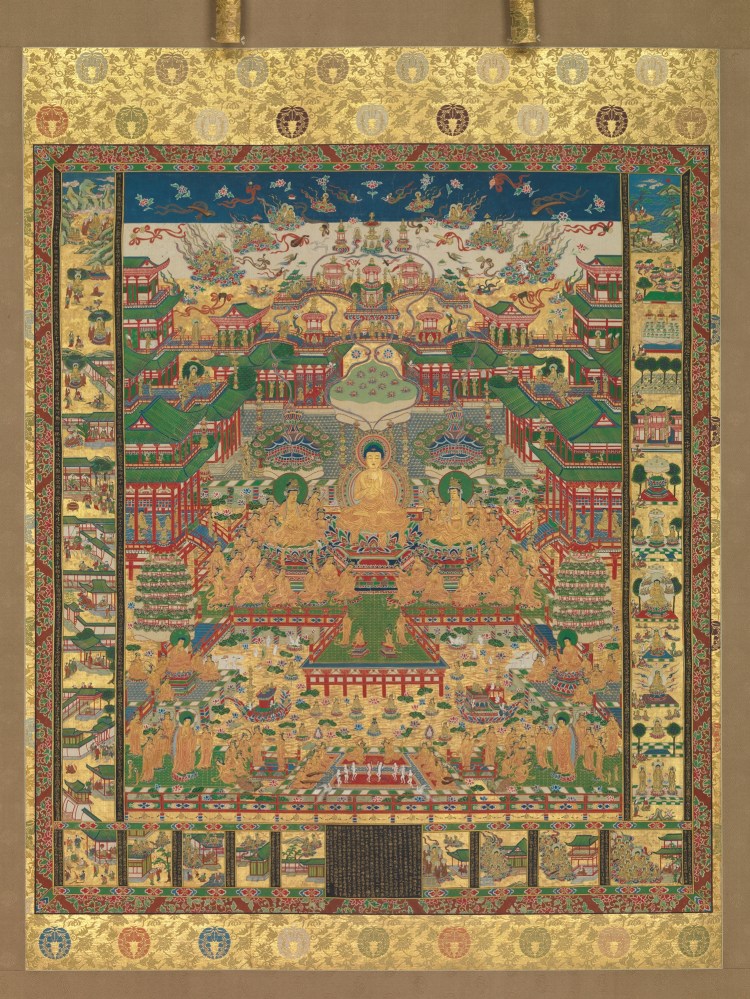
This practice extended into medieval Japan. The picture below is from an early work of Japanese Buddhist art attributed to a Nara Period-era monk named Chikō (智光, 709 – 770 or 781) who belonged to the Japanese branch of the San-lun (Sanron in Japanese) sect of Buddhism.
The “Chiko Mandala” (智光曼荼羅) depicting the Pure Land of Amitabha Buddha, attributed to Chikō. This version is a copy made in the Kamakura Period, while the original was made centuries earlier in the Nara Period.
Chikō wrote in the Muryōjukyōron Shaku (無量寿経論釋, “Commentaries on the Treatise on the Sutra of Immeasurable Life”):
There are two types of nembutsu. The first is the mental nembutsu (shinnen 心念) and the second is the vocal nembutsu (kunen 口念)….As for the vocal nembutsu, if you lack the power (to undertake the mental nembutsu), use your mouth (to recite the nembutsu as a means) to remain mindful of the buddha and to prevent your mind from becoming distracted. In this way, you can achieve mental concentration.
translation by Robert F. Rhodes
What’s interesting is that all of these monks, both in China and in early Japanese history, focused on Buddhist practices that focused primarily on visualization in keeping with the sutras, but that the verbal recitation as a complementary or support practice. This is further complicated in Asian languages because the Chinese characters for nenbutsu/nianfo are 念仏1 whereby 念 refers to the mind (e.g. thoughts, feelings, etc) and 仏 is the generic term for a Buddha. So, this can mean things like “bringing a Buddha (usually Amitabha) to mind”, or “recalling a Buddha”, or “holding a Buddha in one’s thoughts”.
The Taima Mandala, another famous Pure Land “mandala” from that era. More on that in another blog post.
To further complicate things, as we’ve seen above, this recalling of the Buddha is often conflated with the Buddha’s name since that presumably requires one to think of the Buddha as one is saying. This often happens so much so that when most people talk about the nenbutsu/nianfo, they’re talking about the verbal recitation only. This trend was further accelerated in 12th Century Japan when populist Buddhist movements such as Jodo Shu and Jodo Shinshu started. In order appeal to as many people as possible, meditation aspects of the Pure Land were eschewed and complete reliance on the name of Amitabha (e.g. verbal nembutsu) in some way or another became the core practice. At times in Japanese-Buddhist history, the name itself has become an object of meditation, but only so much. Pure Land Buddhist became much more widely popular after this time, but at the cost of the streamlining the practice to the verbal nembutsu only, then justifying this approach retroactively in various writings.
One thing that we haven’t touched on yet is the fact that many of these visualization practices were written by, and practiced by, the monastic community. The monastic community was the target audience since the monastic community comprised of bikkhus (monks) and bikkhunis (nuns) who had given up worldly pursuits in order to devote themselves full-time to practicing the Buddhist path full time. While the history of Buddhist monasticism even to the present day has its scallywags, there were monks and nuns who really did try to put these various meditation exercises, circumambulations, and verbal+visual practices to use.
But this leaves us with a problem: what is the Nembutsu? Is it the meditative practice, or the recitation?
It’s clear from the early tradition that the visual/meditative nembutsu was the intention, but it’s also clear that over time this proved elaborate and impractical, hence later generations have emphasized the verbal nembutsu, even though the meditative nembutsu is more inline with the overall Buddhist tradition.2. This leaves a tricky conundrum: expediency vs. efficacy (or doctrinal orthodoxy).
My $0.02 as a non-ordained, amateur Buddhist with too much time on his hands (and who doesn’t want to get sued) is that both are still needed. Mahayana Buddhism in the early years seems to have suffered a tendency of trying to “out-do” itself over and over in the literature until the practices and levels of attainment simply weren’t realistic anymore. A look at the Sutra of the 10 Stages within the massive Flower Garland Sutra will frighten all but the most dedicated Buddhists. Not surprisingly, as these teachings established roots in China (and cultures on its periphery), a culture that was radically different from India, reaction movements like Zen and Pure Land and Tiantai schools arose to basically “fix this”. Like software patches to fix the initial release.
But I think the core essence of the Pure Land tradition is still important and we can still learn from it, but not necessarily be bound by it. Nor do we have to follow the strict orthodoxy of newer “populist sects” either. They were products of their time, and outlook on the world, and not all of it applies to now.
In any case, meditation practice is still one of the most fundamental practices in Buddhism, and it doesn’t have to be a terrible slog either as described in places like in the Contemplation Sutra. In the excellent book The Way to Buddhahood, but the late Venerable Yin-Shun, he spent some time explaining how basic visualization meditation works. I’ll post this in a separate article, but the gist was that one should hold an image of Amitabha (or any Buddha or Bodhisattva) that one has seen (e.g. from a work or art, etc) in mind as they meditate. This is similar to mindfulness of the breath, but visually oriented. One can also supplement with reciting the verbal nembutsu as well.
At the same time, it’s easy for this practice to get in the way of itself. People who are perfectionists or suffer from “imposter syndrome” will begin worrying about their inability to focus their mind, doubt that they’re making progress, etc. In other words, their self-doubt and unrealistic drive to perfection will get in the way. This could happen just as easily with any other form of Buddhist practice, though. It does require a little bit of, dare I say it, faith in the practice and the Dharma, but also faith in oneself. 😉
Because Buddhist practice has a therapeutic side to it, I think it’s important to keep the practice simple, realistic, flexible and even a little pleasant. Not pleasant in the sense of whacked-out mental states, but in the sense of a calm, abiding joy. Find an image of Amitabha Buddha you like, find inspiration in the beautiful images of the Pure Land described in the Amitabha Sutra, find a reasonable period of time in your day (3 minutes, 5 minutes, whatever) and just try it. You can refine the process as you go, so long as you keep the right intentions in mind.
Meditation, like all Buddhist practices, is a process of emotional growth, insight into things, and fostering goodwill toward others. As long as you keep these things in mind, the rest will work itself out one way or another.
May the Light of Amitabha Buddha shine upon all beings! Namu Amida Butsu.
1 in traditional Chinese characters, it is written as 念佛. You’ll see this in places like Taiwan, but even in Chinese/Japanese temples and sources that predate the reformation of Chinese characters.
2 meditating on Buddhist figures is nothing new. Even Shakyamuni said there was some value in contemplating his own form, though he also downplayed the devotional side quite a bit.
When most people think of Ancient Greece, they think of ancient Athens with its democracy and philosophers, or Sparta with its militaristic culture.1 But Greece was a much larger and more complex culture, and no where is this more evident than in the Hellenistic Period.
The Hellenistic Period, covers a broad period from the death of Alexander the Great in the 4th century, to Cleopatra’s reign in the 1st century BCE. During this period, Alexander’s conquest quickly devolved into multiple, powerful Hellenized (Greek) kingdoms that vied one another for domination in the four Wars of the Diadochoi, followed by a breakup of the empire into distinct kingdoms, each with their strengths and challenges. Many were ruled by a former companion of Alexander, and their dynasties lasted for centuries, others were existing Greek colonies that navigated the complex Hellenistic world through alliances and building armies of their own.
These powerful kingdoms included, but were not limited to:
Ptolemies who ruled Egypt, including the famous city of Alexandria.
Seleucids who ruled the vast lands once ruled by the Persians including Babylon, Judea, and for a time the lands next to India (present day Pakistan and Afghanistan).
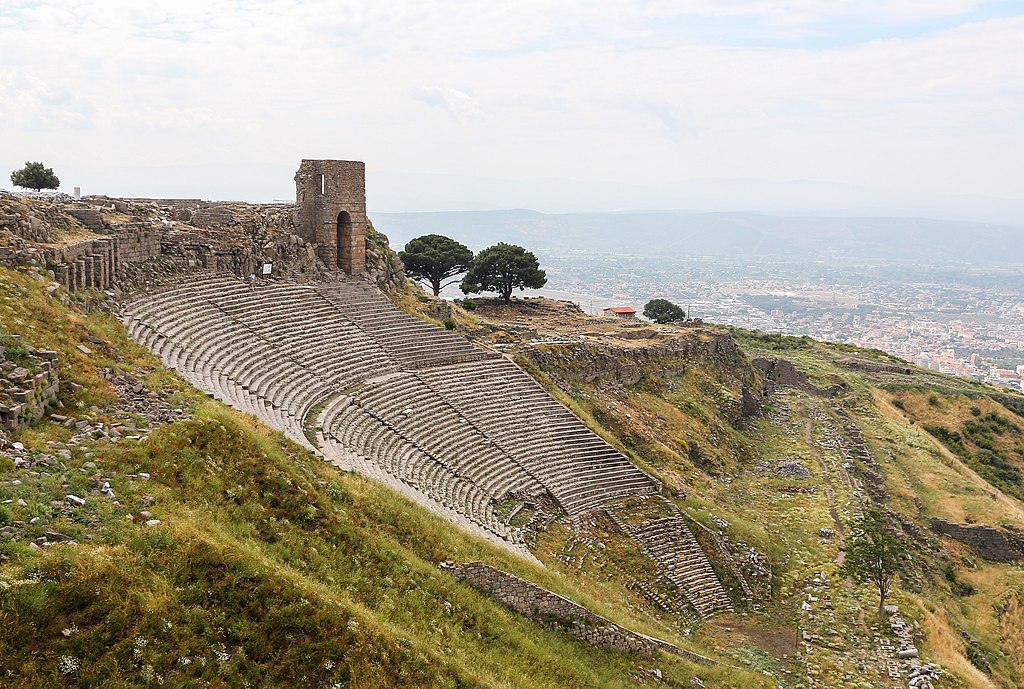
Attalids who ruled the powerful, dynamic city-state of Pergamum.
Antigonids who reigned in Greece and Macedon after Alexander’s death.
The powerful western colony of Syracuse, home of Archimedes
The powerful Kingdom of Pontus surrounding today’s Crimean peninsula.
An example of Greco-Buddhist art in Gandhara (modern day Pakistan), showing the Buddha and flanked by guardian Vajrapani, whose depiction clearly borrows from the Greek hero Herakles. Courtesy of Wikipedia.
A lot of aspects that people are vaguely aware of about the ancient Greek world are often found within the Hellenistic Period, including things referenced in the Bible, the Buddhist tradition, major philosophical schools, venerable works of art, and rivals to the later Roman Empire. Eventually, the Roman Empire defeated all but the most eastern regions (who fell to the Parthians and other conquerors), but the legacy they left behind has persisted through the centuries even up until now.
I’ve been reading a lot about this period from an excellent book called From Alexander to Cleopatra: The Hellenistic World by Michael Grant. This book covers every facet of life in the Hellenistic World: history, structure, life, art, architecture, philosophy, etc.
What’s most fascinating about the Hellenistic Period is how diverse the different characters and regions of the larger Greek world were, and yet how each had distinctive Greek influence. For example, the city-state of Syracuse, home of Archimedes, on the island of Sicily was a remote Greek colony yet it was also a great center of learning with additional influences from the Carthage and Roman culture. On the other end of the Hellenistic world was the city of Seleucia, which was built deep in the heart of Mesopotamia had much cultural exchange particularly in the fields of mathematics and astronomy between the Greeks and the native Mesopotamian culture. Everywhere the Greeks and their colonies went, they left their mark upon the world, but the native cultures left their marks on the Greeks as well.
The book and its contents are much too broad and complex to cover in this blog post, but it’s well worth a read, and I will likely be revisiting this topic again soon in subsequent posts covering different aspects of the Hellenistic Period.
While this period is not well known to general audiences, the Hellenistic Period represents the high-water mark of Greek culture, but also reflects a deeply cosmopolitan and dynamic period of history where changes to society and ideas were emerging, and in ways not previously seen in western culture, yet with lasting effect.
P.S. If you’d like to learn more about the Hellenstic Age, I highly recommend the Hellenistic Age Podcast. I’ve been enjoying this for months and it is top-notch.
1 The myths of Sparta present a lot of problems and misconceptions. Movies like 300 are a joke, and not remotely accurate to life in actual Sparta, but that’s a rant for another day.
Recently, I was reminded of an anecdotal tale from the early Roman Empire about the introduction of Gauls to the Roman Senate. The anecdote is also frequently alluded to in Professor Mary Beard’s excellent overview of Roman History titled SPQR: A History of Ancient Rome.
In 48 CE, Emperor Claudius was trying to convince the Roman Senate in his capacity as princeps (first among equals in the Senate) to allow Gauls as members of the Senate. According to Professor Beard, Claudius played up Rome’s ancient history during the time of Romulus and the fact that it had been founded on foreigners being integrated into Rome (sometimes forcibly), so why should Gauls, who had been part of Rome for generations since Julius Caesar’s conquest, be any different?
But this didn’t go down well, for some Romans. There were plenty of Roman stereotypes about Gauls, not the least of which was their different appearance. According to Greek historian Diodorus Siculus he described them in the first century BCE like so (source):
Some of them shave their beards, but others let it grow a little; and the nobles shave their cheeks, but they let the mustache grow until it covers the mouth.
Romans often used the term “hairy Gaul” (Gallia Comata) to describe the province of Transalpine Gaul which included territory that Julius Caesar had conquered in the Gallic Wars. In the video series Historia Civilis, the narrator explains in one video that when Caesar in his role as dictator, appointed some Gauls to the Senate in order to fulfill some of his post-conquest promises, the people in Rome had an uproar. There were jokes about Gauls invading Rome (just as they did centuries before), asking for directions to the Senate house. Professor Beard confirms these jokes were making the rounds among the people in Rome.
However, despite these persistent stereotypes as hairy barbarians, the Gauls, especially among the nobility, were adopting Roman lifestyle habits, dress, using Latin language and even teaching their children Latin. They were just about as Roman as anyone else was, but Roman “natives” kept looking down at them.
A century later, when Emperor Claudius gave his speech, he still had to justify the idea to the Senate:
If anyone concentrates on the fact that the Gauls gave Julius Caesar, now a god, such trouble in war for ten years, he should consider that they have also been loyal and trustworthy for a hundred years since then.
Mary Beard, “SPQR”, chapter 12
It’s interesting that many Romans, despite being founded on a tradition of integration with foreigners, still couldn’t stomach the idea of Gauls in the Senate both in Julius Caesar’s time and later with Emperor Claudius. Despite Roman citizenship being granted to people in the provinces, some people simply felt they were more “Roman” than others, regardless of legal status.
Interesting parallels for our times.
P.S. For a fascinating look at the real Gauls, including Celtic culture at large, I highly recommend this podcast. Needless to say, there is a lot about ancient Celts that people don’t know.
Lately, I’ve been watching some fascinating videos by Historia Civilis on Youtube (Patreon page here) about politics in the days of the Roman Republic and the transition to an empire. This video is an overview of how the Roman consulship worked:
The fact that Rome had two leaders, or consuls, and a Senate is pretty fascinating to me. It’s interesting to see how politics then really don’t differ all that much from now.
Anyhow, great video series, so please take a look and show the author some appreciation! 🙂









 Gleanings in Buddha-Fields


You must be logged in to post a comment.