A Not-So Brief History of Zen and Samurai

There is a persistent image in the West of samurai being adherents of Zen, that the “way of the warrior” (bushido)1 and Zen are somehow one and the same. One can imagine a samurai who has practiced swordsmanship to a finely honed skill, meditating under a waterfall, and writing Zen-like deathbed poetry before preparing to throw away their life in battle. In my first visit to Ryoanji temple (featured photo shown above), 28-year old me had a similar image in mind persisting all the way back when I was a naïve 16-year old white kid just reading about Zen for the first time. Looking back after almost 20 years of Buddhist-study and practice, I facepalm at myself a little, but it’s a very persistent image in media. (side note: Last Samurai is not my favorite movie)

So, did samurai really embrace Zen, and was Zen essentially a “samurai religion”? Turns out, it’s complicated, and most of the imagery was romanticized.

Recently, I dusted off an old book that I hadn’t read in years: Five Mountains: The Rinzai Zen Monastic Institution in Medieval Japan by Professor Martin Collcutt. As I am stuck home in Covid-isolation for a few days, I finally have time to both read and write about it.

Dr Collcut summarizes all this in the book:

Even at the height of its influence in the last fourteenth century, Zen–including the more widely diffused Sōtō Zen–probably had still not replaced devotion to Kannon, Jizō [Bodhisattva], the Lotus Sutra [e.g. Nichiren Buddhism], or the Pure Land of Amida in the hearts of most ordinary, and many high-ranking, Japanese samurai.

page 80

Further:

Zen in the Kamakura and Muromachi periods can be called “the religion of the samurai” only in the sense that most patrons of Zen were samurai, not in the sense that it was practiced assiduously or exclusive by all, or even perhaps the majority, of those who would be described as warriors.

page 80

So where did the image come from? Let’s take a brief look at the history of Zen, especially Rinzai Zen, in Japan.

The Two Lineages of Zen in Japan

Japan has historically two sects of Buddhism, both descended from Chinese lineages: Soto and Rinzai Zen. The differences between the two are too big to cover here, and there’s plenty of information on the web that explore the two. Suffice to say, the two lineages came to Japan in the 12th century, but took pretty different trajectories.

Soto Zen, founded by Dogen after journeying to China, did not sit well with existing powerful Buddhist sects in Japan, because of Dogen’s unwavering commitment to his ideal of ideal Zen practice, and was pushed out to the countryside. For centuries it was obscure, and enjoyed little patronage beyond certain local samurai families, primarily for the sake of prestige. Its popularity grew later through the efforts of a monk named Keizan, who developed increasing patronage from (mostly) provincial samurai rulers, and cultivated more community support. Professor Bodiford’s book, Sōtō Zen in Medieval Japan, is an excellent overview of its history. In any case, all Soto Zen traditions in Japan (and beyond) trace back to Dogen.

Rinzai Zen, founded by Eisai, has a much more complicated history. Eisai was willing to compromise more when he returned from China with the Buddhist establishment, so early Rinzai Zen was more like a hybrid Zen-Tendai Buddhist institution with a lot of esoteric practices. It enjoyed further popularity under Enni Ben’en (圓爾辯圓, 1202 – 1280) in the capitol of Kyoto, but remained a relatively small sect, often conflated with existing Buddhist institutions at the time.

Zen really didn’t take off until the second-half of the Kamakura Period under the Hojo Clan regency. After the death of Sanetomo, the 3rd shogun, the subsequent shoguns, distant offshoots of the family, were installed but increasingly powerless against their own regents, the Hojo Clan. Under talented Hojo leaders such as Hojo Tokiyori and Tokimune, power was consolidated, and they became the effective rulers of Japan.

But there was a persistent issue: the Hojo Clan, while militarily powerful and based in Kamakura was seen as inferior to the old aristocracy (e.g. the Fujiwara) in Kyoto who had centuries of refinement to rely upon compared to the upstarts. The old Buddhist establishment was still closely allied to the aristocracy, and thus hostile to the Hojo Clan.

Enter the Mongols

When the Mongols finally destroyed the Song Dynasty in China, establishing the new “Yuan” Dynasty, the upheaval affected many monastic institutions. Some monks, including ardent Song-loyalists, decided to leave China and make the journey to Japan either to get away from Mongol authority, or possibly in some cases, to work as spies for the Mongols who later tried to invade Japan.

Starting with a monk named Lanxi Daolong (蘭溪道隆, 1213-1278), who came to Japan in 1246 for reasons not entirely clear, followed by Wuan Puning (兀庵普寧, 1197 – 1276) in 1260, a steady stream of Rinzai-lineage monks came to Japan. For the Hojo leadership, this new source of Chinese education, culture and religious teachings practically fell into their lap, and they quickly adopted these new monks, establishing a series of monasteries in the new capital of Kamakura starting with Kenchōji (website here) in 1253, and expanding to other temples such as Engaku-ji in 1282. These new temples in Kamakura Zen temples were different than the ones that Eisai and Enni Ben’en’s temples had established in Kyoto, designed to match Song Dynasty practices, with Chinese monks frequently serving as abbots.

Thus, Rinzai Zen in Japan was essentially established as two separate lineages2 albeit with a common ancestry: the first lineage established by Eisai and popularized in Kyoto by Enni Ben’en that incorporated more native Japanese-Buddhist practices, and the second lineage which came later driven by Chinese Zen monks during the end of the Song Dynasty who established a more “pure” form of Zen based on the Chinese model. It should be noted that the Chinese monks mentioned above did journey to Kyoto as well to update existing monasteries of the older lineage to modern (e.g. Song Dynasty) standards as well, but the temple of Kenchōji was the premiere Zen temple for centuries in Japan. Further, by the 14th century, and especially later, much of Rinzai Zen was more homogenized than the early communities.

The arrival of the Chinese-Buddhist teachers to Japan in the 13th century is important to note, though, because this is the point in time where the samurai class really start to interact with Zen communities.

The Hojo Clan had finally found a way to one-up their rivals in Kyoto by raising their own cultural credentials with the new immigrants from China, but also some Hojo family members really did embrace Rinzai Zen teachings. Hojo Tokiyori (北条 時頼, 1227 – 1263) and his son, Tokimune (北条 時宗, 1251 – 1284) both became avid students under Chinese teachers, patronized the new monastic communities in Kamakura, and encouraged its practice among their samurai vassals. Other regents of the Hojo Clan never took much interest. But now, Zen finally had the patronage it needed to expand and grow in Japan, yet as Collcut’s book shows, it was still largely adopted for cultural prestige, and also oftentimes due to obligation towards Hojo Clan. Many of these vassal clans later rose to be major powers centuries later (cf. Hosokawa, Takeda, Uesugi, Tokugawa, etc) with their own patronage to Zen temples in their provinces.

Later, as the Hojo Clan finally declined in power, and gradually replaced by the Ashikaga Clan (e.g the Muromachi Period), the pattern continued. Both the emperors of the time such as Go-Daigo and Hanazono, and the Ashikaga Shoguns patronized Rinzai Zen temples, but often times for political expediency. The “Five Mountains” monastic system developed at this time, borrowed from Chinese cultural, is a big topic, and worthy of its own post.
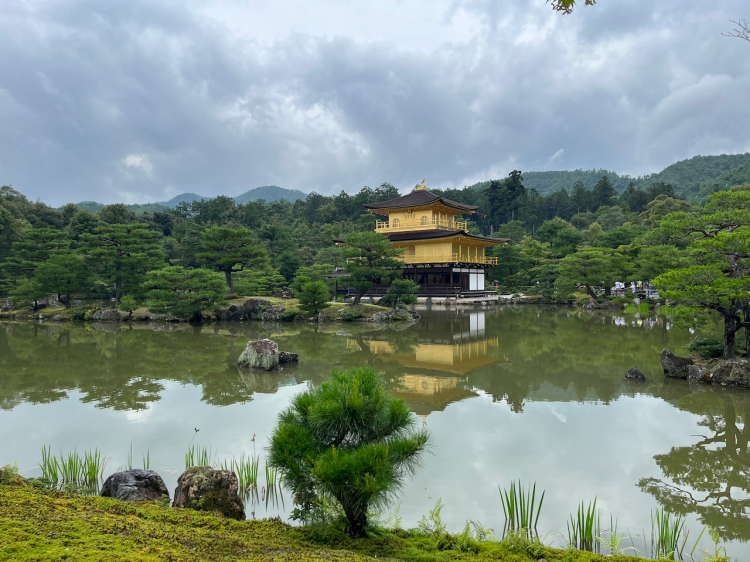
The Golden Pavilion, built as a villa for Ashikaga Yoshimitsu, later converted to a Rinzai Zen temple.

The high-point of “Zen-Samurai” culture as we know it can probably be traced to the 8th shogun of the Ashikaga Clan, Yoshimasa (足利 義政, 1436 – 1490) who while being a dismal military commander, was a brilliant innovator of Zen aesthetics. Yoshimasa had a taste of artistic genius, and patronized Zen-influenced architecture, painting, poetry, and gardening, and so on, but also directly added his own spin. The “zen aesthetic” we all recognize is largely due to Yoshimasa who synthesized earlier Song-Dynasty culture through establishment of institutions by the Hojo Clan.

However, on a personal level, Yoshimasa recited the nembutsu and seldom meditated.

Conclusion

All this is not meant to detract from Zen teachings, or the contributions of Zen monks to Japanese culture, or to imply that there were no Zen-devotees among the samurai class, but as I alluded to in the beginning, the romanticized Zen-Samurai image mostly exists on paper or in the writings of its sincere devotees. It was the ideal at the time among enthusiasts, and this ideal has persisted into Western culture, including teachers and self-help gurus.

How samurai in Japan, or Japanese in general, interacted with Buddhism (including Zen) was complicated and very individual, and not always related to piety. When you look at other pre-modern cultures, you see similar patterns. The emperors of the Eastern Romans had a complex relationship with the Church, and usually were not interested in the deeper teachings, or various doctrinal conflicts of the Byzantine Orthodox church except when it interfered with political goals (cf. iconoclasm, schisms, etc), or were varying degrees of sincerity. Further, how they practiced religion would have been noticeably different than your typical Eastern Roman in the provinces or the streets of Byzantium.

Now, imagine the same in any other culture: Western medieval communities, people in the Islamic caliphate, Chinese Buddhists, etc.

In short, how people interact with religion, and how its romanticized, are two different things. The dynamic interaction of people, culture and religion is fascinating, but not very marketable. The romanticized form of religion is marketable, but is like a bag of potato chips: tastes good, but rarely provides anything meaningful.

1 Please, please, please: if you ever go visit Japan, do not wear a “bushido” shirt. It really pegs you as a tourist.

2 The third “Obaku” sect of Zen in Japan is in fact yet another Rinzai Zen lineage that came from China, this time from the Ming Dynasty. By this point, Pure Land Buddhism and Zen in China had largely reconciled, and Obaku Zen includes more elements of Pure Land than is found in other Rinzai lineages, while still retaining its core Zen element.

The Pious Prince Shotoku

This pagoda (Buddhist stupa) we saw in Kyoto near Kiyomizudera is among others attributed to Prince Shotoku.

The 6th century Prince Shotoku (Shōtoku Taishi, 聖徳太子) holds a revered place in Japanese culture not unlike Constantine the Great, Emperor Ashoka, or Good King Wenceslas. Even today, kids in Japan learn about Prince Shotoku through comic books, art and even the two-thousand yen bill. Even my son, who’s grown up in both Japanese and American culture has learned about the famous prince who was so smart that he could listen to ten conversations at once and recall each individually.

On a historical note, several famous Buddhist temples and pagoda (Buddhist stupa) are attributed to Prince Shotoku, including Horyuji. Further, he reorganized the Yamato court in a Confucian-style bureaucracy and is said to have composed an early Buddhist constitution.

But who was Prince Shotoku?

Prince Shotoku was part of a powerful triad at the time, consisting of Empress Suiko, a rare example of a powerful empress in Japanese history, Prince Shotoku as regent and advisor, and Soga no Umako, head of the powerful and reformist Soga Clan with strong connections to Korean and Chinese communities.

Japan at this time was emerging from geographic isolation and increasingly establishing cultural contacts with the Korean Peninsula, and with Tang-Dynasty China. This led to a power struggle between more conservative, nativist clans such as the Mononobé and Nakatomi, and reformist groups such as the Soga. The triad above were definitely reformist, and clashed with the conservative faction eventually leading to war.

According to the Nihon Shoki, on the eve of battle, Prince Shotoku prayed to the Four Heavenly Kings (a group of Buddhist guardian deities) for success. Upon crushing the Mononobe and their allies, Prince Shotoku built and dedicated the temple of Shitennnoji to the victory. The rest, as they say, is history.

Let’s talk about some of the things attributed to Prince Shotoku…

Buddhist Constitution

In 604, Prince Shotoku supposedly promulgated a seventeen article constitution based on Buddhist and Confucian principles: the jūshichijō kenpō (十七条憲法). Unlike a modern constitution, it was not legally binding, but more of a vague statement of governance, and was later replaced by the Ritsuryo System in the 8th century.

Translations of the 17 Article Constitution are hard to find, but you can see examples of it here and here.

Japan’s New Name

Names for Japan in early, early history varied and inconsistent. Chinese officials called it the land of Wa (倭), and Japan often called itself Wakoku (倭国) or Yamato (大和). However, the modern Japanese name for Japan, Nihon (日本) is attributed to a letter that Prince Shotoku wrote introducing his sovereign to the Sui Dynasty in China:

“From the sovereign of the land of the rising sun (hi izuru tokoro) to the sovereign of the land of the setting sun.”

The “land of the rising sun” evolved into Nihon (日本, lit. “where the sun comes from”).

Further, by putting the Emperor of Japan on equal footing as the Emperor of China, Prince Shotoku was not so subtly rejecting the Chinese-centric world view.

The Cap and Rank System

Prince Shotoku is also credited with establishing the first meritocracy in Japan in 603, inspired by Chinese Confucianism called the Kan’i Jūnikai (冠位十二階, “Twelve Cap and Rank System). The idea was to get out of hereditary government appointments, and promote ministers based on skill and talent, using a series of colored caps to correspond with rank (instead of lineage).

Promulgation of Buddhism

A copy of the Lotus Sutra said to be composed by Prince Shotoku. 日本語: 尾上八郎English: Hachiro Onoue, Public domain, via Wikimedia Commons

Prince Shotoku was said to be a great promoter of the Buddhist faith in Japan. We talked about the conflict with the nativist Mononobé clan earlier, who held to the Shinto faith, but after Shotoku’s victory, he continued to build temples such as Horyu-ji and stupas (like the one shown above), copy sutras, and so on.

Further, later generations of Buddhist teachers in Japan revered Prince Shotoku almost as a cult figure, often conflated with Bodhisattva Kannon. Even today, if you go to many Jodo Shinshu Buddhist temples, you will often see a scroll of Prince Shotoku to the side of the central altar due to the founder Shinran’s devotion to Shotoku.

Historicity

The historicity of Prince Shotoku is interesting though. While a historical figure named Prince Umayado (厩戸皇子) is thought to have really existed, and is thought to be the origin of Prince Shotoku, many of the stories and accomplishments attributed to him may have come from other sources.

Early Japan at this time was importing much mainland culture through the Korean kingdoms of Baekje and Silla, as well as China, and this often meant that immigrant families migrated to serve the early Japanese court. The Hata clan, for example, came from Silla.

The book Shotoku shows how certain subtle aspects of the Shotoku myth stories reflect cultural sources from Silla, via immigrant groups such as the Hata clan. This is through specific imagery used, coupled with archeological evidence from known sites in early Japan where immigrant groups habited, and their influence on local Shinto shrine practices.

For example, a famous story in the Nihon Shoki about Prince Shotoku and the Beggar of Kataoka reads as follows, with [my additions] and (additions from original author):

21st year, 12th month, 1st day.

The crown prince [Shotoku] made a journey to Kataoka. At that time there was a starving man who was lying at the side of the road. He asked for (the beggar’s) name, but he said nothing. The crown prince seeing this, gave him food and drink. He then took off his cloak, and covered the beggar with it, saying “lie there in peace.” He then made a song.

12th month, second day.

The crown prince sent a messenger to see the starving man. The messenger returned and said “The serving man is already dead.” The crown prince was greatly saddened by this and he therefore had them bury the man at that spot in a tomb that was firmly shut. Several days later [trimmed for brevity] he sent (another) messenger to look (at the tomb). The messenger returned and said “When I arrived at the tomb, (the earth) was firm and had not moved. (Yet) when I opened it and looked inside the corpse had already disappeared. There was only the clothing folded above the casket.”

At this the crown prince once again sent the messenger back to retrieve the clothing. He then wore it as he always had done. The people then all marveled at this and said “It is true that a sage knows a sage!”…

Shotoku, by Michael I Como, page 102

The story is hard for Western audiences, and even modern Japanese ones, to understand without additional context. Elements such as the dead resurrecting were motifs used by an immigrant community called the Wani clan from the Korean peninsula in their origin stories, and the notion of a “sage prince” was an idea imported from Chinese-Buddhist culture.

The book takes a very detailed an exhaustive look at the legends and stories of the time, but this example shows how the legend of Prince Shotoku was gradually constructed from obscure cultural trends and symbolism popular in antiquity, and conflated over generations. In later versions, for example, the beggar is the Indian monk Bodhidharma.

The Joseon Dynasty of Korea: death by factions

If political gridlock, government shutdowns due to budget fights, and rabid factionalism get you down, consider the case of the Joseon Dynasty of Korea (1392–1894). The Joseon Dynasty, also known as Joseon-guk in Korean (朝鮮國, 조선국) was the last and longest of royal dynasties of Korea. At 502 years long, it is also among the longest dynasties in world history.

After the rise of Buddhism in East Asia, Confucian teachings took a backseat for a time, until it re-emerged centuries later under a doctrine called Neo-Confucianism. Neo-Confucianism is a fascinating subject all by itself, but it’s a hard one to describe to Western audiences. It’s enough to know that it was an effort to reinforce early Confucian ethics with more philosophy and metaphysics, while avoiding mysticism.

This is important because Neo-Confucianism became the official state doctrine early the foundation the Joseon Dynasty, just as it had become Ming-Dynasty China and Tokugawa-era Japan. Schools of Confucian scholars would staff the elaborate bureaucracies used by each sovereign, and provide advice on policies, or criticism if the sovereign’s conduct was deemed inappropriate or immoral. As the beacon of a rational and orderly society, the sovereign was held to a very high standard, but also (in theory) commanded unwavering loyalty from his subjects. Because orderly and rational societies were valued by Confucian thinking, there was heavy emphasis on ritual, etc. Everyone had their place, and everyone was expected to carry out their moral obligations, putting the needs of society over their own profit.

On paper, this was how it all worked.

In reality, the Confucian bureaucracy (the yangban) of Korea grew very powerful, and different schools of Confucian thought began to compete with one another for dominance in the Joseon bureaucracy. Over generations, these rivalries grew very cutthroat, and worse they splintered into sub-factions, and sub-sub-factions, all vying with one another. Further, sons of bureaucrats had the wealth and resources necessary to ensure they’d pass the civil service exams and become bureaucrats themselves. The Iron Law of Oligarchy comes to mind.

Source: https://xkcd.com/1095

This might seem kind of silly at first glance, since it obviously contradicted basic Confucian ethics.

However, this all began when bureaucrats in the court would debate how to address policy issues at the time, or question certain political appointments. Inevitably reform and conservative wings developed with different views of how to address such issues, and the leading figures of each wing would try to then pack the bureaucracy with their own men.

Is this starting to sound familiar?

The back and forth by factions, starting with the Easterners (dong-in, 동인 or 東人) and Westerners (seo-in, 서인 or 西人) began over subtle ideological disagreements. Then, each of these factions broke up into different factions. The Westerns faction alone broke up into the Noron (노론, 老論) and Soron (소론, 少論) depending on whether you supported Confucian scholar Song Si-yeol‘s reformist policies (the Noron) or not (the Soron). The Easterner faction similarly split up into Buk-in (“northerners”, 북인, 北人) and Nam-in (“southerners”, 남인, 南人) factions.

The king’s response to each of these factions varied by sovereign. In some cases, a king would support one faction over another. But if that faction got too powerful or out of line, the losing faction could sometimes convince the king to purge them from the bureaucracy. Sometimes the purges became extremely violent, with many faction members executed such as the one in 1589.

Inevitably, once a faction was crushed or purged, another would take its place in the court and consoldiate power, requiring yet another purge. By 1545 there had already been four blood purges.

Portrait of King Yeongjo of Joseon, source

By the time of King Yeongjo (1694 – 1776, 영종, 英宗) the fighting between factions and the bloody purges had gotten so out of hand, that Yeongjo survived an assassination attempt in his youth.

Yeongjo tried to take the high-ground in the conflict, implementing a policy of Tangpyeong (탕평, 蕩平) or “great harmony”. Yeongjo tried to stay above the fray and remained somewhat successful. Barely. By the reign of the next king, his grandson Jeongjo, the bureaucrats were at it again and King Jeongjo fought off a coup by the Noron faction.

In spite of the coup, the Noron dominates the court after Jeongjo’s later (and mysterious) death until they were ousted for good, but by this time the functions of government were locked in by certain powerful families and from the 1800’s onward the Joseon became isolationist and dysfunctional at a time when Western and Japanese powers grew in strength and aggression. The reforms of 1895 were simply too little too late to save the Dynasty and Korea was annexed by Iapan in 1905.

Much like the Eastern Roman Empire (i.e. the Byzantines), the Joseon Dynasty survived and thrived at times when there was a powerful ruler who could push for reforms, and keep interests in check. But there were always sharks circling the water, and as soon as they smelled weakness there would be bloody infighting and this would reset the clock on any meaningful reforms. Paralyzed by internal strife, other more dynamic, external powers eventually pulled ahead and defeated them.

Portrait of Kim Yuk (1570 – 1658), source.

It also should be noted that were plenty of good, sincere Confucian scholars who made a genuine effort at good governance, such as Kim Yuk, but in the end, powerful men always felt they could do it better when they sensed an opportunity.

P.S. astute readers may have noticed that I keep posting the names using both Hangeul script and Chinese characters (Hanja). Until the modern era, both were used together in a kind of mixed fashion, especially when a person wanted to avoid ambiguity (the Chinese characters are more distinct). Compared to neighbors like Japan or China, Chinese characters were used comparatively less (Hangeul was usually sufficient and simpler), but remain an important part of the language and culture.

Isis and the Buddha: an Egyptian discovery

Recently, archaeologists have uncovered a statue of the Buddha, not in India or Asia, but in ancient Egypt! The statue, according to the Egyptian government, was uncovered as part of a temple dedicated to Isis, and crafted by a local Indian Buddhist community during the early Roman Imperial age, the Principate.

The cult of Isis was a fascinating example of religion in the Hellenistic Period, and inherited later when the Romans took over the eastern Mediterranean. During the Hellenistic Period, a period of constant political rivalries, and large movements of Greek people, and expansion of Greek culture through colonies, the old Olympian religion had increasingly proved unable to help people through difficult times. The old Olympian religion was focused on public cults in a kind of “contractual” religion where people of a city-state publicly worship a particular god, and get something out of it. For more personal needs, there just wasn’t much substance.

Thus, mystery religions such as the Cult of Demeter and others arose. These provided more personal relationships with the gods, and clearer undersetanding of the afterlife, and how one might secure a better fate than just being an empty shade wandering in Hades (cf. Homer’s Odyssey).

When the Macedonian Ptolemy family took over Egypt, they had to reform Greco-Egyptian society into something they could rule legitimately, so certain gods were reinvented or elevated. Egyptians had done this too, but the Ptolemies tapped into this and elevated two gods in particular:

  • Serapis – a kind of hybrid god based loosely on Osiris, but also Zeus.
  • Isis – Osiris’s consort.

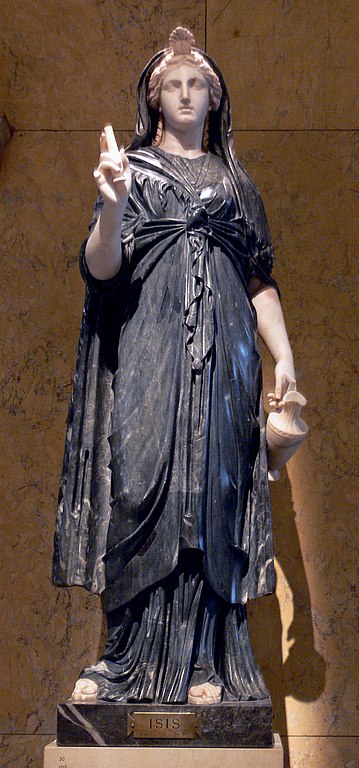
Isis’s role in particular grew far beyond the original Egyptian religion and her cults spread across the Roman world. Her status also grew in that she wasn’t just a mother goddess, but the mother goddess: embodying wisdom, magic, maternal love and so on. Other goddess figures from disparate cults were sometimes viewed as just more manifestations of Isis. There are even

A statue of Isis, from the 2nd century CE. Photo: Andreas Praefcke, Public domain, via Wikimedia Commons

Isis’s religion wasn’t organized according to the kind of doctrine or dogma we associate with modern religions, it was still very much a form of personal, devotional worship,1 rather than an “one-size fits all” religion to explain everything. Roman society at large was still a marketplace of religions, but the religions had changed from mostly public ritual (e.g. the Olympian gods) to more internal, personal religion.

So, how does the Buddha fit into all this? That part is still being researched, but given Isis’s status as a goddess of wisdom, putting a statue of the Buddha, a figure also associated with wisdom, in her temple was probably a useful cultural prop. Indian merchants, had a trade colony in Egypt at the time, and the Buddhist religion in India reached a high-water mark at the time, so at least some of the Indian people living in Egypt would know of it, or might even be devotees.

Does that mean that there were Buddhist communities in Roman Egypt? Evidence is very scant. Even if there were, their presence was likely limited to the Indian expat community.

Still, the cultural cross-over is pretty fascinating.

P.S. This is the last post before the family and I head to Japan. When next we meet, I’ll post updates from

1 Similarly, worship of Mithra, a Zoroastrian deity imported into Roman culture, enjoyed widespread devotion among soldiers and other figures. People worshipped the god or goddess they tended to feel most affinity with.

Revisiting the Eastern Romans: the Byzantines

For some time, I have been following podcast called the History of Byzantium Podcast, which covers the lengthy history of the Eastern Romans from 5th century all the way to the fall in 1453, a thousand years later.

“Wait!” you might be wondering, “didn’t the Roman Empire fall in the 4th century to barbarian invasions?!”

Yes, and no.

The reforms of Emperor Diocletian after the Crisis of the Third Century had essentially split the Roman empire into two, smaller more manageable empires:

The small Greek town of Byzantion (Byzanitium in Latin) became increasingly important after Emperor Constantine made it his new capitol, renaming it after himself (Constatinople).

In any case, when the Roman Empire fell, it was only the Western half, which was the less prosperous, less populous half anyway. The eastern half was able to bribe or drive out the hordes, and kept going.

In fact, it kept going until 1453. Over the course of 1,000 years, it gradually changed, losing its Latin influences and becoming increasingly Greek in nature, but until the 4th Crusade, there never was a break in the Roman Empire of the East. Professor Anthony Kaldelis pointed out that Greek people continued to identify themselves as “Roman” even into 20th century during Ottoman times, and even the Ottomans referred to Greece as the Sultanate of Rûm (Rome). Historians use the term “Byzantine” to describe the Eastern Roman Empire, but Romans in the East never used this term. They called themselves “Romania” or “Rome”.

Was it even Roman anymore? Western purists would assume “no” because Rome the city wasn’t part of the empire, but even before the 4th century, Rome had ceased to be the the center of the Empire as the Western half administered things from Ravenna or other cities. Further, Latin was never technically the official language of the Roman Empire (as in, “by law”). Greek and Latin co-existed, and Greek speakers always outnumbered the Latin-speaking ones because of the influence of the earlier Hellenistic period (for example in Roman Egypt).

Alexios I, Komnenos, one of the last great Emperors of the Eastern Roman Empire. Public domain, via Wikimedia Commons

Further, the Republican aspects of the Empire kept going in Eastern half many centuries later. This concept of res publica wasn’t the same as modern English “republic” (never was), as in a specific system of government, but instead was used to describe “Rome” the polity. When the first emperor, Augustus, took over as the princeps (“first among equals”), the term res publica was still widely used to describe Rome, and kept going through the Byzantine era using the Greek equivalent politeia (πολιτεία). The Emperors during the Byzantine era were still installed and overthrown in the same way the earlier Emperors had been.

As Anthony Kaldellis demonstrates, Emperors were always subject to popular will, just as the old Republican consuls had been, and nothing really changed in the Byzantine era. Thus, the res publica of Rome was a continuous spectrum from the earliest days of the republic to the 15th century.

All this is to say that, when we speak of the “Fall of the Roman Empire”, in reality, only some of the Empire fell in the 5th century. The rest, amazingly, kept going. Constantinople was for centuries one of the largest cities in the world, and the Theodosian Walls were never thrown down until the invention of modern cannon warfare.

Like any empire, the Eastern Romans had periods of growth and decline, and as the neighbors gradually caught up in terms of technology and military skill, Constantinople’s power steadily waned. In the days of Julius Caesar, Rome was so far ahead of the Gauls and other neighbors, it was easy to steamroll them, but by the time of Alexios Komnenos, the Eastern Empire faced many complex and powerful enemies, and there’s just only so much a society can do in that scenario. As the host of the podcast explains, the chessboard was very crowded.

So, if you’d like to know more about the Eastern Romans, not Byzantines, please check out the podcast above.

Juneteenth and What It Means For All Of Us

In Charles B Jones’s overview of the Pure Land Buddhist tradition, he talks about a sect called the Yuzu Nembutsu sect (which I explored here), but in particular, he delves into the Buddhist concept of interdepedence, which the sect relies upon:1

Suppose you lay a row of ten coins on a table, and then move the tenth coin in front of the first, shifting the rest over one position. You probably assume that changing the order does not affet what they are in any way. However, from the Huayan point of view, they are not independent of one another; the first is coin one of ten, the second is two of ten, the third is three of ten, and so on. Their relationship with the other coins in the row is part of their identity and figure into the way we conceptualize them. When you take the last coin and move it to the first position, it changes from ten of ten to one of ten. At the same time, since the relation of the other coins to the one you moved has changed, they are no longer the same coins as before either, even though you did not move them.

Charles B Jones, “Pure Land: History, Tradition, and Practice“, page 120

It’s not enough to simply exist, things exist in relation to one another, and what affects one thing affects others. Taken in total, this is the Buddhist-Sanskrit concept of shunyata.

So, what does this have to do with Juneteenth?

The enslavement of Africans, generation after generation didn’t just traumatize and dehumanize black Americans, it dragged all of society down with it. Everyone was adversely impacted by it in one way or another, even those who profited from it. American society was poorer for it, directly contradicting its own high ideals of human rights, and forcing some to use mental gymnastics to justify such a barbaric enterprise, even resorting to organized violence to deflect their own festering guilt and paranoia. This spilled over into such conflicts as the infamous Bleeding Kansas, and then again later in the Civil War, to say nothing of the tragic deaths of countless Black Americans.

Thus, while Juneteenth wasn’t a holiday that I grew up with as a white kid of the 80’s and 90’s, I am glad to see we celebrate it now. Or rather, I am glad we have more awareness now and the holiday has the widespread acceptance it deserves. The emancipation of Black Americans wasn’t the end of discrimination, especially since the Jim Crow laws persisted even as late as the 1960’s, but as soon as slavery ended, America as a whole was that much better for it.

When we see the entire struggle for freedom and equal rights through the lens of Buddhism, it’s not just a problem for Black Americans, it poisons the well for us all. Where one suffers, we all suffer in some way. Where one person is treated with goodwill and dignity, we all benefit. When one black man in this country is unfairly persecuted by the law, or killed by police violence, it wounds us all. Where Americans of different backgrounds come together in a spirit of community, family and so on, we all benefit.

The struggle of Black America, as is struggle of Native Americans, LBGTQ people and so on is everyone’s struggle too. The little things we do on a daily basis to listen to these struggles,2 or to be an ally for others, or even just be kind on a person-by-person basis do affect others, including those we never see. This is a fundamental Buddhist truth, whether we see it or not.

Let us each leave this world a little better than the one we entered.

Namu Amida Butsu

1 The example above was originally composed by Fa-zang (法藏; 643–712), a proponent of the Chinese Huayan school centered around shunyata.

2 Sometimes this can be as simple as letting other people speak about their experiences, and not sucking all the oxygen out of the room with your own thoughts and opinions.

Towards a Modern Buddhism, Sort Of

In my limited spare time, I often follow the amazing Youtube series: Extra History, which covers a lot of unspoken, or lesser-known aspects of world history in the form of short mini-series. One mini-series covers the history of Indonesia through the maritime empire of Majapahit. The last video covers the conversion of Indonesian culture from Hinduism/Buddhism to Islam:

One of the points raised was that Islam was a much more portable religion since it only required books (namely the holy Qur’an), and Arabic religious-cultural practices. In contrast, Buddhism has typically required elaborate monasteries and temples. This is not always the case however, as Buddhism arrived in China as a merchant’s religion as well, and gradually “percolated up” through Chinese society (quoting Charles B Jones in this excellent book, which I’ll cover in another post soon) but it suffered greatly when Buddhism was persecuted around 845, destroying many of the great monastic centers of learning that had sprung up over the centuries.

Setting aside the virtues of one religion versus another (which is definitely not my point here), it shows how religion is healthiest when it is portable, flexible, and adds value to the society at large, rather than stifling it. I would term this “heavy religion” versus “lightweight religion”.

One can easily look at any religion and finds examples where religious institutions meshed with politics, or became bloated with doctrine, dogma and philosophy after an initial period of innovation. One can easily find examples where religion catered to the well-educated elite, and became aloof to the problems of people on the ground.

This is the problem I think that faces Buddhism in the West.

Buddhism began as an ascetics religion, since this was very commonplace at the time in India (5th c. BCE), hence it prioritized the monastic community, and the monastic community has in turn provided an important element of stability and continuity across the ages. But also, that was a particular time, place and culture. Even when Buddhism circulated in Chinese culture, they ran into cultural clashes with the native Confucian literati that found the monk’s begging for alms, and living celibate in monasteries (instead of fulfilling filial duties to parents) grating and disgraceful. This forced Chinese Buddhist communities to adapt and disregard some practices from India while defending against Confucian criticism.

Similarly, the import of Asian Buddhism to the West has hit plenty of culture clashes, too many to list here. Some of this comes in the form of shady teachers, who abuse the teacher-disciple relationship, monastic communities that demand excessive alms and funding, or cults that can’t “make it” back home, but find fertile ground in the West preying upon naïve people. Finally, speaking from personal experience, many Buddhist converts in the West can behave elitist, even when well-intentioned, thus conflating bad stereotypes about “liberal, elitist culture”.

People have tried to solve this culture clash in a number of ways, either reinventing Buddhism to fit a “hip, new Western society” (groan…), or double-down on traditional Buddhist culture, either becoming insular or making well-meaning, but flawed attempts to translate traditional culture to a different culture. Or, they’re just shady guru cults.

None of these approaches are wrong, by the way (except the cults), but it underscores challenges for religions in crossing one culture to another.

But put yourself in the shoes of a working-class person in small town in rural America, with a demanding, minimum-wage job trying to support their kids. Expecting such a person to master the subtleties of Tibetan culture, or to learn Sanskrit mantras, or to find a reliable Zen meditation teacher is asking a lot. Some people make it work, most simply can’t.

It’s not their fault either; these Buddhist practices are all luxuries that the vast majority of society can’t realistically invest time in. Most people spend most of their time just making ends meet. It was true in medieval Asian society as much as it is today. While people in Silicon Valley can afford comfy desk jobs and trips to the next door coffee shop in between meetings, the people working in that coffee shop have to work annoying day jobs serving their coffee, and take a long commute home with 2-3 buses. And don’t forget the unseen people cleaning up the tech office overnight, scrubbing toilets, etc.

The point is is that all of these people are important to society, and if religious teachings aren’t relevant, useful, and meaningful to all of them, it will never spread beyond niche communities.

This is the problem that Buddhism faces, I think. I don’t have a good solution for this either. In Asia, similar problems have been dealt through lay-oriented Buddhist communities, both modern and medieval, gradually developed over decades or even generations, where monastic institutions are minimal or non-existent, and practices are straightforward and portable, yet steeped in deeper meaning in line with mainstream Mahayana Buddhism. Such communities have yet to fully take root in the West, and until they do, Buddhism will remain a tiny niche in the West and doomed to wither on the vine.

Hosso Yogacara Buddhism and the Five Natures Doctrine

Throughout the history of the Hossō Buddhist sect in Japan, descended from the Yogacara school of thought from India, no one doctrine has caused more controversy or sparked debate with other schools than the Five-Natures Doctrine, or goshō kakubetsu (五姓各別). I don’t necessarily endorse nor criticize this doctrine myself, but I am a big believer that a little healthy competition is good for everyone, and the Japanese Buddhist discourse in the West is dominated by sects descended from Tendai Buddhism in particular (Zen, Pure Land, Nichiren), which tends to make things lop-sided. And so I think it’s good to provide alternate views to get people thinking. This post is one such effort. 🙂

This teaching, unique to Yogacara Buddhism and its offshoots only, states that there are in fact three “vehicles” of Buddhism (三乗, sanjō), not one as contended by the Lotus Sutra:

  1. The Bodhisattva vehicle
  2. The Pratyeka or “private Buddha” vehicle
  3. The Śrāvaka or “voice hearer/disciple” vehicle.

All three of these “vehicles” are defined in the earliest sutra scriptures, but not necessarily in a straightforward, textbook fashion. This page by Buddhanet provides an excellent summary if you’re not already familiar with the concept.

Now the Five Natures Doctrine in Hossō / Yogacara Buddhism states that due to innate natures of beings (lit. innate seeds), people will ultimately follow only one of these nature to fruition, or none at all. One does not feed into the other, so to speak. The Five Natures are:

  1. Beings with a predisposition toward the Bodhisattva Path
  2. Beings with a predisposition toward the Private Buddha Path
  3. Beings with a predisposition toward the Voice Hearer Path
  4. Beings with an indeterminate predisposition (they could go a few different ways)
  5. Beings lacking the predisposition at all for reaching Enlightenment (e.g. icchantikas)

The last class of beings is the one that draws the most fire. The notion of Icchantikas or beings who can never attain Enlightenment has some precedence in the Buddhist teachings, where it’s mentioned in the Mahayana Nirvana Sutra, and also mentioned at length in the Lankavatara Sutra. The Lankavatara also happens to be one of the two central texts in Hossō Buddhism.1 Anyway, the Sutra defines the Icchantikas as follows (explanations added by D.T. Suzuki):

Again, Mahamati, how is it that the Icchantika never awaken the desire for emancipation? Because they have abandoned all the stock of merit, and because they cherish certain vows for all beings since beginningless time. What is meant by abandoning all the stock of merit? It refers to [those Buddhists] who have abandoned the Bodhisattva collection [of the canonical texts], making the false accusation that they are not in conformity with the sutras, the codes of morality, and the emancipation. By this they have forsaken all the stock of merit and will not enter into Nirvana. Secondly again, Mahamati, there are Bodhisattva-Mahasattvas who, on account of their original vows made for all beings, saying, “So long as they do not attain Nirvana, I will not attain it myself,” keep themselves away from Nirvana. This, Mahamati, is the reason of their not entering into Nirvana, and because of this they go on the way of the Icchantika. (Section XXII)

So there are actually two types of icchantikas, or those who will never attain Enlightenment: those who have utterly abandoned merit and good works, and those Bodhisattvas who voluntarily stay and liberate all beings, rather than reach Enlightenment. But even in the case of those who have abandoned merit, the Buddha then states in the Sutra:

Those Icchantikas, Mahamati, who have forsaken all the stock of merit might some day be influenced by the power of the Tathagatas and be induced at any moment to foster the stock of merit. Why? Because, Mahamati, no beings are left aside by the Tathagatas. For this reason, Mahamati, it is [only] the Bodhisattva-Icchantika who never enters into Nirvana.

As Rev. Tagawa in his book, Living Yogacara, explains the doctrine like so:

When we consider the broad range of sentient beings, even without their variations in external form and appearance, we must acknowledge that they internally contain a wide variety of differences in terms of ability of character. In roughly defining a Buddhist lifestyle, I would like to think of it as the lifestyle of consistent application toward the elimination of of evil and cultivation of good, which the ultimate aim of liberating our mind, while simultaneous caring for others. But we certainly cannot say that all sentient beings are endowed with the same capacity for the elimination of evil and cultivation of good. Beyond these very general differences, the Yogācāras understood that all living beings do not uniformly become buddhas in the same way, and furthermore, that the state that they attain differs according to their predilection. (pg. 104)

This teaching drew intense criticism from the Tendai school of Buddhism in particular, which held the Lotus Sutra and its One Vehicle teaching as the ultimate. Indeed, Saichō, the founder of Tendai, traded harsh words with Tokuitsu, the leading Hossō scholar of his time. Later, debates such as the Ōwa Debate in 963, pitted both sides against each other with inconclusive results, followed by more and more debates until the time of Jōkei in the 13th century, who according to James L. Ford’s book, Jōkei and Buddhist Devotion in Early Medieval Japan, attempted to reconcile the differences with a “middle way” approach: reiterating the Lankavatara Sutra’s point that even Icchantikas will be saved by Buddhas and Bodhisattvas, rather than their own effort (or lack thereof). At the same time, he uses the Lotus Sutra, namely chapter five, and the parable of medicinal herbs, to assert the view that there are indeed different natures ultimately for all beings.

Rev. Tagawa writes regarding the whole debate and controversy:

This disparity in view between all sentient beings becoming Buddha and distinction in five natures is grounded in the differences between an idealistic point of view [the Tendai One Vehicle doctrine] and a realistic point of view [the Hossō Five-Natures doctrine]. To the extent that members of each side attach their own positions, they will accomplish nothing more than continuing to traverse along parallel lines, and we can never expect any satisfactory resolution of the controversy. However, those of us who are trying to follow the Buddhist path should, regardless of the standpoint, be willing to give serious consideration to the perspectives of the others. (pg. 108)

And lastly Rev. Tagawa provides one last warning with regard to the Five-Natures Doctrine:

…we should remember to never take the division into five-natures as either a standard by which others are measured in the Buddha-path, or as a teaching that coldly divides practitioners into classes. The theory of the distinction if five natures is something that should be taken up only in the context of one’s own self-examination regarding one’s own qualities. (pg. 109)

Rev. Tagawa’s point about realism vs. idealism is something for Buddhists to bear in mind, as Buddhism has an abundance of very poetic and beautiful imagery and concepts, but sometimes it’s important to take stock of what we have, compare it to reality, and try to understand where they agree and disagree. I do find myself sympathetic to the Five Natures Doctrine, but also willing to consider the Lotus Sutra view of universal Buddhahood if indeed it’s possible.

Definitely open to hear other thoughts, if you have them. 🙂

Namu Amida Butsu

P.S. this is a re-post from the old blog. It’s handy information to have on the Web. 😎

1 The other is the Samdhinirmocana Sutra, which I can’t find a copy of online anymore. 😦 A third critical text, at least for East Asian Yogacara/Hossō Buddhism is the Jō yuishiki ron, better known as the Chéng wéishì lùn (成唯識論) by Xuanzang.

The Lost “Iranian” Buddhism: A Brief History of the Silk Road

Hello Everyone,

I recently finished two related books this week: the Xuan-zang book I wrote about before and a new book by Richard Foltz titled Religions of the Silk Road: Premodern Patterns of Globalization. The latter book was fairly short, but it was well-written and I finished it in about 4 days. I highly recommend it.

One of the reasons why I enjoyed these books so much is that they helped explain an important question about Buddhist history: how did Buddhism go from India to China?

Anyone who’s studied a little history about Buddhism knows it travelled the Silk Road from India to China, where it flourished and influenced other East Asian countries (Korea, Japan, Vietnam, etc). But this glosses over a lot. So these two books helped explain what exactly happened, and historical research was actually kind of surprising.

Bas relief nagsh-e-rostam couronnement.jpg

Different kingdoms and people “ruled” the Silk Road at different points of time, but many of them had a common “Iranian” origin. This is not the same as the modern country of Iran, but rather a common ancestry, which included such people as the Persians, the Sogdians, the Parthians and the Indo-Aryans such as Siddhartha Gautama. They had a common ancestry, spoke related Iranian-languages, and had common religious traditions that helped influence the new religions they encountered.1

What Is the Silk Road?

Silk route

The Silk Road was actually a network of trade routes that connected China with India, Persia and beyond Persia to the Near East. There were multiple routes, not a single road, and it was not common for a single merchant to travel the entire length. Instead, merchants would often use a “relay system” to bring goods to a major city along the road and trade there. The same goods might be carried by another merchant elsewhere, and so on.

For example, between Indian and China there were three major roads, two passing through Central Asia: the “north” road which was longer but somewhat safer and passed north of the Taklamakan Desert, and the shorter “southern” road which was quicker but was riskier due to mountains, flooding rivers and the Desert. Xuan-zang, in his famous journey, took the northern route from China to India, and was relatively safe, but on his return, he took the southern route and nearly drowned twice, lost his elephant and many important items he brought back from India. Meanwhile, in the ancient city of Palmyra in Syria, mummies have been found wrapped in Chinese silk.

Anyhow, the constant trade back and forth also brought other people who were not in business. Monks, priests and people seeking their fortune would sometimes accompany merchant caravans. Cities and kingdoms on the Road often welcomed such people because they helped connect them with important cultures like Persia, India and China, and would help improve their prestige. With greater prestige and culture, such a kingdom might prosper over rivals.

Why Did Buddhism Spread Along the Silk Road?

The original reason was probably trade. Rulers along the Silk Road would patronize traveling monks by building monasteries and establishing new Buddhist communities. This would help generate donations for the local economy, and enhance the culture and prestige of the city helping the economy further. For example, at the city of Balkh (now Afghanistan), Xuan-zang found 100 monasteries and a 3000 monks there in the 7th Century.

In reality, the local population probably didn’t convert to Buddhism en masse, but instead it may have blended with existing religious traditions. Further, as Buddhism declined, later religions such as Nestorian Christianity, Manichaeism and Islam spread the same way. It was a recurring pattern: whoever controlled the trade influenced the religious tendencies of the region.

What Kind of Buddhism Did They Spread

Three schools of Buddhism, out of the original 18, that spread along the Silk Road were:

  • Mahasangikas – Who tended to downplay the importance of the enlightened arhats, and emphasize intuition. They helped build the famous giant statues at Bamiyan, now destroyed.
  • Dharmaguptakas – Who elevated the importance of the Buddha, such that only he was worthy of offerings, and not the monks. They were the most important school early on, but gradually declined. The Agama Sutta in the Chinese Canon (equivalent to the Pali Canon in Theravada) is partly from Dharmaguptaka sources, as well as the Chinese monastic code of discipline.
  • Sarvastivadins – Who believed that past, present and future all existed simultaneously and were thus considered heretical according to the 3rd Council of Buddhism. Otherwise they were similar to other schools. Much of the Agama Sutta above derives from Sarvastivadin sources as well.

Finally of course was Mahayana Buddhism, which is what we see now in East Asian Buddhism. Mahayana Buddhism was not a distinct school at this time, but had members from each of the various Indian schools, interacted closely with them, and was thus influenced by them. Mahayana Buddhism and its “bodhisattva practices” was a kind of extra-curricular activity monks and nuns could participate in, on top of their usual monastic discipline.

Research shows that much of imagery and sutras used in Mahayana Buddhism may have been composed outside of India in Central Asia. Iranian culture already had a diverse pool of beliefs and imagery, including but not limited to Zoroastrianism, and this may have helped shape what we now know as East Asian Buddhism. More on that in another post.

Who Spread Buddhism?

There were four major peoples that help spread Buddhism along the Silk Road, three of whom were ethnically Iranian:

  • The Bactrians, who blended Indian Buddhism with Greek culture.
  • The Kushans, who learned form Bactrians and spread it further.
  • The Sogdians, master traders and translators
  • The Parthians, the last and most powerful group who brought many texts and translators to China.

Buddhism began to spread from India to the Greco-Iranian kingdom of Bactria first. It was close to Kashmir, which was a major center of Buddhist learning, and the Bactrian kings were tolerant of all religious traditions. The people and language were a mix of Greek setters, Indian and Bactrian (Iranian). The Bactrian language even used Greek letters. As an example of diversity and tolerance, King Menandros patronized Buddhism, though he was not a follower. His dialogues are preserved in a Buddhist text called the Questions of King Menander.

But the Bactrian kingdom didn’t last long, and was soon conquered by an Iranian people called the Sakas, then the Kushans. The Kushans are possibly a mixed-ethnic group (Iranian and Tocharian) who revived the Greco-Bactrian culture and helped spread Buddhism further than before. It was under the Kushan Empire that Buddhist statues, which resembled Greek statues in some ways, began to appear. This is the “Gandhara-style” of Buddhist art, named after a famous region of the Kushan Empire.

Gandhara Buddha (tnm).jpeg

King Kanishka of the Kushan Empire, was considered a great patron of Buddhism, though he wasn’t a follower (he patronized Greek gods and Hindu deities as well). He organized a new Buddhist council in Kashmir to rewrite old Buddhist texts from obscure local “Prakrit” dialects into more standard Sanskrit, for example. Kanishka also helped build monasteries and communities throughout his empire. He is often called the “Second King Ashoka” for this reason.

But the group that helped spread Buddhism the most wasn’t the Kushans, it was the Sogdians. The Sogdians were a small Iranian people who lived around modern Uzbekistan and Tajikistan, and were master translators and traders.

Sogdian artwork of Rostam

Their location along the Silk Road meant that they interacted with many different cultures, and thus they were able to carry ideas and goods to other major cultures easily. After Buddhism, the Sogdians helped spread other religions such as Nestorian Christianity and Manichaeism as well as Islam. The Sogdians frequently translated texts from one language to another: for example Prakrit to Bactrian, Aramaic to Turkish, Parthian to Chinese, etc. Ironically the Sogdians did not translate much Buddhist texts into their own language until much later (mainly from Chinese) and this may help explain why Buddhism didn’t take root in Sogdian culture. There were definitely examples of devout Sogdian monks and communities but not wide-scale devotion.

Finally, the last major group to bring Buddhism to China were the Parthians. The Parthians were another major Iranian group that eventually conquered the Kushans and establaished the Parthian Empire. it was during this time that Buddhism probably spread the furthest into Central Asia. For example in the famous city of Merv (now in Turkmenistan), researchers have found extensive Buddhist texts from the 1st-5th centuries and Buddhist communities in Shash (modern Tashkent) show that Buddhism had spread northwest of India before it turned east toward China.

The Parthians also contributed many famous translators into Chinese.2 The most famous was An Shigao (安世高) who translated a lot of basic Buddhists texts along with his student An Xuan (安玄). The surname ān (安) was frequently used for Parthians at the time. Some of these texts are still used in the East-Asian (and Western) Buddhist canon.

Why Did Buddhism Decline on the Silk Road?

As mentioned earlier, whoever controlled the trade of the Silk Road influenced religion there. After Buddhism was established, newer religions such as Nestorian Christianity and Manichaeism gradually dominated. The Persian merchants patronized both religions, as well as the state religion of Zoroastrianism and soon the Silk Road became very religiously diverse.

The final religion to appear was Islam. By the time that Islam reached Central Asia, Arab traders dominated the trade, and local kings and merchants found it advantageous to convert in order to build closer ties. In the countryside and the remote steppes, people tended to follow Nestorian Christianity and Buddhism for much longer, but in the cities, Islam and Arab culture were the new rising star and people tended to convert. Buddhism was already declining in India, so there wasn’t much incentive to maintain cultural ties with the Buddhist world. People simply lost interest.

Foltz’s book shows how the history of “Islamic conquest” at this time was often greatly exaggerated too. Writings at the time depicting local kings and warlords conquering other lands in the name of Islam were often a cover to simply expand control of trade, not religion. Research shows that the “convert or die” policies of these kings were often unsuccessful and limited in scope. What actually persuaded Central Asian people to convert to Islam were oftentimes charismatic Sufi preachers who helped fulfill the role of “shaman” that previous religions had done generations earlier. To this day, Islam in Central Asia is often syncretic and blends elements of earlier religions with canonical Islam. Meanwhile, the Nestorian Church ironically survived in the heart of the Islamic world in the form of the Syriac Church in northern Iraq and other places.

SyriacChurch-Mosul

Between the change in economy, decline of Buddhism in India and role Sufi preachers played in spreading the new dynamic faith, Buddhism naturally declined and faded entirely as did Nestorianism and Manichaeism.

Conclusion

The Iranian peoples of Central Asia were critical to bringing Buddhism out of India to Central Asia, China and now the modern world. We wouldn’t have things like Zen and Pure Land Buddhism if it weren’t for the Sogdians, Kushans and Parthians among others. Ironically many of these cultures no longer exist, yet their legacy lives on in many others.

The books mentioned at the beginning of this post were a lot of fun to read and I can’t recommend them enough for those interested in Buddhist history.

P.S. another blog repost, but with many fixed and updated links.

1 Even the modern Islamic Republic of Iran is just the latest in a very long series of dynasties and rulers that stretches back to the earliest civilizations of Man. See for example the Safavid Dynasty and Achaemenid Dynasty.

2 Other famous translators were not Parthian though: Lokaksema was Kushan while Kumarajiva had ancestry from both Kashmir and Kucha, another major Buddhist center at the time.

Of Famine and Excess

Recently, I was re-reading an old book in my personal library about the life of the Shogun Ashikaga Yoshimasa (also mentioned here). The Ashikaga Shogunate, that is the military government in Japan from 14th to 16th centuries,1 started out fairly strong, but quickly ran into a series of succession crises and bad governance that culminated in a very disastrous Onin War. The Onin War was a 10-year urban battle in the heart of Kyoto over a succession crisis that basically flattened the city and caused unimaginable death and starvation there and in the provinces.

In Donald Keene’s book, he talks about the utterly ridiculous income disparity between the typical peasant and the aristocrats in Kyoto, as if they lived in two different worlds. Even as the war was raging, Shogun Ashikaga Yoshimasa’s exorbitant taxes to pay for this vanity projects further exacerbated this.

One chronicler at the time, a Zen priest residing in Kyoto named Unsen Taikyoku (雲泉大極, 1421 – ??), recounts in his personal diary:2

When the sun went down I set out for home, and as I was passing Rokujo I saw an old woman with a child in her arms. She called the child’s name repeatedly, then began to wail. I looked and saw that the child was already dead. The mother, still wailing, collapsed on the ground. People standing nearby asked her where she came from. She said, “I’ve come all the way from Kawachi. We’ve had a terrible drought for three years, and the rice plants didn’t so much as sprout. The district officials are cruel and greedy. They demand a lot of money in taxes and show no mercy. If you don’t pay, they kill you. That’s why I had to run away to another province. I was hoping to earn food by begging. But I couldn’t get anything to give my baby. I’m starving and I’m worn out, heart and soul. I can’t take any more.”

When she had finished speaking, she again choked with great sobs. I took from my wallet what spare money I had and gave it to her, saying, “Take this money and hire a man to bury the child. I’m going back to my cell where, with help from the Three Treasures [the Buddha, the Dharma and the Sangha] and the Five Commandments, I shall choose a Buddhist name for the child and offer prayers for his salvation.” The child’s mother was greatly comforted.

While I was still humbly mulling over her sad story, I encountered a group of noblemen out to admire the blossoms. They were escorted by several thousand mounted men, and servants and followers swarmed around them. These gentlemen acted as if they were so superior that nobody could compare with them. Some sneered at the people in the streets; others swore at the menials in the path of their horses; others laughingly stole blossoms; others, drunkenly singing, drew their swords; others still, having vomited food and drink and being unable to walk, lay on the roadside. There were many such sights, and whoever saw them was appalled. Anyone who happened to run into these people was terrified and ran away, intimidated by their high rank.

Yoshimasa and the Silver Pavilion: The Creation of the Soul of Japan, pages 51-52, translation by Donald Keene

It’s not hard to imagine such things happening in a place like Los Angeles, Silicon Valley, London, Paris and so on. It’s not a question of a particular political faction, it’s a tendency of any society to gradually concentrate wealth over time to a smaller and smaller group, further exacerbating the income disparity. Marx spoke of this in the context of capitalism…

But even as far back as the last days of the Roman Republic, we could see a similar pattern (jump to about 19:30 or so):

In any case, unless this trend is addressed in a sustainable way, it never portends anything good.

1 The Ashikaga military government is unrelated to the earlier Kamakura shogunate which I spoke about elsewhere. Since Japan had a succession of military-samurai governments after the Imperial aristocracy was sidelined, and you can think of them like Chinese imperial dynasties in a historical sense.

2 Criticizing such things openly would have incurred the wrath of the Shogunate of course.