The Journeys of Xuanzang, part two: Onward and Upward

In part one of the journey, Xuan-zang braved the Gobi desert and contended with the overbearing monarch of Turpan, but also beheld many wonderful sites at that venerable city before moving on to Yanqi. After leaving Yanqi, Xuan-zang moved onto the city of Kucha, also called Kuchar in Uyghur (كۇچار) or Kùchē (庫車) in Chinese.

The Buddhist Kingdom of Kucha

Out of all the cities of the northern Silk Road surrounding the Tarim Basin, Kucha was the largest and most prosperous. As a powerful Buddhist kingdom, Kucha dominated the Silk Road trade in the area since at least the 4th century. Xuan-zang’s description of the city was as follows:

The soil is suitable for rice and grain…it produces grapes, pomegranates and numerous species of plums, pears, peaches, and almonds…The ground is rich in minerals-gold, copper, iron, and lead and tin. The air is soft, and the manners of the people honest. The style of writing is Indian, with some differences. They excel other countries in their skill in playing on the lute and pipe. They clothe themselves with ornamental garments of silk and embroidery….

There are about one hundred convents in this country, with five thousand and more disciples. These belong to the Little Vehicle [Hinayana]1 of the school of the Sarvastivadas. Their doctrine and their rules of discipline are like those of India, and those who read them use the same originals….About 40 li to the north of this desert city there are two convents close together on the slope of a mountain…Outside the western gate of the chief city, on the right and left side of the road, there are erect figures of Buddha, about 90 feet high.

Source Wikipedia (original source unclear)

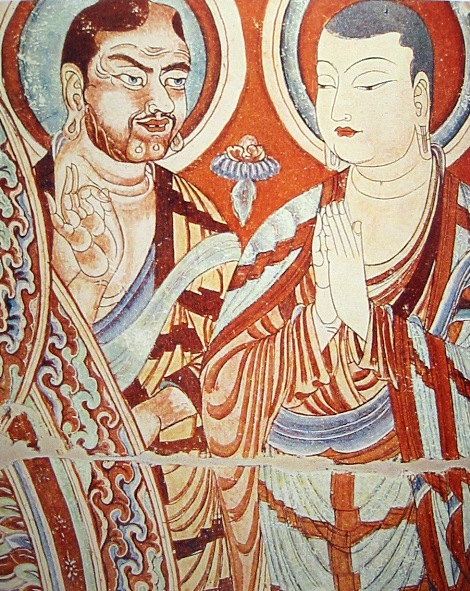
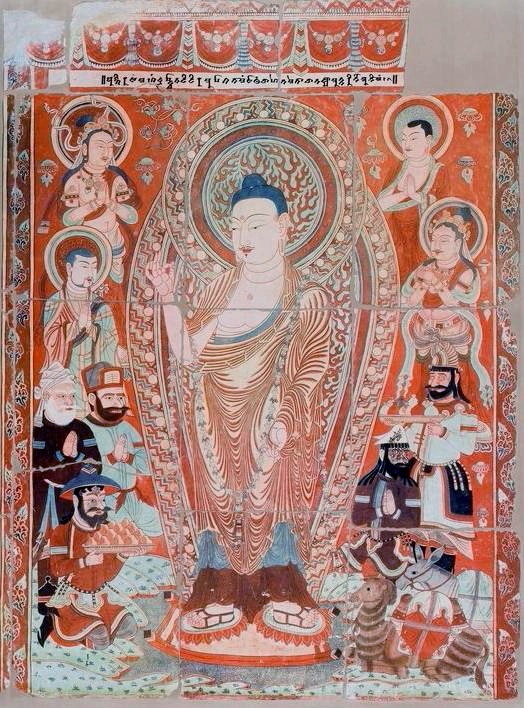
As with prior cities, Xuan-zang’s reputation had proceeded him, and he was greeted by the local ruler, which described as having “red hair and blue eyes”. The king of Kucha at the time was likely either ethnically Sogdian or Tokharian. We saw similar figures depicted in Buddhist art when we looked at the Bezeklik Caves in episode one. The Silk Road north of the Tarim Basin was a fascinating mix of different peoples and ethnicities and it could change from city to city. The Tokharians were distant relatives of other Indo-European people, and their language had some common elements to European languages such as English. Yet, the link between the Tokharians and Westerners is frankly pretty tenuous, but that did not stop researchers in the 19th century who had certain … racial theories, from hyping up their contribution to the Silk Road. It’s important to be cautious and not to draw too many conclusions. Hidden agendas make for bad research.

What’s more interesting to me is how the Tokharians lived alongside totally disparate groups such as Chinese, Turks, Uyghurs, Sogdians and so on, and at times they had friednly co-existence (the Tokharians evidentially revered the Sogdians in particular and tried to emulate them), and at other times they clashed. In other words, pretty typical human stuff. This intermix of cultures and people is what makes the Silk Road so fascinating.

But I digress…

Kucha had a lively material culture, thanks to runoff from the Tian Shan mountains providing plenty of water, and thus a wealth of food and agriculture grew here. It’s place on the Silk Road also ensured plenty of goods and materials were traded here too. Further, Kucha was famed for its music, and musicians from Kucha were highly sought after. A Kuchean orchestra was staffed at the court of Great Tang throughout the dynasty, and played for official ceremonies and celebrations. My book on Xuan-zang points out that famous songs they played included titles like “The Jade Woman Hands the Cup Around”, “Meeting on the Seventh Evening”, and “The Game of Hide the Buckle”.

Yet, for the Buddhist tradition as we now practice it today, Kucha was even more important for another reason: it was the hometown of Kumārajīva (344–413 CE) the translator.

Kumarajiva the Great Translator

Kumarajiva was the son of an Kashimiri-Indian father and a Kuchean mother, and was raised in Kucha. He studied Sarvastivadan-branch Buddhism, an influential pre-Mahayana Buddhist school whose monastic code was adopted by Mahayana Buddhist communities in China onward. However, at some point Kumarajiva converted to Mahayana Buddhism and by age 20 ordained as a Buddhist monk. His fame as a scholar reached China at the time, and he was sought out by the emperor. Our homeboy, Kumarajiva, was imprisoned at one point by a local warlord, but eventually was released by the Chinese emperor, and brought to the capitol of Chang-an (see prologue episode), and was feted.

Kumarajiva proved to be an excellent translator, and helped bring many Indian-Buddhists texts to mainsteam China. Because the Sanskrit originals were mostly lost in India, but preserved in Classical Chinese, these works, now core texts in many modern Buddhist traditions, help maintain the tradition today. To name a few that you probably already familiar with, Kumarajiva translated these sutras:3

  • The Lotus Sutra
  • The Amitabha Sutra (part of the 3 Pure Land Sutras)
  • The Diamond Sutra, important in the Zen tradition
  • The Shurangama Sutra, important in Chinese Buddhism, especially Zen
  • The Sutra of the Ten Stages (chapter 26 of the Flower Garland Sutra)2
  • …. among many others.

To reiterate this point: the English translations of these texts we use today come from the Classical Chinese editions that were originally translated from Sanskrit and prakrits by Kumarajiva.

Having said all that, let’s return, centuries later to Xuan-zang…

Staying at Kucha

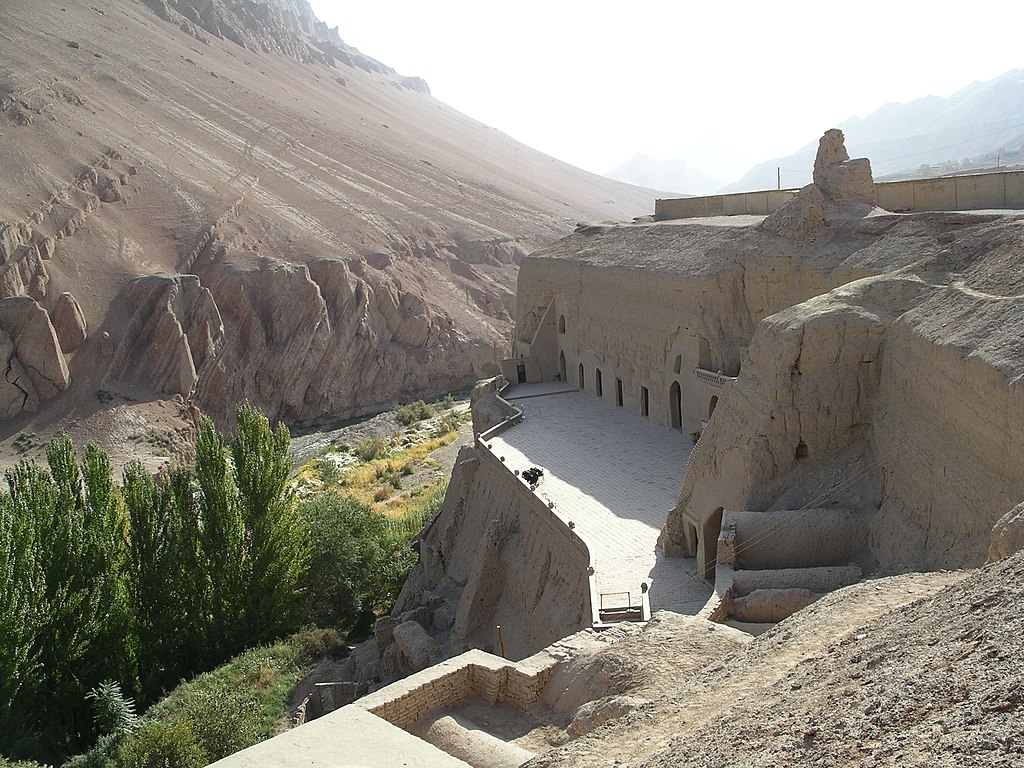
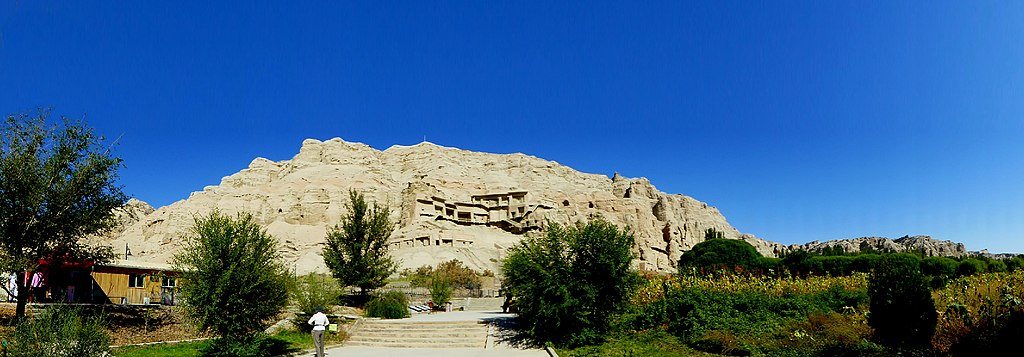
From Kucha, Xuan-zang would have to pass through Aksu before crossing over the Tian Shan mountains, but heavy snows in the passes mean that Xuan-zang had to stay in Kucha for two months. During this time Xuan-zang stayed out of trouble, and spent many days discussing Buddhist philosophy with the local community. This included the famous Kizil Caves:

Photo by Hiroki Ogawa, CC BY 3.0, via Wikimedia Commons

The Kizil Caves (in Uyghur قىزىل مىڭ ئۆي) or Kèzī’ěr Qiānfú Dòng (克孜尔千佛洞, lit “1000 Buddhist Caves of Kizil”) are a massive cave complex and probably one of the earliest along the northern Silk Road used for Buddhist monasticism. The artwork here often shows strong influence from Buddhist-India, or more precisely, the Greco-Bactrian art of Gandhara. However, like the Bezeklik Caves we saw earlier, a combination of local religious iconoclasm, looting by European researchers,4 and subsequent tourism have greatly disturbed the artwork in the Kizil Caves. Here’s an example reconstruction from the so-called Peacock Room:

A representation of the Peacock Room layout, and what remains. Photo in public domain, courtesy of Wikimedia Commons

In any case, check out the Wikipedia article I linked above on the Kizil Caves. There’s simply too much to add here, but needless to say, Xuan-zang must’ve beheld some amazing art in his time, which we will sadly never see again.

Side note: the red haired, blue-eye ruler of Kucha that I mentioned earlier ran afoul of the Chinese emperor, Taizong, a few years later by pretending fealty, while also declaring his loyalty to the Western Turkic Khaganate (more on that soon). Needless to say, China did not take this lying down and soon conquered Kucha just as it did with Turpan. Xuan-zang would be long gone by this point though.

The Tian Shan Mountains

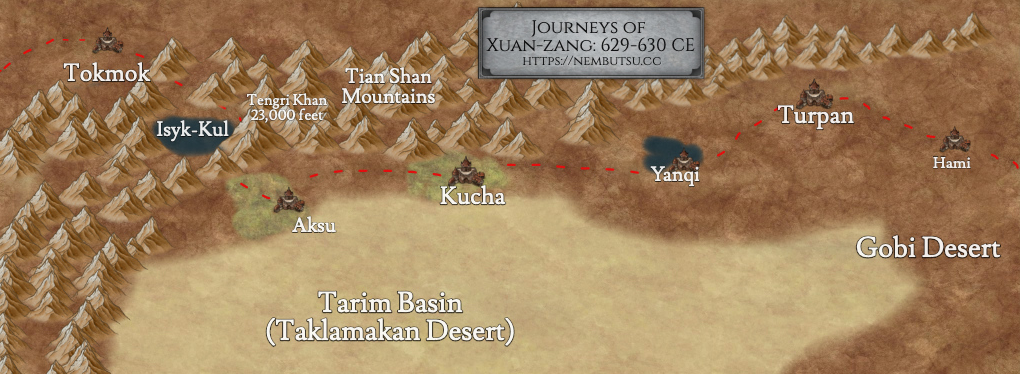
Once it was safer to travel, Xuan-zang’s caravan moved onto the city of Aksu, which in his time was called Baluka (跋祿迦, Bolujia in Chinese). Xuan-zang’s caravan was again ambushed by bandits along the way, but once again the bandits were full from another attack and quickly lost interest in Xuan-zang’s group. I’d say Xuan-zang was lucky, or the bandits were just lazy. 🤷🏼‍♂️

Anyhow, Xuan-zang stated that Aksu was very similar to Kucha in many respects, though according to Wikipedia, Xuan-zang noticed that the people of Aksu seemed to speak a different kind of Tokharian language. The Wikipedia article on Tokharian mentions that there were several dialects, all of them pretty different from one another. In any case, it doesn’t seem that Xuan-zang stayed at Aksu too long though and set out for the mountain passes over the Tian Shan mountains to reach Tokmok. There things took a dangerous turn.

The Tian Shan mountains, with Khan Tengri in the middle. Photo by Chen Zhao, CC BY 2.0, via Wikimedia Commons

The Tian Shan mountains are huge, cold and dangerous to traverse. The Khan Tengri mountain is more than 23,000 feet high, and the Bedel Pass near it is one of the few ways to cross over to the other side. Of the mountain, Xuan-zang wrote:

This mountain is steep and dangerous, and reaches to the clouds (lit. “heaven”). From creation the perpetual snow which has collected here in piles, as been changed into glaciers which melt neither in the winter nor summer; the hard-frozen and cold sheets of water rise mingling with the cloudes; looking at them the eye is blinded with the glare, so that it cannot long gaze at them. The icy peaks fall down sometimes and lie athwart the road, some of them a hundred feet high, and others several tens of feet wide.

The Silk Road Journey with Xuan-zang, page 31

It took eight days to traverse the pass, and Xuan-zang lost up to 30-40% of his men and countless horses and oxen. Imagine that famous scene from the movie Fellowship of the Ring when the good guys braved the mountain pass, but instead of turning back almost half the party freezes to death. That’s how serious it was.

Nonetheless, the survivors did reach the gorgeous lake of Issyk Kul, now in modern Kyrgyzstan. From here, the caravan would soon reach Tokmok and with it enter the lands of the powerful Western Turkic Khaganate….

Stay tuned!

1 Explained also in part one, the term Hinayana Buddhism is not related to Theravada Buddhism (it’s seems unlikely to me that they interacted with one another due to geography), but instead is a broad term for all pre-Mayahana Indian Buddhism. It’s still a somewhat pejorative term, but the relationship between early Hinayana Buddhism and Mahayana Buddhism is … complicated and not necessarily antagonistic.

2 I would love to talk about the Flower Garland Sutra some time, but it is a TOME, and I’ve only read very small parts of it. The Sutra of the Ten Stages deserves special attention though, and I have read it, but it’s challenge all by itself to explain in a blog post. Maybe some day.

3 one notable omission in this list is the Heart Sutra. The Heart Sutra is thought to have been compiled in China, not India, as a clever summary of much longer sutras. It gets to the “heart” of the matter, if you take my meaning. Xuan-zang, as we’ll see later, brings it back to India where it’s translated to Sanskrit, not from it.

4 The story of Albert Grünwedel is an interesting example of someone who was a dedicated archeologist, but also kind of unhinged too.
The Journeys of Xuanzang, part one: Desert Monasteries

In the prologue, we introduced the Buddhist monk Xuan-zang and explored the world of Tang-dynasty China. Xuan-zang left this world behind, contravening imperial decree about leaving the country without a permit, to pursue Buddhist teachings in India.

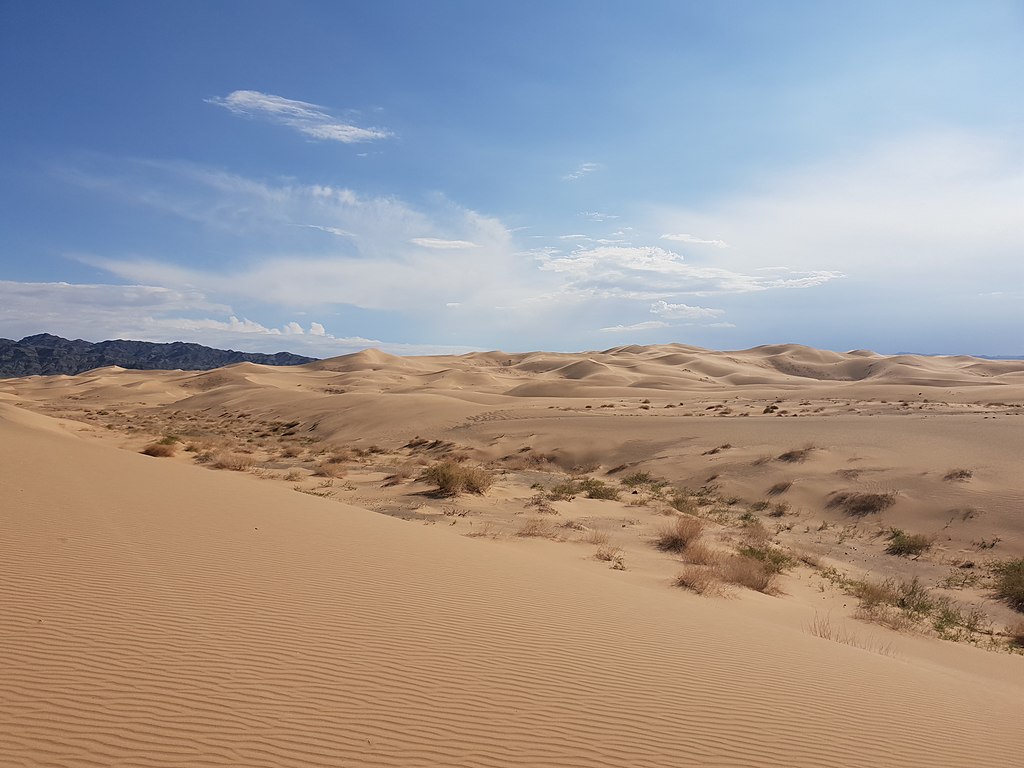
However, once he left the Yumen Pass, he immediately ran into a major issue: the Gobi Desert.

The Gobi Desert, photo by Richard Mortel, CC BY 2.0, via Wikimedia Commons

The road from the Yuman Pass to the next stop, the oasis at Hami, was barren, dry, with extreme heat and cold, and not well marked. Xuan-zang, who had little experience with this kind of travel, at one point lost his waterskin, became lost, and collapsed due to exhaustion. It is said that the bodhisattva Guan-yin guided him in his darkest hour to Hami.

The Hami Oasis

A map of the first part of Xuanzang’s journey. I made this using Inkarnate (a great online map tool). Apologies for any geographical mistakes. Free for non-commercial use.

The town of Hāmì (哈密), also known as Kumul (قۇمۇل) in Uyghur, was populated by a Chinese military colony since the Sui Dynasty, but had been cut off from China during turbulent times. At Xuan-zang’s time, it pledged loyalty to the regional Turk rulers while still maintaining diplomatic relations with the new Tang Dynasty. Some months after Xuan-zang left, Great Tang’s expansion absorbed Hami into its empire.

Here in Hami, Xuan-zang stayed at a Buddhist monastery where three Chinese monks lived. They were overjoyed to see a fellow monk, and offered him lodging. Xuan-zang did not stay too long here, and moved onto the larger city of Turpan.

The King of Turpan

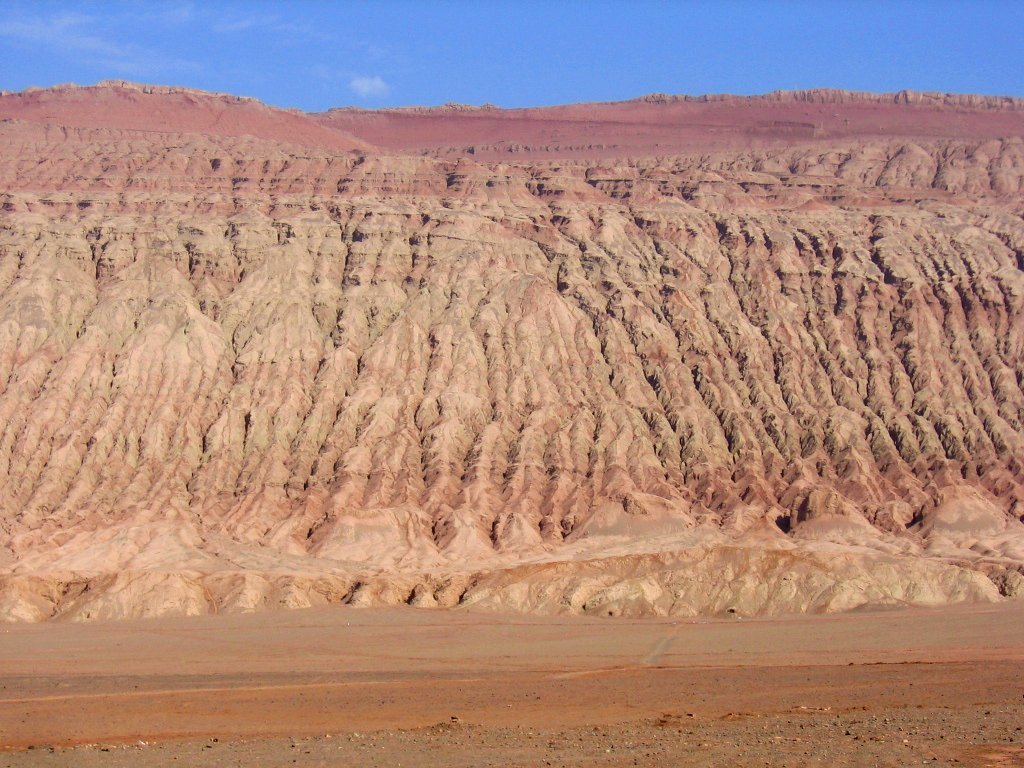
The “Flaming Mountains” near the city of Turpan on the Silk Road. Photo by es:User:Colegota, CC BY-SA 2.5 ES, via Wikimedia Commons

The city of Turpan (Uyghur: تۇرپان) also called Tǔlǔfān (吐鲁番) in Chinese was a prosperous city since ancient times, and changed hands often, but since antiquity had a large Chinese community, and considerable Chinese cultural influence, especially compared to cities further west.

The King of Turpan at this time was a devout Buddhist, and gave Xuan-zang a warm welcome upon his arrival, but also pressured him to stay rather than continue his journey. When Xuan-zang politely refused, the King of Turpan begged, cajoled, and threatened him. Xuan-zang was not allowed to leave, and he resorted to fasting to make his point. The king relented, and got Xuan-zang’s promise that he would stay for a month to preach to the people of Turpan, and would return later upon his return trip.

Once this agreement was reached, Xuan-zang stayed as promised. He used this time to explore the area, including the ancient city of Gāochāng (高昌), also known as Qocho, which was the former capital of a once-powerful kingdom, where he gave sermons to audiences there. Archeological excavations have show plenty of evidence of a vibrant Buddhist community at the time.

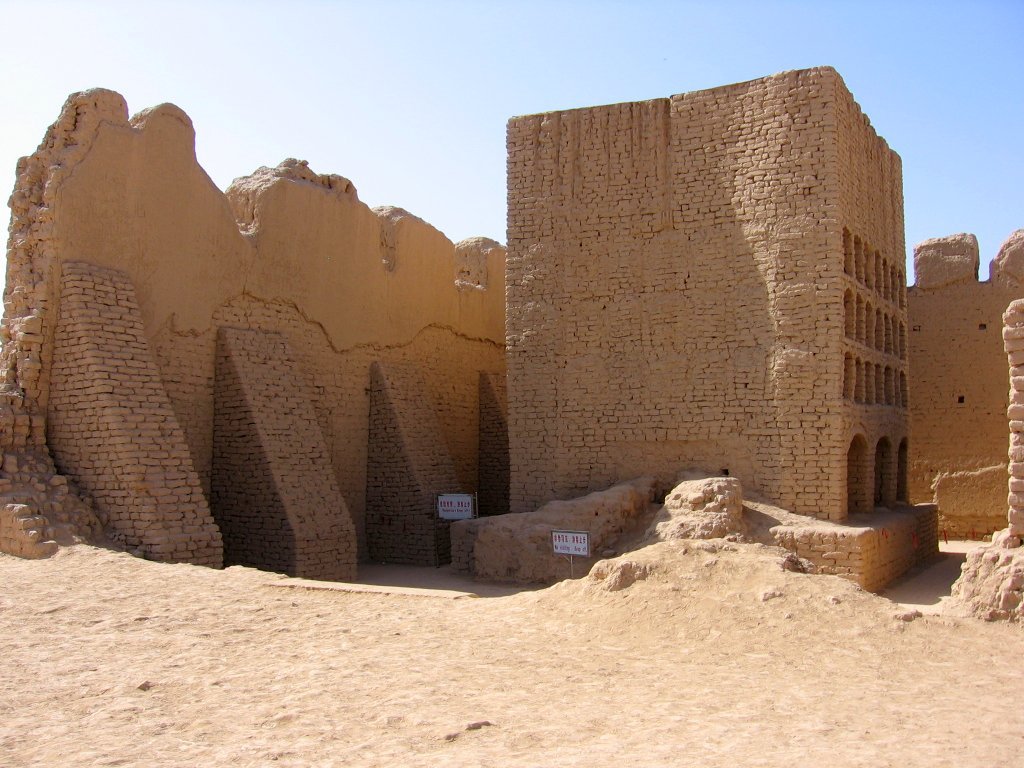
Remnants of a Buddhist stupa at Gaochang. Photo by Colegota, CC BY-SA 2.5 ES, via Wikimedia Commons

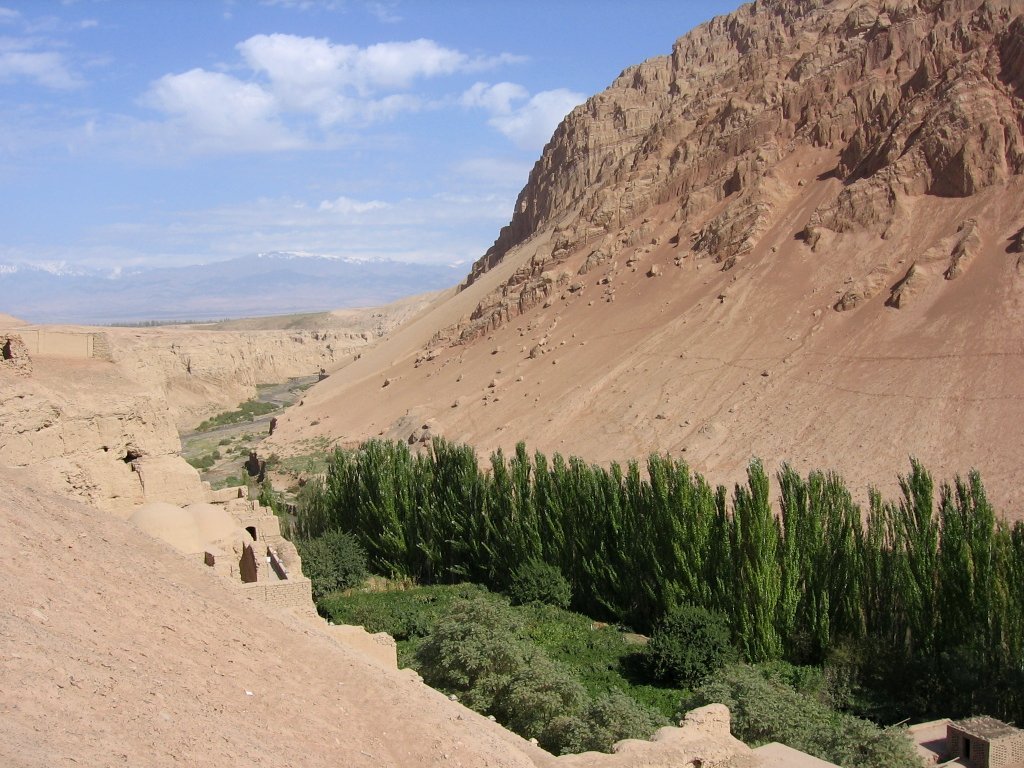
Xuan-zang also likely visted the nearby Bezeklik caves as well:

The Bezeklik Caves as seen from above. Photo courtesy of Wikimedia Commons.
Photo by T Chu, CC BY 2.0, via Wikimedia Commons

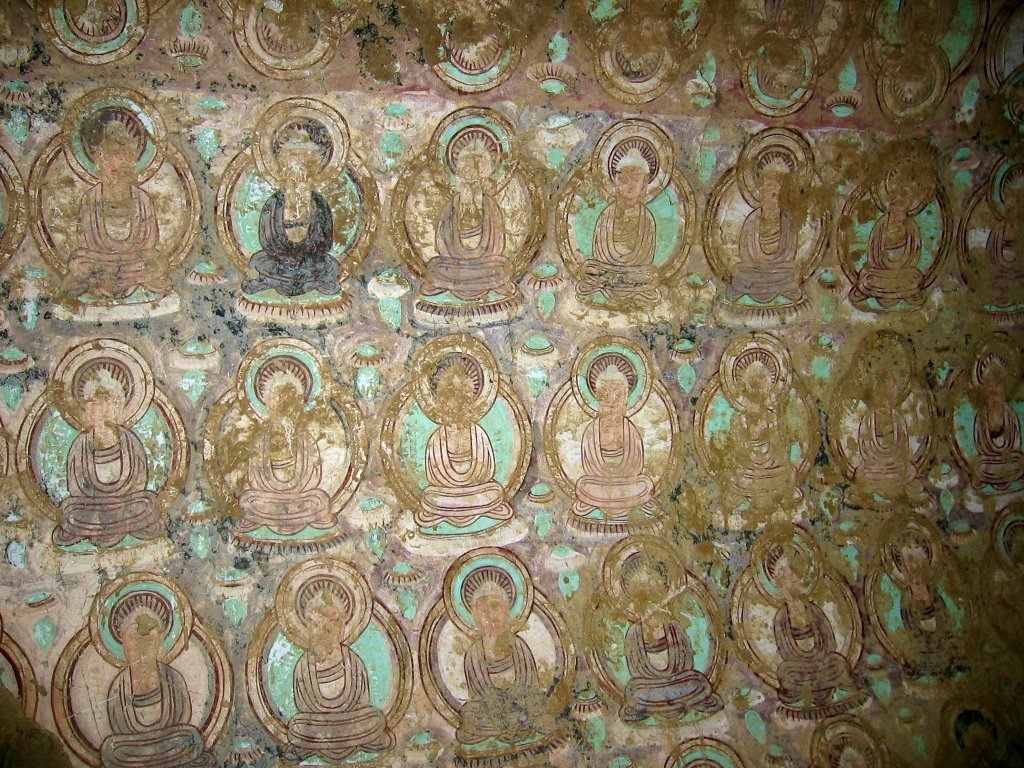
The Bezeklik caves are a massive grotto that served as a monastery for the local Buddhist monastic community. Many of the walls and ceilings were painted with frescoes of the Buddha, or other famous imagery, though in later generations, these were often defaced or damaged by locals for one reason or another (superstition, religious prohibition against human imagery, or simply raw materials).

A fresco of various buddhas. Notice that the faces have been scratched off. Photo by Colegota, CC BY-SA 2.5 ES, via Wikimedia Commons

Further, European archeologists looted the caves and brought many works of art back to Europe, only for them to be destroyed later in World War II. Thus, very little remains of the artwork now, but what does remain is simply spectacular, and a shining example of the fusion of cultures along the Silk Road at this time.

Bezeklik caves, Pranidhi scene 14, temple 9. Note the Sogdian men depicted in reverence of the Buddha. See page for author, Public domain, via Wikimedia Commons
Two Buddhist monks, one Eurasian (possibly Sogdian or Tokharian), and one East Asian. Public domain, via Wikimedia Commons
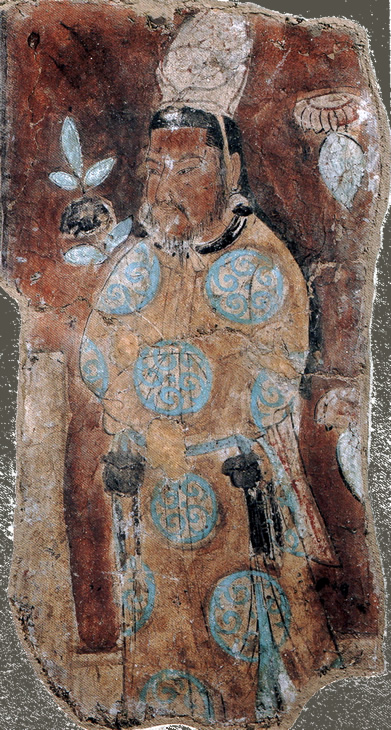
A Uyghur prince, photo by The original uploader was Kellerassel at German Wikipedia., Public domain, via Wikimedia Commons

Once Xuan-zang’s month was completed, the King of Turpan made good on his word. He provided Xuan-zang with many goods, supplies and letters of introduction to the kings further along the road. He now traveled with a caravan toward the next city Yānqí (焉耆) known by many other names, including Karasahr (قاراشەھەر in Uyghur) or Agni from the old Tokharian name, but not before being robbed by bandits! Evidentially, the bandits had already killed and robbed an earlier caravan, and were content to be bribed by Xuan-zang’s party and left with no further violence.

Upon reaching the city of Yanqi/Karasahr/Agni, Xuan-zang was said to have received a warm welcome, and described a city with ten different monasteries, and with two thousand monks practicing Hinayana Buddhism.1 He did not have flattering things to say about the king of Yanqi though, and later in 643 when the king broke his allegiance with Great Tang, the emperor Taizong, whom we met in the prologue episode, steamrolled Yanqi’s army and took the king prisoner.

Xuan-zang for his part only stayed for one night and moved on toward the city of Kucha. Kucha is an important city in early Buddhist history, but as we’ll see in our next episode, it was caught in a game of political tug-of-war…

Until the next episode: the Western Turks!

1 The term Hinayana is a loaded term in Buddhism, and frequently misunderstood. It has also been used as a pejorative by Mahayana Buddhists too. Without getting lost in the weeds, think of “Hinayana” Buddhism as any pre-Mahayana Indian-Buddhist school. It is not the same as Theravada Buddhism (the other major branch of Buddhism) since both branches were geographically separate and had little interaction with one another.

The Journeys of Xuanzang, prologue: Great Tang

I had an idea recently while flipping through my book on the journeys of the Buddhist monk Xuan-zang (pronounced like “Shwan-tsong”). Xuan-zang was the famous Buddhist monk who walked to India in order to bring back more information and texts in order to help develop Buddhism in his native China. In my old post, I covered some of the trials and tribulations of this amazing journey, and even made a fun song. However, looking back the post felt incomplete. I realized that many of these places that Xuan-zang traversed are obscure and forgotten now despite their central importance to Buddhist history, and the journey was so long that it’s too much to really explore in a single post.

So, this is the start of a series of posts meant to help retrace Xuan-zang’s journey, explore places of significance and how they tied into larger history. I don’t have a schedule yet (these posts take a while to write), but I am working on the next few drafts already.

Today’s post is the prologue episode, covering China at this time, and why Xuan-zang left.

Quick note: because this episode in particular uses a lot of Chinese names, for the sake of accuracy and modern readers, I am using the pinyin-style accent marks where relevant, and also using Simplified Chinese characters. I also put in lots of hyphens to help with pronunciation.

The Tang Dynasty

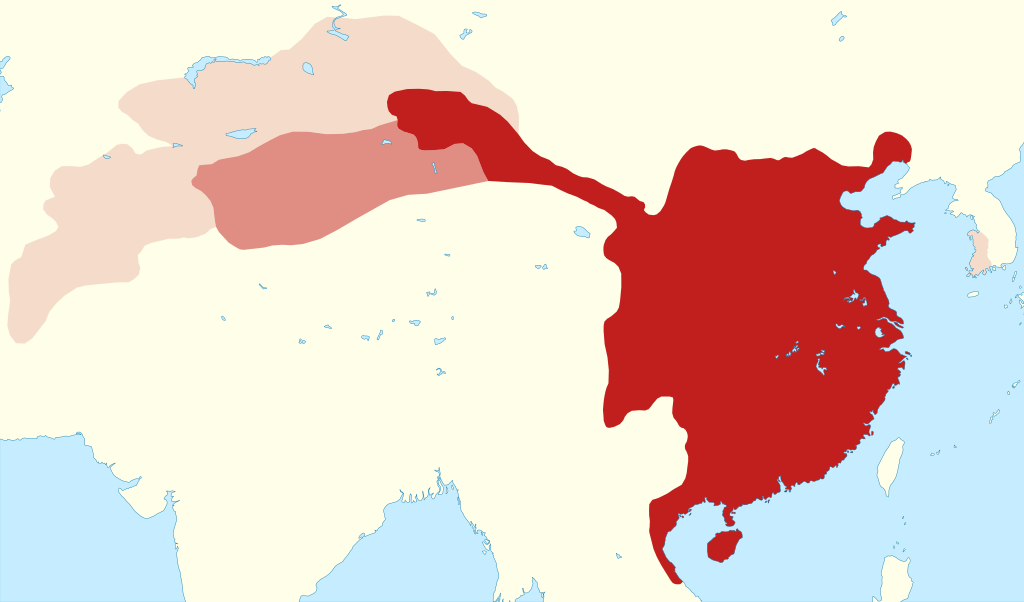
Great Tang at its largest extent in 661, map courtesy of Kanguole, CC BY-SA 4.0, via Wikimedia Commons

Chinese history, until the Republican era (1912 onward) had seen a series of kingships followed by imperial dynasties. Although, we usually call the country “China”, the name used by Chinese people in antiquity, and by their neighbors, was often taken from the current ruling dynasty.

Dynasties came and went. Some were fairly short-lived such as the Sui, others were incredibly powerful and long-lasting such as the Ming. Some were constantly fighting for their existence, such as the Song, others were fractured into a series of “mini-dynasties” that only exerted control over a region and were unable to unify China.

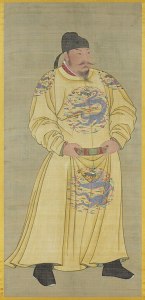
A portrait of Emperor Tai-zong, painted centuries later in the Ming Dynasty. National Palace Museum, Public domain, via Wikimedia Commons

Xuan-zang lived during the last days of the Suí Dynasty, and the early days of the Táng Dynasty (唐). “Great Tang” (大唐) as it called itself, lasted from 618 – 907, and was one of the high points of Chinese civilization. The empire expanded very far to the west, along the Silk Road (more on that in future posts) and actively imported all kinds of art, people, ideas, religions and material culture from Central Asia. Compared to earlier dynasties, Great Tang was much more cosmopolitan and less insular.

Xuan-zang lived primarily during the reign of the second Tang emperor Tài-zōng (太宗), who was an incredibly powerful, dynamic ruler. Chinese history still reveres him as of the greatest rulers. Tai-zong aided his father, the first emperor, in overthrowing the previous dynasty. Further, he was a powerful, expansionist ruler with a strong sense of administration, which helped provide stable foundations for Great Tang.

The Capital of Chang-An

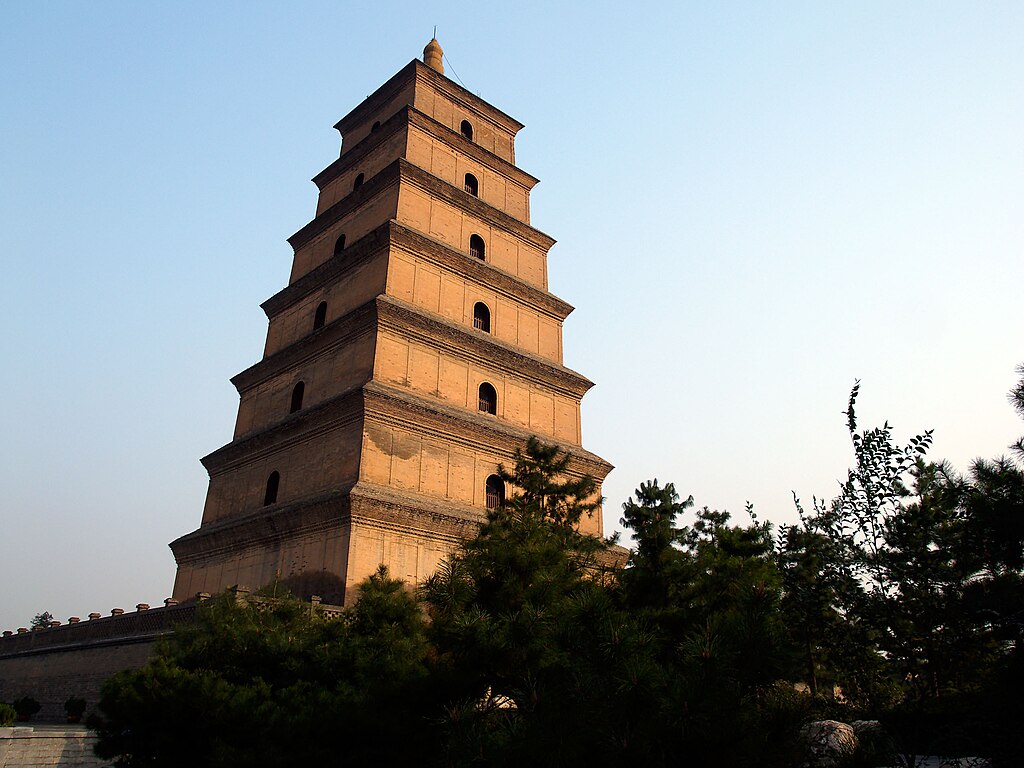
The Giant Wild Goose Pagoda (Buddhist stupa), photo by Alex Kwok, CC BY-SA 3.0, via Wikimedia Commons

The capital of Great Tang was the city of Cháng-ān (长安) in the western part of China. The city was a massive, cosmopolitan center of administration, commerce and culture. Chang-an at its height grew to 30 square miles, which was massive compared to Rome which occupied only 5.2 square miles. The population by 742 was recorded as 2,000,000 residents and of these 5,000 foreigners.

Chang-an was easily one of the world’s greatest cities at the time, and it had a great influence on its neighbors as well: the layout for the capital of Japan, Kyoto, was intended to resemble Chang-an, and great Buddhist masters such as Saicho’s rival, Kukai, studied there extensively. It was here that many Buddhist texts that came from the Silk Road were translated here as well.

Other religions, such as Nestorian Christianity, Zoroastrianism, Manichaeism and even Judaism and Islam all had a presence in Chang-an.

As the easternmost point of the Silk Road, it was here that many journeys began or ended…

Buddhism in Great Tang

The Tang Dynasty is often regarded as one of the high points of Chinese civilization, but also for Buddhism. Buddhism had emerged in China centuries earlier but its spread was slow at first. The native Confucian community particular resented the foreign Buddhist teachings as un-filial, unproductive (since monks did not work fields), and a drain on national resources.

In spite of the criticisms, it spread nonetheless. Wave and wave of teachings, newly translated texts, and schools of thought were imported from the Silk Road, allowing Buddhism to gradually take root, articulate its teachings better over successive generations, and develop natively Chinese schools of thought such as Tiān-tāi, Huá-yán, and Pure Land alongside imported schools of thought from India such as Fǎ-xiàng (Yogacara) and Sān-lùn (Madhyamika). By the time of the Tang Dynasty, massive temple complexes had arisen around Chang-an and other major cities.

This was a rare time when there was still a connection between Buddhist India and China, allowing a free flow of information. Later, when Buddhism fell in India, and the Silk Road was no longer safe to travel due to warfare, China was cut off.

Emperor Tai-zong himself had a distant relationship with Buddhism in his early reign. He kept it at arm’s length and strictly regulated. Further, travel in and out of China was tightly restricted, so that while there was commerce and trade, one could only do so with official permissions. More on this shortly.

Enter Xuan-Zang

Xuan-zang was the second son of his family. His older brother had ordained as a Buddhist monk, and Xuan-zang decided to follow in his footsteps at a young age. During the collapse of the Sui Dynasty, both brothers came to Chang-an where it was safe, and undertook further Buddhist studies. Since Xuan-zang proved to be a promising student, he was soon given access to advanced Buddhist texts and eventually ordained as a full monk in 622.

As to why Xuan-zang decided to journey all the way back to India, he is quoted as stating the following:

The purpose of my journey is not to obtain personal offerings. It is because I regretted, in my country, the Buddhist doctrine was imperfect and the scriptures were incomplete. Having many doubts, I wish to go and find out the truth, and so I decided to travel to the West at the risk of my life in order to seek for the teachings of which I have not yet heard, so that the Dew of the Mahayana sutras would have not only been sprinkled at Kapilavastu, but the sublime truth may also be known in the eastern country.

During his studies, Xuan-zang had noticed copyist errors, corruptions of texts, missing texts and other textual issues that prevented a thorough understanding. Thus, he resolved to journey to India, much like a monk named Fa-xian (法显) had done centuries earlier. He was particularly interested in the writings of Vasubandhu and his half-brother Asanga , who were crucial to the development of Mahayana Buddhism as we know it. Xuan-zang and some like-minded monks petitioned the Emperor Tai-zong to be allowed to journey to India, but never received an answer. He made his preparations, possibly learning some Tokharian language (commonly spoken along the Silk Road at that time) from the foreign quarters at Chang-an, then went west.

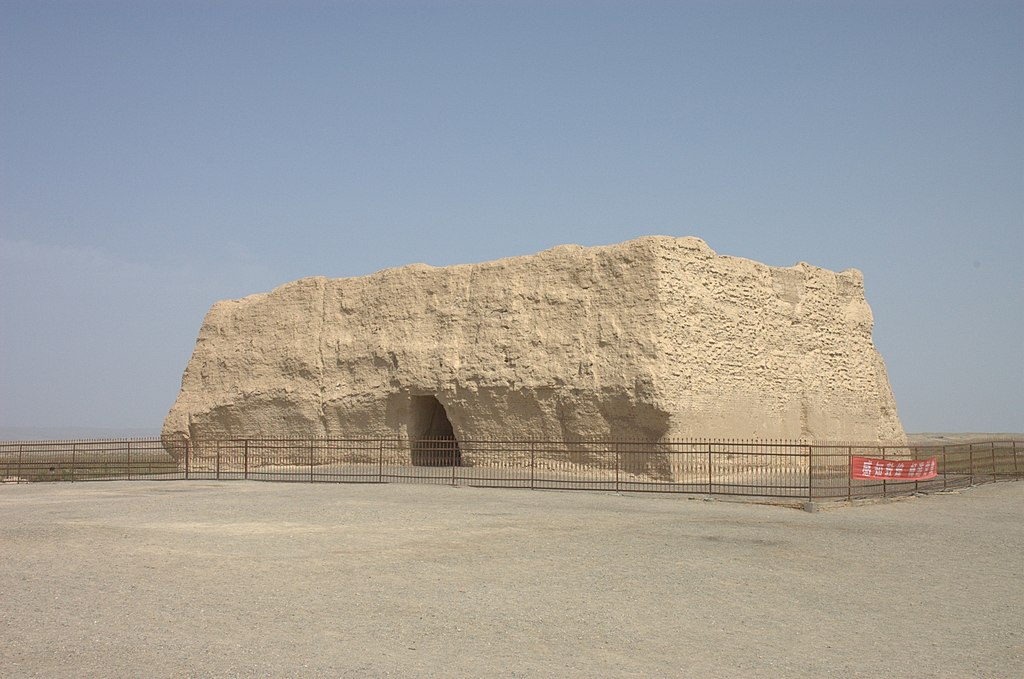
Ruins from the Yumen Pass, photo courtesy of 张骐, CC BY-SA 3.0, via Wikimedia Commons

By the time Xuan-zang reached the Yumen Pass (Yùmén Guān 玉门关) at the western end of Great Tang, he had attracted some unwanted scrutiny by authorities, and wasn’t permitted to leave. By this point, his companions had lost their nerve, but Xuan-zang was determined to continue. With some help from a sympathizer, Xuan-zang defied imperial orders and snuck around the Yumen Pass to leave China. He was now a criminal, and he was alone with a vast desert ahead of him.

What happened next? Find out in next episode.

Perspective

Recently, I discovered that one of my coworkers, who is an immigrant to this country, had survived the Yugoslav wars of the 1990s. I am trying to protect their identity a bit, but they described life as a teenager being besieged in their home city for months in 1992 without running water, or reliable food supply. After the war was over, they came to the US with a mere $50, a college degree, and no idea what to do next. Thankfully, my coworker was able to get on their feet, establish their career here, and now have a growing family.

However, what’s interesting is that if my coworker had never confided their past, I would never have guessed. By all appearances they were just another career adult. I’ve had a coworker who grew up in Palestinian refugee camps in the Middle East, but again, it’s not obvious in a professional work setting and they only confided in me much later in our friendship.

It underscores how many people around you, who by all accounts seem like normal, functional adults, may be carrying terrible traumas in their lives. It is not always wars, natural disasters, and ethnic conflicts either; it can also be personal, domestic traumas, emotional scarring that fades with time, but never fully disappears. It is said that 1 out of 4 women in the US, possibly more, have been abused and that means that out of all the women I work with, correspond with, or hang out with, one out of four, maybe even one out of three of them may be carrying out terrible scars from their past.

And of course, it’s not limited to women, either. It’s not hard to scratch the surface and find men who have also suffered terrible traumas, abuse, etc., and carry this with them for the rest of their lives. I remember my best friend in grade school suffering terrible, physical abuse from his father. He grew into a pretty unhappy teen and eventually the family moved away. I didn’t comprehend any of this until too late, and lost touch with him before we could talk about it together. I’ve always regretted that.

Being an adult is hard enough as it is, but also carrying around terrible traumas makes it even harder because you can never fully erase them. You can move on, find happiness, and still grow as a human being, but the scar will always be there.

Photo by Mokhalad Musavi on Pexels.com

My coworker who survived the Yugoslav wars, for their part, told us that they decided not to focus on the past and instead focus on the here and now: kids, career, helping others in the same field, and so on. They joke among other survivors that they still get a bit twitchy sometimes due to their traumatic past. Yet at the same time, they don’t want to be weighed down by it either. They want to move on and look toward the future.

In learning to understand others, I think it’s important to consider painful past they may have had. It doesn’t always excuse the behavior, but it does provide some perspective.

Screenshots from the game Chrono Trigger.

Saicho: Founder of Tendai in Japan

June 4th is the yearly memorial service in Japan’s Tendai sect of Buddhism called Sangé-é (山家会) for its founder, Saichō (最澄, 767 – 822). I am writing this post a bit late this year, but I wanted to explore the life of Saicho a little bit and why he matters.

Saicho as depicted in a Heian-Period painting.

If you look at the history of Japanese Buddhism, Saicho doesn’t elicit much historical attention and discussion, even compared to contemporary rivals at the time like Kūkai, founder of Shingon-sect Buddhism. Yet, the sect he founded in Japan was overwhelmingly the largest and most influential for centuries (probably too much so), until it finally faded into the background in the late medieval period. This is why you rarely see mention of Saicho or Tendai these days: it’s far smaller now than it was in the past.

Also, to confuse matters further, Saicho is only the founder of the Japanese branch of Tendai. It was the Buddhist monk Zhi-yi (智顗, 538 – 597), who originally started the Tian-tai (天台) sect in China in the 7th century and it remains a very influential sect across many areas of mainland-Buddhist Asia (Korea, Vietnam, etc). Tian-tai in Japan (pronounced as Tendai) reveres Zhiyi as well.

Anyhow, Saicho was a monk at a time when Buddhism had already been established in Japan, primarily around the old capitol of Nara, yet was limited to a very tightly regulated number of schools and monks per school. Besides the Yogacara (Hossō) and Huayan (Kegon) schools, the rest are very obscure today. These schools had all been imported from Tang-Dynasty China, and represent “branch” schools to the mother temples there. The existing schools at that time were obligated to perform rituals on behalf of the Emperor to prevent calamities, cure diseases, bring prosperity to the nation and other political needs. In turn, the government allocated new acolyte monks every year, and allowed them to continue. However, beyond that, Buddhism had very little reach in the rest of Japanese society. This is very different than the bottom-up approach in China.

Mount Hiei today, photo courtesy of Wikimedia Commons.

Saicho was ordained as an official monk, but soon left and retreated to Mount Hiei where he underwent ascetic practices, rather than stay in the urban temple complexes. In time, he attracted other like-minded disciples, and a small, informal monastic community developed there on the mountain. Further, he carved an image of the Medicine Buddha, and later lit an oil lamp in reverence to the Buddha, praying that the light would never be extinguished. This lamp, the Fumetsu no Hōtō (不滅の法灯) was the subject of a previous post. By this point, the foundations of the temple of Enryakuji were laid.

Later, by a lucky coincidence, the capitol of Japan was moved away from Nara to Kyoto (back then Heian-kyō) in 795. Since Mount Hiei happened to be to the northeast of Kyoto, and since the northeast was considered an inauspicious direction in classic Chinese geomancy, the presence of a Buddhist temple there (namely Enryakuji) helped protect the new capital from negative influences. The Emperor, for his part, saw this new Buddhist sect has a counterbalance to the old guard sects in Nara. Thus, Saicho’s star quickly rose.

The Eastern Pagoda (Buddhist stupa), of Enryakuji Temple, 663highland, CC BY-SA 3.0, via Wikimedia Commons

Now with sponsorship from the new Imperial court, Saicho was dispatched to sail back to China in 804, gather more resources and help bring Buddhism to a wider audience. On the same diplomatic mission, another promising young monk named Kūkai was also dispatched. More on him later. Of the four ships that sailed out to sea, only 2 survived a storm at sea (Saicho and Kukai were each aboard one of the surviving ships).

Saicho’s had mixed success in China. He did not speak Chinese (he could only read it), but was able to get official permission from the Chinese government to travel to Mount Tiantai. There he stayed for 135 days. Saicho later received limited training in esoteric Buddhism, which was all the rage in Tang-Dynasty China (and Japan at this time). It wasn’t until the second generation of Tendai monks who went to China (Ennin for example) that esoteric training really developed in the Tendai sect in Japan. Saicho also copied many sutras and texts in order to provide fresh copies back in Japan (printing did not come until much later, despite flourishing in China).

Guoqing Temple (guó qīng sì, 国清寺) on Mount Tiantai, head of the Tiantai Order. Photo by Joshtinho, courtesy of Wikimedia Commons.

Nonetheless, when Saicho returned to Japan 8 months later, he was feted for his accomplishments. He got to work using his newfound training, and his collection of sutras brought back from China to petition the Emperor to start a new sect derived from the Chinese Tiantai Buddhism he trained under. Saicho’s vision was slightly different than Tiantai Buddhism, particularly because he envisioned a purely “Mahayana” sect, not just a sect with Mahayana Buddhism on top of earlier Buddhist tradition. This meant different ordination platforms, different training, etc. It was a big controversy at the time, and the powerful Yogacara (Hossō in Japanese) school based in Nara really gave him grief over it.2

In Dr Paul Groner’s book on Saicho, he explains Saicho’s vision further:

In his works directed against Tokuitsu and the Hossō [Yogacara] School, Saichō argued that all people had the Buddha-nature [capacity for Enlightenment] and could attain Buddhahood. Receiving the Fan wang [Bodhisattva precepts] ordination and adhering to the precepts were religious practices open to anyone. Anyone could receive a Fan wang ordination and anyone who had been correctly ordained could in turn confer the Fan wang precepts on others….

Saichō envisaged a system in which Tendai monks would be trained for twelve years on Mount Hiei and then go to live in the princes in order to perform good works, to preach, and to confer Fan wang ordinations.

Page 179

Further, Saicho really took the idea of unifying different Buddhist practices and traditions into an “umbrella tradition” to a new level. It wasn’t enough that the Lotus Sutra was the highest teaching (per Tiantai tradition), he wanted to really absorb other practices and traditions toward that end, and diffuse them across the country in a religious community that blurred the traditional lines between monks and laity.

Saicho’s zeal, his rising status in the new Imperial court at Kyoto, and his fresh training gave him a lot of leeway, and the Emperor granted his request. Thus, Tendai Buddhism (the Japanese branch of Tiantai) was born. It has a deep connection with the mother sect in China, but Saicho also added some innovations to it as well.

Saicho’s star was soon eclipsed after the other monk from the same diplomatic mission, Kūkai, who returned some time later and brought an extensive training program in esoteric Buddhism (something Saicho had only a partial training of). Because esoteric Buddhism was all the rage (until the Purge of 845), Kukai’s training and religious material he imported outshone Saicho. Kukai and Saicho tried to maintain a cordial relationship, but Saicho wasn’t willing to train under Kukai, and Kukai kept poaching disciples of Saicho’s so the two groups became somewhat acrimonious over time.

Saicho proved throughout his life that he was dedicated to the Lotus Sutra and the Buddhist path. He was a sincere ascetic in his youth, rather than a “career monk” like many others of his time, and held himself to high standards. The fact that attracted like-minded people around him, shows that he “walked the talk” too. In China, he underwent many trainings, copied many sutras, and didn’t stop learning and improving. It should be noted that Kukai and Saicho were both pioneers for journeying to China to bring back more Buddhist teachings, rather than past schools that relied on foreign monks to make the journey to remote Japan.

If Saicho had any virtue, it was zeal.

If Saicho had any fault, it was that he was perhaps stubborn.

Personally, I like Saicho, flaws and all. Like, I would have loved to sit with him on those early days on Mount Hiei, swap practice tips, get his advice, etc. I really like his enthusiasm and positivity. Much like Honen centuries later, Saicho was bold and motivated by sincere conviction. The Tendai sect morphed into something that I don’t think he anticipated but personally I blame politics more than the founder.

But anyway, this is all just my opinion.

As for me, I did an extra long home service for Saicho this week in his honor.

1 Devout Buddhists in early Japanese history, such as Prince Shotoku, were devotees of the Lotus Sutra as well, but I don’t think there was any effort in those days to elevate it to the highest teachings, let alone make a new sect out of it. It was just there as part of the larger tradition.

2 Acrimony between Tendai and Hosso schools of Buddhism continued for centuries, starting with Saicho’s disagreements with one Tokuitsu of Hossō. Both sects frequently faced off during official Buddhist debates at the Imperial court as well.

Injustice

In a couple recent posts, I touched upon the misdeeds of one 12th century warlord named Minamoto no Yoritomo in the excellent Japanese historical drama, the Thirteen Lords of the Shogun. Huge credit to Japanese actor Oizumi Yo (大泉洋) for his brilliant performance by the way.

There’s one particularly heart-breaking scene halfway thorugh the drama series: Yoritomo bullies his retainer, Hojo no Yoshitoki, to carry out a series of bloody purges (partly as a test of loyalty). Yoshitoki hesitates, seekingly ready to stand up to Yoritomo at last, but in the end he backs down. Later in the episode after the purges have taken place, Yoshitoki is at home holding his infant baby, but quietly cries to himself. He says to his child, “please forgive your dad” as the episode ends. 😭

While some of this is dramatic fiction, Yoritomo really was a ruthless man, just one of many in history who exerts power and does whatever is necessary to keep it. They exploit others and toss them aside when they are done. Such men are so hopelessly self-absorbed that they pull everyone in orbit down with them, and even then it’s not enough. Like a bucket with a big hole at the bottom, the more they try to fill it and appease their ego, the more they need to fill it again.

For you science types you can also compare them to a singularity (e.g. a black hole): something that has collapsed in on itself and now pulls everything in destroying them in the process.

Sagittarius A*, the black hole at the center of our galaxy.

For simplicity, we’ll call these people “super assholes”. It’s a pseudo-Buddhist term. 😉

Even in modern times, such powerful assholes still exist. They merely changed jobs. Some run major corporations, some rule dictatorships, others are just obnoxious politicians, lawyers, priests, media influencers and so on. Yet in spite of their obvious misdeeds and harm to others, they seem invulnerable, able to evade justice through wealth, power and just being enough of an asshole.

Worse, even if you manage to take down one asshole, another one inevitably arises.


All governments suffer a recurring problem: Power attracts pathological personalities. It is not that power corrupts but that it is magnetic to the corruptible.

Frank Herbert, Chapterhouse: Dune (Dune #6)

That said, all is not hopeless.

When I think about this issue, I sometimes consider a passage from the Earth Store Bodhisattva Sutra, chapter five:

The power of karma is extremely great. It rivals Mount Sumeru in its heights. It surpasses the great oceans in its depths. It obstructs the path leading to sagehood. For that reason, beings should never think that minor bad deeds are unimportant or assume that they do not count as offenses. After death, there will be retributions to undergo that reflect all those details.

Translation by City of Ten Thousand Buddhas

This is, admittedly, a pretty small comfort to the countless people whose lives have been destroyed, literally and figuratively, by such powerful men. Sure, they may self-destruct someday, and face some kind of karmic retribution in the future, but what about the people who are suffering or dead now?

Make no mistake, though, time does go on, awful people wither and die, and their legacies are forgotten. Remember the ancient Assyrian king, Ashurbanipal? His was a reign of terror. But soon after he died, the dreaded Assyrian Empire fell and its legacy is now just dust. Small comfort to people at the time, but still.

Screenshot from the game Fire Emblem: Three Houses.

If you compare these “super assholes” to black holes in space, I find the best thing to do is steer clear of their orbit. If you’re far away, you can still escape with minimal effort, but get too close and you may get sucked in further no matter what you do, just like Hojo no Yoshitoki. Sometimes it’s better to just lay low and let things pass.

Sometimes, though, it feels unavoidable, and that becomes the true test of one’s character.

Namu Amida Butsu

P.S. I coincidentally wrote most of this before a certain asshole was convicted (you know who). I fear he will somehow escape justice though, but he will be dead in time anyway.

Update: I was right afterall.

Separated by Centuries

This is another cool moment in Japanese history (previous post here) that I wanted to share while re-watching the drama Thirteen Lords of the Shogun. Shortly after the death of Kazusa Hirotsune, the head of the Genji (Minamoto) clan named Minamoto no Yoritomo, sought to finally take the fight to Heike (Taira) clan. The trouble was was that he had a rival within the Genji clan itself.

Yoshinaka as portrayed in woodblock print from 1866, source Wikimedia Commons.

The Genji clan was quite large by this time, going all the way back a few centuries to Emperor Saga in the early 9th century. By the time of the Genpei War (late 11th century), the clan had a number of sub-clans, domains and so on. One such branch was led by Yoritomo’s cousin, Kiso no Yoshinaka.1 Yoshinaka and Yoritomo initially worked together, and Yoshinaka even sent his son, Yoshitaka (木曽義高), in good faith as a hostage at Yoritomo’s court in the city of Kamakura. However, the relationship quickly became estranged, and they competed for who could get to the capitol of Kyoto first to rescue the Emperor under house-arrest from the Heike clan.

What Yoshinaka didn’t know was that the scheming Emperor, Go-Shirakawa, was already in league with Yoritomo. Go-Shirakawa expressed gratitude to Yoshinaka, and even bestowed the lofty title of Asahi Shogun, or “Asahi” Commander of the Armed Forces, and commanded him to take the fight to the Heike. And yet, Go-Shirakawa still threw in his lot with with Yoshinaka’s cousin Yoritomo. Things quickly went downhill as Yoshinaka, realizing that he was being double-crossed, seized the Emperor briefly, and battled his cousin’s forces. In the end, Yoshinaka and his army were wiped out. His son, Yoshitaka, did not survive much longer despite being wed to Yoritomo’s daughter O-hime. This part of the historical drama is really sad because it was clear that Yoshitaka did nothing wrong, but was simply a victim of politics.

In the historical drama, and in Japanese literature, Yoshinaka is portrayed as sincere and well-meaning, but out of his league compared to the scheming of the Emperor and of Yoritomo. He was a genuine warrior, loved by his vassals, but court politics were beyond his ability, and he was ultimately betrayed by the very forces he sought to help. Seeing a pattern with Yoritomo?

So, why bring this up?

Yoshinaka’s remains were interred at a small Buddhist temple named Gichū-ji2 in the city of Otsu, in Shiga Prefecture. Centuries later, the famous haiku poet, Matsuo Basho, visited the temple on one of this pilgrimages. Basho was evidentially an admirer of Yoshinaka and composed a haiku upon visiting the gravesite:

JapaneseRomanizedRough Translation2
義仲のYoshinaka noIs this not the mountain
寝覚めの山かMezame no yama kathat Yoshinaka woke up on?
月悲しTsuki kanashiThe melancholy moon.
2 any faults in the translation are my own

According to tradition, it is thought that one night while sleeping on a mountainside, Yoshinaka woke up and gazed at the moon. Here, on that same mountainside, the moon shines melancholy, still reflecting over the demise of Yoshinaka.

Later, when Basho passed away he was, according to his wishes, also interred at Gichū-ji so that he may rest alongside the admired warlord.

There’s a travel blog entry in Japanese that shows the temple grounds and the grave sites, while this page shows the temple.

It’s interesting that such a talented poet was so infatuated by this legendary, though ill-fated warlord that he would be buried alongside him despite the passage of centuries.

P.S. If you thought Yoritomo was a scallywag now, wait until you get to the murder of Yoritomo’s own half-brother, the talented general Yoshitsune.

P.P.S. Yoritomo also punished another branch of the Genji clan, the Genji of Kai province, by executing that lord’s young heir on suspicion of treason as well.

P.P.P.S. Yoritomo was, suffice to say, a cold-blooded ruler. Not surprisingly, the Shogunal military government he founded got off to a rotten foundation and struggled after his death. Unlike the video game character Edelgard, Yoritomo seemed to have no moral conviction. He wanted power and vengeance.

1 Fun fact: the actor who played Kiso no Yoshinaka in the historical drama was also in Godzilla Minus One. He appears in the opening scene as a runway mechanic, Tachibana, talking to the ensign.

2 The kanji characters 義仲 can be read as either “Yoshinaka”, as in Kiso no Yoshinaka’s name, or as “Gichū”, the name of the temple. Clever.

The Death of Kazusa Hirotsune

After finishing the Japanese historical drama, The Thirteen Lords of the Shogun,1 I managed to buy the Blu-ray from Amazon JP before it was taken off shelves due to controversy with one of the actors. Lately, as life has finally calmed down a little, I have been watching it again. With the benefit of rewatching, and Japanese subtitles, I have picked up a lot more from the show including this tragic bit of history.

One of the climatic turnings points early in the drama is Minamoto no Yoritomo’s execution of one of his vassals, Kazusa Hirotsune in front of everyone. Hirotsune was made the scapegoat for a failed rebellion among local retainers, while the rebellion was appeased, Yoritomo had him killed to teach a lesson. Hirotsune’s innocence was only confirmed after his death.

Apparently, some version of this really happened.

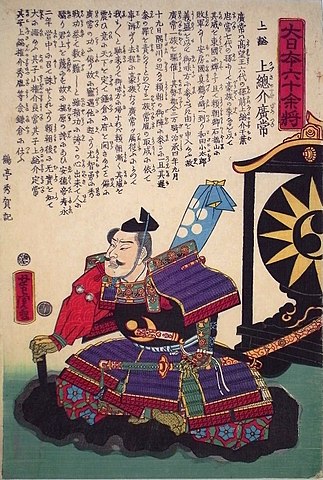
Woodblock print of Kazusa Hirotsune by Utagawa Yoshitora, Public domain, via Wikimedia Commons

According to the end of the episode, the incident was recorded in a historical record called the Gukanshō (愚管抄). In that document, it states that Hirotsune was a big player of a dice game called Sugoroku and while he was playing with some other vassals, he was suddenly attacked and slain by another vassal, Kajiwa Kagetoki, on Yoritomo’s orders. Later, Kagetoki, was said to have purified and washed the blood off his sword at the waters of a holy spring nearby. Hirotsune was evidentially abrasive and butted heads with Yoritomo at times, but nonetheless he was innocent of provoking the rebellion. Nonetheless, the damage was done: the clan property was broken up and given to other vassals for their loyalty, and the Kazusa clan disappeared from history.

Eight hundred years later the lands of the Kazusa family are now part of a local orchard in Kanagawa Prefecture, Japan called the Juniso Kajuen (十二所果樹園). You can see it on Instagram here. It’s a very nice looking orchard, but visitors walking through that orchard would probably never guess that long ago this was once the domain of a powerful and influential warlord.

I guess what I find fascinating and tragic about all this is how someone powerful and wealthy can be struck down, possibly through no fault of their own, and with the passage of centuries very little trace of their legacy remains.

1 not to be confused with the American series “Shogun”. The “Thirteen Lords” series was for Japanese TV only, and based on an entirely different historical event. Sadly, there is no English subtitles available which is a shame because I would argue that Thirteen Lords of the Shogun is a really fine drama and would be a huge hit overseas.

Celebrating the Buddha’s Birthday

Next week, according to the solar calendar, is the Buddha’s birthday. Many communities observe this holiday using the lunar calendar, and different communities use different lunar calendars, so the dates will vary quite a bit. I use the Japanese-Buddhist calendar which in turn uses the Western calendar since the 19th century, thus April 8th.1

But I digress.

How does one celebrate the Buddha’s birthday?

Based on my limited experience in Japan and such, Buddhist holidays tend to be pretty laid back affairs. Buddhist temples usually do not hit you over the head with religious teachings, but often do hold local festivals maybe with a sermon or two. There’s no pressure for holiday shopping or even attending a temple. The reality is that Buddhism is not an evangelical religion; people are welcome to come as they are, and approach at their own pace.

Instead, the Buddha’s birthday is a time of joy and reflection.

The appearance of a buddha is, according to tradition, exceedingly rare and even if one is not alive during the time of a buddha, the buddha’s teachings and influence on the world last for many generations. If one lived in an age where the Dharma, the teachings of the Buddha, did not exist or were obscured, then one could not benefit from them.

Thus, even for us living 2,500 years2 after the Buddha Shakyamuni (e.g. Siddhartha Gautama), we can still learn from the Buddha, apply the teachings as best we can, and thereby break the cycle of rebirth. The Buddha-Dharma is good medicine that one can take as one needs, and apply to their life as they see fit.

So, on April 8th, or whatever day you celebrate, take a moment to reflect on the historical Buddha, enjoy the warm weather, and don’t hesitate to do something good and noble that day.

Namo Shakyamuni Buddha

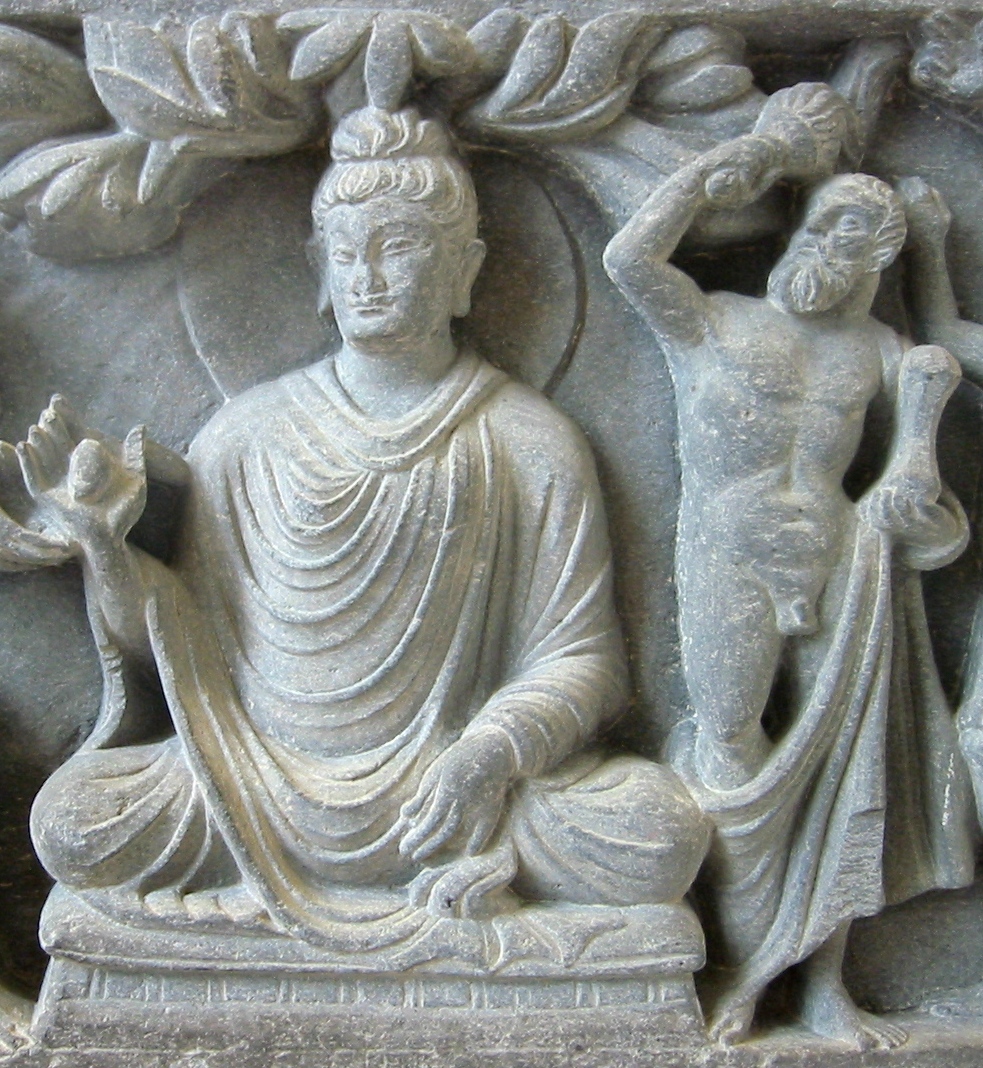
P.S. Featured image is Shakyamuni Buddha flanked by a guardian named Vajrapani. Notice the strongly Greek artistic style, including Vajrapani who looks similar to Hercules. This was made in Gandhara almost 2,000 years ago. Countless cultures and people have paid homage to Shakyamuni Buddha just as we do now. 🥳

1 Rant: Given that Christmas is observed on December 25th, despite Jesus’s birth very obviously not taking place in December (the Romans did not collect taxes in winter), the specific date for celebrating an event really isn’t that important. One date is as good as another, as long as the tradition is meaningful for people. I do prefer observing holidays using the solar calendar since it’s just so much easier to observe and plan out, though. Lunar calendars are fascinating in their own way, but they’re opaque and confusing to anyone who doesn’t fully understand them.

2 random history fact: by the time the Romans had subjugated places like Egypt and Mesopotamia, these places already had 2,000 years of culture and tradition. The Akkadian language was still in use for religious ceremonies and documents, despite the Akkadian empire of Sargon being gone for more than a thousand years. And all of this is but a drop in the bucket compared to geologic time of the Earth.

The Five Mountains System in Medieval Japan

In a recent post I talked about how Zen imported from Song-Dynasty China found patronage with the elite samurai families of the city of Kamakura. Sometimes this was due to the cultural prestige of Zen among “country bumpkin samurai”, but also the new Zen monastic community drew sincere students as well, helping it take root. Zen still had a very small presence, compared to other Buddhist institutions in medieval Japan, but it was definitely the “up and coming” sect.

By the 14th century, and with the destruction of the Hojo Family (ending the Kamakura Period of history), the seat of government shifted back to Kyoto under the new Ashikaga Shogunate (a.k.a. the Muromachi Period of Japanese history). The Ashikaga Shoguns, many of whom were avid Sinophiles, further cultivated the Rinzai Zen institutions from China, and created a new hierarchy of temples called the Five Mountains System. The same system existed in China, where “mountain” was synonymous with “Buddhist monasteries”, but the Chinese version was a looser organization and not strictly related to Zen Buddhism.

The Japanese version organized Rinzai Zen temples (and some Soto Zen temples) across the country into one of three administrative “ranks” with the “five mountains” (gozan, 五山) at the very top. These temples, as we’ll see later, functioned less as Buddhist temples and increasingly as bureaucratic hubs for the rest of the temples in Japan. They enjoyed much patronage and prestige, but the monastic life greatly suffered.

The three ranks were:

  • Gozan (五山) temples, the top-tier
  • Middle-tier jissatsu (十刹) temples, and
  • Shozan (諸山) temples at the bottom.

Confusingly, many Rinzai Zen temples existed outside this temple structure, either by choice, or just lacked prestige, and were derisively called rinka (林下, “the forest below”) to distinguish from more prestigious temples “up on the mountain”. I briefly mentioned rinka temples in this old post.

Anyhow, let’s look more closely at each.

The Gozan Temples

The list of gozan temples varied over time, usually whichever temples the current Shogun patronized. Further, there were actually two sets of gozan temples, one for Kyoto and one for the former capitol of Kamakura. Which one was more important depending on who was in power.

For example, in 1341, under guidance from Tadayoshi, the ranks were as follows (homepages linked where possible):

RankKamakura TemplesKyoto Temples
1KenchōjiNanzenji
2EngakujiTenryuji
3Jufukuji
4Kenninji
5Tōfukuji
“associate”
temple
Jōchiji

For each rank, the Kamakura temples were elevated slightly higher than their Kyoto counterparts. By 1380 under the 3rd Shogun, Yoshimitsu:

RankKamakura TemplesKyoto Temples
1KenchōjiNanzenji
2EngakujiTenryuji
3JufukujiKenninji
4JōchijiTōfukuji
5JōmyōjiManjuji

And by 1386, also under Yoshimitsu, the rankings switch in favor of the Kyoto temples, but also Nanzenji gets elevated to a “superior gozan temple”. Plus, a new temple built on Yoshimitsu’s orders, Shōkokuji, was slotted into the Gozan temple ranks.

RankKyoto TemplesKamakura Temples
“superior”Nanzenji
1TenryujiKenchōji
2ShōkokujiEngakuji
3KenninjiJufukuji
4TōfukujiJōchiji
5ManjujiJōmyōji

The Gozan temples were the top of a large administrative bureaucracy that managed the many other Rinzai Zen temples, and as such enjoyed much patronage and influence. However, as we’ll see later, this came at a heavy cost.

Middle Rank Temples: Jissatsu

The ten temples of the middle rank, the jissatsu (十刹), were major temples in the provinces that served as middle-management. They managed other temples in the provinces and were subordinate to the gozan temples, but also held much influence too. Eventually, the jissatsu temples were also split up into 10 temples under the Kyoto gozan temples, and 10 more under the Kamakura gozan temples.

The list of temples moves around a lot, and sometimes temples were promoted to gozan temples, or downgraded.

Lower Rank Temples: Shozan

The shozan temples are the lowest-ranking, but also the largest group by far. At any time, up to 250 temples were ranked as shozan temples. As with the jissatsu temples, the shozan temples were usually provincial temples that simply didn’t have the prestige or political influence that the jissatsu had. However, they were still important in extending Shogunal control over the provinces, and thus still had ranking.

What Happened to the Gozan System?

As we saw in an old post, whenever the Buddhist establishment developed close ties with the ruling regime, this worked as long as the regime was powerful, but began to collapse easily when the regime was weak.

In the case of the Gozan system, the Zen temples never maintained huge standing armies that other, older temples such as Enryakuji (Tendai) or Kofukuji (Hossō sect) did, and so they relied on the Ashikaga shoguns for protection. As the Ashikaga shogunate started to weaken, local warlords in the provinces and the rival temple armies began to assert their power, and the Gozan temples suffered.

In fact, the disastrous Ōnin War in the 15th century practically destroyed many of these monasteries along with most of Kyoto city. Some of these temples never to rebuilt, or became greatly diminished. By this point, the Ashikaga “shoguns” had no real power outside of the Kyoto area, and thus couldn’t protect or influence other temples anyway.

However, probably the biggest reason for their decline was that spiritual practices at these temples declined and atrophied as they became more and more important politically. In the book Five Mountains: The Rinzai Zen Monastic Institution in Medieval Japan by Professor Martin Collcutt, Collcutt shows how records and journals at these temples showed that they had a very active social scene: banquets, religious functions, public rituals, and so on, but very little actual Zen practice as we know it. Monastic discipline greatly declined, and while they flourished culturally, the religious practices suffered. The famous Zen monk, Ikkyu, at the time lamented the decline in monastic discipline. Then again, he was a bit of an eccentric curmudgeon anyway.

Ironically, Rinzai Zen temples that existed outside the Gozan system, gained lasting prominence instead. The modern lineages in Rinzai derive from two temples that were not in the Gozan system: Daitokuji and Myōshinji. Both had reputations for maintaining austere Zen practices, and enjoyed patronage from wealthy merchants, and the increasingly powerful provincial warlords. Under Hakuin (mentioned here), the two temples became the basis for Rinzai Zen today.

Admittedly, both Daitokuji and Myoshinji suffered from corruption as well, as they gained social prominence, but Hakuin’s reforms later fixed this.

So, repeat after me: religion and politics should not mix.

P.S. happy Spring Ohigan! 🌸