During a recent trip to Japan, we visited the city of Kyoto. Since antiquity, it was a trendy of the nobility to build villas in the hilly suburbs of Kyoto (presumably cooler there in the summer), which in turn became Buddhist temples generations later. Some of these temples grew to be very powerful during Muromachi Period of Japanese history, namely the Zen temples of the Five Mountains System.
We were lucky enough to visit two of the five temples of the Five Mountains System: Tenryuji and Kenninji. Tenryuji is located in the western area of Kyoto, in Arashiyama district. By contrast, Kenninji is in east Kyoto at Higashiyama. Both of these were apex temples in the Five Mountains System, centers of Rinzai-sect Zen, and greatly benefited from patronage by the Ashikaga shogun rulers, before they lost prestige again and essentially became museum pieces.
Both temples are quite large, and very tourist-friendly, but they each have their own character, so I am making a separate post for each temple.1
Tenryuji Temple
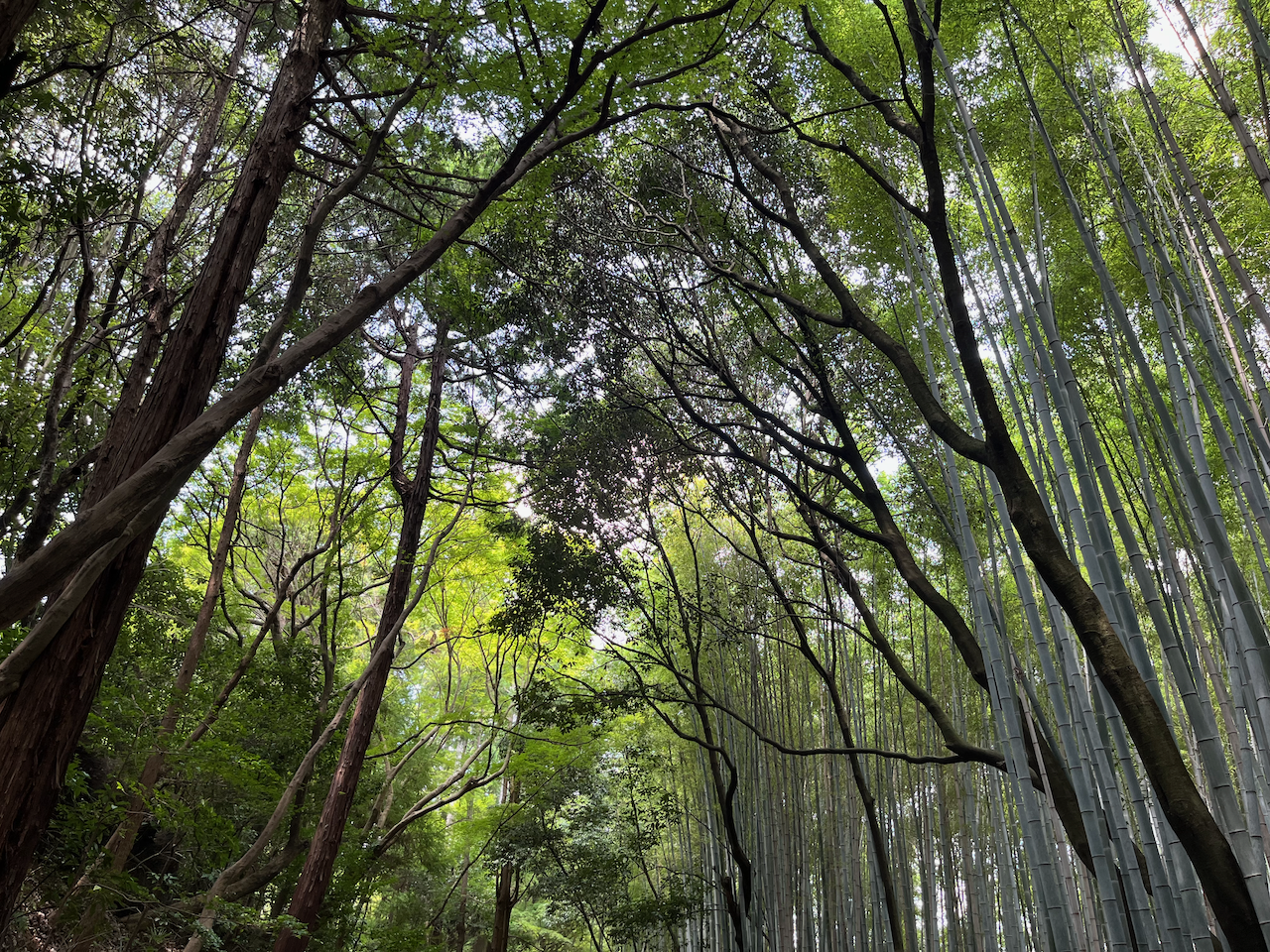
Tenryuji Temple, official website here, is a temple that has seen a lot historically. It was number two or three in the Five Mountains hierarchy, and was thus a very prestigious temple. It contains many terrific works of art, and a gorgeous pond created by Muso Soseki back in the day. Because it is right next to the famous bamboo forests of Arashiyama in western Kyoto, we were able to view both on the same hike, as well as the iconic Togetsu-kyo Bridge:
I should add that the temperature was 37C (98F) in Kyoto and extremely humid that day. The walk through bamboo forests was incredibly enchanting, but also grueling due to heat.
It’s not clear from the photos, but because of the shade and the high humidity, there was a constant mist between the trees, and an oppressive air. It was really cool, and would make a great setting for any Asian-style D&D campaign (not unlike the ones that I made previously … 😏).
Once you emerge from the bamboo forest, you enter the back-entrance of Tenryuji Temple. The front entrance that’s very close to the Saga-Arashiyama train station as well, so you can also visit from that direction too. The signs are very obvious.
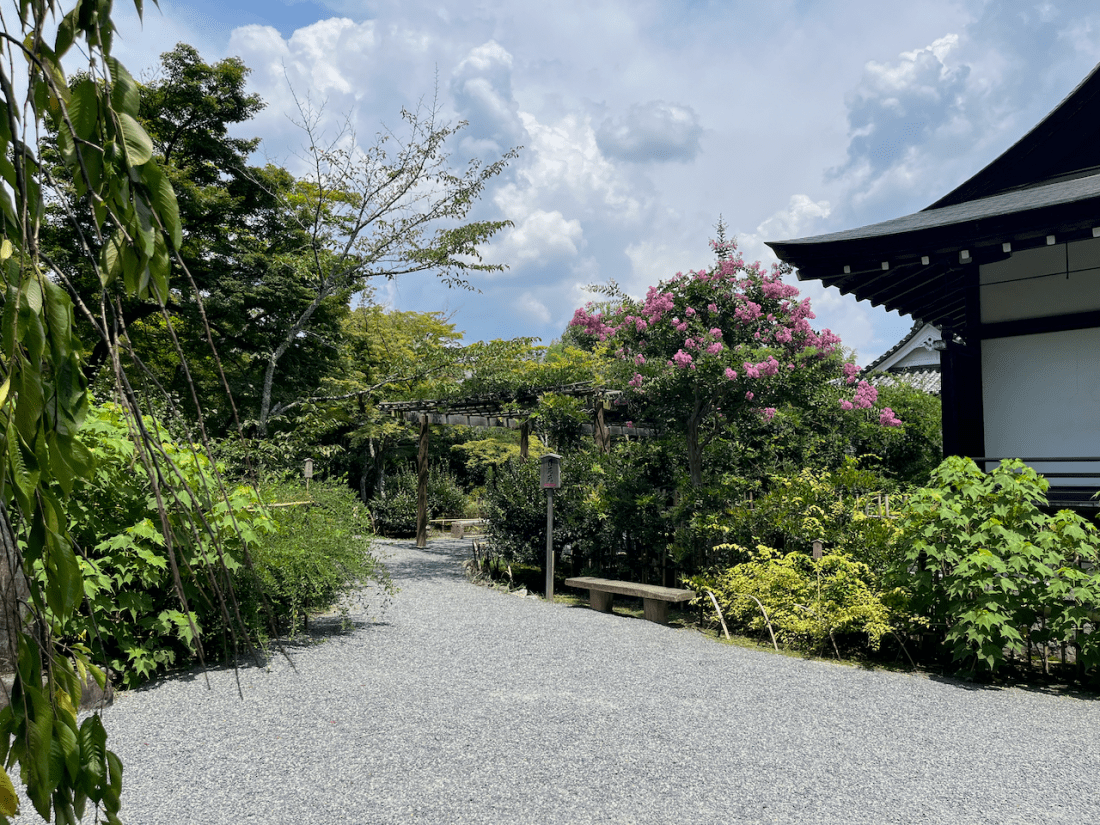
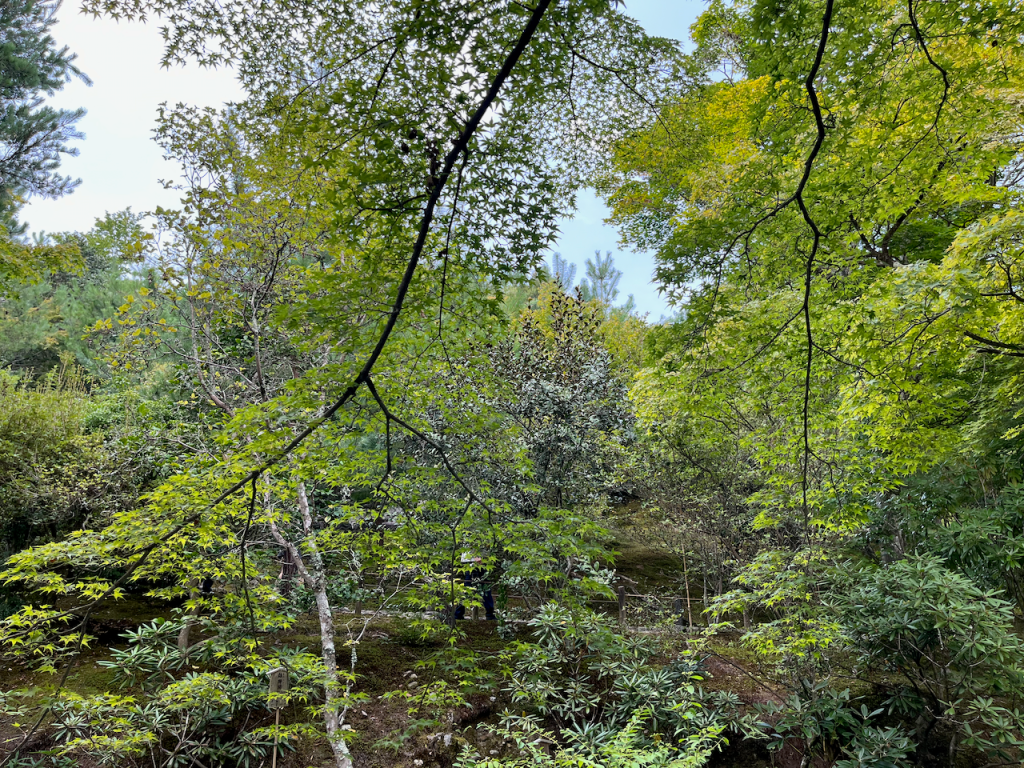
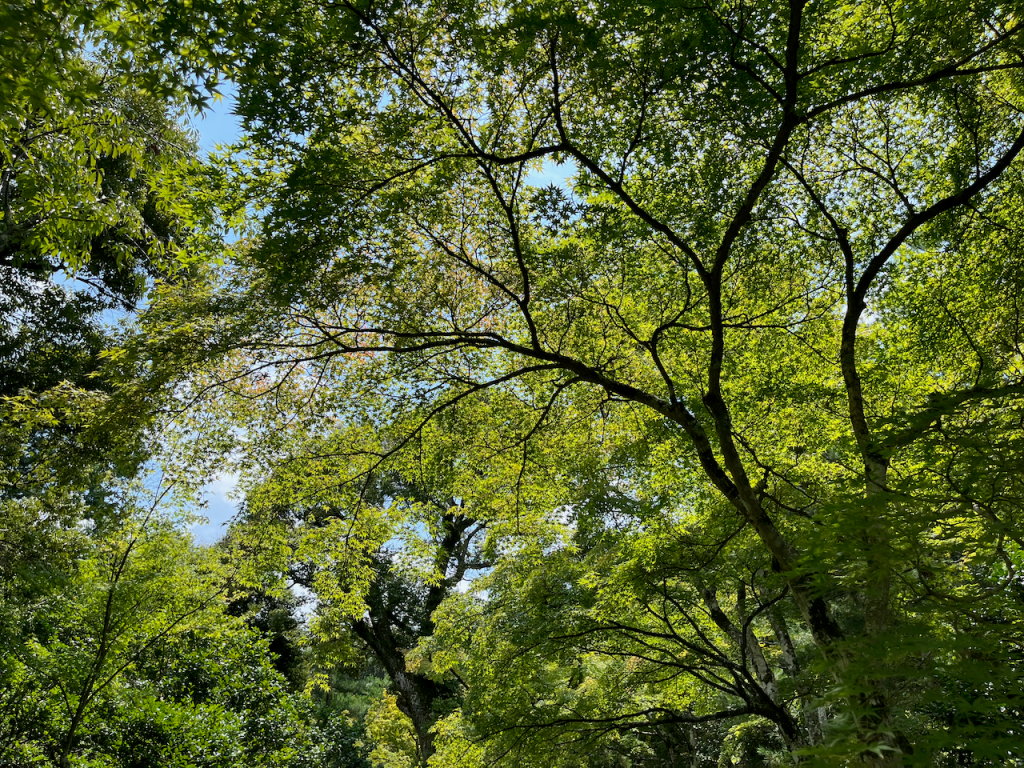
The main buildings were clustered together in the middle of the property, with a really nice garden walk surrounding it, including many lovely or rare plants. If I were a botanist, I’d probably have a field-day here. The signs are all multi-lingual too, which is really handy.
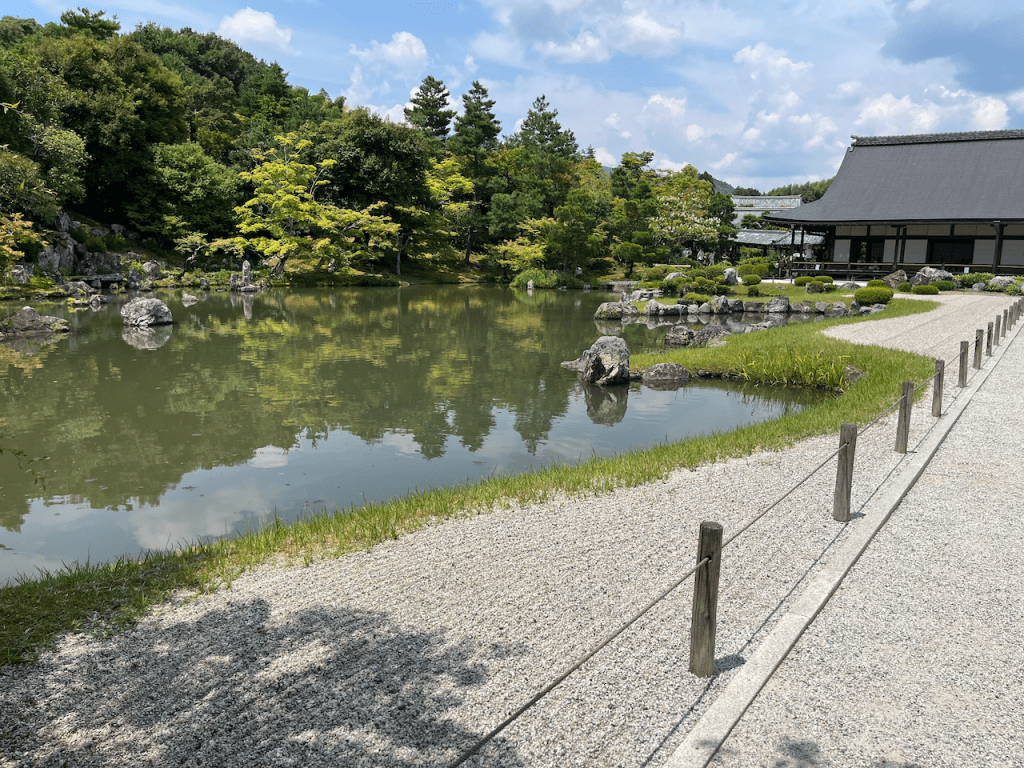
If you continue around the walk, you will come to the Sogenchi (曹源池) Pond, which according to the sign is modeled on Chinese architecture at the time (and a common feature of Japanese aesthetics during the Muromachi Period):
Similarly, you find a lovely sand garden (karesansui in Japanese, 枯山水 ) nearby too:
I wanted to take more photos of the interior of Tenryuji, but there were just too many tired, overheated tourists, and Instagram influencers. I chuckled as I saw a couple young ladies who were way over-dressed in fine, Chinese-style silk dresses and taking turns posing and photographing each other. The heat and humidity were so intense, I can’t imagine why they would do this to themselves. But I digress.
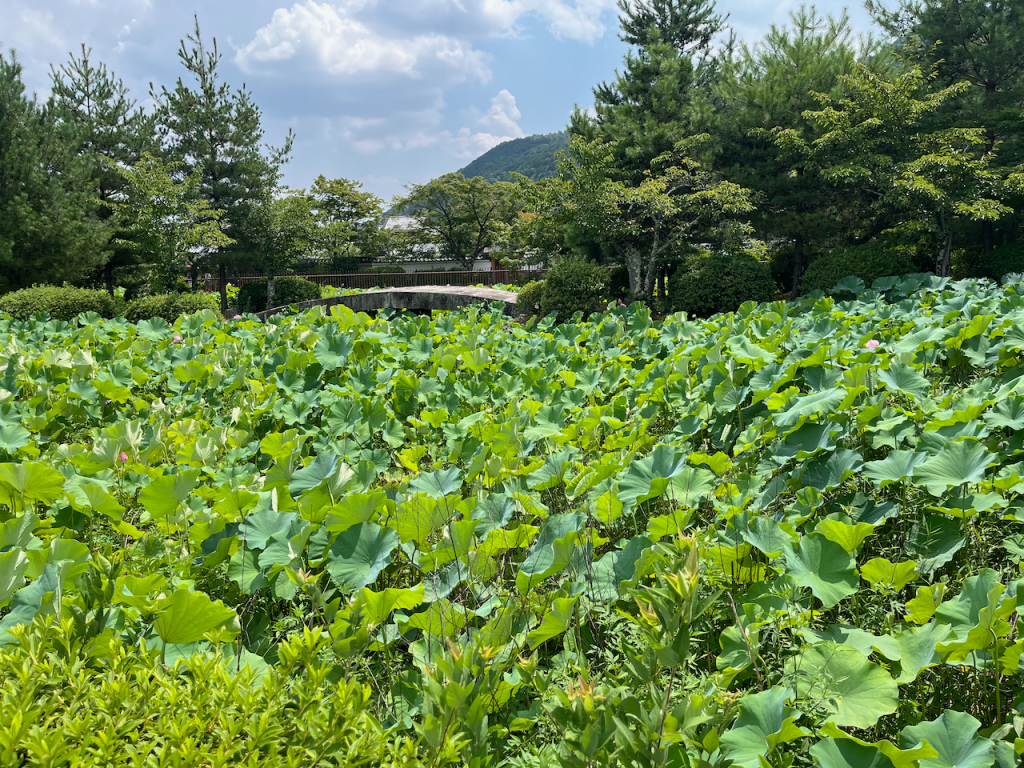
Finally, as exited Tenryuji toward the train station side we saw a very nice lotus pond:
Tenryuji Temple is, for historical reasons, a shadow of its former self, but even what remains is very scenic and embodies much of the beauty and prestige of Arashiyama. I didn’t enjoy it on the same level as another Zen temple, Ryoanji, but it is lovely. For poetry fans, the Arashiyama district is also the site where the Hyakunin Isshu anthology was compiled, which I covered on my other blog.
That said, Arashiyama is quite touristy and crowded. It’s pretty foreign friendly, and if you’re just passing through Kyoto for the first time, it’s a great place to stop. But, for me, if you have the time and want to really get to know Kyoto life and culture, there are other places I prefer.
Next time, we’ll talk about Kenninji, which was smaller than Tenryuji, but had some pretty mind-blowing artwork.
P.S. 欢迎中国游客,感谢您的阅读。
1 I tried to put both in a single post, but it quickly got too large. I am a victim of my own hubris…
The Japanese-Buddhist holiday of Ohigan is fast approaching, and I haven’t written about it in years (!), so I felt like posting about it today.
Ohigan (お彼岸, “the other Shore”) started with the pious 8th-century emperor Shomu. The name implies crossing over from this shore, which is comprised of greed, anger, desired, pain, frustration, strife, etc, etc., the usual nonsense. Contrast that with the “other shore” in Buddhism which symbolizes peace, contentment, freedom from harm, fear, conflict, etc. Because Ohigan is observed both at the Spring and Autumnal equinoxes, this is a time when the weather is mild, and so people can slow down and re-commit to the Buddhist path.1 Given how climate change is affecting the weather, this point is not lost on us today either.
Ages and ages ago, quotations of the historical Buddha, Shakyamuni (a.k.a. Siddhartha Gautama) were collected in India in a text called the Dhammapada. Despite the centuries gap between what the Buddha said, and what was recorded later, the Dhammpada probably represents one of the very oldest texts, and the closest to the historical Buddha that we’ll ever get. It’s short, easy to digest, and has lots of little witticisms that even today people can learn from.
One of them is this quote:
371. Meditate, O monk! Do not be heedless. Let not your mind whirl on sensual pleasures. Heedless, do not swallow a red-hot iron ball, lest you cry when burning, “O this is painful!”
In modern American English, I suppose we’d translate this as “don’t shoot yourself in the foot”.
But, of course we do this all the time. My doctor told me pretty bluntly that I should lose weight, and I want to lose weight, and yet when someone in the family offers to buy some bubble tea, I totally forget. What little spare time I have is usually spent playing Fire Emblem2 games instead of doing anything constructive like washing the dishes.
Centuries later, someone asked the Pure Land Buddhist teacher, Honen in the 12th century a series of questions and answers, this is question 57:
一。さけのむは、つみにて候か。 答。ま事にはのむべくもなけれども、この世のならひ。
Q: Is it a sin to drink saké [alcohol]? A: Indeed one ought not to drink, but [you know] it is the way of the world.
This is our normal state of being. Most of the time its benign, but clearly some actions we do are self-destructive even if just a little bit, and it’s hard to break the cycle if we aren’t even aware we’re doing the cycle to begin with.
So, there tends to be a need for both awareness, as well as self-restraint. When one becomes aware of their own habits, they are more capable of stopping self-destructive habits. By moderating or restraining bad habits, one tends to have fewer headaches later, and thereby getting one step closer on the Buddhist path.
There’s no magic formula for this. As we’ve seen in Mahayana Buddhism, there are countless ways to approach this both in the grand sense, but in the little day to day efforts too. Everyone is encouraged to find their own way, or emulate others they find admirable. The latter is why the Sangha, the Buddhist community, is considered one of the Three Treasures by the way. People can’t always see what they’re doing is harmful, and even if they can, they can’t always fix it without support from loved ones and people they trust.
The Buddhist path is long, spanning countless lifetimes, but even tiny little changes we make here and now, even if we falter, will still have big effects in the future. Don’t underestimate your own ability, and don’t be afraid to rely on others if needed. If nothing else, recite the nembutsu.3
Happy Ohigan!
Namo Shakyamuni Buddha
P.S. The featured image is the temple of Todaiji in Nara, Japan, another project by Emperor Shomu.
1 In modern Japanese culture, it is often a holiday time for overworked employees, and a chance to go to their home town, pay respects to their ancestors, etc. Like a smaller scale Obon.
2 After this initial post, I have still been actively playing Three Houses for the past year (!), but I have also branched into other games in the series. I have five games currently and am various stages of each. It’s a terrific series, but Three Houses will always be my favorite. Such a beautiful story, such an emotional rollercoaster. If you own a Nintendo Switch, I hope you get a chance to play it.
3 Question 69 of same letter addressed to Honen:
一。心に妄念のいかにも思はれ候は、いかがし候べき。 答。ただよくよく念仏を申させ給へ。
Q: When bad thoughts keep arising within my mind, what should I do? A: The only thing to do is to repeat Nembutsu.
I alluded in recent posts about my visits to the temple of Sanjūsangendō (三十三間堂, San-ju-san-gen-do) in Kyoto, Japan, but I’ve never really talked about it.
My experiences with Sanjusangendo go all the way back to our first trip to Japan together in 2005. My wife (whose Japanese) and I had married the previous year,1 and we came to Japan to meet the extended family, but also take in many sites. That first trip through Kyoto was a whirlwind, and I have very fuzzy memories of most of it. I couldn’t remember much about Sanjusangendo, and since we couldn’t take photos, I had very little to remind me either.
And yet, something about Sanjusangendo drew us back in recent years. My late mother-in-law really liked Sanjusangendo, and my wife wanted visit again for her mother’s sake, and now with 20 years of experience in Buddhism, the temple made a lot more sense to me. The fact that it’s a Tendai temple (and I like Tendai Buddhism) was icing on the cake. My wife was really inspired by it too, so the following year we visited it again.
…. so, what is Sanjusangendo?
Sanjusangendo is a Buddhist temple, which venerates the bodhisattva Kannon, also known as Avalokiteshvara, Guan-yin, etc. It was founded in the 12th century by the infamous warlord Taira no Kiyomori as a way to impress Emperor Go-Shirakawa (tl;dr it didn’t work). What makes Sanjusangendo so famous is two things:
It’s very long, narrow main hall (本堂, hondō). This is different than most temples which have a more square-shaped main hall. The hondō of Sanjusangendo is a very long rectangle, but there’s a reason for this. The featured photo above is something I took in 2023, and shows the scale of the building. The website also has a nice photo.
The temple’s main attraction is the 1,000 statues of Kannon bodhisattva, centering around a much larger statue of Kannon. These statues are lined up in rows along the main hall, and in front of them are other statues featuring various gods and other divine beings protecting the temple. More on that below.
Since Sanjusangendo doesn’t allow photography inside the main hall,2 you should check out the official website instead. You can see the main hall, and the row upon row of Kannons here. The official website also has photos of each figure.
The main figure of devotion, as i said above, is the bodhisattva Kannon, but since Kannon has many forms, this form is the 1,000-armed Kannon called Senju Kannon (千手観音). This form of Kannon isn’t limited to Japanese Buddhism; I have seen this form expressed at Vietnamese Buddhist temples as well. The idea is that Kannon, according to the Lotus Sutra, uses many different means and methods to help people, and the 1,000 arms, each holding different objects, symbolizes the diverse ways that Kannon helps others.
Something you might also note is that the Kannon statue has 11 heads. Just as the 1,000 arms show Kannon’s efforts to help all beings in a variety of ways, the 11 heads show Kannon’s vigilance in watching out over people.
Not shown in the photos is a small display which teaches a particular mantra associated with the 1,000-armed Kannon:
You can recite this mantra in Japanese or Sanskrit. I am unclear what the translation is, but I’ve been told before that translating mantras is kind of pointless, like giving answers to a Zen koan. So, I left out the translation.
Anyhow, flanking the great big statue of Kannon on either side are 10 rows of smaller, standing statues of Kannon, each with 1,000 arms, which you can see here. The website says that of the one-thousand statues, they were built over time: 124 were from the late Heian period (12th century) and the rest were constructed during the Kamakura period (13th-15th century). There are a total of 1,000 statues, each one slightly different, but generally the same form.
Finally, in front of these statues is a series of mythical figures. Some are originally from India, and traveled the Silk Road, gradually transforming into what we see today. Others are more native Japanese deities who’ve also become Buddhist guardians. You can see the full catalog here.
To give an example of the eclectic nature of these figures, one figure is a Buddhist guardian deity named Vajrapani (Naraenkengō 那羅延堅固 in Japanese), whose imagery was influenced by the Greek hero Herakles at a time when places like Bactria and Gandhara were still part of the Greek world.
On the other hand, you can also see the famous figures of Raijin and Fūjin who are Thunder and Wind gods respectively. As far as I know, these are native deities and did not originate from the Silk Road.
The quality of the artwork is really excellent. When you see any of these figures, Kannon, Vajrapani, Raijin, etc, the life-like quality is really impressive. And, like many examples of Buddhist art, they are full of symbolism and visual meaning beyond words. They impress and inspire those who see them. Since I have now seen Sanjusangendo three times, I found that it continues to impress me every time I see it.
Speaking from experience, Sanjusangendo is a place that requires some context to really appreciate. If you are unfamiliar with Kannon and why they have one-thousand arms, or with the strange but beautiful figures guarding the front row, then some of it will feel like a mystery. It’s a beautiful mystery, but still a mystery. But, hopefully after reading this, you will get a chance to see it someday and really get a feel for why this place is special.
As someone who has an affinity for Kannon since I first became a Buddhist, it is a special place for me. 😊
Edit: fixed a number of typos. Three-day weekend drowsiness. 😅
P.S. Again, apologies for the lack of photos. I know sometimes foreigners will take photos anyway (I have seen people do this), despite the signs clearly saying “photography prohibited”, but I don’t want to be one of those tourists. So, if you want to see more, check out the excellent website.
1 Twenty-year anniversary as of early 2024. 🎉
2 A lot of temples in Japan do this. I don’t fully understand why, and it is frankly a little frustrating.
3 Katakana script is often used to write foreign-imported words in Japanese, as opposed to hiragana script. Since mantras are originally derived from Sanskrit, using katakana makes sense in this context. Sometimes katakana is also used for visual impact (like in manga), so that might explain things too. NHK has a nice website explaining how to read katakana.
I’ve talked a lotrecently about the Jodo Shinshu sect (sometimes called “Shin Buddhism” in some circles) of Japanese Buddhism and its founder Shinran, a former Tendai-Buddhist monk of the 13th century.
Shinran was one of a multitude of disciples of Honen. Honen was crucial in propagating Pure Land Buddhist teachings to the wider Japanese populace through simple recitation of the nembutsu over elaborate death-bed practices. For his part, Honen was building on older teachings from such illustrious monks as Genshin in Japan (also Tendai), and Shandao in China.
Needless to say, Honen’s hugely popular egalitarian movement really rubbed the Buddhist establishment, which had close ties with the Imperial government (especially with the Fujiwara), the wrong way. Although several complaints by powerful temples such as Kofukuji of the Hosso (Yogacara) sect and Enryakuji of the Tendai sect were rejected, Emperor Gotoba1 finally purged the movement after some alleged shenanigans between a couple disciples and some of his ladies in waiting. This is known in history as the Jogen Persecution (jōgen no hōnan, 承元の法難) of 1207.2
I say this because not only were the offending disciples executed, Honen and many of his followers were banished to the provinces, including Shinran, and were stripped of their monastic certification. The latter point is important to this post and worth exploring.
Way back in the day in ancient India, during the time of Shakyamuni (5th c. BCE), people who wished to follow the Buddha full time would renounce worldly life and become monks (bhikkhu) or nuns (bhikkuni). This was voluntary, and people could choose to give it up and return to lay life, assuming of course they weren’t kicked out for committing some offense. Since antiquity, Indian religious culture respected sages, ascetics, and monastics, such sages, ascetics and monks lived by begging for alms and were generally supported by the community. Since they were supposed to devote themselves full time to religious pursuits, it was assumed that the community would handle their day to day needs.
Fast-forward centuries later to Imperial China, where Confucianism was already entrenched in the government. Confucian bureaucrats generally had a suspicious view of Buddhist monks because they did not work, and didn’t contribute toward rearing families, or other such obligations to society. This clash of cultures played out over centuries, and there was even a dramatic purge during the Tang Dynasty in 845 where many monasteries were destroyed. Centuries later, they gradually reconciled, but it was a very bumpy ride.
This tension between Confucian bureaucracy and Buddhists played out in Japan too. Buddhism was eagerly adopted by the early Imperial court in Japan, but it was a tightly regulated extension of the State, intended to help avert calamities, and bring prosperity to the nations. Monks were frequently called on to recite sutra passages, or chant mantras to help ailing members of the aristocracy, or prevent natural disasters. Of course, many people were sincere followers too, but ordinations, regulations and such were all managed by the central government. It was, first and foremost, another organ of the State.
Why do I mention this?
Because when Shinran and other followers of Honen were stripped of monastic certification, they were no longer recognized as monks by the authorities. Sure they might have training, but no official status.
However, Shinran had been a trainee on Mount Hiei, center of the Tendai sect, since he was a small boy. He knew no other life. And yet now he was technically not a monk anymore in the eyes of the law. And yet, he wasn’t really a lay person either.
This led to a fascinating declaration by Shinran who changed his name to Gutoku Shinran (愚禿釋親鸞, “foolish, stubble-headed disciple of Shakyamuni [Buddha], Shinran”) and declaring himself hisō hizoku (非僧非俗) which means “neither priest, nor layman”. This set the trend that became the Jodo Shinshu movement thereafter.
Rather than relying on monastic institutions or monastic structure, Jodo Shinshu followers self-organized into dōjō (道場)3 which were often just people’s houses. Such members would gather periodically, pay dues, discuss issues at the time, shared letters from Shinran, recited the nembutsu together and so on. It was probably the first truly lay-centered Buddhist movement of this size and scale in Japan, possibly in history.
Lay movements are not new to Buddhism, but usually are often centered around a famous teacher (a monk) or a temple. Or, they tended to dissipate after a few generations. The Jodo Shinshu movement had neither monastic teachers, nor temples. They self-organized, trained their own priests, which included both men and women, and these men and women lived as other people did: they married, had families, worked, etc. Shinran for his part also married and had kids. He had no reason at this point not to since he was legally not a monk any more.
It wasn’t always smooth sailing, and Shinran (and later Rennyo) had to frequently deal with bad teachers, who let the power go to their heads, or taught unorthodox ideas purporting that they came from Shinran. Further, in the time of warlord Oda Nobunaga, and later the Zen monk Tetsugen, mob-violence by Jodo Shinshu followers was a genuine threat.
Nevertheless, the fact that such a self-organized lay-focused Buddhist community existed and thrived across medieval Japan is very noteworthy. It’s openness to women priests was revolutionary for the time, as was its lack of monastic standards for priests. It was run by laypeople for laypeople.
Even while I criticize some aspects of Shinran’s thought, I can’t help but deny that the “neither priest nor layman” concept, even if it was lamenting his own fate, ended up being a brilliant innovation and ahead of his time. Lay-Buddhist movements are very common now across Asia and the West, but these are often very modern innovations. Jodo Shinshu was basically doing it centuries earlier, before it was cool. It met the needs of people in a way that “ivory tower” monastic institutions could not, and solved the issue of accessibility of Buddhist teachings in a robust, sustainable way.
Not surprisingly, Jodo Shinshu is overwhelmingly the largest sect in Japan.
P.S. Shinran wasn’t the only one to really propagate Pure Land teachings in the provinces. Another major disciple of Honen, Bencho, was exiled to the island of Kyushu and established a lineage there which is now the main branch (a.k.a. Chinzei-branch) of the Jodo Shu sect we know today. Another disciple, Shoku, developed a second branch called Seizan-branch Jodo Shu. Shinran’s teachings and organization differed enough from Honen’s that later generations treated it as a separated sect entirely. Hence, “Jodo Shinshu”, not “Jodo Shu”. This might feel like splitting hairs, but if you’re a history nerd, now you know.
1 Emperor Gotoba was also the author of poem 99 in the Hyakunin Isshu, and was definitely a larger-than-life figure… for better or for worse.
2 There is also another persecution in 1227 called the Karoku Persecution (karoku no hōnan, 嘉禄の法難). In the latter case, Honen had already passed away, but after followers who remained in Kyoto built a mausoleum for their beloved teacher, the warrior monks of Enryaku-ji temple raided the mausoleum, destroyed it, and killed some disciples. These were tough times.
3 the modern “dojo” as a martial-arts institution gradually derived from this.
Years ago, when I was part of the local Jodo Shinshu Buddhist community, my minister told me a story about how Rennyo and Ikkyu, two famous Buddhist monks from 15th century Japan, were both good friends and would frequently test one another in their grasp of Buddhism. They were an unlikely pair of friends, given that they belonged to two very different Buddhist traditions, and yet they clearly had a rapport that you rarely find in Japanese-Buddhist history.
To be honest, I thought the story of them being friends was embellished, but I got curious recently poked around some Japanese sources on the Interwebs, and sure enough there were a number of famous anecdotes between Ikkyu and Rennyo. These anecdotes aren’t necessarily historically accurate, but they have been passed down through the generations and even show up in Japanese TV today.
But first, let’s introduce Ikkyu and Rennyo.
Ikkyu Sojun (一休宗純, 1394 – 1481) was a monk of the Rinzai Zen tradition,1 which was politically dominant at this time due to the Five Mountains System in Kyoto. He was disillusioned with the pomp and grandeur of the Zen community at that time, and left to live a more “authentic life” among the people. He is famous for his flashes of genius, and his artistic talents, but also his unorthodox behavior, including partying and sleeping with girls. Ikkyu left behind many excellent poems, paintings, and his genius image has made him a popular figure even in modern Japan.
Rennyo (蓮如, 1415–1499) was the eighth head of the ancestral Honganji Temple in Kyoto,2 which ostensibly was the head temple of the Jodo Shinshu sect. Trouble was, the movement was very fractured, with regional groups, rival powers, etc. And then there were the warrior-monks of Mount Hiei (head of Tendai sect) that wanted him dead. Rennyo had to flee Kyoto for a long while to the provinces, but used the time to unify the Jodo Shinshu groups into a more cohesive sect for the first time. His Letter on White Ashes, is a particularly inspired piece of writing.
Ikkyu was 20 years older than Rennyo, but in many anecdotes, they are making jokes with one another, or testing each other’s wisdom.
In one famous story (used in the “Ikkyu-san” cartoon), Ikkyu had put up a sign near a really crooked pine tree. The sign read whoever can see this pine straight, I will give them a kanmon of gold.
People were stumped, and brought this to Rennyo’s attention. Rennyo said, “pfft, more of Ikkyu’s mischief. I see this pine straight. I’ll get the cash.”
When Rennyo confronted Ikkyu about it, Ikkyu said, “Oh, it’s you. You don’t count. Look at the back of the sign.”
Sure enough, on the back of the sign was painted “EXCEPT RENNYO”.
When people ask Rennyo how he was able to see the crooked pine straight, Rennyo said that he saw it for what it was: a crooked pine. By seeing it for what it really was (a crooked pine), he saw it “straight”.
In another anecdote, for which I could find the original Japanese, Ikkyu had read the Amitabha Sutra and commented:
阿弥陀には まことの慈悲はなかりけり たのむ衆生のみぞ助ける
Amida Buddha has no true compassion; he only helps those who ask.
Rennyo is invoking the imagery of Amida Buddha’s compassion as moonlight, which we’ve seen before, and how it shines everywhere. But if water is in a container (has a lid on it), the moonlight will not reflect back.
Ikkyu tested Rennyo again:
極楽は十万億土と説くなれば 足腰立たぬ婆は行けまじ
If the Pure Land of Amida Buddha is indeed 10,000,000,000,000 lands away [as described in the sutras], then an elderly woman who is unable to stand cannot go there.
In another story, Ikkyu attended the 200th memorial of the founder of Jodo Shinshu (and Rennyo’s ancestor), Shinran. Of Shinran, Ikkyu wrote the following verse:
襟巻の あたたかそうな黒坊主 こやつが法は 天下一なり That black[-robed] monk with the warm [as in “kind”] head and scarf, his Dharma teachings are peerless.
There are a lot of other stores too, and I’ll try to share more as I find them, but I thought these were neat. Zen and Pure Land Buddhism are often treated as separated teachings, and separate sects, but I suspect that as with any Buddhist path if you get far enough along, you’ll start to run into people of the same mind.
That, in my humble opinion, is the power of the Lotus Sutra and its many gates.
1 Zen in Japan is divided into 3 schools: Soto, Rinzai and Obaku, all imported from China at various points in history. Rinzai and Obaku both have the same “ancestral lineage” in China, but arrived in Japan at different points. Soto comes from a different lineage entirely in China.
2 A few generations after Rennyo, the Honganji split into two temples: Nishi (West) Honganji, and Higashi (East) Honganji after a family split, plus politics. They are effectively equal, but different sub-sects.
In our last episode (… a few months ago 😓) Xuan-zang met the Qaghan of the Western Turkic Khaganate, and made a good impression, allowing him to travel safely further south and westward toward the city of Samarkand.
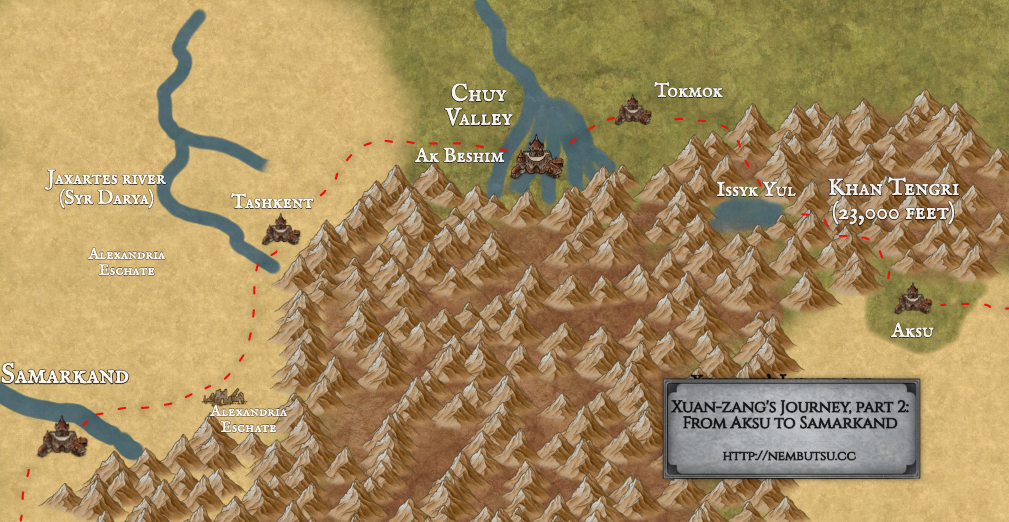
Map of Xuan-zang’s journeys from Tashkent to Balkh. Inkarnate put out a new version of its software while I was on break, so some things may look different than past maps. As always, this is an amateur map, and may contain geographic mistakes.
If you need to brush up on earlier episodes, click below:
Samarkand is a fascinating place: a fabulously old city, and a major hub on the Silk Road. All the way back in the time of Alexander the Great’s conquests in 329 BCE, 1,000 years before Xuan-Zang, the city was called Marakanda (Μαράκανδα) in Greek and was part of the Achaemenid Persian Empire before that. By Xuan-zang’s time the city was part of the Sassanian Persian empire, and still a major trading hub, known even to the Chinese, but I was unable to find a reliable source on the Chinese name at the time. Modern term is 撒马尔干 (sǎ mǎ ěr gàn ?). The city at this time was almost entirely populated by Sogdian Iranian people, whom we’ve also seen in past episodes. This far west from China, Xuan-Zang probably saw very few if any Chinese people, and instead encountered many people from other cultures and parts of the world. He was very much a “stranger in a strange land”.1
However, because this city was part of the Sassanian Empire, the official religion was Zoroastrianism, not Buddhism, and as Xuan-zang came to the city, he noticed that the Buddhist monasteries there were abandoned and neglected. Some of Xuan-zang’s followers went to pay their respects at these monasteries, but they were chased off by a mob of Zoroastrian followers with flaming brands. Later, the king heard what happened and arrested the mob leaders and was going to pass sentence to mutilate them. Xuan-zang begged for leniency, and so they were flogged and expelled from the city.
The king of Samarkand wasn’t particularly friendly to Xuan-zang, but their relations did improve. Further, it seems that later the king of Samarkand made friendly, diplomatic overtures to Tang-Dynasty China as a foil to the Western Turkic Khaganate, but these did not go very far. Decades later, Great Tang’s expansion reached all the way to Samarkand and they briefly ruled for a few decades until the Battle of Talas later. All this happened decades after Xuan-zang visited the city though.
In any case, Xuan-zang wisely did not stay long in the city and turned at least to towards the south.
Heading South
Up until now, Xuan-zang’s journey from the Yumen Pass in China to Samarkand, over the Tian Shan mountains and across two deserts, has mostly been a westerly journey. But this was as far west as Xuan-zang would go. The road to India was now in a south-southeasterly direction passing through places like modern Afghanistan, Pakistan, and Uzbekistan. These areas were not part of Sassanian Empire, and instead were local princes and minor rulers with complicated relations with regional powers. These areas were more Buddhist-friendly as well due to the legacy of Bactrian Greeks,2 but more importantly due to the Kushans who came later. Much of these lands were former Kushan territory, and their good governance and patronage of Buddhism at the time allowed things to flourish on the Silk Road.
The first obstacle Xuan-Zang and his party ran into was the famous “Iron Gates“.
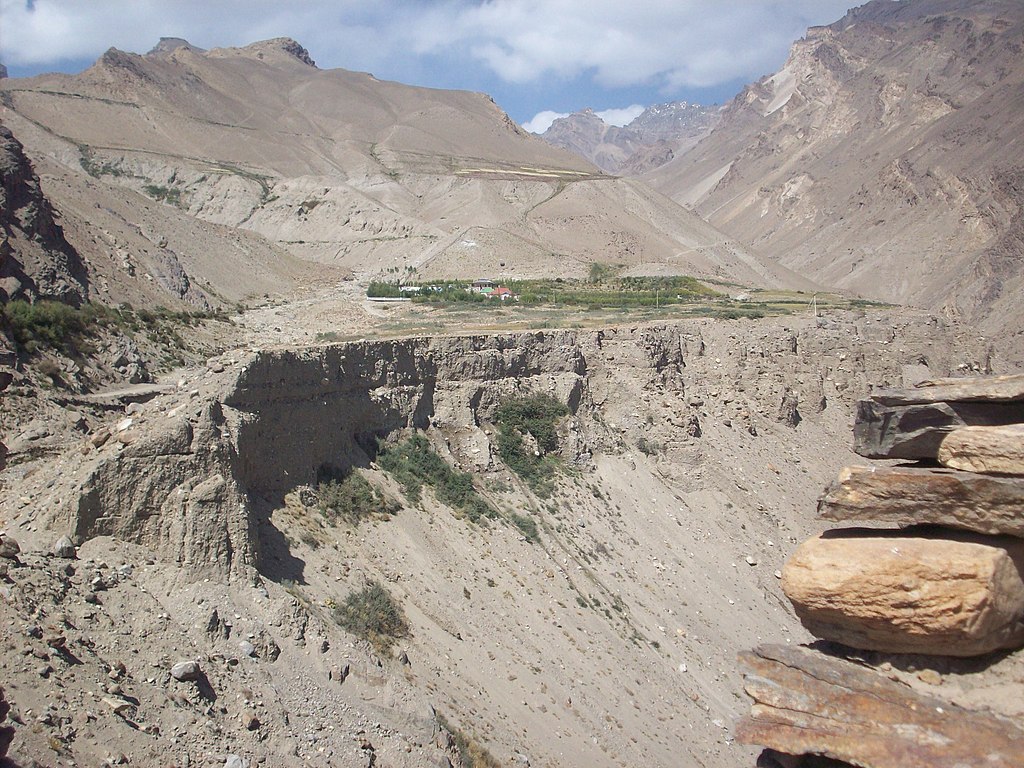
A valley in the Badakshan Province in Afghanistan, close to the where the Iron Gates would be. Photo by Zack Knowles, CC BY-SA 3.0, via Wikimedia Commons
Because this area was a choke-point for travel, it was often garrisoned, and he described “double wooden doors, strengthened with iron and furnished with bells”. In any case, Xuan-zang seemed able to pass through without much issue.
After crossing the Oxus River (now the Amu Darya), he returned to regions where Buddhism was still flourishing namely in the small city of Termez. Termez was once a major city of the Kushan Empire, but was much more diminished by the time Xuan-zang arrived. The Buddhist community here numbered about 1,000 monks. It was here that he saw the Ajina Tepe monastery and its excellent works of art.
In fact, from here Xuan-zang would behold some pretty amazing spectacles. Many people may not realize that the lands we now call Afghanistan were once bastions of Buddhism along the Silk Road, and boasted many treasures, monasteries, and a very eclectic culture.
But first, Xuan-zang had to deal with a series of problems in the city of Kunduz.
Xuan-zang’s visit to the city of Kunduz was no accident. After meeting the king of Turfan way back in episode one, and the Qaghan of the Western Turks in episode three, he had many letters of introduction to the Prince of Kunduz named Tardu. As rulers on the Silk Road, they were all related by family or marriage, so Xuan-zang had little trouble getting an audience with Prince Tardu.
Except for one problem: the Prince’s wife had recently died, and he was in mourning. Later, Tardu abruptly married another daughter of the king of Turfan (episode one), and she in turn plotted with his son from the first marriage. This is starting to sound like the plot of a historical K-drama, doesn’t it?
Before long, Prince Tardu was poisoned and died. The new queen married the prince, and ruled Kunduz thereafter.
Xuan-zang did his best to lay low, and stay out of the issue. His delays at Kunduz meant that he had time to get to know another Buddhist monk named Dharmasimha. Dharmasimha and Xuan-zang debated Buddhist thought and treatises for some time, but Xuan-zang felt Dharmasimha didn’t know as much as he was hyped up to. Dharmasimha for his part, acknowledged his shortcomings, and tried to stay humble about it.
Moving On
Before Prince Tardu’s death, he had encouraged Xuan-zang to visit another city named Balkh, also in modern Afghanistan. Balkh had quite a few sites to see, and since some Buddhist monks were already planning to head back there, Xuan-zang accompanied them. After passing through a city named Tashkurghan (modern Kholm, not related to a similar city in China), they reached the verdant lands of Balkh.
The city of Balkh, known to the Greeks of Alexander the Great as Baktra (Βάκτρα) and Baítíguó (白題國) in Chinese to Tang-dynasty China, was important since very far back in antiquity. Balkh was the traditional birthplace of the Zoroastrian religion, and an important cultural center to Persian people since very ancient times, rivaling cities further to the west such as Babylon and Ecbatana in importance. According to Buddhist tradition, the first two of the Buddha’s disciples also hailed from Balkh, and made the first stupa. Centuries later, it was here that Alexander had married a bride named Roxana, seeking to unify western Greek culture with the eastern Persian culture. Later in the Hellenstic Age, it was an important center of the Greco-Bactrian kingdom.
Needless to say, while few people have heard of Balkh today, it was a very important city across many centuries.
During Xuan-zang’s time, the lands around Balkh were still very fertile (desertification happened gradually later). Even with the widespread destruction the Hephthalities (a.k.a. “white huns”), the lands were still prosperous, if somewhat depopulated. There were two major monasteries in the area collectively known as the Nava Vihara, that belonged to the Sarvastivadin tradition of “Hinayana” (early Indian) Buddhism.3 There were tens of thousands of monks in attendance, and Balkh was one fo the remaining places where teachers were regularly installed from India. Similar to Bamiyan, the Naha Vihara boasted massive statues of the Buddha as well. Interestingly, even as far as the 8th century, long after Xuan-zang was dead, an Arab historian named Umar ibn al-Azraq al-Kermani recorded a place of worship here similar to the Kabaa in Mecca. But instead a Buddhist stupa was enshrined inside, with a cloth draped over it, in accordance with Persian custom of showing veneration.
Xuan-zang stayed at the Nava Vihara for a month, and became good friends with a monk there named Prajnakara. Xuan-zang seemed to finally find a monk of high-caliber, who had a good depth of understanding of Buddhist doctrine, even if he was a “Hinayana”, not Mahayana Buddhist. The two journeyed together further south to Bamiyan.
In our next episode, we’ll explore Xuan-zang’s visit to the great Buddha status of Bamiyan, and Xuan-zang is reaching the borders of India. But first, he has to cross the Himalayas…
3 Although the Sarvastivada school was not Mahayana Buddhism, Mahayana Buddhism inherited a lot from it anyway: canon of texts, certain viewpoints, etc. Another important early school that influence Mahayana were the Dharmaguptaka, who mostly gave their monastic traditions and rules to the Mahayana.
A little while ago, when talking about Japanese mythology, I alluded to the belief in the divine origins of the Japanese imperial family through their reputed ancestor Amaterasu Ōmikami (Amaterasu for short), kami of the sun. This lineage and how they came to rule Japan is recorded in two very old historical texts: the Kojiki and the Nihon Shoki.
Since I have been reading a fun book in Japanese about the Nihon Shoki, we will focus on that one. Just know that the origin story in Kojiki is mostly the same.
The Nihon Shoki begins as a series of myths about the creation of Japan, followed by stories of different generations of kami, culminating in Amaterasu’s grandson, Ninigi-no-Mikoto who descends to earth. Next, Ninigi had a great-grandson, named Kamu-yamato Iware-biko no Sumeramikoto (神日本磐余彦天皇),1 and in time “Iware-biko” became the first emperor of Japan, the legendary Emperor Jimmu (jimmu tennō, 神武天皇).2 We’ll explore later why this is more myth than history, but for now, let’s continue the story as recorded.
In his youth, the future emperor grew up in what later became the province of Hyuga in southern Japan, also called Himuka (日向) in olden times. By the age of 45, he had married, had children, and took care of his brothers. Then one day, he proclaimed to his family that due to his divine lineage, it is his destiny to rule the lands to the east (central Japan) which are rich and verdant, and to establish his capital there.
From here, Iware-biko sets out with his kin to the island of Honshu, the main island of Japan, and begins the invasion of the “Yamato” region, starting at the bay of Naniwa (later Osaka). It is here they come into conflict with the a local chieftain named Naga-sune-hiko. Sadly, Iware-biko’s older brother was killed, and the newcomers were forced to retreat. Iware-biko then reasoned that by fighting eastward, facing the rising sun, they lost the battle. Thus, he decides to sail south around the Kii Peninsula, and then attack from the east (i.e. westward). Upon reaching the region Kumano, they encountered a huge crow named the Yatagarasu (八咫烏) where “ata” 咫 means a hand-span from the thumb to the middle finger, about 18cm. So, the crow was 8 hand-spans long. The Yatagarasu was dispatched by the kami Amaterasu to help her descendant as a guide.
Once again, Iware-biko and his clan battled Nage-sune-hiko long and hard. Then, a golden-colored kite (as in bird), called the kinshi (金鵄), mounted on Iware-biko’s bow (hence the depiction above), and its blazing glare blinded their enemies. They were defeated at last.
From here, Iware-biko pacified the region, and assumed the throne as the first Emperor, Jimmu, and proclaimed that his line would “last 10,000 generations” (lit. mansei ikkei, 万世一系). Further, according to the Nihon Shoki, the first Emperor then proclaimed the phrase hakkō ichi-u (八紘一宇), or more elaborately “all under Heaven [lit. the eight corners of the world] under one roof”. The idea was basically one of universal brotherhood.
Allegedly, this unification of Japan, and its founding by Emperor Jimmu, all happened in the year 660 BCE.
Fast forward to the year 1940, as in 1940 CE.
This period was the height of Japanese militarism in the modern era, and the Youtube show Extra History has a brilliant miniseries on it:
I highly recommend viewing the miniseries if you are curious, but it helps explain a lot.
Anyhow, by 1940, this trend of nationalist fervor reached a crescendo, and it was coincidentally 2,600 years since the mythical founding of Japan. When the Greater East Asia Co-Prosperity Sphere was promulgated in 1940 by the Prime Minister at the time,3 Prince Konoe Fumimaro, he repeated an ancient phrase said to have been spoken by Emperror Jimmu: hakkō ichi-u (八紘一宇, “Eight corners of the world under one roof”). However, in Fumimaro’s modern interpretation, Asia would be united in a union of brotherhood, with Japan at the center (i.e. under one Japanese roof). This was repeated during war times as a rallying slogan as well, and questioning the historicity of the Nihon Shoki at that time was illegal.
There’s a small problem with the original historical narrative about Emperor Jimmu, though: it’s unlikely he ever existed, and it’s very doubtful that Japan was founded in 660 BC.
There is basically no archeological evidence that the early “Yamato” kingdom existed in Japan during this time. In fact, the earliest emperor that has any reliable archeological evidence is Sujin the 10th emperor, who is thought to have died around 30 BCE, 600 years later. Sovereigns weren’t even called “emperors” (tennō, 天皇) at the time, but “great kings” (dai-ō, 大王) instead. The term Emperor was reputedly used by Prince Shotoku centuries later.
So, why 660 BCE, and why the mythical lineage that probably didn’t exist?
Because the Nihon Shoki was not written for Japanese audiences. It was written for Chinese audiences in order to introduce Japan and its history. The Kojiki, conversely, was written for domestic audiences. Many of the early dates and lineages don’t line up properly, have insufficient historical evidence, or have imperial reigns that are unnaturally long. Yet as a narrative it seamlessly transitions between a divine kami ancestor and the current reigning family, and helped provide legitimacy in the eyes of the much larger and more powerful China. Even the date 660 BCE, 1260 years before the Nihon Shoki was completed, fit seamlessly with the Taoist 60-year calendar cycle to imply an auspicious beginning.
People did live in Japan back then, but we know from archaeological evidence that these were mostly hunter-gatherers, and rulers might be local chieftains at best.
What the Nihon Shoki does tell us though, through its legendary stories, heroes and such, is that pre-historical Japan was a place of many tribes, communities and confederations, and that over time the “Yamato” group came to increasingly dominate or incorporate them. For example, the ancestral kami, Ninigi, had a son in the Nihon Shoki named Yamasachi-hiko whose name includes “mountain”. Yamasachi-hiko married Toyotama-hime, who was a daughter of a sea deity. The fusion of mountains and sea ancestries is not lost on scholars.
Further, my book explaining the Nihon Shoki shows how some myths include subtle allusions to rival confederations who were defeated (or absorbed) by the early Yamato rulers. One noteworthy rival were the people of Izumo, for example. So, the Nihon Shoki can tell us a lot of interesting things about how Japan was founded, but not necessarily in the way we expect.
1 Many early figures in Japanese mythology had extremely long, grandiose names, by the way. My book on the Nihon Shoki likes to give amusing nicknames for ease of reading.
2 Thus, Emperor Jimmu was five generations removed from Amaterasu. The Nihon Shoki coveres stories and myths of each generation in between, but they are too numerous to list here. Needless to say, once Ninigi-no-Mikoto descends to the earth, things got wild.
3 Ostensibly to kick European Colonialism out of Asia, but it mostly ended up replacing European colonialism with Japanese colonialism. Not surprisingly, after WWII, many South East Asian countries fought for independence when the Europeans tried to reassert control. Enough was enough.
I had a bit of free time today, and I finished up another episode of the Japanese historical drama, the Thirteen Lords of the [Kamakura] Shogun (discussed here), the episode where Minamoto no Yoshitsune has been killed at last, which I talked about in a recent post. It was a really heavy, dark episode, but also really moving. I really wish this show was available overseas.
As with every episode, the show has a nice segment at the end showcasing where these events actually took place in Japan, and some extra history as well. It seems that Yoshitsune died at a place called Takadachi (高館) near the village of Hiraizumi (平泉) in the old province of Oshu, but now modern Iwate Prefecture. Evidentially, the famous Haiku poet Matsuo Basho visited there centuries later in 1689 when Yoshitsune, and the Northern Fujiwara clan that protected (then betrayed) him, were nothing more than ancient history.
According to Basho’s own travel diary, the Oku no Hosomichi (おくのほそ道) or “The Narrow Road to the Interior”, when he visited the Takadachi, he composed this haiku:
Japanese
Romanization
My Amateur Translation
夏草や
Natsu kusa ya
Ah summer grass:
兵どもが
Tsuwamono domo ga
fleeting echos of
夢の跡
Yume no ato
great warriors past
Usually this haiku is translated as something like “Summer grass is all that remains of warriors’ ambitions” or something along those lines, and that’s what I first thought. However, then I found this site, which makes a convincing argument that the nuance is a little different. The key is the word yumé (夢) which means “dream”, much like in English. However, in Basho’s time, it was more narrowly used to refer to sleep only, not ambition.
Evidentially it is a common trope in Noh Theater where a character dreams about someone important who died, and their restless spirit is unable to move on to the afterlife. But then the character wakes up, and the spirit disappears. Since Basho was no doubt familiar with Noh drama and its iconic stories, the site above argues that it’s possible that Basho was referring to echoes of the past, not warrior’s ambitions. Maybe he dozed off and dreamt of Yoshitsune, Benkei his stalwart partner, and the lords of the Northern Fujiwara. Or maybe he still felt their lingering presence. Who knows?
That is why I translated it the way I did. The rhyming was coincidental, but kind of catchy so I kept it in there. Apologies for any mistakes or clumsiness of the translation.
Out of all the haiku I’ve read, I find this one particularly moving for some reason especially with the alternate interpretation.
Namu Amida Butsu
P.S. Another of Basho’s haiku, commemorating another slain member of the Genji (Minamoto) Clan.
I’ve talked about the first shogun of Japan’s new Kamakura government, Minamoto no Yoritomo and his betrayal of his vassals here and here, but I also alluded to his execution of his younger half-brother, Minamoto no Yoshitsune. Yoshitsune’s downfall is indeed a sad tale. But as we’ll see, Yoritomo’s own downfall, while slower, wasn’t much better.
Minamoto no Yoshitsune was a military genius and the youngest of nine sons of Minamoto no Yoshitomo (Yoritomo was the oldest). When Yoshitomo was executed by his rival, Taira no Kiyomori, the half brothers were all scattered in exile, but gradually reunited under Yoritomo. Out of these brothers, Yoshitsune was the most talented in warfare. Yoshitsune led the led against the Heike clan and eventually destroyed it in the battle of Dan-no-ura.
Yoshitsune has been celebrated throughout Japanese history as the ultimate warrior, who along with his companion Benkei, went on many adventures and fought many battles. Yoshitsune’s bravery and unconventional strategies, coupled with Benkei’s stalwart strength and loyalty have been the subject of many Noh and Kabuki plays, as well as many works of art.
The famous battle between Benkei and Yoshitsune on the Gojobashi bridge in Kyoto. Photo courtesy of Wikimedia Commons.
But one thing Yoshitsune was not good at was politics. Once the Heike were destroyed, tensions rose between the new military commander (shogun 将軍), namely his older half-brother Yoritomo, and the conniving emperor Go-Shirakawa. The Imperial family had lost power due to the Heike clan, and were eager to get it back. The Genji clan defeated the Heike and weren’t keen to hand over their hard-fought power.
Yoshitsune was caught between these two men, and used as a proxy for their struggle for power. The Emperor, grateful for Yoshitsune’s efforts appointed him Kebiishi (検非違使): the Sheriff of Kyoto the capitol. Accepting this position, however, meant that Yoshitune was now working under the Emperor, not his half-brother the Shogun, and Yoritomo was evidentially furious by this. From here on out, he began to suspect his baby brother of plotting to overthrow him. The historical drama, Thirteen Lords of the Shogun, implies that certain retainers, perhaps jealous of Yoshitsune, may have been whispering in Yoritomo’s ear, fanning his paranoia further. When Yoshitsune tried to return to Kamakura to talk to his brother directly, he was refused entry and had to idle in the nearby town of Koshigoé.
While staying at Koshigoe, Yoshitsune wrote the following letter to his older brother:
So here I remain, vainly shedding crimson tears….I have not been permitted to refute the accusations of my slanderers or [even] to set foot in Kamakura, but have been obliged to languish idly these many days with no possibility of declaring the sincerity of my intentions. It is now so long since I have set eyes on His Lordship’s compassionate countenance that the bond of our blood brotherhood seems to have vanished.
Painting of Shizuka from 1825 by Hokusai, Public domain, via Wikimedia Commons
Yoshitsune was unable to ease his older brother’s concerns, nor did he want to be under control of the Emperor either, so he bowed out, and retreated to the province of Ōshū way up north, where he had previously been exiled. It was familiar land, and the ruler of Oshu promised to watch Yoshitsune on behalf of Yoritomo, while also protecting him from Yoritomo. With his mistress, Shizuka,2 they moved there and things were quiet for a time.
However, Yoritomo wasn’t satisfied. When Yoshitsune’s keeper passed away, the keeper’s son hatched a plan with Yoritomo to allow Yoritomo’s troops to attack his Yoshitsune’s house.
Legends hype up this last stand by Yoshitsune (with Benkei defending), but in any case, Yoshitsune the famed military commander was killed by his own half-brother, and his head was preserved in a box with sake. Yoshitsune was later enshrined as a kami at Shirahata Shrine in Fujisawa.3
Yoshitsune died in 1189, and by 1192 Yoritomo was in full control of Japan since the Emperor had died as well. As the shogun, the supreme commander of military forces, no one could oppose Yoritomo any longer, the country had been pacified at last, and he had avenged his father for his wrongful death.
……..but, this came at a steep, steep price. Yoritomo had to dodge other assassination attempts, and spent the remaining years of his life constantly watching his back. He had paid for his power in blood and betrayal, and even after taking tonsure as a Buddhist monk,4 he never really found any peace. When he died at age 51, more than a few probably sighed in relief. Yoritomo was powerful, and crafty, but he was brutal and paranoid, and everyone around him spent their lives in constant fear. One can not help but see the similarities to certain dictators today.
P.S. if you go to Tsurugaoka Hachimangu shrine in Kamakura, Japan, you can see a tiny museum, just to the left of the inner sanctum, which has relics from Yoritomo’s life. It’s easy to miss, but tickets are cheap, and it’s amazing to see. We saw it in December 2022, just after watching the historical drama, and it was pretty amazing. The new, larger museum near the front entrance is also great. A visitor can easily spend half a day at Tsurugaoka Hachimangu, especially if you are a history nerd.
P.P.S. Official website for Shirahata Shrine in Fujisawa. No English, sorry, but it’s close to Fujisawa station if you’re in the neighborhood.
1 I couldn’t find a good translation of Kebiishi in English, but based on the duties, and based on varied definitions of “Sheriff” in English-speaking countries, this seemed the closest equivalent. Needless to say, being the sheriff of the capital city was a prestigious honor, but also comes with plenty of political strings attached.
2 Another revered character in the plays and art about Yoshitsune. Yoshitsune had married another one for political reasons, and Shizuka was technically his concubine, but they seemed to have genuinely loved one another and so she alone stayed with Yoshitsune at Oshu. She is often revered for her sincere, loving devotion, and for their doomed fate.
3 When we visit family friends in Japan, we often go to Fujisawa. It’s a nice seaside town, but I never knew that Yoshitsune was enshrined here. I might try to stop by one of these days and get a stamp for my book.
4 A Buddhist monk, as in an bhikkhu or renunciant. More on the terminology here. The practice of retiring to the monastic life was a common practice among the nobility in pre-modern Japan. His wife, Hojo no Masako, not only retired to the monastic life, but still took the reins of power after Yoritomo’s death becoming the famous “warlord nun“. Go-Shirakawa, the scheming emperor, had technically retired to the monastic life as well, but only as a means of dodging certain constraints on his power by the Fujiwara clan. Politics were…. complicated in those days, and few who retired truly let go of power, despite the Buddhist prohibition for Buddhist monks to be involved in politics. Then again, even now some monks fail to heed this prohibition either. Once again, politics and religion should not mix.
Also, at the risk of being sanctimonious, I wonder if Yoritomo’s Buddhist devotion did him much good in the afterlife, given how many people he had murdered. This is not unlike the ancient king in India, Ajatashatru, who while devoted to the historical Buddha Shakyamuni, had also murdered his way to the top. Because of the weight of his crimes, Ajatashatru’s devotion and progress on the Buddhist path was greatly hindered for many lifetimes to come according to Shakyamuni. I can’t help but think Yoritomo suffered the same fate. In other words, we all pay our debts some time.
In part one, Xuan-zang the famous Buddhist monk of the 7th century who crossed from China to India encountered the first cities of the Silk Road, crossed the Gobi Desert, and avoided bandits and overbearing monarchs. In part two, Xuan-zang journeyed to the famous city of Kucha and climbed the mountain pass near Tengri Khan losing many people in the dangerous crossing.
As Xuan-zang traveled further and further west, he was leaving Chinese political influence and going further into areas comprised of steppe nomadic tribes such as the Turkic people, as well as sedentary Iranian people such as the Sogdians.
But let’s talk about Turkic people for a moment.
As we’ve talked about in previous posts, the Silk Road was a fascinating mix of different cultures and people. This was very common in the nomadic world of the Eurasian Steppes because tribes were constantly moving around, encountering new tribes, subjugating new tribes, being subjugated by other tribes, or forming alliances. It was a very fluid, dynamic and extremely dangerous environment. We’ve seen examples in past blog posts with groups like the Scythians and Parthians.
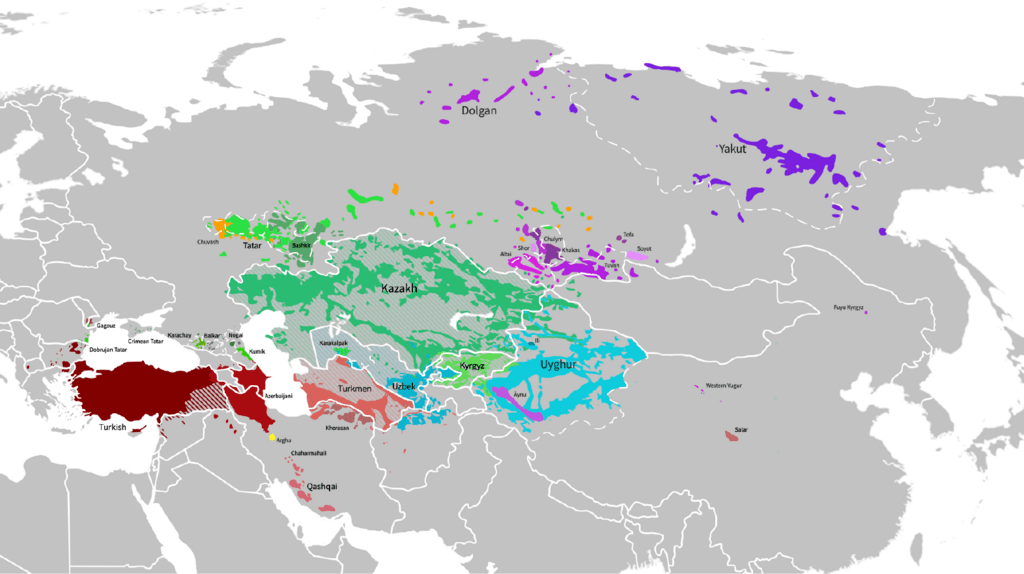
The Turkic people were another such group. Like many steppe tribes, their origins are very obscure, but they were caught up in this cultural soup, and over time grew and grew into more powerful tribal confederations. As they spread and intermixed with other steppe tribes, they also took on increasingly regional differences among each other.
A map showing the distribution today of Turkic languages across Asia. Photo by GalaxMaps, CC BY-SA 4.0, via Wikimedia Commons
Thus, the Turkish people of the Republic of Turkey (a.k.a. modern Türkiye) and the Uyghurs of north-western China have common ancestry. Some of their ancestors migrated west and contended with the Eastern Romans (a.k.a. the Byzantines), while others fought with the Chinese Tang dynasty onward. Yet in some distant, remote past they began as just one steppe tribe out of countless others and over time grew into a family of ethnicities and languages that spread all over Asia.
In Xuan-zang’s time, the Turkic tribes had formed a powerful confederation on the Eurasian steppe called the Western Turkic Khaganate. They called themselves the On oq budun (𐰆𐰣:𐰸:𐰉𐰆𐰑𐰣) or “People of the Ten Arrows” implying they were a federation of tribes, ruled by a single Qaghan (alternatively spelled Khaghan). These “Göktürks“, and their empire, remnants of an even larger Turkic Khaganate, were spread out far enough to have contact with China, the Sassanian Persians and Eastern Romans all at once.
Great Tang (e.g. Tang Dynasty China) would come to rule this entire area at the zenith of its power in the decades ahead, and the Khaganate reduced to a puppet state, but in Xuan-zang’s time, it was still a land ruled by Turkic people.
Meeting the Khagan
The Chuy river valley, photo by Vmenkov, CC BY-SA 3.0, via Wikimedia Commons
As Xuan-zang and his party descended the Tian-Shan mountains they came near to the modern city of Tokmok in Kyrgyzstan. More precisely, Xuan-Zang came the ancient capital of Suyab, also called Ak-Beshim, just to the southwest. This region was fed by the Chu river and was a verdant land compared to the desert wastes elsewhere. The Khaganate used these lands as a resting place when not on the march.
The leader of the Khaganate, Tong Yabghu Qaghan (Tǒng Yèhù Kěhán, 统叶护可汗 to the Chinese) was eager to meet Xuan-zang and provided a fitting welcome. Xuan-zang, for his part, gave the Qaghan a letter of introduction from the king of Turpan.
Xuan-zang described the Qaghan thus:
[the Qaghan] was covered with a robe of green satin, and his hair was loose, only it was bound round with a silken band some ten feet in length, which was twisted round his head and fell down behind. He was surrounded by about 200 officers, who were all clothed in brocade stuff, with hair braided. On the right and left he was attended by independent troops all clothed in furs and fine spun hair garments; they carried lances and bows and standards, and were mounted on camels and horses. The eye could not estimate their numbers.
The Silk Road Journey with Xuan-zang, page 32
Tong Yabghu Qaghan’s “palace” was a great yurt, wherein a feast was held. The guests enjoyed such foods as wine, mutton, and boiled veal among other things. Since Xuan-zang was a Buddhist monk, he was forbidden to eat meat and drink alcohol, and thus he was served delights such as rice cakes, cream, mare’s milk, sugar, and honey instead.
Kyrgyz-style yurts, in Xinjiang region of China. Photo by katorisi, CC BY-SA 3.0, via Wikimedia Commons
Once everyone was settled down, Tong Yabghu Qaghan asked poor Xuan-zang to make a Buddhist sermon on the spot.
Xuan-zang had to be careful not to ruin the mood of the occasion, so he opted for a sermon on the need for goodwill (metta in Buddhism) towards all beings, and on the benefits of the religious life. The Qaghan was evidentially impressed. In fact, this wasn’t the Qaghan’s first encounter with a Buddhist monk. Apparently, some years earlier a Buddhist monk from India named Pabhakarmitras had journeyed through these lands on the way to China, and so the Qaghan was well-disposed to the religion. He even tried to convince Xuan-zang to stay among his people, but Xuan-zang declined. Unlike the king of Turpan, the Qaghan seemginly took no offense and offered to send a ethnically Chinese soldier to accompany Xuan-zang for part of the way.
More importantly, the Qaghan gave Xuan-zang both gifts and letters of introduction to share with the petty princes along the way, who were all vassals of the Qaghan.
Finally, it was time to leave.
To Fabled Samarkand
From the great yurt camp at Sayub, Xuan-zang was escorted by the Qaghan part of the way, but they eventually parted. After leaving the Chuy region, the land reverted back to desert, namely the Kyzylkum Desert, also known as the Desert of Red Sands. Xuan-zang’s party journey to the next city, the city of Tashkent (modern Uzbekistan) named Zhěshí (赭時) in Chinese at the time, proved difficult, but they did eventually reach it after crossing the Jaxartes River. Of the crossing, Xuan-zang describes the scenery.
North-west from this [river crossing] we enter on a great sandy desert, where there is neither water nor grass. The road is lost in the waste, which appears boundless, and only by looking in the direction of some great mountain, and following the guidance of the bones which lie scattered aboout, can we know the way in which we ought to go.”
The Silk Road Journey with Xuan-zang, page 34
Xuan-zang does not seem to spend much time in Tashkent (I wasn’t able to find much description of his time in my limited resources), and continued on in a more Westerly direction towards Samarkand.
Fun fact, after crossing the Jaxartes river and passing Tashkent, Xuan-zang and his party entered into lands once ruled by the Bactrian Greeks. To the south and west of Tashkent was the former outpost city of Alexandria Eschate, which had been the most northerly city of the Greeks. It was a strong fortress city under king Euthydemus I, but suffered constantly attacks by the native Iranian Sogdian peoples. By the 1st century AD, the city had reverted back to local control, and the Greeks retreated from the area. By Xuan-Zang’s time this was all a distant memory.
We’ll cover Samarkand in the next episode, because things take a dangerous turn in this output of the Sassanian Persians, and also from here, the road will turn back south toward India at last.













 Gleanings in Buddha-Fields

.jpg)


You must be logged in to post a comment.