Recently, I have been dabbling in learning ancient Greek language for the first time in years. I polished off my old DVD copy of the Greek 101 course from The Great Courses which I bought during the Pandemic after my local library no longer had it available.1 It’s been fun to review old lessons, get reacquainted with such a gorgeous language, and so on.
Anyhow, something I wanted to share was a famous axiom in Koine Greek found throughout the Eastern Roman (a.k.a. the Byzantine) world:
This is pronounced as Nipson anomēmata mē monan opsin. This is a famous palindrome (same forwards or backwards) that according to Wikipedia is attributed to one Saint Gregory of Nazianzus. I am not super familiar with the Orthodox tradition, but feel free to consult Wikipedia for more details. You can find it at many monasteries across the Eastern Roman world, including the holy font at the Hagia Sophia, the central church of Constantinople.
In any case, the concept of ablution is also found in Buddhism and expresses a similar sentiment.
Buddhism has a popular custom whereby one performs some kind of ablution with water or incense before approaching a Buddhist altar to pray. It is not strictly required, but is commonly performed as a gesture of respect toward the Buddhist deity you are visiting by cleansing oneself at a superficial level. Within Japanese Buddhism, some sects encourage this more than others; from what I have learned Tendai Buddhism tends to emphasize this a lot, Pure Land Buddhist sects (e.g. Jodo Shu and Jodo Shinshu) do not. The emphasis varies, in other words.
But also ablution in Buddhism is not limited to the external ritual; we also the concept of repentance (e.g. “washing the soul”). This is not the same thing as Western religions, where someone begs God for forgiveness for transgressions committed. Instead, the Buddha strongly encouraged us to constantly evaluate our past conduct, and use the Dharma as a kind of yard-stick to measure them: were they skillful actions, or unskillful actions? Inevitably, one must confront their own unskillful actions. We all do. It is part of being a human being.
So, in Buddhism, many traditions have a ritual were people reflect on their past actions and renounce them, resolving to do better. It is encouraged to do this in front of a statue of the Buddha, and to repeat the liturgy out loud, not just in one’s mind:
All of the misdeeds I’ve committed in the past, are the result of my own greed [or craving], anger and delusion [or ignorance]. I renounce [or repent] these misdeeds.
Translations vary by community, this is just one example.
The idea is that by acknowledging and confessing one’s faults, one not only learns from one’s mistakes, one also potentially diminishes some negative karma that one has sown, and also prevents further self-harm (i.e. guilt, self-recrimination) by letting go and forgiving oneself.
So, just as the old Greek palindrome says, Buddhist practice is not only washing one’s face, but also one’s “soul”.2
Namu Shakamuni Nyorai
P.S. A common misunderstanding is the primary language in the Roman Empire was Latin. In fact, most of the population spoke Greek as their primary language, though this varied widely by region. This prevalence of Greek was both a leftover from the Hellenistic Age, but also because even Romans felt that Greek was a prestige language, and wealthy Romans hired Greek tutors for their children when possible. Julius Caesar’s famous “Et Tu Brute” quote was actually recited in Greek (Kai Su Teknon).
1 I prefer having hard copies of things, whenever possible.
2 Buddhism is somewhat unique among world religions in that it teaches the concept of “no-soul” (anatman), so by “soul” I don’t mean a literal soul, but the mind and one’s provisional self.
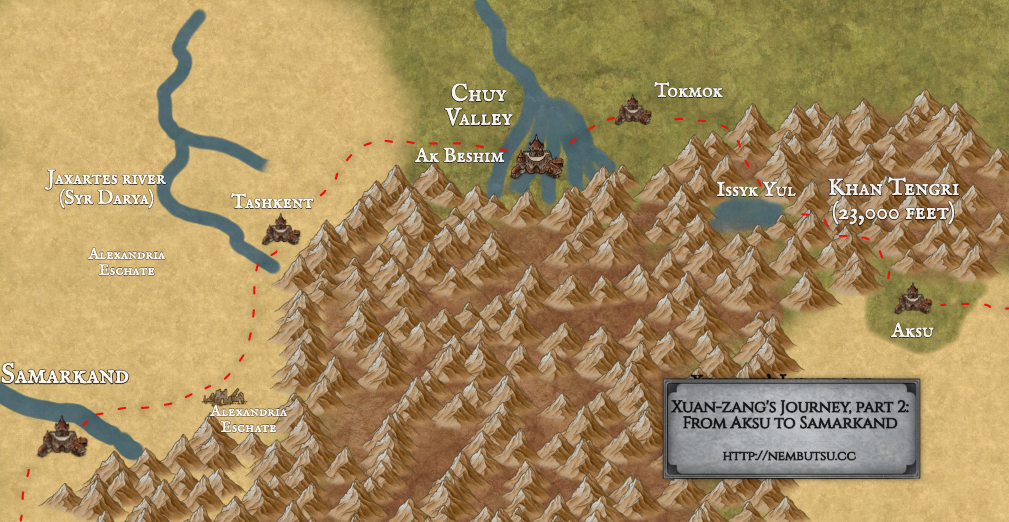
In our last episode (… a few months ago 😓) Xuan-zang met the Qaghan of the Western Turkic Khaganate, and made a good impression, allowing him to travel safely further south and westward toward the city of Samarkand.
Map of Xuan-zang’s journeys from Tashkent to Balkh. Inkarnate put out a new version of its software while I was on break, so some things may look different than past maps. As always, this is an amateur map, and may contain geographic mistakes.
If you need to brush up on earlier episodes, click below:
Samarkand is a fascinating place: a fabulously old city, and a major hub on the Silk Road. All the way back in the time of Alexander the Great’s conquests in 329 BCE, 1,000 years before Xuan-Zang, the city was called Marakanda (Μαράκανδα) in Greek and was part of the Achaemenid Persian Empire before that. By Xuan-zang’s time the city was part of the Sassanian Persian empire, and still a major trading hub, known even to the Chinese, but I was unable to find a reliable source on the Chinese name at the time. Modern term is 撒马尔干 (sǎ mǎ ěr gàn ?). The city at this time was almost entirely populated by Sogdian Iranian people, whom we’ve also seen in past episodes. This far west from China, Xuan-Zang probably saw very few if any Chinese people, and instead encountered many people from other cultures and parts of the world. He was very much a “stranger in a strange land”.1
However, because this city was part of the Sassanian Empire, the official religion was Zoroastrianism, not Buddhism, and as Xuan-zang came to the city, he noticed that the Buddhist monasteries there were abandoned and neglected. Some of Xuan-zang’s followers went to pay their respects at these monasteries, but they were chased off by a mob of Zoroastrian followers with flaming brands. Later, the king heard what happened and arrested the mob leaders and was going to pass sentence to mutilate them. Xuan-zang begged for leniency, and so they were flogged and expelled from the city.
The king of Samarkand wasn’t particularly friendly to Xuan-zang, but their relations did improve. Further, it seems that later the king of Samarkand made friendly, diplomatic overtures to Tang-Dynasty China as a foil to the Western Turkic Khaganate, but these did not go very far. Decades later, Great Tang’s expansion reached all the way to Samarkand and they briefly ruled for a few decades until the Battle of Talas later. All this happened decades after Xuan-zang visited the city though.
In any case, Xuan-zang wisely did not stay long in the city and turned at least to towards the south.
Heading South
Up until now, Xuan-zang’s journey from the Yumen Pass in China to Samarkand, over the Tian Shan mountains and across two deserts, has mostly been a westerly journey. But this was as far west as Xuan-zang would go. The road to India was now in a south-southeasterly direction passing through places like modern Afghanistan, Pakistan, and Uzbekistan. These areas were not part of Sassanian Empire, and instead were local princes and minor rulers with complicated relations with regional powers. These areas were more Buddhist-friendly as well due to the legacy of Bactrian Greeks,2 but more importantly due to the Kushans who came later. Much of these lands were former Kushan territory, and their good governance and patronage of Buddhism at the time allowed things to flourish on the Silk Road.
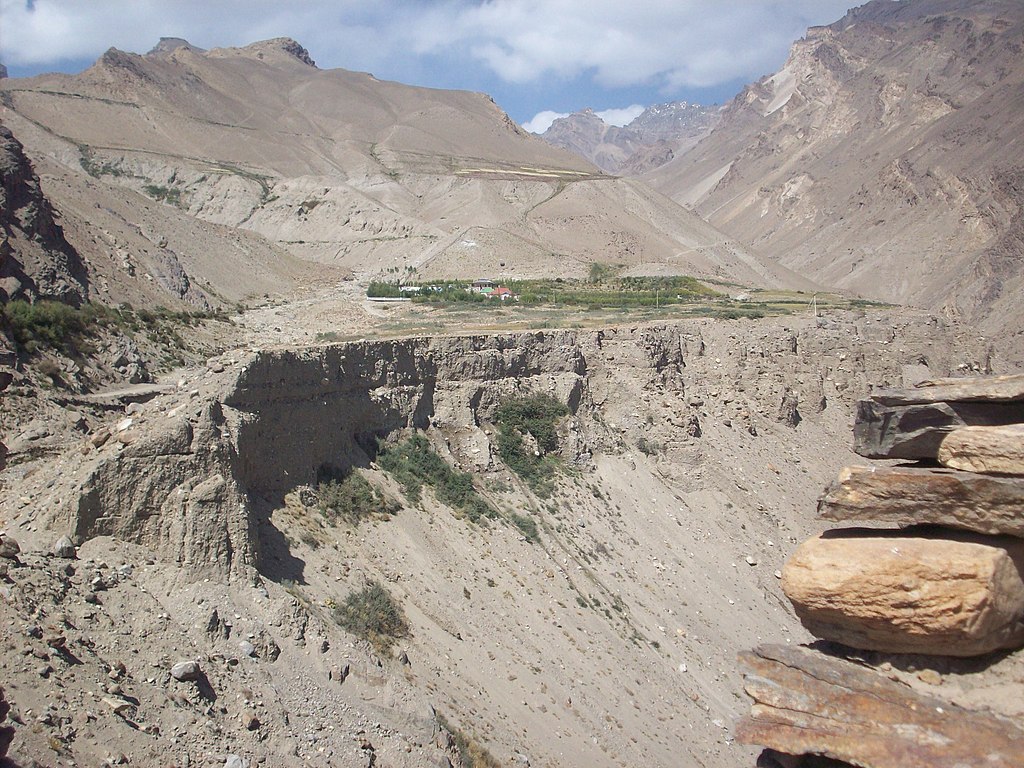
The first obstacle Xuan-Zang and his party ran into was the famous “Iron Gates“.
A valley in the Badakshan Province in Afghanistan, close to the where the Iron Gates would be. Photo by Zack Knowles, CC BY-SA 3.0, via Wikimedia Commons
Because this area was a choke-point for travel, it was often garrisoned, and he described “double wooden doors, strengthened with iron and furnished with bells”. In any case, Xuan-zang seemed able to pass through without much issue.
After crossing the Oxus River (now the Amu Darya), he returned to regions where Buddhism was still flourishing namely in the small city of Termez. Termez was once a major city of the Kushan Empire, but was much more diminished by the time Xuan-zang arrived. The Buddhist community here numbered about 1,000 monks. It was here that he saw the Ajina Tepe monastery and its excellent works of art.
In fact, from here Xuan-zang would behold some pretty amazing spectacles. Many people may not realize that the lands we now call Afghanistan were once bastions of Buddhism along the Silk Road, and boasted many treasures, monasteries, and a very eclectic culture.
But first, Xuan-zang had to deal with a series of problems in the city of Kunduz.
Xuan-zang’s visit to the city of Kunduz was no accident. After meeting the king of Turfan way back in episode one, and the Qaghan of the Western Turks in episode three, he had many letters of introduction to the Prince of Kunduz named Tardu. As rulers on the Silk Road, they were all related by family or marriage, so Xuan-zang had little trouble getting an audience with Prince Tardu.
Except for one problem: the Prince’s wife had recently died, and he was in mourning. Later, Tardu abruptly married another daughter of the king of Turfan (episode one), and she in turn plotted with his son from the first marriage. This is starting to sound like the plot of a historical K-drama, doesn’t it?
Before long, Prince Tardu was poisoned and died. The new queen married the prince, and ruled Kunduz thereafter.
Xuan-zang did his best to lay low, and stay out of the issue. His delays at Kunduz meant that he had time to get to know another Buddhist monk named Dharmasimha. Dharmasimha and Xuan-zang debated Buddhist thought and treatises for some time, but Xuan-zang felt Dharmasimha didn’t know as much as he was hyped up to. Dharmasimha for his part, acknowledged his shortcomings, and tried to stay humble about it.
Moving On
Before Prince Tardu’s death, he had encouraged Xuan-zang to visit another city named Balkh, also in modern Afghanistan. Balkh had quite a few sites to see, and since some Buddhist monks were already planning to head back there, Xuan-zang accompanied them. After passing through a city named Tashkurghan (modern Kholm, not related to a similar city in China), they reached the verdant lands of Balkh.
The city of Balkh, known to the Greeks of Alexander the Great as Baktra (Βάκτρα) and Baítíguó (白題國) in Chinese to Tang-dynasty China, was important since very far back in antiquity. Balkh was the traditional birthplace of the Zoroastrian religion, and an important cultural center to Persian people since very ancient times, rivaling cities further to the west such as Babylon and Ecbatana in importance. According to Buddhist tradition, the first two of the Buddha’s disciples also hailed from Balkh, and made the first stupa. Centuries later, it was here that Alexander had married a bride named Roxana, seeking to unify western Greek culture with the eastern Persian culture. Later in the Hellenstic Age, it was an important center of the Greco-Bactrian kingdom.
Needless to say, while few people have heard of Balkh today, it was a very important city across many centuries.
During Xuan-zang’s time, the lands around Balkh were still very fertile (desertification happened gradually later). Even with the widespread destruction the Hephthalities (a.k.a. “white huns”), the lands were still prosperous, if somewhat depopulated. There were two major monasteries in the area collectively known as the Nava Vihara, that belonged to the Sarvastivadin tradition of “Hinayana” (early Indian) Buddhism.3 There were tens of thousands of monks in attendance, and Balkh was one fo the remaining places where teachers were regularly installed from India. Similar to Bamiyan, the Naha Vihara boasted massive statues of the Buddha as well. Interestingly, even as far as the 8th century, long after Xuan-zang was dead, an Arab historian named Umar ibn al-Azraq al-Kermani recorded a place of worship here similar to the Kabaa in Mecca. But instead a Buddhist stupa was enshrined inside, with a cloth draped over it, in accordance with Persian custom of showing veneration.
Xuan-zang stayed at the Nava Vihara for a month, and became good friends with a monk there named Prajnakara. Xuan-zang seemed to finally find a monk of high-caliber, who had a good depth of understanding of Buddhist doctrine, even if he was a “Hinayana”, not Mahayana Buddhist. The two journeyed together further south to Bamiyan.
In our next episode, we’ll explore Xuan-zang’s visit to the great Buddha status of Bamiyan, and Xuan-zang is reaching the borders of India. But first, he has to cross the Himalayas…
3 Although the Sarvastivada school was not Mahayana Buddhism, Mahayana Buddhism inherited a lot from it anyway: canon of texts, certain viewpoints, etc. Another important early school that influence Mahayana were the Dharmaguptaka, who mostly gave their monastic traditions and rules to the Mahayana.
In part one, Xuan-zang the famous Buddhist monk of the 7th century who crossed from China to India encountered the first cities of the Silk Road, crossed the Gobi Desert, and avoided bandits and overbearing monarchs. In part two, Xuan-zang journeyed to the famous city of Kucha and climbed the mountain pass near Tengri Khan losing many people in the dangerous crossing.
As Xuan-zang traveled further and further west, he was leaving Chinese political influence and going further into areas comprised of steppe nomadic tribes such as the Turkic people, as well as sedentary Iranian people such as the Sogdians.
But let’s talk about Turkic people for a moment.
As we’ve talked about in previous posts, the Silk Road was a fascinating mix of different cultures and people. This was very common in the nomadic world of the Eurasian Steppes because tribes were constantly moving around, encountering new tribes, subjugating new tribes, being subjugated by other tribes, or forming alliances. It was a very fluid, dynamic and extremely dangerous environment. We’ve seen examples in past blog posts with groups like the Scythians and Parthians.
The Turkic people were another such group. Like many steppe tribes, their origins are very obscure, but they were caught up in this cultural soup, and over time grew and grew into more powerful tribal confederations. As they spread and intermixed with other steppe tribes, they also took on increasingly regional differences among each other.
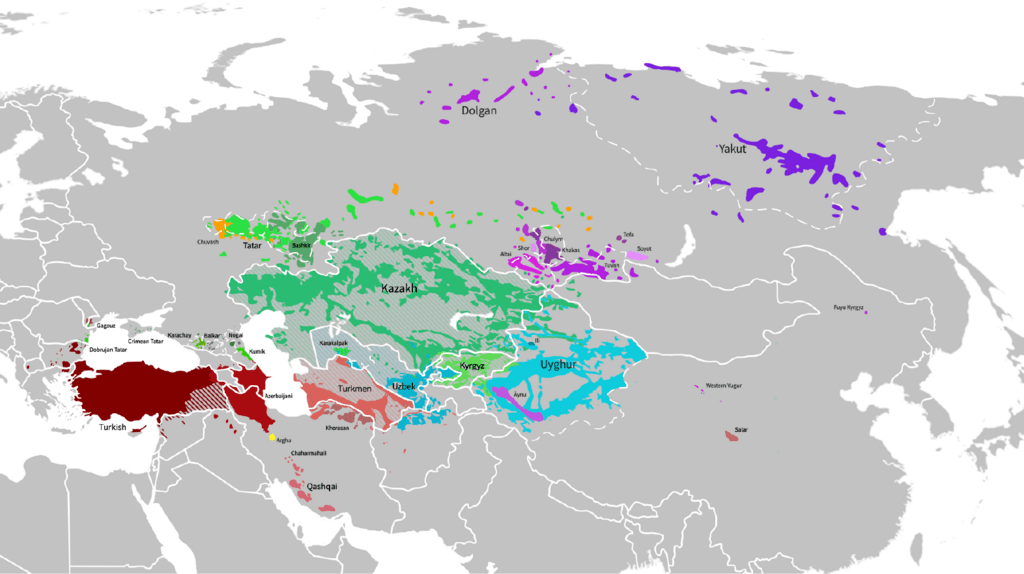
A map showing the distribution today of Turkic languages across Asia. Photo by GalaxMaps, CC BY-SA 4.0, via Wikimedia Commons
Thus, the Turkish people of the Republic of Turkey (a.k.a. modern Türkiye) and the Uyghurs of north-western China have common ancestry. Some of their ancestors migrated west and contended with the Eastern Romans (a.k.a. the Byzantines), while others fought with the Chinese Tang dynasty onward. Yet in some distant, remote past they began as just one steppe tribe out of countless others and over time grew into a family of ethnicities and languages that spread all over Asia.
In Xuan-zang’s time, the Turkic tribes had formed a powerful confederation on the Eurasian steppe called the Western Turkic Khaganate. They called themselves the On oq budun (𐰆𐰣:𐰸:𐰉𐰆𐰑𐰣) or “People of the Ten Arrows” implying they were a federation of tribes, ruled by a single Qaghan (alternatively spelled Khaghan). These “Göktürks“, and their empire, remnants of an even larger Turkic Khaganate, were spread out far enough to have contact with China, the Sassanian Persians and Eastern Romans all at once.
Great Tang (e.g. Tang Dynasty China) would come to rule this entire area at the zenith of its power in the decades ahead, and the Khaganate reduced to a puppet state, but in Xuan-zang’s time, it was still a land ruled by Turkic people.
Meeting the Khagan
The Chuy river valley, photo by Vmenkov, CC BY-SA 3.0, via Wikimedia Commons
As Xuan-zang and his party descended the Tian-Shan mountains they came near to the modern city of Tokmok in Kyrgyzstan. More precisely, Xuan-Zang came the ancient capital of Suyab, also called Ak-Beshim, just to the southwest. This region was fed by the Chu river and was a verdant land compared to the desert wastes elsewhere. The Khaganate used these lands as a resting place when not on the march.
The leader of the Khaganate, Tong Yabghu Qaghan (Tǒng Yèhù Kěhán, 统叶护可汗 to the Chinese) was eager to meet Xuan-zang and provided a fitting welcome. Xuan-zang, for his part, gave the Qaghan a letter of introduction from the king of Turpan.
Xuan-zang described the Qaghan thus:
[the Qaghan] was covered with a robe of green satin, and his hair was loose, only it was bound round with a silken band some ten feet in length, which was twisted round his head and fell down behind. He was surrounded by about 200 officers, who were all clothed in brocade stuff, with hair braided. On the right and left he was attended by independent troops all clothed in furs and fine spun hair garments; they carried lances and bows and standards, and were mounted on camels and horses. The eye could not estimate their numbers.
The Silk Road Journey with Xuan-zang, page 32
Tong Yabghu Qaghan’s “palace” was a great yurt, wherein a feast was held. The guests enjoyed such foods as wine, mutton, and boiled veal among other things. Since Xuan-zang was a Buddhist monk, he was forbidden to eat meat and drink alcohol, and thus he was served delights such as rice cakes, cream, mare’s milk, sugar, and honey instead.
Kyrgyz-style yurts, in Xinjiang region of China. Photo by katorisi, CC BY-SA 3.0, via Wikimedia Commons
Once everyone was settled down, Tong Yabghu Qaghan asked poor Xuan-zang to make a Buddhist sermon on the spot.
Xuan-zang had to be careful not to ruin the mood of the occasion, so he opted for a sermon on the need for goodwill (metta in Buddhism) towards all beings, and on the benefits of the religious life. The Qaghan was evidentially impressed. In fact, this wasn’t the Qaghan’s first encounter with a Buddhist monk. Apparently, some years earlier a Buddhist monk from India named Pabhakarmitras had journeyed through these lands on the way to China, and so the Qaghan was well-disposed to the religion. He even tried to convince Xuan-zang to stay among his people, but Xuan-zang declined. Unlike the king of Turpan, the Qaghan seemginly took no offense and offered to send a ethnically Chinese soldier to accompany Xuan-zang for part of the way.
More importantly, the Qaghan gave Xuan-zang both gifts and letters of introduction to share with the petty princes along the way, who were all vassals of the Qaghan.
Finally, it was time to leave.
To Fabled Samarkand
From the great yurt camp at Sayub, Xuan-zang was escorted by the Qaghan part of the way, but they eventually parted. After leaving the Chuy region, the land reverted back to desert, namely the Kyzylkum Desert, also known as the Desert of Red Sands. Xuan-zang’s party journey to the next city, the city of Tashkent (modern Uzbekistan) named Zhěshí (赭時) in Chinese at the time, proved difficult, but they did eventually reach it after crossing the Jaxartes River. Of the crossing, Xuan-zang describes the scenery.
North-west from this [river crossing] we enter on a great sandy desert, where there is neither water nor grass. The road is lost in the waste, which appears boundless, and only by looking in the direction of some great mountain, and following the guidance of the bones which lie scattered aboout, can we know the way in which we ought to go.”
The Silk Road Journey with Xuan-zang, page 34
Xuan-zang does not seem to spend much time in Tashkent (I wasn’t able to find much description of his time in my limited resources), and continued on in a more Westerly direction towards Samarkand.
Fun fact, after crossing the Jaxartes river and passing Tashkent, Xuan-zang and his party entered into lands once ruled by the Bactrian Greeks. To the south and west of Tashkent was the former outpost city of Alexandria Eschate, which had been the most northerly city of the Greeks. It was a strong fortress city under king Euthydemus I, but suffered constantly attacks by the native Iranian Sogdian peoples. By the 1st century AD, the city had reverted back to local control, and the Greeks retreated from the area. By Xuan-Zang’s time this was all a distant memory.
We’ll cover Samarkand in the next episode, because things take a dangerous turn in this output of the Sassanian Persians, and also from here, the road will turn back south toward India at last.
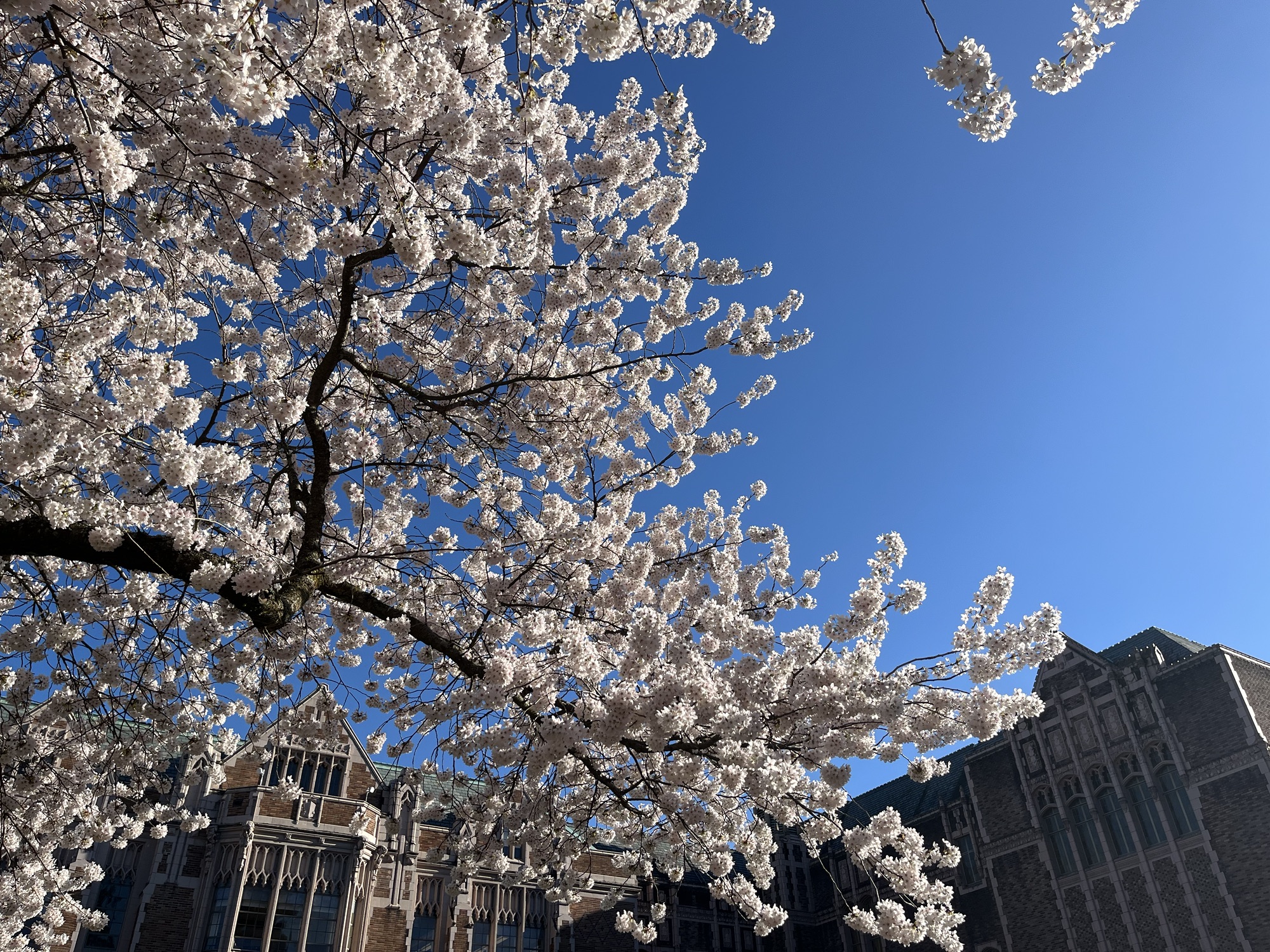
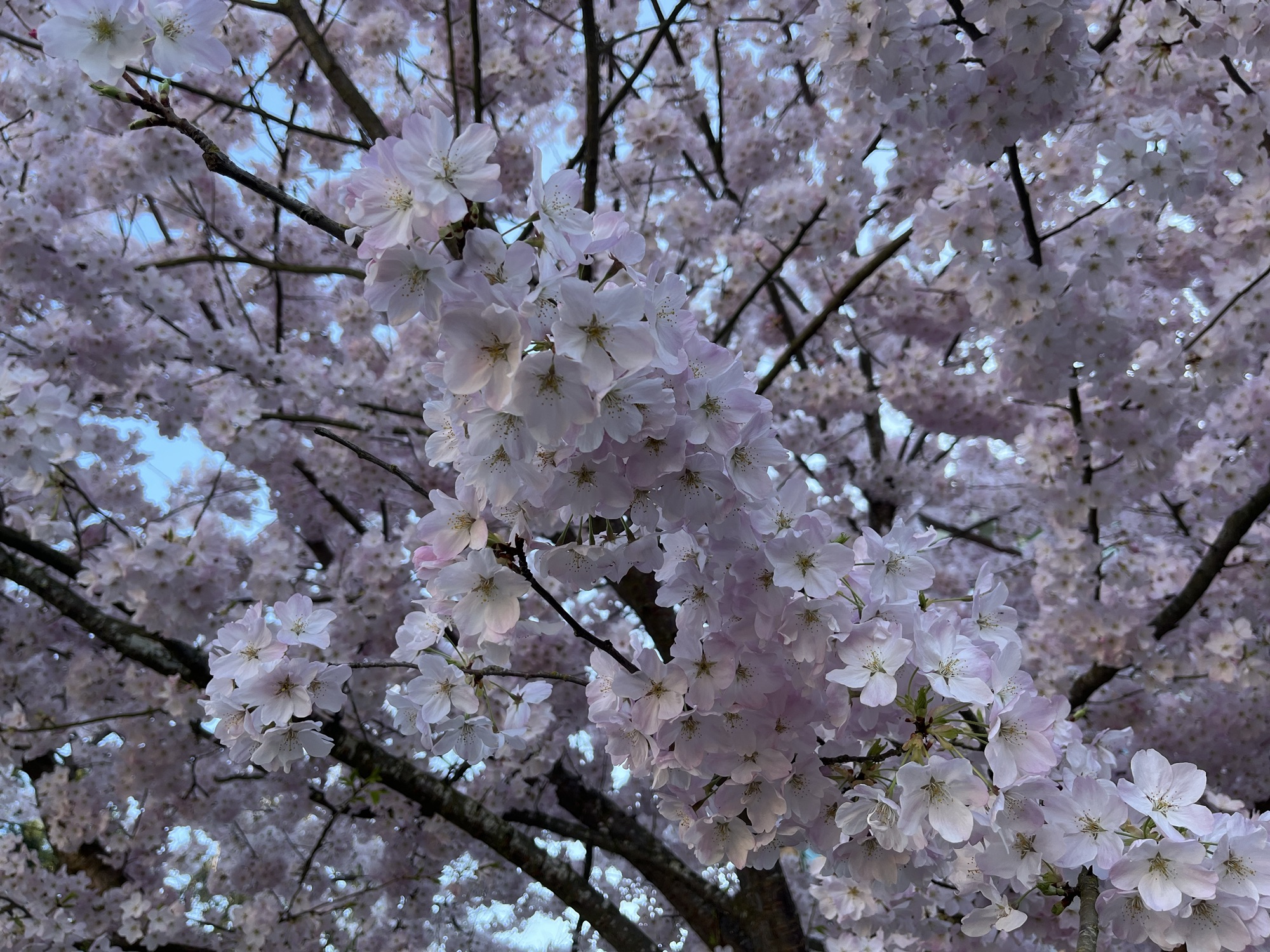
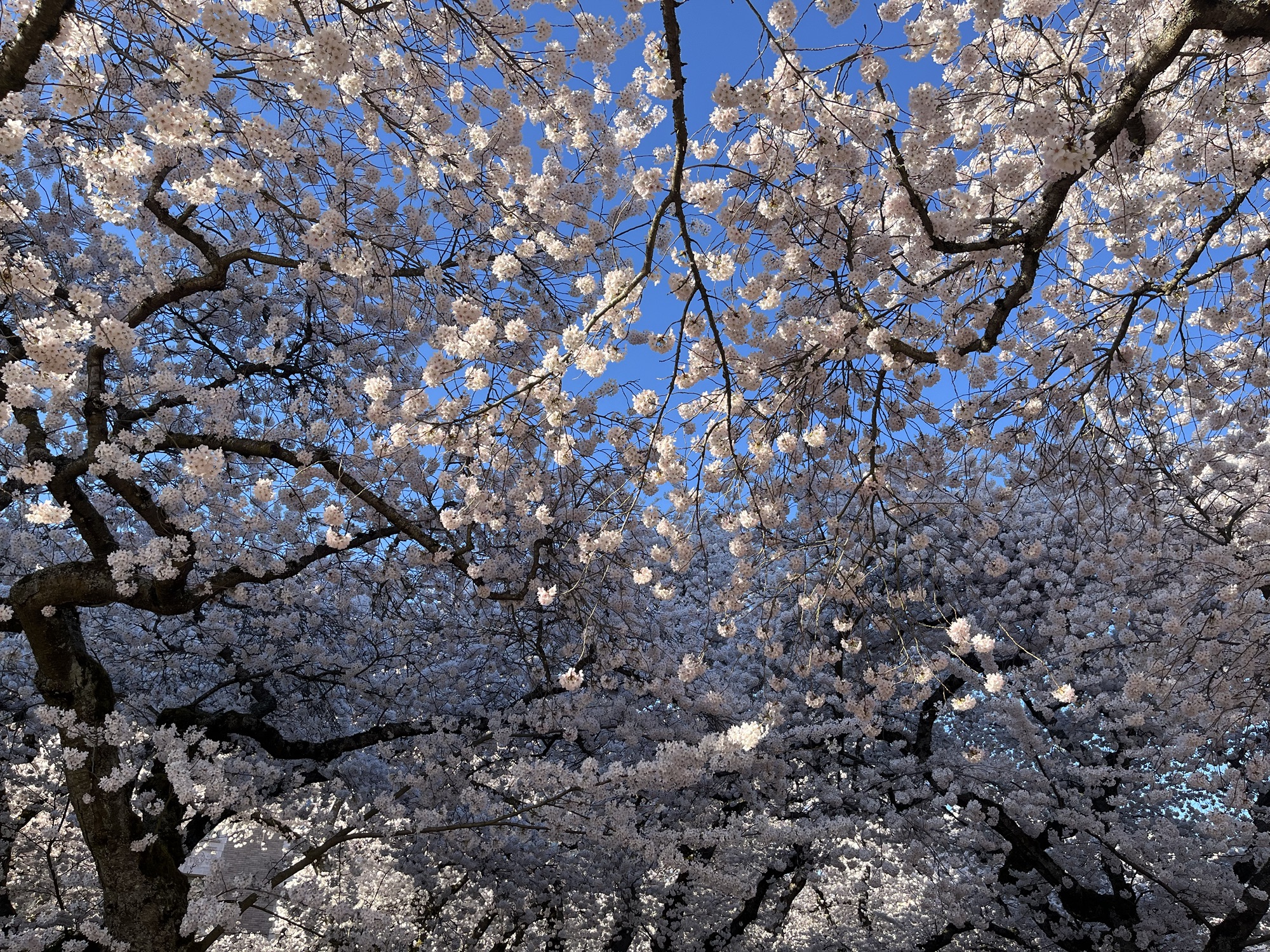
I’ve been talking a lot about heavy, often historical subjects lately, but today I just wanted to share something more local. Every year, my family and I go to see the cherry blossoms at the local University of Washington. This is part of a popular Japanese tradition called ohanami (お花見) or “flower viewing”. Ever since our children were little babies, my wife and I never fail to go to the University of Washington every year, and take lots of family photos and such. A lot of other people come too, and it is a fun community event. The UW has even created a dedicated website just for the occasion, plus social media accounts, and you can even watch a live-cam version of it:
A lot has changed in the last 15 years!
Depending on weather, timing of the bloom, etc, some times we arrive at full bloom (mankai, 満開, in Japanese) and at other times we come too late or a bit too early. This year we came on Tuesday and the timing and weather turned out perfect.
The UW actually has a few clusters of cherry trees, and different varieties, which you can see on the official map, so we tried to visit as many as I could. Also, on my other blog, I wrote a brief guide to Japanese cherry blossoms as well, so feel free to take a look.
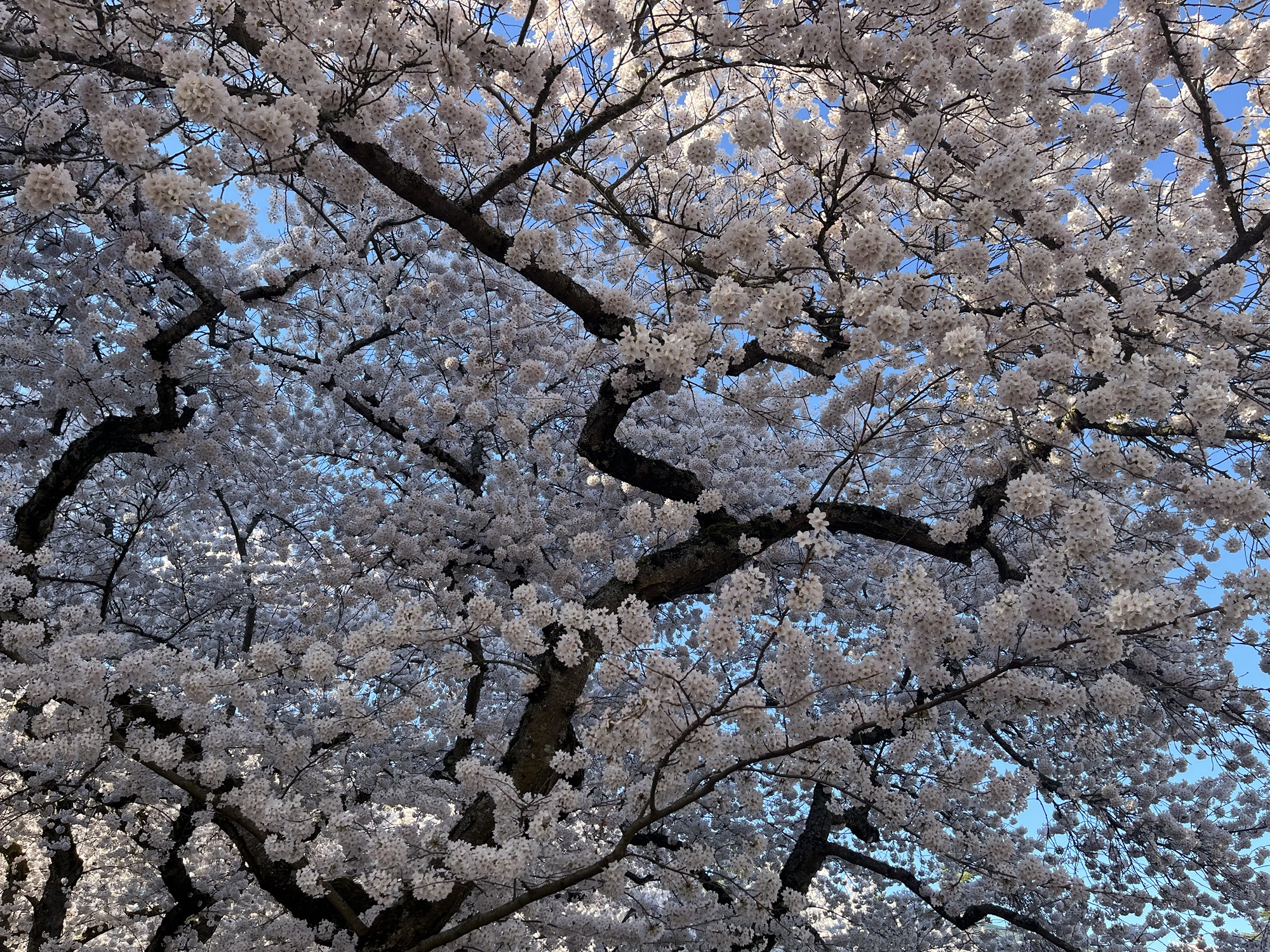
The main attraction of course is the Quad, and the Yoshino cherry trees there:
The “Yoshino” cherry tree is the most common and iconic cherry tree variety. In Japanese it is called the somei yoshino.
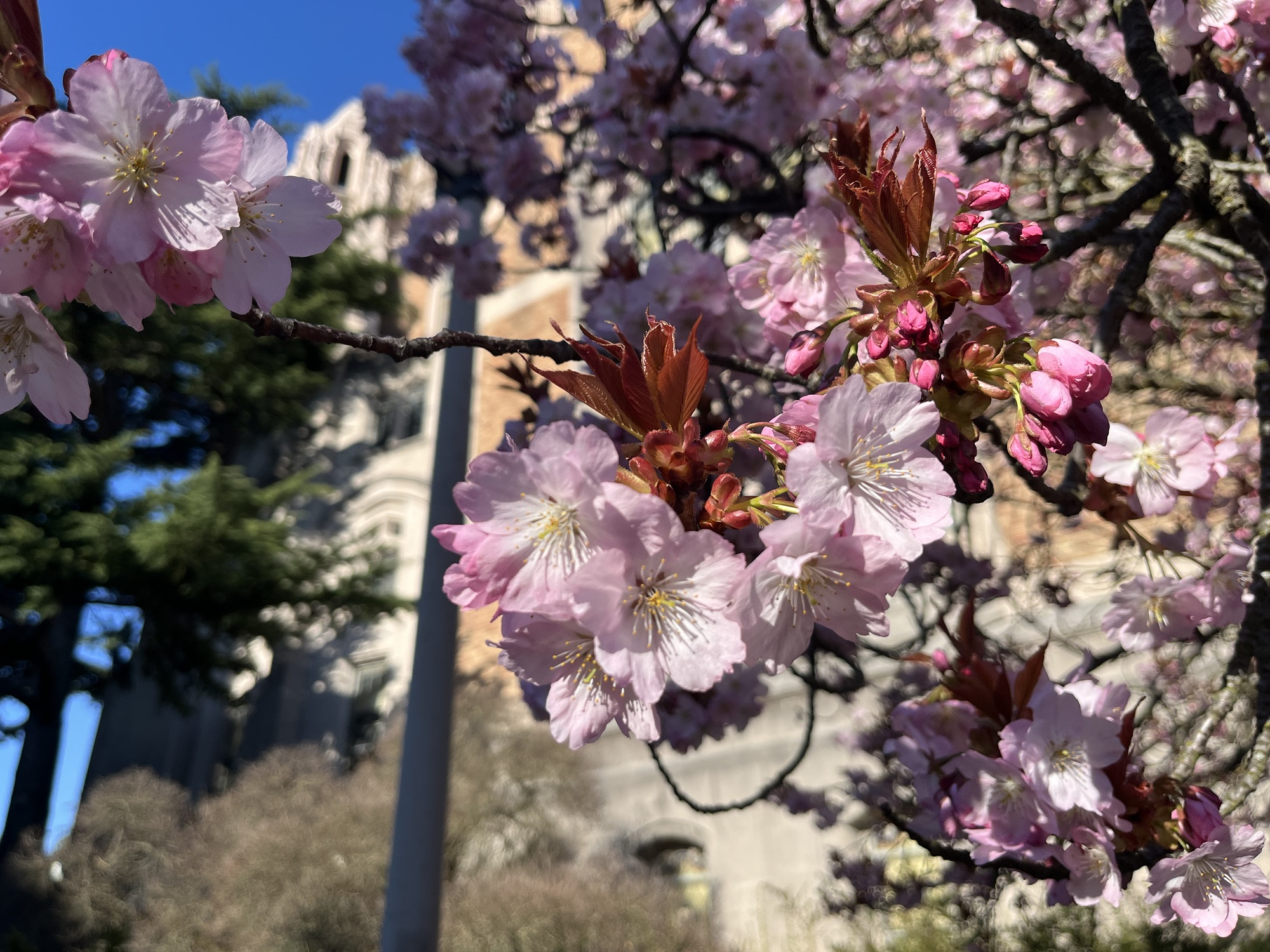
Next we moved south to see some of the varieties around Drumheller fountain. Not all varieties were in bloom yet, but we did see one called Kanzan,1 which I had never seen before. The blossoms were noticeably pinker, and had two layers of blossoms, not one.
I really liked this variety myself.
Later, we ran into some good friends who were also viewing the cherry blossoms. Since I hadn’t really been out much this past month, due to surgery recovery, it’s really nice to see some friends and socialize for a while. We later went and got some gyros at a place I used to frequent back in college.
One the way, we saw one other variety I had not seen before: a Mt Fuji Cherry tree:
I had not heard of this variety either, but it is apparently a variety of the Prunus Serrulata tree,2 and is known for it’s all white blossoms. This is probably why it got it’s name “Mount Fuji” since it matches the color of snow. In Japanese it is called the “Shirotae” variety, where shirotae is a well-known pillow word in Japanese poetry meaning something that is gleaming white.
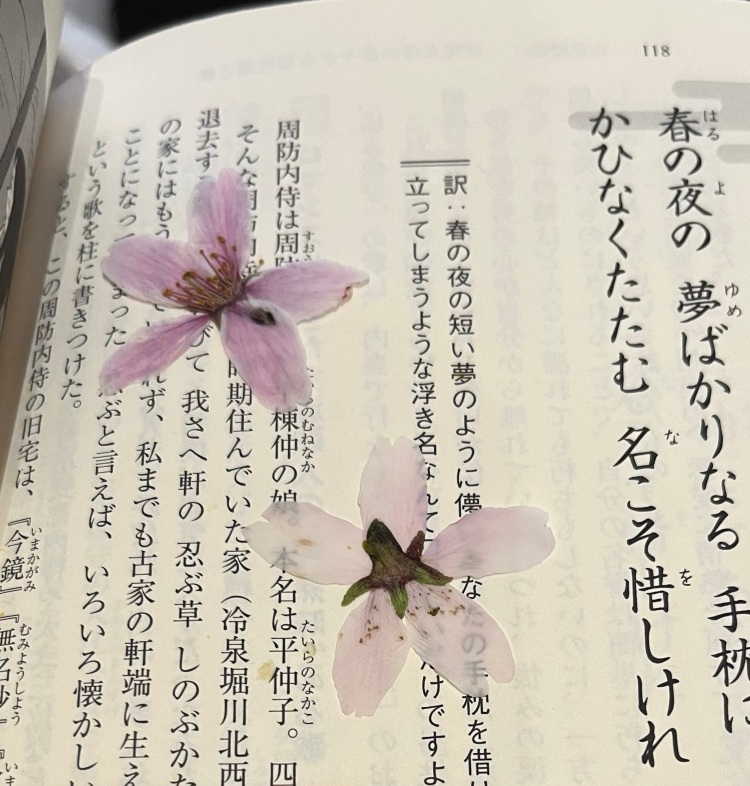
Anyhow, the weather worked out really well, and seeing old friends after a rough month really made the trip extra special. I had brought along one of my favorite books about the Hyakunin Isshu with me, and when a couple blossoms fell to the ground, I used it to press them within the pages. After a week, the pressed blossoms turned out pretty nice.
All in all, it was a memorable day, and really uplifting after a difficult month.
P.S. I know I’ve said it before, but a happy Spring Ohigan to all.
1 The UW website lists them as “Kwanzan”, but that is an older, archaic style of romanization of Japanese language. In Japanese it is definitely spelled “kanzan”. In the same way, the Bodhisattva Kannon was often spelled as “Kwannon” in older English literature.
2 The UW has another variety of Prunus Serrulata called the Shirofugen (a.k.a. Fugenzo in Japanese), but they were not in bloom when we came there.
Usually I don’t like to talk about my personal life, especially work,1 but this past week or two has been pretty rough. I’ve been working with another team on a project, and I found out recently that the manager of that project was unhappy with me, and complained to my own manager. Further, the same manager made an under-handed comment during a meeting yesterday, almost certainly aimed at me, rubbing salt on the wound.
My own manager has done his best to be supportive, but I can’t lie, getting criticized really stings, especially given all I’ve done for that team in the past.
In the last 24 hours, I went through a range of emotions: rage, revenge, quitting the job entirely, then despair because I need the job, etc. The fact is is that a steady, secure income is hard to come by these days, and as the sole bread-winner of a family, I have to be extra mindful of where I go, and sometimes have to just “suck it up” to provide for my family. I am certain I am not the only person who is in this bind, either. Each time we get up and head to work, we are forced to “sing for our bread” whether we want to or not. Capitalism sucks.
Even a Buddhist text near and dear to my heart, the Larger Sutra of Immeasurable Life2 (link and link), composed more than 2,000 years ago, touches on this:
But in this world [as opposed to the Pure Land of the Buddha] much evil is committed, and few are provided for naturally; people must work hard to get what they want. Since they intend to deceive each other, their minds are troubled, their bodies exhausted, and they drink bitterness and eat hardship.
Translation by Rev. Hisao Inagaki
So, yeah, as Office Space rightly said: work sucks, and yet we have to put up with it to survive.3
But the sting to my pride, coupled with the fact that I have to suck it up and continue to work with this person for the forseeable future makes me feel rotten. I do it for the sake of my kids and wife, but it still makes me feel rotten inside.
So, I started thinking about things like the Eight Winds of Buddhism, and the story of Hakuin the 18th century Zen master in Japan who was unfairly blamed for something but shrugged it off anyway, or the story of the tsunami and the Zen master. In each case, the lesson is to not get hung up on one’s reputation, and gain freedom in the process. This makes sense, but is a lot harder to implement in practice.
I suppose in a more Pure Land Buddhist, less Zen Buddhist context, the goodwill of Amida Buddha extends to all beings equallyregardless of their character. Even if the world finds fault in you, Amida Buddha extends his goodwill nonetheless. The Eight Winds may blow this way and that, but it doesn’t matter. No need to get hung up on perfection, or criticizing yourself. In the end, you will be fine.
Namu Amida Butsu
P.S. Another thing I forgot to mention is that regardless of Buddhist sect or practice, it never hurts to stop and contemplate goodwill in Buddhism. You don’t have to like the other person, but you can extend a sense of goodwill toward them.
P.P.S. The oppressiveness of the working class isn’t necessarily limited to modern capitalist societies. Back in the Hellenistic Period of history, the Ptolemaic dynasty in Egypt was known for their oppressive bureacracy too:
1 Folks might be surprised where I currently work, but it’s definitely unrelated to my blog in every respect. Plus, it’s generally best not to mix the two.
2 This sutra is also known by various other names: the Larger Sutra, the Immeasurable Life Sutra, the Longer Sukhāvatīvyūha Sūtra, and so on. More on the Pure Land Buddhist canon here.
3 There are limits though. If someone is subject to harassment, intimidation or discrimination, that’s when the environment is simply too toxic. No amount of patience can fix that. It will erode one’s mental health. If you are in this situation, please do not think “sucking it up” will make it better. Sometimes a change in environment is the best thing you can do for yourself. At the very least, talk to someone you trust, preferably outside of work.
Recently, archaeologists have uncovered a statue of the Buddha, not in India or Asia, but in ancient Egypt! The statue, according to the Egyptian government, was uncovered as part of a temple dedicated to Isis, and crafted by a local Indian Buddhist community during the early Roman Imperial age, the Principate.
The cult of Isis was a fascinating example of religion in the Hellenistic Period, and inherited later when the Romans took over the eastern Mediterranean. During the Hellenistic Period, a period of constant political rivalries, and large movements of Greek people, and expansion of Greek culture through colonies, the old Olympian religion had increasingly proved unable to help people through difficult times. The old Olympian religion was focused on public cults in a kind of “contractual” religion where people of a city-state publicly worship a particular god, and get something out of it. For more personal needs, there just wasn’t much substance.
Thus, mystery religions such as the Cult of Demeter and others arose. These provided more personal relationships with the gods, and clearer undersetanding of the afterlife, and how one might secure a better fate than just being an empty shade wandering in Hades (cf. Homer’s Odyssey).
When the Macedonian Ptolemy family took over Egypt, they had to reform Greco-Egyptian society into something they could rule legitimately, so certain gods were reinvented or elevated. Egyptians had done this too, but the Ptolemies tapped into this and elevated two gods in particular:
Serapis – a kind of hybrid god based loosely on Osiris, but also Zeus.
Isis’s role in particular grew far beyond the original Egyptian religion and her cults spread across the Roman world. Her status also grew in that she wasn’t just a mother goddess, but the mother goddess: embodying wisdom, magic, maternal love and so on. Other goddess figures from disparate cults were sometimes viewed as just more manifestations of Isis. There are even
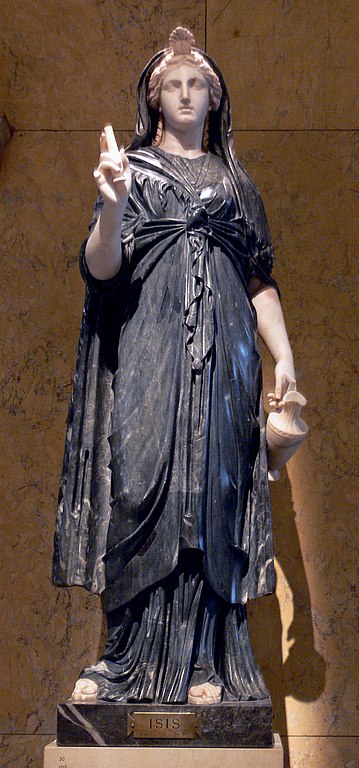
A statue of Isis, from the 2nd century CE. Photo: Andreas Praefcke, Public domain, via Wikimedia Commons
Isis’s religion wasn’t organized according to the kind of doctrine or dogma we associate with modern religions, it was still very much a form of personal, devotional worship,1 rather than an “one-size fits all” religion to explain everything. Roman society at large was still a marketplace of religions, but the religions had changed from mostly public ritual (e.g. the Olympian gods) to more internal, personal religion.
So, how does the Buddha fit into all this? That part is still being researched, but given Isis’s status as a goddess of wisdom, putting a statue of the Buddha, a figure also associated with wisdom, in her temple was probably a useful cultural prop. Indian merchants, had a trade colony in Egypt at the time, and the Buddhist religion in India reached a high-water mark at the time, so at least some of the Indian people living in Egypt would know of it, or might even be devotees.
Does that mean that there were Buddhist communities in Roman Egypt? Evidence is very scant. Even if there were, their presence was likely limited to the Indian expat community.
Still, the cultural cross-over is pretty fascinating.
P.S. This is the last post before the family and I head to Japan. When next we meet, I’ll post updates from
1 Similarly, worship of Mithra, a Zoroastrian deity imported into Roman culture, enjoyed widespread devotion among soldiers and other figures. People worshipped the god or goddess they tended to feel most affinity with.
For some time, I have been following podcast called the History of Byzantium Podcast, which covers the lengthy history of the Eastern Romans from 5th century all the way to the fall in 1453, a thousand years later.
“Wait!” you might be wondering, “didn’t the Roman Empire fall in the 4th century to barbarian invasions?!”
Yes, and no.
The reforms of Emperor Diocletian after the Crisis of the Third Century had essentially split the Roman empire into two, smaller more manageable empires:
The small Greek town of Byzantion (Byzanitium in Latin) became increasingly important after Emperor Constantine made it his new capitol, renaming it after himself (Constatinople).
In any case, when the Roman Empire fell, it was only the Western half, which was the less prosperous, less populous half anyway. The eastern half was able to bribe or drive out the hordes, and kept going.
In fact, it kept going until 1453. Over the course of 1,000 years, it gradually changed, losing its Latin influences and becoming increasingly Greek in nature, but until the 4th Crusade, there never was a break in the Roman Empire of the East. Professor Anthony Kaldelis pointed out that Greek people continued to identify themselves as “Roman” even into 20th century during Ottoman times, and even the Ottomans referred to Greece as the Sultanate of Rûm (Rome). Historians use the term “Byzantine” to describe the Eastern Roman Empire, but Romans in the East never used this term. They called themselves “Romania” or “Rome”.
Was it even Roman anymore? Western purists would assume “no” because Rome the city wasn’t part of the empire, but even before the 4th century, Rome had ceased to be the the center of the Empire as the Western half administered things from Ravenna or other cities. Further, Latin was never technically the official language of the Roman Empire (as in, “by law”). Greek and Latin co-existed, and Greek speakers always outnumbered the Latin-speaking ones because of the influence of the earlier Hellenistic period (for example in Roman Egypt).
Alexios I, Komnenos, one of the last great Emperors of the Eastern Roman Empire. Public domain, via Wikimedia Commons
Further, the Republican aspects of the Empire kept going in Eastern half many centuries later. This concept of res publica wasn’t the same as modern English “republic” (never was), as in a specific system of government, but instead was used to describe “Rome” the polity. When the first emperor, Augustus, took over as the princeps (“first among equals”), the term res publica was still widely used to describe Rome, and kept going through the Byzantine era using the Greek equivalent politeia (πολιτεία). The Emperors during the Byzantine era were still installed and overthrown in the same way the earlier Emperors had been.
As Anthony Kaldellis demonstrates, Emperors were always subject to popular will, just as the old Republican consuls had been, and nothing really changed in the Byzantine era. Thus, the res publica of Rome was a continuous spectrum from the earliest days of the republic to the 15th century.
All this is to say that, when we speak of the “Fall of the Roman Empire”, in reality, only some of the Empire fell in the 5th century. The rest, amazingly, kept going. Constantinople was for centuries one of the largest cities in the world, and the Theodosian Walls were never thrown down until the invention of modern cannon warfare.
Like any empire, the Eastern Romans had periods of growth and decline, and as the neighbors gradually caught up in terms of technology and military skill, Constantinople’s power steadily waned. In the days of Julius Caesar, Rome was so far ahead of the Gauls and other neighbors, it was easy to steamroll them, but by the time of Alexios Komnenos, the Eastern Empire faced many complex and powerful enemies, and there’s just only so much a society can do in that scenario. As the host of the podcast explains, the chessboard was very crowded.
So, if you’d like to know more about the Eastern Romans, not Byzantines, please check out the podcast above.
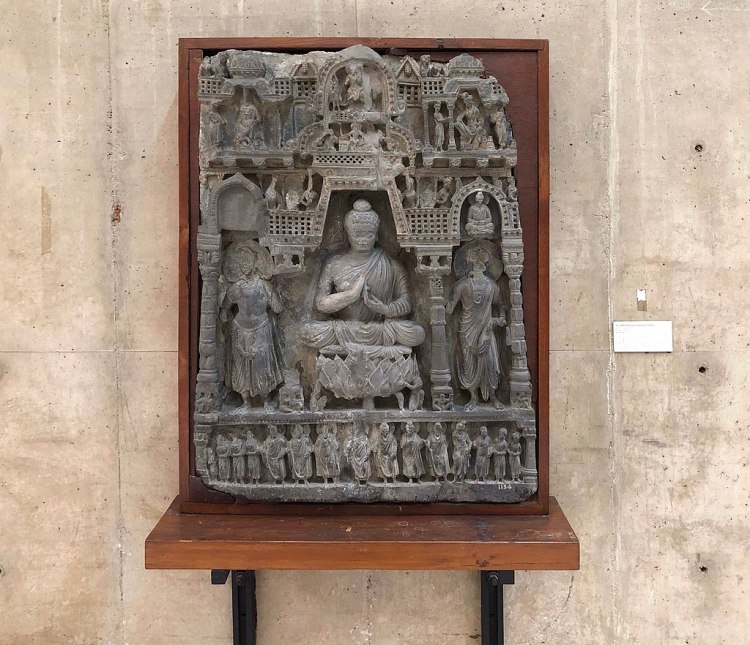
Recently, while bumbling around Wikipedia (as one does), I came upon this random but very fascinating example of Buddhist art from the Gandhara region. This is a depiction of Amitabha Buddha preaching upon a lotus throne in the Pure Land (Sukhāvatī in Sanskrit).
A 2nd-century Gandharan sculpture depicting Amitabha Buddha preaching from the Pure Land, UnpetitproleX, CC BY-SA 4.0, via Wikimedia Commons
This picture dates from the Kushan Empire, which inherited the earlier Greco-Bactrian and Indo-Greek kingdoms, who in turn arose from the empire of Alexander the Great. I’ve talked about the interaction between India and Greeks before, but the cultural interactions were even deeper than I originally hinted at. The Hellenistic Age Podcast recently posted a fascinating interview with Dr. Osmund Bopearachchi (website) that explored this cultural interaction even further. Highly recommend if you can.
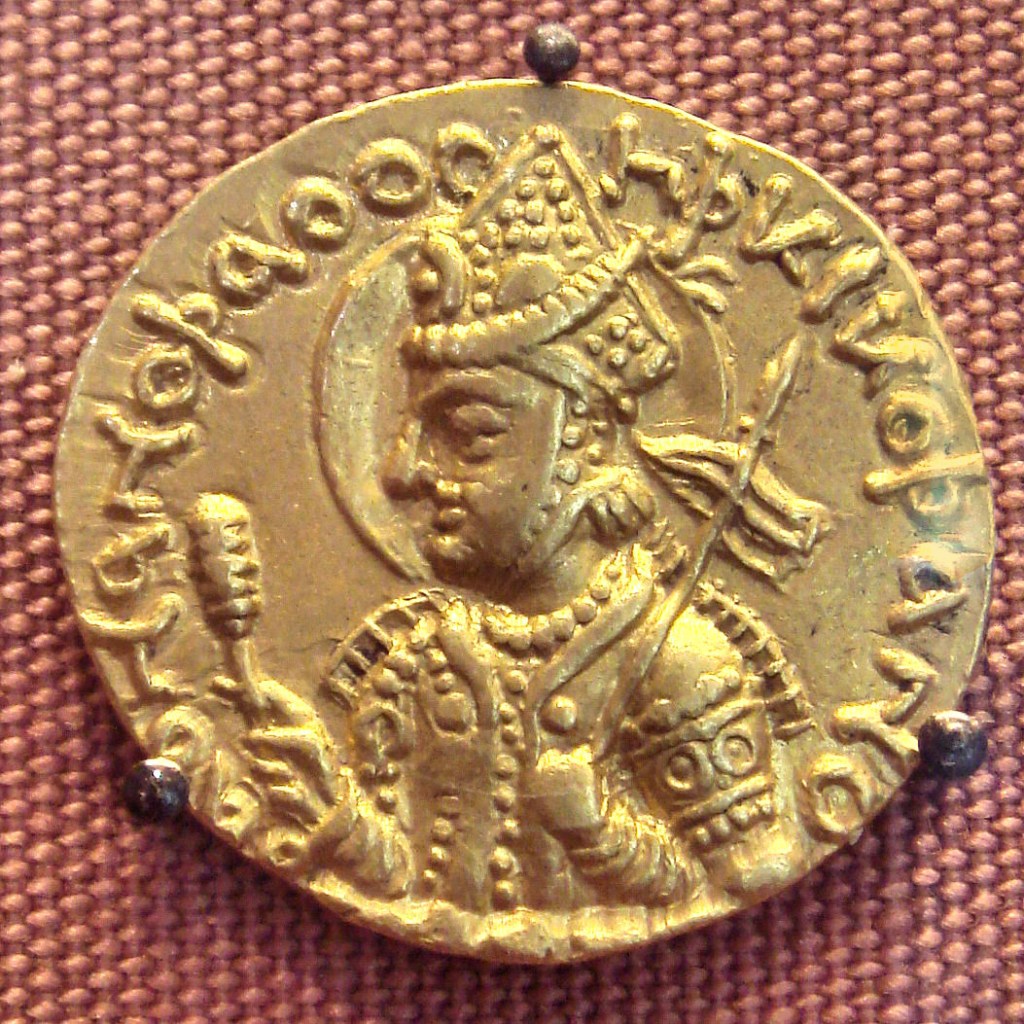
But this picture of Amitabha Buddha got me thinking about a more specific question: where does Amitabha Buddha come from? Amitabha is not mentioned in the earliest Buddhist texts at all, and the earliest statuary appears in the Kushan Empire under the reign of King Huvishka, while other artwork dates back to the Gandhara period of northwest India.
King Huvishka depicting in coinage from the era. Notice the halo behind his head. Public domain, via Wikimedia Commons
A number of interesting theories have arisen over time, some of which have been encapsulated in an essay from 1988 by Soho Machida titled Life and Light, the Infinite: A Historical and Philological Analysis of the Amida Cult. Machida points out some interesting facts:
No statuary of Amitabha Buddha have ever been found in India’s interior, only in northwest India.
Chinese monks who later visited India never mentioned Amitabha Buddha.
Luminosity as an Buddhist symbol is never described in early Buddhist texts, but does appear in later Mahayana ones.
Similarly, Buddhist statues that feature a luminous “halo”, known in Sanskrit as śiraś-cakra (Chinese: 光背), do not appear until the 1st century CE.
The people of Gandhara interacted not just with India, but also with the Scythians (who conquered the Indo-Greeks) as well as the Parthians. The Parthian Empire in particular did have a Buddhist presence, albeit small, and yet the state religion was Zoroastrianism, which frequently uses light as religious symbolism, especially in the royal symbolism of khvarenah. For example, the god Mithra, who also had a cult-following in the Roman Empire, symbolized light, justice, and the sun.
It’s conceivable that the neighboring people of Gandhara in creating new Buddhist art borrowed elements and styles from their neighbors and contemporaries:
from the Greek descendants of Bactria and Indo-Greek kingdoms, they learned to depicted the Buddha in an anthropromorphic way (i.e. similar to Greek statues) as Dr. Osmund Bopearachchi attests to
from the Parthians, they may have learned to depict wisdom, truth and compassion through the imagery of light, using the religious imagery of Zoroastrianism.
from India, they would have imported Buddhist teachings and concepts in an abstract sense, in addition to the literary tradition of the sutras.
If that is the case, then Amitabha Buddha represents a fusion of Indian-Buddhist thought, especially Mahayana Buddhism, with Parthian religious symbolism and Greek artistic methods.
The preamble of the Sutra of Immeasurable Life, one of the three core Pure Land sutras, depicts the gradual progression of a being to becoming a fully enlightened Buddha:
After attaining the Buddha-garland samādhi, he [the prospective bodhisattva] proclaims and expounds all the sutras. While dwelling deep in meditation, he visualizes all the innumerable Buddhas and in an instant visits every one of them. By elucidating and teaching the ultimate truth to sentient beings, he delivers them from the state of extreme pains, from the conditions in which suffering is so great as to prevent people from finding time for Buddhist practices, and also from the conditions in which suffering is not so great as to prevent them from doing so. Having attained the Tathāgata’s thorough knowledge and eloquence, he has fluent command of languages, with which he enlightens all beings. He is above all worldly affairs and his mind, always serene, dwells on the path of emancipation; this gives him complete control over all dharmas.
Translation by Rev. Hisao Inagaki
The Sutra, as one of the founding texts of Pure Land Buddhism epitomizes the path to Buddhahood, using the story of the historical Shakyamuni Buddha as the template, and through this sutra, Amitabha is clearly meant to be the epitome of Buddhas. What better way to epitomize a Buddha than to use infinite light as symbolism?
Fascinating stuff.
Update: posted some additional content I forgot add with the initial draft. Enjoy!
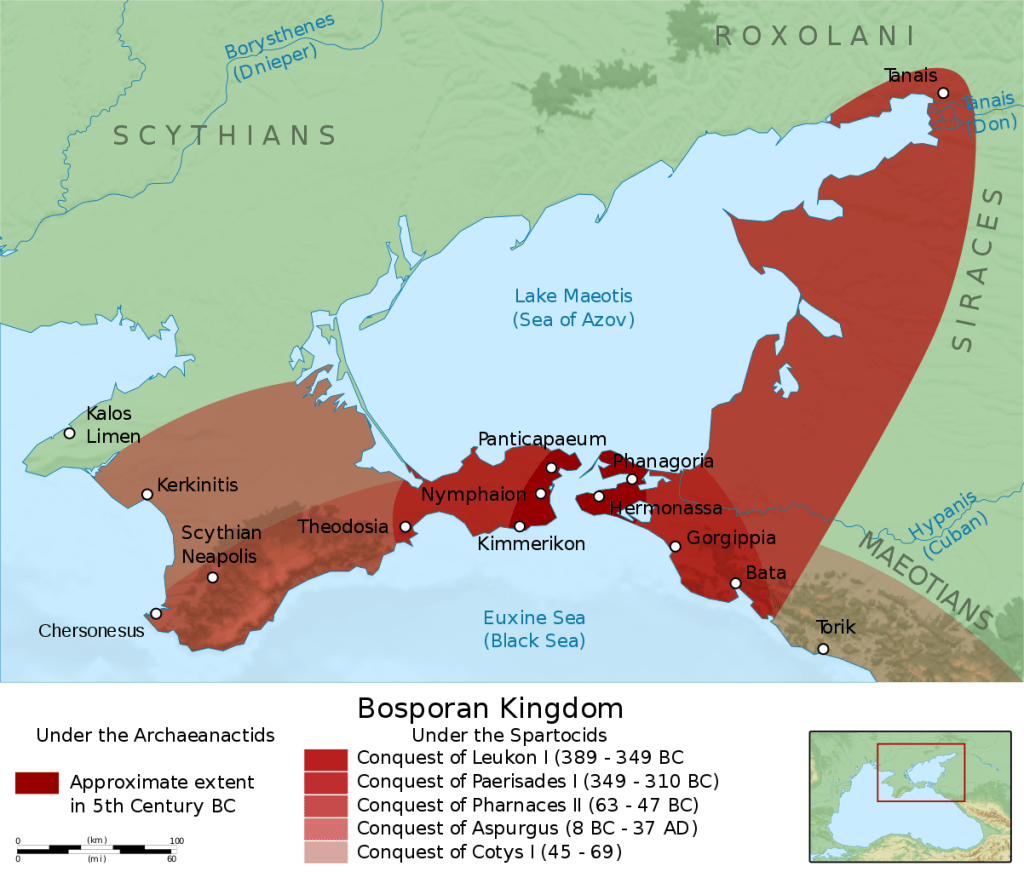
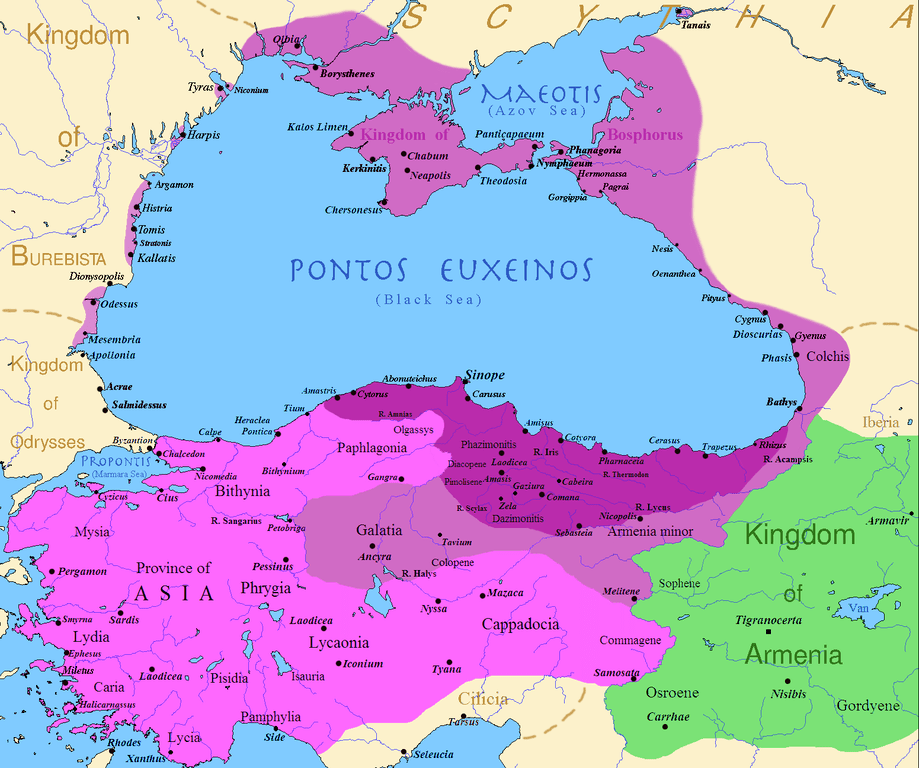
My continued read about the Scythians, especially the Scythians in the west, has lead to a fascinating period of time in early history, overlapping with the Hellenistic Period called the Kingdom of the Bosporus. The Kingdom of the Bosporus, later part of the Kingdom of the Pontus, survived in one form or another from the 5th century BC to the late Roman Imperial period in the year 370 AD (roughly 800 years). As you can see from the map, it started very small, just a collection of Greek colonies bound by mutual defense, and grew in size into a much larger kingdom that included the Crimean peninsula and parts of modern-day Ukraine.
Later growing into a much later kingdom that went to war with Rome:
Javierfv1212, Public domain, via Wikimedia Commons
What makes the Kingdom of the Bosporus / Pontus fascinating is the convergence of Greek, Thracian, Scythian and other cultures, and the exchanges between them. Let’s take a brief look at each…
The Greek Colonies
The humble beginnings of the Kingdom of the Bosporus began as a hodge-podge of Greek colonies in the Black Sea. The ancient Greeks were prolific colonizers in the Mediterranean because the lands of Greece have low agricultural output, and as populations grew, they needed places to grow and stretch. Famous colonies include Syracuse on the island of Sicily (home of Archimedes!), southern Italy a.k.a. Magna Graecia, Cyrene in modern-day Libya, as well as countless colonies in Spain, southern France, Asia Minor and so on.
Colonies in the Black Sea, including the modern Ukrainian city of Odessa,1 mostly originated from the Greek city-state of Miletos which had been aggressively colonizing all around the Black Sea. Even now, old Greeks relics can be found. The Greeks were colonizing hostile territory, so they tended to build fortresses on off-shore islands, or just inland from a river. From the inland communities, the Greeks would get raw materials, grain and other foodstuffs to ship back to the Greek metropolises back home. In turn, they would bring wine (much prized by the Scythians), crafted luxury goods and spread Greek culture.
From the perspective of the Greek world, the Black Sea and colonies around the Crimean peninsula were the very edge of civilization. This was the frontier, where only the bravest, or the punished would go.
The Native Thracians
The Thracians are an influential people who lived north and east of Greece proper, but are not well-attested in history. Thracian culture shows considerable Greek influence, but they spoke a different language (now lost), and had a more loose, more tribal political structure than the classic Greek polis.
But the Thracians weren’t slouches either. They frequently combated with the northern Greeks, especially Phillip II of Macedon and his son, Alexander the Great, and the Odryzian Kingdom was a serious attempt by the Thracians to unify and challenge their Greek neighbors.
The Kingdom of the Bosporus, the subject of this post, was perhaps their most important contribution, though, because the founder of that kingdom was a man named Spartacus. No, not this Spartacus:
The name “Spartacus” is a distinctly Thracian name, and the founder of the ruling dynasty of the Bosporan Kingdom was a Thracian man named Spartokos I, first as the strongman or “tyrant” of the Greek colony of Panticapaeum (modern Kerch), and then gradually uniting the nearby colonies in a system of mutual protection.
The Steppe Warriors
Starting with the Cimmerians, steppe nomads would often encroach into the steppe lands of modern Ukraine and Hungary, the westernmost extent (as well as the most hospitable) of the Eurasian steppes. Having driven out the Cimmerians, they settled and lead a confederation of tribes that dominated the lands for centuries, until they were eventually defeated by the Sarmatians.
The nomadic Scythians were at first largely hostile to the settled Greco-Thracian cities along the coast, and there is evidence of war and violence at some places, hence the colonies banded together for mutual defence. Gradually, though, the different cultures learned to get along and began mutually beneficial trade. The Scythians liked Greek commodities and helped ship raw resources from other cultures further north down to the Greek settlements.
The kurgan tombs of Scythian warriors also began to show more Greek architectural influence, such as the great kurgan at Kul-oba, and a tomb at Bliznitsa near the colony of Phanagoria that depicted the goddess Demeter, hinting at the Eleusinian Mysteries.
Further, a number of famous Greeks have (often dubious) claim to Scythian ancestry such as the Athenian orator, Demosthenes, so intermarriage did occur between the colonists and steppe nomads. Herodotus’s historical accounts of his travels in these lands also provide invaluable information about the people of the Bosporan Kingdom, the Scythians beyond it, and more.
The Wider World
How the Bosporan Kingdom fit into the wider Hellenistic and Roman world is interesting too. Because of its location, it was luckily not involved much in the power struggles between Alexander the Great’s successors, nor did it tangle with the Roman Republic until much later during the Mithridatic Wars. All three of them.
Further, the mixed ethnic composition of the Bosporan Kingdom meant that it was an unusually cosmopolitan place, and held a certain mystique among the more urban residents of the Greeks and later Roman empire. When Ovid was banished there, though, he often whined about how hard and rustic the life was, but he would, wouldn’t he?
Anyhow, even when we watch the news about events in Ukraine, especially southern Ukraine, it’s helpful to remember that these lands have a long and fascinating, multicultural history, and we haven’t even gotten to Kievan Rus’ yet.
1 Which, as of writing, remains free thankfully. Слава Україні! 🇺🇦
Recently, I had to attend a mandatory HR meeting at work to discuss our return to the office,1 and not surprisingly, it was awkward and grueling.2
A depiction of the Buddha taming a belligerent elephant,
One interesting thing that came from this meeting is an analogy of handling change using an analogy of an elephant and a rider. The rider represents the logical, rational part of the mind, and the elephant represents feelings and emotions. When they are in accord, things move along well enough, but if the elephant doesn’t want to go, it’s really hard to it go.3
We often take that elephant for granted when things are moving along nicely, but when the elephant is being stubborn or rampaging, the rider is tempted to lash out, give up, or punish it further. This may end up being counter-productive though.
There in lies the challenge.
The image I posted above depicts a famous episode from the Buddha’s life where his cousin Devadatta, out of spite, sent a rampaging elephant out to trample the Buddha but the Buddha was ultimately able to calm the elephant through compassion and keeping a clear head.
In the Buddhist sutras (scriptures), the Buddha often used the analogy of a charioteer driving his horses. In the Dhammapada, the Buddha says:
222. He who checks rising anger as a charioteer checks a rolling chariot, him I call a true charioteer. Others only hold the reins.
Translation by Acharya Buddharakkhita
at the same time, the Buddha also uses the analogy of a vīṇā (lute) and how to keep the strings not too taut, nor too slack:
“And what do you think? When the strings of your vīṇā were neither too taut nor too loose, but tuned [literally: established] to be right on pitch, was your vīṇā in tune & playable?”
“Yes, lord.”
“In the same way, Soṇa, over-aroused persistence leads to restlessness, overly slack persistence leads to laziness. Thus you should determine the right pitch for your persistence, attune [‘penetrate,’ ‘ferret out’] the pitch of the (five) faculties (to that), and there pick up your theme.”
Translation by Thannisaro Bhikkhu, the Soṇa Sutta (AN 6:55)
Just as managing horses in a chariot, or tuning one’s lute, managing the “elephant” of emotions is learning how and when to hold the reins, and when to loosen them. If the elephant is rampant, then one has to soothe it using calm goodwill, rather than fighting it, or punishing it.
Elephants are great creatures, and the elephant of one’s own emotions similarly needs to be treated with goodwill, even if you need to get it to move somewhere. 🐘❤️
P.S. On a side note, I highly recommend this podcast episode from the Hellenistic Age Podcast about elephants in warfare at the time. It has lots of interesting zoological details about elephants as well.
1 I am part of a department that wont’ be coming back until probably next year, so I am pretty lucky in that regard. I know a number of folks who refuse to work in an office and have looked for jobs elsewhere rather than come back. It’s a good company, but I think they’re in for a surprise when they realize how few want to actually return to the office.
2 Friendly reminder that HR departments answer, ultimately, to the company and not to employees even when they have the best of intentions.














 Gleanings in Buddha-Fields
.jpg)


.jpg)


You must be logged in to post a comment.