With Obon Season coming to Japan in late July and August, this is also the time of the Segaki (施餓鬼) ceremony in many Buddhist temples.
In Buddhism, one of the six (sometimes five or ten) realms of rebirth that brings undergo based on accumulated karma is the realm of the Hungry Ghosts, called preta in India, or gaki (餓鬼) in Japanese.
From a 12th century scroll depicting hungry ghosts living among us unseen, feeding on refuse, feces, water, etc. Courtesy of Wikipedia.
Hungry Ghosts are those whose past lives were defined by extreme vice and craving. This could be alcohol, drugs, women, money, etc. The usual. This craving carries over and they lived as hungry shades, unseen by the living, surviving off of scraps in the shadows. Further, the foods they are forced to eat, garbage, feces, blood, etc, are never enough, so such ghosts are constantly hungry and living in misery. It is the second-worst realm of rebirth apart from the hell realms in the Buddhist cosmology.
Thus, the segaki ritual, practiced in all Buddhist sects except Jodo Shinshu, is meant to help alleviate their craving, at least for a short while, also in hopes (depending on sect) that they can be reborn in the Pure Land of Amitabha Buddha next.
Like so many others, I am enjoying The Legend of Zelda: Tears of the Kingdom, but I am not just enjoying the game-play, I am subtly enjoying how certain Japanese cultural concepts shine through even in a medieval fantasy adventure. In a previous post, I talked about Japanese-religious influences in Breath of the Wild, and today, I wanted to revisit the subject for Tears of the Kingdom (hereafter TotK), since one aspect really stands out: the sky realm and the world below.
In early Indian Buddhism, the world was described in a complex cosmology involving devas (forerunners of the Hindu gods), and various hell realms not unlike Dante’s Inferno, plus many other states of rebirth such as hungry ghosts, asuras (titans) and so on. Many of these were inherent to Indian culture, but as Buddhism moved to other cultures, China and beyond, things gradually shifted in emphasis, or merged with native religious traditions. I don’t mean this in a sense of corruption, or loss of authenticity though. Just simply changing times, changing places.
In any case, by the time of late 12th century, medieval Japan, and especially through the writings of monks like Genshin, the cosmology from India had gradually streamlined in popular culture to essentially two realms of rebirth: Hell and the Pure Land. Other realms still existed on paper (i.e. religion tradition), but in the minds of most Japanese at the time, either you were destined to Hell or through the Buddha’s compassion you might be get fortunate to be reborn in the Pure Land.
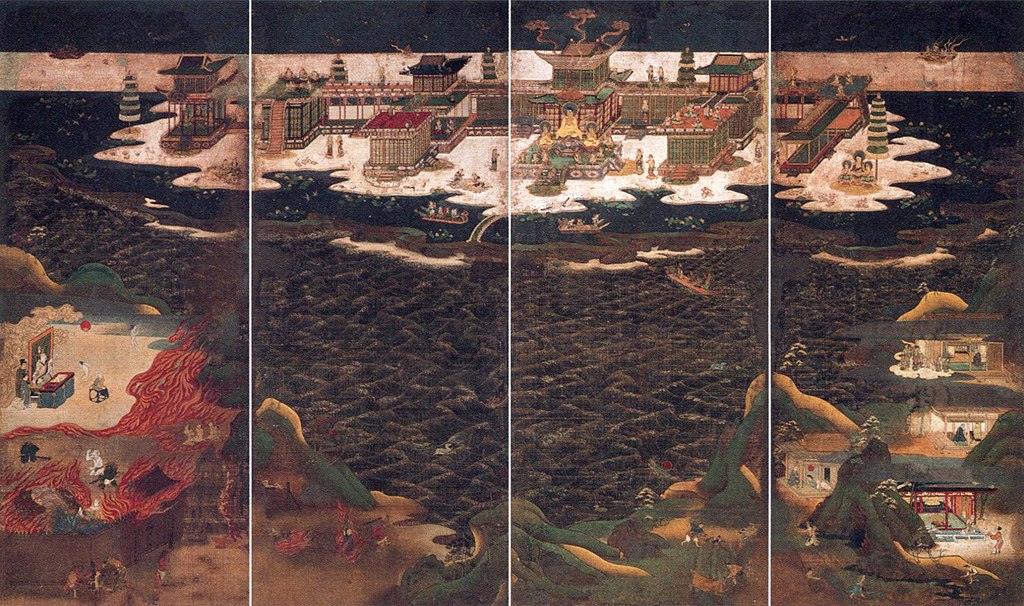
A 14th century painting depicting the Buddha’s Pure Land (top), Hell (bottom-left) and the mundane world (right). Painting courtesy of Konkaikōmyō-ji Temple, Public domain, via Wikimedia Commons
As Pure Land Buddhism gained in popularity during the Heian Period (8th-12th centuries), you see an increase of artwork depicting Amida Buddha welcoming the deceased to paradise,1 sometimes juxtaposed with images of Hell.2 Years ago I attended a local art exhibit in Kamakura, Japan, next to Tsurugaoka-Hachimangu shrine which displayed a gallery of such art from local temples and it was fascinating to see such a stark world-view, much like medieval Christianity, yet also very different under the hood, theologically.
Anyhow, getting back to the Legend of Zelda: TotK, the kingdom of Hyrule has expanded to include a sky realm, and a dark world underground. This is imagery that’s pretty universal in many cultures, but the details reflect Japanese-religious traditions.
Let’s look at the sky world first.
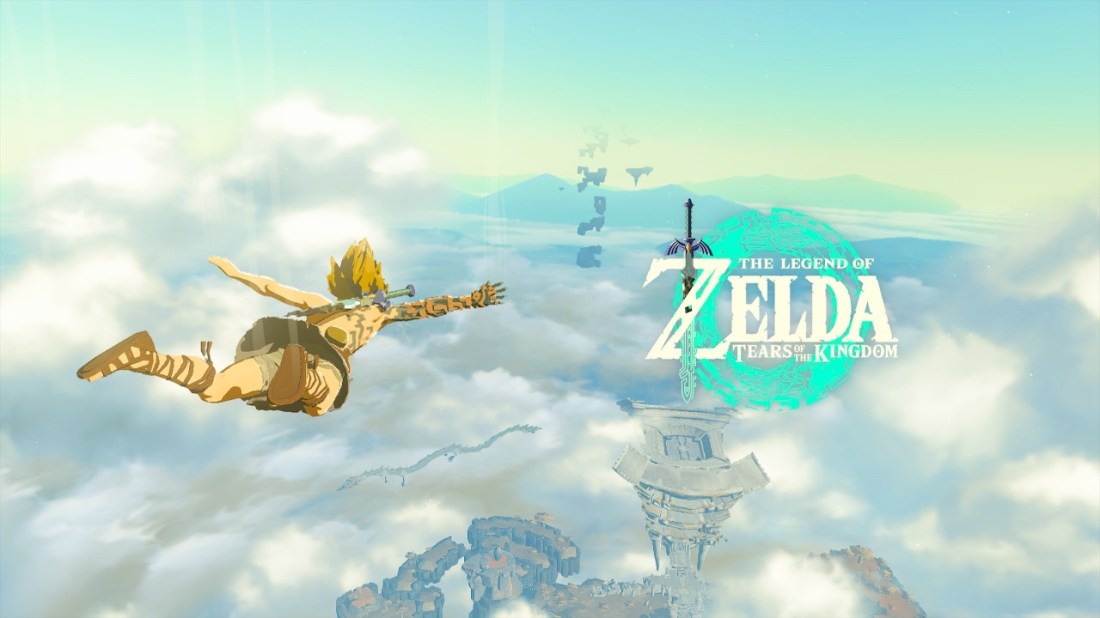
The sky world has placid ponds with lotus blossoms, and frequently uses a gentle golden color.
Compare with this passage from a Buddhist text, the Amitabha Sutra (阿弥陀経, amida-kyō in Japanese):
“In the pools [of the Pure Land] are lotuses as large as carriage wheels: green colored of green light, yellow colored of yellow light, red colored of red light, white colored of white light, subtly, wonderfully fragrant and pure….Moreover, Shāriputra, in that Buddhaland there is always heavenly music and the ground is yellow gold.”
The beautiful and rare birds also reflect another passage in the same sutra:
“Moreover Shāriputra, in this country there are always rare and wonderful varicolored birds: white cranes, peacocks, parrots, and egrets, kalavinkas, and two-headed birds.
Thus, we can see that sky world in TotK reflects imagery associated with Buddhism, especially the Pure Land of Amida Buddha. This may be entirely an arsthetic choice, but it still reflects Japanese-religious culture.
Now, let’s look at the world below:
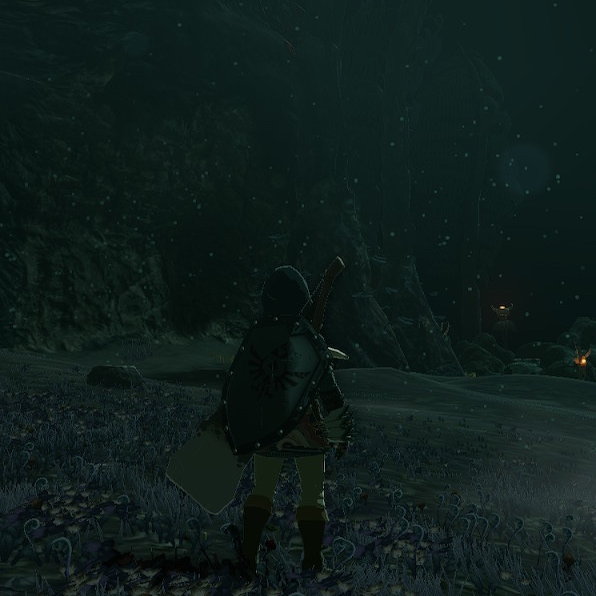
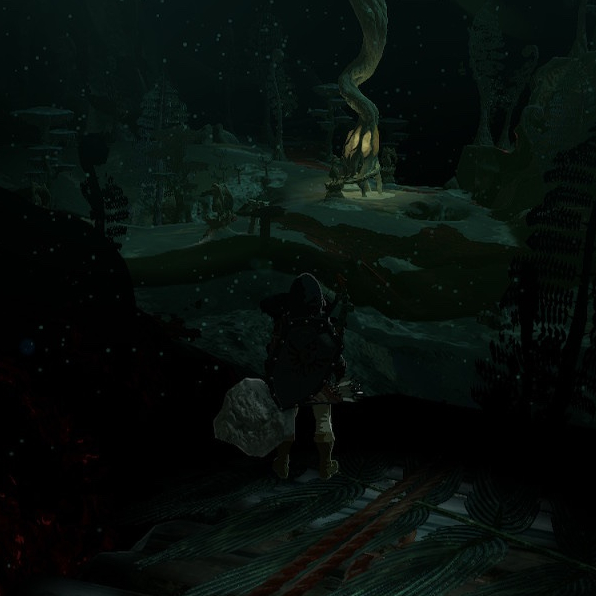
The world below is a world of darkness and misery. There is little life here, primarily predatory life, or creatures toiling away mining Zonaite minerals, and the air is stifling with spores (or ash?) in the air.
The imagery here does not fit neatly into the elaborate Buddhist hells as described in a Buddhist text such as the Earth Store Bodhisattva Sutra.
Instead, it more neatly fits a more Shinto (not Buddhist) depiction of the Land of Yomi, the Land of the Dead. Yomi, like the world below in TotK, is also accessible from the mundane world through various entrances, and similar to the Greek concept of Hades, it includes shades and shadows of former lives.
But again, in popular religious tradition, the Buddhist concept of Hell, and the native Shinto concept of Yomi blend together. This was very common in pre-modern Japanese culture where the two religions blended, and were virtually indistinguishable. In medieval Europe, Christianity blended with pagan and local folk traditions in the same way to the point where it was hard to see where one ended, and the other began.
And it’s fascinating to see the imagery applied to modern gaming as well.
A screenshot from the sky world. The image of a setting sun, by the way, is used to represent Amida Buddha in the first meditation in the Contemplation Sutra among other places.
Namu Amida Butsu
P.S. All Zelda screenshots here are by me.
1 Called amida shōju raigōzu (阿弥陀聖衆来迎図) in Japanese.
Hell is an interesting subject in Buddhism, though not a particularly important one. It differs from the more Western notion of hell in a number of key ways.
First, the Buddhist “model of existence” is based on ancient Indian cosmology which viewed the universe not a single world, but many different worlds that intertwine, and with living beings trans-migrating between worlds: first one world, then another, all based on one’s karmawithout end. Buddhism differed from other Indian religions at the time due to its teaching of anātman (roughly “no self”, or “no soul”), but otherwise the basic model was still the same:
These realms collectively were things such as the realm of animals (i.e. pure survival and instinct), the deva realms (realms of heavenly bliss), the human realm, the hell realms and so on. Imagine Dante’s Inferno, in all its agony and dismal torment, but many more layers, and each one is a disparate “world” or “realm” rather than just one layer among several. That is the hell realms (plural) in Buddhism. Some more severe than others, various ironic punishments, etc.
The hell realms, as with the other realms, are all temporary states. One may suffer horrific torment for a long time until one’s karma related to it is exhausted, but eventually it does exhaust and one moves onto another rebirth in some other realm.
However, there’s even more to this story. Another way that Buddhists tend to look at these realms, hell, deva, animal, and so on, is that they are states of mind, just as they are potential destinations for rebirth. The Tiantai (Tendai in Japan) Buddhists first posited an idea that within a single moment of thought, one might dwell in any number of realms. This was called the 3,000 realms in a single thought, to cover all possibilities: past, present or future, and within them, the hell realms, deva realms, basic instinctive survival (animals), and so on. The mind jumps from one state to another, from time period to another, without end.
A person lives in terrible, abusive environment may be said to be living in the hell realms here and now, even if there are breaks of relief in between. A person suffering from a terrible addiction may be living like a hungry ghost.
This notion of the mental realms vs. actual realms of rebirth aren’t necessarily mutually exclusive either. What matters is that there are people around us living in various states, some blissful (even if only temporarily) and others are suffering terrible torment, and everything in between. The Buddhist learns to be aware of this migration from one state to another within their own mind, but also extend this awareness outward towards others around them who may need help or relief.
Recently I was chatting with some folks in my PBP group about mandalas, starting with the famous sand mandalas that the Tibetan community drew for President Obama, then mandala in Japanese Buddhism. This conversation woke up some old memories of mine, including an obscure mandala that I wanted to share: the Taima Mandala.
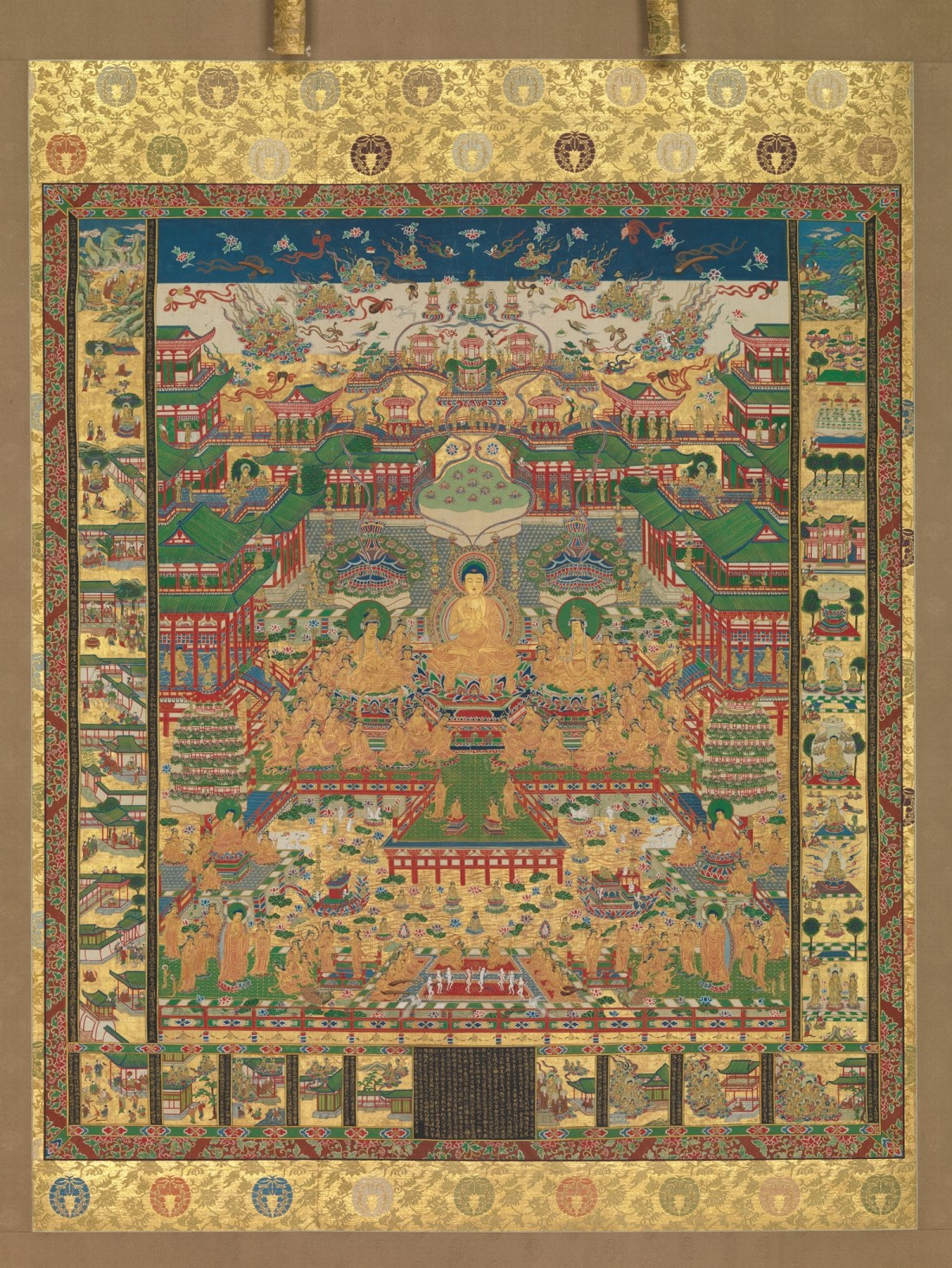
The Taima Mandala (taima mandara, 当麻曼荼羅) is a tapestry that was created in the year 763 and currently stored in the temple of Taima-dera in the city of Nara, Japan although many reproductions exist. You can see the original here. In spite of the name “mandala” it is not technically a mandala, nor is related to the esoteric traditions of Buddhism. Instead, it is part of genre of Buddhist art called hensōzu (変相図) in Japanese, graphic illustrations of the Pure Land of the Buddha or of the Buddhist hell realms.1
The Taima Mandala is a visual depiction of the Pure Land of Amitabha Buddha, the Buddha of Infinite Light. It is in the Pure Land (jōdo 浄土 in Japanese) that the Buddha provides refuge for all beings, and there that they can dwell in an environment that is very conducive to the Buddhist path and ultimately Buddhahood of their own. Part of the appeal of the Pure Land as a Buddhist practice or “dharma gate” is its accessibility. The Buddha, in order to create this refuge for all beings, vowed to make it so accessible that one need only recite his name as little as 10 times, or more if you wish.
Think of it as the ultimate Buddhist retreat, but far more affordable. 😉
If you click on the picture above you can see many details. In the center sits the Buddha Amitabha himself attended by his two attendant bodhisattvas Kannon (right) and Seishi (left).3 They are surrounded by many disciples of all kinds, who eager listen to the Dharma4 and toward the lower central area, you can see new beings being reborn in the Pure Land from the buds of lotus blossoms. Around the edges are smaller pictures, depicting various scenes of the Pure Land, adapted from existing Buddhist sutras, and the bottom depicts the nine grades of followers who are reborn in the Pure Land. The primary source for all this is the Contemplation of Amitabha Sutra, if I recall correctly.
The creation of the Taima Mandala is attributed to a Buddhist nun named Chūjō-himé (中将姫), daughter of one Fujiwara no Toyonari. She was deeply devoted to the Bodhisattva Kannon (Guan-yin). According to the origin story, she finished transcribing a copy of a Buddhist sutra called the shōsanjōdokyō (称讃浄土経, “Sutra on Praises of the Pure Land”?),2 and that same evening, from the western direction of the setting sun, she beheld a vision of the Pure Land in its splendid detail. She was so amazed that she took tonsure as a nun at Taima-dera Temple, and with Kannon’s guidance was able to craft the mandala based on what she saw.
As an example of hensōzu art, the Taima Mandala is simply amazing. It is one of those “often imitated, but never surpassed” works of art. While it is not a mandala in the strict sense, it has been called one for many generations because it does provide a very visual representation of the Pure Land that can’t be fully expressed in written form, hence it has a religious impact all its own.
Very little information about the Taima Mandala or this artistic genre exists in English unfortunately, and I have only scratched the surface, but I hope this helps inspire readers and other Buddhists in some way.
Namu Amida Butsu
P.S. Featured photo is a reprint of the Taima Mandala with the Jodo Shinshu-sect crest at the top and bottom, Metropolitan Museum of Art, CC0, via Wikimedia Commons
1 Ages ago, I attended a museum exhibition in Kamakura which displayed many such medieval hensōzu artwork from local temples, and it was simply amazing. It had a big impression on me, and how I understand Pure Land Buddhism.
2 There is very little information about this sutra in English or Japanese, but it appears to be an alternate translation of the more famous Amida Sutra, brought by the famous Chinese monk, Xuanzang, from India during his journeys. It is also called the shōsan jōdo butsu shōju-kyō (称讃浄土仏摂受経). There’s no translation at all in English, so the above title is my best guess.
3 Buddhas were often depicted in “trinities” with two attendant Bodhisattvas. Shakyamuni, the historical founder of Buddhism, was often depicted with Monju (Manjushri) and Fugen (Samantabhadra) for example.
4 The Buddhist law of existence, or “how things work”. Buddhism at its heart is not a dogma but a way of expressing how reality works, not how we want it to work, with the aim to awaken and enlighten others.
The founder of the Jodo-Shu sect of Buddhism, a 12th-century Buddhist monk named Honen, once composed a poem titled tsukikagé (月かげ, “Moonlight”). What follows is a rough translation on my part:
Japanese
Romanization
Translation
月かげの
Tsuki-kagé-no
There is no village
いたらぬ里は
Itaranu sato wa
that the light of moon
なけれども
Nakeredomo
does not shine,
眺むる人の
Nagamuru hito no
but it dwells in the hearts
心にぞすむ
Kokoro ni zosumu
of those who see it.
The “light of the moon” here is meant to symbolize the light of the Buddha, namely Amida Buddha. Light is a common motif in Buddhist art, depicting both wisdom to banish away the darkness of ignorance, and also goodwill to all living beings.
Amida Buddha and his attendant bodhisattvas welcoming Chūjōhime, Taima Temple Mandala, University of Michigan Museum of Art, Artist Unknown, Japan, Public domain, via Wikimedia Commons
“The radiant light of the Buddha of Immeasurable Life is dazzling brilliant, illuminating all the buddha lands of the ten directions, and there is nowhere it is not heard of.”
From The Three Pure Land Sutras published by the Jodo Shu Research Institute, translation by Karen J. Mack
Further, the sutra explains in the previous section:
“Those sentient beings who encounter this light will have the three hindrances1 eliminated, become amenable in body and mind, leap with joy and their hearts will give rise to good. Should they suffer hardship in the three realms of defilement,2 when they see this radiant light, they will all attain relief and not again suffer this pain.”
Thus, the light of Amida Buddha shines everywhere, but people may not necessarily know it. Those who do encounter the light experience a transformation within. It may not be obvious at first, but it as one of Honen’s disciples once taught, it melts ice to become warm water.
Thus, Honen’s poem is about how Amida’s goodwill and wisdom reaches out to all beings and all places, and even if people do not see it, it is still there. Further, those who do see it are changed by it, even if they are not aware of it at first.
Namu Amida Butsu
1 The three hindrances in Buddhism are greed, hatred and ignorance.
2 The three realms of defilement is another term for lower states of rebirth that one might fall into: animals, hungry ghosts, and the hell realms.
A print of a kasa-obake (傘お化け, “umbrella ghost”) made around 1850.
For Westerners, the “scary” time of year (besides tax season) is Halloween, but Japan has a similar tradition, called Obon (お盆) season which arose from a totally different set of circumstances, yet is an interesting example of convergent (and yet divergent) cultural traditions. Obon season in Japan varies by region: in the eastern “Kantō” part of Japan it’s around July 15th, while in the western “Kansai” part of Japan it is around August 15th. The reasons for this are due to certain political/historical reasons we won’t get into here. Despite the differences in timing, the traditions are still basically the same.
Obon, which literally means “serving tray”, is loosely derived from a Buddhist sutra called the Ullambana Sutra (盂蘭盆経; urabon-kyō in Japanese) wherein one of Shakyamuni Buddha’s chief disciples, named Maudgalyayana (or Mogallana), experiences a vision during a deep state of meditation. In this vision, he sees his mother trapped in one of the many Hell realms.1 His mother, while doting on lil’ Maudgalyayana, tended to bad-mouth others and did a lot of negative things all for the sake of her son.2
Maudgalyayana felt terrible about this, and resolved to help get his mother out of Hell, so he consulted with Shakyamuni Buddha, who said that if Maudgalyayana made offerings to the rest of the monastic community and dedicated the good merit to his mother, his mother would be liberated and could move onto a better rebirth. As the story goes, Maudgalyayana carried out the Buddha’s advice (hence the “serving tray” referring to Maudgalyayana’s offerings to the other monks). Having accomplished this, he later had a vision of his mother being liberated from Hell as a result.
Thus, in China and Japan this story has served as an inspiration for late-summer festivities that revere the ghosts of ancestors, offering gratitude to them, and so on. It’s an interesting example of how Buddhist teachings intermingle with local beliefs to create a cultural tradition (much the same way that Halloween is a mix of pre-Christian Celtic + early-medieval Christian traditions). It’s also why ghost stories are popular around this time. The famous book Kaidan (older spelling Kwaidan) by Greco-Irish author Lafcadio Hearn is a rare English-language window into some of these classics ghost-stories. I’ll post a few such stories later this week.
In practical terms, Obon has a lot of parallels with the Mexican Day of the Dead festivities. Offerings are made to one’s ancestors in the family Buddhist altar (butsudan, 仏壇), and families will also visit ancestral graves to clean them up and make further offerings there (ohaka-mairi, お墓参り). People often take time off around this time, or companies have work holidays (obon-yasumi お盆休み) to allow people to return to their hometowns, relax and get in touch with family again.
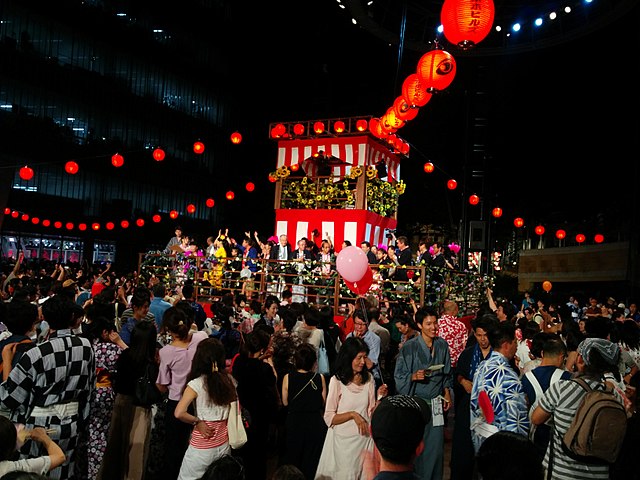
Bon-odori in Tokyo (Roppongi), courtesy of Wikipedia
The most well-known custom of Obon is the communal dance or bon-odori (盆踊り) which you’ll often find in overseas Japanese communities as well. I’ll post some videos or something soon of the Bonodori dances in my wife’s neighborhood, which we often visit around this time. My daughter, who’s now a teenager and knows a lot of the neighbors, helps volunteer at the local bonodori every year.
Anyhow, while Obon season is very much a Japanese tradition, it also has fascinating roots from both China and Buddhist India as well.
P.S. The July vs. August celebration of Obon happens not just between east and west, but can vary by region. Northern Japan also celebrates in August while the Tokyo area celebrates in July, and so on.
1 Buddhism, borrowing from earlier Indian cosmology, describes many hell realms and many heavenly realms. All of these are seen as temporary destinations on the even longer cycle of rebirth. For Buddhism, the larger goal is liberation from the near-infinite cycle of rebirth (Samsara, or “aimless wandering”) more than seeking out the “good” realms over the bad ones.
2 I think this often gets overlooked, but the Ullambana Sutra is a poignant reminder that not everything done for the sake of one’s kids is the right thing to do. Parents need to uphold good moral conduct in addition to good parenting. They’re not necessarily exclusive either. In simpler terms: don’t be a dick.








 Gleanings in Buddha-Fields


.jpg)

You must be logged in to post a comment.