Whatever Happened to the Ancient Greek Religion?

general_view_of_sanctuary_of_demeter_and_kore_and_the_telesterion_28initiation_hall292c_center_for_the_eleusinian_mysteries2c_eleusis_28819184168429
The great hall in Eleusis, Telesterion, one of the primary centers of the Eleusinian Mysteries. Photo by Carole Raddato from FRANKFURT, Germany [CC BY-SA]. Link to Wikipedia

While reading about the Hellenistic Period of ancient history, and the later Roman history, I have been curious about the gradual evolution and decline of the ancient Greek religion, centered around the Olympian gods.

As history shows, the Roman Empire gradually transitioned from a pagan Imperial religion to Christianity, becoming official with the reign of Emperor Constatine. Subsequent emperors such as Theodosius then purged the remains of Greco-Roman religion across the Empire, including Greece itself.

But I got to thinking, why?  What the heck happened?

The classic Greek religion, which people learn through school and mythology was best defined in the Homeric epics (the Iliad and the Odyssey) as well as Hesiod’s Theogony. These epics and poems captured the larger Greek religious culture at the time, but also gave it structure and formed a basis for later religion, which in turn was later synthesized with the ancient Roman religion and disseminated further.  This “Olympian” religion was never a particularly organized one. Instead, it was based on a loose network of “cults” centered around the local deity of a city-state with festivals and rituals unique to that locale. For example, Artemis was widely worshiped all over Greece, but each place had its own local legends and festivals. Athena was frequently a patron-deity of city-states such as Sparta, Athens, Argos, etc. Then there were certain cult centers, such as the Pythia (a.k.a. the Oracle of Delphi), that were famous across all Greece.

magical_book_kircherian_terme
Magic “tablets” with inscriptions, courtesy of Wikipedia.

But the story didn’t end with the “Olympian gods”.  Magic and superstition were very common beliefs too, as manifested in a goddess named Tyche (Fortune). Fortune was, as the name implies, entirely unpredictable, and could change at any moment. Further, there was a palpable (and somewhat contradictory) sense at the time that one’s own fate was written in the stars and could not be avoided. While modern day views of ancient Greece centers around the Olympian gods, they were only one part of a larger religious outlook at the time.

During the Hellenistic Period, after Alexander the Great’s conquests spread Greek culture to a much wider geographic area, Greek society also came into much more direct contact with other religions as well.  This led to a much more syncretic culture (sometimes deliberate, sometimes accidental), where Greeks were confronted with other deities and teachings to address their anxiety about the world around them.  The reason, as Michael Grant points out in From Alexander to Cleopatra: The Hellenistic World, was that the Hellenistic World was much more uncertain than the classic “city-state” culture (e.g. Sparta, Athens, Thebes, etc). The Greek world was suddenly thrust into a much larger one and while people became more affluent and educated, they also became increasingly concerned with personal salvation. Classic Greek beliefs viewed life as fleeting and uncertain, while the afterlife, reflected in the Odyssey and other sources, for the vast, vast majority would be to simply dwell in the Underworld as flitting spirits, memories of their former lives all but forgotten.

This concern with avoiding a dismal fate manifested in “mystery cults” starting with the worship of Demeter at Eleusis. As Michael Grant writes:

Magic might change your destiny, but initiation — musterion, so that these were called Mystery religions — raised you outside its clutches altogether; and the soul of the initiate was elevated beyond the reach of the hateful stars….This miracle was affected by personal union with a Savior God, who was often himself believed to have died and risen again in the past.

Page 225

These Eleusinian Mysteries involved re-enacting the legend of Demeter’s daughter, Persephone: descending into the Underworld, marriage to Hades, and then reuniting with her mother. As they were a closely guarded secret, know one knows what exactly

fresque_des_mytc3a8res2c_pompc3a9i
Fresco of the mystery ritual, right, Villa of the Mysteries, Pompeii, Italy.  Courtesy of Wikipedia

happened, but many Roman and Greek villas have scenes painted of the various initiation ceremonies. Another, perhaps even more popular, mystery cult surrounded the “foreign god” Dionysus. Dionysus was particularly venerated by Alexander the Great’s army as they marched east, re-enacting his legendary conquests in the East before he laid down his sword and gave himself over to the gentler pursuits in life. Dionysus’s story of his death by the Titans and rebirth through his mother Semele became an important element in the cult, and followers believed that they too would be reborn just as Dionysus had. The fact that Dionysus was also associated with joy and the spring of life was not lost on followers either. As with the Eleusinian Mysteries, scenes of the Dionysian Mysteries could be found on wall-paintings such as those at the Villa dei Misteri in Pompeii.

Further, foreign cults gained much prominence. By far the most famous was the

pompeii_-_temple_of_isis_-_io_and_isis_-_man
Io (left, with horns) is welcomed in Egypt by Isis (sitting).
Museo Archeologico Nazionale (Naples) and courtesy of Wikipedia.

Egyptian goddess Isis, who was worshipped as something like a “supreme goddess”. By the time the Greeks encountered Isis, the Egyptian myths and rituals were already well-developed and the syncretic Hellenistic culture at the time quickly found common ground between the two. Isis’s consort, Osiris (in the form Sarapis), was thought to be Dionysus, and Isis was loosely conflated with the Greek deity Aphrodite. However, in addition to a series of public rituals and festivals, the cult of Isis also had its contemplative side as well as promises of salvation which helped it spread rapidly in the Hellenistic world. Isis exemplified pity and compassion toward her followers as well as deep wisdom. Even the Buddha had a connection to Isis via Indian expats.

Indeed, as Michael Grant summarizes:

Pagan religion was not already dying and dead when Christianity overtook it; it had remained very lively indeed. But it had deviated, and continued to deviate throughout the Hellenistic age, from the traditional mainstream of the classical Olympian cults. They continued, it is true, to receive impressive ceremonial worship, but a person of this epoch no longer pinned his or her faith on those gods, but on a number of Divine Saviours. These Saviours were relied on, passionately, for two quite distinct miraculous gifts, of which their various cults held out hopes in varying proportions: the conferment of strength and holiness to endure the present life upon this earth, and the gift of immortality and happiness after death.

Page 224

This syncretism and need for answers was not limited to “popular religion” either.  Many of traditional Greek schools of philosophy, which had maintained a flippant and disdaining view of religion and superstition, absorbed monotheistic elements from Persian culture and gradually transformed themselves into “new”, more grandiose explanations of the world.  Platonic philosophy became (what we now call) Neoplatonism, Phythagoras’s belief in the unifying importance of mathematics took in increasingly deistic tones.  All of these trended toward a more monotheistic outlook on life, where the original Olympian gods played less and less of a significant role.

In short, it seems that in a larger, uncertain world such as the Hellenistic Era followed by the Roman Empire, that the traditional Olympian gods no longer fulfilled people’s needs, and that this greater awareness of mortality, fate and the afterlife led many to pursue other, more personal faiths, and with so many different cultures and ideas suddenly within reach, a great explosion of ideas and faiths spread across the Mediterranean until the Olympian gods (and their Roman counterparts) were relegated to public rituals only.

Whatever Happened to the Spartans?

Who doesn’t love the Spartans?  Those wacky, ripped super-men of few words and huge enslaved underclass that built an entire society around warfare and preservation of their way of life.  Laconophilia, or a love of Sparta and Spartan culture (named after Lacedaemon Λακεδαίμων, an alternate name of Sparta), has been an underlying current of the Western world since antiquity (and even among politicians now), and even a movie of dubious historicity.

But even with the questionable history around the Spartans, the image of Sparta is a persistent one.  However, one thing that many people are unaware of is the fate of Sparta after their high-water mark of power in the 4th century BCE, during the Peloponnesian Wars and their stand against Persia.

In the short-term, Sparta lost a critical battle in 371 BCE called the Battle of Leuctra to another major city-state named Thebes which was an oligarchic society, and a frequent foe of both Sparta and Athens.  The victorious general, Epaminondas, knew he would have trouble dealing with the power Spartan phalanx head-on, so he employed unconventional tactics to attack the right-flank of the Spartan military and causing the rest of the line to collapse.  The Spartan military was powerful, but inflexible, and this became a theme of the Spartan downfall I believe.

Let’s take a step back and look at Spartan society, which was basically divided into two classes: the spartiatés (Σπᾰρτῐᾱ́της) who were full-citizens and the helots (εἵλωτες) who were the enslaved underclass.  Spartan society was built around the idea that the helots would do all the menial labor so the Spartiates (namely, men) could focus all their time and honing their military skills.  Other social classes existed somewhere in the middle (for example conquered peoples who were neither Spartiates nor Helots), but were sidelined by Spartan society.  This social structure did not always exist, but was designed as a kind of social-experiment by one Lycurgus after a period of societal collapse around the 7th or 8th century.

In order to be a Spartiates, this meant that you had to be descended Spartan citizens, but also that you had to pay a membership “fee” which helped fund the training schools, communal mess halls, etc.  At its height, Sparta may have had around 25,000-30,000 such citizens.

What happened though was that after Sparta lost wars such as the Battle of Leuctra, it couldn’t replace its losses very quickly.  The bar for being a Spartiates was so high, that even Spartiates sometimes lost their status and were demoted.  Generations later, the Spartans couldn’t field more than 1000 soldiers at most.  Further, Sparta’s economic system was unusual. Its currency was iron bars, not coins as other Greek city-states used, and due to unusual inheritance laws, its wealth by and by was concentrated in the hands of a smaller and smaller number of wealthy land-holders.  Other Spartan citizens became mired in debt (and unable to generate new avenues of wealth due to Sparta’s backwards economic system) and lost their citizen status as a result. By the reign of King Agis IV (see below), there were no more than 700 Spartiates left, and thousands had recently lost their status.

Sparta eventually came to realize that its highly elite social structure also meant that it was inflexible (not to mention strangled innovation), and certain kings attempted to introduce reforms during the Hellenistic Period.  The first, King Agis IV (r.244 – 241 BC), attempted a sweeping land-reform that would correct the wealth imbalance that plagued Sparta, while also increasing the pool of Spartiates by allowing Perioikoi (Περίοικος, conquered people who were partial Spartan citizens) to be Spartiates.  As Michael Grant writes in From Alexander to Cleopatra: The Hellenistic World:

Opposition, however, was strong. The owners of the large properties, though glad enough to have their debts cancelled, were naturally hostile to the redistribution of their own land; and some of ephors, horrified at what sounded like a recipe for revolution, supported these objections. Moreover, even by having their debts cancelled, found it very distasteful to have perioikoi as fellow-citizens and sharers in their new property.

King Agis IV didn’t last much longer and was ultimately killed by the opposition, particularly by his co-monarch King Leonidas II.1 Soon after came Cleomenes III (r.235 – 219 BC), son of Leonidas II. Cleomenes started his rule with some forceful military victories but then turned his attention back to Sparta and abolished the ephors altogether and cancelled debts, enlisted perioikoi and even allowed some helots to buy their freedom. All the while, he redistributed land holdings as well. As Michael Grant writes, these measures were drastic, but intended to increase the Spartan army enough to take on the rival Achaean League. Despite these efforts, the Spartan army was almost entirely destroyed in the year 222, and Cleomenes fled to Egypt. Cleomenes’ rule was popular with the poor, but tyrannical and ultimately self-destructive. Finally, came Nabis (r.207 – 192 BC) who attempted to revive the reforms of Cleomenes and liberated even more helot slaves, but his reckless foreign policy against Rome and the Achaean League made him no friends and was soon killed by a former ally.

Michael Grant explains the decline and failure to revive Sparta like so:

The Spartan ‘revolutions’ had failed, because they were backward-looking and made no attempt to create new wealth, of with there was not enough to go round.

Sparta was conquered not long after and became a literal tourist-trap for Romans and later visitors. Romans at the time would often holiday there and see its weird, exotic traditions, but ultimately that was the end of Sparta as an independent state.

While the idea of Sparta might be fascinating, in practice it was an odd social-experiment that didn’t really pan out. Sparta’s social structure looked good on paper, but eventually lost as its enemies adapted and the weight of its own hard-headed (not to mention oppressive) traditions stifled it. Compare with the Roman military of the early Republic which lost many, many times, but eventually defeated its enemies because they were willing to experiment and take their lumps until they got it right. Each time, they faced a new threat, they adapted and pushed back.

3l1dmf

Sparta, by contrast, remained proudly conservative in the face of change, and ultimately just petered out until it was irrelevant.

P.S. Compare with the city-state of Athens, which gradually reformed itself multiple times until it became the democratic system we all know.

1 Sparta was unusual as it was a diarchy, not a monarchy. The two kings ruled equally, and took turns, with the Ephors keeping both in line.

Ancient Greek Philosophy is Nutty

People often imagine ancient Greek philosophy and imagine such great minds as Socrates, Plato and Aristotle preaching something deep and insightful as disciples sit at their feet basking in the light of wisdom.

At least, that’s what I had imagined in the back of my mind…

socrates

I spent some time recently, while researching the Hellenistic Period, to also acquaint myself with ancient Greek philosophy in greater detail and what I found was this amorphous blob of people, places and ideas that were sometimes insightful, sometimes amusing and other times just plain nutters. Eidolon has a great tongue-in-cheek article about some of these more eccentric philosophies, but I also wanted to give a brief (not to mention probably inaccurate) summary of some of the major philosophical schools and a few of the more eccentric ones. This is not a comprehensive list, or a thorough understanding, just one man’s impressions of the myriad schools of thought.

Plato and Platonic Philosophy

Plato was one of several disciples of Socrates, who himself never established a school (Xenophon is another major disciple, btw).  Plato’s philosophy could possible be summarized by the famous Allegory of the Cave wherein people are fooled by shadows of forms, unable to see the real form.  Plato spent much time contemplating the transcendent “true form” of things, which he felt arose from Goodness as the ultimate source.  That which was true was inherently good, and those who pursued good would come to the truth.

By the Hellenistic Period, Plato’s school had taken on a more mystical tone under Plotinus and is now known as Neo-Platonism.  Here, the source of all things is the One, who also is the source of all goodness.  In keeping with the transcendent nature of Plato’s philosophy, followers of Neoplatonism sought to reunite with the One, shedding crude matter in the process.

Peripatetics

The Peripatetics were the followers of, and the name of the school of Aristotle’s philosophy.  Aristotle had been a student of Plato but had also gone his own way more and more as the years went on.  Unlike, Plato who focused on forms and transcendence, Aristotle’s philosophy was ground more in empirical experience, and that the physical, material world was the basis of all things.  Not surprisingly, this was an important inspiration in later European history in the pursuit of sciences and the Enlightenment era.

Like Plato, Aristotle and the Peripatetics regarded virtue as the ultimate goal, and the means of happiness though they different with the Platonic school over what exactly virtue was.  In time, the Peripatetics were eclipsed by the Neoplatonists (and Christians) above.  It is also noteworthy that the Peripatetics had a strict “no-girls” policy as Aristotle was generally pretty critical of women relative to other Greek philosophers.1

Stoics

img_3555

The Stoics were a later school that had a major heyday during the Hellenistic Period and even as far as the Roman Empire.  Many people will note that famous Romans such as Cicero, Seneca the Younger and Emperor Marcus Aurelius (e.g. “Markie A”) were all devotees.  The Stoics were begun by Zeno of Citium who had previously been a follower of the Cynics, but didn’t agree with some of their practices.

Like Plato and Aristotle, Zeno and later Stoics felt that virtue was the highest good, but that this virtue would be best achieved by learning to live according to nature or one’s fate.  This is where we get the idea of being rational or “stoic” in the face of calamity. Stoics emphasized that maintaining virtue even in the face challenging circumstances was the only real means of attaining peace of mind (eudaimonia εὐδαιμονία) and be in touch with the world-soul (something also espoused by the Platonists).

One interesting note that Michael Grant writes in From Alexander to Cleopatra: The Hellenistic World is that the Stoics tended to be favored by aristocratic social conservatives due to their practice of maintaining a sense of equanimity in the face of social order (i.e. not upsetting it).

Epicureans

The Epicureans were another late, Hellenistic-period, school that for a time was immensely influential.  Roman-era Stoics used to gripe how Epicureanism was a big fad in Rome among other places.

Epicurus the founder, in some ways like Aristotle, had very grounded view of the world, including a belief that while the gods existed, they were so enraptured in their own lives that they had zero involvement in the lives of men.  For him the highest good was a sense of equanimity (ataraxia ἀταραξία) through pleasure, but not necessarily pleasure in the sense of sensual pleasure.  Instead Epicurus advocated things like companionship of friends, freedom from troubles, etc.  Epicurus’s ideal was a kind of quietist, self-sufficient ascetic life free from entanglements like politics, sex, etc, and so the Epicurean approach to life was to engage in activities that work toward that end.

Epicureanism had a kind of “calculating” approach to life, ethics and virtue and that tended to paint a big target on its back from other philosophies. Stoics in particular hated the Epicureans.

Cynics

The Cynics were a somewhat older school of philosophy that Stoicism clearly was based off of.  It was founded by yet another Socrates disciple, Antisthenes.  The Cynics proposed virtue through living naturally, totally free from “artificial” social conventions.  This mean things like walking around naked, living in a large clay pot, as Diogenes did, and speaking to authority figures with plain, not honorific, speech. Diogenes apparently also had some run-ins with Plato, evidentially and allegedly with Alexander the Great, too.

Such an impractical and immodest life eventually turned off Zeno of Citium and thus leading to his Stoic school.  Cynicism as a school eventually died out by the 3rd century, but during its heyday, according to Michael Grant, it was one of the few schools that actively decried social injustices in Hellenistic society such as poverty and slavery. Unlike some of the more cerebral philosophies, Cynicism had a broader, counter-cultural appeal even if few people were actually able to put it into practice.

Pythagoreanism

Arguably one of the oldest schools of Greek philosophy, its founder Pythagoreas, the famous mathematician, not surprisingly applied a philosophical/mathematical view of the Universe.  In other words, through the study of mathematics and numerology, one could better understanding the philosophical underpinnings of the harmonious Universe.  Pythagoreanism was also noteworthy for its teaching of reincarnation (though this was not exclusively a Pythagorean teaching).  At its core, the Pythagoreans were an ascetic community (back before it was trendy), and eventually were eclipsed by the Cynics until it revived centuries later as Neopythagoreanism which deified the “one” more than before, but still kept to its mathematical roots.

Pyrrhonism

This school, founded by Pyrrho of Ellis, had a strongly skeptical outlook to life and other philosophical schools while emphasizing pragmatism. By withholding belief, and questioning things, one could avoid the mental disturbances caused by erroneous or misleading viewpoints and attain a sense of equanimity (see Epicurianism above). At its heart Pyrrhonism was about peace through avoiding “mind games” and just embracing things as they are. 🙂

Not surprisingly, the Skeptics avoided writing their teachings down much in order to avoid later generations from getting caught up in dogma.

Conclusion

What makes Ancient Greek Philosophy so interesting is that there were so many different approaches to the same basic problems of happiness and well-being. As Michael Grant writes:

The Hellenistic age, as we have seen, devoted a new, sympathetic attention to the individual man and woman. In consequence, an enormous proportion of the best thought of the time was concerned with analyzing the extensive problems and predicaments that disturbed him and her, in order to solve them and dispel the anxieties that they caused. (ch. 4)

But what’s really fascinating is that this was not limited to the Mediterranean.

Shakyamuni Buddha during his ministry in India (7th-6th century BCE) was similarly surrounded by rival schools the new Śramaṇa tradition that had grown beyond the singular devotion to the gods of the Vedas, and like the Greeks, strove to make sense of the Universe. Prior to his enlightenment, the Buddha had even studied under some of these schools, and later these same schools sent their best and brightest to debate with him. In a Buddhist text, the Brahmajāla Sutta (DN1 of the Pali Canon), the Buddha listed 62 other rivals schools of thought.

In China too, there was a similar explosion of thought at the time including Confucianism, Taoism, Mohism, Legalism, etc. Each of these competing ideas had certain fundamental cultural assumptions such as the Yellow Emperor, Heaven as a model of order and goodness, and Nature, but each sought a way to organize Man along the will of Heaven and thereby prosper in a chaotic period.

Each society was geographically cut off from the other, but as each one grew and flourished beyond simple survival, they began to look around them and ask deeper questions, and those theories, conjectures and teachings still shape our world today.

1 Ancient Greek culture in general was pretty misogynistic. Women lived cloistered lives and even ate in separate rooms from the men. During the Hellenistic Period, this rapidly changed and women started to take more control of their own lives, participate in social activities more and even have some economic and political influence of their own. Also, compare with Roman women who enjoyed relatively equal status with men than their Greek counterparts.

The Hellenistic World: Ancient Greece on a Wider Scale

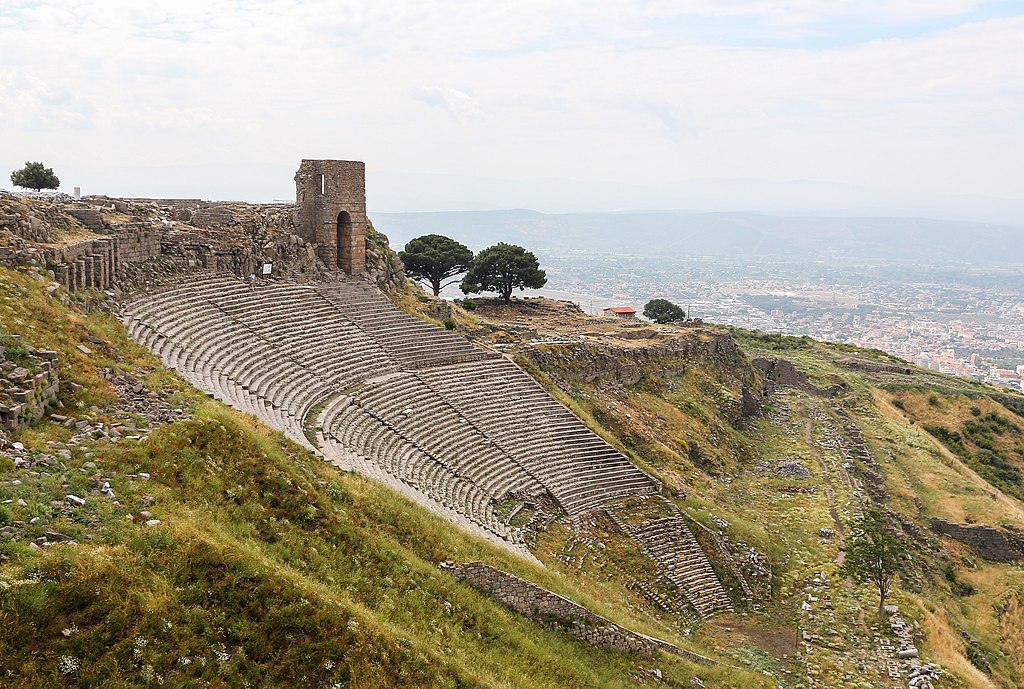
Ancient Greek theatre of Pergamon, Turkey, photo by Bernard Gagnon, CC BY-SA 3.0, via Wikimedia Commons

When most people think of Ancient Greece, they think of ancient Athens with its democracy and philosophers, or Sparta with its militaristic culture.1 But Greece was a much larger and more complex culture, and no where is this more evident than in the Hellenistic Period.

The Hellenistic Period, covers a broad period from the death of Alexander the Great in the 4th century, to Cleopatra’s reign in the 1st century BCE.  During this period, Alexander’s conquest quickly devolved into multiple, powerful Hellenized (Greek) kingdoms that vied one another for domination in the four Wars of the Diadochoi, followed by a breakup of the empire into distinct kingdoms, each with their strengths and challenges. Many were ruled by a former companion of Alexander, and their dynasties lasted for centuries, others were existing Greek colonies that navigated the complex Hellenistic world through alliances and building armies of their own.

Hellenistic world 281 B.C.

These powerful kingdoms included, but were not limited to:

  • Ptolemies who ruled Egypt, including the famous city of Alexandria.
  • Seleucids who ruled the vast lands once ruled by the Persians including Babylon, Judea, and for a time the lands next to India (present day Pakistan and Afghanistan).
  • Attalids who ruled the powerful, dynamic city-state of Pergamum.
  • Antigonids who reigned in Greece and Macedon after Alexander’s death.
  • The powerful western colony of Syracuse, home of Archimedes
  • The colony of Cyrene in North Africa
  • The Bactrian Greeks, who broke away from the Seleucids.
  • The Indo-Greek kingdoms, who broke away from the Bactrian Greeks.
  • The powerful Kingdom of Pontus surrounding today’s Crimean peninsula.
buddha-vajrapani-herakles
An example of Greco-Buddhist art in Gandhara (modern day Pakistan), showing the Buddha and flanked by guardian Vajrapani, whose depiction clearly borrows from the Greek hero Herakles. Courtesy of Wikipedia.

A lot of aspects that people are vaguely aware of about the ancient Greek world are often found within the Hellenistic Period, including things referenced in the Bible, the Buddhist tradition, major philosophical schools, venerable works of art, and rivals to the later Roman Empire. Eventually, the Roman Empire defeated all but the most eastern regions (who fell to the Parthians and other conquerors), but the legacy they left behind has persisted through the centuries even up until now.

I’ve been reading a lot about this period from an excellent book called From Alexander to Cleopatra: The Hellenistic World by Michael Grant. This book covers every facet of life in the Hellenistic World: history, structure, life, art, architecture, philosophy, etc.

What’s most fascinating about the Hellenistic Period is how diverse the different characters and regions of the larger Greek world were, and yet how each had distinctive Greek influence.  For example, the city-state of Syracuse, home of Archimedes, on the island of Sicily was a remote Greek colony yet it was also a great center of learning with additional influences from the Carthage and Roman culture.  On the other end of the Hellenistic world was the city of Seleucia, which was built deep in the heart of Mesopotamia had much cultural exchange particularly in the fields of mathematics and astronomy between the Greeks and the native Mesopotamian culture.  Everywhere the Greeks and their colonies went, they left their mark upon the world, but the native cultures left their marks on the Greeks as well.

The book and its contents are much too broad and complex to cover in this blog post, but it’s well worth a read, and I will likely be revisiting this topic again soon in subsequent posts covering different aspects of the Hellenistic Period.

While this period is not well known to general audiences, the Hellenistic Period represents the high-water mark of Greek culture, but also reflects a deeply cosmopolitan and dynamic period of history where changes to society and ideas were emerging, and in ways not previously seen in western culture, yet with lasting effect.

P.S. If you’d like to learn more about the Hellenstic Age, I highly recommend the Hellenistic Age Podcast. I’ve been enjoying this for months and it is top-notch.

1 The myths of Sparta present a lot of problems and misconceptions. Movies like 300 are a joke, and not remotely accurate to life in actual Sparta, but that’s a rant for another day.