A Look At the Hellenistic Age Dynasties

The Hellenistic Age in history is the period after Alexander the Great died in 323 BCE, when his soldiers scrambled for power over the vast conquered empire, and ruling the known world for three centuries until they were toppled one by one by the Roman Republic.

These dynasties, descended from Alexander’s generals and philoi (trusted companions), were all Greco-Macedonian in culture and language, yet because each dynasty ruled over a different culture: Egyptian, Persian, Babylonian, and so on, they took on their own unique characteristics. These Hellenistic kings exemplified masculine warrior king ideology as they competed for legitimacy through warfare and conquest, with no overarching political ideology.

Let’s look at a couple examples.

The Seleucid Empire

The Seleucid Empire, descended from former general Seleukos I Nikator (“the victor”). The Seleucid Dynasty had by far the largest chunk of Alexander’s conquests, but also the most difficult to maintain. The diversity of people of people from the Levant, including the Hebrews, the Babylonians, the Parthians, and peoples in northwest India required constant vigilance to rule by a tiny Greco-Macedonian minority.

To assist with their rule, the Seleucids wisely adopted Babylonian customs and religious ceremonies, while their patron god Apollo synthesized with eastern Persian (and Parthian) cultures who venerated archery. The Seleucid kings had to go on campaign constantly to maintain control over such a large empire, while maintaining religious functions in Babylon. The satraps (local kings ruling each province in Persian tradition) required constant discipline because they were prone to set themselves up as rivals. The early Seleucid rulers also established or augmented Greek colonies across the empire to help maintain rule.

The powerful Antiochus III Megas, (a.k.a. Antiochus the Great) made a famous Anabasis campaign that took him all the way to Kabul, Afghanistan to crush rebel satrap Euthydemus I, in Bactria, before swinging back around and crushing then re-subjugating Persia, and Coele Syria (the lands around modern Israel). Antiochus III Megas, the most successful of the Seleucid rulers, only keep it all together through sheer force of will and constant warfare, and many later rulers were simply not as capable or successful.

After Antiochus III, the empire began to unravel as his sons Seleucus IV Philopator and Antiochus IV Epiphanes, and their progeny gradually split the ruling family, as one side would usurp the throne, while the other would eventually reclaim it. All this happened, as enemies gradually increased on their borders, and the territory they ruled over got smaller and smaller.

Antiochus IV Epiphanes is particularly infamous in the biblical tradition, namely in the Old Testament, for his Abomination of Desolation (defiling the Temple of Jerusalem and replacing worship of G*d with pagan idols) and became the archetypal antichrist figure later. The Hellenistic Age podcast has a really nice series of episodes about this period:

Definitely check them out if interested. By the way, the Jewish holiday of Hanukkah dates from the time of Antiochus IV, and his (failed) efforts to crush the Maccabean revolt, though according to the Hellenistic Age Podcast, the tradition of the Menorah seems to date some time later. (Happy Hanukah to Jewish readers, btw!)

Ptolemaic Egypt

The Ptolemies, by contrast, ruled a somewhat smaller empire, but it was more culturally unified, and incredibly rich. By the time Alexander the Great came to Egypt, Egypt as a nation-state had already existed for 2500-3000 years. So, Egyptian culture was OLD even by the standards of the ancient Greeks.

To rule such a state, the Ptolemies adopted rulership as another Pharonic dynasty, technically the 33rd such dynasty if you are counting. Unlike the traditional dynasts of Egypt, who ruled from either Memphis (Old Kingdom) or Thebes (New Kingdom), the Ptolemies settled in the northwest city of Alexandria, and ruled over a small but powerful Greek aristocracy. Much like the Seleucids, this ethnically Greek minority had certain privileges and rights that the rest of the population did not, and frequently filled key positions of the powerful bureaucracy. Their phalanx armies were, until relatively late, ethnically Greek in composition, while the Egyptian mostly fielded armies of archers and sailors. The Ptolemies were filthy rich, because the bureaucratic system they inherited from Egyptian society was so effective at regulating taxation and exploiting the farm labor for maximum profit.

Alexandria itself grew to a powerful center of learning and culture in the Mediterranean (rivaled only by Antioch in the Seleucid Empire) under Ptolemy II Philadelphus, and Greek religion synthesized with Egyptian leading to gods such as Sarapis with Greek deities, leading to an explosion of popularity in Egyptian deities (particularly Isis) outside of Egypt. These “refurbished” Egyptian deities didn’t always resemble their original Egyptian form, but represented a fascinating synthesis of Greek thought and Egyptian religion.

Edit: Extra History happened to put out a nice video about the Ptolemies in Egypt here:

Confusingly, every single king from Ptolemy I Soter to Ptolemy XIV Philopator was named Ptolemy. Every one of them. Further, brother-sister marriages were practiced with each generation per Egyptian custom, so after so many generations, you can guess what happened. The truth is, Hellenistic kings frequently married their sisters, not just the Ptolemies, since the available pool of “eligible” women of sufficient pedigree (ethnically Macedonian-Greek, from one of the elite families) were pretty small. So, after a few generations, every Hellenistic monarch was marrying a relative in some form of another, much like the Hapsburgs many centuries later.

Corruption was a chronic problem in the Ptolemy court, especially after Ptolemy IV Philopator, who lived a reckless and decadent life, then died, leaving the kingdom a mess for sycophants and corrupt officials to run into the ground. Things unravelled and got so bad that at one point, there were two Ptolemy kings (VI and VIII) who were rivals, one of them married to his sister Cleopatra III at some point, each fighting over Egypt as the Seleucid rule Antiochus IV above nearly overran Egypt until the Romans stepped into tell him to go home.

Out of all Hellenistic kingdoms, Egypt under the Ptolemies lasted the longest, but by the time that Cleopatra (yes that famous Cleopatra, the VII) died with her lover Marcus Antonius (Marc Antony) after the Battle of Actium, Egypt was a flailing, second-rate power that had greatly diminished through the centuries.

Problems with the Hellenistic Kingdoms

Although each kingdom, including the Ptolemies and Seleucids, was diverse in how Greek culture interacted with local cultures, there were some functional problems that affected each one until the Romans eventually crushed them one by one.

First, as you might have guessed, they fought each other a lot. The Hellenistic dynasts were constantly warring with one another. This required tremendeous funds to raise armies, but Hellenistic warfare relied upon Greco-Macedonian phalanxes, which were difficult to raise and train. So, with their vast wealth, they would often just buy their way out of the problem and hire huge mercenary armies. However, once you lost your army in battle, it was hard to raise another one quickly. By contrast, the Romans raised large citizen armies quickly and cheaply, so when an army was lost, they’d just raise more of them and replace their numbers. When Antiochus III lost to the Romans at the Battle of Magnesia, the empire never quite recovered.

Second, each royal family was constantly fighting with itself. The Antigonids who ruled Macedon proper were the exception, in that they faithfully supported one another until near the end, but the Seleucids and especially the Ptolemies were constantly murdering other family members. The strong central power of the king, with little or no shared power, meant that absolute power was very attractive and “there could only be one”.

Third, because monarchs often died relatively young, eunuchs and powerful ministers often filled in as regents (again the Antigonids were a happy exception), and many of them did not rule justly or honestly, leading to further conflicts and revolts.

Finally, because they were ethnic minorities ruling over much larger territories, mismanagement led to revolts that required even more resources to suppress. Very few Ptolemies, for example, learned the Egyptian language fluently, preferring to use Greek. Some monarchs tried to “Hellenize” subject cultures through organizing Greek-style poleis cities, gymnasiums and other features. Further, subject people often found it handy to take on Greek-style names, and style in order to find work in the government. Many famous Jewish people at the time spoke and wrote in fluent Greek while still maintaining traditions handed down from their Hebrew forefathers.

Across the Hellenistic world, the once powerful kingdoms, descendents of Alexander the Great and his famed army, collectively faded in power through squabbles, unstable regimes, and failure to adapt to new threats, and some whims of Fate, until they either were crushed by other, newer powers (Rome in the West, Parthians in the East). That being the case, the cultural legacy of the Hellenistic kingdoms, and the (often bumpy) synthesis of cultures is super fascinating, and its echoes still lives on with us today in such things as Hanukkah, Buddhist statuary, famous philosophers, the Library of Alexandria, and many more.

P.S. featured photo is a reconstruction of the Pergamon Temple in Berlin, Germany, a famous Hellenistic Age monument. Photo by Lestat (Jan Mehlich), CC BY-SA 3.0, via Wikimedia Commons.

The Wars of the Diadochoi

Recently I talked about the human tendency to grab power, and the tendency to self-destruct as a result. I wanted to look at a very fascinating, but often forgotten, period of Western history: the Wars of the Diadochoi, probably one of the most clear expressions of this tendency.

The Greek term diadochos (διάδοχος) means “successor”, or in plural diadochoi (διάδοχοι). These were the troops of Alexander the Great, who had marched with him all the way to India, battle after battle, and were present when he died in the city of Babylon on June 10th, in 323 BC.

Alexander’s premature death left the small Greek kingdom of Macedon ruling a vast empire stretching all the way from Macedon and Greece, down to Egypt, and east to central Asia and northwestern India. Much of this territory had been administered under the Achaemenid Persians as “Satrapies” each with their own king. The Achaemenid emperor ruled these local kings as the “king of kings”.

But as soon as Alexander the Great died, this empire unravelled.

Alexander, in true fashion, had rushed headlong in one invasion after another, with no clear plan how to rule the newly acquired territory. Alexander was a military genius who never lost a battle, and was genuinely convinced he was the son of a god. Yet, he was also extremely impetuous and didn’t really have a long-term plan other than a vague notion of Greco-Persian empire.

Upon his sudden death, his close confidants (philoi, φίλοι), generals, and various troops quickly divided into factions who rallied behind one successor of Alexander or another, while also scrambling for territory (satraps).

Update: Extra History put out a really nice video summarizing these early years of conflict:

Anyhow, to put it mildly, this scramble for power, territory, and regency of the heirs unleashed one war after another, from Greece to Central Asia, from Egypt to Asia Minor:

  • First War of the Diadochoi (321–319 BCE) – an alliance against general Perdiccas who sought to expand his regency by marrying Alexander’s daughter, resulted in the death of Perdiccas who was betrayed by his men who worked out a deal with the opposing faction. During this time, Ptolemy stole Alexander’s body and escaped to Egypt. Seleucus (one of Perdiccas’s murderers) made a deal with Ptolemy. Remember these two men.
  • Second War of the Diadochoi (318–316 BCE) – the new preeminent power, Antigonus, went to war against a faction challenging his authority in Mesopotamia. By the end of this long, complex war of shifting alliances, Ptolemy was now firmly in control of Egypt as Ptolemy I Soter (“savior”), and Antigonus was still the strongest power who reigned as Antigonus I Monopthalmus (“the one-eyed”). Macedon was ruled by Cassander who also instrumented the death of Alexander the Great’s primary heir, Alexander the IV. By this point the empire had broken up into massive dynasties, with no more pretense of ruling in Alexander’s stead.
  • Third War of the Diadochoi (315–311 BCE) – continued wars by Antigonus against an increasingly powerful Seleucus who built a power-base from the eastern Satraps, and also with Ptolemy I in Egypt. Antigonus was unable to decisively defeat either, and things devolved into a detente.
  • Babylonian War (311–309 BCE) – the war between Antigonus and Seleucus resumes, and ultimately Antigonus is later defeated by Seleucus and a coalition of other Diadochoi at the Battle of Ipsus in 301 BCE. Seleucus now rules the remnants of the Persian empire as Seleucus I Nicator (“the victorious”).
  • Fourth War of the Diadochi (307–301 BCE) – This was a prolonged four-way battle between Antigonus I, who now ruled Macedon with his son Demetrius I Poliorcetes (“besieger of cities”), Ptomley I in Egypt, Seleucus I in Mesopotamia, and Lysimachus (another successor) who ruled Asia Minor. By this point, the various dynasties were mostly stable now, but further battles continued:
    • A prolonged three-way war from 298–285 BCE between Demetrius I Polircetes, Phyrrus of Epirus, and Cassander’s sons, resulting ultimately in Demetrius’s death, but succession by his son Antigonus II Gonatas and thus establishment of the Antigonid Dynasty.
    • Meanwhile, Seleucus I and Lysimachus battled for a long time (285–281 BCE) until Lysimachus was killed in battle in 281 BCE. It should be noted that Seleucus’s victory was as close to reunification of Alexander’s empire as the Diadochoi ever came. However, Seleucus I was murdered while marching to Europe by his ally, Ptolemy Ceraunus, an ousted son of Ptolemy I, for reasons unknown. Seleucus’s son, Antiochus I Soter, established the Seleucid Empire in Mesopotamia, Persia, and the east.
    • The last struggle was Ptolemy Ceraunus’s brief seizure of power in 281 BCE in Macedon, but his reign was unexpectedly cut short due to a massive invasion of Celtic tribes into Macedon, Greece, and even Asian minor. These Celts later came to rule a territory known as Galatia for centuries. With Ceraunus dead, the Antogonid’s reclaimed power in Macedon and ruled for centuries.

Thus, by 280 or so, the various successors and powers had finally settled into three great dynasties:

  • the Antigonid Dynasty (Greece/Macedon),
  • the Ptolemaic Dynasty (Egypt, eastern Mediterranean), and
  • the Seleucid Empire (Mesopotamia, Persia, etc).
A map depicting the kingdoms of the Diadochi c. 301 BC, after the Battle of Ipsus. Courtesy of Diadochen1.png: Captain_BloodDiadochi IT.svg: Luigi Chiesa (talk) This vector image includes elements that have been taken or adapted from this file: Battle icon gladii.svg.derivative work: Homo lupustranslator: Manlleus (ca), CC BY-SA 3.0, and Wikimedia Commons

A fourth Hellenstic dynasty, the Attalids, came to rule a small, but powerful state in western Asia Minor, and were a close ally of Rome for generations, while a fifth dynasty (a hybrid Greco-Persian one), ruled the Black Sea as the Mithridatic or Pontic Dynasty until they too were annexed by Rome. And then we have the Bactrian-Greeks far to the east as well.

Aside from the Bactrian Greeks, each of these dynasties ruled their respective lands for the next three centuries, a period known in history as the Hellenistic Period, until the rise of the Roman Republic who destroyed them one at a time.

The four wars of the Diadochoi make Game of Thrones look mild. There was so much switching of sides, backstabbings, intritrigue, scandals, and of course constant warfare. The excellent Hellenistic Age Podcast spends the first twenty episodes alone covering this conflict. And even after the wars had settled down, the constant struggles between the Antigonids, Ptolemies and Seleucids never really ended. They fought dynastic battles within their own families, but also constant battles with one another. The Ptolemies and Seleucids in particular fought six wars over a territory called Coele-Syria (modern Lebanon and Syria, sometimes included modern Israel and Palestine) until the Ptolemies finally lost it for good. The Book of Daniel in the Old Testament even alludes to this war between the “king of the north” and “king of the south”.

Next time, we’ll look more into how these different dynasties thrived and survived (until the Romans came), and how each took on different personalities.

The Trials and Tribulations of Athenian Democracy

The Parthenon of Athens, a tall crumbling stone building with many columns.

Something I’ve been thinking about lately. A lot. Nothing lasts forever and, to paraphrase the Buddha-Dharma, all phenomena are fluid and subject to change. So it is with political systems.

With things as they are now, it’s hard to know how things will turn out 5, 10 or even 50 years from now. However, I find it help to look to the past, and draw lessons and patterns from those.

Enter the city-state of Athens in the 7th century BCE.

Ancient Greece, that is to say Greek history before the Hellenistic Period and Roman times, was a loose patchwork of city-states called polis (Πόλις). Each polis was its own government, raised its own army, and so on. There was no concept of Greek nationalism at this time. They shared a culture and language, they had overlapping religious cults to teh same deities, but not a single “nation” we call Greece today.

Sometimes, powerful polis would absorb small villages around them as part of the polis, but it was still one city, one government. Often times, especially as history progressed, groups of polis would form “leagues” called Koinon (Κοινὸν) for mutual defense, trade and so on. But again, no single nation.

Why do I mention this?

Each polis formed its own government system. Each polis had its own notion of citizenship (i.e. who was a citizen and who wasn’t). Sparta had a diarchy (two kings), plus a complicated system of checks and balances, and a very limited sense of citizenship at the expense of its huge helot slave underclass. Sparta sucked.

As the excellent video below explains, Athens by contrast started out as an oligarchy: a group of affluent families running affairs. However, gradually Athens migrated more and more toward full democracy, expanding citizenship (somewhat) and so on.

I highly recommend the video if you can. It’s an fun, excellent summary of 200 years of Athenian history. What’s really important to understand, I think, is that democracy didn’t spring into existence overnight, and it didn’t start in a perfect form. When the oligarchy was reformed, a man named Solon (Σόλων; c. 630 – c. 560 BC) developed a limited democratic system, which worked well enough until a populist-tyrant named Peisistratus (Πεισίστρατος, c. 600 BC – 527 BC) seized power. “Tyrant”, or tyrannos (τύραννος) in ancient Greek had a slightly different connotation than modern English. A Greek-style tyrant was more simply a dictator or autocrat: not inherently cruel or evil, but did hold absolute power.

Peisistratus, ironically, had a lot of popular support from the masses, and after overthrowing the nascent democratic system, he worked to further curtail the influence of the oligarchs who hadn’t fully relinquished power and influence under Solon’s reforms, plus agricultural and economic reforms. Sounds good at first, but people quickly grew sick of his autocratic behavior, and exiled him. Twice. Peisistratus turned a third time at the head of an army and took over Athens one last time, before we eventually died and his authority passed to his son.

Eventually, his son was kicked out for good, and Democracy returned to Athens under Cleisthenes (Κλεισθένης, c. 570 – c. 508 BC). Cleisthenes had enough sense to not return to the old democratic system, which had been somewhat fragile, and prone to abuse by powerful people. Instead, he reformed the voting districts entirely into new, artificial tribes, each with their own voting districts or demes. He also instituted the system of ostracism to help Athens get rid of bad actors more easily, before it was too late. The rights of citizens were also clarified, and extended to villages within Athens’s sphere for the first time.

Cleisthenes built upon Solon’s earlier work by further reforming the Athenian democratic system, and making it more robust and fair.

This persisted until the 5th century BCE when a brief coup in 411, followed by an imposed government by conquering Sparta, the Thirty Tyrants, in 408 again interrupted the democratic system. However, democracy once again bounced back, made further incremental reforms under Ephialtes (Ἐφιάλτης, d. 461 BC), and persisted until 307 BCE under the domination of the Macedonians. Athens by this point, as a city-state, was simply too small to stand up to empires such as Macedon, followed by Rome. The system continued to exist, but it did not manage anything significant beyond its city borders, until it finally become a simple province under the Eastern Romans (i.e. the Byzantines).

But what I find fascinating is that after every setback Athens always bounced back and reformed its democratic system more and more to avoid internal strife and disruption. They learned from the past, avoided a repeat of the same mistakes, and made their system more robust in the process. Athens isn’t the only country to do this. After the French Revolution of 1789, France has had 5 republics. Each time, they get encounter strife due to a problem in the system, they bounce back, make a new republic, new constitution, and so on. Some republican systems were more successful than others (the Fourth Republic only lasted 12 years), but even in failure there’s lessons to be learned.

So, when I find myself worrying about current events, I try to take solace in that other societies have experienced similar tribulations, but oftentimes the problems are comparatively short-lived, and help spur reforms to the political system that help avoid similar issues in the future, thus revitalizing democracy.

Ablution

A floor tile mosaic showing two peacocks flanking a foundatin. Above the fountain is the Greek palindrome "ΝΙΨΟΝΑΝΟΜΗΜΑΤΑΜΗΜΟΝΑΝΟΨΙΝ".

Recently, I have been dabbling in learning ancient Greek language for the first time in years. I polished off my old DVD copy of the Greek 101 course from The Great Courses which I bought during the Pandemic after my local library no longer had it available.1 It’s been fun to review old lessons, get reacquainted with such a gorgeous language, and so on.

Anyhow, something I wanted to share was a famous axiom in Koine Greek found throughout the Eastern Roman (a.k.a. the Byzantine) world:

ΝΙΨΟΝΑΝΟΜΗΜΑΤΑΜΗΜΟΝΑΝΟΨΙΝ
(Νίψον ἀνομήματα, μὴ μόναν ὄψιν)

“Wash your sins, not only your face.”

This is pronounced as Nipson anomēmata mē monan opsin. This is a famous palindrome (same forwards or backwards) that according to Wikipedia is attributed to one Saint Gregory of Nazianzus. I am not super familiar with the Orthodox tradition, but feel free to consult Wikipedia for more details. You can find it at many monasteries across the Eastern Roman world, including the holy font at the Hagia Sophia, the central church of Constantinople.

A floor tile mosaic showing two peacocks flanking a foundatin. Above the fountain is the Greek palindrome "ΝΙΨΟΝΑΝΟΜΗΜΑΤΑΜΗΜΟΝΑΝΟΨΙΝ".
A floor mosaic at the monastery of Panagia Malevi, image by Christina Kekka from Athens, GreeceLight correction by Basile Morin, CC BY 2.0, via Wikimedia Commons

In any case, the concept of ablution is also found in Buddhism and expresses a similar sentiment.

Buddhism has a popular custom whereby one performs some kind of ablution with water or incense before approaching a Buddhist altar to pray. It is not strictly required, but is commonly performed as a gesture of respect toward the Buddhist deity you are visiting by cleansing oneself at a superficial level. Within Japanese Buddhism, some sects encourage this more than others; from what I have learned Tendai Buddhism tends to emphasize this a lot, Pure Land Buddhist sects (e.g. Jodo Shu and Jodo Shinshu) do not. The emphasis varies, in other words.

But also ablution in Buddhism is not limited to the external ritual; we also the concept of repentance (e.g. “washing the soul”). This is not the same thing as Western religions, where someone begs God for forgiveness for transgressions committed. Instead, the Buddha strongly encouraged us to constantly evaluate our past conduct, and use the Dharma as a kind of yard-stick to measure them: were they skillful actions, or unskillful actions? Inevitably, one must confront their own unskillful actions. We all do. It is part of being a human being.

So, in Buddhism, many traditions have a ritual were people reflect on their past actions and renounce them, resolving to do better. It is encouraged to do this in front of a statue of the Buddha, and to repeat the liturgy out loud, not just in one’s mind:

All of the misdeeds I’ve committed in the past, are the result of my own greed [or craving], anger and delusion [or ignorance]. I renounce [or repent] these misdeeds.

Translations vary by community, this is just one example.

The idea is that by acknowledging and confessing one’s faults, one not only learns from one’s mistakes, one also potentially diminishes some negative karma that one has sown, and also prevents further self-harm (i.e. guilt, self-recrimination) by letting go and forgiving oneself.

So, just as the old Greek palindrome says, Buddhist practice is not only washing one’s face, but also one’s “soul”.2

Namu Shakamuni Nyorai

P.S. A common misunderstanding is the primary language in the Roman Empire was Latin. In fact, most of the population spoke Greek as their primary language, though this varied widely by region. This prevalence of Greek was both a leftover from the Hellenistic Age, but also because even Romans felt that Greek was a prestige language, and wealthy Romans hired Greek tutors for their children when possible. Julius Caesar’s famous “Et Tu Brute” quote was actually recited in Greek (Kai Su Teknon).

1 I prefer having hard copies of things, whenever possible.

2 Buddhism is somewhat unique among world religions in that it teaches the concept of “no-soul” (anatman), so by “soul” I don’t mean a literal soul, but the mind and one’s provisional self.

The Journeys of Xuanzang, part four: Southward

In our last episode (… a few months ago 😓) Xuan-zang met the Qaghan of the Western Turkic Khaganate, and made a good impression, allowing him to travel safely further south and westward toward the city of Samarkand.

Map of Xuan-zang’s journeys from Tashkent to Balkh. Inkarnate put out a new version of its software while I was on break, so some things may look different than past maps. As always, this is an amateur map, and may contain geographic mistakes.

If you need to brush up on earlier episodes, click below:

Samarkand

Samarkand is a fascinating place: a fabulously old city, and a major hub on the Silk Road. All the way back in the time of Alexander the Great’s conquests in 329 BCE, 1,000 years before Xuan-Zang, the city was called Marakanda (Μαράκανδα) in Greek and was part of the Achaemenid Persian Empire before that. By Xuan-zang’s time the city was part of the Sassanian Persian empire, and still a major trading hub, known even to the Chinese, but I was unable to find a reliable source on the Chinese name at the time. Modern term is 撒马尔干 (sǎ mǎ ěr gàn ?). The city at this time was almost entirely populated by Sogdian Iranian people, whom we’ve also seen in past episodes. This far west from China, Xuan-Zang probably saw very few if any Chinese people, and instead encountered many people from other cultures and parts of the world. He was very much a “stranger in a strange land”.1

However, because this city was part of the Sassanian Empire, the official religion was Zoroastrianism, not Buddhism, and as Xuan-zang came to the city, he noticed that the Buddhist monasteries there were abandoned and neglected. Some of Xuan-zang’s followers went to pay their respects at these monasteries, but they were chased off by a mob of Zoroastrian followers with flaming brands. Later, the king heard what happened and arrested the mob leaders and was going to pass sentence to mutilate them. Xuan-zang begged for leniency, and so they were flogged and expelled from the city.

The king of Samarkand wasn’t particularly friendly to Xuan-zang, but their relations did improve. Further, it seems that later the king of Samarkand made friendly, diplomatic overtures to Tang-Dynasty China as a foil to the Western Turkic Khaganate, but these did not go very far. Decades later, Great Tang’s expansion reached all the way to Samarkand and they briefly ruled for a few decades until the Battle of Talas later. All this happened decades after Xuan-zang visited the city though.

In any case, Xuan-zang wisely did not stay long in the city and turned at least to towards the south.

Heading South

Up until now, Xuan-zang’s journey from the Yumen Pass in China to Samarkand, over the Tian Shan mountains and across two deserts, has mostly been a westerly journey. But this was as far west as Xuan-zang would go. The road to India was now in a south-southeasterly direction passing through places like modern Afghanistan, Pakistan, and Uzbekistan. These areas were not part of Sassanian Empire, and instead were local princes and minor rulers with complicated relations with regional powers. These areas were more Buddhist-friendly as well due to the legacy of Bactrian Greeks,2 but more importantly due to the Kushans who came later. Much of these lands were former Kushan territory, and their good governance and patronage of Buddhism at the time allowed things to flourish on the Silk Road.

The first obstacle Xuan-Zang and his party ran into was the famous “Iron Gates“.

A valley in the Badakshan Province in Afghanistan, close to the where the Iron Gates would be. Photo by Zack Knowles, CC BY-SA 3.0, via Wikimedia Commons

Because this area was a choke-point for travel, it was often garrisoned, and he described “double wooden doors, strengthened with iron and furnished with bells”. In any case, Xuan-zang seemed able to pass through without much issue.

After crossing the Oxus River (now the Amu Darya), he returned to regions where Buddhism was still flourishing namely in the small city of Termez. Termez was once a major city of the Kushan Empire, but was much more diminished by the time Xuan-zang arrived. The Buddhist community here numbered about 1,000 monks. It was here that he saw the Ajina Tepe monastery and its excellent works of art.

In fact, from here Xuan-zang would behold some pretty amazing spectacles. Many people may not realize that the lands we now call Afghanistan were once bastions of Buddhism along the Silk Road, and boasted many treasures, monasteries, and a very eclectic culture.

But first, Xuan-zang had to deal with a series of problems in the city of Kunduz.

Intrigue and Murder at Kunduz

The Kunduz River valley today, Afghanistan Matters, CC BY 2.0, via Wikimedia Commons

Xuan-zang’s visit to the city of Kunduz was no accident. After meeting the king of Turfan way back in episode one, and the Qaghan of the Western Turks in episode three, he had many letters of introduction to the Prince of Kunduz named Tardu. As rulers on the Silk Road, they were all related by family or marriage, so Xuan-zang had little trouble getting an audience with Prince Tardu.

Except for one problem: the Prince’s wife had recently died, and he was in mourning. Later, Tardu abruptly married another daughter of the king of Turfan (episode one), and she in turn plotted with his son from the first marriage. This is starting to sound like the plot of a historical K-drama, doesn’t it?

Before long, Prince Tardu was poisoned and died. The new queen married the prince, and ruled Kunduz thereafter.

Xuan-zang did his best to lay low, and stay out of the issue. His delays at Kunduz meant that he had time to get to know another Buddhist monk named Dharmasimha. Dharmasimha and Xuan-zang debated Buddhist thought and treatises for some time, but Xuan-zang felt Dharmasimha didn’t know as much as he was hyped up to. Dharmasimha for his part, acknowledged his shortcomings, and tried to stay humble about it.

Moving On

Before Prince Tardu’s death, he had encouraged Xuan-zang to visit another city named Balkh, also in modern Afghanistan. Balkh had quite a few sites to see, and since some Buddhist monks were already planning to head back there, Xuan-zang accompanied them. After passing through a city named Tashkurghan (modern Kholm, not related to a similar city in China), they reached the verdant lands of Balkh.

The city of Balkh, known to the Greeks of Alexander the Great as Baktra (Βάκτρα) and Baítíguó (白題國) in Chinese to Tang-dynasty China, was important since very far back in antiquity. Balkh was the traditional birthplace of the Zoroastrian religion, and an important cultural center to Persian people since very ancient times, rivaling cities further to the west such as Babylon and Ecbatana in importance. According to Buddhist tradition, the first two of the Buddha’s disciples also hailed from Balkh, and made the first stupa. Centuries later, it was here that Alexander had married a bride named Roxana, seeking to unify western Greek culture with the eastern Persian culture. Later in the Hellenstic Age, it was an important center of the Greco-Bactrian kingdom.

Needless to say, while few people have heard of Balkh today, it was a very important city across many centuries.

During Xuan-zang’s time, the lands around Balkh were still very fertile (desertification happened gradually later). Even with the widespread destruction the Hephthalities (a.k.a. “white huns”), the lands were still prosperous, if somewhat depopulated. There were two major monasteries in the area collectively known as the Nava Vihara, that belonged to the Sarvastivadin tradition of “Hinayana” (early Indian) Buddhism.3 There were tens of thousands of monks in attendance, and Balkh was one fo the remaining places where teachers were regularly installed from India. Similar to Bamiyan, the Naha Vihara boasted massive statues of the Buddha as well. Interestingly, even as far as the 8th century, long after Xuan-zang was dead, an Arab historian named Umar ibn al-Azraq al-Kermani recorded a place of worship here similar to the Kabaa in Mecca. But instead a Buddhist stupa was enshrined inside, with a cloth draped over it, in accordance with Persian custom of showing veneration.

Xuan-zang stayed at the Nava Vihara for a month, and became good friends with a monk there named Prajnakara. Xuan-zang seemed to finally find a monk of high-caliber, who had a good depth of understanding of Buddhist doctrine, even if he was a “Hinayana”, not Mahayana Buddhist. The two journeyed together further south to Bamiyan.

In our next episode, we’ll explore Xuan-zang’s visit to the great Buddha status of Bamiyan, and Xuan-zang is reaching the borders of India. But first, he has to cross the Himalayas…

1 A nod to Robert Heinlein.

2 A few articles on the Gandharan culture, and the cultural connections between the Bactrian Greeks and Buddhism.

3 Although the Sarvastivada school was not Mahayana Buddhism, Mahayana Buddhism inherited a lot from it anyway: canon of texts, certain viewpoints, etc. Another important early school that influence Mahayana were the Dharmaguptaka, who mostly gave their monastic traditions and rules to the Mahayana.

Cherry Blossoms at the University of Washington

I’ve been talking a lot about heavy, often historical subjects lately, but today I just wanted to share something more local. Every year, my family and I go to see the cherry blossoms at the local University of Washington. This is part of a popular Japanese tradition called ohanami (お花見) or “flower viewing”. Ever since our children were little babies, my wife and I never fail to go to the University of Washington every year, and take lots of family photos and such. A lot of other people come too, and it is a fun community event. The UW has even created a dedicated website just for the occasion, plus social media accounts, and you can even watch a live-cam version of it:

A lot has changed in the last 15 years!

Depending on weather, timing of the bloom, etc, some times we arrive at full bloom (mankai, 満開, in Japanese) and at other times we come too late or a bit too early. This year we came on Tuesday and the timing and weather turned out perfect.

The UW actually has a few clusters of cherry trees, and different varieties, which you can see on the official map, so we tried to visit as many as I could. Also, on my other blog, I wrote a brief guide to Japanese cherry blossoms as well, so feel free to take a look.

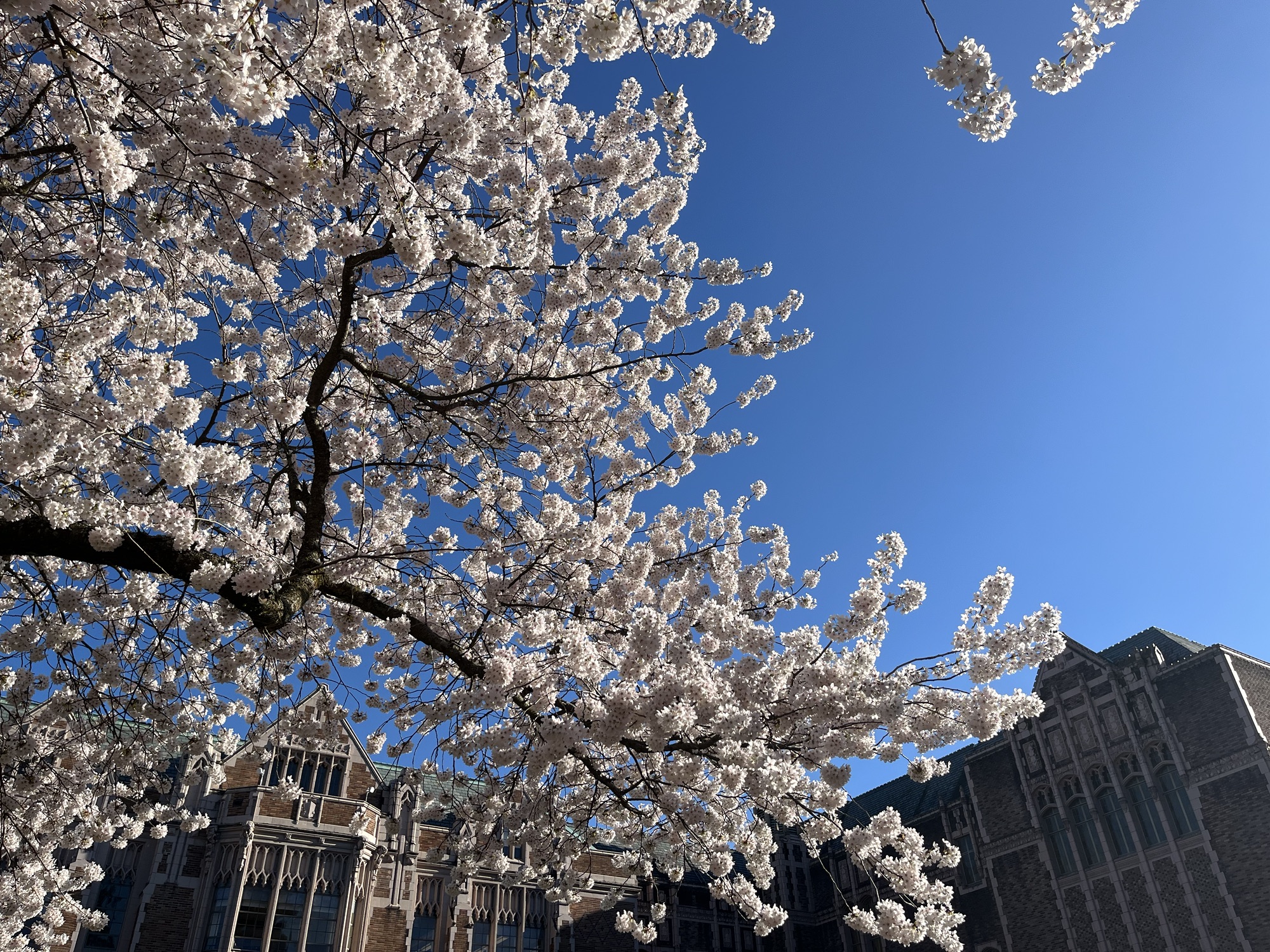
The main attraction of course is the Quad, and the Yoshino cherry trees there:

The “Yoshino” cherry tree is the most common and iconic cherry tree variety. In Japanese it is called the somei yoshino.

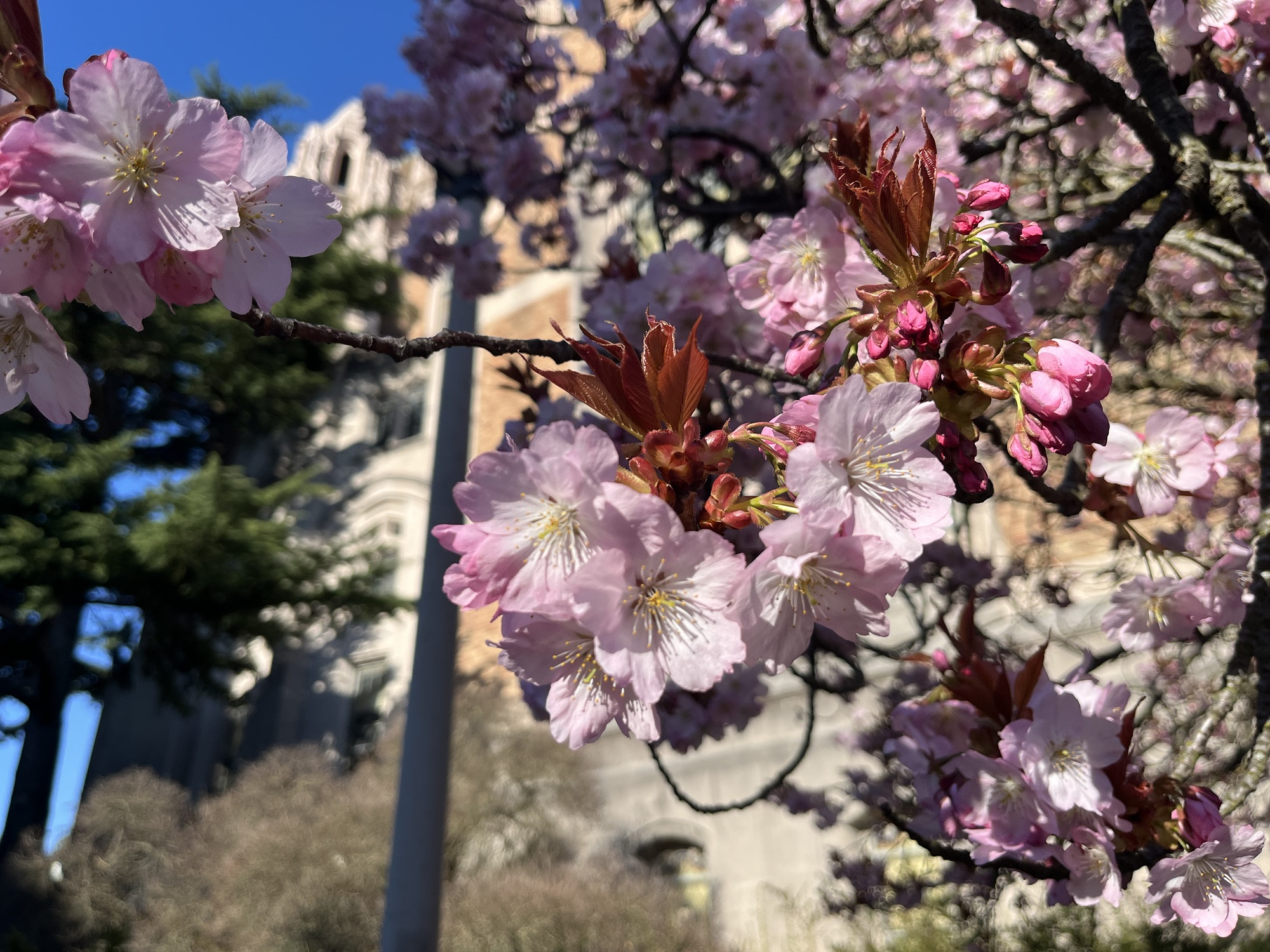
Next we moved south to see some of the varieties around Drumheller fountain. Not all varieties were in bloom yet, but we did see one called Kanzan,1 which I had never seen before. The blossoms were noticeably pinker, and had two layers of blossoms, not one.

I really liked this variety myself.

Later, we ran into some good friends who were also viewing the cherry blossoms. Since I hadn’t really been out much this past month, due to surgery recovery, it’s really nice to see some friends and socialize for a while. We later went and got some gyros at a place I used to frequent back in college.

One the way, we saw one other variety I had not seen before: a Mt Fuji Cherry tree:

I had not heard of this variety either, but it is apparently a variety of the Prunus Serrulata tree,2 and is known for it’s all white blossoms. This is probably why it got it’s name “Mount Fuji” since it matches the color of snow. In Japanese it is called the “Shirotae” variety, where shirotae is a well-known pillow word in Japanese poetry meaning something that is gleaming white.

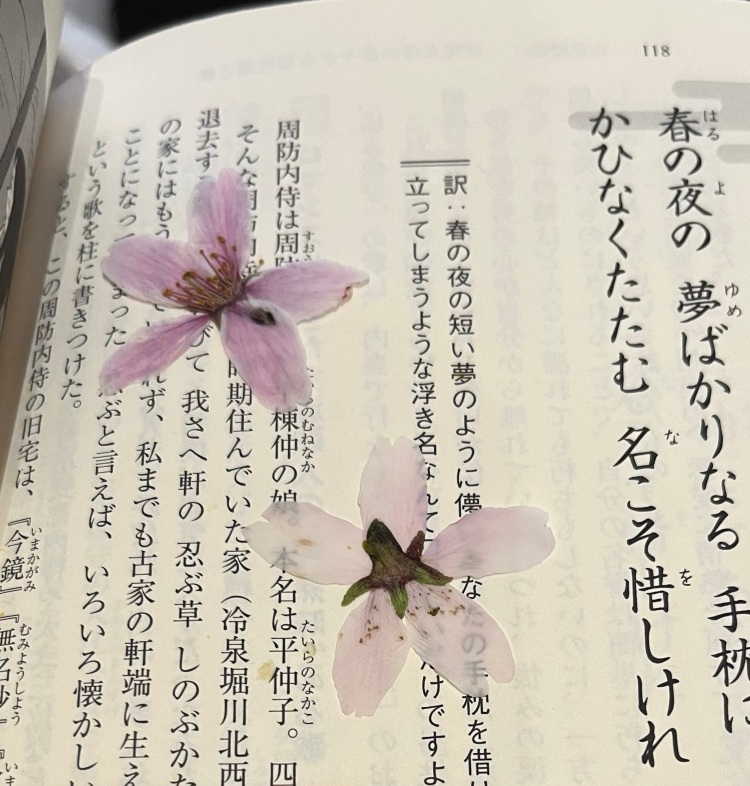
Anyhow, the weather worked out really well, and seeing old friends after a rough month really made the trip extra special. I had brought along one of my favorite books about the Hyakunin Isshu with me, and when a couple blossoms fell to the ground, I used it to press them within the pages. After a week, the pressed blossoms turned out pretty nice.

All in all, it was a memorable day, and really uplifting after a difficult month.

P.S. I know I’ve said it before, but a happy Spring Ohigan to all.

1 The UW website lists them as “Kwanzan”, but that is an older, archaic style of romanization of Japanese language. In Japanese it is definitely spelled “kanzan”. In the same way, the Bodhisattva Kannon was often spelled as “Kwannon” in older English literature.

2 The UW has another variety of Prunus Serrulata called the Shirofugen (a.k.a. Fugenzo in Japanese), but they were not in bloom when we came there.

Bad Bosses

Usually I don’t like to talk about my personal life, especially work,1 but this past week or two has been pretty rough. I’ve been working with another team on a project, and I found out recently that the manager of that project was unhappy with me, and complained to my own manager. Further, the same manager made an under-handed comment during a meeting yesterday, almost certainly aimed at me, rubbing salt on the wound.

My own manager has done his best to be supportive, but I can’t lie, getting criticized really stings, especially given all I’ve done for that team in the past.

In the last 24 hours, I went through a range of emotions: rage, revenge, quitting the job entirely, then despair because I need the job, etc. The fact is is that a steady, secure income is hard to come by these days, and as the sole bread-winner of a family, I have to be extra mindful of where I go, and sometimes have to just “suck it up” to provide for my family. I am certain I am not the only person who is in this bind, either. Each time we get up and head to work, we are forced to “sing for our bread” whether we want to or not. Capitalism sucks.

Even a Buddhist text near and dear to my heart, the Larger Sutra of Immeasurable Life2 (link and link), composed more than 2,000 years ago, touches on this:

But in this world [as opposed to the Pure Land of the Buddha] much evil is committed, and few are provided for naturally; people must work hard to get what they want. Since they intend to deceive each other, their minds are troubled, their bodies exhausted, and they drink bitterness and eat hardship.

Translation by Rev. Hisao Inagaki

So, yeah, as Office Space rightly said: work sucks, and yet we have to put up with it to survive.3

But the sting to my pride, coupled with the fact that I have to suck it up and continue to work with this person for the forseeable future makes me feel rotten. I do it for the sake of my kids and wife, but it still makes me feel rotten inside.

So, I started thinking about things like the Eight Winds of Buddhism, and the story of Hakuin the 18th century Zen master in Japan who was unfairly blamed for something but shrugged it off anyway, or the story of the tsunami and the Zen master. In each case, the lesson is to not get hung up on one’s reputation, and gain freedom in the process. This makes sense, but is a lot harder to implement in practice.

I suppose in a more Pure Land Buddhist, less Zen Buddhist context, the goodwill of Amida Buddha extends to all beings equally regardless of their character. Even if the world finds fault in you, Amida Buddha extends his goodwill nonetheless. The Eight Winds may blow this way and that, but it doesn’t matter. No need to get hung up on perfection, or criticizing yourself. In the end, you will be fine.

Namu Amida Butsu

P.S. Another thing I forgot to mention is that regardless of Buddhist sect or practice, it never hurts to stop and contemplate goodwill in Buddhism. You don’t have to like the other person, but you can extend a sense of goodwill toward them.

P.P.S. The oppressiveness of the working class isn’t necessarily limited to modern capitalist societies. Back in the Hellenistic Period of history, the Ptolemaic dynasty in Egypt was known for their oppressive bureacracy too:

1 Folks might be surprised where I currently work, but it’s definitely unrelated to my blog in every respect. Plus, it’s generally best not to mix the two.

2 This sutra is also known by various other names: the Larger Sutra, the Immeasurable Life Sutra, the Longer Sukhāvatīvyūha Sūtra, and so on. More on the Pure Land Buddhist canon here.

3 There are limits though. If someone is subject to harassment, intimidation or discrimination, that’s when the environment is simply too toxic. No amount of patience can fix that. It will erode one’s mental health. If you are in this situation, please do not think “sucking it up” will make it better. Sometimes a change in environment is the best thing you can do for yourself. At the very least, talk to someone you trust, preferably outside of work.

Isis and the Buddha: an Egyptian discovery

Recently, archaeologists have uncovered a statue of the Buddha, not in India or Asia, but in ancient Egypt! The statue, according to the Egyptian government, was uncovered as part of a temple dedicated to Isis, and crafted by a local Indian Buddhist community during the early Roman Imperial age, the Principate.

The cult of Isis was a fascinating example of religion in the Hellenistic Period, and inherited later when the Romans took over the eastern Mediterranean. During the Hellenistic Period, a period of constant political rivalries, and large movements of Greek people, and expansion of Greek culture through colonies, the old Olympian religion had increasingly proved unable to help people through difficult times. The old Olympian religion was focused on public cults in a kind of “contractual” religion where people of a city-state publicly worship a particular god, and get something out of it. For more personal needs, there just wasn’t much substance.

Thus, mystery religions such as the Cult of Demeter and others arose. These provided more personal relationships with the gods, and clearer undersetanding of the afterlife, and how one might secure a better fate than just being an empty shade wandering in Hades (cf. Homer’s Odyssey).

When the Macedonian Ptolemy family took over Egypt, they had to reform Greco-Egyptian society into something they could rule legitimately, so certain gods were reinvented or elevated. Egyptians had done this too, but the Ptolemies tapped into this and elevated two gods in particular:

  • Serapis – a kind of hybrid god based loosely on Osiris, but also Zeus.
  • Isis – Osiris’s consort.

Isis’s role in particular grew far beyond the original Egyptian religion and her cults spread across the Roman world. Her status also grew in that she wasn’t just a mother goddess, but the mother goddess: embodying wisdom, magic, maternal love and so on. Other goddess figures from disparate cults were sometimes viewed as just more manifestations of Isis. There are even

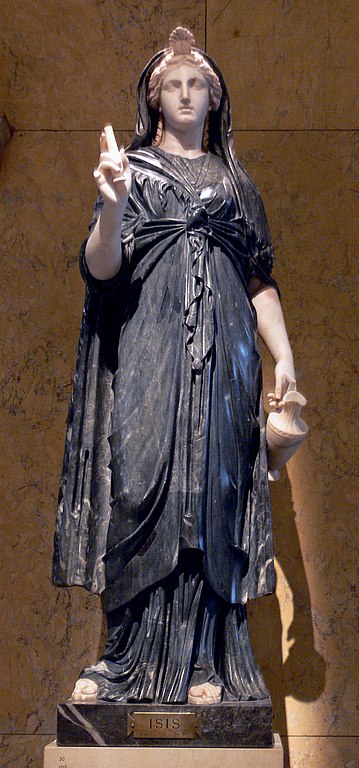
A statue of Isis, from the 2nd century CE. Photo: Andreas Praefcke, Public domain, via Wikimedia Commons

Isis’s religion wasn’t organized according to the kind of doctrine or dogma we associate with modern religions, it was still very much a form of personal, devotional worship,1 rather than an “one-size fits all” religion to explain everything. Roman society at large was still a marketplace of religions, but the religions had changed from mostly public ritual (e.g. the Olympian gods) to more internal, personal religion.

So, how does the Buddha fit into all this? That part is still being researched, but given Isis’s status as a goddess of wisdom, putting a statue of the Buddha, a figure also associated with wisdom, in her temple was probably a useful cultural prop. Indian merchants, had a trade colony in Egypt at the time, and the Buddhist religion in India reached a high-water mark at the time, so at least some of the Indian people living in Egypt would know of it, or might even be devotees.

Does that mean that there were Buddhist communities in Roman Egypt? Evidence is very scant. Even if there were, their presence was likely limited to the Indian expat community.

Still, the cultural cross-over is pretty fascinating.

P.S. This is the last post before the family and I head to Japan. When next we meet, I’ll post updates from

1 Similarly, worship of Mithra, a Zoroastrian deity imported into Roman culture, enjoyed widespread devotion among soldiers and other figures. People worshipped the god or goddess they tended to feel most affinity with.

Revisiting the Eastern Romans: the Byzantines

For some time, I have been following podcast called the History of Byzantium Podcast, which covers the lengthy history of the Eastern Romans from 5th century all the way to the fall in 1453, a thousand years later.

“Wait!” you might be wondering, “didn’t the Roman Empire fall in the 4th century to barbarian invasions?!”

Yes, and no.

The reforms of Emperor Diocletian after the Crisis of the Third Century had essentially split the Roman empire into two, smaller more manageable empires:

The small Greek town of Byzantion (Byzanitium in Latin) became increasingly important after Emperor Constantine made it his new capitol, renaming it after himself (Constatinople).

In any case, when the Roman Empire fell, it was only the Western half, which was the less prosperous, less populous half anyway. The eastern half was able to bribe or drive out the hordes, and kept going.

In fact, it kept going until 1453. Over the course of 1,000 years, it gradually changed, losing its Latin influences and becoming increasingly Greek in nature, but until the 4th Crusade, there never was a break in the Roman Empire of the East. Professor Anthony Kaldelis pointed out that Greek people continued to identify themselves as “Roman” even into 20th century during Ottoman times, and even the Ottomans referred to Greece as the Sultanate of Rûm (Rome). Historians use the term “Byzantine” to describe the Eastern Roman Empire, but Romans in the East never used this term. They called themselves “Romania” or “Rome”.

Was it even Roman anymore? Western purists would assume “no” because Rome the city wasn’t part of the empire, but even before the 4th century, Rome had ceased to be the the center of the Empire as the Western half administered things from Ravenna or other cities. Further, Latin was never technically the official language of the Roman Empire (as in, “by law”). Greek and Latin co-existed, and Greek speakers always outnumbered the Latin-speaking ones because of the influence of the earlier Hellenistic period (for example in Roman Egypt).

Alexios I, Komnenos, one of the last great Emperors of the Eastern Roman Empire. Public domain, via Wikimedia Commons

Further, the Republican aspects of the Empire kept going in Eastern half many centuries later. This concept of res publica wasn’t the same as modern English “republic” (never was), as in a specific system of government, but instead was used to describe “Rome” the polity. When the first emperor, Augustus, took over as the princeps (“first among equals”), the term res publica was still widely used to describe Rome, and kept going through the Byzantine era using the Greek equivalent politeia (πολιτεία). The Emperors during the Byzantine era were still installed and overthrown in the same way the earlier Emperors had been.

As Anthony Kaldellis demonstrates, Emperors were always subject to popular will, just as the old Republican consuls had been, and nothing really changed in the Byzantine era. Thus, the res publica of Rome was a continuous spectrum from the earliest days of the republic to the 15th century.

All this is to say that, when we speak of the “Fall of the Roman Empire”, in reality, only some of the Empire fell in the 5th century. The rest, amazingly, kept going. Constantinople was for centuries one of the largest cities in the world, and the Theodosian Walls were never thrown down until the invention of modern cannon warfare.

Like any empire, the Eastern Romans had periods of growth and decline, and as the neighbors gradually caught up in terms of technology and military skill, Constantinople’s power steadily waned. In the days of Julius Caesar, Rome was so far ahead of the Gauls and other neighbors, it was easy to steamroll them, but by the time of Alexios Komnenos, the Eastern Empire faced many complex and powerful enemies, and there’s just only so much a society can do in that scenario. As the host of the podcast explains, the chessboard was very crowded.

So, if you’d like to know more about the Eastern Romans, not Byzantines, please check out the podcast above.

Amitabha Buddha and Gandhara

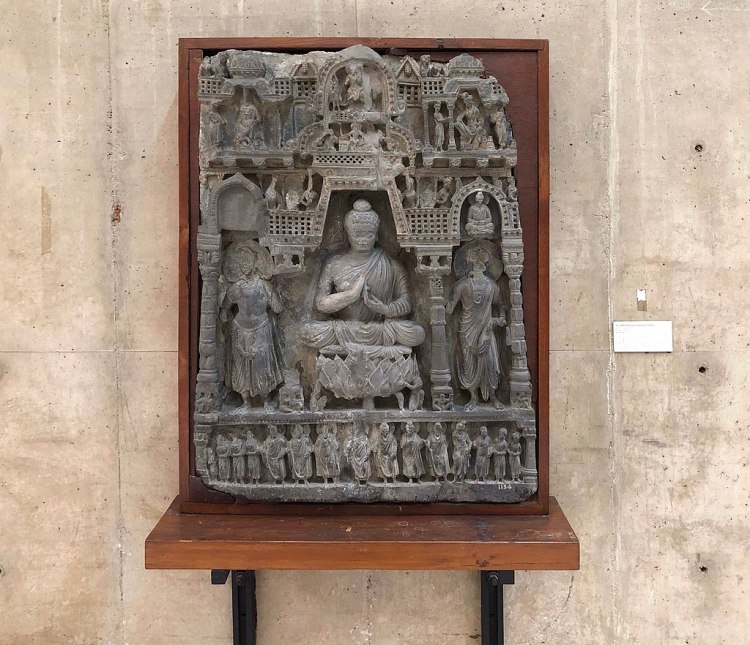
Recently, while bumbling around Wikipedia (as one does), I came upon this random but very fascinating example of Buddhist art from the Gandhara region. This is a depiction of Amitabha Buddha preaching upon a lotus throne in the Pure Land (Sukhāvatī in Sanskrit).

A 2nd-century Gandharan sculpture depicting Amitabha Buddha preaching from the Pure Land, UnpetitproleX, CC BY-SA 4.0, via Wikimedia Commons

This picture dates from the Kushan Empire, which inherited the earlier Greco-Bactrian and Indo-Greek kingdoms, who in turn arose from the empire of Alexander the Great. I’ve talked about the interaction between India and Greeks before, but the cultural interactions were even deeper than I originally hinted at. The Hellenistic Age Podcast recently posted a fascinating interview with Dr. Osmund Bopearachchi (website) that explored this cultural interaction even further. Highly recommend if you can.

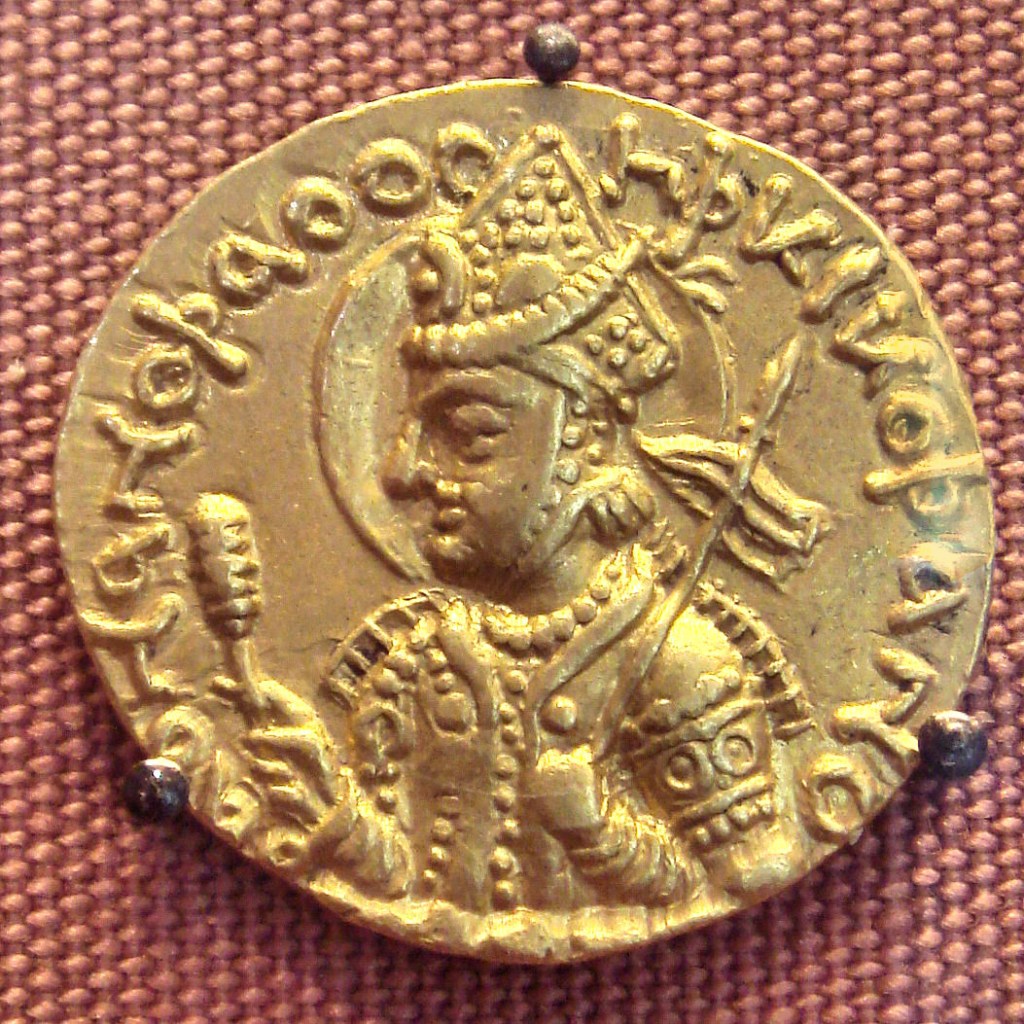
But this picture of Amitabha Buddha got me thinking about a more specific question: where does Amitabha Buddha come from? Amitabha is not mentioned in the earliest Buddhist texts at all, and the earliest statuary appears in the Kushan Empire under the reign of King Huvishka, while other artwork dates back to the Gandhara period of northwest India.

King Huvishka depicting in coinage from the era. Notice the halo behind his head. Public domain, via Wikimedia Commons

A number of interesting theories have arisen over time, some of which have been encapsulated in an essay from 1988 by Soho Machida titled Life and Light, the Infinite: A Historical and Philological Analysis of the Amida Cult. Machida points out some interesting facts:

  • No statuary of Amitabha Buddha have ever been found in India’s interior, only in northwest India.
  • Chinese monks who later visited India never mentioned Amitabha Buddha.
  • Luminosity as an Buddhist symbol is never described in early Buddhist texts, but does appear in later Mahayana ones.
  • Similarly, Buddhist statues that feature a luminous “halo”, known in Sanskrit as śiraś-cakra (Chinese: 光背), do not appear until the 1st century CE.
Late 4th-century Sasanian Persian relief of Mithra, by dynamosquito from France, CC BY-SA 2.0, via Wikimedia Commons

The people of Gandhara interacted not just with India, but also with the Scythians (who conquered the Indo-Greeks) as well as the Parthians. The Parthian Empire in particular did have a Buddhist presence, albeit small, and yet the state religion was Zoroastrianism, which frequently uses light as religious symbolism, especially in the royal symbolism of khvarenah. For example, the god Mithra, who also had a cult-following in the Roman Empire, symbolized light, justice, and the sun.

It’s conceivable that the neighboring people of Gandhara in creating new Buddhist art borrowed elements and styles from their neighbors and contemporaries:

  • from the Greek descendants of Bactria and Indo-Greek kingdoms, they learned to depicted the Buddha in an anthropromorphic way (i.e. similar to Greek statues) as Dr. Osmund Bopearachchi attests to
  • from the Parthians, they may have learned to depict wisdom, truth and compassion through the imagery of light, using the religious imagery of Zoroastrianism.
  • from India, they would have imported Buddhist teachings and concepts in an abstract sense, in addition to the literary tradition of the sutras.

If that is the case, then Amitabha Buddha represents a fusion of Indian-Buddhist thought, especially Mahayana Buddhism, with Parthian religious symbolism and Greek artistic methods.

The preamble of the Sutra of Immeasurable Life, one of the three core Pure Land sutras, depicts the gradual progression of a being to becoming a fully enlightened Buddha:

After attaining the Buddha-garland samādhi, he [the prospective bodhisattva] proclaims and expounds all the sutras. While dwelling deep in meditation, he visualizes all the innumerable Buddhas and in an instant visits every one of them. By elucidating and teaching the ultimate truth to sentient beings, he delivers them from the state of extreme pains, from the conditions in which suffering is so great as to prevent people from finding time for Buddhist practices, and also from the conditions in which suffering is not so great as to prevent them from doing so. Having attained the Tathāgata’s thorough knowledge and eloquence, he has fluent command of languages, with which he enlightens all beings. He is above all worldly affairs and his mind, always serene, dwells on the path of emancipation; this gives him complete control over all dharmas.

Translation by Rev. Hisao Inagaki

The Sutra, as one of the founding texts of Pure Land Buddhism epitomizes the path to Buddhahood, using the story of the historical Shakyamuni Buddha as the template, and through this sutra, Amitabha is clearly meant to be the epitome of Buddhas. What better way to epitomize a Buddha than to use infinite light as symbolism?

Fascinating stuff.

Update: posted some additional content I forgot add with the initial draft. Enjoy!