Forbearance

The Lotus Sutra, one of the most fundamental texts of Mahayana Buddhism, relies on a number of allegories to make its point. The last few chapters feature archetypal bodhisattvas (including Avalokitesvara) who each represent different virtues espoused in Mahayana Buddhism.

For today, we are looking at the Chapter Twenty. This chapter features a bodhisattva named Sadāparibhūta, who in Chinese was named 常不輕菩薩 (cháng bù qīng púsà), which in turn became jōfukyō bosatsu in Japanese. In English, we translate this as the Never-Disparaging Bodhisattva.

The story of Chapter Twenty is that Never-Disparaging Bodhisattva previously lived as a simple, unlettered monk during a past aeon where the Buddhist monastic community was arrogant and domineering. Nonetheless, this humble monk always bowed to other monks, nuns and laity stating that they would one day become Buddhas themselves.

As an uneducated monk making such bold statements, the other monks and nuns found him presumptuousness (I would have appreciated the compliment, personally), and assaulted him. Rather than fighting back, he would retreat and then bow toward them from a distance, still acknowledging their inherent Buddha-nature (e.g. they had the capacity to become Buddhas someday).

This continued on for years, yet the monk never got angry and continued venerating those around him. When he was finally on his deathbed though…

…he heard up in the sky fully twenty thousand, ten thousand, a million verses of the Lotus Sutra….and he was able to accept and uphold them all. Immediately he gained the kind of purity of vision and purity of the faculties of the ear, nose, tongue, body and mind….Having gained this purity of the six faculties, his life span was increased by two hundred ten million nayutas of years, and he went about widely preaching the Lotus Sutra for people.

Translation by Dr Burton Watson

The monks, nuns, and laity were astounded by the transformation reformed their ways, becoming sincere disciples. The chapter then ends in a lengthy series of “plot twists” where such and such person in that past aeon was now a disciple in Shakyamuni’s retinue, while Shakyamuni himself was originally Bodhisattva Never-Disparaging.

I say this a bit tongue-in-cheek because the narrative style of the Lotus Sutra can feel a bit forced at times to modern audiences. However, the underlying message is really profound and something I think about regularly, especially when someone really annoys me.

Chapter Twenty is all about forbearance.

This isn’t a new teaching within Buddhism. You can find many similar teachings on forbearance in older texts such as Pali Canon (example here), the Dhammapada, and also one of the Six Perfections. From the very beginning, Buddhism elevated forbearance as a crucial teaching. It is central to the concept of goodwill in Buddhism.


3. “He abused me, he struck me, he overpowered me, he robbed me.” Those who harbor such thoughts do not still their hatred.

4. “He abused me, he struck me, he overpowered me, he robbed me.” Those who do not harbor such thoughts still their hatred.

The Dhammapada, translation by Ven. Acharya Buddharakkhita

What makes the Lotus Sutra approach interesting is the use of simile and archetypal characters. Nonetheless, even in a later text like the Lotus Sutra, the message remains the same: a disciple must always practice forebearance and avoid ill-will towards others if they intend to attain a state of peace.

This is harder than it sounds, believe me.
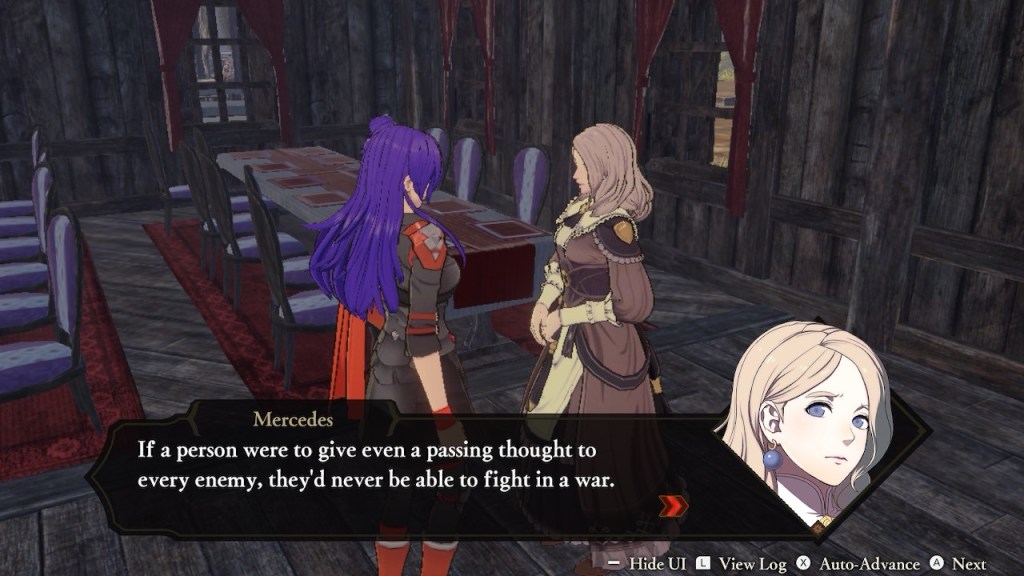
A scene from Fire Emblem: Three Hopes… Mercedes is a great character

Not too long ago, I was yelled at by a neighbor for something me (and my dog) didn’t do. It was frustrating. I tried to explain, but they didn’t listen and cursed and yelled at me. I was pretty angry, but I managed to hold my tongue and just walk away. Even now, weeks later, I am still a bit raw about it, and every time I walk past that house (which is almost daily, unfortunately), I still am a little bitter about it.

But then I have to remind myself the opening words of the Dhammapada, or the example of the Bodhisattva Never-Disparaging. Because ill-will is one of the Five Hindrances, it must be counteracted with goodwill (or at least wisdom to see why ill-will is self-destructive).

Further, because the Never-Disparaging Bodhisattva was able to practice the Buddhist path to fruition, there’s a second, related teaching that the Lotus Sutra emphasizes.

The start of the chapter talks about how those who uphold the Lotus Sutra purify their senses, and the Bodhisattva Never-Disparaging has his senses purified before his death. This “Lotus Sutra” isn’t the historical Lotus Sutra as a text, it is the deep, fundamental teaching of Buddhism that the text represents. The Bodhisattava’s unwavering conduct in the face of adversity led to his awakening to (i.e. he “heard” the teachings of) the Lotus Sutra and his senses were purified. He saw world with clarity and purity, and was this capable of teachings others.

Further, the other disciples picked up on his change. It’s not clear how or why, but there was just something “different” about him, and this metaphorical (not literal) aura was something that others around him picked up on.

You can find similar teachings in Yogacara school of Buddhism, even when it’s phrased differently. In Yogacara Buddhism, they talk about the mental feedback loop or “seeds” of the mind planting and replanting themselves through our thoughts, choices and habits. Like a pair of jeans, these seeds also give off a “scent” or “perfume” in Yogacara terms. If you wear a pair of jeans to a bar, it smells like tobacco and alcohol. If you wear a pair of jeans at a bbq, it will smell like bbq. If you wear a pair of jeans to a Buddhist temple, it will smell like incense. In the same way, one’s environment and conduct does “perfume” a person, and if one chooses the wholesome, noble path, people will eventually pick up on it. But it does require patience (shall we say _forbearance_ 😉).

Forbearance, like the other Six Perfections, is a very long-term virtue to perfect, with many setbacks, but as the Lotus Sutra shows, if carried to fruition, it is a great benefit to oneself, but also those around you.

P.S. The featured image is from Fire Emblem: Three Hopes, the successor to Three Houses. I have been enjoying this game too. The character here, Mercedes, is one of the nicest and most positive characters of the game. Also shout-out to Dorothy Elias-Fahn for her excellent voice-acting.
Ecumenism

I have been avidly playing the game Fire Emblem: Three Houses since fall of last year. Yes, the game is that good. But also the game makes you think about things too, including religion.

One of my favorite characters in the game, is the leader of the Golden Deer House, Claude von Riegan (also mentioned here and here), voiced in English by Joe Zieja. Claude’s background is unusual for the game’s cast, and he keeps his identity close to his vest, but needless to say he’s had a very worldly upbringing, and sees things different than the other students who mostly grew up in Fódlan. He is just as ambitious as Edelgard, but prefers to meet his goals in a more hands-off, less forceful way.1

Unlike most of his fellow students, who grew up within the Church of Seiros, Claude tends to be pretty cynical about Fódlan’s only religious organization, and regularly questions it (this is also important to certain elements of the plot, but that’s beside the point).

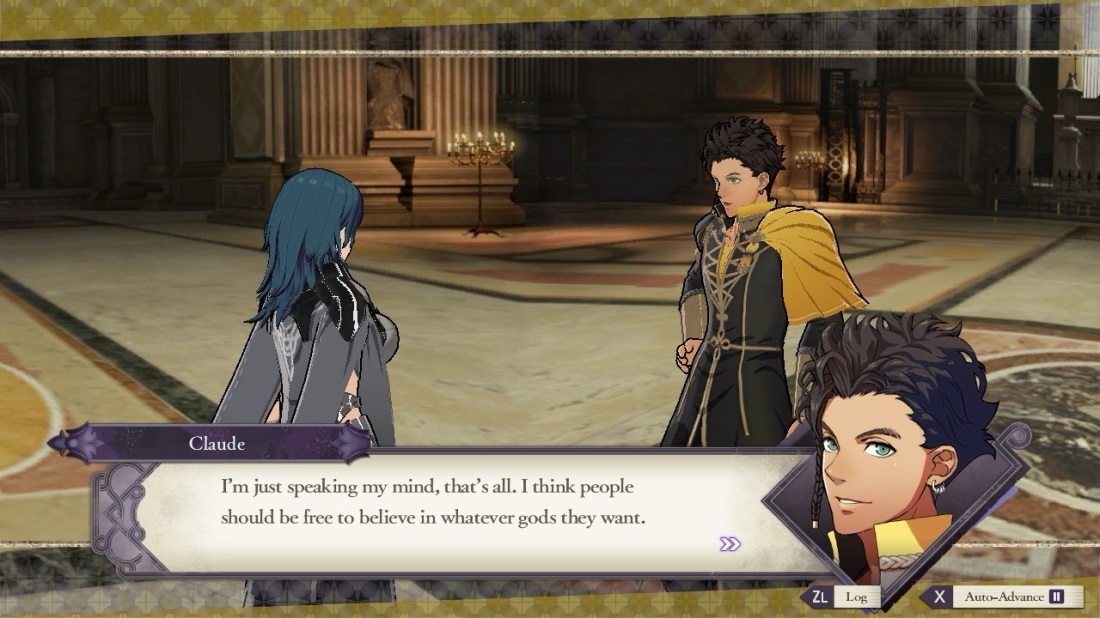
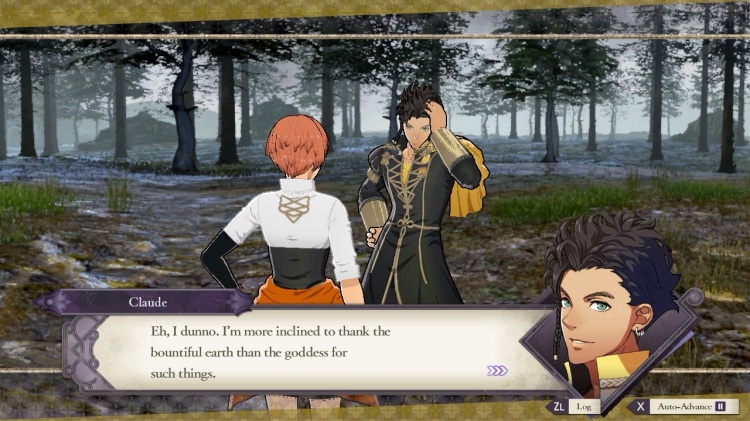
Anyhow, I wanted to share something he said that I think is worth considering (possibly out of order, I lost track of which is which):

Even though I tend to be an ardent Buddhist, I think what Claude is saying here is a healthy to look at the world and its religions. If you consider religions past and present, there have been countless gods and goddesses, rituals, liturgical languages, and so on. Even in in the same religions, practices and views diverge over time. This may offend purists, but it’s impossible to avoid, let alone manage.

Further, Buddhism has never been a particularly evangelical religion. It’s not in a race to win converts (minus a few cults), for a variety of reasons. First, this is in keeping with the Buddhist notion of metta (“goodwill”) that as long as other people have a belief system that helps them, not hinders or makes them feel bad, then that is fine. Second, the danger of imposing one’s beliefs on others is that it’s almost always fueled by ego and one’s own delusion anyway. A person’s religious beliefs, even Buddhist ones, are almost always a reflection of one’s own mind, and have to be taken with a grain of salt. Third, the Buddha clearly wanted people to take refuge in the Dharma of their own volition, and not by coercion. Even the Five Precepts are phrased as “I undertake” not as a command. Similarly with the practice of the nembutsu in Pure Land Buddhism. There’s nothing in the Buddhist canon that tells people to recite, or not recite it. It’s up to each individual to work with the tools offered in the Buddhist toolkit and apply them as best as they can. Like Claude says above, if you find a support system that works, great. This is no less true within Buddhism and its many traditions as well.

It’s generally better, and healthier for one’s own mental state, to let others be who they are, believe what they will, as long as its helpful, not harmful. The tighter one grasps, the more exhaustion and grief they inflict upon themselves, and others.

There are almost as many as variations on religious beliefs as there are people, so like the analogy of the Blind Men and the Elephant, each person is trying to feel their way through life using what resources, background and knowledge they have. Even within Buddhism, each person has their own “spin” on what the Buddha was, or what his teachings were.

It’s imperfect, but we all have to start from somewhere.

P.S. If you own a Switch, try Fire Emblem: Three Houses. 😋

1 Bit of a tangent, but of the three lords in Three Houses, I feel that Dmitri plays the role of the “conservative”, trying to restore his kingdom and the Church the way it was. Claude is the “liberal” trying to open things up and hoping it will change Fódlan, while Edelgard is the “revolutionary” who wants to change things directly (i.e. through force).

Life, It’s Complicated

Open the door
And walk away
Never give in
To the call of yesterday

Memories that made
Those days sublime
These ruined halls entomb
Stolen time….

Here in cherished halls
In peaceful days
I fear the edge of dawn
Knowing time betrays

“Edge of Dawn”, theme Song for Fire Emblem: Three Houses, YouTube

Recent events are a reminder that even when life is calm and going well, something bad can hit you square in the face like a frypan. Try as we might, this is not something we can always avoid.

In the Pali Canon, the Buddha said the following:

You shouldn’t chase after the past
or place expectations on the future.
What is past is left behind.
The future is as yet unreached.

Whatever quality is present
you clearly see right there,
right there.

Not taken in,
unshaken,
that’s how you develop the heart.

Ardently doing
what should be done today,
for — who knows? — tomorrow
death.

There is no bargaining
with Mortality & his mighty horde.

“The Sutra of the Auspicious Day” (Bhaddekaratta Sutta, MN 131), trans. by Thanissaro Bhikkhu

People who are chasing after spirituality through Yoga and self-help books will mostly fixate on just the first part, without knowing the rest. No one wants to pay money to be told life sucks, afterall.

While the world might be interconnected, and life has its beautiful moments filled with laughter, light, and love, it is also marked by pain, frustration, death, fear, frustration, strife, humiliation, and so on. People try to run away from the latter, while chasing happy moments for that “spiritual high“, but it’s all in vain. It’s like covering a pile of dog-poop with some silk. It’s just more of the mind leading the mind astray.

Simply put: life is complicated.

Mount Rainier, known locally as “Tahoma”. Photo taken by me.

Life must be faced with both eyes open, and as the sutra above says, one must train the mind not to be taken in by the highs and lows, neither to be taken in by nostalgia nor illusions of the future. Like a mountain quietly sitting, regardless of which way the winds blow, or a blade of grass that bends. For sooner or later, time betrays and the frypan of life will smack you in the face once more.

Namu Shakamuni Butsu

The Contradictions of Organized Religion

This post was inspired by a recent play-through of Fire Emblem: Three Houses and contains spoilers to the game.

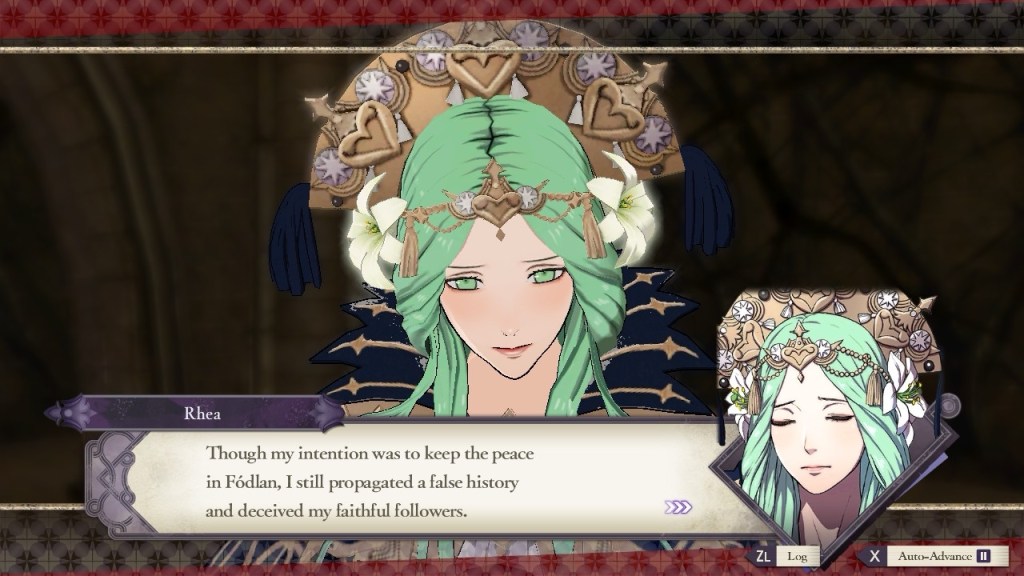
In addition to the main plot, Three Houses contains a lot of subtle side-stories and hidden lore that players discover as they explore the monastery. For example, the game strongly hints that the official history of the Church of Seiros is a fabrication used to obfuscate the real history of Lady Rhea the archbishop.

Lady Rhea doesn’t just venerate Saint Seiros (pictured above); she is Saint Seiros disguised for countless eons. The game, especially in the Silver Snow route, also reveals her divine dragon ancestry, the real source of the holy relics (remains of her siblings), and hints that other saints, namely Seteth (Saint Cichol) and Flayn (Saint Cethleann) are still alive after all these centuries, hiding their identities even as they manage the church.

Rhea/Seiros fears a repeat of a terrible massacre of her loved ones by humans centuries ago. Thus, she uses the Church to keep the peace, obfuscate the past with false narratives, suppress dissent, manipulate the governments of Fódlan, and (in a less cynical sense) gives the masses something positive to believe in: the goddess Sothis, her mother.

Rhea’s actions, like Lady Edelgard‘s, are morally grey in that they are driven by sincere desires to address the evils of society, but through questionable means.1 Good intentions lead to controversial decisions that nevertheless become church canon over the centuries.

It’s not hard to see the relevance of this toward real-world organized religions. 

Organized religion is not, of course, being manipulated by divine dragon beings (presumably). However, seeing as how church official history can obfuscate unpleasant aspects of the past, one can’t help but wonder how many such inconvenient truths that we’ll never know about have been smoothed over and polished for the sake of unity and peace.

Further, is an inconvenient truth better than a convenient lie? This answer isn’t so easy.

This is where the inherent contradictions of organized religion come into play: humans tend to manipulate and corrupt religious teachings in order to further an agenda, often with well-meaning (or at least benign) intentions. And yet, in spite of this cynical view, organized religion is necessary to preserve and carry on teachings across generations. Thus, followers often have to make the best of an awkward situation.

Everyone in their own personal religious path has to try to resolve these contradictions and try to put teachings into practice as best they can. Or, like Edelgard, throw them out completely and expose the hypocrisy. This latter choice entails conflict, and worse: the risk of simply replacing one convenient lie with another more suited to one’s preferences if they are not careful.

Anyone who says religion is easy is either wrong or trying to sell you something.

1 Further in Three Houses, Rhea and Edelgard’s intentions are irreconcilable, mutually exclusive, and in the end one of them must destroy the other, hence the tragedy of the whole story.

A Nerd Dad’s Review of Fire Emblem: Three Houses

Amidst all the posts about Japanese history and Buddhism, I had been playing Zelda: Tears of the Kingdom in my spare time, but to be honest I found the game long and tedious compared to its predecessor. Once I defeated Ganon (in mid-suavamente, no less), I was exhausted and put the game down and haven’t picked it up since.

Looking for other games to play, I realized that I had purchased Fire Emblem: Three Houses a while back and hadn’t played it. Thanks to Super Smash Brothers Ultimate, I was introduced to the Fire Emblem series (big in Japan, not as well known here), and figured I should try at least one game.

My Amiibo collection includes both Marth and Lucina from Fire Emblem, since I “main” both characters in Super Smash, plus Captain Falcon. FALCON PUUUNCH!!

I have been totally hooked on it since.

The Fire Emblem series has apparently been around a long time, famous for its turn-based strategy, and permanent death for any teammate that falls in battle. However, another side to the series is its character depth.

In Fire Emblem: Three Houses, you become a teacher of one of three classes, or “houses”. The students mainly hail from nobility from a given region of the continent, but also some commoners too. The house you choose greatly impacts the story, and if you play through again with a different house, or even different choices at key points, the story alters drastically. Further, the way the students interact with one another also grows and develops over time. You learn their backstories (often quite surprising), or their relationship with another student may change over time. You can, with a bit of effort, recruit students from other houses to join yours, further expanding the range of interactions.

It feels an awful lot like anime version of Hogwarts Castle (a la Harry Potter) at first glance, and normally anime does not interest me. However, the sheer breadth of characteres, interactions, and ways to built your team is fascinating, and the character depth is really well-written.

Even now, I can close my eyes, recall each of my students and something about them. Since I picked the Black Eagle House, I can tell you all about Linhardt, Caspar and Ferdinand, not to mention the ladies like Bernadetta, Dorothea, and Petra. Even the villainous characters are surprisingly three-dimensional, not cartoony evil.

Further, per Fire Emblem tradition, you have the option to romance characters and such, and even marry them at a later stage in the game. Many of the characters are bisexual, so regardless of what gender you pick for the hero, Byleth, romance is still an option. Some characters are openly bi which caught me by surprise, but a refreshing one.

Early in the game, I was trying to romance both Shamir (I am a sucker for tough women), and having intimate tea time with Lady Rhea at the same time. I figured that Lady Rhea was a villain early on (at least in some story lines), but it was fun to try. It’s a guilty pleasure but a fun one.

All in all, life in Garreg Mach monastery is really fun, even more so than the combat, as you can explore and interact as much as you like.

Then comes the emotional gut punch.

The story, at least through the Black Eagle House, contains some pretty shocking twists that caught me by surprise. It’s like being on a roller coaster that slowly creeps up and then suddenly the bottom drops out and it’s free fall from there. Brilliant story-telling.

There have been some very heart-warming moments thus far, and some moments or choices I made which made me feel pretty awful. I feel like there’s a hidden subtext about kids having to grow up too fast, which as a parent breaks my heart. I had to grow up too fast in my youth, and it’s hard watching kids in the game be forced to do the same, but that’s the reality of the situation as well.

I haven’t finished the first play-through yet, but I am roughly halfway and absolutely loving it, while also planning ahead toward my next play through, either through the Blue Lions or the Golden Stag house (that Claude is such a charmer).

It’s funny reviewing a game from 2019, but as someone who’s entirely new to the Fire Emblem I have been genuinely impressed with the game and the series overall. Quite honestly, I wish I had known about this sooner, but I am glad I took a chance on an unfamiliar franchise. If you own a Switch, definitely pick up the game if you can, and let me know which House you picked. 😁

P.S. Fun fact: the Japanese name for the game is ファイアーエムブレム 風花雪月 (faia enburemu fūkasetsugetsu) whereby by 風花雪月 stands for the four story lines:

  • 風 (, “wind”) – as in Verdant Wind.
  • 花 (ka, “flower”) as in Crimson Flower.
  • 雪 (setsu, “snow”) as in Silver Snow.
  • 月 (getsu, “moon”) as in Azure Moon.

Brilliant.

P.P.S. RIP Billy Kametz, voice of Ferdinand von Aegir: