Hello dear readers, and happy new year, or as they say in Japan akemashite omedetou gozaimasu!
My family and I took time off for Winter Break and are probably more exhausted now than when the break began.
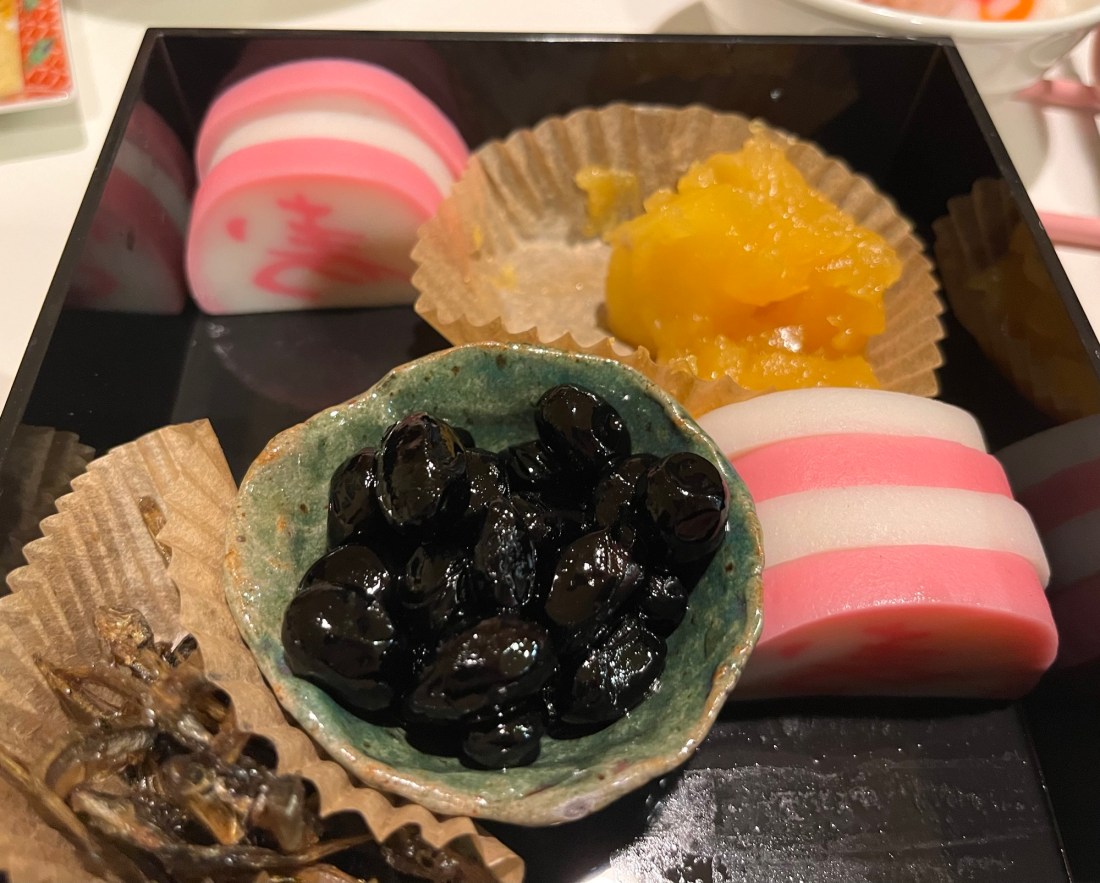
After enjoying New Year’s Eve with friends, we woke up this morning to eat Osechi (お節), which are traditional foods eaten in Japan for New Year for good luck. This is just one of many traditions found in Japanese New Year, also called oshougatsu (お正月).
I won’t list each one, but you can read here. These are foods thought to have auspicious meanings, and include things like shrimp, black beans, candied fish, chestnuts and so on. I like some more than others, but I try to have a bite of at least one of each. I like the pink and white kamaboko in particular. This year, we bought a brand that has the Chinese character 寿 (kotobuki) in it, meaning “felicitations” and such. The featured photo shows the Chinese character in reverse.
Also, in the photo above, our little ceremonial dishes feature the Seven Luck Gods too, and in the ozouni soup shown the naruto fish cakes feature Mount Fuji in front of a sunrise.
Later today, I will probably play some Karuta and then head for the local Japanese Buddhist temple for the first visit of the year, hatsumoude, and post on that soon.
Happy 2024 to everyone!
P.S. For us Star Trek fans, another thing to may be look forward to this year:
FOMO, the feeling of missing out, can happen any time, but it feels like the holidays really exacerbate this feeling.
This year my wife and I chose not to go to company holiday party. It is a 21+ event that my company hosts, and is a big social event around the workplace, but since my kids obviously can’t go, we felt that we’d rather stay home and enjoy our time as a family than leave the kids at home just so the parents could have fun.
The notion of skipping the party got some odd looks from people at work, but generally people were supportive (while obviously planning to go themselves).
But the Monday after the party, I was inundated with post-holiday party discussions, anecdotes, photos on the company social media, and so on. Even if no one intends it, it’s grating to be constantly reminded of all the fun people had while I chose to miss out.
I willingly chose to stay home and hang out with my kids, and I don’t regret that, but I also don’t enjoy the feeling that everyone else celebrated anyway without me. Selfish, but still.
This also goes for the holidays themselves. I grew up Christian, but in my teens and 20’s I left that behind1 and eventually took up the Buddhist path. For most of the year, I have no qualms about this, but then every Christmas and Easter, I feel a pang of FOMO. Maybe it’s because I grew up with Sunday school, and the old biblical stories still have a place in my heart,2 or maybe it’s because holidays just aren’t prominent in the Buddhist faith. I don’t know. But every year I miss it, then when the holiday passes, I am back to my old self.3
It feels sometimes like someone who’s exiled themselves, and looking back at everything they have missed.
But when I think about it, it’s something I willingly left behind, and am glad for doing so. From a personal growth and theological standpoint, I feel like Buddhism was much more helpful to me, even with all the twists and turns I’ve gone through over the years. It’s hard to imagine what my life would have been like if I hadn’t had the encounters I did. It’s a lonely path sometimes, especially living in the West, but I am glad I chose it.
1 I am sure someone reading this will eventually want to ask “why”, and whether I’d consider coming back. Short answer is “no”, and save your breath. That ship sailed a long time ago.
2 It’s hard to explain. It’s not something I personally believe in, I just enjoy imagining the time and place, maybe in the same way I feel about reading Tolkien or something. Or, I miss it the way I miss Christmas as depicted in the Peanuts cartoons: something that’s idyllic, but doesn’t actually exist.
3 I even picked up the Bible a couple times over the years and read through some old, familiar chapters, but they feel hollow to me now with the benefit of perspective. The Dharma is just so much deeper and meaningful to me now.
Since I started playing Fire Emblem: Three Houses, I have been continuously impressed with how well-written and relatable the cast of characters is. But there’s more to it.
Early in the story, when you first meet the other characters and students, many come off as quirky, annoying or just mean. However, as you progress in the game and get to know them through dialogues (e.g. “supports”), you learn more about why they are the way they are. Why is Dorothea such a good-digger? Why is Felix such a jerk? Why is Marianne so gloomy, Lysithea a workaholic, Sylvain a womanizer, and so on.
What you learn over time is that many of these characters, even the more stable ones, have some kind of personal trauma or persistent fear that’s driving their lives. Some characters have more crippling mental health issues, while some just hide their pain better than others.
After playing through a game like this, it’s not hard to see that many people around you are almost certainly suffering from some past traumas or persistent mental health problems. The degree or nature of that problem is different for each person, and some people hide it better than others, but I bet if you scratch the surface you will see it.
Of course, this applies to ourselves too. Past traumas, emotional pain and lingering, persistent mental habits color our behavior on a daily basis.
I grew up as the eldest son of a single mom in a conservative community in the 1980’s, and experienced plenty of bullying and ostracism as a result, while trying to grow up fast and help the family.1 I have no doubt this colors my behavior today. Seeing my grandmother dead from cancer at age 57 on the hospital bed two days after Thanksgiving in 1990 still comes back to me every November.
But there’s more to this.
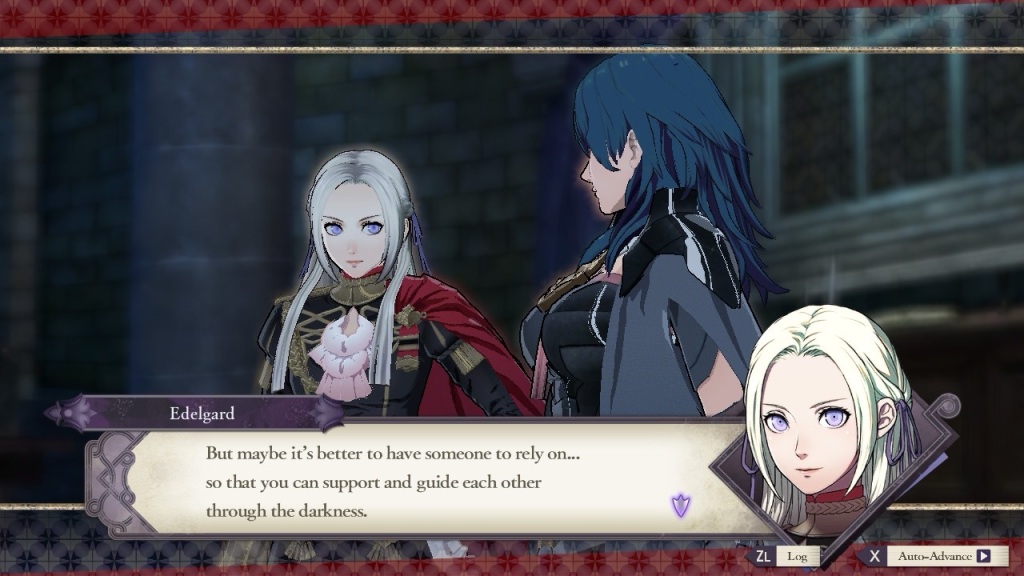
As the game progresses, and through increased interaction, many of the characters open up about their pain and trauma to others and from this they find kindred spirits, or they gain new perspectives. It doesn’t erase the past, but oftentimes it helps them find closure, or get the support they needed.
In Buddhism, we revere the Sangha (the community) as one of the three treasures, along with the Buddha (teacher) and the Dharma (the teachings). The Sangha is essential in Buddhism because people can’t do it alone. The Buddha recognized from the beginning that people need one another, and can support one another.
I love how Edelgard may appear as a villain at first glance, but then there are moments like these…
Even when the Sangha has its fair share of dickheads and scallywags, the mutual support people offer one another is part of the therapy that Buddhism offers. This isn’t limited to Buddhism, by the way; one can find solace in any religious community. My other grandmother was a devout Lutheran and would go to her local church every Sunday for many years.
It’s just that Buddhism overtly recognizes that everyone suffers from mental health problems on some level, which are given fancy terms like kleshas in Sanskrit, or bonnō in Japanese, but also that there aren’t easy solutions. It’s a long slow process, and it requires a mutual support network.
It’s scary to share one’s pain with others, or even with yourself,2 but it can really take a heavy load off you, and help provide new perspectives. You don’t have to force it either. As you spend time with others, people naturally start to open up over time. There’s no magic here, it’s just simply that people need one another, and this is how we find peace and wellbeing.
Namu Amida Butsu
1 a little bit like Jonathan Byers in Stranger Things, minus all the weird extra-dimensional stuff. Maybe. 😋
2 sometimes a personal journal or an anonymous blog can really work wonders.
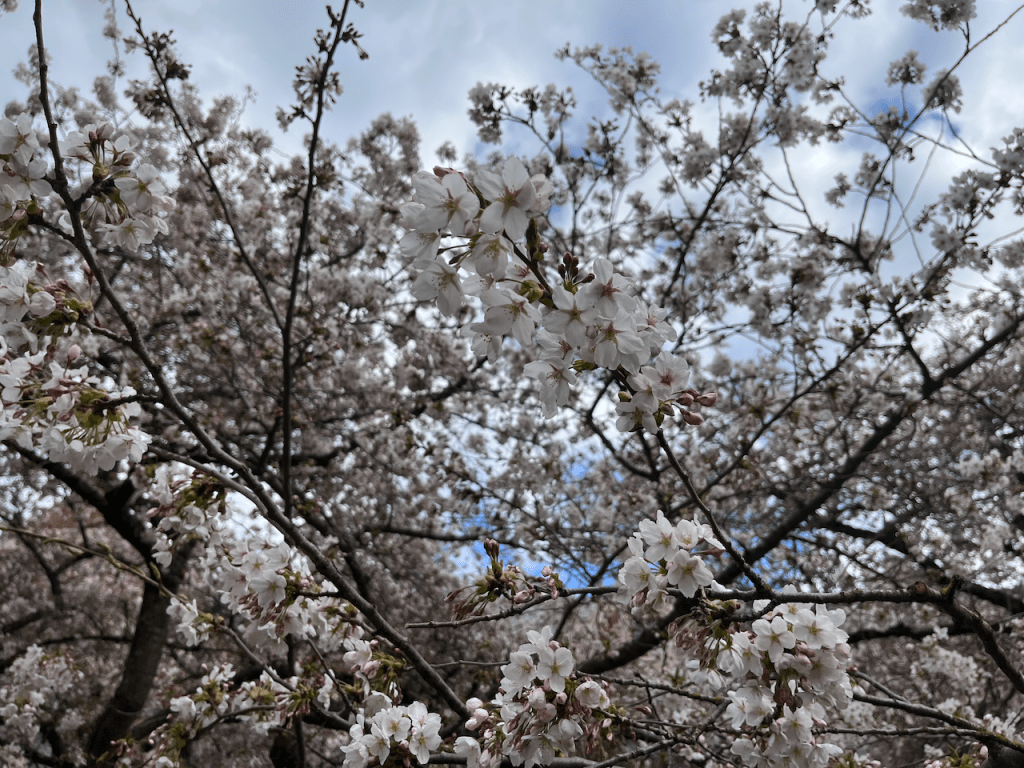
In Japan, the tradition of viewing cherry blossoms, or sakura (桜), is a very popular one. Every year, we take the kids to the University of Washington for cherry blossom viewing, called o-hanami (お花見) in Japanese.
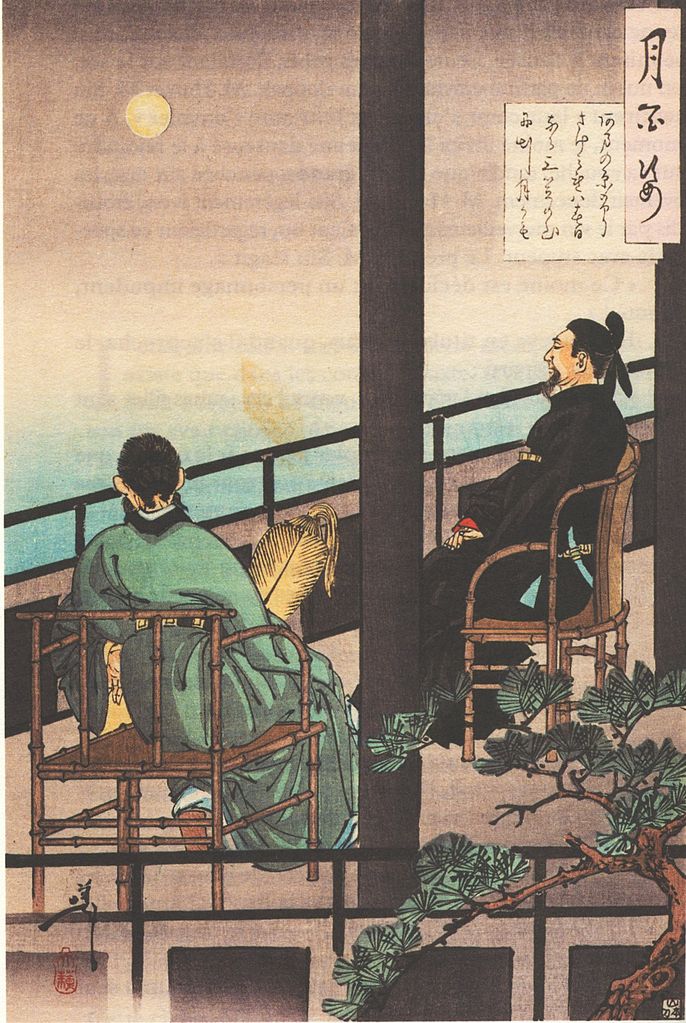
It was a very lovely time with the family. Centuries ago, the brilliant, and yet failed Shogun Ashikaga Yoshimasa (also mentioned here), once composed a poetic verse:1
We toured the cherry blossoms, took photos amidst other people, and then we headed to the library at the University of Washington, something I that brought back a lot fo memories for me:
… and finally we stopped nearby for some good ramen:3
It was a somewhat unplanned event, since we usually don’t go on a weekday, but we decided to chance it due to the weather, and like any unplanned event, we were pleasantly surprised.
As an o-hanami event, the kids had a wonderful time, and hopefully some good memories for the future.
1 According to Donald Keene, this was the hokku (発句), or opening verse, of a renga poem.
In the old Japanese calendar, based on the 24 periods of the ancient Chinese calendar, the third day of the second month is marked as risshun (立春) or the coming of Spring. Granted, it was still cold outside and flowers hadn’t really blossomed yet, but it is considered the start of the Spring season.1 It marks the time when nature is just starting to defrost, and wake up.
Among the first things that traditionally bloom are plum blossoms, such as those featured in the photo above (courtesy of Wikipedia).
One of the poems from the Hyakunin Isshu anthology, poem 35, touches upon this exciting feeling of the first blossoms of the year:
Finally, let’s talk about Setsubun. Every year we celebrate this Japanese holiday with the kids, and over time the Oni mask I use to “scare” the kids has evolved over time, including one my daughter made many years ago and was (unintentionally) a bit terrifying.
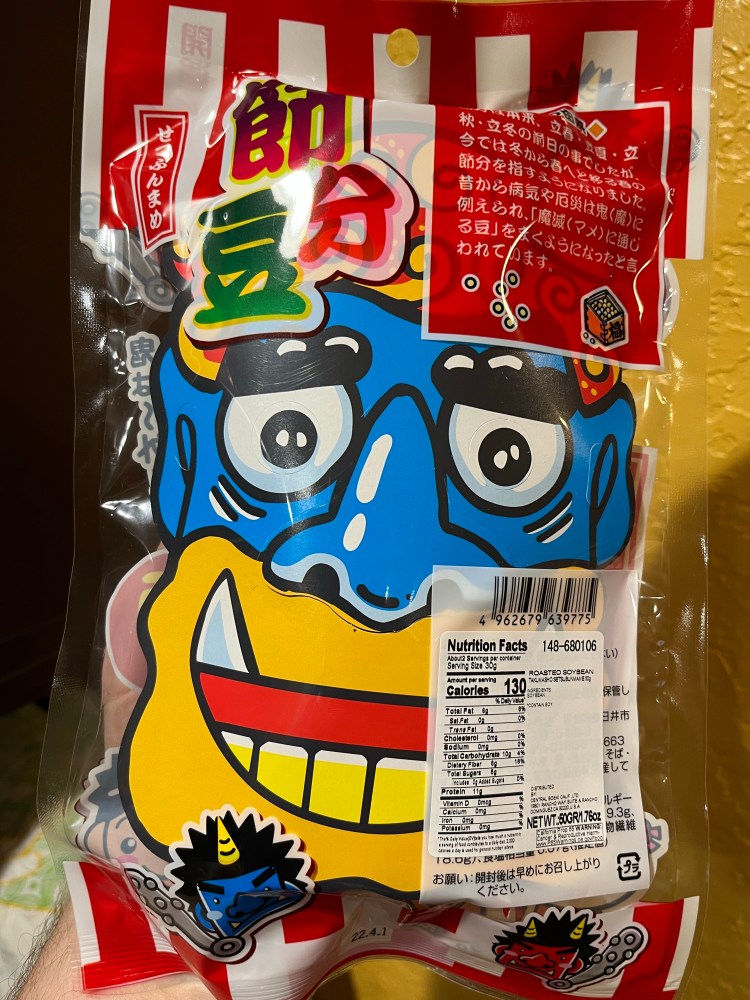
This year, we finally got a real mask rather than a homemade one:
This handy Setsubun “kit” provides the cooked soybeans that the kids throw and a nice Oni mask for me to wear. Basically everything you need for mamemaki! As mentioned in past posts, the tradition is for the dad to dress up as an Oni, a kind Japanese ogre, and knock on the door while the kids throw roasted soybeans at him to drive out bad luck and welcome in good luck for the year. Since Lunar New Year used to fall a couple days before Setsubun, this was part of the New Year tradition.
Supply of traditional goods like this from Japan vary quite a bit each year, even before the pandemic, so we were lucky to get a hold of one this year. It’s unclear if the mask will fit my big American face, but we’ll see. If I can, I’ll try to post some photos or a video.
Happy (early) Spring everyone!
1 Here in the PNW, the last day of frost is said to be March 10th, according to my gardening book. Spring comes extra late here.
It is a bit early to celebrate for folks here in the US, but in Japan it is already March 3rd, which means it is already Girl’s Day (hinamatsuri ひな祭り)!
As readers may have noticed from past posts, I have posted about certain traditional Japanese holidays, called sekku (節句). Examples included Girls Day (March 3rd), Children’s Day (May 5th), Tanabata (July 7th) and Day of the Chrysanthemum (September 9th). The last holiday on my list is actually the first on the calendar: Nanakusa (七草) which literally just means “seven grasses / herbs”. More formally it’s called jinjitsu no sekku (人日の節句, “day of the human”) as we’ll see shortly.
This holiday is surprisingly old, with origins in ancient custom in southern China whereby people would cook seven herbs as a porridge on the 7th day after the Chinese new year. It also relates to the Chinese lunar calendar, where the first seven days of the year were designated as rooster, dog, boar, sheep, ox, horse and human, the first six being animals of the zodiac. Since the seventh day was (for some reason) marked as the day of the human, criminal punishments were not executed on this day.
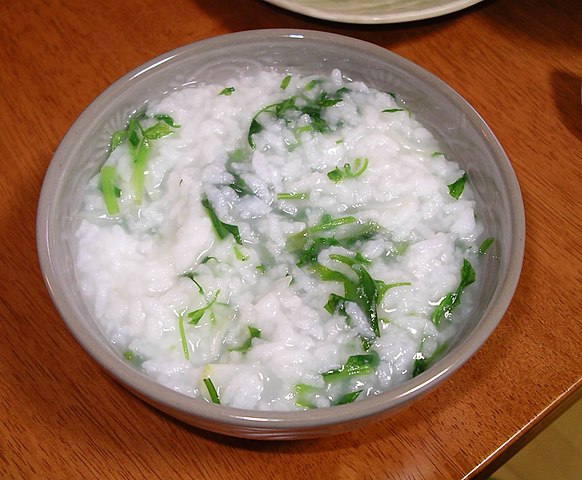
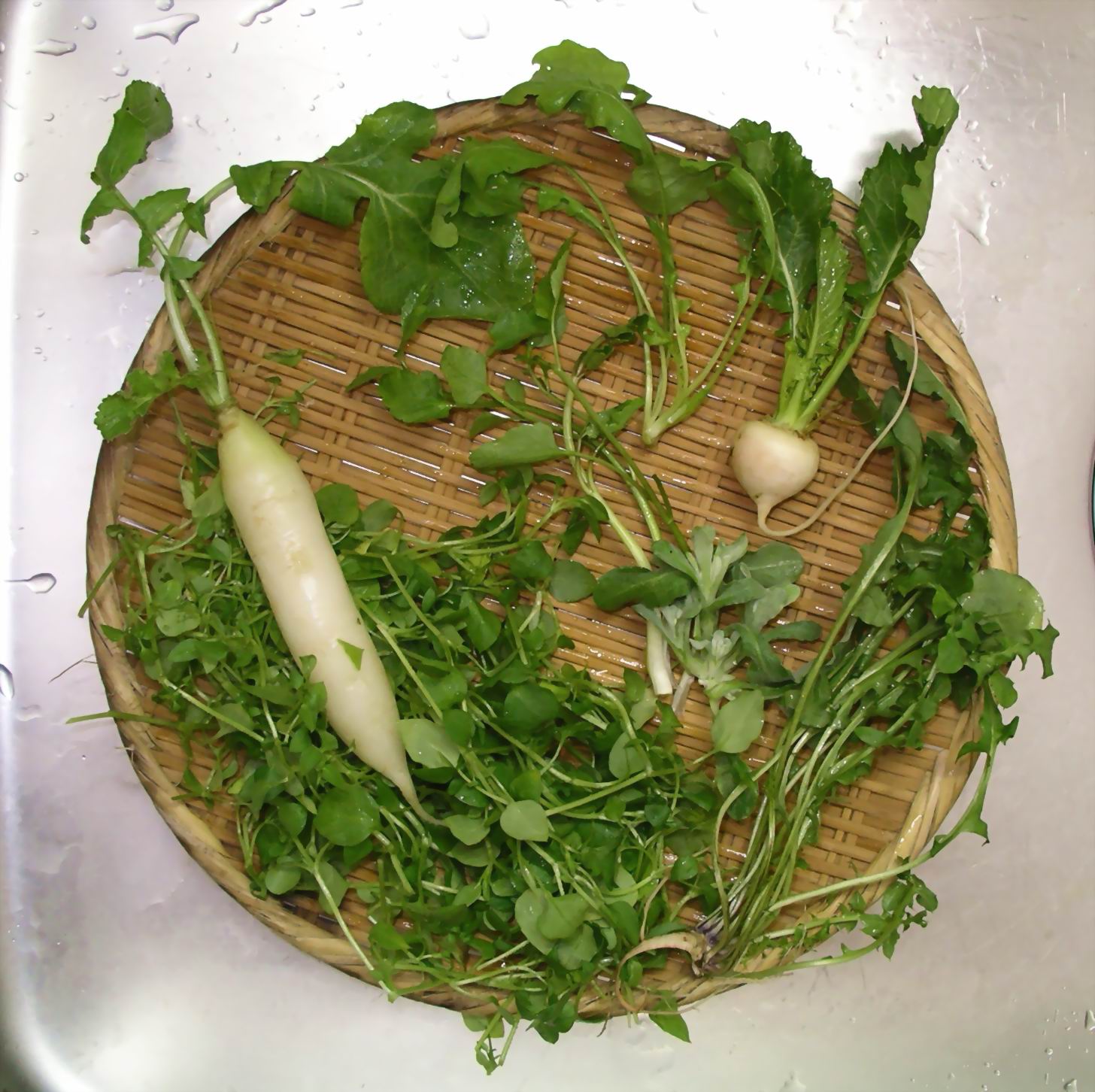
The custom of eating a seven-herb porridge carried over to Japan as nanakusa-gayu (七草がゆ), though in some households more than others. I had it once many years ago when we were first married, and visited my wife’s family home in December-January. I saw a bunch of roots and herbs in the kitchen, like the ones shown above, but didn’t give it much thought. The next day, we were served nanakusa-gayu porridge for breakfast. It has a pretty bland in taste, but that was how I learned about Nanakusa.
A bowl of rice porridge served during Nanakusa, Blue Lotus, CC BY 2.0, via Wikimedia Commons
According to the Wikipedia article, the seven herbs are:
Of these seven herbs, I’ve eaten turnips and Japanese daikon radish regularly, but the other five are pretty obscure to me. I doubt most Japanese would easily remember them off-hand either. Supposedly there is a song that is sometimes sung while facing the auspicious direction that year (same direction as for Setsubun, I suspect), but no one in my wife’s house sang it, or at least while I wasn’t around.
Edit: I found the song in a book recently:
せり Seri
なずな Nanazu
ごぎょう Gogyou
はこべら Hakobera
ほとけのざ Hotoke-no-za
すずな Suzuna
すずしろ Suzushiro
それは七草 Sore wa nanakusa (“That’s Nanakusa”)
Anyhow, that’s a look at Nanakusa. I joked with my wife if she’d make it this year, and she flatly refused. While it is a very traditional holiday, the porridge takes a lot of work, especially here in the US where the herbs might be hard to gather, and frankly isn’t great tasting. It’s a medicinal porridge more than comfort food. That said, it is a fascinating window into some very old Chinese traditions that still persist in Japan.
1 The adolescent in me giggles whenever I read this plant name. 😂
September 9th (9/9) is the last of the yearly sekku (節句) or seasonal holidays in the old Japanese calendar, and is named kiku no sekku (菊の節句) or more formally chōyō no sekku (重陽の節句). The name means something like “Day of the Chrysanthemum”, and has its origins in a similar Chinese holiday called the Double Ninth Festival. The formal name chōyō (重陽) is the more Sinified name.
Because 9 is considered a “yang” number, the double 9 (September 9th) is thought to become “yin”, and thus can bring misfortune. So, like other sekku holidays, it was thought that celebrating a holiday on this day would avert disaster. Since 9 is the highest single-digit “yang” number, the “yin” misfortune was even worse. More on this in a future post.
The holiday, as the name implies, is devoted to Chrysanthemum flowers. In Heian Period Japan (8th-11th centuries), the golden age of the Imperial court, it was commonly believed that gathering the morning dew from chrysanthemums on this day, and applied to the face would keep ladies youthful looking. For example, in the famous Pillow Book by lady of the court, Sei Shonagon, she writes:
[7] … It’s charming when a light rain begins to fall around daybreak on the ninth day of the ninth month, and there should be plenty of dew on the chrysanthemums, so that the cotton wadding that covers them is thoroughly wet, and it brings out the flowers’ scent that imbues it.
translation by Meredith McKinney
People would also consume Chrysanthemum-infused rice wine, and go on picnics too.
Chrysanthemums are a popular subject for poetry as well. Sugawara no Michizane, who was later deified as the god of learning, Tenjin, wrote the following:
Modern day celebrations during Day of the Chrysanthemum still happen at local Shinto shrines, Buddhist temples and such, but compared to more well-known sekku such as Children’s Day or Girl’s Day, September 9th is a more low-key day. As someone who likes low-stress holidays, I think the concept is pretty neat, to be honest.
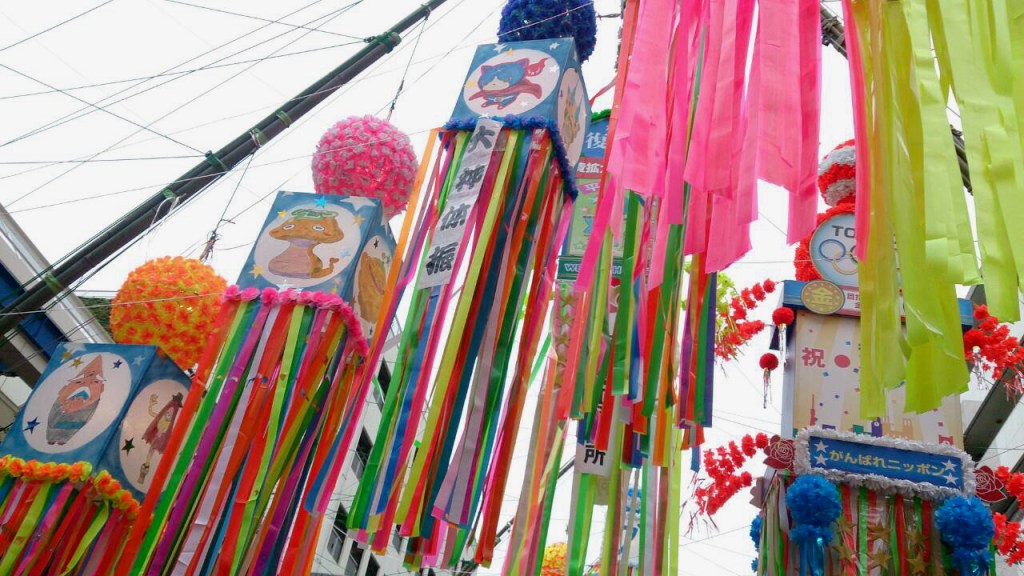
Taken at a local festival near Hiratsuka, Japan in 2015
Tanabata (七夕) is the fourth of five sekku or “seasonal” holidays that happen every year in Japan,1 and has been a big summer festival since antiquity. The origin story of Tanabata is based on a Chinese legend about two young, celestial lovers named Hikoboshi and Orihime who were later forcibly separated by Orihime’s father except for one night each year: the seventh day of the seventh month. On that day, a flock of magpies form a bridge so the two can meet for that evening. Thus, Tanabata in the modern calendar is always July 7th.
There’s even a famous poem referring to Tanabata in the ancient Hyakunin Isshu anthology:
The reference to the Magpie’s Bridge is from two places: the Imperial Palace at the time had a set of stairs called Magpie’s Bridge, but also the famous legend of Tanabata. Although the poem takes place in the dead of winter, even as far back as the 8th century, the story of the magpie bridge was culturally significant.
The story of Tanabata makes a good theme for a summer night, and not surprisingly, it’s a great excuse to get out, dress up in traditional robes (yukata) and enjoy local festivals, food and people watching. My wife and kids are usually in Japan during this time, but due to work, I tend to arrive later in July, so I often miss the Tanabata, but when I do go, it’s a good time for the family.
One popular tradition is to write one’s wishes on a small piece of paper called tanzaku (短冊)2 and hang it on a designated bamboo tree:
Sasa no ha sara-sara Nokiba ni yureru Ohoshi-sama kira-kira Kingin sunago Goshiki no tanzaku watashi ga kaita Ohoshi-sama kirakira sora kara miteru
The bamboo leaves rustle, And sway under the eaves. The stars twinkle Like gold and silver grains of sand. The five-color paper strips I have written them. The stars twinkle, Watching from above.
My wife usually only sings the first four verses if I recall correctly, but I can still hear her singing this song in my mind to our newborn kids before they go to sleep. 🥰
Anyhow, Tanabata is a nice summer holiday that young and old can enjoy, and well worth seeing if you happen to be in Japan in the summer.
I have a small fascination with calendars,1 including the traditional Japanese calendar (online example here), which has a lot of interesting cultural tidbits that aren’t obvious to Westerners.
On many Japanese calendars are small words like 大安, 仏滅, and 先勝 that repeat over and over in a cycle each month. These are known as the rokuyō (六曜) or “six days” and are related to a superstition that has persisted since the Edo Period (16th – 19th century).
Here is an old example I took many years ago at my in-laws house in Japan. I use to stare at this calendar all the time, trying to puzzle out what these words meant…
A more contemporary example here is from a calendar we got in 2025:
Prior to the early-industrial Meiji Period (late 19th century), Japan still used a lunar calendar based on the Chinese model which is now called kyūreki (旧暦) or “the old calendar”. As a lunar calendar, it had twelve months, 30 days each, to reflect the cycles of the moon. Japanese New Year thus originally coincided with Chinese New Year, though the first day of the new lunar year is now relegated to kyūshōgatsu (旧正月, “old New Year”). Modern new year is observed on January 1st instead to coincide with Western calendar.
Anyhow, since the months were all exactly 30 days, the rokuyō were six days that reflected good or bad fortune on that day, mainly related to public events like weddings, funerals, new undertakings, etc. Though, it’s thought that the six days were also used to determine one’s fortune in gambling, too. The six days are, in order are:
Japanese
Romanization
Meaning
Notes
先勝
senshō
Winning first/before
Mornings were thought to be auspicious, but afternoons unlucky.
友引
tomobiki
Pulling friends
Funerals were avoided this day, but private gathering of friends were considered OK.
先負
senbu
Losing first/before
Mornings were thought to be unlucky, but afternoons auspicious.
仏滅
butsumetsu
Death of the Buddha
Inauspicious all day. Social events avoided.
大安
taian
Great Luck
Very auspicious day.
赤口
shakkō
Red Mouth
Though 11am to 1pm was thought to be OK, the rest is dangerous, especially handling knives.
The six days simply repeat over and over throughout the old Chinese calendar, but there’s a twist:
The first day of the 1st and 7th lunar months is always 先勝 (senshō).
The first day of the 2nd and 8th lunar months is always 友引 (tomobiki).
The first day of the 3rd and 9th lunar months is always 先負 (senbu).
…and so on.
So this cycle of six days actually resets at the beginning of a new month. This leads to some interesting outcomes for certain traditional Japanese holidays, particularly the 5 seasonal holidays or sekku, some of which we’ve talked about here in the blog. For example:
Girls Day is always 大安 (taian). Girls rock, what can I say? 😎
Childrens Day (originally Boys Day) is always 先負 (senbu). Maybe boys start out awkward, but mature into their own later? 💪🏼
Tanabata (July 7th), one of my other favorite Japanese holidays, is always 先勝 (senshō). The star-crossed lovers that feature in the story of Tanabata were separated later, so perhaps they were only lucky at first. 💔 (just kidding)
Day of the Chrysanthemum (Sept. 9th, another holiday we haven’t gone over yet) is always 大安 (taian). Mathematically this makes sense since it is exactly 6 months away from Girls Day.
Further, a couple other traditional holidays such as jūgoya (十五夜, “harvest moon-viewing day”) is always 仏滅 (butsumetsu) and the lesser-known jūsanya (十三夜, “the full moon after harvest moon”) is always 先負 (senbu).
Finally, there are intercalary or “leap months” (uruuzuki, 閏月) that are inserted about every 3 years to help re-align the calendar with the seasons. Lunar cycles don’t match solar ones very well, so in antiquity, lunar calendars frequently fell out of alignment. In the case of the Japanese calendar, this is done about every 3 years after the risshun season from what I can see.
A while back before I had all this figured out, I wrote a small computer program that would execute every time I would log into my computer terminal. Sometimes, I written program this in Python language, sometimes in Ruby, and then Golang. The screenshot below is from the Ruby version which worked reasonably well:
The current incarnation I use was written in Golang language and doesn’t yet include Imperial reign name, nor leap months. I have taken the existing version and moved it to Gitlab for public usage, though it is far from complete. You can find the repo here.
Anyhow, that’s a brief look at the rokuyo in the Japanese calendar. If you’re technically-inclined, feel free to try out the program above, make improvements, send feedback, whatever.
For everyone else, the six days are a bit of a cultural relic from an earlier time in Japan, and apart from planning weddings and funerals, most people give it no real thought. Me? I like to check it from time to time and see if my day’s experiences matched the day’s fortune (spoiler: it usually doesn’t).
Edit: turns out my Ruby code had a silly bug in it all these years. It is now fixed.
Edit 2: turns out 2023 in the Chinese lunar calendar had a leapmonth, which throws off this entire script. I hadn’t expected this. Will think about this for a while and try to solve for leap months too.
1 Historia Civilis has a fun video on Youtube about the origin of the Julian Calendar and why 44 BCE was the “longest” year in history.
2 The idea of the Buddha’s death and the concept of Nirvana (lit. “unbinding”) is a lengthy subject in Buddhism. Enjoy!













 Gleanings in Buddha-Fields


.jpg)
You must be logged in to post a comment.