What’s Your Alignment?

Dungeons and Dragons, in its 40-year history, has many things it is famous for and many influential mechanics. One of the most memorable is alignment. Characters are defined in part by their moral outlook and are inclined certain actions as a result.

There are many interpretations of how alignment works and how strictly one should follow their alignment. To some degree it depends on the adventure and the DM’s discretion,1 but if we accept that alignment serves as a personal ideal to strive for, then loosely defined, alignment is a 3×3 grid consisting of these axes:

  • lawful – order
  • chaotic – freedom
  • evil – self/ego
  • good – other

Arranged like so:

Lawful
Good Lawful Good Lawful Neutral Lawful Evil Evil
Neutral Good True Neutral Neutral Evil
Chaotic Good Chaotic Neutral Chaotic Evil
Chaotic

So, a chaotic-good person is someone who values personal freedom, and doing good for others. By contrast, a lawful-evil person is someone who values order and tradition, primarily for their own benefit. True Neutral is someone who is probably hesitant or unwilling to make a strong stand one way or another.

I think the key to making a successful choice for alignment for your D&D character is to answer the question: what is my character’s ideal lifestyle, and which alignment best fits it? A character whose ideal life is high-adventure and getting rich might be chaotic neutral, while a character whose ideal is a life of honor and serving the greater good might be lawful-good, and so on.

While this is just a rough guide, hopefully it will help you make informed decisions about character alignment and how to make the most of it when fleshing out a character from being just a collection of stats into something more memorable. 🙂

1 Recently, I had a heated discussion with a new player why they couldn’t have a chaotic-evil character in my new campaign. Aside from the fact she wanted to just be contrarian, and just learned the rules, my concern was how much it would affect the other party members (many of the similarly new) and ruin their experience. basically, it came down to me telling her she could do chaotic-neutral (or chaotic-good) or nothing.


What’s up with Barkskin in D&D?

brown tree trunk
Photo by Michael Morse on Pexels.com

Barkskin is a spell in Dungeons and Dragons 5th edition, which my Elf Nature cleric automatically gets, and every time I look up this spell I kind of scratch my head.  The current online text states:

You touch a willing creature. Until the spell ends, the target’s skin has a rough, bark-like appearance, and the target’s AC can’t be less than 16, regardless of what kind of armor it is wearing.

Normally, your character’s starting armor class (AC) is 10 + dexterity bonus + armor bonuses.  My current elf cleric has an AC of 17:

  • Starting AC of 10
  • Dexterity bonus of +2
  • Armor bonus +2 with shield
  • Armor bonus +3 with chain shirt

Now, if my cleric casts Barkskin on himself, what would happen?

The official D&D rules site, has a ruling to this question (link here):

Q: How does barkskin work with shields, cover, and other modifiers to AC?
A: Barkskin specifies that your AC can’t be lower than 16 while you are affected by the spell. This means you effectively ignore any modifiers to your AC—including your Dexterity modifier, your armor, a shield, and cover—unless your AC is higher than 16. For example, if your AC is normally 14, it’s 16 while barkskin is on you. If your AC is 15 and you have half cover, your AC is 17; barkskin isn’t relevant in this case, because your AC is now higher than 16.

The gist of this answer seems to be: if the recipient’s AC is lower than 16 (no matter how or why), it’s now 16.  Full stop.  If the recipient’s AC is 16 or higher, Barkskin basically does nothing.

So with my current setup, Barkskin isn’t very useful for my cleric.  Nature clerics are proficient in everything up to heavy armor, so I can easily equip myself with the necessary defense without relying on a spell slot every combat.  However, Barkskin might be useful in protecting other members of my party who aren’t so lucky.  Wizards, for example, can’t use armor at all (apart from edge-cases like Bracers of Defense), other less melee-oriented classes also make good targets for Barkskin.  But casting Barkskin on your primary melee character basically does nothing.

Barkskin seems like a good way to shore up party defenses, but not necessarily enhance them.

Exploring the Feywild

photo of a pathway in a forest
Photo by Artem Saranin on Pexels.com

Dungeons and Dragons has many different planes and places to explore, but one of my personal favorite is the Feywild. D&D Beyond has a terrific article on the Feywild and this is a good starting point, I think.

If the Shadowfell is bleak and dreary and full of inertia, the Feywild is basically the opposite. It is teeming with life, passion and change. So much so, that it can be genuinely dangerous or downright maddening to players not native to that plane. Even time behaves inconsistently in the Feywild.

Further, fey creatures tend to divide along either “Seelie” or “Unseelie”. Seelie Fey tend to be loyal to some degree or another with Queen Titania of the Summer Court, while the Unseelie tend to be loyal to the Queen of Air. The Seelie Fey typically are “good” while the Unseelie are seen as “evil”, but from what I can tell, these lines can be somewhat blurred. Because fey such as the Eladrin, can be so passionate, this might lead them to do some terrible deed even if they are otherwise good-aligned. Similarly, a dark Fey power may be swayed into helping a party for some reason.

Anyhow, a while back, my daughter’s campaign took an unexpected detour into the Feywild. What started as a minor side-quest turned into a major adventure in its own right after her party stumbled into a portal into the Feywild, and after exploring a bit came to the court of a powerful Unseelie Fey who put them through a lengthy trial. Eventually, they made their way to a large town mostly populated by satyrs who loved to revel so much that their town frequently burned down. They also came across a haunted cornfield and an old murder that was loosely based on this excellent adventure from D&D Beyond.

With the constant upheaval, exotic places, unexpected attacks from various Fey creatures in the forest and dealing with the time-displacement, the party was all too happy to finally get back into the Prime Material Plane several episodes later.

Looking back, the biggest challenge I found was coming up with enough Fey creatures. Luckily I had old copies of Dragon Magazine and old Monster Manuals to help fill in gaps for creatures that are fey and should be in there (but for which have not been ported into 5th edition D&D). Of course, as with any D&D adventure, you can also just make your own based on existing stats.

But if I had to do it all over, I would definitely make an adventure in the Feywild again. While there isn’t a lot of material on the Feywild (the Dungeon Master’s Guide and Mordenkainen’s Tome of Foes seem to be the best resources), the general principles of the Feywild were enough to make a solid adventure and really spark the imagination in the players.

Good luck and happy adventuring! 🙂

Using Tarokka Decks in Dungeons and Dragons

Photo by Alina Vilchenko on Pexels.com

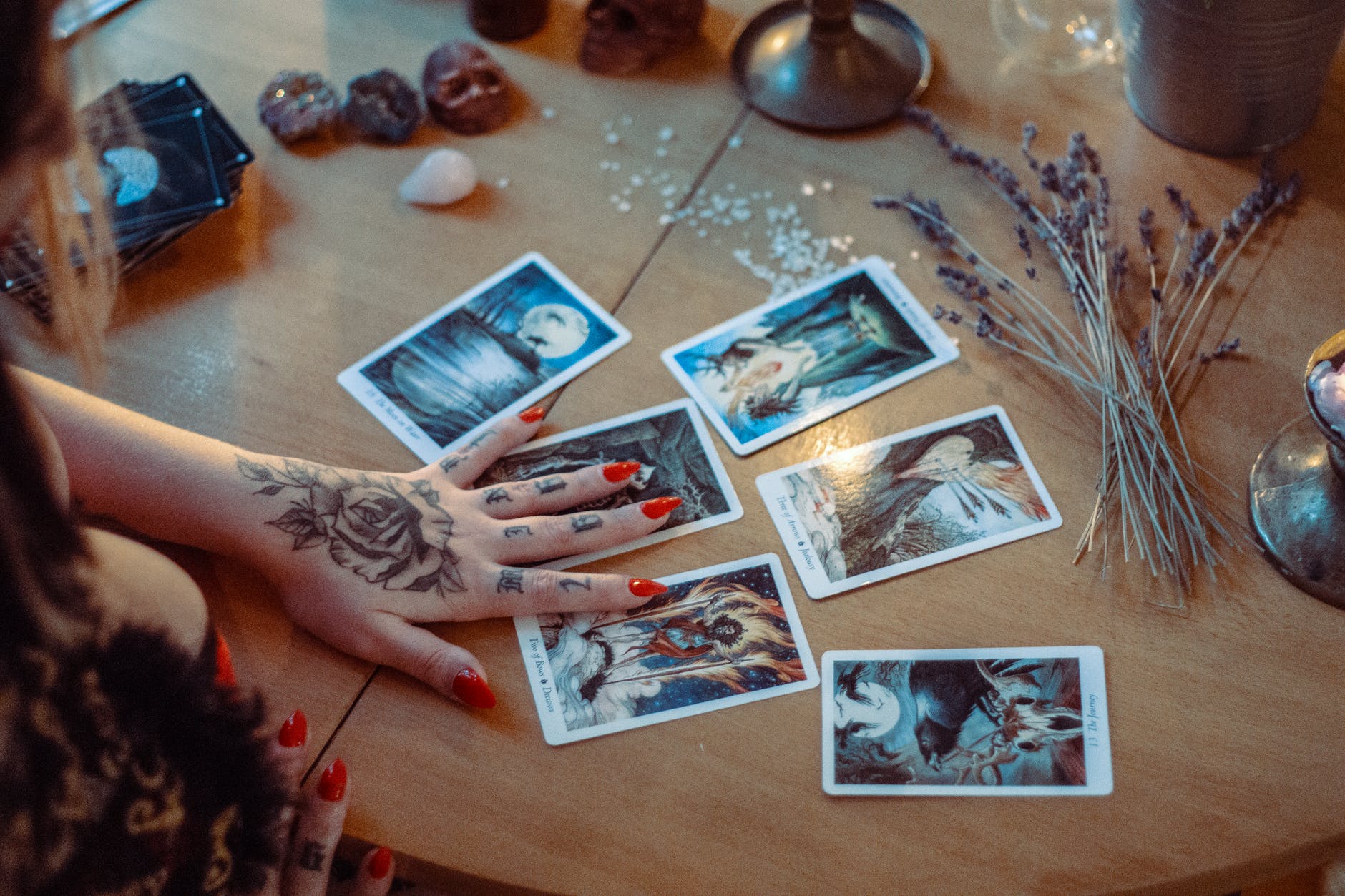
Recently, my daughter’s D&D campaign had concluded a year-long story, and after taking a few weeks off to do other things, we started it back up recently with a new story.  This time I was struggling to decide what kind of story I wanted to do for her, so I decided to let the Fates decide using a Tarokka Deck from the Curse of Strahd adventure.¹

The Tarokka Deck is an in-game prop that looks similar to a Tarot deck, but is more thematic to the adventure.  It can also be used to play a card game (rules included in the package).  The Curse of Strahd adventure guide provides some rules about how to use a Tarokka Deck as a way of telling fortunes for the players, but really this is just a way to randomize certain points of the campaign so it’s a different adventure each time.

I wanted to do something similar for my daughter’s campaign so I created an adventure hook where she encountered some itinerant Vistani² at a nearby encampment, and she had her fortune told by the elder Vistani matriarch as a kind of friendly, good-will gesture.

I adapted the ritual outlined in Curse of Strahd and laid out the cards like so:

  1. left card (from the main deck) – the character’s past
  2. top card (from the main deck) – the character’s current situation
  3. right card (from the main deck) – something in the near future
  4. bottom card (from the separate high-card deck) – something the character wants
  5. middle card (from the separate, high-card deck) – the outcome

My daughter did all that and came up with a “fortune” that … with some creative interpretation on my part, managed to build a cohesive history of the character, and a basic outline of her next adventure.  It worked well because it was a fun, mildly spooky moment, and unbeknownst to her, it let me generate a skeleton framework for her next campaign and allow me to fill in the rest later.

Even if you don’t own the Tarokka Deck, Curse of Strahd and other resources show how to make your own “deck” using a normal pack of playing cards and mapping the suit and number to the same cards in Tarokka.  From there, you just need to drum up an elaborate ritual to “tell the party’s fortune” and let them basically pick their new adventure.  😀

¹ I own both but haven’t actually been able to use either one for their intended purpose yet.  The Curse of Strahd is much too dark of an adventure for my daughter’s campaign, so I am saving it for other adult campaigns in the future.

² Vistani in Dungeons and Dragons are a bit of a awkward subject due to their stereotyping of real life Romani people, but at the same time they fulfill an interesting niche in Dungeons and Dragons lore.  I tried to paint a more positive image of the Vistani from what I knew of Romani culture (emphasize Indian heritage, deemphasize negative stereotypes) while maintaining an aura of mystery thanks to the Vistani’s planar-travelling ability.  I hope it worked.

D&D: Nature Clerics Are Fun

gray bridge and trees
Photo by Martin Damboldt on Pexels.com

Since I play Dungeons and Dragons (5th edition) with my two kids, I also make up some additional characters to help bolster their team.  My current favorite is an Wood-Elf Cleric with Nature Domain.

Maybe this is a reflection of real life, but I have often enjoyed playing clerics in Dungeons and Dragons, and if I combine this with my fascination with Tolkein’s elves it was a no-brainer for me, except for one thing: what cleric domain to play?

Elf Deities are numerous, and each one reflects certain domains you can play.  Corellon is a good default choice and covers many good domains to play, and Sehanine covers some other interesting domains that are otherwise overlooked such as Knowledge.  But this time around, I really felt like playing Nature domain instead, so I made my character a priest of Rillifane instead.  Being a wood-elf, this made even more sense.

Nature-domain clerics sometimes get confused with Druids and are often criticized as such.  There was no clear answer online about what the actual difference would be between a nature-domain cleric vs. a druid, but it seems to come down to a couple points:

  1. Clerics derive their power from the divine.  Druids directly from nature.
  2. Clerics serve a higher-power (i.e. emissary of said deity), while Druids are more like sages who explore the mysteries of nature.

The choices partly come down to role-playing “flavor”, but there are some mechanical differences too.

Nature-domain cleric have all the fun of a typical D&D cleric (life gain spells, blessings and still solid melee) combined with the fun flavor of Nature domain.  Unlike a Druid, they also take advantage of Channel Divinity and other things you’d expect from a cleric.  The spells included with Nature Domain are more like utility spells; your nature cleric may not be a one-man wrecking crew, but it does mean you can do wacky, unconventional things like befriending a giant spider rather than outright killing it.1

In any case, part of the fun of D&D is exploring different character ideas and not getting bogged down in purely combat-oriented ideas or which class is better.  After all, there is a great variety of people in real life from a variety of backgrounds, so there’s no reason that D&D can’t reflect the same. 🍃🍄🌸🌻

1 True story, in one adventure, where the party was attacked by giant frogs, I was able to use the Animal Friendship spell to convince the frogs not to eat us, and therefore leave. It was a nice moment of role-playing and reinforces the idea that not all battles in D&D need be fought to the death.

New D&D Adventure: Ghosts of Saltmarsh

I was excited by today’s news:

Coincidentally, I have been hosting a campaign for my daughter, which started in the famous city of Waterdeep, but has moved to the high seas after she got run out of town by the Zhentarim.

Playing a high-seas adventure is surprisingly fun, but I don’t have a lot of material to work with so I am really looking forward to see what WotC has to offer. 🙂

P.S. Waterdeep: Dragon Heist is a terrific adventure book. It really expands on the city of Waterdeep and provides lots of possible adventures.