A Nerd Dad’s Review of Tasha’s Cauldron of Everything

Late last year, I picked up a copy of Tasha’s Cauldron of Everything, but with so much going on, I never got a chance to properly read through the book until last month (one year later 🤦🏽), which I now regret. What an excellent addition to the D&D canon.

Tasha, also known as Iggwilv, is a famous “witch” (more correctly an archmage) known as the Witch Queen in some sources. She is more of a chaotic character than the somewhat stodgy Mordenkainen, both her colleague and rival, and she has been known to consort with some demonic characters, but is not portrayed as evil either. One could draw some parallels with Liliana the planeswalker character from the Magic The Gathering series, but Tasha has a much longer history in the gaming world.1

The book is written from her perspective, and has some witty anecdotes from Tasha, and terrific artwork of Tasha herself. Mordenkainen never looked that good in heels. 😋

When I first bought the book, I wasn’t sure what to expect, apart from it seeming like a kind of “rules update” or reboot of some aspects of original Player’s Handbook. The book states off the bat that all the rules contained therein are entirely optional and meant to enhance the 5th-edition D&D experience, while also addressing some shortcomings with certain classes (rangers for example) or outmoded racial-character designs. But again, they are all optional.

Tasha’s focuses on four main areas, I feel:

  • Optional class options.
  • Spells and Magic items.
  • Additional tips and tools for world-building, including group patron options.
  • Custom background and character creation options

The first section struck me as the most immediately useful. My daughter, when she first played with me years ago, had a half-elf ranger with a beast master archetype. She loved that character, and her cougar companion, but as the adventures became more and more difficult, it was hard for her companion to keep up. This happened back before I (as the DM) knew about alternate house rules and such, so we played pretty closely to the book. Although she loved her animal companion, she couldn’t risk bringing it on adventures anymore, so she would often leave it in the care of NPCs and go off by herself.

But, using the new Tasha’s optional class features, the same animal companion gets a much needed improvement (as well as the rules for how to use it), and it properly scales with the character class.

In separate example, my elven forge cleric has Channel Divinity options that are seldom used in Adventurer’s League settings. Now, with the new Tasha’s options, I can choose to exercise that Channel Divinity option and regain spell slots (something clerics couldn’t previously do). Thus, he can stay on par with his wizard and druid party companions.

I also went back and made similar updates for my son’s Eberron halfling bard character, by allowing him to take some spell options he didn’t have previously through the Player’s Handbook. He enjoys his new Enlarge/Reduce spell.

For each character class, the optional updates from Tasha’s fall into two general types:

  1. Options that replace older, less desirable class features.
  2. Expanded options that you can chose to add alongside whatever you’re already playing.

The flexibility here is great, and works with D&D Beyond if you have purchased your book that way. Simply enable one or both of these options on the first page of your character creation:

I haven’t delved much into the magic items and spells, but I have seen a number of colleagues use them in Adventurer’s League games and my play-by-post group, and they seem pretty useful. The “summon” spells for each type of monster: celestial, fey, fiend, undead, etc. all seem pretty intriguing, and address some of the existing challenges of the classic summon spells. Other spells, like Tasha’s Mind Whip help fill a gap by allow more psychic magic options while staying roughly on par with other similar spells.

The custom background options in Tasha’s are also surprisingly useful in that they allow you to convert features of one background into another one using a simple conversion chart. This helps, for example, with my aforementioned elven forge cleric he may not necessarily spend his time in the woods, but perhaps in a more urbanized setting, so using a longbow seems a bit out of place for him, but perhaps a crossbow might. This gives plenty of options to customize the character the way you want, without negatively impacting the mechanics of the game or affecting character balancing.

All in all, Tasha’s Cauldron of Everything, just like the re-introduction of Tasha herself, gives 5th-edition Dungeons and Dragons a much needed breath of fresh air. I would be hesitant to call this 5.5th edition, but if heavily adopted, it does provide some far-reaching changes to a particular table. The flexibility of allowing DMs and players to adopt and implement the rules on an a la cart basis is an effective way to keep the classic look-and-feel of 5th edition, but also make updates where groups would like to see them. One can think of Tasha’s as an officially sanctioned set of house rules.

Having tried out the new rules, rather belatedly, my kids and I found some of them pretty handy, and look forward to trying other ones as the opportunities come up. Tasha is a welcome addition to the Dungeons and Dragons “Core Rulebooks”.

1 The trope of the independent, confident woman as a “bad girl” is kind of annoying in a way, and not limited to class TTRPG fantasy settings. You see it a lot in anime too. I won’t go into why I think it’s so prevalent, but suffice to say it’s nice to see women in fantasy settings standing on their own two feet, deciding their own fates and getting some representation. Tasha as a character still has a lot of baggage from older D&D versions and tropes, but it’s cool to see her get some updates as well.
The Return of Heian Amakiiro

A while back, I posted about an elf-samurai character concept I created for Dungeons and Dragons, and from this character concept I created a character for Adventurer’s League named Heian Amakiiro (character sheet here). His backstory was based on my own Hamato Island series of adventures. After playing several adventures in Adventurer’s League, I wanted to share some experiences.

As of writing, Heian has reached level 8, and participated in 6 modules, plus 2 DM rewards I got from running adventures for others.

Not surprisingly, the way I expected to play Heian and the way I actually played Heian turned out to be different. I originally wanted a samurai who was more or less capable of both strength-based melee combat (with a katana longsword) and archery. To help with this, I did a magic item trade in Adventurers League to get Gauntlets of Ogre Strength. That way, I was free to focus on developing his dexterity.

But in reality, Heian rarely ever used melee combat. That’s because I kind of stumbled upon a neat trick that made his archery pretty powerful.

At fourth level I took the feat Elven Accuracy. When paired with the samurai sub-archetype and its Fighting Spirit ability this gave me a handy combination. I use Fighting Spirit to give myself advantage on attacks, and with Elven Accuracy, I can re-roll one of those attack dice. This means when I use the two together, I am effectively rolling 3d20.

Further, at level 6, I took another feat, Sharpshooter, since with an effective attack roll of 3d20, I can safely risk taking a -5 attack bonus to hit for +10 damage.

In a recent tier-2 adventure fighting a Hezrou demon, Heian had a round where he attacked 4 times (two attacks + Fighter’s Second Wind ability) and with the combination above hit 3 out of 4 times causing 50+ damage that round!

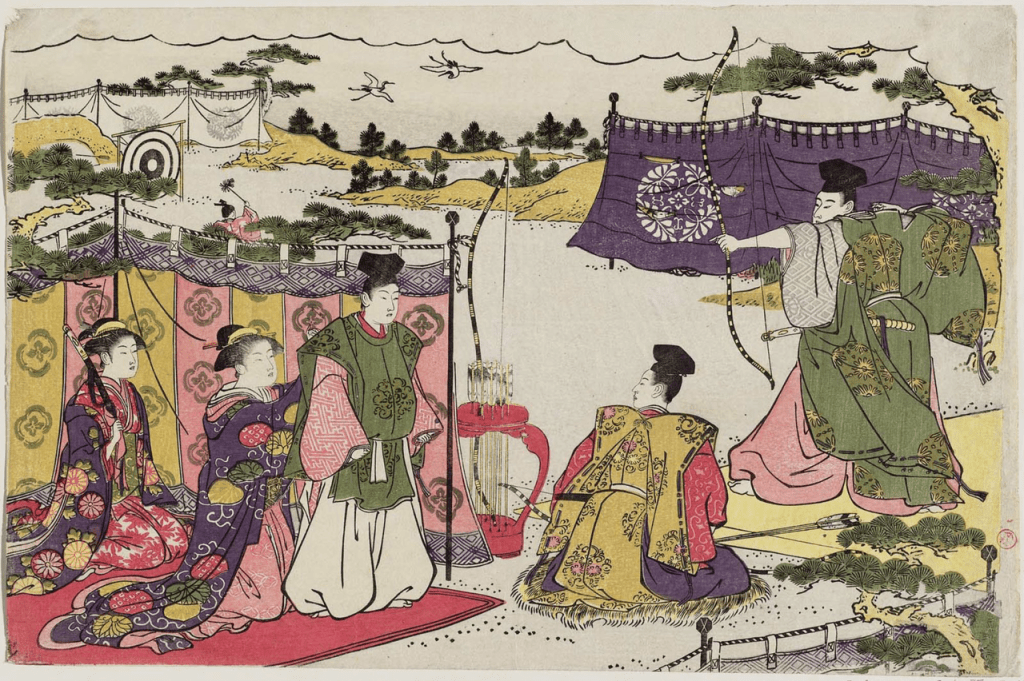
First Archery of the New Year (Yumi hajime) by Torii Kiyonaga (1787), courtesy of Wikipedia

Heian has become something of a kyūdō master between his Elvish heritage and samurai training.

Further, at level 5, per Adventurer’s League rules, he picked up a +1 longbow, which for flavor reasons I made as a Japanese-style daikyū (大弓) bow.

As a character he has been surprising fun. His samurai benefits as a courtier have been occasionally helpful in role-playing situations and in combat he clears the house.

Part of the fun of playing an unconventional character is discovering combinations and abilities you didn’t foresee. Plus, it makes the character more memorable in the long run.

So here’s to Heian Amakiiro, the best dang (imaginary) elf samurai archer I know! 🧝🏼‍♂️🍂🌸

Adventurers League: Starting Over

Recently, the admins of Adventurers League made a major rules announcement:

You can also read here for a detailed explanation as to why.

This a pretty exciting change after Season 10 introduced some pretty controversial changes (which have effectively been reversed) in 2020, which led to a lot of grumbling among D&D players on Discord. I remember some people talking about taking their business over to Pathfinder official play instead.1

The AL admin community evidentially did some serious thinking and finally, finally gave us an updated, compact, easy to understand set of player rules. I for one am genuinely excited to play again.

However, I also have a problem. When the transition from Season 9 to Season 10 began, a number of rules were introduced for character conversions, and such, and now with another move to a standard set of rules for the Forgotten Realms, some of my old characters are converting twice. Technically, no conversion is strictly required, but with the end of Season 9 players were encouraged to rebuild for either “historic” or “seasonal” and I did that for at least some of my old characters. Other old characters just got forgotten.

Breathing life back into some of my old AL characters, thanks to the new rules.
Binder above purchased at the Rook and the Raven

With the new rules, a lot of options opened up and rebuilding again is an option:

Whenever you could gain a level (even if you decline), you may rebuild any aspect of your character.

Adventure’s League Player’s Guide for the Forgotten Realms

With this in mind, I’ve been looking at all my AL characters up to this point, old and new. Some were too old and haven’t been played in so long that I decided retire2 them. I decided to keep my oldest character, Qisandoral, after dragging him out of retirement in season 10 during a brief window when they allowed a one-time rebuild. Using the rule above, I tweaked him a bit more but adjusting his feats a bit (he uses ice magic a lot, so I gave him Elemental Adept). In one case, I decided to rebuild my favorite Nature cleric from scratch, new name, level one, etc.

For newer characters, I have also taken advantage of the rules above, plus new options for character backgrounds and such to rebuild them as well. My elf-samurai Heian Amakiiro got the Far Traveller background now, which fits his character better. In the end, I wanted to have at least 1-3 characters per tier (I have no tier-4 characters as of writing), and it has been nice to finally “clean house”.

I, like many other players, are excited by the new ruleset, which will hopefully stay somewhat stable going forward. I have seen the rules change a number of times since I started in Season 8, and keeping up with the changing rules has been exhausting. However, my sense is the the AL admins want to come up with a simpler, more flexible set of rules that can run on auto-pilot going forward. And I for one fully support that. 😄

1 Needless to say, I did Pathfinder once and don’t plan on doing it again. To some degree, I blame that particular DM, who just wanted cool combat campaigns without any real plot. But I also got tired of the complicated character creation, tracking feats, and pressure to min/max.

2 “Retirement” here isn’t as dramatic as it sounds. I just exported and backed up their character sheets from DnD Beyond, and saved their logs into a different folder. If I really wanted to, I could still bring them back. Unlikely, though. I would more likely build a fresh, new version of that character instead.

A Nerd Dad’s Review of the Hero’s Feast Cookbook

Last week, at the local book store, my teenage daughter used some of her allowance to purchase a book called Heroes’ Feast: a cookbook of Dungeons and Dragons-inspired recipes. During lockdown, she has taken an interest in baking and cooking, and after years of playing Dungeons and Dragons with me (and now her little brother), it seemed like a fun project. Turns out, she loves the book.

My daughter has already added many bookmarks into her copy.

Heroes’ Feast is a collection of recipes, divided mostly by character races: elves, humans, dwarves and halflings (hobbits) plus some more exotic options. Each of the different sections has a different style: elvish recipes tend to be light and vegetarian, dwarvish recipes hearty and meaty, while halfling recipes have a wholesome taste with lots of cheese or baked goods. The elvish salad has edible flowers (who knew that you could eat pansies?), while the drow (dark elf) recipe uses portabello mushrooms.

Obviously, the alcohol-based recipes are inappropriate for kids (we don’t even keep alcohol in the house anyway), but there’s plenty of other options. All in all, I’d guess there are roughly 40-50 recipes to choose from.

My daughter has little practical experience cooking, and many of these recipes were definitely for adults, particularly adults with cooking experience. The recipes do vary between easier recipes (soups and salads) and ones more suitable for serious cooks, but some recipes are definitely good starters.

For example, my daughter was able to get the tomato soup going after a couple tries (spoiler: it’s quite good), but struggled to cook the cream puffs several times. My wife, who’s an experienced cook, stepped in to try the same recipe and struggled with it too. We gave up and tried a similar recipe from her Japanese cookbook and had much better results. On the other hand, the Dwarvish potato and leek soup turned out great the first time.

One thing I haven’t covered yet is the artwork. Amazing. Every section has artwork devoted to the character race that it focuses on and there’s plenty there to admire. Recent publications by WotC, for example the Theros adventure and Candlekeep Mysteries have amazing artwork and Heroes Feast continues that tradition.

Seeing my wife and daughter baking together so much lately has been great, and this book has been inspiring my daughter to cook outside her comfort zone more and more. My wife, who has no interest in D&D, is just happy to be able to share a hobby with her.

For a fun, quirky purchase, I highly recommend Heroes’ Feast for any D&D fan, regardless of cooking level.

DnDviaPBPlolz

Update: there is a follow-up review posted 6 months later.

For those of us older than 14,1 this post is about a concept I only learned about recently, and that is playing Dungeons and Dragons via “play by post” (pbp).

Dungeons and Dragons, as a fantasy role-playing game has always been about playing as a group, preferably a group you already know and have a good rapport with (friends, co-workers, family, etc).2 When I first played in high-school in the mid-1990’s, 2nd-edition Advanced Dungeons and Dragons was all the rage, and I fondly remember playing the Darksun setting for many weekend hours at my friend’s house. Sometimes we’d play for almost an entire day at a time. We’d even stay late, cook some of that awful pan-popped popcorn (more like pan-seared), and play some more.

This is D&D at its best, in my opinion.

The perennial issue with D&D, however, is getting people to coordinate on a schedule.

For some groups who already hang out anyway, this is super easy, but for everyone else, it isn’t. Playing a single “one-shot” adventure is often doable, as is Adventurer’s League (which I wholeheartedly support), but for everything else, you run into the perennial risk of D&D campaign running out of steam because someone’s schedule changes, or it just gets too hard to sustain.

This is where Play by Post comes in.

I had to stop playing Adventurer’s League late last year after the family schedule changed and conflicted with my Monday nights, and to be honest I was pretty bummed about it. I loved my local AL community. I spent most of that time focusing on personal module writing projects, which I do enjoy, but it is no substitute for just playing with friends.

Recently, one of the other AL guys had to drop out of as well due to a new baby, so he organized a private Discord channel for doing Adventurer’s League via Play By Post. The module we currently play, the venerable Bounty in the Bog, is a normally 4-hour module, but we’ve been playing for a week because we post replies and comments throughout the day, like any Internet forum you might find:

Me (ElfNut) posting an update on Discord about what my character is doing while the caravan travels from A to B.

In this channel I play a new character, Fenmaer Wasanthi, a high elf cleric (forge domain) who I had originally planned to use for Season 10 AL and never got to use. Problems with Season 10 are for another day. Anyhow, I liked this character and was happy to finally dust him off and use him in Adventurer’s League, and with the PBP format, I don’t have to block out 4 hours a week away from wife and kids (always an awkward experience). It’s as easy as anything else you do on social-media so it fits into existing schedules.

Further, it allows more time to go in-depth on the role-playing side of things, which is normally hard to do in Adventurer’s League because you drop into adventures, and play under a time constraint (no time for 18-page backstories). I can think about what I want Fenmaer to do, why, and flesh out his personality a bit more.

The one challenge is getting used to the pace. Normally when you’re playing D&D, it’s an interactive, conversational experience, and now I have to get used to no updates for hours, or even as long as a day. Our DM has commitments outside of this, and may be gone a day or more, so it’s weird not keeping a consistent pace, but on the other side, knowing that I can work in my D&D game in the rest of my life seamlessly (5-10 minutes a day so far) has been really nice.

Plus, for us old timers, it kind of harks back to good old text-based games anyway. 😉

1 I have definitely reached the point in my life where my teenage daughter (known in older blogs as “princess”) has surprised my “web saavy”.

2 A friendly reminder that sometimes no D&D is sometimes better than bad D&D. Having a group of people you get along with well before you start, and regardless of whether you play D&D or not, makes a huge difference. Coming together with strangers just for the sake of D&D is a risky endeavor, unless it’s in a structured environment such as Adventurer’s League.

The Adventures of Brock Stonefist

Let me tell you a story about a warrior who never actually existed, named Brock Stonefist. One night recently, I was playing Dungeons and Dragons Adventurers League online, after months of not playing (scheduling conflicts). It was a relief to finally play again. The character I used was a High Elf wizard, similar to the one I retired recently, but more in the Conjuration school than Abjuration (plus the character was designed better with the benefit of hindsight). Meet Sael Teinithra.

Anyhow, Sael had one spell called Silent Image which conjures up an illusion that is visual only, but can be controlled to mimic human movement and action. It doesn’t do or say anything, but it looks cool.

During a fight against some fire monsters, I decided that my party members needed help, so I had Sael cast Silent Image to conjure up the image of a warrior in hopes that it could draw some of the monsters away. To make the effect more convincing, I decided to make the illusion look like a beefy combatant, and I tentatively named him “Brock Stonefist” for no good reason.

Needless to say, Brock Stonefist did nothing useful during the fight. The monsters were not drawn away, and I couldn’t maneuver Brock Stonefist anywhere fast enough to get ahead of the battle. So, it was a bust.

After the night’s adventuring was over, we joked about it the following day on the local Discord channel. One player quipped “you got problems? We got Brock Stonefist.”

To which I replied …

Turns out that someone else on the Discord channel was following Discord on their work laptop and right when they gave a presentation at work (i.e, in the meat world), their screen popped up a message during the presentation that said:

Brock Stonefist is a one-man solution to every problem.

I have been told that the other people in the meeting were confused but had a good chuckle.

For an adventurer that didn’t actually exist in any sense, let alone make any meaningful contribution, he made his mark…. Stonefist Style!! 💪🏼💥🎸🎶

Retiring my First Adventurer’s League Character

Or: “how not to build a wizard in Dungeons and Dragons, fifth edition.”

Update: I have brought Qisandoral back from retirement after the 2021 rules changes.

My first character in Dungeons and Dragons, Adventurers League, was a high-elf wizard (Abjuration school) named Qisandoral Ariesstanus. He was a side-kick I originally made for my kids in their home campaign, with his deadpan, humorous personality reminiscent of Mr Spock from Star Trek. Because of his stodgy, stoic nature, Abjuration as a school of magic seemed like a sensible move.

I kind of always pictured Qisandoral like the elf shown in this Magic the Gathering card. Source: Scryfall

Later, when I first “imported” this character to Adventurers League (i.e. made a new, AL-legal version of him), I didn’t really know how to do a proper build for wizards, so I prioritized sub-optimal stat choices such as Charisma, which didn’t actually make sense with his role-playing style. I probably could have role-played him different, but the group dynamics in Adventurers League helped influence my choices in role-playing.

The bigger problem though was learning how to manage spells for Qisandoral. Abjurers activate (or recharge) their primary ability, Arcane Ward, whenever they cast a spell from the Abjuration school. I thought this was great, so with my limited monetary resources, I spent everything I had to purchase and copy Abjuration school spells in my spellbook. The trouble was was that most Abjuration spells are pretty situational, particularly in the sort of one-shot adventures you often find in Adventurers League. Arcane Lock is a pretty neat utility spell in some situations, but I practically never used it in Adventurers League. Even mighty spells like Counterspell and Dispel Magic, staples of the Abjuration school, didn’t come up very often due to the nature of combat and adventures. Things would probably be different in a longer-term home campaign, but this version of Qisandoral was meant for Adventurers League only.

Further, I didn’t take advantage of Adventurers League rules for copying spells from another wizard player character enough, instead buying scrolls on my own. Thus, I spent too much money on spells that were often not worth it. Such spells are great in right situation, but rarely enough to be worth spending hundreds of gold pieces on for a scroll (nevermind the costs to copy).

Conversely, because I leaned so heavily in Abjuration, Qisandoral wasn’t very effective in most combat situations. Using Chromatic Orb helped to some degree because of its versatility, but by tier-3 (levels 10 through 15), a wizard usually is a pretty powerful class, and Qisandoral had excellent defenses, but not much else to offer. Even for an Abjuration wizard, I might have built him too conservatively.

In a recent article by the awesome James Haeck,1 he points out that wizards work best when they have a solution to every situation. They may have their fallback specialty, but the sheer diversity in spellcasting is what makes wizards stand apart from every other D&D spell class.

When I saw this article, I realized that for building an Abjuration wizard, the key to success is to have a certain number of core spells to trigger Arcane Ward, but also diversify to cover every other situation. For core Abjuration spells:

  • Mage Armor – cast it first thing in the day to bolster your armor class, and activate Arcane Ward in one shot. Yay.
  • Shield – in a pinch it will not only deflect potential damage but recharge your Arcane Ward a little bit, too. Double yay.
  • Alarm – since you can cast this as a ritual, a common trick by players is to cast over and over during a long break to recharge Arcane Ward. Kind of silly, but people do it. Plus, it’s handy for situations where you need to rest overnight in a hostile environment.
  • Counterspell – there are many situations where this isn’t useful, but when it is…
  • Dispel Magic – same as above… Abjuration wizards should always have these two prepared.
  • Banishment – personally one of my favorite Abjuration spells. Reduce the battlefield thread instantly by taking one or more creatures out of rotation, possibly for good! Sometimes you can send the big boss packing instantly.

Beyond these six core abjuration spells, you probably should diversify as much as you can.

Sadly, I didn’t do this, and after trying to belatedly fix Qisandoral’s build, it became too little too late in tier-3 adventures so I decided to retire him.

Retiring my first AL character wasn’t easy. Even though he wasn’t mechanically great, I still liked him as a role-playing character because he was a fun, distinctive, memorable character. What made me finally decide to retire him was that the original side-kick version still existed in my home campaign with my kids, and if I wanted to, I could probably make a new version from scratch in Adventurer’s League if I really wanted to. The “new” Qisandoral wouldn’t have the same character history, so no reliving the Liberation of Phlan again, nor any of the rewards from before, but it would be a chance to “make him right”.

On the other hand, I like to think that boring, old Qisandoral really did retire from adventuring and went back to his studies having learned all he needed to from the wider world, and having made his mark. With all that he accomplished in his adventuring life, he probably earned a long sabbatical anyway.

1 Mr Haeck also has a nice article on Abjuration wizards, but it was published after I made my character, so 🤷🏽‍♂️

A Nerd Dad’s Review of Eberron: Rising from the Ashes

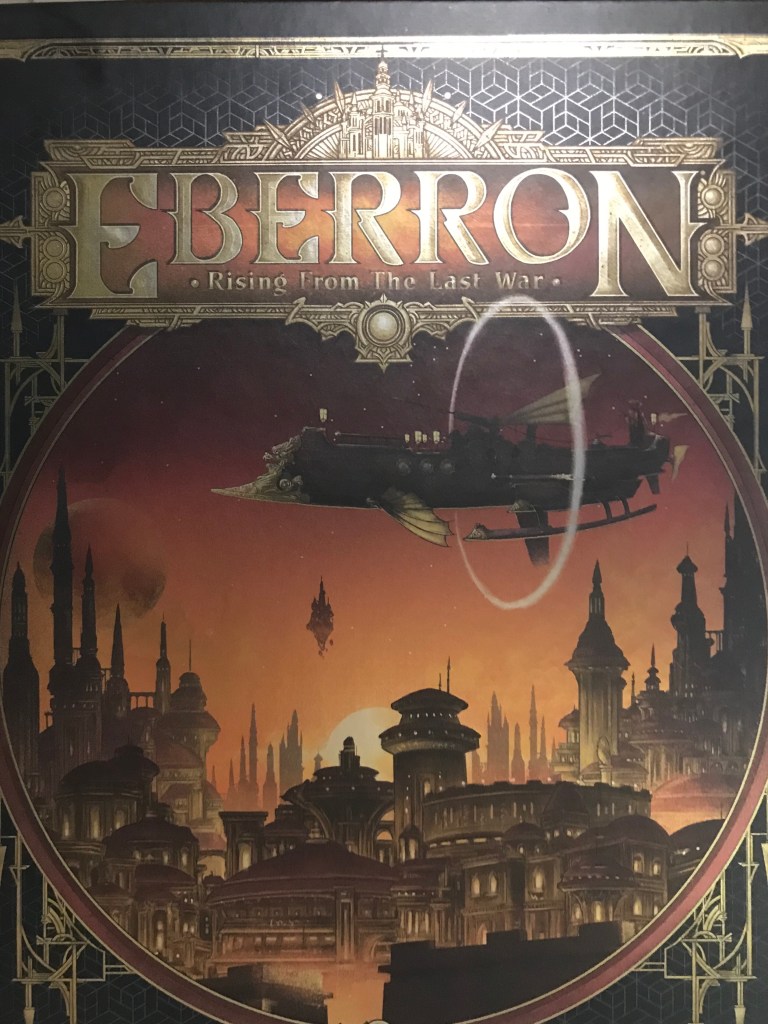
The alternate-art book we purchased last Thanksgiving weekend

Late last year during a fun extended Thanksgiving weekend, my kids and I picked up another D&D sourcebook: Eberron: Rising from the Last War. The setting of Eberron came out during Dungeons and Dragons 3.5, so I missed it completely until now,1 and wanted to try it out with the kids. Taking advantage of lockdown, I finally had some time to look into this book and start planning out a campaign for my kids.

Eberron, as a setting, seems to attract a pretty devoted audience due to its unusual magic-steampunk atmosphere which differs from the more typical high-fantasy of the Forgotten Realms or Greyhawk settings. If you like trains powered by lightning, flying ships powered by fire elementals, and plenty of noir atmosphere, there’s a lot to work with.

The sourcebook is dense even by the standards of D&D sourcebooks, and if you have never played Eberron before, the amount Eberron-specific lore in the book is pretty daunting. I feel pretty familiar with the Forgotten Realms setting, its lore and such, and almost none of it translates into Eberron. It is its own world, its own history, people and even terminology. I still have only a vague idea what Quori are, and who the Daelkyr were, but they feature prominently. Then there is a whole new pantheon of gods (which for some reason have no alignment defined in the sourcebook), new religions, etc.

The history of Eberron alone is amazingly detailed, as it covers various empires that have risen and fallen. Demonic kingdoms existed in antiquity, as did dragons, and later goblinoid empires. Then there’s the Last War which is what the current setting is pinned on: a great continental war that resulted in the total destruction of one of its kingdoms (Cyre) leaving behind a kind of magic post-apocalyptic nightmare. All of this makes for pretty fascinating backstory, and the richness of Eberron probably helps explain its enduring popularity.

However, for all this impressive backstory, culture and extra features (for example “dragonmarks”) a couple problems confront a new DM totally unfamiliar with Eberron:

  1. The learning curve for such material is kind of steep, and unless you’ve played in a campaign before, it might be hard to retain it all.
  2. Due to density, it’s hard to know what’s essential information, and what’s not. How much can you afford to cut out for a smaller campaign taking play in, say, Sharn, vs. the Shadow Reaches?

Another challenge presenting DMs who are making campaigns for kids is adapting the grim noir setting into something more lightweight and fun. My youngest is much too young to appreciate dark backstories, or the horrors of war, he just likes to fight cool monster battles. When I started out making a campaign for my kids, I sat there with an open notebook, read through a few chapters and hours later still had a blank notebook. I had no idea how to come up with quick intro-level adventure.2

Thankfully, Keith Baker, the genius behind Eberron wrote an article recently for D&D Beyond that helped address this very question. He suggested 4 possible types of adventures to start with, among others:

  • An urban adventure in Sharn, particular in the “underbelly” (literally and figuratively) of the city.
  • A wilderness adventure on assignment with the Clifftop Adventurer’s Guild.
  • A gritty, frontier adventure at the mining colony of Hope.
  • Go back a bit in time to the last days of the War and various adventure opportunities that presents.

The article helped me finally come up with a good starting adventure hook, and some much-needed context around the vast lore of Eberron: Rising from the Last War. My kids and I played a small two-episode campaign in the Shadow Reaches as a “contract” with Clifftop Adventurer’s Guild to clear some monsters, plus I added some sidekicks: a Warforged fighter (who, little do they know, has some Manchurian Candidate-style programming in his mind), and a Hobgoblin cleric of Aureon who longs to fit into high-society. Once things settled in, the campaign felt like any old fun adventure around the dinner table. It was D&D through and through, just with a different campaign. We’ve since started to branch off into a second adventure taking place in Sharn doing some relic scavenging.

As my family’s first experience with Eberron, once we got over the hurdle of absorbing a whole new world’s worth of lore, the rules and gameplay are just as fun as any other D&D game.

In closing, I think one of the biggest challenges of Eberron: Rising from the Last War is its format: dense, and not organized around getting started. My impression was that the target audience is the existing Eberron fanbase, and the interest in adapting Eberron in a more official 5th-edition capacity than before. Thus, as an official sourcebook for all things Eberron, this book passes with flying colors. As an onboarding guide for new players this book is a bit intimidating, but if you can work your way through it, it’s quite fun.

Good luck and happy adventuring!

P.S. I realize most D&D players are probably focused on the latest adventure book, Rime of the Frostmaiden, but I as a busy nerd dad, I move kind of slow. 😉

1 For those keeping score, my first experience with D&D was 2nd edition AD&D, which I played a bunch in high-school with friends. None of us knew what we were doing, but we had a lot of fun, I devoured books about Drizzt Do’Urden, and played some Dark Sun as well. By the time 3rd edition came out, though, I was in college and had forgotten all about D&D for a long time until _4th edition_ came out. I played one game of that and said no thanks. It wasn’t until 5th edition that I seriously played again. So, I missed everything related to D&D 3rd and 3.5 edition. I played Pathfinder for a bit as well, and I would be up for playing it again (especially Pathfinder 2), but I have just barely enough time for 5e as it is.

2 As other reviews have pointed out, there is an introduction adventure included in the book, but due to its density, I wasn’t able to find it. Descriptions of Sharn the City of Tower were nice and detailed, but how to turn this into a fun intro story weren’t readily apparent.

No DnD Sometimes Is Better Than Bad DnD

Photo by Nathan Cowley on Pexels.com

I suppose it was going to happen sooner or later: a bad Dungeons and Dragons session in Adventurer’s League, and boy did it happen.

Adventurers League is a more portable format by its nature, which means that players can drop in to any game (as opposed to a more dedicated “campaign” with a set group of players who meet every so often to pick up the story). So, you never really know who you’re going to play with. Most players are easy to get along with (I’ve been playing over a year and have only had 1-2 bad experiences), since we all come to enjoy D&D anyway, but occasionally you’ll get an obnoxious player who rubs every on the wrong way and spoils the mood of the game.

We had such a player a couple Mondays ago. He was apparently new, and tried to dominate the game. He complained frequently because the game didn’t go his way (his character was fragile and had a random, bad encounter that nearly killed him), and kept trying to push the group into the direction he wanted. Finally, he lost his temper when our DM had mistakenly missed his turn, and he went into a rant about how everyone got a turn and left him with no monsters to fight. This made things very awkward for the rest of the game.

This really got under my skin for a few reasons:

  • He rolled bad initiative, which was no one’s fault but his own.
  • His character was a healer (according to him) and by design isn’t a powerful damage-dealer anyway. I am not sure what he was expecting to do.
  • DM’s make mistakes, and he shouldn’t have taken it personally.

Needless to say after 4 hours of listening to his whining and his rant, I was mentally exhausted after the game, and felt like taking a long, long break from communal D&D for a while.

Dungeons and Dragons as a game has its strengths and weaknesses. Coming together as a group to solve a challenge, whether it be a battle or a difficult puzzle, or some social dispute can be really fun and exciting. It’s why I play D&D, and dropped games like Magic: The Gathering: I prefer collaborating with a group more than constantly vying with one another for petty rewards (and then having to repeat the process over and over again ad nauseum).

But this also means that D&D requires a functional social-group.

Countless posts have been made online about dysfunctional D&D gaming groups, usually involving one or more toxic personalities. Some of them very toxic. Oftentimes, I feel these happen when:

  • People try to cobble a group together out of desperation. It usually starts out well, then peters out within a few sessions because people lose interest, the group doesn’t “click”, etc. I’ve been on, and DM’ed, groups like this. Or,
  • Open play (e.g. conventions, etc). People with serious social issues seek these out because the bar for entry is pretty low, and they can get what they want out of it, without consideration for the rest of the players.

The first one though is usually the most common, and most frustrating, because like so many things in life, people start out with good intentions, but the whole foundation is shaky.

I had a group I cobbled together at work to play the D&D adventure Waterdeep: Dragon Heist, but one by one the people dropped out due to work obligations, leaving only the socially-awkward players left, who were pretty frustrating to DM for. One of them insisted on an 18-page backstory which was definitely cringey in parts. The group fell apart fast, and left most of us kind of awkward thereafter at the workplace.

I think secret to making a successful, sustained D&D group is to already have an existing social group that willingly hangs out with or without D&D. Afterall, if people can’t get along in real life, why would they get along in a fantasy realm? Trying to force some strangers together for a group fantasy adventure is more often than not going to fail, but if a group already has a healthy social-dynamic, a well-run D&D campaign will certainly flourish. There are exceptions to this, but without an underlying, healthy social dynamic, usually the odds are not in your favor.

But what if you don’t have such a group? In my opinion, taking the risk of an unfamiliar group, and the potential emotional distress that this causes may not be worth it. It might be a good learning experience in general, but when people get sucked into an unhealthy group the situation can really go off the rails. So, I kind of think it’s better to just miss out and save yourself the unnecessary anguish. But, if you really want to play, caveat emp-friggin-tor.

So what about Adventurer’s League? After the bad game, I took a week off and then played again. The subsequent games were with players in my community whom I already played with and trusted, and we had a good time. My faith with AL was restored, and I’ve had a good time. Also, I haven’t seen that problem player again, which leads me to suspect that one of the community admins had a chat with them and showed them the door. The admins in my community are pretty sensitive to keeping the atmosphere healthy, and are willing to step up and protect players if need be. That’s very appreciated. But taking a break, even a short one, was worth it in order to “reset” things for me.

I suppose that’s another life lesson: there’s nothing wrong with taking a break. It might just be the best thing for yourself. 😉

P.S. yet another bad D&D session.

Buddhism and Bonnoh

Based on experience of being a Buddhist (with a few interruptions) since I was 16, I’ve learned that reading about Buddhism and living Buddhism, especially within a Buddhist culture, are two different things.

My wife, who is Japanese and whose father works in the funeral industry, has always had a good, intuitive understand of Buddhism even if she has seldom studied it. I, on the other hand, approached it for a long, long time from a more scholarly (read: “amateur scholarly”), analytical standpoint. It was only in recent years, that I started to realize the short-comings of “academic-only Buddhism” and kind of started over.

Case in point: in Japanese culture, you sometimes hear the Buddhist term bonnō (煩悩).1 I heard this term over the years, but lately I have heard it a lot while listening to a certain Japanese language Buddhist + comedy podcast.

The term bonnō in Japanese is derived from the Sanskrit term klesha, via Chinese, which in English is translated as “mental defilements”, “mental delusions”, etc. From a textbook perspective, these deluded mental states are the ones that cloud judgment, and cause people to do unwholesome conduct, further creating negative karma, and fostering conditions that keep one bound on the never-ending cycle of birth and rebirth (not to mention suffering in this life). Further, the most fundamental kleshas are defined as greed, anger, and ignorance, leading to other kleshas and so on.

I mean, that kind of makes sense. It might be interesting from an intellectual standpoint, but it’s not very practical. It doesn’t resonate with one’s life much.

But, while listening to the podcast, I realized that bonnō in everyday language just means all the stupid shit we do, think, or expect that causes us more grief.

  • That time I said something snarky to my wife and we got into a big fight? bonnō.
  • That time I (again) ate too much at the company holiday party and made myself sick? bonnō.
  • That time I played a Magic: The Gathering draft at my local game store without any practice or research, and got upset about a 0-4 ? bonnō.
  • That one session of Adventurer’s League I was super excited about, and waited all week for, and then it turned out to suck? bonnō.
  • That one girl that I really wanted to date in college, and when we finally did go out, it was super obvious we weren’t compatible? bonnō.

And so on. Bonnō is an interesting concept because we create grief for ourselves all the time, in small ways, in big ways, and so on. All of it derives from fundamental misunderstandings with other people, bad assumptions based on limited information, or unrealistic expectations that didn’t accord with reality.

Bonnō is not something limited to “trashy” people, though. People who are well-educated or come from affluent backgrounds are just as afflicted by bonnō as anyone else; the nature of their afflictions may be different, but you’d be fooling yourself into thinking that just because you went to college and had a class on European Colonialism in the 18th century that you’re somehow more enlightened than other people.

From the Japanese-Buddhist perspective, you are still bonpu (凡夫, sometimes pronounced “bonbu“): that is to say, a run-of-the-mill person subject to the same basic afflictions, same basic patterns of behavior, selfish ego, etc.

Nor is this some red pill vs. blue pill nonsense either.2 People who consider3 themselves smarter or more awakened like to think that it’s a matter of awakening to some higher truth, and suddenly BAM you’re a new, better man.

No, as far as Buddhism is concerned, it doesn’t work that way. In the end, you just need two things:

  1. Self-reflection. You can’t stop being a dick-head if you aren’t aware you’re acting like a dick-head.
  2. Cultivating wholesome qualities. Every defilement has a corresponding wholesome quality to counteract it: Anger is counteracted with good-will, greed with self-restraint, ignorance with wisdom, and so on.

Oh, and patience. A lot of patience. Even if you’re dead-set on the path to Enlightenment, you can not overcome old habits easily. A river does not change course overnight. Lots of mistakes are made, but remember to keep reflecting on your own behavior and determine what’s wholesome and what’s not.

As the Buddha said to his step-mother (who became a nun):

“As for the qualities of which you may know, ‘These qualities lead to dispassion, not to passion; to being unfettered, not to being fettered; to shedding, not to accumulating; to modesty, not to self-aggrandizement; to contentment, not to discontent; to seclusion, not to entanglement; to aroused persistence, not to laziness; to being unburdensome, not to being burdensome’: You may categorically hold, ‘This is the Dhamma [the Buddha’s teaching], this is the Vinaya [the Buddhist monastic community], this is the Teacher’s instruction.'”

translated from the Pali by Thanissaro Bhikkhu (with emphasis added by me)

The results of putting the Dharma into practice speak for themselves, if given time.

1 Pronounced “bohn-noh”.

2 Sorry, Neo, that was just a Dayquil you swallowed, lolz.

3 People consider themselves a lot of things. Welcome to the world of bonnō.