You, Priest in your mufti, you are a chaplain to the self-satisfied. I come not to challenge Muad’Dib but to challenge you! Is your religion real when it costs you nothing and carries no risk? Is your religion real when you fatten upon it? Is your religion real when you commit atrocities in its name? Whence comes your downward degeneration from the original revelation? Answer me, Priest!
Frank Herbert, Children of Dune
A great quote I stumbled upon recently. It pretty much says it all. Also, this is not limited to priests, lay people can benefit from some level of austerity as well. This is how one can enjoy a life well-lived, instead of one of regret.
Recently, I talked a little bit about an old, but highly influential stream of Mahayana Buddhist thought called Yogacara Buddhism (sounds like “Yogaachaara“) also known as “Conscious-ness Only Buddhism”. A lot of modern Buddhism that people practice now from Tibet to Japan is deeply influenced by Yogacara, even if not overtly aware of it.
The book goes on to describe a more down to earth example of how Yogacara Buddhism describes the world:
We touch upon various things every day, meet various kinds of people, and are encountering various situations and events as we carry out our day-to-day living. At that time, it is quite natural for us to think that in regard to the objects of our mental functions of perceiving, thinking, and making judgments, that we are directly seeing, hearing, and making judgements in regard to this and that object. However, according to Yogācāra Buddhism, those cognized objects have already been colored and transformed by our minds in the process of their manifestation.
Page 10, translation by A Charles Muller
In the same chapter, the author uses the example of looking at a clock and recognizing that it is 7:30pm. The raw, digital output from the clock is internalized by our minds and interpreted as “7:30 in the evening” as the initial cognization, with follow up thoughts such as “oh, I am late” or “it’s time to get ready for bed”, and so on, as the followup stream of consciousness.
Elsewhere, Rev. Tagawa, also writes:
We lead our lives surrounded by all sorts of things. We annoyed, we may try to escape them by moving to the quiet and simple life in the middle of the mountains, but the fact of our being surrounded by many things does not change at all. As long as we are alive, there is no way that we can ever sever ourselves from our environment. In managing our daily lives, we have no recourse by to proceed while maintaining some kind of relationship with all those things that surround us. At such a time, there will always be things, people, and events. Rather than seeking to escape from them, what we need to do is examine the way we cognize these things, and the way we understand their content.
Page 11, trans. by A Charles Muller
This harks allllllllll the way back to one of the very earliest Buddhist texts, the Dhammapada, which is a collection of sayings attributed to the Buddha, wherein the opening lines are:
1. Mind precedes all mental states. Mind is their chief; they are all mind-wrought. If with an impure mind a person speaks or acts suffering follows him like the wheel that follows the foot of the ox.
2. Mind precedes all mental states. Mind is their chief; they are all mind-wrought. If with a pure mind a person speaks or acts happiness follows him like his never-departing shadow.
Translation by Acharya Buddharakkhita
Indeed, one cannot escape the mind or its mental states, regardless of whether one is in a mountain retreat, or stuck in the office. Buddhism is, first and foremost, a religion of the mind, not magical phenomena.
In the second Dune novel, there’s a quotation I think about sometimes think about at times like this:
The greatest palatinate earl and the lowliest stipendiary serf share the same problem. You cannot hire a mentat or any other intellect to solve it for you. There’s no writ of inquest or calling of witnesses to provide answers. No servant — or disciple — can dress the wound. You dress it yourself or continue bleeding for all to see.
Dune Messiah by Frank Herbert
In other words, we have to learn to live with ourselves and the environment around us somehow.
Time and again, I keep thinking back to that famous scene from the original Dune novel by Frank Herbert and the gom jabbar test.
“A duke’s son must know all about poisons,” she said, “…Here’s a new one for you: the gom jabbar. It kills only animals.”
Pride overcame Paul’s fear. “You dare suggest that a duke’s son is an animal?” he demanded.
“Let us say I suggest that you may be human,” she said.
Frank Herbert’s Dune
Frank Herbert envisioned a future of humanity based on extremely intelligent, evolved people (e.g. Mentats, the Bene Gesserit, etc) who still wrestled with primal instincts even 20,000 years in the future. Given the glacial pace of human evolution that’s not so surprising.
But even on a day to day level here in the 21st, this struggle continues between our instinct as Homo sapiens and our lives as “human beings”. In the 13th century Japanese text, the Essays in Idleness, Kenkō laments this point:
The testament to our birth in the human realm should be a strong urge to escape from this world. Surely there can be nothing to distinguish us from the beasts, if we simply devote ourselves to greed and never turn our hearts toward the Buddhist Truth.
Translation by Meredith McKinney
Indeed, many people are content to live by needs and primal instinct alone. They may as well be just another animal species living in the wild. The problem isn’t that we have such instincts, nor are they a source of shame, but what makes us human vs. just another animal is our ability to be aware of them, to keep them in check when appropriate and so on.
Demon: “So why do you consider my presence a pollution, a disease? Is it because there is that within you which is like unto myself? …If so, I mock you in your weakness, Binder.”
Sam: “It is because I am a man who occasionally aspires to things beyond the belly and the phallus.”
Roger Zelazny’s Lord of Light
It’s important, I think, not to loathe that side of oneself, because it is natural, but it’s important to have the bigger picture, and be able to see when our instincts as human beings are self-destructive, or ultimately unable to provide any lasting contentment, and thus aspire for something higher. This is much easier said than done, but even the sincere aspiration is a step in the right direction.
A scene from the Genpei War, courtesy of Wikipedia
When religion and politics travel in the same cart, the riders believe nothing can stand in their way. Their movements become headlong – faster and faster and faster. They put aside all thoughts of obstacles and forget the precipice does not show itself to the man in a blind rush until it’s too late.
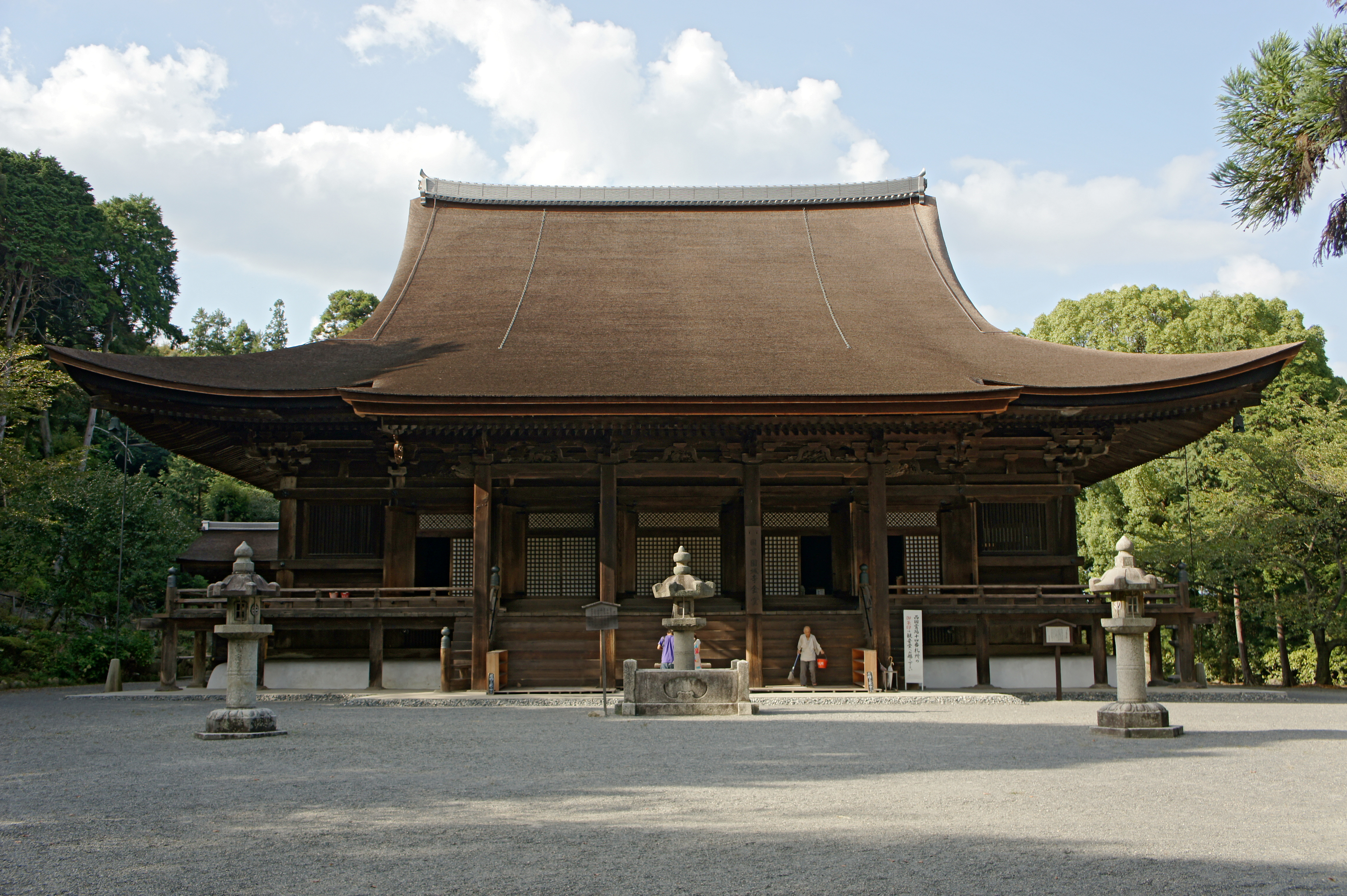
While reading my new book on the Ojoyoshu and its author Genshin, a highly influential Japanese Buddhist monk in the 12th century, I came across the story of two men who were very powerful at the time, and colluded to build the temple of Enryakuji, home of the Tendai sect, to become the most powerful religious institution at the time. This had some very negative unintended side-effects as we shall see, but first let’s see who these two men were.
The first was an ambitious monk named Ryōgen (良源, 912 – 985) who quickly embroiled himself in a generations-long simmering dispute between two rival factions of the Tendai sect: one based on the lineage of the Ennin: the sanmon-ha (山門派), and the other based on the lineage of Enchin: the jimon-ha (寺門派). Both Ennin and Enchin had been direct disciples of founder Saichō (最澄, 767 – 822). Interestingly, neither faction had major doctrinal differences between them, the dispute was entirely over who should run Enryakuji Temple. Ryōgen, who was from the Ennin / sanmon-ha lineage, overtly sought to push out and exclude rivals from the Enchin line from positions of power, until he eventually attained supremacy as the 18th head abbot (zasu, 座主) of Enryakuji Temple in 966.
The other man in this story was a nobleman named Fujiwara no Morosuke, who belonged to one of several competing branches of the Fujiwara clan for control of the Imperial throne. This most common strategy for controlling the throne at the time was through intermarriage with the Imperial family, and controlling the strings as regents for child emperors. In this case, Morosuke wanted to ensure that his pregnant daughter, Anshi (安子, 927-964), the consort of Emperor Murakami, would give birth to a son. He enlisted Ryōgen who had known his father in social circles, and Ryōgen agreed to undertake a lengthy 300-day Buddhist esoteric ritual to ensure safe birth of a son. Sure enough, Anshi gave birth to a son (later Emperor Reizei), and Ryōgen was greatly rewarded by Morosuke with prestigious positions and patronage against rivals at Enryakuji.
This relationship between the two profited both. From Ryōgen, Morosuke got spiritual protection, and influence over the powerful Enryakuji temple, while Ryõgen could further his plans to consolidate power at the temple with blessings from the powerful Fujiwara clan.
Ryōgen paid back Morosuke by appointing one of Morosuke’s junior family relations, Jinzen, to the prominent position of “bishop” within Enryakuji and then archbishop (sōjō 僧正) two years later. Jinzen was far too young to be an archbishop, and lacked past qualifications, but his connection to the Fujiwaran clan and Ryōgen were enough to make the promotion happen. Ryōgen appointed others similarly to his “inner circle” based more on loyalty to the Ennin faction than on qualifications, while pushing out more qualified rivals who belonged to the Enchin faction. This struggle came to a head later in 981 when a member of the rival Enchin line was appointed to an important position by the government. Protests, threats and rumors by monks spread quickly, and monks of the Enchin lineage felt increasingly unsafe and moved further down the mountain. By 991, armed monks (sōhei 僧兵)1 from the Ennin line (Ryōgen’s lineage) openly attacked the Enchin monks’ residences and they fled to a rival Tendai Buddhist temple named Miidera:
The political/factional rivalry didn’t end there though. Both temple complexes, along with several other major temples in and around the capitol, fielded armies of warrior-monks, and allied themselves with power noble families. Between Enryakuji and Miidera, the violence escalated until Miidera was burned down by warrior monks from Enryakuji 4 times in the 11th century, while Miidera warrior-monks attacked and destroyed places associated with the Ennin lineage.
By the time of the Genpei War in the last 12th century (more on that here), the temples were caught up in the larger struggle between the Taira and Minamoto clans with the Miidera Temple being burned down (yet again) and its monks fleeing with the retreating Minamoto clan.
All of this started with a lineage dispute between two disciples of the founder, Saichō, but gradually escalated as one side sabotaged the other politically and then, starting with Ryōgen, tapped into patronage from power noble families in order to drive out the other faction. This back and forth happened for decades and centuries, until both temples were repeatedly destroyed by warfare. The temporary political gains that Ryōgen received through Morosuke did little to actually solve the issue long-term and worsened things through factionalism. Monks, increasingly drawn into political battles, forgot their monastic training and engaged armed conflicts with other monks (or opposing samurai warriors in some cases) in total contradiction of the Buddha’s firm teachings against taking life, especially in the capacity as a monk.
As the book shows, not all monks at Enryakuji bought into this conflict. Genshin, for example, setup a retreat at the more isolated Yokawa region of Mt. Hiei for monks to focus on the Pure Land teachings and practices. In a sense, he just clocked out. Some monks just openly left to start new Buddhist sects (Honen, Shinran, Dogen, etc) or join them. Others just turned a blind eye to what was happening.
Nevertheless, the monastic system in Japan by the 11th and 12th centuries hadn’t just been plagued by “monks gone wild”; the entire system had totally gone off the rails.
Not surprisingly, although these sects survived the conflict and continued on into the later Kamakura and Muromachi Periods, their reputations were permanently tarnished, and even today enjoy far less prestige that newer, fresher sects that had less political muscle,2 and more mass-appeal. As researchers argue, the political sects at the time hitched their wagons with powerful noble families and profited from this, but when those families declined political, so did the temples.
A cautionary tale for future generations….
P.S. the book also alludes to an “acrimonious debate” in China between two factions of the parent Tiantai sect: the shanjia (山家, “mountain family”) and the shanwai (山外, “outside the mountain”). Unlike Japan, the struggle in China never led to open warfare, but the Tiantai sect suffered paralysis until the debate was resolved.
1 Warrior-monk armies were not exclusive to the Tendai sect, by the way. Other major sects around the capitol got tangled up in a weird kind of religious-political “arms race” with each other. Kōfukuji, the head of the still-powerful Hossō sect, fielded a powerful army and frequently threw their weight around, intimidating followers of the new Pure Land sect, while getting into armed clashes with Enryaku-ji, their rival Miidera, and later with newer Zen temples. The army from Enryakuji was also known for robbing the grave of Pure Land Buddhism founder, Hōnen (ironically a former Tendai monk) later. Centuries later, these warrior-monks were still harassing rival Buddhist sects (for example Rennyo’s community of the Jodo Shinshu sect, and Dōgen’s community of the Sōtō Zen sect) until they were finally wiped out (literally) by the infamous warlord Oda Nobunaga. For more on sohei warrior-monks and how they might look in Dungeons and Dragons role-playing, check out my other blog post.
2 The one prominent exception to this would the Jodo Shinshu sect, which did openly challenge Oda Nobunaga with a peasant army (ikko-ikki) of its own whose relationship to Rennyo was … complicated. Outside of war, Jodo Shinshu has also had a somewhat sketchy history of attacking critics such as the Zen monk Tetsugen through mob-violence.




 Gleanings in Buddha-Fields


You must be logged in to post a comment.