Buddhism Here and Now, Or the Future?

Recently while taking my personal retreat, I spent some time catching up on Buddhist reading, and finished a book titled Introduction to the Lotus Sutra by Yoshiro Tamura, and translated to English. I had high hopes for the book, but came away pretty disappointed as it was a pretty thinly veiled promotion of a Nichiren-Buddhist interpretation of the Lotus Sutra, and of Nichiren Buddhism in general.1

One passage makes some interesting comments worth noting though (Wikipedia links added):

Shinran (1173-1262), Dogen (1200-1253), and Nichiren (1222-1282) also came into reality of out Mt. Hiei’s hall of truth [same as Honen a generation earlier]. Yet their attitudes toward the actual world were quite different from Honen’s. While Honen was mostly devoted to giving up on life and longed for the pure land of the next life, Shinran, Dogen, and Nichiren struggled positively within the actual world. Their activities and writings came right after the Jokyu turbulence of 1221 and were related to it.

Page 123, translation by Michio Shinozaki, edited by Gene Reeves

Mr Tamura is comparing several different Buddhist monks who all left the Tendai sect around the same time, and each founded their own sects. The first, was Honen, who founded the Jodo Shu sect and greatly popularized Pure Land Buddhism in Japan. This is a fascinating historical phenomenon that started in the last 12th century with Honen, and persisted with a couple more generations of Buddhist monks all trained from the same Tendai sect, and apart from Nichiren, its great temple complex on Mt Hiei.

As Nichiren was the last of these great reformers, he had the benefit of hindsight, and tended to be rather harsh toward Honen’s Pure Land movement as degenerate, and further obscuring the true Buddhist teachings (as enshrined in the Lotus Sutra and the Tendai sect). Thus, ever since, Nichiren authors and followers have had particular animus toward Honen. The book doesn’t pull punches either.

But it’s an interesting comment to make, and not without merit. The Jodo Shu Buddhist sect has always been focused on a singular goal within the larger Buddhist religion: to enable followers to be reborn in the Pure Land of Amitabha (Amida) Buddha and thus provide as a refuge, but also to enable them to accelerate on the traditional Buddhist path faster. A lot of this hinges on a medieval-Buddhist interpretation of the “end days” or Dharma Decline, which looks a bit silly knowing what we know now.

In any case, Jodo Shu sect Buddhism, at least on paper, definitely focuses on the life to come. From what I hear on the ground, the reality is a lot more nuanced, and many communities still practice some manner “traditional Buddhism”, but the primary focus still remains rebirth in the Pure Land to come.

So, what Mr Tamura says makes sense.

Mr Tamura is also correct in that Dogen, who founded the Soto Zen sect, and Nichiren approached the same medieval concern with Dharma Decline, but in different ways: Dogen focused on the classic Buddhist approach to mindfulness, meditation, focus on the now, etc. Nichiren took the logical conclusion of the Lotus Sutra’s egalitarian teachings in the form of social reform, nominally as a reform of the Tendai sect, especially in the face of the crooked administration by the new Hojo clan’s military government.2

But I have to disagree with Mr Tamura’s hidden conclusion that by focusing on this-worldly practice that certain sects of Buddhism are superior to others. I feel that this hopelessly generalizes things.

One of the things that always attracted me to Honen’s teachings was his overt rejection of petty, secular life while keeping his focus on the future, namely the Buddha’s Pure Land. It may seem counterintuitive, but by focusing on the “world to come” and thus rejecting the world as it is, i think this fosters a renunciant’s mindset, even as one continues to live in this world. The historical Buddha, Shakyamuni, definitely advocated this approach.

This may seems like not a big deal, especially given other Buddhist sects also have some form of monastic practice, or similar rejection of secular life, but consider that the other aforementioned reformers were all Buddhist monks of hte same Tendai sect, and Tendai at the time had a controversial teaching called hongaku (本覚) or original enlightenment. The idea is that one is already enlightened but unaware of this due to ignorance or skewed viewpoints. This leads to all sorts of thorny issues with Buddhism and Buddhist practice, and gave some scallywags in the Buddhist monastic community an excuse to “loosen the reins a bit” in terms of discipline.

Honen seeing the state of affairs of the community at his time, overtly rejected this concept. Other reformers embraced the concept to some degree or another, sometimes leading to some behavior that in the wider Buddhist world would raise eyebrows.

On the other hand, the historical Buddha definitely advocated practice and mindfulness here and now too. In fact, it’s pretty much central to Buddhist practice, at least for monastic followers. So, Mr Tamura, Dogen, Nichiren and others aren’t wrong.

As a modern 21st-century Buddhist speaking 800 years later (and from another culture), with plenty of personal biases of my own, I think you need a bit of both. On the one hand, whether you are a Buddhist layperson or a monastic, it’s healthy to maintain a renunciant’s mindset. The world is a series of endless transitions, both on a macro level and a personal level, so there’s no lasting refuge or rest. Further, it doesn’t make sense to just throw up your hands and bank on the future through prayer and good merit, because there’s plenty of things you can do in the here and now to make life better for others, and also for yourself. Even if you engage in a little bit of Buddhist practice,3 that’s still a step in the right direction. Even if you meditate even only occasionally, that’s still better than nothing.

So, in a sense, all of the Buddhist reformers in 12th-13th century Japan had something positive to contribute, and each was approaching the same issues with novel approaches. It’s somewhat stupid to try to and hold up one sect as superior to others based on an artificial criteria.

So, anyhow, the book was disappointing, but it does help remind me of what matters.

P.S. Photo taken at the Butchart Gardens in Victoria BC last week.

1 The book started out reasonably well, but the last third of the book was unabashedly promotion of Nichiren Buddhism. Bear in mind that the Lotus Sutra has been revered and influential in many Buddhist communities outside of 13th century Japanese-Buddhist thought, so this tendency to focus on a single sect’s teachings to the exclusion of others. The book’s not-so-subtle tendencies to belittle continental Buddhist culture while promoting Japanese thought didn’t help either. People sure do love to inject culture into their religion.

2 Shinran, who was a follower of Honen, took a more nuanced approach that tends to incorporate some elements of Honen’s view, while focusing on a radically lay-oriented religious community (similar to Nichiren). There’s already plenty of books about Jodo Shinshu (Shinran’s sect), and Shinran, so no need to belabor it here.

3 Consistency has never been my forté. 🤦

Corridors of Time

Box Log Falls, Lamington National Park, Queensland, Australia. Part of a remnant rainforest that once spanned across Antarctica and neighboring lands.Malcolm Jacobson, CC BY-SA 2.0, via Wikimedia Commons

Recently, the family and I went on the first vacation since the Pandemic to Victoria, British Columbia. I keep forgetting to post photos and talk about the trip due to time, but needless to say it was a great trip and we had a much needed break after 3 years.

On the final day, we visited the Royal British Columbia Museum and saw many great exhibits. The Museum is excellent, and I definitely recommend a visit.

Mammoth exhibit
The prehistoric mammoth exhibit at RBCM was amazing.
Elk exhibit
The RBCM also had great exhibits depicting native fauna including elk.
Seashore exhibit
You could also see exhibits of different habitats around Vancouver Island.

Among its features that day was an IMAX movie about prehistoric Antarctica titled “Dinosaurs Of Antarctica 3D”. As of 2025, it is now available on Youtube:

The IMAX movie provides a visual tour of Antarctica across various points in time, when it was a lush rainforest, how it survived the catastrophic Permian-Triassic mass-extinction, and much later when the Chicxulub asteroid struck the earth, leading to the end of the dinosaurs. Now, the entire continent is a frozen waste, with only remnants left in Australia, but it was not always so.

The Gondwana Supercontinent, 420 million years ago. Fama Clamosa, CC BY-SA 4.0, via Wikimedia Commons

It’s sad to imagine a vibrant world like that is now long dead, buried under ice, but it’s also fascinating to think of how much time has passed, and how much the world changes. Even when Antarctica was warmer and sustained a vast array of life, that life changed and evolved over eons as well. In the earliest era, there were primitive lizard-like creatures that eventually evolved into mammals, huge predatory amphibians, and later the classic dinosaurs. They, like us, would not be able to mark such a long, vast passage of time.

Thinking about it puts all our efforts and beliefs into perspective. The earth, and its changing climate (man-made or otherwise) doesn’t really care whether you believe in it or not, or whether it might lead to extinction of some species while allowing others to thrive. This world belongs to the Earth, and we’re just living in it. Even on a small, more generational level, change occurs. When my family and I visited Leavenworth, WA earlier this summer we visited a local man-made island that had been created a hundred years ago. A plaque at the entrance pointed out that over time due to natural processes, certain species of trees had sprung up, but after another 100 years those trees would die off and different species would be ascendant. Any human alive today will likely not be around to see the change, but in a few generations the island will have different flora and fauna simply due to natural process.

Example fauna and flora we saw at the park just outside Leavenworth.

Faced with this reality, it makes us naturally worry about what our place in the world is, and how we can live in it. Many of our solutions, philosophical, religious and such are, if you scratch the surface, made by humans for humans. Even the Buddhist religion, of which I’ve been a follower since 20051 often feels like it has a lot human-centric window-dressing. Many aspects of Buddhist “lore” (think Star Wars expanded universe) seem somewhat silly in the face of science. It’s not necessarily “wrong” though, and I strongly disagree the Western-Buddhist tendency to write it off as “cultural accretions”, either.2 However, at the end of the day, it’s just a form of human expression grappling with the world around us.

And yet, there are certain fundamental truths that all Buddhists know (or ought to), that not only conform to science, but also give it some sense of meaning beyond the raw, materialistic one:

  • All things arise due to external causes and conditions. As such, their existence is contingent and fluid, not static.
  • Therefore, life is both precious and fragile.
  • Similarly, change is the only true constant of the universe, and much of it happens outside our control. Some if it is induced by our own shortsightedness though.
  • Thus, one’s mind is what truly matters.
  • In the same way, conduct matters. What we do affects others, what others do affects us.

For this reason, many different approaches, or “dharma gates“, arose in the Buddhist tradition in order to actualize these truths. But sometimes, you also need something bland and neutral like natural science to kick you in the pants, ground yourself, and remind you what matters.

Namu Amida Butsu
Namu Kanzeon Bosatsu

P.S. Title of this post is a nod to famous song from the Chrono Trigger soundtrack: toki no kairō (時の回廊)

1 Arguably even further back, if you count dabbling in high school, but it’s a hassle to explain.

2 One researcher’s description of Western Buddhism as “Protestant Buddhism” is pretty spot-on, I think. Oh hey, look, more cultural accretions! Highly recommend the linked book, by the way.

Remembering Thich Nhat Hanh

I was sad to learn last week that the Buddhist monk and teacher, Thich Nhat Hanh, had passed away in January at the age of 95. I admit that I only found out about this while in a local bookstore, which had a tribute for him in the Buddhist section.

Thich Nhat Hanh was a prolific writer on Buddhist subjects, especially mindfulness and meditation,1 but I admit that I was more interested in his translations and commentaries of Buddhist sutras.

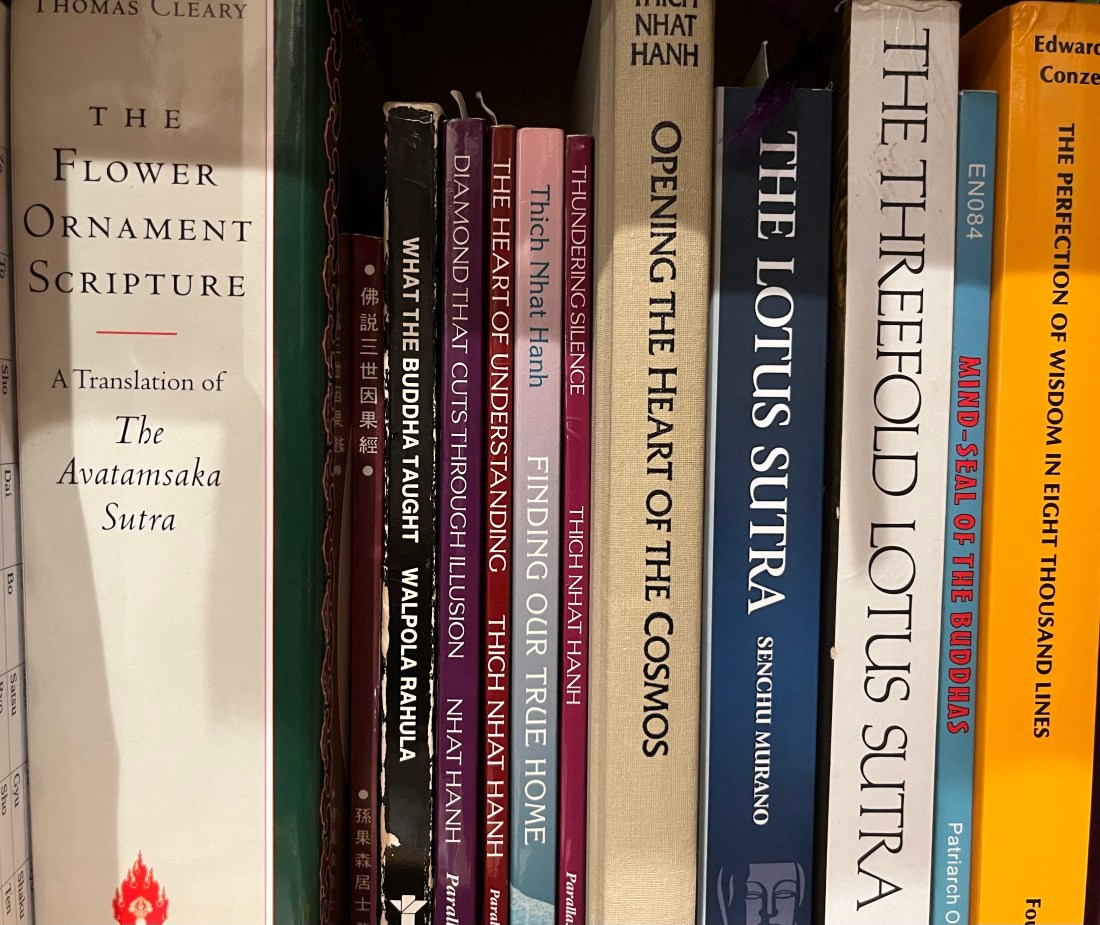
In my bookshelf above, you can see several books I own. I bought many of them in my early years when I really wanted to better understand Buddhist teachings, and needed a good walkthrough. Thich Nhat Hanh really helped with this, starting with the Heart Sutra (Heart of Understanding), and on through the Lotus Sutra (Heart of the Cosmos) and Amitabha Sutra (Finding Our True Home) among others. I didn’t always agree with Thich Nhat Hanh’s somewhat romanticized style of writing, preferring a more calm, analytical style like Bhikkhu Bodhi or the late Yin-Shun, but the fact is is that he covered a lot of important subjects in Mahayana Buddhism that other Western authors simply never did. And still don’t.2

So, I don’t say this lightly, but Thich Nhat Hanh’s book, teachings, translations and commentaries were really important to me in my early years, and have stayed with me since. Thank you “Thay”, and I hope wherever you are now, you’re having a good rest.

Namu Amida Butsu
Namu Kanzeon Bosatsu

1 I used to meditate a lot more than I do now, but even then it was never “into” meditation the way some Buddhists are. Then again, Buddhism is broad with many dharma gates for all types.

2 The gaps in Western Buddhist literature, especially on practical subjects, compared to the Asian equivalents would probably surprise you. It’s why I try to read sources in Japanese as much as I can (some of which ends up in blog posts here 🙂). I hope to write a book to fill in these gaps someday, but at my current progress it’s doubtful I will ever finish.

Conduct First, Practice Second

Note: this is a repost from the old blog, with minor edits. Original post was made in 2016.

Lately, I’ve been re-reading a biography of the Japanese Zen monk Tetsugen Dōkō (鉄眼道光, 1630-1682). He was a monk of the lesser-known Obaku Zen sect in Japan,1 and is best-known for his efforts to standardize and print a complete Buddhist sutra collection (the “Obaku Tripitaka”) for Japanese Buddhism. However, Tetsugen was also an accomplished monk in his own time and his writings are preserved in Obaku Zen literature even today.

Originally, Tetsugen had been a Jodo Shinshu sect priest, just as I have been aspiring towards. However, for reasons not well-understood he left and took up Zen instead. As a Zen monk, Tetsugen became devoted to the Shurangama Sutra in particular, which is not widespread in Japanese Buddhism, but remains very popular in Chinese Buddhism. The origins of the sutra are somewhat unclear (some theories say it was composed in China, but lately scholarship places it back in India) but it emphasizes the importance of conduct first as a foundation for one’s practice. Tetsugen would often travel the country delivering lectures on this and other sutras (e.g. the Lotus Sutra), while collecting funds for the scripture printing project mentioned above.

In one poignant example in the Dharma Debate in Mori in 1674 (known as mori no hōnan 森の法難), the Jodo Shinshu priests in Higo Province there felt threatened by Tetsugen’s lectures and petitioned the local lord insisting on a Dharma debate.2 Jodo Shinshu teaches complete reliance on Amida Buddha, and thus the Buddhist precepts are not observed even by the Shinshu priesthood.  According to Tetsugen’s own affadavit called the “Affadavit Concerning the Dharma Debate in Mori” (mori no hōnan ni kansuru kōjōgaki 森の法難に関する口上書), he wrote:

Those who practice without keeping the precepts set out by the Buddha all represent False Dharma. The reason for this [is as follows:] Although practices such as chanting the nembutsu, seated meditation, and reciting the sutras are each practiced differently depending on the abilities of the believer, the precepts against taking life, stealing, sexual misconduct, lying and the like are absolute, regardless of the sect.

This is similar to a much older, the Dhammapada, where the Buddha teaches:

9. Whoever being depraved, devoid of self-control and truthfulness, should don the monk’s yellow robe, he surely is not worthy of the robe.

10. But whoever is purged of depravity, well-established in virtues and filled with self-control and truthfulness, he indeed is worthy of the yellow robe.

In other words, one’s virtue and self-discipline provide substance to one’s practice. Tetsugen discusses this later in the affidavit:

Thieves don the robes of the Thus Come One [the Buddha], take on the appearance of a monk or nun, and so turn the Buddha into an object for sale and make him into a source of their livelihood. They create all sorts of [bad] karma, and say that it is all the teachings of the Buddha Dharma. Instead, they malign those monks who keep the precepts as followers of the Lesser Vehicle.

The important thing I think is to appreciate what Tetsugen and the Dhammapada are saying: not everyone who wears robes, who has a lineage or teaches a temple (or meditation center) is necessarily a true monk. The quality of a teacher or monk is in how they conduct themselves. 

Intuitively, I think we all know this, but it’s easy to think that we can forgive a teacher for misconduct if his teachings are good, especially where qualified teachers are few and far between. What Tetsugen and the Dhammapada are saying, though, is the opposite: conduct should be the cornerstone of a teacher or monk’s quality, the teachings and practice second.

P.S. Interestingly, Tetsugen never actually criticized the Jodo Shinshu school specifically.  His lectures on the importance of precepts was directed to monastics and lay-followers of all schools equally.  Why Jodo Shinshu followers felt threatened enough to resort to violence is beyond me but might be a leftover from the earlier ikko-ikki peasant uprisings a century earlier.

1 Obaku Zen is descended in China from the same lineage as Rinzai Zen, but Rinzai had come to Japan during the Chinese Song Dynasty, while Obaku had come during the Qing Dynasty, or 500+ years later. In that time, Zen (or “Chan”) in China had changed quite a bit.  However, in Japan, Obaku has been influenced by it’s larger Rinzai cousin to the point that they closely resemble one another again.

2 Historical documents show that Jodo Shinshu followers from nearby towns gathered in a mob outside the temple and threatened to seize him by force, even while under the protection of the local lord. Not wanting to incite violence, and for practical reasons not wanting to bring down the wrath of the Tokugawa Shogunate, Tetsugen and other monks quietly withdrew the following morning and the lecture was cancelled.

The Illusion of Romance

Tetsugen, a Japanese Obaku-Zen monk who lived in the 17th century, and frequent topic of mine recently, once wrote in his main surviving work, the Dharma Lesson in Japanese1 the following passage:2

Thinking that something is repulsive and thinking that something is attractive are both figments of your own imagination….As we gradually get to know someone, feelings of intimacy deepen toward a person we find compatible, and we create the feeling that they are attractive. It is precisely because of this circumstance that when we follow the paths of affection, however much it changes our lives, to that extent the ties of tenderness likewise increase. When you develop feelings of love in this way, loves seems inevitable, and whichever way you turn it over in your mind, it is love without a trace of hatefulness. When you love reaches an extreme, and you think that even if you were to live one hundred million kalpas [vast eons] your feelings wouldn’t change, you are mistaken.

Tetsugen elaborates here:

Though you are intimate friends, you will have some differences of opinion, and will quarrel. Then the quarrels grow into arguments. Or, as is the way of life, if your [lover’s] feelings shift to another, however deep were your feelings of love at the beginning, that is how deep your hate will now become. These feelings of hatred and bitterness are so deep that you may even think that they will eventually kill you….If the thoughts of love were not false in the first place, then you would probably not have changed your mind in a short time…

page 69, trans. by Dr Helen J Baroni in Iron Eyes: The Life and Teachings of Obaku Zen Master Tetsugen Doko

The reason why it is “false” is because your feelings of desire for that person, are a kind of projection of all your hopes and needs onto that person. When they don’t live up to that expectation, your feelings of love or friendship turn into anger. The greater the expectations, the greater the disappointment and frustration.

Speaking from personal experience when my wife and I are happy and romantic in the morning, and then furious at each other in the afternoon, I know it happens. We’ve all probably felt it at least once in our lives. One misstep, one forgotten thing, and it can change so fast. It’s a bummer, but it’s true if you think about it.

Instead, the Buddha taught the need for goodwill for all beings. A balanced, level-headed kind of goodwill.  Genuine goodwill and love is something entirely separate from passion. It’s based on the welfare of others not how they make you feel. “May they be well, and free from harm.”

But if blinded by passion, one is capable of all kinds of harm, even when they believe they are doing good. 

That’s why wisdom is so important. 😎

P.S. The Buddha’s teaching on what true friendship is. 🙂

1 In Japanese: tetsugen zenji kana hōgo (鉄眼禅師仮名法語)

2 Compare with the Buddha’s own words:

“Monks, in whatever monk or nun there arises desire, passion, aversion, delusion, or mental resistance with regard to forms cognizable via the eye, he/she should hold the mind in check. [Thinking,] ‘It’s dangerous & dubious, that path, thorny & overgrown, a miserable path, a devious path, impenetrable. It’s a path followed by people of no integrity, not a path followed by people of integrity. It’s not worthy of you,’ he/she should hold the mind in check with regard to forms cognizable via the eye.

SN 35.205, the Vina Sutta, translation by Ven. Thanissaro Bhikkhu

Mind as Mirror

In his famous “Dharma Lesson in Japanese” or tetsugen zenji kana hōgo (鉄眼禅師仮名法語), the Japanese Zen-Buddhist monk Tetsugen (mentioned here in earlier post), wrote in the fourth section:

When you see images reflected in a bright mirror all day long, it reflects the sky, the land, flowers, willow trees, people, animals and birds. All the colors change and the types of things [reflected] change without a moment’s rest, but the true form of the mirror is not the birds and animals, or the people, or the willows, flowers, the land, or the sky. It is just the shining and unclouded mirror itself. Our original minds reflect and illuminate the ten thousand dharmas, but have no connection to their distinctions.

Translation by Helen J Baroni, from Iron Eyes: The Life And Teachings of Obaku Zen Master Tetsugen Doko

This is based on earlier Yogacara-Buddhist teachings, and can be pretty hard to grasp beyond a surface-level intellectual standpoint. It takes considerable time, practice and introspection to finally “get it”.

Dr. Helen J. Baroni, comments elsewhere in the book:

The mind, like the mirror, is independent of the images it reflects and remains unchanged by them. Therefore, there is no need to purify it of them. While it is possible to quiet the flow of psychic constructions in meditation, there remains a dualism inherent in the practice. For the enlightened mind, the mirror should be visible “even if images of blossoms and willows are reflected.”

Pretty deep stuff.

Even Carrion is Tasty to Some

Tetsugen Dōkō (鉄眼道光, 1630-1682), often called “Tetsugen” is a somewhat obscure but influential Buddhist monk of the similarly obscure Obaku Zen sect in Japan. Tetsugen was a prolific teacher and writer in his day, and today is best known for his efforts to provide a comprehensive, high-quality block-printed edition of the entire Buddhist canon (the “Obaku Edition” of the Tripitaka) in Japan. The life and teachings of Tetsugen are compiled in the excellent biography Iron Eyes: The Life And Teachings of Obaku Zen Master Tetsugen Doko.

One of his best known writings is a text called the Dharma Lesson in Japanese (鉄眼禅師仮名法語 , tetsugen zenji kana hōgo) which was written for a lay-devotee and is based on the Heart Sutra.

I had read the biography and the Dharma Lesson years ago, but suddenly recalled this quote:

Even though what we think of as painful or pleasant aren’t really pain and pleasure, because we are deluded, we end up thinking they are. The reason for this is that when a crow, a dog, or a fox sees a dead crow or horse rotting or a human corpse festering, they think it is a rare treat. First they enjoy looking at it, then their enjoyment increases as they smell it and grasp it. They think this is the greatest of pleasures. Seen from the human perspective, this seems immeasurably impure and repulsive. If we were forced by others to eat such putrid things, it would be incomparable suffering. What is worse than being forced to eat them is that crows devour such things greedily, and think it is pleasant…(pg. 99)

Translation by Helen J Baroni

Similarly, the Buddha, when observing moths attracted to a flame commented to his disciples:

Rushing up but then too far, they miss the point; Only causing ever newer bonds to grow. So obsessed are some by what is seen and heard, They fly just like these moths — straight into the flames.

Ud 6.9, the Adhipataka Sutta, translation by Andrew Olendzki

It’s not hard to see how this pertains to people as well.

Eco Buddhism Now More Than Ever

Years back, when I used to go to a certain Buddhist temple here in the Pacific Northwest, we had a lay minister named Reverend Don Castro, who was passionate about Ecology and Buddhism. He would encourage the congregation to recycle, talk about Buddhism as a religion of ecology and so on. He was a beloved minister,1 and I fondly remember many times practicing liturgy with him, but I admit that at the time I didn’t think about his ecology message too much. It was an abstract thing for another day.

The EcoSangha logo, which Reverend Castro hoped will be widely used in the Dharma community.

But now, fast forward ten years, I believe that the message of Buddhism and Ecology is more important than ever.

Reverend Castro famously said in various sermons and publications:

To be a Buddhist is to be both an ecologist and a conservationist.

What does this mean?

Buddhism as a religion is somewhat complicated, but its teachings, the Dharma, include some important teachings that are worth nothing here:

  • Goodwill towards all beings (e.g. metta)
  • The interdependence of all beings (e.g. shunyata)

Goodwill towards all beings doesn’t necessarily mean that you be their best friend, or that it is a bleeding-heart compassion for all beings. Instead, it’s about appreciating the value of all living beings, wishing them at the very least that they be free from harm and well. This includes tiny little bees in your garden to angry, obnoxious people. This is harder than it sounds, especially when faced with a drunk, swearing idiot blocking your way. But then in the Dhammapada, the Buddha encourages the following viewpoint:

129. All tremble at violence; all fear death. Putting oneself in the place of another, one should not kill nor cause another to kill.

130. All tremble at violence; life is dear to all. Putting oneself in the place of another, one should not kill nor cause another to kill.

131. One who, while himself seeking happiness, oppresses with violence other beings who also desire happiness, will not attain happiness hereafter.

132. One who, while himself seeking happiness, does not oppress with violence other beings who also desire happiness, will find happiness hereafter.

The Dhammapada, section 10, translation by Acharya Buddharakkhita

The Buddha asks us to put ourselves in the shoes of others, to see what they see, to feel what they feel. It might not change your mind, but at least it gives a newfound respect and appreciation for others.

The interdependence of all beings means that our life and our existence is contingent on so many other beings, external causes and such. We are nurtured by our parents, taught by our teachers, and fed and clothed by hard-working people in factories, whom we will probably never meet. In the same way, may others around us are contingent on what we say, think and do too.

Thus, your actions and attitudes towards others do help shape the world around us. It’s not that we can make a difference, it’s that we do make a difference each day. Thus, if we make a conscious effort to make the world a better place for others (even the angry, obnoxious ones), bit by bit it does happen.

Looking back, we can see how the Dharma teachings of goodwill and interdependence relate to Ecology too. By our actions, however small, we’re making the world a better place for others, even the ones we don’t necessarily like (but still are an important part of this world). Planting trees, bee-friendly flowers, recycling, cutting car emissions, keeping our rivers and streams clean, and so many other things do make a difference.

Will it be enough? Who knows, but somewhere down the line, someone will benefit from what we’ve done, and we too will benefit as a result.

Namu Amida Butsu

P.S. The symbol of the Eco-Sangha, is the Buddha touching the earth in the famous Earth-Touching Mudra. Historically speaking, this was the Buddha-to-be, Siddhartha’s vow to stay put and meditate until he reached Awakening (with the earth as his witness), but in the ecology sense, it takes on a new meaning. More on the local Eco Sangha community here.

P.P.S. Although I’ve lost contact with Reverend Castro, if he ever reads this, I hope he enjoys. ☺️

1 Reverend Castro had a talent for singing Buddhist liturgy nicely, unlike me who was pretty tone-deaf. I remember him being very patient with me. 😅

One Damn Thing After Another

The last few weeks have been pretty rough for me, after a senior engineer on my team resigned, and my workload suddenly grew exponentially. I try to turn off the news as well when it feels overwhelming, but it still weighs on my mind even when I try not to think about it.

Lately I have a persistent feeling of “it’s just one damn thing after another”, but as I think about it, this is a pretty good summation of Buddhist doctrine, the Dharma, as well.

The Buddha described the world using the term dukkha which doesn’t translate well in English, but was often compared to a spinning potter’s wheel. A wheel that is sukkha spins smoothly and easily. A potter’s wheel that is dukkha wobbles and requires more effort to make it spin the way you want. In the same way, life is marked with frustration, challenges, dissatisfaction and so on.

Then, things outside your control happen, throwing a wrench in your plans and aspirations. It really can feel like “one damn thing after another” both on a personal level, and at a macro level.

The Buddha is thus cynical of the cosmic rat race and all the suffering that comes with it. Like waves in water, arising and falling in rapid succession, many things in life, both beneficial and harmful, will come and go. The Buddha’s teaching is thus not to get too attached, too invested. See it for what it is, and let it go.

On flows the river ceaselessly, nor does its water ever stay the same. The bubbles that float upon its pools now disappear, now form anew, but never endure for long.

Kamo no Chomei, the Hojoki, trans. by Meredith McKinney

Namu Amida Butsu

The Ten Verse Kannon Sutra

A photo of the Ten Verse Kannon sutra, showing Chinese characters vertically, with Japanese pronunciation to the right of each individual character.
A photo of the Ten Verse Kannon Sutra from my sutra book, purchased as Asakusa Temple (a.k.a. Sensoji) in Tokyo Japan

In medieval Japanese Buddhism, you can find many interesting little innovations. One example is a popular liturgy called the jikku kan’on gyō (十句觀音經), or the “10 Verse Kannon Sutra”.

It is a popular, devotional chant in Japanese Buddhism toward Kannon Bodhisattva. You can find it in various Buddhist sects, Zen, Tendai, etc. My sutra book from Asakusa Temple (a.k.a. Sensoji) includes it since the temple’s deity is Kannon. The origin of the text is not entirely known, though it’s speculated that is was composed by a Tendai priest as a summation of the 25th chapter of the Lotus Sutra. The 25th chapter is sometimes chanted or recited in devotional services because it is dedicated entirely to Kannon Bodhisattva. However, it is challenging to recite due to its length, even if you just recite the verse section.

Assuming this is really was formulated as a summary, a lay person could recite this with the same intention as reciting the full chapter, but this would be a lot easier for someone of humble background who maybe cannot read all the complex Chinese characters in the original, let alone someone who has to work the fields all day. It is also short enough for someone to easily memorize and chant in its entirety.

It’s not technically a sutra in the sense that it does not purport to speak on behalf of the Buddha, but there are other examples in of sutras (such as the Platform Sutra in Zen) that fit this awkward category as well.

So, for those interested, I present the Ten Verse Kannon Sutra, with translation below:

Can’t read the characters?

If you’re having trouble reading the Kanji characters, you might have one or two problems with your computer:

  • Your computer may not have Asian fonts installed. In Windows you have to enable UTF8 and East Asian fonts under the Control Panel. Modern Mac computers are fully compatible already.
  • Your browser may be assuming the wrong character set. If you use a relatively modern browser and use UTF8 as character set, you should be able to read fine. IE, Firefox and Safari all read this fine as far as I can tell.

Even if not, then you can still use the romanized characters, and the (terrible) English translation.

Disclaimer and Legal Info

I hereby release this into the public domain. Please use it as you see fit, but if you attribute it to this site, greatly appreciated. Also, please bear in mind this is an amateur translation, and should not be taken too seriously, nor is it of academic quality.

Dedication

Kannon Bodhisattva. Taken at Daienji Temple in Meguro Ward, Tokyo, Japan in 2010

I dedicate this effort to all sentient beings everywhere. May all beings be well, and may they all attain perfect peace.

Namu Kanzeon Bosatsu

The 10 Verse Kannon Sutra

Japanese TextRomanizationКирилицею (in Cyrillic)
觀世音Kan ze onкан дзе он
南無佛namu butsuнаму буцу
與佛有因yo butsu u inйо вуцу у ін
與佛有縁yo butsu u enйо вуцу у ен
佛法相縁bup po so enвуппо со ен
常樂我淨jo raku ga joджьо раку ґа джьо
朝念觀世音cho nen kan ze onшьо нен кан дзе он
暮念觀世音bo nen kan ze onбо нен кан дзе он
念念從心起nen nen ju shin kiнен нен джю шін кі
念念不離心nen nen fu ri shinнен нен фу рі шін

Chanting Example

You can find examples of chanting of the Ten Verse Kannon Sutra on Youtube such as this one:

My Translation

At its heart, the Ten Verse Kannon Sutra is both a praise of Kannon Bodhsattva, but also gratitude for the karmic bond between oneself and Kannon (explanation here, albeit different Buddhist deity).

This translation below is something I made a while back, and is a rough translation only. Other translations is here and here. Big thanks to Reverend “E” for his excellent scholarship and assistance in this endeavor.

Kanzeon [Bodhisattva]!

Praise to the Buddha!

With the Buddha as cause,

With the Buddha as condition,

Through the Buddha, the Dharma and the Sangha

I attain eternal, blissful, self, purified of all defilements [nirvana].

In the morning, I recite “Kanzeon”.

In the evening, I recite “Kanzeon”.

Reciting and reciting arises from the awakened mind.

Reciting and reciting is not separate from [awakened] mind.

Enjoy and happy reciting!

P.S. The “Buddha” here I believe is the eternal Buddha, the Dharmakaya, not the historical Buddha, Shakyamuni