The Lost “Iranian” Buddhism: A Brief History of the Silk Road

Hello Everyone,

I recently finished two related books this week: the Xuan-zang book I wrote about before and a new book by Richard Foltz titled Religions of the Silk Road: Premodern Patterns of Globalization. The latter book was fairly short, but it was well-written and I finished it in about 4 days. I highly recommend it.

One of the reasons why I enjoyed these books so much is that they helped explain an important question about Buddhist history: how did Buddhism go from India to China?

Anyone who’s studied a little history about Buddhism knows it travelled the Silk Road from India to China, where it flourished and influenced other East Asian countries (Korea, Japan, Vietnam, etc). But this glosses over a lot. So these two books helped explain what exactly happened, and historical research was actually kind of surprising.

Bas relief nagsh-e-rostam couronnement.jpg

Different kingdoms and people “ruled” the Silk Road at different points of time, but many of them had a common “Iranian” origin. This is not the same as the modern country of Iran, but rather a common ancestry, which included such people as the Persians, the Sogdians, the Parthians and the Indo-Aryans such as Siddhartha Gautama. They had a common ancestry, spoke related Iranian-languages, and had common religious traditions that helped influence the new religions they encountered.1

What Is the Silk Road?

Silk route

The Silk Road was actually a network of trade routes that connected China with India, Persia and beyond Persia to the Near East. There were multiple routes, not a single road, and it was not common for a single merchant to travel the entire length. Instead, merchants would often use a “relay system” to bring goods to a major city along the road and trade there. The same goods might be carried by another merchant elsewhere, and so on.

For example, between Indian and China there were three major roads, two passing through Central Asia: the “north” road which was longer but somewhat safer and passed north of the Taklamakan Desert, and the shorter “southern” road which was quicker but was riskier due to mountains, flooding rivers and the Desert. Xuan-zang, in his famous journey, took the northern route from China to India, and was relatively safe, but on his return, he took the southern route and nearly drowned twice, lost his elephant and many important items he brought back from India. Meanwhile, in the ancient city of Palmyra in Syria, mummies have been found wrapped in Chinese silk.

Anyhow, the constant trade back and forth also brought other people who were not in business. Monks, priests and people seeking their fortune would sometimes accompany merchant caravans. Cities and kingdoms on the Road often welcomed such people because they helped connect them with important cultures like Persia, India and China, and would help improve their prestige. With greater prestige and culture, such a kingdom might prosper over rivals.

Why Did Buddhism Spread Along the Silk Road?

The original reason was probably trade. Rulers along the Silk Road would patronize traveling monks by building monasteries and establishing new Buddhist communities. This would help generate donations for the local economy, and enhance the culture and prestige of the city helping the economy further. For example, at the city of Balkh (now Afghanistan), Xuan-zang found 100 monasteries and a 3000 monks there in the 7th Century.

In reality, the local population probably didn’t convert to Buddhism en masse, but instead it may have blended with existing religious traditions. Further, as Buddhism declined, later religions such as Nestorian Christianity, Manichaeism and Islam spread the same way. It was a recurring pattern: whoever controlled the trade influenced the religious tendencies of the region.

What Kind of Buddhism Did They Spread

Three schools of Buddhism, out of the original 18, that spread along the Silk Road were:

  • Mahasangikas – Who tended to downplay the importance of the enlightened arhats, and emphasize intuition. They helped build the famous giant statues at Bamiyan, now destroyed.
  • Dharmaguptakas – Who elevated the importance of the Buddha, such that only he was worthy of offerings, and not the monks. They were the most important school early on, but gradually declined. The Agama Sutta in the Chinese Canon (equivalent to the Pali Canon in Theravada) is partly from Dharmaguptaka sources, as well as the Chinese monastic code of discipline.
  • Sarvastivadins – Who believed that past, present and future all existed simultaneously and were thus considered heretical according to the 3rd Council of Buddhism. Otherwise they were similar to other schools. Much of the Agama Sutta above derives from Sarvastivadin sources as well.

Finally of course was Mahayana Buddhism, which is what we see now in East Asian Buddhism. Mahayana Buddhism was not a distinct school at this time, but had members from each of the various Indian schools, interacted closely with them, and was thus influenced by them. Mahayana Buddhism and its “bodhisattva practices” was a kind of extra-curricular activity monks and nuns could participate in, on top of their usual monastic discipline.

Research shows that much of imagery and sutras used in Mahayana Buddhism may have been composed outside of India in Central Asia. Iranian culture already had a diverse pool of beliefs and imagery, including but not limited to Zoroastrianism, and this may have helped shape what we now know as East Asian Buddhism. More on that in another post.

Who Spread Buddhism?

There were four major peoples that help spread Buddhism along the Silk Road, three of whom were ethnically Iranian:

  • The Bactrians, who blended Indian Buddhism with Greek culture.
  • The Kushans, who learned form Bactrians and spread it further.
  • The Sogdians, master traders and translators
  • The Parthians, the last and most powerful group who brought many texts and translators to China.

Buddhism began to spread from India to the Greco-Iranian kingdom of Bactria first. It was close to Kashmir, which was a major center of Buddhist learning, and the Bactrian kings were tolerant of all religious traditions. The people and language were a mix of Greek setters, Indian and Bactrian (Iranian). The Bactrian language even used Greek letters. As an example of diversity and tolerance, King Menandros patronized Buddhism, though he was not a follower. His dialogues are preserved in a Buddhist text called the Questions of King Menander.

But the Bactrian kingdom didn’t last long, and was soon conquered by an Iranian people called the Sakas, then the Kushans. The Kushans are possibly a mixed-ethnic group (Iranian and Tocharian) who revived the Greco-Bactrian culture and helped spread Buddhism further than before. It was under the Kushan Empire that Buddhist statues, which resembled Greek statues in some ways, began to appear. This is the “Gandhara-style” of Buddhist art, named after a famous region of the Kushan Empire.

Gandhara Buddha (tnm).jpeg

King Kanishka of the Kushan Empire, was considered a great patron of Buddhism, though he wasn’t a follower (he patronized Greek gods and Hindu deities as well). He organized a new Buddhist council in Kashmir to rewrite old Buddhist texts from obscure local “Prakrit” dialects into more standard Sanskrit, for example. Kanishka also helped build monasteries and communities throughout his empire. He is often called the “Second King Ashoka” for this reason.

But the group that helped spread Buddhism the most wasn’t the Kushans, it was the Sogdians. The Sogdians were a small Iranian people who lived around modern Uzbekistan and Tajikistan, and were master translators and traders.

Sogdian artwork of Rostam

Their location along the Silk Road meant that they interacted with many different cultures, and thus they were able to carry ideas and goods to other major cultures easily. After Buddhism, the Sogdians helped spread other religions such as Nestorian Christianity and Manichaeism as well as Islam. The Sogdians frequently translated texts from one language to another: for example Prakrit to Bactrian, Aramaic to Turkish, Parthian to Chinese, etc. Ironically the Sogdians did not translate much Buddhist texts into their own language until much later (mainly from Chinese) and this may help explain why Buddhism didn’t take root in Sogdian culture. There were definitely examples of devout Sogdian monks and communities but not wide-scale devotion.

Finally, the last major group to bring Buddhism to China were the Parthians. The Parthians were another major Iranian group that eventually conquered the Kushans and establaished the Parthian Empire. it was during this time that Buddhism probably spread the furthest into Central Asia. For example in the famous city of Merv (now in Turkmenistan), researchers have found extensive Buddhist texts from the 1st-5th centuries and Buddhist communities in Shash (modern Tashkent) show that Buddhism had spread northwest of India before it turned east toward China.

The Parthians also contributed many famous translators into Chinese.2 The most famous was An Shigao (安世高) who translated a lot of basic Buddhists texts along with his student An Xuan (安玄). The surname ān (安) was frequently used for Parthians at the time. Some of these texts are still used in the East-Asian (and Western) Buddhist canon.

Why Did Buddhism Decline on the Silk Road?

As mentioned earlier, whoever controlled the trade of the Silk Road influenced religion there. After Buddhism was established, newer religions such as Nestorian Christianity and Manichaeism gradually dominated. The Persian merchants patronized both religions, as well as the state religion of Zoroastrianism and soon the Silk Road became very religiously diverse.

The final religion to appear was Islam. By the time that Islam reached Central Asia, Arab traders dominated the trade, and local kings and merchants found it advantageous to convert in order to build closer ties. In the countryside and the remote steppes, people tended to follow Nestorian Christianity and Buddhism for much longer, but in the cities, Islam and Arab culture were the new rising star and people tended to convert. Buddhism was already declining in India, so there wasn’t much incentive to maintain cultural ties with the Buddhist world. People simply lost interest.

Foltz’s book shows how the history of “Islamic conquest” at this time was often greatly exaggerated too. Writings at the time depicting local kings and warlords conquering other lands in the name of Islam were often a cover to simply expand control of trade, not religion. Research shows that the “convert or die” policies of these kings were often unsuccessful and limited in scope. What actually persuaded Central Asian people to convert to Islam were oftentimes charismatic Sufi preachers who helped fulfill the role of “shaman” that previous religions had done generations earlier. To this day, Islam in Central Asia is often syncretic and blends elements of earlier religions with canonical Islam. Meanwhile, the Nestorian Church ironically survived in the heart of the Islamic world in the form of the Syriac Church in northern Iraq and other places.

SyriacChurch-Mosul

Between the change in economy, decline of Buddhism in India and role Sufi preachers played in spreading the new dynamic faith, Buddhism naturally declined and faded entirely as did Nestorianism and Manichaeism.

Conclusion

The Iranian peoples of Central Asia were critical to bringing Buddhism out of India to Central Asia, China and now the modern world. We wouldn’t have things like Zen and Pure Land Buddhism if it weren’t for the Sogdians, Kushans and Parthians among others. Ironically many of these cultures no longer exist, yet their legacy lives on in many others.

The books mentioned at the beginning of this post were a lot of fun to read and I can’t recommend them enough for those interested in Buddhist history.

P.S. another blog repost, but with many fixed and updated links.

1 Even the modern Islamic Republic of Iran is just the latest in a very long series of dynasties and rulers that stretches back to the earliest civilizations of Man. See for example the Safavid Dynasty and Achaemenid Dynasty.

2 Other famous translators were not Parthian though: Lokaksema was Kushan while Kumarajiva had ancestry from both Kashmir and Kucha, another major Buddhist center at the time.
Of Famine and Excess

Recently, I was re-reading an old book in my personal library about the life of the Shogun Ashikaga Yoshimasa (also mentioned here). The Ashikaga Shogunate, that is the military government in Japan from 14th to 16th centuries,1 started out fairly strong, but quickly ran into a series of succession crises and bad governance that culminated in a very disastrous Onin War. The Onin War was a 10-year urban battle in the heart of Kyoto over a succession crisis that basically flattened the city and caused unimaginable death and starvation there and in the provinces.

In Donald Keene’s book, he talks about the utterly ridiculous income disparity between the typical peasant and the aristocrats in Kyoto, as if they lived in two different worlds. Even as the war was raging, Shogun Ashikaga Yoshimasa’s exorbitant taxes to pay for this vanity projects further exacerbated this.

One chronicler at the time, a Zen priest residing in Kyoto named Unsen Taikyoku (雲泉大極, 1421 – ??), recounts in his personal diary:2

When the sun went down I set out for home, and as I was passing Rokujo I saw an old woman with a child in her arms. She called the child’s name repeatedly, then began to wail. I looked and saw that the child was already dead. The mother, still wailing, collapsed on the ground. People standing nearby asked her where she came from. She said, “I’ve come all the way from Kawachi. We’ve had a terrible drought for three years, and the rice plants didn’t so much as sprout. The district officials are cruel and greedy. They demand a lot of money in taxes and show no mercy. If you don’t pay, they kill you. That’s why I had to run away to another province. I was hoping to earn food by begging. But I couldn’t get anything to give my baby. I’m starving and I’m worn out, heart and soul. I can’t take any more.”

When she had finished speaking, she again choked with great sobs. I took from my wallet what spare money I had and gave it to her, saying, “Take this money and hire a man to bury the child. I’m going back to my cell where, with help from the Three Treasures [the Buddha, the Dharma and the Sangha] and the Five Commandments, I shall choose a Buddhist name for the child and offer prayers for his salvation.” The child’s mother was greatly comforted.

While I was still humbly mulling over her sad story, I encountered a group of noblemen out to admire the blossoms. They were escorted by several thousand mounted men, and servants and followers swarmed around them. These gentlemen acted as if they were so superior that nobody could compare with them. Some sneered at the people in the streets; others swore at the menials in the path of their horses; others laughingly stole blossoms; others, drunkenly singing, drew their swords; others still, having vomited food and drink and being unable to walk, lay on the roadside. There were many such sights, and whoever saw them was appalled. Anyone who happened to run into these people was terrified and ran away, intimidated by their high rank.

Yoshimasa and the Silver Pavilion: The Creation of the Soul of Japan, pages 51-52, translation by Donald Keene

It’s not hard to imagine such things happening in a place like Los Angeles, Silicon Valley, London, Paris and so on. It’s not a question of a particular political faction, it’s a tendency of any society to gradually concentrate wealth over time to a smaller and smaller group, further exacerbating the income disparity. Marx spoke of this in the context of capitalism…

But even as far back as the last days of the Roman Republic, we could see a similar pattern (jump to about 19:30 or so):

In any case, unless this trend is addressed in a sustainable way, it never portends anything good.

1 The Ashikaga military government is unrelated to the earlier Kamakura shogunate which I spoke about elsewhere. Since Japan had a succession of military-samurai governments after the Imperial aristocracy was sidelined, and you can think of them like Chinese imperial dynasties in a historical sense.

2 Criticizing such things openly would have incurred the wrath of the Shogunate of course.

Every Day Is A Good Day, Kind Of

Soon after I wrote this post, I was reminded of a certain Zen aphorism in Japanese: 日日是好日 which is read as nichi nichi kore kō nichi.

This usually translates as “every day is a good day”, or “each day is a good day” or other such things. It is originally attributed to a Chinese Zen monk named Yunmen Wenyan from the 9th and 10th centuries.

At first glance, this seems like a positive affirmation of life. This is the sort of thing you might see from life-coaches, self-help gurus, posters, daily affirmations, songs, and so on. Live, laugh, love and all that.

But that kind of attitude and outlook is only useful for financially stable, healthy, affluent people living in stable countries. It’s pretty useless for people who live in difficult circumstances, working thankless, dead-end jobs, dying from pneumonia, or suffering from abuse. If you’re a child in Syria who has lost their parents during the recent earthquakes, the “live, laugh, love” phrase rings pretty hollow.

A while back, I wrote about similar issues with Seneca’s philosophical teachings. The Stoic teachings which Seneca espoused basically amounted to “suck it up” and “don’t be sad”, which is fine when you’re a Roman senator, but not too useful for the Roman slave working the fields.

In fact, for most people in the world, most days are varying degrees of shitty.

Life is a slog; First Noble Truth of Buddhism right there.

So, is there any value or meaning to Yunmen Wenyan’s famous phrase? I think so.

This is strictly my own interpretation, so please take with it a grain of salt. This morning, I had to step outside in the early morning and I beheld the sunrise. It is cold, it is early March, it is still dark outside, yet I saw the sun rising, and birds flying past it. I was glad to see it, to be breathing and savoring that moment.

Life is bittersweet. It is full of pain, loss, frustrations, and unfulfilled needs. It doesn’t necessarily get better, but it does carry on. Each moment of breath is still worth it. If you can share it with others, so much the better. But even if not, each moment is still worth something.

This is, I believe, what Yunmen Wenyan might have been saying to us, even when it gets lost in translation.

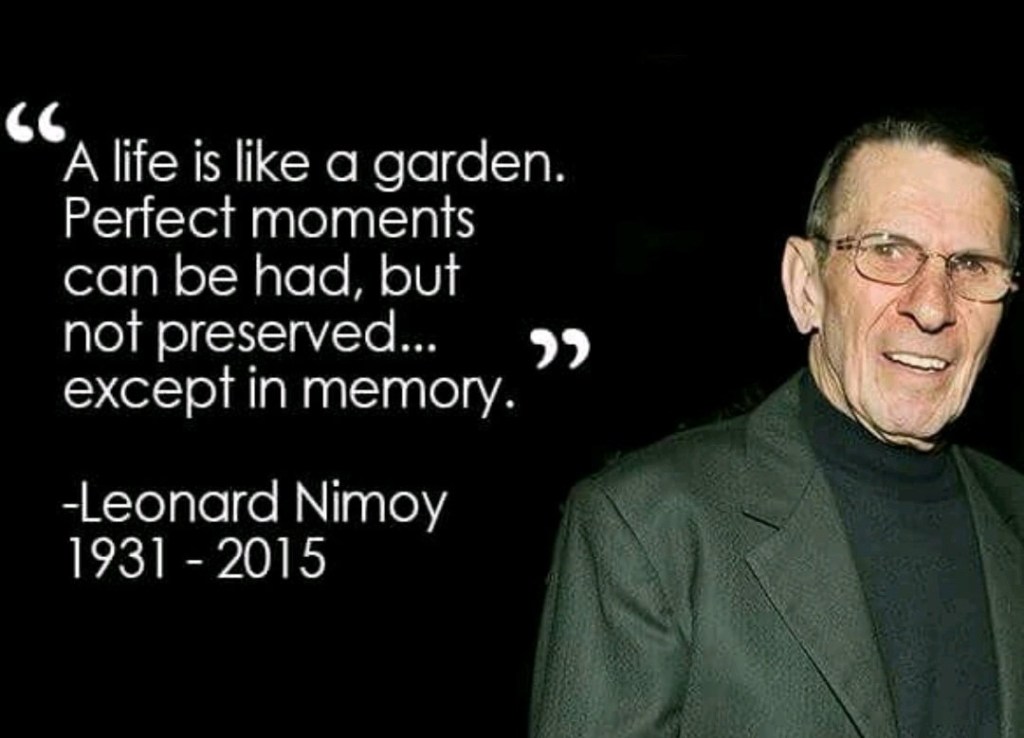
P.S. RIP Leonard Nimoy. LLAP. 🖖

Polishing the Mind

In Chinese-Buddhist literature, the influential treatise Cheng Wei Shi Lun (成唯識論) contains the following quote, translated in the book Living Yogacara:1

Polishing their minds, the courageous do not waver.

trans. Professor A. Charles Muller

This treatise was written by the famous Chinese monk, Xuanzang (玄奘), whom I talked about recently. From his journeys in India, Xuanzang brought back considerable information and texts to help the Yogacara Buddhism tradition flourish in China, along with many other important Buddhist texts and observations. Upon his return he wrote extensively and translated many works with Imperial support.

The Cheng Wei Shi Lun, is one of the foundational texts for East Asian Yogacara thought including the descendant Hossō school in Japan, and the treatise is quoted multiple times in Living Yogacara.

When I read this passage, I feel it is an encouragement for people who walk the Buddhist path. Life really can bring you down, and when you’re tired and exhausted, it is so easy to want to backslide and wallow in self-pity or take the low-road which is so much easier up front.

However, every action and thought committed “perfumes the mind” in Yogacara-speak, and its important to bear this in mind. There’s no such thing as a free lunch,2 so every deed or intention has its price, and the only way to break free from the constant up and down cycle, the constant upkeep, is to purify the mind once and for all, bit by bit. As the Yogacara school of thought teaches that Enlightenment takes 3 massive eons to complete (literally “three asaṃkhya kalpa”), it’s a gradual process. However, in Buddhism there is a lovely passage from the Immeasurable Life Sutra that I was also contemplating lately:

“At that time the Buddha Lokeshvararaja recognized the Bhiksu Dharmakara’s noble and high aspirations, and taught him as follows: ‘If, for example, one keeps on bailing water out of a great ocean with a pint-measure, one will be able to reach the bottom after many kalpas and then obtain rare treasures. Likewise, if one sincerely, diligently and unceasingly seeks the Way, one will be able to reach one’s destination. What vow is there which cannot be fulfilled?’

Nothing worthwhile in life comes easily, and hence Xuan-Zang’s statement that the courageous do not waver. They have everything to gain in the process.

Namu Amida Butsu

1 Compare to the ancient Dhammapada, verse 183:

The non-doing of any evil, the performance of what’s skillful, the cleansing of one’s own mind: this is the teaching of the Awakened.

2 See Heinlein’s novel The Moon is a Harsh Mistress. 🙂

Soto Zen Yearly Liturgical Calendar

Hello,

Recently, I alluded to joining a local Soto Zen group and deepening my practice there. I am happy to report that after several weeks, I finally decided to formally join the community as a member. Thus, I guess I am now a student of Soto Zen.1 It is kind of exciting to be part of a Buddhist community again after years of isolation, but also a bit of an adjustment since I’ve been doing things a different way for a very, very long time.

As part of this I wanted to get familiar with the yearly liturgy of the Soto Zen tradition. To my surprise, the local community seemed to not follow this yearly calendar, but I guess it’s up to each follower, and each community to apply this calendar as much possible.2

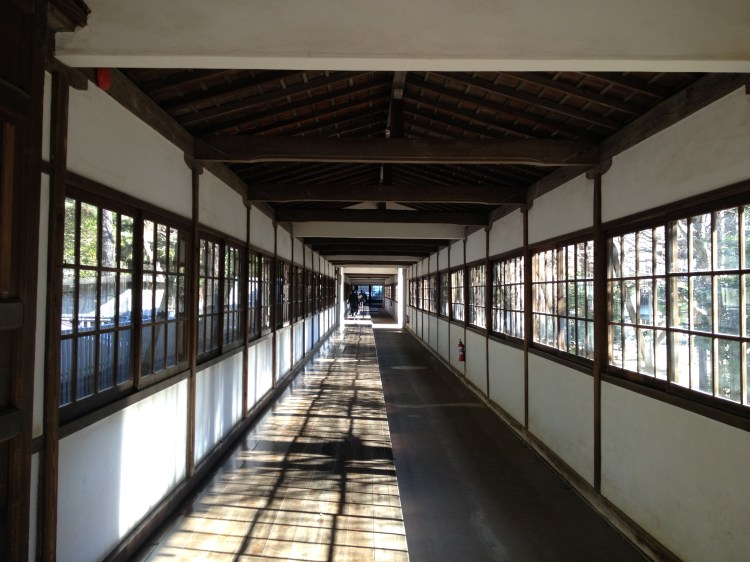
This was taken near the famous Chujakumon (中雀門) Gate at Sojiji Temple, looking westward. Photo from 2012.

Anyhow, I think it’s helpful to get familiar with the calendar of events not just to have a foundation in one’s life and practice, but also to stay connected with the much larger community. So, for that reason I’m posting the yearly event calendar here for readers. Many of these holidays line up with other Buddhist traditions in Japan, and I’ve already talked about them in other blog posts, while a few are exclusive to Soto Zen only.

DateJapaneseEvent
January 3rd転読大般若
Tendoku Dai-hannya
Reading of the Great Perfection of Wisdom Sutra
February 15th涅槃会
Nehan-e
The Death of the Historical Buddha, Shakyamuni
Late March彼岸会
Higan-e
Spring Equinox
April 8th花まつり
Hanamatsuri
The Birth of the Historical Buddha, Shakyamuni
Late July / Late August盂蘭盆会
Urabon-e
Obon Season
Late September彼岸会
Higan-e
Fall Equinox
September 29th両祖忌
Ryoso-ki
Memorial for both founders of Soto Zen: Dogen and Keizan
October 5th達磨忌
Daruma-ki
Memorial for Bodhidharma, the Indian monk who brought the Zen tradition to China.
December 8th成道会
Jodo-e
The Enlightenment of the Historical Buddha, Shakyamuni
December 31st除夜
Joya
End of the year temple bell ringing
Source: https://www.sotozen-net.or.jp/ceremony/annual

Let’s talk about some of these events below.

Reading of the Great Perfection of Wisdom Sutra

The Great Perfection of Wisdom Sutra requires some explanation. The Sutra is not one Buddhist text, but a collection of sutras that appeared in India starting in the 1st century CE. Each of these “great perfection of wisdom” sutras (a.k.a. prajña-paramita in Sanskrit) basically teaches the same message, but each version was composed in varying sizes: 8,000 verses, 15,000 verses, 25,000 verses, etc. The trend happens in reverse too: some versions get shorter and shorter until you get to the famous Diamond Sutra and Heart Sutra. Due to their slimmer size and easier recitation, these two sutras have retained more popularity over time.

Nevertheless, regardless of which version we’re talking about, the Great Perfection of Wisdom Sutra is a powerful foundation for Mahayana Buddhist traditions everywhere, including the Zen tradition. Thus, many traditions have some kind of “sutra reading” ceremony.

Because the Perfection of Wisdom Sutra is so large, it’s impractical to read/recite the entire sutra in a single session, so the ceremony usually involves Buddhist monks opening each fascicle and fanning through the pages to symbolize reading it. It’s a very formal ceremony. You can see an example of this below, though I am unclear which Buddhist sect this is:

If you want to the ceremony itself, skip to 11:30 or later, until about 16:00

English-language copies of the Great Perfection of Wisdom Sutra are very hard to find, by the way. I consider myself very lucky to find a copy of the 8,000-verse sutra at Powell’s City of Books some years back (that bookstore is amazing by the way):

Most Zen communities in the West can’t be expected to have such a copy. In any case, since the Heart Sutra is a summation of the Great Perfection of Wisdom Sutra anyway, it makes sense for most Zen practitioners to simply recite the Heart Sutra as appropriate. In the Youtube video above, the monks even recite the Heart Sutra at one point too.

Dual Founders Memorial

Soto Zen is somewhat unusual in Japan for having two founders, not one. The sect-founder-practice dynamic is something unique to Japanese Buddhism,3 usually each recognized Buddhist sect in Japan has one founder, not two.

Normally, when Westerners think of Soto Zen in Japan, they think of Dogen as the founder since he was the one who traveled to Song-Dynasty China, studied Caodong-sect Zen teachings, and brought those back to Japan.4 The challenge is that during this time, Soto Zen was a strictly monastic institution that had minimal appeal to the wider Japanese society.

Keizan, who came a few generations later, reformed Soto Zen as an institution that had more broad appeal. It was still centered around the monastic institution, but also included more community connections to the warrior samurai class and the peasantry as well. Soto Zen flourished in a way that other Zen sects in Japan simply never did. For this reason, Keizan is considered the second founder.

Thus, during formal ceremonies, a Soto Zen text, the ryōsokisho (両祖忌疏) is read aloud, which describes the virtuous life of both founders through the use of Chinese-style poetry.

Bodhidharma Memorial

Bodhidharma, unusually depicted standing. Taken at Sojiji Temple in 2012.

Within the world of Zen, Bodhidharma is a guy who needs no introduction. This semi-legendary monk from India supposedly came to China in the 4th century, and helped establish the lineage there, and subsequently all such lineages through East Asia.

The historicity of Bodhidharma though is pretty suspect, and some historians contend that he was made up in order to refute criticism that Zen had no prior connection to Buddhism in India. I don’t know which is true.

Regardless of whether Bodhidharma was real or not, he is the embodiment of Buddhism (particularly Zen) passing the torch from the community in India to the community in China and beyond.

End Of Year Temple Bell Ringing

The “joya” tradition is found across all Buddhist sects in Japan, and is a way of ringing in the new year. I took part in it once myself at a local Jodo Shu temple thanks to my father-in-laws connections.

The temple bell, or bonshō (梵鐘), is run 108 times, to signify the 108 forms of mental delusions (kleshas in Sanskrit, bonnō in Japanese) that all sentient beings carry with them. Things like anger, jealousy, covetousness, envy, ill-will, etc. In other words, the stupid petty shit we all do.

When I participated ages ago, this particular temple lined 108 volunteers up, and one by one we proceeded to the temple bell and rang it. As the temple bell is very large, and the striker is a large wooden log suspended by rope, this wasn’t easy, but it was cool.

Obviously, many communities in the West don’t have huge temple bells, and only tiny ones at home at their home altar. Still, one can relive the experience using a small bell, such as one found on your Buddhist altar, and ringing it 108 times (Buddhist rosaries can help keep count, by the way; that’s literally what they’re for), or some division of 108 if that’s not easy: 54, 27, etc.

Conclusion

The liturgical calendar of Soto Zen, as promulgated by the home temples in Japan, includes a lot of holidays that are practiced by the wider Mahayana Buddhist tradition anyway, plus a few novelties found only in Japan, or even just in Soto Zen itself.

Outside of Japan, how one incorporates this into one’s own community, or just in one’s personal life is entirely up to them. Personally, I like having some structure, including a set calendar like this to keep me from getting too idle, but also as a way to tie in to the larger Buddhist community as a whole. However, other people may differ.

Good luck and happy practicing!

Namu Amida Butsu

1 I should clarify that I haven’t stopped reciting the nembutsu and such, I just feel I moved onto the next phase of my Buddhist practice.

2 I have noticed over the years that communities here in the West are more or less connected to the home temple overseas. Some strive to stay in lock-step, some go the opposite route. I have mixed feelings on the subject.

3 TL;DR – The Edo Period government decided to divide-and-conquer previously militarized Buddhist establishments into distinct sects, where each one required to define their founder, their particular practice, and key sutras they base their teachings around. This led to the parochial style Buddhist institutions that still exist today, but also bucked the trend in continental East Asia where Buddhist sects tended to synthesize into a single “super-Buddhist” tradition.

4 Fun fact: the “Soto” is just the Japanese-style reading of Cao-dong: 曹洞. For a look at how Japan imported Chinese characters, and why they sound so different, you can watch this Youtube video. I have personal quibbles about some details, but it’s otherwise a great historical overview.

Asakusa Temple Over The Years

There’s a good chance that if you ever visited Tokyo, you’ve been to this place:

The kaminari-mon gate (雷門), taken in 2022
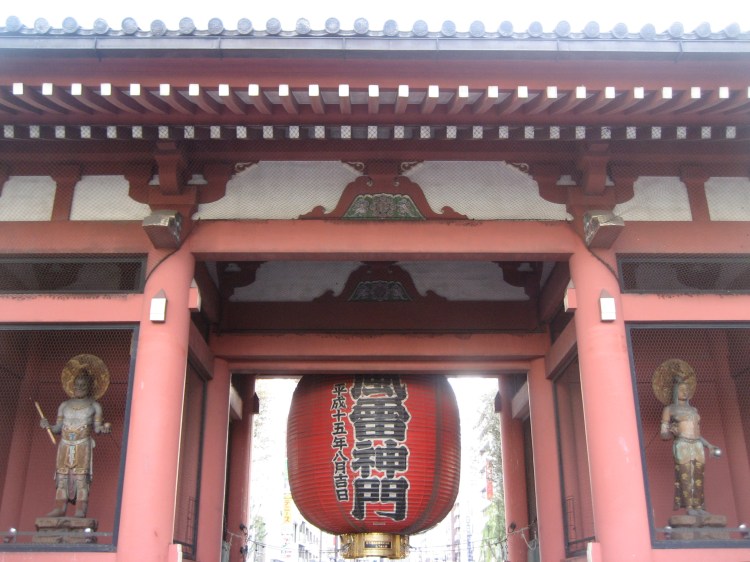
Same place, taken in 2009

This place is Asakusa Temple, or in Japanese Asakusa-dera, though more formally known as Sensōji. The Chinese characters 浅草寺 can be read either way. This is a temple formerly of the Tendai sect that has been a part of Tokyo since at least the 9th century and is centered around a statue of the Bodhisattva Kannon said to have washed up on the shore one day. The homepage (English available) is here.

Asakusa Temple is simultaneously a giant tourist-trap and a great experience. I have visited the temple 3-4 times since 2009 and it is always worth it. I have included photos from various trips below.

The first thing people will see is the famous Kaminari-mon Gate (雷門, “the lightning gate”) with its massive red lantern, flanked by two guardian Buddhist deities, the Niō. If you pass through the gate, or on your way out, you may notice the reverse:

Taken in 2009

The lantern on the back instead reads Fūraijinmon (風雷神門) or the Gate of the Wind and Thunder god.

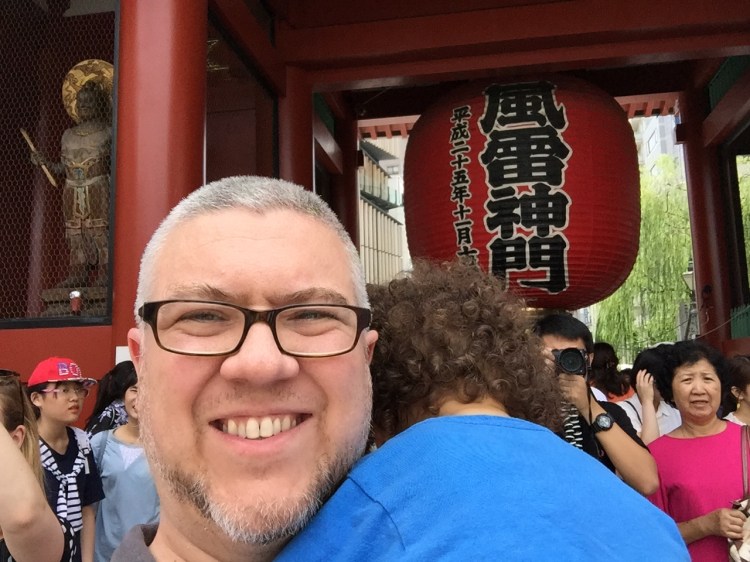
Me carrying a very tired little boy in the summer of 2014.

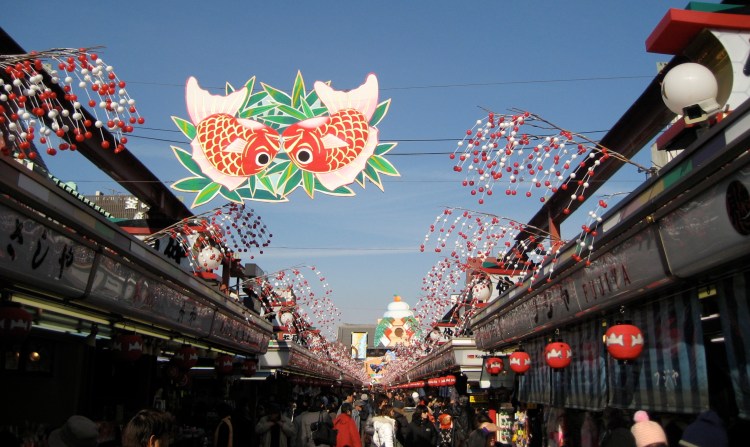
Once you pass through the gate, you will see a huge, long walkway: the Nakamise-dōri (中店通り):

December 2022
Summer of 2016
2009, just after New Year

This is not the temple proper. This is a large number of very crowded street stalls selling all kinds of wares: some focused on foreign tourists, and some focused more on native Japanese visitors. You can find all kinds of things here. In our most recent trip, we found some excellent shichimi spice with yuzu flavor added. Goes really well in soups. You can probably spend half a day here. Just beyond these shops, to the left and right, are various restaurants, against catered toward either native Japanese or foreign tourists. We ate at this place during our last trip:

In any case, once you go all the way past the shops, you can get to the temple proper:

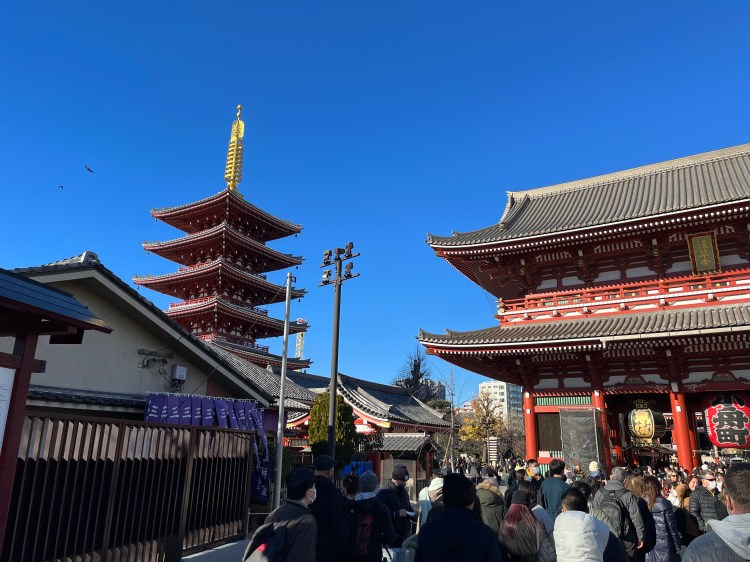
Pagoda and temple gate, December 2022
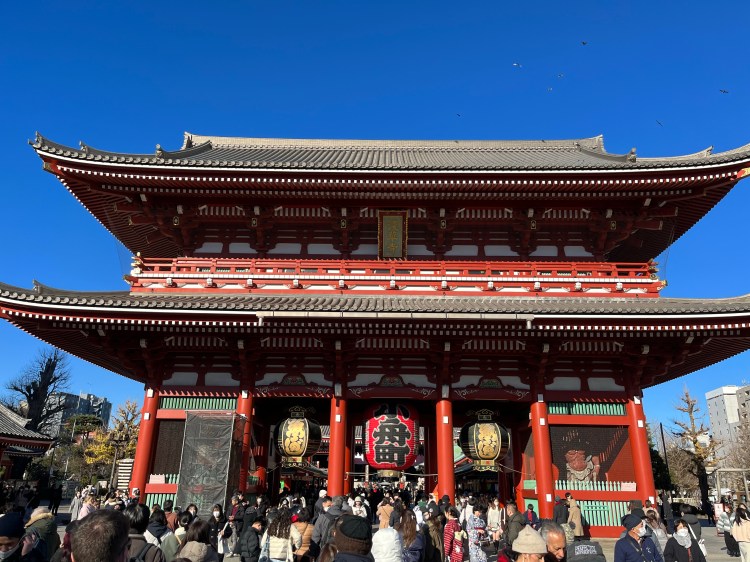
Temple gate, December 2022
Pagoda, 2009 New Year’s

This tall structure is a pagoda:

A pagoda, or gojū no tō (五重塔) in Japanese, is something adapted from Chinese culture and is meant to represent the ancient Buddhist stupas in India: storehouses for relics of the Buddha.

The temple gate itself, called the Hōzōmon (宝蔵門, “treasure [of the Dharma] storehouse gate”) sports a similarly large red lantern:

Me being a tourist in December 2022
Summer of 2016

Past this second gate you are now at the temple proper. There is a large, outdoor charcoal brazier with incense sticks burning here. Per Buddhist tradition, you can purify yourself (ablution) before seeing the Bodhisattva by waving some of the incense smoke over you. Once ready, you then proceed to the main hall (honden 本殿):

December 2022
January 2009

If you look up as you pass this lamp, you’ll also see the underside has a neat dragon pattern on it:

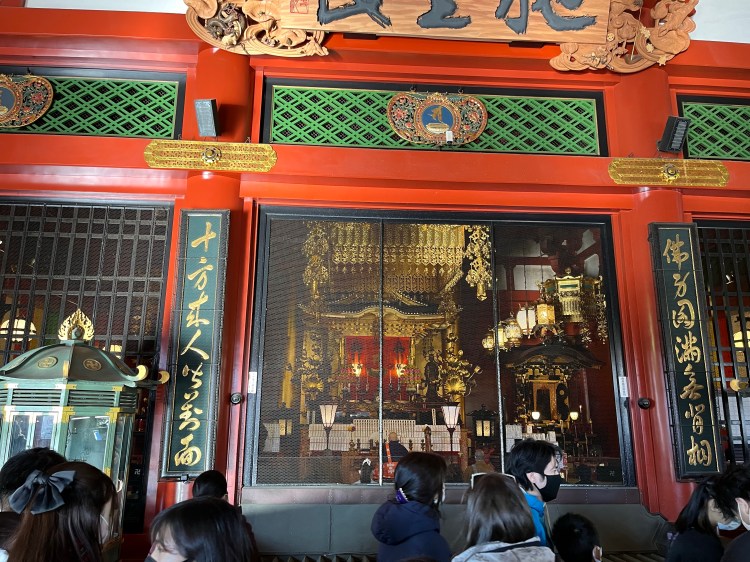
Since the temple itself is devoted to the Bodhisattva Kannon, you will see it enshrined at the central altar:

December 2022
January 2009

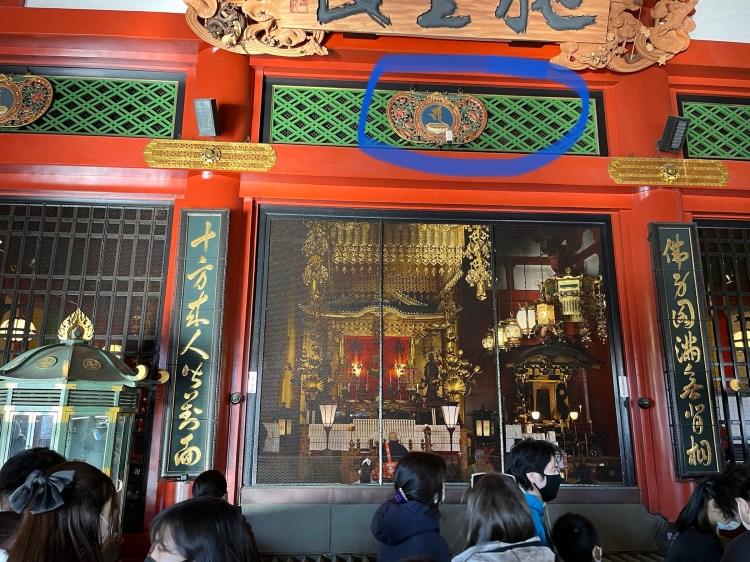
The statue itself is hidden behind the red screen, but is flanked by two other statues denoting the Indian gods Brahma and Indra as guardians. Also, if you pay attention, you’ll notice this mark both on the red screen and above:

This is the Sanskrit letter “sa” written in old Siddham script as 𑖭, and is used to represent Kannon. It also represents the Sanskrit word satya (“truth, virtue, etc”). There is also a really large grilled wooden box in front, and that is where you can put in a donation. Per tradition, people often put in a ¥5 yen coin (go-en-dama) due to word-play that implies fostering a karmic-bond with the bodhisattva.

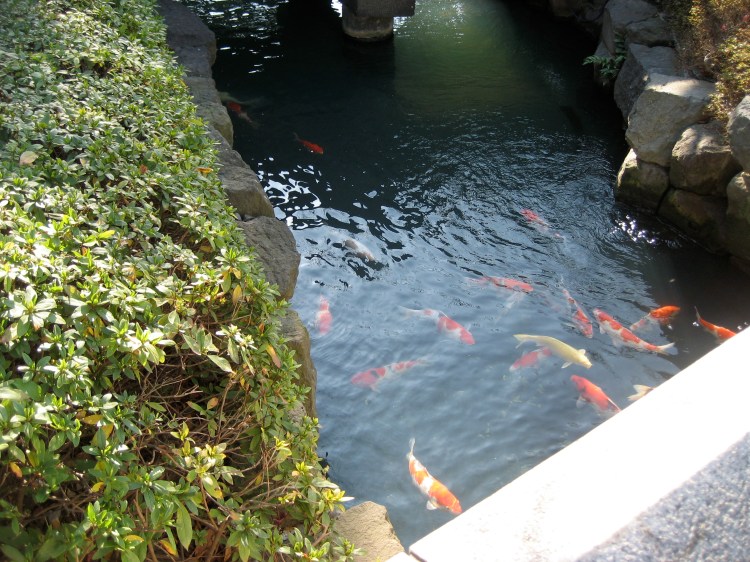
Note that if you go left of the main hall, there’s several other things to note. First is the koi pond and bridge:

January 2009
January 2009

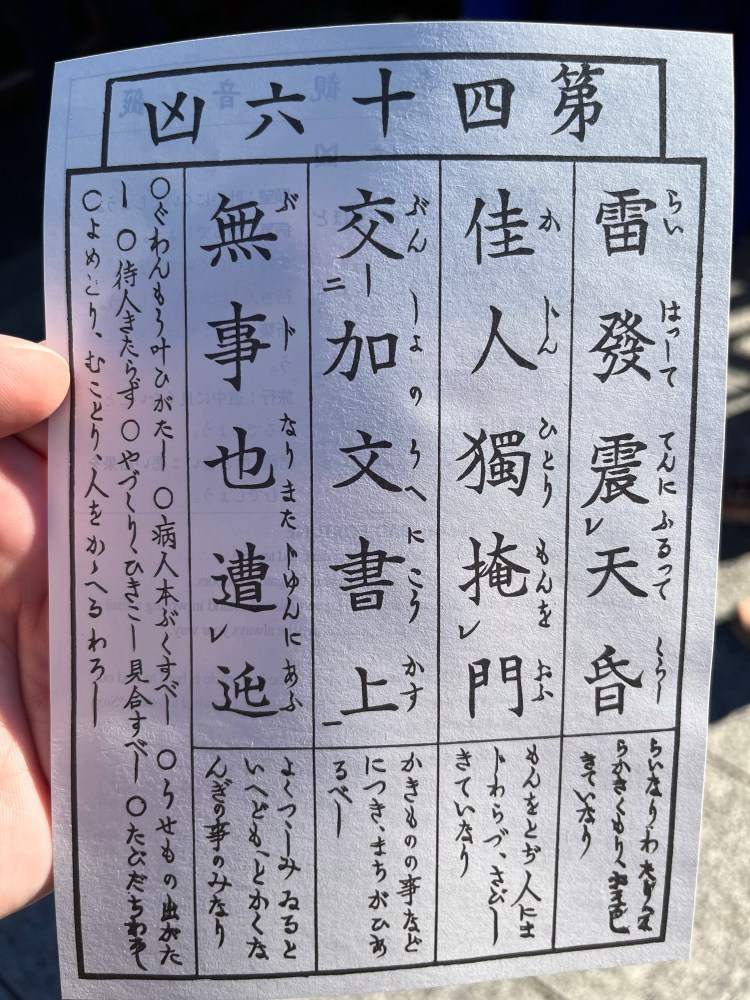
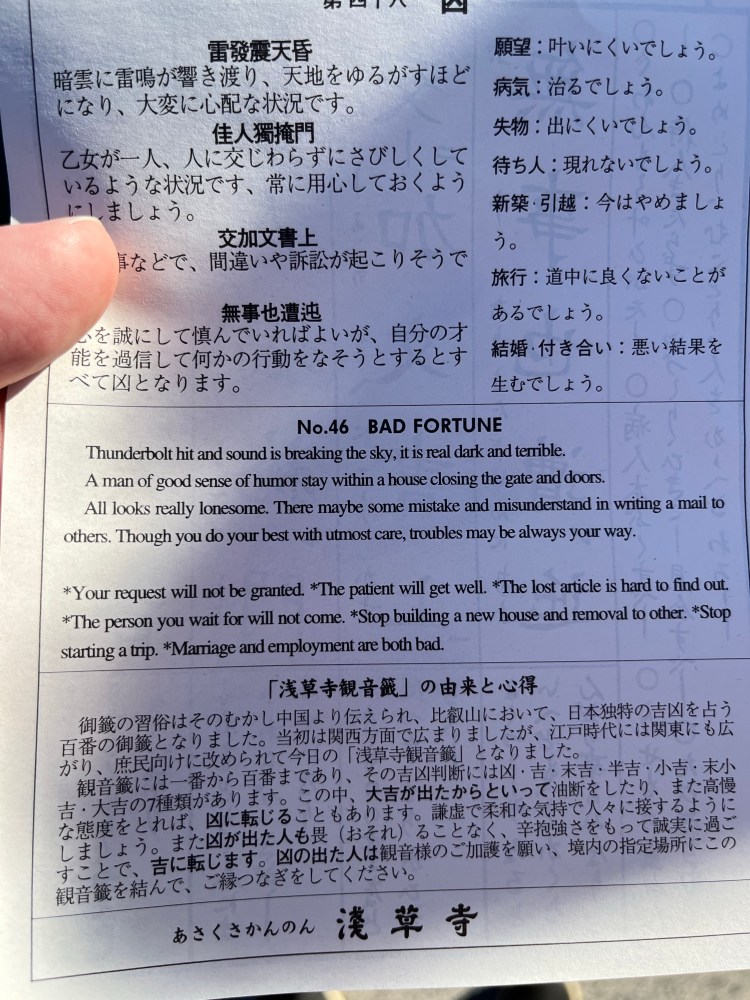
There’s also a place here where you can draw your fortune (omikuji). This year, I drew a bad fortune (凶 on the upper left):

Per tradition, if you get a bad fortune, you’re supposed to tie it up on a small wire fence nearby, so the bad luck “stays there”, and does not follow you.

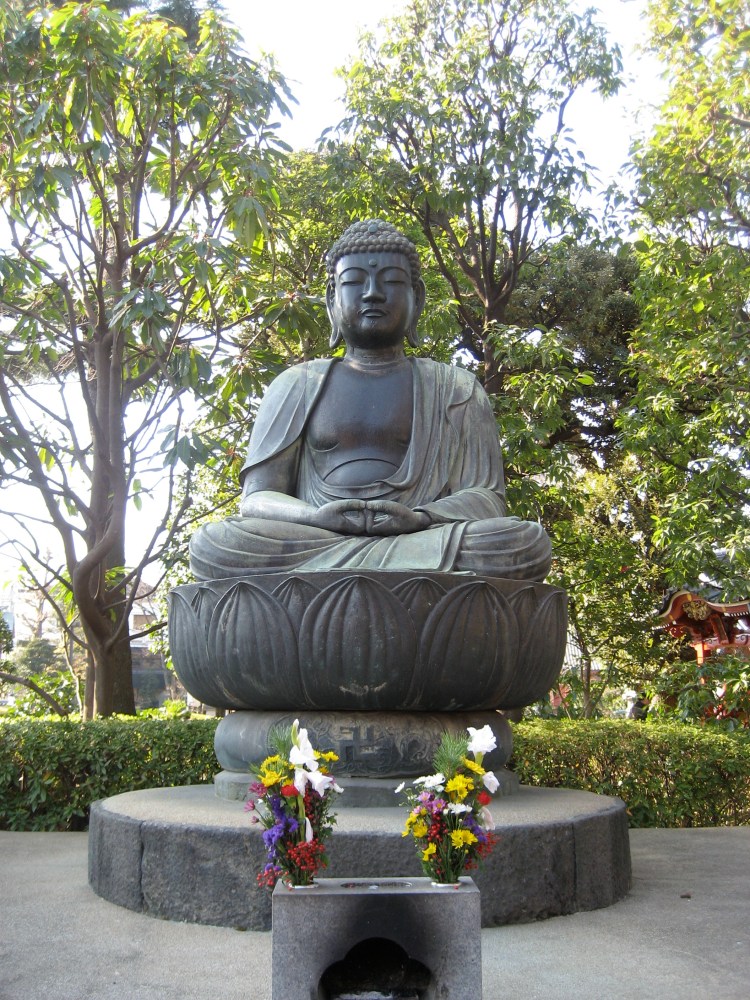
There is also a statue of Amitabha Buddha (阿弥陀如来, amida nyorai) nearby:

December 2022
Summer 2016

Finally, to the left of the main hall is one of several secondaries halls that compromise the temple complex. This hall is called the Yogodo Hall:

It is here that I got my pilgrimage book in 2022:

The Yogodo Hall is a commemorative hall to mark the 1,200th anniversary of the Tendai monk Ennin, who was a pivotal figure in the early Japanese Tendai tradition, and still crucial to the growth and development of the tradition. Side note, the term yōgō (影向) is a Buddhist term of the temporary manifestation of a Buddha or Bodhisattva or other divinity in the world for the benefit of beings. This is probably meant to be a form of praise to Ennin, implying that he had been a temporary manifestation of a Buddhist figure.

There are several other halls I’ve managed to overlook each time I visit, but a full map of the site in English can be found here.

In any case, it’s interesting to look back on my old photos and reflect on how much has changed (phone camera technology, for example 😉 ), and how much has remained the same at Sensoji…

Remembering Loved Ones

Recently, my family and I observed the 100th day memorial for “baba”, my wife’s mother in Japan, and grandmother to our kids. This had me thinking about another poem by Lady Izumi1 from The Ink Dark Moon by Jane Hirshfield and Mariko Aratani:

Original JapaneseRomanizationTranslation
跡をみてAto wo miteEven in my dreams
偲ぶもあやしShinobu mo ayashiI never think of you—
ゆめにてもYume nite mohow strange now,
何事のまたNanigoto no mataseeing your handwriting,
有りしともなくArishi to mo nakuto recall…
Translation by by Jane Hirshfield and Mariko Aratani

I can understand this sentiment. When doing the memorials, it can feel kind of formulaic, but then sometimes I will see something that reminds me of my mother in law, and I can still her presence somehow. While I was in Japan, my father in law, noticing my interest in the Hyakunin Isshu, gave me a book to take home that belonged to his wife (my late mother-in-law).

「新百人一首をおぼえよう」(Let’s Memorize the Hyakunin Isshu, new edition) by 佐佐木幸綱 (Sasaki Yukitsuna)

This is a nice book, published back in 2002 that covers the Hyakunin Isshu anthology with lots of neat photography of famous locations, and tips and mnemonics for memorizing poems for karuta card game. I’ve enjoyed reading through it.

But more importantly, it provides a tangible link to my mother-in-law. Due to language barrier, I wasn’t able to converse with her much in my early years of marriage, and in the later years her health had declined to the point we couldn’t converse anyway. So, I wasn’t able to connect with her as much as I wanted to.

But with this book, I feel connected to her in a way I couldn’t before. My only regret is that we didn’t share this hobby before.

However, as Lady Izumi’s poetry shows, there is another side to grief and losing loved ones:

Original JapaneseRomanizationTranslation
としをへてToshi wo heteThrough the years
物思ふことはMono omou koto waI’ve become used to sorrow:
ならひにきNarai ni kithere was not one spring
花に別れぬHana ni wakarenuI didn’t leave behind
春しなければHaru shinarakerebathe flowers
Translation by by Jane Hirshfield and Mariko Aratani

and:

Original JapaneseRomanizationTranslation
頼むとてTanomu toteDo you now know
頼みけるこそTanomi keru kosothis world
はかなけれHakana kereis a waking dream?
昼間の夢のHiruma no yume noHowever much I needed you,
よとは知らずやYo towa shirazu yathat is also a fleeting thing…
Translation by by Jane Hirshfield and Mariko Aratani

As one gets older, one becomes somewhat numb to all the people that we’ve lost. The second poem here has overtly Buddhist undertones, reminding the reader that, as the Diamond Sutra famous says:

All composed things are like a dream,
a phantom, a drop of dew, a flash of lightning.
That is how to meditate on them.
That is how to observe them.

Translation by Ven. Thich Nhat Hanh, in The Diamond That Cuts Through Illusion

For my part, I have lost friends as far back as high school, known relatives who have taken their own lives, lost loved ones due to cancer, dementia, pneumonia, etc.

Chances are, you have too.

As time goes on, this number will continue to grow. If you imagine scattered blossoms in spring, one can easily find parallels to life and the people all around us.

1 Other recent mentions here, here and here.

Of Burning Houses and Rain

Here is another wonderful poem (previous posts here and here) by the 11th century Japanese poetess, Lady Izumi (izumi shikibu 和泉式部 in Japanese), that I found in The Ink Dark Moon by Jane Hirshfield and Mariko Aratani:

Original JapaneseRomanizationTranslation*
ものをのみMono o nomiShould I leave this burning house
思ひの家をOmoi no ie oof ceaseless thoughts
出でてふるIdete furuand taste the pure rain’s
一味の雨にIchimi no ame nisingle truth
ぬれやしなましNure ya shina mashifailing upon my skin?
* Translation by by Jane Hirshfield and Mariko Aratani

The headline for this poem reads:

On the night of the sixth, the sound of the night monk’s voice reciting the Sutras mingled with the sound of incessant rain, and truly this seemed to be a world of dreams…

Lady Izumi cleverly makes not one, not two, but THREE separate allusions to the famous Lotus Sutra, in this poem. I’ve talked about the Lotus Sutra before. It’s a very influential Buddhist text in the Mahayana tradition, and contains many parables and dramatic allusions, compared to some of the drier, more textbook style Buddhist sutras. Thus, allusions to the Lotus Sutra are found throughout literature in East Asia. In my opinion, understanding the Lotus Sutra is key to understanding Buddhism in East Asia: Zen, Pure Land, Tiantai, Nichiren and Vajrayana, etc.

The “burning house” here alludes to the Parable of the Burning House of third chapter of the Lotus Sutra. I’ve talked about it here, among other places. This is pretty straightforward to understand in the poem: the Burning House here is symbolic of the world we live in, burning with passions, craving, anger, delusion, old age, disease, and so on. We can step out of the burning house if we choose to, but we are often distracted by things in the house, and thus unaware that the timbers all around us are on fire, putting us in mortal danger.

The second allusion is that of rain. In the fifth chapter of the Lotus Sutra, there is a parable describing rain on plants, the so-called The Parable of the Medicinal Herbs:

What falls from the cloud is water of a single flavor, but the plants and trees, thickets and groves, each accept the moisture that is appropriate to its portion. All the various trees, whether superior, middling or inferior, take that is fitting for large or small and each is enabled to sprout and grow. Root, stem, limb, leaf, the glow and hue of flower and fruit— one rain extends to them and all are able to become fresh and glossy, whether their allotment of substance, form and nature is large or small, the moistening they receive is one, but each grows and flourishes in its own way.

The Buddha is like this when he appears in the world, comparable to a great cloud that covers all things everywhere, Having appeared in the world, for the sake of living beings he makes distinctions in expounding the truth regarding phenomena.

Translation by Burton Watson

This is, for me, one of my most favorite parts of the Lotus Sutra. As a sutra, it’s very inclusive (cf. the Parable of the Dragon Princess), but it also acknowledges that there is a huge variety of people in the world. Some people are just different than others, but they can all benefit from the Dharma in their own way, just like the various plants in world drinking from the rain.

Finally, the third allusion in Lady Izumi’s poem is that of a single “taste”. Both the Parable of the Burning House and the Parable of the Medicinal Herbs make a single point: the Dharma of the Buddha appears in a variety of ways, or “gates” for one to enter, but in the end the Dharma tastes the same equally, and is but one truth. So, whichever gate one enters, the rain will ultimately taste the same. For the Burning House, when the children come outside, their father offers, in the end, a single magnificent cart (not many) to offer them as an incentive.

Turning back to Lady Izumi, it’s obvious that she was very thoughtful of these things, even if she struggled to practice them amidst her life. Even when she was surrounded by scandal, and lost both her lovers and her daughter to illness, she could see past it and look at the greater picture.

Namu Amida Butsu

The Amitabha Root Dharani

The Amida Nyorai Konpon Dharani (阿弥陀如来根本陀羅尼) or “Amitabha Root Dharani” is a dharani used in some Japanese Buddhist sects, typically only on the Segaki ritual used to feed the hungry ghosts in Buddhism, or possibly funerals and other similar services. It is typically only found in esoteric rituals in Shingon and Tendai Buddhism, but can be found in Jodo Shu and Zen as well. The dharani is typically of very, very limited use, and not part of normal liturgy.

This page is intended to post the dharani for reference purposes only. Esoteric practices such as mantras and dharani should only be used as recommended by one’s teacher, under a guided training program. I found reference material on this dharani to be almost non-existent in English, hence my decision to post it here.

This page will provide both the Sino-Japanese reading follow by the Sanskrit reading. There are multiple versions of the dharani in Japanese, so pronunciation may vary slightly between them, so for this reason the Sanskrit is provided as well. No translation will be provided as this is part of the esoteric training one should undergo when learning the dharani. Any translation you see online of this, or any mantra/dharani, should be treated as suspect.

Can’t read the characters?

If you’re having trouble reading the Kanji characters, you might have one or two problems with your computer:

  • Your computer may not have Asian fonts installed. In Windows you have to enable UTF8 and East Asian fonts under the Control Panel. Modern Mac computers are fully compatible already.
  • Your browser may be assuming the wrong character set. If you use a relatively modern browser and use UTF8 as character set, you should be able to read fine. IE, Firefox and Safari all read this fine as far as I can tell.

Even if not, then you can still use the romanized characters, and the (terrible) English translation.

Disclaimer and Legal Info

I hereby release this into the public domain. Please use it as you see fit, but if you attribute it to this site, greatly appreciated. Also, please bear in mind this is an amateur work, and should not be taken too seriously.

Dedication

I dedicate this effort to all sentient beings everywhere. May all beings be well, and may they all attain perfect peace.

Namu Amida Butsu

The Amitabha Root Dharani

Japanese Kana

ノウボウ アラタンノウ タラヤ-ヤ-ノウマク アリヤ-ミタバ-ヤ- タタギャ タヤ-アラカテイ サンミャクサンボダヤ-タニャタ オン アミリテイ アミリトドバンベイ アミリタサンバンベイアミリタギャラベイ アミリタシッデイ アミリタテイゼイ アミリタビキランテイアミリタビキランタ ギャミネイ アミリタギャギャノウ キチキャレイアミリタドンドビソバレイ サラバアラタ サダネイサラバキャラマキレイシャ キャシャヨウキャレイソワカ

Japanese Romanization

nōbō aratannō tarayāyānōmaku ariyāmitabāyā tatagyatayāarakatei sanmyakusanbodayātanyata on amiritei amiritodobanbei amiritasanbanbeiamiritagyarabei amiritashiddei amiritateizei amiritabikiranteiamirita bikiranta gyaminei amirita gyagyasō kichikyareiamirita dondobi sobarei sarabārata sadaneisaraba kyarama kireisha kyashayō kyarei sowaka

Original Sanskrit

Namo ratna-trayāyanamaḥ āryāmitābhāya tathāgatāyārhatesamyak-saṃbuddhāya.Tadyathā oṃ amṛte amṛtodbhave amṛta-saṃbhaveamṛta-garbhe amṛta-siddhe amṛta-teje amṛta-vikrānteamṛta-vikrānta-gāmine amṛta-gagana kīrtikareamṛta-dundubhi-svare sarvārtha sādhanesarva-karma-kleśa-kṣayaṃ-kare svāhā!

Additional Links

All in Japanese, and used for reference.

Example Chant in a Japanese Buddhist Service

An example of this can be seen on Youtube:

P.S. This is an old post from my former blog that I thought I had lost, but recently recovered. Reposting here with better blog formatting. Otherwise, I haven’t changed the contents.

The Shōshinge Hymn

While in Japan, my wife, kids and I attended the 49-day memorial service (details here) for my mother in law. This service was held at a neighborhood Jodo Shinshu-sect temple which my mother in law frequently volunteered, and have been family friends for generations. 😌

This was the first Jodo Shinshu Buddhist service that I had attended in almost five years. The Pandemic was a large reason, but also there are personal reasons too.

Anyhow, the memorial service included an important hymn in the Jodo Shinshu tradition called the Shōshinge (正信偈). This is a hymn composed in the 13th century by the founder Shinran, and lays down the basics of Jodo Shinshu teachings, and the “lineage” of one Dharma master to another, starting in India, through China, to Shinran’s teacher, Honen.1

The hymn is quite long (20 minutes), but it is frequently used in formal services. When I was training for ordination years ago, I practiced this hymn over and over with my minister, so hearing it brought back a lot of memories. I could still remember some of the verses, the rhythm, etc. It’s interesting how music stays in your memory like that. Also, I am very tone-deaf so during my training days, I sang it terrible. My minister was quite good at it, and also very patient with me. Reverend Castro, thank you.

The above YouTube video is a good example of the Shōshinge when sang properly. I definitely did not sound like this, no matter how much I practiced. Also, there are at least two styles to singing the Shōshinge, the gyōfu (行譜) style, and the more common sōfu (草譜) style. But start off somewhat flat, but then gradually build as the song goes along. IIRC, the gyōfu is more difficult.

This video below, demonstrates the gyōfu style. Note the abrupt change in style around 10:00 or so…

One other note is that the Shōshinge often ends with a set of 6 shorter hymns called Wasan (和讃). Shinran wrote quite a few of these little hymns, but these 6 in particular are most commonly included at the end. I remember singing these too (also rather poorly).

By the way, you can find a full translation of the Shoshinge including the 6 Wasan hymns here.

One thing that always struck me as unusual about Jodo Shinshu as a sect was its heavy reliance on hymns more than chanting the Buddhist sutras, as other sects do. My guess is that using music and hymnals, especially in vernacular Japanese, made the teachings more accessible to Japanese lay people. This is similar to the medieval Christian debate between using Latin vs vernacular language, perhaps.

However, Jodo Shinshu does recite some Buddhist sutras too, such as the Juseige and Sanbutsuge, both excerpts from the Immeasurable Life Sutra. Also, the Shoshinge is written in Sino-Japanse, not vernacular (like the Wasan hymns), so the answer is maybe not clear-cut. Maybe Shinran was just a musically-inclined person. I am not sure. Personally, I just prefer to recite sutras as it is the more mainstream tradition anyway.

In any case, for the 100th day memorial for my mother in law, I will probably sing the Shoshinge hymn as a tribute to her, so I have been brushing up a bit lately. We’ll see how it goes. But, I hope she enjoys nonetheless.

1 The concept of lineage in Pure Land Buddhism is a bit fuzzy, compared to Zen, Shingon or Tendai Buddhism in that there is no physical “handover” from master to student. The patriachs all lived in different times and places, but each contributed new ideas or innovations to Pure Land Buddhism, hence there is a steady evolution.