The Great Compassion Dharani

Another dharani I was reading about lately is the Great Compassion Dharani, also known as the Nīlakaṇṭha Dhāraṇī, or in Japanese Buddhism the daihishin darani (大悲心陀羅尼), also known more simply as the daihishu (大悲咒), among other names.

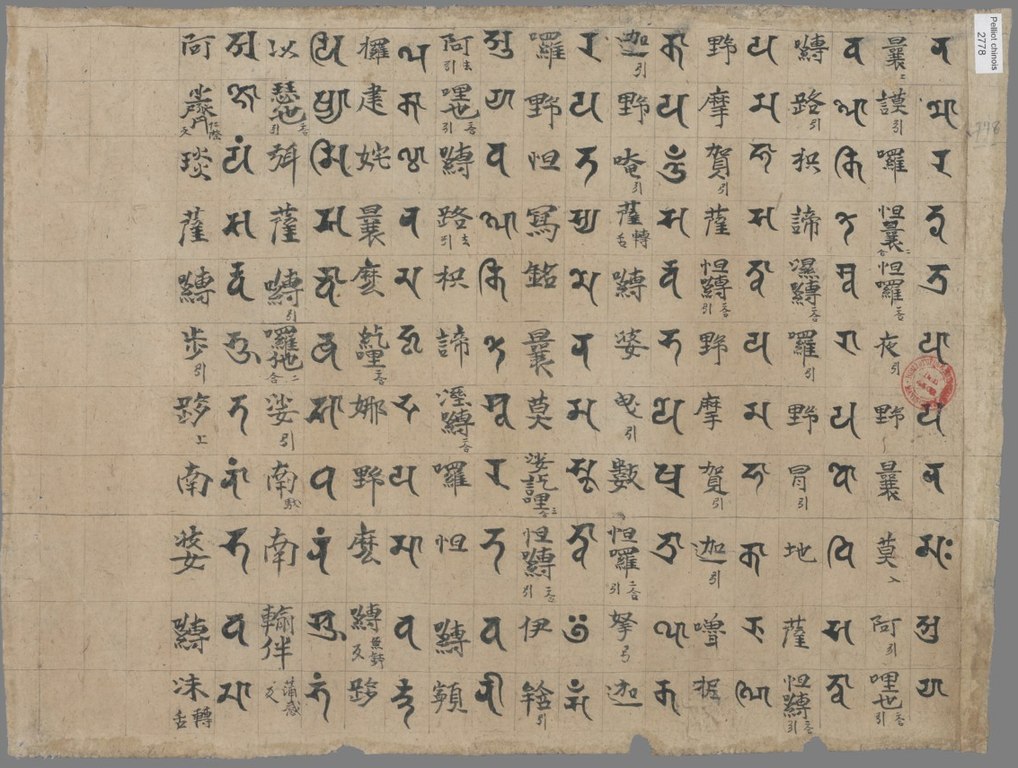
According to Wikipedia, this is one of widely recited dharani across the Buddhist tradition, and has undergone various changes over time, with a couple extant (though corrupted) versions. The featured photo above is an example found in the Dunhuang caves of China, showing the original text in Siddham script, with Chinese transliteration:

Fragment of the Nilaṇṭhanāmahṛdaya dhāraṇī both written in Siddhaṃ script and transliterated in Chinese characters. Bibliothèque nationale de France, Public domain, via Wikimedia Commons

You can see another example here, using both Siddham script, and the ancient Sogdian script:

Whereas the Dharani for the Prevention of Disaster (discussed in a previous post) is focused on practical matters, the Great Compassion Dharani is meant to be chanted in order to awaken goodwill towards others, using Kannon Bodhisattva as the archetype. It is taken from a longer Buddhist text, the Sutra on the Thousand-armed, Thousand-eyed Bodhisattva Avalokitesvara’s Sutra of Dharanis on the Vast, Perfect, and Unobstructed Mind of Great Compassion (千手千眼観世音菩薩広大円満無礙大悲心陀羅尼経).

This dharani is most closely associated the Zen traditions, but because it is pretty long, it’s probably not always practical for lay followers to recite in daily services. I have not seen it listed in service books for lay followers in either Soto Zen or Rinzai Zen. In any case, I am posting it here as a reference.

You can see an example of the Great Compassion Dharani being chanted in a formal Soto Zen service here:

There is a nice Chinese-language version here (starts at 1:07):

I have posted the dharani here in multiple languages, so that people can choose which version they prefer to recite. The main source was Wikipedia, but for the Chinese Pinyin, I had to check multiple websites as the pinyin varied slightly in some places, while for the Japanese version, I checked line by line in the video above.

Sanskrit
(Amoghavajra version)
Original Chinese Chinese Pinyin1Japanese Romaji
(Soto Zen)
namaḥ ratnatrayāya南無喝囉怛那哆囉夜耶Nā mo hē là dá nà duō là yè yéNa mu ka ra tan no to ra ya ya
nama āryā南無阿唎耶Ná mó ā lì yēNa mu o ri ya
valokite śvarāya婆盧羯帝爍缽囉耶Pó lú jié dì shuò bō là yēBo ryo ki chi shi fu ra ya
bodhi satvaya菩提薩埵婆耶Pú tí sà duǒ pó yēFu ji sa to bo ya
mahā satvaya摩訶薩埵婆耶Mó hē sà duǒ pó yēMo ko sa to bo ya
mahā kāruṇikāya摩訶迦盧尼迦耶Mó hē jiā lú ní jiā yēMo ko kya ru ni kya ya
oṃ sarvarbhaye sutnatasya唵薩皤囉罰曳數怛那怛寫Ǎn sà pó là fá yì shù dá nā dá xiàEn sa ha ra ha ei shu tan no ton sha
namo skṛtva imaṃ āryā南無悉吉慄埵伊蒙阿唎耶Ná mó xī jí lì duǒ yī méng ā lì yēNa mu shi ki ri to i mo o ri ya
valokite śvara raṃdhava婆盧吉帝室佛囉愣馱婆    Pó lú jí dì shì fó là léng tuó póBo ryo ki chi shi fu ra ri to bo
namo narakiṇḍi南無那囉謹墀Ná mó nā là jǐn chíNa mu no ra kin ji
hriḥ maha vadhasame醯利摩訶皤哆沙咩Xī lì mó hē pó duō shā miēKi ri mo ko ho do sha mi
sarva athadu yobhuṃ薩婆阿他豆輸朋Sà pó ā tuō·dòu shū péngSa bo o to jo shu ben
ajiyaṃ阿逝孕Ā shì yùnO shu in
sarvasatā nama vastya namabhāga薩婆薩哆那摩婆薩哆那摩婆伽Sà pó sà duō ná mó pó sà duō ná mó pó qiéSa bo sa to2 no mo bo gya
mārvdātuḥ摩罰特豆Mó fá tè dòuMo ha te cho
tadyathā 怛姪他Dá zhí tuōTo ji to
oṃ avalohe 唵阿婆盧醯Ān ā pó lú xīEn o bo ryo ki
lokāte盧迦帝Lú jiā dìRyo gya chi
karate ihriḥ迦羅帝夷醯唎Jiā luó dì yí xī lìKya rya chi i ki ri
mahā bodhisatva 摩訶菩提薩埵Mó hē pú tí sà duǒ Mo ko fu ji sa to
sarva sarva薩婆薩婆Sà pó sà póSa bo sa bo
mālā mala摩囉摩囉Mó là mó làMo ra mo ra
mahemahe ṛdayaṃ摩醯摩醯唎馱孕Mó xī mó xī lì tuó yùnMo ki mo ki ri to in
kuru kuru karmaṃ俱盧俱盧羯蒙Jù lú jù lú jié méngKu ryo ku ryo ke mo
dhuru dhuru vjayate度盧度盧罰闍耶帝Dù lú dù lú fá shé yē dìTo ryo to ryo ho ja ya chi
mahā vjayate摩訶罰闍耶帝Mó hē fá shé yē dìMo ko ho ja ya chi
dhara dhara陀囉陀囉Tuó là tuó làTo ra to ra
dhiriṇi地唎尼Dì lì níChi ri ni
śvarāya室佛囉耶Shì fó là yēShi fu ra ya
cala cala遮囉遮囉Zhē là zhē làSha ro sha ro
mama vmāra摩麼罰摩囉Mó mó fá mó làMo mo ha mo ra
muktele穆帝隸Mù dì lìHo chi ri
ihe īhe伊醯伊醯Yī xī yī xīYu ki yu ki
śina śina室那室那Shì nā shì nāShi no shi no
araṣaṃ phraśali阿囉參佛囉舍利Ā là shēn fó là shě lì. O ra san fu ra sha ri
vsa vsaṃ罰沙罰參Fá suō fá shēnHa za ha za
phraśaya佛囉舍耶Fó là shě yēFu ra sha ya
huru huru mara呼嚧呼嚧摩囉Hū lú hū lú mó làKu ryo ku ryo mo ra
hulu hulu hrīḥ呼嚧呼嚧醯利Hū lú hū lú xī lìKu ryo ku ryo ki ri
sara sara娑囉娑囉Suō là suō làSha ro sha ro
siri siri悉唎悉唎Xī lì xī lìShi ri shi ri
suru suru蘇嚧蘇嚧Sū lú sū lúSu ryo su ryo
bodhiya bodhiya菩提夜菩提夜Pú tí yè pú tí yèFu ji ya fu ji ya
bodhaya bodhaya菩馱夜菩馱夜Pú tuó yè pú tuó yè Fu do ya fu do ya
maiteriyā彌帝唎夜Mí dì lì yèMi chi ri ya
narakinḍi那囉謹墀Nā là jǐn chíNo ra kin ji
dhiriṣṇina地利瑟尼那Dì lì sè ní nāChi ri shu ni no
payāmāna波夜摩那Pō yè mó nā Ho ya mo no
svāhā siddhāyā 娑婆訶悉陀夜Suō pó hē xī tuó yèSo mo ko shi do ya so mo ko
svāhā mahā siddhāyā 娑婆訶摩訶悉陀夜Suō pó hē mó hē xī tuó yè So mo ko mo ko shi do ya
svāhā siddha yoge śvarāya 娑婆訶悉陀喻藝室皤囉耶Suō pó hē sī tuó yù yì shì pó là yē So mo ko shi do yu ki shi fu ra ya
svāhā narakiṇḍi娑婆訶那囉謹墀Suō pó hē nā là jǐn chí So mo ko no ra kin ji
svāhā māranara娑婆訶摩囉那囉Suō pó hē mó là nā là So mo ko mo ra no ra
svāhā sira siṃ amukhāya娑婆訶悉囉僧阿穆佉耶Suō pó hē xī là sēng ā mù qié yē So mo ko shi ra su o mo gya ya
svāhā sava maha asiddhāyā 娑婆訶娑婆摩訶阿悉陀夜Suō pó hē suō pó mó hē ā xī tuó yè suō pó hēSo mo ko so bo mo ko o shi do ya
svāhā cakra asiddhāyā娑婆訶者吉囉阿悉陀夜Suō pó hē zhě jí là ā xī tuó yè So mo ko sha ki ra o shi do ya
svāhā padma kastāyā娑婆訶波陀摩羯悉陀夜Suō pó hē bō tuó mó jié xī tuó yè So mo ko ho do mo gya shi do ya
svāhā narakiṇḍi vagaraya娑婆訶那囉謹墀皤伽囉耶Suō pó hē nā là jǐn chí pó qié là yē So mo ko no ra kin ji ha gya ra ya so mo ko
svāhā mavali śaṅkrayā娑婆訶摩婆利勝羯囉夜Suō pó hē mó pó lì shèng jié là yè So mo ko mo ho ri shin gya ra ya
svāhā namaḥ ratnatrayāya娑婆訶南無喝囉怛那哆囉夜耶Suō pó hē ná mó hé là dá nā duō là yè yēSo mo ko na mu ka ra tan no to ra ya ya
namo āryā南無阿唎耶Ná mó ā lì yēNa mu o ri ya
valokte 婆嚧吉帝Pó lú jí dìBo ryo ki chi
śva rāya svāhā爍皤囉夜娑婆訶Shuò pó là yè suō pó hēShi fu ra ya so mo ko
Oṃ sidhyantu mantra 唵悉殿都漫多囉Ān xī diàn dū màn duō làShi3 te do mo do ra
padāya svāhā跋陀耶娑婆訶Bá tuó yě suō pó hēHo do ya so mo ko

Side note, there is a different version in the Japanese Shingon-Buddhist tradition, but I am too lazy to post here, since the dharani is so long. You can find it here on the Japanese Wikipedia article under “真言宗の読み方”.

June 2025: Major rewrite of this page to make the text side-by-side, but also fixed several typos.

1 Sources used to validate the pinyin: here and here, plus Wikipedia article. Each one slightly disagreed with one another, and my Chinese language skills are very limited, so I had to make a best guess in a few cases where things seemingly contradicted. It’s also possible that certain Chinese characters just have multiple pronunciations.

2 For some reason, the Soto Zen version doesn’t have the words 那摩婆薩哆 (nama vastya / ná mó pó sà duō).

3 Similarly, the Soto Zen version doesn’t have the final “om” (唵, ān) in it.
Dharani for the Prevention of Disaster

The dharani below is the Dharani for the Prevention of Calamity, or shōsaishu (消災呪), called more formally the shōsaimyōkichijō darani (消災妙吉祥陀羅尼). It is used in both Rinzai and Soto Zen traditions as a general-protection “spell”.1 I assume the intention is to protect the Zen disciple so that they can reduce obstructions on their path, similar to prayers to the Medicine Buddha in other traditions.

Before we share the dharani, let’s talk about mantras vs. dharani in Buddhism. Both belong to the esoteric traditions of “Vajrayana Buddhism”, (e.g. Tibetan Buddhism, and Shingon/Tendai Buddhism in Japan). My experience is limited, but I believe that mantras usually have layers of deeper and deeper meaning that a disciple explores in the esoteric path, while dharani do not. Instead, dharani are more like tools, simple “spells”1 or chants to provide a specific benefit. Mantras might provide also a benefit, but that’s not their sole purpose in the esoteric tradition.

Also, non-esoteric traditions in Buddhism will sometimes cherry-pick ones that they feel are useful, some more than others.2 Sometimes mantras and dharani are used for very specific liturgical purposes, others are chanted as part of normal service.

In any case, the Dharani for the Prevention of Calamity is regularly chanted three times in Rinzai Zen liturgies. I am less clear how it’s used in Soto Zen.

An example of the recitation is below from the Soto Zen tradition:

The dharani has a couple versions, one used in the Soto Zen sect, and another used by Rinzai. I’ve included both versions below.

LanguageDharani Text
Sanskritnamaḥ samanta-buddhānām apratihata-śāsanānāṃ tadyathā oṃ kha kha khā hi khā hi hūṃ hūṃ jvala jvala prajvala prajvala tiṣṭhā tiṣṭhā ṣṭri ṣṭri sphaṭ sphaṭ śāntika śrīye svāhā
Classical Chinese曩謨 三滿哆 母駄喃 阿盋囉底 賀哆舍 娑曩喃 怛姪他 唵 佉 佉 佉呬 佉呬 吽 吽 入嚩囉 入嚩囉 盋羅入嚩羅 盋羅入嚩羅 底瑟姹 底瑟姹 瑟致哩 瑟致哩 娑發吒 娑發吒 扇底迦 室哩曳 娑嚩訶
Soto Zen versionのーもーさんまんだー もとなん おはらーちー ことしゃー そのなん とーじーとー えん ぎゃーぎゃーぎゃーきー ぎゃーきー うんぬん しふらー しふらー はらしふらー はらしふらー ちしゅさー ちしゅさー ちしゅりー ちしゅりー そはじゃー そはじゃー せんちーぎゃー しりえー そーもーこー
Japanese Romanization of Soto Zen versionNO MO SAN MAN DA MO TO NAN O HA RA CHI KO TO SHA SO NO NAN TO JI TO EN GYA GYA GYA KI GYA KI UN NUN SHI FU RA SHI FU RA HARA SHI FU RA HARA SHI FU RA CHI SHU SA CHI SHU SA CHI SHU RI CHI SHU RI SO WA JA SO WA JA SEN CHI GYA SHI RI EI SO MO KO
Rinzai Zen versionなむさんまんだー もとなん おはらーちー ことしゃー そのなん とーじーとー えん ぎゃーぎゃーぎゃーきー ぎゃーきー うんぬん しふらー しふらー はらしふらー はらしふらー ちしゅさー ちしゅさー しゅしりー しゅしりー そはじゃー そはじゃー せちーぎゃー しりえー そーもーこー
Japanese
Romanization of Rinzai version
NA MU SAN MAN DA MO TO NAN O HA RA CHI KO TO SHA SO NO NAN TO JI TO EN GYA GYA GYA KI GYA KI UN NUN SHI FU RA SHI FU RA HA RA SHI FU RA HA RA SHI FU RA CHI SHU SA CHI SHU SA SHU SHI RI SHU SHI RI SO WA JA SO WA JA SE CHI GYA SHI RI EI SO MO KO

1 I am not sure what else to call it. Dharani use Sanskrit words that are chanted to provide a concrete benefit. If there was a meaning originally, it’s obscure now. I wish I could use a more suitable word for this, but there’s nothing in English I can use that doesn’t sound like a Harry Potter episode.

2 the Pure Land tradition usually doesn’t use mantras or dharani. One could argue the nembutsu is something similar, but that’s a story for another post.

The Amitabha Root Dharani

The Amida Nyorai Konpon Dharani (阿弥陀如来根本陀羅尼) or “Amitabha Root Dharani” is a dharani used in some Japanese Buddhist sects, typically only on the Segaki ritual used to feed the hungry ghosts in Buddhism, or possibly funerals and other similar services. It is typically only found in esoteric rituals in Shingon and Tendai Buddhism, but can be found in Jodo Shu and Zen as well. The dharani is typically of very, very limited use, and not part of normal liturgy.

This page is intended to post the dharani for reference purposes only. Esoteric practices such as mantras and dharani should only be used as recommended by one’s teacher, under a guided training program. I found reference material on this dharani to be almost non-existent in English, hence my decision to post it here.

This page will provide both the Sino-Japanese reading follow by the Sanskrit reading. There are multiple versions of the dharani in Japanese, so pronunciation may vary slightly between them, so for this reason the Sanskrit is provided as well. No translation will be provided as this is part of the esoteric training one should undergo when learning the dharani. Any translation you see online of this, or any mantra/dharani, should be treated as suspect.

Can’t read the characters?

If you’re having trouble reading the Kanji characters, you might have one or two problems with your computer:

  • Your computer may not have Asian fonts installed. In Windows you have to enable UTF8 and East Asian fonts under the Control Panel. Modern Mac computers are fully compatible already.
  • Your browser may be assuming the wrong character set. If you use a relatively modern browser and use UTF8 as character set, you should be able to read fine. IE, Firefox and Safari all read this fine as far as I can tell.

Even if not, then you can still use the romanized characters, and the (terrible) English translation.

Disclaimer and Legal Info

I hereby release this into the public domain. Please use it as you see fit, but if you attribute it to this site, greatly appreciated. Also, please bear in mind this is an amateur work, and should not be taken too seriously.

Dedication

I dedicate this effort to all sentient beings everywhere. May all beings be well, and may they all attain perfect peace.

Namu Amida Butsu

The Amitabha Root Dharani

Japanese Kana

ノウボウ アラタンノウ タラヤ-ヤ-ノウマク アリヤ-ミタバ-ヤ- タタギャ タヤ-アラカテイ サンミャクサンボダヤ-タニャタ オン アミリテイ アミリトドバンベイ アミリタサンバンベイアミリタギャラベイ アミリタシッデイ アミリタテイゼイ アミリタビキランテイアミリタビキランタ ギャミネイ アミリタギャギャノウ キチキャレイアミリタドンドビソバレイ サラバアラタ サダネイサラバキャラマキレイシャ キャシャヨウキャレイソワカ

Japanese Romanization

nōbō aratannō tarayāyānōmaku ariyāmitabāyā tatagyatayāarakatei sanmyakusanbodayātanyata on amiritei amiritodobanbei amiritasanbanbeiamiritagyarabei amiritashiddei amiritateizei amiritabikiranteiamirita bikiranta gyaminei amirita gyagyasō kichikyareiamirita dondobi sobarei sarabārata sadaneisaraba kyarama kireisha kyashayō kyarei sowaka

Original Sanskrit

Namo ratna-trayāyanamaḥ āryāmitābhāya tathāgatāyārhatesamyak-saṃbuddhāya.Tadyathā oṃ amṛte amṛtodbhave amṛta-saṃbhaveamṛta-garbhe amṛta-siddhe amṛta-teje amṛta-vikrānteamṛta-vikrānta-gāmine amṛta-gagana kīrtikareamṛta-dundubhi-svare sarvārtha sādhanesarva-karma-kleśa-kṣayaṃ-kare svāhā!

Additional Links

All in Japanese, and used for reference.

Example Chant in a Japanese Buddhist Service

An example of this can be seen on Youtube:

P.S. This is an old post from my former blog that I thought I had lost, but recently recovered. Reposting here with better blog formatting. Otherwise, I haven’t changed the contents.

There Is More To Pure Land Buddhism Than Just The Nembutsu

(Warning: Buddhist rant)

Recently, I got into a debate online (that always ends well) about so-called “auxilliary” practices with some fellow Buddhists on an old, private discussion forum for Jodo Shu Buddhist teachings.

The debate started after someone on the forum asked about whether visualization of Amida Buddha was permitted in Jodo Shu, and I was not satisfied with the responses thus far which tended to strongly imply that it wasn’t worth doing, and that one should rely on the nembutsu only. I was somewhat annoyed by these replies, so I responded to the original poster like so (quoting almost verbatim here, minus some typographical editing):

In my experience, both Jodo Shu and the related Jodo Shinshu sects doctrinally focus on the spoken nembutsu only. I would argue though, that this “exclusive nembutsu teaching” is an idiosyncracy of Jodo Shu and does not always reflect the Pure Land tradition in general.

You are correct in that the Contemplation Sutra does teach an elaborate process for visualizing Amida Buddha, and this kind of visualization practice has been undertaken by monks, particularly in the Tiantai (Chinese) and Tendai (Japanese) sects among others. People tend to focus on a single passage toward the end of the sutra whereby reciting the name of Amida Buddha erases all karma, but in some monastic traditions, people have focused on visualization too.

It’s also true that there are parallel traditions for rebirth in the Pure Land that have nothing to do with the nembutsu, mostly in the esoteric tradition. Even today, Shingon Buddhism has visualization/chanting practices related to Amida Buddha that have little or anything to do with the nembutsu. Such parallel practices include such things as the Mantra of Light and various dharanis that sometimes appear in Zen traditions. Genshin, who was ironically a “patriarch” of the Jodo Shinshu tradition, listed many such methods in the Ojoyoshu, but in practice he recited the nembutsu like many other monks and nuns did during his time. Further, the 23rd chapter of the Lotus Sutra, clearly mentions rebirth in the Pure Land of Amitayus (Amida) Buddha through upholding the Lotus Sutra, not reciting the nembutsu.

I think most people would agree that the nembutsu tends to be the most simplest and straightforward, and thus people tend to treat it as the only viable solution in the so-called Latter Age of the Dharma. I think this is a bit of a leap, but if I were a priest and someone wanted to know more about the Pure Land, I would start by teaching the nembutsu too. It’s a great practice. On the other hand, I think it’s also important for people spiritually grow and if people want to branch out from the nembutsu, they should be able to do so without a sense of “guilt” caused by artificial, doctrinal orthodoxy. The reason, I think, is that the Pure Land tradition is more broad than the standard Jodo Shu/Shinshu narrative, and people who want to explore should feel free to do so.

Hope that makes sense,

Doug

Since my interest in Buddhism began in earnest in 2005, starting with Jodo Shu and Jodo Shinshu teachings, I have noticed a tendency for these two sects to dominate Pure Land Buddhist discussions among Western adherents. For a long time, I was also a fervent advocate, but I’ve since become wary of the exclusive approach taught by Jodo Shu/Jodo Shinshu Buddhism.

The heart of the issue, I believe, is the recitation of the nembutsu (念仏), the Buddha’s name, usually rendered as namu amida butsu (南無阿弥陀仏).

Jodo Shu and Jodo Shinshu sects treat this as the sole, exclusive practice and spend an inexhaustible amount of writing and research to assert this point. A cursory study of Jodo Shu/Shinshu literature will reveal that there isn’t much beyond this. The nembutsu is treated with an almost mystical reverence (which is especially amusing since such people are quick to reiterate that it’s not a mantra either). The “name” of Amida Buddha (myōgō 名号) is all-important and if you wish to reborn in the Pure Land of Amitabha Buddha, the only sure-fire method is to recite the nembutsu either as a practice (Jodo Shu) or as an expression of gratitude (Jodo Shinshu) for Amida Buddha’s grace already being extended to you. Beyond this, say adherents, nothing else really matters. Other practices in Buddhism may be conducive to you reciting the nembutsu, but have no merit or power beyond this. Even the Precepts aren’t particularly emphasized or important.

But, as I have learned from various sources, including my new book, this is a kind of revisionist history, and example of how prominent sects tend to dominate the conversation and cherry-pick only those things from the Buddhist sutras that bolster their view.

Further after some backlash, I explained further:

Within the context of Jodo Shu (and related sects), I agree that the position is that the nembutsu is the only essential practice. All other practices supplement it.

However, if you read the Three Pure Land sutras in their entirety, I believe that the authors suggested something slightly different. Take a look at this passage from the Larger Sutra (translation by Rev. Hisao Inagaki):

“For this reason, Ananda, sentient beings who wish to see Amitayus while in this world should awaken aspiration for the highest Enlightenment, do meritorious deeds, and aspire to be born in his land.”

and:

“Why do you not diligently practice good, reflect on the naturalness of the Way and realize that it is above all discriminations and is boundlessly pervasive? You should each make a great effort to attain it. Strive to escape from Samsara and be born in the Land of Peace and Provision. Then, the causes of the five evil realms having been destroyed, they will naturally cease to be, and so you will progress unhindered in your pursuit of the Way. The Pure Land is easy to reach, but very few actually go there. It rejects nobody, but naturally and unfailingly attracts beings. Why do you not abandon worldly matters and strive to enter the Way?”

I believe that the original authors of this sutra [were] advocating a more holistic approach toward rebirth in the Pure Land. It’s a similar message at the end of the Contemplation Sutra: spare no expense if you can.

The issue, I have observed, is that medieval Japanese monks had a tendency to read sutras literally and at face-value, because they were assumed to be the literal words of the Buddha (spoiler alert: they are not). It explains why they literally interpreted Dharma Decline as one of several 500-year periods, among other things. However, we’re living in the 21st century and have access to information they didn’t, so I believe it is beneficial to read the sutras critically, not literally.

Sure you can just recite the nembutsu, but why stop there? I believe that’s the message of both the Pure Land sutras and the Lotus Sutra ch. 2 when the Buddha says a person attains Buddhahood through a single nod to the Buddha or a single “hail Buddha”.

The intention of the Pure Land practices, I believe, isn’t just to get there; it’s part of the larger Mahayana-Buddhist theme of the potential of all beings to achieve Buddhahood and in turn help others still mired in Samsara. The Pure Land is one of many so-called “Dharma Gates” to accomplish this. The Pure Land “gate” just happens to be a particularly compelling one (full disclosure, I too recite the nembutsu).

But “the skies the limit” too, so don’t hesitate to adopt other practices if so inclined.

The danger of faithfully following a particular sect and its core beliefs is that you may well overlook obvious faults in logic, and may become complacent. You have to reassure yourself with “mental gymnastics” when faced by doubt or external criticism. My journey through Buddhism started as far back as 2005, and has taken plenty of twists and turns. At one point, I was even training for ordination as a lay priest in the Jodo Shinshu tradition. But in the end, I’ve become disillusioned by the narrow, sometimes dogmatic emphasis on the nembutsu to the exclusion of the larger Buddhist world and its array of practices and teachings. I can blame this doubt on my almost obsessive personal research at the time, but then again, changing your mind is the point of research. It’s OK to change your mind.

Looking back, I was kind of a fool in those days. I was so happy to have a Buddhist community around here like that, with a straightforward, accessible teaching, that I ignored the fact that it ran against the grain of my Buddhists beliefs. The desire to fit in was more important.

But it’s better to admit a sunk cost and move on, than to double-down. I left the community, somewhat abruptly, and floundered around for years (even deleted a blog or two at the time) until I eventually settled into the more holistic, Tendai-Buddhist practice I follow now, which includes the nembutsu, but a whole lot else too. I enjoy having a broader, not narrow, understanding of Mahayana Buddhism and its teachings, and the flexibility to practices various things in Buddhism without the guilt associated with “deviating” from the standard, orthodox teaching of the sect.

“Look, I already faced her once back when I believed in the throne, and it cost me everything. That’s what’s wrong with Asgard. The throne, the secrets, the whole golden sham.”

Valkyrie, “Thor: Ragnarok”

Much of the centuries of traditions, priesthoods, beautiful liturgy and the high quality books printed in English for budding Western communities are, if you scratch the surface and dig deeper, just a golden sham.1 That leaves any spiritual seeker with a dilemma: fall in line and find contentment, or learn what you can, apply what’s useful, and keep moving onward.

The Buddha warned the Kalamas in a famous old sutra long ago:

“Come, Kalamas. Do not go upon what has been acquired by repeated hearing; nor upon tradition; nor upon rumor; nor upon what is in a scripture; nor upon surmise; nor upon an axiom; nor upon specious reasoning; nor upon a bias towards a notion that has been pondered over; nor upon another’s seeming ability; nor upon the consideration, ‘The monk is our teacher.’ Kalamas, when you yourselves know: ‘These things are good; these things are not blamable; these things are praised by the wise; undertaken and observed, these things lead to benefit and happiness,’ enter on and abide in them.

trans by Soma Thera

The Kalama Sutta doesn’t mean you can just believe what you want, the Buddha is telling the Kalamas to think for themselves and weigh the teachings and traditions objectively against what they know to be good, right, beneficial and blameless. He is encouraging a kind of scientific observation.

So, if you ever feel pressure from your religious community to “toe the line” or that maybe you’re not a “good Buddhist (or whatever religion)”, stop and remember that the problem might not actually be you.

P. S. For the record, Jodo Shu Buddhism still holds a special place in my heart since it has been a long, and largely positive influence on my life. So I am grateful, but I’ve also moved on.

1 Of course, all of this could be just as easily said of many religious communities around the world.