
A long time ago, my wife and I watched this TED Talk in Japanese about religion and how Japanese culture approaches it:
The TED Talk is entirely in Japanese, with no subtitles, so unfortunately most folks here won’t be able to easily follow it. Which is a shame because it’s quite good. I had a saved in my personal playlist, and rewatched it recently. There a couple points in particular that I wanted to tease out:
The priest in question, Matsuyama Daiko, was raised in a “priest family” in Japan (e.g. Buddhist priest),1 but attended a Catholic school growing up. This is not unusual. My sister-in-law also attended a Catholic school in Japan, we have good friends who are a Buddhist priest family. Matsuyama makes the point that Japan approaches religion the way it approaches dinner: in the West we tend to feature a main dish, and maybe a few smaller side dishes (or none). In Japan, food is usually not served with a main dish, but several dishes that are more or less same quantity.

In the same way, while Matsuyama is an ordained Buddhist priest, he grew up with a wide exposure to other religions but sampled many dishes. It’s not unusual for a Japanese person to do Buddhist stuff, but also visit Shinto shrines during Hatsumode, get married in a Christian chapel, etc. Hence, like many dishes, Japanese tend to sample many traditions, and respect them all. People have their personal inclinations (or none at all), but they are not forced to choose following A versus following B. I don’t want to oversell this too much, but it is a practical approach to religion and one you’ll find not just in Japan, but other Asian cultures as well.
The second point that Matsuyama makes that I thought was interesting was the idea of variation even within the same religion. Matsuyama talked about how Buddhists in Theravada countries might look at Japanese Buddhism (Mahayana), and be confused by some of its practices, and vice-versa. So, he used the example of curry. Curry is a food that is found across all of Asia, but there’s an incredible amount of local variety. I LOVE curry. I eat any kind of curry, and love the sheer variety.
Different curry dishes arise from different environments and circumstances: availability of ingredients, cooking methods, climate, and so on. Matsuyama stated that Indian curry tends to be very spicy, which is handy in a hot, dry climate as some parts of India are, because it helps you sweat. Japanese curry, which tends to be very hearty and mild, works well in a climate that is colder. Thai curry uses a lot of coconut milk, something not available in Japan, and seafood. Curry as consumed in the UK has also been adjusted for local resources and taste.
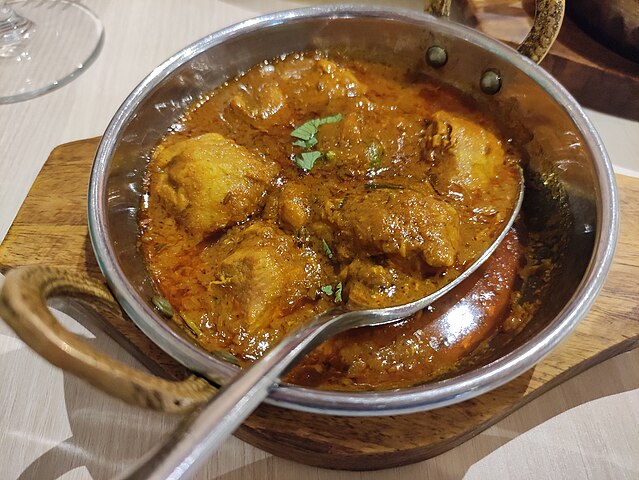


Yet all of these are unquestionably curry. Anyone can taste any of these dishes and immediately recognize it as curry. In the same way, each tradition and sect with Buddhism is easily recognizable. It may not suit one’s personal taste, but the variety of cultures, historical precedents, people and geography have led to a variety of traditions, and there’s something for everyone. Of course, this is true of other world religions too, but I wanted to use Buddhism as the example.
So, when looking at the variety of ideas, teachings and practices, consider the example of curry. Different curries arise from different conditions, and each is suitable for different people, but also curry is delicious no matter how you try it. So, don’t be afraid to sample other versions.
1 Unlike most Buddhist countries where monks are celibate and usually live a cloistered life, Buddhist monks in Japan are (for complex historical reasons that are too long to go into here) parochial, live among communities and marry.
 Gleanings in Buddha-Fields
.jpg)
You must be logged in to post a comment.