The Japanese Way of Doing Things

My guide book on Japanese culture talks about a concept called sahō (作法), which in a mundane sense just means “instructions” for doing stuff. But the book explains that it also describes how things are done culturally:

… for example, in the case of the tea ceremony, every act is carefully choreographed, from where people sit, to how the water is boiled, to how the ea is prepared and so on.

Again, in the business world, one can observe sahō in action as the seller employs polite language and bows often as he shows various forms of respect to the buyer. Another case would be the social setting of a company, where a subordinate will use particular sahō with his boss.

Page 156

The book further explains:

For most Japanese, sahō is an ingrained pattern of behavior that affects their day-to-day actions without them even being aware of it. However, for people who come from overseas, some of these practices may appear puzzling. Why is someone bowing so many times in a particular setting? Or at another time, why is someone sitting ramrod straight? But for the Japanese, they are simply following the sahō that is appropriate for that place and circumstance.

I definitely experienced some of this confusion in the early years when I visited Japan with my wife. My in-laws kindly took me to a local Takashimaya department store and paid to get me a tailored suit. As a poor white kid in America, the experience was kind of awkward on a few levels: I wasn’t used to getting measured for a tailored suit, I wasn’t used to the very polite speech and mannerisms of the store employee, I wasn’t very good at speaking Japanese, and I wasn’t even used to owning my own suit.1

This concept of sahō isn’t limited to Japanese culture, of course. It is true, based on limited experience, that things can feel really choreographed in Japanese culture compared to American culture, but the idea of “how people do things” is universal. The American handshake is on example, the tendency for Russians not to smile during formal settings, the “pub culture” in Ireland and so on. There’s countless examples unique to each culture.

Even for a culture like Japan, where everything really is kind of choreographed, you do get used to it. The extra flourishes at the bookstore (wrapping the books, extra bowing, etc) were a bit confusing at first, but after a while, I don’t even really mind it anymore. Similarly, certain habits became ingrained more and more each time I visit.

So, when you encounter another culture, the important to bear in mind is that each culture has its own sahō, and it will be different than yours. Be observant, be flexible. If you do, you’ll quickly adapt and will succeed. People who stand like tall trees in the wind get blown down, but those who bend like grass prosper.

Food for thought.

P.S. Fun bonus post before Thanksgiving weekend! Happy Thanksgiving Day and Native American Heritage Day to readers in the US.

1 It is still the only suit I own, but I save it for important occasions only, such as my mother-in-law’s funeral. Speaking of sahō, funerals in Japan are very formal compared to American ones.

Family

Ying Nan: You are a product of all who came before you. The legacy of your family, the good and the bad, it is all a part of who you are.

Shang-chi (2021)

My kids and I have been watching the Marvel MCU movies for years. My firstborn is particularly a Marvel fan since she was a little girl. Some of the movies are better than others (my personal favorite is Thor: Ragnarok),1 but we both really like the movie Shang-Chi and the Legend of the Ten Rings.

When my wife (who is Japanese) and I first dated, there was an immediate clash of cultures. I was a generic American white kid who grew up in an impoverished broken home with lots of issues, my wife grew up in a working-class Japanese family that was not overly traditional, but still very Japanese compared to American standards. The fact we were dating in the first place was a bit awkward for her and her parents, whereas I hardly ever talked to my own parents.

The good news is that over time, we learned to understand one another, and that means that I too learned to appreciate her viewpoint sometimes. For example, family.

Even when she disagreed with her parents, she still respected them, and understood her family obligations. This was something frankly new to me because I openly rebelled against my parents, told my dad off, and hardly paid them any heed. I gradually did reconcile with my parents to some degree as I got older (and a bit wiser), to a level where we can get along, but more importantly I learned to accept that I am who I am due to my family. Like the quote above says, you can’t deny your own heritage, both the good and the bad, and that it does shape who you are.

But also, through my wife and through parenting myself, I learned that I do owe some level of gratitude to my parents for what they did. I chose not to be like my parents in how I raise my kids, but even that is something I learned from them.2 Thus, the lesson I learned from my wife is that I also have to be humble, and respectful to my parents enough to acknowledge what they’ve done for me, even if I disagree with them. This is a very Confucian outlook, but I can see the value in this.3

It rubs against my American sense of individualism, but I’ve found it a valuable lesson over the years, and something I think we can all learn from.

P.S. Xu Wenwu, the father in Shang-chi, is a great example of a plausible chaotic-evil person in Dungeons and Dragons: he craves absolute power and yet is also capable of being in love, being a father, etc. Yet, he inevitably bends everything toward evil or ruin, including his lawful-good wife, Ying Li. Tony Leung Chiu-wai‘s performance was excellent.

1 The Thor movies do a really nice job of weaving science fiction with magic and myth, much like Roger Zelazny did in his books generations ago (Lord of Light, the Amber Series, Creatures of Light and Darkness, etc.). Put simply, I like weird, transcendent stuff more than the “grounded” story lines like Captain America or Black Widow.

2 In Japanese there is a four-character phrase for this: hanmen kyōshi (反面教師) meaning to learn from a bad example (i.e. what not to do).

3 This importance in family isn’t even limited to Confucian-influenced cultures. You can find it in many unrelated world cultures where family is emphasized, and respect towards one’s ancestors. For whatever reason, it is not emphasized in Western culture, and maybe to our detriment I think.

Happy Golden Week 2025

Happy Golden Week to readers!

The first week of May in Japan has an interesting phenomenon in the modern calendar called Golden Week (gōruden uīku, ゴールデンウィーク): a series of national holidays that line up very closely. Thus, people often take vacations at this time (a rarity in Japanese business culture), and enjoy the fine weather before the monsoon comes. I wrote about Golden Week in more detail here.

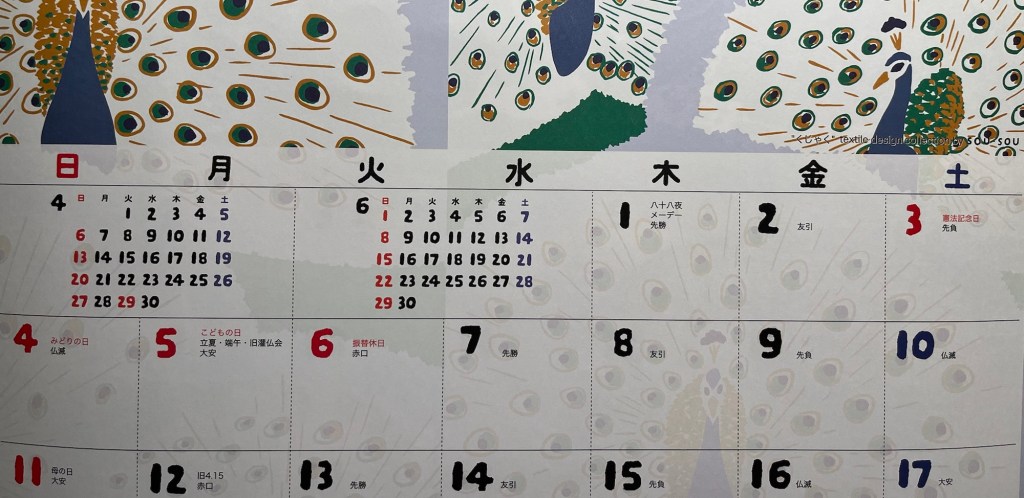
You can see on our home calendar how the holidays (in red) line up:

My sister-in-law in Japan often takes this time off, as do many other Japanese business and white-collar workers. It may be the longest vacation they take in the year, apart from Japanese New Year.

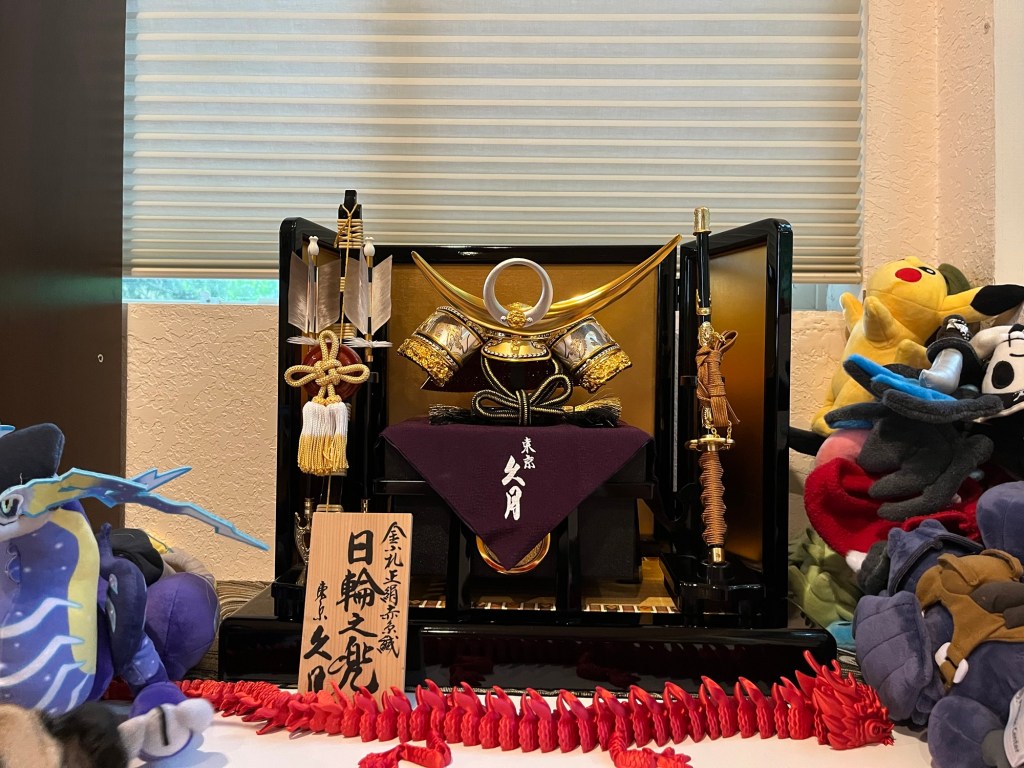
As part of Golden Week, Childrens Day, or Kodomo no Hi (子供の日) also takes place every May 5th. I’ve written about that as well. We have taken out our usual yoroi armor display:

The Pokemon toys and dragons are just my son’s toys (he should clean up more 😋).

I am not sure if we can get kashiwa-mochi this year, as Japanese goods are getting harder and harder to obtain lately, and our schedule is chaotic this week anyway, so I am not sure exactly how we will celebrate. I do know that we will go see the Minecraft movie for a third time in theaters, though. My son and I really enjoy it, and it’s nice to see all the kids yelling certain parts of the dialogue in unison.

I wish I could post more, but as alluded to earlier, I will be away for about a week, and haven’t been able to write more due to work and other competing priorities. However, I hope you all have a terrific Golden Week, and can enjoy the weather in some way. I have other great content coming up, both historical and Buddhist, so please stay tuned, and take care!

P.S. Golden Week also serves as a reminder that what many modern workers need isn’t just equitable pay, but also time off. Happy May Day! ✊🏼

Capsule Machines in Japan

Game centers in Japan are everywhere in urban areas. Kids don’t have as much park space as kids in the US would, since everything is much denser and land space is much smaller, so they often hang out at game centers. And, if you go to a game center you might see rows and rows of these:

These are capsule machines, or as kids call them gacha-gacha after the sound they make. Capsule machines aren’t limited to Japan only, but the variety and prevalence is much larger than in the US. You can find capsule machines all over the place, and the variety of stuff you can get is staggering:

To the bottom-right you can even see a “Buddhist statue” gacha-gacha machine. I saw those in Kyoto a lot too. They even had one for my favorite Japanese song, Matsuken Samba:

The capsule machines can cost anywhere from 100-yen, to as much as 500-yen per capsule. Also, be aware, there is usually a small basket nearby where you can put the opened capsules (do not throw away in regular garbage if possible). So, once you’ve opened your capsule and removed the contents, just put in the basket.

As for Matsuken Samba, he sits on my bookshelf now here in the US:

Golden Week in Japan

We all need a break sometimes. My coworkers in the EU often take time off in August, while I usually take part of the summer of with the family to see relatives in Japan. My company is a Japanese company so per tradition we also get the last week of the year off, ostensibly for New Year’s.

Japan is a place not known for vacations though. Office workers take long hours, and often shy away from taking personal time. Sure, they have personal time by law, but pressure from office culture tends to limit this.1

Thus, many people take time off during Golden Week (gōruden uīku, ゴールデンウィーク). Golden Week is a series of small nations holidays, each minor on its own, but appear on the same week, so people often use this as a reason to take time off.

The holidays in question are (source Wikipedia):

  • Showa Day (昭和の日, shōwa no hi) – a memorial to the late Showa Emperor (Hirohito). This holiday is observed on April 29th.
  • Constitution Day (憲法記念日, kenpō kinenbi) – a day to commemorate the modern constitution (kenpō) of Japan, which was original designed by US Occupation forces in 1946, but includes some novelties and innovations that the US Constitution lacks (explicit rights for women) as well as its renunciation of war.2 Observed on May 3rd.
  • Greenery Day (みどりの日, midori no hi) – this holiday ostensibly is a day to reflect on nature and such, but originally was celebrated as the birthday of the aforementioned Showa Emperor, who also happened to love plants as a hobby. It was also renamed following the ascension of his son, the Heisei Emperor. The significance of the late Showa emperor’s birthday has lessened over time anyway and the general appreciation of nature has taken over. Observed on May 4th.3
  • Children’s Day (子供の日, kodomo no hi) – I’ve touched on this holiday before. It is observed on May 5th, and is probably the most important.

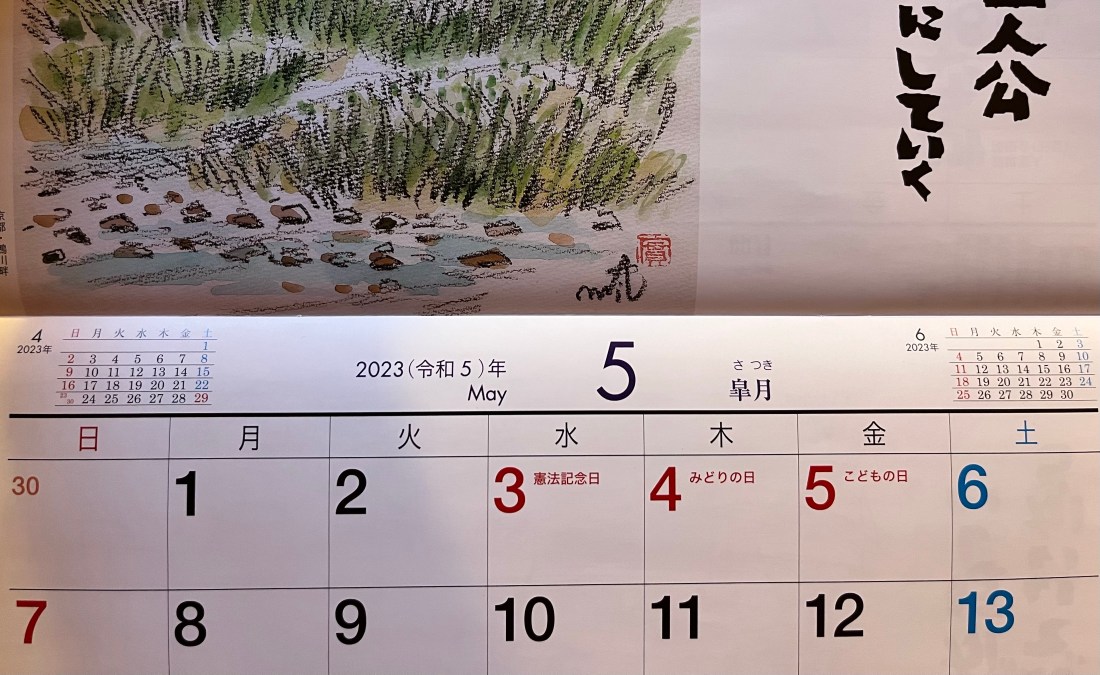
You can see three of them listed on the calendar above, which we have at home.

Vacation travel soars this week, and congestion is everywhere. Sometimes other holidays which float around can further extend Golden Week up to 10 days long. It is for many Japanese workers, the longest week off they will enjoy in the year.

Whether you are in Japan, or overseas, hopefully you can catch some rest this time of year and enjoy the weather!

P.S. Tofugu has a great article on Golden Week too.

1 My sister in law, who is unmarried and works in the banking sector, had to take a lot of time off to care for her mother before she passed away. So people do take time off, but not always for leisure.

2 It replaces the 19th century, militaristic Constitution based on the Prussian model, which gave considerable power to the Emperor and made him sole authority of the military (they didn’t answer to the Cabinet). Check out this fun video series to learn more about Prussia, especially under Frederick the Great. While in college, I attended a lecture by the US Army secretary who helped draft the part of the constitution granting equal rights to women. She was a pretty amazing lady who dealt with a monumental task.

3 Of course, May the Fourth is important around here too. 😉