Family

Ying Nan: You are a product of all who came before you. The legacy of your family, the good and the bad, it is all a part of who you are.

Shang-chi (2021)

My kids and I have been watching the Marvel MCU movies for years. My firstborn is particularly a Marvel fan since she was a little girl. Some of the movies are better than others (my personal favorite is Thor: Ragnarok),1 but we both really like the movie Shang-Chi and the Legend of the Ten Rings.

When my wife (who is Japanese) and I first dated, there was an immediate clash of cultures. I was a generic American white kid who grew up in an impoverished broken home with lots of issues, my wife grew up in a working-class Japanese family that was not overly traditional, but still very Japanese compared to American standards. The fact we were dating in the first place was a bit awkward for her and her parents, whereas I hardly ever talked to my own parents.

The good news is that over time, we learned to understand one another, and that means that I too learned to appreciate her viewpoint sometimes. For example, family.

Even when she disagreed with her parents, she still respected them, and understood her family obligations. This was something frankly new to me because I openly rebelled against my parents, told my dad off, and hardly paid them any heed. I gradually did reconcile with my parents to some degree as I got older (and a bit wiser), to a level where we can get along, but more importantly I learned to accept that I am who I am due to my family. Like the quote above says, you can’t deny your own heritage, both the good and the bad, and that it does shape who you are.

But also, through my wife and through parenting myself, I learned that I do owe some level of gratitude to my parents for what they did. I chose not to be like my parents in how I raise my kids, but even that is something I learned from them.2 Thus, the lesson I learned from my wife is that I also have to be humble, and respectful to my parents enough to acknowledge what they’ve done for me, even if I disagree with them. This is a very Confucian outlook, but I can see the value in this.3

It rubs against my American sense of individualism, but I’ve found it a valuable lesson over the years, and something I think we can all learn from.

P.S. Xu Wenwu, the father in Shang-chi, is a great example of a plausible chaotic-evil person in Dungeons and Dragons: he craves absolute power and yet is also capable of being in love, being a father, etc. Yet, he inevitably bends everything toward evil or ruin, including his lawful-good wife, Ying Li. Tony Leung Chiu-wai‘s performance was excellent.

1 The Thor movies do a really nice job of weaving science fiction with magic and myth, much like Roger Zelazny did in his books generations ago (Lord of Light, the Amber Series, Creatures of Light and Darkness, etc.). Put simply, I like weird, transcendent stuff more than the “grounded” story lines like Captain America or Black Widow.

2 In Japanese there is a four-character phrase for this: hanmen kyōshi (反面教師) meaning to learn from a bad example (i.e. what not to do).

3 This importance in family isn’t even limited to Confucian-influenced cultures. You can find it in many unrelated world cultures where family is emphasized, and respect towards one’s ancestors. For whatever reason, it is not emphasized in Western culture, and maybe to our detriment I think.
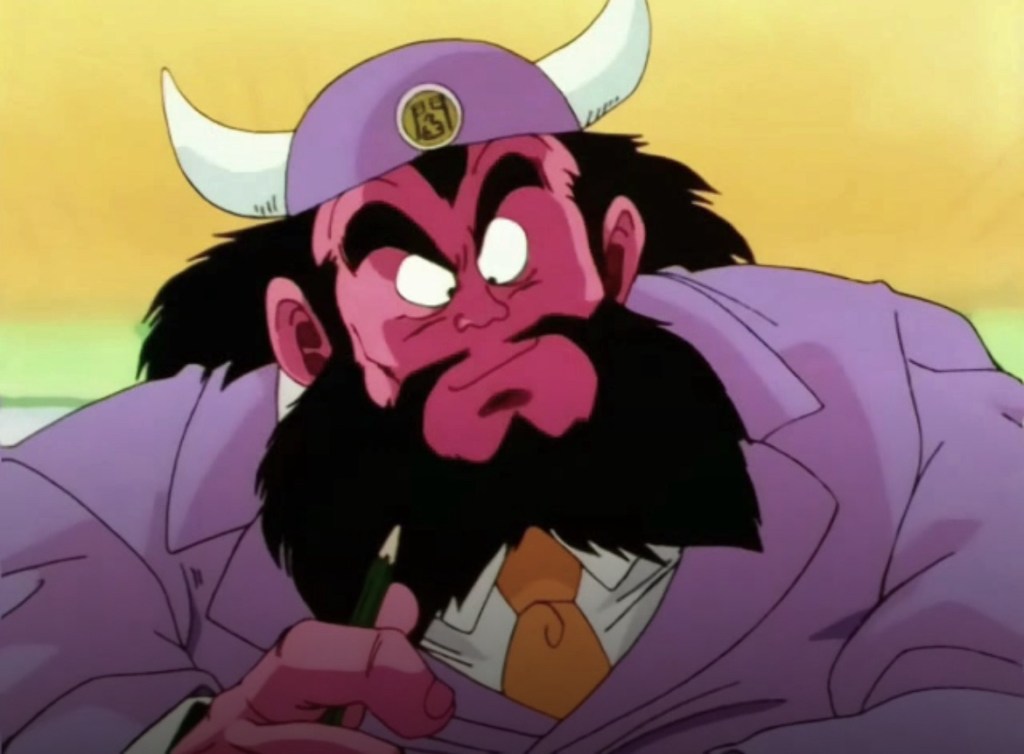
Enma: King of the Dead

My son is at the age where is he is obsessed with Dragon Ball,1 so we watch some of the episodes together on Crunchyroll.

Source: https://dragonball.fandom.com/wiki/King_Yemma?file=KingYemmaNV01

Dragon Ball is a fun series because it blends a lot of Japanese-Chinese mythology, especially the early series, into a futuristic storyline. Goku is obviously based off of the famous legend of the Monkey King, Sun Wukong (Son Goku in Japanese). Another great example is the character Enma.

In Dragon Ball, Enma (sometimes spelled “Yemma” in English) presides the realm of spirits and behaves like a modern bureaucrat. In spite of the suit and tie, this Enma is definitely based on the original figure in Japanese mythology, named Enma Daiō (閻魔大王, “Great King Enma”).

The original Enma is a fascinating example of a “fusion” mythology, not a native Japanese one. Enma is originally based on the Hindu god Yama, lord of the dead.2 However, in China he was transformed into a Confucian-style bureaucrat and shoe-horned into Buddhist cosmology as a judge of the dead. Enma, along with other judges, determine the dead’s next destined rebirth within Buddhist cosmology. During certain Chinese funerary practices and festivals, you can see his visage on “ghost money” used to help the dearly departed coast through the trial process and ensure a smooth, lenient transition to their next life.

This Enma, a bureaucrat / judge of the dead, was how it was imported to Japanese culture in antiquity. He is even featured in classics such as the Tales of the Heike. When the warlord Taira no Kiyomori is dying from a terrible fever, he has a vision of Enma and his demonic attendants awaiting him. I’ve also heard of an old tradition where parents in Japan would scold their kids saying Enma would pull their tongue out if they told a lie. I have never heard this first-hand though, so I wonder if anyone ever says it anymore.

Anyhow, Dragon Ball’s spin on Enma, Goku and others is a fun look at Chinese-Japanese mythology, for a modern era.

RIP Toriyama Akira 🙏🏼

P.S. this post was also inspired after watching the Star Trek: Voyager episode “Barge of the Dead”. It’s a fun look at the Klingon afterlife.

1 growing up in the 1980’s my obsession at the time was Akira, which I still enjoy from time to time. 😄

2 if you ever pick up the book Lord of Light by Roger Zelazny, a wonderful blend of Hindu mythology and ultra-futuristic science-fiction with a lot of sass thrown in, the Yama depicted in that novel is quite an interesting character.

The Challenges of Romanizing Chinese Language

Recently, I was reading a couple old-school fantasy novels set in the Forgotten Realms setting of Dungeons and Dragons: Horselords and Dragonwall. These novels, part of the Empires trilogy, revolve around a fantasy re-telling of the Mongol invasion of Song-Dynasty China.

Dragonwall, in particular, centered on the fictional land of Shou Lung, an analog to Imperial China, and introduced a lot of aspects of Chinese culture, such as Chinese military weapons and armor. The challenge was that these were not always explained and so, I found myself wondering what this sword was, or that piece of armor.

For example, a type of Chinese sword called a chien was frequently mentioned but I had trouble visualizing what it was, so I tried to use Wikipedia. There, the sword is listed as jian, not chien.

Which spelling is correct? In a way, both. In a way, neither.

Welcome to the challenges of expressing Chinese language using the Roman alphabet!

In native Chinese, the jian/chien is written as 劍 or 剑 in Simplified Chinese. . A native speaker probably can read this and know exactly what it means, how it is pronounced, etc. If you are a native English speaker, though, and don’t know Chinese, how do you write 劍/剑 in a way that other native English speakers can understand?

This is a surprisingly tricky issue, and not just limited to Chinese-English. Transliterating words in one language to another is always tricky.

Anyhow, there have been a few attempts to solve this issue of transliterating Chinese to English over the years, and Wikipedia has a very extensive article on the subject, but today we’ll focus on the two most common: Wade-Giles and Pinyin.

Wade-Giles Romanization

Wade-Giles is the older of the two systems, and was the most popular system until the late 20th century, and as a system it is vaguely based on the system used for writing Ancient Greek using the Latin alphabet. Since Ancient Greek had the notion of “rough breathing” as opposed to “smooth breathing” (there was no distinct letter “H” in Greek), apostrophes were used to help distinguish them.

In the same way, letters in Chinese such as “ch” and “j” were distinguished using an apostrophe. Thus “ch’ien” and “chien” would be different. The first uses the English “ch” sound (as in “chop”), while the second uses a “j” sound (as in “jot”). Another example is “t’” versus “t”, as in t’ong versus tong. The first is a hard “t” sound, the second is more like “d”.

If this seems confusing, believe me, it is. Another confusion happens with vowels. The letter “u” is pronounced more like “oh”, whereas “ü” is more like “oo”. Thus, using an example from Wikipedia, the word “k’ung” is pronounced as “kohng”, and “yü” as “yoo”.

Wade-Giles had been the de-facto system for so long, that a lot of English literature that uses Chinese names and words (including my D&D novels above) continues to use it even though it’s frankly pretty antiquated. Wade-Giles is easier to learn upfront because it looks more like natural English, but it uses a confusing system to represent Chinese sounds, and therefore it’s easier misread. Just remember sounds with apostrophes versus sounds without is confusing enough.

Hanyu Pinyin

The other system that’s increasingly in use, and frankly better in my opinion, is the Hanyu Pinyin (or “pinyin”) system. This system requires more work upfront, but provides a more consistent experience because what you see is what you get.

For example, each consonant sound is expressed only one, distinct way. In the “ch’” versus “ch”, pinyin expresses these as “ch” and “j” which is definitely more intuitive. Similarly, “t” versus “d” is pretty straightforward.

Vowels are where pinyin becomes tricky because Latin has only 5 letters to express vowel sounds, and Chinese (just like English) has a lot more than 5 vowel sounds. Unlike ancient Latin which differentiated “I” (as in “fish”) versus “Ī” (as in “ring”), English lost the diacritics and so the sounds just double-up on the same letters.

To work around this, Pinyin uses consonant-vowel combinations to make this work. “Chi” expresses the sound “chih” which rhymes with “fish”. By contrast, “Qi” expresses the sound “chee” as in “cheese”. In the same way “zhi” sounds like “jury” without the y, and “ji” sounds like “jee” as in “jeans”.

The vowel “e” is tricky too since it sounds like “uh” as in “done”. So the surname Cheng does not rhyme with “send”, it rhymes with “sung”.

So, whereas Wade-Giles relies on consonants and apostrophes to express sounds, Pinyin relies on consonant-vowel combinations.

Conclusion

Both systems, like every other attempt at romanization, are imperfect efforts. This is not a fault of the creators of these systems though: transliterating languages is always tricky.

However, of the two systems, I find Pinyin more intuitive overall once you get past the initial hurdles. You don’t have to worry about apostrophes, and most consonants are just more intuitive to read.

Unfortunately, due to cultural inertia, you’ll still find Chinese words expressed through the Wade-Giles system in all sorts of unexpected places.

P.S. if you think Chinese romanization is confusing, wait until you see Korean romanization.

P.P.S. If you’re wondering how good the books are, that’s a subject for an upcoming post. 😏