Children’s Day In Japan

A “koinobori” display made by my wife and son while under living under COVID-19 lockdown. The upper hand pattern is mine, while the bottom one is my son’s. 🥰

May 5th in Japan every year is a holiday called Children’s Day or Kodomo no Hi (子供の日). This holiday was originally the third of five sekku (節句) or seasonal holidays in ancient Japan and a counterpart to Hinamatsuri or Girl’s Day. The 5/5 date, along with Hinamatsuri’s 3/3 date is no coincidence. Most of the sekku holidays have traditional dates like that: Tanabata is 7/7 and the Day of the Chrysanthemum is 9/9, and many of them have Chinese origin as well. May 5th is also a holiday in China as well.

According to an old cultural guidebook that I previously owned, Children’s Day used to be called the Day of the Iris (ayamé no hi, 菖蒲の日) in traditional times. The term for Iris is usually called ayame (菖蒲), but the Chinese characters can also be read as shōbu, which happens to be a homophone of another word that meant warlike spirit, or martial prowess (尚武), which sounded manly and hence it became a festival for boys. By 1948, the holiday was broadened to Children’s Day and has remained that way since. It is also known by an alternate name, tango no sekku (端午の節句) which still retains the nuance of “boy’s day”.

One of the most common displays you’ll see on Children’s Day are the koinobori (鯉のぼり) wind-socks. These wind socks intentionally look like Japanese koi fish, and are usually displayed in groups of 2 to 4. My kids used to make them out of paper each year in Japanese preschool.

The other common tradition is to see samurai armor displayed. If a household has boys in the home, then families setup miniature display of armor, or in our case just the helmet (kabuto 兜) and weapons, some time in April until shortly after Children’s Day. However, schools and preschools also make kabuto helmets and armor out of construction paper for kids to dress up in too. Everyone gets into the spirit that way.

The family “kabuto” display we put up every year for Children’s Day. Other displays depict a full samurai armor (yoroi 鎧), but the one we have is just the helmet, bow and arrow, and katana.

My son, who was born several years after his big sister, is really excited about Children’s Day because he knows he will be spoiled extra, even in these trying times.

Among other things, my wife was able to get kashiwa-mochi (柏餅), which is a special treat made of soft rice-cakes wrapped in White Oak leaves. The leaves are tough and inedible2 (unlike sakura-mochi for Girl’s Day) so unwrap the mochi first and enjoy.
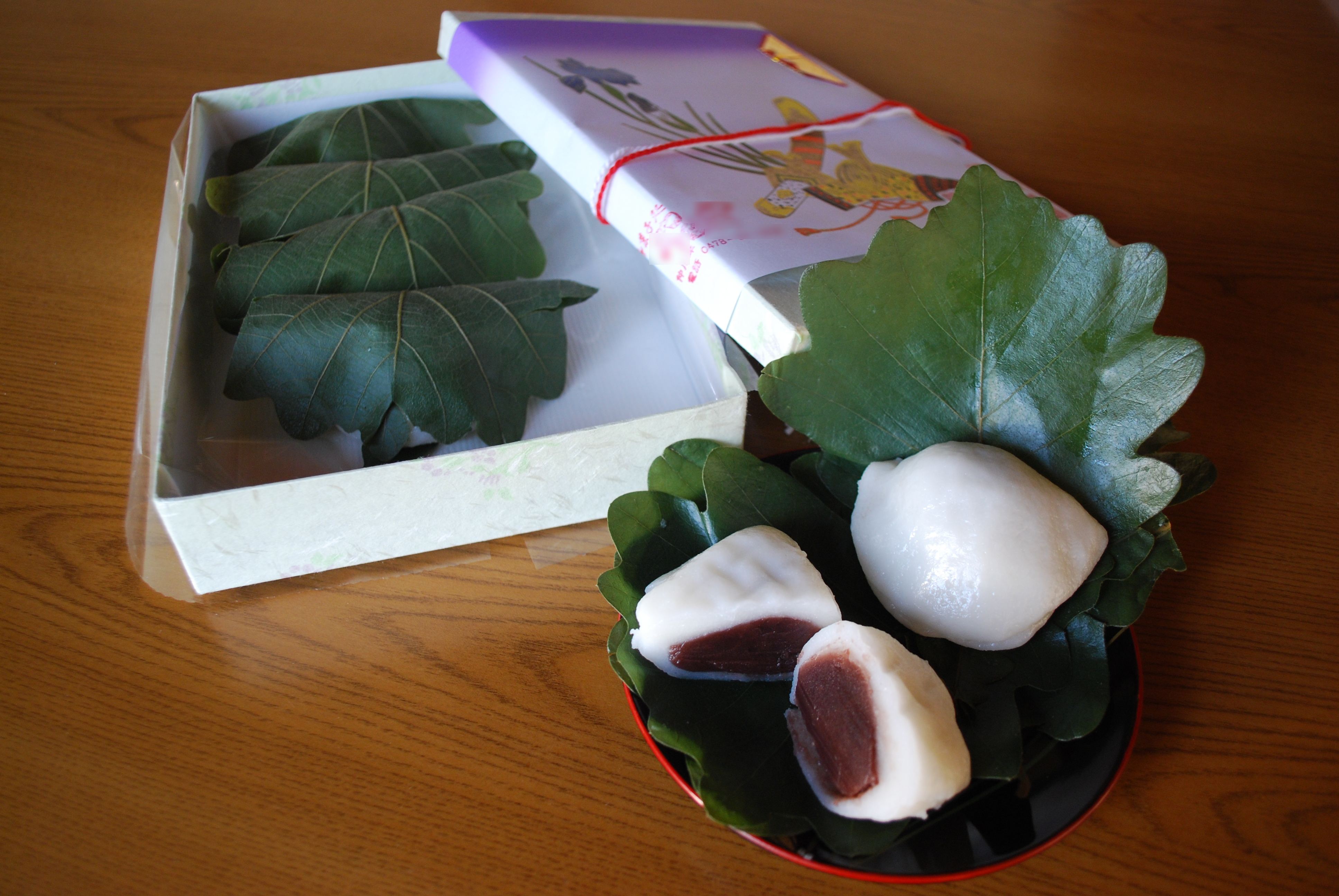
katorisi / CC BY-SA (https://creativecommons.org/licenses/by-sa/3.0), courtesy of Wikipedia

2020 under lockdown is an especially tough year for everyone, especially kids. But I sincerely hope kids everywhere have a terrific Children’s Day and feel loved and appreciated. 🧑‍🧑‍🧒‍🧒

1 One other holiday worth nothing is Nanakusa, which doesn’t follow the usual dating convention, but is considered another sekku holiday.

2 Learned that one the hard way. 😅

Getting Ready for Girls Day

Girls Day in Japan, better known as hinamatsuri (雛祭り) is the third of 5 sekku (節句) or seasonal holidays in the traditional calendar, but it used to be called momo no sekku (桃の節句) or Peach Day, Peach Festival, etc. In the old lunar calendar, it fell every year on the 3rd day of the 3rd month, which then became March 3rd in the modern era. The biggest tradition by far is to put together a special doll set as soon after Setsubun as possible. My wife’s parents brought a nice doll set from Kyoto when our daughter was a baby and every year in February, I bring it out and assemble it:

This is what is looks like when assembled:

The display shows the prince (o-dairi-sama お内裏さま) wedding his bride¹ in traditional style all the way back to the golden era of the Heian Period. Normally such displays can get very elaborate with multiple tiers on them representing the prince’s entourage:

ist_di_cultura_giapponese_-_altare_della_festa_delle_bambole_p1100919
Picture taken by Lalupa, CC BY-SA 4.0, via Wikimedia Commons

My wife’s parents couldn’t bring over a full doll-set, so we just setup the top tier. However, in my visits to Japan, I have sometimes seen the extended family setup displays similar to this one above. It’s a nice father-daughter activity too.  My kindergarten-aged son also likes to help out.

Girls Day and these doll displays are a way of praying for the well-being of the daughters in the family, which traditionally meant starting a new family, prosperity, happiness.  It might seem a bit old-fashioned in the 21st century, but even in this modern era, parents still hope for their daughters’ happiness and well-being and it’s a chance for young ladies to be a princess for a day.  🥰  My wife always makes a nice dinner for our daughter using sashimi and other nice treats.  I’ll post more on that later.

P.S.  The emoji 🎎 is actually from Hinamatsuri, though few outside Japan would normally recognize this.

¹ Notice the bride is also wearing many layers of kimono robes.  This style, called jūni-hito-é (十二単) or “twelve layers”, was a gorgeous style worn by noblewomen and their ladies in waiting during the Heian Period, and even used these days in very, very limited situations such as those presided by the Imperial Family.  Suffice to say the twelve-layers were very heavy and required help to get in and out of.  Lady Murasaki was one such celebrity (herself a lady in waiting) who wore jūnihitoe during formal occasions.

Setsubun Block Party!

One of my favorite holidays in Japan is Setsubun which in the modern calendar is always February 3rd. We celebrate it every year with the kids because it’s a fun way to bring the family together, maybe bring in a little extra good luck, and is pretty low-key.

Setsubun (節分) is the second of 5 “seasonal events” (sekku, 節句) and traditionally marked the beginning of Spring in the Old Chinese calendar. In the traditional 24-period division in the old calendar the beginning of Spring was called risshun (立春). There are technically other Setsubun days, but really the only one anyone knows anymore is “spring Setsubun” which is was on the 3rd day of the second month of the Lunar Calendar, which was converted to February 3rd in the Gregorian calendar.

Since (spring) Setsubun marks the beginning of Spring, which in turn marked the beginning of the new year in the old lunar calendar, Setsubun is a time to “reset” the home, get a fresh start, and so on.

The most important tradition is the mamemaki (豆まき) in which the head of the household usually dresses up as an oni (鬼, Japanese ogre) and knocks on the front door. The kids throw roasted soybeans at him and yell:

鬼は外! 福は内! 
Oni wa soto! Fuku wa uchi!

“ogre out! good luck in!”

I have some old videos of my misadventures with mamemaki. One year, as I pretended to fall down from the soy beans, I hit my head really hard on the handle of the bbq grill. Hurt like hell.

Also, since we live in the US, we use roasted peanuts instead of soybeans since they’re easier to get a hold of. Further, after driving away the Oni, one is supposed to eat a number of beans equal to one’s age.

The local Buddhist temple here also has a mamemaki event we do with the kids. I might post something about that soon.

The other big tradition is eating a special sushi roll called ehōmaki (恵方巻), while facing a particular “auspicious” tradition based on Japanese geomancy. The direction changes every year, and according to tradition, your wish will come true if you can eat the entire ehōmaki roll while facing that direction and not saying a single word. Ehōmaki rolls are more of a Kansai area (Osaka, Kyoto) thing than the Kanto area (Tokyo), but the tradition has spread to much of Japan and overseas communities as well.

So, happy Setsubun every one!