Pure Land Buddhism, that is the broad tradition that is found in places like China, Korea, Japan and Vietnam, frequently relies on a concept known as Dharma Decline. The idea, briefly talked about here, but the idea is that when a Buddha arises in the world and teaches the Dharma (e.g. “the way things are”), it’s like turning a bicycle wheel. In time, that wheel slows down further and further until it finally stops until another Buddha arises.
Because of Dharma Decline, Pure Land Buddhism frequently teaches that as we become further and further removed from the time of the Buddha (e.g. the historical Buddha, Shakyamuni) it gets harder and harder to put certain teachings into practice. Instead, people can rely on the compassion of Amitabha Buddha, the Buddha of Infinite Light, in these latter days of the Dharma.
This is succinctly put in a quote by the late Chinese-Buddhist monk, Shi Yin-Guang (釋印光; 1862–1940):
Cultivation is no different from wearing cotton garments in the summer and heavy padded clothing in winter; we cannot go against the times, capacities and conditions of sentient beings. Even if the Patriarch Bodhidharma himself were to be reborn today, and wished to preach in accordance with the current times and conditions and swiftly emancipate sentient beings, there would be no better method than Pure Land.
The idea here is that just as different clothes are suited for different seasons, different teachings and practices within Buddhism are appropriate for different periods of Dharma Decline. Thus, in latter days of the Dharma, the Pure Land practices are though to the most suitable.
The background this idea comes from a Buddhist text called the Sutra of Immeasurable Life, which ends with the statement:
The Buddha further said, “I have expounded this teaching for the sake of sentient beings and enabled you to see Amitāyus [a.k.a. Amitabha] and all in his land. Strive to do what you should. After I have passed into Nirvāṇa, do not allow doubt to arise. In the future, the Buddhist scriptures and teachings will perish. But, out of pity and compassion, I will especially preserve this sutra and maintain it in the world for a hundred years more. Those beings who encounter it will attain deliverance in accord with their aspirations…”
Dharma Decline appears in a number of Buddhist sutras, but this sutra, which is central to the Pure Land tradition, explicitly teaches that the Pure Land teachings will endure the longest when other teachings are lost, obscured, or cease to be effective.
Of course, this raises some questions: is Dharma Decline real, and even if it is, is the Pure Land approach the most effective in these times?
I have no definitive answer. I have wavering opinions about this myself from time to time. I also believe it’s up to each Buddhist to decide for themselves. A follower of esoteric Buddhism (e.g. Tibetan Buddhism) could just as easily point to specific texts to prove theirs is the best practice, a Zen Buddhist might shrug off Dharma Decline and go back to meditating,1 a follower of the Lotus Sutra might just as easily make the same argument for reciting the Odaimoku. Hence, we have so many gates to the Dharma.
However, I do think Ven. Yin-Guang has a point: different Buddhist practices are suitable for different times and places, and like a winter jacket vs. a summer jacket, it helps to consider the situation: one’s own personal situation, and the situation of the Buddhist community in your area. For me, the accessibility of the Pure Land path, coupled with the straightforward approach, and flexibility with life as a parent make it preferable for me.
1 Dogen, founder of Soto Zen did not subscribe to Dharma Decline for example.
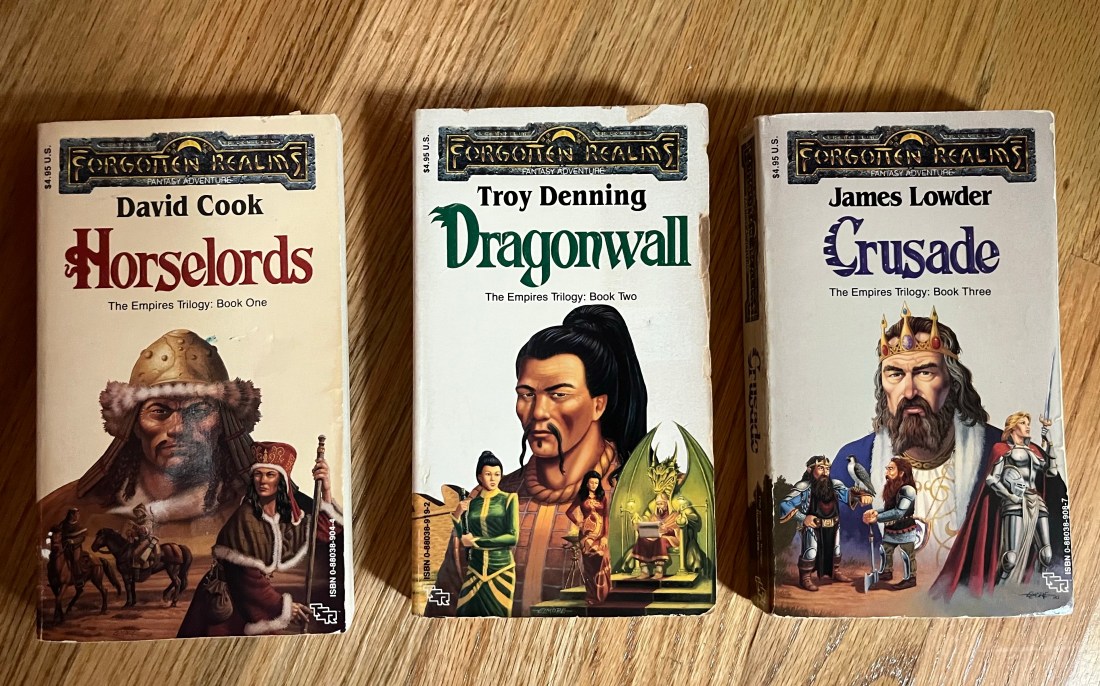
This post started with a surprise find at my local Half Price Books store. I often peruse the old fantasy paperback section, looking for Roger Zelazny novels that I haven’t picked up yet (see Spring Cleaning post), when I stumbled upon this old novel:
I suddenly remembered reading Horselords way back in the 1990’s in college, and although I didn’t remember the story much, I felt like re-reading it. It turned out to be a surprisingly good book. The story had surprisingly little to do with any Dungeons and Dragons lore apart from an odd mention here and there of magic, but instead was essentially a re-telling of the Mongol invasions of China, through a fantasy, fictional tribe called the Tuigan, headed by one Yamun Kahan. The book hints at some lore regarding the great Shou Empire, while the store is largely seen through the eyes of a foreign monk named Koja who is gradually brought into the inner-circle of Yamun Kahan. The story includes a lot of elements of the “noble savage” and “fish out of water” tropes, but overall it was a solid story as Koja gradually becomes more and more Tuigan in spite of himself. Even as his homeland is invaded by the Tuigan, Koja is a semi-willing participant in the invasion.
Having enjoyed the book, I decided to get the next two. I had never read them back in the day, not even sure if I knew they existed, but now, 30 years later, it was time to finish the series.
The second book, Dragonwall, was written by a different author, and was in many ways a different story entirely. The main character is a minor general named Batu Min Ho, who has Tuigan ancestry of his own, but was raised in Shou Lung. Through his tactical skill, he gradually rises through the ranks, earning the jealousy of some of the mandarins above him, culminating in a power struggle, and plenty of treachery that leaves his wife and children killed by the end.
Dragonwall overwhelmingly paints the Shou (fantasy Chinese) people of the Forgotten Realms in a negative light, as treacherous, back-biting, and decadent, which isn’t too surprising where court politics would be concerned but there’s little else to balance this contrast with the rest of Shou culture. This was probably meant to contrast the more brutal, yet honorable Tuigan culture, yet all the characters come off as one-dimensional and cartoonishly evil, especially the female antagonist. It plays into a lot of old, tired stereotypes about Chinese people.
Further, Batu Min Ho, having been discriminated and betrayed by the Shou, loses everything, goes rogue, literally using the Japanese term ronin (🤦🏻♂️)1 to describe himself, and joins Yamun Kahan’s horde.
The book ends with a lengthy divergence when the Tuigan under command of Batu Min Ho invade the fantasy realm of Thay briefly, which probably would’ve been interesting as a third story, rather than the end of this one.
In any case, this is where the third novel, Crusade, picks up, but once again, this book is written from the perspective of someone who is not Tuigan. This time the book is written through the perspective of the kingdom of Cormyr, a staple of the Forgotten Realms setting. This book, out of all three, has the most familiar fantasy setting since it is in a “Western” culture, so the author probably was on steadier ground and was able to afford fleshing out the characters more.
For me, Crusade, was a “slow burn” story: very slow start introducing an entirely new cast of characters with no interaction with the Tuigan. However, by the time of the climactic battle at the end, the book did an effective job of bringing everything together, including Batu Min Ho from the second book.
In spite of the rocky transition between settings across the series, shifting perspectives, and new characters each time, the final book did a rather admirable job wrapping up all the loose ends. The first book begins with a character named Koja and the third book essentially ends with him again. Coming full-circle was a nice conclusion.
The Empires Trilogy seems to have suffered from the same challenges that plagued the Star Wars sequels: No over-arching structure, and too many different “hands in the pot”, plus the stereotypical Asian characters, especially female characters, did not age well.
However, even with all the complaints, I still am glad to have finally finished the series. It was a bold attempt to make a semi-historical re-enactment of the Mongol invasions but through the lens of the Dungeons and Dragons Forgotten Realms setting. In spite of my complaints, I enjoyed the series and proudly keep it on my shelf now.
1 Western fascination of the lone warrior ronin is understandable, especially thanks to Kurosawa films, but it makes no sense for a Chinese character to use such a term, especially since it was not used for centuries later in the Edo period (17th century) when the story takes place in 12th century China.
Recently, I took some personal time to delve deep into Pure Land Buddhist teachings, re-reading some old books, but also some new ones. In particular, I was very impressed by Charles B Jones’s latest book, an excellent survey of the entire Pure Land tradition in Mahayana Buddhism.
If you’re not familiar with Pure Land Buddhism, this is a broad, broad tradition in East Asia, focused on a single Buddha named Amitabha, not the historical Buddha (Shakyamuni). There are way more devotees of the Pure Land path in many Buddhist countries versus, say, Zen practitioners. It is said that Amitabha, according to the Buddhist canon (a.k.a. the sutras), made a great series of vows to provide a refuge for all beings if they with to be reborn there. In this refuge, one will unfailingly become an enlightened being, by virtue of being so close to a living Buddha.
This might seem weird at first glance, since Shakyamuni Buddha started the whole religion in the first place, right? It’s a long story of how we got to something like Four Noble Truths to something like an ethereal paradise where people can go simply by reciting his name.
Charles B Jones’s book actually does walk through how this tradition evolved from an advanced meditative practice in India to the forms we see today, so that alone is worth reading the book. However, there’s another side to this issue that Jones’s book also covers: sectarian bias.
Way back in 2005, shortly after I married my Japanese girlfriend (now wife), we made our first trip to Japan to visit her extended family. The culture shock hit hard: I hardly knew the language, the customs and food weren’t what I expected, and the Buddhist religion that I was so interested in made no sense to me. I remember seeing Amitabha Buddha at Chion-in temple in Kyoto, and while it was very beautiful, it felt like weird superstition to me. This wasn’t mentioned in any of my books about Buddhism! Someone in Japan even asked me what I thought about it all, and I made some stupid, arrogant comment about superstition, etc.
But it was still nagging me when I got home later, and that’s when I discovered the Jodo Shu homepage in English. I slowly started to unravel things, and eventually became a devoted follower (still am in many ways), but at the time, this was very niche Buddhist teachings outside of some Western organizations like the Buddhist Churches of America (also a wonderful org, highly recommend).
Since then, there have been a lot of books published in the last 20 years about Pure Land Buddhism, but they are almost always sectarian, and obfuscate the variety of practices in favor of one single approach. I learned Pure Land Buddhism through Jodo Shu/Jodo Shinshu sectarian sources, including one overtly nationalist book by D T Suzuki (don’t get me started on that guy…), and it colored my understanding for a long time.
For all the increased information on Pure Land Buddhism in the West, it’s still based on very biased, sectarian sources, namely Japanese sects such as Jodo Shu and Jodo Shinshu. This isn’t necessarily wrong, and as a long-time follower of these traditions, they really helped me a lot when I was first getting on my feet.
However, long time readers may note that I’ve danced aroundotheraspects of Pure Land Buddhism, but until recently I had no idea how broad the tradition was, and the many ways people have tackled the theological questions behind it.
Through Jones’s book, I realized that the tradition is huge, and varied in its approach. It’s not just a “Japanese Buddhism versus Chinese Buddhism” comparison either. Many thinkers over the centuries in many countries and eras have grappled with these questions:
What is the nature of Amitabha Buddha and the Pure Land? Is it mind-only? Does it literally exist X yojanas to the West? Or is it right here?
Similarly, is Amitabha Buddha the embodiment of the Dharma or a literal Buddha who excels at reaching out to people?
What is the point of striving for rebirth into the Pure Land? Is it to awaken one’s mind here and now, or is it to reach a refuge in which one can progress along the Buddhist path more easily?
How does one do it? Do they rely on Amitabha Buddha’s compassion (e.g. other power) or does one strive to be reborn there? Is it a “meet in the middle” situation?
What is the nianfo/nembutsu (念佛/念仏), and is the nianfo/nembutsu sufficient on its own to accomplish rebirth in the Pure Land, or are other practices required?
Charles B Jones covers all the ways people have interpreted these questions, in India, in China and in Japan and the variety of responses and interpretations is surprising.
For example, if we only consider the questions of whether the Pure Land and Amitabha arises from one’s own mind, a Zen-style interpretation, or a more literal savior to that exists elsewhere reaching out to others, we get a spectrum of interpretations. However even if you have two different teachers both advocate for a literal interpretation of Amitabha Buddha, they will differ on whether reciting the nianfo/nembutsu alone is enough, or what practices one should do to strive there.
Even when two teachers agree on a set of practices leading to rebirth in the Pure Land, they might differ on how much of it is due to one’s own efforts versus Amitabha’s compassion and power of his vows.
Thus, what you get is a really complicated, three-dimensional matrix of views.
For example, the Chinese Buddhist teacher, Yunqi Zhuhong (雲棲袾, 1535–1615),1 advocated a very sophisticated approach that tried to reconcile both the mind-only or “principle” interpretation of Amitabha Buddha with the more literal or “phenomenal” one often used by lay people. In his mind, both were essentially correct, and it was perfectly fine to approach from either mentality, so long as one kept up the essential practices: reciting the nianfo (nembutsu in Japanese), reciting sutras, devotional acts, etc. It confirms what I suspected for a long time: that there is more to Pure Land Buddhism than just the nembutsu.
I never even knew about Yunqi Zhuhong until a few weeks ago (I pretty much rewrote the entire Wikipedia article linked above using more sources), and this shows how sectarian views, even when benign, obscure aspects of the tradition and make it hard to understand Pure Land Buddhism at large. One can easily apply this to other Buddhist traditions such as Zen, or Theravada, etc.
Another challenge in Buddhism has always been accessibility, and Charles B Jones shows how the Jodo Shu and especially Jodo Shinshu sects in Japan really excelled at outreach to common people instead of the aristocratic Buddhist followers who focused on esoteric Buddhist practices.2 However, in order to make Buddhism very accessible to large segments of the population, it’s clear they also took some liberties in how they interpret some of the issue above, and these are issues that they have to continuously defend, theologically, to this day.
Anyhow, there’s no clear answer here on who’s right or not. Jones’s book does a great job showing all the different approaches, arguments, and the virtues and challenges of each one, and thus the reader is welcome to decide for themselves. It’s so rare to find such a balanced and thorough overview of the entire tradition. For my part, I haven’t fully decided for myself what the right approach is (hence all the book reading lately), but it really helped give me a broader picture, and plenty of food for thought.
Namu Amida Butsu
1 Pronounced as “yoon-chee joo-hong”
2 Another interesting contrast that Jones’s book shows between Chinese Buddhist history versus Japanese: Japanese Buddhist history starts with the Imperial Court patronage and over generations gradually filtered down to the general population, thus it required patronage, sects, etc. Chinese Buddhism by contrast “percolated” up from small communities, often influenced by foreign merchant communities, and thus never had to organize sects, schools and such; Buddhist communities just sprang up organically.
One of the most important figures in Buddhism and East Asian history is, arguably, also one of the least known outside of some cultural circles. I am talking about a famous Chinese monk named Xuan-zang (玄奘, 602 – 664).1 Recently, I found an old, but fascinating book on my shelf I had forgotten about, titled The Silk Road Journey With Xuanzang by Sally Wriggins. This book tells the story of Xuanzang as a young monk, who decided to journey to India to see historical land of the Buddha.
The “Flaming Mountains” near the city of Turpan on the Silk Road. Photo by es:User:Colegota, CC BY-SA 2.5 ES, via Wikimedia Commons
He is also celebrated in this video from Extra History:
Why would he do this? In his own words:
The purpose of my journey is not to obtain personal offerings. It is because I regretted, in my country, the Buddhist doctrine was imperfect and the scriptures were incomplete. Having many doubts, I wish to go and find out the truth, and so I decided to travel to the West at the risk of my life in order to seek for the teachings of which I have not yet heard, so that the Dew of the Mahayana [Buddhist] sutras would have not only been sprinkled at Kapilavastu, but the sublime truth may also be known in the eastern country.
Translation by Li Yung-hsi in The Life of Hsuan Tsang by Huili (Translated). Chinese Buddhist Association, Beijing, 1959
But journeying from China to India can’t be all that hard, right?
In fact, it was extremely difficult and dangerous, and a big reason why even getting Buddhism to China was such a big deal in the first place. First, one has to…
A 14th century Japanese painting of Xuanzang journeying to India. Courtesy of the Tokyo National Museum, Public domain, via Wikimedia Commons
Cross over the Oxus River (modern-day Afghanistan), then
Pass over a small mountain range that you might have heard of: the Himalaya mountains, meanwhile
Avoid getting robbed by bandits (Xuan-zang did encounter a few)
Avoid thirst and starvation, and
Avoid exposure to the elements (extreme heat and cold), and finally once India
Follow the Ganges River for thousands of miles downstream to the city of Benares.
The so-called “silk road” between China and India was not a simple road that people could just traverse, but a series of inter-connected trade routes, and due to the harsh climate and difficult environments, also a very dangerous one. Powerful steppe warrior tribes of Uyghurs and Turks, not unlike the Scythians, dominated much of these no-mans-lands, and were fickle with whom they protected and supported.
The revered remains of the Buddha’s hut in the Jeta Grove, modern-day Shravasti, myself, CC BY-SA 2.5, via Wikimedia Commons
While in India, Xuanzang journeyed to many areas. Among other things, he beheld the giant Buddhist statues in Bamiyan, Afghanistan (now destroyed), visited the Jeta Grove where the Buddha frequently resided with his followers, and many of the great cities along the Ganges River before residing at Nalanda University for some time.
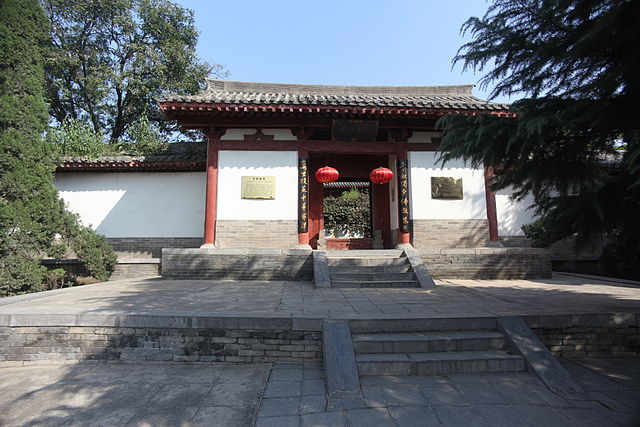
Xuanzang’s residence in China, photo by Gisling, CC BY-SA 3.0, via Wikimedia Commons
Technically Xuanzang wasn’t the first Chinese monk to accomplish this. Another monk named Faxian (法顯, 337 – 422)2 was the first of several. Faxian stayed only in the northern part of India, then took a ship back to China. Xuanzang journeyed all over India, studied at the famous Nalanda University (coincidentally mentioned in the BBC recently) and then walked all the way back too. The trip took a total of 11 years.
When Xuanzang returned to China, he was feted by the Emperor and was given a team of translators and scholars to help translate and compile all the texts he brought back. This led to an explosion of information for the Chinese Buddhist community and helped the Yogacara school gain deeper roots in East Asian Buddhism which we stillbenefit from today. Much of these records were gradually lost in India, but preserved in China thanks to people like Xuanzang.
One other historical note here, when Faxian came to India, Buddhism was still a prosperous religion, but when Xuanzang visited centuries later, it was clearly declining in some areas, and slowly being replaced with the Hindu religion we know today.3 Some Buddhist monasteries he encountered still maintained certain practices but no longer understood why. Other monasteries still survived as great centers of learning, with others were completely deserted. It’s not surprising then, centuries later, when Turko-Afghan warriors invaded India and established a Sultanate, Buddhist institutions were easily swept aside.
One thing that’s often overlooked is the language barrier. Chinese language and Sanskrit (as well as spoken Prakrits) are miles apart. They have no common linguistic ancestry. The effort to translate old Buddhist texts from Sanskrit to Chinese during the Tang Dynasty had been a major undertaking and required multiple efforts to properly refine the translation. But Chinese Buddhist monks who could actually speak Sanskrit or any Indian language would have been very rare indeed. Xuanzang must have relied on translators, or somehow learned to speak it well enough to survive so long in India. That invaluable ability to speak it fluently would have been very helpful on his return trip when he translated the volumes of texts he brought back to China.
Also, keep in mind that translating concepts such as the “phenomena of the mind” is much, much harder than translating, say, a shopping list. This was an extremely challenging undertaking.
Xuanzang’s adventure became the inspiration for a 16th-century Chinese novel called “Journey to the West” (西遊記). This Chinese novel was hugely popular, and you can often see movies and dramas about it both in China and Japan. In Japan, it’s called saiyūki. When my wife and I were first married, we enjoyed watching the 2006 drama with SMAP’s Kattori Shingo as the lead actor. We also have an kid’s manga version Japanese for our son. Even the image of Goku from Dragon Ball takes some influences from Journey to the West (a simian-like being riding a cloud, for example).
The book is a fantastic overview of many places along the Silk Road, Afghanistan, Pakistan, Kashmir, and India that Xuanzang saw and wrote about, and are only dimly understood by Westerners. In many places where the US has been involved in overseas conflicts, it’s simply amazing how much history has been there, and how many different feet have tread upon that ground, including monks like Xuanzang and earlier by the Bactrian Greeks of Alexandar the Great.
In any case, I’ve always been a big fan of Xuanzang, and I feel he deserves a lot more recognition in history. So, to help readers remember who he was, I made a song about him based on the original Spiderman theme song ( original lyrics):
♫ Xuanzang-man, Xuanzang-man.
Does whatever a Buddhist can
Goes around, anywhere,
Catches sutras just like flies.
Look out!
Here comes the Xuanzang-man.
Is he tough?
Listen bud—
He walked the entire way there.
Can he cross a de-sert?
Take a look over there.
Hey bro!
There goes the Xuanzang-man.
In the chill of the night,
At the Roof of the World,
He crossed a ravine,
With only a rope bridge!
Xuanzang-man, Xuanzang-man,
Friendly neighborhood Xuanzang-man.
Wealth and fame, he’s ignored— Wisdom is his reward.
To him, Life is a great illusion—
Wherever there’s a stupa,
You’ll find the Xuanzang-man!♫
Try it out a few times. A few parts of the wording are a bit awkward, so I probably need to work on it some more.
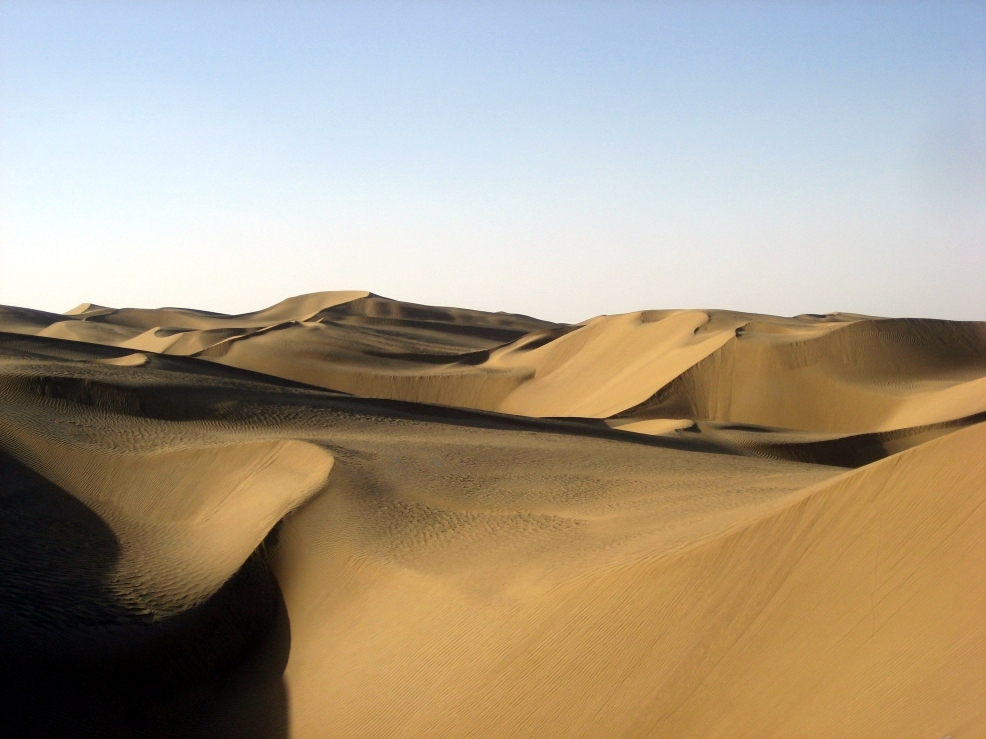
P.S. Featured image is a photo of the Taklamakan Desert, photo by Pravit, CC BY-SA 4.0, via Wikimedia Commons
1 Pronounced like “Shwan Tsahng”. In Japanese, the same name is pronounced as Genjō.
2 Pronounced like “Fa Shien”.
3 A common misconception is that Buddhism arose from Hinduism, but this is inaccurate. Buddhism and Hinduism both have a common cultural ancestor in the ancient religion of the Vedas. Buddhism ultimately rejected the deistic religion of the Vedas and its veneration of the early gods, relegating them to secondary status, but Hinduism embraced it and gave it much more philosophical weight. Hinduism as we know it simply didn’t exist, and the religion of the Vedas was more similar to, say, ancient Greek religion around the Olympian gods.
Recently, I posted an example of Buddhist liturgy as found in the Japanese Tendai tradition, but I wanted to call out one aspect of that liturgy called the Four Bodhisattva Vows or shiguseigan (四弘誓願) among other names. According to my book on Genshin, the Four Bodhisattva Vows were formulated by the original founder of Tiantai (Tendai) Buddhism in China: Zhiyi. Zhiyi formulated these vows based on an earlier gatha verse from the fifth chapter of the Lotus Sutra:
Those who have not yet crossed over I will cause to cross over,
those not yet freed I will free,
those not yet at rest I will put to rest,
those not yet in nirvana I will cause to attain nirvana.
Translation by Burton Watson
The vows have since promulgated to other Buddhist cultures and sects. The liturgy text will vary slightly from Buddhist tradition to tradition, but like the dedication of merit, is remarkably consistent overall.
In the aforementioned Tendai tradition, one version of the vows is as follows:
Sino-Japanese1
Pronunciation
Translation by me (other, better translations exist 😉)
衆生無辺誓願度
Shu jo mu hen sei gan do
Sentient beings are innumerable, and yet I vow to save them all.
煩悩無尽誓願断
Bon no mu hen sei gan dan
My mental defilements (lit. bonnō) are innumerable, I vow to extinguish them all.
The path to Buddhahood is peerless, I vow to fulfill it.
1 Chinese liturgy with Japanese phonetic pronunciation 2 I’ve also seen the last character as 知 (chi), but more or less means the same thing
These vows cover something that we saw in previousarticles about the Mahayana-Buddhist notion of the Bodhisattva: that we’re all in this together, and so the Buddhist path is not truly fulfilled until one completes their vows to aid all beings no matter how long it takes. The Mahayana path of the Bodhisattva is lofty, heroic even, but as the last verse says, nothing less is enough.
On the other hand, the path of the bodhisattva begins with a single good act, or a good thought towards others. It’s about piling up grains of sand or pebbles time and time again. With enough time and dedication, one can move mountains. Don’t be afraid to think big, even if you come up short in this life. Even if you acted like a dickhead today, that doesn’t mean tomorrow you will be one. Every day is a rehearsal. The very notion of “buddha nature” means that each one of you has the capability for great things, even if you don’t think you can. That’s why in the 20th chapter of the Lotus Sutra, the Bodhisattva Never Disparaging bows to each person, even when they’re a total jerk: given the right conditions, any sentient being can become a bodhisattva or a fully-awakened buddha. Given enough time all of them will.
My best wishes to you all, dear readers. May all you be well, free from harm, and find what you are looking for.
P.S. Featured image from the story of Chujo-hime in the Taima Mandala Engi (当麻曼荼羅縁起)
It is a bit early to celebrate for folks here in the US, but in Japan it is already March 3rd, which means it is already Girl’s Day (hinamatsuri ひな祭り)!
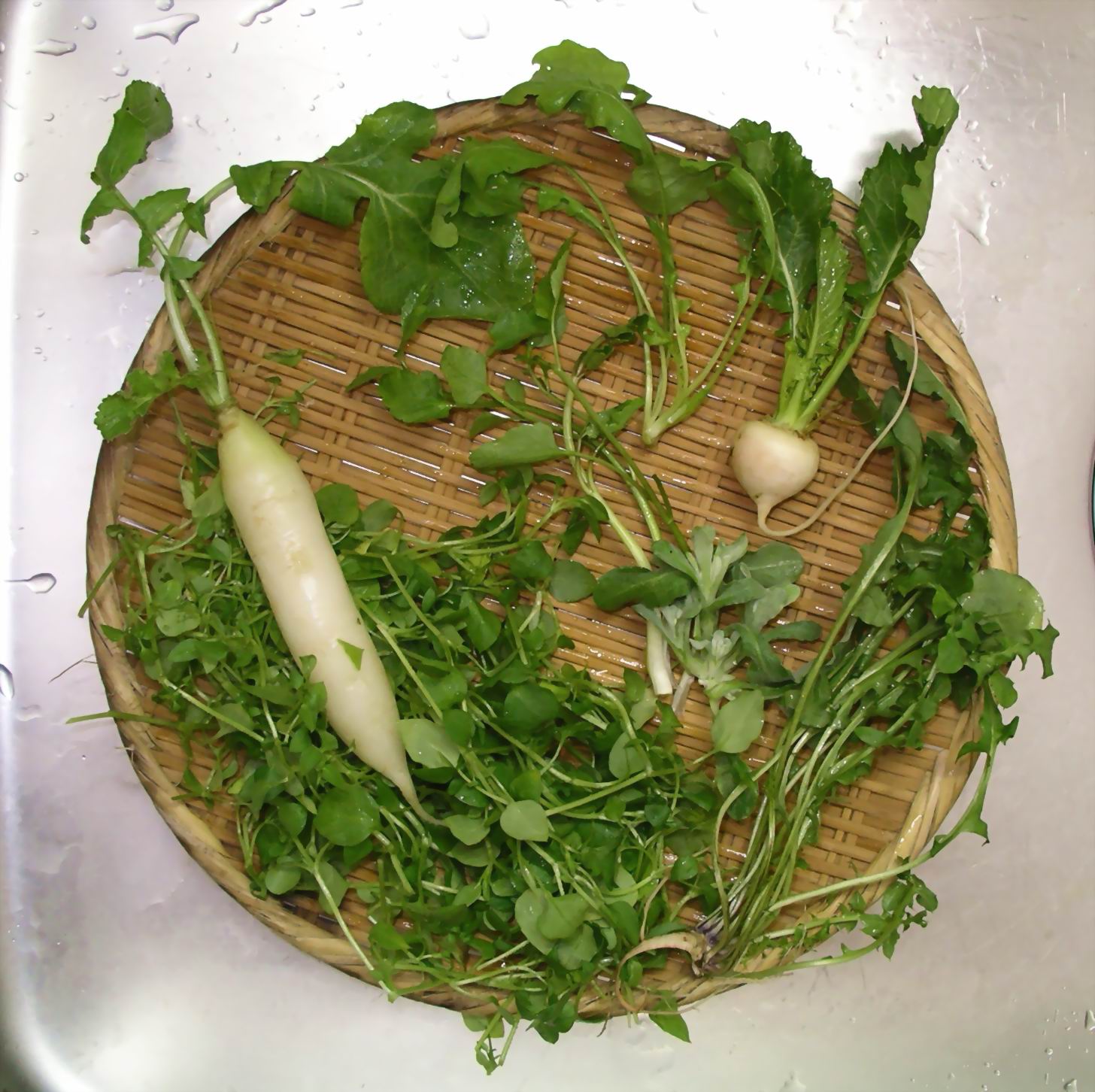
As readers may have noticed from past posts, I have posted about certain traditional Japanese holidays, called sekku (節句). Examples included Girls Day (March 3rd), Children’s Day (May 5th), Tanabata (July 7th) and Day of the Chrysanthemum (September 9th). The last holiday on my list is actually the first on the calendar: Nanakusa (七草) which literally just means “seven grasses / herbs”. More formally it’s called jinjitsu no sekku (人日の節句, “day of the human”) as we’ll see shortly.
This holiday is surprisingly old, with origins in ancient custom in southern China whereby people would cook seven herbs as a porridge on the 7th day after the Chinese new year. It also relates to the Chinese lunar calendar, where the first seven days of the year were designated as rooster, dog, boar, sheep, ox, horse and human, the first six being animals of the zodiac. Since the seventh day was (for some reason) marked as the day of the human, criminal punishments were not executed on this day.
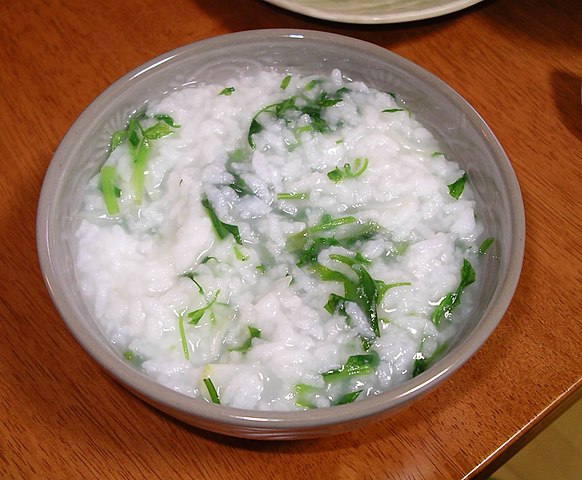
The custom of eating a seven-herb porridge carried over to Japan as nanakusa-gayu (七草がゆ), though in some households more than others. I had it once many years ago when we were first married, and visited my wife’s family home in December-January. I saw a bunch of roots and herbs in the kitchen, like the ones shown above, but didn’t give it much thought. The next day, we were served nanakusa-gayu porridge for breakfast. It has a pretty bland in taste, but that was how I learned about Nanakusa.
A bowl of rice porridge served during Nanakusa, Blue Lotus, CC BY 2.0, via Wikimedia Commons
According to the Wikipedia article, the seven herbs are:
Of these seven herbs, I’ve eaten turnips and Japanese daikon radish regularly, but the other five are pretty obscure to me. I doubt most Japanese would easily remember them off-hand either. Supposedly there is a song that is sometimes sung while facing the auspicious direction that year (same direction as for Setsubun, I suspect), but no one in my wife’s house sang it, or at least while I wasn’t around.
Edit: I found the song in a book recently:
せり Seri
なずな Nanazu
ごぎょう Gogyou
はこべら Hakobera
ほとけのざ Hotoke-no-za
すずな Suzuna
すずしろ Suzushiro
それは七草 Sore wa nanakusa (“That’s Nanakusa”)
Anyhow, that’s a look at Nanakusa. I joked with my wife if she’d make it this year, and she flatly refused. While it is a very traditional holiday, the porridge takes a lot of work, especially here in the US where the herbs might be hard to gather, and frankly isn’t great tasting. It’s a medicinal porridge more than comfort food. That said, it is a fascinating window into some very old Chinese traditions that still persist in Japan.
1 The adolescent in me giggles whenever I read this plant name. 😂
September 9th (9/9) is the last of the yearly sekku (節句) or seasonal holidays in the old Japanese calendar, and is named kiku no sekku (菊の節句) or more formally chōyō no sekku (重陽の節句). The name means something like “Day of the Chrysanthemum”, and has its origins in a similar Chinese holiday called the Double Ninth Festival. The formal name chōyō (重陽) is the more Sinified name.
Because 9 is considered a “yang” number, the double 9 (September 9th) is thought to become “yin”, and thus can bring misfortune. So, like other sekku holidays, it was thought that celebrating a holiday on this day would avert disaster. Since 9 is the highest single-digit “yang” number, the “yin” misfortune was even worse. More on this in a future post.
The holiday, as the name implies, is devoted to Chrysanthemum flowers. In Heian Period Japan (8th-11th centuries), the golden age of the Imperial court, it was commonly believed that gathering the morning dew from chrysanthemums on this day, and applied to the face would keep ladies youthful looking. For example, in the famous Pillow Book by lady of the court, Sei Shonagon, she writes:
[7] … It’s charming when a light rain begins to fall around daybreak on the ninth day of the ninth month, and there should be plenty of dew on the chrysanthemums, so that the cotton wadding that covers them is thoroughly wet, and it brings out the flowers’ scent that imbues it.
translation by Meredith McKinney
People would also consume Chrysanthemum-infused rice wine, and go on picnics too.
Chrysanthemums are a popular subject for poetry as well. Sugawara no Michizane, who was later deified as the god of learning, Tenjin, wrote the following:
Modern day celebrations during Day of the Chrysanthemum still happen at local Shinto shrines, Buddhist temples and such, but compared to more well-known sekku such as Children’s Day or Girl’s Day, September 9th is a more low-key day. As someone who likes low-stress holidays, I think the concept is pretty neat, to be honest.
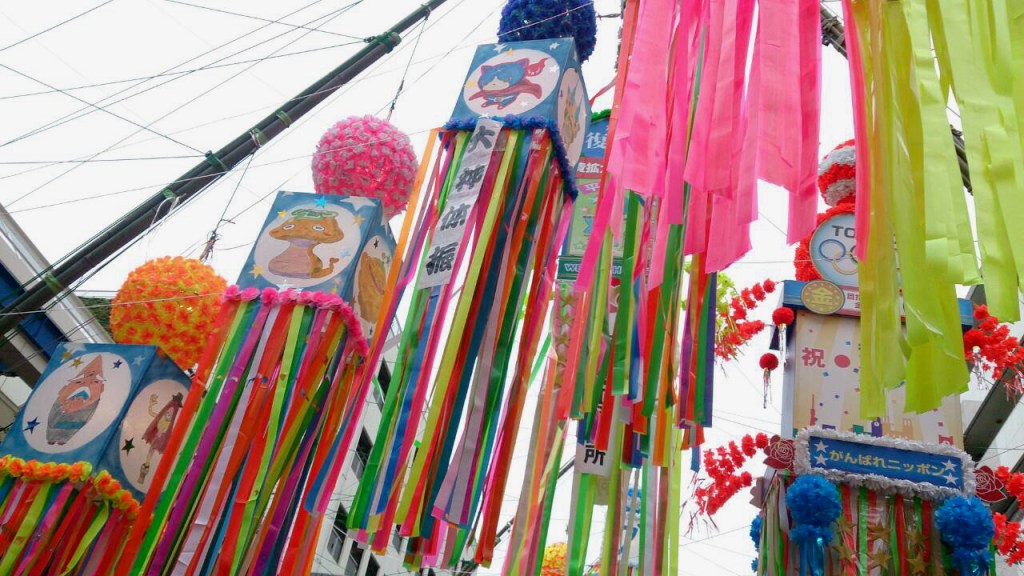
Taken at a local festival near Hiratsuka, Japan in 2015
Tanabata (七夕) is the fourth of five sekku or “seasonal” holidays that happen every year in Japan,1 and has been a big summer festival since antiquity. The origin story of Tanabata is based on a Chinese legend about two young, celestial lovers named Hikoboshi and Orihime who were later forcibly separated by Orihime’s father except for one night each year: the seventh day of the seventh month. On that day, a flock of magpies form a bridge so the two can meet for that evening. Thus, Tanabata in the modern calendar is always July 7th.
There’s even a famous poem referring to Tanabata in the ancient Hyakunin Isshu anthology:
The reference to the Magpie’s Bridge is from two places: the Imperial Palace at the time had a set of stairs called Magpie’s Bridge, but also the famous legend of Tanabata. Although the poem takes place in the dead of winter, even as far back as the 8th century, the story of the magpie bridge was culturally significant.
The story of Tanabata makes a good theme for a summer night, and not surprisingly, it’s a great excuse to get out, dress up in traditional robes (yukata) and enjoy local festivals, food and people watching. My wife and kids are usually in Japan during this time, but due to work, I tend to arrive later in July, so I often miss the Tanabata, but when I do go, it’s a good time for the family.
One popular tradition is to write one’s wishes on a small piece of paper called tanzaku (短冊)2 and hang it on a designated bamboo tree:
Sasa no ha sara-sara Nokiba ni yureru Ohoshi-sama kira-kira Kingin sunago Goshiki no tanzaku watashi ga kaita Ohoshi-sama kirakira sora kara miteru
The bamboo leaves rustle, And sway under the eaves. The stars twinkle Like gold and silver grains of sand. The five-color paper strips I have written them. The stars twinkle, Watching from above.
My wife usually only sings the first four verses if I recall correctly, but I can still hear her singing this song in my mind to our newborn kids before they go to sleep. 🥰
Anyhow, Tanabata is a nice summer holiday that young and old can enjoy, and well worth seeing if you happen to be in Japan in the summer.
I have a small fascination with calendars,1 including the traditional Japanese calendar (online example here), which has a lot of interesting cultural tidbits that aren’t obvious to Westerners.
On many Japanese calendars are small words like 大安, 仏滅, and 先勝 that repeat over and over in a cycle each month. These are known as the rokuyō (六曜) or “six days” and are related to a superstition that has persisted since the Edo Period (16th – 19th century).
Here is an old example I took many years ago at my in-laws house in Japan. I use to stare at this calendar all the time, trying to puzzle out what these words meant…
A more contemporary example here is from a calendar we got in 2025:
Prior to the early-industrial Meiji Period (late 19th century), Japan still used a lunar calendar based on the Chinese model which is now called kyūreki (旧暦) or “the old calendar”. As a lunar calendar, it had twelve months, 30 days each, to reflect the cycles of the moon. Japanese New Year thus originally coincided with Chinese New Year, though the first day of the new lunar year is now relegated to kyūshōgatsu (旧正月, “old New Year”). Modern new year is observed on January 1st instead to coincide with Western calendar.
Anyhow, since the months were all exactly 30 days, the rokuyō were six days that reflected good or bad fortune on that day, mainly related to public events like weddings, funerals, new undertakings, etc. Though, it’s thought that the six days were also used to determine one’s fortune in gambling, too. The six days are, in order are:
Japanese
Romanization
Meaning
Notes
先勝
senshō
Winning first/before
Mornings were thought to be auspicious, but afternoons unlucky.
友引
tomobiki
Pulling friends
Funerals were avoided this day, but private gathering of friends were considered OK.
先負
senbu
Losing first/before
Mornings were thought to be unlucky, but afternoons auspicious.
仏滅
butsumetsu
Death of the Buddha
Inauspicious all day. Social events avoided.
大安
taian
Great Luck
Very auspicious day.
赤口
shakkō
Red Mouth
Though 11am to 1pm was thought to be OK, the rest is dangerous, especially handling knives.
The six days simply repeat over and over throughout the old Chinese calendar, but there’s a twist:
The first day of the 1st and 7th lunar months is always 先勝 (senshō).
The first day of the 2nd and 8th lunar months is always 友引 (tomobiki).
The first day of the 3rd and 9th lunar months is always 先負 (senbu).
…and so on.
So this cycle of six days actually resets at the beginning of a new month. This leads to some interesting outcomes for certain traditional Japanese holidays, particularly the 5 seasonal holidays or sekku, some of which we’ve talked about here in the blog. For example:
Girls Day is always 大安 (taian). Girls rock, what can I say? 😎
Childrens Day (originally Boys Day) is always 先負 (senbu). Maybe boys start out awkward, but mature into their own later? 💪🏼
Tanabata (July 7th), one of my other favorite Japanese holidays, is always 先勝 (senshō). The star-crossed lovers that feature in the story of Tanabata were separated later, so perhaps they were only lucky at first. 💔 (just kidding)
Day of the Chrysanthemum (Sept. 9th, another holiday we haven’t gone over yet) is always 大安 (taian). Mathematically this makes sense since it is exactly 6 months away from Girls Day.
Further, a couple other traditional holidays such as jūgoya (十五夜, “harvest moon-viewing day”) is always 仏滅 (butsumetsu) and the lesser-known jūsanya (十三夜, “the full moon after harvest moon”) is always 先負 (senbu).
Finally, there are intercalary or “leap months” (uruuzuki, 閏月) that are inserted about every 3 years to help re-align the calendar with the seasons. Lunar cycles don’t match solar ones very well, so in antiquity, lunar calendars frequently fell out of alignment. In the case of the Japanese calendar, this is done about every 3 years after the risshun season from what I can see.
A while back before I had all this figured out, I wrote a small computer program that would execute every time I would log into my computer terminal. Sometimes, I written program this in Python language, sometimes in Ruby, and then Golang. The screenshot below is from the Ruby version which worked reasonably well:
The current incarnation I use was written in Golang language and doesn’t yet include Imperial reign name, nor leap months. I have taken the existing version and moved it to Gitlab for public usage, though it is far from complete. You can find the repo here.
Anyhow, that’s a brief look at the rokuyo in the Japanese calendar. If you’re technically-inclined, feel free to try out the program above, make improvements, send feedback, whatever.
For everyone else, the six days are a bit of a cultural relic from an earlier time in Japan, and apart from planning weddings and funerals, most people give it no real thought. Me? I like to check it from time to time and see if my day’s experiences matched the day’s fortune (spoiler: it usually doesn’t).
Edit: turns out my Ruby code had a silly bug in it all these years. It is now fixed.
Edit 2: turns out 2023 in the Chinese lunar calendar had a leapmonth, which throws off this entire script. I hadn’t expected this. Will think about this for a while and try to solve for leap months too.
1 Historia Civilis has a fun video on Youtube about the origin of the Julian Calendar and why 44 BCE was the “longest” year in history.
2 The idea of the Buddha’s death and the concept of Nirvana (lit. “unbinding”) is a lengthy subject in Buddhism. Enjoy!













 Gleanings in Buddha-Fields


.jpg)
You must be logged in to post a comment.