A Look At The Awakening of Faith in the Mahayana

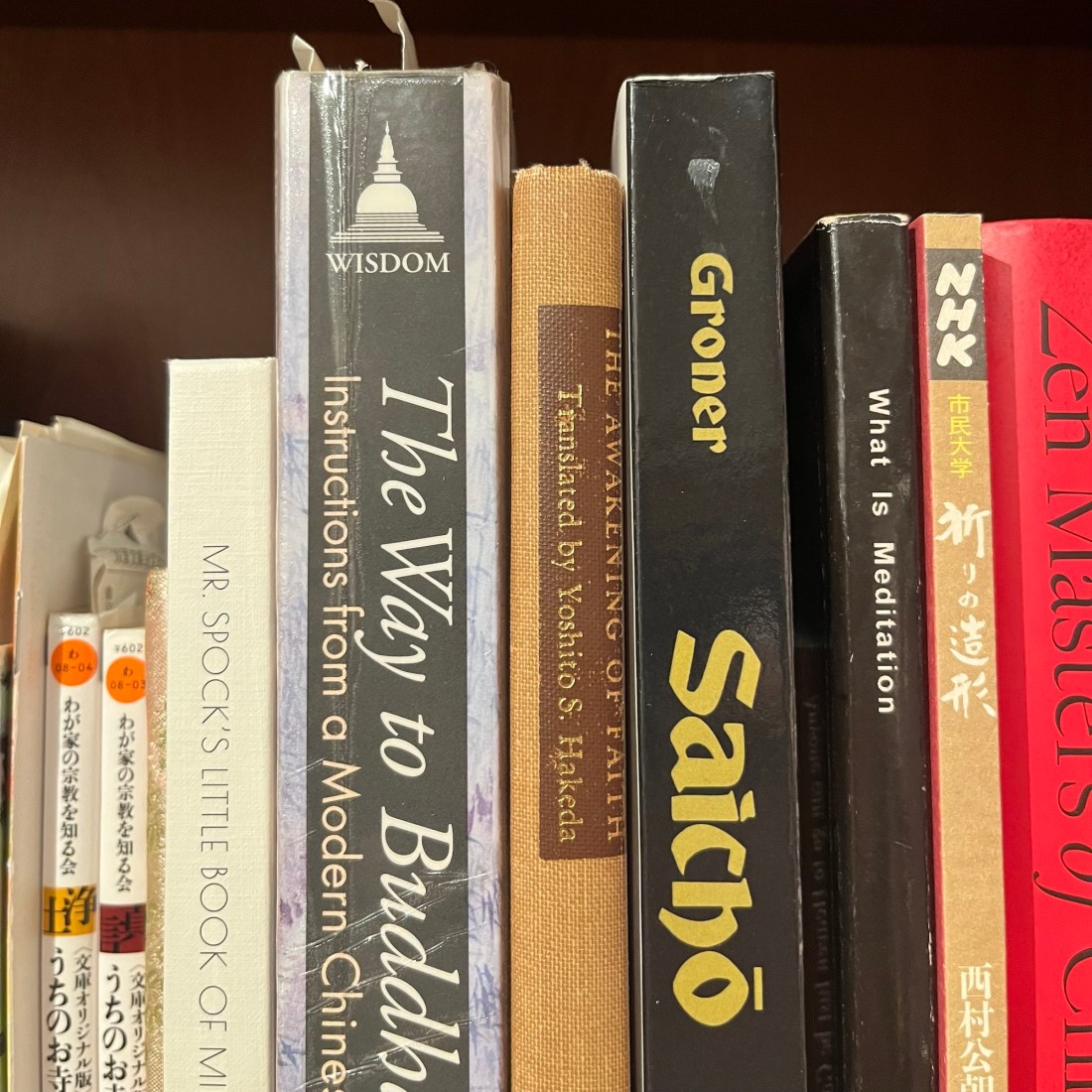
Not too long ago, I found an old book I had forgotten I had: a translation of the Awakening of Faith in the Mahayana. For simplicity, we’ll call it the “Awakening of Faith” in this blog post. The Awakening of Faith is a Buddhist treatise, a śastra,1 written probably in the 6th century, but attributed to a Buddhist master in India, Aśvaghoṣa from the 2nd century. It is thought to have been composed in China, but likely drew from Indian sources, or was composed by an Indian-Buddhist monk living in China. Since it is mainly found in China, it is called Dàshéng Qǐxìn Lùn (大乘起信論).

Wikipedia points out that researchers now think a more appropriate title would be Awakening of Mahayana Faith in the Suchness of the mind. The 信 here might also be interpreted as “trust” or “entrusting”, so maybe Awakening of Mahayana-style Entrusting [in the Suchness of the Mind]? That reads a bit awkward though, so readers will have to decide how to phrase it.

If readers are curious what Mahayana Buddhism is, please feel free to read here.

This might sound like I am splitting hairs, but it is kind of important to emphasize that English terms like “faith” aren’t a good analogue for what the book is about. This is not a book of Christian-style faith. Instead, the author of the treatise addresses why they wrote The Awakening of Faith, when the same teachings are found throughout existing Mahayana sutras:

Though this teaching is presented in the sutras, the capacity and deeds of men today are no longer the same, nor are the conditions of their acceptance and comprehension….

Translation by Yoshito S. Hakeda

The author lists eight reason such as helping all attain peace of mind, liberating from suffering, and correcting heretical views (my words, not the book). In other words, the author wanted to both assert an orthodox Mahayana viewpoint of Buddhism, but also to clarify any misunderstandings and inspire others to take up the path. It is in a sense, a textbook introduction of Mahayana Buddhism.

Mahayana Buddhism is actually a pretty broad tradition, with lots of sub-schools, diverging viewpoints and so on. So, it’s hard to explain the entire tradition in a single book. Still, the treatise does a good job of touching on some essentials that many Mahayana Buddhist traditions today are founded upon. Traditions such as Zen, Pure Land, Nichiren, Tendai, and Vajrayana (among others) all have certain common teachings that pervade them all. The Awakening of Faith helps to enumerate what these are, in a fairly short, readable format, which for a 6th century text is pretty impressive.

To give an example, here is a quote on Suchness : a fancy term for reality, totality of existence, the Whole Enchilada, the Whole Shebang, etc, etc.:

[The essence of Suchness] knows no increase or decrease in ordinary men, the Hinayanists [earlier Buddhist schools], the Bodhisattvas, or the Buddhas. It was not brought into existence in the beginning, nor will it cease to be at the end of time; it is eternal through and through.

Page 65, translation by Yoshito S. Hakeda

If this sounds strangely familiar to readers, you might find something very similar in the Heart Sutra:

“Hear, Shariputra, all dharmas [all things, stuff] are marked with emptiness; they are neither produced nor destroyed, neither defiled nor immaculate, neither increasing nor decreasing….”

Translation by Ven. Thich Nhat Hanh in “Heart of Understanding”

You can definitely see some common themes between The Awakening of Faith and early Mahayana-Buddhist sutras such as the Heart Sutra. Further, The Awakening of Faith explores the notion of Bodhisattvas quite a bit:

The Buddha-Tathāgatas [e.g. the many buddhas], while in the stages of Bodhisattva-hood [i.e. on the cusp of becoming fully enlightened buddhas], exercised great compassion, practiced pāramitās [perfecting certain virtues], and accepted and transformed sentient beings. They took great vows, desiring to liberate all sentient beings through countless aeons until the end of future time, for they regarded all sentient beings as they regarded themselves.

Page 67, translation by Yoshito S. Hakeda

… but it gradually moves from theoretical teachings into more practical ones too. I was surprised to see the treatise openly teach the importance of developing faith in the Western Pure Land of Amida Buddha:

Next, suppose there is a man who learns this teaching for the first time and wishes to seek the correct faith but lacks courage and strength….It is as the sutra says: “If a man meditates wholly on Amitābha Buddha in the world of the Western Paradise and wishes to be born in that world, directing all the goodness he has cultivated [toward that goal], then he will be reborn there.”

Page 103, translation by Yoshito S. Hakeda

The particular “sutra” that the author is talking about is unclear. Hakeda and other scholars seem really quick to dismiss this section as a later addition, or influenced by the Pure Land Buddhist community, since it’s not found in the Three Pure Land sutras, but I would argue that it is either quoted from, or related to an earlier Pure Land sutra called the Pratyutpanna Sutra. Note this quotation here:

In the same way, Bhadrapāla, bodhisattvas, whether they are ascetics or wearers of white (i.e., laypeople), having learned of the buddha field of Amitābha in the western quarter, should call to mind the buddha in that quarter. They should not break the precepts and call him to mind singlemindedly, either for one day and one night, or for seven days and seven nights. After seven days they will see Amitābha Buddha. If they do not see him while in the waking state, then they will see him in a dream.

Translation by Paul Harrison, courtesy of BDK America

But I digress.2

If you think of The Awakening of Faith as a kind of Mahayana training manual, you’d probably be right. It’s meant to distill the vast corpus of teachings into a more bite-sized treatise that covers all the important bases without getting bogged down in sectarian debates. It’s not difficult to read, but does get a little cerebral at times. Still, it was a pretty impressive effort for the day, when Buddhism was still being introduced in China, and people wanted sought to find a way to make the teachings accessible and easy to understand.

It’s influence on later East Asian Buddhism cannot be understated. It provided an important foundation for later schools such as Tian-tai (Tendai in Japan), and subsequent schools that arose from it: Zen, Pure Land, etc.

English translations are hard to find, but if you manage to find a copy of The Awakening of Faith, and are interested to understand what Mahayana Buddhism is all about, definitely pick it up.

1 Pronounced like “shastra”, see Buddhist Sanskrit Basics for more information.

2 It’s quite possible that Professor Hakeda is correct in that it’s a later addition. Ph.D’s aren’t for show: the dude has a lot of background and training in the subject, so he knows a lot. I just think that because the Pratyutpanna Sutra was already popular in China by the time that The Awakening of Faith was composed, it might not be a later addition. But as the kids say, that’s just my “head canon”. 😁

Also noteworthy is no mention of the verbal nembutsu in the above quote. The verbal nembutsu as a practice was popularized centuries later by Shan-dao. Therefore, if it was added to The Awakening of Faith as an afterthought, it was probably something very contemporary.

New Chinese Chess Set

A long, long time ago in college, I studied abroad in Hanoi, Vietnam for a summer for preparation for grad-school. I was, frankly, a pretty terrible student, skipped classes a lot and then dropped out of grad school in the US before I even took a single class.1

While there, I spent a lot of time goofing around in Hanoi, hanging out at Internet cafes, and talking with the local rickshaw drivers who played Chinese Chess during their downtime.

My Chinese Chess set, courtesy of Yellow Mountain Imports. The pieces are not quite arrange properly; I just snapped this photo for fun.

Two years of college-level Vietnamese courses meant that I could do basic communication but was certainly not fluent. Still, the drivers were happy to let me join in and play. Playing against the young American probably was something to break up the routine. Of course, I lost handily. They had been playing one another for years and were quite good, and I was getting a crash course in the game. Even though I was terrible, Chinese Chess was something I really enjoyed, and played as much as I could.

That was more than twenty years ago.

Sadly, I never played Chinese Chess since returning from Vietnam. Later, I learned to play Japanese Chess (shogi), but the two games are fairly different, each with their own virtues. I always kind of missed playing Chinese Chess, and I was happy to discover that one can buy good, quality sites online at places like Yellow Mountain Imports.

Yellow Mountain Imports includes some excellent instructions for non-native players to learn quickly. Chinese Chess, more properly called Xiang-qi (象棋)2, is another variant of Chess, in the same family as Western Chess, or Japanese Shogi. The basic premises is the same for all three: move your pieces, capture opponents pieces and defeat the opponent by trapping their king/general into an attack that they cannot escape from.

But each game has notable differences. In Shogi, you can replay pieces you capture, plus it includes multiple kinds of generals, each with unique moves. In xiangqi, the pieces have some unusual moves, but also terrain is more prominent: some pieces change their moves after cross the “river” in the middle, and some are unable to move outside their own “palace”.

Xiangqi, based on my limited experience, is a leaner, faster game than Chess or Shogi, because it has comparatively fewer pieces, and the many pieces have large movesets. Some pieces are strictly defensive too, so the actual pieces you use to attack are comparatively few. This makes for a game where every move really starts to count. So while the endgame is faster, there’s lots of “head games” about where to put your pieces, especially when you consider tricky combinations with the cannon. Using one or both cannons, you can do some complicated combinations to attack your opponent’s general. And since the general can’t move very far, you have to be extra careful where you put yours because a checkmate can happen surprisingly easy if you are careless in guessing your opponents moves.

I enjoy Chess, Xiangqi and Shogi each in their own way (honestly, I am probably best at Shogi, but even then I am a lousy player). Each one has its own vibe, but Xiangqi is especially nostalgic for me because I played it so much in Vietnam.

I taught my daughter to play a bit of Xiangqi with me, and I was surprised to see that she enjoyed it too. So I am glad to put this set to use.

Even for Westerners who can’t read Chinese characters, everything is simple enough, and visual enough that you can quickly learn the game, and begin playing.3 Like all good games, it’s simple enough to learn, but complex enough to keep you playing for a long time.

P.S. the Vietnamese name for Xiangqi is cờ tướng, or in old Hán-Nôm style: 碁將

P.P.S. More on my experiences playing Shogi.

1 Needless to say, I was immature, cocky and unprepared for life outside the US. There were many positives too, but plenty of regrets too. If I could still speak Vietnamese well, I would like to go back and visit, now older and wiser. But I doubt I will have the opportunity any more. I should post some of my old photos one of these days, though.

2 Pronounced like Shyong-chee.

3 I do find it fascinating that the Chinese characters on each side are not always the same. For example the elephant on the red side is and the green side is , or the advisor is (red) and (green). I am unclear why these are different, while other characters such as are the same.

The Journeys of Xuanzang, part three: the Western Khaganate

In part one, Xuan-zang the famous Buddhist monk of the 7th century who crossed from China to India encountered the first cities of the Silk Road, crossed the Gobi Desert, and avoided bandits and overbearing monarchs. In part two, Xuan-zang journeyed to the famous city of Kucha and climbed the mountain pass near Tengri Khan losing many people in the dangerous crossing.

As Xuan-zang traveled further and further west, he was leaving Chinese political influence and going further into areas comprised of steppe nomadic tribes such as the Turkic people, as well as sedentary Iranian people such as the Sogdians.

But let’s talk about Turkic people for a moment.

As we’ve talked about in previous posts, the Silk Road was a fascinating mix of different cultures and people. This was very common in the nomadic world of the Eurasian Steppes because tribes were constantly moving around, encountering new tribes, subjugating new tribes, being subjugated by other tribes, or forming alliances. It was a very fluid, dynamic and extremely dangerous environment. We’ve seen examples in past blog posts with groups like the Scythians and Parthians.

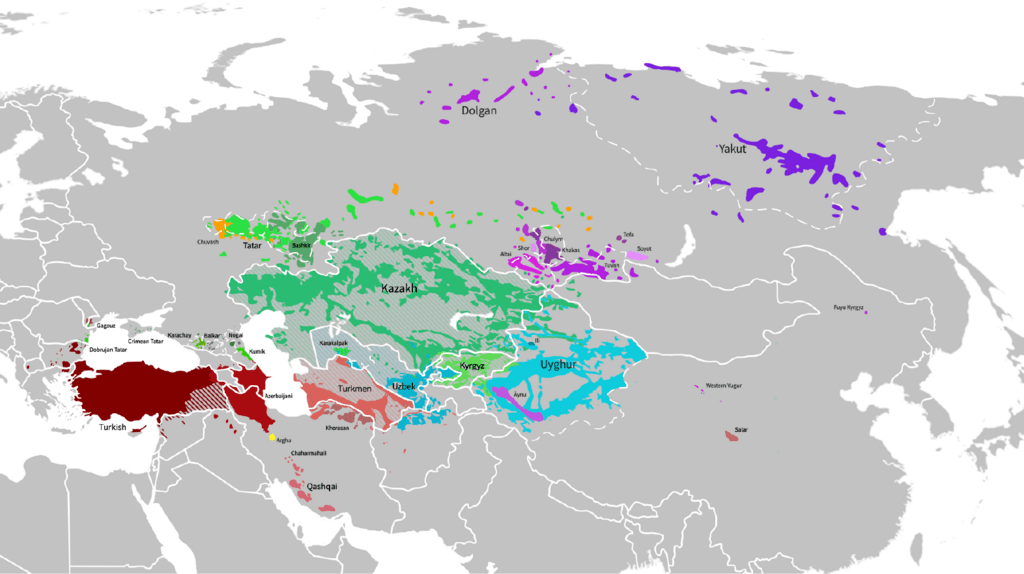
The Turkic people were another such group. Like many steppe tribes, their origins are very obscure, but they were caught up in this cultural soup, and over time grew and grew into more powerful tribal confederations. As they spread and intermixed with other steppe tribes, they also took on increasingly regional differences among each other.

A map showing the distribution today of Turkic languages across Asia. Photo by GalaxMaps, CC BY-SA 4.0, via Wikimedia Commons
Turkic officers, from a painting in the city of Samarkand, photo by Photograph: Republic of Korea, CC BY-SA 2.0, via Wikimedia Commons

Thus, the Turkish people of the Republic of Turkey (a.k.a. modern Türkiye) and the Uyghurs of north-western China have common ancestry. Some of their ancestors migrated west and contended with the Eastern Romans (a.k.a. the Byzantines), while others fought with the Chinese Tang dynasty onward. Yet in some distant, remote past they began as just one steppe tribe out of countless others and over time grew into a family of ethnicities and languages that spread all over Asia.

In Xuan-zang’s time, the Turkic tribes had formed a powerful confederation on the Eurasian steppe called the Western Turkic Khaganate. They called themselves the On oq budun (𐰆𐰣:𐰸:𐰉𐰆𐰑𐰣) or “People of the Ten Arrows” implying they were a federation of tribes, ruled by a single Qaghan (alternatively spelled Khaghan). These “Göktürks“, and their empire, remnants of an even larger Turkic Khaganate, were spread out far enough to have contact with China, the Sassanian Persians and Eastern Romans all at once.

Great Tang (e.g. Tang Dynasty China) would come to rule this entire area at the zenith of its power in the decades ahead, and the Khaganate reduced to a puppet state, but in Xuan-zang’s time, it was still a land ruled by Turkic people.

Meeting the Khagan

The Chuy river valley, photo by Vmenkov, CC BY-SA 3.0, via Wikimedia Commons

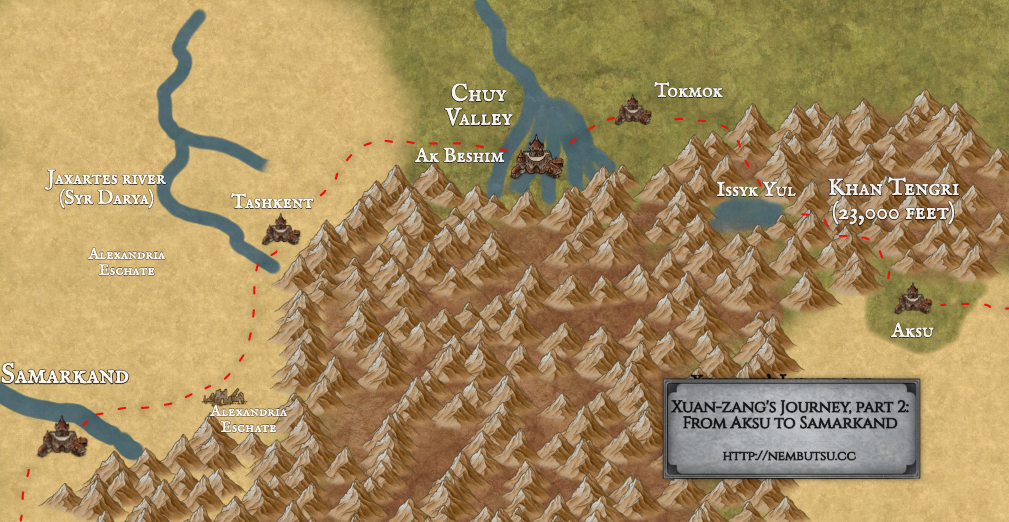
As Xuan-zang and his party descended the Tian-Shan mountains they came near to the modern city of Tokmok in Kyrgyzstan. More precisely, Xuan-Zang came the ancient capital of Suyab, also called Ak-Beshim, just to the southwest. This region was fed by the Chu river and was a verdant land compared to the desert wastes elsewhere. The Khaganate used these lands as a resting place when not on the march.

The leader of the Khaganate, Tong Yabghu Qaghan (Tǒng Yèhù Kěhán, 统叶护可汗 to the Chinese) was eager to meet Xuan-zang and provided a fitting welcome. Xuan-zang, for his part, gave the Qaghan a letter of introduction from the king of Turpan.

Xuan-zang described the Qaghan thus:

[the Qaghan] was covered with a robe of green satin, and his hair was loose, only it was bound round with a silken band some ten feet in length, which was twisted round his head and fell down behind. He was surrounded by about 200 officers, who were all clothed in brocade stuff, with hair braided. On the right and left he was attended by independent troops all clothed in furs and fine spun hair garments; they carried lances and bows and standards, and were mounted on camels and horses. The eye could not estimate their numbers.

The Silk Road Journey with Xuan-zang, page 32

Tong Yabghu Qaghan’s “palace” was a great yurt, wherein a feast was held. The guests enjoyed such foods as wine, mutton, and boiled veal among other things. Since Xuan-zang was a Buddhist monk, he was forbidden to eat meat and drink alcohol, and thus he was served delights such as rice cakes, cream, mare’s milk, sugar, and honey instead.

Kyrgyz-style yurts, in Xinjiang region of China. Photo by katorisi, CC BY-SA 3.0, via Wikimedia Commons

Once everyone was settled down, Tong Yabghu Qaghan asked poor Xuan-zang to make a Buddhist sermon on the spot.

Xuan-zang had to be careful not to ruin the mood of the occasion, so he opted for a sermon on the need for goodwill (metta in Buddhism) towards all beings, and on the benefits of the religious life. The Qaghan was evidentially impressed. In fact, this wasn’t the Qaghan’s first encounter with a Buddhist monk. Apparently, some years earlier a Buddhist monk from India named Pabhakarmitras had journeyed through these lands on the way to China, and so the Qaghan was well-disposed to the religion. He even tried to convince Xuan-zang to stay among his people, but Xuan-zang declined. Unlike the king of Turpan, the Qaghan seemginly took no offense and offered to send a ethnically Chinese soldier to accompany Xuan-zang for part of the way.

More importantly, the Qaghan gave Xuan-zang both gifts and letters of introduction to share with the petty princes along the way, who were all vassals of the Qaghan.

Finally, it was time to leave.

To Fabled Samarkand

From the great yurt camp at Sayub, Xuan-zang was escorted by the Qaghan part of the way, but they eventually parted. After leaving the Chuy region, the land reverted back to desert, namely the Kyzylkum Desert, also known as the Desert of Red Sands. Xuan-zang’s party journey to the next city, the city of Tashkent (modern Uzbekistan) named Zhěshí (赭時) in Chinese at the time, proved difficult, but they did eventually reach it after crossing the Jaxartes River. Of the crossing, Xuan-zang describes the scenery.

North-west from this [river crossing] we enter on a great sandy desert, where there is neither water nor grass. The road is lost in the waste, which appears boundless, and only by looking in the direction of some great mountain, and following the guidance of the bones which lie scattered aboout, can we know the way in which we ought to go.”

The Silk Road Journey with Xuan-zang, page 34

Xuan-zang does not seem to spend much time in Tashkent (I wasn’t able to find much description of his time in my limited resources), and continued on in a more Westerly direction towards Samarkand.

Fun fact, after crossing the Jaxartes river and passing Tashkent, Xuan-zang and his party entered into lands once ruled by the Bactrian Greeks. To the south and west of Tashkent was the former outpost city of Alexandria Eschate, which had been the most northerly city of the Greeks. It was a strong fortress city under king Euthydemus I, but suffered constantly attacks by the native Iranian Sogdian peoples. By the 1st century AD, the city had reverted back to local control, and the Greeks retreated from the area. By Xuan-Zang’s time this was all a distant memory.

We’ll cover Samarkand in the next episode, because things take a dangerous turn in this output of the Sassanian Persians, and also from here, the road will turn back south toward India at last.

The Journeys of Xuanzang, part two: Onward and Upward

In part one of the journey, Xuan-zang braved the Gobi desert and contended with the overbearing monarch of Turpan, but also beheld many wonderful sites at that venerable city before moving on to Yanqi. After leaving Yanqi, Xuan-zang moved onto the city of Kucha, also called Kuchar in Uyghur (كۇچار) or Kùchē (庫車) in Chinese.

The Buddhist Kingdom of Kucha

Out of all the cities of the northern Silk Road surrounding the Tarim Basin, Kucha was the largest and most prosperous. As a powerful Buddhist kingdom, Kucha dominated the Silk Road trade in the area since at least the 4th century. Xuan-zang’s description of the city was as follows:

The soil is suitable for rice and grain…it produces grapes, pomegranates and numerous species of plums, pears, peaches, and almonds…The ground is rich in minerals-gold, copper, iron, and lead and tin. The air is soft, and the manners of the people honest. The style of writing is Indian, with some differences. They excel other countries in their skill in playing on the lute and pipe. They clothe themselves with ornamental garments of silk and embroidery….

There are about one hundred convents in this country, with five thousand and more disciples. These belong to the Little Vehicle [Hinayana]1 of the school of the Sarvastivadas. Their doctrine and their rules of discipline are like those of India, and those who read them use the same originals….About 40 li to the north of this desert city there are two convents close together on the slope of a mountain…Outside the western gate of the chief city, on the right and left side of the road, there are erect figures of Buddha, about 90 feet high.

Source Wikipedia (original source unclear)

As with prior cities, Xuan-zang’s reputation had proceeded him, and he was greeted by the local ruler, which described as having “red hair and blue eyes”. The king of Kucha at the time was likely either ethnically Sogdian or Tokharian. We saw similar figures depicted in Buddhist art when we looked at the Bezeklik Caves in episode one. The Silk Road north of the Tarim Basin was a fascinating mix of different peoples and ethnicities and it could change from city to city. The Tokharians were distant relatives of other Indo-European people, and their language had some common elements to European languages such as English. Yet, the link between the Tokharians and Westerners is frankly pretty tenuous, but that did not stop researchers in the 19th century who had certain … racial theories, from hyping up their contribution to the Silk Road. It’s important to be cautious and not to draw too many conclusions. Hidden agendas make for bad research.

What’s more interesting to me is how the Tokharians lived alongside totally disparate groups such as Chinese, Turks, Uyghurs, Sogdians and so on, and at times they had friednly co-existence (the Tokharians evidentially revered the Sogdians in particular and tried to emulate them), and at other times they clashed. In other words, pretty typical human stuff. This intermix of cultures and people is what makes the Silk Road so fascinating.

But I digress…

Kucha had a lively material culture, thanks to runoff from the Tian Shan mountains providing plenty of water, and thus a wealth of food and agriculture grew here. It’s place on the Silk Road also ensured plenty of goods and materials were traded here too. Further, Kucha was famed for its music, and musicians from Kucha were highly sought after. A Kuchean orchestra was staffed at the court of Great Tang throughout the dynasty, and played for official ceremonies and celebrations. My book on Xuan-zang points out that famous songs they played included titles like “The Jade Woman Hands the Cup Around”, “Meeting on the Seventh Evening”, and “The Game of Hide the Buckle”.

Yet, for the Buddhist tradition as we now practice it today, Kucha was even more important for another reason: it was the hometown of Kumārajīva (344–413 CE) the translator.

Kumarajiva the Great Translator

Kumarajiva was the son of an Kashimiri-Indian father and a Kuchean mother, and was raised in Kucha. He studied Sarvastivadan-branch Buddhism, an influential pre-Mahayana Buddhist school whose monastic code was adopted by Mahayana Buddhist communities in China onward. However, at some point Kumarajiva converted to Mahayana Buddhism and by age 20 ordained as a Buddhist monk. His fame as a scholar reached China at the time, and he was sought out by the emperor. Our homeboy, Kumarajiva, was imprisoned at one point by a local warlord, but eventually was released by the Chinese emperor, and brought to the capitol of Chang-an (see prologue episode), and was feted.

Kumarajiva proved to be an excellent translator, and helped bring many Indian-Buddhists texts to mainsteam China. Because the Sanskrit originals were mostly lost in India, but preserved in Classical Chinese, these works, now core texts in many modern Buddhist traditions, help maintain the tradition today. To name a few that you probably already familiar with, Kumarajiva translated these sutras:3

  • The Lotus Sutra
  • The Amitabha Sutra (part of the 3 Pure Land Sutras)
  • The Diamond Sutra, important in the Zen tradition
  • The Shurangama Sutra, important in Chinese Buddhism, especially Zen
  • The Sutra of the Ten Stages (chapter 26 of the Flower Garland Sutra)2
  • …. among many others.

To reiterate this point: the English translations of these texts we use today come from the Classical Chinese editions that were originally translated from Sanskrit and prakrits by Kumarajiva.

Having said all that, let’s return, centuries later to Xuan-zang…

Staying at Kucha

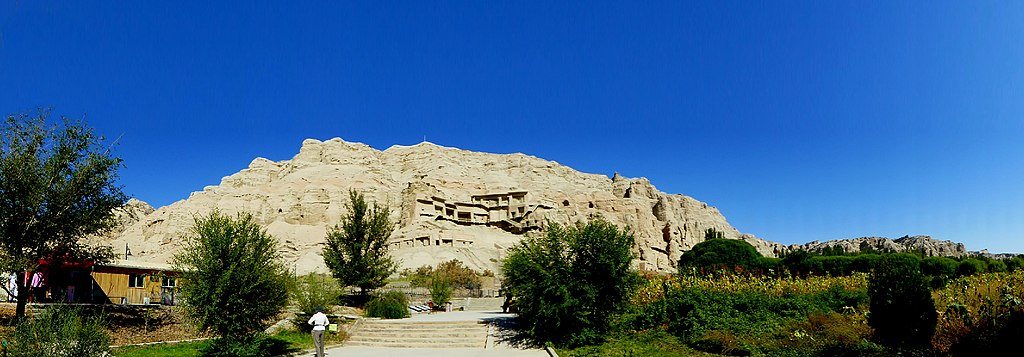
From Kucha, Xuan-zang would have to pass through Aksu before crossing over the Tian Shan mountains, but heavy snows in the passes mean that Xuan-zang had to stay in Kucha for two months. During this time Xuan-zang stayed out of trouble, and spent many days discussing Buddhist philosophy with the local community. This included the famous Kizil Caves:

Photo by Hiroki Ogawa, CC BY 3.0, via Wikimedia Commons

The Kizil Caves (in Uyghur قىزىل مىڭ ئۆي) or Kèzī’ěr Qiānfú Dòng (克孜尔千佛洞, lit “1000 Buddhist Caves of Kizil”) are a massive cave complex and probably one of the earliest along the northern Silk Road used for Buddhist monasticism. The artwork here often shows strong influence from Buddhist-India, or more precisely, the Greco-Bactrian art of Gandhara. However, like the Bezeklik Caves we saw earlier, a combination of local religious iconoclasm, looting by European researchers,4 and subsequent tourism have greatly disturbed the artwork in the Kizil Caves. Here’s an example reconstruction from the so-called Peacock Room:

A representation of the Peacock Room layout, and what remains. Photo in public domain, courtesy of Wikimedia Commons

In any case, check out the Wikipedia article I linked above on the Kizil Caves. There’s simply too much to add here, but needless to say, Xuan-zang must’ve beheld some amazing art in his time, which we will sadly never see again.

Side note: the red haired, blue-eye ruler of Kucha that I mentioned earlier ran afoul of the Chinese emperor, Taizong, a few years later by pretending fealty, while also declaring his loyalty to the Western Turkic Khaganate (more on that soon). Needless to say, China did not take this lying down and soon conquered Kucha just as it did with Turpan. Xuan-zang would be long gone by this point though.

The Tian Shan Mountains

Once it was safer to travel, Xuan-zang’s caravan moved onto the city of Aksu, which in his time was called Baluka (跋祿迦, Bolujia in Chinese). Xuan-zang’s caravan was again ambushed by bandits along the way, but once again the bandits were full from another attack and quickly lost interest in Xuan-zang’s group. I’d say Xuan-zang was lucky, or the bandits were just lazy. 🤷🏼‍♂️

Anyhow, Xuan-zang stated that Aksu was very similar to Kucha in many respects, though according to Wikipedia, Xuan-zang noticed that the people of Aksu seemed to speak a different kind of Tokharian language. The Wikipedia article on Tokharian mentions that there were several dialects, all of them pretty different from one another. In any case, it doesn’t seem that Xuan-zang stayed at Aksu too long though and set out for the mountain passes over the Tian Shan mountains to reach Tokmok. There things took a dangerous turn.

The Tian Shan mountains, with Khan Tengri in the middle. Photo by Chen Zhao, CC BY 2.0, via Wikimedia Commons

The Tian Shan mountains are huge, cold and dangerous to traverse. The Khan Tengri mountain is more than 23,000 feet high, and the Bedel Pass near it is one of the few ways to cross over to the other side. Of the mountain, Xuan-zang wrote:

This mountain is steep and dangerous, and reaches to the clouds (lit. “heaven”). From creation the perpetual snow which has collected here in piles, as been changed into glaciers which melt neither in the winter nor summer; the hard-frozen and cold sheets of water rise mingling with the cloudes; looking at them the eye is blinded with the glare, so that it cannot long gaze at them. The icy peaks fall down sometimes and lie athwart the road, some of them a hundred feet high, and others several tens of feet wide.

The Silk Road Journey with Xuan-zang, page 31

It took eight days to traverse the pass, and Xuan-zang lost up to 30-40% of his men and countless horses and oxen. Imagine that famous scene from the movie Fellowship of the Ring when the good guys braved the mountain pass, but instead of turning back almost half the party freezes to death. That’s how serious it was.

Nonetheless, the survivors did reach the gorgeous lake of Issyk Kul, now in modern Kyrgyzstan. From here, the caravan would soon reach Tokmok and with it enter the lands of the powerful Western Turkic Khaganate….

Stay tuned!

1 Explained also in part one, the term Hinayana Buddhism is not related to Theravada Buddhism (it’s seems unlikely to me that they interacted with one another due to geography), but instead is a broad term for all pre-Mayahana Indian Buddhism. It’s still a somewhat pejorative term, but the relationship between early Hinayana Buddhism and Mahayana Buddhism is … complicated and not necessarily antagonistic.

2 I would love to talk about the Flower Garland Sutra some time, but it is a TOME, and I’ve only read very small parts of it. The Sutra of the Ten Stages deserves special attention though, and I have read it, but it’s challenge all by itself to explain in a blog post. Maybe some day.

3 one notable omission in this list is the Heart Sutra. The Heart Sutra is thought to have been compiled in China, not India, as a clever summary of much longer sutras. It gets to the “heart” of the matter, if you take my meaning. Xuan-zang, as we’ll see later, brings it back to India where it’s translated to Sanskrit, not from it.

4 The story of Albert Grünwedel is an interesting example of someone who was a dedicated archeologist, but also kind of unhinged too.

The Journeys of Xuanzang, prologue: Great Tang

I had an idea recently while flipping through my book on the journeys of the Buddhist monk Xuan-zang (pronounced like “Shwan-tsong”). Xuan-zang was the famous Buddhist monk who walked to India in order to bring back more information and texts in order to help develop Buddhism in his native China. In my old post, I covered some of the trials and tribulations of this amazing journey, and even made a fun song. However, looking back the post felt incomplete. I realized that many of these places that Xuan-zang traversed are obscure and forgotten now despite their central importance to Buddhist history, and the journey was so long that it’s too much to really explore in a single post.

So, this is the start of a series of posts meant to help retrace Xuan-zang’s journey, explore places of significance and how they tied into larger history. I don’t have a schedule yet (these posts take a while to write), but I am working on the next few drafts already.

Today’s post is the prologue episode, covering China at this time, and why Xuan-zang left.

Quick note: because this episode in particular uses a lot of Chinese names, for the sake of accuracy and modern readers, I am using the pinyin-style accent marks where relevant, and also using Simplified Chinese characters. I also put in lots of hyphens to help with pronunciation.

The Tang Dynasty

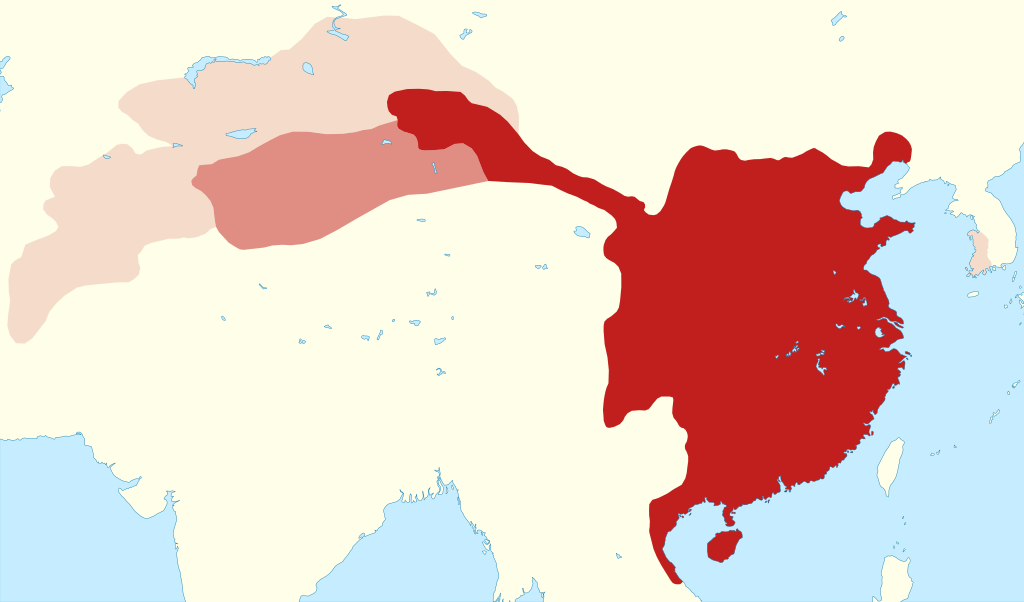
Great Tang at its largest extent in 661, map courtesy of Kanguole, CC BY-SA 4.0, via Wikimedia Commons

Chinese history, until the Republican era (1912 onward) had seen a series of kingships followed by imperial dynasties. Although, we usually call the country “China”, the name used by Chinese people in antiquity, and by their neighbors, was often taken from the current ruling dynasty.

Dynasties came and went. Some were fairly short-lived such as the Sui, others were incredibly powerful and long-lasting such as the Ming. Some were constantly fighting for their existence, such as the Song, others were fractured into a series of “mini-dynasties” that only exerted control over a region and were unable to unify China.

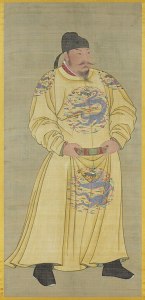
A portrait of Emperor Tai-zong, painted centuries later in the Ming Dynasty. National Palace Museum, Public domain, via Wikimedia Commons

Xuan-zang lived during the last days of the Suí Dynasty, and the early days of the Táng Dynasty (唐). “Great Tang” (大唐) as it called itself, lasted from 618 – 907, and was one of the high points of Chinese civilization. The empire expanded very far to the west, along the Silk Road (more on that in future posts) and actively imported all kinds of art, people, ideas, religions and material culture from Central Asia. Compared to earlier dynasties, Great Tang was much more cosmopolitan and less insular.

Xuan-zang lived primarily during the reign of the second Tang emperor Tài-zōng (太宗), who was an incredibly powerful, dynamic ruler. Chinese history still reveres him as of the greatest rulers. Tai-zong aided his father, the first emperor, in overthrowing the previous dynasty. Further, he was a powerful, expansionist ruler with a strong sense of administration, which helped provide stable foundations for Great Tang.

The Capital of Chang-An

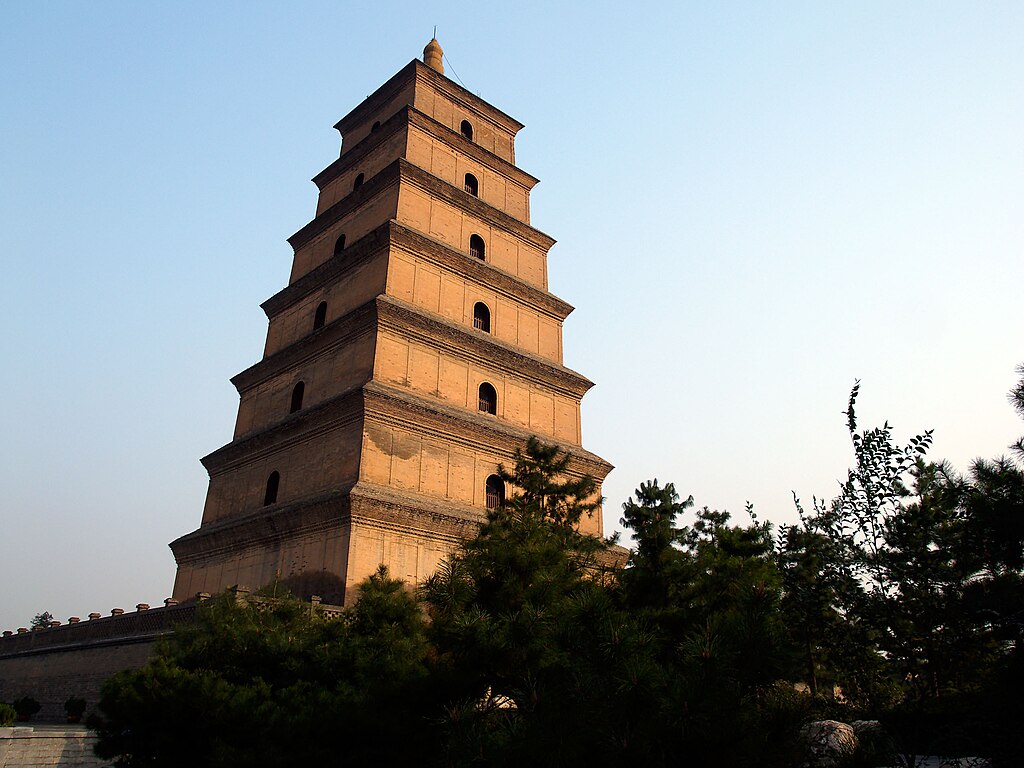
The Giant Wild Goose Pagoda (Buddhist stupa), photo by Alex Kwok, CC BY-SA 3.0, via Wikimedia Commons

The capital of Great Tang was the city of Cháng-ān (长安) in the western part of China. The city was a massive, cosmopolitan center of administration, commerce and culture. Chang-an at its height grew to 30 square miles, which was massive compared to Rome which occupied only 5.2 square miles. The population by 742 was recorded as 2,000,000 residents and of these 5,000 foreigners.

Chang-an was easily one of the world’s greatest cities at the time, and it had a great influence on its neighbors as well: the layout for the capital of Japan, Kyoto, was intended to resemble Chang-an, and great Buddhist masters such as Saicho’s rival, Kukai, studied there extensively. It was here that many Buddhist texts that came from the Silk Road were translated here as well.

Other religions, such as Nestorian Christianity, Zoroastrianism, Manichaeism and even Judaism and Islam all had a presence in Chang-an.

As the easternmost point of the Silk Road, it was here that many journeys began or ended…

Buddhism in Great Tang

The Tang Dynasty is often regarded as one of the high points of Chinese civilization, but also for Buddhism. Buddhism had emerged in China centuries earlier but its spread was slow at first. The native Confucian community particular resented the foreign Buddhist teachings as un-filial, unproductive (since monks did not work fields), and a drain on national resources.

In spite of the criticisms, it spread nonetheless. Wave and wave of teachings, newly translated texts, and schools of thought were imported from the Silk Road, allowing Buddhism to gradually take root, articulate its teachings better over successive generations, and develop natively Chinese schools of thought such as Tiān-tāi, Huá-yán, and Pure Land alongside imported schools of thought from India such as Fǎ-xiàng (Yogacara) and Sān-lùn (Madhyamika). By the time of the Tang Dynasty, massive temple complexes had arisen around Chang-an and other major cities.

This was a rare time when there was still a connection between Buddhist India and China, allowing a free flow of information. Later, when Buddhism fell in India, and the Silk Road was no longer safe to travel due to warfare, China was cut off.

Emperor Tai-zong himself had a distant relationship with Buddhism in his early reign. He kept it at arm’s length and strictly regulated. Further, travel in and out of China was tightly restricted, so that while there was commerce and trade, one could only do so with official permissions. More on this shortly.

Enter Xuan-Zang

Xuan-zang was the second son of his family. His older brother had ordained as a Buddhist monk, and Xuan-zang decided to follow in his footsteps at a young age. During the collapse of the Sui Dynasty, both brothers came to Chang-an where it was safe, and undertook further Buddhist studies. Since Xuan-zang proved to be a promising student, he was soon given access to advanced Buddhist texts and eventually ordained as a full monk in 622.

As to why Xuan-zang decided to journey all the way back to India, he is quoted as stating the following:

The purpose of my journey is not to obtain personal offerings. It is because I regretted, in my country, the Buddhist doctrine was imperfect and the scriptures were incomplete. Having many doubts, I wish to go and find out the truth, and so I decided to travel to the West at the risk of my life in order to seek for the teachings of which I have not yet heard, so that the Dew of the Mahayana sutras would have not only been sprinkled at Kapilavastu, but the sublime truth may also be known in the eastern country.

During his studies, Xuan-zang had noticed copyist errors, corruptions of texts, missing texts and other textual issues that prevented a thorough understanding. Thus, he resolved to journey to India, much like a monk named Fa-xian (法显) had done centuries earlier. He was particularly interested in the writings of Vasubandhu and his half-brother Asanga , who were crucial to the development of Mahayana Buddhism as we know it. Xuan-zang and some like-minded monks petitioned the Emperor Tai-zong to be allowed to journey to India, but never received an answer. He made his preparations, possibly learning some Tokharian language (commonly spoken along the Silk Road at that time) from the foreign quarters at Chang-an, then went west.

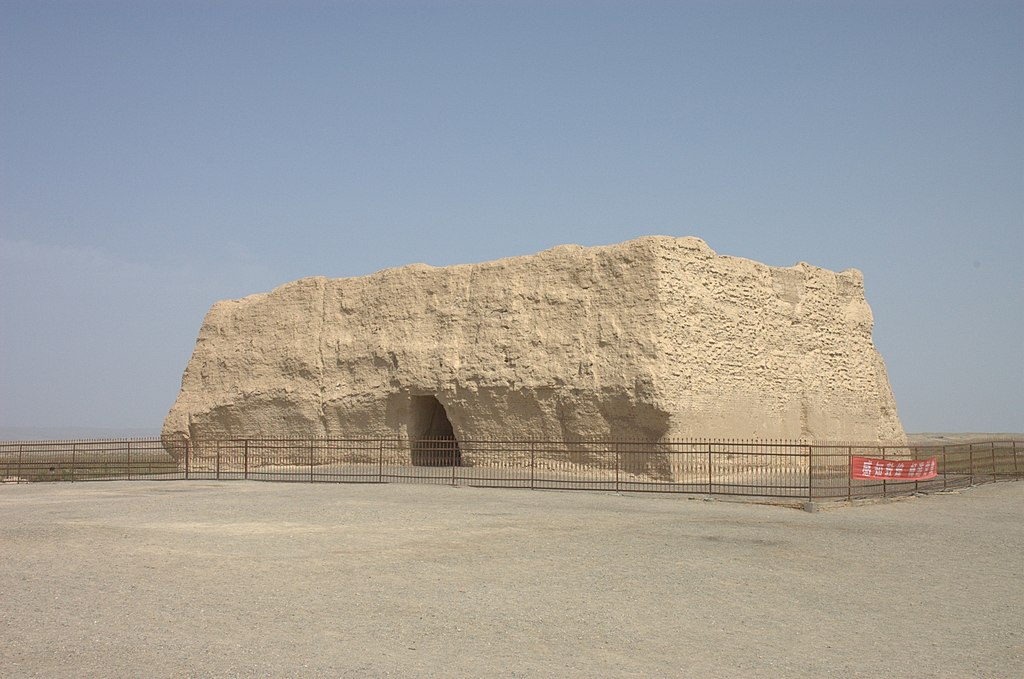
Ruins from the Yumen Pass, photo courtesy of 张骐, CC BY-SA 3.0, via Wikimedia Commons

By the time Xuan-zang reached the Yumen Pass (Yùmén Guān 玉门关) at the western end of Great Tang, he had attracted some unwanted scrutiny by authorities, and wasn’t permitted to leave. By this point, his companions had lost their nerve, but Xuan-zang was determined to continue. With some help from a sympathizer, Xuan-zang defied imperial orders and snuck around the Yumen Pass to leave China. He was now a criminal, and he was alone with a vast desert ahead of him.

What happened next? Find out in next episode.

Uposatha For Modern Times

The Buddhist religion has a very old tradition originally called Uposatha1 or Upavasatha,2 that is vaguely similar to the Jewish sabbath.

In traditional Theravada-Buddhist countries (e.g. Myanmar, Thailand, etc), monks and nuns recite the old monastic code on the full and new moons. Devout lay Buddhists will undertake the Eight Precepts (more detailed explanation here) and in essence live like a monk for a day.

In Mahayana-Buddhism much of the same traditions are observed depending on the country. In China, the tradition is called bù sà (布薩) for monastics, and liù zhāi rì (六齋日) for the lay community. The latter means “six days of fasting [or abstinence]”. These terms became fusatsu (布薩) and rokusainichi (六齋日) respectively in Japanese. I did some digging and I learned that these traditions are also upheld in Vietnamese and Korean Buddhism too. Much like the Theravada tradition, the 8th, 14th, 15th, 23rd, 29th, and 30th days of the lunar calendar are used to undertake the Eight Precepts, while monastic communities recite the monastic code.

However, I am unclear how many lay Buddhists in traditional countries actually uphold this tradition. It’s not something people really talk about it in daily conversation, and of course everyone’s situation is different.

Over the years, I have tried to observe the Uposatha tradition. I even put calendar reminders too:

A reminder on my phone. Also, trying to listen to the Hyakunin Isshu as well in my spare time to improve my listening skills when playing karuta. Photo was taken at the Skagit Valley Tulip Festival in 2024. We go every year, and take lots of photos.

My reminder is set for the 8th, 14th, 15th days, etc. for each calendar month. I just substituted the Western calendar for the lunar calendar, and for the month of February I simply moved the 29th and 30th to March 1st and 2nd. It’s not perfect, but it is predictable and easy to manage.

However, reality tends to catch up with me. My ability to undertake, let alone uphold the Eight Precepts is very inconsistent, and most of the time I am so busy as a working parent that I forget Uposatha entirely. Alternatively, I have to pare it down to something very simple that I can fit into my schedule, such reading a sutra out loud, reciting the nembutsu, etc.

But even when I fail, I think there’s still value in setting aside certain dates like this for Uposatha. You could just pick a certain day every weekend, or a certain day of the week,3 or stick with the lunar calendar. You can choose to follow the “gold standard” and undertake the Eight Precepts, or find another sustainable practice, or some combination. Planning ahead like this also helps work it into your schedule.

You can also just start small, do something sustainable, and then intensify practice after a few weeks or months (or even years). Once it becomes habit you have established a good foundation.

1 This is the Pāli language term.

2 The Sanskrit language term. If you’re looking for pronunciation help, check out my other post. Also, for reasons that are unclear, there appear to be two different Sanskrit words: Uposadha or Upavasatha. I am unclear which one is correct, but what little I could find suggests that Upavasatha is the more commonly used term. 🤷🏼‍♂️

3 I used to set aside Tuesday nights every week to “live like a monk”. Like a “half-Uposatha” or something.

Take Two: What Is the Nembutsu?

For months, I’ve had on my to-do list to go and fix up the Wikipedia article about the nembutsu (or nian-fo in Chinese). I had started contributing to that article way back in 2006 shortly after I first got interested in Pure Land Buddhism, and occasionally update or add details. The article was flagged for some quality control issues recently, and I decided to help clean it up.

Some of my early contributions in Wikipedia way back in the day… can’t believe it’s been 18 years.

As I began to write some updates to the article, though, and trying to distill what the nembutsu is within the Pure Land tradition, I realized that this is a really tough question. There’s centuries of interpretations, layers of culture, and divergent viewpoints. I tried to summarize this in an older article, but after reading over that article, I realized that I didn’t quite hit the mark there either.

So, let’s try this again.

Pure Land Buddhism is a large, broad, organic tradition within Mahayana Buddhism (an even bigger tradition). It is not centrally-organized, but follows many trends and traditions across many places and time periods. However, these traditions all have a couple things in common:

  1. Reverence toward the Buddha of Infinite Light (a.k.a. Amitabha Buddha, Amida, Emituofo, etc.). The nature of who or what Amitabha Buddha is is open to interpretation though.
  2. Aspiration to be reborn (as in one’s next life) in the Pure Land of Amitabha Buddha. There have been many ways to interpret what exactly this means, but I am sticking to the most simple, literal interpretation for now.

In any case, these two things are what make the “Cult of Amitabha” what it is. By “cult” I mean the more traditional, academic definition, not the modern, negative definition. Amitabha is to Mahayana Buddhism, what the Virgin Mary is to Catholicism.

Every Pure Land tradition across Buddhist history is mostly focused on #2: how to get to the Pure Land. The early Pure Land Sutras spend much time describing how great Amitabha Buddha is, and how getting to the Pure Land is so beneficial towards one’s practice, but differ somewhat on how get reborn there.

One early sutra, the Pratyutpanna Sutra is one of the first to mention Amitabha and the Pure Land at all, but it very strongly emphasizes a meditative approach, in order to achieve a kind of samadhi. According to Charles B Jones, being reborn in the Pure Land wasn’t even mentioned in this sutra, nor Amitabha’s origin story. It was a purely meditate text. Nonetheless, this sutra was highly favored by the early Chinese Pure Land Buddhists, namely the White Lotus Society started in the 5th century by Lushan Huiyuan.

The main textual source for being reborn in the Pure Land is from the Immeasurable Life Sutra, also called the Larger [Sukhavati Vyuha] Sutra. This is where we see the famous 48 vows of the Buddha, including the most important, the 18th vow (highlights added):

設我得佛。十方衆生至心信樂。欲生我國乃至十念。若不生者不取正覺。唯除五逆誹謗正法

(18) If, when I attain Buddhahood, sentient beings in the lands of the ten quarters who sincerely and joyfully entrust themselves to me, desire to be born in my land, and call my Name, even ten times, should not be born there, may I not attain perfect Enlightenment. Excluded, however, are those who commit the five gravest offences and abuse the right Dharma.

translation by Rev. Hisao Inagaki

This is where things get interesting, in my opinion.

The Chinese character (niàn) was used to translate the Buddhist-Sanskrit term Buddhānusmṛti or “recollection of the Buddha”. But, according to Jones, the Chinese character 念 had multiple nuances in Chinese:

  • To mentally focus on something.
  • A moment in time.
  • Reciting the Confucian Classics aloud.

And in fact each one of these interpretations can be applied to the nembutsu (Chinese niànfó) because it means niàn (念) of the Buddha (, 佛).

But which is it: concentration, a moment of recollection, or verbal recitation?

Most of the early Chinese Buddhist teachers like Tanluan, Daochuo and Shandao all promoted a mix: usually visualization was the superior method, but verbal recitation was a fallback for people who couldn’t dedicate themselves to visualization-meditation and ritual. The earliest Buddhist teachers mostly emphasized the visualization-meditation approach, but by Shandao’s time (7th century) the verbal recitation was deemed the most effective method.

Later, in Japan, the monk Genshin (not to be confused with the game…) summarizes these various methods in his 10th century work, the Ojoyoshu. It was a high quality work and even praised by Chinese monks when it was sent over as part of Japan’s diplomatic missions. But Genshin came to the same basic conclusion: the nembutsu can be any one of the three.

Finally we get to Buddhist teachers like Honen (12th century), who taught that the verbal recitation was the only viable choice. Honen praised past methods, but his target audience was a mostly illiterate population, as well as monks whose monastic institutions had largely declined into corruption and empty ritual. So, for such people, better to rely on Amitabha Buddha’s compassion and recite the verbal nembutsu wholeheartedly.

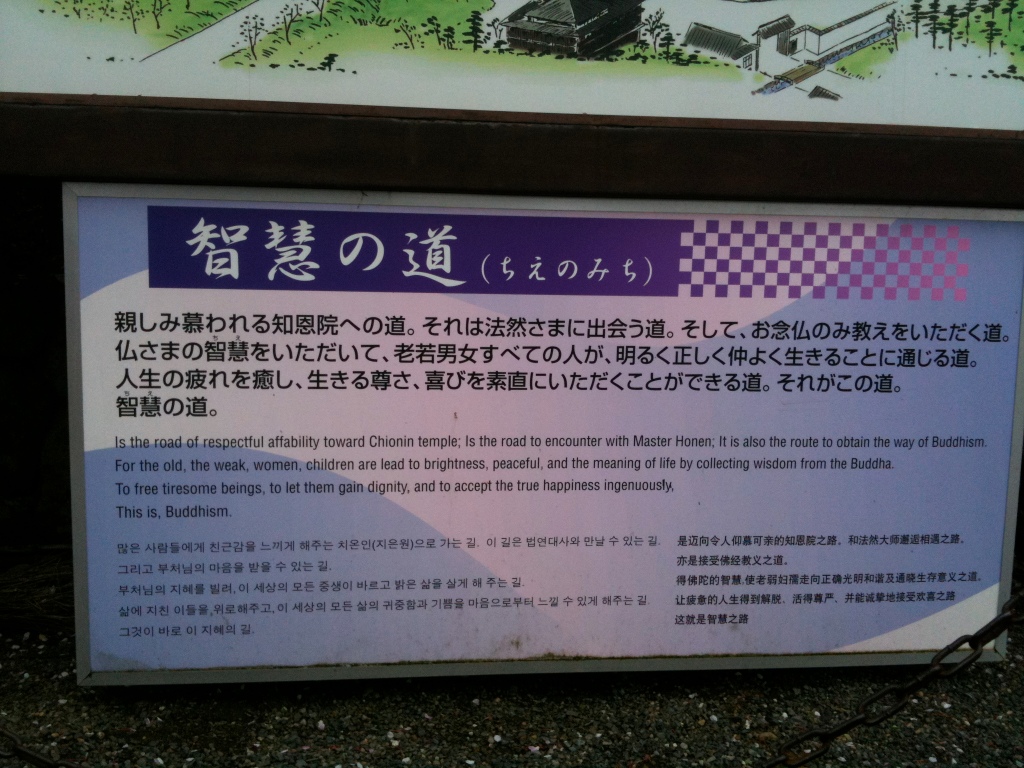
Multi-lingual sign at the temple of Chion-in in Kyoto, Japan where Honen’s mausoleum rests.

This approach isn’t that different from the Chinese approach which varied by teacher or patriarch but through Shandao’s influence had a parallel development. Some teachers emphasized the efficacy of simply reciting the nembutsu (much like Honen), others added the importance of concentration while reciting the nembutsu.

However, turning back to the Larger Sutra, let’s go back to the 48 vows. The 19th and 20th vows state:

(19) If, when I attain Buddhahood, sentient beings in the lands of the ten quarters, who awaken aspiration for Enlightenment, do various meritorious deeds and sincerely desire to be born in my land, should not, at their death, see me appear before them surrounded by a multitude of sages, may I not attain perfect Enlightenment.

(20) If, when I attain Buddhahood, sentient beings in the lands of the ten quarters who, having heard my Name, concentrate their thoughts on my land, plant roots of virtue, and sincerely transfer their merits towards my land with a desire to be born there, should not eventually fulfill their aspiration, may I not attain perfect Enlightenment.

So, taken together, the 18-20th vows cover the various interpretations of 念 we discussed above. All of them are included in Amitabha’s vows to bring across anyone who desires to be reborn there. The common theme is sincerity (至心 zhì xīn). If you look at the original Chinese text, all three include “sincerity”.

Further, when asked about how many times one should recite the nembutsu, Honen replied:1

“….believe that you can attain ojo [往生, rebirth in the Pure Land] by one repetition [of the nembutsu], and yet go on practicing it your whole life long.”

So, let’s get down to business: what is the nembutsu / niànfó ?

Based on the evidence above, I believe that the nembutsu is any of these Buddhist practices described above, taken under a sincere aspiration to be reborn in the Pure Land. It’s about bending one’s efforts and aspirations toward the Pure Land.

If you are calculating how to be reborn, or if your heart’s not 100% into it, then it may be a waste of effort.

Instead, if you feel unsure, study the Buddhist doctrines, get to know the Pure Land sutras, read about past teachers and if you feel fired up about, recite the nembutsu, or do whatever moves you. You will just know when. The more you put into it, the more you get out of it too.

Amitabha’s light shines upon all beings, like moonlight, and if you feel inspired by it, just know that you’re already halfway to the Pure Land.

Namu Amida Butsu

1 The site is long gone, sadly, but the Wayback Machine has an archive of the site. The updated Japanese-only site is here.

Chinese versus Japanese Character Readings

Way back in high school, like most American kids, I had to study things like Spanish, French, etc. I took German for two years in high school, but I didn’t find it very interesting, and I didn’t like my teacher very much. So, I never put in much effort. Later, one of my friends told me that we offered Mandarin Chinese at my high school, and I was just beginning my “teenage weeb phase”, so I was definitely curious.1

Our teacher, Mrs. Wu, was a very nice elderly teacher, even though she was in over her head dealing with a bunch of teenagers. Still, exploring something exotic like Chinese language really interested 16-year old me, and I was a pretty motivated student. I tried to learn both Traditional Chinese characters (used in Taiwan) and Simplified characters (Chinese mainland). My best friend at the time was Taiwanese-American, and I used to practice with his immigrant parents.

Anyhow, long story short, once I got into college, I focused on other priorities, and gradually, I forgot my Chinese studies.

Lately, I have been dabbling in Duolingo and learning Chinese again. I forget why, but I guess it’s partly fueled by nostalgia, but also because I already know how to read many Chinese characters through my studies of Japanese.

It’s been fascinating to see how Japanese kanji (Japanese-imported Chinese characters), and modern Chinese characters overlap and yet differ. The important thing to bear in mind is that Japan (like other neighboring countries), imported Chinese characters at an earlier stage in history, and over centuries the usage, pronuncaition and such have all diverged.

Take this easy sentence in Chinese:

All of these Chinese characters are used in Japanese, and without any prompts, I can read this and get the gist of what its saying, but there’s some notable divergences.

These Chinese sentence above is:

日本菜和中国菜
rì běn caì hé zhōng guó caì

A Japanese equivalent might be:

日本料理と中国料理
nihon ryōri to chūgoku ryōri

A few interesting things to note.

  • The character 菜 is used in modern Chinese to mean food in general, but in Japanese it means vegetables. So the usage has diverged. I noticed that Chinese
  • The country names, 中国 and 日本 are used by both languages, but the pronunciation has also diverged considerably. 中国 is pronounced zhōng guó in Chinese, and chūgoku in Japanese. You can kind of hear the similarities, but also the pronunciation has diverged for centuries.
  • The character 和 () is used in Chinese to mean “and”, but in Japanese a system of particles is used instead. Interestingly, 和 is used in Japanese, for example the old name of Japan was Yamato (大和) or modern words like heiwa (平和, “peace”). The pronunciation is wa, so it has diverged as well.

On thing I haven’t really delved into is the native Japanese readings for Chinese characters. Chinese characters are a foreign, imported writing system to Japan, so native words sound completely different even when written with Chinese characters. The word for 中国 (chūgoku) derives from Chinese, but 中 by itself is pronounced as naka (“middle”) which is a native Japanese word (not imported).

Anyhow, this is just a quick overview of how two entirely different languages both adopted the same writing system, but have diverged over time. If you add in languages like Vietnamese and Korean that also adopted Chinese characters, the picture is even more fascinating.

P.S. Through Duolingo, I learned that the Chinese word for hamburger is hàn-bǎo-bāo.

Chinese has to import foreign words using Chinese characters that at least kind of sound like the original. Japanese uses a second syllabary system, katakana, to approximate the same thing, although in the past Chinese characters were used as well. Hence, America is usually written as amerika アメリカ, but in more formal settings it is called beikoku 米国 (compare the pronunciation with Chinese měi guó).

1 The fact that my high school even offered Chinese language at that time (1990’s America) is pretty unusual, but I am grateful for the option. Also, thank you Mrs Wu if you ever happen to read this.

Enma: King of the Dead

My son is at the age where is he is obsessed with Dragon Ball,1 so we watch some of the episodes together on Crunchyroll.

Source: https://dragonball.fandom.com/wiki/King_Yemma?file=KingYemmaNV01

Dragon Ball is a fun series because it blends a lot of Japanese-Chinese mythology, especially the early series, into a futuristic storyline. Goku is obviously based off of the famous legend of the Monkey King, Sun Wukong (Son Goku in Japanese). Another great example is the character Enma.

In Dragon Ball, Enma (sometimes spelled “Yemma” in English) presides the realm of spirits and behaves like a modern bureaucrat. In spite of the suit and tie, this Enma is definitely based on the original figure in Japanese mythology, named Enma Daiō (閻魔大王, “Great King Enma”).

The original Enma is a fascinating example of a “fusion” mythology, not a native Japanese one. Enma is originally based on the Hindu god Yama, lord of the dead.2 However, in China he was transformed into a Confucian-style bureaucrat and shoe-horned into Buddhist cosmology as a judge of the dead. Enma, along with other judges, determine the dead’s next destined rebirth within Buddhist cosmology. During certain Chinese funerary practices and festivals, you can see his visage on “ghost money” used to help the dearly departed coast through the trial process and ensure a smooth, lenient transition to their next life.

This Enma, a bureaucrat / judge of the dead, was how it was imported to Japanese culture in antiquity. He is even featured in classics such as the Tales of the Heike. When the warlord Taira no Kiyomori is dying from a terrible fever, he has a vision of Enma and his demonic attendants awaiting him. I’ve also heard of an old tradition where parents in Japan would scold their kids saying Enma would pull their tongue out if they told a lie. I have never heard this first-hand though, so I wonder if anyone ever says it anymore.

Anyhow, Dragon Ball’s spin on Enma, Goku and others is a fun look at Chinese-Japanese mythology, for a modern era.

RIP Toriyama Akira 🙏🏼

P.S. this post was also inspired after watching the Star Trek: Voyager episode “Barge of the Dead”. It’s a fun look at the Klingon afterlife.

1 growing up in the 1980’s my obsession at the time was Akira, which I still enjoy from time to time. 😄

2 if you ever pick up the book Lord of Light by Roger Zelazny, a wonderful blend of Hindu mythology and ultra-futuristic science-fiction with a lot of sass thrown in, the Yama depicted in that novel is quite an interesting character.

The Three Pure Land Sutras

While writing a recent blog post, I realized that I had mentioned, but never explained, what the Three Pure Land Sutras are in the Buddhist tradition, and their significance to Mahayana Buddhism as a whole.

Think of this as a handy reference post. I haven’t done one of these in a while. 😊

The Buddhist Canon

When you think of most world religions, they are usually based on one or two books. Christianity has the Bible (including both Old and New Testaments), Islam has the Qur’an plus Hadiths, and so on. Things get fuzzier with religions like Hinduism and Buddhism where they are not based on one or two books, but instead layers of texts written at different periods of time. Such religions have a kind of “accumulated” religious tradition.

As an organized religion, Buddhism begins and ends with the historical Buddha, Shakyamuni. His birth name is Siddhartha Gautama, but in the Buddhist tradition he is called “Shakyamuni”, or “Sage of the Shakya clan”.

Long story short, all Buddhist texts, called “sutras”, are considered sermons of Shakyamuni Buddha, passed down through the generations, first by word, and later written down. Modern historians question the historicity of this, since the very earliest sutras were recorded around 100 BC, 400 years after the Buddha lived. Also some sutras, especially those in the Mahayana Buddhist tradition, were definitely later compositions since they have a more narrative flow quite different from earlier ones.

Why did the early Mahayana Buddhist compose a new set of sutras? My personal guess is that these authors took fragments of early teachings and repackaged them in a more “hip” (relative to the times) and smoother format for easier distribution.

In any case, Buddhism doesn’t have a strict dependency on the sutras the way other religions might. The Dharma, the teachings of the Buddha, is more like the Laws of Physics: something all around us whether we believe it or not. Shakyamuni Buddha’s contribution was to both uncover the Dharma and articulate it. So, the sutras, as purported sermons of the Buddha, are our best guide to understanding the Dharma, but they have their limits.

Sutra Format

Buddhist sutras can be volumes long, or extremely short, very specific to a topic, or kind of general in their teachings. Many were composed in India to address specific audiences, while others were composed in China, but made to look like they were from India for authenticity. As the featured photo above shows, many sutras are preserved in Classical Chinese (not modern Chinese) instead of Sanskrit, despite originating from India. The sutra book above is from a Japanese temple, so each Chinese character includes pronunciation guides (furigana) for Japanese audiences.

Finally, because there are so many sutras, many Buddhist traditions tend to gravitate toward one sutra or set of sutras for their theological foundation. This is especially true in Mahayana Buddhism.

Mahayana Buddhism teaches the notion of “expedient means” (lit. Upaya in Sanskrit): this means that any and all of these sutras are suitable to someone somewhere for progressing along the Buddhist path. “Different strokes for different folks”.1 Mahayana Buddhism is (speaking frankly) broad and messy, but it also strives to be as accessible as possible to a variety of people since one of its founding tenets is that all beings are capable of enlightenment. They just each start from different circumstances.

Sutras of the Pure Land Tradition

The Pure Land Buddhist tradition is probably one of the largest, if not the largest in East Asian Buddhism, but it’s not a single sect or school. It is a loose network of traditions across several countries, from Tibet to Japan, all centered around three key sutras and devotion to Amitabha Buddha, the Buddha of Infinite Light. Professor Charles B Jones compared it to the tradition in Catholicism venerating the Virgin Mary within the larger Christian tradition: some Christians do, some do not. In the same way, some Buddhists are devoted to the Buddha of Infinite Light, and some are not.

In any case, across all Pure Land traditions, the primary textual sources are called the Three Pure Land Sutras. In short, they are:

English TitleSanskrit TitleChinese with
pinyin
Likely Country of Origin
Immeasurable Life SutraSukhāvatīvyūha Sūtra, longer version佛說無量壽經
(Fó shuō wú liàng shòu jīng)
India, before 2nd century
Amitabha SutraSukhāvatīvyūha Sūtra, shorter version佛說阿彌陀經
(Fó shuō Ā mí tuó jīng)
India, before 4th century
Contemplation SutraAmitāyurdhyāna Sūtra佛說觀無量壽佛經
(Fó shuō guān wú liàng shòu fó jīng)
China, possibly 4th century

Note that many other sutras mention or focus on Amitabha Buddha too, but the three above are the primary sources.

Let’s look at each one individually…

The Immeasurable Life Sutra

This sutra, known more formally as The Sutra of the Buddha of Immeasurable Life, is the oldest and longest of the three. In English, it would probably take about 2 hours to read, so it’s not short, but not a tome like the Lotus Sutra either.

The general format is (in order):

  • A long preamble about the progress of a Bodhisattva to full Buddhahood (patterned from Shakyamuni’s life)
  • The origin of Amitabha Buddha, and his 48 vows to help all beings
  • The virtues of Amitabha Buddha, and benefits of those who encounter his light
  • Why someone would want to be reborn in his Pure Land, and the three grades of people reborn there
  • Contrasting this world with the Pure Land (spoiler: our world sucks)
  • General Buddhist exposition about the hassles of this life (again, trying to emphasize the Pure Land)
  • Admonition by Shakyamuni Buddha to be reborn there

What’s interesting about the Immeasurable Life Sutra is that it’s a fairly good primer, covering many general Buddhist subjects, from a Mahayana-Buddhist perspective, while also explaining in detail who Amitabha Buddha is, and why the Pure Land is a worthwhile goal.

Sometimes I still find little hidden gems in there when I read it.

Note, for ritual and chanting, the sutra is much too long to chant, so people often chant key sections, for example the Shiseige in Japanese-Buddhist traditions. The featured photo above is part of the Immeasurable Life Sutra.

The Amitabha Sutra

The Amitabha Sutra, known by the more clunky name Shorter Sukhāvatīvyūha Sūtra, is by far the shortest and simplest of the three Pure Land sutras. It is not quite as short as the Heart Sutra (it takes about 10 minutes to recite/chant compared to the Heart Sutra which takes 1-2 minutes), but it is often chanted as a whole.

The Amitabha Sutra condenses many things about the Immeasurable Life Sutra into a much simpler and shorter narrative, mostly describing the wonder of the Pure Land of Amitabha Buddha. and why one would want to be reborn there:

  • The land is very beautiful and safe, with nothing to fear. It reflects Amitabha Buddha’s goodwill toward all beings.
  • The land is very conducive to Buddhist practice since everything there relates to Buddhism somehow, even the birds singing, or the wind blowing.
  • You will be in the presence of a great many teachers, Bodhisattvas, and even the Buddha Amitabha himself.

From there, the sutra lists many, many Buddhas who attest to the Pure Land, and reiterate that it’s worth being reborn there.

Finally the sutra states that one can be reborn there by simply being mindful of the Buddha.

The Contemplation Sutra

The Contemplation Sutra, also known as the The Sutra on the Contemplation of the Buddha of Immeasurable Life, is the newest sutra, and believed to have been composed in China, not India. It is the most “visual” of the three sutras since it describes a long, complex meditation exercise one can do to be reborn in the Pure Land of Amitabha Buddha. The sutra starts with a story about the Buddha (Shakyamuni) helping Queen Vaidehi who is in prison due to her son’s treachery. She wants to escape this world of misery, and so the Buddha teaches her the following visualization exercises, which are meant to be done in order:

  1. The setting sun in the west
  2. Placid water that becomes clear ice, then beryl.
  3. The ground as made of precious jewels, like sand
  4. Trees that are jeweled, countless in number
  5. Pools of water with precious jewels as sediment
  6. Jewelled pavilions, countless in number
  7. A great dais made of a lotus flower
  8. The Buddha, golden in color, seated upon that dais, then flanked by his two bodhisattvas on each side, also on their lotus seats.
  9. Details of the Buddha, Amitabha
  10. Details of the Bodhisattva, Avalokitesvara
  11. Details of the Bodhisattva, Mahastamaprapta
  12. Oneself being reborn in the Pure Land in a lotus bud
  13. Visualizing the Buddha Amitabha in a specific way, leading beings to the Pure Land
  14. Rebirth in the Pure Land for those of superior grade
  15. Rebirth in the Pure Land for those of middle grade
  16. Rebirth in the Pure Land for those of lower grade

Because the visualization exercises listed in the sutra are so detailed, they have often been depicted in Buddhist artwork such as the Taima Mandala.

Significance

Of course the Three Pure Land Sutras are important to the Pure Land tradition, but they are also influential in other Buddhist traditions, and also in Buddhist art and culture in the medieval period. Even today in various communities, people relive the origin story of Amitabha Buddha in chanting and liturgy, and art related to the Pure Land still persist in such things as video games and other media. It has greatly influenced East Asian Buddhism and continues to influence Buddhism at large.

I like the Immeasurable Life Sutra in particular, and every once in a while like to read through it again. I suppose it’s my “go to” sutra.

Namu Amida Butsu

1 This is does not mean an “anything goes” approach to Buddhism, of course. Stories of “crazy wisdom” and other such things are exaggerated and rarely practiced in Buddhism. Instead, teachings such as the The Four Dharma Seals provide a theological “anchor”, as well as the Buddhist tradition. Not everyone may like the idea of following a religion tradition, but as with any long tradition, it has the benefit of collective experience across generations, so long as we are not overly bound to it.