IDIC, Redux

Imagine a star in the sky, any star. It is a great big ball of hydrogen gas (some helium too). Its own mass is so great that it compresses its core with tremendous heat and pressure until it ignites a nuclear fusion reaction.

Photo by Pixabay on Pexels.com

Through nuclear fusion (not fission as we use), hydrogen molecules fuse into helium, releasing energy each time. If the star is heavy enough it will eventually also fuse helium into things like carbon and oxygen. If the star is exceptionally big, it will fuse even heavier elements.

Such stars, when they reach the end of their lives, billions of years later, explode in dramatic fashion scattering all their fused elements into space. In a few more billion years, this material coalesces into another star, some planets, etc.

DELENN: We are all born as molecules in the hearts of a billion stars molecules that do not understand politics or policies or differences.

Over a billion years we foolish molecules forget who we are and where we came from.

In desperate acts of ego we give ourselves names, fight over lines on maps and pretend that our light is better than everyone else’s.

Babylon 5, “And All My Dreams, Torn Asunder” (s5:ep16)

Thus when you look at your own hands, or the cup of coffee you are drinking it is literally, and scientifically speaking, made from material that was fused in a nuclear reaction by stars that were destroyed many billions of years ago. This generation of stars is all but gone (the Universe is quite old), but we are their legacy. From ancient chemical processes, a near-infinite number of things have arisen. As the Vulcans in Star Trek would say: infinite diversity in infinite combinations (IDIC).

And yet, it’s easy to forget this.

We take our bodies for granted, as well as the things around us. We also assume they are permanent. A coffee cup is a coffee cup. Always will be. This gives rise to thoughts of “me” and “my things”. Survival becomes our primary motive. We are homo sapiens after all.

Evolution teaches us that we must fight that which is different in order to secure land, food, and mates for ourselves. But we must reach a point where the nobility of intellect asserts itself and says no. We need not be afraid of those who are different. We can embrace that difference and learn from it.

G’Kar, Babylon 5, “The Ragged Edge” (s5:e12)

But none of this is permanent. As the Buddha taught, we do not own anything. We don’t even truly own ourselves:

Rahula, any form whatsoever that is past, future, or present; internal or external; blatant or subtle; common or sublime; far or near: every form is to be seen as it actually is with right discernment as: ‘This is not mine. This is not my self. This is not what I am.'”

Mahā Rāhulovāda Sutta (MN 62) of the Pali Canon, translation by Thanissaro Bhikkhu

Thus, that cup of coffee isn’t really your cup of coffee. Your body isn’t really yours either. At most, you are borrowing that body (a gift from your parents, the universe, etc). That cup is in your care, but it will fall apart or go in the bin someday. Your children are in your care; you do not own them.

In time, like the stars that once forged the elements in your body, such things will be long, long gone. Dust in grand scheme of time.

P.S. Original IDIC post.
Confronting a Suffering World

More than any other year in recent history, it seems like 2025 is a year where we are suffering more than before. It is frustrating to watch all this unfold, frustrating to know that even when you try to help, it feels like it makes no difference, and frustrating to see no light at the end of the tunnel. I feel a combination of denial, passivity, frustration, anger, despair, and everything in between, over and over.

IVANOVA: Damn it, John, there’s always too many of them and not enough of us. What am I supposed to do?

SHERIDAN: Fight them without becoming them.

Babylon 5, “Dust to Dust”, s3:ep06

But I’ve also been thinking about this a lot, and I realized that the forces of History are always in motion, even if we don’t see them. It can take years, or in some cases decades to see the bigger picture.

Claude from Fire Emblem: Three Houses saying “…but even while you’re standing still, the world keeps on moving. I always find that oddly comforting.”

But also, the little things we are doing here and now still matter. What happens to others who are suffering affects us, even if we are not consciously aware of it.

G’KAR: If we deny the other, we deny ourselves and we will cease to exist.

Babylon 5, “Point of No Return”, s3:ep9

Even those whom we oppose are suffering, even if we do not comprehend it:

If both sides are dead, no one will care which side deserves the blame. It no longer matters who started it, G’Kar. It only matters who is suffering.

Babylon 5, “Dust to Dust”, s3:ep6

So, simply standing back and letting history unfold isn’t enough. On the other hand it is just not possible to save the whole world. Even if I gave away everything I have here and now, it would be a drop in the bucket.

Instead, each one of us needs to find one small thing that we can dedicate ourselves to, for the good of others. In a Pure Land Buddhist text, The Larger Sutra of Immeasurable Life, the Buddha Amitabha started as a king, then a bodhisattva, and through tireless efforts over eons transformed his realm into the Pure Land through countless good acts, accumulated merit, and so on. This process was glacial, but it came to fruition nonetheless.

In the same way, each one of us when we dedicate ourselves to a cause, however small, it feels glacial. Nothing changes. But change does happen. As with the forces of History, things do unfold, but our actions help shift the currents of the “river of History” ever so little.

But even so, not every one will see this and understand. In the immense Buddhist tome, the Avatamsaka Sutra (a.k.a. the “Flower Garland Sutra”), is a famous quote:

On seeing a bodhisattva
Perform various practices,
Some give rise to a good mind and others a mind of evil,
But the bodhisattva embraces them all.

Original translation from the Collected Works of Shinran, courtesy of the Jōdo Shinshū Hongwanji-ha

This is the Mahayana Buddhist in a nutshell.

Namu Shakamuni Butsu

Namu Amida Butsu

P.S. Thanks to a bug in my blogging app I posted two posts at the same time last week. Apologies for any confusion.

Also, I am still resting a little from burnout, so no blog schedule for now. I wanted to at least finish some mostly-complete drafts for now.

Effort

Garibaldi: This isn’t gonna be easy.
G’kar: Nothing worthwhile ever is.

Babylon 5, “And the Rock Cried Out, No Hiding Place”, s3:ep20

Recently, I talked about the key to practicing Zen (or Buddhism in general) is training while incorporating other things in your life toward that same goal. Like Rocky Balboa training in Rocky, or Li Fong in the excellent movie Karate Kid: Legends, or someone working hard to learn a language by making other aspects of life conducive toward language learning.

In most cases, we go through a some stages when we take up a project like this.

  1. New thing – “this is fun, I can see the benefits already!”
  2. Steady practice – “gotta keep this up”
  3. Boredom – “ugh, I gotta do this again”
  4. Skipped days – “I’ll make up for it tomorrow”
  5. More skipped days – “No, really, I’ll make up it up tomorrow.”
  6. Guilt – “I suck”
  7. Despair – “I’ll never succeed.”
  8. Quitting.

My usual pattern with new projects, or dieting and exercise, is to eventually feel guilty, despair, and quit. It happens to me a lot over the years, admittedly.

But also, there are a few things that surprisingly I have managed to stick with for years, decades even. I’ve been actively studying Japanese since 2008, for example. I realized though that the way I’ve studied Japanese has changed and shifted many times. Some experiments succeeded, others failed immediately. But the goal was important enough to me, that even when I failed I just shifted tactics and tried again. I failed the N1 JLPT twice in the last five years, and to my surprise, I am still at it, but now trying a new tactic.

Put another way: when I hit a roadblock, instead of hitting my head on the wall harder and harder, I tried another route. I knew where I wanted to go (language fluency) and just kept trying methods until I found something that stuck.

I realized too that my pursuit of the Buddhist path has been much the same way. I started out in 2005 with very little understanding, but I really liked reciting the nembutsu, and I loved the simple, down-to-earth, and highly approachable Jodo Shu sect as taught by Honen (still do!). But while I’ve had the same basic goal, my understanding of Buddhism has grown over time, and like language learning, has gone through many false-starts, projects that soon ended, or things that just didn’t work. So, I just shifted, tried another route, backtracked, and so on. This what I think happened to me, and why I took up Zen practice since May.

My current Zen practice is, I suppose, just another track toward my goal.

So, I think the point of all this is that the goal is more important than the particular approach. If the goal is something you really care about you’ll find a way. In fact, you’ll probably bend other aspects of your life toward it. If not, then the goal maybe wasn’t that important to begin with. That’s OK. Better to acknowledge it, cut your losses, and move on.

But if the goal is worthwhile to you, then like G’Kar says, you’ll find a way.

Namu Shakamuni Butsu
Namu Amida Butsu

Navigating Chaotic Times

VIR: I believe there are currents in the universe. Eddies and tides that pull us one way or the other. Some we have to fight, some we have to embrace.

Babylon 5, “The Geometry of Shadows”, s2:ep3

I really liked this quote from the science-fiction classic Babylon 5 (which I’ve been re-watching lately)1 because it speaks to the sense that many things happen outside our control. Instead, we’re constantly pulled along by other forces, and some of these can be beneficial, others can be harmful, and simply just pull us in unexpected directions. Some of these currents are very strong and difficult to resist, some are barely noticeable until we look back.

Further, we don’t always know where these currents will take us. So, there’s always danger in choosing one course or another.

DRAAL: What’s the third principle of sentient life? It is the capacity for self-sacrifice. The ability to override evolution and self-preservation…

Babylon 5, “A Voice in the Wilderness (part 1)”, s1:ep18

I think intuition is not enough to navigate this mess. One also needs a set of independent principles to help guide one, and that’s where things like the five precepts of Buddhism really come in handy. It’s not a list of “don’t do” things, it is a list of training rules to help strengthen the mind, and benefit others.

Also, clarity of mind.

Rather than giving in to self-doubt, stay cool, and take things one step at a time, navigate eddies and currents, but also don’t lose your goodwill towards others.

At least, that’s how I see it. 😏

Namu Shakamuni Butsu

1 Speaking of Shadows

What Do You Believe In?

G’KAR: What do you believe in?

NA’TOTH: Myself, Ambassador.

G’KAR: Too easy an answer. We all believe in something… greater than ourselves. Even if it’s just the blind forces of chance.

NA’TOTH: Chance favours the warrior.

Babylon 5, “By Any Means Necessary” (s1ep12)

I have been re-watching the classic science-fiction series, Babylon 5, and I found this neat dialogue between two of the Narn characters. G’Kar is a devout follower of the Narn religion, while his attaché Na’Toth is not.

G’Kar makes a good point: everyone believes in something. Even an atheist believes in something: science and reason instead of faith. Even someone who is agnostic believes in a higher power even if they can’t define it for themselves. Or people believe in chance, or the natural world or whatever. All of these are beliefs.

But then, I wonder: is belief (even Buddhist belief) just an extension of oneself? Is it a way to make sense of the world outside ourselves?

By the way, I think there’s nothing wrong with having beliefs (Buddhist or otherwise), but I think one’s beliefs are a good indicator of one’s inner fears and anxieties. Two people might sincerely believe in the God of the Bible, but each one emphasizes something different, or interprets God differently. So, how much of this is real, and how much is this just a projection of oneself onto the world?

So, then back to the top of the post: what do you believe in, and what does it say about you? 😏 You can learn a lot just by exploring this question.

Namu Shakamuni Butsu

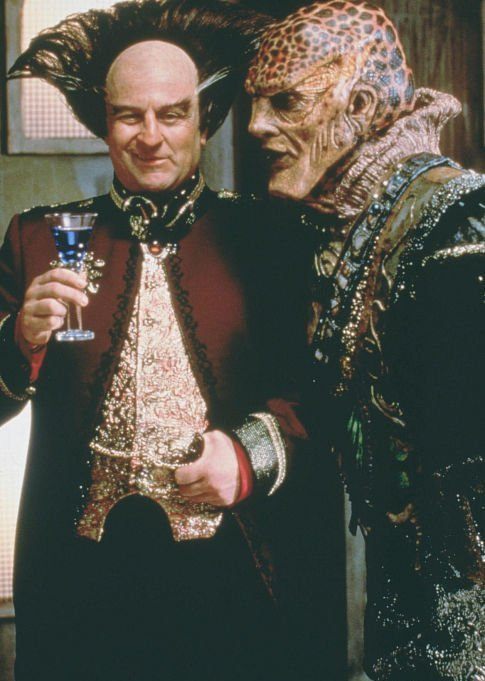
P.S. Featured photo is “best buddies” Londo and G’kar from Babylon 5. RIP Andreas Katsulas (G’kar).

P.P.S. If you remember Mr Morden from Babylon 5, and his question “what do you want?”, that too is very instructive.