Adventurers League for 2024 Ruleset

Adventurer’s League is the community play program for Dungeons and Dragons, and has been around for years, but with the recent publishing of the 2024 updated ruleset, this forces some updates for AL players. In recent months, I have been able to get back into AL after a really long lull,1 and I wanted to share some experiences with the 2024 results.

Per AL regulations, players are expected to field characters using the latest ruleset available, and to rebuild any characters accordingly when required. In the case of 2024 ruleset, that means that all characters built before 2024 ruleset need to be rebuilt to some extent before playing the next session.

In some cases, I’ve found this to be pretty easy, in some cases somewhat challenging. Here’s a couple examples in my case.

note: I wrote this before I learned about the new Legends of Greyhawk community play. While the FAQ states that this is not related to Adventurer’s League, and that “Adventurers League will continue as a community-content program”, this leads me to believe that AL will nonetheless continue to wither and die on the vine for the forseeable future. Given WoTC’s history, I do not fully trust them to support AL going forward as they prioritize the new, shiny program. Still, I am posting this anyway to illustrate how rebuilding my long-term 2014 characters for 2024 rules was sometimes very easy, and sometimes a pain in the neck.

Abjurer Elf Wizard

My original AL character, Qisandoral Arriestanus (DDB link), is a 13th level high-elf wizard (abjuration school) as of writing, was the easiest to rebuild in some ways, and painfully difficult in others. I have written about him here and here. He’s been rebuilt, retired, and revived a number of times.

The 2024 ruleset in the Player’s Handbook fully supports both High Elves and the Wizard class. The eight wizard schools have been changed into four subclasses at 3rd level2 and collapsed into , and for the Abjuration subclass it is covered in the PHB. So, just using the new PHB, I can fully rebuild the wizard without any extra rules or books. Easy.

The challenge of rebuilding a high-level wizard is picking spells for the spellbook. Using standard rules, I can calculate how many spells I should have in my spellbook at level 13, but I also had copied some spells into my spellbook from purchased spell scrolls. Plus, 2024 background choices give you additional spells through feats on top of that. And then there’s spells you get as a high elf innately.

In the end, I had to abandon any spells I had copied from spell scrolls as they are not considered part of the rebuild. As consumables not tied to any adventure rewards, they are treated as a sunk cost when rebuilding.

For everything else, I had to carefully calculate my starting 6 spells at level one, 24 spells for every level after one (2 per level, 12 levels total), plus 3 from elf lineage, and finally spells from my Magic Initiate background feat. This took hours to sort out, and I had to double-check with fellow AL players on Discord, but in the end I was able to rebuild my spellbook. I also leveraged DnD Beyond to validate that the configuration made sense.

Drow Nature Cleric

My other favorite character from earlier AL seaons was a Drow nature domain cleric named Shava Do’Mindrun (DDB link), who worshipped Eilistraee as an alternate to the dread Spider Queen Lloth. Nature clerics are not a particularly popular choice for character builds, but I had surprising fun with it, and it fit Eilistraee’s domains so it was an easy choice at the time.

However, Nature Domain is not a part of the 2024 ruleset, but Eilistree’s other cleric domains, Light and Life, are. So, if I wanted to make a vanilla 2024 character, I would have to rebuild Shava as a Light Domain cleric.

Alternatively, I can still use the Nature Domain, since both 2024 ruleset and AL rules allow it (the 2014 Player’s Handbook is still the newest rules for a Nature Domain cleric). The 2024 Player’s Handbook in particular clarifies that older domains not listed in the handbook are still legal choices, so long as their abilities are granted at 3rd level, not earlier. This is to keep things internally consistent with other new Cleric subclasses.

As of writing, I ultimately decided to reset entirely, and Shava as a light domain cleric at 1st level. Eilistraee’s imagery of the moon dovetails nicely with the Light cleric domain, and it seems that the Nature cleric domain feels a bit more anemic in the 2024 ruleset, while the Light domain is fully supported by comparison. This may change though, as AL allows character rebuilds. Time will tell. As for resetting to first level as an essentially a new character, I did this mainly for personal reasons as I had made some choices with the original character I regretted, and frankly I just wanted to play her over again from the beginning, rather than let her languish in higher tiers were game options are fewer.

High Elf Forge Cleric

Similar to the Nature Cleric above, my High Elf forge domain cleric named Fenmaer Wasanthi (DDB link) was faced with a cleric domain that isn’t fully supported in the 2024 ruleset, but still allowed.

To make a long story short, in this character’s case, I decided to keep the Forge domain and rebuilt him accordingly. The deity in question, Darahl Firecloak, does have the domains of Forge and Light, so I could play another Light domain cleric, but as of writing I felt that the Forge domain was still compelling enough that it was worth keep this build even under 2024 rules.

Simply put, I rebuilt as-is with little or no change.

Wood Elf Samurai

My last character that I regularly play is a Wood Elf samurai fighter named Heian Amakiiro (DDB link), whom I’ve written about here.

1 Pandemic + parenting meant that I played once a year, maybe twice if lucky. I required quite a few characters at the time. Nowadays I play somewhat more often, but still not at pre-pandemic levels. I hope to change that in the coming year once my oldest leaves the nest.

2 To be more consistent with other character classes, presumably. Much of the 2024 updates to 5th edition Dungeons and Dragons seems intended to make character creation process more consistent regardless of choice, and to homogenize some aspects.

P.S. Double-post today. Cleaning out the “draft” folder. 😉

A Nerd Dad’s Review of Dungeons and Dragons 2024 Player’s Handbook

Most players of Dungeons and Dragons within the last couple of years are probably aware that an updated ruleset was on the horizon, to coincide with the 50th anniversary of the game. This new ruleset has included names such as “One D&D”, or jokingly “5.5 edition” and so on. Nonetheless, the new Player’s Handbook came out, and I got a limited edition copy at my local game store a couple weeks ago. My kids and I hadn’t really played any TTRPG in many months, both due to demanding schoolwork for the oldest, busy schedule for the family, malaise with Pathfinder Second Edition1 and just unhappiness with Hasbro shenanigans.

But we all agreed that we missed our old family D&D sessions during the early Pandemic, and my oldest child’s school schedule this year is much lighter now. So, we agreed to block out a time on weekends and start playing again.

We bought the alt-cover 2024 Player’s Handbook early, since FLGS’s were allowed to sell it a week before online release.

Further, my kids wanted to try the new rules, so I went to the local FLGS (friendly local gaming store), skimmed over the new 2024 Player’s Handbook, felt it was intuitive enough that I could adapt, and within a couple weeks, we were running a basic Forgotten Realms campaign, borrowing elements from R.A. Salvatore’s original Icewind Dale trilogy.2

I have my old copy of the Sword Coast Adventurer’s Guide to help with the world-building. old resource books for the Sword Coast. Also, before the game, I tested the new rules by creating a couple characters using 2024 rules to help provide sidekicks to our small party.

Our “session zero” with the new 2024 campaign.

The kids, having experience with 2014 5th Edition D&D quickly picked up the new rules and were able to get a couple fun characters created in an hour:

  • a dragonborn paladin (my son)
  • a tiefling cleric (daughter)
  • plus sidekicks I made: dwarf druid of the sea, and drow eldritch knight.

From there we’re back on familiar turf, having a good time, enjoying a classic bar fight opening and subsequently getting thrown out. Wulfgar and Regis from the Icewind Dale trilogy made a cameo too.

In short, getting up to speed with the 2024 rules was easier than expected. The character creation processed has definitely changed in a couple essential ways :

  1. Character race no longer determines stats, it’s based on chosen background now. The result doesn’t really change the process all that much, but it is a philosophical shift.
  2. The racial subclasses get net abilities to help with “flavor” more: elves for example are still divided by wood, high, and drow elves, but each one gets different innate spells at certain levels. Same with Tieflings, and so on. I found this change more fun than expected.
  3. Many character class paths are homogenized to match other class paths. This means that clerics now choose their domain at level three, not level one for example. Wizards similarly choose school on wizardly later than before. However, even at level one there are choices you can make with character creation, so this isn’t as limiting as one might expect. However, clerics and wizards as of writing only have 4 subclasses only versus 8 previously.

Because classes and backgrounds are so strongly emphasized, these sections comprise most of the book by a long shot. The book covers species (character races), spells and equipment toward the end which is different from the classes 2014 PHB. The intro includes a nice, updated walkthrough of how a typical D&D session looks like so if you’re new to D&D, this is a good read.

Most of the other rules have not drastically changed, so in most cases they will feel familiar. There is a comprehensive list here as well.

Spells have often changed and take some careful reading to get re-acquainted. Many of these updates provide much-needed fixes and balance updates. For example the 3rd level Daylight spell now actually counts as sunlight for mechanics purposes (handy for vampires). The classic Cure Wounds spell heals 2d8 damage, not 1d8.

In short, some spells are weaker or more limited now than before. Spells that were seldom used such as Barkskin now have a new life. Again, if you played fifth edition before, you should definitely reread your spell list and familiarize yourself with the new spells.

All in all, despite my personal misgivings toward Hasbro, I must admit that the 2024 Player’s Handbook is a welcome update. It fixes a number of oddities, balance issues and deficiencies of the original while keeping its essence more than I expected. I can still use my old resource books without much effort to convert, which is greatly appreciated. Meanwhile, new players will have enough to get started with the PHB without needing to refer to older material.

I am eager to see what the 2024 Dungeon Master’s Guide brings as well.

Edit: I “butt-published” this too early. I had to write the last third of the post in a hurry. Apologies for the rushed effort. 🤦🏼‍♂️

P.S. another reason for investing in the 2024 PHB is that Adventurer’s League requires rebuilding characters to conform to 2024 rules anyway. I don’t play AL too often these days but I don’t want to get left behind.

1 While we did have a good time initially, especially with character creation, the biggest challenges with maintaining the Pathfinder campaign was a lack of coherent fantasy settings. Most of the research and prep I did as a DM was to pore over Wiki fan pages, which inevitably referred to modules I never bought (and weren’t interested in purchasing). There just wasn’t enough compelling lore, characters or story modules to get immersed in to replace classic D&D lore, plus they are scattered across so many books anyway that it was impossible to find anything. Plus the fatigue in keeping up with the constant stream of new classes, new ancestries, and so on. A TTRPG hobbyist has the time to keep up with this, but not a working parent who just wants to spend a weekend with the kids. Pathfinder 2e Remaster has good rules, and good design, but outside of this and the Beginner Box there is not enough support for more casual players especially those who have some nostalgia about classic TTRPG lore.

2 I’ve been reading the Icewind Dale trilogy shard to my son at night, after we finished the Lord of the Rings Trilogy, the Hobbit, and the original Dragonlance chronicles. LOtR was great, the Hobbit was great, Dragonlance wasn’t as good as I remember, but the Crystal Shard has been a solid read, though I have to skim over certain scenes that are inappropriate for younger audiences. He loves the main cast, even more so in teh second book Streams of Silver. It does feel like a D&D adventure for him, and he enjoys listening to the story, and (in his opinion), my voice acting.

Making the Most of an Abjuration Wizard in D&D 5th edition

Recently, I dragged my first Adventurers League character, Qisandoral Arreistanus, out of a long, long retirement for another adventure in our play-by-post group. Qisandoral is a high elf wizard of the Abjuration school. You can think of him as Mr Spock in a fantasy setting.

“We reach”… with Otiluke’s Freezing Sphere!

Due to pandemic and other issues, I hadn’t played this character in literally years, but due to AL rules, he had jumped from level 9 to level 12 through accumulated downtime. Otherwise he sat idle. With the new 2024 ruleset, and the requirement in Adventurers League to rebuild a character that conforms with this ruleset, here is the latest, update character sheet (link):

Screenshot from DnD Beyond as of writing (link).

The tier-3 adventure module, from the Season 8 Waterdeep setting, took place in the underbelly of the city, where we fought a vampire cult worshipping Shar. With only three players, and no melee fighters, this was hugely risky. My memory of how to play Qisandoral was rusty, I had forgotten his abilities, and my spellbook choices were confusing and weird.1 During the big boss fight, I performed pretty terribly at first, and nearly wiped out my own party due to a poorly timed Otiluke’s Freezing Sphere. Further, our DM skillfully played the boss, a vampire mage, as it fought tooth and nail using every nasty trick in the book to survive. It took a huge effort to finally slay the abomination. At one point, I had to use Wall of Force to pin the vampire long enough for us to recover a couple rounds.2

The good news is that during play, I eventually dusted off the mental cobwebs and started playing my wizard more effectively. This post is to share some hard-learned lessons about playing an Abjuration Wizard in 5th edition Dungeons and Dragons. I think Abjuration wizards are really neat, and fit Qisandoral’s character concept (a dour, elf wizard who is very bland and likes routine) nicely, but they’re also a little different from other wizards as I learned the hard way.

Edit: with the 2024 Player’s Handbook, the rules for the Wizard class have changed considerably. You now choose your wizard subclass at level 3, but the abilities largely remain the same, and the advice remains unchanged. The level 10 ability in the 2024 ruleset has been greatly enhanced, and will certainly increase the power of this subclass at higher levels.

The Basics of Abjuration

First and foremost, Abjuration is about defense, cancellation and denial. Of course, an Abjuration wizard must also have some offense, but they will never excel at offense. Instead, an Abjuration wizard shines when they frustrate and shutdown the enemy.

Your 2nd level wizard ability, Arcane Ward, is your bread and butter. Simply by casting Mage Armor at the start of your day (which wizard’s do anyway), you gain a extra pool of hit points that will automatically absorb (afaik, you don’t get to choose, it just happens) a certain amount of damage before passing through. At low levels this pool is quickly used up, but at higher levels the pool of hit points gets pretty large.

Further, the pool recharges X hit points where X is 2 times the spell level. If I cast Shield, a 1st-level spell, my ward tops up by 2 hit points. If I cast Counterspell, a 3rd-level spell, it tops up the Arcane Ward by 6 hit points.

Later, when your character reaches 6th level, you can then project this ward as a reaction to absorb someone else’s damage. You have to be able to see that person, and they have to be within 30 feet, but otherwise it’s a handy way to keep teammates alive in a pinch (and I projected it a lot in the boss fight above).

Finally, the other big deal with Abjuration wizards is that for certain spells like Dispel Magic and Counterspell, you can boost your chance of success using your proficiency bonus. This does not work with Banishment sadly (I learned this the hard way).

Lastly, starting at 14th level, Abjuration wizards are highly resistant against spell attacks, which from a defensive standpoint is pretty neat and probably live-saving (sadly Qisandoral was 13th level during the aforementioned adventure).

What To Do And Not Do

An abjuration wizard needs to rely on their Arcane Ward a lot, so you should activate each day using Mage Armor or something suitable. Also, have a few cheap spells of the Abjuration school prepared to help recharge it as needed. The challenge is that many of those cheap spells are pretty niche:

  • Shield is always a good idea to have, but can only be used as a reaction (i.e. you’re being attacked). Further, shield gets less and less useful at higher levels as your AC struggles to keep up with enemy attack levels. You should always have it prepared just in case, but bear its limitations in mind.
  • Protection from Evil and Good can provide some help in some situations, but you can only cast it on one party member, even if you cast at higher level, and it requires concentration (yuck).
  • Counterspell only works when someone is casting a spell, and you can’t always stand around waiting for someone to do that.
  • Alarm is only useful outside of combat. Sneaky wizards know to cast this as a ritual over and over again (time permitting) to charge up the Arcane Ward.
  • Banishment is a high-level spell, and may fizzle if the saving throw succeeds. If it succeeds, you’re a target for opponents trying to break your concentration.
  • Globe of Invulnerability is very powerful, but it has a fixed location, so it will not move with the player.

Each of these is pretty niche spells, so if you want to maximize usage of the Arcane Ward, you prepare as many of these as you can to react to various situations.

On the flip side, the more of these you prepare, the fewer offensive spells and other utility spells you can prepare. In earlier adventurers, this was the problem I had with Qisandoral: in many fights, the best he could do was shoot Ray of Frost (a cantrip) half the time.

Thus if you want to have an Abjuration wizard with some offensive capability, you will have to choose your spells carefully, and strike a balance between the needs of your school, and the needs on the battlefield.

It’s best to pick spells that are generally useful in all situations. Magic Missile isn’t glamorous, but few monsters can resist force damage, and it just about always hits its target (unless they have a Shield spell). Even cantrips can be useful since they do scale up damage over time. Qisandoral has both Ray of Frost for distance, and Shocking Grasp for close range.3 Having a variety of offensive cantrips may help free up the need to use precious spell slots for other things, even if you are not a powerhouse.

Also, having a classic like Fireball or Freezing Sphere is good to have in your back-pocket as a kind of panic button.

On the utility side, spells like Misty Step are a great way to get in and out of the battlefield, and well as some common detection spells like See Invisibility or Detect Magic.

Combat

Since you’re default strategy is to leverage Arcane Ward to frustrate attacks, or use your spells to stop magic effects, you may be in combat doing mostly passive or reactionary moves while spending your turn making low-level attacks that don’t require commitment or concentration. The default strategy is one of observation, and being able to respond to threats as they come up, but still reasonably do your part to take out threats offensively.

If you do manage to Banish a creature that you intended too, then don’t hesitate to protect yourself using your own abilities otherwise intelligent monsters may decide to target you next to break concentration.

Finally, remember that if you use Globe of Invulnerability, make sure to put it in a strategic spot where you and party members can take cover for the rest of the battle. In other words, make it count.

Final Thoughts

If your goal is to make a wizard that decimates the battlefield with world-bending magic, an Abjuration wizard probably isn’t a suitable choice unless you want to charge your Arcane Ward once per day and maybe keep an abjuration spell or two handy.

If your goal is to disrupt the battlefield and frustrate your enemies, an Abjuration wizard excels at this, but it does require responding to various niche situations as they come up, and your damage output will be somewhat below average. Just remember you’re focusing on defense first, offense second.

Conversely, since so many Abjuration spells are situational don’t be surprised if you are in a situation where none of them are useful. Have a few generalist spells prepared for this situation.

Finally, as with every wizard, you can never quite prepare enough spells. It’s always a juggling act to balance various competing needs, and accept that you will sooner or later have failed to prepare the right spell for a particular situation. The vast breadth of spells a wizard has comes with the cost of lots of care and feeding.

I hope this was helpful. Good luck!

1 Thanks to simpler AL rules now, I probably should have just rebuilt him again from the ground up before the adventure, but I was in a hurry and busy.

2 I also had Hold Monster prepared, but failed to notice the stipulation that it does not work on undead monsters. 🤦🏼‍♂️ Word of advice for new players: read your spells carefully beforehand.

3 Shocking Grasp is also handy when your opponent has legendary actions, since a hit prevents them from taking reactions for a turn. This was something I could’ve done in our fight, but I failed to grasp this until too late. To be fair, our opponent was invisible most of the time anyway.

When It’s Over…

I loved this song back in the day, but the music video sure hasn’t aged well…

Last night I finally got to play Adventurer’s League at the local gaming store for the first time in maybe a year, patiently waiting since for my kids’ school activities to end for the school term, and getting my character dusted off and ready to go.

But it was a terrible night. The adventure module we played, something from Season 7 Tomb of Annihilation, was poorly designed, and our DM was just an inexperienced kid who tried his best but hadn’t prepared enough.

The worst part though were some of the other players. I sat in the farthest back, surrounded by a number of “power players” (including one dad who brought his teenage daughter), who kept talking over me and one another. They kept pushing the rules envelope, and the DM didn’t really have the confidence or experience to make decisive choices about allowing this, or saying no to that, so the power players ran roughshod over the game. Within the first hour, I checked out, and spent the evening on the phone, venting on Twitter (rant since deleted) and hardly said anything for the rest of the night. I was all too glad to leave when it was over. The module had been scheduled for 2 hours, but we stayed almost for 5.

And yet it was more than that. The gaming store, which thankfully weathered the pandemic, still felt very different. Overly-complicated food menu, unfamiliar staff, flashier “gamer” vibe, etc. The large community of AL players I used to know back before the pandemic has almost entirely disappeared, or play their own table exclusively leaving occasional players like me at the “little kids table”. Where before we usually had 4-5 tables a night, and I knew all the senior DMs, I recognize almost no one now. That goes double for the other players.

In short, the local AL community really sucks now, and the gaming store isn’t what it used to be. When I last played during the pandemic, it had also been a bad experience, though not quite as bad. So, I just chalked it up to the occasional bad night. They happen, and you move on.

However, it’s clearly become a pattern and I finally had to face the fact that the local gaming community that I once knew is over. The pandemic and WotC’s tinkering with AL rules drove off a lot of committed players, and in a sense gutted my local community. Further, I’ve lost interest in newer D&D rule books,1 and our local regional Discord channel is very quiet now.

As I wrote back in the day, sometimes it’s better to just not play D&D than subject yourself to a frustrating and disappointing experience, but I kept trying through the pandemic hoping things would eventually recover. They haven’t. And as with Magic, I have to face that sunk-cost of investing any further in it, and give it up.

Never say never, of course. Even if I don’t like the community now, who know how things will look say five years from now. Maybe I’ll find another, healthier AL community someday. But for now, I’m putting that hobby on a shelf for the foreseeable future.

Contrarily, playing at home with my kids has been a lot of fun, and my daughter’s friends want to play with us too, so while my local gaming community has faded away, I suppose a new one is being formed right under my nose.

1 The new Mordenkainen’s book somehow just feels flat, homogenized, and takes a lot of fun out of playing certain character builds. I did get Witchlight and Candlekeep Mysteries, but have hardly cracked open either book since.

Playing a Warforged in D&D

Front cover art for Eberron: Rising from the Last War, adapted from free wallpaper art (see link), all rights reserved

My kids and I have been playing a longer D&D campaign in the world of Eberron, a noir steam-punk magic setting for almost a year now, and the kids consistently seem to enjoy this setting more than other D&D campaigns we’ve run. Since we have only two players (my daughter and my son), the party consists of:

  • Daughter: Swiftstride shifter fighter / ranger, Latisse
  • Son: Halfling bard, Kirby1
  • Sidekick: Hobgoblin cleric (knowledge) / wizard, Borsheg
  • Sidekick: Warforged fighter (samurai), Malbus 414
  • Sidekick: Valenar (wood) elf fighter, Tantalus

I run the sidekick characters myself, and some have come in and others rotated out.2 The hobgoblin and warforged sidekicks have been with the party since the beginning and have been a pretty integral part of the story.

Our hobgoblin cleric’s backstory is that he secretly wanted to be a wizard instead and only did the cleric role out of familial obligation. However, since Borsheg was rejected by the wizards guild, he has since gotten private tutorship on the side with a shady teacher named “Dak” who, currently unknown to the party, is a Rakshasa.

Our Warforged has become the most central character to the party though. Originally, Malbus 414’s backstory was that he had, like all Warforged, fought in the Last War, particularly as part of the 523rd Battalion in East Breland. However, it became clear that his entire platoon had been secretly conditioned by their gnomish creator, Dr Vilnius Volrani Vishkik, to attack any gnomes from a certain rival house on sight. Eventually, the kids were able to find an artificer who could remove Malbus’s conditioning, and scrape up enough money to pay for it, but at the cost of partial memory loss. The kids really got choked up when they realized that Malbus wasn’t going to be quite the same.

Out of all the stories that I’ve teased in front of kids, including demonic cults, Borsheg’s evil tutor, smuggling jobs, etc, the kids have really attached themselves to Malbus’s and have since pursued Dr Vishkik (who unknown to the kids, is now a glorified brain-in-a-jar) across continent only to discover that he has reconstituted most of the old 523rd platoon, and means to take on the Lord of Blades in Cyre in order to become a new ruler there, assert dominance over all Warforged at large. Malbus is torn between his loyalties to his old platoon, but also his new purpose in stopping Dr Vishkik, especially where violence is required.

Mechanically speaking, a Warforged is an interesting character race since it’s fully artificial, yet is also a living being. According to the 5e guide, if you play a Warforged, you (among other things):

  • Gain a +1 bonus to Armor Class.
  • Have advantage on saving throws against being poisoned, and you have resistance to poison damage, and are immune to disease
  • Do not require sleep, but when you take a long rest, you must spend at least six hours in an inactive, motionless state, rather than sleeping. In this state, you appear inert, but it doesn’t render you unconscious, and you can see and hear as normal. Further, you don’t need to sleep, and magic can’t put you to sleep.

These things all come from the Warforged’s artificial nature. However, as a living sentient being, you can still benefit from things like healing magic, potions, etc., so you are not a construct either. It’s not entirely clear to what degree a Warforged is a machine vs. a living being, but I’ve mostly leaned toward the artificial, and focused on the “power core” as a source of their sentience and humanity.

The mechanics of a Warforged are fun, but the role-playing side of the Warforged is what I find most compelling. Because the Last War is over, Warforged are kind of superfluous now. Society doesn’t need them anymore, and they are no longer manufactured (at least in mass-production), so they have been tossed out on the street with no clear picture of what to do with themselves. This leaves plenty of room to decide how you would want to play a Warforged. Malbus 414 initially took mercenary jobs because war was the only thing he knew, but once he met the party during the initial session, he gradually took his life in a new direction with them.

The official interview with creator Keith Baker helps clarify this and is worth a watch:

I tend to roleplay Malbus 414 similar to Commander Data from Star Trek: The Next Generation, in that he is searching for his humanity, and trying to forge a new identity for himself bit by bit as something more than just a war machine. One could conceivably do the opposite and play a Warforged who never really left the Last War. The noir, brooding atmosphere of Eberron really lends itself to this, because of the heavier emphasis on character backstory, personal challenges, etc, but if you play a Warforged within the larger universe, such as Planescape or even the Forgotten Realms somehow, the brooding war backstory can still come into play and create a good starting point for the character.

Or you could just make a character like this one:

Comment posted in linked video above

I wish Warforged were more available in other settings, not just for its useful mechanical reasons, especially in Adventurer’s League, but I am happy to play one when the opportunity comes up. Its nature lends itself to good role-playing, and its mechanics allow for all kinds of interesting character / class options.

1 My son is a huge Kirby fan.

2 Our half-orc rouge-scout sidekick died a few weeks back in a random encounter, and the elf fighter replaced him since the party was near Valenar anyway. I keep a pool of sidekicks in the backlog in case I need to replace one. Still, the half-orc scout was a good character in his own right, and the kid and I kind of miss him already, even as we enjoy the new character.

Meet Darahl Firecloak: the Elven Forge Deity

Photo by thevibrantmachine on Pexels.com

For some time now, I’ve been actively playing a high-elf cleric of the forge domain named Fenmaer Wasanthi in a small play-by-post community for Dungeons and Dragons’s Adventurer’s League. It’s been great fun, and one of the few consistent bright spots in the last two years for me. Fenmaer had initially been something of a throw-away character that I had intended to use for the new season 10 rules of Adventurer’s League (and never did), but when the season 11 rules came out, fixing a lot of issues, I decided to bring back Fenmaer and try things out.

My characters home is Elventree, near the city of Mulmaster, where a small, dwindling community of high-elf forge masters still maintains an obscure cult to Darahl Firecloak. Fenmaer being (comparatively) the youngest has been tasked to rekindle the community through acquired knowledge and experience. When our PbP group started doing adventure season 7 modules (“Tomb of Annihilation”) in Chult, I also had a small side-story where Fenamer got in touch with a scattering of Darahl worshippers in Port Nyanzaru as well.

Darahl’s sketchy history makes him an interesting “anti-hero” elven deity, who is not affiliated with evil, but also sundered from the rest of Elven pantheon too and forced to “go it alone”. That said, when trying to flesh out Fenmaer’s backstory and role-playing, I realized that there is not a lot of information about his deity, Darahl Firecloak.

The main source of information comes from one issue of Dragon Magazine, issue 251, which can be found online in PDF form. Fifth Edition material on Darahl (i.e. Mordenkainen’s Tome of Foes) largely preserves this without adding much too it. Below, I’ve included basic information both canonical (Dragon Magazine + Mordenkainen’s) followed by additions that I’ve added for Fenmaer specifically. If you like, feel free to use it, adapt, etc. Spread the faith of Darahl to player characters far and wide. He’s not a picky deity, as you’ll see. 😋

Canonical Information

Starting with the basic stats:

  • Name: Darahl Firecloak, originally Tilvenar
  • Nicknames: The Even-Tempered, Lord of the Green Flame
  • Alignment: Lawful Neutral, leaning toward good
  • Follower Alignments (optional): typically LN, LG or NG
  • Symbol: A greenflame between two outstretched hands
  • Domain: Forge (5th edition), Earth and Fire (3rd edition?)
  • Symbolic Weapon: longsword

Darahl Firecloak was originally part of the elven panthan, the Seldarine, and served under Rillifane Rallathil, but after being offered a cursed artifact by Lloth and the Unseelie Queen of Air, his avatars went beserk and caused a great deal of destruction before being pacified again. However, the damage had been done and Darahl lost many followers, while also being shunned by the other elven deities. Darahl left the plane of Arvandor and made his home in the 1st layer of Arcadia where he first took the name “Darahl Firecloak” and began to reinvent himself. Darahl is now much more open to non-elvish followers, and alliances with non-elven deities such as Dumathoin of the Dwarves, Urogalan of the Halflings, and Flandal Steelskin of the Gnomes for example.

Because Darahl is so open to other followers, he has even some followers from the Underdark, particularly Duergar. For this reason, both Lloth and Laduguer oppose him. Darahl, according to Dragon magazine, is often invoked by followers at the start of a new undertaking such as digging a new mine, or crafting a magical artifact, or to help avert disasters such as earthquakes and forest fires. Offerings by the faithful include precious minerals or minor magical items. Priests are also called firecloaks and often dress in motifs of yellow, red and brown with a green flame somewhere.

That’s the canonical stuff. Let’s move on to Fenmaer’s religion in particular.

The Molten Path

Fenmaer’s high-elf community in Elventree were more prosperous in the past and their craft earned the respect of their neighbors as well as other traders from afar. I was heavily inspired by the Noldor of J.R.R. Tolkien’s The Silmarillion who also had unparalleled crafting skills in comparison to other elves and races. The Elventree high elves remained somewhat apart from their more numerous wood elf neighbors and fellow residents in Elventree, yet as the human community of Mulmaster later flourished, the elves diminished. Thus, the high elf community did what elves do best: retreat further in isolation, only to their detriment.

The elders of Fenmaer’s community teach an offshoot of Darahl’s religion called the Molten Path. Contemplatives, priests and some mages as well, seek to burn away their own “impurities” (just as metal is purified by fire) through a hard work ethic, devotion to their craft, and community. Through this they believe they see the handiwork of Darahl in all things, and in themselves.

According to the high elves of Elventree, Darahl dwells in Arcadia at a place called Maldinnon, the Peerless Forge, where he guards the Eternal Flame,1 and uses it to mold and craft the many things of the world. In Platonic philosophical style, that which He crafts is said to be the peerless example of that object to which all others seek to emulate in their craft. By contrast the elemental evil represents attempts to corrupt the peerless works of Darahl and profane his craft, and must therefore be opposed by all followers.

Through the PbP adventures, I’ve had Fenmaer recite a few prayers and liturgy, sometimes more serious, sometimes more joking:

“Hail Tilvenar full of fiery grace…deliver us from elemental evil… and lead us not down the path of rust and ruin…”

and a benediction like so:

I call upon Darahl Tilvenar, the blessed Firecloak, who keeps the Sacred Flame free from impurities, and molds metal as he molds souls into fine vessels for the good of others. Be ye most kindly disposed to us, let your warmth and radiance fill the hearts of this family and guide them through the darkness with your light. Let not the elemental evil obstruct their path. May their coffers be bountiful and their worries few. (then in Elvish…) Vardo nu luini yassen Tilvenárii eleni ómaryo airetári-lírinen.

or:

Tilvinarë na-molonen! (Tilvenar don’t fail me)

Fake elvish

or:

Tilvenar, may your fiery Cloak descend upon us!

and:

In the Name of the Firecloak

When Fenmaer reached 7th level, he acquired the Divination spell, and used it to contact Darahl for some questions concerning their next adventure. I described the ritual like so:

Using the ground iron, copper, silver, gold and copious coal dust, Fenmaer draws a large, intricate “sand mandala” on the ground between him and a small lit brazier. The different ground materials form different colors in the mandala. Once that’s done, his chanting continues on in Old Elvish for a while until observers notice that the filings have somehow heated up and are glowing red hot. Not melting, just red hot. Finally, he poses his question…

So, those are some non-canonical examples of how I applied Darahl’s religion in role-playing Fenmaer. Like any religion, one can imagine many regional differences, or even liturgical differences among communities, so in role-playing a follower of Darahl, feel free to adapt, adjust or innovate your own liturgy or community teachings. Or feel free to use what’s here and help spread the Word.

P.S. a big thanks to my DM and my fellow players who put up with Fenmaer’s religious antics. 😄

1 I had envisioned it as a white-hot flame until I saw the Dragon Magazine article later. You are welcome to decide what the actual color is, dear readers.

Yo Mando! The D&D Version

Lately, I’ve been re-watching The Mandalorian and while I enjoyed it the first time through, I enjoy it a lot more the second time around. I’ve been thinking about how I might make a Dungeons and Dragons character for Adventurer’s League that mirrors the Mandalorian, Din Djarin.

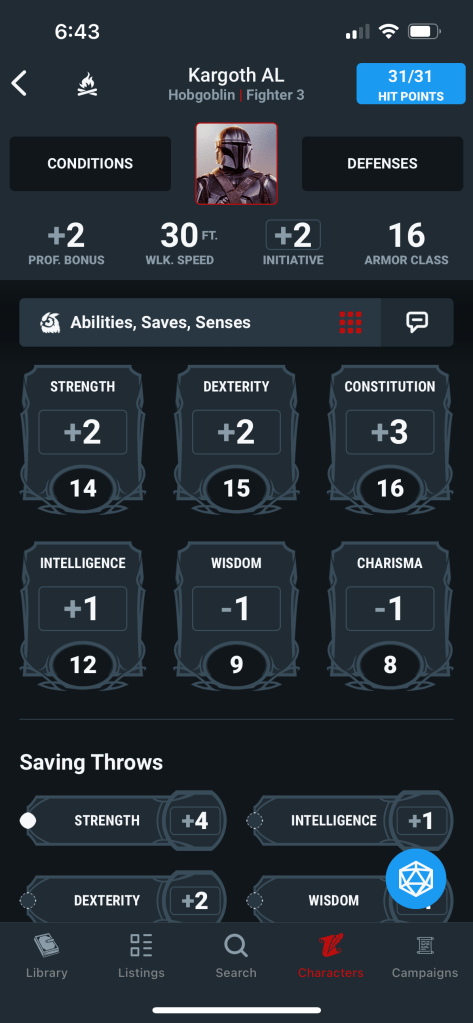
I wrote recently about hobgoblins in D&D and how they mirrored Klingons in some way, and at that time I made a character named Kargoth toward that end. I played a couple tier-1 sessions, and it was fun, but the character wasn’t as interesting as I would have liked.

Then, after re-watching The Mandalorian, I got an idea. Since the new, season 11 rules allow for much easier rebuilding of characters, I decided to use the opportunity to rebuild Kargoth as a Mandalorian-style hobgoblin fighter, eldritch knight:

Kargoth’s backstory is that he was adopted after being a child on the losing side of a war by a fanatical cult of warriors (e.g. Children of the Watch), but hides his hobgoblin identity in public using a helmet, as well as following the religious ethos he was raised with. Helmet is cosmetic only and provides no additional armor class. Kargoth also has the hermit character background unsurprisingly.

Eldritch Knight as a subclass made surprising sense because first and foremost he would have to be a warrior anyway, but as an Eldritch Knight he would have many additional tricks up his sleeves that can be approximated as magic spells:

It’s fun to be a little creative here since every Mandalorian will be a little different anyway.

The real challenge is the hobgoblin racial character stats. A bonus to Intelligence helps with playing an Eldritch Knight, but the bonus to Constitution doesn’t have an overt benefit beyond more hit points.

I debated back and forth and opted to make Kargoth mostly a ranged fighter, to match the Mandalorian as a crack-shot. I gave him the Archery fighting style, equipped him with both a hand-crossbow (for later Crossbow feat) and a heavy crossbow. But, I also gave Kargoth enough Strength to handle melee combat too.

For armor I settled on Medium armor with the goal of getting good half-plate someday. The Mandalorian seems to wear half-plate rather than full-body armor and this allows me to continue focusing on Kargoth’s Dexterity based build.

Lastly, the kid. I debated using my “free spell choice” as an Eldritch Knight to cast _Find Familiar_ but a pet raven is a lousy substitute for Grogu (a.k.a. baby Yoda). So, for now Kargoth doesn’t have a sidekick … yet. Then again if I want to rebuild I can certainly do that too.

Enjoy!

This is the Way.

A Nerd Dad’s Review of Tasha’s Cauldron of Everything

Late last year, I picked up a copy of Tasha’s Cauldron of Everything, but with so much going on, I never got a chance to properly read through the book until last month (one year later 🤦🏽), which I now regret. What an excellent addition to the D&D canon.

Tasha, also known as Iggwilv, is a famous “witch” (more correctly an archmage) known as the Witch Queen in some sources. She is more of a chaotic character than the somewhat stodgy Mordenkainen, both her colleague and rival, and she has been known to consort with some demonic characters, but is not portrayed as evil either. One could draw some parallels with Liliana the planeswalker character from the Magic The Gathering series, but Tasha has a much longer history in the gaming world.1

The book is written from her perspective, and has some witty anecdotes from Tasha, and terrific artwork of Tasha herself. Mordenkainen never looked that good in heels. 😋

When I first bought the book, I wasn’t sure what to expect, apart from it seeming like a kind of “rules update” or reboot of some aspects of original Player’s Handbook. The book states off the bat that all the rules contained therein are entirely optional and meant to enhance the 5th-edition D&D experience, while also addressing some shortcomings with certain classes (rangers for example) or outmoded racial-character designs. But again, they are all optional.

Tasha’s focuses on four main areas, I feel:

  • Optional class options.
  • Spells and Magic items.
  • Additional tips and tools for world-building, including group patron options.
  • Custom background and character creation options

The first section struck me as the most immediately useful. My daughter, when she first played with me years ago, had a half-elf ranger with a beast master archetype. She loved that character, and her cougar companion, but as the adventures became more and more difficult, it was hard for her companion to keep up. This happened back before I (as the DM) knew about alternate house rules and such, so we played pretty closely to the book. Although she loved her animal companion, she couldn’t risk bringing it on adventures anymore, so she would often leave it in the care of NPCs and go off by herself.

But, using the new Tasha’s optional class features, the same animal companion gets a much needed improvement (as well as the rules for how to use it), and it properly scales with the character class.

In separate example, my elven forge cleric has Channel Divinity options that are seldom used in Adventurer’s League settings. Now, with the new Tasha’s options, I can choose to exercise that Channel Divinity option and regain spell slots (something clerics couldn’t previously do). Thus, he can stay on par with his wizard and druid party companions.

I also went back and made similar updates for my son’s Eberron halfling bard character, by allowing him to take some spell options he didn’t have previously through the Player’s Handbook. He enjoys his new Enlarge/Reduce spell.

For each character class, the optional updates from Tasha’s fall into two general types:

  1. Options that replace older, less desirable class features.
  2. Expanded options that you can chose to add alongside whatever you’re already playing.

The flexibility here is great, and works with D&D Beyond if you have purchased your book that way. Simply enable one or both of these options on the first page of your character creation:

I haven’t delved much into the magic items and spells, but I have seen a number of colleagues use them in Adventurer’s League games and my play-by-post group, and they seem pretty useful. The “summon” spells for each type of monster: celestial, fey, fiend, undead, etc. all seem pretty intriguing, and address some of the existing challenges of the classic summon spells. Other spells, like Tasha’s Mind Whip help fill a gap by allow more psychic magic options while staying roughly on par with other similar spells.

The custom background options in Tasha’s are also surprisingly useful in that they allow you to convert features of one background into another one using a simple conversion chart. This helps, for example, with my aforementioned elven forge cleric he may not necessarily spend his time in the woods, but perhaps in a more urbanized setting, so using a longbow seems a bit out of place for him, but perhaps a crossbow might. This gives plenty of options to customize the character the way you want, without negatively impacting the mechanics of the game or affecting character balancing.

All in all, Tasha’s Cauldron of Everything, just like the re-introduction of Tasha herself, gives 5th-edition Dungeons and Dragons a much needed breath of fresh air. I would be hesitant to call this 5.5th edition, but if heavily adopted, it does provide some far-reaching changes to a particular table. The flexibility of allowing DMs and players to adopt and implement the rules on an a la cart basis is an effective way to keep the classic look-and-feel of 5th edition, but also make updates where groups would like to see them. One can think of Tasha’s as an officially sanctioned set of house rules.

Having tried out the new rules, rather belatedly, my kids and I found some of them pretty handy, and look forward to trying other ones as the opportunities come up. Tasha is a welcome addition to the Dungeons and Dragons “Core Rulebooks”.

1 The trope of the independent, confident woman as a “bad girl” is kind of annoying in a way, and not limited to class TTRPG fantasy settings. You see it a lot in anime too. I won’t go into why I think it’s so prevalent, but suffice to say it’s nice to see women in fantasy settings standing on their own two feet, deciding their own fates and getting some representation. Tasha as a character still has a lot of baggage from older D&D versions and tropes, but it’s cool to see her get some updates as well.

The Return of Heian Amakiiro

A while back, I posted about an elf-samurai character concept I created for Dungeons and Dragons, and from this character concept I created a character for Adventurer’s League named Heian Amakiiro (character sheet here). His backstory was based on my own Hamato Island series of adventures. After playing several adventures in Adventurer’s League, I wanted to share some experiences.

As of writing, Heian has reached level 8, and participated in 6 modules, plus 2 DM rewards I got from running adventures for others.

Not surprisingly, the way I expected to play Heian and the way I actually played Heian turned out to be different. I originally wanted a samurai who was more or less capable of both strength-based melee combat (with a katana longsword) and archery. To help with this, I did a magic item trade in Adventurers League to get Gauntlets of Ogre Strength. That way, I was free to focus on developing his dexterity.

But in reality, Heian rarely ever used melee combat. That’s because I kind of stumbled upon a neat trick that made his archery pretty powerful.

At fourth level I took the feat Elven Accuracy. When paired with the samurai sub-archetype and its Fighting Spirit ability this gave me a handy combination. I use Fighting Spirit to give myself advantage on attacks, and with Elven Accuracy, I can re-roll one of those attack dice. This means when I use the two together, I am effectively rolling 3d20.

Further, at level 6, I took another feat, Sharpshooter, since with an effective attack roll of 3d20, I can safely risk taking a -5 attack bonus to hit for +10 damage.

In a recent tier-2 adventure fighting a Hezrou demon, Heian had a round where he attacked 4 times (two attacks + Fighter’s Second Wind ability) and with the combination above hit 3 out of 4 times causing 50+ damage that round!

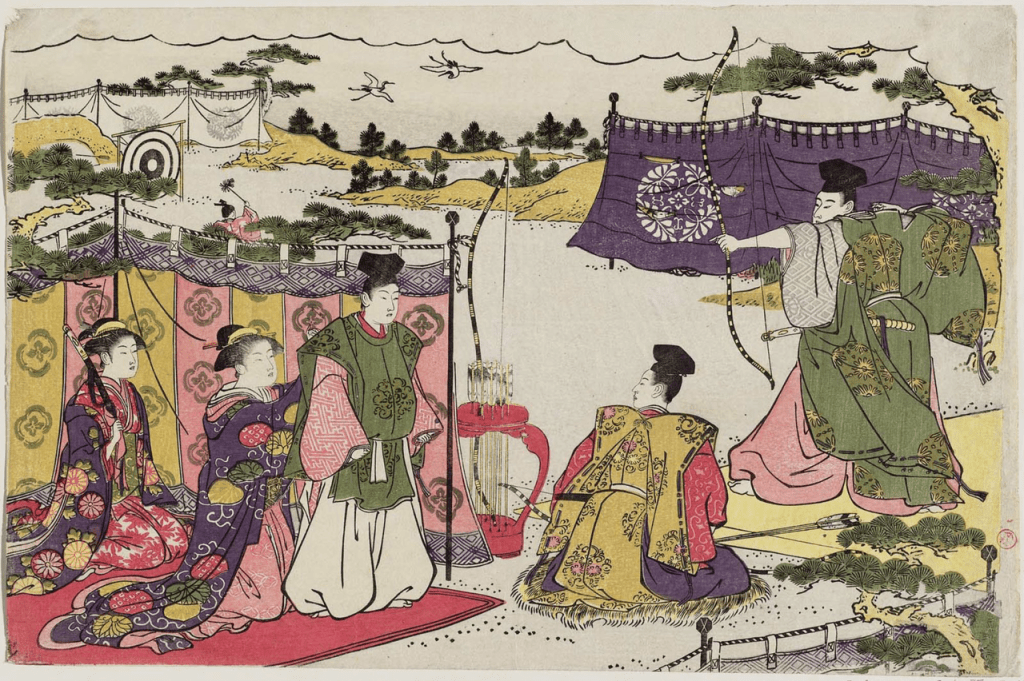
First Archery of the New Year (Yumi hajime) by Torii Kiyonaga (1787), courtesy of Wikipedia

Heian has become something of a kyūdō master between his Elvish heritage and samurai training.

Further, at level 5, per Adventurer’s League rules, he picked up a +1 longbow, which for flavor reasons I made as a Japanese-style daikyū (大弓) bow.

As a character he has been surprising fun. His samurai benefits as a courtier have been occasionally helpful in role-playing situations and in combat he clears the house.

Part of the fun of playing an unconventional character is discovering combinations and abilities you didn’t foresee. Plus, it makes the character more memorable in the long run.

So here’s to Heian Amakiiro, the best dang (imaginary) elf samurai archer I know! 🧝🏼‍♂️🍂🌸

Adventurers League: Starting Over

Recently, the admins of Adventurers League made a major rules announcement:

You can also read here for a detailed explanation as to why.

This a pretty exciting change after Season 10 introduced some pretty controversial changes (which have effectively been reversed) in 2020, which led to a lot of grumbling among D&D players on Discord. I remember some people talking about taking their business over to Pathfinder official play instead.1

The AL admin community evidentially did some serious thinking and finally, finally gave us an updated, compact, easy to understand set of player rules. I for one am genuinely excited to play again.

However, I also have a problem. When the transition from Season 9 to Season 10 began, a number of rules were introduced for character conversions, and such, and now with another move to a standard set of rules for the Forgotten Realms, some of my old characters are converting twice. Technically, no conversion is strictly required, but with the end of Season 9 players were encouraged to rebuild for either “historic” or “seasonal” and I did that for at least some of my old characters. Other old characters just got forgotten.

Breathing life back into some of my old AL characters, thanks to the new rules.
Binder above purchased at the Rook and the Raven

With the new rules, a lot of options opened up and rebuilding again is an option:

Whenever you could gain a level (even if you decline), you may rebuild any aspect of your character.

Adventure’s League Player’s Guide for the Forgotten Realms

With this in mind, I’ve been looking at all my AL characters up to this point, old and new. Some were too old and haven’t been played in so long that I decided retire2 them. I decided to keep my oldest character, Qisandoral, after dragging him out of retirement in season 10 during a brief window when they allowed a one-time rebuild. Using the rule above, I tweaked him a bit more but adjusting his feats a bit (he uses ice magic a lot, so I gave him Elemental Adept). In one case, I decided to rebuild my favorite Nature cleric from scratch, new name, level one, etc.

For newer characters, I have also taken advantage of the rules above, plus new options for character backgrounds and such to rebuild them as well. My elf-samurai Heian Amakiiro got the Far Traveller background now, which fits his character better. In the end, I wanted to have at least 1-3 characters per tier (I have no tier-4 characters as of writing), and it has been nice to finally “clean house”.

I, like many other players, are excited by the new ruleset, which will hopefully stay somewhat stable going forward. I have seen the rules change a number of times since I started in Season 8, and keeping up with the changing rules has been exhausting. However, my sense is the the AL admins want to come up with a simpler, more flexible set of rules that can run on auto-pilot going forward. And I for one fully support that. 😄

1 Needless to say, I did Pathfinder once and don’t plan on doing it again. To some degree, I blame that particular DM, who just wanted cool combat campaigns without any real plot. But I also got tired of the complicated character creation, tracking feats, and pressure to min/max.

2 “Retirement” here isn’t as dramatic as it sounds. I just exported and backed up their character sheets from DnD Beyond, and saved their logs into a different folder. If I really wanted to, I could still bring them back. Unlikely, though. I would more likely build a fresh, new version of that character instead.