While enjoying the awesome Youtube series Historia Civilis and its coverage of the last days of the Roman Republic, I picked up a terrific book on the history of Rome, its politics and how people lived. I’ve been fascinated by the political and social struggles of the Roman Republic because there are interesting parallels to contemporary life here.
Photo by Skitterphoto on Pexels.com
The Roman Republic had a similar political system to what we find in many Western democracies: it had a Senate (from the Latin senex or “old man”) and it had elections, though they tended to be pretty biased toward the land-owning elite and used a convoluted system based on social class. To keep the power of the Senate (and its elite) in check, the Republic also had a Tribune of the Plebs that differed than the Senate and frequently drew from the lower classes.
Further, although the Republic had extended its borders to the Italian peninsula and beyond, politics and citizenship were still biased toward actual residents of Rome, and especially toward certain families with a long, distinguished history. Cicero, for example, was a novus homo or “new man” from the provinces newly entered into political life, and that fact dogged his career.
Over time, this system started to break down. By 137 BCE, a man named Tiberius Gracchus (grandson of the famous Scipio Africanus) was increasingly concerned about the plight of small farmers in the Italian countryside, and their vulnerability to landed gentry that displaced them. When he was elected to the Tribune of the Plebs in 133 BCE, he started pushing for land reform.
Not surprisingly, this started a hornet’s nest of debate and some even spread rumors that Tiberius Gracchus was setting himself up as a king (a grievous sin in Roman culture that even later Emperors avoided). By 129 BCE, in classic Roman style, he was found dead from mysterious circumstances. Professor Mary Beard, who wrote SPQR, points out that Tiberius Gracchus may not have been altogether altruistic and may have also held a personal grudge against the Senate for past slights, but his message of land reform was enough to ignite the populace.
But the debates about land-reform, and rights of the gentry versus general populace didn’t stop with Gracchus’s death. The two factions gradually coalesced around two factions:
The optimates, meaning “the best” who were the conservative faction. They were concerned about changes to the Roman Republic and wanted preserve the traditions of the Republic, including governance by the optimī or “the best”.
the populares or “reform” faction. They opposed the conservatives and sought to reform Roman society. The meaning of the name is “for the people”.
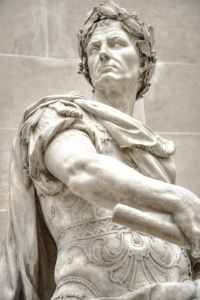
Professor Mary Beard points out that these factions weren’t political parties in the modern sense, but different politicians held allegiance to one or the other. Julius Caesar, despite coming from a well to do family, was a Populares probably because he was more interested in opposing the old order for his own personal gain, than actual concern of the people (except where it served his interests). Gnaeus Pompeius Magnus (e.g. “Pompey”) sided with the Optimates, but was no less ambitious than Caesar, and the Optimates needed a champion on their side. It was a marriage of convenience.
In any case, the Populares, starting with Gracchus, pushed for reforms such as:
Restricting the size and amount of property that Roman citizens could own. Some of the landed elite of Rome held multiple, multiple properties both within Rome and many villas in the countryside. Cicero, a man of middling wealth, owned over a dozen individual villas, cottages, and other properties. Men like Caesar’s one-time ally, Crassus, were obscenely wealthy.
Improvements to the “grain dole”. Since many Roman farmers were being pushed into the city to find work (as their lands were being bought up), Rome needed a more consistent solution to address the rampant poverty in the city. With the new grain dole, the government (and not private contractors as previously done) would buy grain monthly from certain reserved countryside areas and provide to Rome’s poorest citizens according to the census. Such a system did not exist anywhere else in the Western world until modern times.
Expand citizenship to more people in the Italian peninsula, and even colonies abroad.
Fight the corruption in Roman elections, which were often rampant with bribery and other dirty tricks.
The struggle between Optimates and Populares was messy and not always clear cut. For example, a powerful senator named Clodius fought on the side of the Populares, but used privately-hired thugs to terrorize other senators to vote his way until he in turn was killed by Milo’s thugs. Until then, weapons were not allowed at all within the city limits of Rome, but by the time of Clodius the ancient customs were ignored and gangs fought on the street. On the other side of things, Cato the Younger, was a staunch conservative, but had a reputation (unlike his peers) for honesty and integrity even if he came across as grating and excessively moralizing at times.
In the end, none of it mattered. Both Caesar and Pompey had massive private armies, decades of military experience, and fought a lengthy, protracted civil war that ended with Caesear’s victory. He pushed the Senate to make him a lifelong dictator, and shortly thereafter was assassinated by his peers. Once his adopted son, Octavian, swooped in to takeover as “first among equals” (princeps) following another civil war with Marc Antony, it was all over.
Interestingly, when Julius Caesar returned to Rome after the Civil War, he made good on a number of Populares reforms and anti-corruption reforms that remained well into the waning days of the later Roman Empire. However, the two factions pretty much melted away by the time that Emperor Augustus Caesar (Octavian) took over.
The reason why I mention all this is that it’s fascinating to see the struggles between Roman reformers, and Roman conservatives, just as the same struggles happen today. There were scoundrels on both sides, men of virtue, and plenty of power-hungry opportunists too. Many of the battle cries of the different factions might sound eerily familiar today too, as if not a whole lot has changed in 2000+ years, and we’re just repeating the same patterns over and over across the generations…
No study of Japanese language would be complete without learning how keigo (敬語) works. Ostensibly, keigo is just honorific speak, but it’s also a good window into Japanese culture as well and reflects a lot of unspoken, cultural rules.
Kinship Terms
One cultural/linguistic rule is how you address your own kin versus another person’s kin. When talking about your own older sister, you use the term ané (姉), but when talking about the listener’s older sister, you use onēsan (お姉さん). Note that this is not keigo per se, but it is super important to familiarize yourself with to avoid being impolite.
Other kinship terms include:
Relative
Self
Other
Mother
母
haha
お母さん
okāsan
Father
父
chichi
お父さん
otōsan
Older brother
兄
ani
お兄さん
onīsan
Grandmother
祖母
sobo
お婆さん
obāsan
Wife
妻
tsuma
奥さん
okusan
For “wife” sometimes the term kanai (家内) is used for one’s own wife, but this is often sounds old-fashioned because it implies that the wife stays at home.
Honorific and Humble Words
Another unspoken rule is that, in some situations, you replace normal vocab words with either honorific terms when addressing another person or humble terms when describing yourself or people in your “inner circle”. The trick with such words is that, like a fine spice, a little bit goes a long way, while too much kind of ruins the flavor (not to mention sounds like you’re sucking up to people).
Good examples of people to whom you can/should address with honorific speech:
A customer (if you’re running a business)
Nobility
A teacher of your kids
Someone much older than you
But even here, it’s usually sufficient to use regular polite speech, and pepper keigo terms here and there.
Examples of honorific speech:
Instead of the verb する (suru, to do), replace with なさる (nasaru).
Instances of いる (iru), including when it is an auxilliary in te-form verbs, are replaced with いらっしゃる (irassharu).
The verb 言う (iu, to say) is replaced in all instances with おっしゃる (ossharu).
Many verbs can be made more honorific by changing to a noun-form, prepending with “o” and appending with “ninaru”. For example, with the verb 出かける (dekakeru, “to go out”) becomes お出かけになる (odekakeninaru).
A few verbs have more irregular honorific forms: 食べる (taberu, to eat) becomes 召し上がる (meshiagaru), 着る (kiru, “to wear”) becomes 召す (mesu), and so on. These just have to be memorized.
Similarly, examples of humble speech:
The verb 言う (iu, to say) is replaced with 申し上げる (mōshiageru).
The verb もらう (morau) is replaced with いただく (itadaku). This is often why Japanese say “itadakimasu” before eating a meal: it expresses humility in receiving the meal.
Similar to honorific speech, a few verbs have more irregular honorific forms: 合う (au, to meet) becomes お目に掛かる (omenikakaru), and 見る (miru, to see), is replaced with 拝見する (haiken suru) for example. These must be similarly memorized.
Passive Speech as Keigo
Another way to use Keigo, is to use passive speech when referring to someone. Passive speech isn’t quite as polite as honorific speech, but it’s often sufficient for most situations and easier to use. For example, instead of saying 帰る (kaeru) for “come home”, simply replace it with the passive form 帰られる (kaerareru), even if the sentence is not actually passive:
本を書く
hon wo kaku (to write a book)
本を書かれる
hon wo kakareru (to write a book, but more polite)
Polite Speech
As weird as it might sound, in Japanese there is a difference between keigo (honorific speech) and teineigo (polite speech). Polite speech is, as the name implies, when you are speaking politely to another person, but still implies that you’re more or less on equal footing. Honorific/humble speech overtly elevates someone else, which is why it’s sometimes out of place.
Polite speech is thus a more common and useful pattern of speech to use, and will work 85% of the time.
Chances are, you’ve probably learned polite speech before, but a few tips:
Verbs are expressed in masu-form: 食べる (taberu, to eat) becomes 食べます(tabemasu), 見る (miru, to see) becomes 見ます (mimasu), etc.
The conjunction が (ga) is often useful for connecting sentences. It can either be a soft “but” or a soft “and”, depending on context.
Another conjunction なので・ので (nanode/node) is more polite than から (kara), but still implies “because” or “since”.
Remember those kinship terms above. 😉
Especially in business Japanese, regular verbs are often replaced with more formal sounding suru-verbs. Instead of 答える (kotaeru, “to answer”) it’s more common to use 返事します (henji shimasu).
Conclusion
Part of your success in navigating Japanese culture and speech is being sensitive to hierarchy, and knowing the right amount of polite speech to use. If you’re new to Japanese, you’re often tempted to either overdo it, or by force of habit, you might be simply too relaxed and forget your manners. But, if you acclimate yourself to Japanese speech by listening to others’ conversations, you’ll gradually get a “feel” for what’s appropriate and when.
Barkskin is a spell in Dungeons and Dragons 5th edition, which my Elf Nature cleric automatically gets, and every time I look up this spell I kind of scratch my head. The current online text states:
You touch a willing creature. Until the spell ends, the target’s skin has a rough, bark-like appearance, and the target’s AC can’t be less than 16, regardless of what kind of armor it is wearing.
Normally, your character’s starting armor class (AC) is 10 + dexterity bonus + armor bonuses. My current elf cleric has an AC of 17:
Starting AC of 10
Dexterity bonus of +2
Armor bonus +2 with shield
Armor bonus +3 with chain shirt
Now, if my cleric casts Barkskin on himself, what would happen?
The official D&D rules site, has a ruling to this question (link here):
Q: How does barkskin work with shields, cover, and other modifiers to AC? A: Barkskin specifies that your AC can’t be lower than 16 while you are affected by the spell. This means you effectively ignore any modifiers to your AC—including your Dexterity modifier, your armor, a shield, and cover—unless your AC is higher than 16. For example, if your AC is normally 14, it’s 16 while barkskin is on you. If your AC is 15 and you have half cover, your AC is 17; barkskin isn’t relevant in this case, because your AC is now higher than 16.
The gist of this answer seems to be: if the recipient’s AC is lower than 16 (no matter how or why), it’s now 16. Full stop. If the recipient’s AC is 16 or higher, Barkskin basically does nothing.
So with my current setup, Barkskin isn’t very useful for my cleric. Nature clerics are proficient in everything up to heavy armor, so I can easily equip myself with the necessary defense without relying on a spell slot every combat. However, Barkskin might be useful in protecting other members of my party who aren’t so lucky. Wizards, for example, can’t use armor at all (apart from edge-cases like Bracers of Defense), other less melee-oriented classes also make good targets for Barkskin. But casting Barkskin on your primary melee character basically does nothing.
Barkskin seems like a good way to shore up party defenses, but not necessarily enhance them.
Since I became a dad and we raised our kids to be bi-lingual in Japanese and English, I’ve come to incidentally learn a lot of “baby” Japanese words, but also a lot of sound-effect words too. Compared to English, Japanese has a large vocabulary of descriptive words for sounds, movement, moods and such. These are called giongo (擬音語) “sound effect words” and gitaigo (擬態語) “situational words” in Japanese. It’s very common in daily conversation to use them when telling a story to a friend, or complaining about something, or in literature, though not so much in polite, formal conversation. Nevertheless, they’re very handy for conversational Japanese.
One challenge for learning such words most of these words have no direct equivalent in English and they’re often really situational. Instead, when learning such words, the English translation in dictionaries will be a verb or adverb.
Here’s an example list of words I’ve compiled, and their English meaning. If you’re learning Japanese, it is a good investment of time to learn them. Some of these words are mainly used by young children, but many are not:
niko niko – To grin, smile.
niya niya – Smiling evilly.
heta heta – To wither, wilt (vegetables).
poki-! – To snap (twig, pencil, etc).
hoka hoka – To be warm (drink, sweater, blanket, etc).
hai hai – Kids word for crawling on the floor.
pyun pyun – Kids word for moving fast.
kon kon – To pile up (snow flakes).
zara zara – Rough, gritty (sandpaper, dry skin).
pasa pasa – Dried out.
suka suka – Smooth surface.
kuta kuta – Exhausted, physically.
doki doki – To be startled, heart fluttering.
hira hira – Sound of a leaf falling, fluttering.
waku waku – The feeling of being excited about something.
kune kune – Winding, meandering (e.g. a road).
suta suta – Walking briskly.
soro soro – Momentarily, imminently.
somo somo – In the first place, to begin with.
dossan – To land on the ground with a thud.
gokkun – To swallow (food, drink, etc).
The big thing to remember about speaking Japanese is that less is more. Japanese language tends to omit previously understood parts of speech, unlike English where we like to make more precise descriptions using more words.1 In Japanese, it’s often ok to be succinct and vague.
For example, if you see a leaf falling, you might describe it like:
hanabira ga hirahira shiteiru (a blossom is fluttering down)
But in Japanese, you could even drop the verb:
hanabira ga hirahira
Or drop the subject (assuming the listener already knows) and say:
hirahira shiteiru
Hirahira in this context is a loaded word in Japanese, so to a native speaker it will evoke a mental image and say plenty. That’s why it’s not always easy to translate into English. Speaking from experience, this is far from an exhaustive list, and over time you just pick up more such words. That’s why exposure to Japanese media and conversation is super helpful. You’ll find such little gems from time to time. 🙂
Good luck!
1 Inexperienced Japanese speakers, as a result, often sound too wordy. Time, practice and experience help address this by teaching more efficient, native ways to express the same thing. 🙂
The haiku in question, written by the famous poet Kobayashi Issa, reads as:
或時は花の都にも倦にけり
aru toki wa hana no miyako ni mo aki nikeri
I think there’s a powerful truth to this poem, even if it’s a bit tongue-in-cheek too: even the most pleasant joyous things we experience in our lives get old.
I like a good pizza, but if I eat pizza every day, I will get tired of it. I like playing old-school video games, but if I play them all the time, I get burned out and my body doesn’t feel good since I’ve been sitting too long. The thrills of life get old.
Anything we enjoy in life is best done in moderation, and oftentimes it’s best to let go if the amount of effort put into it is not worth the return. It’s easy to forget this when you’re deep in the weeds, so take a minute to step back, breathe deep and take stock.
Life is short, and it’s important to make good use of one’s time before one goes old and too feeble to do anything about it anymore.
P.S. I have two plum trees outside my door, and I love it when they blossom, but then I get annoyed by all the garbage they leave behind when the blossoms fall. I suppose that’s a related metaphor, too. ;p
P.P.S. I have been to Chion-in temple above in the past a couple times and it is still dear to me in many ways. More on that in a future post.
Coincidentally, I have been hosting a campaign for my daughter, which started in the famous city of Waterdeep, but has moved to the high seas after she got run out of town by the Zhentarim.
Playing a high-seas adventure is surprisingly fun, but I don’t have a lot of material to work with so I am really looking forward to see what WotC has to offer. 🙂
P.S. Waterdeep: Dragon Heist is a terrific adventure book. It really expands on the city of Waterdeep and provides lots of possible adventures.



 Gleanings in Buddha-Fields
You must be logged in to post a comment.