Reading Kids Manga In Japanese

My kids and I love playing the game Splatoon 2, a quirky game with a lot of satire on Japanese society, but also some very creative backstory too. We love playing Ranked Battles, but I am consistently trying to keep up with my kids who are both B ranked, while I am still mostly C or C- rank.1 😅

Our love of Splatoon has extended into reading the manga too. My son is learning to read, and with remote learning and lockdown, it was hard to get the reading education he needed (we have great teachers, the issue was remote learning). Finding something that he wanted to read was the biggest challenge. We found the Splatoon manga, English translation, at a local bookstore, and my son instantly loved it. He kept asking me how to read this or that, and before long he was reading the issues by himself. The change in attitude and reading skill was frankly startling.

Japanese edition of issue 1

However, my kids also learn Japanese too since they are biracial. We’ve tried really hard to keep parity between both languages, and thanks to distance-learning services in Japan, we’ve been able to get the older sister to be pretty proficient in Japanese. Our son has struggled a bit more, so we decided to get the Japanese version of the Splatoon manga for him too by ordering online.

He enjoys reading them in both Japanese and English, while I have also grown to like reading them in Japanese too.

In the past, I have read other Japanese manga, my other favorite is Saint Young Men, but many of the manga that I have read are for adult audiences, and feature adult jokes and vocabulary. It’s easy to get lost, and give up. Reading kids manga is certainly easier, but the stories aren’t interesting, or it’s just a bit embarrassing to read something so elementary.

However, with the Splatoon manga, I found something that is relatively easy for me to read, while keeping my interest. I have tried not to invest too much time looking up every single word (most are kind of obvious in context anyway), so I can finish a Japanese-language version of the manga in reasonable time. It’s a nice thing to read, plus some of the gags just sound better in the original language.

Anyhow, admittedly, I’ve usually frowned upon anime and manga because they are so closely associated with diehard Japan nerds, while I am arguably a Japan nerd, it’s not something I like to advertise outside of the blogosphere. I had too many bad experiences with Japan nerds in college and beyond.

But seeing at how much my son enjoys manga in both English and Japanese, I can see that if you find a good series, it is a great medium to introduce kids (and language-learning adults) to a world of fun reading.

1 I feel a sense of irony in this. When I was a kid, and owned an NES system, I used to play Ice Hockey with my dad, who got floored every time we played. I didn’t really think about this until as a parent myself. I personally don’t mind if my kids exceed me, in fact I am kind of glad, but as a long-time gamer I also don’t plan on giving up so easily either. 😏
Happy Belated New Year!

Hello Readers!

Although the first couple weeks of 2021 have been kind of lousy for us all, I wanted to take a moment to say “happy new year!” to you all.

In Japanese, people greet one another the first time they meet after the new year with a special greeting. First, people say to one another akemashite omedetō (gozaimasu) which means “congratulations on the conclusion of the (old) year”. This is then followed by kotoshi mo yoroshiku (onegaishimasu). This is literally means “please be kind to me this year, too”. The words in parentheses are for polite conversation (drop them when speaking among friends).

This year with lockdown and such, we couldn’t do much for New Years. We didn’t risk going to our usual Buddhist temple for hatsumōde, the first temple visit of the year. Maybe we’ll make up for it later in the year, but we’ll see.

Instead, I celebrated as much as I could online.

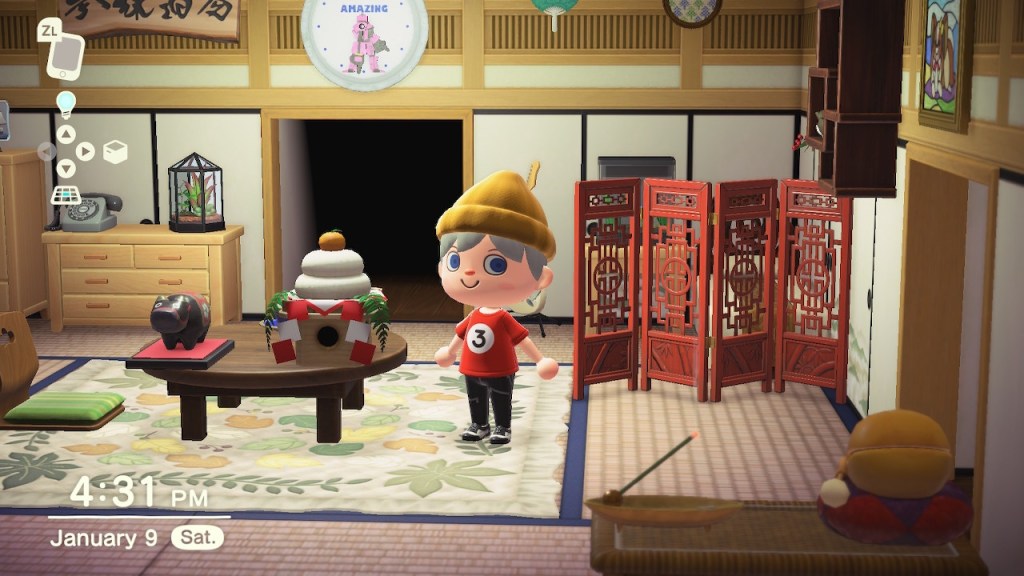
My humble abode in Animal Crossing: New Horizons. Besides the kagami-mochi on the table is a small “cow” since this year is the Year of the Ox.

There is one additional tradition that happens on the 11th of January called kagami-biraki (鏡開き), which means “breaking the mirror (mochi). Originally this was observed on the 20th day of the new year, but at some point moved to the 11th. After breaking open the kagami-mochi (more on that here) you then cook the rice cakes with sweet red beans (azuki) in a kind of red bean “stew” desert.

Our real kagami-mochi is a bit simpler, but I still like it.

Since our kagamimochi is plastic, it opens at the bottom revealing the real mochi rice cake inside. I tend to keep the little plastic daidai (bitter orange) too just because they are cute.

In any case after crazy holidays and a crazy end of the year in genera, we are hoping things will gradually calm down in the following days, weeks. I hope you all have a better year ahead too. 🎍

akemashite omedetō gozaimasu!kotoshi mo yoroshiku onegaishimasu!

Counting Down to Bodhi Day

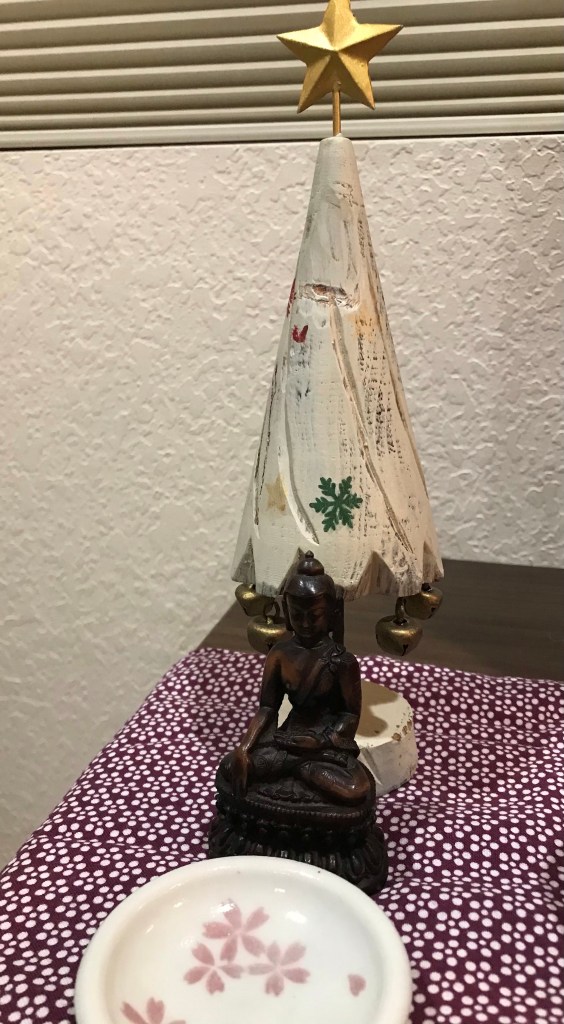
A small home altar we have at home, showing a statue of the Buddha sitting beneath a white, miniature Christmas Tree.

Bodhi Day, sometimes called Rohatsu in some traditions, is celebrated in the Japanese-Buddhist calendar every year on December 8th in accordance with the tradition that Shakyamuni (a.k.a. Siddhartha Gautama) attained full enlightenment on the morning of the 8th day of the 12th month of the lunar calendar. In Japan, this is known formally as shaka jōdō-e (釈迦成道会) or just jōdō-e (成道会) for short. In other Asian-Buddhist cultures that still use the lunar calendar, this date will change. For 2021, it will be observed on January 20th.

I would argue in general Buddhism isn’t a very flashy religion1 and this goes double for Buddhist holidays. This makes it hard for kids like mine who grow up in the US raised in both American and Japanese traditions. Having a holiday like Bodhi Day overshadowed every year by Christmas is a bit demoralizing as a parent, but I still like to give the kids at least one or two Buddhist holidays of their own per year. They may not appreciate it now, but I hope they will later.

If you are celebrating Bodhi Day this year, you may be wondering what to do. Our little traditions at home are by no means the norm. It’s something I’ve gradually come up with for the kids, sometimes borrowing from Christmas traditions, which let’s be frank, borrowed a lot of things from earlier pagan Roman ones. In any case, take what I write below with a big grain of salt.

First, starting on December 1st, I make a special little altar with a statue of the Buddha sitting under a mini “Bodhi Tree”. We got a nice new, wooden tree this year from our local gardening nursery. In the past we had cheap-o plastic mini trees, so this felt like a much needed upgrade.

Around the altar, I try to keep the usual accoutrements: a small bell, an offering dish,2 and maybe a small incense holder.

Originally I tried doing a “Santa Claus”-like tradition, where the kids (just one at the time) would wake up with a new gift from the Buddha. Eventually I dropped the “Santa facade”, though. I never felt quite right about it. Nowadays, we just surprise the kids with a wrapped gift from mom and dad on Bodhi Day morning, usually restricted to books or something wholesome. However, last year I got my teenage daughter some girl Marvel graphic novels. Not very Buddhist, but she thought it was cool. 🥰

Finally, on Bodhi Day itself, we have a nice little celebration, including a special dinner for the wife and kids (this year doing delivery, obviously). Nothing fancy nor any dietary restrictions here. If I can share a little joy with the family, especially this year, I am usually content with that.

As for my personal practice, I’ve tried to observe different precepts on Bodhi Day. Some years, I’ve observed the Eight Precepts, other years the similar, though Mahayana-only Bodhisattava Precepts, but in more recent years I am less stringent with myself and instead just try to “live like a monk” for a day in that I avoid excess, speak kindly to loved ones, spend more time with the kids, and just strive to have wholesome, “blameless” conduct for a day. Undertaking any Buddhist ascetic training is pretty tough when you have kids, and so over time, I’ve learned to set more reasonable expectations on myself and try to live a sustainable life of good conduct. That doesn’t stop me from doing a little extra Buddhist chanting or meditation around this time though. 😌

That’s Bodhi Day in a nutshell over here. I’ll be posting more Buddhist-themed posts this week. Hope you enjoy and have a blessed Bodhi Day! 🖖

1 Buddhist altars, depending on the tradition, can be very ornate. This often surprises people who are new to Buddhism, and weren’t expecting gold-plated statues of the Buddha and such. Some of this comes down to particular traditions, but also as with all Buddhist art, there’s meaning behind everything.

2 Sadly, the offering dish pictured is just a like saké cup which is the perfect size and looks nice, but kind of rubs against the general Buddhist proscription against alcohol.

Summer Heat and the Day of the Ox

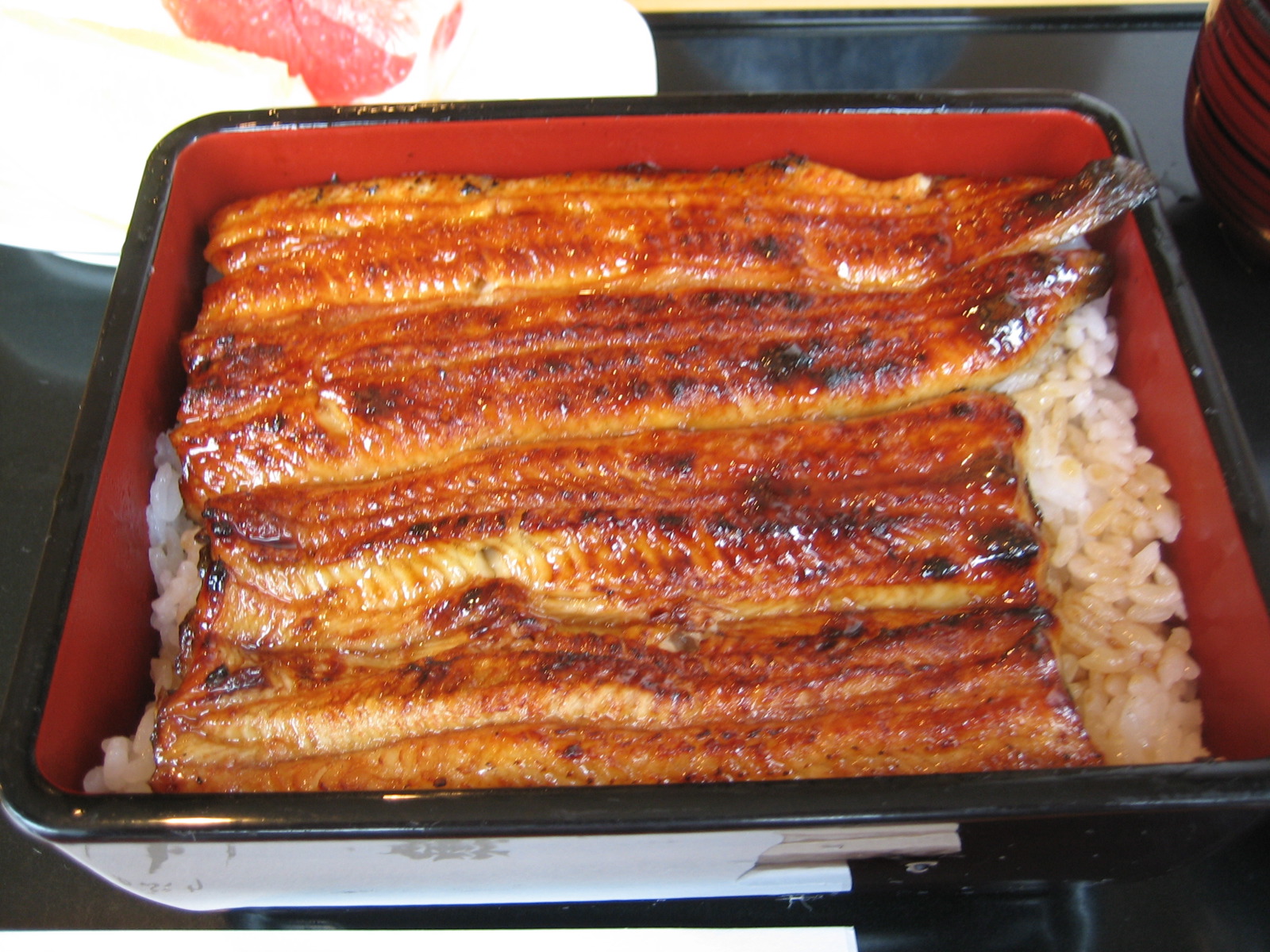
Summers in Japan are nothing to sneeze at. The sun is hot, but the humidity is stifling. Since the Edo Period (1600-1868), there is a custom in Japanese culture that during the hot summer season, one can get relief from the summer heat and increase stamina by eating a kind of freshwater eel called unagi (うなぎ) on a certain day called doyō no ushi no hi (土用の丑の日). This roughly translates to “Day of the Earth Ox”.

Cooked unagi by naotakem from Yurakucho, Tokyo / CC BY (https://creativecommons.org/licenses/by/2.0), courtesy of Wikipedia

The Day of the Ox was based on the old Chinese-style calendar, and its yearly relation to the sun’s position, so the day changes from year to year. Further, 57% of the years have two such days called ichi no ushi (一の丑) and ni no ushi (二の丑). For years with only one day, it’s just called ichi no ushi (一の丑). For example, the year 2020 has two days: July 21st and August 2nd, while for 2021, it only falls on July 28th, and 2022 again will have two days: July 23rd and August 4th.

But why do people eat unagi (glass eels) on the Day of the Ox?

According to my old cultural guidebook, the specific tradition of eating unagi on doyō no ushi no hi began with a fellow by the name of Hiraga Gennai who was a kind of renaissance-man in Edo-Period Japan. The story goes that a local eel-seller in Edo (modern-day Tokyo) came to Hiraga because he wanted to increase slumping sales during the hot summer period. Hiraga made him a sign to present at his shop advertising that “Today is Day of U“, a Japanese pun.

The book states that in ancient Chinese thought, each season of the year would be subdivided into the five elements: earth, fire, water, wood and metal, and of these earth was assigned to a special 18-day period at the end of each season called doyō (土曜, day of earth). With four seasons, there were four doyō periods, and of these, the most famous of these doyō days began around July 20th during the hottest days of the year, which also happened to be traditionally assigned to the zodiac sign of the Ox.

So, the point of all this is that in the olden days, the Ox, or ushi (丑) was synonymous with the summer heat, and especially around the doyō period around July 20th.

Since unagi also starts with the Japanese letter “u” (う), Hiraga tried to draw a connection between the two. Other foods eaten around this time traditionally to improve stamina in the heat are freshwater clams, mochi rice cakes and eggs, however unagi is by far the most popular. The book also implies that the vitamin B content in unagi may actually help with fatigue and lack of appetite, so there may be some truth to it, but the true origins are a clever word-play by Mr. Hiraga to help a friend generate some business. 😉

P.S. I’ve tried unagi before, and it’s OK. It’s just not for me, but my wife loves it, and insists it is better in Japan due to freshness and quality. Between the taste and the increasing scarcity of unagi though, I’m not interested.

Adventures at Sojiji, the other Soto Zen Temple

Since our trip to Japan is cancelled this year due to the pandemic, I have been posting old images of past temples I visited. Last time I posted about Zojoji temple and Tokyo Tower, this time I wanted to share some of photos of Sōjiji Temple (總持寺, homepage here) which happens to be fairly close to my wife’s hometown. Sojiji Temple is one of two head temples in the Soto Zen tradition, the other being the famous Eiheiji Temple where Dogen the founder established his community. Sojiji Temple existed since the 8th century though it belonged to a different sect, then eventually it changed hands in the 14th century. There, under the leadership of Keizan, the temple switched to Soto Zen, and over generations grew in increasing prominence as the main Zen temple in eastern Japan (Eiheiji is further west).

If Eiheiji is the spiritual heart of Soto Zen, Sojiji is the administrative heart. Much of what we see today with how Soto Zen looks and “feels” is due to Sojiji.

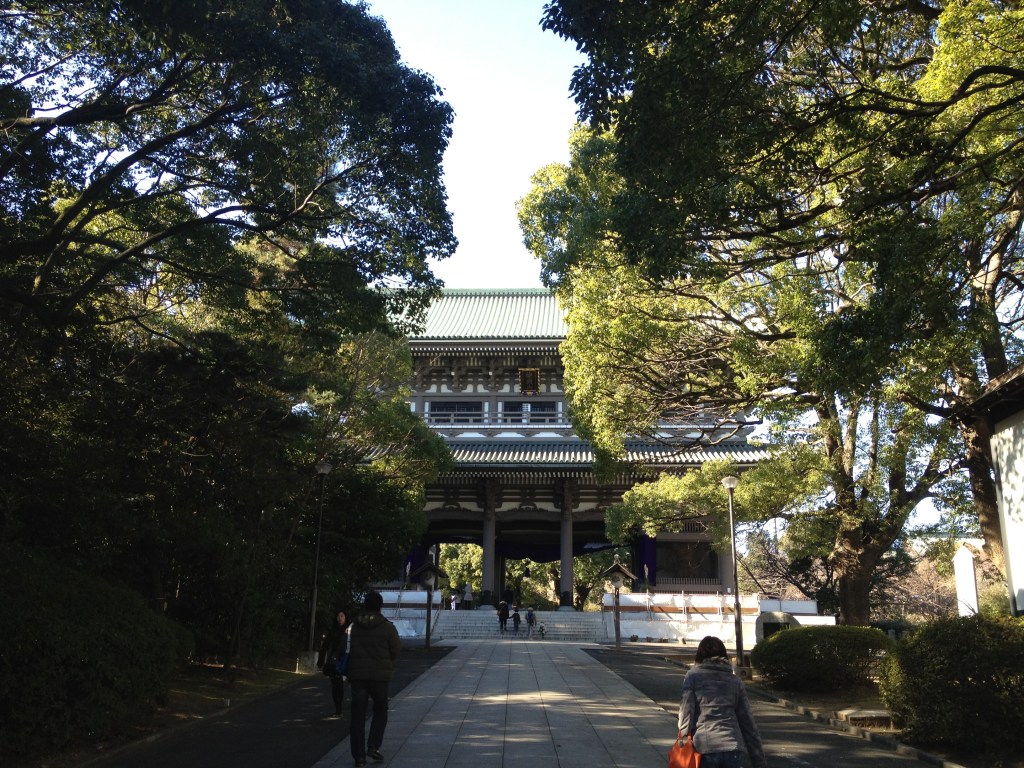
As a temple Sojiji is pretty large. It is located in the Tsurumi1 district of Yokohama comprises a large complex. My first visit there was in 2012, and I had a great time. The front gate is a lengthy ascent:

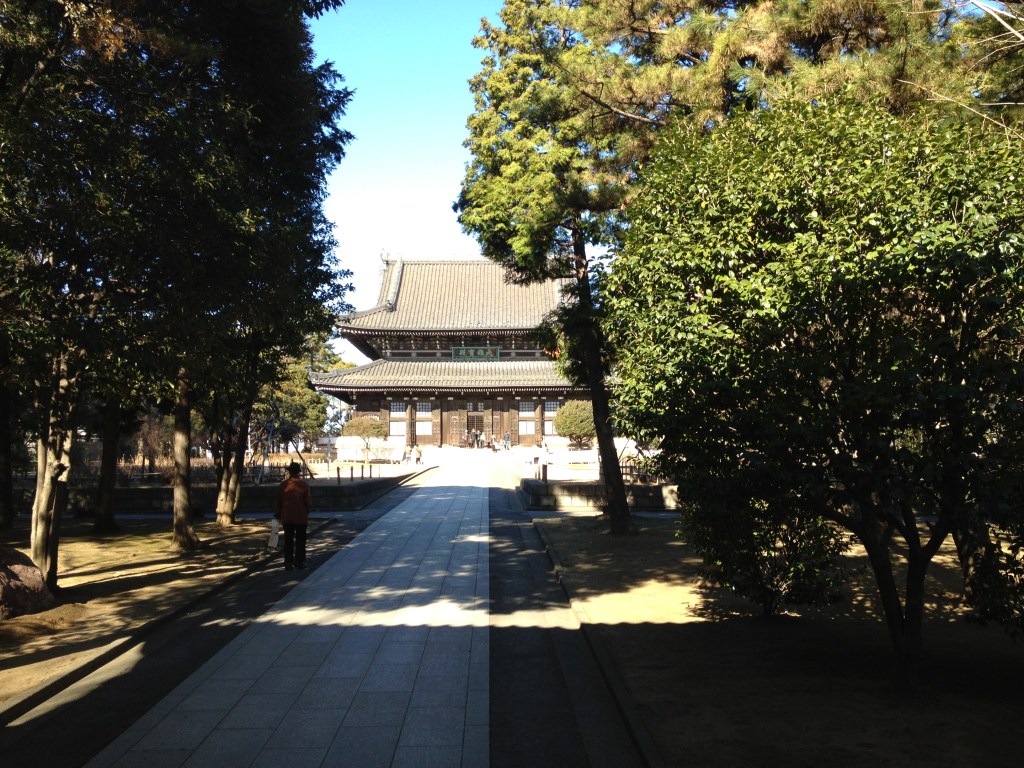
If you turn to the right, you’ll find the main office, which does offer English tours sometimes (check schedule for details), and the rest of the monastery. Way in the back is the main worship hall or butsuden.

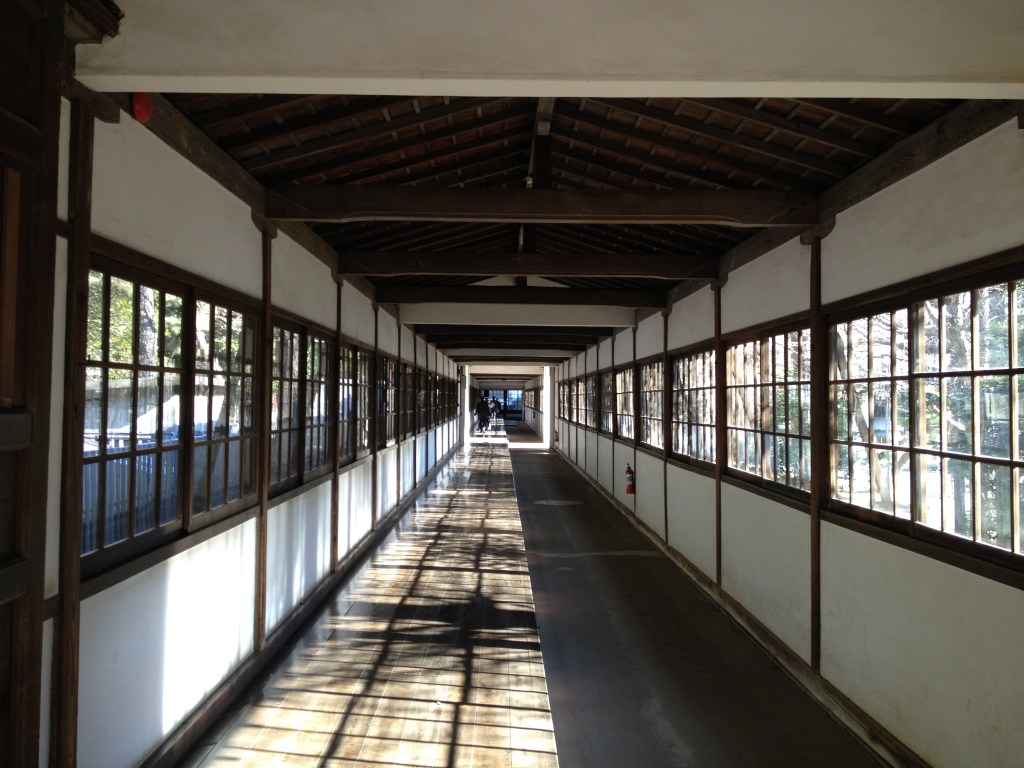
In my visit to Sojiji, we were able to get a tour which was very helpful in seeing the lesser known aspects of Sojiji. One of the more noteworthy sites is a kind of outdoor hallway connecting the east and west parts of the temple complex called the hyakken rōka (百間廊下):

I believe this translates to something like the “hundred-span hallway” or something. Monks clean this floor daily from one end to the other.

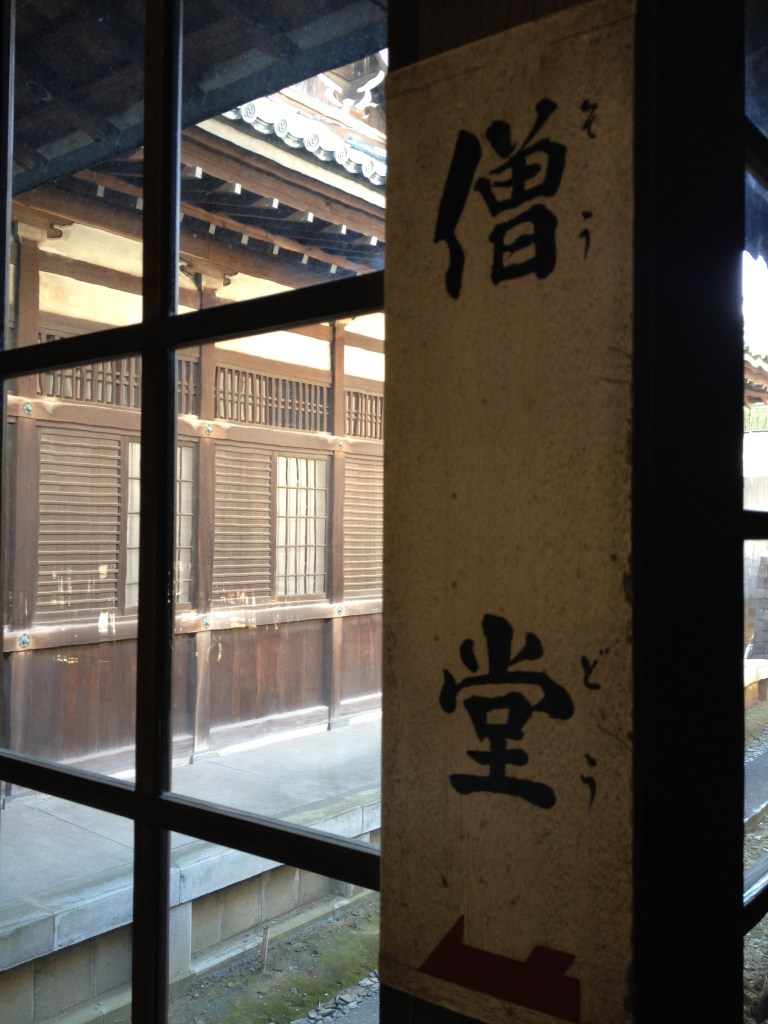
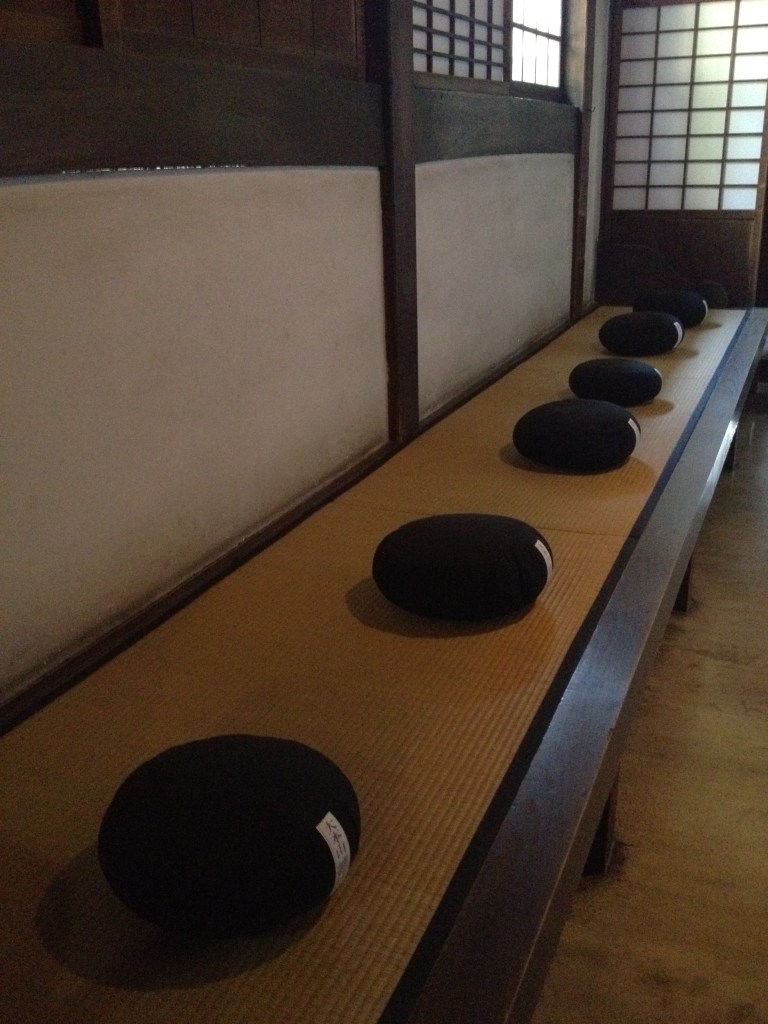
If you go on the tour, you might also get to see the monks’ hall (sōdō, 僧堂) where they practice meditation:

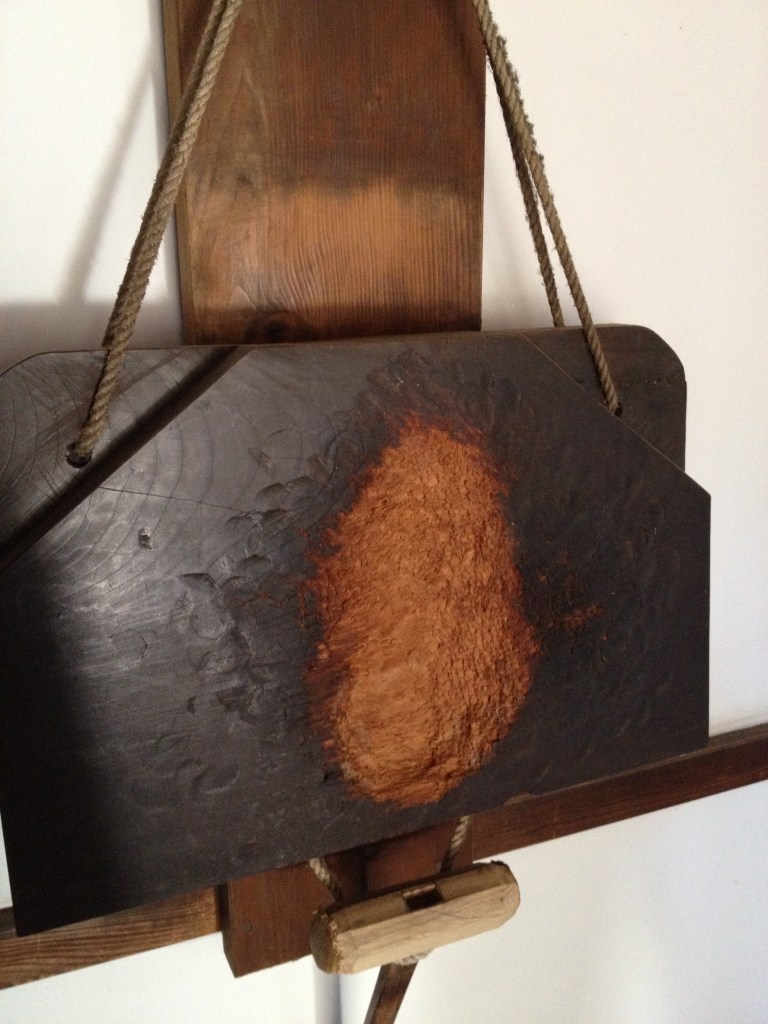
This wooden plank is used as a kind of “bell” to keep monks at Sojiji Temple on schedule while meditation. As you can see, it’s been well-worn.

One place on the tour that I didn’t get a photograph of (I can’t recall why, but maybe a fear of disrespecting the temple) was the memorial hall, where many daily services are held. You can see a video made in 1989 of service here done in the morning:2

It is a lovely hall and well worth seeing. Another, which I haven’t been able to visit is the main altar building, the butsuden.

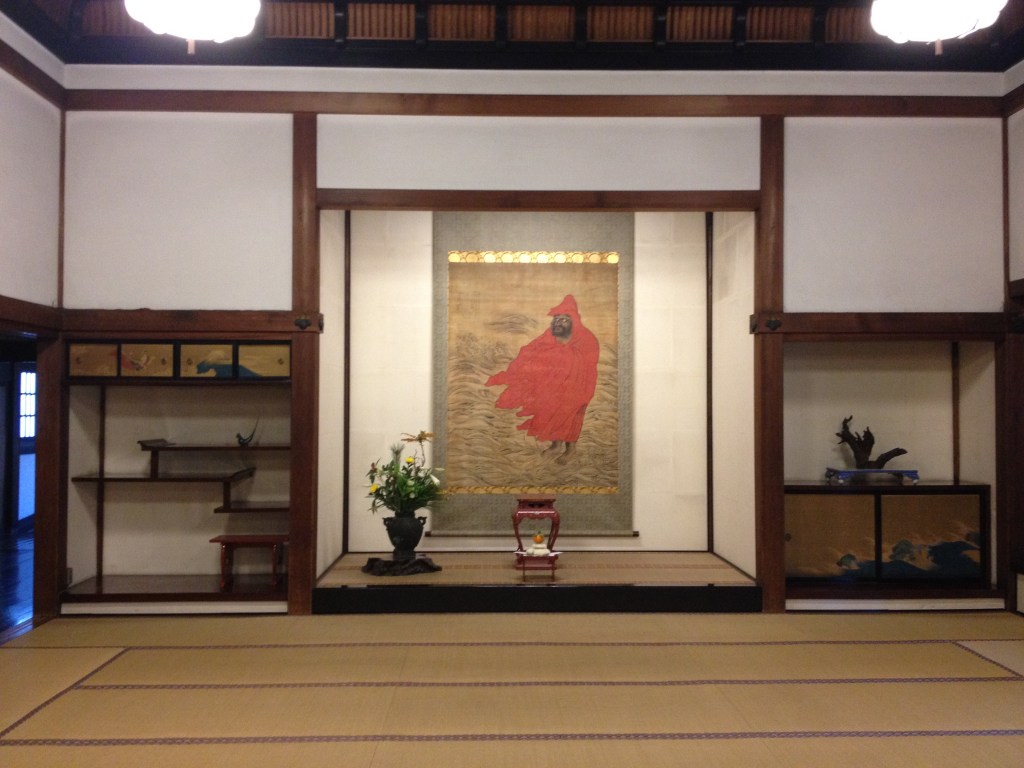
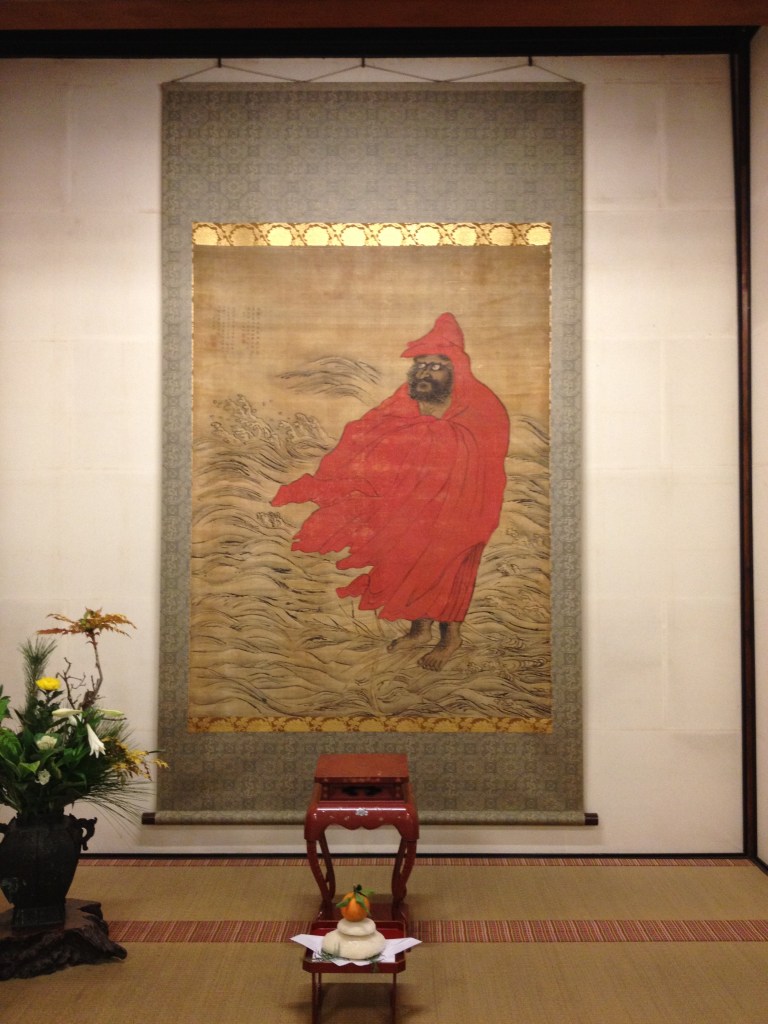
From the tour, we also learned that Sojiji also has a room for entertaining guests, which includes an amazing portrait of the legendary monk Bodhidharma who reputedly brought Zen to China from India.

Close up:

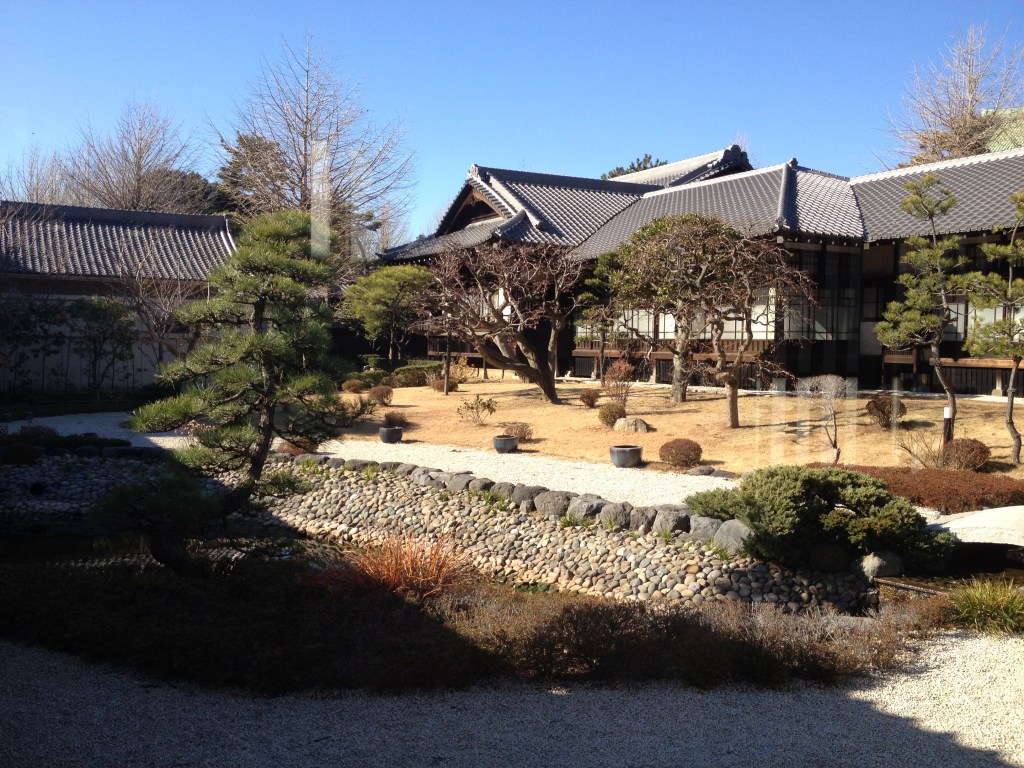
Nearby are gardens, too:

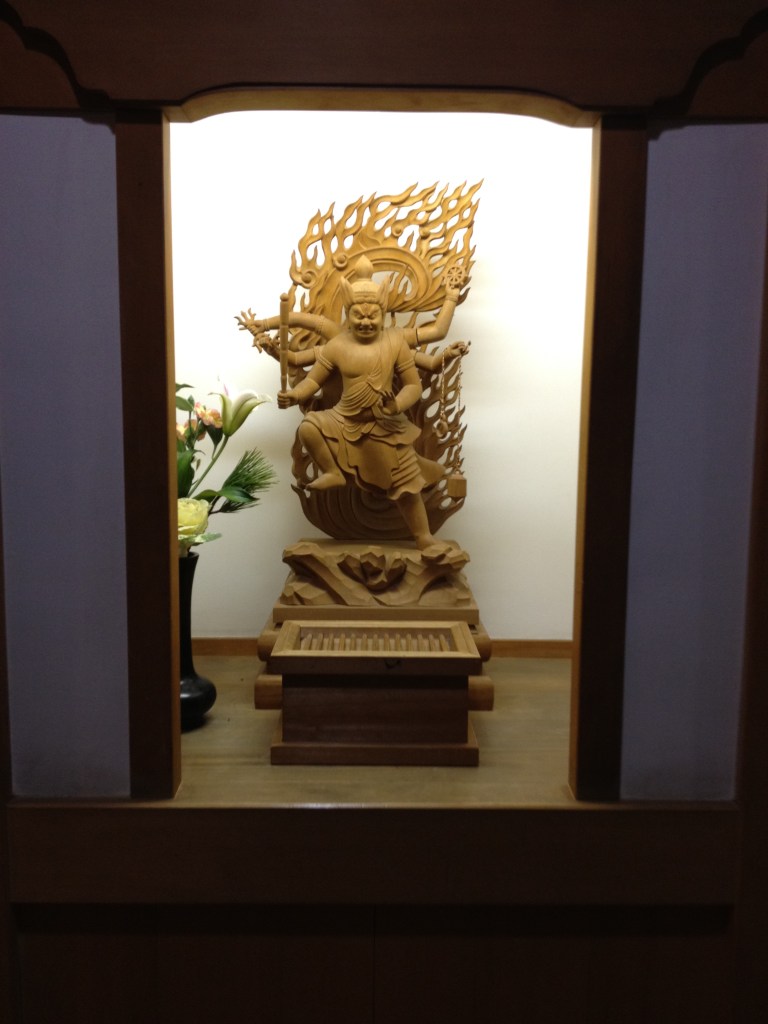
Sojiji had other interesting things too. For example, the main guest bathroom near the office had a great statue of an esoteric Buddhist deity:

If memory serves, this deity was associated with driving away impurities, but I can’t recall much.

Sojiji is not quite what I expected from a Soto Zen temple. It has a long monastic Zen tradition, a colorful history starting with Keizan and beyond, yet at the same time it was surprisingly open and friendly. The Soto Zen sutra book that I have was purchased here at the gift shop, along with some nice English language books. It still remains one of my favorite temples to go in Japan.

If you’re in Japan and interested in Zen Buddhism, don’t hesitate to check out this temple due to its accessibility and its amazing traditions.

1 If you plan to visit, look for Tsurumi train station, the closest. It is just a couple blocks away. From the larger Kawasaki station, it’s just a single stop away on certain train lines.

2 The part where monks fan through what looks like a stack of papers is a practice adapted from the parent Tendai sect, where monks would simulate reading through very long Buddhist sutras (in this case, the Perfection of Wisdom Sutra I think) as a way of accumulating positive merit, and share the teachings with others. Actually trying to recite the whole sutra, given its length, is no small undertaking.

Gardening Update

Hi folks, here’s an update on our family garden. Our bean pole plants, now christened Kirby and The United Colors of Beanington, continue to grow at a fast pace, now reaching above the usual canopy of weeds. It didn’t take long for them to grow above the first set of “teepees” we made using chopsticks, so I ordered some bamboo poles from Home Depot and some simple twine. My goal throughout this little project has been to keep things cheap and simple, so rather than buying proper trellises, which seemed overkill for 2-3 plants anyway, I just made a bigger teepee.

The teepee was very easy to make, using good, sturdy twine to bind it at the top, then making loops around at certain points. I carefully put the growing plants on the bottom rung, and they quickly adapted. They are now the same height as my son!

However, one thing I have noticed so far is that they are still not sprouting beans. It has been roughly 2 months so far, and pole beans supposedly mature by now, which has me a bit concerned. I did some digging on the Internet, and found that there’s likely a few possible scenarios:

  • Not enough sunlight, which seems likely in my very shady plot of land. Chances are, next time I’ll try growing kale or lettuce which does just fine in such environments.
  • Not enough water, which seems unlikely given how much it rains here in the PNW.
  • Wrong concentration of nitrogen in the soil. Online resources show how to measure this, but as I am keeping things simple and cheap, I am probably not going to look into this.

My hope is that Kirby and Beanington are just a bit “slow” to mature and we’ll have beans before long. Then again, even if they don’t it’s been a fun gardening project and I have learned a lot, so it’s not all for nothing.

Update: we have beans now!

Scattered Blossoms

Blossoms from the Thundercloud Plum tree in my yard with sky in the background
Blossoms from the Thunderhead Plum tree in my yard.

96) 花さそふ Hana sasou
あらしの庭の Arashi no niwa no
雪ならで Yuki nara de
ふりゆくものは Furi yuku mono wa
わが身なりけり Wa ga mi narikeri

It entices the flowers—
the storm—but through the garden’s white,
it is not snow,
and what it is that’s scattering
are, in fact, the years of my life!

translation by Professor Mostow

The two Thundercloud Plum trees in my yard have started blooming again this year, but already the blossoms have scattered in the wind and rain. At times like this I am reminded of this poem (more details in my other blog) from the famous Hyakunin Isshu poetry anthology, as well as this poem in same anthology written centuries earlier by a lady of the court named Ōno no Komachi:

6) 花の色は Hana no iro wa
うつりにけりな Utsuri ni keri na
いたづらに Itazura ni
わが身世にふる Waga mi yo ni furu
ながめせしまに Nagame seshi ma ni

The color of flowers
has faded indeed
in vain
have I passed through the world
while gazing at the falling rains.

translation by Professor Mostow

I’ll post more about my favorite scholar/poet Sugawara no Michizane soon. Until then, enjoy!

Boss Coffee is Back in Town, Yay

Coffee in Japan is a relatively new phenomenon but it has certainly found its way into the culture. Starbucks in Japan is pretty easy to find in major metropolitan areas, and I can say with certainty that the food is terrific, and the dark-mocha frappacinos are worth it.¹ But coffee in Japan is also commonly found in small cans avaiable at the near-universal vending machines, under several name brand coffees such as UCC and Boss. Canned coffee in Japan tastes noticeably different than the US to me: sweeter, creamier and with less coffee flavor than what you might get in the US, so if you need a caffeine fix, it’s not the best source. However, for flavor, variety (and convenience) it is great.

My personal favorite is Boss Coffee.

My story with Boss Coffee began all the way back in 2005 during my first trip to Japan.  Being a Seattlite and major coffee drinker, I was having some withdrawal problems there because I didn’t know my way around, and Starbucks was less widespread at the time.  In short, I was grumpy and culturally disoriented.  My wife introduced to Boss Coffee from a vending machine one afternoon, and I loved it.  The cans looked cool, and I was finally to have some coffee again.

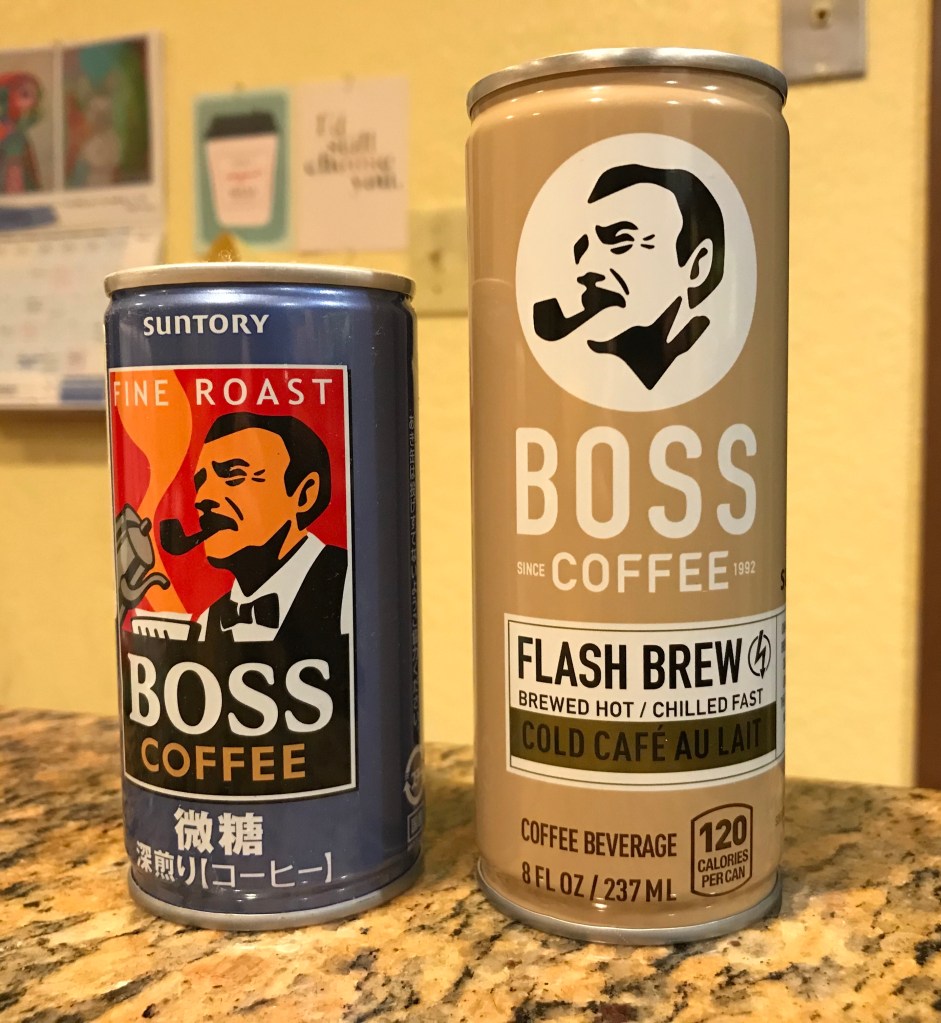
Interestingly, Boss Coffee comes out with new cans frequently as they sell a variety of flavors:

img_0004

I always felt that the man in the cans looks like a young Sean Connery to me.  Many of the cans and flavors taste similar to one another, so there really isn’t that much variety, but I used to collect them all whenever I visited Japan yearly.  After a while, the collection grew to 30+ cans, but I finally decided to recycle most of them as they were gathering dust and taking up space.

Still, every time I am in Japan, I always check to see if new Boss flavors are out.  I was really happy to see that Boss Coffee (the can on the right) is sold here in the Pacific Northwest again at my local Asian supermarket after being unavailable for years.

I am not the only Western fan of Boss Coffee either:

If you’re heading to the 2020 Tokyo Olympics, don’t hesitate to stop and pick up a can or two of Boss Coffee.  If you’re overseas, keep an eye out for Boss at your local Asian supermarket.  😄☕️🥫

¹ Fair warning: etiquette at Starbucks in Japan is different in the US, especially in more crowded shops where you’re just trying to avoid colliding into people.

Don’t Mess With Donkeys

This is something I saw on Twitter recently, showing an ancient Egyptian papyrus translation:

Like others on the Twitter feed, I can only wonder what the heck happened to the donkey.  Some people live “interesting” lives.  🤣

P.S.  Special shout-out to Susan Rayhab for sharing interesting historical tidbits.  Translations can be a thankless job sometimes, but it’s wondering when people share interesting snippets of history like this.  Have you thanked your historian lately? 🥇

Japanese Particles Make the Difference

Japanese_Hiragana_kyokashotai_NI

Every language is different, and each one has its idiosyncrasies.  The more languages you study and familiarize yourself with, the more this becomes apparent.  This is not something you have to be a polyglot for, but just part of the fun of learning other languages.  In the case of Japanese, the biggest idiosyncrasy I have come across is the system of particles.

Particles in Japanese (and Korean language, iirc) are the language’s answer to determine who did what, where and how.  While this is very different from Western languages, it practice it basically does the same thing that inflections and conjugations do in languages like ancient Greek or Sanskrit, or word-order does in English.  Different systems, same outcome.  Particles have no intrinsic meaning; they cannot stand alone. However, if they’re attached to end of the word they’re affecting, it takes on a new meaning.  Some common examples:

  • book + は (wa) / が (ga) – The book (does something or is something).¹
  • book + を (wo) – Something “does” the book (e.g. direct object).
  • book + に (ni) – Something “targets” the book.²
  • book + で (de) – “With the book” (e.g. “instrumental case” for grammarians)
  • book + の (no) – “The book’s …” (possessive)
  • book + も (mo) – “The book too …” (inclusive list)

But, the devil’s in the details.  For example, English has lots of small, unwritten rules about what to use here, but not there (e.g. when to use preposition X vs. Y).  Native speakers just intuitively learn these, but people learning English as a second language just have to slowly grind their way through and learning these subtleties over time.  In Japanese, the same thing happens with particles.  These little usage rules are too numerous to memorize as a grammar exercise, they’re things you just kind of learn through time and grinding.

Take the common verb hanasu (話す, to speak).  The usage that I knew of was (person) + 話す which means “to talk with (person)”.  However, as I learned recently in the excellent textbook Japanese From Zero! 3 (originally published by Yesjapan.com), there are other common usages:

  • (person) + と + 話す – to talk to (person)
  • (topic) + の + こと + を + 話す – to talk about (topic)

This isn’t the only example where particles can tweak the meaning of a verb.  Another common example is 出る (deru, “to come out”):

  • (place) + を + 出る – to leave (place)
  • (TV show) + に + 出る – to appear on (TV show)
  • (object) + が + 出る – (object) comes out.

…this is not a comprehensive overview, but you can see how the particles really make a difference.  Similarly in English, the difference between “think of”, “think about” and “think up” is subtle, but each one is different.

Unfortunately, as I alluded to earlier, this is not something you can really memorize grammar rules for.  There’s just too many exceptions, examples, etc.  Instead, it helps to read actual Japanese sentences and use the cloze method for any Japanese flash-cards you make, such as through Anki SRS:

This helps isolate the particles needed, and get a feel for what’s correct and what’s not.

Good luck!

P.S.  Suggestion reading on particles are Tae Kim’s excellent Guide to Japanese and tofugu.com’s cheatsheet.

¹ は (wa) and が (ga) are much too complicated to go into depth.  The easiest way to think of it is that “wa” just sets the topic of conversation, while the “ga” particle specifically answers the “who” “what” or “which” question only.  They’re often used in the same sentence as a result.

² Credit for this term goes to Tae Kim’s Guide to Japanese.  Sometimes に (ni) is wrongly translated as a “location/time” particle, but this is misleading in a lot of examples.  It’s not the direct object, but it is being targetted by the verb for some other reason.  For example (but not always) an indirect object.  Some verbs just take に no matter what.