Chinese versus Japanese Character Readings

Way back in high school, like most American kids, I had to study things like Spanish, French, etc. I took German for two years in high school, but I didn’t find it very interesting, and I didn’t like my teacher very much. So, I never put in much effort. Later, one of my friends told me that we offered Mandarin Chinese at my high school, and I was just beginning my “teenage weeb phase”, so I was definitely curious.1

Our teacher, Mrs. Wu, was a very nice elderly teacher, even though she was in over her head dealing with a bunch of teenagers. Still, exploring something exotic like Chinese language really interested 16-year old me, and I was a pretty motivated student. I tried to learn both Traditional Chinese characters (used in Taiwan) and Simplified characters (Chinese mainland). My best friend at the time was Taiwanese-American, and I used to practice with his immigrant parents.

Anyhow, long story short, once I got into college, I focused on other priorities, and gradually, I forgot my Chinese studies.

Lately, I have been dabbling in Duolingo and learning Chinese again. I forget why, but I guess it’s partly fueled by nostalgia, but also because I already know how to read many Chinese characters through my studies of Japanese.

It’s been fascinating to see how Japanese kanji (Japanese-imported Chinese characters), and modern Chinese characters overlap and yet differ. The important thing to bear in mind is that Japan (like other neighboring countries), imported Chinese characters at an earlier stage in history, and over centuries the usage, pronuncaition and such have all diverged.

Take this easy sentence in Chinese:

All of these Chinese characters are used in Japanese, and without any prompts, I can read this and get the gist of what its saying, but there’s some notable divergences.

These Chinese sentence above is:

日本菜和中国菜
rì běn caì hé zhōng guó caì

A Japanese equivalent might be:

日本料理と中国料理
nihon ryōri to chūgoku ryōri

A few interesting things to note.

  • The character 菜 is used in modern Chinese to mean food in general, but in Japanese it means vegetables. So the usage has diverged. I noticed that Chinese
  • The country names, 中国 and 日本 are used by both languages, but the pronunciation has also diverged considerably. 中国 is pronounced zhōng guó in Chinese, and chūgoku in Japanese. You can kind of hear the similarities, but also the pronunciation has diverged for centuries.
  • The character 和 () is used in Chinese to mean “and”, but in Japanese a system of particles is used instead. Interestingly, 和 is used in Japanese, for example the old name of Japan was Yamato (大和) or modern words like heiwa (平和, “peace”). The pronunciation is wa, so it has diverged as well.

On thing I haven’t really delved into is the native Japanese readings for Chinese characters. Chinese characters are a foreign, imported writing system to Japan, so native words sound completely different even when written with Chinese characters. The word for 中国 (chūgoku) derives from Chinese, but 中 by itself is pronounced as naka (“middle”) which is a native Japanese word (not imported).

Anyhow, this is just a quick overview of how two entirely different languages both adopted the same writing system, but have diverged over time. If you add in languages like Vietnamese and Korean that also adopted Chinese characters, the picture is even more fascinating.

P.S. Through Duolingo, I learned that the Chinese word for hamburger is hàn-bǎo-bāo.

Chinese has to import foreign words using Chinese characters that at least kind of sound like the original. Japanese uses a second syllabary system, katakana, to approximate the same thing, although in the past Chinese characters were used as well. Hence, America is usually written as amerika アメリカ, but in more formal settings it is called beikoku 米国 (compare the pronunciation with Chinese měi guó).

1 The fact that my high school even offered Chinese language at that time (1990’s America) is pretty unusual, but I am grateful for the option. Also, thank you Mrs Wu if you ever happen to read this.
A Nerd Dad’s Review of Remastered Pathfinder 2e

Edit: I wrote this post almost a year ago and my thoughts have changed somewhat in that time. While we did have a good time initially, especially with character creation, the biggest challenges with maintaining the Pathfinder campaign was a lack of coherent fantasy settings. Most of the research and prep I did as a DM was to pore over Wiki fan pages, which inevitably referred to modules I never bought (and weren’t interested in purchasing). There just wasn’t enough compelling lore, characters or story modules to get immersed in to replace classic D&D lore, plus they are scattered across so many books anyway that it was impossible to find anything. Plus the fatigue in keeping up with the constant stream of new classes, new ancestries, and so on. A TTRPG hobbyist has the time to keep up with this, but not a working parent who just wants to spend a weekend with the kids. Pathfinder 2e Remaster has good rules, and good design, but outside of this and the Beginner Box there is not enough support for more casual players especially those who have some nostalgia about classic TTRPG lore.

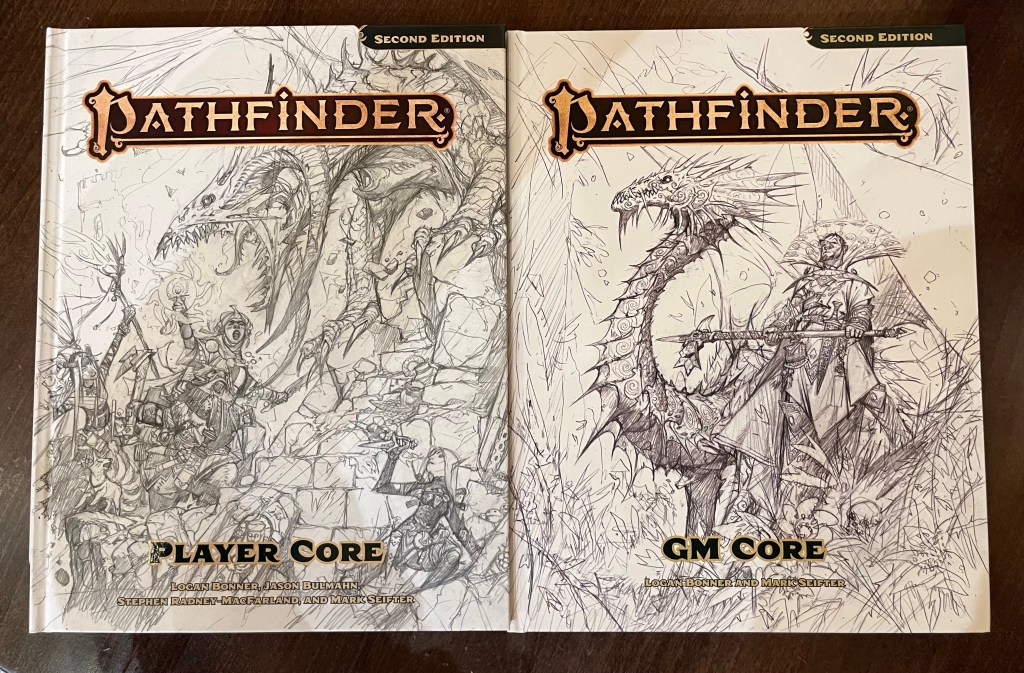
The debacle in January 2023 with the OGL license and Wizards of the Coast pushed a lot of people away from Dungeons and Dragons, towards other role-playing games, particularly Pathfinder 2nd edition. I reviewed PF2e here and here. Recently, I also picked up the new Remastered edition:

The Remastered edition is Paizo’s clean break from the OGL license and anything related to Dungeons and Dragons mechanics. Classic staples such as alignment, and ability scores, are simply gone, and with it some aspects of Pathfinder 2e have been streamlined. The old ability scores (0-18) are simply replaced with ability bonuses, starting at 0. This actually makes a lot of sense. The only thing we care about are the bonuses anyway, and the old numerical ability scores were more relevant in older versions of D&D where the number didn’t just dictate a bonus, but also dictated other factors (ability to be resurrected, chance of failure to cast a spell, avoid traps, etc).

Removing alignment also makes sense, since it’s been 40+ years, and still no one can agree on how to interpret alignment anyway. 😁 But it also removes some of the artificial guardrails placed on characters and allows greater diversity in motivations and personalities.

With the removal of alignment, this also affects religiously-inclined character classes such as clerics, and focuses on the particular anathemas and religious edicts of each deity. As with character motivation, this does breathe more life into each deity and religious characters path, but it’s also a bit of an adjustment for old-school players like myself.

Further, these changes also mean that some aspects of the Pathfinder character sheets have been streamlined. Previously, my kids character sheets were up to 6 pages long, but the newly designed sheets are 4 pages at most. This is on par with D&D 5th edition.

Finally, let’s talk about the book formats.

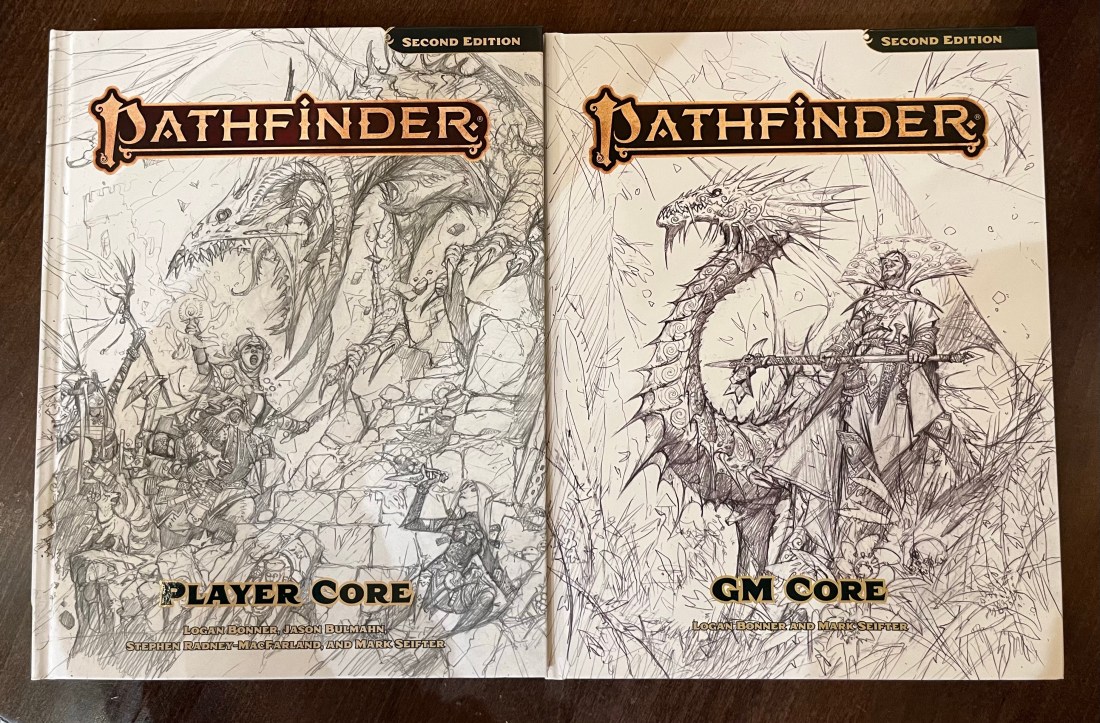
The old Core Rulebook, Advanced Player’s Guide, and GameMastery Guide have been all sliced up and recombined into different books. For example, the new Player Core book (special edition cover shown above), combines elements of the old Core Rulebook and Advanced Player’s Guide. By default, one can play a Witch for example, but remastered Champions (paladins) aren’t available yet, pending further remastered publications. The GM aspects of the old Core Rulebook have been combined with the GameMaster Guide to form the new GM Core book.

What you get is a more logical division between the two books: a player-centric handbook and a GM-centric one. The old tome, the Core Rulebook, thus has been broken up into two logical divisions with newer content added into them.

Further, the format of the books themselves is way more readable than before. Much of the content will look familiar, but is significantly easier to find thanks to book structure, and also due to the handy sidebar on each page. Some rules have been slightly modified to address inconsistencies that have arisen. Other rules have been simply rewritten for better clarity. I can’t tell you how much easier it is to find things on the fly as a GM now rather than stopping the game to flip through a book for 10 minutes then give up and search online. The GM Core in particular does provide more helpful content for planning and designing campaigns, and I found this part particular fun to read. It was previously scattered elsewhere (and similar tough to find), but now I know exactly where to turn to.

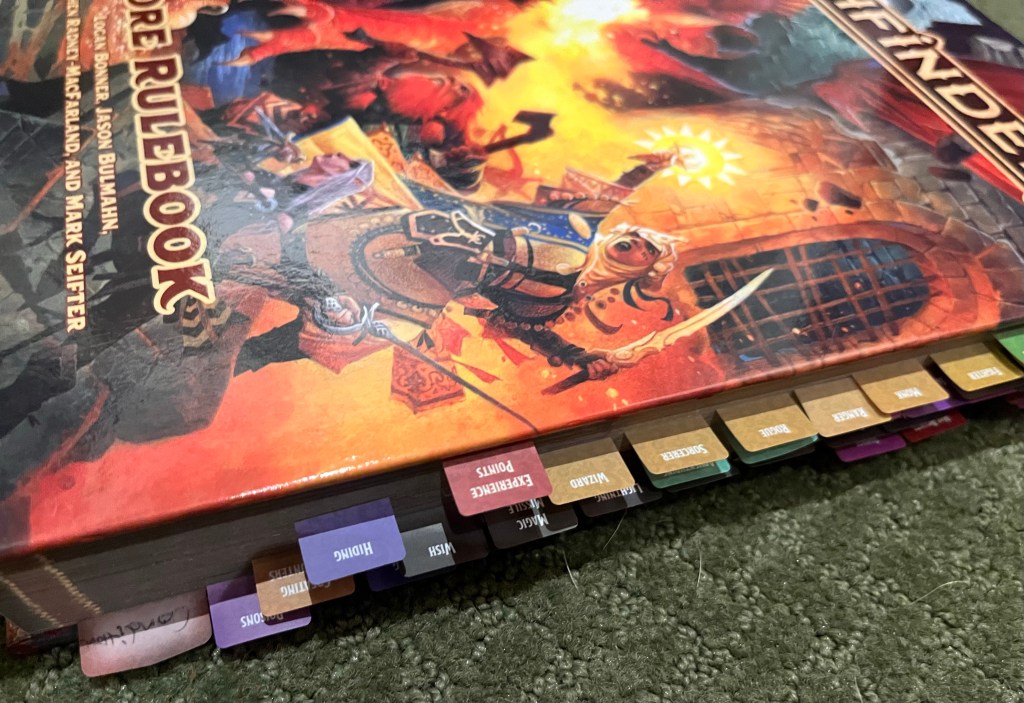
No joke, I struggled a lot with the old Core Rulebook to find things so I had to buy some tabs at a game store to mark the chapter out:

The updated books make this task a lot easier.

Finally, the spell list. In order to make a clean break from the OGL, many classic D&D spells have been renamed to non-OGL ones. For example, the iconic Magic Missile is now Force Barrage. Magic Weapon is given a cooler name of Runic Weapon, and some spells are given names that are more intuitive such as Gentle Repose becoming Peaceful Rest. Mechanically, very little if anything changes, but having to remember a new set of names is probably the biggest challenge for both GMs and magic-using players.

In any case, part of me misses the Pathfinder tie-back to old D&D, so it’s bittersweet that this connection is finally severed at last, but on the other hand, the remastered Pathfinder 2e is a significant improvement over the original 2e in terms of streamlined mechanics and streamlined publications.

On the other hand, it does feel like Pathfinder is finally getting out of the shadow of D&D and maturing as a role-playing game in its own right, and I salute these updates, and will be looking forward to more games with the kids (or maybe finally getting off my seat to check out the local Pathfinder Society).

Segaki and Salvation for Hungry Ghosts

With Obon Season coming to Japan in late July and August, this is also the time of the Segaki (施餓鬼) ceremony in many Buddhist temples.

In Buddhism, one of the six (sometimes five or ten) realms of rebirth that brings undergo based on accumulated karma is the realm of the Hungry Ghosts, called preta in India, or gaki (餓鬼) in Japanese.

From a 12th century scroll depicting hungry ghosts living among us unseen, feeding on refuse, feces, water, etc. Courtesy of Wikipedia.

Hungry Ghosts are those whose past lives were defined by extreme vice and craving. This could be alcohol, drugs, women, money, etc. The usual. This craving carries over and they lived as hungry shades, unseen by the living, surviving off of scraps in the shadows. Further, the foods they are forced to eat, garbage, feces, blood, etc, are never enough, so such ghosts are constantly hungry and living in misery. It is the second-worst realm of rebirth apart from the hell realms in the Buddhist cosmology.

Thus, the segaki ritual, practiced in all Buddhist sects except Jodo Shinshu, is meant to help alleviate their craving, at least for a short while, also in hopes (depending on sect) that they can be reborn in the Pure Land of Amitabha Buddha next.

Ukrainian Verbs

My quest to learn Ukrainian continues, and lately I have been spending a lot of time learning how to use verbs. This post is not an exhaustive coverage of how verbs work in Ukrainian language, but hopefully this will help fellow non-Ukrainian learners make more sense of the patterns based on my limited field-experience. This post will cover present tense, past tense, future tense and reflexive verbs.

Since Ukrainian is an Indo-European language, if you ever studied Latin or Ancient Greek, or any other modern European language, some things will feel pretty familiar. Others will likely catch you by surprise. Compared to Japanese verbs (more on that in a future, comparative post), this will feel somewhat like home.

Disclaimer: this post uses Cyrillic alphabet. If you’d like to learn more about reading Cyrillic, or Ukrainian in general, I highly recommend Ukrainian Lessons. Anna is an amazing teacher.

Disclaimer #2: apologies for any mistakes or omissions. Я ще вчуся (I am still learning).

Present Tense

From what I’ve figured out so far, the present tense for Ukrainian verbs is the hardest to learn. That’s good since you learn it first and can get the hard part out of the way. The bad news is that present tense really is complicated. So far I have found it the hardest part of Ukrainian to be honest.

Like other Indo-European languages, the verb endings are inflected, meaning they change depending on who says it (and singular vs. plural). They follow a pretty standard pattern:

PersonSingularPlural
First person (“I”, “We”)I am doing X,
or I am X’ing
We are doing X
Second person (“You”, “You All”)You are doing XYou all are doing X
Third person (“He, she, it”, “they”)He/she/it is doing XThey are doing X

There’s also the infinitive form: “to do X”. This one’s important, so don’t forget.

So, let’s take a typical verb like працювати meaning “to work”. I like this verb because it seems to follow a pretty easy to follow pattern, and is a useful verb. If you take the infinitive form, працювати, simply drop the вати ending, you can then attach the ending for whoever is doing the action (e.g. who’s working):

PersonSingularPlural
First person (“I”, “We”)працююпрацюємо
Second person (“You”, “You All”)працюєшпрацюєте
Third person (“He, she, it”, “they”)працюєпрацюють

Ok, that’s not too bad, right? Six endings, and they all have the same root. However, let’s look at another verb: писати meaning “to write”. The infinitive looks a bit different than працувати, and conjugates a bit different. For this verb, drop the сати, add ш, and add the personal ending:

PersonSingularPlural
First person (“I”, “We”)пишупишемо
Second person (“You”, “You All”)пишешпишете
Third person (“He, she, it”, “they”)пишепишуть

Hm, ok, the endings are a bit different aren’t they? You can see how the pattern is kind of the same, but also subtly different.

But surprise! There’s more! Let’s look at жити meaning “to live”. Here we drop the ти, add an в, and then attach the personal endings:

PersonSingularPlural
First person (“I”, “We”)живуживемо
Second person (“You”, “You All”)живешживете
Third person (“He, she, it”, “they”)живеживуть

Again, it’s almost the same as the other two, but subtly different.

So … you might be asking yourself how many verb types exist in Ukrainian. Evidentially there are 9 types of verbs, 4 of which fall under the more common 1st-conjugation, and 5 that fall under the less-common 2nd conjugation. The first conjugation verbs have е or є in some personal endings, while 2nd conjugation verbs use и instead as in любити meaning (“to love”) or to really like something.

PersonSingularPlural
First person (“I”, “We”)люблюлюбимо
Second person (“You”, “You All”)любишлюбите
Third person (“He, she, it”, “they”)любитьлюблять

If this makes your head hurt, that’s ok. It’s probably not worth memorizing every pattern; there are just too many. Instead learning specific verbs you need to know, and then recognizing that there is a pattern is probably the best way to gradually learn these. Onward and upward. Knowing the infinitive form of a verb really seems to help too because you can usually intuit the rest once you get familiar with the patterns.

Thankfully past-tense is a lot easier.

Past Tense

Ukrainian has an interesting, though straightforward pattern for past tense verbs. Rather than based on the usual grammatical “person”. Instead, it’s based on the gender of the subject. Is the person doing past-tense masculine or feminine or plural? Ukrainian Lessons has an excellent article about this, so I won’t repeat here.

Again, the key is to know the infinitive of the verb, drop the ти and add the appropriate ending. The fact that it’s based on gender and number, not on grammatical person is fascinating though.

Future Tense

Future tense seems to be even easier than the previous two. For the future tense, simply use the verb бути + infinitive verb. The auxiliary verb бути conjugates the same way we saw earlier with the present tense, but beyond that, knowing the infinitive is once again useful. Let’s use the previous example of працювати (“to work”):

PersonSingularPlural
First person (“I”, “We”)буду + працюватибудемо + працювати
Second person (“You”, “You All”)будеш + працюватибудете + працювати
Third person (“He, she, it”, “they”)буде + працюватибудуть + працювати

The actual verb we are concerned about (e.g. “to work”) stays the same infinitive form, as you can see. Only the auxiliary verb changes.

Ukrainian Lessons points out that there are a couple other auxiliary verbs used to express other nuances of future tense (e.g. “actions completed”, “actions started”, etc), but the pattern seems to be same.

Reflexive Verbs

The last one I wanted to cover were reflexive verbs. This one took me by surprise because I have never heard of the concept of “reflexive voice” until now,1 and many languages don’t explicitly use it, but Ukrainian does.

Reflexive simply means the verbs subject and object are the same. Some verbs lend themselves to this, others don’t. For example the verb дивитися (“to watch”) is often expressed in reflexive voice: I am watching TV ( is just the infinitive дивити + reflexive ending ся or сь. What’s interesting is that the verb still conjugates like we saw above, but the ся/сь remains mostly unchanged:

PersonSingularPlural
First person (“I”, “We”)дивлюсьдивимося
Second person (“You”, “You All”)дивишсядивитесь
Third person (“He, she, it”, “they”)дивитьсядивляться

Of course many verbs can also be expressed in more typical active form, or passive. It just depends on what the object is. Ukrainian Lessons has more about it here.

Conclusion

This is not an exhaustive look at Ukrainian verbs, but this is what I’ve learned so far and provides a fascinating glimpse at how Ukrainian is similar to other European languages, and yet how it is unique too.

1 I was confused by this at first because Ancient Greek and Sanskrit both have the concept of a middle-voice, which kind of does the same thing. The middle voice is somewhere between the usual active and passive voices, but also often expressed self-interest. So at first I was confused on how this differed from

Cats Gone Wrong: Bakeneko

Monsters from another culture are a fascinating window into premodern culture, and how they viewed the world. This includes, of all things, cats.

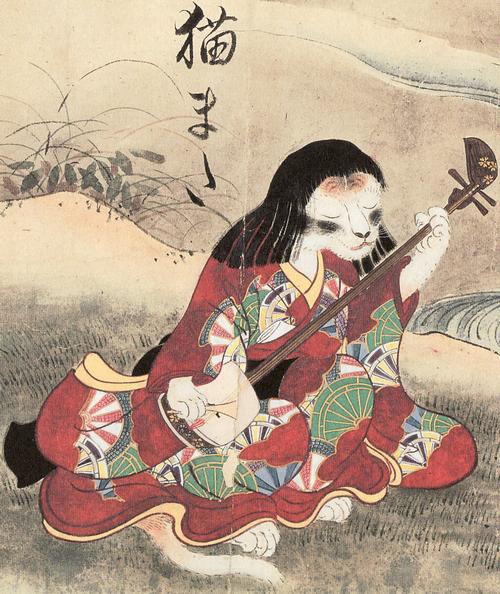
In Japanese mythology, there were variations on monsters, or yōkai, collectively known as bakeneko (化け猫) which means “ghost cats”. Such cats can range from cats who simply died and return as ghosts, to mischevious spirits who might harass or trick people. A popular example of a bakeneko is Jibanyan in the popular series Yokai Watch.

When looking at Jibanyan, note the double, or forked tail, and the hi-no-tama ghostly balls of fire that hover around him. These are popular images for yokai (multiple tails) and for spirits (ghost fire). The bakeneko in general is a prime example of yokai in Japanese mythology.

However, there is one particularly malevolent form of bakeneko called the nekomata (猫又), or “cat with a forked tail”. Yokai.com has a great article about it. Unlike the run-of-the-mill bakeneko, the nekomata is far more powerful and hostile. They are said to grow more powerful with time, and can be very large, shoot fireballs, cause plagues, etc. They even command the undead. It’s not hard to imagine a nekomata as an end-boss (BBEG) in a Japanese-themed campaign, where as the mundane bakeneko are more like nuisances, or possibly serving the nekomata in some way.

Heck, I should probably write one. 😊

Yokai in Japanese mythology in general fulfill a similar role that fey did in medieval Japanese culture: mischievous at best, terrifying at worst, and it’s fascinating how cats in particular held such a popular role in Japanese mythology.

The Mantra of Light as a Buddhist Practice

Mantras are a strange beast within Buddhism. The tradition of mantras predates Buddhism and goes all the way back to the early “Vedic religion”, that is the ancient devotional practices around the Vedas (precursors to Hinduism as we know it), and they continue to occupy an awkward spot.

The Mantra of Light as shown in a Rinzai-Zen service book.

“Recitation” in Buddhism usually comes in the form of reciting sutras, which makes sense, because the tradition of passing down the teachings from teacher to student has existed from the beginning. Mantras do not fit this role since they are essentially obscure (not to mention mispronounced) Sanskrit phrases, with esoteric meanings. The esoteric traditions such as Vajrayana in Tibet, Shingon and Taimitsu (Tendai school) traditions in Japan all embrace them as a central practice,1 but in other non-esoteric traditions mantras are relegated to a backup “support” role, protecting the Buddhist disciple.

For example, here’s a certain mantra as found in a Rinzai Zen liturgy book I own. This is the famous Mantra of Light (kōmyō shingon, 光明真言), which reads in various languages like so:

LanguageText
Sanskritoṃ amogha vairocana mahāmudrā maṇi padma jvāla pravarttaya hūṃ
Chinese唵 阿謨伽 尾盧左曩 摩訶母捺囉 麽抳 鉢納麽 入嚩攞 鉢囉韈哆野 吽
Chinese romanizationǍn ā mó jiā wěi lú zuǒ nǎng mó hē mǔ nà luō me nǐ bō nà me rù mó luó bō luō wà duō yě hōng
Japanese:2オン アボキャ ベイロシャノウ マカボダラ マニ ハンドマ ジンバラ ハラバリタヤ ウン
Japanese romanizationOn abokya beiroshano makabodara mani handoma jinbara harabaritaya un

Here’s an example of how it’s chanted in Japan (notice the Siddham letters, too):

What makes the Mantra of Light somewhat unusual within the world of mantras and esoteric traditions in Buddhism is how widely it’s been adopted. You will find it in many Buddhist traditions, even ones that are otherwise not interested in esoteric practices.

In fact, for a time in the late Heian Period of Japan, the Mantra of Light was propped up as a rival practice to the nembutsu in the Pure Land tradition particularly by a monk named Myoe (明恵, 1173 – 1232).

At that time, there was an existing funerary practice of scattering sand blessed by the Mantra of Light on the deceased, but Myoe tried to popularize it further by playing up its benefits in helping one to be reborn in the Pure Land of Amitabha Buddha. This interpretation is largely Myoe’s, however.

It never quite worked as Myoe hoped, and the popularity of the nembutsu prevailed, but even today it’s common for Buddhist practitioners to chant both. I do this in my home service for example. I happen to like the Tendai-sect approach of “umbrella Buddhism” where meditation practices, Pure Land practices and esoteric practices are given roughly equal weight, with the Lotus Sutra as a kind of capstone.

Thus, reciting the nembutsu (pure land Buddhism) and the Mantra of Light (esoteric Buddhism) are both perfectly fine.3 For me at least, I chant the nembutsu for the benefit of others, and the Mantra of Light to reinforce my commitment to being a help to others (and be less of a dickhead). That may not be the correct approach, but it’s a start.

Speaking of which what does the Mantra of Light actually mean? Like all mantras, they’re infused with meaning in esoteric traditions, so a simple translation doesn’t tell the whole story. Furthermore, in esoteric traditions, mantras are supposed to be recited while visualizing a specific image and holding your hands in a specific “mudra”. This combination is thought to jar something deep inside, not at an intellectual level, but on an experiential level. Thus, the meaning of the mantra is something shared between teacher and student. So, I don’t have a good answer for this. If you really want to know, consult a trusted teacher in good-standing!

But it’s not necessary to know the exact meaning either. The act of recitation is more important, or so I have been told. So, if you chose to recite the nembutsu, Mantra of Light, both, neither, that’s fine. Buddhism has a large toolbox, so try what works, and enjoy!

1 Interestingly enough, the Japanese word “shingon” as in the Shingon school, literally just means “mantra”.

2 Mantras are usually written in Japanese using katakana, given that they’re technically foreign words, but for ease of readibility, hiragana is also used.

3 Meditation has always been my Achilles Heel, but I still meditate from time to time.

Of Fun Times and Family Losses

Hello Readers,

I can’t believe I haven’t posted in more than a week. Although I rarely plan things out anymore,1 but I like to write a post or two weekly.

The truth is, the past week has been a very weird one with logs of ups and downs.

First, I got promoted at work. Readers who may have followed along for a while know that I got my current job during the pandemic after my last company (think mice and jedi) laid off my department due to redundancy. I was pretty lucky to get the job I have, but having worked remotely for 2 years, it’s been far more stressful to get up to speed than it would have been with someone by my side to show me the ropes. That said, hard work paid off, and my family and I celebrated with a nice dinner together (at, we still have a pandemic, you know).2 I usually like to keep work and personal hobbies, including blogging, separate, but it was nice to finally get recognized. I had worked in various companies in the past 20 years and almost never had a promotion in all that time. That doesn’t mean my current company is all roses though, frustrations abound, but I am surrounded by good people who recognize me, and that’s greatly appreciated.

A few days later, I got a call from my uncle. It seems my other uncle, my mom’s oldest brother, died. This was a shock to the family, especially my mother, in a way, but in a way it wasn’t. My uncle, like my grandfather who had died a few years earlier, had been a very private person who also had been slowly dying from cancer. In both cases, smoking heavily probably didn’t help. Anyhow, my uncle was a pretty wild and cantankerous person from what I heard, and even as a teenager I almost got in a fist fight with him after he drunkenly insulted my mother.

And yet, when my grandfather died, I met him for the first time decades at the funeral and he had changed. He was quieter and more sullen. We talked for a bit, and he said something really nice to me, and that was the last time I ever saw him. I texted him earlier this year to wish him a happy new year, but I never got a reply back. I didn’t know he had been in the hospital recently for an unrelated injury, and that he later wasted way and died at home. I didn’t even know he had remarried in all this time.

The only photo I have of my uncle (center) and my grandfather (right). It was taken almost 20 years ago when my first born was a tiny little girl.

I was really glad that I got to talk to him one last time at grandpa’s funeral, and that we had a moment of reconciliation, but I am also really saddened about how little we got to interact over the years, and how now we’ll never get that chance. When my grandpa passed away, I had similar feelings of loss; the last time I saw him in person was way back at the time of the photo above, and before that only once when my wife and I first married.

In reality, I feel sorry for him. His youth was had been a very difficult one, and his relationship with all of us, as a result, was very problematic. But I like to think that he found at least some peace in his later years, and that’s what allowed us to reconcile like we did, even if only for a few minutes.3 Needless to say, I miss my uncle and my grandpa, and I said some extra prayers for both and in hopes that they may find peace in a future life. RIP.

Finally, the family and I took a break and went to Portland, OR. We have gone there before, a month before the pandemic lockdown in early 2020, and had not traveled at all since then apart from a couple small, isolated camping trips. This was the first time we did a proper vacation, outside our home state (we traveled by car, not plane,4 btw) and it was great. My kids were so happy after coming back, they were practically glowing. It was hard to go on a vacation so soon after my Uncle had passed away, but we had already reserved everything, and my kids had endured lockdown for so long, so I knew I couldn’t back out now. I did pick up some very good books on Buddhism at Powell’s and had the obligatory donuts and coffee there, plus my youngest son loved the zoo.

From there, it’s been a week just to process all the ups and downs of the previous week.

I have a few more posts lined up soon, so thanks for your patience and continued readership.

Namu Amida Butsu

1 In an older blog incarnation, I used to do things on a set schedule, but often times I found myself scrambling to “fill slots” and it wasn’t’ always my best work. I would love to actually to do nothing but write blog posts all day, but alas I have to live a life.

2 This post did not age well. 🤦🏽‍♂️

3 Prior to his death, my uncle had also requested that there be no funeral service after his death. He didn’t want that burden on others, and I feel that was pretty magnanimous of him. I may do the same someday for my own death.

4 Even if I wanted to go somewhere, I doubt I’ll be flying anytime soon, unless I absolutely have to (e.g. some emergency with my wife’s family in Japan). Too much hostility among some passengers, and too few common-sense health and safety procedures.

Untitled

Introducing the Karoshthi Script, a script of the Silk Road

The Silk Road, especially during the time when Buddhism first propagated out of India into the northwest and then east into China, is a fascinating point in history. Much of this is epitomized in a little-known writing system called Karoshthi.

At that time, much of the world from Europe to Asia spoke a language called Aramaic. Jesus’s native language was Aramaic, not Hebrew (though like many Jewish people at the time, he certainly knew it). Aramaic spread far and wide partly by accident, when Assyrians forced captive peoples to migrate to remote parts of their empire. Compared with the older cuneiform script, used in many Near East languages, Aramaic had a simple, straightforward alphabet that allowed people to pick it up quickly and easily.

Aramaic was also used in the Silk Road that ran from the edges of the Roman Empire, through the Parthian Empire, east to the Kushan Empire (later the Hephthalites) and across the Taklamakan Desert to Tang Dynasty China.

However, starting in the region of Gandhara (modern-day Pakistan), a new script, based on Aramaic began to appear: Karoshthi.

This video, courtesy of Vidya-mitra’s online correspondence courses, explains the Karoshthi in great detail and is worth a watch.

Some highlights from that video that I wanted to share.

First, Karoshthi was only around for a few centuries: mostly the 1st century CE to 3rd century CE. However, this overlapped with a pivotal time when Buddhism developed many characteristics in Gandhara that we now see today:

  • Mahayana Buddhist texts were developed and written down, not orally transmitted.
  • Buddhist statuary, possibly influenced from Bactrian-Greek culture, were first made.

Second, contrary to what I thought, most of these Buddhist-Karoshthi scripts were composed in a prakrit language called Ghandari Prakrit, not Sanskrit.1 According to the video, Ghandhari had some unusual features compared to other prakrit languages found in India, and Karoshthi had to be adapted for this. So, it contains some letters and styles not found elsewhere.

Third, Karoshthi wasn’t just used for Buddhist literature: it was used across a large swath of the eastern part of the Silk Road, so texts written in Karoshthi can be found in western China as easily as they are found in Pakistan, though because of geography, it tends to be found in pockets, where oasis-towns and other settlements existed.

I have been playing around with it quite a bit using Unicode and HTML as well as other ancient scripts, and was able to compile the Sanskrit phrase om namo’valokiteshvarāya2 meaning “praise to [the Bodhisattva] Avalokiteshvara”:

  • Brahmi script: 𑀑𑀀 𑀦𑀫𑁄𑀯𑀮𑁄𑀓𑀺𑀢𑁂𑀰𑁆𑀯𑀭𑀸𑀬𑁍
  • Karoshthi script: 𐨀𐨆𐨎 𐨣𐨨𐨆 𐨬𐨫𐨆𐨐𐨁𐨟𐨅𐨭𐨿𐨬𐨪𐨌𐨩𐩕

The Brahmi script such as Emperor Ashoka might have used, is written left-to-right, as you’ll notice, but the Karoshthi script is written right-to-left. This makes copy and pasting on a browser really tricky by the way. 😅

Anyhow, this is a very amateur look at the ancient Karoshthi script. Karoshthi script is something that you probably wouldn’t see very often, if ever, but it’s a fascinating historical relic of a time when commerce and information was exchanged heavily along the Silk Road, bringing empires across parts of Asia and Europe briefly together. As a Buddhist, it’s also a snapshot into the earliest forms of Buddhist, particularly Mahayana-Buddhist, literature one can find anymore.

1 Buddhist texts gradually became more and more Sanskrit-like, but that took centuries, and even then it probably wasn’t pure, literary Sanskrit as one would learn in a textbook. This phenomenon was dubbed “Buddhist-Hybrid Sanskrit” by scholars.

2 I found this phrase in a stotra (hymn of praise) published in romanized-Sanskrit from the Digital Sanskrit Buddhist Canon, namely here: Avalokiteśvarastotram (carapatipādaviracitam)

Taking Stock

July has been a rough month for me. The problem started in early July, after attending a Dungeons and Dragons game in person at my local game shop for the first time in over a year. Not long after, I started feeling ill, my head was stuffy, and breathing was sometimes difficult. My heart was pounding a lot, and sometimes I wondered if I should go to the hospital.

I took a COVID test (which is thankfully very easy and convenient around here), and the tests came back negative. Phew. Given that I am fully vaccinated, and still wear masks every time I go out, the likelihood was low, but better safe than sorry. Nevertheless, I was still ill and have been ever since. I am feeling much better than I did two weeks ago, but still not 100%.

Eventually, I came to the conclusion that I had three unrelated, but overlapping issues going on:

  1. Work stress – a big deadline was coming up, and that was definitely giving me prolonged anxiety. I noticed my heart pounding + breathing issues tended to drop off on the weekends, but pick up on the weekdays. Definitely could have been palpitations. The project deadline was met, and since then things got easier. This week I haven’t had any palpitations at all and I can take walks around the neighborhood again without feeling constantly winded.
  2. The other issue is either a head-cold (as in the mundane common cold) or allergies. I haven’t decided which one, but seems more likely a head cold. I had an unusual experience where 10 days into the cold, my wife gave me some Chinese medicinal herbal tea to help with the cold, and that night, I woke up drenched in sweat. Like, as if someone threw a bucket of water on me. Gross, but since then, I started recovering. Chinese medicinal herbs can really kick your ass sometimes. 😝
  3. Finally, I cut back greatly on coffee after I started palpitations. I figured it would help, but then again the caffeine withdrawal really hit me hard by the 3rd and 4th day: headaches, irritability, sleepiness, etc. Today is my 14th day cutting back on coffee and while the physical withdrawal symptoms are gone, the mental craving is still strong. Habit energy, perhaps.

Anyhow, all this is to say that life for me kind of shut down for most of July. I still worked of course, and helped with parenting where I could, but everything else just dropped off: D&D, writing projects, games, reading, other hobbies, etc.

In a way, getting ill and being in recovery so long was a chance to take stock in what really matters, versus needless distractions. I’ve shelved some of my projects for the foreseeable future. This is to focus on things that are more meaningful, and conducive to well being and recovery.

The blog is going nowhere, but the focus may change a bit for the near term. As life picks up again, maybe I’ll pick those hobbies back up, but time will tell.

Thanks all for your understanding and well-wishes. 😄