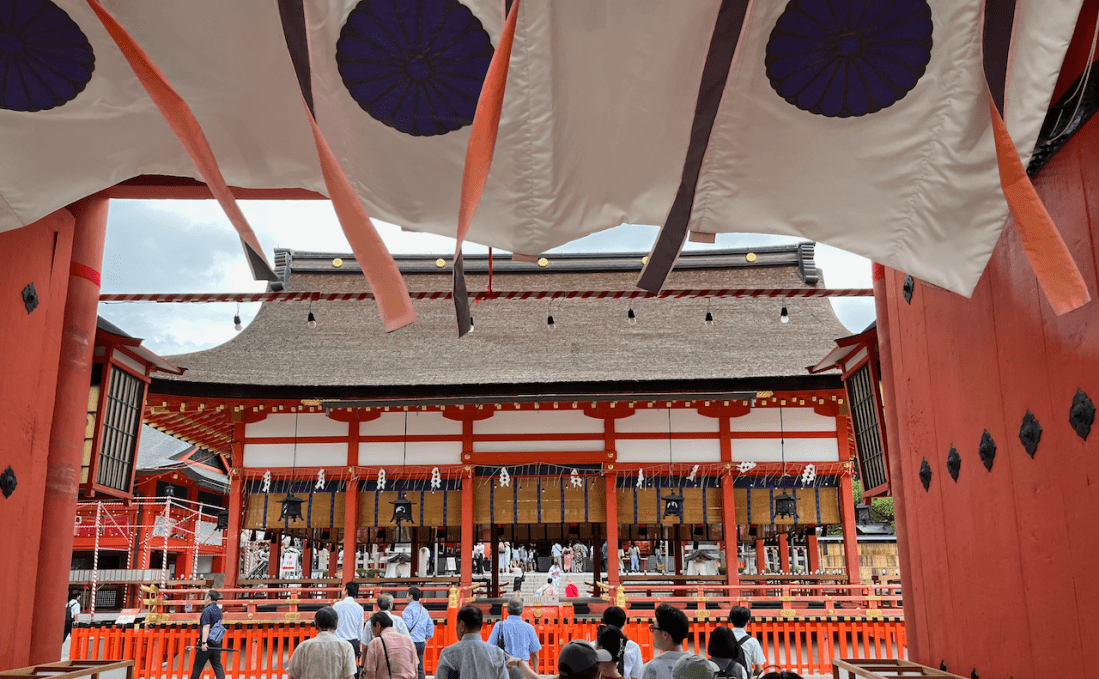
Fushimi Inari shrine in Kyoto, Japan. Photo courtesy of Wikipedia.
I follow a certain Japanese taxi company (MK Taxi) based in Kyoto, Japan on Twitter, and they recently posted these photos of rubber ducks swimming in a pool of water.
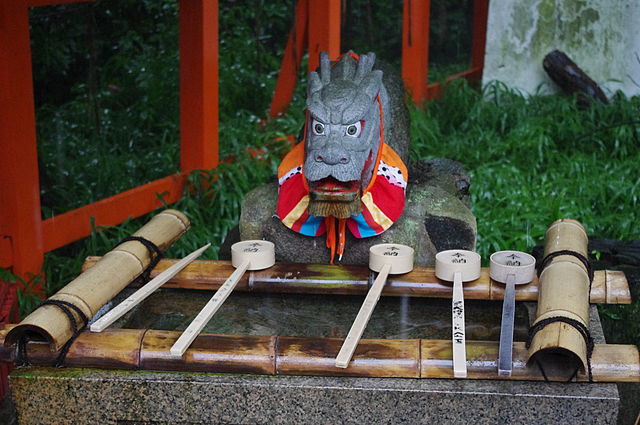
But this is no ordinary pond or pool, this as an ablution pool at Awata Shrine, a small Shinto shrine in Kyoto, Japan. Almost every Buddhist temple or Shinto shrine in Japan will have a pool with running water for doing ablution. This is an optional but customary step, and is thought to cleanse oneself, mentally and physically, before going to the main object of veneration at that temple or shrine. As a visitor, you may want to remember to do this too. When in Rome…
The process of ablution (called temizu 手水 in Japanese) literally means to wash one’s hands with water,1 but the process is a bit more involved.
The venerable Ise Jingu shrine has nice video on the how to do temizu here:
The gist of the process is:
With a scoop of water, pour some over your left hand to clean it.
Now, using your left hand, take the ladle and pour some water over your right hand to clean it.
Now, using your right hand, pour a bit of water into your left hand, and use it to clean your mouth.
Next, tip the ladle up, so the remaining water washes over the handle, cleaning it for the next person.
Finally, put the ladle back on the rack.
To be honest, my wife and I skip the mouth-washing step, for hygiene reasons. You’ll often see older generation Japanese rinsing their mouth like mouth-wash before spitting out on the ground, but I wouldn’t recommend that. Sometimes, I’ll just go through the motions of washing my mouth without actually contacting the water. It’s up to you.
In some circumstances, you may also see a large outdoor brazier with bundles of incense inside. Asakusa Temple (a.k.a. Sensoji) has one of these outside the main hall entrance. This is another ablution step you can do whereby you fan some of the incense smoke onto yourself.
Although Shinto and Buddhism are entirely different religions, the fact that both of them have essentially identical ablution traditions shows the power of local culture in shaping religion (and vice-versa).
1 The book The Time Traveler’s Guide to Medieval England: A Handbook for Visitors to the Fourteenth Century clarified that in 14th century England, most people couldn’t afford bathing daily (weekly if they were lucky), but they washed their hands pretty often, especially when going to church. I suppose the concept of “ablution” was pretty universal at least in medieval times.
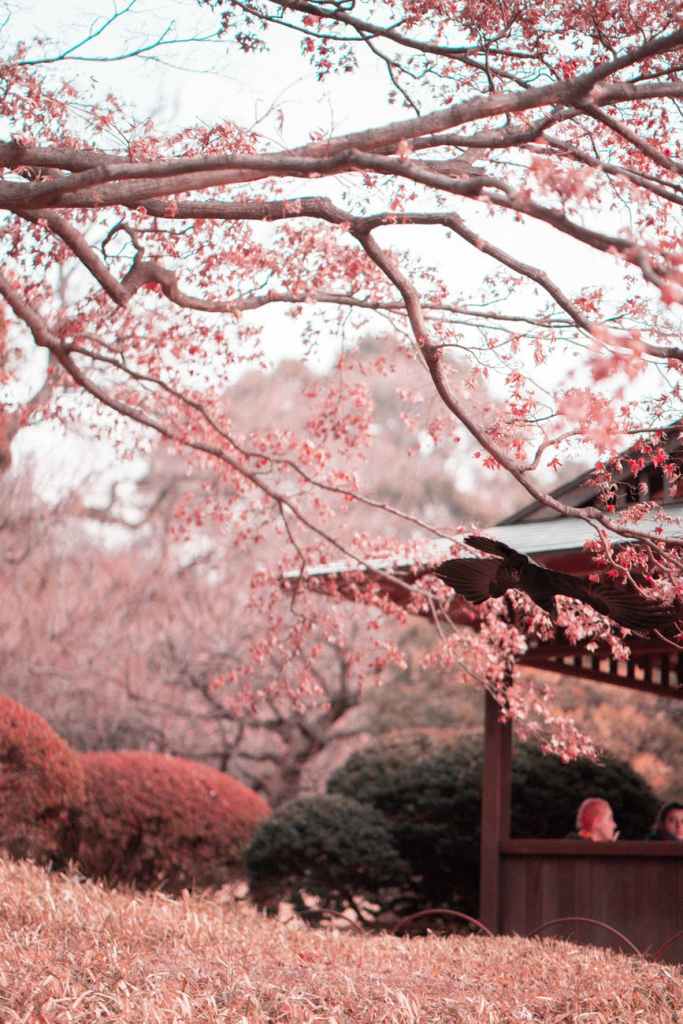
This tweet, posted by the Yasaka Taxi Company in Kyoto, Japan was taken at a Shinto shrine named Tatsumi Shrine. The picture shows a Japanese cherry tree (sakura 桜) with fall leaves. For some reason this really struck me because when people usually think of Japanese cherry trees, they think of cherry blossoms blowing away in the wind, that quintessential symbol of Japanese aesthetic of the impermanence of life (a very Buddhist tenet):
Summer in 2020 came and went probably like no summer in recent memory. Ignoring the painful facts for a moment that there’s a global pandemic, politics are pretty bat-shit crazy, and the economic woes, and my stress level was through the roof, it was a quiet and low-key summer. Hunkering down for the summer had a few silver linings, in that I got to see my kids a lot more, and some long-neglected things around the home got fixed. The kids had little “summer reading challenges” I gave them and I had personalprojectsof my own that I mostly got done.
Lately, I’ve been thinking about a certain poem from the ancient Japanese poetry anthology, the Hyakunin Isshu, which I have a whole blog devoted to. The poem, number 98, out of 100 reads:
This poem refers to a frequent ritual in Japanese Shinto religion called misogi (みそぎ or 禊) which is a kind of purification ritual through immersion in a river, waterfall or the sea. Shinto differs from Buddhism, among other ways, by its heavier emphasis on purification as contact with death, or trauma or other negative forces can weigh on a person and bring misfortune not to mention the mental burden. So, since antiquity, water immersion as a form of ritual purification was a way to “reset” the balance and avoid potential misfortune later.
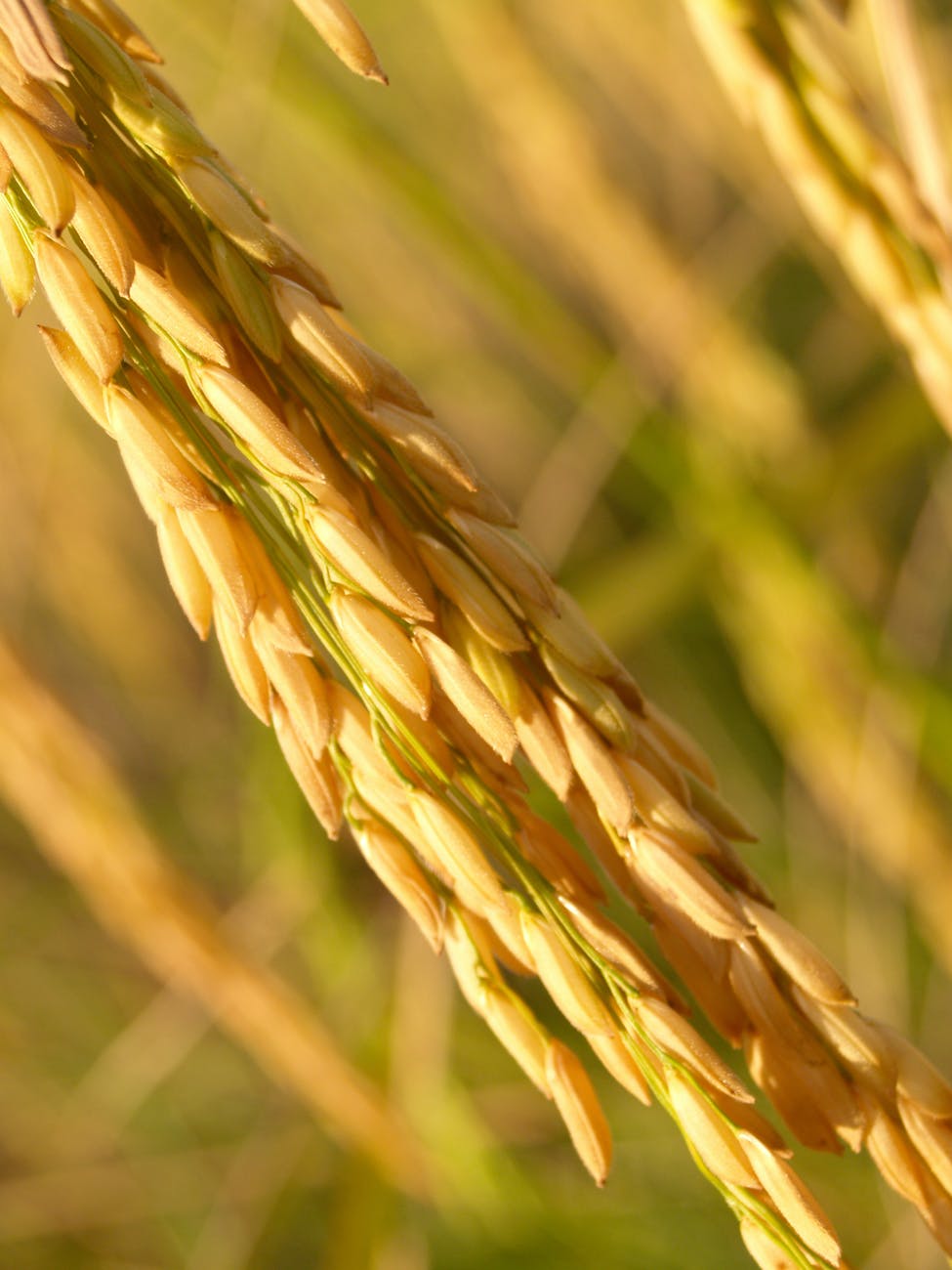
Further, the 1st day of the 8th month in the old Japanese calendar (early September in modern times) is traditionally marked by a special ceremony called hassaku (八朔) where the first rice harvests of the season is dedicated to the gods in gratitude. Sometimes this is in the form of mochi rice cakes instead. It is still practiced even today by some.
Anyhow, looking forward to getting kids back into school (sort of), but also going to kind of miss the weirdest, yet quietest summer I can remember in my life.
Photo of my two Thundercloud plum trees currently in bloom
Shinto religion in Japan is a loose network of diverse traditions and local deities (kami), and one of the most unusual, and popular, kami is Tenjin, the god of learning. Tenjin is unusual because he is a deified version of an actual historical figure named Sugawara no Michizane who lived in the 9th and 10th centuries. Sugawara no Michizane (and his deification as Tenjin) are considered an archetypal scholar, poet and Confucian.
Sugawara no Michizane was a scholar from a middle-ranked noble family in the Heian Period (9th-12th c.), but under Emperor Uda, he unexpectedly rose to a high rank as a close advisor. This drew of the wrath of the rival, powerful Fujiwara family, who engineered Michizane’s downfall and exile to the remote town of Dazaifu. It was on parting his home, that Michizane reputedly wrote this poem (his most famous):
東風吹かば Kochi fukaba 匂ひおこせよ Nioi okoseyo 梅の花 Ume no hana 主なしとて Aruji nashi tote 春を忘るな Haru wo wasuruna
When the east wind blows, let it send your fragrance, oh plum blossoms. Although your master is gone, do not forget the spring.
Translation by Robert Borgen in “Sugawara no Michizane and the Early Heian Court”
For this reason, plum blossoms are closely associated with Michizane and Tenjin. Another story relates how after Michizane died in Dazaifu, the ox pulling his funeral cart stopped at one point, and refused to go any further. Thus, that site became the site of his burial and later the Dazaifu Tenman-gū shrine. For this reason, oxen are also associated with Michizane.
But how did Michizane go from a talented (though perhaps not necessarily a genius) scholar and poet into a deity? The answer lies in Sugawara no Michizane’s exile. Soon after Michizane’s death in exile a series of natural disasters and untimely deaths befell the capitol, and people began to attribute these to Michizane’s wrathful spirit.1 To placate this vengeful spirit, the Imperial Court reinstated his original rank, promoted him, and instituted elaborate rituals and offerings. But this took on a life of its own and over time, worship of “Tenjin” became popular across all of Japan.
These days, Tenmangū (天満宮) shrines devoted to Tenjin are particularly popular around entrance-exam season. People will pile on supplications to Tenjin in hopes of success.
Votive tablets or ema (絵馬) taken by author at Yushima Tenmangu shrine in 2010.
I have visited Yushima Tenmangu shrine in Tokyo some years back when I was studying for the JLPT N3 exam (spoiler alert: I passed), and it was one of my favorite Shinto shrines.
Inner-sanctum of Yushima Tenmangu shrine, taken by author in 2010.
As a nerd and amateur scholar, I’ve always felt a special connection to Michizane and the concept of a “scholar god”, so coming there was a fun experience. In 2023, I visited the Kitano Tenmangū shrine in Kyoto as well. Sadly, I failed the JLPT N1 exam this time around.
Sugawara no Michizane / Tenjin is a curious but fascinating figure in Japanese cultural history. In Robert Borgen’s excellent book Sugawara no Michizane and the Early Heian Court, he points out that in the end Sugawara no Michizane wasn’t that extraordinary a poet, scholar or teacher, but through a somewhat lucky (or unlucky) series of events, he rose to become the archetypal deity of learning and education. In the Muromachi Period of Japanese history, he was the archetypal Zen scholar-monk, in the Edo Period, he was the archetypal Confucian scholar, while in the early-modern Meiji Period, which reasserted the primacy of Shinto religion, his worship as a full-fledged Shinto deity matured.
Sugawara no Michizane, the historical figure, was an interesting man, faults and all. But as Tenjin, the god of learning, he came to embody all the ideals of Japanese culture, suitable for each time and period, which persist today.
1 This was not entirely unusual at the time (cf. Prince Sawara a couple centuries earlier). Also, the Shinto kami, Susano-o, is another example of a deity that required placation, but is now seen more as a benevolent deity these days. Time heals all wounds, I guess. ;p
One of my favorite holidays in Japan is Setsubun which in the modern calendar is always February 3rd. We celebrate it every year with the kids because it’s a fun way to bring the family together, maybe bring in a little extra good luck, and is pretty low-key.
Setsubun (節分) is the second of 5 “seasonal events” (sekku, 節句) and traditionally marked the beginning of Spring in the Old Chinese calendar. In the traditional 24-period division in the old calendar the beginning of Spring was called risshun (立春). There are technically other Setsubun days, but really the only one anyone knows anymore is “spring Setsubun” which is was on the 3rd day of the second month of the Lunar Calendar, which was converted to February 3rd in the Gregorian calendar.
Since (spring) Setsubun marks the beginning of Spring, which in turn marked the beginning of the new year in the old lunar calendar, Setsubun is a time to “reset” the home, get a fresh start, and so on.
The most important tradition is the mamemaki (豆まき) in which the head of the household usually dresses up as an oni (鬼, Japanese ogre) and knocks on the front door. The kids throw roasted soybeans at him and yell:
鬼は外! 福は内! Oni wa soto! Fuku wa uchi!
“ogre out! good luck in!”
I have some old videos of my misadventures with mamemaki. One year, as I pretended to fall down from the soy beans, I hit my head really hard on the handle of the bbq grill. Hurt like hell.
Also, since we live in the US, we use roasted peanuts instead of soybeans since they’re easier to get a hold of. Further, after driving away the Oni, one is supposed to eat a number of beans equal to one’s age.
The local Buddhist temple here also has a mamemaki event we do with the kids. I might post something about that soon.
The other big tradition is eating a special sushi roll called ehōmaki (恵方巻), while facing a particular “auspicious” tradition based on Japanese geomancy. The direction changes every year, and according to tradition, your wish will come true if you can eat the entire ehōmaki roll while facing that direction and not saying a single word. Ehōmaki rolls are more of a Kansai area (Osaka, Kyoto) thing than the Kanto area (Tokyo), but the tradition has spread to much of Japan and overseas communities as well.
Call it karma, superstition, what have you, but the last week of yakudoshi got the last laugh on me. You see, I was in the last year of yakudoshi (a.k.a. atoyaku, 後厄 ) until the Chinese New Year of 2020, or January 25th. Although Japan doesn’t celebrate the New Year according to the Chinese calendar anymore, a few traditions still relate to the “old” New Year (kyūshōgatsu, 旧正月). The yakudoshi years begin and end at the old New Year according to the Chinese lunar calendar.
Photo by Min An on Pexels.com
Here in the Pacific Northwest, it has been raining a lot. Apart from a little bit of snow around “big cold” time, it’s been raining day after day after day. As such, the deck of my home, which isn’t in great shape anyway, gets really slimy and slippery due to algae. One weekend not too long ago, a few days before the “old” New Year, I was taking out the garbage when I slipped on the deck steps like Charlie Chaplin and landed on my back and rear. My left shoulder and elbow hurt, but my elbow in particular started to swell. While the rest of me soon recovered quickly, my elbow just got more sore and swollen. I could still move it well enough, but the back of my elbow hurt like hell.
Finally after a week of this, I decided to see the doctor, and after a quick examination he determined that I had bursitis. The fluid sac inside my elbow had gotten very swollen and irritated due to the fall and would take weeks to heal. Thankfully nothing was torn nor broken, so that was a relief, but here I sit with a Japanese-style poultice on my elbow to help ease the swelling.
The lesson of this is that:
Don’t wait to see a doctor if you suspect something is wrong. For me, the week long pain in my elbow made me miserable. If I had known better, I could’ve gotten a medical examination earlier and saved some unnecessary grief.
Keep your deck and stairs maintained and clean. I previously tried various schemes to keep moss and algae off the wood, but this time around, I tried a bucket of water and a kitchen sponge with a rough side. Just scrubbing those steps got the algae off immediately. Of course, keeping it clean in the first place prevents algae from growing, but if I had spent 20 minutes sometime in the last several weeks scrubbing the deck and stairs, I could’ve saved myself a serious fall.
Finally, yakudoshi is finally done, but I like to think (joking) that it got in one last dig at me. To be honest, I never really took the tradition seriously, and still don’t. A little home maintenance would’ve saved a lot of trouble, and that’s on me. Further, 2018-2019 were pretty good years overall. True, I lost both of my remaining grandparents (different sides of the family) and that put me in a long funk, and looking back I think I had gone through a longer grieving process than I would’ve thought. Plus, the company I work for had undergone a major restructuring and that meant the constant fear of being “redundant” for months. Finally, I had some minor surgery after an old medical issue came back to haunt me which was no small stress (plus medical bills).
But are these really due to an inauspicious year based on an old Chinese-style wordplay? Sooner or later we lose our loved ones, and companies grow, change and shed employees from time to time to stay competitive. Our bodies can’t stay 100% healthy all the time, either. It’s easy for me to say these things here and now, but even when they suck they’re a part of life. There’s no guarantees of security and long life. These are things we cannot truly rely upon, like so many other things in life.
Further, in spite of these difficulties, I also got to see my kids grow. One graduated elementary school, while the other started it. We made a lot memories together as a family, and my wife and I celebrated our 15th year anniversary too.
A certain famous Indian Buddhist named Nagarjuna described such things as the Eight Worldly Concerns, sometimes called “Eight Winds” in various Buddhist circles:
Happiness and Suffering
Gain and Loss
Praise and Blame
Benefit and Harm
The idea is that these “winds” blow us back and forth. At times, we’re happy, at times we’re sad. Sometimes we gain some kind of boon, and other times we lose something dear. Similarly, our boss tells us we did a good job, and a few weeks later we get scolded for some mistake, only to later be praised again some time later.
There’s no rest when being blown about by these winds. Praise and fame are not something we can rely on, and blame and loss don’t last forever.
Knowing this to be true is one thing, but actually being able to stand calm the eight winds like a mountain is something that takes time, reflection, persistence, and perspective into the nature of things. Easier said than done. But the alternative is to spend a life time chasing after the “good” side of the eight winds, and forever lamenting the “bad” side.
So, Yakudonshi or not, the last few years had their ups and downs, but it all worked out somehow in the end. 😎
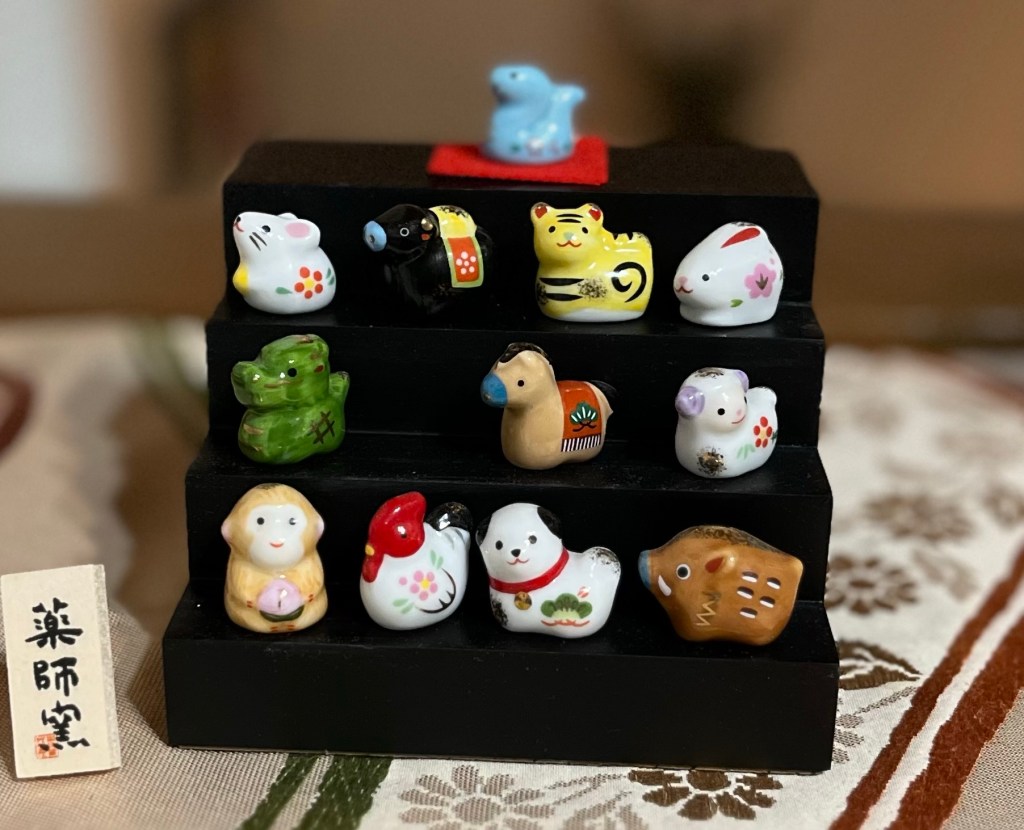
This year, 2020, is in the Japanese (extended) zodiac the year of 庚子 (kano-é-ne). The Japanese zodiac was originally based off the Chinese Lunar calendar, though this changed in the late 19th century when Japan moved toward rapid Westernization and industrialization. However, the 12-animal zodiac, or jūnishi (十二支), is still an important part of the culture. In Japanese culture, like Chinese culture, the calendar is divided into a 12-animal cycle that rotates year after year. Even hours of the day were divided by these same animals, with the time starting at midnight, the hour of the rat, and noon being the hour of the horse.
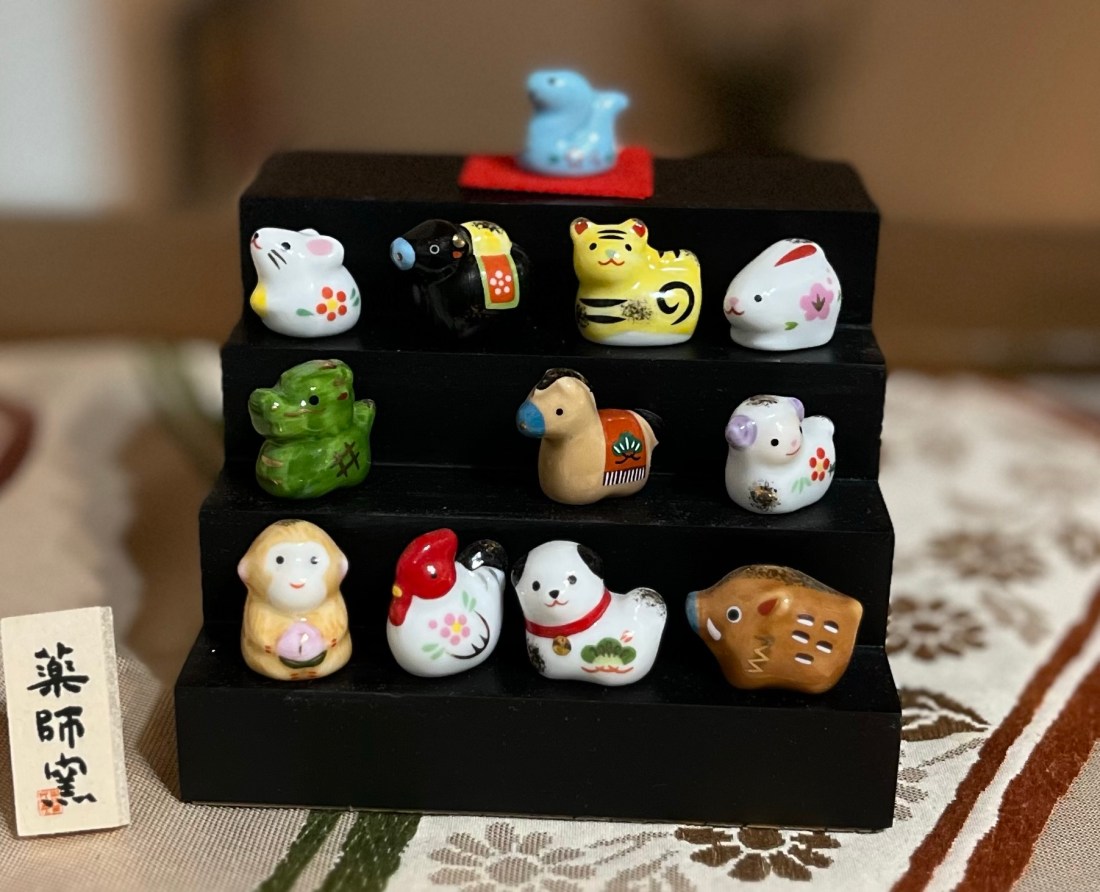
The twelve animals of the zodiac. My wife found this display in Japan a couple years ago, and we change it each year when the zodiac changes. (As of writing 2025, year of the snake)
The animals, their names and kanji are listed as follows:
Unlike the Chinese calendar, the “pig” has been replaced by a “boar”, which are more common in the mountainous areas of Japan, even today.
The Kanji (Chinese characters) for these animals are quite different than the ones in daily use. The regular Kanji for Dog is 犬 but in the zodiac it’s 戌.
Some of the animals also have different readings in the Zodiac than daily usage. Compare the snake, hebi in daily use, but mi in the zodiac.
However, what many Westerners (and Japanese) don’t know is that these 12 animals signs can be sub-divided further and further. Traditionally the 12 animals of the zodiac were also interwove with the five elements: earth, fire, water, air and metal. The cycle of the five elements is divided even further into a pair of “stems”, for a total of ten stems. The stems related to the notion of yin/yang, or inyō in Japanese (陰陽) with in (陰) being “yin”, and yō (陽) for “yang”. Often times these are referred to as big brother, or é (兄), and little brother, or to (弟), as well. Taken together, the five elements plus the yin and yang stems are called jikkan (十干) and are organized like so, with pronunciations added:
Element
Yin vs. Yang
Stem
Wood: 木 (ki)
Yang (e)
甲 (ki no é)
Yin (to)
乙 (ki no to)
Fire: 火 (hi)
Yang (e)
丙 (hi no é)
Yin (to)
丁 (hi no to)
Earth: 土 (tsuchi)
Yang (e)
戊 (tsuchi no é)
Yin (to)
己 (tsuchi no to)
Metal: 金 (kane)
Yang (e)
庚 (ka no é)
Yin (to)
辛 (ka no to)
Water: 水 (mizu)
Yang (e)
壬 (mizu no é)
Yin (to)
癸 (mizu no to)
A few notes here as well:
The character on the right represents both the yin/yang and the element, so they’re not written separately as one would expect. One character is sufficient to express both.
All the stems are kanji that show up elsewhere in Japanese, but here they take on different meanings, readings.
So, how do you read this? If someone is born as the element wood, or “ki” and the yin stem, this is read as ki no to. If yang stem, then ki no é. That’s why I mentioned “e” and “to” above under yang and yin. The only exception to this rule is “metal” which sounds awkward if you say kane-no-e or kane-no-to, so it gets shortened to ka-no-e or ka-no-to.
Now, putting this altogether. If you consult the chart here, you can figure out for your birth year, what stem and animal is associated with it. So, for me, being born in late 1977, I am a “yin fire snake”, since “丁” is the yin stem for fire (see above). Thus, in Japanese, I could say I am hi-no-to-mi, or “fire yin snake”: 丁巳. The year 2025 is ki-no-to-mi (乙巳), or “wood yin snake”.
Going back to the beginning of this post this year, 2020, is kano-é-né (庚子) which translates as “mental yang mouse”.
While I don’t believe in the zodiac at all, it does come up in conversation a lot in Japan, so it’s a good subject to get familiar with. You will also see the same formula used in Japanese calendars, which the 10 stems and 12 animals cycling through the days as well. Also, people often like to ask what year you were born: nani doshi desu ka? For such questions, it’s enough to just say “(animal)-doshi“.
But as interesting as horoscopes are, I am reminded that the Buddha said in the opening lines of the Dhammapada (trans. Acharya Buddharakkhita):
Mind precedes all mental states. Mind is their chief; they are all mind-wrought. If with an impure mind a person speaks or acts suffering follows him like the wheel that follows the foot of the ox.
Mind precedes all mental states. Mind is their chief; they are all mind-wrought. If with a pure mind a person speaks or acts happiness follows him like his never-departing shadow.
Seems a lot more practical than horoscopes anyway, if you ask me. 🙂
Namu Amida Butsu Namu Kanzeon Bosatsu
1 Or, Water Buffalo or Bull depending on who’s doing the translation.
While I usually talk about Buddhism a lot, especially Japanese Buddhism, on this blog, I wanted to take some time to talk a little bit about the other religion in Japan: Shintoism. With New Year’s just past, it’s a good time to explore this oft-misunderstood tradition.
Japan has two religions that have co-existed side by side for a very long time: Buddhism and Shinto. They have different origins, different ways of describing the world, and so on. However, due to (mostly) peaceful coexistence, they influence one another, and Japanese culture leading to what we see today.
Taken by me at the excellent Hie Shrine in downtown Tokyo in 2017.
Shinto is a tricky subject in some ways because it’s deeply tied to Japan, and “Japan-ness” in a way that Buddhism, a foreign religion, is not. My personal interest in Shinto began years ago when I visited a few shrines here and there as a tourist and would pay respects to whatever kami or divinity dwelt within. It’s not something I really believe in, but I felt that it was worth taking the time to delve into the culture and do things the Japanese way.
Back then, I picked up a book on Shinto called The Essence of Shinto by a Shinto priest, or kannushi (神主), named Motohisa Yamakage to learn more. Later, I found a Professor Ian Reader’s excellent and easy to read guide to Shinto titled: Shinto – Simple Guides. These are the two primary sources for this post.
Basic Shinto Beliefs
Shintō (神道) is translated as the “Way of the Kami”. It has no founder, no doctrines, and no real central authority. Variations exist throughout different parts of Japan, and according to Yamakage, each kannushi (priest) will have slightly different view of it. It has been around since antiquity, before the arrival of Buddhism, and just gradually sprang up out of local, common practices. Each shrine, and each priest is trying to commune with the Kami, to revere nature, and much emphasis is placed upon experiential wisdom.
Shinto “deities” or Kami (神), usually gets translated into English as “gods”, but they run the gamut. Kami come in all shapes and sizes, some are revered country-wide, some very obscure and local. Many embody many aspects of nature, or aspects of life, but also include more celestial Kami as well. It’s hard to compare with modern, Western religion. But it’s somewhat analogous to ancient Greco-Roman religion with its Olympian gods, chthonic earth deities, spirits like nymphs, naiads, etc., plus foreign-imported deities from elsewhere (Dionysus, Isis, Mithras, etc). The variety of Kami is nearly endless. In Japanese, there is a term for this: 八百万の神 (yaoyorozu no kami) which means “eight million kami” literally, but really just means “countless kami”.
Ian Reader’s book lists some of the most well-known:
Amaterasu – Goddess of the sun and associated with the Imperial family, who traditionally claims descent from this Kami.
Hachiman – God of war, originally thought to have derived from the legendary Emperor Ōjin. Absorbed by Buddhism in medieval times as a bodhisattva (frequent references in the Tales of the Heike, for example).
Ebisu – A Kami associated with small business and commerce. Particularly popular in the Osaka area.
Inari – Kami of rice and harvest originally, but grew in popularity as a guardian of Buddhism and separately of business. The famous Shiseido cosmetic company has a shrine devoted to Inari on top of its headquarters called Seidō Shrine.
Benten or Benzaiten – Kami associated with music and the arts. Originally thought to be imported indirectly from India, as the goddess Saraswati. Imported gods in Shinto is not unusual.
Tenjin – Kami of education. Originally a famous Heian Period nobleman named Sugawara no Michizane, who was wrongfully slandered and whose death was thought to have triggered natural disasters at the time. Worshiped as a Kami to placate his restless spirit, as well as for his excellent poetry and writings.
Konpira – Kami associated with seafaring, and with sea commerce. A popular patron for sailors, fishermen and other such groups.
Susanoo – Amaterasu’s brother, and Kami of wind. While legendary as a trouble-maker, he is also revered for protection against natural forces such as typhoons.
Izanami and Izanagi – The original female and male pair of Kami believed to have created Japan according to traditional myth.
Professor Reader also quotes an excellent definition of kami from a famous scholar from the Edo Period named Motoori Norinaga:
…it is not only the divinities of Japanese sacred texts and myths that are considered as kami, for anything — humans, animals, trees, plants, rocks, mountains, seas — which appears impressive, inspires a sense of awe, or exhibits a life-force, may be a kami.
This helps to emphasize the fact that Kami are not so much a set pantheon of gods in a set hierarchy, but rather that they exist in a near-infinite variety that embody many aspects of life. Many Kami are very local to a region, and myths of their origin grow over time as worship around the Kami develops over generations after some miraculous event or discovery.
Communing with Kami
In spite of their variety, Kami are believed to have very human-like qualities and must be appeased and placated, or they may cause trouble. This is reinforced by carefully followed rituals where a Kami is honored, and whose assistance is called for. Or, one expresses gratitude to the Kami for their protection, thereby showing humility and appreciation. In order to avoid offending a Kami, the ritual must be carried out correctly, and by someone who is considered ritually pure, otherwise the Kami may ignore them, or cause problems instead.
For Shinto priests and even lay followers, it’s also important to setup a good dwelling spot so that a Kami can descend and make their presence felt. Originally, there were no Shinto shrines, or jinja (神社), instead the ancient priests would sanctify a suitable spot and call out to the Kami to descend to that spot. Later, formalized structures were built around holy places and these became the major shrines (jinja) seen today, which branched out into sub-shrines and so on. In people’s homes, devout Shinto followers will also create a small sacred space in hopes that a Kami will descend there as well. Kami don’t live in these sacred spaces, according to Yamakage, instead it’s more like an antenna allowing the Kami to descend for a time. The actual term for this “antenna” is yorishiro (依り代), and can be something like a rock, a mirror, a special charm someone got from a Shinto shrine, and so on.
Since Kami will only descend in places that are clean, pure and bright, if this “antenna” or the sacred space around it gets run-down, dusty, and such, then the Kami will not descend, and if they do not descend, they won’t be able to help you, or worse, some evil spirit will take up residence.
So as part of communing with Kami, Shinto a lot revolves around purification.
Ritual Purification
An ōnusa wand used for purification rituals. Source: Wikipedia.
In Shinto, there is a strong relation between purity and well-being. Through contact with unclean things, or through negative and angry thoughts, one builds up negative energy or impurities that can cause concrete problems. Thus, Shinto has many ceremonies (祓 harai or harae) designed to restore balance, and to remove the impurities. According to Yamakage, the four Shinto ideals are clean, bright, right and straight and these ceremonies, rituals and such help to restore one to a state that reflects all four. Yamakage is quick to emphasize that there is no Original Sin in Shinto (obviously intended toward a Western audience), but things get off-kilter from time to time, and so one should restore the balance through these rituals.
One of the most important rituals, and probably the most familiar, is the misogi (禊ぎ) or purification by bathing in water. This ceremony can be practiced at a waterfall, river or other body of water, but ceremonies can also be as simple as temizu (手水), which is something people often do at Shinto shrines, and even Buddhist temples. Temizu is a “purification-lite” ceremony, where you wash your hands and maybe your mouth. If you’ve visited a major temple or shrine in Japan, you will see a little water area with ladles and people washing their hands. The basic ceremony is the following steps:
Wash your left hand with the water from the ladle.
Now wash your right hand with the water from the ladle.
(optional) Now, holding some water in your left hand, pour it into your mouth.
That purifies the person, so they can enter the sacred space of a shrine. Of course, if you forget to do this, it’s not a disaster, it just won’t help you in any way commune with the Kami there.
Relation to Buddhism
The relation to Buddhism here is a tricky one. Medieval Buddhism, that of the Nara and Heian Periods, tended to have a strong blending of native Shinto and Buddhist beliefs. A common theory from that time until the modern era, was that the Shinto Kami were manifestations of Buddhist figures. For example, the major Shinto deity Amaterasu, goddess of the sun, was assumed to be a manifestation of Vairocana Buddha. The Tales of the Heike, among other famous Japanese literature at the time, would frequently mention this.
Buddhist sects in the past attempted to assimilate or eschew¹ this blending in varying degrees, while Shintoists at times tried to reassert themselves as a separate religion.
In the end the two religions have learned to co-exist because they have little overlap with one another. Buddhism has little to say about spirits and divinities, while Shinto is focused primarily on them. Shinto focuses on purification and avoiding pollution and taboos so it has little to do with funerals, while funerals have been a part of the Buddhist tradition for a long time.
Shinto as a religion is so deeply tied to Japanese culture and people, it’s hard to separate the two, which also helps to explain why Shinto has almost no presence outside of Japan, but at the same time, it’s a fascinating spiritual tradition and well worth getting familiar with if one intends to come to Japan, or to explore the tradition more.
Japanese New Year (oshōgatsu お正月) has come and gone, and we’re now in the year 2020, but I took a photos around the house to show the kinds of symbols and accoutrements you’ll see this time of year.
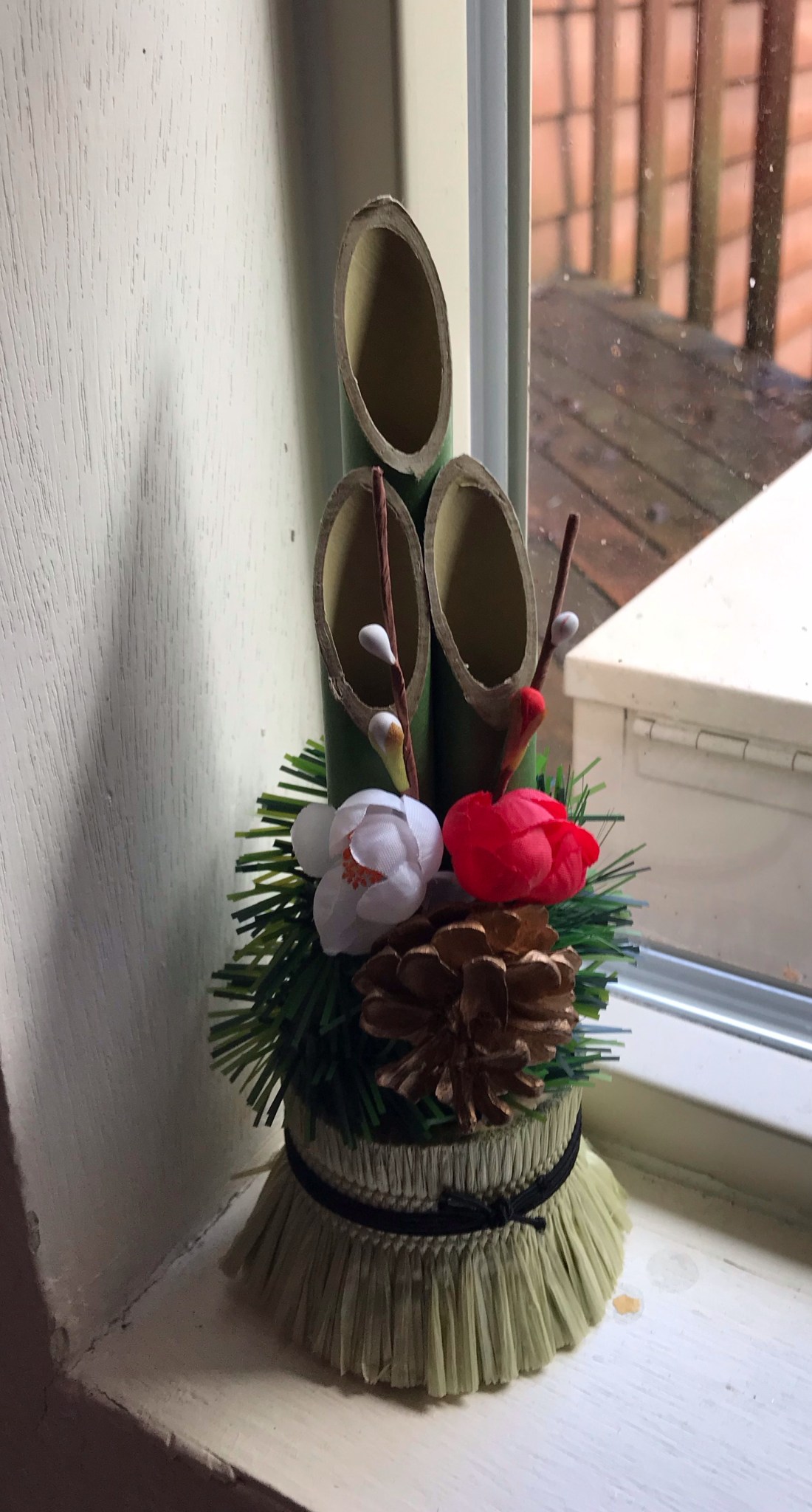
The first one is a kadomatsu (門松):
This display, combines bamboo (竹), pine (松) and plum blossoms (梅), all auspicious plants, into a single ornament. Similar to a Christmas wreath, it is usually displayed near the front entrance of the house, and is thought to “invite” good luck into the home for the rest of the year. More specifically, it is thought to invite auspicious kami (Shinto religion deities) into the home who by their presence bless the home with good fortune and avoidance of calamity.
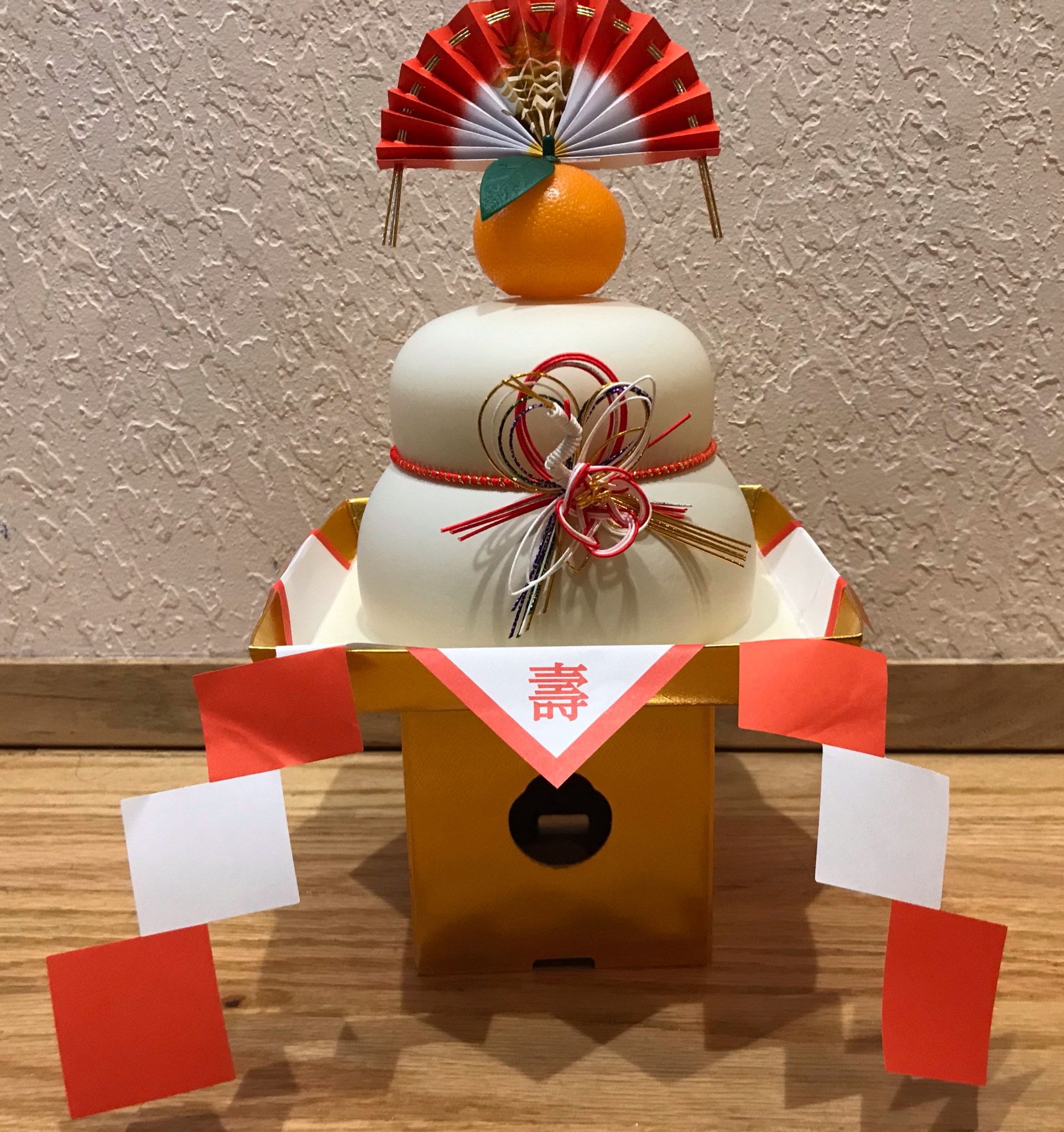
Another symbol is a kagami-mochi (鏡餅) or “mirror-mochi“:
This is a basic one we bought at the local Asian supermarket, but consists of a small platform and two mochi rice-cakes piled onto one another with an orange above. In our display, the mochi is actually hidden inside a plastic case, but more traditionally, the display really does use two round mochi cakes piled onto one another. Mochi symbolize material wealth. The orange, more specifically a bitter orange (daidai 橙 or alternatively 代々), is placed on top and symbolizes longevity because a bitter orange stays on the tree even in winter, but also because a bitter orange tree also bears many fruit. Also, the word daidai (代々) is a homophone for “generations” which means prosperity of the family across generations.
At its core, the kagami-mochi is a kind of Shinto temporary “altar” (依り代 yorishiro) for kami to descend and bless the house with both material culture and longevity/prosperity across the generations, particularly a kami named toshigami-sama (年神様) which is the God of the Year. At first when I reserached this in Japanese, I thought the term 年神様 was some kind of catch-all phrase for kami to that come at the end of the year, but apparently there really is in Shinto religion a kami specifically for “years” and in particular the New Year. 😄
One other tradition related to the kagami-mochi is that on the 11th day of the new year (January 11th), the mochi is cooked with sweet red beans, thus bringing good luck for the year.
Happy 2020 Everyone!
EDIT: Made some updates with respect to the kagami-mochi.
P.S. My earlier post on Japanese New Year greetings.





 Gleanings in Buddha-Fields

You must be logged in to post a comment.