Ten Virtues of Incense

During our most recent trip to Japan, I picked up some nice incense from Zojoji Temple, and my wife separately picked up some from Sanjusangendō Temple in Kyoto.1 We also bought some incense last year at the Golden Pavilion and Ryoanji. It’s a thing in our house. We actually use incense a fair amount: I use it for Buddhist home services, my wife uses it to honor her deceased mother. Sometimes we also just light it for guests who come over.
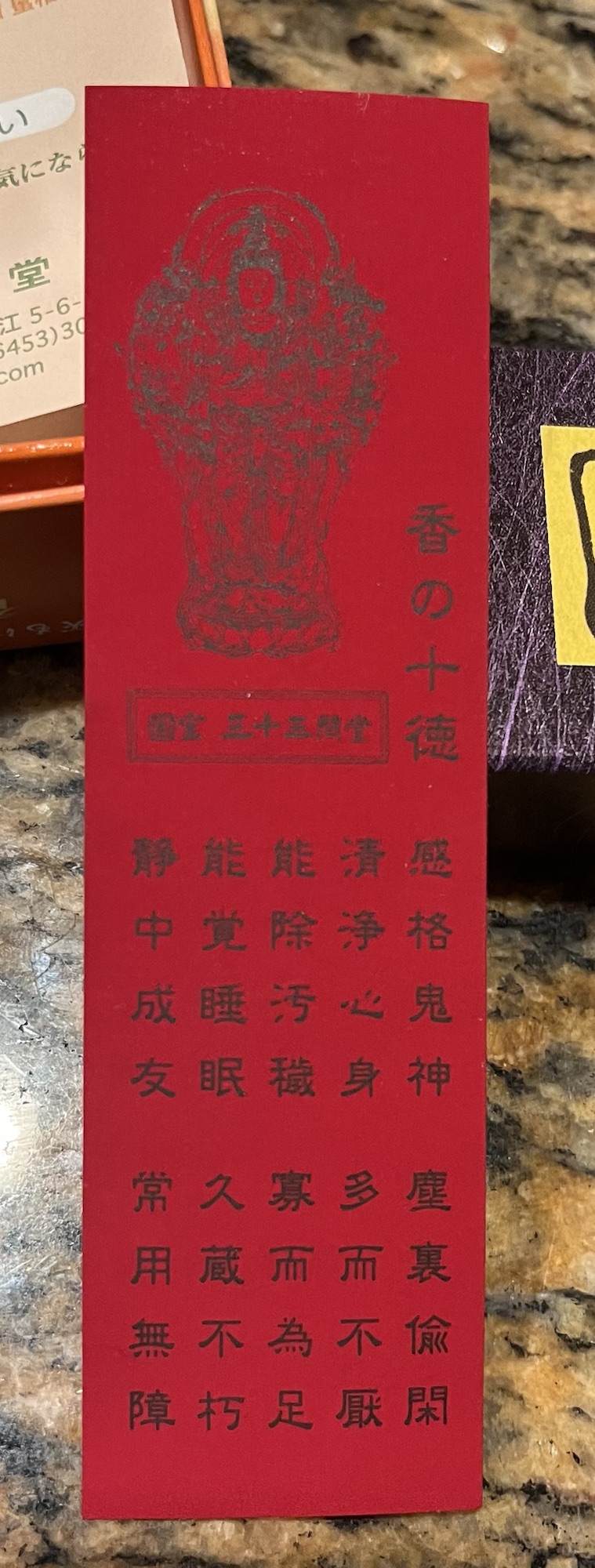
When we opened the incense box from Sanjusangendō, we were surprised to see this little red slip of paper. This is not bad photography: the paper is hard to read. At the top is a Buddhist image,2 but below that is something written on the slip of paper called the Ten Virtues of Incense, or kō no jittoku (香の十得). The Ten Virtues is a form of Chinese-style poetic verse, or kanshi (漢詩) originally composed by the 15th century eccentric Rinzai-Zen monk Ikkyu.

The Ten Virtues are ten aspects of incense that Ikkyu felt was beneficial for whomever uses it. Nippon Kodo has a really nice English-language page about it, including a translation. Feel free to stop and take a look. I’ll wait.

To summarize the benefits here (refer to other sources for proper translations), the ten virtues are:

  1. Spiritual awakening
  2. Purification of body and mind
  3. Removes impurity
  4. Brings alertness
  5. Brings comfort in solitude
  6. Brings moment of peace
  7. One doesn’t get tired of it
  8. Even a little is enough
  9. Stays fresh even in age.3
  10. You can use it every day.

Of course, it’s also important to use incense in a well-ventilated room. The smoke, while very pleasant, is probably not good for your lungs. I always open windows and doors before using it. Also, good quality incense tends to be less smoky. You can even find “reduce smoke” incense sometimes, which is probably healthier, though I would still keep good airflow just in case.

In any case, incense is pretty neat, and if you ever visit a Buddhist temple in Japan, you’re almost sure to find some really good quality stuff. But even if you can’t afford to travel, it’s not hard to find stuff online or in your area too.

Good luck and happy …….. inhaling?

1 We have visited this place a number of times over the years, including our “honeymoon” trip to meet the extended family in Japan way back when. And yet, I haven’t talked about it much. I actually really like this temple, but because they don’t allow much photography it’s hard to make a blog post about it. I might try one of these days, just haven’t figured out how to describe Sanjusangen-do without photos I can use.

2 The Buddhist image is the bodhisattva Kannon, in the form of 1000 arms, also known as senju kannon (千手観音). Since the temple venerates Kannon, this makes sense.

3 Speaking of our honeymoon trip way long ago, we went to a spa-resort place in Japan, and got these nice little incense envelopes. I put my envelope between two pages of a book at the time, shelved it, and forgot about it for years. I opened years later, and the oils of the incense had seeped through and stained the page, but it also left a really nice scent that still lasts. Even now 20 years later, the book still has a nice fragrance.

Night and Day: Tendai Home Practice Redux

Home services in Japanese Buddhism, known as otsutomé (お勤め) or more formally gongyō (勤行), have many different approaches. It often depends on sect, particular communities, and personal preference. Trouble is, English sources are often confusing or insufficient. So, I try to look up information in Japanese, which is sometimes harder than you might think.

Anyhow, something I’ve learned recently about Tendai Buddhism, is that at least in some Tendai traditions, home practice might be divided between a morning service and a night service. This is in keeping with the two concepts in Tendai (more on that here):

Thus, in lay-Buddhist home services for Tendai Buddhism, some communities tend to divide the morning versus evening services to reflect these two concepts.

This page from the Jimon-branch of Tendai Buddhism, based in the famous Mii-dera Temple (as opposed to the Sanmon-branch based in Enryakuji atop Mount Hiei) shows example services for both morning and evening. I can’t translate everything word for word from the site, but let me try to summarize the basic format.

Morning Service

For the morning service, one pays homage to the Buddhas and Bodhisattvas “of the ten directions”1 and takes the Lotus Sutra as their basis. The morning service cited in the Jimon-sect page is based on a treatise by founder Saicho called the Hokke Sanmai Gyōhō (法華三昧行法), and for some reason is much shorter than the evening service.

The morning service is comparatively short, but includes liturgy such as:

  1. The Kannon Sutra – chapter 25 of the Lotus Sutra
  2. The Heart Sutra
  3. Dedication of Merit for all sentient beings’ welfare

I left out some of the liturgy from this list because I could not find details, or they were very specific to the Jimon sect (e.g. praises of Saicho’s disciple Enchin, who is the source of the Jimon branch), but hopefully you get the idea. This emphasizes the here and now, and seems rooted in the hokke senpo side of Tendai Buddhism to me.

Evening Service

The evening service by comparison uses the Amitabha Sutra as its basis and includes somewhat different liturgy.

  1. Verses of Repentance
  2. Verses of the Opening of the Sutra
  3. The Jigagé verses (chapter 16) of the Lotus Sutra
  4. Hymns to Amida Buddha
  5. Mantra of Light
  6. Reciting the Nembutsu
  7. Dedication of Merit for Rebirth in the Pure Land (this differs slightly from the morning service version).

It’s interesting to note that the evening service still includes verses from the Lotus Sutra, but also mixes the Nembutsu and Mantra of Light as well and definitely emphasizes the reiji saho side of Tendai.

Conclusion

As these are services associated with just one sub-sect of Tendai, and since people often add, subtract or adapt services to meet their needs, it’s perfectly fine to adjust this to whatever works in your situation. You could potentially reduce this all the way down to reciting the Heart Sutra in the morning, and the nembutsu at night. Or something similar. As long as it is sustainable, and captures the spirit of Hokke Senpo and Reiji Saho.

The themes of morning services expressing hokke senpo, and evening services expressing reiji saho, are a great way to apply Tendai teachings in one’s own life, or just Mahayana Buddhism in general.

P.S. features the gardens of Mii-dera temple, photo by E5894, CC BY-SA 3.0, via Wikimedia Commons

1 The eight cardinal directions, plus up and down.

Perspective

Recently, I discovered that one of my coworkers, who is an immigrant to this country, had survived the Yugoslav wars of the 1990s. I am trying to protect their identity a bit, but they described life as a teenager being besieged in their home city for months in 1992 without running water, or reliable food supply. After the war was over, they came to the US with a mere $50, a college degree, and no idea what to do next. Thankfully, my coworker was able to get on their feet, establish their career here, and now have a growing family.

However, what’s interesting is that if my coworker had never confided their past, I would never have guessed. By all appearances they were just another career adult. I’ve had a coworker who grew up in Palestinian refugee camps in the Middle East, but again, it’s not obvious in a professional work setting and they only confided in me much later in our friendship.

It underscores how many people around you, who by all accounts seem like normal, functional adults, may be carrying terrible traumas in their lives. It is not always wars, natural disasters, and ethnic conflicts either; it can also be personal, domestic traumas, emotional scarring that fades with time, but never fully disappears. It is said that 1 out of 4 women in the US, possibly more, have been abused and that means that out of all the women I work with, correspond with, or hang out with, one out of four, maybe even one out of three of them may be carrying out terrible scars from their past.

And of course, it’s not limited to women, either. It’s not hard to scratch the surface and find men who have also suffered terrible traumas, abuse, etc., and carry this with them for the rest of their lives. I remember my best friend in grade school suffering terrible, physical abuse from his father. He grew into a pretty unhappy teen and eventually the family moved away. I didn’t comprehend any of this until too late, and lost touch with him before we could talk about it together. I’ve always regretted that.

Being an adult is hard enough as it is, but also carrying around terrible traumas makes it even harder because you can never fully erase them. You can move on, find happiness, and still grow as a human being, but the scar will always be there.

Photo by Mokhalad Musavi on Pexels.com

My coworker who survived the Yugoslav wars, for their part, told us that they decided not to focus on the past and instead focus on the here and now: kids, career, helping others in the same field, and so on. They joke among other survivors that they still get a bit twitchy sometimes due to their traumatic past. Yet at the same time, they don’t want to be weighed down by it either. They want to move on and look toward the future.

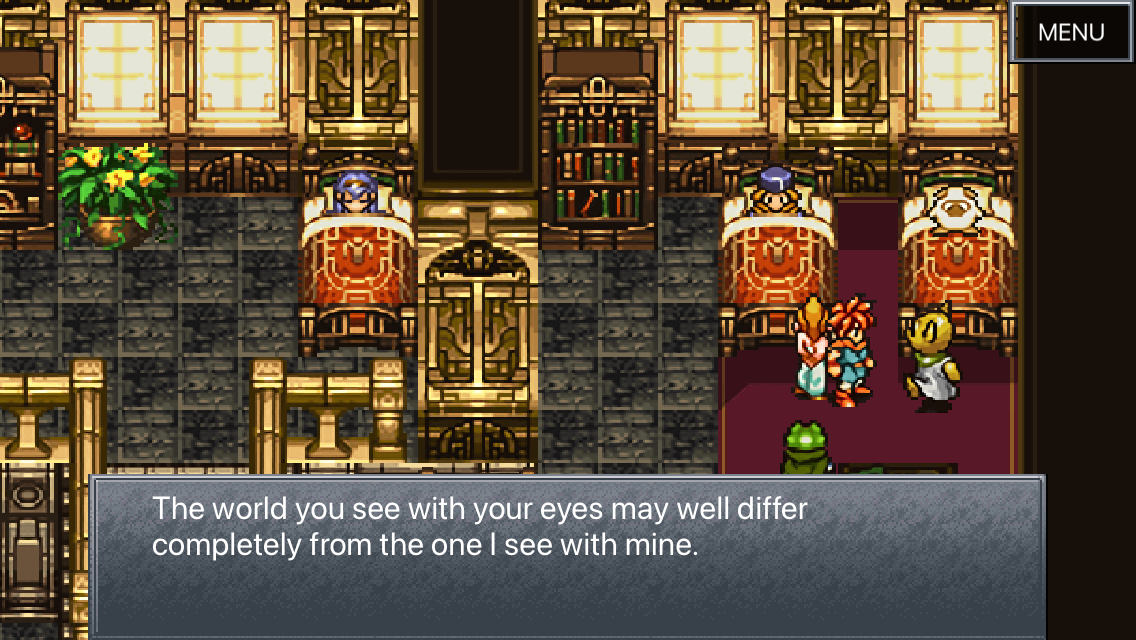
In learning to understand others, I think it’s important to consider painful past they may have had. It doesn’t always excuse the behavior, but it does provide some perspective.

Screenshots from the game Chrono Trigger.

Ecumenism

I have been avidly playing the game Fire Emblem: Three Houses since fall of last year. Yes, the game is that good. But also the game makes you think about things too, including religion.

One of my favorite characters in the game, is the leader of the Golden Deer House, Claude von Riegan (also mentioned here and here), voiced in English by Joe Zieja. Claude’s background is unusual for the game’s cast, and he keeps his identity close to his vest, but needless to say he’s had a very worldly upbringing, and sees things different than the other students who mostly grew up in Fódlan. He is just as ambitious as Edelgard, but prefers to meet his goals in a more hands-off, less forceful way.1

Unlike most of his fellow students, who grew up within the Church of Seiros, Claude tends to be pretty cynical about Fódlan’s only religious organization, and regularly questions it (this is also important to certain elements of the plot, but that’s beside the point).

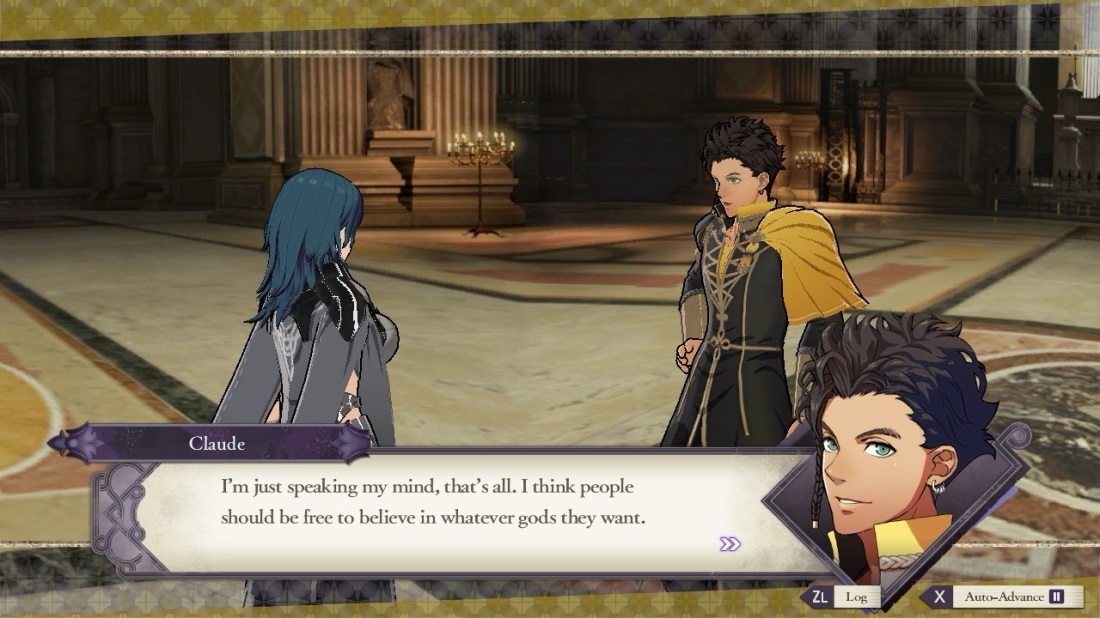
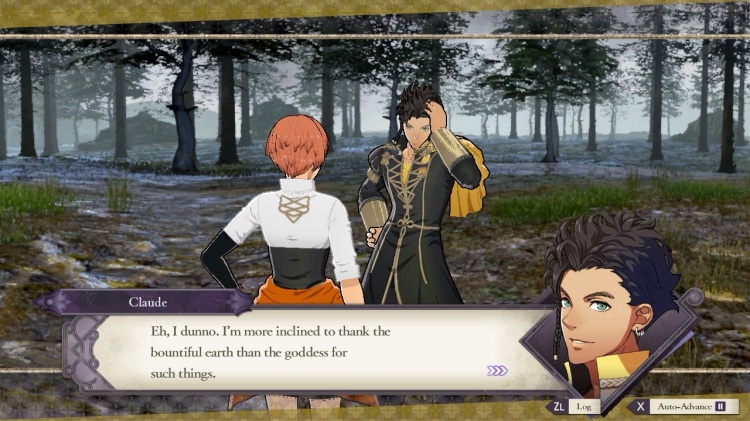
Anyhow, I wanted to share something he said that I think is worth considering (possibly out of order, I lost track of which is which):

Even though I tend to be an ardent Buddhist, I think what Claude is saying here is a healthy to look at the world and its religions. If you consider religions past and present, there have been countless gods and goddesses, rituals, liturgical languages, and so on. Even in in the same religions, practices and views diverge over time. This may offend purists, but it’s impossible to avoid, let alone manage.

Further, Buddhism has never been a particularly evangelical religion. It’s not in a race to win converts (minus a few cults), for a variety of reasons. First, this is in keeping with the Buddhist notion of metta (“goodwill”) that as long as other people have a belief system that helps them, not hinders or makes them feel bad, then that is fine. Second, the danger of imposing one’s beliefs on others is that it’s almost always fueled by ego and one’s own delusion anyway. A person’s religious beliefs, even Buddhist ones, are almost always a reflection of one’s own mind, and have to be taken with a grain of salt. Third, the Buddha clearly wanted people to take refuge in the Dharma of their own volition, and not by coercion. Even the Five Precepts are phrased as “I undertake” not as a command. Similarly with the practice of the nembutsu in Pure Land Buddhism. There’s nothing in the Buddhist canon that tells people to recite, or not recite it. It’s up to each individual to work with the tools offered in the Buddhist toolkit and apply them as best as they can. Like Claude says above, if you find a support system that works, great. This is no less true within Buddhism and its many traditions as well.

It’s generally better, and healthier for one’s own mental state, to let others be who they are, believe what they will, as long as its helpful, not harmful. The tighter one grasps, the more exhaustion and grief they inflict upon themselves, and others.

There are almost as many as variations on religious beliefs as there are people, so like the analogy of the Blind Men and the Elephant, each person is trying to feel their way through life using what resources, background and knowledge they have. Even within Buddhism, each person has their own “spin” on what the Buddha was, or what his teachings were.

It’s imperfect, but we all have to start from somewhere.

P.S. If you own a Switch, try Fire Emblem: Three Houses. 😋

1 Bit of a tangent, but of the three lords in Three Houses, I feel that Dmitri plays the role of the “conservative”, trying to restore his kingdom and the Church the way it was. Claude is the “liberal” trying to open things up and hoping it will change Fódlan, while Edelgard is the “revolutionary” who wants to change things directly (i.e. through force).

Chanting the “Hobenpon”: Chapter Two of the Lotus Sutra

The Lotus Sutra, one of the most important sutras of Mahayana Buddhism, is the size of an epic novel, and thus much too large to recite cover to cover. Even reciting a single chapter can be daunting because each chapter contains a large narrative section, and one or more verse sections that recap the narrative.

For this reason, certain verse sections have become popular for chanting because they get to the heart of the Lotus Sutra and convey its essential teachings, in a manageable size.

Popular examples (among others) include the Kannon Sutra, the verse section of chapter 16, and the opening secction of chapter 2. Both are actively recited in Nichiren and Tendai sect home services. Today we will focus on the opening section of chapter 2, called the hōbenpon (方便品) in Japanese.

Chapter 2 of the Lotus Sutra introduces the concept of Expedient Means (Sanskrit upāya), the idea (alluded to in earlier Buddhists texts) that the Buddha’s teachings and practices are flexible and meant to accommodate the capacity of the follower, guiding them along until they reach the ultimate truth (e.g. Enlightenment). Later, the chapter leans on this concept to further teach that any effort along the Buddhist path is not wasted, and every bit counts. But the chant above is for the just the opening section, which teaches that full Enlightenment is a deeply profound concept, but something only the Buddhas can truly understand between one another, so it’s a pretty lofty goal (e.g. that’s why the Buddhas and Bodhisattvas do what they can to help).

“Shariputra, ever since I attained Buddhahood, I have widely expounded my teachings through many stories of past relationships and many parables, and by countless means have led the people to renounce all their attachments.”

Translation by Burton Watson

Let’s move on now to the liturgy itself.

Liturgical Language

Because this is a chant used in Japanese Nichiren and Tendai traditions, among others, I am posting it as-is in Japanese, more specifically Sino-Japanese: the original Classical Chinese that it was recorded in, but with historical Japanese pronunciation. You are welcome to recite in English, or any other language, there is no restriction.

For this liturgical text, I relied on a few sources, plus I double-checked the spellings using physical sutra books I have at home. I am fairly certain it’s accurate.

Also, I formatted the text similar to how it is formatted in real service books.

Translation

I decided not to post the translation side-by-side with the text, the way I do with the Heart Sutra and such. This is due to formatting reasons on the blog, plus also length of the text makes this more difficult. I may revise this later.

For now, I highly recommend checking out a modern translation here by the excellent Dr Burton Watson. The Buddhist Text Translation Society also has an excellent translation here. The chant below is the first narrative section that goes all the way to the first verse section.

Disclaimer and Legal Info

I hereby release this into the public domain. Please use it as you see fit, but if you attribute it to this site, greatly appreciated. Also, please bear in mind this is an amateur work, and should not be taken too seriously.

Dedication

I dedicate this effort to all sentient beings everywhere. May all beings be well, and may they all attain perfect peace.

Namu Shakamuni Buddha

The Lotus Sutra second chapter, opening section

Preamble

Original ChineseJapanese Romanization
妙法蓮華経
方便品第二
Myo ho ren ge kyo
ho ben pon dai ni

Verse Section

Original ChineseJapanese Romanization
爾時世尊
従三昧
安詳而起
告舎利弗
Ni ji se son
ju san mai
an jo ni ki
go sha ri hotsu
諸仏智慧
甚深無量
其智慧門
難解難入
sho buc-chi e
jin jin mu ryo
go chi e mon
nan ge nan nyu
一切声聞
辟支仏
所不能知
所以者何
is-sai sho mon
hyaku shi butsu
sho fu no chi
sho i sha ga
仏曾親近
百千万億
無数諸仏
尽行諸仏。
butsu zo shin gon
hyaku sen man noku
mu shu sho butsu
jin gyo sho butsu
無量道法
勇猛精進
名称普聞
成就甚深
mu ryo do ho
yu myo sho jin
myo sho fu mon
jo ju jin jin
未曾有法
随宜所説
意趣難解
舎利弗
mi zo u ho
zui gi sho setsu
i shu nan ge
sha ri hotsu
吾従成仏已来
種種因縁
種種譬諭
広演言教
go ju jo buc-chi rai
shu ju in nen
shu ju hi yu
ko en gon kyo
無数方便
引導衆生
令離諸著
所以者何
mu shu ho ben
in do shu jo
ryo ri sho jaku
sho i sha ga
如来方便
知見波羅蜜
皆已具足
舎利弗
nyo rai ho ben
chi ken ha ra mitsu
kai i gu soku
sha ri hotsu
如来知見
広大深遠
無量無礙
力無所畏
nyo rai chi ken
ko dai jin non
mu ryo mu ge
riki mu sho i
禅定解脱三昧
深入無際
成就一切
未曾有法
zen jo ge das-san mai
jin nyu mu sai
jo ju is sai
mi zo u ho
舎利弗
如来能種種分別
巧説諸法
言辞柔軟
sha ri hotsu
nyo rai no shu ju fun betsu
gyo ses-sho ho
gon ji nyu nan
悦可衆心
舎利弗
取要言之
無量無辺
ek ka shu shin
sha ri hotsu
shu yo gon shi
mu ryo mu hen
未曾有法
仏悉成就
止舎利弗
不須復説
mi zo u ho
bus-shitsu jo ju
shi sha ri hotsu
fu shu bu setsu
所以者何
仏所成就
第一希有
難解之法
sho i sha ga
bus-sho jo ju
dai ichi ke u
nan ge shi ho
唯仏与仏
乃能究尽
諸法実相
yui butsu yo butsu
nai no ku jin
sho ho jis-so

Conclusion

(note: at least in some Nichiren traditions, this part is repeated 3 times. I am unclear if this is also done in the Tendai tradition.)

Original ChineseJapanese Romanization
所謂諸法
如是相
如是性
如是体
如是力
如是作
如是因
如是縁
如是果
如是報
如是本
末究竟等
sho i sho ho
nyo ze so
nyo ze sho
nyo ze tai
nyo ze riki
nyo ze sa
nyo ze in
nyo ze en
nyo ze ka
nyo ze ho
nyo ze hon
ma ku kyo to

Enma: King of the Dead

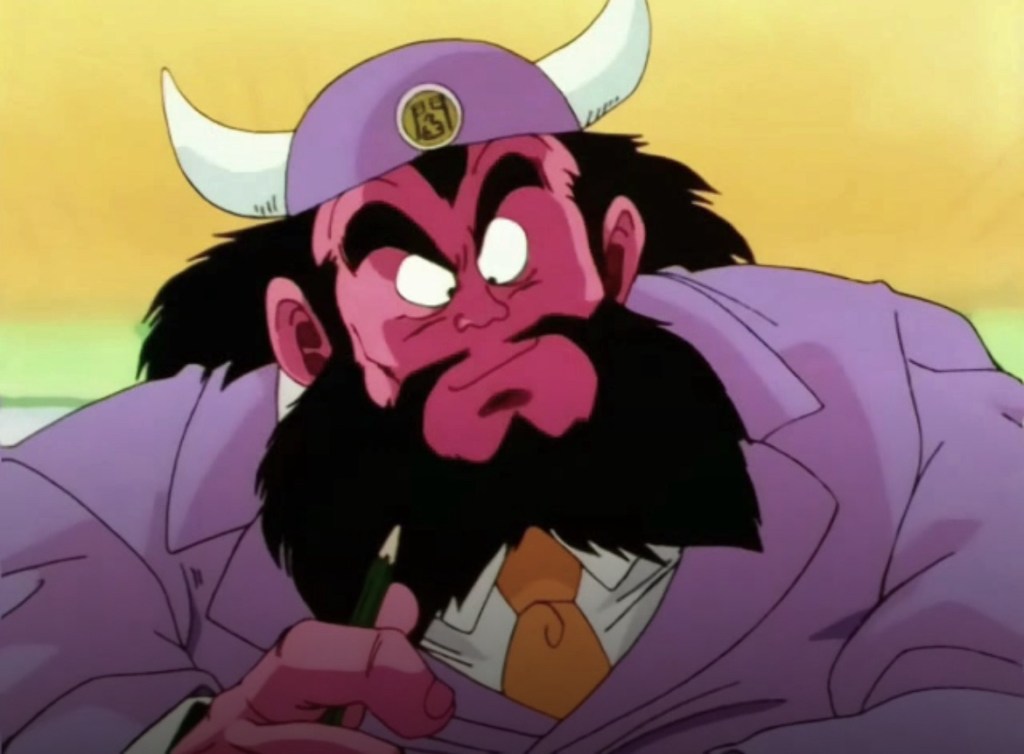
My son is at the age where is he is obsessed with Dragon Ball,1 so we watch some of the episodes together on Crunchyroll.

Source: https://dragonball.fandom.com/wiki/King_Yemma?file=KingYemmaNV01

Dragon Ball is a fun series because it blends a lot of Japanese-Chinese mythology, especially the early series, into a futuristic storyline. Goku is obviously based off of the famous legend of the Monkey King, Sun Wukong (Son Goku in Japanese). Another great example is the character Enma.

In Dragon Ball, Enma (sometimes spelled “Yemma” in English) presides the realm of spirits and behaves like a modern bureaucrat. In spite of the suit and tie, this Enma is definitely based on the original figure in Japanese mythology, named Enma Daiō (閻魔大王, “Great King Enma”).

The original Enma is a fascinating example of a “fusion” mythology, not a native Japanese one. Enma is originally based on the Hindu god Yama, lord of the dead.2 However, in China he was transformed into a Confucian-style bureaucrat and shoe-horned into Buddhist cosmology as a judge of the dead. Enma, along with other judges, determine the dead’s next destined rebirth within Buddhist cosmology. During certain Chinese funerary practices and festivals, you can see his visage on “ghost money” used to help the dearly departed coast through the trial process and ensure a smooth, lenient transition to their next life.

This Enma, a bureaucrat / judge of the dead, was how it was imported to Japanese culture in antiquity. He is even featured in classics such as the Tales of the Heike. When the warlord Taira no Kiyomori is dying from a terrible fever, he has a vision of Enma and his demonic attendants awaiting him. I’ve also heard of an old tradition where parents in Japan would scold their kids saying Enma would pull their tongue out if they told a lie. I have never heard this first-hand though, so I wonder if anyone ever says it anymore.

Anyhow, Dragon Ball’s spin on Enma, Goku and others is a fun look at Chinese-Japanese mythology, for a modern era.

RIP Toriyama Akira 🙏🏼

P.S. this post was also inspired after watching the Star Trek: Voyager episode “Barge of the Dead”. It’s a fun look at the Klingon afterlife.

1 growing up in the 1980’s my obsession at the time was Akira, which I still enjoy from time to time. 😄

2 if you ever pick up the book Lord of Light by Roger Zelazny, a wonderful blend of Hindu mythology and ultra-futuristic science-fiction with a lot of sass thrown in, the Yama depicted in that novel is quite an interesting character.

Liturgy on White Ashes

A while back, I mentioned a well-known liturgy called the Letter on White Ashes (白骨の章, hakkotsu no shō). It is letter that is often read aloud in the Jodo Shinshu tradition, and was originally composed by the 8th head (monshu, 門主) of the order, Rennyo (蓮如, 1415–1499) to a follower.

Some quick backstory about Rennyo first though.

A portrait of Rennyo, courtesy of ブレイズマン, Public domain, via Wikimedia Commons

Rennyo is an interesting, though often controversial figure. Jodo Shinshu is somewhat unusual in Buddhism because it was, from the outset, a strictly lay order and even today the priests do not take any clerical vows. Rennyo reputedly had 28 children by 4 different wives (not at the same time). The ravages of war, famine, and medieval healthcare for pregnant women,1 meant that he remarried 3 times.

Rennyo also presided over a very fractured and divided Jodo Shinshu community. Because the community was lay-oriented and had no political support, it divided into regional sects in rural areas, each developing their own interpretation, and with no oversight.

Further, certain established sects constantly viewed the widespread Jodo Shinshu Buddhism as a threat and, in the case of the Tendai complex on Mount Hiei, would send monastic armies to persecute them.

As if all this wasn’t enough, by Rennyo’s time, the central authority in Kyoto had broken down leaving the country in civil war (the Warring States period).

Rennyo was politically vulnerable against other rival, regional Jodo Shinshu groups and was actively being chased by the armies of Mount Hiei. He fled with his family to a more remote region in Echizen province. Here, Rennyo was finally able to catch his breath and gradually reunite many of the disparate Jodo Shinshu communities under a single organization, with reformed and updated liturgy, ordination and so on. Rennyo’s efforts were greatly successful and today he is remembered as the “Restorer” of Jodo Shinshu.2

Part of Rennyo’s success was his letter-writing. These are collected today in a text called the Gobunsho (御文章) or more colloquially the O-fumi (御文).

The letter below is perhaps the most famous of the collection (emphasis added). There are many translations available, but I tend to like Rev. Hisao Inagaki’s the most.

When I deeply contemplate the transient nature of human life, I realize that, from beginning to end, life is impermanent like an illusion. We have not yet heard of anyone who lived ten thousand years. How fleeting is a lifetime!

Who in this world today can maintain a human form for even a hundred years? There is no knowing whether I will die first or others, whether death will occur today or tomorrow. We depart one after another more quickly than the dewdrops on the roots or the tips of the blades of grasses. So it is said. Hence, we may have radiant faces in the morning, but by evening we may turn into white ashes.

Once the winds of impermanence have blown, our eyes are instantly closed and our breath stops forever. Then, our radiant face changes its color, and the attractive countenance like peach and plum blossoms is lost. Family and relatives will gather and grieve, but all to no avail?

Since there is nothing else that can be done, they carry the deceased out to the fields, and then what is left after the body has been cremated and has turned into the midnight smoke is just white ashes. Words fail to describe the sadness of it all.

Thus the ephemeral nature of human existence is such that death comes to young and old alike without discrimination. So we should all quickly take to heart the matter of the greatest importance of the afterlife, entrust ourselves deeply to Amida Buddha, and recite the nembutsu.

Humbly and respectfully.

Rennyo

Translated by Reverend Hisao Inagaki

Rennyo does a terrific job distilling important Buddhist truths into a single letter, written in a straightforward, accessible manner, with a simple message at the end: do not waste time, settle your affairs in the afterlife and entrust yourself to Amida Buddhia. It is no surprise this is still read aloud even today in Jodo Shinshu funerals, including my mother-in-law’s. Personally I always liked this letter more than something long and droning like the Shōshinge hymn.

Namu Amida Butsu

P.S. This is the first post I started after my medical emergency. Needless to say, I’ve been thinking about this stuff a lot.

P.P.S. For liturgical purposes, I’ve posted a full text of the letter in Japanese here.

1 throughout most of world history, pregnancy and childbirth was extremely dangerous for women everywhere. Each childbirth had an average 10% fatality rate for the mother. And since pre-modern populations had high birth rates and high death rates, a family typically would have 8-10 kids on average. Each one of these was another 10% chance for a woman to die during childbirth. Small wonder that wives often died, and men had to remarry. I think about this sometimes because my wife had a very difficult labor with our firstborn, and I imagine that had we lived in pre-modern times, she would have almost certainly died. Chilling.

2 something I didn’t cover here, and Rennyo’s biggest controversy was his association with the peasant rebellions known as ikko-ikki. Warfare and neglect caused multiple peasant uprisings and even disaffected samurai joined the cause. Some of these rebellions were quite serious and actively threatened the established order. Rennyo’s relationship is somewhat vague and confusing. It doesn’t appear that he advocated rebellion, but many of the rebels were devout followers of Jodo Shinshu Buddhism and looked to Rennyo for support.

A Pinch of Austerity

Anyone who’s ever followed a religious path, regardless of religion, will know that there’s usually some kind of rules, restrictions or prohibition about how to live one’s life. Some people approach this as “Eager Beavers” and dive head-first, others hate the idea of rules imposed on their own life and rebel. Others find some kind of middle-ground.

For Buddhism though, The Buddha treated the entire Buddhist path, from mundane newbie to fully-awakened buddha as nothing more than self-training. It’s something you have to take on yourself, following the Buddha’s advice (like a doctor telling you to eat more vegetables), and you’re responsible for your own efforts, pace, self-discipline, and so on.

Further, no matter what tradition, Buddhism is at heart a path of austerity. Because monks and nuns explicitly give up all worldly attachments to focus on the Buddhist path exclusively, this is seen as the ideal form of practice. However, even for lay followers, Buddhism encourages moderation and austerity as one can reasonably practice.

Another way of looking at it: anyone who pursues the Buddhist path is “living like a monk” to some degree.

But how does a lay person find the right balance?

In an old sutra of the Pali Canon, the Buddha used the example of a vīna (a kind of lute), but we can use modern examples such as a guitar, cello, and so on. If the strings are too tight, they will soon snap. If they are too loose, the music sounds terrible. Tuned just right, the instrument plays well.

I like to think of it as adding spice to a soup. If you add no spice, the soup is kind of bland, unremarkable. If you add too much, the flavor is ruined. A pinch of spice though really enhances the flavor.

In the same way, adding a pinch of austerity to one’s life is a safe, sustainable approach. The Five Precepts are a great start, but you can also add a small amount of Buddhist practice like meditation or chanting. Remember though, if you add too much at first, it will “ruin the soup”, so start small. If it’s not enough, add a bit more. If you can’t follow all Five Precepts, start with four, three, two or even one. Do not be taken in by self-doubt; start small, experiment, try something, evaluate later.

Just a pinch of austerity in one’s life can help a person gain self-respect, dignity, and a sense of stability. It’s not obvious at first, but speaking from almost 20 years of trial-and-error experience, it does pay off.

P.S. This is another draft I started writing before I had my medical emergency.

P.P.S. Featured image is some home-cooked nabé (鍋) soup my wife made. It’s basically just fish broth (dashi), vegetables, tofu and/or some sliced meat. Easy to make, flexible, and very hearty. I make a good vegetarian lentil soup too, and will probably share the recipe someday.

The Hymn of Zazen

Recently I stumbled upon a neat bit of Buddhist liturgy in the Rinzai Zen tradition called the Hakuin Zenji Zazen Go-Wasan (白隠禅師坐禅御和讃), or more simply the Zazen Wasan (坐禅和讃). This means “The Hymn of Zazen [of Zen Master Hakuin]”. In English it is sometimes called the “Song of Zazen”.1

Rinzai Zen is a somewhat unusual sect in Japanese Buddhism because although it was founded in the 12th century by Eisai (栄西, 1141 – 1215, alternatively called “Yosai”), and flourished for centuries alongside other Buddhist sects, the Rinzai Zen we know today is due in large part to the 18th century Zen master Hakuin (白隠, 1686 – 1769). We might think of Hakuin as a kind of reformer, or second founder.

The Hymn of Zazen is an exposition of Hakuin’s beliefs, the virtues of zazen meditation practice (especially compared to other Buddhist practices), and the nature of one’s own mind. It is regularly recited as part of Rinzai Buddhist liturgy as shown below:

Since I have a copy in Japanese, I decided to post here as a reference for others. I’ve posted the text in the original Japanese with Romanized (e.g. romaji) text. I am using the excellent translation by Robert Aitken Roshi as well, originally found here, and some proof-reading of the Japanese text using this site.

JapaneseRomanizationTranslation
衆生本来仏なり水と氷のごとくにてShujō honrai hotoké nari mizu to kōri no gotoku ni te
All beings by nature are Buddha, as ice by nature is water;
水を離れて氷なく衆生の外に仏なしMizu wo hanarete kōri naku shujō no hoka ni hotoké nashiApart from water there is no ice, apart from beings no Buddha.
衆生近きを不知らずして遠く求むるはかなさよShujō chikaki wo shirazu shite tōku motomu hakanasayo
How sad that people ignore the near and search for truth afar,
譬ば水の中に居て渇を叫ぶがごとくなりTatoeba mizu no naka ni ite katsu wo sakebu gotoku nariLike someone in the midst of water crying out in thirst,
長者の家の子となりて貧里に迷うに異ならずChōja no ié no ko to narite hinri ni mayō ni kotonarazuLike a child of a wealthy home wandering among the poor.
六趣輪廻の因縁は己が愚痴の闇路なりRokushū rinne no innen wa onore ga guchi no yamiji nariLost on dark paths of ignorance we wander through the six worlds,
闇路に闇路を踏そへていつか生死をはなるべきYamiji ni yamiji wo fumisoete itsuka shōji wo hanarubekiFrom dark path to dark path we wander, when shall we be freed from birth and death?
夫れ摩訶衍の禅定は称歎するに余りありSore maka-en no zenjō wa shōtan suru ni amari ariFor this the zazen of the Mahayana deserves the highest praise.
布施や持戒の諸波羅蜜念仏懺悔修行等Fuse ya jikai no sho haramitsu nenbutsu sange shugyō tōOfferings, precepts, paramitas, Nembutsu, atonement, practice—
其の品多き諸善行皆この中に帰するなりSono shinaōki sho zengyō mina kono naka ni kisuru narithe many other virtues—all rise within zazen.
一座の功をなす人も積し無量の罪ほろぶIchiza no kō wo nasu hito mo tsumishi muryō no tsumi horobuThose who try zazen even once wipe away immeasurable crimes—
悪趣何処にありぬべき浄土即ち遠からずAkushu izuku ni arinu beki
Jōdo sunawachi tōkarazu
where are all the dark paths then? The Pure Land itself is near.
辱なくも此の法を一たび耳にふるる時Katajikenaku mo kono nori wo hitotabi mimi ni fururu tokiThose who hear this truth even once and listen with a grateful heart,
讃歎随喜する人は福を得る事限りなしSantan zuiki suru hito wa
fuku wo uru koto kagiri nashi
treasuring it, revering it, gain blessings without end.
いはんや自ら回向して直に自性を証すればIwanya mizukara ekō shite
jiki ni jijō wo shō sureba
Much more, if you turn yourself about and confirm your own self-nature—
自性即ち無性にてすでに戯論を離れたりJijō sunawachi mushō ni te
sude ni keron wo hanaretari
that self-nature is no nature—you are far beyond mere argument.
因果一如の門ひらけ無二無三の道直しInga ichinyo no mon hiraké
muni musan no michi naoshi
The oneness of cause and effect is clear, not two, not three, the path is put right;
無相の相を相として行くも帰るも余所ならずMusō no sō wo sō toshite yuku mo kaeru mo yoso narazuwith form that is no form going and coming never astray,
無念の念を念として
謡うも舞ふも法の声
Munen no nen wo nen toshite utau mo mau mo nori no koéWith thought that is no thought singing and dancing are the voice of the Law.
三昧無碍の空ひろく
四智円明の月さえん
Zanmai muge no sora hiroku shichi enmyō no tsuki saenBoundless and free is the sky of samadhi! Bright the full moon of wisdom!
此時何をか求むべ寂滅現前するゆえにKono toki nani wo ka motomu beki jakumetsu genzen suru yue niTruly is anything missing now? Nirvana is here, before your eyes,
当所即ち蓮華国此身即ち仏なりTōsho sunawachi rengekoku
kono mi sunawachi hotoke nari
this very place is the Lotus Land, this very body the Buddha.

As Zen is not my forté, I admit I don’t fully understand the meaning of this hymn, and it’s interesting that Hakuin praises zazen in such a way that other Buddhist practices arise from it. This reminds me of Shinran’s teachings in Jodo Shinshu whereby the nembutsu encompasses all the virtues of other acts. To some degree, every Buddhist sects inevitably makes this assertion.

That said, I think it’s a very nice exposition of Rinzai Zen thought, and along with my experiences at Ryoanji Temple (a Rinzai temple) in Kyoto last year,2 it certainly inspires me to keep exploring Rinzai teachings further.

Namu Shakamuni Butsu

P.S. Featured photo is Hakuin Ekaku (self-portrait), Public domain, via Wikimedia Commons

1 I am quibbling here, but wasan (和讃) is better translated as a hymn in my opinion, not a song (uta 歌), even though a “hymn” means something different in Buddhism than it would in Christianity. You can find examples of wasan in Jodo Shinshu Buddhism, composed by its founder Shinran, as well.

2 Technically, the Golden Pavilion, which we also visited, is also a Rinzai Temple too. I will probably write about the Five Mountains system of the Ashikaga Period soon, but I am brushing up on some old books first for research. It’s not a small topic.

The Zen Mindset for Home Practice

While continuing my research into Buddhist home practice in Japanese Buddhism, I found this neat excerpt online from a Rinzai Zen booklet (I don’t have a copy, so I am just transcribing here).

This is my amateur translation, by the way:

勤行の内容は座禅、礼拝、読経でありますが、この三つがぴたっと一つになってこそ本当の勤行ということができます。先ず体を端正に調え懇ろに礼拝をし、厳かにお経を読むこれがそのまま座禅でなくてはなりません。

The contents of home practice are zazen [zen meditation], veneration [of the buddha], and the reading of sutras, and yet only when these are seen as one can we truly call it “Home practice”. First, by freshening ourselves up, then warmly venerating the Buddha, and reading sutras solemnly, how can this be anything other than Zazen!

I think what the author is trying to say here is that when people think of Zen, they naturally think of meditation (e.g. zazen, 座禅), but it’s more than the physical act of sitting on a cushion, it’s also an attitude: a reverence toward the Buddha, the sutras (e.g. the Buddha’s teachings), and personal conduct both through sitting meditation, but also through life.

In an old post, I stated that expectations for lay followers to keep up a consistent meditation practice as monks and nuns do is a bit unrealistic for most people. Try doing this if you’re a working-class single mom, for example. On the other hand, Buddhism is a religion focused more on practice than faith, yet for lay-followers the practice has to be somehow reasonable and sustainable, while still retaining the essence of the Buddha’s teachings.

This is probably how the common practice of home services (otsutomé お勤め, or gongyō 勤行) evolved over time in Japan. Western Zen communities tend to emphasize zazen as in the physical act, which isn’t necessarily wrong (it is after all the central practice of Zen), but it’s a somewhat narrow interpretation.

Further, other Buddhist sects encourage their practices with a similar attitude too. One can follow this advice above in a Pure Land context, Vajrayana (Shingon) context, Nichiren context, or Tendai context with only minor adjustments. Whatever sect or practice one is inclined towards, and regardless of background, it is definitely possible maintain a healthy, sustainable Buddhist practice if one approaches it with reverence, and with sincerity.

If you’re already a Buddhist, then this is just a fancy way of saying that whatever practice you’re doing right now is probably just right for you.

Namu Shakamuni Butsu